Compiler Design
Presentation
Prepared by:Aniket Mali (12202040501007)
Daiwik Korat (12202040501012)
Dhyan Shah (12202040501023)
Academic Year: 2024-25
Batch: 1A04
Mini programming
Language parser using
Lex & Yacc
2.
Introduction
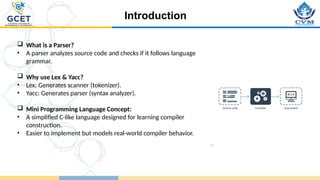
What isa Parser?
• A parser analyzes source code and checks if it follows language
grammar.
Why use Lex & Yacc?
• Lex: Generates scanner (tokenizer).
• Yacc: Generates parser (syntax analyzer).
Mini Programming Language Concept:
• A simplified C-like language designed for learning compiler
construction.
• Easier to implement but models real-world compiler behavior.
3.
Motivation
3
Why CompilerConstruction?
• Every programming language needs a compiler/interpreter.
• Understanding compilers helps in language design and optimization.
Importance of Scanners & Parsers:
• Scanner (Lex): Breaks raw input into tokens (words with meaning).
• Parser (Yacc): Ensures tokens follow the grammar rules.
Why Mini-Languages?
• Easier to design and understand.
• A stepping stone towards building real compilers.
4.
Role of Lexand Yacc
4
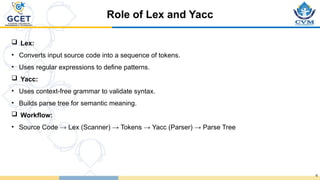
Lex:
• Converts input source code into a sequence of tokens.
• Uses regular expressions to define patterns.
Yacc:
• Uses context-free grammar to validate syntax.
• Builds parse tree for semantic meaning.
Workflow:
• Source Code → Lex (Scanner) → Tokens → Yacc (Parser) → Parse Tree
5.
Problem Objectives
5
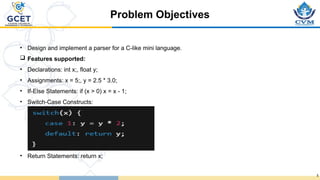
• Designand implement a parser for a C-like mini language.
Features supported:
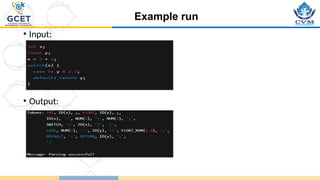
• Declarations: int x;, float y;
• Assignments: x = 5;, y = 2.5 * 3.0;
• If-Else Statements: if (x > 0) x = x - 1;
• Switch-Case Constructs:
• Return Statements: return x;
6.
Language Features
6
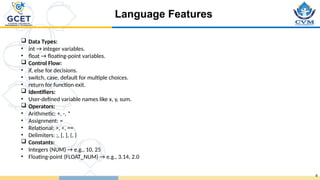
DataTypes:
• int → integer variables.
• float → floating-point variables.
Control Flow:
• if, else for decisions.
• switch, case, default for multiple choices.
• return for function exit.
Identifiers:
• User-defined variable names like x, y, sum.
Operators:
• Arithmetic: +, -, *
• Assignment: =
• Relational: >, <, ==
• Delimiters: ;, {, }, (, )
Constants:
• Integers (NUM) → e.g., 10, 25
• Floating-point (FLOAT_NUM) → e.g., 3.14, 2.0
Applications
14
Education:
• Teachingcompiler construction concepts.
Programming Tools:
• Syntax checking in IDEs.
• Custom interpreters for small languages.
Industry:
• Designing Domain-Specific Languages (DSLs).
• Validation of config files or query languages.
Research:
• Foundation for building optimized compilers.
![7
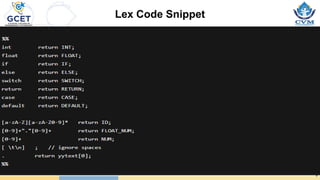
Purpose: Define lexical tokens using regex.
Token Categories:
• Keywords → int, float, if, else, switch, return, case, default.
• Identifiers → [a-zA-Z][a-zA-Z0-9]*
• Numbers → Integers [0-9]+, Floats [0-9]+.[0-9]+
Example Mapping:
• "int" → INT
• "float" → FLOAT
• 123 → NUM
• 3.14 → FLOAT_NUM
Lex(Scanner) Overview](https://image.slidesharecdn.com/compilerppt-250911160511-ec55e237/85/Parsing_using-_lex_and_yacc_compilerdesign-pptx-7-320.jpg)
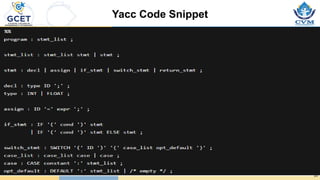
![8
Purpose:
• Check if sequence of tokens follows grammar.
• Define syntax in CFG style.
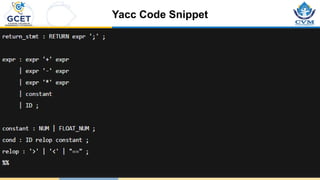
Rules Example:
• decl → type ID ;
• assign → ID = expr ;
• if_stmt → IF ( cond ) stmt [ELSE stmt]
• switch_stmt → SWITCH (ID) { case_list }
• return_stmt → RETURN expr ;
Output:
• Produces Parse Tree if syntax is valid.
Yacc(Parser) overview](https://image.slidesharecdn.com/compilerppt-250911160511-ec55e237/85/Parsing_using-_lex_and_yacc_compilerdesign-pptx-8-320.jpg)