Chapter Four :  How to Teach Grammar  from Examples Instructor: Dr. Merry Presenter:  Jenny Date: Oct. 22 nd , 2008
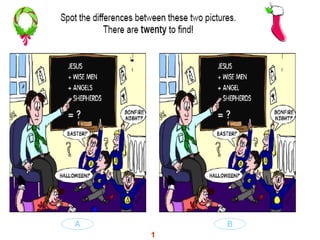
1 A B
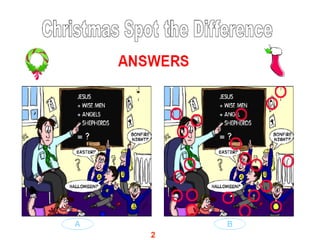
2 A B
3    You  know  Norma and Joe, don’t you? They  work  every day. Joe  talks  to tourists , and Norma  writes  letters. We always  go  to their travel agency. The agency  offers  tours to many different countries. I  like  the service there too.  There is a final  s  on the verb only with certain  subjects. What are they ?    I    you    he    she    it    we    they  (p52)
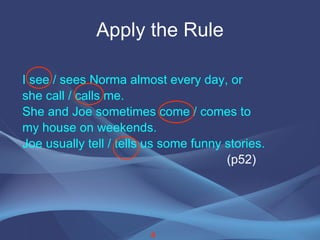
Apply the Rule I see / sees Norma almost every day, or she call / calls me.  She and Joe sometimes come / comes to  my house on weekends. Joe usually tell / tells us some funny stories. (p52) 4
Contents Discovery Approach Inductive Approach Pros and Cons of An Inductive Approach Sample Lessons (5) Conclusion Q & A 5
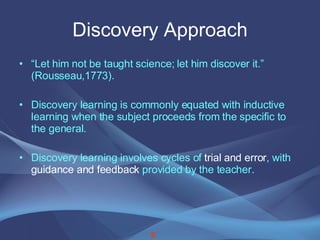
Discovery Approach “ Let him not be taught science; let him discover it.” (Rousseau,1773). Discovery learning is commonly equated with inductive learning when the subject proceeds from the specific to the general. Discovery learning involves cycles of  trial and error , with  guidance and feedback  provided by the teacher. 6
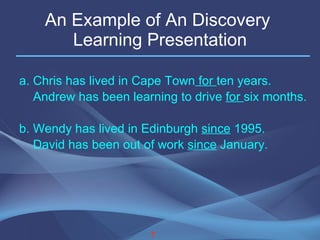
An Example of An Discovery  Learning Presentation a. Chris has lived in Cape Town  for  ten years. Andrew has been learning to drive  for  six months. b. Wendy has lived in Edinburgh  since  1995.  David has been out of work  since  January. 7
Apply the Rule Choose  for  or  since  to complete the following sentences: Anna has been married ___ seven years. Jeff has been studying French ______1990. Chris and Jim have been together ___ a long time. I have been living here  ______  last summer. They have been going out together _____ they met five  weeks ago. for since for since since 8
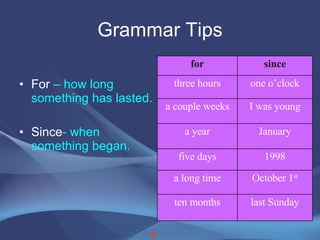
Grammar Tips For  – how long something has lasted. Since - when something began.   9 last Sunday ten months October 1 st a long time 1998 five days January a year I was young a couple weeks one o’clock three hours since for
Inductive Approach Students learn the use of the structure through the practice of LG in context and later realize rules from the practical examples. Common Teaching methods Total Physical Response (TPR) Direct Method (DM) Situational Language Teaching (SLT) 10
Pros of An Inductive Approach Learning rules from self-discovery is more efficient than rule-driven. It reinforces Ss’ memorability of cognitive depth. Ss are active learners. It improves Ss’ pattern-recognition and problem solving. It’s an interactive practice. It enhances self-directed learning. 11
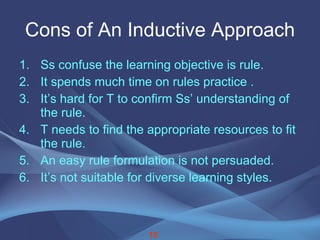
Cons of An Inductive Approach Ss confuse the learning objective is rule. It spends much time on rules practice . It’s hard for T to confirm Ss’ understanding of the rule. T needs to find the appropriate resources to fit the rule. An easy rule formulation is not persuaded. It’s not suitable for diverse learning styles. 12
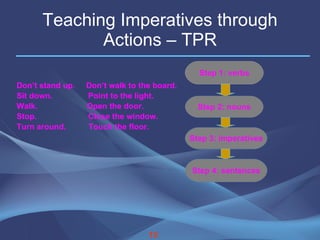
Teaching Imperatives through Actions – TPR Don’t stand up.  Don’t walk to the board. Sit down.  Point to the light. Walk.  Open the door. Stop.  Close the window. Turn around.  Touch the floor. 13 Step 1: verbs Step 2: nouns Step 3: imperatives Step 4: sentences
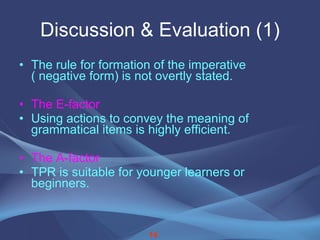
Discussion & Evaluation (1) The rule for formation of the imperative ( negative form) is not overtly stated. The E-factor Using actions to convey the meaning of grammatical items is highly efficient. The A-factor TPR is suitable for younger learners or beginners. 14
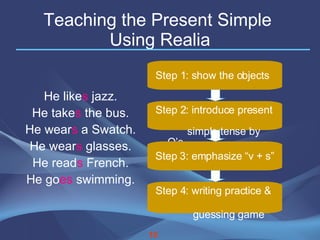
Teaching the Present Simple  Using Realia Step 1: show the objects Step 2: introduce present  simple tense by Q’s Step 4: writing practice &  guessing game He like s  jazz. He take s  the bus. He wear s  a Swatch. He wear s  glasses. He read s  French. He go es   swimming. 15 Step 3: emphasize “v + s”
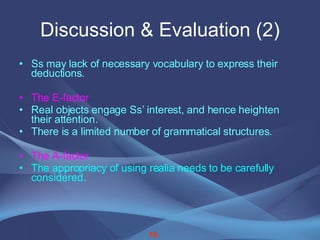
Discussion & Evaluation (2) Ss may lack of necessary vocabulary to express their deductions. The E-factor Real objects engage Ss’ interest, and hence heighten their attention. There is a limited number of grammatical   structures. The A-factor The appropriacy of using realia needs to be carefully considered. 16
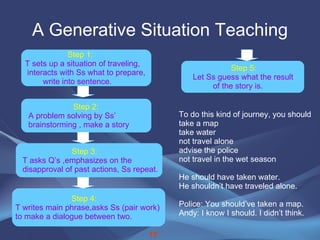
A Generative Situation Teaching Step 1:  T sets up a situation of traveling, interacts with Ss what to prepare,  write into sentence. Step 2:   A problem solving by Ss’ brainstorming , make a story  Step 3: T asks Q’s ,emphasizes on the disapproval of past actions, Ss repeat. Step 4:  T writes main phrase,asks Ss (pair work)  to make a dialogue between two. Step 5:  Let Ss guess what the result  of the story is. 17 To do this kind of journey, you should take a map  take water not travel alone advise the police not travel in the wet season He should have taken water. He shouldn’t have traveled alone. Police: You should’ve taken a map. Andy: I know I should. I didn’t think.
Discussion (3) No attempt is made by the teacher to elicit a statement of the rule. She relies instead on frequent checks of students’ understanding of should have done. This is no guarantee that learners will formulate the correct rule. Eliciting a statement might help, but this will depend on the learners’ command of terminology. 18
Evaluation (3) The E-factor (Efficacy) A situational context permits presentation of a wide range of langue items. The situation serves as a means of contextualizing the language and this helps clarify its meaning. The generated examples provide the learners with data for induction of the rules of form. Students can be involved in the development of the presentation as well as in solving the grammar problem. If well chose , the situation is likely to be more memorable than a simple explanation. 19
Evaluation(3) The E-factor ( No economy) This kind of presentation takes more time than an explanation. The E-factor ( No ease) It requires a resourceful teacher who is not only is able to conjure up situations that general structurally identical sentences, but also to prepare the necessary visual aids. The A-factor   It dispenses with the need for either translation or explanation and it’s appropriate with younger learners. 20
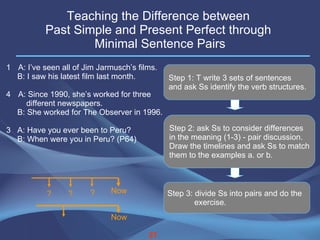
Teaching the Difference between  Past Simple and Present Perfect through  Minimal Sentence Pairs A: I’ve seen all of Jim Jarmusch’s films. B: I saw his latest film last month. A: Since 1990, she’s worked for three  different newspapers. B: She worked for The Observer in 1996. 3  A: Have you ever been to Peru? B: When were you in Peru? (P64)   Step 1: T write 3 sets of sentences  and ask Ss identify the verb structures. Step 2: ask Ss to consider differences in the meaning (1-3) - pair discussion. Draw the timelines and ask Ss to match  them to the examples a. or b. Step 3: divide Ss into pairs and do the  exercise.  Now ? ? ? Now 21
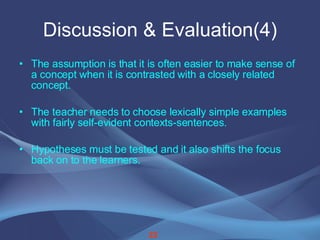
Discussion & Evaluation(4) The assumption is that it is often easier to make sense of a concept when it is contrasted with a closely related concept. The teacher needs to choose lexically simple examples with fairly self-evident contexts-sentences. Hypotheses must be tested and it also shifts the focus back on to the learners. 22
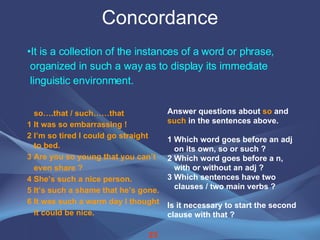
Concordance It is a collection of the instances of a word or phrase,  organized in such a way as to display its immediate  linguistic environment. so….that / such……that 1 It was so embarrassing !  2 I’m so tired I could go straight  to bed.  3 Are you so young that you can’t  even share ?  4 She’s such a nice person.  5 It’s such a shame that he’s gone.  6 It was such a warm day I thought it could be nice.  Answer questions about  so  and  such  in the sentences above. 1 Which word goes before an adj on its own, so or such ?  2 Which word goes before a n,  with or without an adj ? 3 Which sentences have two  clauses / two main verbs ?  Is it necessary to start the second clause with that ?  23
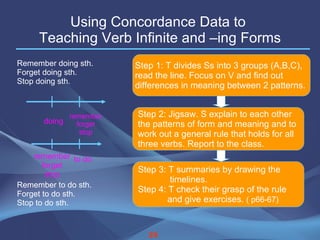
Using Concordance Data to  Teaching Verb Infinite and –ing Forms Step 1: T divides Ss into 3 groups (A,B,C),  read the line. Focus on V and find out  differences in meaning between 2 patterns.  Step 2: Jigsaw. S explain to each other  the patterns of form and meaning and to  work out a general rule that holds for all  three verbs. Report to the class. Step 3: T summaries by drawing the  timelines.  Step 4: T check their grasp of the rule  and give exercises.  ( p66-67) Remember doing sth. Forget doing sth. Stop doing sth. remember forget stop doing remember forget stop to do Remember to do sth. Forget to do sth. Stop to do sth. 24
Discussion (5) It’s necessary to balance the losses and gains that produce when the learner is actively involved in the learning process. 25
Evaluation (5) The E-factor Selecting the data in advance is a good idea. Teacher can have access to concordance software and  have a sufficiently large database to apply it to. The A-factor Learners who are comfortable with computers , and are sufficiently motivated and they may find that learning to use concordance data is an extremely useful too.   26
Conclusion In the inductive approach, the role of teacher is an instructor and a facilitator, furthermore , the preparation of the lesson plan design and the materials of grammar readings are the important factors to influence students’ inference abilities of grammar learning. 27
Q & A Which approaches do you prefer to teacher grammar, deductive or inductive ?  Why? 28
Resources Christmas spot the difference http://www.primaryresources.co.uk./other/pdfs/chri stmas_std.pdf 29
Tell me, I forget. Show me, I remember. Involve me, I understand…Eureka!   --- An ancient Chinese proverb 30

Ch4 Jenny

  • 1.
    Chapter Four : How to Teach Grammar from Examples Instructor: Dr. Merry Presenter: Jenny Date: Oct. 22 nd , 2008
  • 2.
  • 3.
  • 4.
    3   You know Norma and Joe, don’t you? They work every day. Joe talks to tourists , and Norma writes letters. We always go to their travel agency. The agency offers tours to many different countries. I like the service there too. There is a final s on the verb only with certain subjects. What are they ?  I  you  he  she  it  we  they (p52)
  • 5.
    Apply the RuleI see / sees Norma almost every day, or she call / calls me. She and Joe sometimes come / comes to my house on weekends. Joe usually tell / tells us some funny stories. (p52) 4
  • 6.
    Contents Discovery ApproachInductive Approach Pros and Cons of An Inductive Approach Sample Lessons (5) Conclusion Q & A 5
  • 7.
    Discovery Approach “Let him not be taught science; let him discover it.” (Rousseau,1773). Discovery learning is commonly equated with inductive learning when the subject proceeds from the specific to the general. Discovery learning involves cycles of trial and error , with guidance and feedback provided by the teacher. 6
  • 8.
    An Example ofAn Discovery Learning Presentation a. Chris has lived in Cape Town for ten years. Andrew has been learning to drive for six months. b. Wendy has lived in Edinburgh since 1995. David has been out of work since January. 7
  • 9.
    Apply the RuleChoose for or since to complete the following sentences: Anna has been married ___ seven years. Jeff has been studying French ______1990. Chris and Jim have been together ___ a long time. I have been living here ______ last summer. They have been going out together _____ they met five weeks ago. for since for since since 8
  • 10.
    Grammar Tips For – how long something has lasted. Since - when something began. 9 last Sunday ten months October 1 st a long time 1998 five days January a year I was young a couple weeks one o’clock three hours since for
  • 11.
    Inductive Approach Studentslearn the use of the structure through the practice of LG in context and later realize rules from the practical examples. Common Teaching methods Total Physical Response (TPR) Direct Method (DM) Situational Language Teaching (SLT) 10
  • 12.
    Pros of AnInductive Approach Learning rules from self-discovery is more efficient than rule-driven. It reinforces Ss’ memorability of cognitive depth. Ss are active learners. It improves Ss’ pattern-recognition and problem solving. It’s an interactive practice. It enhances self-directed learning. 11
  • 13.
    Cons of AnInductive Approach Ss confuse the learning objective is rule. It spends much time on rules practice . It’s hard for T to confirm Ss’ understanding of the rule. T needs to find the appropriate resources to fit the rule. An easy rule formulation is not persuaded. It’s not suitable for diverse learning styles. 12
  • 14.
    Teaching Imperatives throughActions – TPR Don’t stand up. Don’t walk to the board. Sit down. Point to the light. Walk. Open the door. Stop. Close the window. Turn around. Touch the floor. 13 Step 1: verbs Step 2: nouns Step 3: imperatives Step 4: sentences
  • 15.
    Discussion & Evaluation(1) The rule for formation of the imperative ( negative form) is not overtly stated. The E-factor Using actions to convey the meaning of grammatical items is highly efficient. The A-factor TPR is suitable for younger learners or beginners. 14
  • 16.
    Teaching the PresentSimple Using Realia Step 1: show the objects Step 2: introduce present simple tense by Q’s Step 4: writing practice & guessing game He like s jazz. He take s the bus. He wear s a Swatch. He wear s glasses. He read s French. He go es swimming. 15 Step 3: emphasize “v + s”
  • 17.
    Discussion & Evaluation(2) Ss may lack of necessary vocabulary to express their deductions. The E-factor Real objects engage Ss’ interest, and hence heighten their attention. There is a limited number of grammatical structures. The A-factor The appropriacy of using realia needs to be carefully considered. 16
  • 18.
    A Generative SituationTeaching Step 1: T sets up a situation of traveling, interacts with Ss what to prepare, write into sentence. Step 2: A problem solving by Ss’ brainstorming , make a story Step 3: T asks Q’s ,emphasizes on the disapproval of past actions, Ss repeat. Step 4: T writes main phrase,asks Ss (pair work) to make a dialogue between two. Step 5: Let Ss guess what the result of the story is. 17 To do this kind of journey, you should take a map take water not travel alone advise the police not travel in the wet season He should have taken water. He shouldn’t have traveled alone. Police: You should’ve taken a map. Andy: I know I should. I didn’t think.
  • 19.
    Discussion (3) Noattempt is made by the teacher to elicit a statement of the rule. She relies instead on frequent checks of students’ understanding of should have done. This is no guarantee that learners will formulate the correct rule. Eliciting a statement might help, but this will depend on the learners’ command of terminology. 18
  • 20.
    Evaluation (3) TheE-factor (Efficacy) A situational context permits presentation of a wide range of langue items. The situation serves as a means of contextualizing the language and this helps clarify its meaning. The generated examples provide the learners with data for induction of the rules of form. Students can be involved in the development of the presentation as well as in solving the grammar problem. If well chose , the situation is likely to be more memorable than a simple explanation. 19
  • 21.
    Evaluation(3) The E-factor( No economy) This kind of presentation takes more time than an explanation. The E-factor ( No ease) It requires a resourceful teacher who is not only is able to conjure up situations that general structurally identical sentences, but also to prepare the necessary visual aids. The A-factor It dispenses with the need for either translation or explanation and it’s appropriate with younger learners. 20
  • 22.
    Teaching the Differencebetween Past Simple and Present Perfect through Minimal Sentence Pairs A: I’ve seen all of Jim Jarmusch’s films. B: I saw his latest film last month. A: Since 1990, she’s worked for three different newspapers. B: She worked for The Observer in 1996. 3 A: Have you ever been to Peru? B: When were you in Peru? (P64) Step 1: T write 3 sets of sentences and ask Ss identify the verb structures. Step 2: ask Ss to consider differences in the meaning (1-3) - pair discussion. Draw the timelines and ask Ss to match them to the examples a. or b. Step 3: divide Ss into pairs and do the exercise. Now ? ? ? Now 21
  • 23.
    Discussion & Evaluation(4)The assumption is that it is often easier to make sense of a concept when it is contrasted with a closely related concept. The teacher needs to choose lexically simple examples with fairly self-evident contexts-sentences. Hypotheses must be tested and it also shifts the focus back on to the learners. 22
  • 24.
    Concordance It isa collection of the instances of a word or phrase, organized in such a way as to display its immediate linguistic environment. so….that / such……that 1 It was so embarrassing ! 2 I’m so tired I could go straight to bed. 3 Are you so young that you can’t even share ? 4 She’s such a nice person. 5 It’s such a shame that he’s gone. 6 It was such a warm day I thought it could be nice. Answer questions about so and such in the sentences above. 1 Which word goes before an adj on its own, so or such ? 2 Which word goes before a n, with or without an adj ? 3 Which sentences have two clauses / two main verbs ? Is it necessary to start the second clause with that ? 23
  • 25.
    Using Concordance Datato Teaching Verb Infinite and –ing Forms Step 1: T divides Ss into 3 groups (A,B,C), read the line. Focus on V and find out differences in meaning between 2 patterns. Step 2: Jigsaw. S explain to each other the patterns of form and meaning and to work out a general rule that holds for all three verbs. Report to the class. Step 3: T summaries by drawing the timelines. Step 4: T check their grasp of the rule and give exercises. ( p66-67) Remember doing sth. Forget doing sth. Stop doing sth. remember forget stop doing remember forget stop to do Remember to do sth. Forget to do sth. Stop to do sth. 24
  • 26.
    Discussion (5) It’snecessary to balance the losses and gains that produce when the learner is actively involved in the learning process. 25
  • 27.
    Evaluation (5) TheE-factor Selecting the data in advance is a good idea. Teacher can have access to concordance software and have a sufficiently large database to apply it to. The A-factor Learners who are comfortable with computers , and are sufficiently motivated and they may find that learning to use concordance data is an extremely useful too. 26
  • 28.
    Conclusion In theinductive approach, the role of teacher is an instructor and a facilitator, furthermore , the preparation of the lesson plan design and the materials of grammar readings are the important factors to influence students’ inference abilities of grammar learning. 27
  • 29.
    Q & AWhich approaches do you prefer to teacher grammar, deductive or inductive ? Why? 28
  • 30.
    Resources Christmas spotthe difference http://www.primaryresources.co.uk./other/pdfs/chri stmas_std.pdf 29
  • 31.
    Tell me, Iforget. Show me, I remember. Involve me, I understand…Eureka! --- An ancient Chinese proverb 30