Copyright © Richard N. Taylor, Nenad Medvidovic, and Eric M. Dashofy. All rights reserved.
Software Connectors
Software Architecture
Lecture 7
Software Architecture: Foundations, Theory, and Practice
What is a Software Connector?
 Architectural element that models
Interactions among components
Rules that govern those interactions
 Simple interactions
Procedure calls
Shared variable access
 Complex & semantically rich interactions
Client-server protocols
Database access protocols
Asynchronous event multicast
 Each connector provides
Interaction duct(s)
Transfer of control and/or data 2
Software Architecture: Foundations, Theory, and Practice
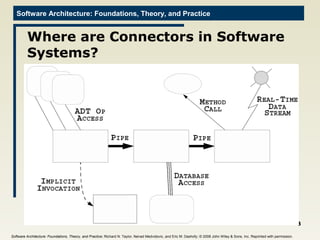
Where are Connectors in Software
Systems?
3
Software Architecture: Foundations, Theory, and Practice; Richard N. Taylor, Nenad Medvidovic, and Eric M. Dashofy; © 2008 John Wiley & Sons, Inc. Reprinted with permission.
Software Architecture: Foundations, Theory, and Practice
Implemented vs. Conceptual
Connectors
 Connectors in software system implementations
Frequently no dedicated code
Frequently no identity
Typically do not correspond to compilation units
Distributed implementation
Across multiple modules
Across interaction mechanisms
4
Software Architecture: Foundations, Theory, and Practice
Implemented vs. Conceptual
Connectors (cont’d)
 Connectors in software architectures
First-class entities
Have identity
Describe all system interaction
Entitled to their own specifications & abstractions
5
Software Architecture: Foundations, Theory, and Practice
Reasons for Treating Connectors
Independently
 Connector ≠ Component
Components provide application-specific functionality
Connectors provide application-independent
interaction mechanisms
 Interaction abstraction and/or parameterization
 Specification of complex interactions
Binary vs. N-ary
Asymmetric vs. Symmetric
Interaction protocols
6
Software Architecture: Foundations, Theory, and Practice
Treating Connectors Independently
(cont’d)
 Localization of interaction definition
 Extra-component system (interaction) information
 Component independence
 Component interaction flexibility
7
Software Architecture: Foundations, Theory, and Practice
Benefits of First-Class Connectors
 Separate computation from interaction
 Minimize component interdependencies
 Support software evolution
At component-, connector-, & system-level
 Potential for supporting dynamism
 Facilitate heterogeneity
 Become points of distribution
 Aid system analysis & testing
8
Software Architecture: Foundations, Theory, and Practice
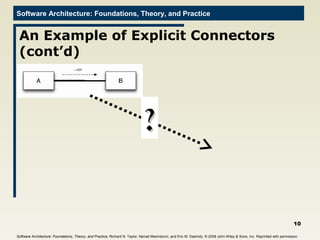
An Example of Explicit Connectors
9
Software Architecture: Foundations, Theory, and Practice; Richard N. Taylor, Nenad Medvidovic, and Eric M. Dashofy; © 2008 John Wiley & Sons, Inc. Reprinted with permission.
Software Architecture: Foundations, Theory, and Practice
An Example of Explicit Connectors
(cont’d)
10
??
Software Architecture: Foundations, Theory, and Practice; Richard N. Taylor, Nenad Medvidovic, and Eric M. Dashofy; © 2008 John Wiley & Sons, Inc. Reprinted with permission.
Software Architecture: Foundations, Theory, and Practice
Software Connector Roles
 Locus of interaction among set of components
 Protocol specification (sometimes implicit) that defines its
properties
Types of interfaces it is able to mediate
Assurances about interaction properties
Rules about interaction ordering
Interaction commitments (e.g., performance)
 Roles
Communication
Coordination
Conversion
Facilitation 11
Software Architecture: Foundations, Theory, and Practice
Connectors as Communicators
 Main role associated with connectors
 Supports
Different communication mechanisms
e.g. procedure call, RPC, shared data access,
message passing
Constraints on communication structure/direction
e.g. pipes
Constraints on quality of service
e.g. persistence
 Separates communication from computation
 May influence non-functional system characteristics
e.g. performance, scalability, security 12
Software Architecture: Foundations, Theory, and Practice
Connectors as Coordinators
 Determine computation control
 Control delivery of data
 Separates control from computation
 Orthogonal to communication, conversion, and
facilitation
Elements of control are in communication, conversion
and facilitation
13
Software Architecture: Foundations, Theory, and Practice
Connectors as Converters
 Enable interaction of independently developed,
mismatched components
 Mismatches based on interaction
Type
Number
Frequency
Order
 Examples of converters
Adaptors
Wrappers
14
Software Architecture: Foundations, Theory, and Practice
Connectors as Facilitators
 Enable interaction of components intended to
interoperate
Mediate and streamline interaction
 Govern access to shared information
 Ensure proper performance profiles
e.g., load balancing
 Provide synchronization mechanisms
Critical sections
Monitors
15
Software Architecture: Foundations, Theory, and Practice
Connector Types
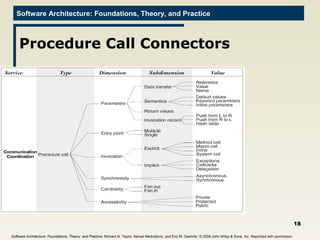
 Procedure call
 Data access
 Event
 Stream
 Linkage
 Distributor
 Arbitrator
 Adaptor
16
Software Architecture: Foundations, Theory, and Practice
A Framework for Classifying
Connectors
17
Software Architecture: Foundations, Theory, and Practice; Richard N. Taylor, Nenad Medvidovic, and Eric M. Dashofy; © 2008 John Wiley & Sons, Inc. Reprinted with permission.
Software Architecture: Foundations, Theory, and Practice
Procedure Call Connectors
18
Software Architecture: Foundations, Theory, and Practice; Richard N. Taylor, Nenad Medvidovic, and Eric M. Dashofy; © 2008 John Wiley & Sons, Inc. Reprinted with permission.
Software Architecture: Foundations, Theory, and Practice
Event Connectors
19
Software Architecture: Foundations, Theory, and Practice; Richard N. Taylor, Nenad Medvidovic, and Eric M. Dashofy; © 2008 John Wiley & Sons, Inc. Reprinted with permission.
Software Architecture: Foundations, Theory, and Practice
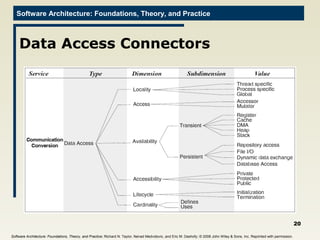
Data Access Connectors
20
Software Architecture: Foundations, Theory, and Practice; Richard N. Taylor, Nenad Medvidovic, and Eric M. Dashofy; © 2008 John Wiley & Sons, Inc. Reprinted with permission.
Software Architecture: Foundations, Theory, and Practice
Linkage Connectors
21
Software Architecture: Foundations, Theory, and Practice; Richard N. Taylor, Nenad Medvidovic, and Eric M. Dashofy; © 2008 John Wiley & Sons, Inc. Reprinted with permission.
Software Architecture: Foundations, Theory, and Practice
Stream Connectors
22
Software Architecture: Foundations, Theory, and Practice; Richard N. Taylor, Nenad Medvidovic, and Eric M. Dashofy; © 2008 John Wiley & Sons, Inc. Reprinted with permission.
Software Architecture: Foundations, Theory, and Practice
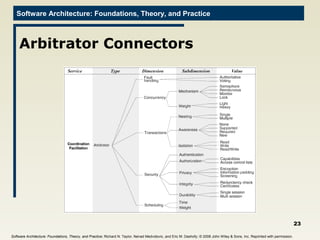
Arbitrator Connectors
23
Software Architecture: Foundations, Theory, and Practice; Richard N. Taylor, Nenad Medvidovic, and Eric M. Dashofy; © 2008 John Wiley & Sons, Inc. Reprinted with permission.
Software Architecture: Foundations, Theory, and Practice
Adaptor Connectors
24
Software Architecture: Foundations, Theory, and Practice; Richard N. Taylor, Nenad Medvidovic, and Eric M. Dashofy; © 2008 John Wiley & Sons, Inc. Reprinted with permission.
Software Architecture: Foundations, Theory, and Practice
Distributor Connectors
25
Software Architecture: Foundations, Theory, and Practice; Richard N. Taylor, Nenad Medvidovic, and Eric M. Dashofy; © 2008 John Wiley & Sons, Inc. Reprinted with permission.
Software Architecture: Foundations, Theory, and Practice
Discussion
 Connectors allow modeling of arbitrarily complex
interactions
 Connector flexibility aids system evolution
Component addition, removal, replacement,
reconnection, migration
 Support for connector interchange is desired
Aids system evolution
May not affect system functionality
26
Software Architecture: Foundations, Theory, and Practice
Discussion
 Libraries of OTS connector implementations allow
developers to focus on application-specific issues
 Difficulties
Rigid connectors
Connector “dispersion” in implementations
 Key issue
Performance vs. flexibility
27

07 software connectors (2)

  • 1.
    Copyright © RichardN. Taylor, Nenad Medvidovic, and Eric M. Dashofy. All rights reserved. Software Connectors Software Architecture Lecture 7
  • 2.
    Software Architecture: Foundations,Theory, and Practice What is a Software Connector?  Architectural element that models Interactions among components Rules that govern those interactions  Simple interactions Procedure calls Shared variable access  Complex & semantically rich interactions Client-server protocols Database access protocols Asynchronous event multicast  Each connector provides Interaction duct(s) Transfer of control and/or data 2
  • 3.
    Software Architecture: Foundations,Theory, and Practice Where are Connectors in Software Systems? 3 Software Architecture: Foundations, Theory, and Practice; Richard N. Taylor, Nenad Medvidovic, and Eric M. Dashofy; © 2008 John Wiley & Sons, Inc. Reprinted with permission.
  • 4.
    Software Architecture: Foundations,Theory, and Practice Implemented vs. Conceptual Connectors  Connectors in software system implementations Frequently no dedicated code Frequently no identity Typically do not correspond to compilation units Distributed implementation Across multiple modules Across interaction mechanisms 4
  • 5.
    Software Architecture: Foundations,Theory, and Practice Implemented vs. Conceptual Connectors (cont’d)  Connectors in software architectures First-class entities Have identity Describe all system interaction Entitled to their own specifications & abstractions 5
  • 6.
    Software Architecture: Foundations,Theory, and Practice Reasons for Treating Connectors Independently  Connector ≠ Component Components provide application-specific functionality Connectors provide application-independent interaction mechanisms  Interaction abstraction and/or parameterization  Specification of complex interactions Binary vs. N-ary Asymmetric vs. Symmetric Interaction protocols 6
  • 7.
    Software Architecture: Foundations,Theory, and Practice Treating Connectors Independently (cont’d)  Localization of interaction definition  Extra-component system (interaction) information  Component independence  Component interaction flexibility 7
  • 8.
    Software Architecture: Foundations,Theory, and Practice Benefits of First-Class Connectors  Separate computation from interaction  Minimize component interdependencies  Support software evolution At component-, connector-, & system-level  Potential for supporting dynamism  Facilitate heterogeneity  Become points of distribution  Aid system analysis & testing 8
  • 9.
    Software Architecture: Foundations,Theory, and Practice An Example of Explicit Connectors 9 Software Architecture: Foundations, Theory, and Practice; Richard N. Taylor, Nenad Medvidovic, and Eric M. Dashofy; © 2008 John Wiley & Sons, Inc. Reprinted with permission.
  • 10.
    Software Architecture: Foundations,Theory, and Practice An Example of Explicit Connectors (cont’d) 10 ?? Software Architecture: Foundations, Theory, and Practice; Richard N. Taylor, Nenad Medvidovic, and Eric M. Dashofy; © 2008 John Wiley & Sons, Inc. Reprinted with permission.
  • 11.
    Software Architecture: Foundations,Theory, and Practice Software Connector Roles  Locus of interaction among set of components  Protocol specification (sometimes implicit) that defines its properties Types of interfaces it is able to mediate Assurances about interaction properties Rules about interaction ordering Interaction commitments (e.g., performance)  Roles Communication Coordination Conversion Facilitation 11
  • 12.
    Software Architecture: Foundations,Theory, and Practice Connectors as Communicators  Main role associated with connectors  Supports Different communication mechanisms e.g. procedure call, RPC, shared data access, message passing Constraints on communication structure/direction e.g. pipes Constraints on quality of service e.g. persistence  Separates communication from computation  May influence non-functional system characteristics e.g. performance, scalability, security 12
  • 13.
    Software Architecture: Foundations,Theory, and Practice Connectors as Coordinators  Determine computation control  Control delivery of data  Separates control from computation  Orthogonal to communication, conversion, and facilitation Elements of control are in communication, conversion and facilitation 13
  • 14.
    Software Architecture: Foundations,Theory, and Practice Connectors as Converters  Enable interaction of independently developed, mismatched components  Mismatches based on interaction Type Number Frequency Order  Examples of converters Adaptors Wrappers 14
  • 15.
    Software Architecture: Foundations,Theory, and Practice Connectors as Facilitators  Enable interaction of components intended to interoperate Mediate and streamline interaction  Govern access to shared information  Ensure proper performance profiles e.g., load balancing  Provide synchronization mechanisms Critical sections Monitors 15
  • 16.
    Software Architecture: Foundations,Theory, and Practice Connector Types  Procedure call  Data access  Event  Stream  Linkage  Distributor  Arbitrator  Adaptor 16
  • 17.
    Software Architecture: Foundations,Theory, and Practice A Framework for Classifying Connectors 17 Software Architecture: Foundations, Theory, and Practice; Richard N. Taylor, Nenad Medvidovic, and Eric M. Dashofy; © 2008 John Wiley & Sons, Inc. Reprinted with permission.
  • 18.
    Software Architecture: Foundations,Theory, and Practice Procedure Call Connectors 18 Software Architecture: Foundations, Theory, and Practice; Richard N. Taylor, Nenad Medvidovic, and Eric M. Dashofy; © 2008 John Wiley & Sons, Inc. Reprinted with permission.
  • 19.
    Software Architecture: Foundations,Theory, and Practice Event Connectors 19 Software Architecture: Foundations, Theory, and Practice; Richard N. Taylor, Nenad Medvidovic, and Eric M. Dashofy; © 2008 John Wiley & Sons, Inc. Reprinted with permission.
  • 20.
    Software Architecture: Foundations,Theory, and Practice Data Access Connectors 20 Software Architecture: Foundations, Theory, and Practice; Richard N. Taylor, Nenad Medvidovic, and Eric M. Dashofy; © 2008 John Wiley & Sons, Inc. Reprinted with permission.
  • 21.
    Software Architecture: Foundations,Theory, and Practice Linkage Connectors 21 Software Architecture: Foundations, Theory, and Practice; Richard N. Taylor, Nenad Medvidovic, and Eric M. Dashofy; © 2008 John Wiley & Sons, Inc. Reprinted with permission.
  • 22.
    Software Architecture: Foundations,Theory, and Practice Stream Connectors 22 Software Architecture: Foundations, Theory, and Practice; Richard N. Taylor, Nenad Medvidovic, and Eric M. Dashofy; © 2008 John Wiley & Sons, Inc. Reprinted with permission.
  • 23.
    Software Architecture: Foundations,Theory, and Practice Arbitrator Connectors 23 Software Architecture: Foundations, Theory, and Practice; Richard N. Taylor, Nenad Medvidovic, and Eric M. Dashofy; © 2008 John Wiley & Sons, Inc. Reprinted with permission.
  • 24.
    Software Architecture: Foundations,Theory, and Practice Adaptor Connectors 24 Software Architecture: Foundations, Theory, and Practice; Richard N. Taylor, Nenad Medvidovic, and Eric M. Dashofy; © 2008 John Wiley & Sons, Inc. Reprinted with permission.
  • 25.
    Software Architecture: Foundations,Theory, and Practice Distributor Connectors 25 Software Architecture: Foundations, Theory, and Practice; Richard N. Taylor, Nenad Medvidovic, and Eric M. Dashofy; © 2008 John Wiley & Sons, Inc. Reprinted with permission.
  • 26.
    Software Architecture: Foundations,Theory, and Practice Discussion  Connectors allow modeling of arbitrarily complex interactions  Connector flexibility aids system evolution Component addition, removal, replacement, reconnection, migration  Support for connector interchange is desired Aids system evolution May not affect system functionality 26
  • 27.
    Software Architecture: Foundations,Theory, and Practice Discussion  Libraries of OTS connector implementations allow developers to focus on application-specific issues  Difficulties Rigid connectors Connector “dispersion” in implementations  Key issue Performance vs. flexibility 27