Heath Insurance
Evolution of Health Insurance
• Historically, health insurance provided coverage
  for catastrophic illness and injury
• It has evolved into coverage for preventative care
  and services
• The traditional type of insurance is fee-for-
  service care
Managed Care Delivery Systems
• This system integrates the delivery and payment
  of health care by contracting with select
  providers for a reduced cost
• The goal is to provide health care with an
  emphasis on prevention
Types of Insurance Plans
•   Commercial health insurance plans
•   Indemnity-type insurance
•   Health maintenance organizations (HMOs)
•   Preferred Provider Organization (PPO)
•
•   Consumer-driven health plans (CDHPs)
•   Government health plans
HMOs
• Provide comprehensive health care with a focus
  on preventative care
 ▫ Annual physicals and PAP tests, well-child care
• Members choose a Primary Care Provider (PCP)
  to oversee medical care
 ▫ PCP refers to a specialist, if needed
PPO, POS, IPA
 ▫ Preferred provider organization (PPO)
    Members must select a PCP
    Network of providers that provide services to members at
     a discounted rate (in-network)
    Members pay more out of pocket for out-of-network
     providers
 ▫ Point-of-service (POS) plans
    Members do not select a PCP and can self-refer to
     specialist
 ▫ Independent practice associations (IPAs)
    Providers who practice in their own offices with their own
     staff
Consumer Driven Health Plans:DHPs
• Health savings account (HSA)
 ▫ Must be paired with a qualified health plan
• Health reimbursement account (HRA)
 ▫ Employers contribute to HRA (not employees)
• Flexible spending account (FSA)
 ▫ Employees contribute to FSA
 ▫ Can pay for health insurance premiums, qualified
   medical expenses, dependent expenses
CDHP’s
• Flexible spending account (FSA)
 ▫ Components
    Health insurance premiums
    Qualified medical expenses
    Dependent care expenses
 ▫ Funded by the employee’s pretax dollars
 ▫ “Use it or lose it” plan
Government Health Plans
•   Medicare
•   Medicaid
•   Workers’ Compensation
•   TRICARE
•   CHAMPVA
Medicare
• Created by the Social Security Act in 1965
 – Administered by the Centers for Medicare and
   Medicaid Services (CMS)

• Who is covered?
 – People over age 65 meeting eligibility
   requirements and have filed for Medicare
 – People who are disabled, receive Social Security
   benefits, or are in end-stage renal disease
Medicare
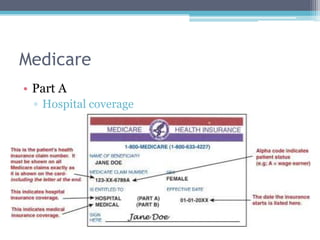
• Part A
 ▫ Hospital coverage
Medicare
• Part B
 – Other medical expenses, including office visits
   • X-ray and laboratory services
   • Initial Preventive Physical Exam
• Part C
 – Enables beneficiaries to select a managed care
   plan as their primary coverage
• Part D
 – Coverage for generic and brand-name drugs
Medicare and Claims Processing
• Always keep up-to-date with Medicare
  requirements
 ▫ Must use CMS-1500 form
 ▫ Must submit Medicare claims electronically
• Reimbursement to providers
 ▫ Medicare pays 80% of allowed amount after the
   deductible is satisfied
 ▫ 20% is paid by patient, or supplemental insurance
Medical Necessity
• Medicare only reimburses services or supplies
  deemed reasonable and necessary for the
  diagnosis

• Advance Beneficiary Notices (ABN)
 ▫ If a provider performs a service not covered by
   Medicare, an ABN is completed
 ▫ Must be signed by patient prior to procedure
Medicaid
• Health insurance for limited or low-income
  individuals
 – Must use participating provider

• Funded by both state and federal governments
 – Eligibility requirements and benefits vary by state
 – Medicaid cards are issued each month
 – Always verify current coverage prior to visit
Workers’ Compensation
• State laws which cover employees who are
  injured while working or as a result of work

• Benefits
 – Medical treatment in or out of a hospital
 – Temporary disability: may receive weekly cash
   benefits in addition to medical care
 – Permanent disability: weekly or monthly benefits,
   or a lump sum settlement
 – Payments to dependents for fatal injuries
TriCare
• Beneficiaries
 ▫ Active service personnel and their dependents
 ▫ Retired active service personnel and their
   dependents
 ▫ Dependents of service personnel who died in
   active duty
CHAMPVA:
Civilian Health and Medical Program of the Veterans’ Administration


  • Beneficiaries
    ▫ Spouses and children of permanently disabled
      veterans
    ▫ Spouses and children of veterans who died as a
      result of service
Patients with No Insurance
• Classified as self-pay patients
• These patients are expected to pay at the time of
  service
Primary and Secondary Insurance
• Patients may have more than one insurance plan
• Charges are filed first with the primary carrier,
  and then secondary
 ▫ Coordination of benefits
• Dependent children and the Birthday rule
Primary and Secondary Insurance
• Medicare and supplemental insurance
 ▫ Many Medicare patients have supplemental or
   Medigap insurance
 ▫ This covers the deductible and 20% coinsurance

• Medicare as secondary insurance
 ▫ When a person qualifies for Medicare but is still
   employed
Verifying Insurance Coverage
•   Always ask patients for current insurance card
•   Make a copy of the card, or scan into the EMR
•   Verify coverage online or over the phone
Utilization Review
•   Preauthorization
•   Precertification
•   Predetermination
•   Concurrent review
•   Discharge planning
Fee Schedules
• Providers enrolled in an insurance carrier’s
  network agrees to treat subscribers for an agreed
  upon (discounted) rate for services

• Accepting assignment: when providers accept
  the allowed amount as the rate for services
 ▫ Disallowed amounts are written off as
   adjustments

Ch.14ppt

  • 1.
  • 2.
    Evolution of HealthInsurance • Historically, health insurance provided coverage for catastrophic illness and injury • It has evolved into coverage for preventative care and services • The traditional type of insurance is fee-for- service care
  • 3.
    Managed Care DeliverySystems • This system integrates the delivery and payment of health care by contracting with select providers for a reduced cost • The goal is to provide health care with an emphasis on prevention
  • 4.
    Types of InsurancePlans • Commercial health insurance plans • Indemnity-type insurance • Health maintenance organizations (HMOs) • Preferred Provider Organization (PPO) • • Consumer-driven health plans (CDHPs) • Government health plans
  • 5.
    HMOs • Provide comprehensivehealth care with a focus on preventative care ▫ Annual physicals and PAP tests, well-child care • Members choose a Primary Care Provider (PCP) to oversee medical care ▫ PCP refers to a specialist, if needed
  • 6.
    PPO, POS, IPA ▫ Preferred provider organization (PPO)  Members must select a PCP  Network of providers that provide services to members at a discounted rate (in-network)  Members pay more out of pocket for out-of-network providers ▫ Point-of-service (POS) plans  Members do not select a PCP and can self-refer to specialist ▫ Independent practice associations (IPAs)  Providers who practice in their own offices with their own staff
  • 7.
    Consumer Driven HealthPlans:DHPs • Health savings account (HSA) ▫ Must be paired with a qualified health plan • Health reimbursement account (HRA) ▫ Employers contribute to HRA (not employees) • Flexible spending account (FSA) ▫ Employees contribute to FSA ▫ Can pay for health insurance premiums, qualified medical expenses, dependent expenses
  • 8.
    CDHP’s • Flexible spendingaccount (FSA) ▫ Components  Health insurance premiums  Qualified medical expenses  Dependent care expenses ▫ Funded by the employee’s pretax dollars ▫ “Use it or lose it” plan
  • 9.
    Government Health Plans • Medicare • Medicaid • Workers’ Compensation • TRICARE • CHAMPVA
  • 10.
    Medicare • Created bythe Social Security Act in 1965 – Administered by the Centers for Medicare and Medicaid Services (CMS) • Who is covered? – People over age 65 meeting eligibility requirements and have filed for Medicare – People who are disabled, receive Social Security benefits, or are in end-stage renal disease
  • 11.
    Medicare • Part A ▫ Hospital coverage
  • 12.
    Medicare • Part B – Other medical expenses, including office visits • X-ray and laboratory services • Initial Preventive Physical Exam • Part C – Enables beneficiaries to select a managed care plan as their primary coverage • Part D – Coverage for generic and brand-name drugs
  • 13.
    Medicare and ClaimsProcessing • Always keep up-to-date with Medicare requirements ▫ Must use CMS-1500 form ▫ Must submit Medicare claims electronically • Reimbursement to providers ▫ Medicare pays 80% of allowed amount after the deductible is satisfied ▫ 20% is paid by patient, or supplemental insurance
  • 14.
    Medical Necessity • Medicareonly reimburses services or supplies deemed reasonable and necessary for the diagnosis • Advance Beneficiary Notices (ABN) ▫ If a provider performs a service not covered by Medicare, an ABN is completed ▫ Must be signed by patient prior to procedure
  • 15.
    Medicaid • Health insurancefor limited or low-income individuals – Must use participating provider • Funded by both state and federal governments – Eligibility requirements and benefits vary by state – Medicaid cards are issued each month – Always verify current coverage prior to visit
  • 16.
    Workers’ Compensation • Statelaws which cover employees who are injured while working or as a result of work • Benefits – Medical treatment in or out of a hospital – Temporary disability: may receive weekly cash benefits in addition to medical care – Permanent disability: weekly or monthly benefits, or a lump sum settlement – Payments to dependents for fatal injuries
  • 17.
    TriCare • Beneficiaries ▫Active service personnel and their dependents ▫ Retired active service personnel and their dependents ▫ Dependents of service personnel who died in active duty
  • 18.
    CHAMPVA: Civilian Health andMedical Program of the Veterans’ Administration • Beneficiaries ▫ Spouses and children of permanently disabled veterans ▫ Spouses and children of veterans who died as a result of service
  • 19.
    Patients with NoInsurance • Classified as self-pay patients • These patients are expected to pay at the time of service
  • 20.
    Primary and SecondaryInsurance • Patients may have more than one insurance plan • Charges are filed first with the primary carrier, and then secondary ▫ Coordination of benefits • Dependent children and the Birthday rule
  • 21.
    Primary and SecondaryInsurance • Medicare and supplemental insurance ▫ Many Medicare patients have supplemental or Medigap insurance ▫ This covers the deductible and 20% coinsurance • Medicare as secondary insurance ▫ When a person qualifies for Medicare but is still employed
  • 22.
    Verifying Insurance Coverage • Always ask patients for current insurance card • Make a copy of the card, or scan into the EMR • Verify coverage online or over the phone
  • 23.
    Utilization Review • Preauthorization • Precertification • Predetermination • Concurrent review • Discharge planning
  • 24.
    Fee Schedules • Providersenrolled in an insurance carrier’s network agrees to treat subscribers for an agreed upon (discounted) rate for services • Accepting assignment: when providers accept the allowed amount as the rate for services ▫ Disallowed amounts are written off as adjustments