www.booneinsuranceassociates.com Copyright by BIA 1 
MEDICARE MADE SIMPLE 
BIA 
Boone Insurance 10/20/2014 Associates Education Guide: New
Today’s Agenda 
 About BIA 
 Introduction & History of Medicare 
 Medicare Parts A, B, C, D 
 Coverage Gaps 
 General Medicare Plan Types 
 And More . . . 
Copyright by BIA 10/20/2014 BIA 
2
About Boone Insurance Associates 
 Boone Insurance Associates provides health and life insurance products to clients all over 
Oregon. 
 We work directly with the companies to resolve any of your claim, benefit, & premium 
questions. 
 Unlike a captive insurance producer who represents that insurance company alone, we are 
independent of a specific insurance company and represent a variety of different 
companies and products. 
 Boone Insurance Associates provides this educational program today to help inform you. 
There is no obligation for you to purchase services from us. 
“Our pledge is to provide our clients with superior customer service and product knowledge in 
order to guide them in making the most informed decisions." 
Copyright by BIA 10/20/2014 BIA 
3
Basic Medicare Terminology 
 Deductible 
 Copay / Coinsurance 
 OOP – Out of Pocket Maximum 
 LIS – Low Income Subsidy 
Copyright by BIA 10/20/2014 BIA 
4
Introduction & History of Medicare 
 Medicare is a Federal Insurance Program 
 Administered by CMS, a federal agency in the 
Department of Health and Human Services. 
“Center for Medicare & Medicaid Services” 
 Consists of Hospital insurance, Medical insurance, 
Medicare Advantage plans, and Prescription Drug 
plans 
 In July 1965, Congress passed a bill to establish 
Medicare. 
Copyright by BIA 10/20/2014 BIA 
5
Introduction & History of Medicare cont… 
 Balanced Budget Act of 1997 established Part C, 
known as Medicare + Choice (M + C) Program 
 Plans also called Medicare Advantage 
 Medicare Modernization Act (MMA) was passed in 
2003 
 Implements new prescription drug benefit 
 Implements new Medicare Advantage program (replacing 
M+C) 
Copyright by BIA 10/20/2014 BIA 
6
Who gets Medicare? 
 It is available to qualified individuals, including: 
 People age 65 or older 
 People under age 65 who have been declared 
disabled 
 People with End-Stage Renal Disease (ESRD), also 
known as kidney failure. 
Copyright by BIA 10/20/2014 BIA 
7
Medicare is comprised of: 
Medicare Part A: Hospital coverage 
Medicare Part B: Medical coverage: (Outpatient 
Surgery & Doctor Visits) 
Medicare Part C: Medicare Advantage 
(Offered by Insurance Carriers) 
Medicare Part D: Medicare Prescription Drug 
coverage (Offered by Insurance Carriers) 
Copyright by BIA 10/20/2014 BIA 
8
Medicare Part A 
(Hospital Insurance) 
What do I pay for Medicare Part A? 
 It has no premium cost for individuals who have 
worked at least 40 calendar quarters 
 Is automatically provided to those who reach 65 
years of age 
 Includes a monthly premium for those who have 
worked fewer than 40 calendar quarters. 
 All taxpayers are contributing towards Medicare 
via payroll FICA deductions. 
Copyright by BIA 10/20/2014 BIA 
9
Medicare Part A 
(Hospital Insurance) Cont… 
What does Part A cover? 
 Hospital stays 
 Home health services 
 Hospice care 
 Minimal care in a skilled nursing facility (SNF) 
 Cover the first 20 days in full days after a 3 day hospital 
stay, then cover days 21-100 at a daily rate. Then no 
coverage after 100 days. 
 Does not include intermediate or custodial coverage. 
Copyright by BIA 10/20/2014 BIA 
10
Medicare Part A 
(Hospital Insurance) Cont… 
 Part A Deductibles 
 [2013] Hospital stay per benefit period: 
 Days 1-60 [$1184] per benefit period 
 Days 61-90 [$296] per day 
 Days 91-150 [$592] per day 
 [2013] Skilled Nursing Facility: 
 Days 1-20 [$0] per day 
 Days 21-100 [$148] per day 
Copyright by BIA 10/20/2014 BIA 
11
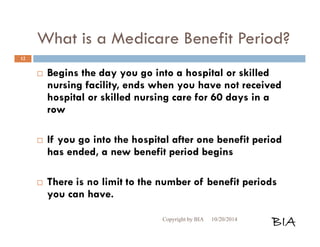
What is a Medicare Benefit Period? 
 Begins the day you go into a hospital or skilled 
nursing facility, ends when you have not received 
hospital or skilled nursing care for 60 days in a 
row 
 If you go into the hospital after one benefit period 
has ended, a new benefit period begins 
 There is no limit to the number of benefit periods 
you can have. 
Copyright by BIA 10/20/2014 BIA 
12
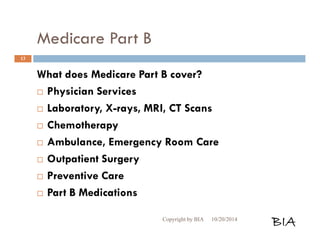
Medicare Part B 
What does Medicare Part B cover? 
 Physician Services 
 Laboratory, X-rays, MRI, CT Scans 
 Chemotherapy 
 Ambulance, Emergency Room Care 
 Outpatient Surgery 
 Preventive Care 
 Part B Medications 
Copyright by BIA 10/20/2014 BIA 
13
Medicare Part B Cont… 
What do I pay for Medicare Part B? 
 Part B premium is based on Part B medical costs and annual income level per 
individual 
 [2013] Part B Premium Annual Income per Individual 
$104.90 [$85,000 or less] 
$146.00 [$85,001 to $107,000] 
$209.80 [$107,001 to $160,000] 
$272.70 [$160,000 to $214,000] 
$335.70 More than [$214,000] 
 Double amounts listed above for married couples filing jointly 
 Premiums are deducted from the Social Security benefits, or billed quarterly 
Copyright by BIA 10/20/2014 BIA 
14
Medicare Part B Cont… 
Deductibles & Coinsurance for 
 Deductible: 
 2013 [$147] per year 
 Other Services: 
 Patient pays [20%] of approved amount, after 
deductible. {Medicare pays 80%} 
 [50%] for most Outpatient mental healthcare 
services. 
 There is no OOP maximum, risk is unlimited 
Copyright by BIA 10/20/2014 BIA 
15
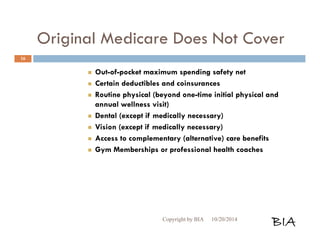
Original Medicare Does Not Cover 
 Out-of-pocket maximum spending safety net 
 Certain deductibles and coinsurances 
 Routine physical (beyond one-time initial physical and 
annual wellness visit) 
 Dental (except if medically necessary) 
 Vision (except if medically necessary) 
 Access to complementary (alternative) care benefits 
 Gym Memberships or professional health coaches 
Copyright by BIA 10/20/2014 BIA 
16
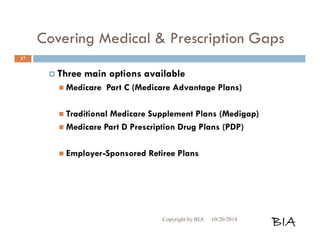
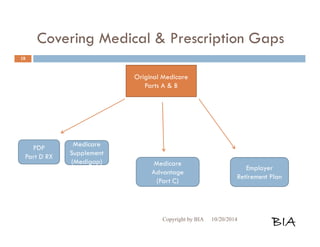
Covering Medical & Prescription Gaps 
 Three main options available 
 Medicare Part C (Medicare Advantage Plans) 
 Traditional Medicare Supplement Plans (Medigap) 
 Medicare Part D Prescription Drug Plans (PDP) 
 Employer-Sponsored Retiree Plans 
Copyright by BIA 10/20/2014 BIA 
17
Covering Medical & Prescription Gaps 
Copyright by BIA 10/20/2014 BIA 
18 
Original Medicare 
Parts A & B 
PDP 
Part D RX 
Medicare 
Supplement 
(Medigap) Medicare 
Advantage 
(Part C) 
Employer 
Retirement Plan
Medicare Part C (Medicare Advantage) 
 Expands Medicare choices with a variety of 
options. 
 A few examples: 
 Preferred Provider Organization (PPO) 
 Health Maintenance Organization (HMO) 
 Point of Service (POS) 
 Private Fee For Service (PFFS) 
Copyright by BIA 10/20/2014 BIA 
19
Medicare Part C (Medicare Advantage) Coverage 
Who is eligible? 
 Must be enrolled in Medicare Part A & B? 
 Permanent resident in plan service area? 
 Cannot have End Stage Renal Disease (ESRD)? 
Copyright by BIA 10/20/2014 BIA 
20
Medicare Part C (Medicare Advantage) 
 They are health plan options that are part of the 
Medicare program 
 Medicare pays the plan a set amount every 
month for your care 
 MA plans must offer all benefits of Original 
Medicare and coverage can include Part D 
prescription drug coverage 
 You may have to use a network of providers that 
participate with the plan 
Copyright by BIA 10/20/2014 BIA 
21
Medicare Part C (Medicare Advantage) 
 In most plans, there are generally extra benefits 
and out-of pocket costs that are lower that with 
Original Medicare. 
 Plans cover everything Medicare covers, at a 
minimum. 
 Plans typically have copay and coinsurance that 
are paid when client goes in for services. 
 Plans may cover extra benefits such as routine 
vision exams, preventive dental, alternative care, 
gym membership, etc. 
Copyright by BIA 10/20/2014 BIA 
22
Medicare Part C (Medicare Advantage) 
 Choose from options with or without integrated 
Part D prescription drug coverage. 
 No drugs included: Medicare Advantage (MA) only 
 Prescription drugs included: Medicare Advantage 
with drugs (MA-PD) 
Copyright by BIA 10/20/2014 BIA 
23
Medicare Part C (Medicare Advantage) 
Preferred Provider Organization (PPO) 
 Defined network of providers 
 Allows flexibility to use providers who are not part 
of the network 
 No referral needed to see any doctor 
 However, out-of-pocket costs increase significantly 
when out-of-network providers are used 
Copyright by BIA 10/20/2014 BIA 
24
Medicare Part C (Medicare Advantage) 
Preferred Provider Organization (PPO) Cont… 
Greatest saving for use of network providers 
because the plan pays a larger share of the 
cost 
No referrals are required. Prior authorizations 
may be required for some services. (Cost 
Sharing with the co-pays and/or deductibles. 
Cost is reflected in the lower monthly 
premium.) 
Copyright by BIA 10/20/2014 BIA 
25
Medicare Part C (Medicare Advantage) 
Health Maintenance Organization (HMO) 
 Defined network of providers 
 Primary Care Physician (PCP) manages all 
of your care 
 You must have a referral from your PCP to 
see a Specialist 
 You must use network providers for all 
scheduled care 
Out-of-pocket costs may be significantly 
lower with an HMO plan 
Copyright by BIA 10/20/2014 BIA 
26
Medicare Part C (Medicare Advantage) 
Health Maintenance Organization (HMO) Cont… 
 Health maintenance organizations (HMO) offer a provider 
network, and members are covered for most of their Plan 
services in-network only. Urgent and emergency care is 
covered inside and outside the HMO network, however. 
 With most HMOs, a primary care physician (PCP) acts as 
a health care coordinator (gatekeeper) to provide or to 
refer for all the patient care. Referrals are usually 
required to see a specialist. 
 You may change your PCP any time (usually not more 
than twice a year.) 
Copyright by BIA 10/20/2014 BIA 
27
Medicare Part C (Medicare Advantage) 
Point Of Service (POS) 
 A Point of Service (POS) plan usually offers HMO-style 
benefits in-network. It also provides the ability to choose 
whether to get some selected services in-network or out-of- 
network. 
 Otherwise, POS plans are very similar to HMOs. 
Copyright by BIA 10/20/2014 BIA 
28
Medicare Part C (Medicare Advantage) 
Private Fee For Service (PFFS) 
 No plan network 
 Plan works similar to Original Medicare except the 
insurance company pays for your services, not Medicare 
 Freedom to use any provider that accepts Medicare and, 
agrees to the plan’s payment terms 
 You should check with your providers to make certain 
that they are willing to accept the PFFS plan’s terms 
Copyright by BIA 10/20/2014 BIA 
29
Medicare Part C (Medicare Advantage) 
Private Fee For Service (PFFS) 
 Out-of-pocket costs may be lower than with Original 
Medicare coverage 
 Private Fee For Service (PFFS) plans usually offer benefits 
intended to compete with Medicare Supplements. 
 Members can go to any Medicare provider who accepts 
them as patient, and agrees to the plan’s terms and 
conditions of payment. 
 Before joining, people should contact their health care 
provider to assure will accept PFFS. 
Copyright by BIA 10/20/2014 BIA 
30
Traditional Medicare Supplements (Medigap Plans) 
 Private companies sell Medicare Supplement plans 
(also known as MediGap plans). 
 After initial enrollment eligibility, may require health 
statement underwriting. (exception is Bday Rule) 
 Nationally standardized plan designs (Plans A-N). 
 Prescription drugs are not included in plans sold after 
1/1/2006. 
 Medicare pays for Medicare-eligible benefits. Then 
MediGap pays plan’s portion. 
 MediGap also pays some benefits not covered by 
Medicare. Benefits vary between plans A-N. 
Copyright by BIA 10/20/2014 BIA 
31
Traditional Medicare Supplements (Medigap Plans) 
 Standardized plans offered by various insurance 
companies. Companies can offer between 1 to 10 
plans, plans lettered A-N most people get plan F. 
 Open Enrollment is for all people going on 
Medicare within the first six months of the effective 
date. After that, one is subject to medical 
underwriting. 
 You may see any Medicare provider in the United 
States. You do not have a Primary Care physician 
and can see any specialist. 
Copyright by BIA 10/20/2014 BIA 
32
Traditional Medicare Supplements (Medigap Plans) 
 All of your care is subject to what Medicare 
allows. It must be medically necessary. The 
doctor codes it, when the claim is submitted to 
Medicare. If Medicare pays on the claim, then 
the secondary insurance pays on it as well. 
 If the claim is denied – the secondary insurance 
cannot pay it. 
Copyright by BIA 10/20/2014 BIA 
33
Employer Sponsored Retiree Plans 
 Employers may continue to offer coverage to 
retirees 
 Retirees are usually provided with information at 
retirement, if available. 
 Check with employee benefits department. 
 Costs and coverage options may vary. 
 Plan may include Part D creditable drug coverage, or 
not. Important to know. 
Copyright by BIA 10/20/2014 BIA 
34
Employer Sponsored Retiree Plans 
Cont… 
To Note: 
 If you currently have health coverage from an 
employer or union, joining a Medicare Advantage 
plan or a stand-alone prescription drug plan could 
affect your employer or union health benefits. If 
you have health coverage from an employer or 
union, joining a Medicare Advantage or stand-alone 
prescription drug plan may change how your 
current coverage works. Read the communications 
your employer or union sends you. If you have 
questions, visit their website, or contact the office 
listed in their communications. 
Copyright by BIA 10/20/2014 BIA 
35
Medicare Part D RX Coverage 
 Private companies must be approved by The Centers 
for Medicaid and Medicare Services (CMS) to offer 
Part D prescription drug coverage. Two ways to get 
RX coverage. 
 (MAPD) People with a Medicare Advantage plan (such as 
PPO or HMO) coverage may obtain Part D drugs 
integrated with their health plan 
 (PDP) People with other insurance, such as Original 
Medicare, Medicare Supplements, and others, may obtain a 
stand-alone prescription drug plan in addition to their 
health coverage. 
Copyright by BIA 10/20/2014 BIA 
36
Medicare Part D prescription drug plans 
(PDP) 
 Medicare Part D prescription drug plans (PDP) 
 Stand-alone drug coverage(PDP) may be paired with 
health plans such as: 
 MediGap (Medicare Supplement) 
 Only Original Medicare 
 Private Fee for Service (not most MAPD plans) 
 Some (not all) other private health coverage that doesn’t 
include Part D creditable coverage 
Copyright by BIA 10/20/2014 BIA 
37
Medicare Part D prescription drug plans (PDP) or 
(MAPD) 
 2014 
 Deductible $310 for RX. 
 Initial coverage $2850 
 Doughnut Hole or Coverage Gap: Most Medicare drug 
plans have a coverage gap (also called the “donut hole”). 
This means that after you and your drug plan has spent 
$285, you have to pay 72% for generics and 47.5% for 
brand name prescriptions up to a yearly limit. 
 Catastrophic Coverage: Once paid $4550 then pays 95% 
 Medicare print out is simply an estimate of the plans 
available to you. 
 Donut Hole or Coverage Gap Closing: In 2020 will be same 
as initial coverage Limit. 
Copyright by BIA 10/20/2014 BIA 
38
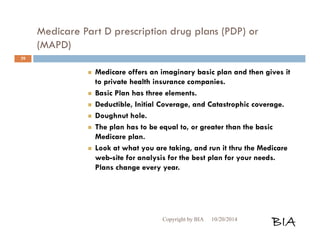
Medicare Part D prescription drug plans (PDP) or 
(MAPD) 
 Medicare offers an imaginary basic plan and then gives it 
to private health insurance companies. 
 Basic Plan has three elements. 
 Deductible, Initial Coverage, and Catastrophic coverage. 
 Doughnut hole. 
 The plan has to be equal to, or greater than the basic 
Medicare plan. 
 Look at what you are taking, and run it thru the Medicare 
web-site for analysis for the best plan for your needs. 
Plans change every year. 
Copyright by BIA 10/20/2014 BIA 
39
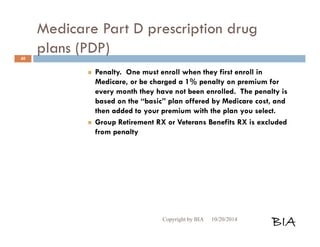
Medicare Part D prescription drug 
plans (PDP) 
 Penalty. One must enroll when they first enroll in 
Medicare, or be charged a 1% penalty on premium for 
every month they have not been enrolled. The penalty is 
based on the “basic” plan offered by Medicare cost, and 
then added to your premium with the plan you select. 
 Group Retirement RX or Veterans Benefits RX is excluded 
from penalty 
Copyright by BIA 10/20/2014 BIA 
40
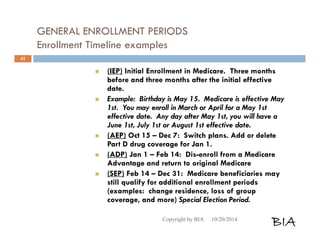
GENERAL ENROLLMENT PERIODS 
Enrollment Timeline examples 
 (IEP) Initial Enrollment in Medicare. Three months 
before and three months after the initial effective 
date. 
 Example: Birthday is May 15. Medicare is effective May 
1st. You may enroll in March or April for a May 1st 
effective date. Any day after May 1st, you will have a 
June 1st, July 1st or August 1st effective date. 
 (AEP) Oct 15 – Dec 7: Switch plans. Add or delete 
Part D drug coverage for Jan 1. 
 (ADP) Jan 1 – Feb 14: Dis-enroll from a Medicare 
Advantage and return to original Medicare 
 (SEP) Feb 14 – Dec 31: Medicare beneficiaries may 
still qualify for additional enrollment periods 
(examples: change residence, loss of group 
coverage, and more) Special Election Period. 
Copyright by BIA 10/20/2014 BIA 
41
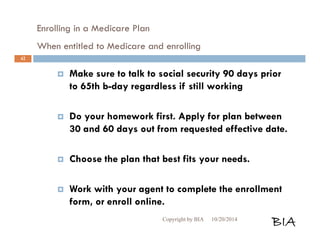
Enrolling in a Medicare Plan 
When entitled to Medicare and enrolling 
 Make sure to talk to social security 90 days prior 
to 65th b-day regardless if still working 
 Do your homework first. Apply for plan between 
30 and 60 days out from requested effective date. 
 Choose the plan that best fits your needs. 
 Work with your agent to complete the enrollment 
form, or enroll online. 
Copyright by BIA 10/20/2014 BIA 
42
Enrolling in a Medicare Plan 
When entitled to Medicare and enrolling Cont… 
 Submit it during the appropriate enrollment 
period. 
 You may not combine an MA-only PPO or HMO 
with a stand-alone PDP. Choose one or the other. 
 If you did not have creditable coverage in [2006], 
your monthly plan premium may be slightly 
higher when you enroll in Part D coverage plan 
(MAPD, PDP). 
Copyright by BIA 10/20/2014 BIA 
43
Help with RX Costs ? (LIS) 
 People with Medicare may be able to get extra help to 
pay for prescription drug premiums and costs. To see 
if you qualify for getting extra help, call. The Social 
Security Administration at 1-800-772-1213. 
 Your resources must be limited to $13,070 for an individual 
or $26,120 for a married couple living together. Resources 
include such things as bank accounts, stocks, and bonds. We 
do not count your home, car, and any life insurance policy as 
resources. 
 Your annual income must be limited to $16,755 for an 
individual or $22,695 for a married couple living together. 
Copyright by BIA 10/20/2014 BIA 
44
Help with RX Costs? (LIS) 
 Apply for low-income subsidy (LIS) if you think you 
may be eligible. Form available from Social Security 
or Medicare. 
 Other assistance programs may be available. 
 Oregon Prescription Drug Plan 
 The state of Oregon offers a prescription drug program to 
Oregon residents who do not have prescription drug 
coverage, or who are in a coverage gap. 
 For more information: Visit www.OPDP.org or call 1-800- 
913-4146 
Copyright by BIA 10/20/2014 BIA 
45
Recap…how do I choose? 
 There are three basic factors to weigh when choosing 
a plan: 
 Cost – Compare the out-of-pocket costs. (MAPD vs 
Medicare Supplement) 
 Providers – Will the plan allow me to see the providers I 
need or want to see( HMO vs PPO)? 
 Benefits – Does the plan offer you the coverage and 
benefits you need? (RX, OOP) 
Copyright by BIA 10/20/2014 BIA 
46

BIA Medicare 101 Presentation Long Form

  • 1.
    www.booneinsuranceassociates.com Copyright byBIA 1 MEDICARE MADE SIMPLE BIA Boone Insurance 10/20/2014 Associates Education Guide: New
  • 2.
    Today’s Agenda About BIA  Introduction & History of Medicare  Medicare Parts A, B, C, D  Coverage Gaps  General Medicare Plan Types  And More . . . Copyright by BIA 10/20/2014 BIA 2
  • 3.
    About Boone InsuranceAssociates  Boone Insurance Associates provides health and life insurance products to clients all over Oregon.  We work directly with the companies to resolve any of your claim, benefit, & premium questions.  Unlike a captive insurance producer who represents that insurance company alone, we are independent of a specific insurance company and represent a variety of different companies and products.  Boone Insurance Associates provides this educational program today to help inform you. There is no obligation for you to purchase services from us. “Our pledge is to provide our clients with superior customer service and product knowledge in order to guide them in making the most informed decisions." Copyright by BIA 10/20/2014 BIA 3
  • 4.
    Basic Medicare Terminology  Deductible  Copay / Coinsurance  OOP – Out of Pocket Maximum  LIS – Low Income Subsidy Copyright by BIA 10/20/2014 BIA 4
  • 5.
    Introduction & Historyof Medicare  Medicare is a Federal Insurance Program  Administered by CMS, a federal agency in the Department of Health and Human Services. “Center for Medicare & Medicaid Services”  Consists of Hospital insurance, Medical insurance, Medicare Advantage plans, and Prescription Drug plans  In July 1965, Congress passed a bill to establish Medicare. Copyright by BIA 10/20/2014 BIA 5
  • 6.
    Introduction & Historyof Medicare cont…  Balanced Budget Act of 1997 established Part C, known as Medicare + Choice (M + C) Program  Plans also called Medicare Advantage  Medicare Modernization Act (MMA) was passed in 2003  Implements new prescription drug benefit  Implements new Medicare Advantage program (replacing M+C) Copyright by BIA 10/20/2014 BIA 6
  • 7.
    Who gets Medicare?  It is available to qualified individuals, including:  People age 65 or older  People under age 65 who have been declared disabled  People with End-Stage Renal Disease (ESRD), also known as kidney failure. Copyright by BIA 10/20/2014 BIA 7
  • 8.
    Medicare is comprisedof: Medicare Part A: Hospital coverage Medicare Part B: Medical coverage: (Outpatient Surgery & Doctor Visits) Medicare Part C: Medicare Advantage (Offered by Insurance Carriers) Medicare Part D: Medicare Prescription Drug coverage (Offered by Insurance Carriers) Copyright by BIA 10/20/2014 BIA 8
  • 9.
    Medicare Part A (Hospital Insurance) What do I pay for Medicare Part A?  It has no premium cost for individuals who have worked at least 40 calendar quarters  Is automatically provided to those who reach 65 years of age  Includes a monthly premium for those who have worked fewer than 40 calendar quarters.  All taxpayers are contributing towards Medicare via payroll FICA deductions. Copyright by BIA 10/20/2014 BIA 9
  • 10.
    Medicare Part A (Hospital Insurance) Cont… What does Part A cover?  Hospital stays  Home health services  Hospice care  Minimal care in a skilled nursing facility (SNF)  Cover the first 20 days in full days after a 3 day hospital stay, then cover days 21-100 at a daily rate. Then no coverage after 100 days.  Does not include intermediate or custodial coverage. Copyright by BIA 10/20/2014 BIA 10
  • 11.
    Medicare Part A (Hospital Insurance) Cont…  Part A Deductibles  [2013] Hospital stay per benefit period:  Days 1-60 [$1184] per benefit period  Days 61-90 [$296] per day  Days 91-150 [$592] per day  [2013] Skilled Nursing Facility:  Days 1-20 [$0] per day  Days 21-100 [$148] per day Copyright by BIA 10/20/2014 BIA 11
  • 12.
    What is aMedicare Benefit Period?  Begins the day you go into a hospital or skilled nursing facility, ends when you have not received hospital or skilled nursing care for 60 days in a row  If you go into the hospital after one benefit period has ended, a new benefit period begins  There is no limit to the number of benefit periods you can have. Copyright by BIA 10/20/2014 BIA 12
  • 13.
    Medicare Part B What does Medicare Part B cover?  Physician Services  Laboratory, X-rays, MRI, CT Scans  Chemotherapy  Ambulance, Emergency Room Care  Outpatient Surgery  Preventive Care  Part B Medications Copyright by BIA 10/20/2014 BIA 13
  • 14.
    Medicare Part BCont… What do I pay for Medicare Part B?  Part B premium is based on Part B medical costs and annual income level per individual  [2013] Part B Premium Annual Income per Individual $104.90 [$85,000 or less] $146.00 [$85,001 to $107,000] $209.80 [$107,001 to $160,000] $272.70 [$160,000 to $214,000] $335.70 More than [$214,000]  Double amounts listed above for married couples filing jointly  Premiums are deducted from the Social Security benefits, or billed quarterly Copyright by BIA 10/20/2014 BIA 14
  • 15.
    Medicare Part BCont… Deductibles & Coinsurance for  Deductible:  2013 [$147] per year  Other Services:  Patient pays [20%] of approved amount, after deductible. {Medicare pays 80%}  [50%] for most Outpatient mental healthcare services.  There is no OOP maximum, risk is unlimited Copyright by BIA 10/20/2014 BIA 15
  • 16.
    Original Medicare DoesNot Cover  Out-of-pocket maximum spending safety net  Certain deductibles and coinsurances  Routine physical (beyond one-time initial physical and annual wellness visit)  Dental (except if medically necessary)  Vision (except if medically necessary)  Access to complementary (alternative) care benefits  Gym Memberships or professional health coaches Copyright by BIA 10/20/2014 BIA 16
  • 17.
    Covering Medical &Prescription Gaps  Three main options available  Medicare Part C (Medicare Advantage Plans)  Traditional Medicare Supplement Plans (Medigap)  Medicare Part D Prescription Drug Plans (PDP)  Employer-Sponsored Retiree Plans Copyright by BIA 10/20/2014 BIA 17
  • 18.
    Covering Medical &Prescription Gaps Copyright by BIA 10/20/2014 BIA 18 Original Medicare Parts A & B PDP Part D RX Medicare Supplement (Medigap) Medicare Advantage (Part C) Employer Retirement Plan
  • 19.
    Medicare Part C(Medicare Advantage)  Expands Medicare choices with a variety of options.  A few examples:  Preferred Provider Organization (PPO)  Health Maintenance Organization (HMO)  Point of Service (POS)  Private Fee For Service (PFFS) Copyright by BIA 10/20/2014 BIA 19
  • 20.
    Medicare Part C(Medicare Advantage) Coverage Who is eligible?  Must be enrolled in Medicare Part A & B?  Permanent resident in plan service area?  Cannot have End Stage Renal Disease (ESRD)? Copyright by BIA 10/20/2014 BIA 20
  • 21.
    Medicare Part C(Medicare Advantage)  They are health plan options that are part of the Medicare program  Medicare pays the plan a set amount every month for your care  MA plans must offer all benefits of Original Medicare and coverage can include Part D prescription drug coverage  You may have to use a network of providers that participate with the plan Copyright by BIA 10/20/2014 BIA 21
  • 22.
    Medicare Part C(Medicare Advantage)  In most plans, there are generally extra benefits and out-of pocket costs that are lower that with Original Medicare.  Plans cover everything Medicare covers, at a minimum.  Plans typically have copay and coinsurance that are paid when client goes in for services.  Plans may cover extra benefits such as routine vision exams, preventive dental, alternative care, gym membership, etc. Copyright by BIA 10/20/2014 BIA 22
  • 23.
    Medicare Part C(Medicare Advantage)  Choose from options with or without integrated Part D prescription drug coverage.  No drugs included: Medicare Advantage (MA) only  Prescription drugs included: Medicare Advantage with drugs (MA-PD) Copyright by BIA 10/20/2014 BIA 23
  • 24.
    Medicare Part C(Medicare Advantage) Preferred Provider Organization (PPO)  Defined network of providers  Allows flexibility to use providers who are not part of the network  No referral needed to see any doctor  However, out-of-pocket costs increase significantly when out-of-network providers are used Copyright by BIA 10/20/2014 BIA 24
  • 25.
    Medicare Part C(Medicare Advantage) Preferred Provider Organization (PPO) Cont… Greatest saving for use of network providers because the plan pays a larger share of the cost No referrals are required. Prior authorizations may be required for some services. (Cost Sharing with the co-pays and/or deductibles. Cost is reflected in the lower monthly premium.) Copyright by BIA 10/20/2014 BIA 25
  • 26.
    Medicare Part C(Medicare Advantage) Health Maintenance Organization (HMO)  Defined network of providers  Primary Care Physician (PCP) manages all of your care  You must have a referral from your PCP to see a Specialist  You must use network providers for all scheduled care Out-of-pocket costs may be significantly lower with an HMO plan Copyright by BIA 10/20/2014 BIA 26
  • 27.
    Medicare Part C(Medicare Advantage) Health Maintenance Organization (HMO) Cont…  Health maintenance organizations (HMO) offer a provider network, and members are covered for most of their Plan services in-network only. Urgent and emergency care is covered inside and outside the HMO network, however.  With most HMOs, a primary care physician (PCP) acts as a health care coordinator (gatekeeper) to provide or to refer for all the patient care. Referrals are usually required to see a specialist.  You may change your PCP any time (usually not more than twice a year.) Copyright by BIA 10/20/2014 BIA 27
  • 28.
    Medicare Part C(Medicare Advantage) Point Of Service (POS)  A Point of Service (POS) plan usually offers HMO-style benefits in-network. It also provides the ability to choose whether to get some selected services in-network or out-of- network.  Otherwise, POS plans are very similar to HMOs. Copyright by BIA 10/20/2014 BIA 28
  • 29.
    Medicare Part C(Medicare Advantage) Private Fee For Service (PFFS)  No plan network  Plan works similar to Original Medicare except the insurance company pays for your services, not Medicare  Freedom to use any provider that accepts Medicare and, agrees to the plan’s payment terms  You should check with your providers to make certain that they are willing to accept the PFFS plan’s terms Copyright by BIA 10/20/2014 BIA 29
  • 30.
    Medicare Part C(Medicare Advantage) Private Fee For Service (PFFS)  Out-of-pocket costs may be lower than with Original Medicare coverage  Private Fee For Service (PFFS) plans usually offer benefits intended to compete with Medicare Supplements.  Members can go to any Medicare provider who accepts them as patient, and agrees to the plan’s terms and conditions of payment.  Before joining, people should contact their health care provider to assure will accept PFFS. Copyright by BIA 10/20/2014 BIA 30
  • 31.
    Traditional Medicare Supplements(Medigap Plans)  Private companies sell Medicare Supplement plans (also known as MediGap plans).  After initial enrollment eligibility, may require health statement underwriting. (exception is Bday Rule)  Nationally standardized plan designs (Plans A-N).  Prescription drugs are not included in plans sold after 1/1/2006.  Medicare pays for Medicare-eligible benefits. Then MediGap pays plan’s portion.  MediGap also pays some benefits not covered by Medicare. Benefits vary between plans A-N. Copyright by BIA 10/20/2014 BIA 31
  • 32.
    Traditional Medicare Supplements(Medigap Plans)  Standardized plans offered by various insurance companies. Companies can offer between 1 to 10 plans, plans lettered A-N most people get plan F.  Open Enrollment is for all people going on Medicare within the first six months of the effective date. After that, one is subject to medical underwriting.  You may see any Medicare provider in the United States. You do not have a Primary Care physician and can see any specialist. Copyright by BIA 10/20/2014 BIA 32
  • 33.
    Traditional Medicare Supplements(Medigap Plans)  All of your care is subject to what Medicare allows. It must be medically necessary. The doctor codes it, when the claim is submitted to Medicare. If Medicare pays on the claim, then the secondary insurance pays on it as well.  If the claim is denied – the secondary insurance cannot pay it. Copyright by BIA 10/20/2014 BIA 33
  • 34.
    Employer Sponsored RetireePlans  Employers may continue to offer coverage to retirees  Retirees are usually provided with information at retirement, if available.  Check with employee benefits department.  Costs and coverage options may vary.  Plan may include Part D creditable drug coverage, or not. Important to know. Copyright by BIA 10/20/2014 BIA 34
  • 35.
    Employer Sponsored RetireePlans Cont… To Note:  If you currently have health coverage from an employer or union, joining a Medicare Advantage plan or a stand-alone prescription drug plan could affect your employer or union health benefits. If you have health coverage from an employer or union, joining a Medicare Advantage or stand-alone prescription drug plan may change how your current coverage works. Read the communications your employer or union sends you. If you have questions, visit their website, or contact the office listed in their communications. Copyright by BIA 10/20/2014 BIA 35
  • 36.
    Medicare Part DRX Coverage  Private companies must be approved by The Centers for Medicaid and Medicare Services (CMS) to offer Part D prescription drug coverage. Two ways to get RX coverage.  (MAPD) People with a Medicare Advantage plan (such as PPO or HMO) coverage may obtain Part D drugs integrated with their health plan  (PDP) People with other insurance, such as Original Medicare, Medicare Supplements, and others, may obtain a stand-alone prescription drug plan in addition to their health coverage. Copyright by BIA 10/20/2014 BIA 36
  • 37.
    Medicare Part Dprescription drug plans (PDP)  Medicare Part D prescription drug plans (PDP)  Stand-alone drug coverage(PDP) may be paired with health plans such as:  MediGap (Medicare Supplement)  Only Original Medicare  Private Fee for Service (not most MAPD plans)  Some (not all) other private health coverage that doesn’t include Part D creditable coverage Copyright by BIA 10/20/2014 BIA 37
  • 38.
    Medicare Part Dprescription drug plans (PDP) or (MAPD)  2014  Deductible $310 for RX.  Initial coverage $2850  Doughnut Hole or Coverage Gap: Most Medicare drug plans have a coverage gap (also called the “donut hole”). This means that after you and your drug plan has spent $285, you have to pay 72% for generics and 47.5% for brand name prescriptions up to a yearly limit.  Catastrophic Coverage: Once paid $4550 then pays 95%  Medicare print out is simply an estimate of the plans available to you.  Donut Hole or Coverage Gap Closing: In 2020 will be same as initial coverage Limit. Copyright by BIA 10/20/2014 BIA 38
  • 39.
    Medicare Part Dprescription drug plans (PDP) or (MAPD)  Medicare offers an imaginary basic plan and then gives it to private health insurance companies.  Basic Plan has three elements.  Deductible, Initial Coverage, and Catastrophic coverage.  Doughnut hole.  The plan has to be equal to, or greater than the basic Medicare plan.  Look at what you are taking, and run it thru the Medicare web-site for analysis for the best plan for your needs. Plans change every year. Copyright by BIA 10/20/2014 BIA 39
  • 40.
    Medicare Part Dprescription drug plans (PDP)  Penalty. One must enroll when they first enroll in Medicare, or be charged a 1% penalty on premium for every month they have not been enrolled. The penalty is based on the “basic” plan offered by Medicare cost, and then added to your premium with the plan you select.  Group Retirement RX or Veterans Benefits RX is excluded from penalty Copyright by BIA 10/20/2014 BIA 40
  • 41.
    GENERAL ENROLLMENT PERIODS Enrollment Timeline examples  (IEP) Initial Enrollment in Medicare. Three months before and three months after the initial effective date.  Example: Birthday is May 15. Medicare is effective May 1st. You may enroll in March or April for a May 1st effective date. Any day after May 1st, you will have a June 1st, July 1st or August 1st effective date.  (AEP) Oct 15 – Dec 7: Switch plans. Add or delete Part D drug coverage for Jan 1.  (ADP) Jan 1 – Feb 14: Dis-enroll from a Medicare Advantage and return to original Medicare  (SEP) Feb 14 – Dec 31: Medicare beneficiaries may still qualify for additional enrollment periods (examples: change residence, loss of group coverage, and more) Special Election Period. Copyright by BIA 10/20/2014 BIA 41
  • 42.
    Enrolling in aMedicare Plan When entitled to Medicare and enrolling  Make sure to talk to social security 90 days prior to 65th b-day regardless if still working  Do your homework first. Apply for plan between 30 and 60 days out from requested effective date.  Choose the plan that best fits your needs.  Work with your agent to complete the enrollment form, or enroll online. Copyright by BIA 10/20/2014 BIA 42
  • 43.
    Enrolling in aMedicare Plan When entitled to Medicare and enrolling Cont…  Submit it during the appropriate enrollment period.  You may not combine an MA-only PPO or HMO with a stand-alone PDP. Choose one or the other.  If you did not have creditable coverage in [2006], your monthly plan premium may be slightly higher when you enroll in Part D coverage plan (MAPD, PDP). Copyright by BIA 10/20/2014 BIA 43
  • 44.
    Help with RXCosts ? (LIS)  People with Medicare may be able to get extra help to pay for prescription drug premiums and costs. To see if you qualify for getting extra help, call. The Social Security Administration at 1-800-772-1213.  Your resources must be limited to $13,070 for an individual or $26,120 for a married couple living together. Resources include such things as bank accounts, stocks, and bonds. We do not count your home, car, and any life insurance policy as resources.  Your annual income must be limited to $16,755 for an individual or $22,695 for a married couple living together. Copyright by BIA 10/20/2014 BIA 44
  • 45.
    Help with RXCosts? (LIS)  Apply for low-income subsidy (LIS) if you think you may be eligible. Form available from Social Security or Medicare.  Other assistance programs may be available.  Oregon Prescription Drug Plan  The state of Oregon offers a prescription drug program to Oregon residents who do not have prescription drug coverage, or who are in a coverage gap.  For more information: Visit www.OPDP.org or call 1-800- 913-4146 Copyright by BIA 10/20/2014 BIA 45
  • 46.
    Recap…how do Ichoose?  There are three basic factors to weigh when choosing a plan:  Cost – Compare the out-of-pocket costs. (MAPD vs Medicare Supplement)  Providers – Will the plan allow me to see the providers I need or want to see( HMO vs PPO)?  Benefits – Does the plan offer you the coverage and benefits you need? (RX, OOP) Copyright by BIA 10/20/2014 BIA 46