CHAPTER 11 
Corporations: Organization, Share Transactions, 
Dividends, and Retained Earnings 
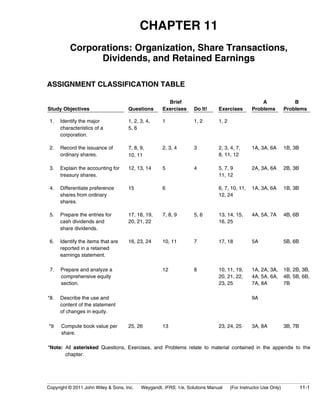
ASSIGNMENT CLASSIFICATION TABLE 
Study Objectives Questions 
Brief 
Exercises Do It! Exercises 
A 
Problems 
B 
Problems 
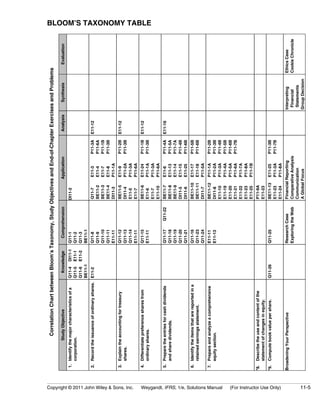
*1. Identify the major 
characteristics of a 
corporation. 
1, 2, 3, 4, 
5, 6 
1 1, 2 1, 2 
*2. Record the issuance of 
ordinary shares. 
7, 8, 9, 
10, 11 
2, 3, 4 3 2, 3, 4, 7, 
8, 11, 12 
1A, 3A, 6A 1B, 3B 
*3. Explain the accounting for 
treasury shares. 
12, 13, 14 5 4 5, 7, 9 
11, 12 
2A, 3A, 6A 2B, 3B 
*4. Differentiate preference 
shares from ordinary 
shares. 
15 6 6, 7, 10, 11, 
12, 24 
1A, 3A, 6A 1B, 3B 
*5. Prepare the entries for 
cash dividends and 
share dividends. 
17, 18, 19, 
20, 21, 22 
7, 8, 9 5, 6 13, 14, 15, 
16, 25 
4A, 5A, 7A 4B, 6B 
*6. Identify the items that are 
reported in a retained 
earnings statement. 
16, 23, 24 10, 11 7 17, 18 5A 5B, 6B 
7. Prepare and analyze a 
comprehensive equity 
section. 
12 8 10, 11, 19, 
20, 21, 22, 
23, 25 
1A, 2A, 3A, 
4A, 5A, 6A, 
7A, 8A 
1B, 2B, 3B, 
4B, 5B, 6B, 
7B 
*8. Describe the use and 
content of the statement 
of changes in equity. 
9A 
*9 Compute book value per 
share. 
25, 26 13 23, 24, 25 3A, 8A 3B, 7B 
*Note: All asterisked Questions, Exercises, and Problems relate to material contained in the appendix to the 
chapter. 
Copyright © 2011 John Wiley & Sons, Inc. Weygandt, IFRS, 1/e, Solutions Manual (For Instructor Use Only) 11-1
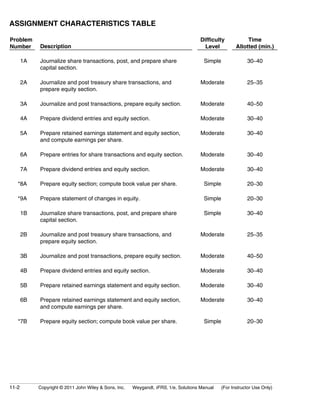
ASSIGNMENT CHARACTERISTICS TABLE 
Problem 
Number Description 
Difficulty 
Level 
Time 
Allotted (min.) 
1A Journalize share transactions, post, and prepare share 
capital section. 
Simple 30–40 
2A Journalize and post treasury share transactions, and 
prepare equity section. 
Moderate 25–35 
3A Journalize and post transactions, prepare equity section. Moderate 40–50 
4A Prepare dividend entries and equity section. Moderate 30–40 
5A Prepare retained earnings statement and equity section, 
and compute earnings per share. 
Moderate 30–40 
6A Prepare entries for share transactions and equity section. Moderate 30–40 
7A Prepare dividend entries and equity section. Moderate 30–40 
*8A Prepare equity section; compute book value per share. Simple 20–30 
*9A Prepare statement of changes in equity. Simple 20–30 
1B Journalize share transactions, post, and prepare share 
capital section. 
Simple 30–40 
2B Journalize and post treasury share transactions, and 
prepare equity section. 
Moderate 25–35 
3B Journalize and post transactions, prepare equity section. Moderate 40–50 
4B Prepare dividend entries and equity section. Moderate 30–40 
5B Prepare retained earnings statement and equity section. Moderate 30–40 
6B Prepare retained earnings statement and equity section, 
and compute earnings per share. 
Moderate 30–40 
*7B Prepare equity section; compute book value per share. Simple 20–30 
11-2 Copyright © 2011 John Wiley & Sons, Inc. Weygandt, IFRS, 1/e, Solutions Manual (For Instructor Use Only)
WEYGANDT IFRS 1E 
CHAPTER 11 
CORPORATIONS: ORGANIZATION, SHARE TRANSACTIONS, 
DIVIDENDS, AND RETAINED EARNINGS 
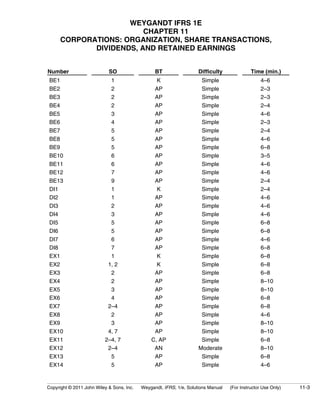
Number SO BT Difficulty Time (min.) 
BE1 1 K Simple 4–6 
BE2 2 AP Simple 2–3 
BE3 2 AP Simple 2–3 
BE4 2 AP Simple 2–4 
BE5 3 AP Simple 4–6 
BE6 4 AP Simple 2–3 
BE7 5 AP Simple 2–4 
BE8 5 AP Simple 4–6 
BE9 5 AP Simple 6–8 
BE10 6 AP Simple 3–5 
BE11 6 AP Simple 4–6 
BE12 7 AP Simple 4–6 
BE13 9 AP Simple 2–4 
DI1 1 K Simple 2–4 
DI2 1 AP Simple 4–6 
DI3 2 AP Simple 4–6 
DI4 3 AP Simple 4–6 
DI5 5 AP Simple 6–8 
DI6 5 AP Simple 6–8 
DI7 6 AP Simple 4–6 
DI8 7 AP Simple 6–8 
EX1 1 K Simple 6–8 
EX2 1, 2 K Simple 6–8 
EX3 2 AP Simple 6–8 
EX4 2 AP Simple 8–10 
EX5 3 AP Simple 8–10 
EX6 4 AP Simple 6–8 
EX7 2–4 AP Simple 6–8 
EX8 2 AP Simple 4–6 
EX9 3 AP Simple 8–10 
EX10 4, 7 AP Simple 8–10 
EX11 2–4, 7 C, AP Simple 6–8 
EX12 2–4 AN Moderate 8–10 
EX13 5 AP Simple 6–8 
EX14 5 AP Simple 4–6 
Copyright © 2011 John Wiley & Sons, Inc. Weygandt, IFRS, 1/e, Solutions Manual (For Instructor Use Only) 11-3
CORPORATIONS: ORGANIZATION, SHARE TRANSACTIONS, 
DIVIDENDS, AND RETAINED EARNINGS 
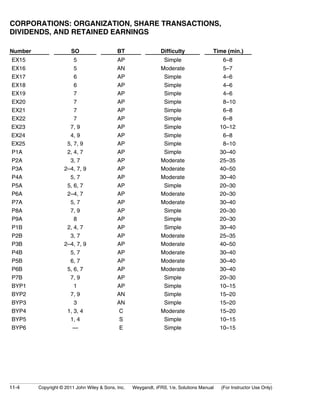
Number SO BT Difficulty Time (min.) 
EX15 5 AP Simple 6–8 
EX16 5 AN Moderate 5–7 
EX17 6 AP Simple 4–6 
EX18 6 AP Simple 4–6 
EX19 7 AP Simple 4–6 
EX20 7 AP Simple 8–10 
EX21 7 AP Simple 6–8 
EX22 7 AP Simple 6–8 
EX23 7, 9 AP Simple 10–12 
EX24 4, 9 AP Simple 6–8 
EX25 5, 7, 9 AP Simple 8–10 
P1A 2, 4, 7 AP Simple 30–40 
P2A 3, 7 AP Moderate 25–35 
P3A 2–4, 7, 9 AP Moderate 40–50 
P4A 5, 7 AP Moderate 30–40 
P5A 5, 6, 7 AP Simple 20–30 
P6A 2–4, 7 AP Moderate 20–30 
P7A 5, 7 AP Moderate 30–40 
P8A 7, 9 AP Simple 20–30 
P9A 8 AP Simple 20–30 
P1B 2, 4, 7 AP Simple 30–40 
P2B 3, 7 AP Moderate 25–35 
P3B 2–4, 7, 9 AP Moderate 40–50 
P4B 5, 7 AP Moderate 30–40 
P5B 6, 7 AP Moderate 30–40 
P6B 5, 6, 7 AP Moderate 30–40 
P7B 7, 9 AP Simple 20–30 
BYP1 1 AP Simple 10–15 
BYP2 7, 9 AN Simple 15–20 
BYP3 3 AN Simple 15–20 
BYP4 1, 3, 4 C Moderate 15–20 
BYP5 1, 4 S Simple 10–15 
BYP6 — E Simple 10–15 
11-4 Copyright © 2011 John Wiley & Sons, Inc. Weygandt, IFRS, 1/e, Solutions Manual (For Instructor Use Only)
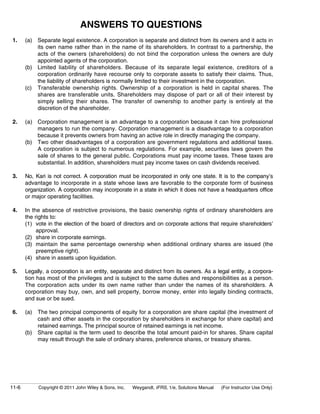
BLOOM’S TAXONOMY TABLE 
Copyright © 2011 John Wiley & Sons, Inc. Weygandt, IFRS, 1/e, Solutions Manual (For Instructor Use Only) 11-5 
Correlation Chart between Bloom’s Taxonomy, Study Objectives and End-of-Chapter Exercises and Problems 
Study Objective Knowledge Comprehension Application Analysis Synthesis Evaluation 
1. Identify the major characteristics of a 
corporation. 
Q11-4 
Q11-5 
Q11-6 
BE11-1 
DI11-1 
E11-1 
E11-2 
Q11-1 
Q11-2 
Q11-3 
BE11-1 
DI11-2 
2. Record the issuance of ordinary shares. E11-2 Q11-8 
Q11-9 
Q11-10 
Q11-11 
E11-11 
Q11-7 
BE11-2 
BE11-3 
BE11-4 
DI11-3 
E11-3 
E11-4 
E11-7 
E11-8 
P11-1A 
P11-3A 
P11-6A 
P11-1B 
P11-3B 
E11-12 
3. Explain the accounting for treasury 
shares. 
Q11-12 
Q11-13 
Q11-14 
E11-11 
BE11-5 
DI11-4 
E11-5 
E11-7 
E11-9 
P11-2A 
P11-3A 
P11-6A 
P11-2B 
P11-3B 
E11-12 
4. Differentiate preference shares from 
ordinary shares. 
Q11-15 
E11-11 
BE11-6 
E11-6 
E11-7 
E11-10 
E11-24 
P11-1A 
P11-3A 
P11-6A 
P11-1B 
P11-3B 
E11-12 
5. Prepare the entries for cash dividends 
and share dividends. 
Q11-17 
Q11-18 
Q11-19 
Q11-20 
Q11-21 
Q11-22 BE11-7 
BE11-8 
BE11-9 
DI11-5 
DI11-6 
E11-6 
E11-13 
E11-14 
E11-15 
E11-25 
P11-4A 
P11-5A 
P11-7A 
P11-4B 
P11-6B 
E11-16 
6. Identify the items that are reported in a 
retained earnings statement. 
Q11-16 
Q11-23 
Q11-24 
BE11-10 
BE11-11 
DI11-7 
E11-17 
E11-18 
P11-5A 
P11-5B 
P11-6B 
7. Prepare and analyze a comprehensive 
equity section. 
E11-11 
E11-13 
BE11-12 
DI11-8 
E11-10 
E11-19 
E11-20 
E11-21 
E11-22 
E11-23 
E11-25 
P11-1A 
P11-2A 
P11-3A 
P11-4A 
P11-5A 
P11-6A 
P11-7A 
P11-8A 
P11-1B 
P11-2B 
P11-3B 
P11-4B 
P11-5B 
P11-6B 
P11-7B 
*8. Describe the use and content of the 
statement of changes in equity. 
P11-9A 
E11-23 
*9. Compute book value per share. Q11-26 Q11-25 BE11-13 
E11-23 
E11-24 
E11-25 
P11-3A 
P11-8A 
P11-3B 
P11-7B 
Broadening Your Perspective Research Case 
Exploring the Web 
Financial Reporting 
Comparative Analysis 
Communication 
A Global Focus 
Interpreting 
Financial 
Statements 
Group Decision 
Ethics Case 
Cookie Chronicle
ANSWERS TO QUESTIONS 
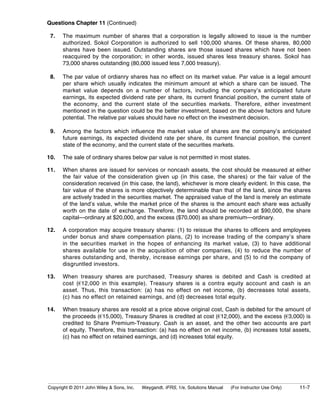
1. (a) Separate legal existence. A corporation is separate and distinct from its owners and it acts in 
its own name rather than in the name of its shareholders. In contrast to a partnership, the 
acts of the owners (shareholders) do not bind the corporation unless the owners are duly 
appointed agents of the corporation. 
(b) Limited liability of shareholders. Because of its separate legal existence, creditors of a 
corporation ordinarily have recourse only to corporate assets to satisfy their claims. Thus, 
the liability of shareholders is normally limited to their investment in the corporation. 
(c) Transferable ownership rights. Ownership of a corporation is held in capital shares. The 
shares are transferable units. Shareholders may dispose of part or all of their interest by 
simply selling their shares. The transfer of ownership to another party is entirely at the 
discretion of the shareholder. 
2. (a) Corporation management is an advantage to a corporation because it can hire professional 
managers to run the company. Corporation management is a disadvantage to a corporation 
because it prevents owners from having an active role in directly managing the company. 
(b) Two other disadvantages of a corporation are government regulations and additional taxes. 
A corporation is subject to numerous regulations. For example, securities laws govern the 
sale of shares to the general public. Corporations must pay income taxes. These taxes are 
substantial. In addition, shareholders must pay income taxes on cash dividends received. 
3. No, Kari is not correct. A corporation must be incorporated in only one state. It is to the company’s 
advantage to incorporate in a state whose laws are favorable to the corporate form of business 
organization. A corporation may incorporate in a state in which it does not have a headquarters office 
or major operating facilities. 
4. In the absence of restrictive provisions, the basic ownership rights of ordinary shareholders are 
the rights to: 
(1) vote in the election of the board of directors and on corporate actions that require shareholders’ 
approval. 
(2) share in corporate earnings. 
(3) maintain the same percentage ownership when additional ordinary shares are issued (the 
preemptive right). 
(4) share in assets upon liquidation. 
5. Legally, a corporation is an entity, separate and distinct from its owners. As a legal entity, a corpora-tion 
has most of the privileges and is subject to the same duties and responsibilities as a person. 
The corporation acts under its own name rather than under the names of its shareholders. A 
corporation may buy, own, and sell property, borrow money, enter into legally binding contracts, 
and sue or be sued. 
6. (a) The two principal components of equity for a corporation are share capital (the investment of 
cash and other assets in the corporation by shareholders in exchange for share capital) and 
retained earnings. The principal source of retained earnings is net income. 
(b) Share capital is the term used to describe the total amount paid-in for shares. Share capital 
may result through the sale of ordinary shares, preference shares, or treasury shares. 
11-6 Copyright © 2011 John Wiley & Sons, Inc. Weygandt, IFRS, 1/e, Solutions Manual (For Instructor Use Only)
Questions Chapter 11 (Continued) 
7. The maximum number of shares that a corporation is legally allowed to issue is the number 
authorized. Sokol Corporation is authorized to sell 100,000 shares. Of these shares, 80,000 
shares have been issued. Outstanding shares are those issued shares which have not been 
reacquired by the corporation; in other words, issued shares less treasury shares. Sokol has 
73,000 shares outstanding (80,000 issued less 7,000 treasury). 
8. The par value of ordianry shares has no effect on its market value. Par value is a legal amount 
per share which usually indicates the minimum amount at which a share can be issued. The 
market value depends on a number of factors, including the company’s anticipated future 
earnings, its expected dividend rate per share, its current financial position, the current state of 
the economy, and the current state of the securities markets. Therefore, either investment 
mentioned in the question could be the better investment, based on the above factors and future 
potential. The relative par values should have no effect on the investment decision. 
9. Among the factors which influence the market value of shares are the company’s anticipated 
future earnings, its expected dividend rate per share, its current financial position, the current 
state of the economy, and the current state of the securities markets. 
10. The sale of ordinary shares below par value is not permitted in most states. 
11. When shares are issued for services or noncash assets, the cost should be measured at either 
the fair value of the consideration given up (in this case, the shares) or the fair value of the 
consideration received (in this case, the land), whichever is more clearly evident. In this case, the 
fair value of the shares is more objectively determinable than that of the land, since the shares 
are actively traded in the securities market. The appraised value of the land is merely an estimate 
of the land’s value, while the market price of the shares is the amount each share was actually 
worth on the date of exchange. Therefore, the land should be recorded at $90,000, the share 
capital—ordinary at $20,000, and the excess ($70,000) as share premium—ordinary. 
12. A corporation may acquire treasury shares: (1) to reissue the shares to officers and employees 
under bonus and share compensation plans, (2) to increase trading of the company’s share 
in the securities market in the hopes of enhancing its market value, (3) to have additional 
shares available for use in the acquisition of other companies, (4) to reduce the number of 
shares outstanding and, thereby, increase earnings per share, and (5) to rid the company of 
disgruntled investors. 
13. When treasury shares are purchased, Treasury shares is debited and Cash is credited at 
cost (€12,000 in this example). Treasury shares is a contra equity account and cash is an 
asset. Thus, this transaction: (a) has no effect on net income, (b) decreases total assets, 
(c) has no effect on retained earnings, and (d) decreases total equity. 
14. When treasury shares are resold at a price above original cost, Cash is debited for the amount of 
the proceeds (€15,000), Treasury Shares is credited at cost (€12,000), and the excess (€3,000) is 
credited to Share Premium-Treasury. Cash is an asset, and the other two accounts are part 
of equity. Therefore, this transaction: (a) has no effect on net income, (b) increases total assets, 
(c) has no effect on retained earnings, and (d) increases total equity. 
Copyright © 2011 John Wiley & Sons, Inc. Weygandt, IFRS, 1/e, Solutions Manual (For Instructor Use Only) 11-7
Questions Chapter 11 (Continued) 
15. (a) Ordinary shares and preference shares both represent ownership of the corporation. 
Ordinary shares signifies the basic residual ownership; preference shares is ownership 
with certain privileges or preferences. Preference shareholders typically have a 
preference as to dividends and as to assets in the event of liquidation. However, 
preference shareholders generally do not have voting rights. 
(b) Some preference shares possess the additional feature of being cumulative. Most preference 
shares are cumulative—preference shareholders must be paid both current-year dividends 
and unpaid prior year dividends before ordinary shareholders receive any dividends. 
(c) Dividends in arrears are disclosed in the notes to the financial statements. 
16. The debits and credits to retained earnings are: 
Debits Credits 
1. 
2. 
3. 
4. 
Net loss 
Prior period adjustments for 
overstatements of net income 
Cash and share dividends 
Some disposals of treasury shares 
1. 
2. 
Net income 
Prior period adjustments for 
understatements of net income 
17. For a cash dividend to be paid, a corporation must have retained earnings, adequate cash, and a 
dividend declared by the board. 
18. May 1 is the date on which the board of directors formally declares (authorizes) and announces 
the cash dividend. May 15 is the record date which marks the time when ownership of outstanding 
shares is determined for dividend purposes from the shareholders’ records. May 31 is the date 
when the dividend checks are mailed to shareholders. Accounting entries are made on May 1 
(debit Cash Dividends and credit Dividends Payable), and on May 31 (debit Dividends Payable 
and credit Cash). 
19. A cash dividend decreases assets, retained earnings, and total equity. A share dividend 
decreases retained earnings, increases share capital and share premium, and has no effect 
on total assets and total equity. 
20. A corporation generally issues share dividends for one of the following reasons: 
(1) To satisfy shareholders’ dividend expectations without spending cash. 
(2) To increase the marketability of its shares by increasing the number of shares outstanding 
and thereby decreasing the market price per share. Decreasing the market price of the 
shares makes the shares easier to purchase for smaller investors. 
(3) To emphasize that a portion of equity that had been reported as retained earnings has been 
permanently reinvested in the business and therefore is unavailable for cash dividends. 
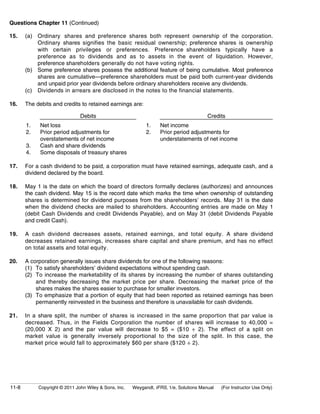
21. In a share split, the number of shares is increased in the same proportion that par value is 
decreased. Thus, in the Fields Corporation the number of shares will increase to 40,000 = 
(20,000 X 2) and the par value will decrease to $5 = ($10 ÷ 2). The effect of a split on 
market value is generally inversely proportional to the size of the split. In this case, the 
market price would fall to approximately $60 per share ($120 ÷ 2). 
11-8 Copyright © 2011 John Wiley & Sons, Inc. Weygandt, IFRS, 1/e, Solutions Manual (For Instructor Use Only)
Questions Chapter 11 (Continued) 
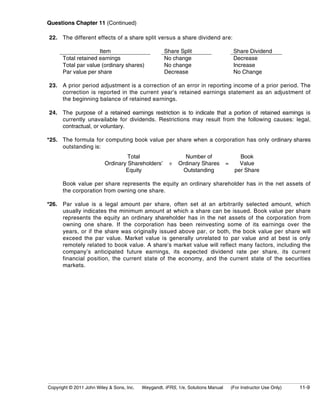
22. The different effects of a share split versus a share dividend are: 
Item Share Split Share Dividend 
Total retained earnings No change Decrease 
Total par value (ordinary shares) No change Increase 
Par value per share Decrease No Change 
23. A prior period adjustment is a correction of an error in reporting income of a prior period. The 
correction is reported in the current year’s retained earnings statement as an adjustment of 
the beginning balance of retained earnings. 
24. The purpose of a retained earnings restriction is to indicate that a portion of retained earnings is 
currently unavailable for dividends. Restrictions may result from the following causes: legal, 
contractual, or voluntary. 
*25. The formula for computing book value per share when a corporation has only ordinary shares 
outstanding is: 
Total 
Ordinary Shareholders’ 
Equity 
÷ 
Number of 
Ordinary Shares 
Outstanding 
= 
Book 
Value 
per Share 
Book value per share represents the equity an ordinary shareholder has in the net assets of 
the corporation from owning one share. 
*26. Par value is a legal amount per share, often set at an arbitrarily selected amount, which 
usually indicates the minimum amount at which a share can be issued. Book value per share 
represents the equity an ordinary shareholder has in the net assets of the corporation from 
owning one share. If the corporation has been reinvesting some of its earnings over the 
years, or if the share was originally issued above par, or both, the book value per share will 
exceed the par value. Market value is generally unrelated to par value and at best is only 
remotely related to book value. A share’s market value will reflect many factors, including the 
company’s anticipated future earnings, its expected dividend rate per share, its current 
financial position, the current state of the economy, and the current state of the securities 
markets. 
Copyright © 2011 John Wiley & Sons, Inc. Weygandt, IFRS, 1/e, Solutions Manual (For Instructor Use Only) 11-9
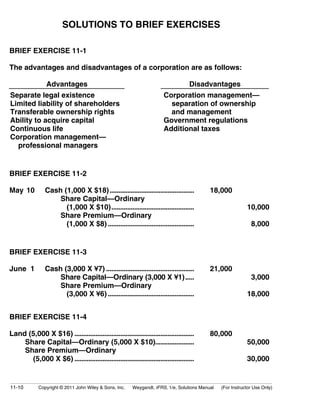
SOLUTIONS TO BRIEF EXERCISES 
BRIEF EXERCISE 11-1 
The advantages and disadvantages of a corporation are as follows: 
Advantages Disadvantages 
Separate legal existence 
Limited liability of shareholders 
Transferable ownership rights 
Ability to acquire capital 
Continuous life 
Corporation management— 
professional managers 
Corporation management— 
separation of ownership 
and management 
Government regulations 
Additional taxes 
BRIEF EXERCISE 11-2 
May 10 Cash (1,000 X $18) ................................................ 18,000 
Share Capital—Ordinary 
(1,000 X $10)............................................... 10,000 
Share Premium—Ordinary 
(1,000 X $8) ................................................. 8,000 
BRIEF EXERCISE 11-3 
June 1 Cash (3,000 X ¥7) .................................................. 21,000 
Share Capital—Ordinary (3,000 X ¥1)..... 3,000 
Share Premium—Ordinary 
(3,000 X ¥6) ................................................. 18,000 
BRIEF EXERCISE 11-4 
Land (5,000 X $16) .................................................................... 80,000 
Share Capital—Ordinary (5,000 X $10)...................... 50,000 
Share Premium—Ordinary 
(5,000 X $6) .................................................................... 30,000 
11-10 Copyright © 2011 John Wiley & Sons, Inc. Weygandt, IFRS, 1/e, Solutions Manual (For Instructor Use Only)
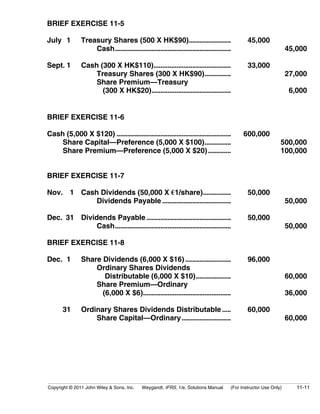
BRIEF EXERCISE 11-5 
July 1 Treasury Shares (500 X HK$90)........................ 45,000 
Cash.................................................................. 45,000 
Sept. 1 Cash (300 X HK$110)............................................ 33,000 
Treasury Shares (300 X HK$90)............... 27,000 
Share Premium—Treasury 
(300 X HK$20)............................................. 6,000 
BRIEF EXERCISE 11-6 
Cash (5,000 X $120) ................................................................. 600,000 
Share Capital—Preference (5,000 X $100)............... 500,000 
Share Premium—Preference (5,000 X $20)............. 100,000 
BRIEF EXERCISE 11-7 
Nov. 1 Cash Dividends (50,000 X €1/share)................ 50,000 
Dividends Payable ....................................... 50,000 
Dec. 31 Dividends Payable ................................................ 50,000 
Cash.................................................................. 50,000 
BRIEF EXERCISE 11-8 
Dec. 1 Share Dividends (6,000 X $16) .......................... 96,000 
Ordinary Shares Dividends 
Distributable (6,000 X $10).................... 60,000 
Share Premium—Ordinary 
(6,000 X $6).................................................. 36,000 
31 Ordinary Shares Dividends Distributable ..... 60,000 
Share Capital—Ordinary............................ 60,000 
Copyright © 2011 John Wiley & Sons, Inc. Weygandt, IFRS, 1/e, Solutions Manual (For Instructor Use Only) 11-11
BRIEF EXERCISE 11-9 
Before 
Dividend 
After 
Dividend 
(a) Equity 
Share Capital—Ordinary, £10 par £2,000,000 £2,200,000 
Share Premium—Ordinary — . 80,000 (1) 
Retained earnings 300,000 20,000 (2) 
Total equity £2,300,000 £2,300,000 
(b) Outstanding shares 200,000 220,000 
(1)20,000 X (£14 – £10) (2)[£300,000 – (20,000 X £14)] 
BRIEF EXERCISE 11-10 
MOUNT INC. 
Retained Earnings Statement 
For the Year Ended December 31, 2011 
Balance, January 1.................................................................... $220,000 
Add: Net income ..................................................................... 120,000 
340,000 
Less: Dividends ........................................................................ 85,000 
Balance, December 31 ............................................................. $255,000 
11-12 Copyright © 2011 John Wiley & Sons, Inc. Weygandt, IFRS, 1/e, Solutions Manual (For Instructor Use Only)
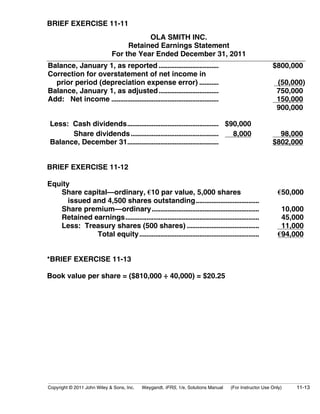
BRIEF EXERCISE 11-11 
OLA SMITH INC. 
Retained Earnings Statement 
For the Year Ended December 31, 2011 
Balance, January 1, as reported .................................. $800,000 
Correction for overstatement of net income in 
prior period (depreciation expense error) ........... (50,000) 
Balance, January 1, as adjusted .................................. 750,000 
Add: Net income ............................................................. 150,000 
900,000 
Less: Cash dividends.................................................... $90,000 
Share dividends.................................................. 8,000 98,000 
Balance, December 31.................................................... $802,000 
BRIEF EXERCISE 11-12 
Equity 
Share capital—ordinary, €10 par value, 5,000 shares 
issued and 4,500 shares outstanding.................................... 
€50,000 
Share premium—ordinary............................................................. 10,000 
Retained earnings............................................................................ 45,000 
Less: Treasury shares (500 shares) ......................................... 11,000 
Total equity.................................................................... €94,000 
*BRIEF EXERCISE 11-13 
Book value per share = ($810,000 ÷ 40,000) = $20.25 
Copyright © 2011 John Wiley & Sons, Inc. Weygandt, IFRS, 1/e, Solutions Manual (For Instructor Use Only) 11-13
SOLUTIONS FOR DO IT! REVIEW EXERCISES 
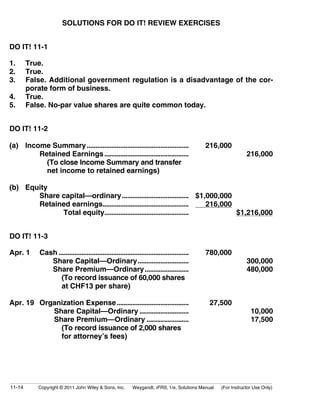
DO IT! 11-1 
1. True. 
2. True. 
3. False. Additional government regulation is a disadvantage of the cor-porate 
form of business. 
4. True. 
5. False. No-par value shares are quite common today. 
DO IT! 11-2 
(a) Income Summary.......................................................... 216,000 
Retained Earnings................................................ 216,000 
(To close Income Summary and transfer 
net income to retained earnings) 
(b) Equity 
Share capital—ordinary...................................... $1,000,000 
Retained earnings................................................. 216,000 
Total equity................................................ $1,216,000 
DO IT! 11-3 
Apr. 1 Cash .......................................................................... 780,000 
Share Capital—Ordinary............................. 300,000 
Share Premium—Ordinary......................... 480,000 
(To record issuance of 60,000 shares 
at CHF13 per share) 
Apr. 19 Organization Expense......................................... 27,500 
Share Capital—Ordinary ............................ 10,000 
Share Premium—Ordinary ........................ 17,500 
(To record issuance of 2,000 shares 
for attorney’s fees) 
11-14 Copyright © 2011 John Wiley & Sons, Inc. Weygandt, IFRS, 1/e, Solutions Manual (For Instructor Use Only)
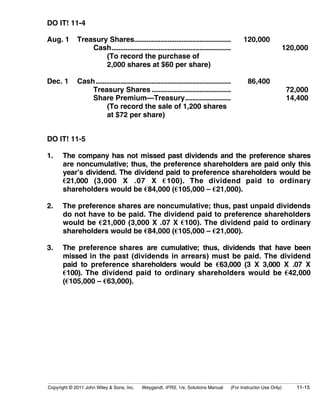
DO IT! 11-4 
Aug. 1 Treasury Shares....................................................... 120,000 
Cash.................................................................... 120,000 
(To record the purchase of 
2,000 shares at $60 per share) 
Dec. 1 Cash............................................................................. 86,400 
Treasury Shares ............................................. 72,000 
Share Premium—Treasury.......................... 14,400 
(To record the sale of 1,200 shares 
at $72 per share) 
DO IT! 11-5 
1. The company has not missed past dividends and the preference shares 
are noncumulative; thus, the preference shareholders are paid only this 
year’s dividend. The dividend paid to preference shareholders would be 
€21,000 (3,000 X .07 X €100). The dividend paid to ordinary 
shareholders would be €84,000 (€105,000 – €21,000). 
2. The preference shares are noncumulative; thus, past unpaid dividends 
do not have to be paid. The dividend paid to preference shareholders 
would be €21,000 (3,000 X .07 X €100). The dividend paid to ordinary 
shareholders would be €84,000 (€105,000 – €21,000). 
3. The preference shares are cumulative; thus, dividends that have been 
missed in the past (dividends in arrears) must be paid. The dividend 
paid to preference shareholders would be €63,000 (3 X 3,000 X .07 X 
€100). The dividend paid to ordinary shareholders would be €42,000 
(€105,000 – €63,000). 
Copyright © 2011 John Wiley & Sons, Inc. Weygandt, IFRS, 1/e, Solutions Manual (For Instructor Use Only) 11-15
DO IT! 11-6 
(a) 1. The share dividend amount is $3,060,000 [(400,000 X 15%) X $51]. 
The new balance in retained earnings is $8,940,000 ($12,000,000 – 
$3,060,000). 
2. The retained earnings after the share split would be the same as it 
was before the split: $12,000,000. 
(b) (1) and (2) The effects on the equity accounts are as follows: 
Original 
Balances 
After 
Dividend After Split 
Share capital and share 
premium 
Retained earnings 
Total equity 
Shares outstanding 
$ 2,400,000 
12,000,000 
$14,400,000 
400,000 
$ 5,460,000 
8,940,000 
$14,400,000 
460,000 
$ 2,400,000 
12,000,000 
$14,400,000 
800,000 
Total equity remains the same under both options. 
DO IT! 11-7 
ALPHA CENTURI CORPORATION 
Retained Earnings Statement 
For the Year Ended December 31, 2011 
Balance, January 1, as reported ................................... €3,100,000 
Correction for understatement of net 
income in prior period (depreciation error).......... 110,000 
Balance, January 1, as adjusted................................... 3,210,000 
Add: Net income .............................................................. 1,200,000 
4,410,000 
Less: Cash dividends...................................................... 150,000 
Balance, December 31...................................................... €4,260,000 
11-16 Copyright © 2011 John Wiley & Sons, Inc. Weygandt, IFRS, 1/e, Solutions Manual (For Instructor Use Only)
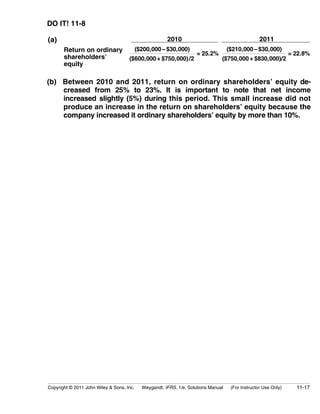
DO IT! 11-8 
(a) 2010 2011 
Return on ordinary 
shareholders’ 
equity 
($200,000 – $30,000) 
($600,000 + $750,000) /2 
= 25.2% 
($210,000 – $30,000) 
($750,000 + $830,000)/2 
= 22.8% 
(b) Between 2010 and 2011, return on ordinary shareholders’ equity de-creased 
from 25% to 23%. It is important to note that net income 
increased slightly (5%) during this period. This small increase did not 
produce an increase in the return on shareholders’ equity because the 
company increased it ordinary shareholders’ equity by more than 10%. 
Copyright © 2011 John Wiley & Sons, Inc. Weygandt, IFRS, 1/e, Solutions Manual (For Instructor Use Only) 11-17
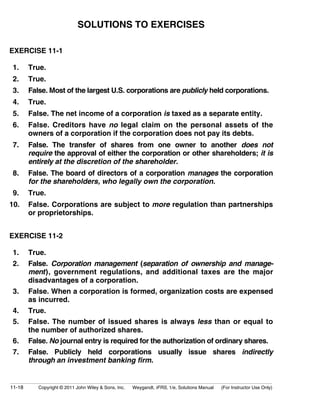
SOLUTIONS TO EXERCISES 
EXERCISE 11-1 
1. True. 
2. True. 
3. False. Most of the largest U.S. corporations are publicly held corporations. 
4. True. 
5. False. The net income of a corporation is taxed as a separate entity. 
6. False. Creditors have no legal claim on the personal assets of the 
owners of a corporation if the corporation does not pay its debts. 
7. False. The transfer of shares from one owner to another does not 
require the approval of either the corporation or other shareholders; it is 
entirely at the discretion of the shareholder. 
8. False. The board of directors of a corporation manages the corporation 
for the shareholders, who legally own the corporation. 
9. True. 
10. False. Corporations are subject to more regulation than partnerships 
or proprietorships. 
EXERCISE 11-2 
1. True. 
2. False. Corporation management (separation of ownership and manage-ment), 
government regulations, and additional taxes are the major 
disadvantages of a corporation. 
3. False. When a corporation is formed, organization costs are expensed 
as incurred. 
4. True. 
5. False. The number of issued shares is always less than or equal to 
the number of authorized shares. 
6. False. No journal entry is required for the authorization of ordinary shares. 
7. False. Publicly held corporations usually issue shares indirectly 
through an investment banking firm. 
11-18 Copyright © 2011 John Wiley & Sons, Inc. Weygandt, IFRS, 1/e, Solutions Manual (For Instructor Use Only)
EXERCISE 11-2 (Continued) 
8. True. 
9. False. The market value of ordinary shares has no relationship with 
the par value. 
10. False. Share capital is the total amount of cash and other assets paid 
in to the corporation by shareholders in exchange for shares. 
EXERCISE 11-3 
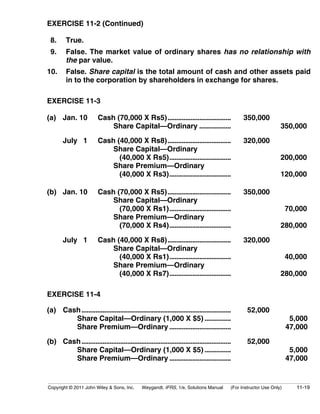
(a) Jan. 10 Cash (70,000 X Rs5).................................... 350,000 
Share Capital—Ordinary .................. 350,000 
July 1 Cash (40,000 X Rs8).................................... 320,000 
Share Capital—Ordinary 
(40,000 X Rs5)................................... 200,000 
Share Premium—Ordinary 
(40,000 X Rs3)................................... 120,000 
(b) Jan. 10 Cash (70,000 X Rs5).................................... 350,000 
Share Capital—Ordinary 
(70,000 X Rs1)................................... 70,000 
Share Premium—Ordinary 
(70,000 X Rs4)................................... 280,000 
July 1 Cash (40,000 X Rs8).................................... 320,000 
Share Capital—Ordinary 
(40,000 X Rs1)................................... 40,000 
Share Premium—Ordinary 
(40,000 X Rs7)................................... 280,000 
EXERCISE 11-4 
(a) Cash..................................................................................... 52,000 
Share Capital—Ordinary (1,000 X $5) ............... 5,000 
Share Premium—Ordinary ................................... 47,000 
(b) Cash..................................................................................... 52,000 
Share Capital—Ordinary (1,000 X $5) ............... 5,000 
Share Premium—Ordinary ................................... 47,000 
Copyright © 2011 John Wiley & Sons, Inc. Weygandt, IFRS, 1/e, Solutions Manual (For Instructor Use Only) 11-19
EXERCISE 11-4 (Continued) 
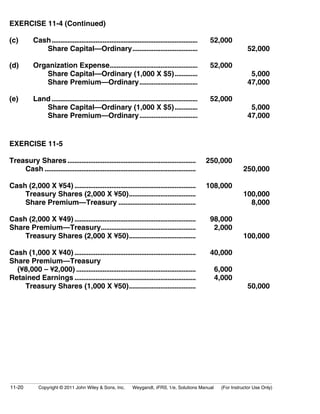
(c) Cash................................................................................... 52,000 
Share Capital—Ordinary..................................... 52,000 
(d) Organization Expense.................................................. 52,000 
Share Capital—Ordinary (1,000 X $5)............. 5,000 
Share Premium—Ordinary................................. 47,000 
(e) Land................................................................................... 52,000 
Share Capital—Ordinary (1,000 X $5)............. 5,000 
Share Premium—Ordinary................................. 47,000 
EXERCISE 11-5 
Treasury Shares ......................................................................... 250,000 
Cash ...................................................................................... 250,000 
Cash (2,000 X ¥54) ..................................................................... 108,000 
Treasury Shares (2,000 X ¥50)...................................... 100,000 
Share Premium—Treasury ............................................ 8,000 
Cash (2,000 X ¥49) ..................................................................... 98,000 
Share Premium—Treasury...................................................... 2,000 
Treasury Shares (2,000 X ¥50)...................................... 100,000 
Cash (1,000 X ¥40) ..................................................................... 40,000 
Share Premium—Treasury 
(¥8,000 – ¥2,000) .................................................................... 6,000 
Retained Earnings ..................................................................... 4,000 
Treasury Shares (1,000 X ¥50)...................................... 50,000 
11-20 Copyright © 2011 John Wiley & Sons, Inc. Weygandt, IFRS, 1/e, Solutions Manual (For Instructor Use Only)
EXERCISE 11-6 
(a) Cash ..................................................................................... 2,100,000 
Share Capital—Preference (100,000 X $20) ...... 2,000,000 
Share Premium—Preference................................. 100,000 
(b) Total Dividend................................................................... $ 500,000 
Less: Preference Shares Dividend 
($2,000,000 X 8%)................................................ 160,000 
Ordinary Shares Dividends .......................................... $ 340,000 
(c) Total Dividend................................................................... $ 500,000 
Less: Preference Shares Dividend 
[($2,000,000 X 8%) X 3] ...................................... 480,000 
Ordinary Shares Dividends .......................................... $ 20,000 
EXERCISE 11-7 
Mar. 2 Organization Expense........................................ 30,000 
Share Capital—Ordinary 
(5,000 X R$1) ............................................. 5,000 
Share Premium—Ordinary....................... 25,000 
June 12 Cash ......................................................................... 375,000 
Share Capital—Ordinary 
(60,000 X R$1)........................................... 60,000 
Share Premium—Ordinary....................... 315,000 
July 11 Cash (1,000 X R$110).......................................... 110,000 
Share Capital—Preference 
(1,000 X R$100)......................................... 100,000 
Share Premium—Preference 
(1,000 X R$10)......................................... 10,000 
Nov. 28 Treasury Shares.................................................... 80,000 
Cash ................................................................ 80,000 
Copyright © 2011 John Wiley & Sons, Inc. Weygandt, IFRS, 1/e, Solutions Manual (For Instructor Use Only) 11-21
EXERCISE 11-8 
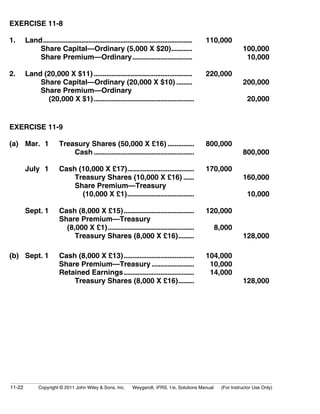
1. Land..................................................................................... 110,000 
Share Capital—Ordinary (5,000 X $20)............ 100,000 
Share Premium—Ordinary.................................. 10,000 
2. Land (20,000 X $11) ........................................................ 220,000 
Share Capital—Ordinary (20,000 X $10) ......... 200,000 
Share Premium—Ordinary 
(20,000 X $1)......................................................... 20,000 
EXERCISE 11-9 
(a) Mar. 1 Treasury Shares (50,000 X £16) ............... 800,000 
Cash ......................................................... 800,000 
July 1 Cash (10,000 X £17)...................................... 170,000 
Treasury Shares (10,000 X £16) ...... 160,000 
Share Premium—Treasury 
(10,000 X £1)...................................... 10,000 
Sept. 1 Cash (8,000 X £15)........................................ 120,000 
Share Premium—Treasury 
(8,000 X £1)................................................. 8,000 
Treasury Shares (8,000 X £16)......... 128,000 
(b) Sept. 1 Cash (8,000 X £13)........................................ 104,000 
Share Premium—Treasury ........................ 10,000 
Retained Earnings........................................ 14,000 
Treasury Shares (8,000 X £16)......... 128,000 
11-22 Copyright © 2011 John Wiley & Sons, Inc. Weygandt, IFRS, 1/e, Solutions Manual (For Instructor Use Only)
EXERCISE 11-10 
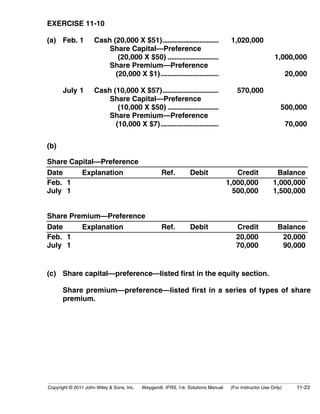
(a) Feb. 1 Cash (20,000 X $51)................................ 1,020,000 
Share Capital—Preference 
(20,000 X $50) ............................. 1,000,000 
Share Premium—Preference 
(20,000 X $1)................................. 20,000 
July 1 Cash (10,000 X $57)................................ 570,000 
Share Capital—Preference 
(10,000 X $50) ............................. 500,000 
Share Premium—Preference 
(10,000 X $7)................................. 70,000 
(b) 
Share Capital—Preference 
Date Explanation Ref. Debit Credit Balance 
Feb. 1 
1,000,000 
1,000,000 
July 1 
500,000 
1,500,000 
Share Premium—Preference 
Date Explanation Ref. Debit Credit Balance 
Feb. 1 
20,000 
20,000 
July 1 
70,000 
90,000 
(c) Share capital—preference—listed first in the equity section. 
Share premium—preference—listed first in a series of types of share 
premium. 
Copyright © 2011 John Wiley & Sons, Inc. Weygandt, IFRS, 1/e, Solutions Manual (For Instructor Use Only) 11-23
EXERCISE 11-11 
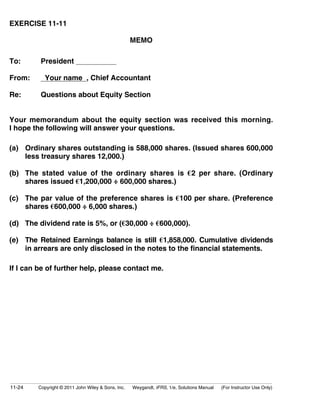
MEMO 
To: President 
From: Your name , Chief Accountant 
Re: Questions about Equity Section 
Your memorandum about the equity section was received this morning. 
I hope the following will answer your questions. 
(a) Ordinary shares outstanding is 588,000 shares. (Issued shares 600,000 
less treasury shares 12,000.) 
(b) The stated value of the ordinary shares is €2 per share. (Ordinary 
shares issued €1,200,000 ÷ 600,000 shares.) 
(c) The par value of the preference shares is €100 per share. (Preference 
shares €600,000 ÷ 6,000 shares.) 
(d) The dividend rate is 5%, or (€30,000 ÷ €600,000). 
(e) The Retained Earnings balance is still €1,858,000. Cumulative dividends 
in arrears are only disclosed in the notes to the financial statements. 
If I can be of further help, please contact me. 
11-24 Copyright © 2011 John Wiley & Sons, Inc. Weygandt, IFRS, 1/e, Solutions Manual (For Instructor Use Only)
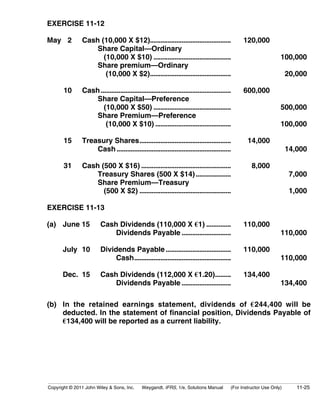
EXERCISE 11-12 
May 2 Cash (10,000 X $12).............................................. 120,000 
Share Capital—Ordinary 
(10,000 X $10) ............................................ 100,000 
Share premium—Ordinary 
(10,000 X $2).............................................. 20,000 
10 Cash.......................................................................... 600,000 
Share Capital—Preference 
(10,000 X $50) ............................................ 500,000 
Share Premium—Preference 
(10,000 X $10) ........................................... 100,000 
15 Treasury Shares.................................................... 14,000 
Cash................................................................. 14,000 
31 Cash (500 X $16) ................................................... 8,000 
Treasury Shares (500 X $14).................... 7,000 
Share Premium—Treasury 
(500 X $2) .................................................... 1,000 
EXERCISE 11-13 
(a) June 15 Cash Dividends (110,000 X €1) .............. 110,000 
Dividends Payable ............................ 110,000 
July 10 Dividends Payable ..................................... 110,000 
Cash....................................................... 110,000 
Dec. 15 Cash Dividends (112,000 X €1.20)......... 134,400 
Dividends Payable ............................ 134,400 
(b) In the retained earnings statement, dividends of €244,400 will be 
deducted. In the statement of financial position, Dividends Payable of 
€134,400 will be reported as a current liability. 
Copyright © 2011 John Wiley & Sons, Inc. Weygandt, IFRS, 1/e, Solutions Manual (For Instructor Use Only) 11-25
EXERCISE 11-14 
1. Share Dividends (24,000* X $18)................................. 432,000 
Ordinary Share Dividends Distributable 
(24,000 X $10)....................................................... 240,000 
Share Premium—Ordinary 
(24,000 X $8)......................................................... 192,000 
*[($1,000,000 ÷ $10) + 60,000] X 15%. 
2. Share Dividends (39,000* X $20)................................. 780,000 
Ordinary Share Dividends Distributable 
(39,000 X $5)......................................................... 195,000 
Share Premium—Ordinary 
(39,000 X $15)....................................................... 585,000 
*[($1,000,000 ÷ 5) + 60,000] X 15%. 
EXERCISE 11-15 
Before 
Action 
After 
Stock 
Dividend 
After 
Stock 
Split 
Equity 
Share capital—ordinary 
Share premium— 
ordinary 
Retained earnings 
Total equity 
CHF 600,000 
0 
900,000 
CHF1,500,000 
CHF 630,000 
12,000 
858,000 
CHF1,500,000 
(1) 
(2) 
CHF 600,000 
0 
900,000 
CHF1,500,000 
Outstanding shares 60,000 63,000 120,000 
(1)3,000 X (CHF14 – CHF10) (2)CHF900,000 – (3,000 X CHF14) 
11-26 Copyright © 2011 John Wiley & Sons, Inc. Weygandt, IFRS, 1/e, Solutions Manual (For Instructor Use Only)
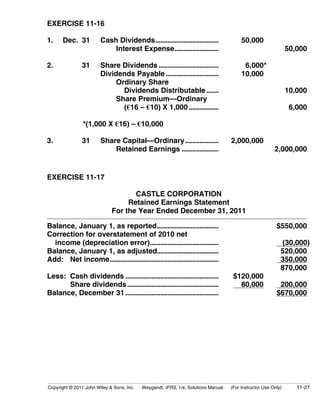
EXERCISE 11-16 
1. Dec. 31 Cash Dividends.................................... 50,000 
Interest Expense......................... 50,000 
2. 31 Share Dividends .................................. 6,000* 
Dividends Payable .............................. 10,000 
Ordinary Share 
Dividends Distributable....... 10,000 
Share Premium—Ordinary 
(€16 – €10) X 1,000 ................. 6,000 
*(1,000 X €16) – €10,000 
3. 31 Share Capital—Ordinary................... 2,000,000 
Retained Earnings ..................... 2,000,000 
EXERCISE 11-17 
CASTLE CORPORATION 
Retained Earnings Statement 
For the Year Ended December 31, 2011 
Balance, January 1, as reported................................... $550,000 
Correction for overstatement of 2010 net 
income (depreciation error)....................................... (30,000) 
Balance, January 1, as adjusted................................... 520,000 
Add: Net income.............................................................. 350,000 
870,000 
Less: Cash dividends ..................................................... $120,000 
Share dividends.................................................... 80,000 200,000 
Balance, December 31 ..................................................... $670,000 
Copyright © 2011 John Wiley & Sons, Inc. Weygandt, IFRS, 1/e, Solutions Manual (For Instructor Use Only) 11-27
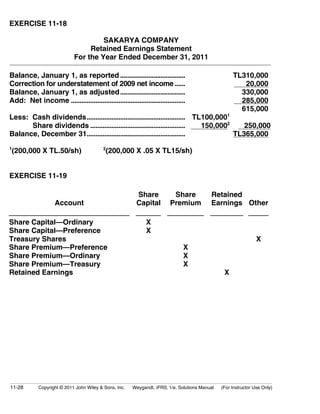
EXERCISE 11-18 
SAKARYA COMPANY 
Retained Earnings Statement 
For the Year Ended December 31, 2011 
Balance, January 1, as reported ..................................... TL310,000 
Correction for understatement of 2009 net income...... 20,000 
Balance, January 1, as adjusted..................................... 330,000 
Add: Net income ................................................................. 285,000 
615,000 
Less: Cash dividends........................................................ TL100,0001 
Share dividends ...................................................... 150,0002 250,000 
Balance, December 31........................................................ TL365,000 
1(200,000 X TL.50/sh) 2(200,000 X .05 X TL15/sh) 
EXERCISE 11-19 
Account 
Share 
Capital 
Share 
Premium 
Retained 
Earnings Other 
Share Capital—Ordinary 
Share Capital—Preference 
Treasury Shares 
Share Premium—Preference 
Share Premium—Ordinary 
Share Premium—Treasury 
Retained Earnings 
XX 
XXX 
X 
X 
11-28 Copyright © 2011 John Wiley & Sons, Inc. Weygandt, IFRS, 1/e, Solutions Manual (For Instructor Use Only)
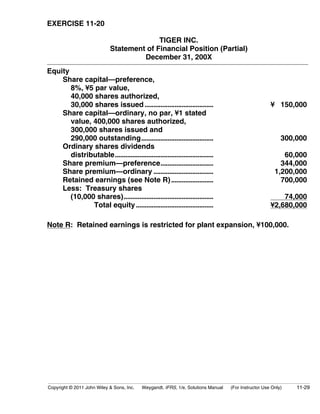
EXERCISE 11-20 
TIGER INC. 
Statement of Financial Position (Partial) 
D e c e m b e r 3 1 , 2 0 0 X 
Equity 
Share capital—preference, 
8%, ¥5 par value, 
40,000 shares authorized, 
30,000 shares issued ....................................... ¥ 150,000 
Share capital—ordinary, no par, ¥1 stated 
value, 400,000 shares authorized, 
300,000 shares issued and 
290,000 outstanding......................................... 300,000 
Ordinary shares dividends 
distributable........................................................ 60,000 
Share premium—preference.............................. 344,000 
Share premium—ordinary .................................. 1,200,000 
Retained earnings (see Note R)........................ 700,000 
Less: Treasury shares 
(10,000 shares)................................................... 74,000 
Total equity ............................................ ¥2,680,000 
Note R: Retained earnings is restricted for plant expansion, ¥100,000. 
Copyright © 2011 John Wiley & Sons, Inc. Weygandt, IFRS, 1/e, Solutions Manual (For Instructor Use Only) 11-29
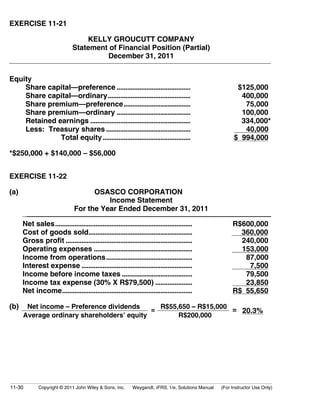
EXERCISE 11-21 
KELLY GROUCUTT COMPANY 
Statement of Financial Position (Partial) 
D e c e m b e r 3 1 , 2 0 1 1 
Equity 
Share capital—preference .......................................... $125,000 
Share capital—ordinary............................................... 400,000 
Share premium—preference...................................... 75,000 
Share premium—ordinary .......................................... 100,000 
Retained earnings ......................................................... 334,000* 
Less: Treasury shares ................................................ 40,000 
Total equity.................................................. $ 994,000 
*$250,000 + $140,000 – $56,000 
EXERCISE 11-22 
(a) OSASCO CORPORATION 
Income Statement 
For the Year Ended December 31, 2011 
__________________________________________________________ 
Net sales.............................................................................. R$600,000 
Cost of goods sold........................................................... 360,000 
Gross profit ........................................................................ 240,000 
Operating expenses ........................................................ 153,000 
Income from operations................................................. 87,000 
Interest expense ............................................................... 7,500 
Income before income taxes ........................................ 79,500 
Income tax expense (30% X R$79,500) ..................... 23,850 
Net income.......................................................................... R$ 55,650 
(b) Net income – Preference dividends R$55,650 – R$15,000 
Average ordinary shareholders’ equity 
= 
R$200,000 
= 20.3% 
11-30 Copyright © 2011 John Wiley & Sons, Inc. Weygandt, IFRS, 1/e, Solutions Manual (For Instructor Use Only)
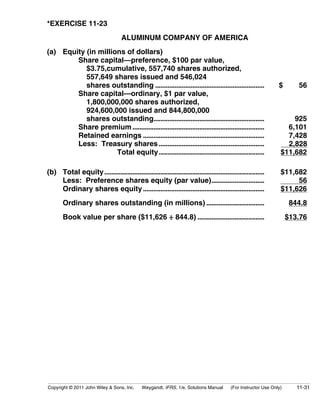
*EXERCISE 11-23 
ALUMINUM COMPANY OF AMERICA 
(a) Equity (in millions of dollars) 
Share capital—preference, $100 par value, 
$3.75,cumulative, 557,740 shares authorized, 
557,649 shares issued and 546,024 
shares outstanding .............................................................. $ 56 
Share capital—ordinary, $1 par value, 
1,800,000,000 shares authorized, 
924,600,000 issued and 844,800,000 
shares outstanding............................................................... 925 
Share premium........................................................................... 6,101 
Retained earnings ..................................................................... 7,428 
Less: Treasury shares ............................................................ 2,828 
Total equity............................................................ $11,682 
(b) Total equity........................................................................................... $11,682 
Less: Preference shares equity (par value).............................. 56 
Ordinary shares equity..................................................................... $11,626 
Ordinary shares outstanding (in millions) ................................. 844.8 
Book value per share ($11,626 ÷ 844.8) ...................................... $13.76 
Copyright © 2011 John Wiley & Sons, Inc. Weygandt, IFRS, 1/e, Solutions Manual (For Instructor Use Only) 11-31
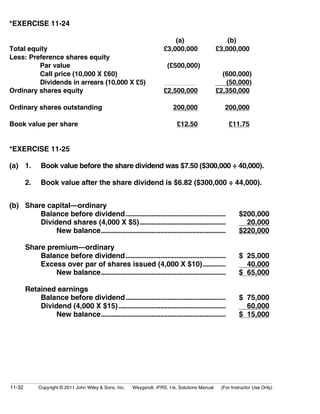
*EXERCISE 11-24 
(a) (b) 
Total equity £3,000,000 £3,000,000 
Less: Preference shares equity 
Par value (£500,000) 
Call price (10,000 X £60) (600,000) 
Dividends in arrears (10,000 X £5) (50,000) 
Ordinary shares equity £2,500,000 £2,350,000 
Ordinary shares outstanding 200,000 200,000 
Book value per share £12.50 £11.75 
*EXERCISE 11-25 
(a) 1. Book value before the share dividend was $7.50 ($300,000 ÷ 40,000). 
2. Book value after the share dividend is $6.82 ($300,000 ÷ 44,000). 
(b) Share capital—ordinary 
Balance before dividend......................................................... $200,000 
Dividend shares (4,000 X $5)................................................. 20,000 
New balance....................................................................... $220,000 
Share premium—ordinary 
Balance before dividend......................................................... $ 25,000 
Excess over par of shares issued (4,000 X $10)............. 40,000 
New balance....................................................................... $ 65,000 
Retained earnings 
Balance before dividend......................................................... $ 75,000 
Dividend (4,000 X $15)............................................................. 60,000 
New balance....................................................................... $ 15,000 
11-32 Copyright © 2011 John Wiley & Sons, Inc. Weygandt, IFRS, 1/e, Solutions Manual (For Instructor Use Only)
SOLUTIONS TO PROBLEMS 
PROBLEM 11-1A 
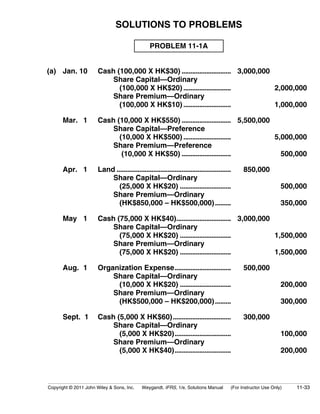
(a) Jan. 10 Cash (100,000 X HK$30) ............................ 3,000,000 
Share Capital—Ordinary 
(100,000 X HK$20) ........................... 2,000,000 
Share Premium—Ordinary 
(100,000 X HK$10) ........................... 1,000,000 
Mar. 1 Cash (10,000 X HK$550) ............................ 5,500,000 
Share Capital—Preference 
(10,000 X HK$500) ........................... 5,000,000 
Share Premium—Preference 
(10,000 X HK$50) ............................ 500,000 
Apr. 1 Land ................................................................. 850,000 
Share Capital—Ordinary 
(25,000 X HK$20) ............................. 500,000 
Share Premium—Ordinary 
(HK$850,000 – HK$500,000)......... 350,000 
May 1 Cash (75,000 X HK$40)............................... 3,000,000 
Share Capital—Ordinary 
(75,000 X HK$20) ............................. 1,500,000 
Share Premium—Ordinary 
(75,000 X HK$20) ............................. 1,500,000 
Aug. 1 Organization Expense................................ 500,000 
Share Capital—Ordinary 
(10,000 X HK$20) ............................. 200,000 
Share Premium—Ordinary 
(HK$500,000 – HK$200,000)......... 300,000 
Sept. 1 Cash (5,000 X HK$60)................................. 300,000 
Share Capital—Ordinary 
(5,000 X HK$20)................................ 100,000 
Share Premium—Ordinary 
(5,000 X HK$40)................................ 200,000 
Copyright © 2011 John Wiley & Sons, Inc. Weygandt, IFRS, 1/e, Solutions Manual (For Instructor Use Only) 11-33
PROBLEM 11-1A (Continued) 
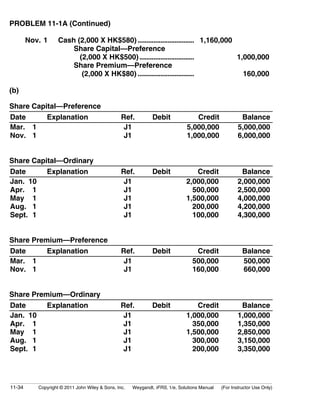
Nov. 1 Cash (2,000 X HK$580) ................................ 1,160,000 
Share Capital—Preference 
(2,000 X HK$500) ............................... 1,000,000 
Share Premium—Preference 
(2,000 X HK$80) ................................ 160,000 
(b) 
Share Capital—Preference 
Date Explanation Ref. Debit Credit Balance 
Mar. 1 
J1 
5,000,000 
5,000,000 
Nov. 1 
J1 
1,000,000 
6,000,000 
Share Capital—Ordinary 
Date Explanation Ref. Debit Credit Balance 
Jan. 10 
J1 
2,000,000 
2,000,000 
Apr. 1 
J1 
500,000 
2,500,000 
May 1 
J1 
1,500,000 
4,000,000 
Aug. 1 
J1 
200,000 
4,200,000 
Sept. 1 
J1 
100,000 
4,300,000 
Share Premium—Preference 
Date Explanation Ref. Debit Credit Balance 
Mar. 1 
J1 
500,000 
500,000 
Nov. 1 
J1 
160,000 
660,000 
Share Premium—Ordinary 
Date Explanation Ref. Debit Credit Balance 
Jan. 10 
Apr. 1 
May 1 
Aug. 1 
Sept. 1 
J1 
J1 
J1 
J1 
J1 
1,000,000 
350,000 
1,500,000 
300,000 
200,000 
1,000,000 
1,350,000 
2,850,000 
3,150,000 
3,350,000 
11-34 Copyright © 2011 John Wiley & Sons, Inc. Weygandt, IFRS, 1/e, Solutions Manual (For Instructor Use Only)
PROBLEM 11-1A (Continued) 
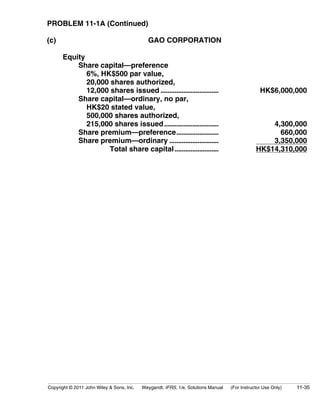
(c) GAO CORPORATION 
Equity 
Share capital—preference 
6%, HK$500 par value, 
20,000 shares authorized, 
12,000 shares issued ................................. HK$6,000,000 
Share capital—ordinary, no par, 
HK$20 stated value, 
500,000 shares authorized, 
215,000 shares issued............................... 4,300,000 
Share premium—preference........................ 660,000 
Share premium—ordinary ............................ 3,350,000 
Total share capital ......................... HK$14,310,000 
Copyright © 2011 John Wiley & Sons, Inc. Weygandt, IFRS, 1/e, Solutions Manual (For Instructor Use Only) 11-35
PROBLEM 11-2A 
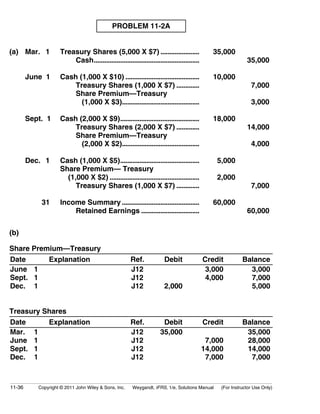
(a) Mar. 1 Treasury Shares (5,000 X $7) ...................... 35,000 
Cash............................................................ 35,000 
June 1 Cash (1,000 X $10) .......................................... 10,000 
Treasury Shares (1,000 X $7) ............. 7,000 
Share Premium—Treasury 
(1,000 X $3)............................................ 3,000 
Sept. 1 Cash (2,000 X $9)............................................. 18,000 
Treasury Shares (2,000 X $7) ............. 14,000 
Share Premium—Treasury 
(2,000 X $2)............................................ 4,000 
Dec. 1 Cash (1,000 X $5)............................................. 5,000 
Share Premium— Treasury 
(1,000 X $2) ................................................... 2,000 
Treasury Shares (1,000 X $7) ............. 7,000 
31 Income Summary ............................................ 60,000 
Retained Earnings ................................. 60,000 
(b) 
Share Premium—Treasury 
Date Explanation Ref. Debit Credit Balance 
June 1 
Sept. 1 
Dec. 1 
J12 
J12 
J12 2,000 
3,000 
4,000 
3,000 
7,000 
5,000 
Treasury Shares 
Date Explanation Ref. Debit Credit Balance 
Mar. 1 
J12 
35,000 
June 1 
J12 
7,000 
Sept. 1 
J12 
14,000 
Dec. 1 
J12 
7,000 
35,000 
28,000 
14,000 
7,000 
11-36 Copyright © 2011 John Wiley & Sons, Inc. Weygandt, IFRS, 1/e, Solutions Manual (For Instructor Use Only)
PROBLEM 11-2A (Continued) 
Retained Earnings 
Date Explanation Ref. Debit Credit Balance 
Jan. 1 
Balance  
100,000 
Dec. 31 
J12 60,000 
160,000 
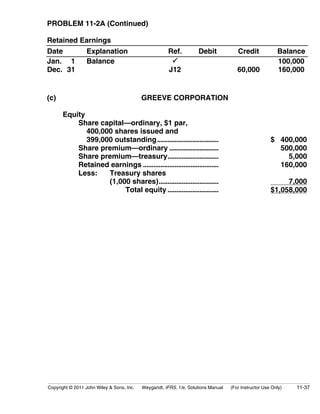
(c) GREEVE CORPORATION 
Equity 
Share capital—ordinary, $1 par, 
400,000 shares issued and 
399,000 outstanding................................... $ 400,000 
Share premium—ordinary ............................ 500,000 
Share premium—treasury............................. 5,000 
Retained earnings ........................................... 160,000 
Less: Treasury shares 
(1,000 shares).................................. 7,000 
Total equity ............................. $1,058,000 
Copyright © 2011 John Wiley  Sons, Inc. Weygandt, IFRS, 1/e, Solutions Manual (For Instructor Use Only) 11-37
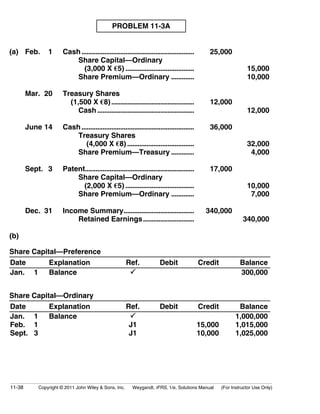
PROBLEM 11-3A 
(a) Feb. 1 Cash................................................................ 25,000 
Share Capital—Ordinary 
(3,000 X €5) ....................................... 15,000 
Share Premium—Ordinary ............. 10,000 
Mar. 20 Treasury Shares 
(1,500 X €8) ............................................... 12,000 
Cash....................................................... 12,000 
June 14 Cash................................................................ 36,000 
Treasury Shares 
(4,000 X €8) ...................................... 32,000 
Share Premium—Treasury ............. 4,000 
Sept. 3 Patent.............................................................. 17,000 
Share Capital—Ordinary 
(2,000 X €5) ....................................... 10,000 
Share Premium—Ordinary ............. 7,000 
Dec. 31 Income Summary........................................ 340,000 
Retained Earnings............................. 340,000 
(b) 
Share Capital—Preference 
Date Explanation Ref. Debit Credit Balance 
Jan. 1 Balance  300,000 
Share Capital—Ordinary 
Date Explanation Ref. Debit Credit Balance 
Jan. 1 
Balance  
Feb. 1 
Sept. 3 
J1 
J1 
15,000 
10,000 
1,000,000 
1,015,000 
1,025,000 
11-38 Copyright © 2011 John Wiley  Sons, Inc. Weygandt, IFRS, 1/e, Solutions Manual (For Instructor Use Only)
PROBLEM 11-3A (Continued) 
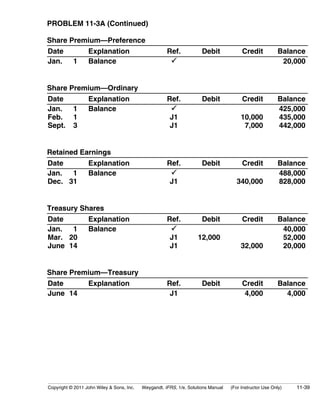
Share Premium—Preference 
Date Explanation Ref. Debit Credit Balance 
Jan. 1 Balance  20,000 
Share Premium—Ordinary 
Date Explanation Ref. Debit Credit Balance 
Jan. 1 
Balance  
425,000 
Feb. 1 
J1 
10,000 
435,000 
Sept. 3 
J1 
7,000 
442,000 
Retained Earnings 
Date Explanation Ref. Debit Credit Balance 
Jan. 1 
Balance  
488,000 
Dec. 31 
J1 340,000 
828,000 
Treasury Shares 
Date Explanation Ref. Debit Credit Balance 
Jan. 1 
Balance  
Mar. 20 
June 14 
J1 
J1 
12,000 
32,000 
40,000 
52,000 
20,000 
Share Premium—Treasury 
Date Explanation Ref. Debit Credit Balance 
June 14 J1 4,000 4,000 
Copyright © 2011 John Wiley  Sons, Inc. Weygandt, IFRS, 1/e, Solutions Manual (For Instructor Use Only) 11-39
PROBLEM 11-3A (Continued) 
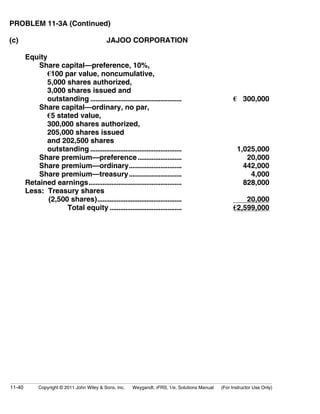
(c) JAJOO CORPORATION 
Equity 
Share capital—preference, 10%, 
€100 par value, noncumulative, 
5,000 shares authorized, 
3,000 shares issued and 
outstanding .................................................... € 300,000 
Share capital—ordinary, no par, 
€5 stated value, 
300,000 shares authorized, 
205,000 shares issued 
and 202,500 shares 
outstanding .................................................... 1,025,000 
Share premium—preference......................... 20,000 
Share premium—ordinary.............................. 442,000 
Share premium—treasury.............................. 4,000 
Retained earnings..................................................... 828,000 
Less: Treasury shares 
(2,500 shares)................................................ 20,000 
Total equity ......................................... €2,599,000 
11-40 Copyright © 2011 John Wiley  Sons, Inc. Weygandt, IFRS, 1/e, Solutions Manual (For Instructor Use Only)
PROBLEM 11-4A 
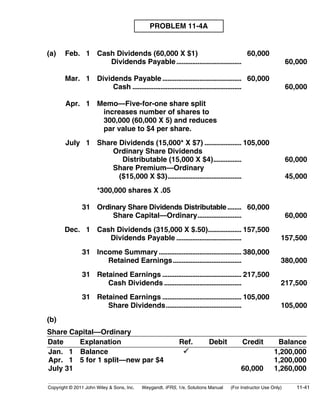
(a) Feb. 1 Cash Dividends (60,000 X $1) 60,000 
Dividends Payable..................................... 60,000 
Mar. 1 Dividends Payable ............................................. 60,000 
Cash .............................................................. 60,000 
Apr. 1 Memo—Five-for-one share split 
increases number of shares to 
300,000 (60,000 X 5) and reduces 
par value to $4 per share. 
July 1 Share Dividends (15,000* X $7) ..................... 105,000 
Ordinary Share Dividends 
Distributable (15,000 X $4)................ 60,000 
Share Premium—Ordinary 
($15,000 X $3).......................................... 45,000 
*300,000 shares X .05 
31 Ordinary Share Dividends Distributable........ 60,000 
Share Capital—Ordinary......................... 60,000 
Dec. 1 Cash Dividends (315,000 X $.50)................... 157,500 
Dividends Payable ..................................... 157,500 
31 Income Summary ............................................... 380,000 
Retained Earnings....................................... 380,000 
31 Retained Earnings ............................................. 217,500 
Cash Dividends ............................................ 217,500 
31 Retained Earnings ............................................. 105,000 
Share Dividends........................................... 105,000 
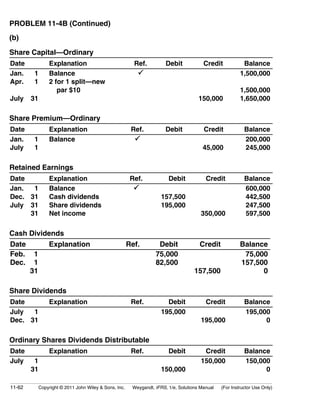
(b) 
Share Capital—Ordinary 
Date Explanation Ref. Debit Credit Balance 
Jan. 1 Balance  1,200,000 
Apr. 1 5 for 1 split—new par $4 1,200,000 
July 31 60,000 1,260,000 
Copyright © 2011 John Wiley  Sons, Inc. Weygandt, IFRS, 1/e, Solutions Manual (For Instructor Use Only) 11-41
PROBLEM 11-4A (Continued) 
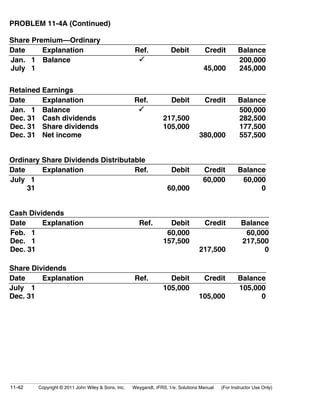
Share Premium—Ordinary 
Date Explanation Ref. Debit Credit Balance 
Jan. 1 Balance  200,000 
July 1 45,000 245,000 
Retained Earnings 
Date Explanation Ref. Debit Credit Balance 
Jan. 1 Balance  500,000 
Dec. 31 Cash dividends 217,500 282,500 
Dec. 31 Share dividends 105,000 177,500 
Dec. 31 Net income 380,000 557,500 
Ordinary Share Dividends Distributable 
Date Explanation Ref. Debit Credit Balance 
July 1 60,000 60,000 
31 60,000 0 
Cash Dividends 
Date Explanation Ref. Debit Credit Balance 
Feb. 1 60,000 60,000 
Dec. 1 157,500 217,500 
Dec. 31 217,500 0 
Share Dividends 
Date Explanation Ref. Debit Credit Balance 
July 1 105,000 105,000 
Dec. 31 105,000 0 
11-42 Copyright © 2011 John Wiley  Sons, Inc. Weygandt, IFRS, 1/e, Solutions Manual (For Instructor Use Only)
PROBLEM 11-4A (Continued) 
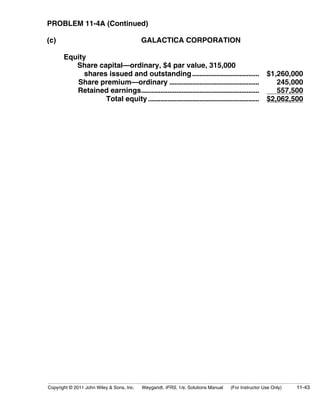
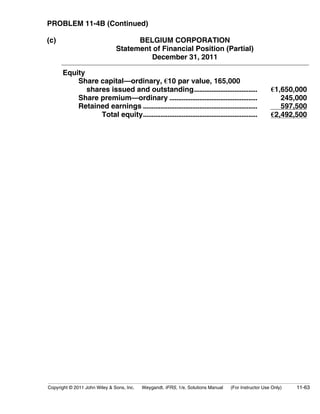
(c) GALACTICA CORPORATION 
Equity 
Share capital—ordinary, $4 par value, 315,000 
shares issued and outstanding...................................... $1,260,000 
Share premium—ordinary ................................................... 245,000 
Retained earnings................................................................... 557,500 
Total equity ............................................................... $2,062,500 
Copyright © 2011 John Wiley  Sons, Inc. Weygandt, IFRS, 1/e, Solutions Manual (For Instructor Use Only) 11-43
PROBLEM 11-5A 
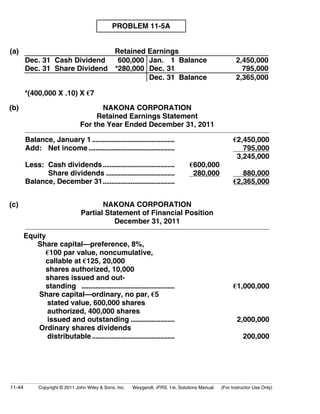
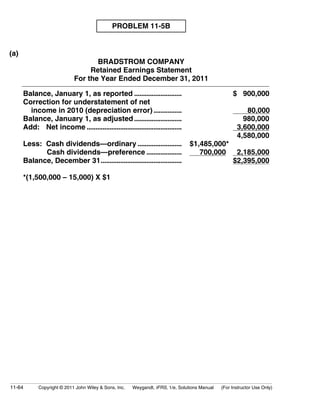
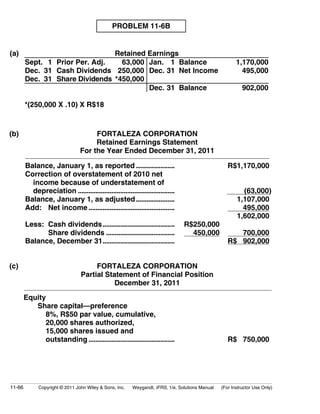
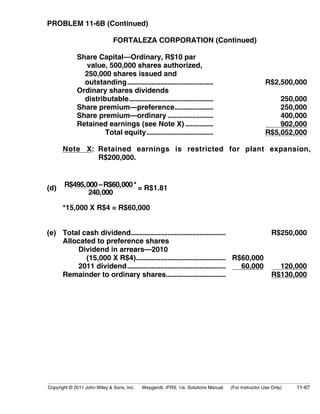
(a) Retained Earnings 
Dec. 31 Cash Dividend 600,000 
Dec. 31 Share Dividend *280,000 
Jan. 1 Balance 2,450,000 
Dec. 31 795,000 
Dec. 31 Balance 2,365,000 
*(400,000 X .10) X €7 
(b) NAKONA CORPORATION 
Retained Earnings Statement 
For the Year Ended December 31, 2011 
Balance, January 1 ............................................... €2,450,000 
Add: Net income ................................................. 795,000 
3,245,000 
Less: Cash dividends......................................... €600,000 
Share dividends ....................................... 280,000 880,000 
Balance, December 31......................................... €2,365,000 
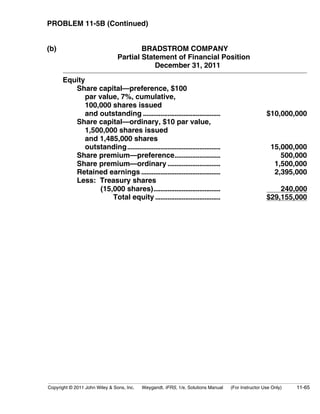
(c) NAKONA CORPORATION 
Partial Statement of Financial Position 
December 31, 2011 
Equity 
Share capital—preference, 8%, 
€100 par value, noncumulative, 
callable at €125, 20,000 
shares authorized, 10,000 
shares issued and out-standing 
..................................................... €1,000,000 
Share capital—ordinary, no par, €5 
stated value, 600,000 shares 
authorized, 400,000 shares 
issued and outstanding ......................... 2,000,000 
Ordinary shares dividends 
distributable ............................................... 200,000 
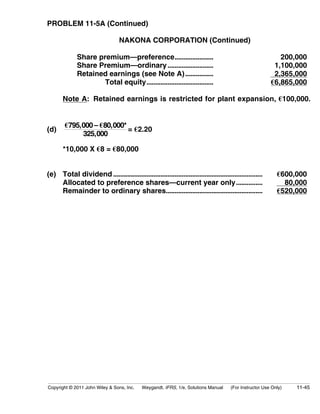
11-44 Copyright © 2011 John Wiley  Sons, Inc. Weygandt, IFRS, 1/e, Solutions Manual (For Instructor Use Only)
PROBLEM 11-5A (Continued) 
NAKONA CORPORATION (Continued) 
Share premium—preference...................... 200,000 
Share Premium—ordinary.......................... 1,100,000 
Retained earnings (see Note A)................ 2,365,000 
Total equity...................................... €6,865,000 
Note A: Retained earnings is restricted for plant expansion, €100,000. 
(d) €795,000– €80,000* 
325,000 = €2.20 
*10,000 X €8 = €80,000 
(e) Total dividend ..................................................................................... €600,000 
Allocated to preference shares—current year only............... 80,000 
Remainder to ordinary shares....................................................... €520,000 
Copyright © 2011 John Wiley  Sons, Inc. Weygandt, IFRS, 1/e, Solutions Manual (For Instructor Use Only) 11-45
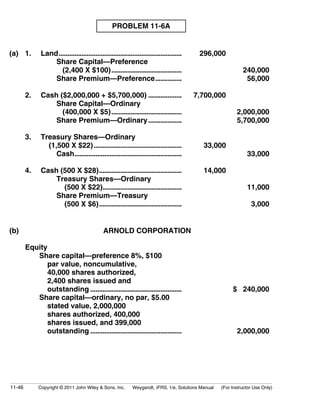
PROBLEM 11-6A 
(a) 1. Land...................................................................... 296,000 
Share Capital—Preference 
(2,400 X $100)........................................ 240,000 
Share Premium—Preference............... 56,000 
2. Cash ($2,000,000 + $5,700,000) ................... 7,700,000 
Share Capital—Ordinary 
(400,000 X $5)........................................ 2,000,000 
Share Premium—Ordinary................... 5,700,000 
3. Treasury Shares—Ordinary 
(1,500 X $22) .................................................. 33,000 
Cash............................................................. 33,000 
4. Cash (500 X $28)............................................... 14,000 
Treasury Shares—Ordinary 
(500 X $22)............................................. 11,000 
Share Premium—Treasury 
(500 X $6)............................................... 3,000 
(b) ARNOLD CORPORATION 
Equity 
Share capital—preference 8%, $100 
par value, noncumulative, 
40,000 shares authorized, 
2,400 shares issued and 
outstanding .................................................... $ 240,000 
Share capital—ordinary, no par, $5.00 
stated value, 2,000,000 
shares authorized, 400,000 
shares issued, and 399,000 
outstanding .................................................... 2,000,000 
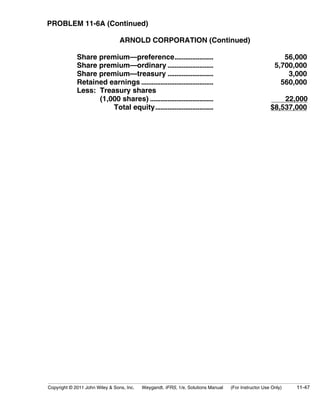
11-46 Copyright © 2011 John Wiley  Sons, Inc. Weygandt, IFRS, 1/e, Solutions Manual (For Instructor Use Only)
PROBLEM 11-6A (Continued) 
ARNOLD CORPORATION (Continued) 
Share premium—preference...................... 56,000 
Share premium—ordinary .......................... 5,700,000 
Share premium—treasury .......................... 3,000 
Retained earnings ......................................... 560,000 
Less: Treasury shares 
(1,000 shares) .................................... 22,000 
Total equity................................. $8,537,000 
Copyright © 2011 John Wiley  Sons, Inc. Weygandt, IFRS, 1/e, Solutions Manual (For Instructor Use Only) 11-47
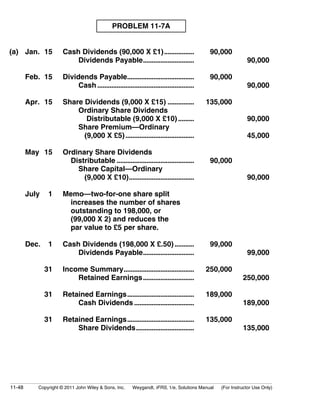
PROBLEM 11-7A 
(a) Jan. 15 Cash Dividends (90,000 X £1)................. 90,000 
Dividends Payable............................. 90,000 
Feb. 15 Dividends Payable...................................... 90,000 
Cash....................................................... 90,000 
Apr. 15 Share Dividends (9,000 X £15) ............... 135,000 
Ordinary Share Dividends 
Distributable (9,000 X £10) ......... 90,000 
Share Premium—Ordinary 
(9,000 X £5) ....................................... 45,000 
May 15 Ordinary Share Dividends 
Distributable ............................................ 90,000 
Share Capital—Ordinary 
(9,000 X £10)..................................... 90,000 
July 1 Memo—two-for-one share split 
increases the number of shares 
outstanding to 198,000, or 
(99,000 X 2) and reduces the 
par value to £5 per share. 
Dec. 1 Cash Dividends (198,000 X £.50) ........... 99,000 
Dividends Payable............................. 99,000 
31 Income Summary........................................ 250,000 
Retained Earnings............................. 250,000 
31 Retained Earnings...................................... 189,000 
Cash Dividends .................................. 189,000 
31 Retained Earnings...................................... 135,000 
Share Dividends................................. 135,000 
11-48 Copyright © 2011 John Wiley  Sons, Inc. Weygandt, IFRS, 1/e, Solutions Manual (For Instructor Use Only)
PROBLEM 11-7A (Continued) 
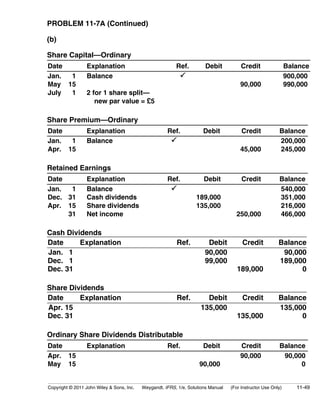
(b) 
Share Capital—Ordinary 
Date Explanation Ref. Debit Credit Balance 
Jan. 1 
Balance 
May 15 
July 1 
2 for 1 share split— 
new par value = £5 
 
90,000 
900,000 
990,000 
Share Premium—Ordinary 
Date Explanation Ref. Debit Credit Balance 
Jan. 1 
Balance  
Apr. 15 
45,000 
200,000 
245,000 
Retained Earnings 
Date Explanation Ref. Debit Credit Balance 
Jan. 1 
Dec. 31 
Apr. 15 
31 
Balance 
Cash dividends 
Share dividends 
Net income 
 
189,000 
135,000 
250,000 
540,000 
351,000 
216,000 
466,000 
Cash Dividends 
Date Explanation Ref. Debit Credit Balance 
Jan. 1 90,000 90,000 
Dec. 1 99,000 189,000 
Dec. 31 189,000 0 
Share Dividends 
Date Explanation Ref. Debit Credit Balance 
Apr. 15 135,000 135,000 
Dec. 31 135,000 0 
Ordinary Share Dividends Distributable 
Date Explanation Ref. Debit Credit Balance 
Apr. 15 
May 15 90,000 
90,000 90,000 
0 
Copyright © 2011 John Wiley  Sons, Inc. Weygandt, IFRS, 1/e, Solutions Manual (For Instructor Use Only) 11-49
PROBLEM 11-7A (Continued) 
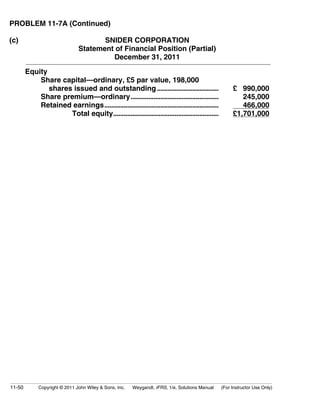
(c) SNIDER CORPORATION 
Statement of Financial Position (Partial) 
D e c e m b e r 3 1 , 2 0 1 1 
Equity 
Share capital—ordinary, £5 par value, 198,000 
shares issued and outstanding ................................... £ 990,000 
Share premium—ordinary.................................................. 245,000 
Retained earnings................................................................. 466,000 
Total equity............................................................ £1,701,000 
11-50 Copyright © 2011 John Wiley  Sons, Inc. Weygandt, IFRS, 1/e, Solutions Manual (For Instructor Use Only)
PROBLEM 11-8A 
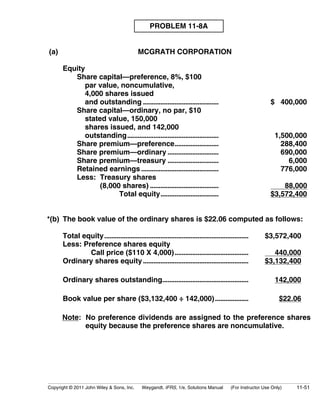
(a) MCGRATH CORPORATION 
Equity 
Share capital—preference, 8%, $100 
par value, noncumulative, 
4,000 shares issued 
and outstanding ........................................... $ 400,000 
Share capital—ordinary, no par, $10 
stated value, 150,000 
shares issued, and 142,000 
outstanding.................................................... 1,500,000 
Share premium—preference......................... 288,400 
Share premium—ordinary ............................. 690,000 
Share premium—treasury ............................. 6,000 
Retained earnings ............................................ 776,000 
Less: Treasury shares 
(8,000 shares) ....................................... 88,000 
Total equity................................. $3,572,400 
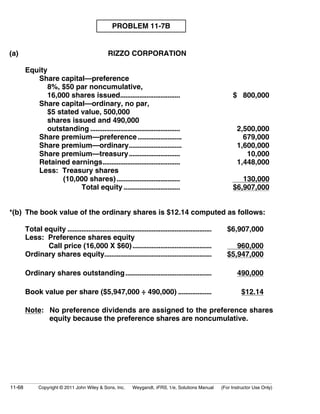
*(b) The book value of the ordinary shares is $22.06 computed as follows: 
Total equity.................................................................................. $3,572,400 
Less: Preference shares equity 
Call price ($110 X 4,000).......................................... 440,000 
Ordinary shares equity............................................................ $3,132,400 
Ordinary shares outstanding................................................. 142,000 
Book value per share ($3,132,400 ÷ 142,000)................... $22.06 
Note: No preference dividends are assigned to the preference shares 
equity because the preference shares are noncumulative. 
Copyright © 2011 John Wiley  Sons, Inc. Weygandt, IFRS, 1/e, Solutions Manual (For Instructor Use Only) 11-51
*PROBLEM 11-9A 
HAMBLIN INC. 
Statement of Changes in Equity 
For the Year Ending December 31, 2011 
(in thousands, except shares) 
Ordinary 
Shares 
Share 
Premium 
Ordinary 
Share 
Dividends 
Distributable 
Treasury 
Shares 
Retained 
Earnings Total 
Balances, Jan. 1 CHF1,000 CHF500 CHF100 CHF 0 CHF 600 CHF 2,200 
Issued 50,000 shares 
for share dividend 100 (100) 0 
Issued 30,000 
shares for cash 60 90 150 
Purchased 25,000 
treasury shares (150) (150) 
Declared cash 
dividend (111) (111) 
Sold 8,000 treasury 
shares 48 48 
Net income for year 360 360 
Balances, Dec. 31 CHF1,160 CHF590 CHF 0 CHF(102) CHF849 CHF2,497 
11-52 Copyright © 2011 John Wiley  Sons, Inc. Weygandt, IFRS, 1/e, Solutions Manual (For Instructor Use Only)
PROBLEM 11-1B 
(a) Jan. 10 Cash (80,000 X $4)....................................... 320,000 
Share Capital—Ordinary 
(80,000 X $3)...................................... 240,000 
Share Premium—Ordinary 
(80,000 X $1)...................................... 80,000 
Mar. 1 Cash (5,000 X $105)..................................... 525,000 
Share Capital—Preference 
(5,000 X $100) ................................... 500,000 
Share Premium—Preference 
(5,000 X $5)....................................... 25,000 
Apr. 1 Land ................................................................. 85,000 
Share Capital—Ordinary 
(24,000 X $3)...................................... 72,000 
Share Premium—Ordinary 
($85,000 – $72,000).......................... 13,000 
May 1 Cash (80,000 X $4.50) ................................. 360,000 
Share Capital—Ordinary 
(80,000 X $3)...................................... 240,000 
Share Premium—Ordinary 
(80,000 X $1.50) ................................ 120,000 
Aug. 1 Organization Expense................................ 40,000 
Share Capital—Ordinary 
(10,000 X $3)...................................... 30,000 
Share Premium—Ordinary 
($40,000 – $30,000).......................... 10,000 
Sept. 1 Cash (10,000 X $5)....................................... 50,000 
Share Capital—Ordinary 
(10,000 X $3)...................................... 30,000 
Share Premium—Ordinary 
(10,000 X $2)...................................... 20,000 
Copyright © 2011 John Wiley  Sons, Inc. Weygandt, IFRS, 1/e, Solutions Manual (For Instructor Use Only) 11-53
PROBLEM 11-1B (Continued) 
Nov. 1 Cash (1,000 X $109) ...................................... 109,000 
Share Capital—Preference 
(1,000 X $100) ..................................... 100,000 
Share Premium—Preference 
(1,000 X $9)......................................... 9,000 
(b) 
Share Capital—Preference 
Date Explanation Ref. Debit Credit Balance 
Mar. 1 
J5 
500,000 
500,000 
Nov. 1 
J5 
100,000 
600,000 
Share Capital—Ordinary 
Date Explanation Ref. Debit Credit Balance 
Jan. 10 
Apr. 1 
May 1 
Aug. 1 
Sept. 1 
J5 
J5 
J5 
J5 
J5 
240,000 
72,000 
240,000 
30,000 
30,000 
240,000 
312,000 
552,000 
582,000 
612,000 
Share Premium—Preference 
Date Explanation Ref. Debit Credit Balance 
Mar. 1 
J5 
25,000 
Nov. 1 
J5 
9,000 
25,000 
34,000 
Share Premium—Ordinary 
Date Explanation Ref. Debit Credit Balance 
Jan. 10 
J5 
80,000 
Apr. 1 
J5 
13,000 
May 1 
J5 
120,000 
Aug. 1 
J5 
10,000 
Sept. 1 
J5 
20,000 
80,000 
93,000 
213,000 
223,000 
243,000 
11-54 Copyright © 2011 John Wiley  Sons, Inc. Weygandt, IFRS, 1/e, Solutions Manual (For Instructor Use Only)
PROBLEM 11-1B (Continued) 
(c) KEELER CORPORATION 
Equity 
Share capital—preference, 8%, 
$100 par value, 10,000 shares 
authorized, 6,000 shares 
issued.............................................................. $ 600,000 
Share capital—ordinary, no par, $3 
stated value, 500,000 shares 
authorized, 204,000 shares 
issued.............................................................. 612,000 
Share premium—preference........................ 34,000 
Share premium—ordinary ............................ 243,000 
Total share capital ......................... $1,489,000 
Copyright © 2011 John Wiley  Sons, Inc. Weygandt, IFRS, 1/e, Solutions Manual (For Instructor Use Only) 11-55
PROBLEM 11-2B 
(a) Mar. 1 Treasury Shares (5,000 X £8) ...................... 40,000 
Cash............................................................ 40,000 
June 1 Cash (1,000 X £12) .......................................... 12,000 
Treasury Shares (1,000 X £8) ............. 8,000 
Share Premium—Treasury 
(1,000 X £4)............................................ 4,000 
Sept. 1 Cash (2,000 X £10) .......................................... 20,000 
Treasury Shares (2,000 X £8) ............. 16,000 
Share Premium—Treasury 
(2,000 X £2)............................................ 4,000 
Dec. 1 Cash (1,000 X £6)............................................. 6,000 
Share Premium—Treasury 
(1,000 X £2) ................................................... 2,000 
Treasury Shares (1,000 X £8) ............. 8,000 
31 Income Summary ............................................ 40,000 
Retained Earnings ................................. 40,000 
(b) 
Share Premium—Treasury 
Date Explanation Ref. Debit Credit Balance 
June 1 
Sept. 1 
Dec. 1 
J10 
J10 
J10 2,000 
4,000 
4,000 
4,000 
8,000 
6,000 
Treasury Shares 
Date Explanation Ref. Debit Credit Balance 
Mar. 1 
J10 
40,000 
June 1 
J10 
8,000 
Sept. 1 
J10 
16,000 
Dec. 1 
J10 
8,000 
40,000 
32,000 
16,000 
8,000 
11-56 Copyright © 2011 John Wiley  Sons, Inc. Weygandt, IFRS, 1/e, Solutions Manual (For Instructor Use Only)
PROBLEM 11-2B (Continued) 
Retained Earnings 
Date Explanation Ref. Debit Credit Balance 
Jan. 1 
Balance  
100,000 
Dec. 31 
J10 40,000 
140,000 
(c) GOLDBERG CORPORATION 
Equity 
Share capital—ordinary, £5 par, 
100,000 shares issued and 
99,000 outstanding ..................................... £500,000 
Share premium—ordinary ............................ 200,000 
Share premium—treasury............................. 6,000 
Retained earnings ........................................... 140,000 
Less: Treasury shares 
(1,000 shares) ...................................... 8,000 
Total equity ............................. £838,000 
Copyright © 2011 John Wiley  Sons, Inc. Weygandt, IFRS, 1/e, Solutions Manual (For Instructor Use Only) 11-57
PROBLEM 11-3B 
(a) Feb. 1 Cash ................................................................. 100,000 
Share Capital—Ordinary 
(25,000 X $1)...................................... 25,000 
Share Premium—Ordinary 
($100,000 – $25,000) ....................... 75,000 
Apr. 14 Cash ................................................................. 33,000 
Treasury Shares 
(6,000 X $4) ....................................... 24,000 
Share Premium—Treasury 
($33,000 – $24,000)......................... 9,000 
Sept. 3 Patent............................................................... 30,000 
Share Capital—Ordinary 
(5,000 X $1) ........................................ 5,000 
Share Premium—Ordinary 
($30,000 – $5,000) ............................ 25,000 
Nov. 10 Treasury Shares........................................... 6,000 
Cash ........................................................ 6,000 
Dec. 31 Income Summary......................................... 452,000 
Retained Earnings .............................. 452,000 
(b) 
Share Capital—Preference 
Date Explanation Ref. Debit Credit Balance 
Jan. 1 Balance  400,000 
Share Capital—Ordinary 
Date Explanation Ref. Debit Credit Balance 
Jan. 1 
Balance  
1,000,000 
Feb. 1 
J5 
25,000 
1,025,000 
Sept. 3 
J5 
5,000 
1,030,000 
11-58 Copyright © 2011 John Wiley  Sons, Inc. Weygandt, IFRS, 1/e, Solutions Manual (For Instructor Use Only)
PROBLEM 11-3B (Continued) 
Share Premium—Preference 
Date Explanation Ref. Debit Credit Balance 
Jan. 1 Balance  100,000 
Share Premium—Ordinary 
Date Explanation Ref. Debit Credit Balance 
Jan. 1 
Balance  
1,450,000 
Feb. 1 
J5 
75,000 
1,525,000 
Sept. 3 
J5 
25,000 
1,550,000 
Retained Earnings 
Date Explanation Ref. Debit Credit Balance 
Jan. 1 
Balance  
1,816,000 
Dec. 31 
J5 452,000 
2,268,000 
Treasury Shares 
Date Explanation Ref. Debit Credit Balance 
Jan. 1 
Balance  
Apr. 14 
Nov. 10 
J5 
J5 6,000 
24,000 
40,000 
16,000 
22,000 
Share Premium—Treasury 
Date Explanation Ref. Debit Credit Balance 
Apr. 14 J5 9,000 9,000 
Copyright © 2011 John Wiley  Sons, Inc. Weygandt, IFRS, 1/e, Solutions Manual (For Instructor Use Only) 11-59
PROBLEM 11-3B (Continued) 
(c) PORT CORPORATION 
Equity 
Share capital—preference, 8%, 
$50 par value, cumulative, 
10,000 shares authorized, 
8,000 shares issued and 
outstanding ................................................... $ 400,000 
Share capital—ordinary, no par, 
$1 stated value, 
2,000,000 shares authorized, 
1,030,000 shares issued 
and 1,025,000 shares 
outstanding ................................................... 1,030,000 
Share premium—preference........................ 100,000 
Share premium—ordinary............................ 1,550,000 
Share premium—treasury............................. 9,000 
Retained earnings (see Note X)................... 2,268,000 
Less: Treasury shares 
(5,000 shares)....................................... 22,000 
Total equity ................................ $5,335,000 
Note X: Dividends on preference shares totaling $32,000 [8,000 X 
(8% X $50)] are in arrears. 
11-60 Copyright © 2011 John Wiley  Sons, Inc. Weygandt, IFRS, 1/e, Solutions Manual (For Instructor Use Only)
PROBLEM 11-4B 
(a) Feb. 1 Cash Dividends (75,000 X €1)................. 75,000 
Dividends Payable ............................ 75,000 
Mar. 1 Dividends Payable ..................................... 75,000 
Cash....................................................... 75,000 
Apr. 1 Memo—two-for-one share split 
increases number of shares to 
150,000 = (75,000 X 2) and reduces 
par value to €10 per share. 
July 1 Share Dividends (15,000 X €13) ............. 195,000 
Ordinary Share Dividends 
Distributable (15,000 X €10)....... 150,000 
Share Premium—Ordinary 
(15,000 X €3) .................................... 45,000 
31 Ordinary Share Dividends 
Distributable............................................ 150,000 
Share Capital—Ordinary................. 150,000 
Dec. 1 Cash Dividends (165,000 X €.50)........... 82,500 
Dividends Payable ............................ 82,500 
31 Income Summary ....................................... 350,000 
Retained Earnings ............................ 350,000 
31 Retained Earnings ..................................... 157,500 
Cash Dividends.................................. 157,500 
31 Retained Earnings ..................................... 195,000 
Share Dividends ................................ 195,000 
Copyright © 2011 John Wiley  Sons, Inc. Weygandt, IFRS, 1/e, Solutions Manual (For Instructor Use Only) 11-61
PROBLEM 11-4B (Continued) 
(b) 
Share Capital—Ordinary 
Date Explanation Ref. Debit Credit Balance 
Jan. 1 
Apr. 1 
July 31 
Balance 
2 for 1 split—new 
par $10 
 
150,000 
1,500,000 
1,500,000 
1,650,000 
Share Premium—Ordinary 
Date Explanation Ref. Debit Credit Balance 
Jan. 1 
Balance  
July 1 
45,000 
200,000 
245,000 
Retained Earnings 
Date Explanation Ref. Debit Credit Balance 
Jan. 1 
Dec. 31 
July 31 
31 
Balance 
Cash dividends 
Share dividends 
Net income 
 
157,500 
195,000 
350,000 
600,000 
442,500 
247,500 
597,500 
Cash Dividends 
Date Explanation Ref. Debit Credit Balance 
Feb. 1 
Dec. 1 
31 
75,000 
82,500 
157,500 
75,000 
157,500 
0 
Share Dividends 
Date Explanation Ref. Debit Credit Balance 
July 1 
195,000 
Dec. 31 
195,000 
195,000 
0 
Ordinary Shares Dividends Distributable 
Date Explanation Ref. Debit Credit Balance 
July 1 
31 150,000 
150,000 150,000 
0 
11-62 Copyright © 2011 John Wiley  Sons, Inc. Weygandt, IFRS, 1/e, Solutions Manual (For Instructor Use Only)
PROBLEM 11-4B (Continued) 
(c) BELGIUM CORPORATION 
Statement of Financial Position (Partial) 
December 31, 2011 
Equity 
Share capital—ordinary, €10 par value, 165,000 
shares issued and outstanding.................................... €1,650,000 
Share premium—ordinary .................................................. 245,000 
Retained earnings ................................................................. 597,500 
Total equity................................................................. €2,492,500 
Copyright © 2011 John Wiley  Sons, Inc. Weygandt, IFRS, 1/e, Solutions Manual (For Instructor Use Only) 11-63
PROBLEM 11-5B 
(a) 
BRADSTROM COMPANY 
Retained Earnings Statement 
For the Year Ended December 31, 2011 
Balance, January 1, as reported ........................... $ 900,000 
Correction for understatement of net 
income in 2010 (depreciation error) ................ 80,000 
Balance, January 1, as adjusted ........................... 980,000 
Add: Net income ...................................................... 3,600,000 
4,580,000 
Less: Cash dividends—ordinary ......................... $1,485,000* 
Cash dividends—preference .................... 700,000 2,185,000 
Balance, December 31.............................................. $2,395,000 
*(1,500,000 – 15,000) X $1 
11-64 Copyright © 2011 John Wiley  Sons, Inc. Weygandt, IFRS, 1/e, Solutions Manual (For Instructor Use Only)
PROBLEM 11-5B (Continued) 
(b) BRADSTROM COMPANY 
Partial Statement of Financial Position 
D e c e m b e r 3 1 , 2 0 1 1 
Equity 
Share capital—preference, $100 
par value, 7%, cumulative, 
100,000 shares issued 
and outstanding ............................................ $10,000,000 
Share capital—ordinary, $10 par value, 
1,500,000 shares issued 
and 1,485,000 shares 
outstanding..................................................... 15,000,000 
Share premium—preference.......................... 500,000 
Share premium—ordinary .............................. 1,500,000 
Retained earnings ............................................. 2,395,000 
Less: Treasury shares 
(15,000 shares)...................................... 240,000 
Total equity ..................................... $29,155,000 
Copyright © 2011 John Wiley  Sons, Inc. Weygandt, IFRS, 1/e, Solutions Manual (For Instructor Use Only) 11-65
PROBLEM 11-6B 
(a) Retained Earnings 
Sept. 1 Prior Per. Adj. 63,000 
Dec. 31 Cash Dividends 250,000 
Dec. 31 Share Dividends *450,000 
Jan. 1 Balance 1,170,000 
Dec. 31 Net Income 495,000 
Dec. 31 Balance 902,000 
*(250,000 X .10) X R$18 
(b) FORTALEZA CORPORATION 
Retained Earnings Statement 
For the Year Ended December 31, 2011 
Balance, January 1, as reported ...................... R$1,170,000 
Correction of overstatement of 2010 net 
income because of understatement of 
depreciation ....................................................... (63,000) 
Balance, January 1, as adjusted...................... 1,107,000 
Add: Net income ................................................. 495,000 
1,602,000 
Less: Cash dividends......................................... R$250,000 
Share dividends ....................................... 450,000 700,000 
Balance, December 31......................................... R$ 902,000 
(c) FORTALEZA CORPORATION 
Partial Statement of Financial Position 
D e c e m b e r 3 1 , 2 0 1 1 
Equity 
Share capital—preference 
8%, R$50 par value, cumulative, 
20,000 shares authorized, 
15,000 shares issued and 
outstanding ................................................. R$ 750,000 
11-66 Copyright © 2011 John Wiley  Sons, Inc. Weygandt, IFRS, 1/e, Solutions Manual (For Instructor Use Only)
PROBLEM 11-6B (Continued) 
FORTALEZA CORPORATION (Continued) 
Share Capital—Ordinary, R$10 par 
value, 500,000 shares authorized, 
250,000 shares issued and 
outstanding................................................. R$2,500,000 
Ordinary shares dividends 
distributable................................................ 250,000 
Share premium—preference...................... 250,000 
Share premium—ordinary .......................... 400,000 
Retained earnings (see Note X) ................ 902,000 
Total equity...................................... R$5,052,000 
Note X: Retained earnings is restricted for plant expansion, 
R$200,000. 
(d) R$495,000 –R$60,000* 
240,000 = R$1.81 
*15,000 X R$4 = R$60,000 
(e) Total cash dividend...................................................... R$250,000 
Allocated to preference shares 
Dividend in arrears—2010 
(15,000 X R$4)................................................... R$60,000 
2011 dividend........................................................ 60,000 120,000 
Remainder to ordinary shares.................................. R$130,000 
Copyright © 2011 John Wiley  Sons, Inc. Weygandt, IFRS, 1/e, Solutions Manual (For Instructor Use Only) 11-67
PROBLEM 11-7B 
(a) RIZZO CORPORATION 
Equity 
Share capital—preference 
8%, $50 par noncumulative, 
16,000 shares issued.................................. $ 800,000 
Share capital—ordinary, no par, 
$5 stated value, 500,000 
shares issued and 490,000 
outstanding ................................................... 2,500,000 
Share premium—preference......................... 679,000 
Share premium—ordinary.............................. 1,600,000 
Share premium—treasury............................. 10,000 
Retained earnings............................................ 1,448,000 
Less: Treasury shares 
(10,000 shares) .................................... 130,000 
Total equity ................................ $6,907,000 
*(b) The book value of the ordinary shares is $12.14 computed as follows: 
Total equity .................................................................................. $6,907,000 
Less: Preference shares equity 
Call price (16,000 X $60) ............................................. 960,000 
Ordinary shares equity............................................................. $5,947,000 
Ordinary shares outstanding................................................. 490,000 
Book value per share ($5,947,000 ÷ 490,000) ................... $12.14 
Note: No preference dividends are assigned to the preference shares 
equity because the preference shares are noncumulative. 
11-68 Copyright © 2011 John Wiley  Sons, Inc. Weygandt, IFRS, 1/e, Solutions Manual (For Instructor Use Only)
COMPREHENSIVE PROBLEM SOLUTION 
(a) 1. Cash ............................................................................ 
Share Capital—Preference.......................... 
Share Premium—Preference...................... 
33,000 
30,000 
3,000 
2. Cash ............................................................................ 
Share Capital—Ordinary.............................. 
Share Premium—Ordinary.......................... 
21,000 
9,000 
12,000 
3. Accounts Receivable............................................. 
Service Revenue............................................. 
280,000 
280,000 
4. Cash ............................................................................ 
Unearned Service Revenue ........................ 
36,000 
36,000 
5. Cash ............................................................................ 
Accounts Receivable.................................... 
267,000 
267,000 
6. Supplies ..................................................................... 
Account Payable ............................................ 
35,100 
35,100 
7. Accounts Payable................................................... 
Cash.................................................................... 
32,200 
32,200 
8. Treasury Shares ...................................................... 
Cash.................................................................... 
15,200 
15,200 
9. Other Operating Expenses .................................. 
Cash.................................................................... 
188,200 
188,200 
10. Cash Dividends (£2,100 + £10,200*).................. 
Dividends Payable ......................................... 
12,300 
12,300 
11. Allowance for Doubtful Accounts ..................... 
Accounts Receivable.................................... 
1,300 
1,300 
*[(£80,000 ÷ £10) + 900 – 400] X £1.20 
Copyright © 2011 John Wiley  Sons, Inc. Weygandt, IFRS, 1/e, Solutions Manual (For Instructor Use Only) 11-69
COMPREHENSIVE PROBLEM SOLUTION (Continued) 
Adjusting Entries 
1. Supplies Expense (£4,400 + £35,100 – £5,900) ... 
Supplies............................................................. 
33,600 
33,600 
2. Unearned Service Revenue.................................. 
Service Revenue (£36,000 X 9/12)............. 
27,000 
27,000 
3. Bad Debts Expense [£3,500 – (£1,500 – £1,300)]...... 
Allowance for Doubtful Accounts............. 
3,300 
3,300 
4. Depreciation Expense—Building....................... 
Accumulated Depreciation—Building 
(£142,000 – £10,000) ÷ 30 ......................... 
4,400 
4,400 
5. Income Tax Expense.............................................. 
Income Tax Payable....................................... 
23,250 
23,250 
(b) HIATT CORPORATION 
Adjusted Trial Balance 
12/31/11 
Account Debit Credit 
Cash.................................................................................. £146,000 
Accounts Receivable .................................................. 57,200 
Allowance for Doubtful Accounts .......................... £ 3,500 
Supplies .......................................................................... 5,900 
Land.................................................................................. 40,000 
Building ........................................................................... 142,000 
Accum. Depreciation—Building.............................. 26,400 
Accounts Payable........................................................ 28,500 
Income Taxes Payable................................................ 23,250 
Unearned Service Revenue ...................................... 9,000 
Dividends Payable ....................................................... 12,300 
Share Capital—Preference........................................ 30,000 
Share Premium—Preference.................................... 3,000 
Share Capital—Ordinary............................................ 89,000 
Share Premium—Ordinary........................................ 12,000 
Retained Earnings ....................................................... 127,400 
Cash Dividends............................................................. 12,300 
Treasury Shares ........................................................... 15,200 
Service Revenue........................................................... 307,000 
Bad Debts Expense..................................................... 3,300 
Depreciation Expense ................................................ 4,400 
Supplies Expense ........................................................ 33,600 
Other Operating Expenses........................................ 188,200 
Income Tax Expense................................................... 23,250 
Total.............................................................................. £671,350 £671,350 
11-70 Copyright © 2011 John Wiley  Sons, Inc. Weygandt, IFRS, 1/e, Solutions Manual (For Instructor Use Only)
COMPREHENSIVE PROBLEM SOLUTION (Continued) 
(c) Optional T Accounts 
Cash 
Bal. 24,600 
33,000 
21,000 
36,000 
267,000 
32,200 
15,200 
188,200 
Bal. 146,000 
Accounts Receivable 
Bal. 45,500 
280,000 
267,000 
1,300 
Bal. 57,200 
Allowance for Doubtful Accounts 
1,300 Bal. 1,500 
3,300 
Bal. 3,500 
Supplies 
Bal. 4,400 
35,100 
33,600 
Bal. 5,900 
Land 
Bal. 40,000 
Building 
Bal. 142,000 
Accum. Depreciation—Building 
Bal. 22,000 
4,400 
Bal. 26,400 
Accounts Payable 
32,200 Bal. 25,600 
35,100 
Bal. 28,500 
Income Taxes Payable 
23,250 
Unearned Service Revenue 
27,000 36,000 
Bal. 9,000 
Dividends Payable 
12,300 
Share Capital—Preference 
30,000 
Share Premium—Preference 
3,000 
Copyright © 2011 John Wiley  Sons, Inc. Weygandt, IFRS, 1/e, Solutions Manual (For Instructor Use Only) 11-71
COMPREHENSIVE PROBLEM SOLUTION (Continued) 
(c) (Continued) 
Share Capital—Ordinary 
Bal. 80,000 
9,000 
Bal. 89,000 
Share Premium—Ordinary 
12,000 
Retained Earnings 
127,400 
Cash Dividends 
12,300 
Treasury Shares 
15,200 
Service Revenue 
280,000 
27,000 
Bal. 307,000 
Bad Debts Expense 
3,300 
Depreciation Expense 
4,400 
Supplies Expense 
33,600 
Other Operating Expenses 
188,200 
Income Tax Expense 
23,250 
11-72 Copyright © 2011 John Wiley  Sons, Inc. Weygandt, IFRS, 1/e, Solutions Manual (For Instructor Use Only)
COMPREHENSIVE PROBLEM SOLUTION (Continued) 
(d) HIATT CORPORATION 
Income Statement 
For the Year ending 12/31/11 
Service revenue .................................................. £307,000 
Operating expenses 
Supplies expense ...................................... £ 33,600 
Depreciation expense .............................. 4,400 
Bad debts expense.................................... 3,300 
Other operating expenses ...................... 188,200 
Total operating expenses................................ 229,500 
Income before taxes.......................................... 77,500 
Income tax expense.................................. 23,250 
Net income............................................................ £ 54,250 
HIATT CORPORATION 
Retained Earnings Statement 
For the Year ending 12/31/11 
Retained earnings, 1/1/11 .................................................... £127,400 
Add: Net income .................................................................. 54,250 
181,650 
Less: Dividends ..................................................................... 12,300 
Retained earnings, 12/31/11................................................ £169,350 
Copyright © 2011 John Wiley  Sons, Inc. Weygandt, IFRS, 1/e, Solutions Manual (For Instructor Use Only) 11-73
COMPREHENSIVE PROBLEM SOLUTION (Continued) 
HIATT CORPORATION 
Statement of Financial Position 
At 12/31/2011 
Assets 
Property, plant, and equipment 
Land............................................................. £40,000 
Building ...................................................... £142,000 
Accumulated depreciation................... (26,400) 115,600 £155,600 
Current assets 
Supplies ..................................................... 5,900 
Accounts receivable .............................. 57,200 
Allowance for doubtful accounts ...... (3,500) 53,700 
Cash............................................................. 146,000 205,600 
Total assets ....................................................... £361,200 
Equity and Liabilities 
Equity 
Share capital—preference..................... £30,000 
Share capital—ordinary ......................... 89,000 
Share premium—preference ................ 3,000 
Share premium—ordinary..................... 12,000 
Retained earnings ............................................ 169,350 
Less: Treasury shares 
(400 shares) ........................................... 15,200 £288,150 
Current liabilities 
Accounts payable .................................... £28,500 
Income taxes payable............................. 23,250 
Dividends payable ................................... 12,300 
Unearned service revenue .................... 9,000 73,050 
Total equity and liabilities.............................. £361,200 
11-74 Copyright © 2011 John Wiley  Sons, Inc. Weygandt, IFRS, 1/e, Solutions Manual (For Instructor Use Only)
BYP 11-1 FINANCIAL REPORTING PROBLEM 
(a) The ordinary shares of Cadbury has a par value of 10p per share. 
(b) There are 2,500 million shares authorized of which 1,361 million are 
issued. The percentage is 54.4% (1,361 ÷ 2,500). 
(c) Cadbury does not report any treasury shares so the ordinary shares 
outstanding equal the 1,361 million shares issued. 
Copyright © 2011 John Wiley  Sons, Inc. Weygandt, IFRS, 1/e, Solutions Manual (For Instructor Use Only) 11-75
BYP 11-2 COMPARATIVE ANALYSIS PROBLEM 
*(a) Cadbury Nestlé 
Basic earnings per share 22.6p CHF4.87 
(b) Cadbury Nestlé 
Return on 
ordinary 
shareholders’ 
equity 
£366 
(£4,162 + £3, 522) ÷ 2 
= 9.5% 
CHF19, 051 
(CHF54, 776 + CHF54, 916) ÷ 2 
= 34.7% 
The return on common shareholders’ equity can be used to compare 
the profitability of two companies. It shows how many dollars of net 
income were earned for each dollar invested by the owners. Since this 
ratio is expressed as a percent instead of a dollar amount like earnings 
per share, it can be used to compare Cadbury and Nestlé. During 2008, 
Nestlé was significantly (265%) more profitable than Cadbury based on 
their respective returns on common stockholders’ equity. Earnings per 
share measures cannot be compared across companies because they 
may use vastly different numbers of shares to finance the company. 
(c) Cadbury paid cash dividends of £295 million and Nestlé paid CHF4,573 
million of cash dividends in 2008. 
11-76 Copyright © 2011 John Wiley  Sons, Inc. Weygandt, IFRS, 1/e, Solutions Manual (For Instructor Use Only)
BYP 11-3 EXPLORING THE WEB 
Answers will vary depending on company chosen by student. 
Copyright © 2011 John Wiley  Sons, Inc. Weygandt, IFRS, 1/e, Solutions Manual (For Instructor Use Only) 11-77
BYP 11-4 DECISION MAKING ACROSS THE ORGANIZATION 
(a) The cumulative provision means that preference shareholders must 
be paid both current-year dividends and unpaid prior-year dividends 
before ordinary shareholders receive any dividends. When preference 
share are cumulative, preference dividends not declared in a given period 
are called dividends in arrears. 
(b) The market price of a share is caused by many factors. Among the 
factors to be considered are: (1) the corporation’s anticipated future 
earnings, (2) its expected dividend rate per share, (3) its current financial 
position, (4) the current state of the economy, and (5) the current state 
of the securities markets. 
Par value is the amount assigned to each share in the corporate charter. 
Par value may be any amount selected by the corporation. Generally, 
the amount of par value is quite low because states often levy a tax on 
the corporation based on par value. 
Par value is not indicative of the worth or market value of the shares. The 
significance of par value is a legal matter. Par value represents the legal 
capital per share that must be retained in the business for the protection 
of corporate creditors. 
(c) A corporation may acquire treasury shares to: 
1. Reissue the shares to officers and employees under bonus or share 
compensation plans. 
2. Increase trading of the company’s shares in the securities market 
in hope of enhancing its market value. 
3. Have additional shares available for use in the acquisition of other 
companies. 
4. Reduce the number of shares outstanding and thereby increase 
earnings per share. 
5. To rid the company of disgruntled investors. 
11-78 Copyright © 2011 John Wiley  Sons, Inc. Weygandt, IFRS, 1/e, Solutions Manual (For Instructor Use Only)
BYP 11-4 (Continued) 
Treasury shares are not an asset. If treasury shares were reported as 
an asset, then unissued shares should also be shown as an asset, also 
an erroneous conclusion. Rather than being an asset, treasury shares 
reduce shareholder claims on corporate assets. This effect is correctly 
shown by reporting treasury shares as a deduction from total share 
capital and retained earnings. 
(d) It is important to distinguish between legal capital and total share capital. 
Par value represents the legal capital per share that must be retained in 
the business for the protection of corporate creditors. Share capital is 
not legal capital, and therefore a distinction between par value and share 
capital must be maintained. 
Copyright © 2011 John Wiley  Sons, Inc. Weygandt, IFRS, 1/e, Solutions Manual (For Instructor Use Only) 11-79
BYP 11-5 COMMUNICATION ACTIVITY 
Dear Uncle Sol: 
Thanks for your recent letter and for asking me to explain four terms. 
Here are my explanations: 
1. Authorized shares are the total amount of shares that a corporation is 
given permission to sell as indicated in its charter. If all authorized 
shares are sold, a corporation must obtain consent of the state to amend 
its charter before it can issue additional shares. 
2. Issued shares are the amount of shares that have been sold either 
directly to investors or indirectly through an investment banking firm. 
3. Outstanding shares are capital shares that have been issued and are 
being held by shareholders. 
4. Preference shares are capital shares that have contractual preferences 
over ordinary shares in certain areas. 
I really enjoy my accounting classes and especially like the accounting 
instructors. I hope your corporation does well, and I wish you continued 
success with your inventions. 
Regards, 
11-80 Copyright © 2011 John Wiley  Sons, Inc. Weygandt, IFRS, 1/e, Solutions Manual (For Instructor Use Only)
BYP 11-6 ETHICS CASE 
(a) The stakeholders in this situation are: 
 The director of Healy’s RD division. 
 The president of Healy. 
 The shareholders of Healy. 
 Those who live in the environment to be sprayed by the new 
(untested) chemical. 
(b) The president is risking the environment and everything and everybody in 
it that is exposed to this new chemical in order to enhance his company’s 
sales and to preserve his job. Presidents and entrepreneurs frequently 
take risks in performing their leadership functions, but this action appears 
to be irresponsible and unethical. 
(c) A parent company may protect itself against loss and most reasonable 
business risks by establishing separate subsidiary corporations but 
whether it can insulate itself against this type of action is a matter of 
state corporate law and criminal law. 
Copyright © 2011 John Wiley  Sons, Inc. Weygandt, IFRS, 1/e, Solutions Manual (For Instructor Use Only) 11-81
Ch11 solution w_kieso_ifrs 1st edi.

Ch11 solution w_kieso_ifrs 1st edi.

  • 1.
    CHAPTER 11 Corporations:Organization, Share Transactions, Dividends, and Retained Earnings ASSIGNMENT CLASSIFICATION TABLE Study Objectives Questions Brief Exercises Do It! Exercises A Problems B Problems *1. Identify the major characteristics of a corporation. 1, 2, 3, 4, 5, 6 1 1, 2 1, 2 *2. Record the issuance of ordinary shares. 7, 8, 9, 10, 11 2, 3, 4 3 2, 3, 4, 7, 8, 11, 12 1A, 3A, 6A 1B, 3B *3. Explain the accounting for treasury shares. 12, 13, 14 5 4 5, 7, 9 11, 12 2A, 3A, 6A 2B, 3B *4. Differentiate preference shares from ordinary shares. 15 6 6, 7, 10, 11, 12, 24 1A, 3A, 6A 1B, 3B *5. Prepare the entries for cash dividends and share dividends. 17, 18, 19, 20, 21, 22 7, 8, 9 5, 6 13, 14, 15, 16, 25 4A, 5A, 7A 4B, 6B *6. Identify the items that are reported in a retained earnings statement. 16, 23, 24 10, 11 7 17, 18 5A 5B, 6B 7. Prepare and analyze a comprehensive equity section. 12 8 10, 11, 19, 20, 21, 22, 23, 25 1A, 2A, 3A, 4A, 5A, 6A, 7A, 8A 1B, 2B, 3B, 4B, 5B, 6B, 7B *8. Describe the use and content of the statement of changes in equity. 9A *9 Compute book value per share. 25, 26 13 23, 24, 25 3A, 8A 3B, 7B *Note: All asterisked Questions, Exercises, and Problems relate to material contained in the appendix to the chapter. Copyright © 2011 John Wiley & Sons, Inc. Weygandt, IFRS, 1/e, Solutions Manual (For Instructor Use Only) 11-1
  • 2.
    ASSIGNMENT CHARACTERISTICS TABLE Problem Number Description Difficulty Level Time Allotted (min.) 1A Journalize share transactions, post, and prepare share capital section. Simple 30–40 2A Journalize and post treasury share transactions, and prepare equity section. Moderate 25–35 3A Journalize and post transactions, prepare equity section. Moderate 40–50 4A Prepare dividend entries and equity section. Moderate 30–40 5A Prepare retained earnings statement and equity section, and compute earnings per share. Moderate 30–40 6A Prepare entries for share transactions and equity section. Moderate 30–40 7A Prepare dividend entries and equity section. Moderate 30–40 *8A Prepare equity section; compute book value per share. Simple 20–30 *9A Prepare statement of changes in equity. Simple 20–30 1B Journalize share transactions, post, and prepare share capital section. Simple 30–40 2B Journalize and post treasury share transactions, and prepare equity section. Moderate 25–35 3B Journalize and post transactions, prepare equity section. Moderate 40–50 4B Prepare dividend entries and equity section. Moderate 30–40 5B Prepare retained earnings statement and equity section. Moderate 30–40 6B Prepare retained earnings statement and equity section, and compute earnings per share. Moderate 30–40 *7B Prepare equity section; compute book value per share. Simple 20–30 11-2 Copyright © 2011 John Wiley & Sons, Inc. Weygandt, IFRS, 1/e, Solutions Manual (For Instructor Use Only)
  • 3.
    WEYGANDT IFRS 1E CHAPTER 11 CORPORATIONS: ORGANIZATION, SHARE TRANSACTIONS, DIVIDENDS, AND RETAINED EARNINGS Number SO BT Difficulty Time (min.) BE1 1 K Simple 4–6 BE2 2 AP Simple 2–3 BE3 2 AP Simple 2–3 BE4 2 AP Simple 2–4 BE5 3 AP Simple 4–6 BE6 4 AP Simple 2–3 BE7 5 AP Simple 2–4 BE8 5 AP Simple 4–6 BE9 5 AP Simple 6–8 BE10 6 AP Simple 3–5 BE11 6 AP Simple 4–6 BE12 7 AP Simple 4–6 BE13 9 AP Simple 2–4 DI1 1 K Simple 2–4 DI2 1 AP Simple 4–6 DI3 2 AP Simple 4–6 DI4 3 AP Simple 4–6 DI5 5 AP Simple 6–8 DI6 5 AP Simple 6–8 DI7 6 AP Simple 4–6 DI8 7 AP Simple 6–8 EX1 1 K Simple 6–8 EX2 1, 2 K Simple 6–8 EX3 2 AP Simple 6–8 EX4 2 AP Simple 8–10 EX5 3 AP Simple 8–10 EX6 4 AP Simple 6–8 EX7 2–4 AP Simple 6–8 EX8 2 AP Simple 4–6 EX9 3 AP Simple 8–10 EX10 4, 7 AP Simple 8–10 EX11 2–4, 7 C, AP Simple 6–8 EX12 2–4 AN Moderate 8–10 EX13 5 AP Simple 6–8 EX14 5 AP Simple 4–6 Copyright © 2011 John Wiley & Sons, Inc. Weygandt, IFRS, 1/e, Solutions Manual (For Instructor Use Only) 11-3
  • 4.
    CORPORATIONS: ORGANIZATION, SHARETRANSACTIONS, DIVIDENDS, AND RETAINED EARNINGS Number SO BT Difficulty Time (min.) EX15 5 AP Simple 6–8 EX16 5 AN Moderate 5–7 EX17 6 AP Simple 4–6 EX18 6 AP Simple 4–6 EX19 7 AP Simple 4–6 EX20 7 AP Simple 8–10 EX21 7 AP Simple 6–8 EX22 7 AP Simple 6–8 EX23 7, 9 AP Simple 10–12 EX24 4, 9 AP Simple 6–8 EX25 5, 7, 9 AP Simple 8–10 P1A 2, 4, 7 AP Simple 30–40 P2A 3, 7 AP Moderate 25–35 P3A 2–4, 7, 9 AP Moderate 40–50 P4A 5, 7 AP Moderate 30–40 P5A 5, 6, 7 AP Simple 20–30 P6A 2–4, 7 AP Moderate 20–30 P7A 5, 7 AP Moderate 30–40 P8A 7, 9 AP Simple 20–30 P9A 8 AP Simple 20–30 P1B 2, 4, 7 AP Simple 30–40 P2B 3, 7 AP Moderate 25–35 P3B 2–4, 7, 9 AP Moderate 40–50 P4B 5, 7 AP Moderate 30–40 P5B 6, 7 AP Moderate 30–40 P6B 5, 6, 7 AP Moderate 30–40 P7B 7, 9 AP Simple 20–30 BYP1 1 AP Simple 10–15 BYP2 7, 9 AN Simple 15–20 BYP3 3 AN Simple 15–20 BYP4 1, 3, 4 C Moderate 15–20 BYP5 1, 4 S Simple 10–15 BYP6 — E Simple 10–15 11-4 Copyright © 2011 John Wiley & Sons, Inc. Weygandt, IFRS, 1/e, Solutions Manual (For Instructor Use Only)
  • 5.
    BLOOM’S TAXONOMY TABLE Copyright © 2011 John Wiley & Sons, Inc. Weygandt, IFRS, 1/e, Solutions Manual (For Instructor Use Only) 11-5 Correlation Chart between Bloom’s Taxonomy, Study Objectives and End-of-Chapter Exercises and Problems Study Objective Knowledge Comprehension Application Analysis Synthesis Evaluation 1. Identify the major characteristics of a corporation. Q11-4 Q11-5 Q11-6 BE11-1 DI11-1 E11-1 E11-2 Q11-1 Q11-2 Q11-3 BE11-1 DI11-2 2. Record the issuance of ordinary shares. E11-2 Q11-8 Q11-9 Q11-10 Q11-11 E11-11 Q11-7 BE11-2 BE11-3 BE11-4 DI11-3 E11-3 E11-4 E11-7 E11-8 P11-1A P11-3A P11-6A P11-1B P11-3B E11-12 3. Explain the accounting for treasury shares. Q11-12 Q11-13 Q11-14 E11-11 BE11-5 DI11-4 E11-5 E11-7 E11-9 P11-2A P11-3A P11-6A P11-2B P11-3B E11-12 4. Differentiate preference shares from ordinary shares. Q11-15 E11-11 BE11-6 E11-6 E11-7 E11-10 E11-24 P11-1A P11-3A P11-6A P11-1B P11-3B E11-12 5. Prepare the entries for cash dividends and share dividends. Q11-17 Q11-18 Q11-19 Q11-20 Q11-21 Q11-22 BE11-7 BE11-8 BE11-9 DI11-5 DI11-6 E11-6 E11-13 E11-14 E11-15 E11-25 P11-4A P11-5A P11-7A P11-4B P11-6B E11-16 6. Identify the items that are reported in a retained earnings statement. Q11-16 Q11-23 Q11-24 BE11-10 BE11-11 DI11-7 E11-17 E11-18 P11-5A P11-5B P11-6B 7. Prepare and analyze a comprehensive equity section. E11-11 E11-13 BE11-12 DI11-8 E11-10 E11-19 E11-20 E11-21 E11-22 E11-23 E11-25 P11-1A P11-2A P11-3A P11-4A P11-5A P11-6A P11-7A P11-8A P11-1B P11-2B P11-3B P11-4B P11-5B P11-6B P11-7B *8. Describe the use and content of the statement of changes in equity. P11-9A E11-23 *9. Compute book value per share. Q11-26 Q11-25 BE11-13 E11-23 E11-24 E11-25 P11-3A P11-8A P11-3B P11-7B Broadening Your Perspective Research Case Exploring the Web Financial Reporting Comparative Analysis Communication A Global Focus Interpreting Financial Statements Group Decision Ethics Case Cookie Chronicle
  • 6.
    ANSWERS TO QUESTIONS 1. (a) Separate legal existence. A corporation is separate and distinct from its owners and it acts in its own name rather than in the name of its shareholders. In contrast to a partnership, the acts of the owners (shareholders) do not bind the corporation unless the owners are duly appointed agents of the corporation. (b) Limited liability of shareholders. Because of its separate legal existence, creditors of a corporation ordinarily have recourse only to corporate assets to satisfy their claims. Thus, the liability of shareholders is normally limited to their investment in the corporation. (c) Transferable ownership rights. Ownership of a corporation is held in capital shares. The shares are transferable units. Shareholders may dispose of part or all of their interest by simply selling their shares. The transfer of ownership to another party is entirely at the discretion of the shareholder. 2. (a) Corporation management is an advantage to a corporation because it can hire professional managers to run the company. Corporation management is a disadvantage to a corporation because it prevents owners from having an active role in directly managing the company. (b) Two other disadvantages of a corporation are government regulations and additional taxes. A corporation is subject to numerous regulations. For example, securities laws govern the sale of shares to the general public. Corporations must pay income taxes. These taxes are substantial. In addition, shareholders must pay income taxes on cash dividends received. 3. No, Kari is not correct. A corporation must be incorporated in only one state. It is to the company’s advantage to incorporate in a state whose laws are favorable to the corporate form of business organization. A corporation may incorporate in a state in which it does not have a headquarters office or major operating facilities. 4. In the absence of restrictive provisions, the basic ownership rights of ordinary shareholders are the rights to: (1) vote in the election of the board of directors and on corporate actions that require shareholders’ approval. (2) share in corporate earnings. (3) maintain the same percentage ownership when additional ordinary shares are issued (the preemptive right). (4) share in assets upon liquidation. 5. Legally, a corporation is an entity, separate and distinct from its owners. As a legal entity, a corpora-tion has most of the privileges and is subject to the same duties and responsibilities as a person. The corporation acts under its own name rather than under the names of its shareholders. A corporation may buy, own, and sell property, borrow money, enter into legally binding contracts, and sue or be sued. 6. (a) The two principal components of equity for a corporation are share capital (the investment of cash and other assets in the corporation by shareholders in exchange for share capital) and retained earnings. The principal source of retained earnings is net income. (b) Share capital is the term used to describe the total amount paid-in for shares. Share capital may result through the sale of ordinary shares, preference shares, or treasury shares. 11-6 Copyright © 2011 John Wiley & Sons, Inc. Weygandt, IFRS, 1/e, Solutions Manual (For Instructor Use Only)
  • 7.
    Questions Chapter 11(Continued) 7. The maximum number of shares that a corporation is legally allowed to issue is the number authorized. Sokol Corporation is authorized to sell 100,000 shares. Of these shares, 80,000 shares have been issued. Outstanding shares are those issued shares which have not been reacquired by the corporation; in other words, issued shares less treasury shares. Sokol has 73,000 shares outstanding (80,000 issued less 7,000 treasury). 8. The par value of ordianry shares has no effect on its market value. Par value is a legal amount per share which usually indicates the minimum amount at which a share can be issued. The market value depends on a number of factors, including the company’s anticipated future earnings, its expected dividend rate per share, its current financial position, the current state of the economy, and the current state of the securities markets. Therefore, either investment mentioned in the question could be the better investment, based on the above factors and future potential. The relative par values should have no effect on the investment decision. 9. Among the factors which influence the market value of shares are the company’s anticipated future earnings, its expected dividend rate per share, its current financial position, the current state of the economy, and the current state of the securities markets. 10. The sale of ordinary shares below par value is not permitted in most states. 11. When shares are issued for services or noncash assets, the cost should be measured at either the fair value of the consideration given up (in this case, the shares) or the fair value of the consideration received (in this case, the land), whichever is more clearly evident. In this case, the fair value of the shares is more objectively determinable than that of the land, since the shares are actively traded in the securities market. The appraised value of the land is merely an estimate of the land’s value, while the market price of the shares is the amount each share was actually worth on the date of exchange. Therefore, the land should be recorded at $90,000, the share capital—ordinary at $20,000, and the excess ($70,000) as share premium—ordinary. 12. A corporation may acquire treasury shares: (1) to reissue the shares to officers and employees under bonus and share compensation plans, (2) to increase trading of the company’s share in the securities market in the hopes of enhancing its market value, (3) to have additional shares available for use in the acquisition of other companies, (4) to reduce the number of shares outstanding and, thereby, increase earnings per share, and (5) to rid the company of disgruntled investors. 13. When treasury shares are purchased, Treasury shares is debited and Cash is credited at cost (€12,000 in this example). Treasury shares is a contra equity account and cash is an asset. Thus, this transaction: (a) has no effect on net income, (b) decreases total assets, (c) has no effect on retained earnings, and (d) decreases total equity. 14. When treasury shares are resold at a price above original cost, Cash is debited for the amount of the proceeds (€15,000), Treasury Shares is credited at cost (€12,000), and the excess (€3,000) is credited to Share Premium-Treasury. Cash is an asset, and the other two accounts are part of equity. Therefore, this transaction: (a) has no effect on net income, (b) increases total assets, (c) has no effect on retained earnings, and (d) increases total equity. Copyright © 2011 John Wiley & Sons, Inc. Weygandt, IFRS, 1/e, Solutions Manual (For Instructor Use Only) 11-7
  • 8.
    Questions Chapter 11(Continued) 15. (a) Ordinary shares and preference shares both represent ownership of the corporation. Ordinary shares signifies the basic residual ownership; preference shares is ownership with certain privileges or preferences. Preference shareholders typically have a preference as to dividends and as to assets in the event of liquidation. However, preference shareholders generally do not have voting rights. (b) Some preference shares possess the additional feature of being cumulative. Most preference shares are cumulative—preference shareholders must be paid both current-year dividends and unpaid prior year dividends before ordinary shareholders receive any dividends. (c) Dividends in arrears are disclosed in the notes to the financial statements. 16. The debits and credits to retained earnings are: Debits Credits 1. 2. 3. 4. Net loss Prior period adjustments for overstatements of net income Cash and share dividends Some disposals of treasury shares 1. 2. Net income Prior period adjustments for understatements of net income 17. For a cash dividend to be paid, a corporation must have retained earnings, adequate cash, and a dividend declared by the board. 18. May 1 is the date on which the board of directors formally declares (authorizes) and announces the cash dividend. May 15 is the record date which marks the time when ownership of outstanding shares is determined for dividend purposes from the shareholders’ records. May 31 is the date when the dividend checks are mailed to shareholders. Accounting entries are made on May 1 (debit Cash Dividends and credit Dividends Payable), and on May 31 (debit Dividends Payable and credit Cash). 19. A cash dividend decreases assets, retained earnings, and total equity. A share dividend decreases retained earnings, increases share capital and share premium, and has no effect on total assets and total equity. 20. A corporation generally issues share dividends for one of the following reasons: (1) To satisfy shareholders’ dividend expectations without spending cash. (2) To increase the marketability of its shares by increasing the number of shares outstanding and thereby decreasing the market price per share. Decreasing the market price of the shares makes the shares easier to purchase for smaller investors. (3) To emphasize that a portion of equity that had been reported as retained earnings has been permanently reinvested in the business and therefore is unavailable for cash dividends. 21. In a share split, the number of shares is increased in the same proportion that par value is decreased. Thus, in the Fields Corporation the number of shares will increase to 40,000 = (20,000 X 2) and the par value will decrease to $5 = ($10 ÷ 2). The effect of a split on market value is generally inversely proportional to the size of the split. In this case, the market price would fall to approximately $60 per share ($120 ÷ 2). 11-8 Copyright © 2011 John Wiley & Sons, Inc. Weygandt, IFRS, 1/e, Solutions Manual (For Instructor Use Only)
  • 9.
    Questions Chapter 11(Continued) 22. The different effects of a share split versus a share dividend are: Item Share Split Share Dividend Total retained earnings No change Decrease Total par value (ordinary shares) No change Increase Par value per share Decrease No Change 23. A prior period adjustment is a correction of an error in reporting income of a prior period. The correction is reported in the current year’s retained earnings statement as an adjustment of the beginning balance of retained earnings. 24. The purpose of a retained earnings restriction is to indicate that a portion of retained earnings is currently unavailable for dividends. Restrictions may result from the following causes: legal, contractual, or voluntary. *25. The formula for computing book value per share when a corporation has only ordinary shares outstanding is: Total Ordinary Shareholders’ Equity ÷ Number of Ordinary Shares Outstanding = Book Value per Share Book value per share represents the equity an ordinary shareholder has in the net assets of the corporation from owning one share. *26. Par value is a legal amount per share, often set at an arbitrarily selected amount, which usually indicates the minimum amount at which a share can be issued. Book value per share represents the equity an ordinary shareholder has in the net assets of the corporation from owning one share. If the corporation has been reinvesting some of its earnings over the years, or if the share was originally issued above par, or both, the book value per share will exceed the par value. Market value is generally unrelated to par value and at best is only remotely related to book value. A share’s market value will reflect many factors, including the company’s anticipated future earnings, its expected dividend rate per share, its current financial position, the current state of the economy, and the current state of the securities markets. Copyright © 2011 John Wiley & Sons, Inc. Weygandt, IFRS, 1/e, Solutions Manual (For Instructor Use Only) 11-9
  • 10.
    SOLUTIONS TO BRIEFEXERCISES BRIEF EXERCISE 11-1 The advantages and disadvantages of a corporation are as follows: Advantages Disadvantages Separate legal existence Limited liability of shareholders Transferable ownership rights Ability to acquire capital Continuous life Corporation management— professional managers Corporation management— separation of ownership and management Government regulations Additional taxes BRIEF EXERCISE 11-2 May 10 Cash (1,000 X $18) ................................................ 18,000 Share Capital—Ordinary (1,000 X $10)............................................... 10,000 Share Premium—Ordinary (1,000 X $8) ................................................. 8,000 BRIEF EXERCISE 11-3 June 1 Cash (3,000 X ¥7) .................................................. 21,000 Share Capital—Ordinary (3,000 X ¥1)..... 3,000 Share Premium—Ordinary (3,000 X ¥6) ................................................. 18,000 BRIEF EXERCISE 11-4 Land (5,000 X $16) .................................................................... 80,000 Share Capital—Ordinary (5,000 X $10)...................... 50,000 Share Premium—Ordinary (5,000 X $6) .................................................................... 30,000 11-10 Copyright © 2011 John Wiley & Sons, Inc. Weygandt, IFRS, 1/e, Solutions Manual (For Instructor Use Only)
  • 11.
    BRIEF EXERCISE 11-5 July 1 Treasury Shares (500 X HK$90)........................ 45,000 Cash.................................................................. 45,000 Sept. 1 Cash (300 X HK$110)............................................ 33,000 Treasury Shares (300 X HK$90)............... 27,000 Share Premium—Treasury (300 X HK$20)............................................. 6,000 BRIEF EXERCISE 11-6 Cash (5,000 X $120) ................................................................. 600,000 Share Capital—Preference (5,000 X $100)............... 500,000 Share Premium—Preference (5,000 X $20)............. 100,000 BRIEF EXERCISE 11-7 Nov. 1 Cash Dividends (50,000 X €1/share)................ 50,000 Dividends Payable ....................................... 50,000 Dec. 31 Dividends Payable ................................................ 50,000 Cash.................................................................. 50,000 BRIEF EXERCISE 11-8 Dec. 1 Share Dividends (6,000 X $16) .......................... 96,000 Ordinary Shares Dividends Distributable (6,000 X $10).................... 60,000 Share Premium—Ordinary (6,000 X $6).................................................. 36,000 31 Ordinary Shares Dividends Distributable ..... 60,000 Share Capital—Ordinary............................ 60,000 Copyright © 2011 John Wiley & Sons, Inc. Weygandt, IFRS, 1/e, Solutions Manual (For Instructor Use Only) 11-11
  • 12.
    BRIEF EXERCISE 11-9 Before Dividend After Dividend (a) Equity Share Capital—Ordinary, £10 par £2,000,000 £2,200,000 Share Premium—Ordinary — . 80,000 (1) Retained earnings 300,000 20,000 (2) Total equity £2,300,000 £2,300,000 (b) Outstanding shares 200,000 220,000 (1)20,000 X (£14 – £10) (2)[£300,000 – (20,000 X £14)] BRIEF EXERCISE 11-10 MOUNT INC. Retained Earnings Statement For the Year Ended December 31, 2011 Balance, January 1.................................................................... $220,000 Add: Net income ..................................................................... 120,000 340,000 Less: Dividends ........................................................................ 85,000 Balance, December 31 ............................................................. $255,000 11-12 Copyright © 2011 John Wiley & Sons, Inc. Weygandt, IFRS, 1/e, Solutions Manual (For Instructor Use Only)
  • 13.
    BRIEF EXERCISE 11-11 OLA SMITH INC. Retained Earnings Statement For the Year Ended December 31, 2011 Balance, January 1, as reported .................................. $800,000 Correction for overstatement of net income in prior period (depreciation expense error) ........... (50,000) Balance, January 1, as adjusted .................................. 750,000 Add: Net income ............................................................. 150,000 900,000 Less: Cash dividends.................................................... $90,000 Share dividends.................................................. 8,000 98,000 Balance, December 31.................................................... $802,000 BRIEF EXERCISE 11-12 Equity Share capital—ordinary, €10 par value, 5,000 shares issued and 4,500 shares outstanding.................................... €50,000 Share premium—ordinary............................................................. 10,000 Retained earnings............................................................................ 45,000 Less: Treasury shares (500 shares) ......................................... 11,000 Total equity.................................................................... €94,000 *BRIEF EXERCISE 11-13 Book value per share = ($810,000 ÷ 40,000) = $20.25 Copyright © 2011 John Wiley & Sons, Inc. Weygandt, IFRS, 1/e, Solutions Manual (For Instructor Use Only) 11-13
  • 14.
    SOLUTIONS FOR DOIT! REVIEW EXERCISES DO IT! 11-1 1. True. 2. True. 3. False. Additional government regulation is a disadvantage of the cor-porate form of business. 4. True. 5. False. No-par value shares are quite common today. DO IT! 11-2 (a) Income Summary.......................................................... 216,000 Retained Earnings................................................ 216,000 (To close Income Summary and transfer net income to retained earnings) (b) Equity Share capital—ordinary...................................... $1,000,000 Retained earnings................................................. 216,000 Total equity................................................ $1,216,000 DO IT! 11-3 Apr. 1 Cash .......................................................................... 780,000 Share Capital—Ordinary............................. 300,000 Share Premium—Ordinary......................... 480,000 (To record issuance of 60,000 shares at CHF13 per share) Apr. 19 Organization Expense......................................... 27,500 Share Capital—Ordinary ............................ 10,000 Share Premium—Ordinary ........................ 17,500 (To record issuance of 2,000 shares for attorney’s fees) 11-14 Copyright © 2011 John Wiley & Sons, Inc. Weygandt, IFRS, 1/e, Solutions Manual (For Instructor Use Only)
  • 15.
    DO IT! 11-4 Aug. 1 Treasury Shares....................................................... 120,000 Cash.................................................................... 120,000 (To record the purchase of 2,000 shares at $60 per share) Dec. 1 Cash............................................................................. 86,400 Treasury Shares ............................................. 72,000 Share Premium—Treasury.......................... 14,400 (To record the sale of 1,200 shares at $72 per share) DO IT! 11-5 1. The company has not missed past dividends and the preference shares are noncumulative; thus, the preference shareholders are paid only this year’s dividend. The dividend paid to preference shareholders would be €21,000 (3,000 X .07 X €100). The dividend paid to ordinary shareholders would be €84,000 (€105,000 – €21,000). 2. The preference shares are noncumulative; thus, past unpaid dividends do not have to be paid. The dividend paid to preference shareholders would be €21,000 (3,000 X .07 X €100). The dividend paid to ordinary shareholders would be €84,000 (€105,000 – €21,000). 3. The preference shares are cumulative; thus, dividends that have been missed in the past (dividends in arrears) must be paid. The dividend paid to preference shareholders would be €63,000 (3 X 3,000 X .07 X €100). The dividend paid to ordinary shareholders would be €42,000 (€105,000 – €63,000). Copyright © 2011 John Wiley & Sons, Inc. Weygandt, IFRS, 1/e, Solutions Manual (For Instructor Use Only) 11-15
  • 16.
    DO IT! 11-6 (a) 1. The share dividend amount is $3,060,000 [(400,000 X 15%) X $51]. The new balance in retained earnings is $8,940,000 ($12,000,000 – $3,060,000). 2. The retained earnings after the share split would be the same as it was before the split: $12,000,000. (b) (1) and (2) The effects on the equity accounts are as follows: Original Balances After Dividend After Split Share capital and share premium Retained earnings Total equity Shares outstanding $ 2,400,000 12,000,000 $14,400,000 400,000 $ 5,460,000 8,940,000 $14,400,000 460,000 $ 2,400,000 12,000,000 $14,400,000 800,000 Total equity remains the same under both options. DO IT! 11-7 ALPHA CENTURI CORPORATION Retained Earnings Statement For the Year Ended December 31, 2011 Balance, January 1, as reported ................................... €3,100,000 Correction for understatement of net income in prior period (depreciation error).......... 110,000 Balance, January 1, as adjusted................................... 3,210,000 Add: Net income .............................................................. 1,200,000 4,410,000 Less: Cash dividends...................................................... 150,000 Balance, December 31...................................................... €4,260,000 11-16 Copyright © 2011 John Wiley & Sons, Inc. Weygandt, IFRS, 1/e, Solutions Manual (For Instructor Use Only)
  • 17.
    DO IT! 11-8 (a) 2010 2011 Return on ordinary shareholders’ equity ($200,000 – $30,000) ($600,000 + $750,000) /2 = 25.2% ($210,000 – $30,000) ($750,000 + $830,000)/2 = 22.8% (b) Between 2010 and 2011, return on ordinary shareholders’ equity de-creased from 25% to 23%. It is important to note that net income increased slightly (5%) during this period. This small increase did not produce an increase in the return on shareholders’ equity because the company increased it ordinary shareholders’ equity by more than 10%. Copyright © 2011 John Wiley & Sons, Inc. Weygandt, IFRS, 1/e, Solutions Manual (For Instructor Use Only) 11-17
  • 18.
    SOLUTIONS TO EXERCISES EXERCISE 11-1 1. True. 2. True. 3. False. Most of the largest U.S. corporations are publicly held corporations. 4. True. 5. False. The net income of a corporation is taxed as a separate entity. 6. False. Creditors have no legal claim on the personal assets of the owners of a corporation if the corporation does not pay its debts. 7. False. The transfer of shares from one owner to another does not require the approval of either the corporation or other shareholders; it is entirely at the discretion of the shareholder. 8. False. The board of directors of a corporation manages the corporation for the shareholders, who legally own the corporation. 9. True. 10. False. Corporations are subject to more regulation than partnerships or proprietorships. EXERCISE 11-2 1. True. 2. False. Corporation management (separation of ownership and manage-ment), government regulations, and additional taxes are the major disadvantages of a corporation. 3. False. When a corporation is formed, organization costs are expensed as incurred. 4. True. 5. False. The number of issued shares is always less than or equal to the number of authorized shares. 6. False. No journal entry is required for the authorization of ordinary shares. 7. False. Publicly held corporations usually issue shares indirectly through an investment banking firm. 11-18 Copyright © 2011 John Wiley & Sons, Inc. Weygandt, IFRS, 1/e, Solutions Manual (For Instructor Use Only)
  • 19.
    EXERCISE 11-2 (Continued) 8. True. 9. False. The market value of ordinary shares has no relationship with the par value. 10. False. Share capital is the total amount of cash and other assets paid in to the corporation by shareholders in exchange for shares. EXERCISE 11-3 (a) Jan. 10 Cash (70,000 X Rs5).................................... 350,000 Share Capital—Ordinary .................. 350,000 July 1 Cash (40,000 X Rs8).................................... 320,000 Share Capital—Ordinary (40,000 X Rs5)................................... 200,000 Share Premium—Ordinary (40,000 X Rs3)................................... 120,000 (b) Jan. 10 Cash (70,000 X Rs5).................................... 350,000 Share Capital—Ordinary (70,000 X Rs1)................................... 70,000 Share Premium—Ordinary (70,000 X Rs4)................................... 280,000 July 1 Cash (40,000 X Rs8).................................... 320,000 Share Capital—Ordinary (40,000 X Rs1)................................... 40,000 Share Premium—Ordinary (40,000 X Rs7)................................... 280,000 EXERCISE 11-4 (a) Cash..................................................................................... 52,000 Share Capital—Ordinary (1,000 X $5) ............... 5,000 Share Premium—Ordinary ................................... 47,000 (b) Cash..................................................................................... 52,000 Share Capital—Ordinary (1,000 X $5) ............... 5,000 Share Premium—Ordinary ................................... 47,000 Copyright © 2011 John Wiley & Sons, Inc. Weygandt, IFRS, 1/e, Solutions Manual (For Instructor Use Only) 11-19
  • 20.
    EXERCISE 11-4 (Continued) (c) Cash................................................................................... 52,000 Share Capital—Ordinary..................................... 52,000 (d) Organization Expense.................................................. 52,000 Share Capital—Ordinary (1,000 X $5)............. 5,000 Share Premium—Ordinary................................. 47,000 (e) Land................................................................................... 52,000 Share Capital—Ordinary (1,000 X $5)............. 5,000 Share Premium—Ordinary................................. 47,000 EXERCISE 11-5 Treasury Shares ......................................................................... 250,000 Cash ...................................................................................... 250,000 Cash (2,000 X ¥54) ..................................................................... 108,000 Treasury Shares (2,000 X ¥50)...................................... 100,000 Share Premium—Treasury ............................................ 8,000 Cash (2,000 X ¥49) ..................................................................... 98,000 Share Premium—Treasury...................................................... 2,000 Treasury Shares (2,000 X ¥50)...................................... 100,000 Cash (1,000 X ¥40) ..................................................................... 40,000 Share Premium—Treasury (¥8,000 – ¥2,000) .................................................................... 6,000 Retained Earnings ..................................................................... 4,000 Treasury Shares (1,000 X ¥50)...................................... 50,000 11-20 Copyright © 2011 John Wiley & Sons, Inc. Weygandt, IFRS, 1/e, Solutions Manual (For Instructor Use Only)
  • 21.
    EXERCISE 11-6 (a)Cash ..................................................................................... 2,100,000 Share Capital—Preference (100,000 X $20) ...... 2,000,000 Share Premium—Preference................................. 100,000 (b) Total Dividend................................................................... $ 500,000 Less: Preference Shares Dividend ($2,000,000 X 8%)................................................ 160,000 Ordinary Shares Dividends .......................................... $ 340,000 (c) Total Dividend................................................................... $ 500,000 Less: Preference Shares Dividend [($2,000,000 X 8%) X 3] ...................................... 480,000 Ordinary Shares Dividends .......................................... $ 20,000 EXERCISE 11-7 Mar. 2 Organization Expense........................................ 30,000 Share Capital—Ordinary (5,000 X R$1) ............................................. 5,000 Share Premium—Ordinary....................... 25,000 June 12 Cash ......................................................................... 375,000 Share Capital—Ordinary (60,000 X R$1)........................................... 60,000 Share Premium—Ordinary....................... 315,000 July 11 Cash (1,000 X R$110).......................................... 110,000 Share Capital—Preference (1,000 X R$100)......................................... 100,000 Share Premium—Preference (1,000 X R$10)......................................... 10,000 Nov. 28 Treasury Shares.................................................... 80,000 Cash ................................................................ 80,000 Copyright © 2011 John Wiley & Sons, Inc. Weygandt, IFRS, 1/e, Solutions Manual (For Instructor Use Only) 11-21
  • 22.
    EXERCISE 11-8 1.Land..................................................................................... 110,000 Share Capital—Ordinary (5,000 X $20)............ 100,000 Share Premium—Ordinary.................................. 10,000 2. Land (20,000 X $11) ........................................................ 220,000 Share Capital—Ordinary (20,000 X $10) ......... 200,000 Share Premium—Ordinary (20,000 X $1)......................................................... 20,000 EXERCISE 11-9 (a) Mar. 1 Treasury Shares (50,000 X £16) ............... 800,000 Cash ......................................................... 800,000 July 1 Cash (10,000 X £17)...................................... 170,000 Treasury Shares (10,000 X £16) ...... 160,000 Share Premium—Treasury (10,000 X £1)...................................... 10,000 Sept. 1 Cash (8,000 X £15)........................................ 120,000 Share Premium—Treasury (8,000 X £1)................................................. 8,000 Treasury Shares (8,000 X £16)......... 128,000 (b) Sept. 1 Cash (8,000 X £13)........................................ 104,000 Share Premium—Treasury ........................ 10,000 Retained Earnings........................................ 14,000 Treasury Shares (8,000 X £16)......... 128,000 11-22 Copyright © 2011 John Wiley & Sons, Inc. Weygandt, IFRS, 1/e, Solutions Manual (For Instructor Use Only)
  • 23.
    EXERCISE 11-10 (a)Feb. 1 Cash (20,000 X $51)................................ 1,020,000 Share Capital—Preference (20,000 X $50) ............................. 1,000,000 Share Premium—Preference (20,000 X $1)................................. 20,000 July 1 Cash (10,000 X $57)................................ 570,000 Share Capital—Preference (10,000 X $50) ............................. 500,000 Share Premium—Preference (10,000 X $7)................................. 70,000 (b) Share Capital—Preference Date Explanation Ref. Debit Credit Balance Feb. 1 1,000,000 1,000,000 July 1 500,000 1,500,000 Share Premium—Preference Date Explanation Ref. Debit Credit Balance Feb. 1 20,000 20,000 July 1 70,000 90,000 (c) Share capital—preference—listed first in the equity section. Share premium—preference—listed first in a series of types of share premium. Copyright © 2011 John Wiley & Sons, Inc. Weygandt, IFRS, 1/e, Solutions Manual (For Instructor Use Only) 11-23
  • 24.
    EXERCISE 11-11 MEMO To: President From: Your name , Chief Accountant Re: Questions about Equity Section Your memorandum about the equity section was received this morning. I hope the following will answer your questions. (a) Ordinary shares outstanding is 588,000 shares. (Issued shares 600,000 less treasury shares 12,000.) (b) The stated value of the ordinary shares is €2 per share. (Ordinary shares issued €1,200,000 ÷ 600,000 shares.) (c) The par value of the preference shares is €100 per share. (Preference shares €600,000 ÷ 6,000 shares.) (d) The dividend rate is 5%, or (€30,000 ÷ €600,000). (e) The Retained Earnings balance is still €1,858,000. Cumulative dividends in arrears are only disclosed in the notes to the financial statements. If I can be of further help, please contact me. 11-24 Copyright © 2011 John Wiley & Sons, Inc. Weygandt, IFRS, 1/e, Solutions Manual (For Instructor Use Only)
  • 25.
    EXERCISE 11-12 May2 Cash (10,000 X $12).............................................. 120,000 Share Capital—Ordinary (10,000 X $10) ............................................ 100,000 Share premium—Ordinary (10,000 X $2).............................................. 20,000 10 Cash.......................................................................... 600,000 Share Capital—Preference (10,000 X $50) ............................................ 500,000 Share Premium—Preference (10,000 X $10) ........................................... 100,000 15 Treasury Shares.................................................... 14,000 Cash................................................................. 14,000 31 Cash (500 X $16) ................................................... 8,000 Treasury Shares (500 X $14).................... 7,000 Share Premium—Treasury (500 X $2) .................................................... 1,000 EXERCISE 11-13 (a) June 15 Cash Dividends (110,000 X €1) .............. 110,000 Dividends Payable ............................ 110,000 July 10 Dividends Payable ..................................... 110,000 Cash....................................................... 110,000 Dec. 15 Cash Dividends (112,000 X €1.20)......... 134,400 Dividends Payable ............................ 134,400 (b) In the retained earnings statement, dividends of €244,400 will be deducted. In the statement of financial position, Dividends Payable of €134,400 will be reported as a current liability. Copyright © 2011 John Wiley & Sons, Inc. Weygandt, IFRS, 1/e, Solutions Manual (For Instructor Use Only) 11-25
  • 26.
    EXERCISE 11-14 1.Share Dividends (24,000* X $18)................................. 432,000 Ordinary Share Dividends Distributable (24,000 X $10)....................................................... 240,000 Share Premium—Ordinary (24,000 X $8)......................................................... 192,000 *[($1,000,000 ÷ $10) + 60,000] X 15%. 2. Share Dividends (39,000* X $20)................................. 780,000 Ordinary Share Dividends Distributable (39,000 X $5)......................................................... 195,000 Share Premium—Ordinary (39,000 X $15)....................................................... 585,000 *[($1,000,000 ÷ 5) + 60,000] X 15%. EXERCISE 11-15 Before Action After Stock Dividend After Stock Split Equity Share capital—ordinary Share premium— ordinary Retained earnings Total equity CHF 600,000 0 900,000 CHF1,500,000 CHF 630,000 12,000 858,000 CHF1,500,000 (1) (2) CHF 600,000 0 900,000 CHF1,500,000 Outstanding shares 60,000 63,000 120,000 (1)3,000 X (CHF14 – CHF10) (2)CHF900,000 – (3,000 X CHF14) 11-26 Copyright © 2011 John Wiley & Sons, Inc. Weygandt, IFRS, 1/e, Solutions Manual (For Instructor Use Only)
  • 27.
    EXERCISE 11-16 1.Dec. 31 Cash Dividends.................................... 50,000 Interest Expense......................... 50,000 2. 31 Share Dividends .................................. 6,000* Dividends Payable .............................. 10,000 Ordinary Share Dividends Distributable....... 10,000 Share Premium—Ordinary (€16 – €10) X 1,000 ................. 6,000 *(1,000 X €16) – €10,000 3. 31 Share Capital—Ordinary................... 2,000,000 Retained Earnings ..................... 2,000,000 EXERCISE 11-17 CASTLE CORPORATION Retained Earnings Statement For the Year Ended December 31, 2011 Balance, January 1, as reported................................... $550,000 Correction for overstatement of 2010 net income (depreciation error)....................................... (30,000) Balance, January 1, as adjusted................................... 520,000 Add: Net income.............................................................. 350,000 870,000 Less: Cash dividends ..................................................... $120,000 Share dividends.................................................... 80,000 200,000 Balance, December 31 ..................................................... $670,000 Copyright © 2011 John Wiley & Sons, Inc. Weygandt, IFRS, 1/e, Solutions Manual (For Instructor Use Only) 11-27
  • 28.
    EXERCISE 11-18 SAKARYACOMPANY Retained Earnings Statement For the Year Ended December 31, 2011 Balance, January 1, as reported ..................................... TL310,000 Correction for understatement of 2009 net income...... 20,000 Balance, January 1, as adjusted..................................... 330,000 Add: Net income ................................................................. 285,000 615,000 Less: Cash dividends........................................................ TL100,0001 Share dividends ...................................................... 150,0002 250,000 Balance, December 31........................................................ TL365,000 1(200,000 X TL.50/sh) 2(200,000 X .05 X TL15/sh) EXERCISE 11-19 Account Share Capital Share Premium Retained Earnings Other Share Capital—Ordinary Share Capital—Preference Treasury Shares Share Premium—Preference Share Premium—Ordinary Share Premium—Treasury Retained Earnings XX XXX X X 11-28 Copyright © 2011 John Wiley & Sons, Inc. Weygandt, IFRS, 1/e, Solutions Manual (For Instructor Use Only)
  • 29.
    EXERCISE 11-20 TIGERINC. Statement of Financial Position (Partial) D e c e m b e r 3 1 , 2 0 0 X Equity Share capital—preference, 8%, ¥5 par value, 40,000 shares authorized, 30,000 shares issued ....................................... ¥ 150,000 Share capital—ordinary, no par, ¥1 stated value, 400,000 shares authorized, 300,000 shares issued and 290,000 outstanding......................................... 300,000 Ordinary shares dividends distributable........................................................ 60,000 Share premium—preference.............................. 344,000 Share premium—ordinary .................................. 1,200,000 Retained earnings (see Note R)........................ 700,000 Less: Treasury shares (10,000 shares)................................................... 74,000 Total equity ............................................ ¥2,680,000 Note R: Retained earnings is restricted for plant expansion, ¥100,000. Copyright © 2011 John Wiley & Sons, Inc. Weygandt, IFRS, 1/e, Solutions Manual (For Instructor Use Only) 11-29
  • 30.
    EXERCISE 11-21 KELLYGROUCUTT COMPANY Statement of Financial Position (Partial) D e c e m b e r 3 1 , 2 0 1 1 Equity Share capital—preference .......................................... $125,000 Share capital—ordinary............................................... 400,000 Share premium—preference...................................... 75,000 Share premium—ordinary .......................................... 100,000 Retained earnings ......................................................... 334,000* Less: Treasury shares ................................................ 40,000 Total equity.................................................. $ 994,000 *$250,000 + $140,000 – $56,000 EXERCISE 11-22 (a) OSASCO CORPORATION Income Statement For the Year Ended December 31, 2011 __________________________________________________________ Net sales.............................................................................. R$600,000 Cost of goods sold........................................................... 360,000 Gross profit ........................................................................ 240,000 Operating expenses ........................................................ 153,000 Income from operations................................................. 87,000 Interest expense ............................................................... 7,500 Income before income taxes ........................................ 79,500 Income tax expense (30% X R$79,500) ..................... 23,850 Net income.......................................................................... R$ 55,650 (b) Net income – Preference dividends R$55,650 – R$15,000 Average ordinary shareholders’ equity = R$200,000 = 20.3% 11-30 Copyright © 2011 John Wiley & Sons, Inc. Weygandt, IFRS, 1/e, Solutions Manual (For Instructor Use Only)
  • 31.
    *EXERCISE 11-23 ALUMINUMCOMPANY OF AMERICA (a) Equity (in millions of dollars) Share capital—preference, $100 par value, $3.75,cumulative, 557,740 shares authorized, 557,649 shares issued and 546,024 shares outstanding .............................................................. $ 56 Share capital—ordinary, $1 par value, 1,800,000,000 shares authorized, 924,600,000 issued and 844,800,000 shares outstanding............................................................... 925 Share premium........................................................................... 6,101 Retained earnings ..................................................................... 7,428 Less: Treasury shares ............................................................ 2,828 Total equity............................................................ $11,682 (b) Total equity........................................................................................... $11,682 Less: Preference shares equity (par value).............................. 56 Ordinary shares equity..................................................................... $11,626 Ordinary shares outstanding (in millions) ................................. 844.8 Book value per share ($11,626 ÷ 844.8) ...................................... $13.76 Copyright © 2011 John Wiley & Sons, Inc. Weygandt, IFRS, 1/e, Solutions Manual (For Instructor Use Only) 11-31
  • 32.
    *EXERCISE 11-24 (a)(b) Total equity £3,000,000 £3,000,000 Less: Preference shares equity Par value (£500,000) Call price (10,000 X £60) (600,000) Dividends in arrears (10,000 X £5) (50,000) Ordinary shares equity £2,500,000 £2,350,000 Ordinary shares outstanding 200,000 200,000 Book value per share £12.50 £11.75 *EXERCISE 11-25 (a) 1. Book value before the share dividend was $7.50 ($300,000 ÷ 40,000). 2. Book value after the share dividend is $6.82 ($300,000 ÷ 44,000). (b) Share capital—ordinary Balance before dividend......................................................... $200,000 Dividend shares (4,000 X $5)................................................. 20,000 New balance....................................................................... $220,000 Share premium—ordinary Balance before dividend......................................................... $ 25,000 Excess over par of shares issued (4,000 X $10)............. 40,000 New balance....................................................................... $ 65,000 Retained earnings Balance before dividend......................................................... $ 75,000 Dividend (4,000 X $15)............................................................. 60,000 New balance....................................................................... $ 15,000 11-32 Copyright © 2011 John Wiley & Sons, Inc. Weygandt, IFRS, 1/e, Solutions Manual (For Instructor Use Only)
  • 33.
    SOLUTIONS TO PROBLEMS PROBLEM 11-1A (a) Jan. 10 Cash (100,000 X HK$30) ............................ 3,000,000 Share Capital—Ordinary (100,000 X HK$20) ........................... 2,000,000 Share Premium—Ordinary (100,000 X HK$10) ........................... 1,000,000 Mar. 1 Cash (10,000 X HK$550) ............................ 5,500,000 Share Capital—Preference (10,000 X HK$500) ........................... 5,000,000 Share Premium—Preference (10,000 X HK$50) ............................ 500,000 Apr. 1 Land ................................................................. 850,000 Share Capital—Ordinary (25,000 X HK$20) ............................. 500,000 Share Premium—Ordinary (HK$850,000 – HK$500,000)......... 350,000 May 1 Cash (75,000 X HK$40)............................... 3,000,000 Share Capital—Ordinary (75,000 X HK$20) ............................. 1,500,000 Share Premium—Ordinary (75,000 X HK$20) ............................. 1,500,000 Aug. 1 Organization Expense................................ 500,000 Share Capital—Ordinary (10,000 X HK$20) ............................. 200,000 Share Premium—Ordinary (HK$500,000 – HK$200,000)......... 300,000 Sept. 1 Cash (5,000 X HK$60)................................. 300,000 Share Capital—Ordinary (5,000 X HK$20)................................ 100,000 Share Premium—Ordinary (5,000 X HK$40)................................ 200,000 Copyright © 2011 John Wiley & Sons, Inc. Weygandt, IFRS, 1/e, Solutions Manual (For Instructor Use Only) 11-33
  • 34.
    PROBLEM 11-1A (Continued) Nov. 1 Cash (2,000 X HK$580) ................................ 1,160,000 Share Capital—Preference (2,000 X HK$500) ............................... 1,000,000 Share Premium—Preference (2,000 X HK$80) ................................ 160,000 (b) Share Capital—Preference Date Explanation Ref. Debit Credit Balance Mar. 1 J1 5,000,000 5,000,000 Nov. 1 J1 1,000,000 6,000,000 Share Capital—Ordinary Date Explanation Ref. Debit Credit Balance Jan. 10 J1 2,000,000 2,000,000 Apr. 1 J1 500,000 2,500,000 May 1 J1 1,500,000 4,000,000 Aug. 1 J1 200,000 4,200,000 Sept. 1 J1 100,000 4,300,000 Share Premium—Preference Date Explanation Ref. Debit Credit Balance Mar. 1 J1 500,000 500,000 Nov. 1 J1 160,000 660,000 Share Premium—Ordinary Date Explanation Ref. Debit Credit Balance Jan. 10 Apr. 1 May 1 Aug. 1 Sept. 1 J1 J1 J1 J1 J1 1,000,000 350,000 1,500,000 300,000 200,000 1,000,000 1,350,000 2,850,000 3,150,000 3,350,000 11-34 Copyright © 2011 John Wiley & Sons, Inc. Weygandt, IFRS, 1/e, Solutions Manual (For Instructor Use Only)
  • 35.
    PROBLEM 11-1A (Continued) (c) GAO CORPORATION Equity Share capital—preference 6%, HK$500 par value, 20,000 shares authorized, 12,000 shares issued ................................. HK$6,000,000 Share capital—ordinary, no par, HK$20 stated value, 500,000 shares authorized, 215,000 shares issued............................... 4,300,000 Share premium—preference........................ 660,000 Share premium—ordinary ............................ 3,350,000 Total share capital ......................... HK$14,310,000 Copyright © 2011 John Wiley & Sons, Inc. Weygandt, IFRS, 1/e, Solutions Manual (For Instructor Use Only) 11-35
  • 36.
    PROBLEM 11-2A (a)Mar. 1 Treasury Shares (5,000 X $7) ...................... 35,000 Cash............................................................ 35,000 June 1 Cash (1,000 X $10) .......................................... 10,000 Treasury Shares (1,000 X $7) ............. 7,000 Share Premium—Treasury (1,000 X $3)............................................ 3,000 Sept. 1 Cash (2,000 X $9)............................................. 18,000 Treasury Shares (2,000 X $7) ............. 14,000 Share Premium—Treasury (2,000 X $2)............................................ 4,000 Dec. 1 Cash (1,000 X $5)............................................. 5,000 Share Premium— Treasury (1,000 X $2) ................................................... 2,000 Treasury Shares (1,000 X $7) ............. 7,000 31 Income Summary ............................................ 60,000 Retained Earnings ................................. 60,000 (b) Share Premium—Treasury Date Explanation Ref. Debit Credit Balance June 1 Sept. 1 Dec. 1 J12 J12 J12 2,000 3,000 4,000 3,000 7,000 5,000 Treasury Shares Date Explanation Ref. Debit Credit Balance Mar. 1 J12 35,000 June 1 J12 7,000 Sept. 1 J12 14,000 Dec. 1 J12 7,000 35,000 28,000 14,000 7,000 11-36 Copyright © 2011 John Wiley & Sons, Inc. Weygandt, IFRS, 1/e, Solutions Manual (For Instructor Use Only)
  • 37.
    PROBLEM 11-2A (Continued) Retained Earnings Date Explanation Ref. Debit Credit Balance Jan. 1 Balance 100,000 Dec. 31 J12 60,000 160,000 (c) GREEVE CORPORATION Equity Share capital—ordinary, $1 par, 400,000 shares issued and 399,000 outstanding................................... $ 400,000 Share premium—ordinary ............................ 500,000 Share premium—treasury............................. 5,000 Retained earnings ........................................... 160,000 Less: Treasury shares (1,000 shares).................................. 7,000 Total equity ............................. $1,058,000 Copyright © 2011 John Wiley Sons, Inc. Weygandt, IFRS, 1/e, Solutions Manual (For Instructor Use Only) 11-37
  • 38.
    PROBLEM 11-3A (a)Feb. 1 Cash................................................................ 25,000 Share Capital—Ordinary (3,000 X €5) ....................................... 15,000 Share Premium—Ordinary ............. 10,000 Mar. 20 Treasury Shares (1,500 X €8) ............................................... 12,000 Cash....................................................... 12,000 June 14 Cash................................................................ 36,000 Treasury Shares (4,000 X €8) ...................................... 32,000 Share Premium—Treasury ............. 4,000 Sept. 3 Patent.............................................................. 17,000 Share Capital—Ordinary (2,000 X €5) ....................................... 10,000 Share Premium—Ordinary ............. 7,000 Dec. 31 Income Summary........................................ 340,000 Retained Earnings............................. 340,000 (b) Share Capital—Preference Date Explanation Ref. Debit Credit Balance Jan. 1 Balance 300,000 Share Capital—Ordinary Date Explanation Ref. Debit Credit Balance Jan. 1 Balance Feb. 1 Sept. 3 J1 J1 15,000 10,000 1,000,000 1,015,000 1,025,000 11-38 Copyright © 2011 John Wiley Sons, Inc. Weygandt, IFRS, 1/e, Solutions Manual (For Instructor Use Only)
  • 39.
    PROBLEM 11-3A (Continued) Share Premium—Preference Date Explanation Ref. Debit Credit Balance Jan. 1 Balance 20,000 Share Premium—Ordinary Date Explanation Ref. Debit Credit Balance Jan. 1 Balance 425,000 Feb. 1 J1 10,000 435,000 Sept. 3 J1 7,000 442,000 Retained Earnings Date Explanation Ref. Debit Credit Balance Jan. 1 Balance 488,000 Dec. 31 J1 340,000 828,000 Treasury Shares Date Explanation Ref. Debit Credit Balance Jan. 1 Balance Mar. 20 June 14 J1 J1 12,000 32,000 40,000 52,000 20,000 Share Premium—Treasury Date Explanation Ref. Debit Credit Balance June 14 J1 4,000 4,000 Copyright © 2011 John Wiley Sons, Inc. Weygandt, IFRS, 1/e, Solutions Manual (For Instructor Use Only) 11-39
  • 40.
    PROBLEM 11-3A (Continued) (c) JAJOO CORPORATION Equity Share capital—preference, 10%, €100 par value, noncumulative, 5,000 shares authorized, 3,000 shares issued and outstanding .................................................... € 300,000 Share capital—ordinary, no par, €5 stated value, 300,000 shares authorized, 205,000 shares issued and 202,500 shares outstanding .................................................... 1,025,000 Share premium—preference......................... 20,000 Share premium—ordinary.............................. 442,000 Share premium—treasury.............................. 4,000 Retained earnings..................................................... 828,000 Less: Treasury shares (2,500 shares)................................................ 20,000 Total equity ......................................... €2,599,000 11-40 Copyright © 2011 John Wiley Sons, Inc. Weygandt, IFRS, 1/e, Solutions Manual (For Instructor Use Only)
  • 41.
    PROBLEM 11-4A (a)Feb. 1 Cash Dividends (60,000 X $1) 60,000 Dividends Payable..................................... 60,000 Mar. 1 Dividends Payable ............................................. 60,000 Cash .............................................................. 60,000 Apr. 1 Memo—Five-for-one share split increases number of shares to 300,000 (60,000 X 5) and reduces par value to $4 per share. July 1 Share Dividends (15,000* X $7) ..................... 105,000 Ordinary Share Dividends Distributable (15,000 X $4)................ 60,000 Share Premium—Ordinary ($15,000 X $3).......................................... 45,000 *300,000 shares X .05 31 Ordinary Share Dividends Distributable........ 60,000 Share Capital—Ordinary......................... 60,000 Dec. 1 Cash Dividends (315,000 X $.50)................... 157,500 Dividends Payable ..................................... 157,500 31 Income Summary ............................................... 380,000 Retained Earnings....................................... 380,000 31 Retained Earnings ............................................. 217,500 Cash Dividends ............................................ 217,500 31 Retained Earnings ............................................. 105,000 Share Dividends........................................... 105,000 (b) Share Capital—Ordinary Date Explanation Ref. Debit Credit Balance Jan. 1 Balance 1,200,000 Apr. 1 5 for 1 split—new par $4 1,200,000 July 31 60,000 1,260,000 Copyright © 2011 John Wiley Sons, Inc. Weygandt, IFRS, 1/e, Solutions Manual (For Instructor Use Only) 11-41
  • 42.
    PROBLEM 11-4A (Continued) Share Premium—Ordinary Date Explanation Ref. Debit Credit Balance Jan. 1 Balance 200,000 July 1 45,000 245,000 Retained Earnings Date Explanation Ref. Debit Credit Balance Jan. 1 Balance 500,000 Dec. 31 Cash dividends 217,500 282,500 Dec. 31 Share dividends 105,000 177,500 Dec. 31 Net income 380,000 557,500 Ordinary Share Dividends Distributable Date Explanation Ref. Debit Credit Balance July 1 60,000 60,000 31 60,000 0 Cash Dividends Date Explanation Ref. Debit Credit Balance Feb. 1 60,000 60,000 Dec. 1 157,500 217,500 Dec. 31 217,500 0 Share Dividends Date Explanation Ref. Debit Credit Balance July 1 105,000 105,000 Dec. 31 105,000 0 11-42 Copyright © 2011 John Wiley Sons, Inc. Weygandt, IFRS, 1/e, Solutions Manual (For Instructor Use Only)
  • 43.
    PROBLEM 11-4A (Continued) (c) GALACTICA CORPORATION Equity Share capital—ordinary, $4 par value, 315,000 shares issued and outstanding...................................... $1,260,000 Share premium—ordinary ................................................... 245,000 Retained earnings................................................................... 557,500 Total equity ............................................................... $2,062,500 Copyright © 2011 John Wiley Sons, Inc. Weygandt, IFRS, 1/e, Solutions Manual (For Instructor Use Only) 11-43
  • 44.
    PROBLEM 11-5A (a)Retained Earnings Dec. 31 Cash Dividend 600,000 Dec. 31 Share Dividend *280,000 Jan. 1 Balance 2,450,000 Dec. 31 795,000 Dec. 31 Balance 2,365,000 *(400,000 X .10) X €7 (b) NAKONA CORPORATION Retained Earnings Statement For the Year Ended December 31, 2011 Balance, January 1 ............................................... €2,450,000 Add: Net income ................................................. 795,000 3,245,000 Less: Cash dividends......................................... €600,000 Share dividends ....................................... 280,000 880,000 Balance, December 31......................................... €2,365,000 (c) NAKONA CORPORATION Partial Statement of Financial Position December 31, 2011 Equity Share capital—preference, 8%, €100 par value, noncumulative, callable at €125, 20,000 shares authorized, 10,000 shares issued and out-standing ..................................................... €1,000,000 Share capital—ordinary, no par, €5 stated value, 600,000 shares authorized, 400,000 shares issued and outstanding ......................... 2,000,000 Ordinary shares dividends distributable ............................................... 200,000 11-44 Copyright © 2011 John Wiley Sons, Inc. Weygandt, IFRS, 1/e, Solutions Manual (For Instructor Use Only)
  • 45.
    PROBLEM 11-5A (Continued) NAKONA CORPORATION (Continued) Share premium—preference...................... 200,000 Share Premium—ordinary.......................... 1,100,000 Retained earnings (see Note A)................ 2,365,000 Total equity...................................... €6,865,000 Note A: Retained earnings is restricted for plant expansion, €100,000. (d) €795,000– €80,000* 325,000 = €2.20 *10,000 X €8 = €80,000 (e) Total dividend ..................................................................................... €600,000 Allocated to preference shares—current year only............... 80,000 Remainder to ordinary shares....................................................... €520,000 Copyright © 2011 John Wiley Sons, Inc. Weygandt, IFRS, 1/e, Solutions Manual (For Instructor Use Only) 11-45
  • 46.
    PROBLEM 11-6A (a)1. Land...................................................................... 296,000 Share Capital—Preference (2,400 X $100)........................................ 240,000 Share Premium—Preference............... 56,000 2. Cash ($2,000,000 + $5,700,000) ................... 7,700,000 Share Capital—Ordinary (400,000 X $5)........................................ 2,000,000 Share Premium—Ordinary................... 5,700,000 3. Treasury Shares—Ordinary (1,500 X $22) .................................................. 33,000 Cash............................................................. 33,000 4. Cash (500 X $28)............................................... 14,000 Treasury Shares—Ordinary (500 X $22)............................................. 11,000 Share Premium—Treasury (500 X $6)............................................... 3,000 (b) ARNOLD CORPORATION Equity Share capital—preference 8%, $100 par value, noncumulative, 40,000 shares authorized, 2,400 shares issued and outstanding .................................................... $ 240,000 Share capital—ordinary, no par, $5.00 stated value, 2,000,000 shares authorized, 400,000 shares issued, and 399,000 outstanding .................................................... 2,000,000 11-46 Copyright © 2011 John Wiley Sons, Inc. Weygandt, IFRS, 1/e, Solutions Manual (For Instructor Use Only)
  • 47.
    PROBLEM 11-6A (Continued) ARNOLD CORPORATION (Continued) Share premium—preference...................... 56,000 Share premium—ordinary .......................... 5,700,000 Share premium—treasury .......................... 3,000 Retained earnings ......................................... 560,000 Less: Treasury shares (1,000 shares) .................................... 22,000 Total equity................................. $8,537,000 Copyright © 2011 John Wiley Sons, Inc. Weygandt, IFRS, 1/e, Solutions Manual (For Instructor Use Only) 11-47
  • 48.
    PROBLEM 11-7A (a)Jan. 15 Cash Dividends (90,000 X £1)................. 90,000 Dividends Payable............................. 90,000 Feb. 15 Dividends Payable...................................... 90,000 Cash....................................................... 90,000 Apr. 15 Share Dividends (9,000 X £15) ............... 135,000 Ordinary Share Dividends Distributable (9,000 X £10) ......... 90,000 Share Premium—Ordinary (9,000 X £5) ....................................... 45,000 May 15 Ordinary Share Dividends Distributable ............................................ 90,000 Share Capital—Ordinary (9,000 X £10)..................................... 90,000 July 1 Memo—two-for-one share split increases the number of shares outstanding to 198,000, or (99,000 X 2) and reduces the par value to £5 per share. Dec. 1 Cash Dividends (198,000 X £.50) ........... 99,000 Dividends Payable............................. 99,000 31 Income Summary........................................ 250,000 Retained Earnings............................. 250,000 31 Retained Earnings...................................... 189,000 Cash Dividends .................................. 189,000 31 Retained Earnings...................................... 135,000 Share Dividends................................. 135,000 11-48 Copyright © 2011 John Wiley Sons, Inc. Weygandt, IFRS, 1/e, Solutions Manual (For Instructor Use Only)
  • 49.
    PROBLEM 11-7A (Continued) (b) Share Capital—Ordinary Date Explanation Ref. Debit Credit Balance Jan. 1 Balance May 15 July 1 2 for 1 share split— new par value = £5 90,000 900,000 990,000 Share Premium—Ordinary Date Explanation Ref. Debit Credit Balance Jan. 1 Balance Apr. 15 45,000 200,000 245,000 Retained Earnings Date Explanation Ref. Debit Credit Balance Jan. 1 Dec. 31 Apr. 15 31 Balance Cash dividends Share dividends Net income 189,000 135,000 250,000 540,000 351,000 216,000 466,000 Cash Dividends Date Explanation Ref. Debit Credit Balance Jan. 1 90,000 90,000 Dec. 1 99,000 189,000 Dec. 31 189,000 0 Share Dividends Date Explanation Ref. Debit Credit Balance Apr. 15 135,000 135,000 Dec. 31 135,000 0 Ordinary Share Dividends Distributable Date Explanation Ref. Debit Credit Balance Apr. 15 May 15 90,000 90,000 90,000 0 Copyright © 2011 John Wiley Sons, Inc. Weygandt, IFRS, 1/e, Solutions Manual (For Instructor Use Only) 11-49
  • 50.
    PROBLEM 11-7A (Continued) (c) SNIDER CORPORATION Statement of Financial Position (Partial) D e c e m b e r 3 1 , 2 0 1 1 Equity Share capital—ordinary, £5 par value, 198,000 shares issued and outstanding ................................... £ 990,000 Share premium—ordinary.................................................. 245,000 Retained earnings................................................................. 466,000 Total equity............................................................ £1,701,000 11-50 Copyright © 2011 John Wiley Sons, Inc. Weygandt, IFRS, 1/e, Solutions Manual (For Instructor Use Only)
  • 51.
    PROBLEM 11-8A (a)MCGRATH CORPORATION Equity Share capital—preference, 8%, $100 par value, noncumulative, 4,000 shares issued and outstanding ........................................... $ 400,000 Share capital—ordinary, no par, $10 stated value, 150,000 shares issued, and 142,000 outstanding.................................................... 1,500,000 Share premium—preference......................... 288,400 Share premium—ordinary ............................. 690,000 Share premium—treasury ............................. 6,000 Retained earnings ............................................ 776,000 Less: Treasury shares (8,000 shares) ....................................... 88,000 Total equity................................. $3,572,400 *(b) The book value of the ordinary shares is $22.06 computed as follows: Total equity.................................................................................. $3,572,400 Less: Preference shares equity Call price ($110 X 4,000).......................................... 440,000 Ordinary shares equity............................................................ $3,132,400 Ordinary shares outstanding................................................. 142,000 Book value per share ($3,132,400 ÷ 142,000)................... $22.06 Note: No preference dividends are assigned to the preference shares equity because the preference shares are noncumulative. Copyright © 2011 John Wiley Sons, Inc. Weygandt, IFRS, 1/e, Solutions Manual (For Instructor Use Only) 11-51
  • 52.
    *PROBLEM 11-9A HAMBLININC. Statement of Changes in Equity For the Year Ending December 31, 2011 (in thousands, except shares) Ordinary Shares Share Premium Ordinary Share Dividends Distributable Treasury Shares Retained Earnings Total Balances, Jan. 1 CHF1,000 CHF500 CHF100 CHF 0 CHF 600 CHF 2,200 Issued 50,000 shares for share dividend 100 (100) 0 Issued 30,000 shares for cash 60 90 150 Purchased 25,000 treasury shares (150) (150) Declared cash dividend (111) (111) Sold 8,000 treasury shares 48 48 Net income for year 360 360 Balances, Dec. 31 CHF1,160 CHF590 CHF 0 CHF(102) CHF849 CHF2,497 11-52 Copyright © 2011 John Wiley Sons, Inc. Weygandt, IFRS, 1/e, Solutions Manual (For Instructor Use Only)
  • 53.
    PROBLEM 11-1B (a)Jan. 10 Cash (80,000 X $4)....................................... 320,000 Share Capital—Ordinary (80,000 X $3)...................................... 240,000 Share Premium—Ordinary (80,000 X $1)...................................... 80,000 Mar. 1 Cash (5,000 X $105)..................................... 525,000 Share Capital—Preference (5,000 X $100) ................................... 500,000 Share Premium—Preference (5,000 X $5)....................................... 25,000 Apr. 1 Land ................................................................. 85,000 Share Capital—Ordinary (24,000 X $3)...................................... 72,000 Share Premium—Ordinary ($85,000 – $72,000).......................... 13,000 May 1 Cash (80,000 X $4.50) ................................. 360,000 Share Capital—Ordinary (80,000 X $3)...................................... 240,000 Share Premium—Ordinary (80,000 X $1.50) ................................ 120,000 Aug. 1 Organization Expense................................ 40,000 Share Capital—Ordinary (10,000 X $3)...................................... 30,000 Share Premium—Ordinary ($40,000 – $30,000).......................... 10,000 Sept. 1 Cash (10,000 X $5)....................................... 50,000 Share Capital—Ordinary (10,000 X $3)...................................... 30,000 Share Premium—Ordinary (10,000 X $2)...................................... 20,000 Copyright © 2011 John Wiley Sons, Inc. Weygandt, IFRS, 1/e, Solutions Manual (For Instructor Use Only) 11-53
  • 54.
    PROBLEM 11-1B (Continued) Nov. 1 Cash (1,000 X $109) ...................................... 109,000 Share Capital—Preference (1,000 X $100) ..................................... 100,000 Share Premium—Preference (1,000 X $9)......................................... 9,000 (b) Share Capital—Preference Date Explanation Ref. Debit Credit Balance Mar. 1 J5 500,000 500,000 Nov. 1 J5 100,000 600,000 Share Capital—Ordinary Date Explanation Ref. Debit Credit Balance Jan. 10 Apr. 1 May 1 Aug. 1 Sept. 1 J5 J5 J5 J5 J5 240,000 72,000 240,000 30,000 30,000 240,000 312,000 552,000 582,000 612,000 Share Premium—Preference Date Explanation Ref. Debit Credit Balance Mar. 1 J5 25,000 Nov. 1 J5 9,000 25,000 34,000 Share Premium—Ordinary Date Explanation Ref. Debit Credit Balance Jan. 10 J5 80,000 Apr. 1 J5 13,000 May 1 J5 120,000 Aug. 1 J5 10,000 Sept. 1 J5 20,000 80,000 93,000 213,000 223,000 243,000 11-54 Copyright © 2011 John Wiley Sons, Inc. Weygandt, IFRS, 1/e, Solutions Manual (For Instructor Use Only)
  • 55.
    PROBLEM 11-1B (Continued) (c) KEELER CORPORATION Equity Share capital—preference, 8%, $100 par value, 10,000 shares authorized, 6,000 shares issued.............................................................. $ 600,000 Share capital—ordinary, no par, $3 stated value, 500,000 shares authorized, 204,000 shares issued.............................................................. 612,000 Share premium—preference........................ 34,000 Share premium—ordinary ............................ 243,000 Total share capital ......................... $1,489,000 Copyright © 2011 John Wiley Sons, Inc. Weygandt, IFRS, 1/e, Solutions Manual (For Instructor Use Only) 11-55
  • 56.
    PROBLEM 11-2B (a)Mar. 1 Treasury Shares (5,000 X £8) ...................... 40,000 Cash............................................................ 40,000 June 1 Cash (1,000 X £12) .......................................... 12,000 Treasury Shares (1,000 X £8) ............. 8,000 Share Premium—Treasury (1,000 X £4)............................................ 4,000 Sept. 1 Cash (2,000 X £10) .......................................... 20,000 Treasury Shares (2,000 X £8) ............. 16,000 Share Premium—Treasury (2,000 X £2)............................................ 4,000 Dec. 1 Cash (1,000 X £6)............................................. 6,000 Share Premium—Treasury (1,000 X £2) ................................................... 2,000 Treasury Shares (1,000 X £8) ............. 8,000 31 Income Summary ............................................ 40,000 Retained Earnings ................................. 40,000 (b) Share Premium—Treasury Date Explanation Ref. Debit Credit Balance June 1 Sept. 1 Dec. 1 J10 J10 J10 2,000 4,000 4,000 4,000 8,000 6,000 Treasury Shares Date Explanation Ref. Debit Credit Balance Mar. 1 J10 40,000 June 1 J10 8,000 Sept. 1 J10 16,000 Dec. 1 J10 8,000 40,000 32,000 16,000 8,000 11-56 Copyright © 2011 John Wiley Sons, Inc. Weygandt, IFRS, 1/e, Solutions Manual (For Instructor Use Only)
  • 57.
    PROBLEM 11-2B (Continued) Retained Earnings Date Explanation Ref. Debit Credit Balance Jan. 1 Balance 100,000 Dec. 31 J10 40,000 140,000 (c) GOLDBERG CORPORATION Equity Share capital—ordinary, £5 par, 100,000 shares issued and 99,000 outstanding ..................................... £500,000 Share premium—ordinary ............................ 200,000 Share premium—treasury............................. 6,000 Retained earnings ........................................... 140,000 Less: Treasury shares (1,000 shares) ...................................... 8,000 Total equity ............................. £838,000 Copyright © 2011 John Wiley Sons, Inc. Weygandt, IFRS, 1/e, Solutions Manual (For Instructor Use Only) 11-57
  • 58.
    PROBLEM 11-3B (a)Feb. 1 Cash ................................................................. 100,000 Share Capital—Ordinary (25,000 X $1)...................................... 25,000 Share Premium—Ordinary ($100,000 – $25,000) ....................... 75,000 Apr. 14 Cash ................................................................. 33,000 Treasury Shares (6,000 X $4) ....................................... 24,000 Share Premium—Treasury ($33,000 – $24,000)......................... 9,000 Sept. 3 Patent............................................................... 30,000 Share Capital—Ordinary (5,000 X $1) ........................................ 5,000 Share Premium—Ordinary ($30,000 – $5,000) ............................ 25,000 Nov. 10 Treasury Shares........................................... 6,000 Cash ........................................................ 6,000 Dec. 31 Income Summary......................................... 452,000 Retained Earnings .............................. 452,000 (b) Share Capital—Preference Date Explanation Ref. Debit Credit Balance Jan. 1 Balance 400,000 Share Capital—Ordinary Date Explanation Ref. Debit Credit Balance Jan. 1 Balance 1,000,000 Feb. 1 J5 25,000 1,025,000 Sept. 3 J5 5,000 1,030,000 11-58 Copyright © 2011 John Wiley Sons, Inc. Weygandt, IFRS, 1/e, Solutions Manual (For Instructor Use Only)
  • 59.
    PROBLEM 11-3B (Continued) Share Premium—Preference Date Explanation Ref. Debit Credit Balance Jan. 1 Balance 100,000 Share Premium—Ordinary Date Explanation Ref. Debit Credit Balance Jan. 1 Balance 1,450,000 Feb. 1 J5 75,000 1,525,000 Sept. 3 J5 25,000 1,550,000 Retained Earnings Date Explanation Ref. Debit Credit Balance Jan. 1 Balance 1,816,000 Dec. 31 J5 452,000 2,268,000 Treasury Shares Date Explanation Ref. Debit Credit Balance Jan. 1 Balance Apr. 14 Nov. 10 J5 J5 6,000 24,000 40,000 16,000 22,000 Share Premium—Treasury Date Explanation Ref. Debit Credit Balance Apr. 14 J5 9,000 9,000 Copyright © 2011 John Wiley Sons, Inc. Weygandt, IFRS, 1/e, Solutions Manual (For Instructor Use Only) 11-59
  • 60.
    PROBLEM 11-3B (Continued) (c) PORT CORPORATION Equity Share capital—preference, 8%, $50 par value, cumulative, 10,000 shares authorized, 8,000 shares issued and outstanding ................................................... $ 400,000 Share capital—ordinary, no par, $1 stated value, 2,000,000 shares authorized, 1,030,000 shares issued and 1,025,000 shares outstanding ................................................... 1,030,000 Share premium—preference........................ 100,000 Share premium—ordinary............................ 1,550,000 Share premium—treasury............................. 9,000 Retained earnings (see Note X)................... 2,268,000 Less: Treasury shares (5,000 shares)....................................... 22,000 Total equity ................................ $5,335,000 Note X: Dividends on preference shares totaling $32,000 [8,000 X (8% X $50)] are in arrears. 11-60 Copyright © 2011 John Wiley Sons, Inc. Weygandt, IFRS, 1/e, Solutions Manual (For Instructor Use Only)
  • 61.
    PROBLEM 11-4B (a)Feb. 1 Cash Dividends (75,000 X €1)................. 75,000 Dividends Payable ............................ 75,000 Mar. 1 Dividends Payable ..................................... 75,000 Cash....................................................... 75,000 Apr. 1 Memo—two-for-one share split increases number of shares to 150,000 = (75,000 X 2) and reduces par value to €10 per share. July 1 Share Dividends (15,000 X €13) ............. 195,000 Ordinary Share Dividends Distributable (15,000 X €10)....... 150,000 Share Premium—Ordinary (15,000 X €3) .................................... 45,000 31 Ordinary Share Dividends Distributable............................................ 150,000 Share Capital—Ordinary................. 150,000 Dec. 1 Cash Dividends (165,000 X €.50)........... 82,500 Dividends Payable ............................ 82,500 31 Income Summary ....................................... 350,000 Retained Earnings ............................ 350,000 31 Retained Earnings ..................................... 157,500 Cash Dividends.................................. 157,500 31 Retained Earnings ..................................... 195,000 Share Dividends ................................ 195,000 Copyright © 2011 John Wiley Sons, Inc. Weygandt, IFRS, 1/e, Solutions Manual (For Instructor Use Only) 11-61
  • 62.
    PROBLEM 11-4B (Continued) (b) Share Capital—Ordinary Date Explanation Ref. Debit Credit Balance Jan. 1 Apr. 1 July 31 Balance 2 for 1 split—new par $10 150,000 1,500,000 1,500,000 1,650,000 Share Premium—Ordinary Date Explanation Ref. Debit Credit Balance Jan. 1 Balance July 1 45,000 200,000 245,000 Retained Earnings Date Explanation Ref. Debit Credit Balance Jan. 1 Dec. 31 July 31 31 Balance Cash dividends Share dividends Net income 157,500 195,000 350,000 600,000 442,500 247,500 597,500 Cash Dividends Date Explanation Ref. Debit Credit Balance Feb. 1 Dec. 1 31 75,000 82,500 157,500 75,000 157,500 0 Share Dividends Date Explanation Ref. Debit Credit Balance July 1 195,000 Dec. 31 195,000 195,000 0 Ordinary Shares Dividends Distributable Date Explanation Ref. Debit Credit Balance July 1 31 150,000 150,000 150,000 0 11-62 Copyright © 2011 John Wiley Sons, Inc. Weygandt, IFRS, 1/e, Solutions Manual (For Instructor Use Only)
  • 63.
    PROBLEM 11-4B (Continued) (c) BELGIUM CORPORATION Statement of Financial Position (Partial) December 31, 2011 Equity Share capital—ordinary, €10 par value, 165,000 shares issued and outstanding.................................... €1,650,000 Share premium—ordinary .................................................. 245,000 Retained earnings ................................................................. 597,500 Total equity................................................................. €2,492,500 Copyright © 2011 John Wiley Sons, Inc. Weygandt, IFRS, 1/e, Solutions Manual (For Instructor Use Only) 11-63
  • 64.
    PROBLEM 11-5B (a) BRADSTROM COMPANY Retained Earnings Statement For the Year Ended December 31, 2011 Balance, January 1, as reported ........................... $ 900,000 Correction for understatement of net income in 2010 (depreciation error) ................ 80,000 Balance, January 1, as adjusted ........................... 980,000 Add: Net income ...................................................... 3,600,000 4,580,000 Less: Cash dividends—ordinary ......................... $1,485,000* Cash dividends—preference .................... 700,000 2,185,000 Balance, December 31.............................................. $2,395,000 *(1,500,000 – 15,000) X $1 11-64 Copyright © 2011 John Wiley Sons, Inc. Weygandt, IFRS, 1/e, Solutions Manual (For Instructor Use Only)
  • 65.
    PROBLEM 11-5B (Continued) (b) BRADSTROM COMPANY Partial Statement of Financial Position D e c e m b e r 3 1 , 2 0 1 1 Equity Share capital—preference, $100 par value, 7%, cumulative, 100,000 shares issued and outstanding ............................................ $10,000,000 Share capital—ordinary, $10 par value, 1,500,000 shares issued and 1,485,000 shares outstanding..................................................... 15,000,000 Share premium—preference.......................... 500,000 Share premium—ordinary .............................. 1,500,000 Retained earnings ............................................. 2,395,000 Less: Treasury shares (15,000 shares)...................................... 240,000 Total equity ..................................... $29,155,000 Copyright © 2011 John Wiley Sons, Inc. Weygandt, IFRS, 1/e, Solutions Manual (For Instructor Use Only) 11-65
  • 66.
    PROBLEM 11-6B (a)Retained Earnings Sept. 1 Prior Per. Adj. 63,000 Dec. 31 Cash Dividends 250,000 Dec. 31 Share Dividends *450,000 Jan. 1 Balance 1,170,000 Dec. 31 Net Income 495,000 Dec. 31 Balance 902,000 *(250,000 X .10) X R$18 (b) FORTALEZA CORPORATION Retained Earnings Statement For the Year Ended December 31, 2011 Balance, January 1, as reported ...................... R$1,170,000 Correction of overstatement of 2010 net income because of understatement of depreciation ....................................................... (63,000) Balance, January 1, as adjusted...................... 1,107,000 Add: Net income ................................................. 495,000 1,602,000 Less: Cash dividends......................................... R$250,000 Share dividends ....................................... 450,000 700,000 Balance, December 31......................................... R$ 902,000 (c) FORTALEZA CORPORATION Partial Statement of Financial Position D e c e m b e r 3 1 , 2 0 1 1 Equity Share capital—preference 8%, R$50 par value, cumulative, 20,000 shares authorized, 15,000 shares issued and outstanding ................................................. R$ 750,000 11-66 Copyright © 2011 John Wiley Sons, Inc. Weygandt, IFRS, 1/e, Solutions Manual (For Instructor Use Only)
  • 67.
    PROBLEM 11-6B (Continued) FORTALEZA CORPORATION (Continued) Share Capital—Ordinary, R$10 par value, 500,000 shares authorized, 250,000 shares issued and outstanding................................................. R$2,500,000 Ordinary shares dividends distributable................................................ 250,000 Share premium—preference...................... 250,000 Share premium—ordinary .......................... 400,000 Retained earnings (see Note X) ................ 902,000 Total equity...................................... R$5,052,000 Note X: Retained earnings is restricted for plant expansion, R$200,000. (d) R$495,000 –R$60,000* 240,000 = R$1.81 *15,000 X R$4 = R$60,000 (e) Total cash dividend...................................................... R$250,000 Allocated to preference shares Dividend in arrears—2010 (15,000 X R$4)................................................... R$60,000 2011 dividend........................................................ 60,000 120,000 Remainder to ordinary shares.................................. R$130,000 Copyright © 2011 John Wiley Sons, Inc. Weygandt, IFRS, 1/e, Solutions Manual (For Instructor Use Only) 11-67
  • 68.
    PROBLEM 11-7B (a)RIZZO CORPORATION Equity Share capital—preference 8%, $50 par noncumulative, 16,000 shares issued.................................. $ 800,000 Share capital—ordinary, no par, $5 stated value, 500,000 shares issued and 490,000 outstanding ................................................... 2,500,000 Share premium—preference......................... 679,000 Share premium—ordinary.............................. 1,600,000 Share premium—treasury............................. 10,000 Retained earnings............................................ 1,448,000 Less: Treasury shares (10,000 shares) .................................... 130,000 Total equity ................................ $6,907,000 *(b) The book value of the ordinary shares is $12.14 computed as follows: Total equity .................................................................................. $6,907,000 Less: Preference shares equity Call price (16,000 X $60) ............................................. 960,000 Ordinary shares equity............................................................. $5,947,000 Ordinary shares outstanding................................................. 490,000 Book value per share ($5,947,000 ÷ 490,000) ................... $12.14 Note: No preference dividends are assigned to the preference shares equity because the preference shares are noncumulative. 11-68 Copyright © 2011 John Wiley Sons, Inc. Weygandt, IFRS, 1/e, Solutions Manual (For Instructor Use Only)
  • 69.
    COMPREHENSIVE PROBLEM SOLUTION (a) 1. Cash ............................................................................ Share Capital—Preference.......................... Share Premium—Preference...................... 33,000 30,000 3,000 2. Cash ............................................................................ Share Capital—Ordinary.............................. Share Premium—Ordinary.......................... 21,000 9,000 12,000 3. Accounts Receivable............................................. Service Revenue............................................. 280,000 280,000 4. Cash ............................................................................ Unearned Service Revenue ........................ 36,000 36,000 5. Cash ............................................................................ Accounts Receivable.................................... 267,000 267,000 6. Supplies ..................................................................... Account Payable ............................................ 35,100 35,100 7. Accounts Payable................................................... Cash.................................................................... 32,200 32,200 8. Treasury Shares ...................................................... Cash.................................................................... 15,200 15,200 9. Other Operating Expenses .................................. Cash.................................................................... 188,200 188,200 10. Cash Dividends (£2,100 + £10,200*).................. Dividends Payable ......................................... 12,300 12,300 11. Allowance for Doubtful Accounts ..................... Accounts Receivable.................................... 1,300 1,300 *[(£80,000 ÷ £10) + 900 – 400] X £1.20 Copyright © 2011 John Wiley Sons, Inc. Weygandt, IFRS, 1/e, Solutions Manual (For Instructor Use Only) 11-69
  • 70.
    COMPREHENSIVE PROBLEM SOLUTION(Continued) Adjusting Entries 1. Supplies Expense (£4,400 + £35,100 – £5,900) ... Supplies............................................................. 33,600 33,600 2. Unearned Service Revenue.................................. Service Revenue (£36,000 X 9/12)............. 27,000 27,000 3. Bad Debts Expense [£3,500 – (£1,500 – £1,300)]...... Allowance for Doubtful Accounts............. 3,300 3,300 4. Depreciation Expense—Building....................... Accumulated Depreciation—Building (£142,000 – £10,000) ÷ 30 ......................... 4,400 4,400 5. Income Tax Expense.............................................. Income Tax Payable....................................... 23,250 23,250 (b) HIATT CORPORATION Adjusted Trial Balance 12/31/11 Account Debit Credit Cash.................................................................................. £146,000 Accounts Receivable .................................................. 57,200 Allowance for Doubtful Accounts .......................... £ 3,500 Supplies .......................................................................... 5,900 Land.................................................................................. 40,000 Building ........................................................................... 142,000 Accum. Depreciation—Building.............................. 26,400 Accounts Payable........................................................ 28,500 Income Taxes Payable................................................ 23,250 Unearned Service Revenue ...................................... 9,000 Dividends Payable ....................................................... 12,300 Share Capital—Preference........................................ 30,000 Share Premium—Preference.................................... 3,000 Share Capital—Ordinary............................................ 89,000 Share Premium—Ordinary........................................ 12,000 Retained Earnings ....................................................... 127,400 Cash Dividends............................................................. 12,300 Treasury Shares ........................................................... 15,200 Service Revenue........................................................... 307,000 Bad Debts Expense..................................................... 3,300 Depreciation Expense ................................................ 4,400 Supplies Expense ........................................................ 33,600 Other Operating Expenses........................................ 188,200 Income Tax Expense................................................... 23,250 Total.............................................................................. £671,350 £671,350 11-70 Copyright © 2011 John Wiley Sons, Inc. Weygandt, IFRS, 1/e, Solutions Manual (For Instructor Use Only)
  • 71.
    COMPREHENSIVE PROBLEM SOLUTION(Continued) (c) Optional T Accounts Cash Bal. 24,600 33,000 21,000 36,000 267,000 32,200 15,200 188,200 Bal. 146,000 Accounts Receivable Bal. 45,500 280,000 267,000 1,300 Bal. 57,200 Allowance for Doubtful Accounts 1,300 Bal. 1,500 3,300 Bal. 3,500 Supplies Bal. 4,400 35,100 33,600 Bal. 5,900 Land Bal. 40,000 Building Bal. 142,000 Accum. Depreciation—Building Bal. 22,000 4,400 Bal. 26,400 Accounts Payable 32,200 Bal. 25,600 35,100 Bal. 28,500 Income Taxes Payable 23,250 Unearned Service Revenue 27,000 36,000 Bal. 9,000 Dividends Payable 12,300 Share Capital—Preference 30,000 Share Premium—Preference 3,000 Copyright © 2011 John Wiley Sons, Inc. Weygandt, IFRS, 1/e, Solutions Manual (For Instructor Use Only) 11-71
  • 72.
    COMPREHENSIVE PROBLEM SOLUTION(Continued) (c) (Continued) Share Capital—Ordinary Bal. 80,000 9,000 Bal. 89,000 Share Premium—Ordinary 12,000 Retained Earnings 127,400 Cash Dividends 12,300 Treasury Shares 15,200 Service Revenue 280,000 27,000 Bal. 307,000 Bad Debts Expense 3,300 Depreciation Expense 4,400 Supplies Expense 33,600 Other Operating Expenses 188,200 Income Tax Expense 23,250 11-72 Copyright © 2011 John Wiley Sons, Inc. Weygandt, IFRS, 1/e, Solutions Manual (For Instructor Use Only)
  • 73.
    COMPREHENSIVE PROBLEM SOLUTION(Continued) (d) HIATT CORPORATION Income Statement For the Year ending 12/31/11 Service revenue .................................................. £307,000 Operating expenses Supplies expense ...................................... £ 33,600 Depreciation expense .............................. 4,400 Bad debts expense.................................... 3,300 Other operating expenses ...................... 188,200 Total operating expenses................................ 229,500 Income before taxes.......................................... 77,500 Income tax expense.................................. 23,250 Net income............................................................ £ 54,250 HIATT CORPORATION Retained Earnings Statement For the Year ending 12/31/11 Retained earnings, 1/1/11 .................................................... £127,400 Add: Net income .................................................................. 54,250 181,650 Less: Dividends ..................................................................... 12,300 Retained earnings, 12/31/11................................................ £169,350 Copyright © 2011 John Wiley Sons, Inc. Weygandt, IFRS, 1/e, Solutions Manual (For Instructor Use Only) 11-73
  • 74.
    COMPREHENSIVE PROBLEM SOLUTION(Continued) HIATT CORPORATION Statement of Financial Position At 12/31/2011 Assets Property, plant, and equipment Land............................................................. £40,000 Building ...................................................... £142,000 Accumulated depreciation................... (26,400) 115,600 £155,600 Current assets Supplies ..................................................... 5,900 Accounts receivable .............................. 57,200 Allowance for doubtful accounts ...... (3,500) 53,700 Cash............................................................. 146,000 205,600 Total assets ....................................................... £361,200 Equity and Liabilities Equity Share capital—preference..................... £30,000 Share capital—ordinary ......................... 89,000 Share premium—preference ................ 3,000 Share premium—ordinary..................... 12,000 Retained earnings ............................................ 169,350 Less: Treasury shares (400 shares) ........................................... 15,200 £288,150 Current liabilities Accounts payable .................................... £28,500 Income taxes payable............................. 23,250 Dividends payable ................................... 12,300 Unearned service revenue .................... 9,000 73,050 Total equity and liabilities.............................. £361,200 11-74 Copyright © 2011 John Wiley Sons, Inc. Weygandt, IFRS, 1/e, Solutions Manual (For Instructor Use Only)
  • 75.
    BYP 11-1 FINANCIALREPORTING PROBLEM (a) The ordinary shares of Cadbury has a par value of 10p per share. (b) There are 2,500 million shares authorized of which 1,361 million are issued. The percentage is 54.4% (1,361 ÷ 2,500). (c) Cadbury does not report any treasury shares so the ordinary shares outstanding equal the 1,361 million shares issued. Copyright © 2011 John Wiley Sons, Inc. Weygandt, IFRS, 1/e, Solutions Manual (For Instructor Use Only) 11-75
  • 76.
    BYP 11-2 COMPARATIVEANALYSIS PROBLEM *(a) Cadbury Nestlé Basic earnings per share 22.6p CHF4.87 (b) Cadbury Nestlé Return on ordinary shareholders’ equity £366 (£4,162 + £3, 522) ÷ 2 = 9.5% CHF19, 051 (CHF54, 776 + CHF54, 916) ÷ 2 = 34.7% The return on common shareholders’ equity can be used to compare the profitability of two companies. It shows how many dollars of net income were earned for each dollar invested by the owners. Since this ratio is expressed as a percent instead of a dollar amount like earnings per share, it can be used to compare Cadbury and Nestlé. During 2008, Nestlé was significantly (265%) more profitable than Cadbury based on their respective returns on common stockholders’ equity. Earnings per share measures cannot be compared across companies because they may use vastly different numbers of shares to finance the company. (c) Cadbury paid cash dividends of £295 million and Nestlé paid CHF4,573 million of cash dividends in 2008. 11-76 Copyright © 2011 John Wiley Sons, Inc. Weygandt, IFRS, 1/e, Solutions Manual (For Instructor Use Only)
  • 77.
    BYP 11-3 EXPLORINGTHE WEB Answers will vary depending on company chosen by student. Copyright © 2011 John Wiley Sons, Inc. Weygandt, IFRS, 1/e, Solutions Manual (For Instructor Use Only) 11-77
  • 78.
    BYP 11-4 DECISIONMAKING ACROSS THE ORGANIZATION (a) The cumulative provision means that preference shareholders must be paid both current-year dividends and unpaid prior-year dividends before ordinary shareholders receive any dividends. When preference share are cumulative, preference dividends not declared in a given period are called dividends in arrears. (b) The market price of a share is caused by many factors. Among the factors to be considered are: (1) the corporation’s anticipated future earnings, (2) its expected dividend rate per share, (3) its current financial position, (4) the current state of the economy, and (5) the current state of the securities markets. Par value is the amount assigned to each share in the corporate charter. Par value may be any amount selected by the corporation. Generally, the amount of par value is quite low because states often levy a tax on the corporation based on par value. Par value is not indicative of the worth or market value of the shares. The significance of par value is a legal matter. Par value represents the legal capital per share that must be retained in the business for the protection of corporate creditors. (c) A corporation may acquire treasury shares to: 1. Reissue the shares to officers and employees under bonus or share compensation plans. 2. Increase trading of the company’s shares in the securities market in hope of enhancing its market value. 3. Have additional shares available for use in the acquisition of other companies. 4. Reduce the number of shares outstanding and thereby increase earnings per share. 5. To rid the company of disgruntled investors. 11-78 Copyright © 2011 John Wiley Sons, Inc. Weygandt, IFRS, 1/e, Solutions Manual (For Instructor Use Only)
  • 79.
    BYP 11-4 (Continued) Treasury shares are not an asset. If treasury shares were reported as an asset, then unissued shares should also be shown as an asset, also an erroneous conclusion. Rather than being an asset, treasury shares reduce shareholder claims on corporate assets. This effect is correctly shown by reporting treasury shares as a deduction from total share capital and retained earnings. (d) It is important to distinguish between legal capital and total share capital. Par value represents the legal capital per share that must be retained in the business for the protection of corporate creditors. Share capital is not legal capital, and therefore a distinction between par value and share capital must be maintained. Copyright © 2011 John Wiley Sons, Inc. Weygandt, IFRS, 1/e, Solutions Manual (For Instructor Use Only) 11-79
  • 80.
    BYP 11-5 COMMUNICATIONACTIVITY Dear Uncle Sol: Thanks for your recent letter and for asking me to explain four terms. Here are my explanations: 1. Authorized shares are the total amount of shares that a corporation is given permission to sell as indicated in its charter. If all authorized shares are sold, a corporation must obtain consent of the state to amend its charter before it can issue additional shares. 2. Issued shares are the amount of shares that have been sold either directly to investors or indirectly through an investment banking firm. 3. Outstanding shares are capital shares that have been issued and are being held by shareholders. 4. Preference shares are capital shares that have contractual preferences over ordinary shares in certain areas. I really enjoy my accounting classes and especially like the accounting instructors. I hope your corporation does well, and I wish you continued success with your inventions. Regards, 11-80 Copyright © 2011 John Wiley Sons, Inc. Weygandt, IFRS, 1/e, Solutions Manual (For Instructor Use Only)
  • 81.
    BYP 11-6 ETHICSCASE (a) The stakeholders in this situation are: The director of Healy’s RD division. The president of Healy. The shareholders of Healy. Those who live in the environment to be sprayed by the new (untested) chemical. (b) The president is risking the environment and everything and everybody in it that is exposed to this new chemical in order to enhance his company’s sales and to preserve his job. Presidents and entrepreneurs frequently take risks in performing their leadership functions, but this action appears to be irresponsible and unethical. (c) A parent company may protect itself against loss and most reasonable business risks by establishing separate subsidiary corporations but whether it can insulate itself against this type of action is a matter of state corporate law and criminal law. Copyright © 2011 John Wiley Sons, Inc. Weygandt, IFRS, 1/e, Solutions Manual (For Instructor Use Only) 11-81