U.S. ECONOMY
ITS HISTORTY!!
APOSSIBLESOLUTIONTOTHETRADE
DEFICIT
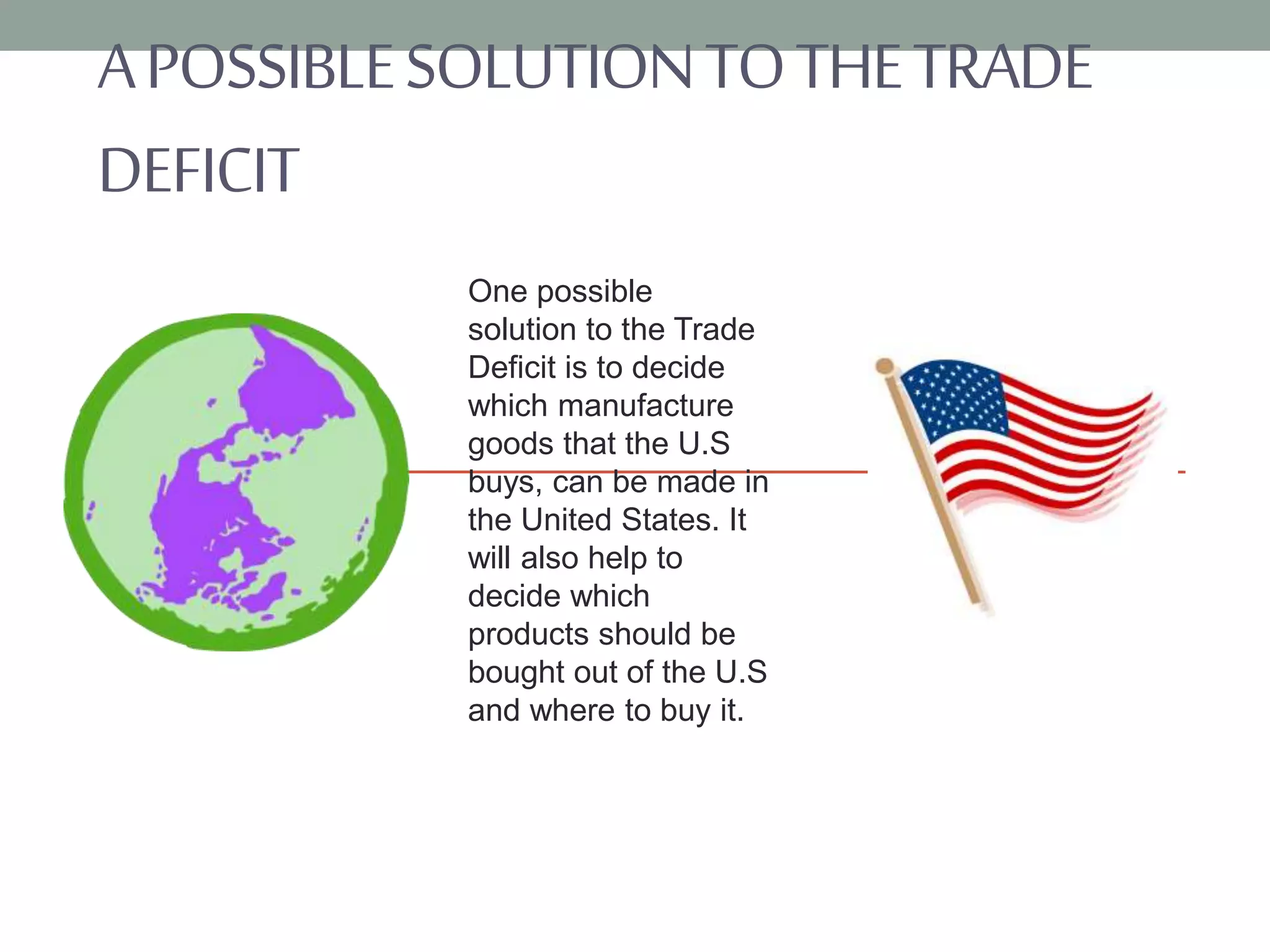
One possible
solution to the Trade
Deficit is to decide
which manufacture
goods that the U.S
buys, can be made in
the United States. It
will also help to
decide which
products should be
bought out of the U.S
and where to buy it.
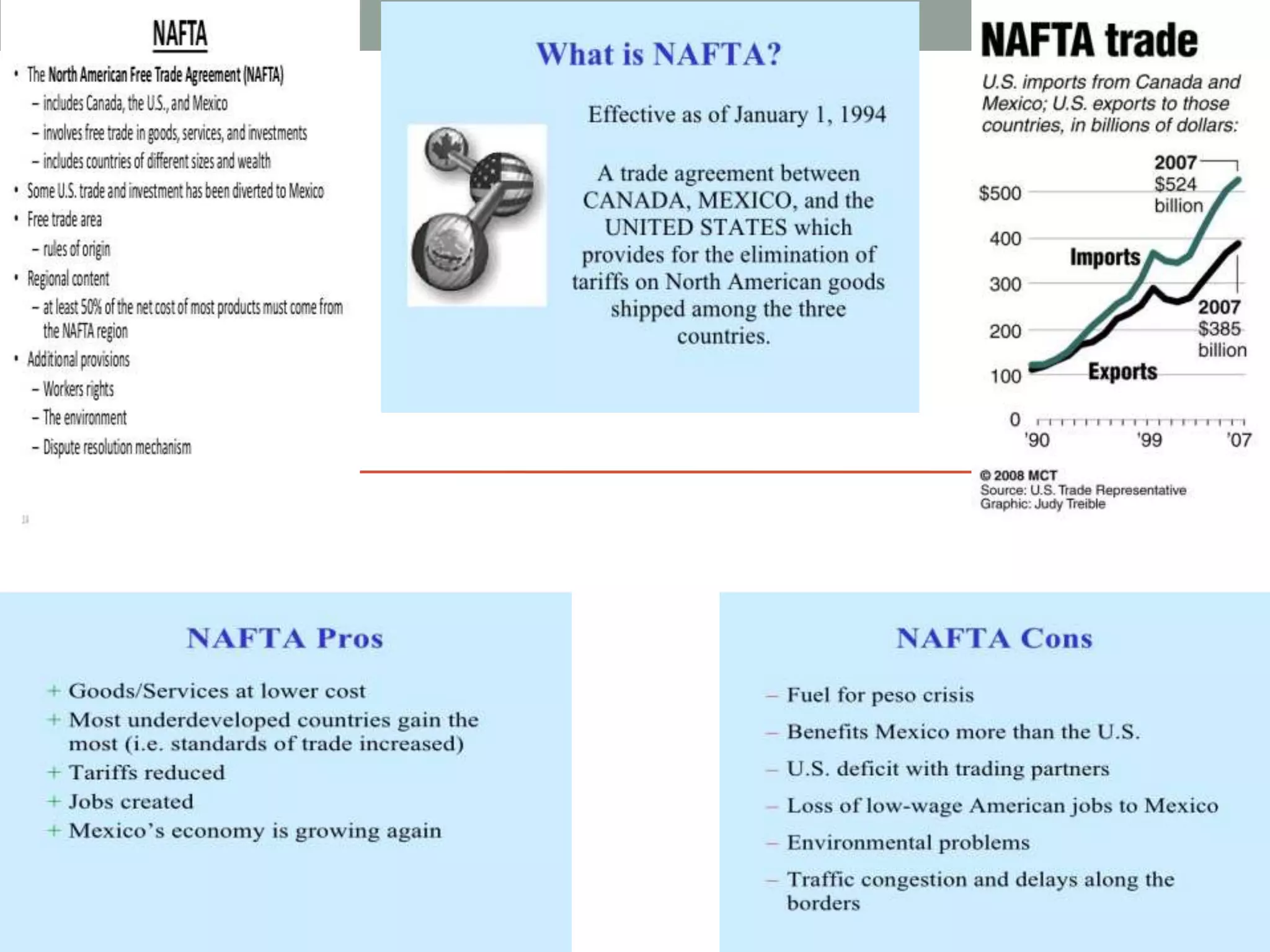
“THE NORTHAMERICAN FREE TRADEAGREEMENT(NAFTA) ISA
TREATYENTERED INTO BYTHE UNITED STATES, CANADA,AND
MEXICO; IT WENTINTO EFFECT ON JANUARY1, 1994.’’
“ What are the benefits of NAFTA?
Since NAFTA came into effect, trade and investment levels in North America have
increased, bringing strong economic growth, job creation, and better prices and
selection in consumer goods. North American businesses, consumers, families,
workers, and farmers have all benefited.”
“How can I make NAFTA work for my business?
NAFTA provides North American businesses with better access to materials,
technologies, investment capital, and talent available across North America”
“NAFTA is highly controversial. American workers that lost jobs
protest outsourcing to Mexico, and that makes sense. On the
other hand, everyone benefits from lower-cost gas and food
prices. They probably have no idea it's because of NAFTA. To
answer the question "Do the pros outweigh the cons?" depends
on who you are and how you've been affected.”
Jenifer Rodriguez 8-C
WHAT IS N.A.F.T.A
N.A.F.T.A MEANS NORTH
AMERICAN FREE TRADE
AGREEMENT, AN
AGREEMENT BETWEEN
NORTH AMERICAN
COUNTRYS. THERE ARE
ONLY 3 NORTH AMERICAN
COUNTRYS AND THEY
ARE MEXICO, THE UNITED
STATES, & CANADA. IT
WAS A DEAL SIGNED IN
TEXAS BY THE THREE
PRESIDENTS FROM
MEXICO, US, AND
CANADA IN 1993.
WHATISN.A.F.T.A?N.A.F.T.A stands for North American Free Trade Agreement. Back to 1990 among the three nations, U.S. President
George H. W. Bush at the time, And Canadian Prime Minister Brian Mulroney and Mexican President Carlos
Salinas, each responsible for spearheading and promoting the agreement, ceremonially signed the agreement in their
respective capitals on December 17, 1992. The signed agreement then needed to be ratified by each nation's
legislative or parliamentary branch.
IMPACT:
NAFTA's effects, both positive and negative, have been quantified by several economists, whose
findings have been reported in publications such as the World Bank's Lessons from NAFTA for Latin
America and the Caribbean, NAFTA's Impact on North America, and NAFTA Revisited by the Institute for
International Economics.
United States
The U.S. Chamber of Commerce credits NAFTA with increasing US trade in goods and services with Canada and
Mexico from $337 billion in 1993 to $1.2 trillion in 2011, while the AFL-CIO blames the agreement for sending
700,000 American manufacturing jobs to Mexico over that time.
Canada
Like Mexico and the U.S., Canada received a modest positive economic benefit as measured by GDP. Many feared
declines failed to materialize, and some industries, like the furniture industry, were expected to suffer but grew
instead. Canadian manufacturing employment held steady despite an international downward trend in developed
countries. One of NAFTA's biggest economic effects on U.S.-Canada trade has been to boost bilateral agricultural
flows. In the year 2008 alone, Canada exports to the United States and Mexico were at $381.3 billion, and imports
from NAFTA were at $245.1 billion. A book written by Mel Hurtig published in 2002 called The Vanishing Country
charged that since NAFTA's ratification more than 10,000 Canadian companies had been taken over by foreigners,
and that 98% of all foreign direct investments in Canada were for foreign takeovers.
Mexico
The overall effect of the Mexico–U.S. agricultural agreement is a matter of dispute.
Mexico did not invest in the infrastructure necessary for competition, such as
efficient railroads and highways, which resulted in more difficult living conditions
for the country's poor. Mexico's agricultural exports increased 9.4 percent annually
between 1994 and 2001, while imports increased by only 6.9 percent a year during
the same period.
One of the most affected agricultural sectors is the meat industry. Mexico has gone
from a small player in the pre-1994 U.S. export market to the 2nd largest importer of
U.S. agricultural products in 2004, and NAFTA may be credited as a major catalyst
for this change. The allowance of free trade removed the hurdles that impeded
business between the two countries. As a result, Mexico has provided a growing
market for meat for the U.S., leading to an increase in sales and profits for the U.S.
meat industry. This coincides with a noticeable increase in Mexican per capita GDP
that has created large changes in meat consumption patterns, implying that Mexicans
can now afford to buy more meat and thus per capita meat consumption has grown.
WHAT IS N.A.F.T.A
N.A.F.T.A stands for North American free trade
agreement. It was a treaty between Canada, Mexico and
United States that started January 1994. George W.
bush , Mexican president, Carlos Sallinas, and Canadian
Prime Minister Brain Mulrony all agreed to the treaty. It
was made to increase trade between these three
countries. It also took away restrictions from commerce.
This benefitted all three countries
What is NAFTA?
NAFTA is the North American Free
Trade Agreement a treaty between
Mexico, Canada and the United States
that has been in effect since 1 January
1994. The agreement was designed to
increase trade among the three nations
by reducing or eliminating restrictions
on commerce, such as tariffs and
import quotas. It is one of the most
powerful and wide-reaching treaties in
the world, governing the entire
spectrum of trade and commerce on the
North American continent. Although it
was designed to benefit its member
nations economically, it has been the
subject of controversy since its
inception. NAFTA is one of the most
prominent and influential.
International commerce, the process of
importing and exporting goods from
one nation to another, is usually
regulated by customs duties and fees
such as tariffs.
WHATISN.A.F.T.A?
N.A.F.T.A is the North
American Free Trade
Agreement which was a
negotiation between the
U.S., Canada, and
Mexico. It was meant to
decrease trade barriers
with the three countries.
“THE NORTHAMERICAN FREE TRADEAGREEMENT(NAFTA) ISA
TREATYENTERED INTO BYTHE UNITED STATES, CANADA,AND
MEXICO; IT WENTINTO EFFECT ON JANUARY1, 1994.’’
“ What are the benefits of NAFTA?
Since NAFTA came into effect, trade and investment levels in North America have
increased, bringing strong economic growth, job creation, and better prices and
selection in consumer goods. North American businesses, consumers, families,
workers, and farmers have all benefited.”
“How can I make NAFTA work for my business?
NAFTA provides North American businesses with better access to materials,
technologies, investment capital, and talent available across North America”
“NAFTA is highly controversial. American workers that lost jobs
protest outsourcing to Mexico, and that makes sense. On the
other hand, everyone benefits from lower-cost gas and food
prices. They probably have no idea it's because of NAFTA. To
answer the question "Do the pros outweigh the cons?" depends
on who you are and how you've been affected.”
WHAT IS A TRADE DEFICIT ?
A Trade Deficit
means, an economic
measure of a negative
balance of trade in
which a country's
imports exceeds its
exports. A trade
deficit represents an
outflow of domestic
currency to foreign
markets.
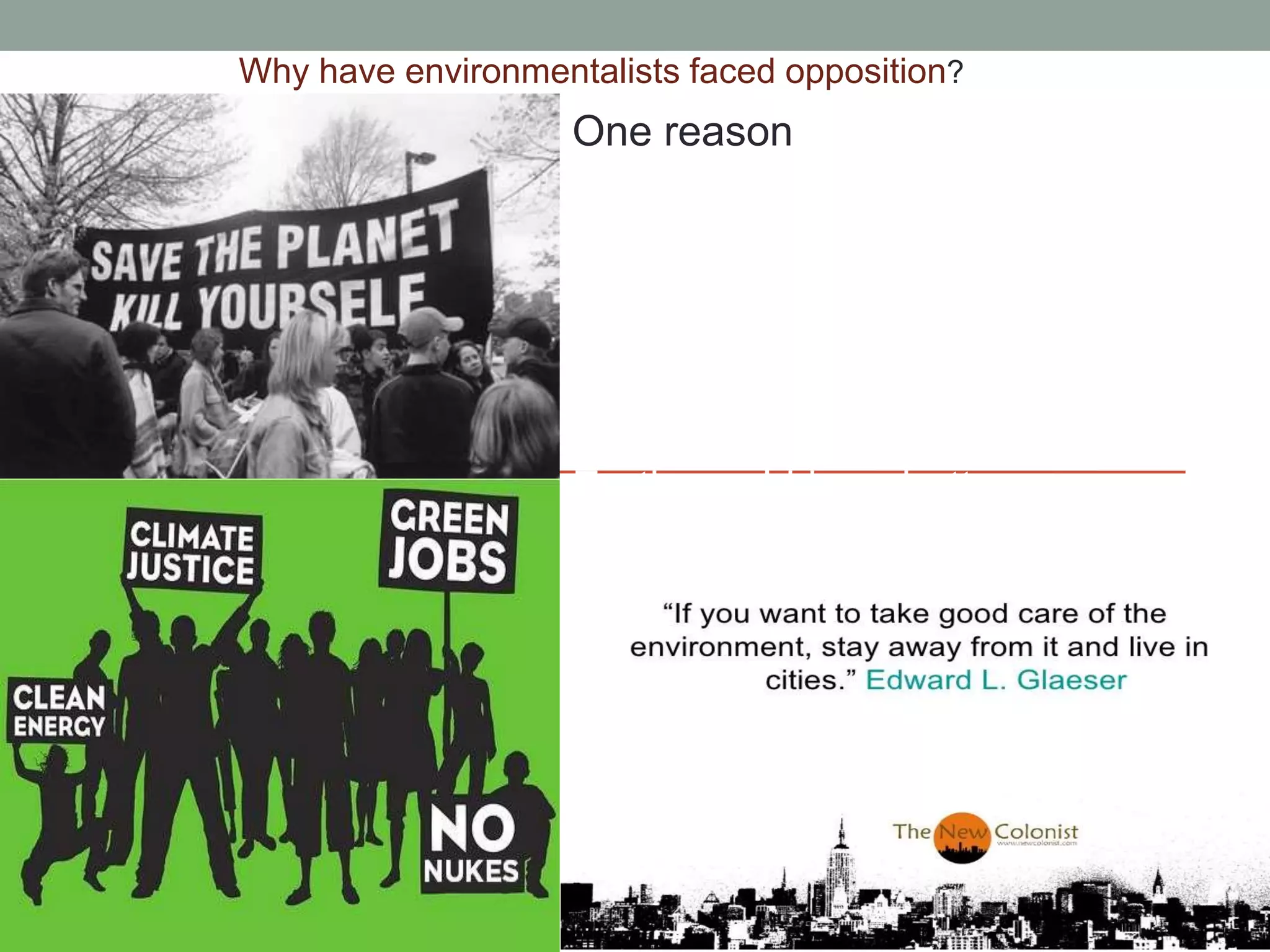
Why have environmentalists faced opposition?
One reason
environmentalists have
faced opposition
because the
environmentalists
wanted to get rid of
technology so that the
Earth would be a better
place to live in.
U.S.GovernmentrespondstoEnvironmentalConcerns
In the 1970’s the US Government responded to
environmental concerns by creating the
Environmental Protection Agency. The Clean Air
Act of 1970 required automakers to clean up car
exhausts, and The Clean Water Act of 1972
fought pollution in rivers and lakes. Also, they
tried to conserve energy by switching from oil to
coal in many factories.
What is the Ozone layer? What is an environmental concern
regarding the Ozone layer?
The Ozone Layer is a natural gas that protects life on Earth
from the Sun’s ultraviolet rays. It is located in the Stratosphere.
Dangerous gas broke the ozone layer creating a big hole.
Countries agree to stop using ozone eating chemicals.
Angel Meza
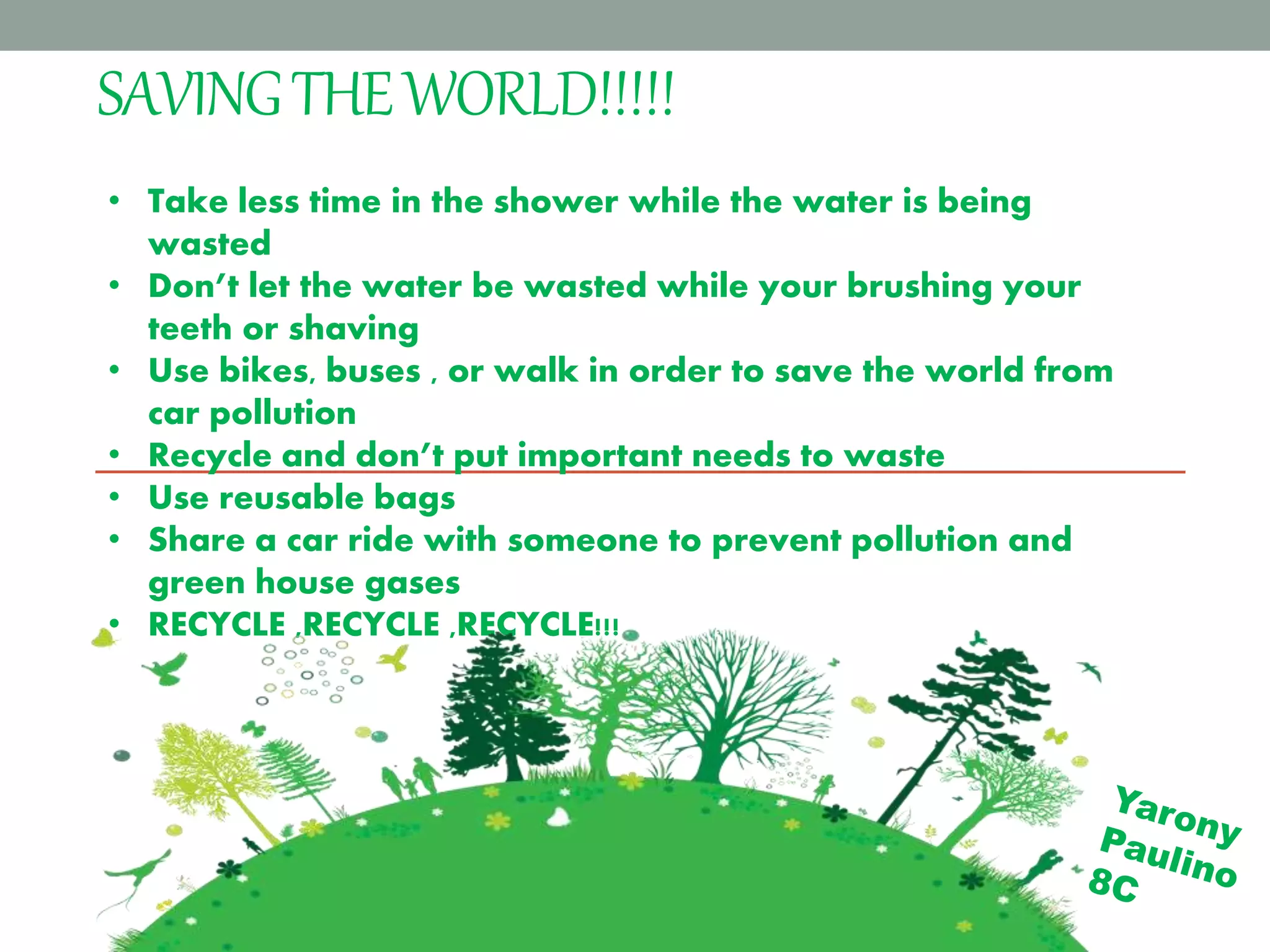
SAVINGTHEWORLD!!!!!
• Take less time in the shower while the water is being
wasted
• Don’t let the water be wasted while your brushing your
teeth or shaving
• Use bikes, buses , or walk in order to save the world from
car pollution
• Recycle and don’t put important needs to waste
• Use reusable bags
• Share a car ride with someone to prevent pollution and
green house gases
• RECYCLE ,RECYCLE ,RECYCLE!!!
• Don’t run the water while you aren’t using it {while brushing your teeth
or shaving}
• Take shorter showers & stop the water if you are going to apply
shampoo to your head {stop the waste of water}
• Buy reusable bags when you go shopping to prevent an abundance of
plastic waste
• Try to walk, ride a bike, or share a ride/carpool to prevent pollution
• Try to recycle by separating and putting and plastics, metals, or glass
into recycling bins.
• Wash your clothes in cold water
• Buy Eco-Friendly Products {they help save energy and electricity}
• Don’t overuse the heater in the winter and AC in the summer to prevent
energy waste
• REUSE, REDUSE, & RECYCLE
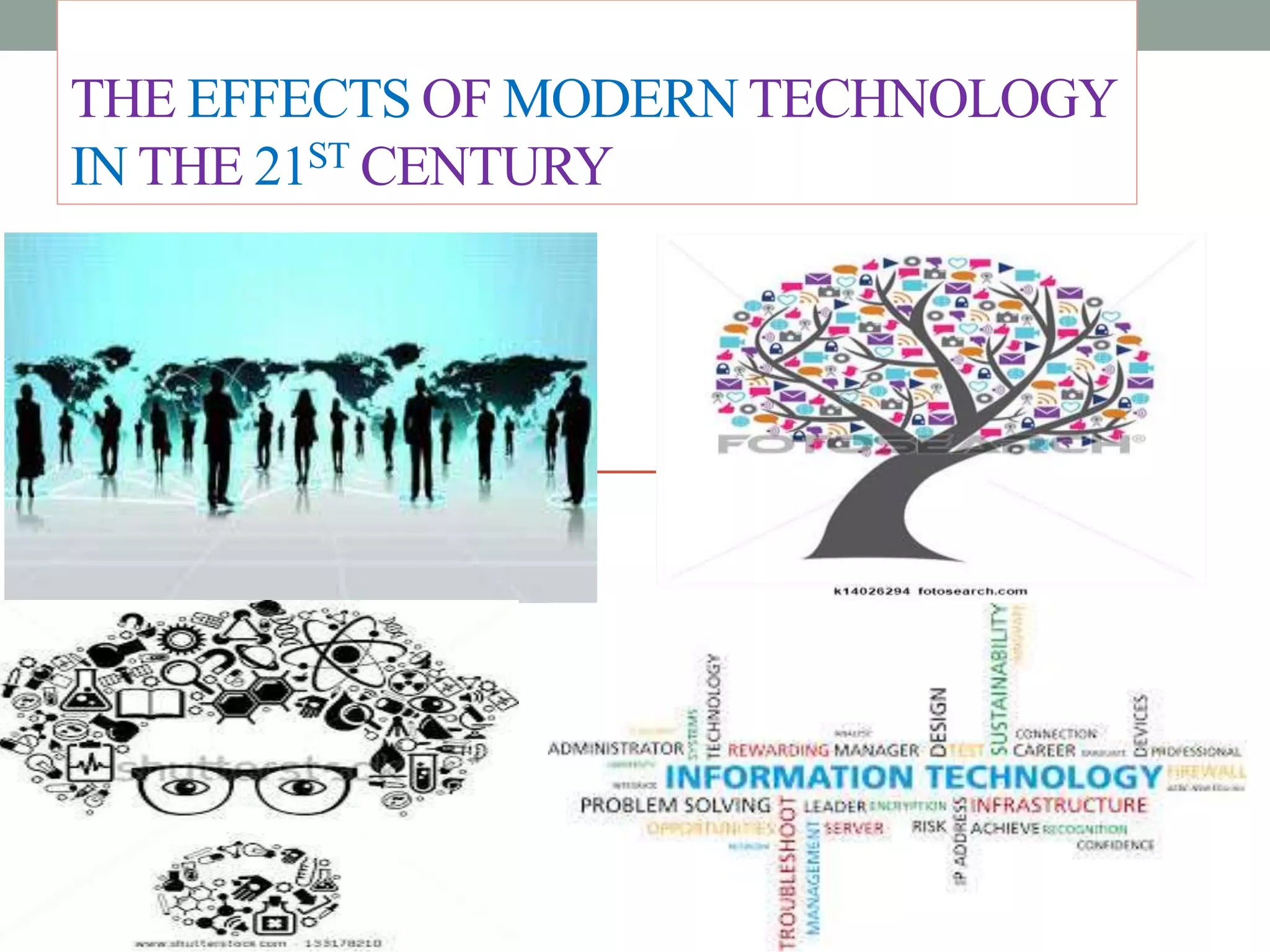
THE EFFECTS OF MODERN TECHNOLOGY
IN THE 21ST CENTURY
What is E-commerce
E-commerce stands for Electric commerce which
is the buying and selling of goods and services
over electronic systems .E-commerce also entails
improvements in businesses , it also affect many
business tax including marketing and
communication. E-commerce is international E-
commerce is an incredible tool for new
businesses as it allows them to rapidly interact
with people through out the world.
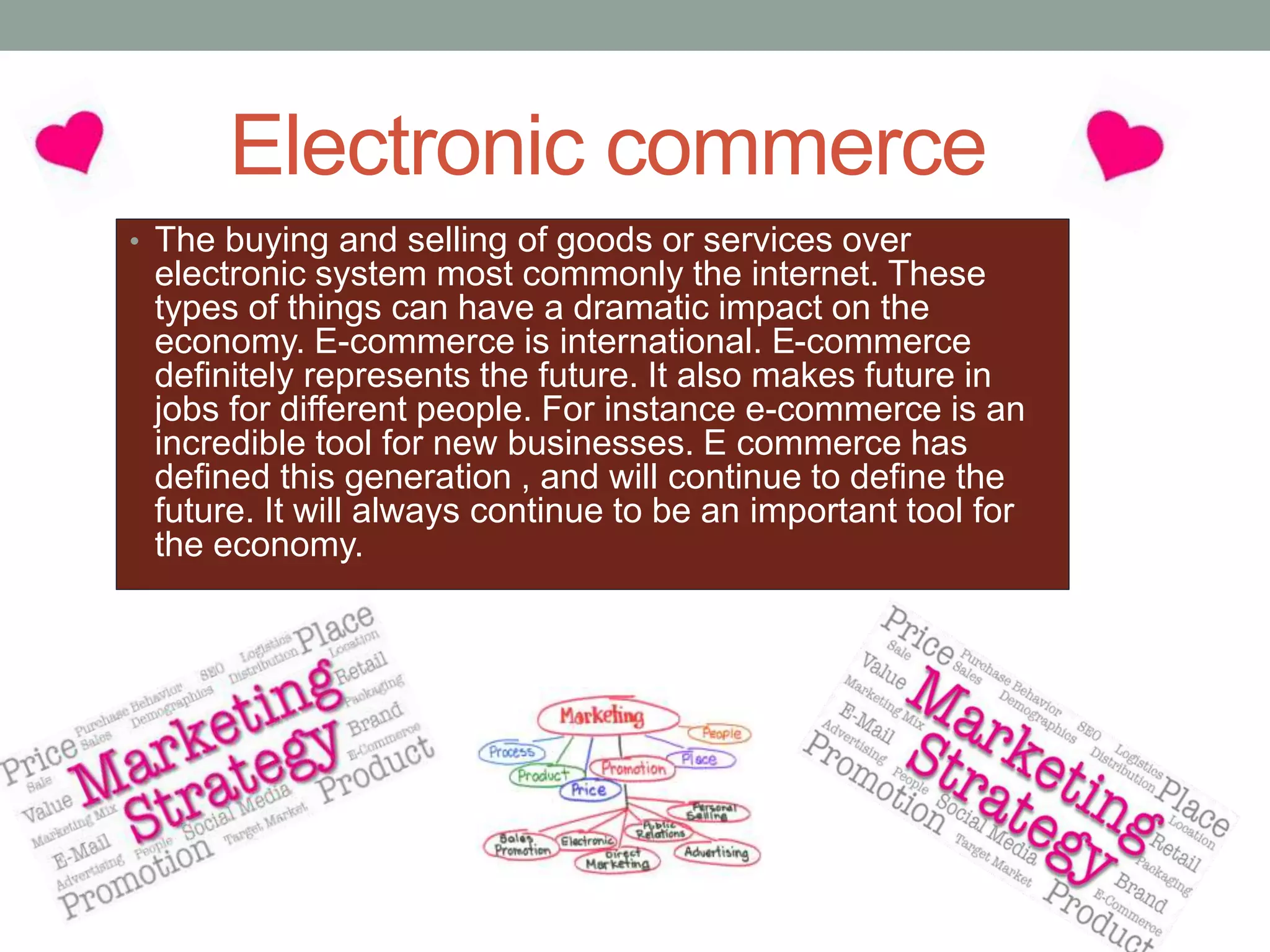
Electronic commerce
• The buying and selling of goods or services over
electronic system most commonly the internet. These
types of things can have a dramatic impact on the
economy. E-commerce is international. E-commerce
definitely represents the future. It also makes future in
jobs for different people. For instance e-commerce is an
incredible tool for new businesses. E commerce has
defined this generation , and will continue to define the
future. It will always continue to be an important tool for
the economy.
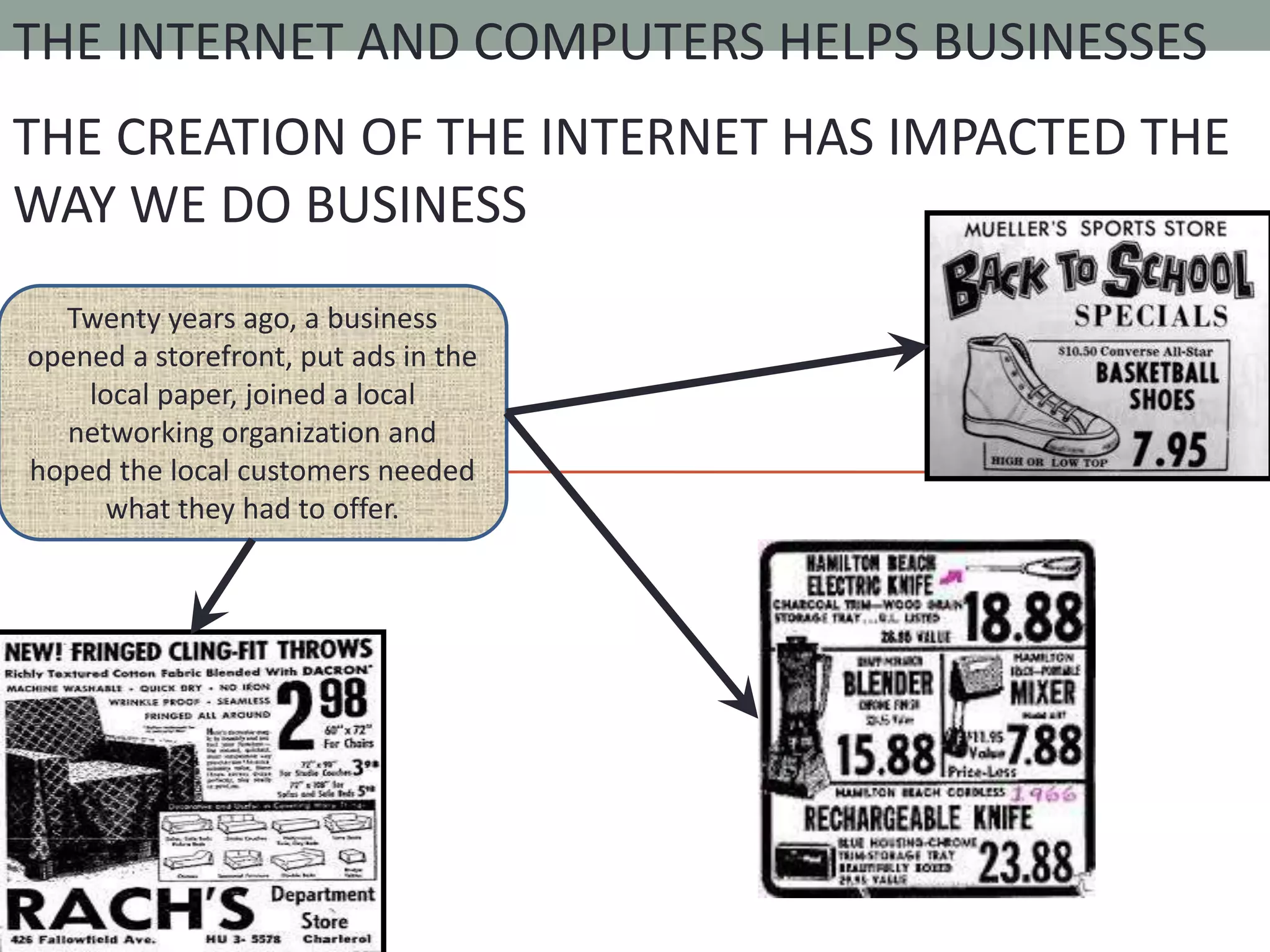
THE CREATION OF THE INTERNET HAS IMPACTED THE
WAY WE DO BUSINESS
THE INTERNET AND COMPUTERS HELPS BUSINESSES
Twenty years ago, a business
opened a storefront, put ads in the
local paper, joined a local
networking organization and
hoped the local customers needed
what they had to offer.
All that changed with the inception of the
Internet. A business is no longer dependent
on its local customer base for its survival; it
now has a worldwide audience for its goods
and services. The Internet has changed how
a business communicates with its
employees, and finds and manages the
competition.
Computers Then And Now
The computers today
compared to the computer in
the 1950s are more easy
because there are flash
drives, cameras ,
touchscreen and a variety of
different websites. The
computers in the 1950s were
smaller and faster. People
use RAM for most
computers. The 1950s
computer games were
popular, but now music and
games are popular today.
The computers from the 1970’s have evolved from
going from war computers to computer that you
can use to look at your emails or for
entertainment.
All sliders 2.0

All sliders 2.0

  • 1.
  • 2.
    APOSSIBLESOLUTIONTOTHETRADE DEFICIT One possible solution tothe Trade Deficit is to decide which manufacture goods that the U.S buys, can be made in the United States. It will also help to decide which products should be bought out of the U.S and where to buy it.
  • 3.
    “THE NORTHAMERICAN FREETRADEAGREEMENT(NAFTA) ISA TREATYENTERED INTO BYTHE UNITED STATES, CANADA,AND MEXICO; IT WENTINTO EFFECT ON JANUARY1, 1994.’’ “ What are the benefits of NAFTA? Since NAFTA came into effect, trade and investment levels in North America have increased, bringing strong economic growth, job creation, and better prices and selection in consumer goods. North American businesses, consumers, families, workers, and farmers have all benefited.” “How can I make NAFTA work for my business? NAFTA provides North American businesses with better access to materials, technologies, investment capital, and talent available across North America” “NAFTA is highly controversial. American workers that lost jobs protest outsourcing to Mexico, and that makes sense. On the other hand, everyone benefits from lower-cost gas and food prices. They probably have no idea it's because of NAFTA. To answer the question "Do the pros outweigh the cons?" depends on who you are and how you've been affected.”
  • 4.
    Jenifer Rodriguez 8-C WHATIS N.A.F.T.A N.A.F.T.A MEANS NORTH AMERICAN FREE TRADE AGREEMENT, AN AGREEMENT BETWEEN NORTH AMERICAN COUNTRYS. THERE ARE ONLY 3 NORTH AMERICAN COUNTRYS AND THEY ARE MEXICO, THE UNITED STATES, & CANADA. IT WAS A DEAL SIGNED IN TEXAS BY THE THREE PRESIDENTS FROM MEXICO, US, AND CANADA IN 1993.
  • 5.
    WHATISN.A.F.T.A?N.A.F.T.A stands forNorth American Free Trade Agreement. Back to 1990 among the three nations, U.S. President George H. W. Bush at the time, And Canadian Prime Minister Brian Mulroney and Mexican President Carlos Salinas, each responsible for spearheading and promoting the agreement, ceremonially signed the agreement in their respective capitals on December 17, 1992. The signed agreement then needed to be ratified by each nation's legislative or parliamentary branch. IMPACT: NAFTA's effects, both positive and negative, have been quantified by several economists, whose findings have been reported in publications such as the World Bank's Lessons from NAFTA for Latin America and the Caribbean, NAFTA's Impact on North America, and NAFTA Revisited by the Institute for International Economics. United States The U.S. Chamber of Commerce credits NAFTA with increasing US trade in goods and services with Canada and Mexico from $337 billion in 1993 to $1.2 trillion in 2011, while the AFL-CIO blames the agreement for sending 700,000 American manufacturing jobs to Mexico over that time. Canada Like Mexico and the U.S., Canada received a modest positive economic benefit as measured by GDP. Many feared declines failed to materialize, and some industries, like the furniture industry, were expected to suffer but grew instead. Canadian manufacturing employment held steady despite an international downward trend in developed countries. One of NAFTA's biggest economic effects on U.S.-Canada trade has been to boost bilateral agricultural flows. In the year 2008 alone, Canada exports to the United States and Mexico were at $381.3 billion, and imports from NAFTA were at $245.1 billion. A book written by Mel Hurtig published in 2002 called The Vanishing Country charged that since NAFTA's ratification more than 10,000 Canadian companies had been taken over by foreigners, and that 98% of all foreign direct investments in Canada were for foreign takeovers. Mexico The overall effect of the Mexico–U.S. agricultural agreement is a matter of dispute. Mexico did not invest in the infrastructure necessary for competition, such as efficient railroads and highways, which resulted in more difficult living conditions for the country's poor. Mexico's agricultural exports increased 9.4 percent annually between 1994 and 2001, while imports increased by only 6.9 percent a year during the same period. One of the most affected agricultural sectors is the meat industry. Mexico has gone from a small player in the pre-1994 U.S. export market to the 2nd largest importer of U.S. agricultural products in 2004, and NAFTA may be credited as a major catalyst for this change. The allowance of free trade removed the hurdles that impeded business between the two countries. As a result, Mexico has provided a growing market for meat for the U.S., leading to an increase in sales and profits for the U.S. meat industry. This coincides with a noticeable increase in Mexican per capita GDP that has created large changes in meat consumption patterns, implying that Mexicans can now afford to buy more meat and thus per capita meat consumption has grown.
  • 6.
    WHAT IS N.A.F.T.A N.A.F.T.Astands for North American free trade agreement. It was a treaty between Canada, Mexico and United States that started January 1994. George W. bush , Mexican president, Carlos Sallinas, and Canadian Prime Minister Brain Mulrony all agreed to the treaty. It was made to increase trade between these three countries. It also took away restrictions from commerce. This benefitted all three countries
  • 8.
    What is NAFTA? NAFTAis the North American Free Trade Agreement a treaty between Mexico, Canada and the United States that has been in effect since 1 January 1994. The agreement was designed to increase trade among the three nations by reducing or eliminating restrictions on commerce, such as tariffs and import quotas. It is one of the most powerful and wide-reaching treaties in the world, governing the entire spectrum of trade and commerce on the North American continent. Although it was designed to benefit its member nations economically, it has been the subject of controversy since its inception. NAFTA is one of the most prominent and influential. International commerce, the process of importing and exporting goods from one nation to another, is usually regulated by customs duties and fees such as tariffs.
  • 9.
    WHATISN.A.F.T.A? N.A.F.T.A is theNorth American Free Trade Agreement which was a negotiation between the U.S., Canada, and Mexico. It was meant to decrease trade barriers with the three countries.
  • 10.
    “THE NORTHAMERICAN FREETRADEAGREEMENT(NAFTA) ISA TREATYENTERED INTO BYTHE UNITED STATES, CANADA,AND MEXICO; IT WENTINTO EFFECT ON JANUARY1, 1994.’’ “ What are the benefits of NAFTA? Since NAFTA came into effect, trade and investment levels in North America have increased, bringing strong economic growth, job creation, and better prices and selection in consumer goods. North American businesses, consumers, families, workers, and farmers have all benefited.” “How can I make NAFTA work for my business? NAFTA provides North American businesses with better access to materials, technologies, investment capital, and talent available across North America” “NAFTA is highly controversial. American workers that lost jobs protest outsourcing to Mexico, and that makes sense. On the other hand, everyone benefits from lower-cost gas and food prices. They probably have no idea it's because of NAFTA. To answer the question "Do the pros outweigh the cons?" depends on who you are and how you've been affected.”
  • 11.
    WHAT IS ATRADE DEFICIT ? A Trade Deficit means, an economic measure of a negative balance of trade in which a country's imports exceeds its exports. A trade deficit represents an outflow of domestic currency to foreign markets.
  • 13.
    Why have environmentalistsfaced opposition? One reason environmentalists have faced opposition because the environmentalists wanted to get rid of technology so that the Earth would be a better place to live in.
  • 14.
    U.S.GovernmentrespondstoEnvironmentalConcerns In the 1970’sthe US Government responded to environmental concerns by creating the Environmental Protection Agency. The Clean Air Act of 1970 required automakers to clean up car exhausts, and The Clean Water Act of 1972 fought pollution in rivers and lakes. Also, they tried to conserve energy by switching from oil to coal in many factories.
  • 15.
    What is theOzone layer? What is an environmental concern regarding the Ozone layer? The Ozone Layer is a natural gas that protects life on Earth from the Sun’s ultraviolet rays. It is located in the Stratosphere. Dangerous gas broke the ozone layer creating a big hole. Countries agree to stop using ozone eating chemicals. Angel Meza
  • 16.
    SAVINGTHEWORLD!!!!! • Take lesstime in the shower while the water is being wasted • Don’t let the water be wasted while your brushing your teeth or shaving • Use bikes, buses , or walk in order to save the world from car pollution • Recycle and don’t put important needs to waste • Use reusable bags • Share a car ride with someone to prevent pollution and green house gases • RECYCLE ,RECYCLE ,RECYCLE!!!
  • 17.
    • Don’t runthe water while you aren’t using it {while brushing your teeth or shaving} • Take shorter showers & stop the water if you are going to apply shampoo to your head {stop the waste of water} • Buy reusable bags when you go shopping to prevent an abundance of plastic waste • Try to walk, ride a bike, or share a ride/carpool to prevent pollution • Try to recycle by separating and putting and plastics, metals, or glass into recycling bins. • Wash your clothes in cold water • Buy Eco-Friendly Products {they help save energy and electricity} • Don’t overuse the heater in the winter and AC in the summer to prevent energy waste • REUSE, REDUSE, & RECYCLE
  • 18.
    THE EFFECTS OFMODERN TECHNOLOGY IN THE 21ST CENTURY
  • 19.
    What is E-commerce E-commercestands for Electric commerce which is the buying and selling of goods and services over electronic systems .E-commerce also entails improvements in businesses , it also affect many business tax including marketing and communication. E-commerce is international E- commerce is an incredible tool for new businesses as it allows them to rapidly interact with people through out the world.
  • 20.
    Electronic commerce • Thebuying and selling of goods or services over electronic system most commonly the internet. These types of things can have a dramatic impact on the economy. E-commerce is international. E-commerce definitely represents the future. It also makes future in jobs for different people. For instance e-commerce is an incredible tool for new businesses. E commerce has defined this generation , and will continue to define the future. It will always continue to be an important tool for the economy.
  • 21.
    THE CREATION OFTHE INTERNET HAS IMPACTED THE WAY WE DO BUSINESS THE INTERNET AND COMPUTERS HELPS BUSINESSES Twenty years ago, a business opened a storefront, put ads in the local paper, joined a local networking organization and hoped the local customers needed what they had to offer.
  • 22.
    All that changedwith the inception of the Internet. A business is no longer dependent on its local customer base for its survival; it now has a worldwide audience for its goods and services. The Internet has changed how a business communicates with its employees, and finds and manages the competition.
  • 23.
    Computers Then AndNow The computers today compared to the computer in the 1950s are more easy because there are flash drives, cameras , touchscreen and a variety of different websites. The computers in the 1950s were smaller and faster. People use RAM for most computers. The 1950s computer games were popular, but now music and games are popular today.
  • 25.
    The computers fromthe 1970’s have evolved from going from war computers to computer that you can use to look at your emails or for entertainment.