2-1
© 2013 by McGraw-Hill Education. This is proprietary material solely for authorized instructor use. Not authorized for sale or distribution in any manner.
This document may not be copied, scanned, duplicated, forwarded, distributed, or posted on a website, in whole or part.
CHAPTER
Developing Marketing
Strategies and a
Marketing Plan
2
McGraw-Hill/Irwin Copyright © 2014 by the McGraw-Hill Companies, Inc. All rights reserved.
2-2
© 2014 by McGraw-Hill Education. This is proprietary material solely for authorized instructor use. Not authorized for sale or distribution in any manner.
This document may not be copied, scanned, duplicated, forwarded, distributed, or posted on a website, in whole or part.
L E A R N I N G O B J E C T I V E S
Define a marketing strategy.
Describe the elements of a marketing plan.
Analyze a marketing situation using SWOT analysis.
Describe how a firm chooses which consumer
group(s) to pursue with its marketing efforts.
Outline the implementation of the marketing mix as a
means to increase customer value.
Summarize portfolio analysis and its use to evaluate
marketing performance.
Describe how firms grow their business.
Developing Marketing Strategies
and a Marketing Plan
LO1
LO2
LO3
LO4
LO5
LO6
LO7
2-3
© 2014 by McGraw-Hill Education. This is proprietary material solely for authorized instructor use. Not authorized for sale or distribution in any manner.
This document may not be copied, scanned, duplicated, forwarded, distributed, or posted on a website, in whole or part.
Sustainable Competitive Advantage
Customer
value
Customer
excellence
Operational
excellence
Product
excellence
Locational
excellence
2-4
© 2014 by McGraw-Hill Education. This is proprietary material solely for authorized instructor use. Not authorized for sale or distribution in any manner.
This document may not be copied, scanned, duplicated, forwarded, distributed, or posted on a website, in whole or part.
CHECK YOURSELF
1. What are the various components of a
marketing strategy?
2. List the four macro strategies that can help a
firm develop a sustainable competitive
advantage.
2-5
© 2014 by McGraw-Hill Education. This is proprietary material solely for authorized instructor use. Not authorized for sale or distribution in any manner.
This document may not be copied, scanned, duplicated, forwarded, distributed, or posted on a website, in whole or part.
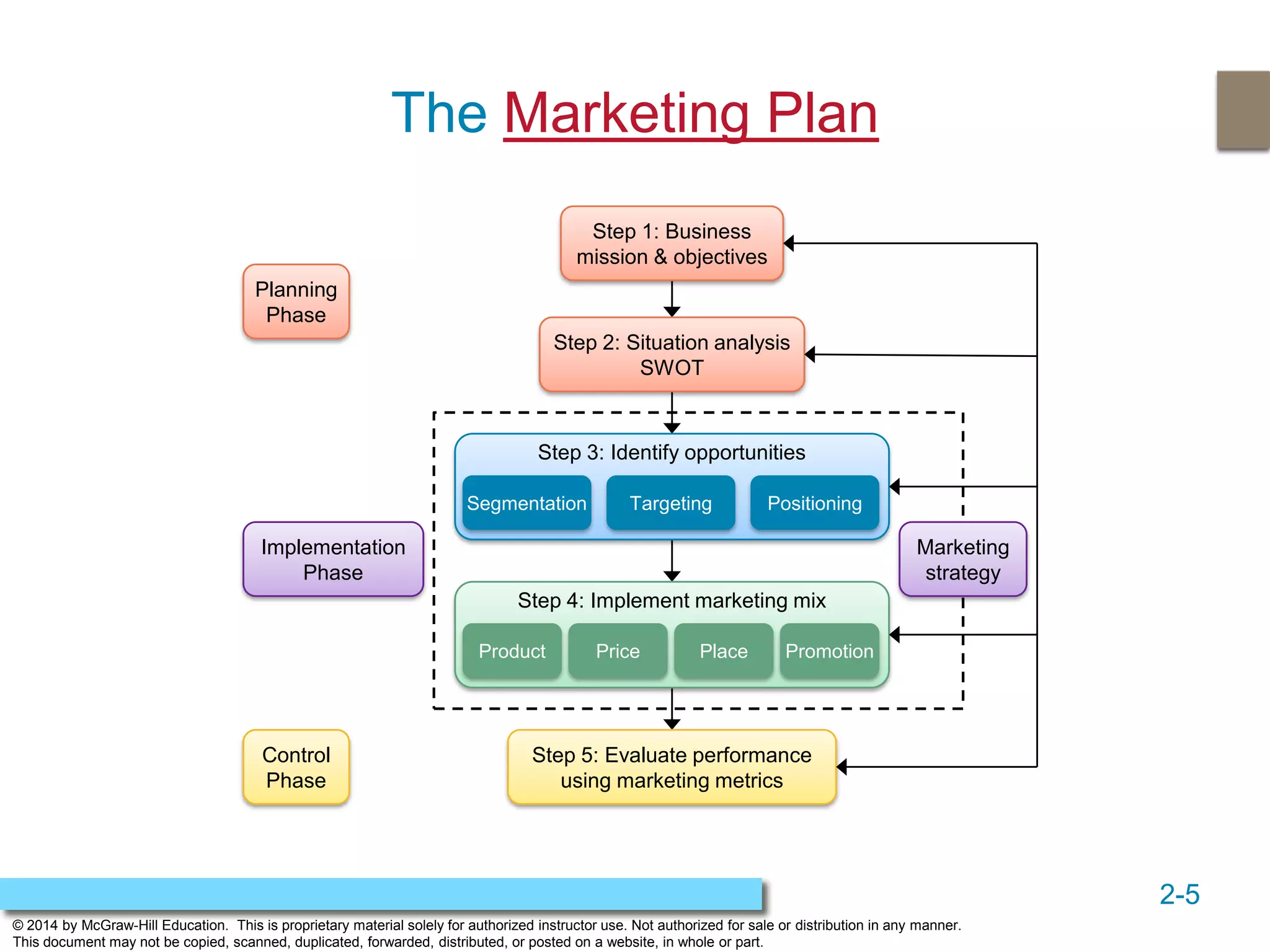
The Marketing Plan
Planning
Phase
Implementation
Phase
Control
Phase
Step 1: Business
mission & objectives
Step 2: Situation analysis
SWOT
Step 5: Evaluate performance
using marketing metrics
Step 3: Identify opportunities
Segmentation Targeting Positioning
Step 4: Implement marketing mix
Product Price Place Promotion
Marketing
strategy
2-6
© 2014 by McGraw-Hill Education. This is proprietary material solely for authorized instructor use. Not authorized for sale or distribution in any manner.
This document may not be copied, scanned, duplicated, forwarded, distributed, or posted on a website, in whole or part.
Three Phases of a Strategic Plan
Planning Implementing Controlling
RyanMcVay/GettyImages
ComstockImages/Almay
GettyImages/DigitalVision
2-7
© 2014 by McGraw-Hill Education. This is proprietary material solely for authorized instructor use. Not authorized for sale or distribution in any manner.
This document may not be copied, scanned, duplicated, forwarded, distributed, or posted on a website, in whole or part.
Step 1: Define the Business Mission
MADD mission statement:
MADD strives to stop drunk driving,
support the victims of this violent crime
and prevent underage drinking.
2-8
© 2014 by McGraw-Hill Education. This is proprietary material solely for authorized instructor use. Not authorized for sale or distribution in any manner.
This document may not be copied, scanned, duplicated, forwarded, distributed, or posted on a website, in whole or part.
Step 2: Conduct a Situation Analysis
Strengths
Strong brand
Strong celebrity endorsers
Innovative products
Strengths
Strong brand
Portfolio of brands
Strong global presence
Weakness
Overreliance on footwear
Weakness
Management of numerous brands
Opportunity
Emerging countries
Other fashion segments
Opportunity
Emerging countries
Threats
Cheaper imports
Imitation products
Retail becoming price competitive
Threats
Cheaper imports
Imitation products
Recessionary forces
2-9
© 2014 by McGraw-Hill Education. This is proprietary material solely for authorized instructor use. Not authorized for sale or distribution in any manner.
This document may not be copied, scanned, duplicated, forwarded, distributed, or posted on a website, in whole or part.
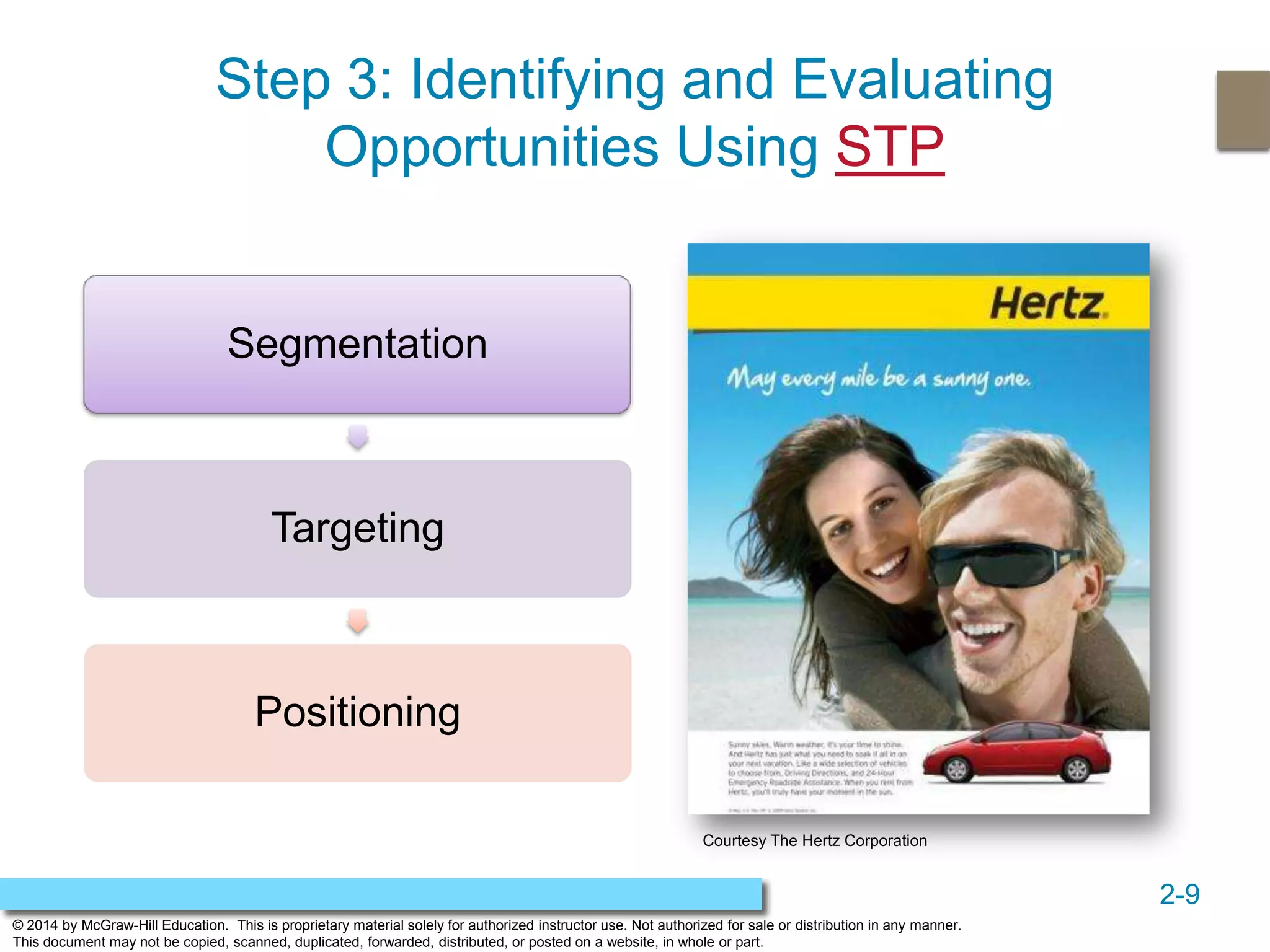
Step 3: Identifying and Evaluating
Opportunities Using STP
Segmentation
Targeting
Positioning
Courtesy The Hertz Corporation
2-10
© 2014 by McGraw-Hill Education. This is proprietary material solely for authorized instructor use. Not authorized for sale or distribution in any manner.
This document may not be copied, scanned, duplicated, forwarded, distributed, or posted on a website, in whole or part.
Step 4: Implement Marketing Mix
and Allocate Resources
Product
Value Creation
Price
Value Capture
Place
Value Delivery
Promotion
Value
Communication
Courtesy Bel Brands USA
2-11
© 2014 by McGraw-Hill Education. This is proprietary material solely for authorized instructor use. Not authorized for sale or distribution in any manner.
This document may not be copied, scanned, duplicated, forwarded, distributed, or posted on a website, in whole or part.
Product and Value Creation
 Successful products
and services are
those that customers
perceive as valuable
enough to buy.
Courtesy Amazon.com
2-12
© 2014 by McGraw-Hill Education. This is proprietary material solely for authorized instructor use. Not authorized for sale or distribution in any manner.
This document may not be copied, scanned, duplicated, forwarded, distributed, or posted on a website, in whole or part.
Price and Value Capture
 Price must allow for
customers to perceive
good value for the
product they receive.
Purestock/SuperStock
2-13
© 2014 by McGraw-Hill Education. This is proprietary material solely for authorized instructor use. Not authorized for sale or distribution in any manner.
This document may not be copied, scanned, duplicated, forwarded, distributed, or posted on a website, in whole or part.
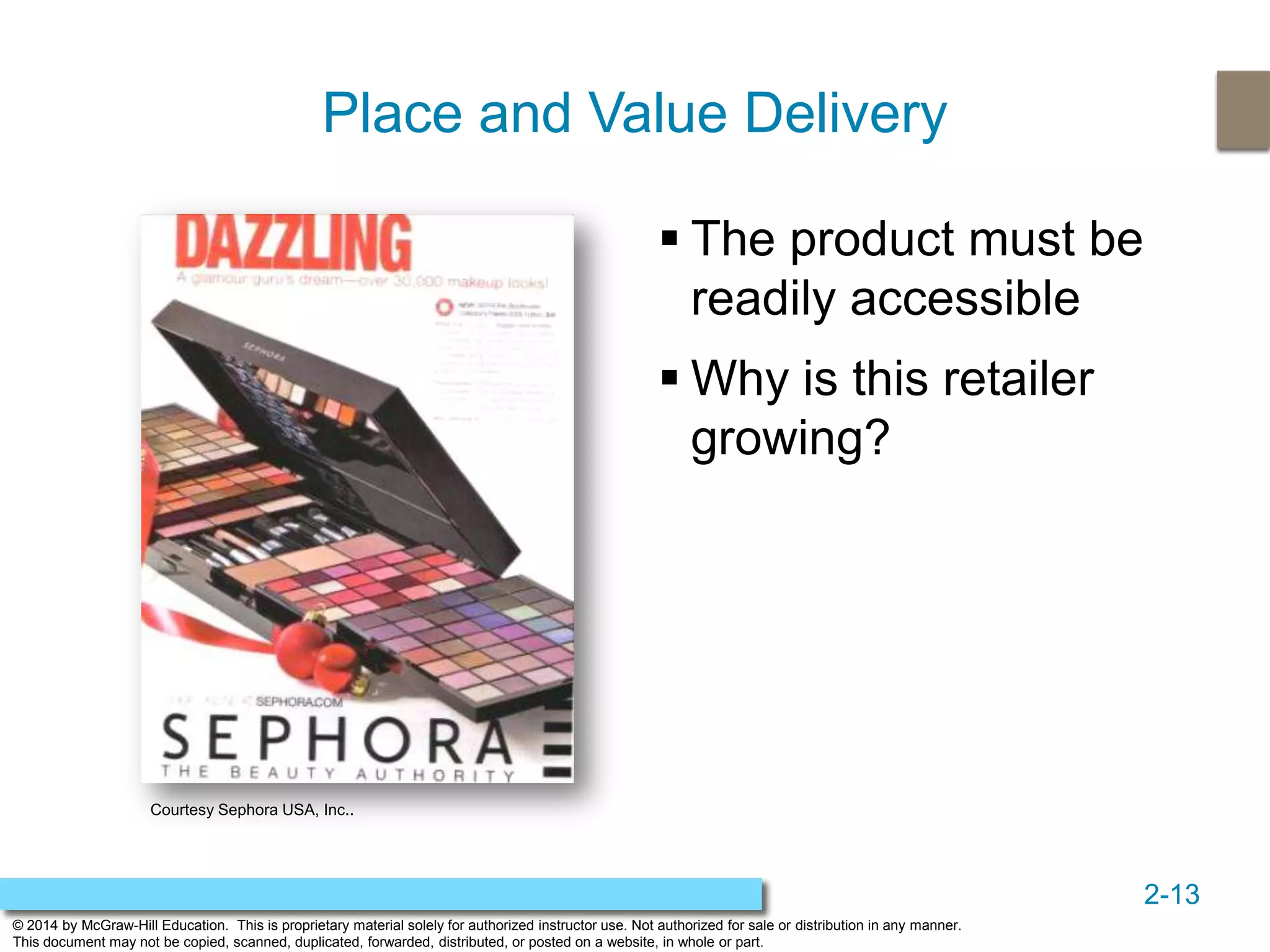
Place and Value Delivery
 The product must be
readily accessible
 Why is this retailer
growing?
Courtesy Sephora USA, Inc..
2-14
© 2014 by McGraw-Hill Education. This is proprietary material solely for authorized instructor use. Not authorized for sale or distribution in any manner.
This document may not be copied, scanned, duplicated, forwarded, distributed, or posted on a website, in whole or part.
Promotion and Value Communication
 Television
 Radio
 Magazines
 Sales force
 New Media©Lars A Niki
McGraw-Hill Companies, Inc./
Gary He, photographer
The McGraw-Hill Companies, Inc./
John Flournoy, photographer
Courtesy Pizza Hut.
2-15
© 2014 by McGraw-Hill Education. This is proprietary material solely for authorized instructor use. Not authorized for sale or distribution in any manner.
This document may not be copied, scanned, duplicated, forwarded, distributed, or posted on a website, in whole or part.
Step 5: Evaluate Performance
and Make Adjustments
P&G Website
HIGH
Relative market share
LOW
HIGH
Marketgrowthrate
LOW
C
B
AA*
2-16
© 2014 by McGraw-Hill Education. This is proprietary material solely for authorized instructor use. Not authorized for sale or distribution in any manner.
This document may not be copied, scanned, duplicated, forwarded, distributed, or posted on a website, in whole or part.
CHECK YOURSELF
1. What are the five steps in creating a
marketing plan?
2. What tool helps a marketer conduct a
situation analysis?
3. What is STP?
4. What do the four quadrants of the portfolio
analysis represent?
2-17
© 2014 by McGraw-Hill Education. This is proprietary material solely for authorized instructor use. Not authorized for sale or distribution in any manner.
This document may not be copied, scanned, duplicated, forwarded, distributed, or posted on a website, in whole or part.
Growth Strategies
Current New
PRODUCTS AND SERVICESCurrentNew
MARKETS
Market
Penetration
Diversification
Product
Development
Market
Development
2-18
© 2014 by McGraw-Hill Education. This is proprietary material solely for authorized instructor use. Not authorized for sale or distribution in any manner.
This document may not be copied, scanned, duplicated, forwarded, distributed, or posted on a website, in whole or part.
CHECK YOURSELF
1. What are the four growth strategies?
2. What type of strategy is growing the business
from existing customers?
3. Which strategy is the riskiest?
2-19
© 2014 by McGraw-Hill Education. This is proprietary material solely for authorized instructor use. Not authorized for sale or distribution in any manner.
This document may not be copied, scanned, duplicated, forwarded, distributed, or posted on a website, in whole or part.
Return to slideReturn to slide
Customer excellence is achieved when a firm
develops value-based strategies for retaining
loyal customers and provides outstanding
customer service.
Glossary
2-20
© 2014 by McGraw-Hill Education. This is proprietary material solely for authorized instructor use. Not authorized for sale or distribution in any manner.
This document may not be copied, scanned, duplicated, forwarded, distributed, or posted on a website, in whole or part.
Return to slideReturn to slide
A diversification strategy introduces a new
product or service to a market segment that
currently is not served.
Glossary
2-21
© 2014 by McGraw-Hill Education. This is proprietary material solely for authorized instructor use. Not authorized for sale or distribution in any manner.
This document may not be copied, scanned, duplicated, forwarded, distributed, or posted on a website, in whole or part.
Return to slideReturn to slide
Locational excellence occurs by having a good
physical location and Internet presence.
Glossary
2-22
© 2014 by McGraw-Hill Education. This is proprietary material solely for authorized instructor use. Not authorized for sale or distribution in any manner.
This document may not be copied, scanned, duplicated, forwarded, distributed, or posted on a website, in whole or part.
Return to slideReturn to slide
A market development strategy employs the
existing marketing offering to reach new market
segments, whether domestic or international.
Glossary
2-23
© 2014 by McGraw-Hill Education. This is proprietary material solely for authorized instructor use. Not authorized for sale or distribution in any manner.
This document may not be copied, scanned, duplicated, forwarded, distributed, or posted on a website, in whole or part.
Return to slideReturn to slide
A market penetration strategy employs the
existing marketing mix and focuses the firm’s
efforts on existing customers.
Glossary
2-24
© 2014 by McGraw-Hill Education. This is proprietary material solely for authorized instructor use. Not authorized for sale or distribution in any manner.
This document may not be copied, scanned, duplicated, forwarded, distributed, or posted on a website, in whole or part.
Return to slideReturn to slide
A marketing plan is a written document
composed of an analysis of the current
marketing situation, opportunities and threats for
the firm, marketing objectives and strategy
specified in terms of the four P’s, action
programs, and projected or pro-forma income
(and other financial) statements.
Glossary
2-25
© 2014 by McGraw-Hill Education. This is proprietary material solely for authorized instructor use. Not authorized for sale or distribution in any manner.
This document may not be copied, scanned, duplicated, forwarded, distributed, or posted on a website, in whole or part.
Return to slideReturn to slide
A mission statement is a broad description of a
firm’s objectives and the scope of activities it
plans to undertake.
Glossary
2-26
© 2014 by McGraw-Hill Education. This is proprietary material solely for authorized instructor use. Not authorized for sale or distribution in any manner.
This document may not be copied, scanned, duplicated, forwarded, distributed, or posted on a website, in whole or part.
Return to slideReturn to slide
Operational excellence is achieved through
efficient operations and excellent supply chain
and human resource management.
Glossary
2-27
© 2014 by McGraw-Hill Education. This is proprietary material solely for authorized instructor use. Not authorized for sale or distribution in any manner.
This document may not be copied, scanned, duplicated, forwarded, distributed, or posted on a website, in whole or part.
Return to slideReturn to slide
A product development strategy offers a new
product or service to a firm’s current target
market.
Glossary
2-28
© 2014 by McGraw-Hill Education. This is proprietary material solely for authorized instructor use. Not authorized for sale or distribution in any manner.
This document may not be copied, scanned, duplicated, forwarded, distributed, or posted on a website, in whole or part.
Return to slideReturn to slide
Product excellence occurs by having products
with high perceived value and effective branding
and positioning.
Glossary
2-29
© 2014 by McGraw-Hill Education. This is proprietary material solely for authorized instructor use. Not authorized for sale or distribution in any manner.
This document may not be copied, scanned, duplicated, forwarded, distributed, or posted on a website, in whole or part.
Return to slideReturn to slide
A situation analysis uses a SWOT analysis that
assesses both the internal environment with
regard to its Strengths and Weaknesses and the
external environment in terms of its
Opportunities and Threats.
Glossary
2-30
© 2014 by McGraw-Hill Education. This is proprietary material solely for authorized instructor use. Not authorized for sale or distribution in any manner.
This document may not be copied, scanned, duplicated, forwarded, distributed, or posted on a website, in whole or part.
Return to slideReturn to slide
STP stands for segmentation, targeting, and
positioning, and is used to identify and evaluate
opportunities for increasing sales and profits.
Glossary
2-31
© 2014 by McGraw-Hill Education. This is proprietary material solely for authorized instructor use. Not authorized for sale or distribution in any manner.
This document may not be copied, scanned, duplicated, forwarded, distributed, or posted on a website, in whole or part.
Return to slideReturn to slide
A sustainable competitive advantage is an
advantage over the competition that is not easily
copied, and thus can be maintained over a long
period of time.
Glossary

Mc g h g&l chap002

  • 1.
    2-1 © 2013 byMcGraw-Hill Education. This is proprietary material solely for authorized instructor use. Not authorized for sale or distribution in any manner. This document may not be copied, scanned, duplicated, forwarded, distributed, or posted on a website, in whole or part. CHAPTER Developing Marketing Strategies and a Marketing Plan 2 McGraw-Hill/Irwin Copyright © 2014 by the McGraw-Hill Companies, Inc. All rights reserved.
  • 2.
    2-2 © 2014 byMcGraw-Hill Education. This is proprietary material solely for authorized instructor use. Not authorized for sale or distribution in any manner. This document may not be copied, scanned, duplicated, forwarded, distributed, or posted on a website, in whole or part. L E A R N I N G O B J E C T I V E S Define a marketing strategy. Describe the elements of a marketing plan. Analyze a marketing situation using SWOT analysis. Describe how a firm chooses which consumer group(s) to pursue with its marketing efforts. Outline the implementation of the marketing mix as a means to increase customer value. Summarize portfolio analysis and its use to evaluate marketing performance. Describe how firms grow their business. Developing Marketing Strategies and a Marketing Plan LO1 LO2 LO3 LO4 LO5 LO6 LO7
  • 3.
    2-3 © 2014 byMcGraw-Hill Education. This is proprietary material solely for authorized instructor use. Not authorized for sale or distribution in any manner. This document may not be copied, scanned, duplicated, forwarded, distributed, or posted on a website, in whole or part. Sustainable Competitive Advantage Customer value Customer excellence Operational excellence Product excellence Locational excellence
  • 4.
    2-4 © 2014 byMcGraw-Hill Education. This is proprietary material solely for authorized instructor use. Not authorized for sale or distribution in any manner. This document may not be copied, scanned, duplicated, forwarded, distributed, or posted on a website, in whole or part. CHECK YOURSELF 1. What are the various components of a marketing strategy? 2. List the four macro strategies that can help a firm develop a sustainable competitive advantage.
  • 5.
    2-5 © 2014 byMcGraw-Hill Education. This is proprietary material solely for authorized instructor use. Not authorized for sale or distribution in any manner. This document may not be copied, scanned, duplicated, forwarded, distributed, or posted on a website, in whole or part. The Marketing Plan Planning Phase Implementation Phase Control Phase Step 1: Business mission & objectives Step 2: Situation analysis SWOT Step 5: Evaluate performance using marketing metrics Step 3: Identify opportunities Segmentation Targeting Positioning Step 4: Implement marketing mix Product Price Place Promotion Marketing strategy
  • 6.
    2-6 © 2014 byMcGraw-Hill Education. This is proprietary material solely for authorized instructor use. Not authorized for sale or distribution in any manner. This document may not be copied, scanned, duplicated, forwarded, distributed, or posted on a website, in whole or part. Three Phases of a Strategic Plan Planning Implementing Controlling RyanMcVay/GettyImages ComstockImages/Almay GettyImages/DigitalVision
  • 7.
    2-7 © 2014 byMcGraw-Hill Education. This is proprietary material solely for authorized instructor use. Not authorized for sale or distribution in any manner. This document may not be copied, scanned, duplicated, forwarded, distributed, or posted on a website, in whole or part. Step 1: Define the Business Mission MADD mission statement: MADD strives to stop drunk driving, support the victims of this violent crime and prevent underage drinking.
  • 8.
    2-8 © 2014 byMcGraw-Hill Education. This is proprietary material solely for authorized instructor use. Not authorized for sale or distribution in any manner. This document may not be copied, scanned, duplicated, forwarded, distributed, or posted on a website, in whole or part. Step 2: Conduct a Situation Analysis Strengths Strong brand Strong celebrity endorsers Innovative products Strengths Strong brand Portfolio of brands Strong global presence Weakness Overreliance on footwear Weakness Management of numerous brands Opportunity Emerging countries Other fashion segments Opportunity Emerging countries Threats Cheaper imports Imitation products Retail becoming price competitive Threats Cheaper imports Imitation products Recessionary forces
  • 9.
    2-9 © 2014 byMcGraw-Hill Education. This is proprietary material solely for authorized instructor use. Not authorized for sale or distribution in any manner. This document may not be copied, scanned, duplicated, forwarded, distributed, or posted on a website, in whole or part. Step 3: Identifying and Evaluating Opportunities Using STP Segmentation Targeting Positioning Courtesy The Hertz Corporation
  • 10.
    2-10 © 2014 byMcGraw-Hill Education. This is proprietary material solely for authorized instructor use. Not authorized for sale or distribution in any manner. This document may not be copied, scanned, duplicated, forwarded, distributed, or posted on a website, in whole or part. Step 4: Implement Marketing Mix and Allocate Resources Product Value Creation Price Value Capture Place Value Delivery Promotion Value Communication Courtesy Bel Brands USA
  • 11.
    2-11 © 2014 byMcGraw-Hill Education. This is proprietary material solely for authorized instructor use. Not authorized for sale or distribution in any manner. This document may not be copied, scanned, duplicated, forwarded, distributed, or posted on a website, in whole or part. Product and Value Creation  Successful products and services are those that customers perceive as valuable enough to buy. Courtesy Amazon.com
  • 12.
    2-12 © 2014 byMcGraw-Hill Education. This is proprietary material solely for authorized instructor use. Not authorized for sale or distribution in any manner. This document may not be copied, scanned, duplicated, forwarded, distributed, or posted on a website, in whole or part. Price and Value Capture  Price must allow for customers to perceive good value for the product they receive. Purestock/SuperStock
  • 13.
    2-13 © 2014 byMcGraw-Hill Education. This is proprietary material solely for authorized instructor use. Not authorized for sale or distribution in any manner. This document may not be copied, scanned, duplicated, forwarded, distributed, or posted on a website, in whole or part. Place and Value Delivery  The product must be readily accessible  Why is this retailer growing? Courtesy Sephora USA, Inc..
  • 14.
    2-14 © 2014 byMcGraw-Hill Education. This is proprietary material solely for authorized instructor use. Not authorized for sale or distribution in any manner. This document may not be copied, scanned, duplicated, forwarded, distributed, or posted on a website, in whole or part. Promotion and Value Communication  Television  Radio  Magazines  Sales force  New Media©Lars A Niki McGraw-Hill Companies, Inc./ Gary He, photographer The McGraw-Hill Companies, Inc./ John Flournoy, photographer Courtesy Pizza Hut.
  • 15.
    2-15 © 2014 byMcGraw-Hill Education. This is proprietary material solely for authorized instructor use. Not authorized for sale or distribution in any manner. This document may not be copied, scanned, duplicated, forwarded, distributed, or posted on a website, in whole or part. Step 5: Evaluate Performance and Make Adjustments P&G Website HIGH Relative market share LOW HIGH Marketgrowthrate LOW C B AA*
  • 16.
    2-16 © 2014 byMcGraw-Hill Education. This is proprietary material solely for authorized instructor use. Not authorized for sale or distribution in any manner. This document may not be copied, scanned, duplicated, forwarded, distributed, or posted on a website, in whole or part. CHECK YOURSELF 1. What are the five steps in creating a marketing plan? 2. What tool helps a marketer conduct a situation analysis? 3. What is STP? 4. What do the four quadrants of the portfolio analysis represent?
  • 17.
    2-17 © 2014 byMcGraw-Hill Education. This is proprietary material solely for authorized instructor use. Not authorized for sale or distribution in any manner. This document may not be copied, scanned, duplicated, forwarded, distributed, or posted on a website, in whole or part. Growth Strategies Current New PRODUCTS AND SERVICESCurrentNew MARKETS Market Penetration Diversification Product Development Market Development
  • 18.
    2-18 © 2014 byMcGraw-Hill Education. This is proprietary material solely for authorized instructor use. Not authorized for sale or distribution in any manner. This document may not be copied, scanned, duplicated, forwarded, distributed, or posted on a website, in whole or part. CHECK YOURSELF 1. What are the four growth strategies? 2. What type of strategy is growing the business from existing customers? 3. Which strategy is the riskiest?
  • 19.
    2-19 © 2014 byMcGraw-Hill Education. This is proprietary material solely for authorized instructor use. Not authorized for sale or distribution in any manner. This document may not be copied, scanned, duplicated, forwarded, distributed, or posted on a website, in whole or part. Return to slideReturn to slide Customer excellence is achieved when a firm develops value-based strategies for retaining loyal customers and provides outstanding customer service. Glossary
  • 20.
    2-20 © 2014 byMcGraw-Hill Education. This is proprietary material solely for authorized instructor use. Not authorized for sale or distribution in any manner. This document may not be copied, scanned, duplicated, forwarded, distributed, or posted on a website, in whole or part. Return to slideReturn to slide A diversification strategy introduces a new product or service to a market segment that currently is not served. Glossary
  • 21.
    2-21 © 2014 byMcGraw-Hill Education. This is proprietary material solely for authorized instructor use. Not authorized for sale or distribution in any manner. This document may not be copied, scanned, duplicated, forwarded, distributed, or posted on a website, in whole or part. Return to slideReturn to slide Locational excellence occurs by having a good physical location and Internet presence. Glossary
  • 22.
    2-22 © 2014 byMcGraw-Hill Education. This is proprietary material solely for authorized instructor use. Not authorized for sale or distribution in any manner. This document may not be copied, scanned, duplicated, forwarded, distributed, or posted on a website, in whole or part. Return to slideReturn to slide A market development strategy employs the existing marketing offering to reach new market segments, whether domestic or international. Glossary
  • 23.
    2-23 © 2014 byMcGraw-Hill Education. This is proprietary material solely for authorized instructor use. Not authorized for sale or distribution in any manner. This document may not be copied, scanned, duplicated, forwarded, distributed, or posted on a website, in whole or part. Return to slideReturn to slide A market penetration strategy employs the existing marketing mix and focuses the firm’s efforts on existing customers. Glossary
  • 24.
    2-24 © 2014 byMcGraw-Hill Education. This is proprietary material solely for authorized instructor use. Not authorized for sale or distribution in any manner. This document may not be copied, scanned, duplicated, forwarded, distributed, or posted on a website, in whole or part. Return to slideReturn to slide A marketing plan is a written document composed of an analysis of the current marketing situation, opportunities and threats for the firm, marketing objectives and strategy specified in terms of the four P’s, action programs, and projected or pro-forma income (and other financial) statements. Glossary
  • 25.
    2-25 © 2014 byMcGraw-Hill Education. This is proprietary material solely for authorized instructor use. Not authorized for sale or distribution in any manner. This document may not be copied, scanned, duplicated, forwarded, distributed, or posted on a website, in whole or part. Return to slideReturn to slide A mission statement is a broad description of a firm’s objectives and the scope of activities it plans to undertake. Glossary
  • 26.
    2-26 © 2014 byMcGraw-Hill Education. This is proprietary material solely for authorized instructor use. Not authorized for sale or distribution in any manner. This document may not be copied, scanned, duplicated, forwarded, distributed, or posted on a website, in whole or part. Return to slideReturn to slide Operational excellence is achieved through efficient operations and excellent supply chain and human resource management. Glossary
  • 27.
    2-27 © 2014 byMcGraw-Hill Education. This is proprietary material solely for authorized instructor use. Not authorized for sale or distribution in any manner. This document may not be copied, scanned, duplicated, forwarded, distributed, or posted on a website, in whole or part. Return to slideReturn to slide A product development strategy offers a new product or service to a firm’s current target market. Glossary
  • 28.
    2-28 © 2014 byMcGraw-Hill Education. This is proprietary material solely for authorized instructor use. Not authorized for sale or distribution in any manner. This document may not be copied, scanned, duplicated, forwarded, distributed, or posted on a website, in whole or part. Return to slideReturn to slide Product excellence occurs by having products with high perceived value and effective branding and positioning. Glossary
  • 29.
    2-29 © 2014 byMcGraw-Hill Education. This is proprietary material solely for authorized instructor use. Not authorized for sale or distribution in any manner. This document may not be copied, scanned, duplicated, forwarded, distributed, or posted on a website, in whole or part. Return to slideReturn to slide A situation analysis uses a SWOT analysis that assesses both the internal environment with regard to its Strengths and Weaknesses and the external environment in terms of its Opportunities and Threats. Glossary
  • 30.
    2-30 © 2014 byMcGraw-Hill Education. This is proprietary material solely for authorized instructor use. Not authorized for sale or distribution in any manner. This document may not be copied, scanned, duplicated, forwarded, distributed, or posted on a website, in whole or part. Return to slideReturn to slide STP stands for segmentation, targeting, and positioning, and is used to identify and evaluate opportunities for increasing sales and profits. Glossary
  • 31.
    2-31 © 2014 byMcGraw-Hill Education. This is proprietary material solely for authorized instructor use. Not authorized for sale or distribution in any manner. This document may not be copied, scanned, duplicated, forwarded, distributed, or posted on a website, in whole or part. Return to slideReturn to slide A sustainable competitive advantage is an advantage over the competition that is not easily copied, and thus can be maintained over a long period of time. Glossary

Editor's Notes

  • #2 Chapter 2 – Developing Marketing Strategies and a Marketing Plan
  • #3 These questions are the learning objectives guiding the chapter and will be explored in more detail in the following slides.
  • #4 This slide covers the four strategies to create and deliver value and a sustainable competitive advantage.
  • #6 Explain to students that the marketing plan should be a written plan yet many companies do not write it down.
  • #12 Because the key to the success of any marketing program is the creation of value, firms attempt to develop products and services that customers perceive as valuable enough to buy.