Silberschatz and Galvin199914.1 Silberschatz and Galvin19995.1 Silberschatz and Galvin 19994.1
1 toOperating System Concepts | Silberschatz and Galvin 1999https://github.com/syaifulahdan/ 16
O P E R A T I N G S Y S T E M S
Chapter 10.2 : Tertiary-Storage Structure
• Tertiary Storage Devices
• Operating System Issues
• Performance Issues
Silberschatz and Galvin199914.2 Silberschatz and Galvin19995.2 Silberschatz and Galvin 19994.2
2 toOperating System Concepts | Silberschatz and Galvin 1999https://github.com/syaifulahdan/ 16
Chapter 10.2: Tertiary-Storage Structure
• Tertiary Storage Devices
• Operating System Issues
• Performance Issues
Silberschatz and Galvin199914.3 Silberschatz and Galvin19995.3 Silberschatz and Galvin 19994.3
3 toOperating System Concepts | Silberschatz and Galvin 1999https://github.com/syaifulahdan/ 16
Tertiary Storage Devices
• Low cost is the defining characteristic of tertiary storage.
• Generally, tertiary storage is built using removable media
• Common examples of removable media are floppy disks and
CD-ROMs; other types are available.
Silberschatz and Galvin199914.4 Silberschatz and Galvin19995.4 Silberschatz and Galvin 19994.4
4 toOperating System Concepts | Silberschatz and Galvin 1999https://github.com/syaifulahdan/ 16
Removable Disks
• Floppy disk — thin flexible disk coated with magnetic material,
enclosed in a protective plastic case.
– Most floppies hold about 1 MB; similar technology is
used for removable disks that hold more than 1 GB.
– Removable magnetic disks can be nearly as fast as hard
disks, but they are at a greater risk of damage from
exposure.
Silberschatz and Galvin199914.5 Silberschatz and Galvin19995.5 Silberschatz and Galvin 19994.5
5 toOperating System Concepts | Silberschatz and Galvin 1999https://github.com/syaifulahdan/ 16
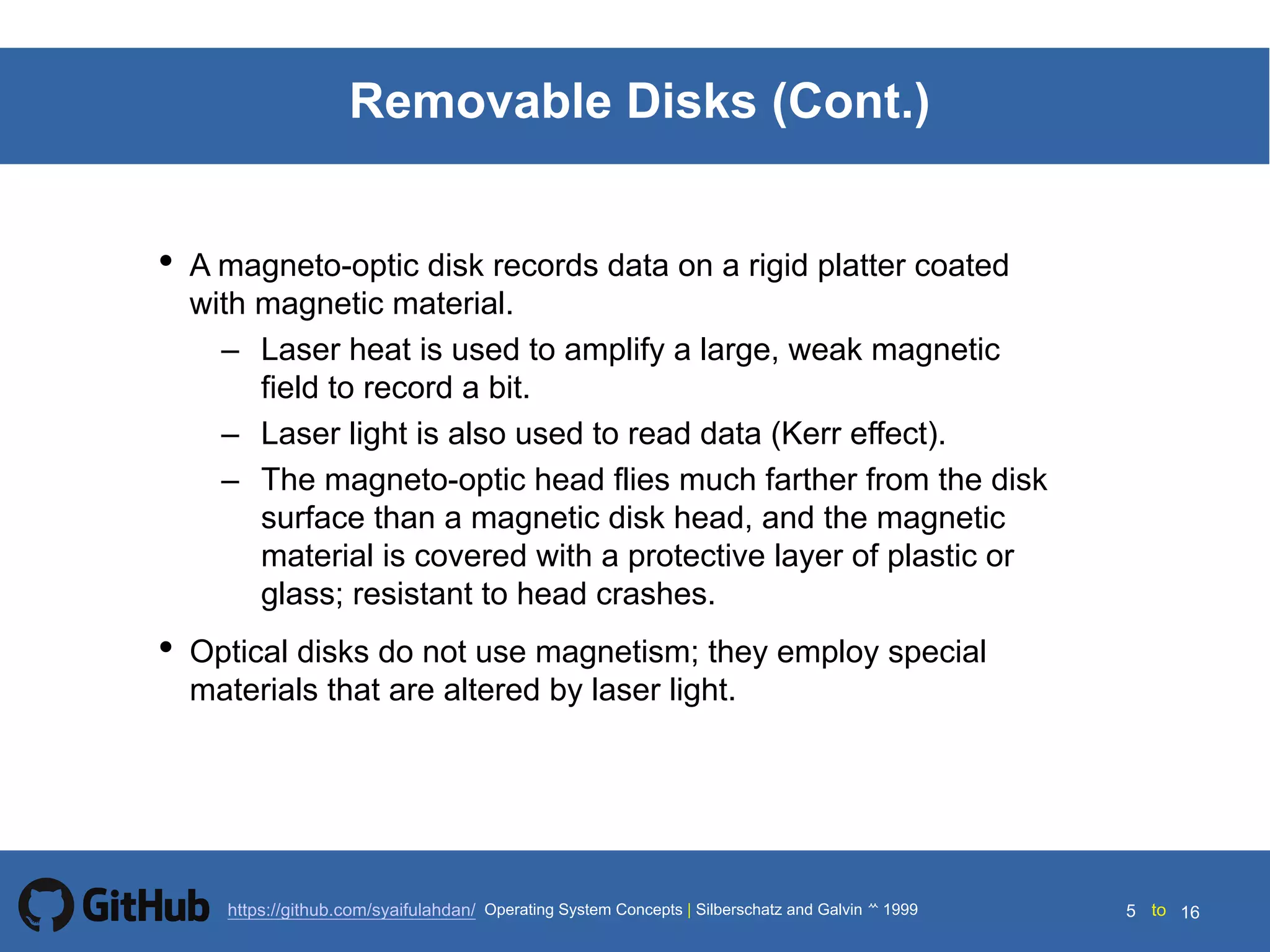
Removable Disks (Cont.)
• A magneto-optic disk records data on a rigid platter coated
with magnetic material.
– Laser heat is used to amplify a large, weak magnetic
field to record a bit.
– Laser light is also used to read data (Kerr effect).
– The magneto-optic head flies much farther from the disk
surface than a magnetic disk head, and the magnetic
material is covered with a protective layer of plastic or
glass; resistant to head crashes.
• Optical disks do not use magnetism; they employ special
materials that are altered by laser light.
Silberschatz and Galvin199914.6 Silberschatz and Galvin19995.6 Silberschatz and Galvin 19994.6
6 toOperating System Concepts | Silberschatz and Galvin 1999https://github.com/syaifulahdan/ 16
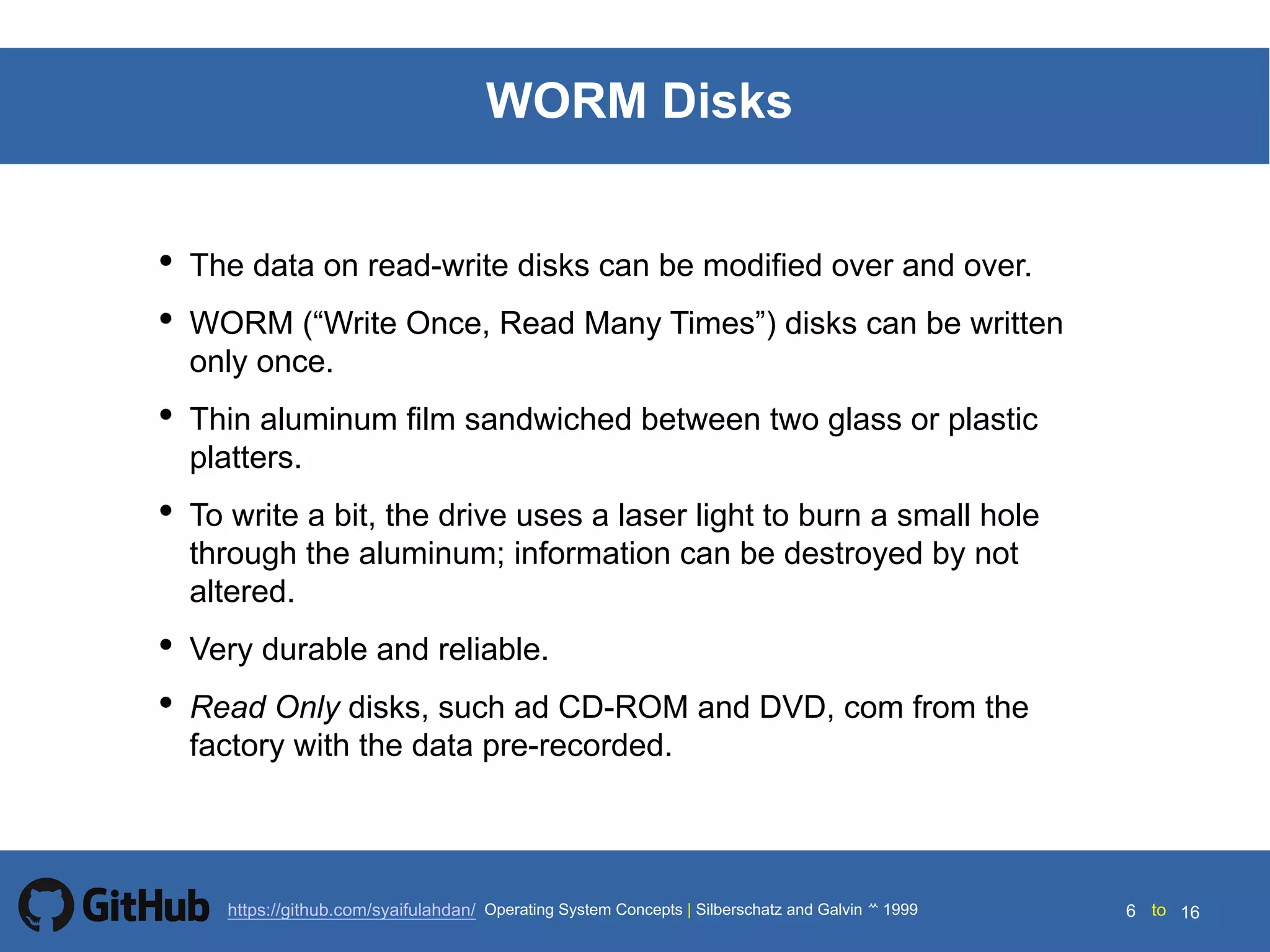
WORM Disks
• The data on read-write disks can be modified over and over.
• WORM (“Write Once, Read Many Times”) disks can be written
only once.
• Thin aluminum film sandwiched between two glass or plastic
platters.
• To write a bit, the drive uses a laser light to burn a small hole
through the aluminum; information can be destroyed by not
altered.
• Very durable and reliable.
• Read Only disks, such ad CD-ROM and DVD, com from the
factory with the data pre-recorded.
Silberschatz and Galvin199914.7 Silberschatz and Galvin19995.7 Silberschatz and Galvin 19994.7
7 toOperating System Concepts | Silberschatz and Galvin 1999https://github.com/syaifulahdan/ 16
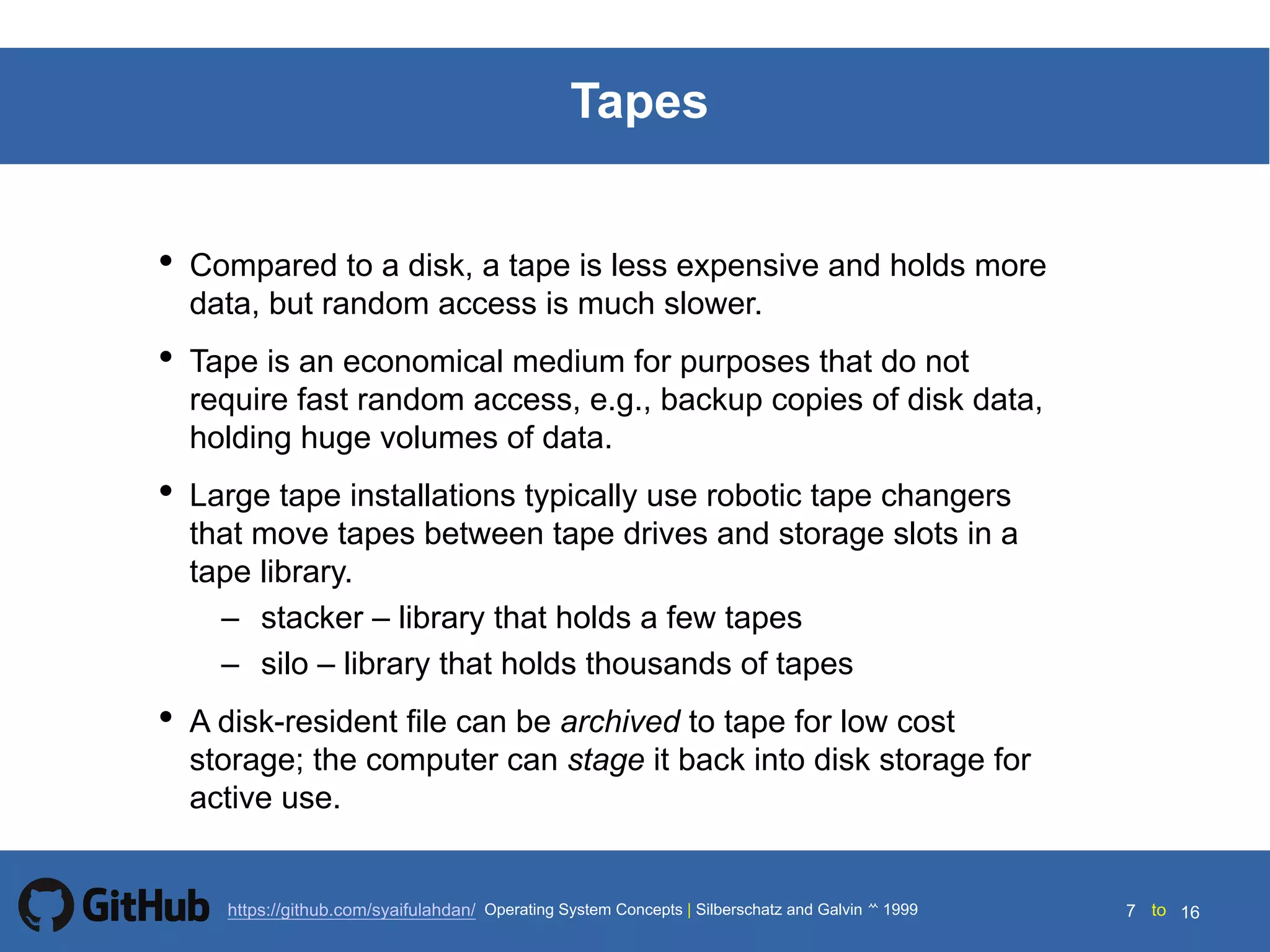
Tapes
• Compared to a disk, a tape is less expensive and holds more
data, but random access is much slower.
• Tape is an economical medium for purposes that do not
require fast random access, e.g., backup copies of disk data,
holding huge volumes of data.
• Large tape installations typically use robotic tape changers
that move tapes between tape drives and storage slots in a
tape library.
– stacker – library that holds a few tapes
– silo – library that holds thousands of tapes
• A disk-resident file can be archived to tape for low cost
storage; the computer can stage it back into disk storage for
active use.
Silberschatz and Galvin199914.8 Silberschatz and Galvin19995.8 Silberschatz and Galvin 19994.8
8 toOperating System Concepts | Silberschatz and Galvin 1999https://github.com/syaifulahdan/ 16
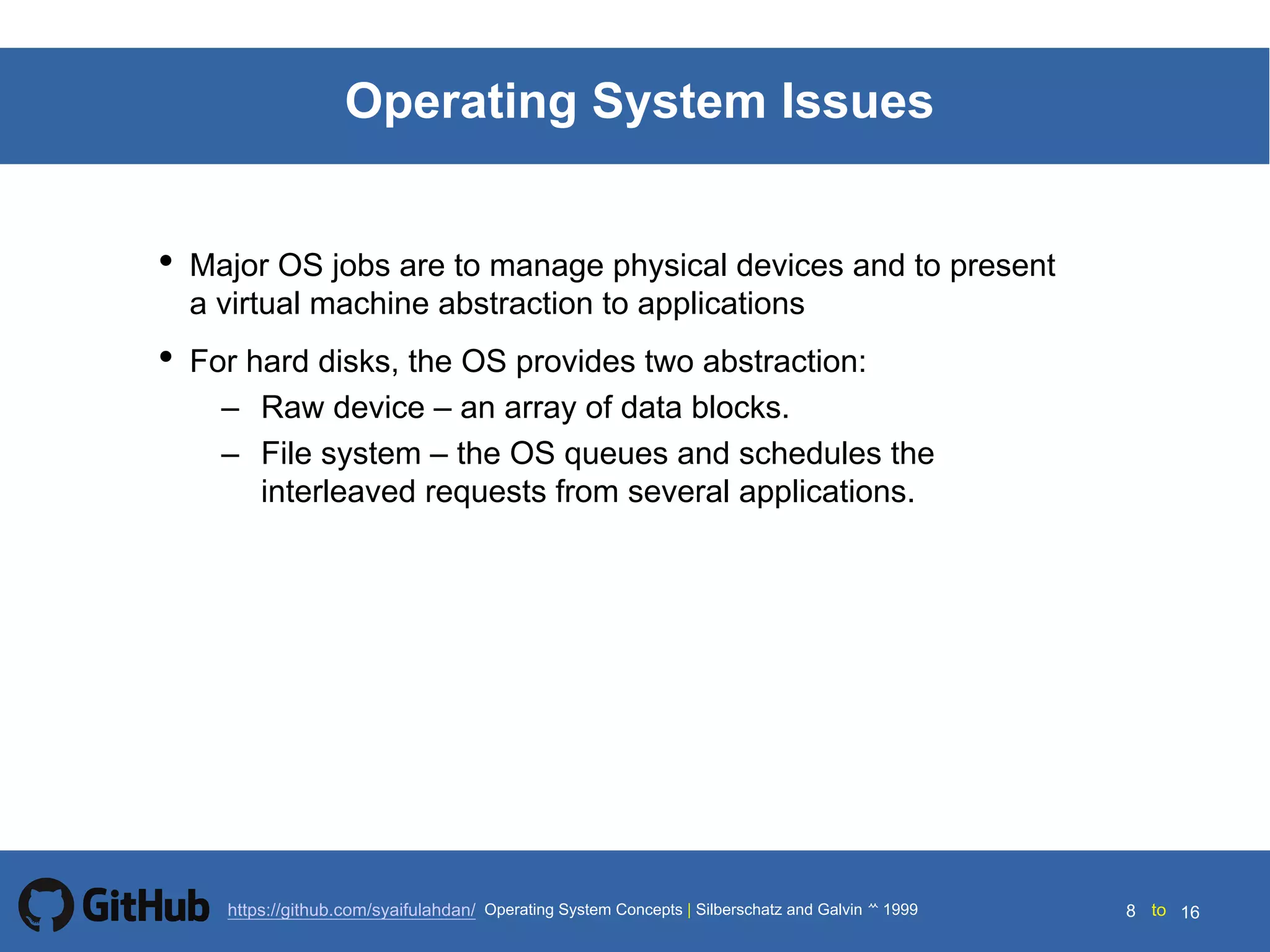
Operating System Issues
• Major OS jobs are to manage physical devices and to present
a virtual machine abstraction to applications
• For hard disks, the OS provides two abstraction:
– Raw device – an array of data blocks.
– File system – the OS queues and schedules the
interleaved requests from several applications.
Silberschatz and Galvin199914.9 Silberschatz and Galvin19995.9 Silberschatz and Galvin 19994.9
9 toOperating System Concepts | Silberschatz and Galvin 1999https://github.com/syaifulahdan/ 16
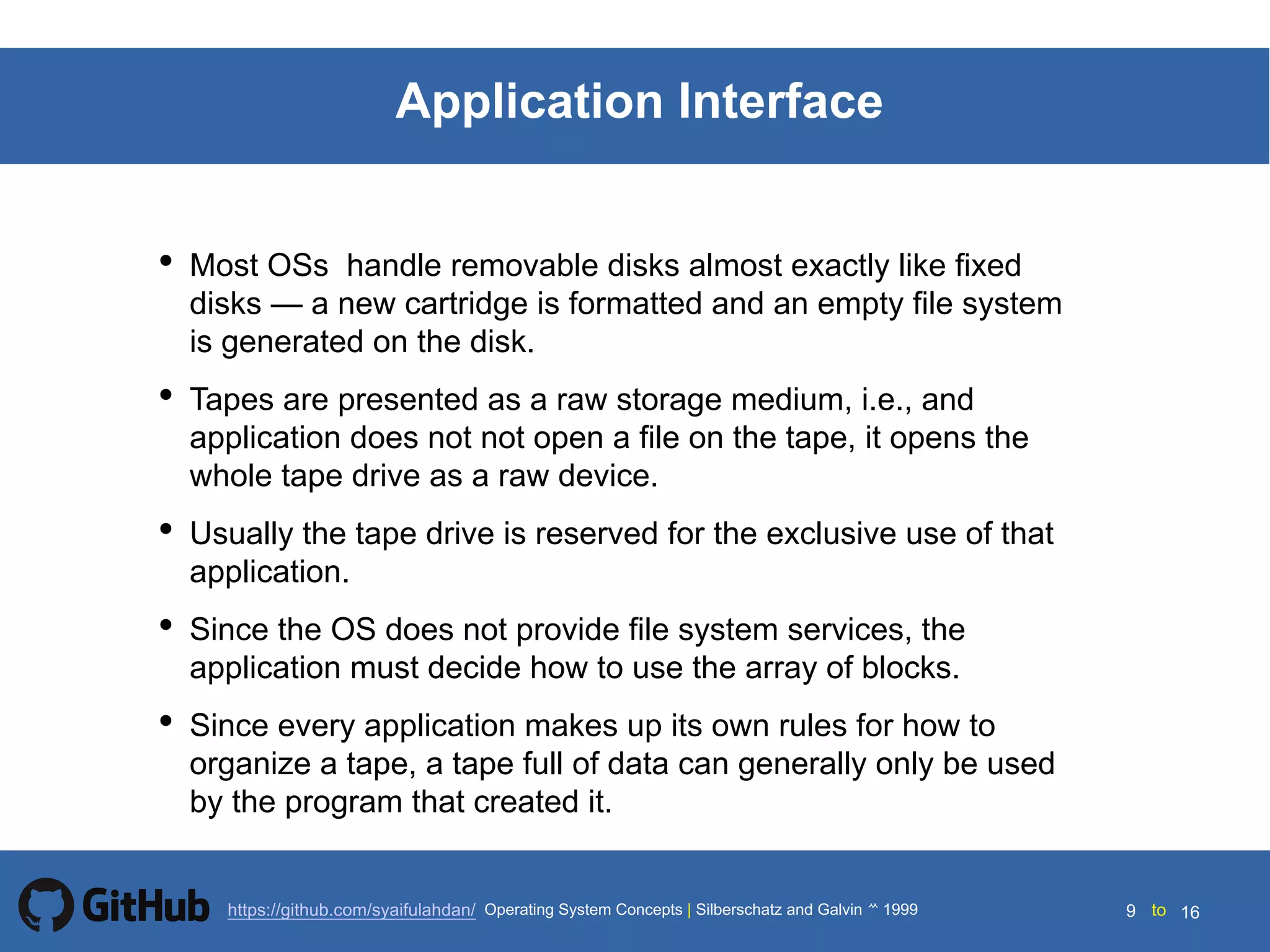
Application Interface
• Most OSs handle removable disks almost exactly like fixed
disks — a new cartridge is formatted and an empty file system
is generated on the disk.
• Tapes are presented as a raw storage medium, i.e., and
application does not not open a file on the tape, it opens the
whole tape drive as a raw device.
• Usually the tape drive is reserved for the exclusive use of that
application.
• Since the OS does not provide file system services, the
application must decide how to use the array of blocks.
• Since every application makes up its own rules for how to
organize a tape, a tape full of data can generally only be used
by the program that created it.
Silberschatz and Galvin199914.10 Silberschatz and Galvin19995.10 Silberschatz and Galvin 19994.10
10 toOperating System Concepts | Silberschatz and Galvin 1999https://github.com/syaifulahdan/ 16
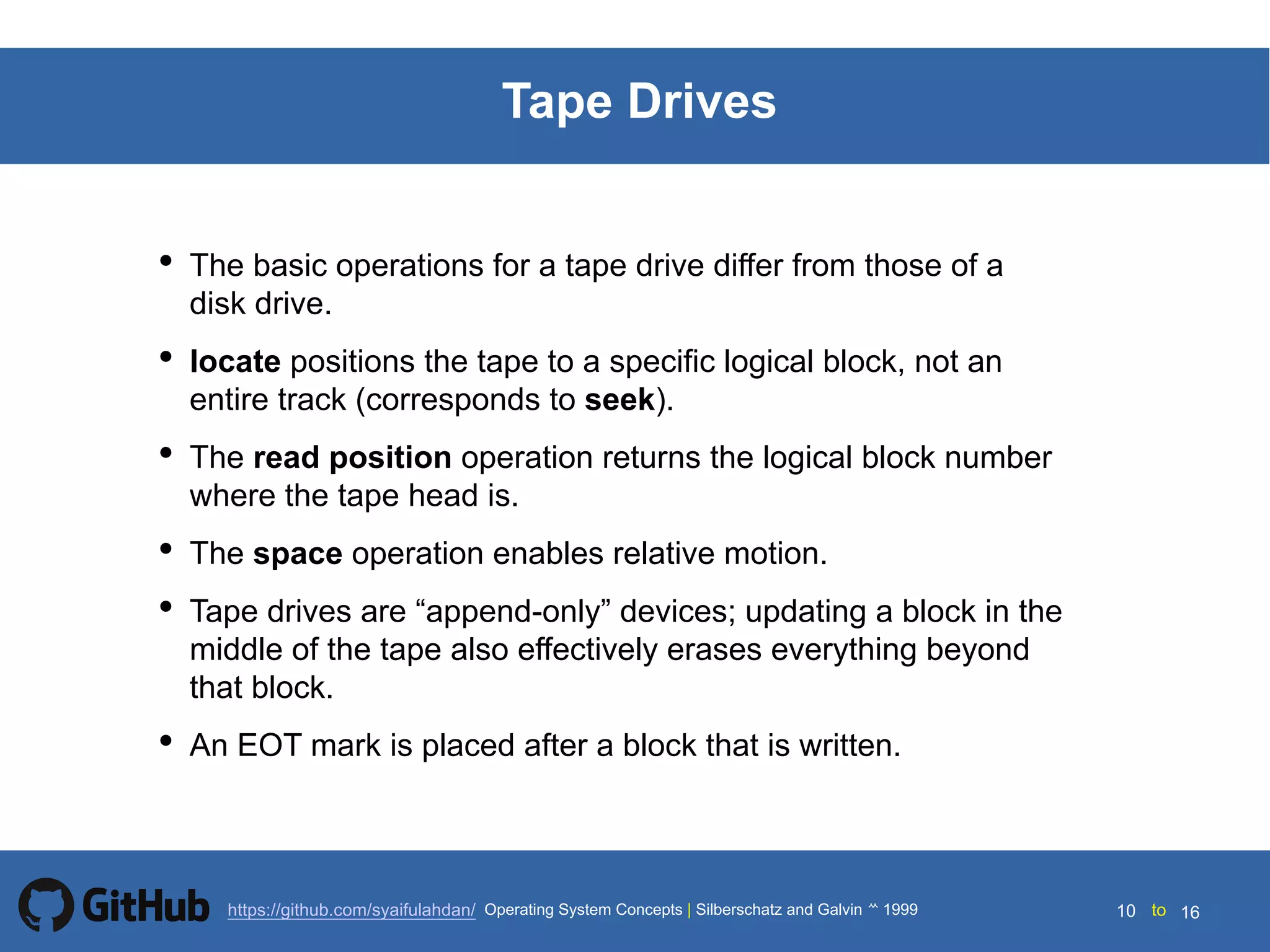
Tape Drives
• The basic operations for a tape drive differ from those of a
disk drive.
• locate positions the tape to a specific logical block, not an
entire track (corresponds to seek).
• The read position operation returns the logical block number
where the tape head is.
• The space operation enables relative motion.
• Tape drives are “append-only” devices; updating a block in the
middle of the tape also effectively erases everything beyond
that block.
• An EOT mark is placed after a block that is written.
Silberschatz and Galvin199914.11 Silberschatz and Galvin19995.11 Silberschatz and Galvin 19994.11
11 toOperating System Concepts | Silberschatz and Galvin 1999https://github.com/syaifulahdan/ 16
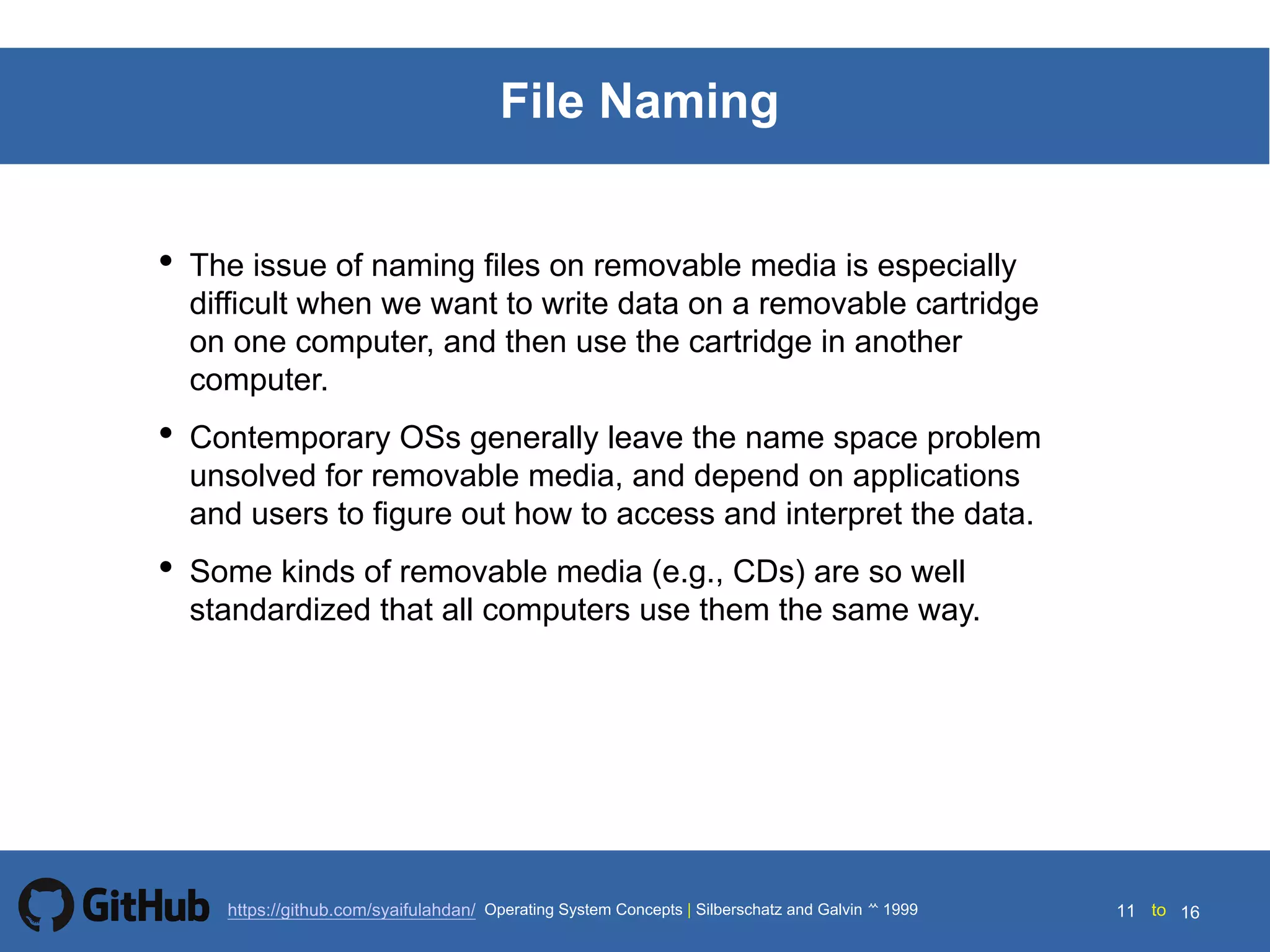
File Naming
• The issue of naming files on removable media is especially
difficult when we want to write data on a removable cartridge
on one computer, and then use the cartridge in another
computer.
• Contemporary OSs generally leave the name space problem
unsolved for removable media, and depend on applications
and users to figure out how to access and interpret the data.
• Some kinds of removable media (e.g., CDs) are so well
standardized that all computers use them the same way.
Silberschatz and Galvin199914.12 Silberschatz and Galvin19995.12 Silberschatz and Galvin 19994.12
12 toOperating System Concepts | Silberschatz and Galvin 1999https://github.com/syaifulahdan/ 16
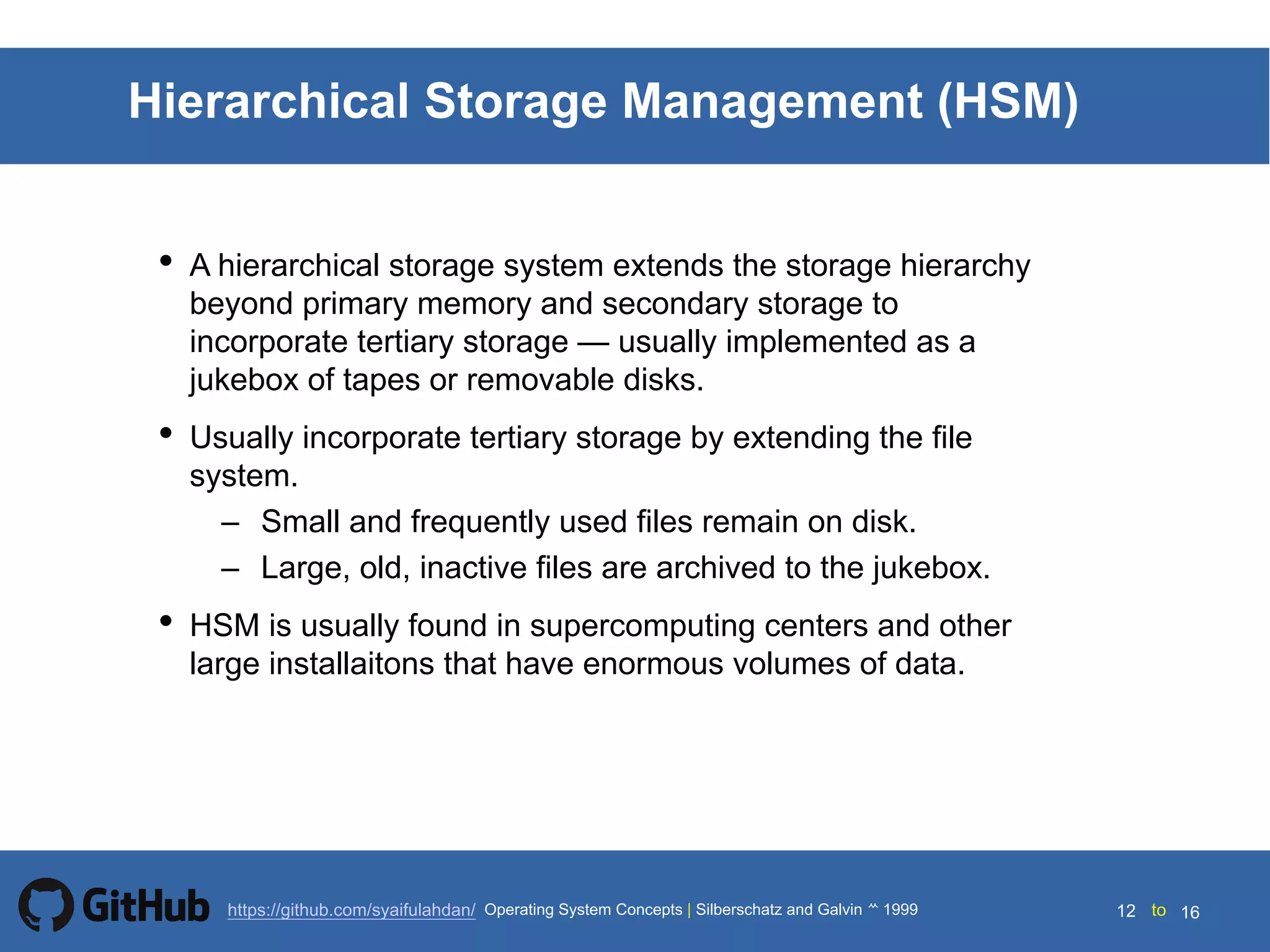
Hierarchical Storage Management (HSM)
• A hierarchical storage system extends the storage hierarchy
beyond primary memory and secondary storage to
incorporate tertiary storage — usually implemented as a
jukebox of tapes or removable disks.
• Usually incorporate tertiary storage by extending the file
system.
– Small and frequently used files remain on disk.
– Large, old, inactive files are archived to the jukebox.
• HSM is usually found in supercomputing centers and other
large installaitons that have enormous volumes of data.
Silberschatz and Galvin199914.13 Silberschatz and Galvin19995.13 Silberschatz and Galvin 19994.13
13 toOperating System Concepts | Silberschatz and Galvin 1999https://github.com/syaifulahdan/ 16
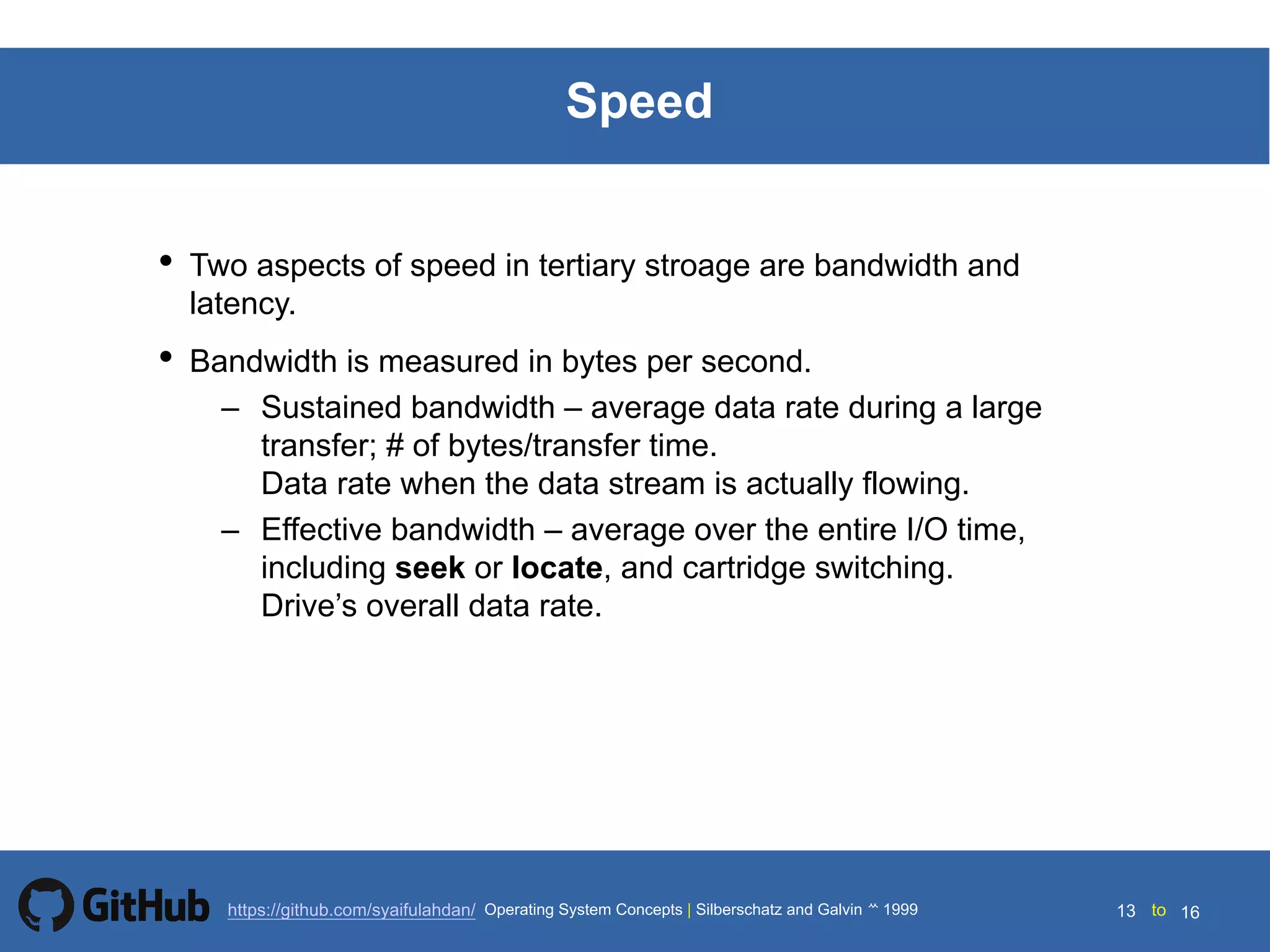
Speed
• Two aspects of speed in tertiary stroage are bandwidth and
latency.
• Bandwidth is measured in bytes per second.
– Sustained bandwidth – average data rate during a large
transfer; # of bytes/transfer time.
Data rate when the data stream is actually flowing.
– Effective bandwidth – average over the entire I/O time,
including seek or locate, and cartridge switching.
Drive’s overall data rate.
Silberschatz and Galvin199914.14 Silberschatz and Galvin19995.14 Silberschatz and Galvin 19994.14
14 toOperating System Concepts | Silberschatz and Galvin 1999https://github.com/syaifulahdan/ 16
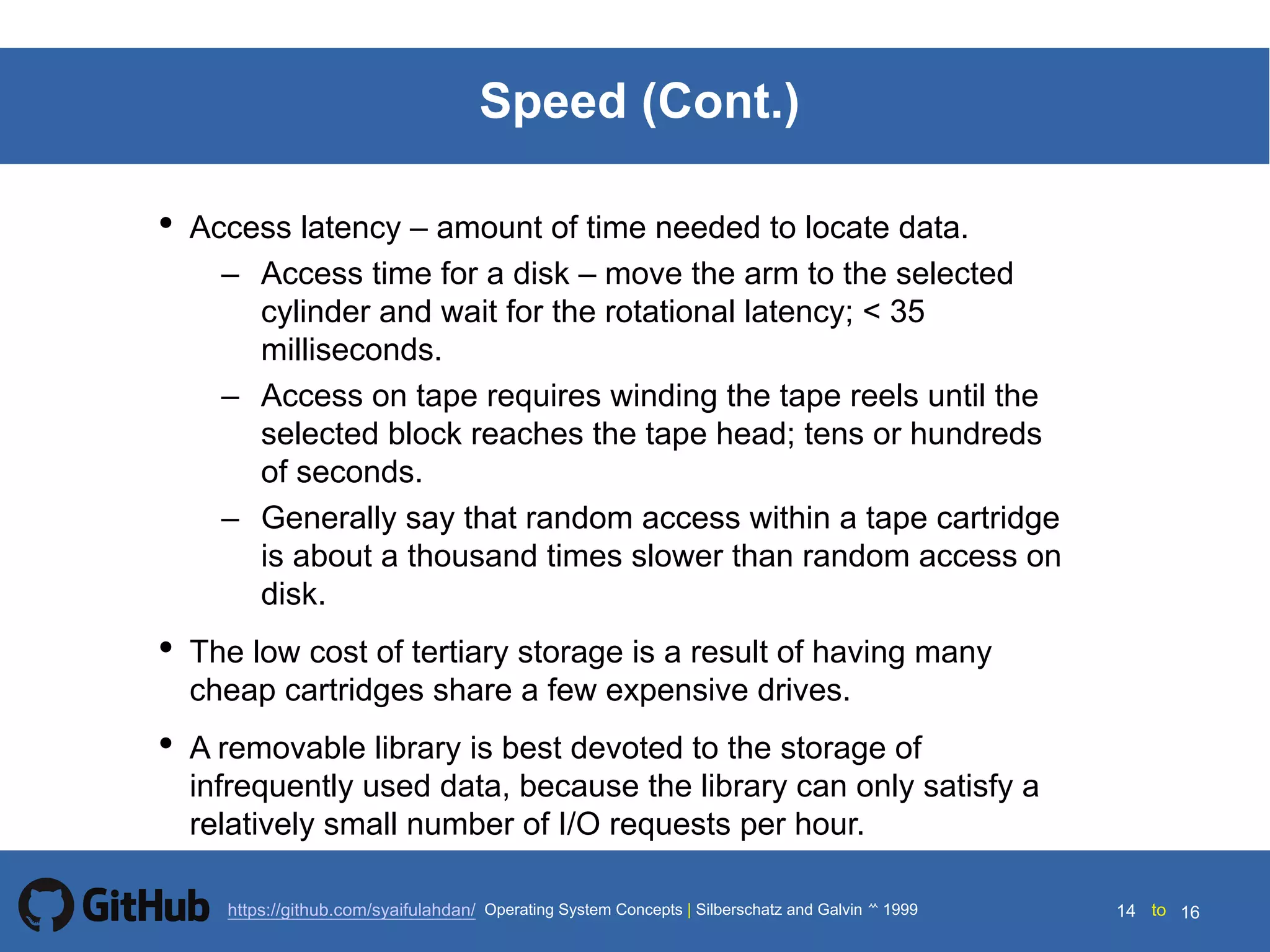
Speed (Cont.)
• Access latency – amount of time needed to locate data.
– Access time for a disk – move the arm to the selected
cylinder and wait for the rotational latency; < 35
milliseconds.
– Access on tape requires winding the tape reels until the
selected block reaches the tape head; tens or hundreds
of seconds.
– Generally say that random access within a tape cartridge
is about a thousand times slower than random access on
disk.
• The low cost of tertiary storage is a result of having many
cheap cartridges share a few expensive drives.
• A removable library is best devoted to the storage of
infrequently used data, because the library can only satisfy a
relatively small number of I/O requests per hour.
Silberschatz and Galvin199914.15 Silberschatz and Galvin19995.15 Silberschatz and Galvin 19994.15
15 toOperating System Concepts | Silberschatz and Galvin 1999https://github.com/syaifulahdan/ 16
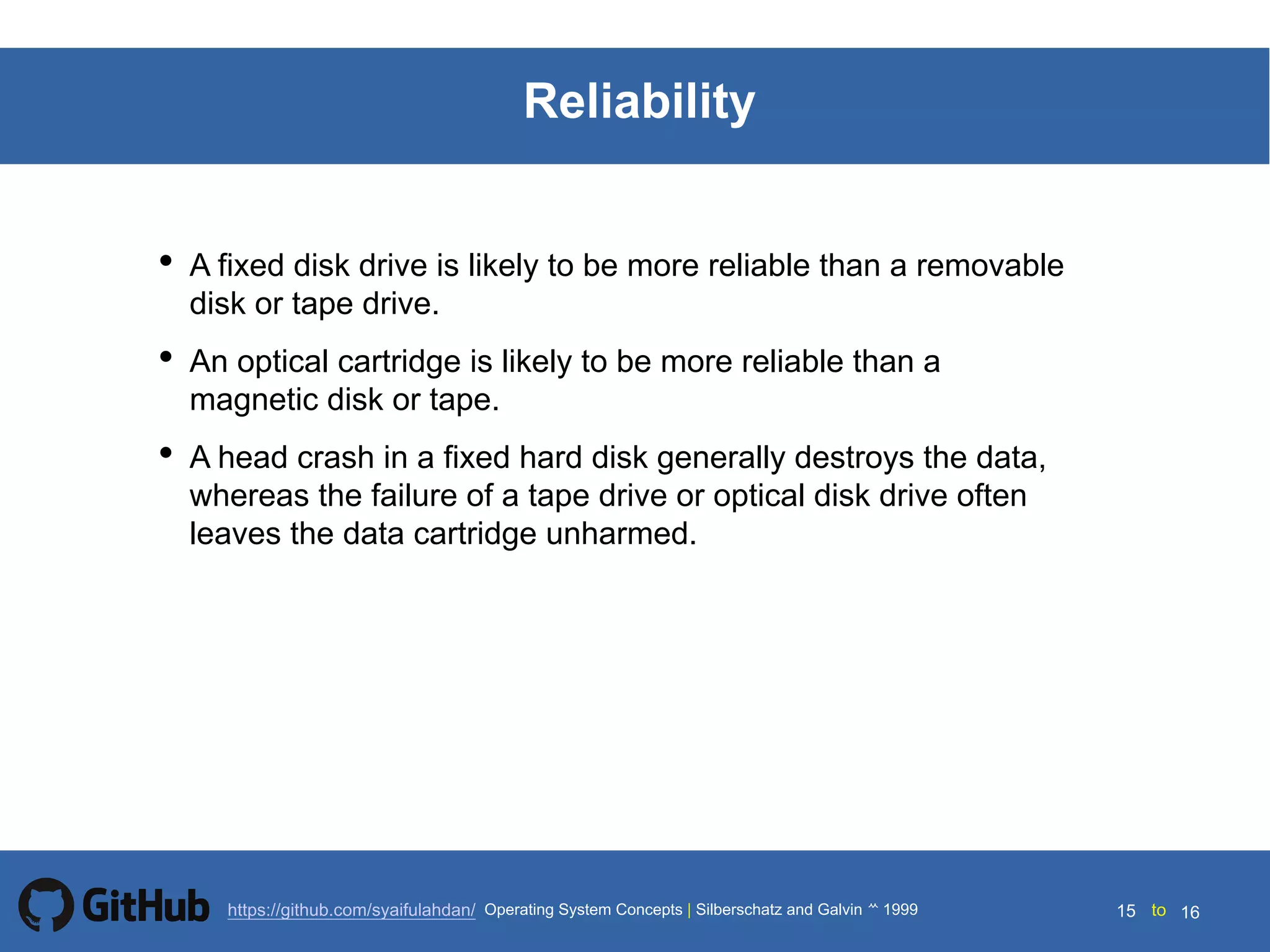
Reliability
• A fixed disk drive is likely to be more reliable than a removable
disk or tape drive.
• An optical cartridge is likely to be more reliable than a
magnetic disk or tape.
• A head crash in a fixed hard disk generally destroys the data,
whereas the failure of a tape drive or optical disk drive often
leaves the data cartridge unharmed.
Silberschatz and Galvin199914.16 Silberschatz and Galvin19995.16 Silberschatz and Galvin 19994.16
16 toOperating System Concepts | Silberschatz and Galvin 1999https://github.com/syaifulahdan/ 16
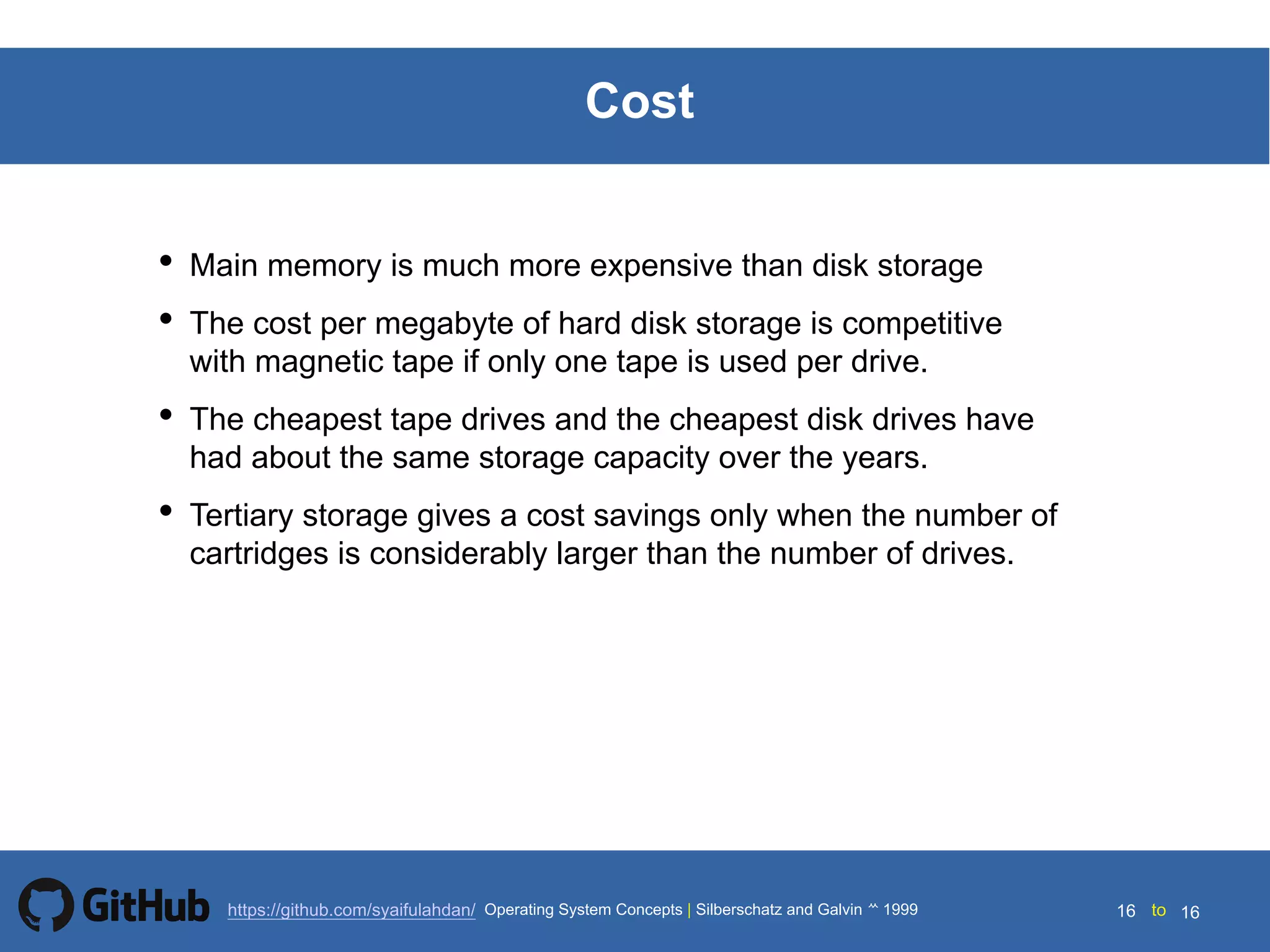
Cost
• Main memory is much more expensive than disk storage
• The cost per megabyte of hard disk storage is competitive
with magnetic tape if only one tape is used per drive.
• The cheapest tape drives and the cheapest disk drives have
had about the same storage capacity over the years.
• Tertiary storage gives a cost savings only when the number of
cartridges is considerably larger than the number of drives.

Ch10.2.tertiary storage structure

  • 1.
    Silberschatz and Galvin199914.1Silberschatz and Galvin19995.1 Silberschatz and Galvin 19994.1 1 toOperating System Concepts | Silberschatz and Galvin 1999https://github.com/syaifulahdan/ 16 O P E R A T I N G S Y S T E M S Chapter 10.2 : Tertiary-Storage Structure • Tertiary Storage Devices • Operating System Issues • Performance Issues
  • 2.
    Silberschatz and Galvin199914.2Silberschatz and Galvin19995.2 Silberschatz and Galvin 19994.2 2 toOperating System Concepts | Silberschatz and Galvin 1999https://github.com/syaifulahdan/ 16 Chapter 10.2: Tertiary-Storage Structure • Tertiary Storage Devices • Operating System Issues • Performance Issues
  • 3.
    Silberschatz and Galvin199914.3Silberschatz and Galvin19995.3 Silberschatz and Galvin 19994.3 3 toOperating System Concepts | Silberschatz and Galvin 1999https://github.com/syaifulahdan/ 16 Tertiary Storage Devices • Low cost is the defining characteristic of tertiary storage. • Generally, tertiary storage is built using removable media • Common examples of removable media are floppy disks and CD-ROMs; other types are available.
  • 4.
    Silberschatz and Galvin199914.4Silberschatz and Galvin19995.4 Silberschatz and Galvin 19994.4 4 toOperating System Concepts | Silberschatz and Galvin 1999https://github.com/syaifulahdan/ 16 Removable Disks • Floppy disk — thin flexible disk coated with magnetic material, enclosed in a protective plastic case. – Most floppies hold about 1 MB; similar technology is used for removable disks that hold more than 1 GB. – Removable magnetic disks can be nearly as fast as hard disks, but they are at a greater risk of damage from exposure.
  • 5.
    Silberschatz and Galvin199914.5Silberschatz and Galvin19995.5 Silberschatz and Galvin 19994.5 5 toOperating System Concepts | Silberschatz and Galvin 1999https://github.com/syaifulahdan/ 16 Removable Disks (Cont.) • A magneto-optic disk records data on a rigid platter coated with magnetic material. – Laser heat is used to amplify a large, weak magnetic field to record a bit. – Laser light is also used to read data (Kerr effect). – The magneto-optic head flies much farther from the disk surface than a magnetic disk head, and the magnetic material is covered with a protective layer of plastic or glass; resistant to head crashes. • Optical disks do not use magnetism; they employ special materials that are altered by laser light.
  • 6.
    Silberschatz and Galvin199914.6Silberschatz and Galvin19995.6 Silberschatz and Galvin 19994.6 6 toOperating System Concepts | Silberschatz and Galvin 1999https://github.com/syaifulahdan/ 16 WORM Disks • The data on read-write disks can be modified over and over. • WORM (“Write Once, Read Many Times”) disks can be written only once. • Thin aluminum film sandwiched between two glass or plastic platters. • To write a bit, the drive uses a laser light to burn a small hole through the aluminum; information can be destroyed by not altered. • Very durable and reliable. • Read Only disks, such ad CD-ROM and DVD, com from the factory with the data pre-recorded.
  • 7.
    Silberschatz and Galvin199914.7Silberschatz and Galvin19995.7 Silberschatz and Galvin 19994.7 7 toOperating System Concepts | Silberschatz and Galvin 1999https://github.com/syaifulahdan/ 16 Tapes • Compared to a disk, a tape is less expensive and holds more data, but random access is much slower. • Tape is an economical medium for purposes that do not require fast random access, e.g., backup copies of disk data, holding huge volumes of data. • Large tape installations typically use robotic tape changers that move tapes between tape drives and storage slots in a tape library. – stacker – library that holds a few tapes – silo – library that holds thousands of tapes • A disk-resident file can be archived to tape for low cost storage; the computer can stage it back into disk storage for active use.
  • 8.
    Silberschatz and Galvin199914.8Silberschatz and Galvin19995.8 Silberschatz and Galvin 19994.8 8 toOperating System Concepts | Silberschatz and Galvin 1999https://github.com/syaifulahdan/ 16 Operating System Issues • Major OS jobs are to manage physical devices and to present a virtual machine abstraction to applications • For hard disks, the OS provides two abstraction: – Raw device – an array of data blocks. – File system – the OS queues and schedules the interleaved requests from several applications.
  • 9.
    Silberschatz and Galvin199914.9Silberschatz and Galvin19995.9 Silberschatz and Galvin 19994.9 9 toOperating System Concepts | Silberschatz and Galvin 1999https://github.com/syaifulahdan/ 16 Application Interface • Most OSs handle removable disks almost exactly like fixed disks — a new cartridge is formatted and an empty file system is generated on the disk. • Tapes are presented as a raw storage medium, i.e., and application does not not open a file on the tape, it opens the whole tape drive as a raw device. • Usually the tape drive is reserved for the exclusive use of that application. • Since the OS does not provide file system services, the application must decide how to use the array of blocks. • Since every application makes up its own rules for how to organize a tape, a tape full of data can generally only be used by the program that created it.
  • 10.
    Silberschatz and Galvin199914.10Silberschatz and Galvin19995.10 Silberschatz and Galvin 19994.10 10 toOperating System Concepts | Silberschatz and Galvin 1999https://github.com/syaifulahdan/ 16 Tape Drives • The basic operations for a tape drive differ from those of a disk drive. • locate positions the tape to a specific logical block, not an entire track (corresponds to seek). • The read position operation returns the logical block number where the tape head is. • The space operation enables relative motion. • Tape drives are “append-only” devices; updating a block in the middle of the tape also effectively erases everything beyond that block. • An EOT mark is placed after a block that is written.
  • 11.
    Silberschatz and Galvin199914.11Silberschatz and Galvin19995.11 Silberschatz and Galvin 19994.11 11 toOperating System Concepts | Silberschatz and Galvin 1999https://github.com/syaifulahdan/ 16 File Naming • The issue of naming files on removable media is especially difficult when we want to write data on a removable cartridge on one computer, and then use the cartridge in another computer. • Contemporary OSs generally leave the name space problem unsolved for removable media, and depend on applications and users to figure out how to access and interpret the data. • Some kinds of removable media (e.g., CDs) are so well standardized that all computers use them the same way.
  • 12.
    Silberschatz and Galvin199914.12Silberschatz and Galvin19995.12 Silberschatz and Galvin 19994.12 12 toOperating System Concepts | Silberschatz and Galvin 1999https://github.com/syaifulahdan/ 16 Hierarchical Storage Management (HSM) • A hierarchical storage system extends the storage hierarchy beyond primary memory and secondary storage to incorporate tertiary storage — usually implemented as a jukebox of tapes or removable disks. • Usually incorporate tertiary storage by extending the file system. – Small and frequently used files remain on disk. – Large, old, inactive files are archived to the jukebox. • HSM is usually found in supercomputing centers and other large installaitons that have enormous volumes of data.
  • 13.
    Silberschatz and Galvin199914.13Silberschatz and Galvin19995.13 Silberschatz and Galvin 19994.13 13 toOperating System Concepts | Silberschatz and Galvin 1999https://github.com/syaifulahdan/ 16 Speed • Two aspects of speed in tertiary stroage are bandwidth and latency. • Bandwidth is measured in bytes per second. – Sustained bandwidth – average data rate during a large transfer; # of bytes/transfer time. Data rate when the data stream is actually flowing. – Effective bandwidth – average over the entire I/O time, including seek or locate, and cartridge switching. Drive’s overall data rate.
  • 14.
    Silberschatz and Galvin199914.14Silberschatz and Galvin19995.14 Silberschatz and Galvin 19994.14 14 toOperating System Concepts | Silberschatz and Galvin 1999https://github.com/syaifulahdan/ 16 Speed (Cont.) • Access latency – amount of time needed to locate data. – Access time for a disk – move the arm to the selected cylinder and wait for the rotational latency; < 35 milliseconds. – Access on tape requires winding the tape reels until the selected block reaches the tape head; tens or hundreds of seconds. – Generally say that random access within a tape cartridge is about a thousand times slower than random access on disk. • The low cost of tertiary storage is a result of having many cheap cartridges share a few expensive drives. • A removable library is best devoted to the storage of infrequently used data, because the library can only satisfy a relatively small number of I/O requests per hour.
  • 15.
    Silberschatz and Galvin199914.15Silberschatz and Galvin19995.15 Silberschatz and Galvin 19994.15 15 toOperating System Concepts | Silberschatz and Galvin 1999https://github.com/syaifulahdan/ 16 Reliability • A fixed disk drive is likely to be more reliable than a removable disk or tape drive. • An optical cartridge is likely to be more reliable than a magnetic disk or tape. • A head crash in a fixed hard disk generally destroys the data, whereas the failure of a tape drive or optical disk drive often leaves the data cartridge unharmed.
  • 16.
    Silberschatz and Galvin199914.16Silberschatz and Galvin19995.16 Silberschatz and Galvin 19994.16 16 toOperating System Concepts | Silberschatz and Galvin 1999https://github.com/syaifulahdan/ 16 Cost • Main memory is much more expensive than disk storage • The cost per megabyte of hard disk storage is competitive with magnetic tape if only one tape is used per drive. • The cheapest tape drives and the cheapest disk drives have had about the same storage capacity over the years. • Tertiary storage gives a cost savings only when the number of cartridges is considerably larger than the number of drives.