 The word is the smallest unit of language
that can be used by itself.
 Written Word: any sequence of letters with
an orthographic space on either side.
 Is there a one-to-one relation between word
and meaning?
 There is no one-to-one correspondence
between orthographic words and elements of
meaning within or across languages.
 Elements of meaning which are represented by
one orthographic word may be represented by
more than one on another language. E.g.
rebuild, disbelieve
 Morpheme is introduced to isolate elements of
meaning in words and deal with them more
effectively.
 Morpheme is the minimal formal element of
meaning in language.
 Inconceivable : one word but three
morphemes:
› In: meaning not,
› conceive: meaning think of or imagine.
› able: meaning able to be, fit to be
 Lexical meaning: the specific value of a word
or lexical unit in a particular system.
 There are four types of lexical meaning:
1- Propositional Meaning.
2- Expressive Meaning.
3- Presupposed Meaning.
4- Evoked Meaning.
 The relation between the word and what it
refers to or describes in a real or imaginative
world. Through this meaning, we can decide
whether the word is true or false.
 E.g. Shirt: a piece of clothing worn on the upper
part of the body. Not worn in foot (socks)
 A translation is inaccurate because of mistakes
in propositional meanings.
 It is related to the speaker’s feeling or attitude. Can’t judge
(true or false)
 Two or more words can have the same propositional
meaning but with different expressive meaning.
 E.g. don’t complain – don’t whinge
- Expressive meaning: “whinge” the speaker finds the
action annoying.
- Famous: it means “well-known” in English and French.
But in French it has a negative meaning.
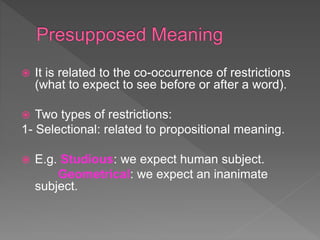
 It is related to the co-occurrence of restrictions
(what to expect to see before or after a word).
 Two types of restrictions:
1- Selectional: related to propositional meaning.
 E.g. Studious: we expect human subject.
Geometrical: we expect an inanimate
subject.
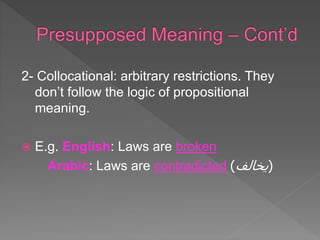
2- Collocational: arbitrary restrictions. They
don’t follow the logic of propositional
meaning.
 E.g. English: Laws are broken
Arabic: Laws are contradicted (
‫يخالف‬
)
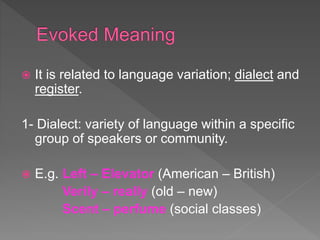
 It is related to language variation; dialect and
register.
1- Dialect: variety of language within a specific
group of speakers or community.
 E.g. Left – Elevator (American – British)
Verily – really (old – new)
Scent – perfume (social classes)
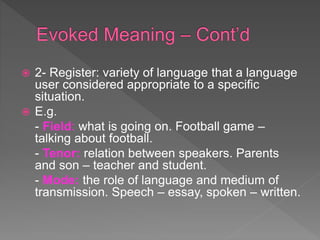
 2- Register: variety of language that a language
user considered appropriate to a specific
situation.
 E.g.
- Field: what is going on. Football game –
talking about football.
- Tenor: relation between speakers. Parents
and son – teacher and student.
- Mode: the role of language and medium of
transmission. Speech – essay, spoken – written.
 A translator must ensure that his translation
doesn’t get ridiculed by the receiver and that
it matches their register expectations,
unless, the purpose of the translation is to
give a flavor of the source culture.
 Choosing the suitable equivalent depends on
a wide variety of factors ; some are linguistic
and some are extra-linguistic.
 Before choosing the suitable equivalent, we
must know semantic fields and lexical
sets.
 Language is usually divided into semantic
fields (divisions) and lexical sets (sub-
divisions).
 Semantic fields refer to abstract concepts,
while the actual expression under the field is
called lexical set.
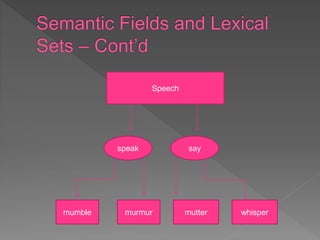
Speech
speak say
mumble whisper
mutter
murmur
 Among languages, there is agreement on
the larger headings (semantic fields) more
than the sub-fields.
 E.g. Temeprature
- English: cold, cool, warm, hot
- Arabic: ‫دافئ‬ ،‫ساخن‬ ،‫حار‬ ،‫بارد‬
 Non-equivalence mean that the target
language has no direct equivalent for a word
which occurs in the source text.
 There are many types of non-equivalence
which can cause problems to the translator.
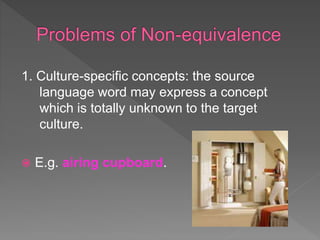
1. Culture-specific concepts: the source
language word may express a concept
which is totally unknown to the target
culture.
 E.g. airing cupboard.
2. The source language concept is not
lexicalized in the target language: the
source word may express a concept which
is known in the target culture but simple not
lexicalized.
 E.g. savoury: attractive to the sense of taste
or smell.
3. The source language word is semantically
complex: a single word which consists of a
single word can sometimes express a more
complex set of meanings than a whole
sentence.
 E.g. arruacao: a word in Brazilian: clearing the
ground under coffee trees of rubbish and piling
it in the middle of the row to aid in the recovery
of beans dropped during harvesting.
4. The source and target languages make different
distinctions in meaning: the target language has
an equivalent but with different distinctions than
the source language.
 E.g. Indonesian:
- Kehujana: going out in the rain with the
knowledge that it is raining.
- Hujanhujanan: going out in the rain without the
knowledge that it is raining.
5. The target language lacks a superordinate:
the target language may have specific words
but no general word to head the semantic
field.
 E.g. Russian: it doesn’t include an general
equivalent for facilities, it has only types of
facilities.
6. The target language lacks a specific term:
the target language has a superordinate but
not a specific word.
 E.g. English:
Superordinate: House
Specific words: bungalow, cottage, chalet,
hut, lodge, mansion, manor, villa, croft and
hall.
7. Difference in expressive meaning: there may be
a target-language word which has the same
propositional meaning as the source-language
word, but it may have a different expressive
meaning.
 The target language equivalent is neutral
compared to the source-language item. So
there might be a need for a modifier or adverb
to add the evaluative element.
8. Difference in form: there is often no
equivalence in the target language for a
particular form in the source text.
 E.g. English uses affixes to produce words,
while Arabic does not have this mechanism,
so we paraphrase.
- drinkable, conceivable, retrievable.
9. Difference in frequency and purpose of
using specific forms.
10. The use of loan words in the source text: using
loan words in the source text creates a special
problem in translation, because they are used for
prestige value and sophistication.
 This is often lost in translation, because we cannot
always find loan words in the target language with
the same meaning.
 E.g. Dilettante – loan word in English. Only
propositional meaning can be rendered in Arabic.
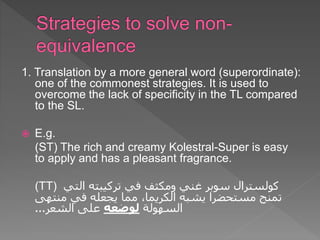
1. Translation by a more general word (superordinate):
one of the commonest strategies. It is used to
overcome the lack of specificity in the TL compared
to the SL.
 E.g.
(ST) The rich and creamy Kolestral-Super is easy
to apply and has a pleasant fragrance.
(TT) ‫كولسترال‬
‫التي‬ ‫تركيبته‬ ‫في‬ ‫ومكثف‬ ‫غني‬ ‫سوبر‬
‫يشبه‬ ‫مستحضرا‬ ‫تمنح‬
‫الكريما‬
‫منتهى‬ ‫في‬ ‫يجعله‬ ‫مما‬ ،
‫السهولة‬
‫لوضعه‬
‫الشعر‬ ‫على‬
...
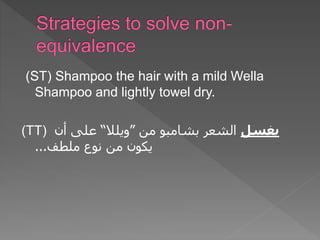
(ST) Shampoo the hair with a mild Wella
Shampoo and lightly towel dry.
(TT) ‫يغسل‬
‫من‬ ‫بشامبو‬ ‫الشعر‬
”
‫ويلال‬
“
‫أن‬ ‫على‬
‫ملطف‬ ‫نوع‬ ‫من‬ ‫يكون‬
...
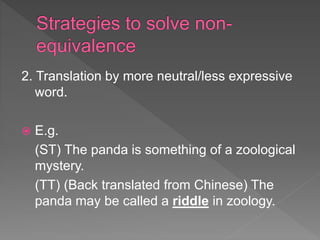
2. Translation by more neutral/less expressive
word.
 E.g.
(ST) The panda is something of a zoological
mystery.
(TT) (Back translated from Chinese) The
panda may be called a riddle in zoology.
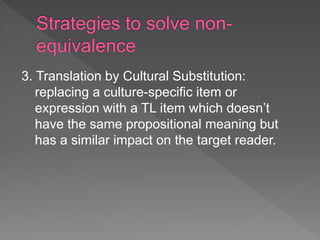
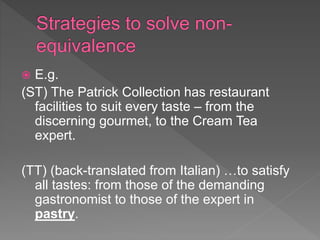
3. Translation by Cultural Substitution:
replacing a culture-specific item or
expression with a TL item which doesn’t
have the same propositional meaning but
has a similar impact on the target reader.
 E.g.
(ST) The Patrick Collection has restaurant
facilities to suit every taste – from the
discerning gourmet, to the Cream Tea
expert.
(TT) (back-translated from Italian) …to satisfy
all tastes: from those of the demanding
gastronomist to those of the expert in
pastry.
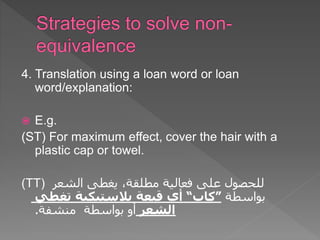
4. Translation using a loan word or loan
word/explanation:
 E.g.
(ST) For maximum effect, cover the hair with a
plastic cap or towel.
(TT) ‫الشعر‬ ‫يغطى‬ ،‫مطلقة‬ ‫فعالية‬ ‫على‬ ‫للحصول‬
‫بواسطة‬
”
‫كاب‬
“
‫تغطي‬ ‫بالستيكية‬ ‫قبعة‬ ‫أي‬
‫الشعر‬
‫منشفة‬ ‫بواسطة‬ ‫أو‬
.
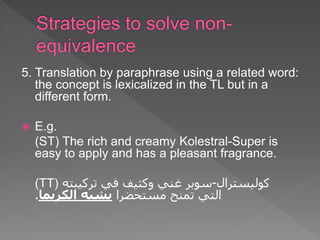
5. Translation by paraphrase using a related word:
the concept is lexicalized in the TL but in a
different form.
 E.g.
(ST) The rich and creamy Kolestral-Super is
easy to apply and has a pleasant fragrance.
(TT) ‫كوليسترال‬
-
‫تركيبته‬ ‫في‬ ‫وكثيف‬ ‫غني‬ ‫سوبر‬
‫مستحضرا‬ ‫تمنح‬ ‫التي‬
‫يشبه‬
‫الكريما‬
.
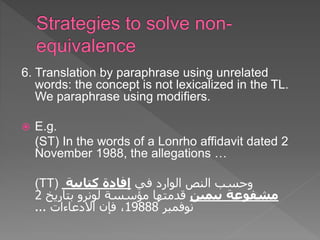
6. Translation by paraphrase using unrelated
words: the concept is not lexicalized in the TL.
We paraphrase using modifiers.
 E.g.
(ST) In the words of a Lonrho affidavit dated 2
November 1988, the allegations …
(TT) ‫في‬ ‫الوارد‬ ‫النص‬ ‫وحسب‬
‫كتابية‬ ‫إفادة‬
‫بيمين‬ ‫مشفوعة‬
‫مؤسسة‬ ‫قدمتها‬
‫لونرو‬
‫بتاريخ‬
2
‫نوفمبر‬
19888
‫االدعاءات‬ ‫فإن‬ ،
...
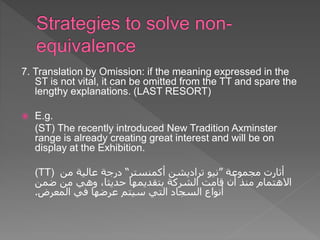
7. Translation by Omission: if the meaning expressed in the
ST is not vital, it can be omitted from the TT and spare the
lengthy explanations. (LAST RESORT)
 E.g.
(ST) The recently introduced New Tradition Axminster
range is already creating great interest and will be on
display at the Exhibition.
(TT) ‫مجموعة‬ ‫أثارت‬
”
‫نيو‬
‫تراديشن‬
‫أكمنستر‬
“
‫من‬ ‫عالية‬ ‫درجة‬
‫ضمن‬ ‫من‬ ‫وهي‬ ،‫حديثا‬ ‫بتقديمها‬ ‫الشركة‬ ‫قامت‬ ‫أن‬ ‫منذ‬ ‫االهتمام‬
‫المعرض‬ ‫في‬ ‫عرضها‬ ‫سيتم‬ ‫التي‬ ‫السجاد‬ ‫أنواع‬
.
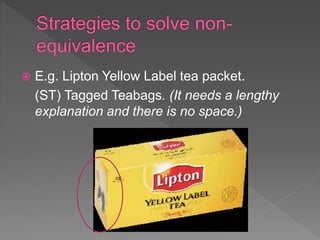
8. Translation by Illustration: this is a useful
option if the TL lacks an equivalent refers to
a physical entity, especially if there are
restrictions on space and if the text must
remain short and consice.
 E.g. Lipton Yellow Label tea packet.
(ST) Tagged Teabags. (It needs a lengthy
explanation and there is no space.)
 Choose two translation strategies and find
two examples on them.
 Deadline: Next Lecture.

Ch1. in other words PPT.pptx

  • 3.
     The wordis the smallest unit of language that can be used by itself.  Written Word: any sequence of letters with an orthographic space on either side.
  • 4.
     Is therea one-to-one relation between word and meaning?  There is no one-to-one correspondence between orthographic words and elements of meaning within or across languages.  Elements of meaning which are represented by one orthographic word may be represented by more than one on another language. E.g. rebuild, disbelieve
  • 5.
     Morpheme isintroduced to isolate elements of meaning in words and deal with them more effectively.  Morpheme is the minimal formal element of meaning in language.  Inconceivable : one word but three morphemes: › In: meaning not, › conceive: meaning think of or imagine. › able: meaning able to be, fit to be
  • 6.
     Lexical meaning:the specific value of a word or lexical unit in a particular system.  There are four types of lexical meaning: 1- Propositional Meaning. 2- Expressive Meaning. 3- Presupposed Meaning. 4- Evoked Meaning.
  • 7.
     The relationbetween the word and what it refers to or describes in a real or imaginative world. Through this meaning, we can decide whether the word is true or false.  E.g. Shirt: a piece of clothing worn on the upper part of the body. Not worn in foot (socks)  A translation is inaccurate because of mistakes in propositional meanings.
  • 8.
     It isrelated to the speaker’s feeling or attitude. Can’t judge (true or false)  Two or more words can have the same propositional meaning but with different expressive meaning.  E.g. don’t complain – don’t whinge - Expressive meaning: “whinge” the speaker finds the action annoying. - Famous: it means “well-known” in English and French. But in French it has a negative meaning.
  • 9.
     It isrelated to the co-occurrence of restrictions (what to expect to see before or after a word).  Two types of restrictions: 1- Selectional: related to propositional meaning.  E.g. Studious: we expect human subject. Geometrical: we expect an inanimate subject.
  • 10.
    2- Collocational: arbitraryrestrictions. They don’t follow the logic of propositional meaning.  E.g. English: Laws are broken Arabic: Laws are contradicted ( ‫يخالف‬ )
  • 11.
     It isrelated to language variation; dialect and register. 1- Dialect: variety of language within a specific group of speakers or community.  E.g. Left – Elevator (American – British) Verily – really (old – new) Scent – perfume (social classes)
  • 12.
     2- Register:variety of language that a language user considered appropriate to a specific situation.  E.g. - Field: what is going on. Football game – talking about football. - Tenor: relation between speakers. Parents and son – teacher and student. - Mode: the role of language and medium of transmission. Speech – essay, spoken – written.
  • 13.
     A translatormust ensure that his translation doesn’t get ridiculed by the receiver and that it matches their register expectations, unless, the purpose of the translation is to give a flavor of the source culture.
  • 14.
     Choosing thesuitable equivalent depends on a wide variety of factors ; some are linguistic and some are extra-linguistic.  Before choosing the suitable equivalent, we must know semantic fields and lexical sets.
  • 15.
     Language isusually divided into semantic fields (divisions) and lexical sets (sub- divisions).  Semantic fields refer to abstract concepts, while the actual expression under the field is called lexical set.
  • 16.
  • 17.
     Among languages,there is agreement on the larger headings (semantic fields) more than the sub-fields.  E.g. Temeprature - English: cold, cool, warm, hot - Arabic: ‫دافئ‬ ،‫ساخن‬ ،‫حار‬ ،‫بارد‬
  • 18.
     Non-equivalence meanthat the target language has no direct equivalent for a word which occurs in the source text.  There are many types of non-equivalence which can cause problems to the translator.
  • 19.
    1. Culture-specific concepts:the source language word may express a concept which is totally unknown to the target culture.  E.g. airing cupboard.
  • 20.
    2. The sourcelanguage concept is not lexicalized in the target language: the source word may express a concept which is known in the target culture but simple not lexicalized.  E.g. savoury: attractive to the sense of taste or smell.
  • 21.
    3. The sourcelanguage word is semantically complex: a single word which consists of a single word can sometimes express a more complex set of meanings than a whole sentence.  E.g. arruacao: a word in Brazilian: clearing the ground under coffee trees of rubbish and piling it in the middle of the row to aid in the recovery of beans dropped during harvesting.
  • 22.
    4. The sourceand target languages make different distinctions in meaning: the target language has an equivalent but with different distinctions than the source language.  E.g. Indonesian: - Kehujana: going out in the rain with the knowledge that it is raining. - Hujanhujanan: going out in the rain without the knowledge that it is raining.
  • 23.
    5. The targetlanguage lacks a superordinate: the target language may have specific words but no general word to head the semantic field.  E.g. Russian: it doesn’t include an general equivalent for facilities, it has only types of facilities.
  • 24.
    6. The targetlanguage lacks a specific term: the target language has a superordinate but not a specific word.  E.g. English: Superordinate: House Specific words: bungalow, cottage, chalet, hut, lodge, mansion, manor, villa, croft and hall.
  • 25.
    7. Difference inexpressive meaning: there may be a target-language word which has the same propositional meaning as the source-language word, but it may have a different expressive meaning.  The target language equivalent is neutral compared to the source-language item. So there might be a need for a modifier or adverb to add the evaluative element.
  • 26.
    8. Difference inform: there is often no equivalence in the target language for a particular form in the source text.  E.g. English uses affixes to produce words, while Arabic does not have this mechanism, so we paraphrase. - drinkable, conceivable, retrievable.
  • 27.
    9. Difference infrequency and purpose of using specific forms.
  • 28.
    10. The useof loan words in the source text: using loan words in the source text creates a special problem in translation, because they are used for prestige value and sophistication.  This is often lost in translation, because we cannot always find loan words in the target language with the same meaning.  E.g. Dilettante – loan word in English. Only propositional meaning can be rendered in Arabic.
  • 29.
    1. Translation bya more general word (superordinate): one of the commonest strategies. It is used to overcome the lack of specificity in the TL compared to the SL.  E.g. (ST) The rich and creamy Kolestral-Super is easy to apply and has a pleasant fragrance. (TT) ‫كولسترال‬ ‫التي‬ ‫تركيبته‬ ‫في‬ ‫ومكثف‬ ‫غني‬ ‫سوبر‬ ‫يشبه‬ ‫مستحضرا‬ ‫تمنح‬ ‫الكريما‬ ‫منتهى‬ ‫في‬ ‫يجعله‬ ‫مما‬ ، ‫السهولة‬ ‫لوضعه‬ ‫الشعر‬ ‫على‬ ...
  • 30.
    (ST) Shampoo thehair with a mild Wella Shampoo and lightly towel dry. (TT) ‫يغسل‬ ‫من‬ ‫بشامبو‬ ‫الشعر‬ ” ‫ويلال‬ “ ‫أن‬ ‫على‬ ‫ملطف‬ ‫نوع‬ ‫من‬ ‫يكون‬ ...
  • 31.
    2. Translation bymore neutral/less expressive word.  E.g. (ST) The panda is something of a zoological mystery. (TT) (Back translated from Chinese) The panda may be called a riddle in zoology.
  • 32.
    3. Translation byCultural Substitution: replacing a culture-specific item or expression with a TL item which doesn’t have the same propositional meaning but has a similar impact on the target reader.
  • 33.
     E.g. (ST) ThePatrick Collection has restaurant facilities to suit every taste – from the discerning gourmet, to the Cream Tea expert. (TT) (back-translated from Italian) …to satisfy all tastes: from those of the demanding gastronomist to those of the expert in pastry.
  • 34.
    4. Translation usinga loan word or loan word/explanation:  E.g. (ST) For maximum effect, cover the hair with a plastic cap or towel. (TT) ‫الشعر‬ ‫يغطى‬ ،‫مطلقة‬ ‫فعالية‬ ‫على‬ ‫للحصول‬ ‫بواسطة‬ ” ‫كاب‬ “ ‫تغطي‬ ‫بالستيكية‬ ‫قبعة‬ ‫أي‬ ‫الشعر‬ ‫منشفة‬ ‫بواسطة‬ ‫أو‬ .
  • 35.
    5. Translation byparaphrase using a related word: the concept is lexicalized in the TL but in a different form.  E.g. (ST) The rich and creamy Kolestral-Super is easy to apply and has a pleasant fragrance. (TT) ‫كوليسترال‬ - ‫تركيبته‬ ‫في‬ ‫وكثيف‬ ‫غني‬ ‫سوبر‬ ‫مستحضرا‬ ‫تمنح‬ ‫التي‬ ‫يشبه‬ ‫الكريما‬ .
  • 36.
    6. Translation byparaphrase using unrelated words: the concept is not lexicalized in the TL. We paraphrase using modifiers.  E.g. (ST) In the words of a Lonrho affidavit dated 2 November 1988, the allegations … (TT) ‫في‬ ‫الوارد‬ ‫النص‬ ‫وحسب‬ ‫كتابية‬ ‫إفادة‬ ‫بيمين‬ ‫مشفوعة‬ ‫مؤسسة‬ ‫قدمتها‬ ‫لونرو‬ ‫بتاريخ‬ 2 ‫نوفمبر‬ 19888 ‫االدعاءات‬ ‫فإن‬ ، ...
  • 37.
    7. Translation byOmission: if the meaning expressed in the ST is not vital, it can be omitted from the TT and spare the lengthy explanations. (LAST RESORT)  E.g. (ST) The recently introduced New Tradition Axminster range is already creating great interest and will be on display at the Exhibition. (TT) ‫مجموعة‬ ‫أثارت‬ ” ‫نيو‬ ‫تراديشن‬ ‫أكمنستر‬ “ ‫من‬ ‫عالية‬ ‫درجة‬ ‫ضمن‬ ‫من‬ ‫وهي‬ ،‫حديثا‬ ‫بتقديمها‬ ‫الشركة‬ ‫قامت‬ ‫أن‬ ‫منذ‬ ‫االهتمام‬ ‫المعرض‬ ‫في‬ ‫عرضها‬ ‫سيتم‬ ‫التي‬ ‫السجاد‬ ‫أنواع‬ .
  • 38.
    8. Translation byIllustration: this is a useful option if the TL lacks an equivalent refers to a physical entity, especially if there are restrictions on space and if the text must remain short and consice.
  • 39.
     E.g. LiptonYellow Label tea packet. (ST) Tagged Teabags. (It needs a lengthy explanation and there is no space.)
  • 40.
     Choose twotranslation strategies and find two examples on them.  Deadline: Next Lecture.