
Nursing History taking & physical
examination
Awad Fadlalla
RN, BNS, MSN,
Shaqra University- 2021
 What is History taking? It is a process by which
information is gained by a physician by asking
specific questions to the patient with the aim of
obtaining information useful in formulating a
diagnosis and providing medical care to the patient
Importance of History Taking?
 Obtaining an accurate history is the critical first step in
determining the etiology of a patient's illness.
 Diagnosis in medicine is based on :
 Clinical history
 Physical Examination
 Investigations
Approach to history taking
 Your look is important Your dressing
 Introduce your self and create a rapport Approach to
history taking
 Be alert and pay full attention
 Ensure consent has been gained.
 Maintain privacy and dignity.
 Ensure the patient is as comfortable as possible
 Summarize each stage of the history taking process.
 Involve the patient in the history taking process Approach
to history taking
Components of History taking
1. Identifying or Demographic data :
2. Chief complain
3. History of present illness(HPI)
4. Past Medical history(PMH)
5. Family History
6. Drugs & Allergies history
7. Socioeconomic history .
8. Review of Systems (ROS):
9. Physical examination
10. investigation
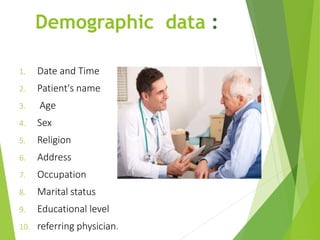
Demographic data :
1. Date and Time
2. Patient's name
3. Age
4. Sex
5. Religion
6. Address
7. Occupation
8. Marital status
9. Educational level
10. referring physician.
 Chief Compliant:
─ The main reason for which the patient is trying to seek
medical help by visiting the physician. Usually a single
symptoms, occasionally more than one complaints eg: fever,
headache, pain, etc .
─ The patient describe the problem in their own words. It
should be recorded in patients own words.
─ The complain should be recorded with their onset duration
History of Present Illness (HPI):
 Elaborate on the chief complaint in detail Ask relevant associated
symptoms . Gain as much information you can about the specific
complaint.
 The onset of (when did it start? .
 location : where is it?
 duration : how long does it last ?
 character of pain (constant, intermittent, stabbing,
 Radiation :
 aggravated by ( eating , drinking , activity
 Reliving factor by : medications , change position ).
 associated with : defecation, urination, eating )
 Lead the conversation by asking questions. Always start with an
open ended question and take the time to listen to the patient’s
‘story’. Once the patient has completed their narrative then closed
questions can be asked to clarify . Leading question are to be
avoided.
Past Medical History (PMH):
 Ask History of :
 Any history of similar complaint in the past
 Any chronic disease present like hypertension, diabetes
 Past hospitalizations and past surgeries
 Medications if any taken in the past (dosage and duration)
 Pediatric: Birth history, Developmental Milestones, Immunizations
 Gyane/Obstetric history if female
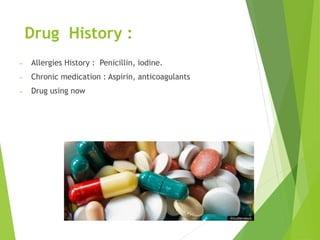
Drug History :
─ Allergies History : Penicillin, iodine.
─ Chronic medication : Aspirin, anticoagulants
─ Drug using now
Family History:
 It is important to establish whether there are any
genetically transmitted diseases within families
 Any illness run in the family?
 Similar history in the family,
 Parents and siblings suffering with any chronic illness,
 Parents if died, how old and what they died of
 You should be able to collect relevant family history
depending upon the present illness.
 Example, Patient has come due anemia , Try to rule out
sickle cell, thalassemia/ G6PD deficiency
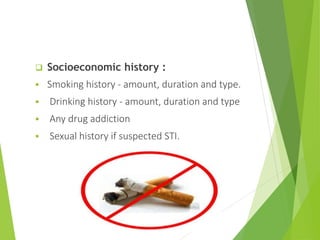
 Socioeconomic history :
 Smoking history - amount, duration and type.
 Drinking history - amount, duration and type
 Any drug addiction
 Sexual history if suspected STI.
Review of Systems (ROS):
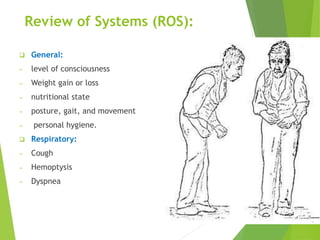
 General:
─ level of consciousness
─ Weight gain or loss
─ nutritional state
─ posture, gait, and movement
─ personal hygiene.
 Respiratory:
─ Cough
─ Hemoptysis
─ Dyspnea
 Cardiovascular:
─ Chest pain
─ orthopnea
─ extremity edema.
 Gastrointestinal:
─ Dysphagia
─ vomiting
─ Hematemesis
─ constipation.
─ Others
Review of Systems (ROS) continue
 Skin:
─ Easy bruising, bleeding tendencies.
 Genitourinary:
₋ Dysuria
₋ hematuria
₋ Others
 Gynecological:
₋ Last menstrual period
₋ gravida , para , Abortions
₋ length of regular cycle and periods
 Neurological:
─ Headaches, seizures , weakness , coma .
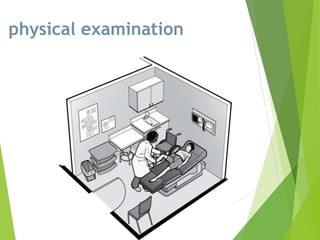
physical examination
Physical Examination
 Purpose:
1. To collect objective data from the client
2. To detect the abnormalities .
3. To diagnose diseases
4. To determine the status of present health and refer the client for
consultation if needed.
Principle of physical examination
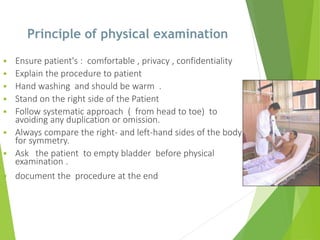
 Ensure patient's : comfortable , privacy , confidentiality
 Explain the procedure to patient
 Hand washing and should be warm .
 Stand on the right side of the Patient
 Follow systematic approach ( from head to toe) to
avoiding any duplication or omission.
 Always compare the right- and left-hand sides of the body
for symmetry.
 Ask the patient to empty bladder before physical
examination .
 document the procedure at the end
Techniques of Physical Examination:
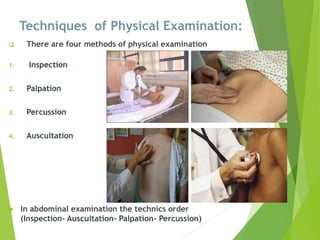
 There are four methods of physical examination
1. Inspection
2. Palpation
3. Percussion
4. Auscultation
 In abdominal examination the technics order
(Inspection- Auscultation- Palpation- Percussion)
Eqiupments of physical examination :
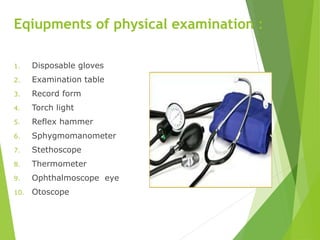
1. Disposable gloves
2. Examination table
3. Record form
4. Torch light
5. Reflex hammer
6. Sphygmomanometer
7. Stethoscope
8. Thermometer
9. Ophthalmoscope eye
10. Otoscope
EQUIPMENT continue
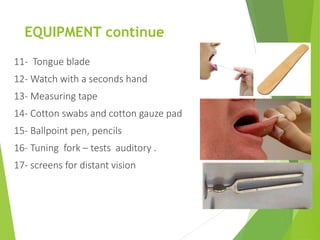
11- Tongue blade
12- Watch with a seconds hand
13- Measuring tape
14- Cotton swabs and cotton gauze pad
15- Ballpoint pen, pencils
16- Tuning fork – tests auditory .
17- screens for distant vision
Implementation
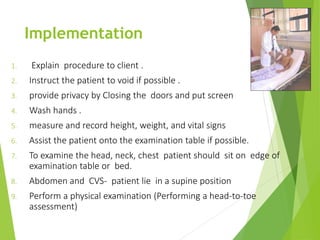
1. Explain procedure to client .
2. Instruct the patient to void if possible .
3. provide privacy by Closing the doors and put screen
4. Wash hands .
5. measure and record height, weight, and vital signs
6. Assist the patient onto the examination table if possible.
7. To examine the head, neck, chest patient should sit on edge of
examination table or bed.
8. Abdomen and CVS- patient lie in a supine position
9. Perform a physical examination (Performing a head-to-toe
assessment)
physical examination includes
 Measure Vital Signs : TPR &BP
 Record Height & weight
 General appearance (general survey )
 Skin ( through proceeding each system )
 Head (hair, scalp , eyes , ears , nose , mouth )
 neck (Thyroid, Carotid arteries, lymph nodes,
 Chest – respiratory
 Chest – CVS -peripheral circulation
 Abdomen
 Lower limbs (Extremities )
 general survey (General appearance )
 A general survey is an overall review or first
impression a nurse has of a person’s well being.
 General surveying is visual observation the following.
General appearance :
1. Observe the client’s: race, sex ,
2. Level of consciousness (awake or comatose )
3. Orientation:( person, time, and place )
4. Signs of pain , facial expression , mood
5. Nutritional state
6. Posture, gait, and movement
7. Personal hygiene and Restlessness
Skin Assessment
 Assessment of Skin & nail
─ While proceeding from head to toe, examine the skin through each body system
by :
 Inspect of skin :
─ skin color, pigmentation, lesions , jaundice, cyanosis, scars, superficial vascularity,
hydration, edema, color of mucous membranes, hair distribution, nails.
 Palpation of skin :
─ Examine skin for temperature, texture, elasticity, turgor.
 Capillary Refill:
 Press down firmly on the patient's finger or toe nail so it blanches.
 Release the pressure and observe how long it takes the nail bed to "pink" up.
 Capillary refill times greater than 2 to 3 seconds suggest peripheral vascular disease,
arterial blockage, heart failure, or shock.
Thank you

3 history taking & physical examination

  • 1.
    Nursing History taking& physical examination Awad Fadlalla RN, BNS, MSN, Shaqra University- 2021
  • 2.
     What isHistory taking? It is a process by which information is gained by a physician by asking specific questions to the patient with the aim of obtaining information useful in formulating a diagnosis and providing medical care to the patient
  • 3.
    Importance of HistoryTaking?  Obtaining an accurate history is the critical first step in determining the etiology of a patient's illness.  Diagnosis in medicine is based on :  Clinical history  Physical Examination  Investigations
  • 4.
    Approach to historytaking  Your look is important Your dressing  Introduce your self and create a rapport Approach to history taking  Be alert and pay full attention  Ensure consent has been gained.  Maintain privacy and dignity.  Ensure the patient is as comfortable as possible  Summarize each stage of the history taking process.  Involve the patient in the history taking process Approach to history taking
  • 5.
    Components of Historytaking 1. Identifying or Demographic data : 2. Chief complain 3. History of present illness(HPI) 4. Past Medical history(PMH) 5. Family History 6. Drugs & Allergies history 7. Socioeconomic history . 8. Review of Systems (ROS): 9. Physical examination 10. investigation
  • 6.
    Demographic data : 1.Date and Time 2. Patient's name 3. Age 4. Sex 5. Religion 6. Address 7. Occupation 8. Marital status 9. Educational level 10. referring physician.
  • 7.
     Chief Compliant: ─The main reason for which the patient is trying to seek medical help by visiting the physician. Usually a single symptoms, occasionally more than one complaints eg: fever, headache, pain, etc . ─ The patient describe the problem in their own words. It should be recorded in patients own words. ─ The complain should be recorded with their onset duration
  • 8.
    History of PresentIllness (HPI):  Elaborate on the chief complaint in detail Ask relevant associated symptoms . Gain as much information you can about the specific complaint.  The onset of (when did it start? .  location : where is it?  duration : how long does it last ?  character of pain (constant, intermittent, stabbing,  Radiation :  aggravated by ( eating , drinking , activity  Reliving factor by : medications , change position ).  associated with : defecation, urination, eating )  Lead the conversation by asking questions. Always start with an open ended question and take the time to listen to the patient’s ‘story’. Once the patient has completed their narrative then closed questions can be asked to clarify . Leading question are to be avoided.
  • 9.
    Past Medical History(PMH):  Ask History of :  Any history of similar complaint in the past  Any chronic disease present like hypertension, diabetes  Past hospitalizations and past surgeries  Medications if any taken in the past (dosage and duration)  Pediatric: Birth history, Developmental Milestones, Immunizations  Gyane/Obstetric history if female
  • 10.
    Drug History : ─Allergies History : Penicillin, iodine. ─ Chronic medication : Aspirin, anticoagulants ─ Drug using now
  • 11.
    Family History:  Itis important to establish whether there are any genetically transmitted diseases within families  Any illness run in the family?  Similar history in the family,  Parents and siblings suffering with any chronic illness,  Parents if died, how old and what they died of  You should be able to collect relevant family history depending upon the present illness.  Example, Patient has come due anemia , Try to rule out sickle cell, thalassemia/ G6PD deficiency
  • 12.
     Socioeconomic history:  Smoking history - amount, duration and type.  Drinking history - amount, duration and type  Any drug addiction  Sexual history if suspected STI.
  • 13.
    Review of Systems(ROS):  General: ─ level of consciousness ─ Weight gain or loss ─ nutritional state ─ posture, gait, and movement ─ personal hygiene.  Respiratory: ─ Cough ─ Hemoptysis ─ Dyspnea
  • 14.
     Cardiovascular: ─ Chestpain ─ orthopnea ─ extremity edema.  Gastrointestinal: ─ Dysphagia ─ vomiting ─ Hematemesis ─ constipation. ─ Others
  • 15.
    Review of Systems(ROS) continue  Skin: ─ Easy bruising, bleeding tendencies.  Genitourinary: ₋ Dysuria ₋ hematuria ₋ Others  Gynecological: ₋ Last menstrual period ₋ gravida , para , Abortions ₋ length of regular cycle and periods  Neurological: ─ Headaches, seizures , weakness , coma .
  • 16.
  • 17.
    Physical Examination  Purpose: 1.To collect objective data from the client 2. To detect the abnormalities . 3. To diagnose diseases 4. To determine the status of present health and refer the client for consultation if needed.
  • 18.
    Principle of physicalexamination  Ensure patient's : comfortable , privacy , confidentiality  Explain the procedure to patient  Hand washing and should be warm .  Stand on the right side of the Patient  Follow systematic approach ( from head to toe) to avoiding any duplication or omission.  Always compare the right- and left-hand sides of the body for symmetry.  Ask the patient to empty bladder before physical examination .  document the procedure at the end
  • 19.
    Techniques of PhysicalExamination:  There are four methods of physical examination 1. Inspection 2. Palpation 3. Percussion 4. Auscultation  In abdominal examination the technics order (Inspection- Auscultation- Palpation- Percussion)
  • 20.
    Eqiupments of physicalexamination : 1. Disposable gloves 2. Examination table 3. Record form 4. Torch light 5. Reflex hammer 6. Sphygmomanometer 7. Stethoscope 8. Thermometer 9. Ophthalmoscope eye 10. Otoscope
  • 21.
    EQUIPMENT continue 11- Tongueblade 12- Watch with a seconds hand 13- Measuring tape 14- Cotton swabs and cotton gauze pad 15- Ballpoint pen, pencils 16- Tuning fork – tests auditory . 17- screens for distant vision
  • 22.
    Implementation 1. Explain procedureto client . 2. Instruct the patient to void if possible . 3. provide privacy by Closing the doors and put screen 4. Wash hands . 5. measure and record height, weight, and vital signs 6. Assist the patient onto the examination table if possible. 7. To examine the head, neck, chest patient should sit on edge of examination table or bed. 8. Abdomen and CVS- patient lie in a supine position 9. Perform a physical examination (Performing a head-to-toe assessment)
  • 23.
    physical examination includes Measure Vital Signs : TPR &BP  Record Height & weight  General appearance (general survey )  Skin ( through proceeding each system )  Head (hair, scalp , eyes , ears , nose , mouth )  neck (Thyroid, Carotid arteries, lymph nodes,  Chest – respiratory  Chest – CVS -peripheral circulation  Abdomen  Lower limbs (Extremities )
  • 24.
     general survey(General appearance )  A general survey is an overall review or first impression a nurse has of a person’s well being.  General surveying is visual observation the following. General appearance : 1. Observe the client’s: race, sex , 2. Level of consciousness (awake or comatose ) 3. Orientation:( person, time, and place ) 4. Signs of pain , facial expression , mood 5. Nutritional state 6. Posture, gait, and movement 7. Personal hygiene and Restlessness
  • 25.
    Skin Assessment  Assessmentof Skin & nail ─ While proceeding from head to toe, examine the skin through each body system by :  Inspect of skin : ─ skin color, pigmentation, lesions , jaundice, cyanosis, scars, superficial vascularity, hydration, edema, color of mucous membranes, hair distribution, nails.  Palpation of skin : ─ Examine skin for temperature, texture, elasticity, turgor.
  • 26.
     Capillary Refill: Press down firmly on the patient's finger or toe nail so it blanches.  Release the pressure and observe how long it takes the nail bed to "pink" up.  Capillary refill times greater than 2 to 3 seconds suggest peripheral vascular disease, arterial blockage, heart failure, or shock.
  • 27.