LEARNING OBJECTIVES
When you complete this chapter, you should be able to:
� Describe the prosecutor’s role, prosecutor’s discretion, and
the issues surrounding prosecutorial
misconduct.
� Explain the concept of joinder and reasons for it.
� Explain the purpose, functions, and powers of a grand jury.
� Outline the development of the right to counsel.
� Be familiar with the courtroom workgroup and its functions.
IS
B
N
1-256-63921-4
Criminal Procedure: From First Contact to Appeal, Fourth
Edition, by John L. Worrall. Published by Pearson. Copyright ©
2012 by Pearson Education, Inc.
337
CHAPTER OUTLINE
Prosecutors, Grand
Juries, and Defense
Attorneys
C
H
A
P
T
E
R
OUTLINE
Introduction: Bringing Charges and Mounting
a Defense
The Prosecutor
The Charging Decision
Deciding Not to Prosecute
Challenging the Decision Not to Prosecute
Restrictions on Bringing Charges
Unfair and Selective Prosecution
Vindictive Prosecution
Dealing with Overzealous Prosecutors
Recourse
Joinder
Multiple Charges against the Same Individual
Charges against Multiple Defendants
The Grand Jury
How a Grand Jury Is Constructed
Duration
Size
Voting Requirements
Selection of Members
Secrecy of Grand Jury Proceedings
Disclosure of Witness Testimony to the Defense
Disclosure of Witness Testimony to Other Parties
Rights of Witnesses Testifying before Grand
Juries
Right to Testify
Being Advised of the Right Not to Testify
Right to Counsel
Investigative Powers of the Grand Jury
Subpoenas
Grants of Immunity
Findings of Contempt
Challenging a Grand Jury Indictment
The Defense Attorney
The Right to Counsel in a Criminal
Prosecution
Due Process Origins
The Contemporary Sixth Amendment
Approach
The Right to Counsel at Other Stages
of the Criminal Process
The Sixth Amendment Approach
The Fifth Amendment Approach
The Due Process Approach
Waiver of the Right to Counsel
Indigent versus Nonindigent Defendants’ Right
to Counsel of Their Choice
Effective Assistance of Counsel
When the Right Applies
The Meaning of Effective Assistance
The Courtroom Work Group
Summary
Key Terms
Key Cases
Review Questions
Web Links and Exercises
11
IS
B
N
1-
25
6-
63
92
1-
4
Criminal Procedure: From First Contact to Appeal, Fourth
Edition, by John L. Worrall. Published by Pearson. Copyright ©
2012 by Pearson Education, Inc.
338 Part 4 • The Beginnings of Formal Proceedings
INTRODUCTION
Bringing Charges and Mounting a Defense
This chapter turns attention to the roles of the prosecutor, grand
jury, and defense
attorney. In a way, this chapter does not flow directly from the
preceding chapter;
for example, the right to counsel attaches to varying degrees
well before the pretrial
process is set into motion. Similarly, when the services of the
grand jury are required,
it can perform an investigative function well before the arrest
stage of the criminal
process. Prosecutors, too, perform a great deal of work before
the pretrial process.
Nevertheless, the functions of all three parties will be
considered here for the sake of
an orderly presentation. Just understand that the prosecutor,
grand jury, and defense
attorney do not necessarily enter the picture after the pretrial
process has
commenced.
This chapter begins by focusing on the prosecutor and, in
particular, the decision
whether or not to charge. In this vein, this chapter also
introduces restrictions on the
prosecutor’s charging decision as well as the notion of joinder.
Most of the discussion
will be limited to the prosecutor’s role leading up to a criminal
trial. To delve into the
prosecutor’s role at trial (e.g., the order and method by which
the state’s case is
presented) would take the discussion into another area. The
prosecutor’s role at trial
is best understood in terms of the law of evidence, a topic not
typically taken up in
criminal procedure class.
Next, this chapter turns attention to the grand jury. The function
of the grand jury
is a source of some confusion to criminal procedure students.
As such, the role of the
grand jury is considered in detail, particularly when a grand
jury is required and what
roles it performs. This chapter also discusses the secrecy of
grand juries, the rights of
witnesses testifying before grand juries, and the various
methods for challenging
indictments. As with the section on the prosecutor, the grand
jury section of this
chapter is pretrial in nature. Indeed, the grand jury’s function
ceases once the charging
decision has been made.
Finally, this chapter turns to the role of the defense attorney in
criminal
procedure. The Fourth Amendment and interrogation sections of
this text have
already discussed the function of defense counsel at various
stages of the criminal
process. Those functions are revisited briefly in this chapter,
but the focus is
primarily on the defense attorney’s role at trial. The bulk of the
defense attorney
section of this chapter concerns the accused’s right to effective
assistance of counsel.
This chapter also discusses the waiver of counsel and the
distinctions between
privately retained counsel and public defenders. It concludes
with some attention
to the so-called courtroom work group.
THE PROSECUTOR
The prosecutor performs a valuable function in reinforcing the
notion that a crime is an
offense against the state. In fact, Article II, Section 3, of the
U.S. Constitution states that
the executive branch of the federal government “shall take Care
that the Laws be faith-
fully executed.” This constitutionally mandated duty to execute
the law usually falls on
prosecutors. Of course, police officers, as part of the executive
branch, do their part to
execute the laws, but a strong argument can be made that
prosecutors possess even
more authority because of their ability to decide whether to
bring formal charges
against suspected criminals.
Just as police officers have the discretion to decide whether to
make an arrest, so, too,
do prosecutors have enormous discretion. As the Supreme Court
noted in Bordenkircher v.
IS
B
N
1-256-63921-4
Criminal Procedure: From First Contact to Appeal, Fourth
Edition, by John L. Worrall. Published by Pearson. Copyright ©
2012 by Pearson Education, Inc.
Chapter 11 • Prosecutors, Grand Juries, and Defense Attorneys
339
Hayes (434 U.S. 357 [1978]), “[S]o long as the prosecutor has
probable cause to believe that
the accused committed an offense defined by statute, the
decision whether or not to
prosecute, and what charge to file or bring before a grand jury,
generally rests entirely on
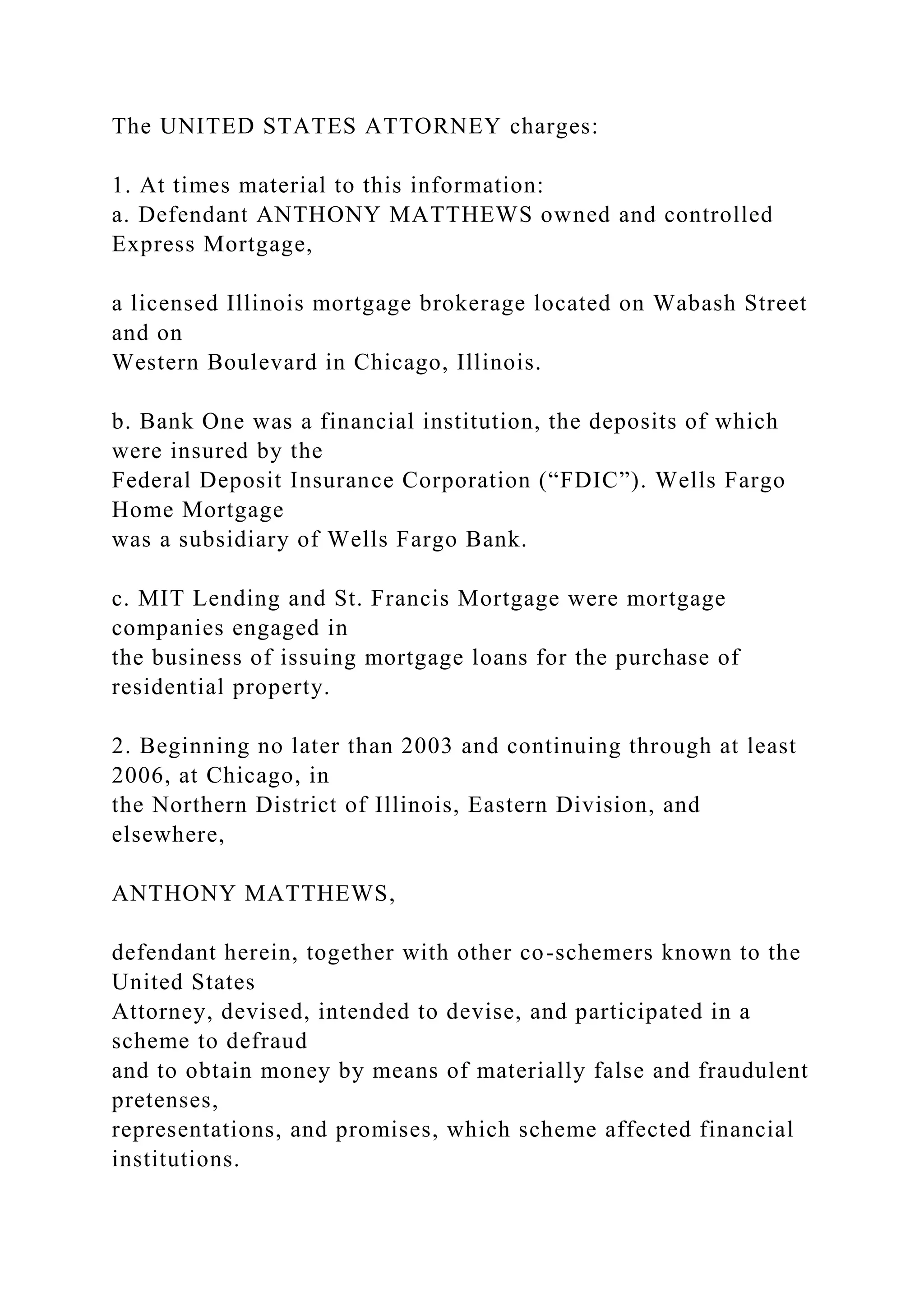
his discretion” (p. 364). Figure 11.1 presents portions of a
federal prosecutor’s charging
document (a.k.a., “information”).
Prosecutors do not have unlimited discretion, however. There
are important
restrictions on their decision to charge. Some stem from the
Constitution, while others
stem from statutes and other related sources.
FIGURE 11.1
Portions of a Federal Prosecutor’s Charging Document
(Information)
United States District Court
Northern District Of Illinois
Eastern Division
COUNT ONE
The UNITED STATES ATTORNEY charges:
1. At times material to this information:
a. Defendant ANTHONY MATTHEWS owned and controlled
Express Mortgage,
a licensed Illinois mortgage brokerage located on Wabash Street
and on
Western Boulevard in Chicago, Illinois.
b. Bank One was a financial institution, the deposits of which
were insured by the
Federal Deposit Insurance Corporation (“FDIC”). Wells Fargo
Home Mortgage
was a subsidiary of Wells Fargo Bank.
c. MIT Lending and St. Francis Mortgage were mortgage
companies engaged in
the business of issuing mortgage loans for the purchase of
residential property.
2. Beginning no later than 2003 and continuing through at least
2006, at Chicago, in
the Northern District of Illinois, Eastern Division, and
elsewhere,
ANTHONY MATTHEWS,
defendant herein, together with other co-schemers known to the
United States
Attorney, devised, intended to devise, and participated in a
scheme to defraud
and to obtain money by means of materially false and fraudulent
pretenses,
representations, and promises, which scheme affected financial
institutions.
More specifically, defendant schemed to fraudulently obtain
over $1 million in
mortgage loan proceeds from various banks and mortgage
lending institutions,
including Bank One, Wells Fargo Bank. MIT Lending. St.
Francis Mortgage and
Wells Fargo Home Mortgage, among others (hereinafter referred
to collectively
as “lenders”), as described below.
Source:
http://www.usdoj.gov/usao/iln/pr/chicago/2008/pr0619_01i.pdf
(accessed November 7, 2008).
UNITED STATES OF AMERICA )
)
v. ) No._____
)
ANTHONY MATTHEWS ) Violations: Title 18, United States
Code,
) Section 1343
IS
B
N
1-
25
6-
63
92
1-
4
Criminal Procedure: From First Contact to Appeal, Fourth
Edition, by John L. Worrall. Published by Pearson. Copyright ©
2012 by Pearson Education, Inc.
340 Part 4 • The Beginnings of Formal Proceedings
The Charging Decision
The prosecutor generally has the authority to decide whether to
proceed with charges.
This is known as prosecutorial discretion. He or she can elect
not to charge for a number
of reasons, even over strenuous objection on the part of the
complainant or victim.
The prosecutor’s discretion can be further manifested by the act
of plea bargaining
(see Chapter 12); that is, he or she can accept a guilty plea for a
lesser offense than the one
charged. Finally, prosecutors sometimes have to answer to
authorities that mandate, or
at least strongly encourage, prosecution.
DECIDING NOT TO PROSECUTE The most obvious reason for
nonprosecution is lack of
evidence. The prosecutor may determine that, based on the
evidence presented to him
or her by the police, the suspect is innocent. In such an event,
there would be no point
in proceeding to trial on the slight chance that a conviction
would be obtained. Even if
the prosecutor believes the suspect is guilty, if there is not
enough evidence to obtain a
conviction, then he or she will likely elect not to prosecute.
There are other reasons not to prosecute, as well. For example,
even if the state’s
case is strong, there may be an incentive not to prosecute. In
particular, if it appears the
defense’s case is stronger, then it may behoove the prosecutor
to proceed with charges
against a different individual.
Nonetheless, prosecutors are human and, as such, can be
influenced by the facts of a
particular case. Say, for instance, that a law mandates life in
prison for growing in excess of
1,000 marijuana plants. Assume further that a suspect
apprehended for violating such a
law has a spotless record, is married, and has four children.
Would life in prison be the best
punishment for such an individual, or would a fine community
service or other sanction
be more appropriate? This decision is up to the prosecutor, and
depending on the nature of
the case, he or she may elect not to proceed with charges.
As another example, California’s “three strikes” law requires
life in prison for
third-time felons. The first two felonies that qualify as
“strikeable” under California’s
law can only be of certain varieties; typically, they are serious
offenses. However, the
third felony can be of any type. Critics of California’s “three
strikes” law often point to
the man who was sentenced to prison for life for stealing a slice
of pizza. Had the
prosecutor who charged this individual been more sensible in
exercising his or her
discretion, then public outcry may not have been so significant.
Another reason for not charging traces to economic concerns.
Simply put, it is
not possible, given the resource restrictions that exist in most
public agencies
(prosecutors’ offices included), to proceed with charges against
every suspect. Not
DECISION-MAKING EXERCISE 11.1
Reasons for Nonprosecution
Another controversial reason for nonprosecution is a
by-product of the United States’ so-called war on drugs. Civil
asset forfeiture statutes permit the forfeiture of money and
property tied to criminal activity—most frequently, the illicit
drug trade. Many asset forfeiture statutes permit forfeited
proceeds to go to the executive branch, which usually means
the police but sometimes prosecutors. Some have argued
that when there is not enough evidence to proceed with a
criminal case, prosecutors can opt to pursue civil forfeiture,
for which the burden of proof is generally lower. And as an
added bonus, if a forfeiture action succeeds and a person’s
property is forfeited to the state, then the prosecutor may
reap a financial reward for selecting a civil proceeding
instead of a criminal one. Is the possibility of civil asset
forfeiture a legitimate reason not to prosecute? That is, if a
prosecutor chooses not to press criminal charges against
someone, instead opting for forfeiture, should the decision
be considered constitutional?
IS
B
N
1-256-63921-4
Criminal Procedure: From First Contact to Appeal, Fourth
Edition, by John L. Worrall. Published by Pearson. Copyright ©
2012 by Pearson Education, Inc.
Chapter 11 • Prosecutors, Grand Juries, and Defense Attorneys
341
having the time to build a case because of a high caseload may
effectively force a
prosecutor to be lenient with certain individuals.
CHALLENGING THE DECISION NOT TO PROSECUTE A
prosecutor’s decision not to press
charges is rarely challenged, but on occasion, higher authorities
may get involved when
they disagree with a prosecutor’s decision. Failure to press
charges can sometimes be
questioned by a court, which can provide relief to individuals
who disagree with the
prosecutor’s decision (e.g., NAACP v. Levi, 418 F. Supp. 1109
[D.D.C. 1976]). Other times, a
prosecutor’s supervisor or other high-ranking official may step
in. According to one
source, “Many states by statute confer upon the attorney general
the power to initiate pros-
ecution in cases where the local prosecutor has failed to act. In
practice, however, attorneys
general have seldom exercised much control over local
prosecuting attorneys.”1
Another way of preventing prosecutors from abusing their
discretion (i.e., by
failing to act) is to require them to abide by standards of
conduct. These standards help
prosecutors decide which cases are worthy of prosecution as
well as what charges to
pursue, all the while ensuring that they act in accordance with
the law. Figure 11.2
presents portions of the Code of Conduct for Judicial
Employees, published by the
Administrative Office of the U.S. Courts.
Some U.S. jurisdictions require court approval of a prosecutor’s
decision not to
pursue charges. The prosecutor is typically required to explain
to the court in writing
his or her reasons for failing to prosecute. While this approach
may seem sensible on its
1 Y. Kamisar, W. LaFave, and J. Israel, Modern Criminal
Procedure, 9th ed. (St. Paul, MN: West, 1999), p. 894.
FIGURE 11.2
Code of Conduct for Judicial Employees
A. Code of Conduct for Judicial Employees.
CANON 1: A JUDICIAL EMPLOYEE SHOULD UPHOLD THE
INTEGRITY AND
INDEPENDENCE OF THE JUDICIARY AND OF THE
JUDICIAL EMPLOYEE’S
OFFICE
An independent and honorable Judiciary is indispensable to
justice in our society.
A judicial employee should personally observe high standards
of conduct so that the
integrity and independence of the Judiciary are preserved and
the judicial employee’s
office reflects a devotion to serving the public. Judicial
employees should require
adherence to such standards by personnel subject to their
direction and control.
The provisions of this code should be construed and applied to
further these
objectives. The standards of this code shall not affect or
preclude other more stringent
standards required by law, by court order, or by the appointing
authority.
CANON 2: A JUDICIAL EMPLOYEE SHOULD AVOID
IMPROPRIETY AND THE
APPEARANCE OF IMPROPRIETY IN ALL ACTIVITIES
A judicial employee should not engage in any activities that
would put into question
the propriety of the judicial employee’s conduct in carrying out
the duties of the office.
A judicial employee should not allow family, social, or other
relationships to influence
official conduct or judgment. A judicial employee should not
lend the prestige of the
office to advance or to appear to advance the private interests of
others. A judicial
employee should not use public office for private gain.
Figure 11.2 continued
IS
B
N
1-
25
6-
63
92
1-
4
Criminal Procedure: From First Contact to Appeal, Fourth
Edition, by John L. Worrall. Published by Pearson. Copyright ©
2012 by Pearson Education, Inc.
342 Part 4 • The Beginnings of Formal Proceedings
CANON 3: A JUDICIAL EMPLOYEE SHOULD ADHERE TO
APPROPRIATE
STANDARDS IN PERFORMING THE DUTIES OF THE
OFFICE
In performing the duties prescribed by law, by resolution of the
Judicial Conference of
the United States, by court order, or by the judicial employee’s
appointing authority, the
following standards apply:
A. A judicial employee should respect and comply with the law
and these canons.
A judicial employee should report to the appropriate
supervising authority any
attempt to induce the judicial employee to violate these canons.
Note: A number of criminal statutes of general applicability
govern federal employees’
performance of official duties. These include:
18 U.S.C. § 201 (bribery of public officials and witnesses);
18 U.S.C. § 211 (acceptance or solicitation to obtain appointive
public office);
18 U.S.C. § 285 (taking or using papers relating to government
claims);
18 U.S.C. § 287 (false, fictitious, or fraudulent claims against
the government);
18 U.S.C. § 508 (counterfeiting or forging transportation
requests);
18 U.S.C. § 641 (embezzlement or conversion of government
money, property,
or records);
18 U.S.C. § 643 (failing to account for public money);
18 U.S.C. § 798 and 50 U.S.C. § 783 (disclosure of classified
information);
18 U.S.C. § 1001 (fraud or false statements in a government
matter);
18 U.S.C. § 1719 (misuse of franking privilege);
18 U.S.C. § 2071 (concealing, removing, or mutilating a public
record);
31 U.S.C. § 1344 (misuse of government vehicle);
31 U.S.C. § 3729 (false claims against the government).
In addition, provisions of specific applicability to court officers
include:
18 U.S.C. § § 153,154 (court officers embezzling or purchasing
property from
bankruptcy estate);
18 U.S.C. § 645 (embezzlement and theft by court officers);
18 U.S.C. § 646 (court officers failing to deposit registry
moneys);
18 U.S.C. § 647 (receiving loans from registry moneys from
court officer).
This is not a comprehensive listing but sets forth some of the
more significant provisions
with which judicial employees should be familiar.
B. A judicial employee should be faithful to professional
standards and maintain
competence in the judicial employee’s profession.
C. A judicial employee should be patient, dignified, respectful,
and courteous to all
persons with whom the judicial employee deals in an official
capacity, including the
general public, and should require similar conduct of personnel
subject to the judicial
employee’s direction and control. A judicial employee should
diligently discharge the
responsibilities of the office in a prompt, efficient,
nondiscriminatory, fair, and profes-
sional manner. A judicial employee should never influence or
attempt to influence the
assignment of cases, or perform any discretionary or ministerial
function of the court in
IS
B
N
1-256-63921-4
Criminal Procedure: From First Contact to Appeal, Fourth
Edition, by John L. Worrall. Published by Pearson. Copyright ©
2012 by Pearson Education, Inc.
Chapter 11 • Prosecutors, Grand Juries, and Defense Attorneys
343
a manner that improperly favors any litigant or attorney, nor
should a judicial employee
imply that he or she is in a position to do so.
D. A judicial employee should avoid making public comment on
the merits of a pending
or impending action and should require similar restraint by
personnel subject to the
judicial employee’s direction and control. This proscription
does not extend to public
statements made in the course of official duties or to the
explanation of court procedures.
A judicial employee should never disclose any confidential
information received in the
course of official duties except as required in the performance
of such duties, nor should a
judicial employee employ such information for personal gain. A
former judicial employee
should observe the same restrictions on disclosure of
confidential information that apply
to a current judicial employee, except as modified by the
appointing authority.
E. A judicial employee should not engage in nepotism
prohibited by law.
Note: See also 5 U.S.C. § 3110 (employment of relatives); 28
U.S.C. § 458 (employment of
judges’ relatives).
F. Conflicts of Interest.
(1) A judicial employee should avoid conflicts of interest in the
performance of offi-
cial duties. A conflict of interest arises when a judicial
employee knows that he or she
(or the spouse, minor child residing in the judicial employee’s
household, or other
close relative of the judicial employee) might be so personally
or financially affected
by a matter that a reasonable person with knowledge of the
relevant facts would
question the judicial employee’s ability properly to perform
official duties in an
impartial manner. . . .
CANON 4: IN ENGAGING IN OUTSIDE ACTIVITIES, A
JUDICIAL EMPLOYEE
SHOULD AVOID THE RISK OF CONFLICT WITH OFFICIAL
DUTIES, SHOULD
AVOID THE APPEARANCE OF IMPROPRIETY, AND
SHOULD COMPLY WITH
DISCLOSURE REQUIREMENTS
A. Outside Activities. A judicial employee’s activities outside
of official duties should not
detract from the dignity of the court, interfere with the
performance of official duties, or
adversely reflect on the operation and dignity of the court or
office the judicial
employee serves. Subject to the foregoing standards and the
other provisions of this
code, a judicial employee may engage in such activities as
civic, charitable, religious,
professional, educational, cultural, avocational, social,
fraternal, and recreational
activities, and may speak, write, lecture, and teach. If such
outside activities concern the
law, the legal system, or the administration of justice, the
judicial employee should first
consult with the appointing authority to determine whether the
proposed activities are
consistent with the foregoing standards and the other provisions
of this code. . . .
CANON 5: A JUDICIAL EMPLOYEE SHOULD REFRAIN
FROM INAPPROPRIATE
POLITICAL ACTIVITY
A. Partisan Political Activity. A judicial employee should
refrain from partisan political
activity; should not act as a leader or hold any office in a
partisan political organization;
should not make speeches for or publicly endorse or oppose a
partisan political organi-
zation or candidate; should not solicit funds for or contribute to
a partisan political
organization, candidate, or event; should not become a
candidate for partisan political
office; and should not otherwise actively engage in partisan
political activities.
B. Nonpartisan Political Activity. A member of a judge’s
personal staff, clerk of court,
chief probation officer, chief pretrial services officer, circuit
executive, and district court
Figure 11.2 continued
IS
B
N
1-
25
6-
63
92
1-
4
Criminal Procedure: From First Contact to Appeal, Fourth
Edition, by John L. Worrall. Published by Pearson. Copyright ©
2012 by Pearson Education, Inc.
344 Part 4 • The Beginnings of Formal Proceedings
face, the Supreme Court has been somewhat critical of judicial
review of prosecutorial
decisions. In Wayte v. United States (470 U.S. 598 [1985]), the
Court gave this reason for
avoiding judicial oversight: “Such factors as the strength of the
case, the prosecution’s
general deterrence value, the Government’s overall enforcement
plan are not readily
susceptible to the kind of analysis the courts are competent to
make” (p. 606).
In general, if the prosecutor’s decision not to press charges
stems from legitimate
factors, such as lack of evidence or case backlog, then the
decision should be honored.
The prosecutor’s decision should be honored even if he or she
agrees to dismiss
criminal charges if the defendant agrees not to file a civil suit.
Restrictions on Bringing Charges
This section turns to situations in which charges are filed but
for inappropriate reasons.
In other words, whereas the previous sections considered
situations in which the pros-
ecutor fails to bring charges, this section considers situations in
which the prosecutor
cannot bring charges.
There are two primary reasons a prosecutor cannot bring
charges against an
accused individual: (1) if the prosecution is unfair and selective
(i.e., targets a certain
individual unfairly) and (2) if the prosecution is pursued for
vindictive reasons.
The following subsections focus in detail on these situations.
Before going ahead, it is important to point out that prosecutors
may occasionally
bring charges, say, for vindictive reasons. Assuming such
conduct comes to the
attention of someone in a higher position of authority, the
prosecuting decision will
essentially be overruled. That is, the charges against the
accused will be dropped, or in
the event that the person is charged and convicted, his or her
conviction will be
overturned. However, if a prosecutor brings charges for
inappropriate reasons and this
decision goes uncontested, then the charges will most likely
stand.
UNFAIR AND SELECTIVE PROSECUTION If the prosecutor’s
decision to press charges
is discriminatory in nature, the Fourteenth Amendment’s equal
protection clause can
be violated. For example, in Yick Wo v. Hopkins (118 U.S. 356
[1886]), the Supreme
Court stated:
Though the law itself be fair on its face and impartial in
appearance, yet, if it is
applied and administered by public authority with an evil eye
and an unequal
hand, so as practically to make unjust and illegal
discriminations between
persons in similar circumstances, material to their rights, the
denial of equal
justice is still within the prohibition of the Constitution. (pp.
373–374)
executive should refrain from nonpartisan political activity such
as campaigning for or
publicly endorsing or opposing a nonpartisan political
candidate; soliciting funds for or
contributing to a nonpartisan political candidate or event; and
becoming a candidate
for nonpartisan political office. Other judicial employees may
engage in nonpartisan
political activity only if such activity does not tend to reflect
adversely on the dignity or
impartiality of the court or office and does not interfere with
the proper performance of
official duties. A judicial employee may not engage in such
activity while on duty or in
the judicial employee’s workplace and may not utilize any
federal resources in connec-
tion with any such activity.
Note: See also 18 U.S.C. chapter 29 (elections and political
activities).
Source: From Code of Conduct for Judicial Employees.
Available Online: http://www.uscourts.gov/
RulesAndPolicies/CodesOfConduct.aspx (accessed February 16,
2011).
IS
B
N
1-256-63921-4
Criminal Procedure: From First Contact to Appeal, Fourth
Edition, by John L. Worrall. Published by Pearson. Copyright ©
2012 by Pearson Education, Inc.
Chapter 11 • Prosecutors, Grand Juries, and Defense Attorneys
345
Oyler v. Boles (368 U.S.
448 [1968])
Simply put, if an individual is targeted for prosecution merely
because he or she falls
into a certain group (e.g., a minority group), then his or her
constitutional rights will be
violated. This is known as selective prosecution.
Since Yick Wo, the Court has become more specific as to what
constitutes selective
prosecution. In Oyler v. Boles (368 U.S. 448 [1968]), the Court
held that prosecution
becomes selective and in violation of the equal protection
clause only when it is inten-
tional and is intended to target “a certain class of cases . . . or
specific persons.” In that
case, the defendant presented evidence that he was the only
individual of six sentenced
under a particular statute. The Court held that this was not
discriminatory because the
defendant was unable to demonstrate intent by the prosecutor or
provide evidence that
he fit the group targeted for prosecution. In fact, the Court
noted:
The conscious exercise of some selectivity in enforcement is not
in itself a
federal constitutional violation. Even though the statistics in
this case might
imply a policy of selective enforcement, it was not stated that
the selection
was deliberately based upon an unjustifiable standard such as
race, religion,
or other arbitrary classification. (p. 456)
DECISION-MAKING EXERCISE 11.2
The Decision Not to Charge
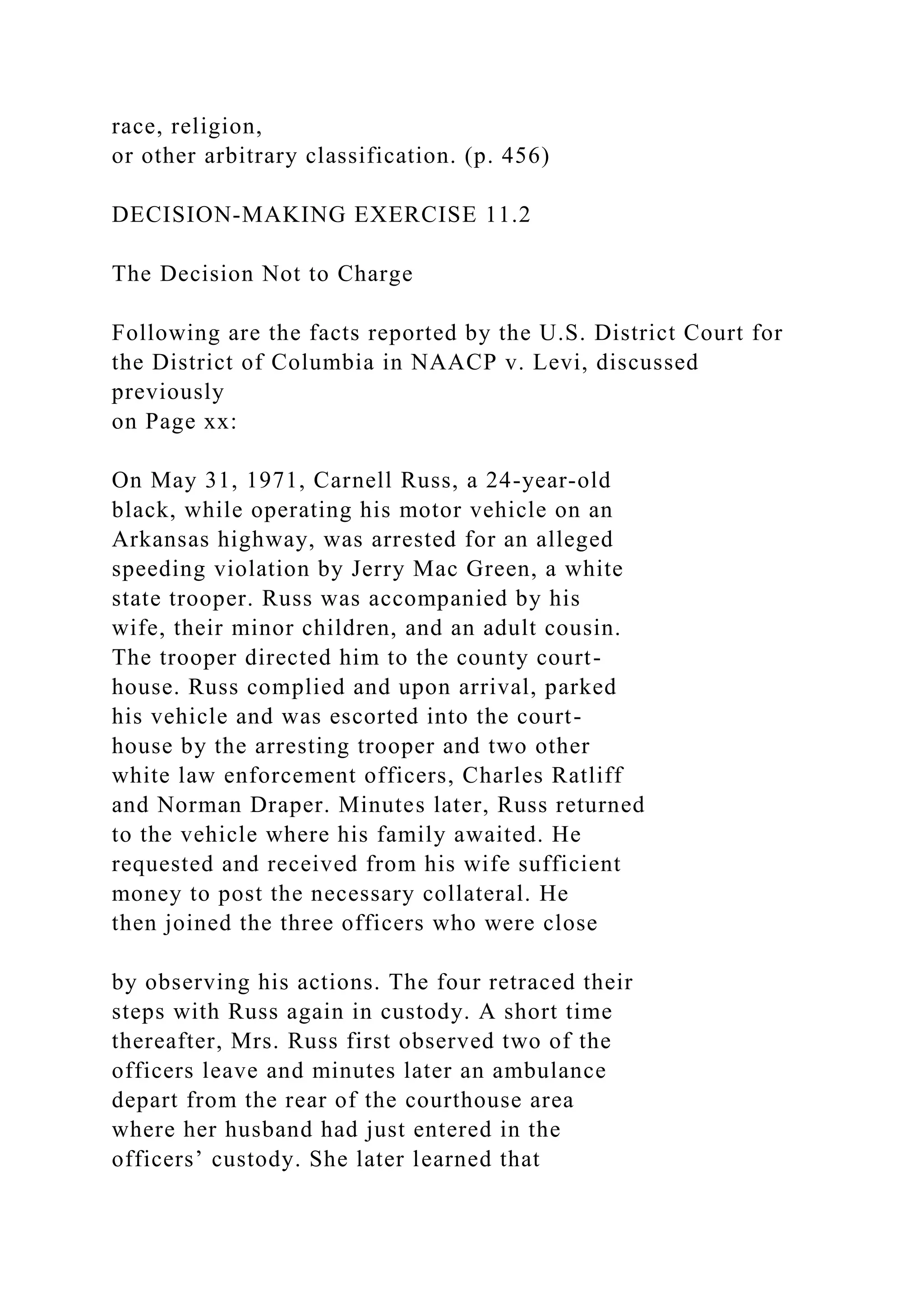
Following are the facts reported by the U.S. District Court for
the District of Columbia in NAACP v. Levi, discussed
previously
on Page xx:
On May 31, 1971, Carnell Russ, a 24-year-old
black, while operating his motor vehicle on an
Arkansas highway, was arrested for an alleged
speeding violation by Jerry Mac Green, a white
state trooper. Russ was accompanied by his
wife, their minor children, and an adult cousin.
The trooper directed him to the county court-
house. Russ complied and upon arrival, parked
his vehicle and was escorted into the court-
house by the arresting trooper and two other
white law enforcement officers, Charles Ratliff
and Norman Draper. Minutes later, Russ returned
to the vehicle where his family awaited. He
requested and received from his wife sufficient
money to post the necessary collateral. He
then joined the three officers who were close
by observing his actions. The four retraced their
steps with Russ again in custody. A short time
thereafter, Mrs. Russ first observed two of the
officers leave and minutes later an ambulance
depart from the rear of the courthouse area
where her husband had just entered in the
officers’ custody. She later learned that
Mr. Russ, while under detention, had been
shot in the center of his forehead by Ratliff and
then transported to a hospital. Green and
Draper were the sole witnesses to the shooting.
Her husband died from the gunshot wound
within hours. (p. 1112)
Ratliff was indicted and found not guilty of voluntary
manslaughter pursuant to an investigation by the state
police. Criminal charges were not brought against the other
two officers, and the case was closed. Does the prosecutor’s
decision not to pursue charges against the other officers
seem reasonable?
DECISION-MAKING EXERCISE 11.3
Another Decision Not to Charge
Chief Lord, of the Springfield Police Department, arrested
Nancy Simpson for tampering with a witness, Terri Flanders,
the alleged victim of an assault by a friend of Simpson’s.
Simpson hired an attorney, and discussions with the local
prosecutor ensued. Simpson agreed to sign a written release—in
which she promised not to sue the city, its officials, or the
alleged victim of the assault—if the prosecutor dismissed the
criminal charges. The criminal charges were dropped. Is fear of
being sued a valid reason not to prosecute?
IS
B
N
1-
25
6-
63
92
1-
4
Criminal Procedure: From First Contact to Appeal, Fourth
Edition, by John L. Worrall. Published by Pearson. Copyright ©
2012 by Pearson Education, Inc.
346 Part 4 • The Beginnings of Formal Proceedings
Blackledge v. Perry
(417 U.S. 21 [1974])
Since the Oyler decision, the courts have imposed a three-
pronged test for
determining whether prosecution violates equal protection. It
must be shown that
(1) similarly situated individuals were not prosecuted, (2) the
prosecutor intended
for this to happen, and (3) the decision resulted from an
arbitrary, rather than
rational, classification scheme. An arbitrary classification
scheme would be based on,
for example, race or sex. A rational classification scheme would
be one that considers
the evidence against each individual without regard to the color
of his or her skin,
country of origin, religious preference, sex, or other such
criteria.
Filing charges for discriminatory reasons is not the only type of
unfair prosecu-
tion. Sometimes, prosecutors aggressively pursue conspicuous
individuals and open
themselves to criticism. This is not to say that highly public
lawbreakers cannot be
charged, however. Indeed, the courts have justified prosecution
on the highest charge of
certain individuals for the sole purpose of discouraging other
people from committing
the same offense. As one court noted, “Selective enforcement
may . . . be justified when
a striking example or a few examples are sought in order to
deter other violators”
(People v. Utica Daw’s Drug Co., 16 A.D.2d 12 [1962], p. 21).
In addition to being criticized for prosecuting high-profile
offenders, prosecutors
can also get into trouble for targeting the most significant
offender in a group of
offenders. To clarify, think of the conspicuous person cases
discussed in the previous
paragraphs, in which prosecutors opted to charge one offender
instead of another, even
though both were suspected of having committed the same
offense. When a group of
individuals is suspected of having committed various degrees of
the same offense, why
does the prosecutor only pursue the individual suspected of
having committed the
most serious offense?
An example of a case illustrating this practice is State v.
McCollum (159 Wis.2d 184
[App. 1990]). In that case, the court dismissed prostitution
charges against nude female
dancers. In its decision, the court pointed out that the male
patrons of these dancers
were not charged, even though Wisconsin law criminalized their
behavior, as well.
A fourth method by which prosecutors can open themselves to
allegations of
unfair and selective prosecution is through what is known as
pretextual prosecution.
This occurs when the prosecutor lacks the evidence to charge
someone with a particular
crime and so charges him or her with a lesser crime. However,
prosecutors are rarely
chastised for this type of conduct. For example, in United States
v. Sacco (428 F.2d 164
[9th Cir. 1970]), a court noted that allowing a prosecutor to
pursue lesser charges when
the evidence to mount a more serious charge does not exist is
perfectly acceptable.
The Supreme Court recently decided a case dealing with alleged
discriminatory
prosecution. Specifically, in United States v. Bass (536 U.S.
862 [2002]), the Court considered
a defendant’s request for discovery of the Department of
Justice’s charging practices in
capital cases. He alleged that blacks were disproportionately
charged in such cases and
that he was charged because of his race. His argument did not
succeed, however.
VINDICTIVE PROSECUTION If a prosecutor’s charging
decision is motivated by revenge,
then the resulting charge violates the due process clause of the
Fourteenth Amendment.
Specifically, if a prosecutor charges an individual simply
because he or she is exercising
his or her constitutional rights, such charges will not be
allowed. This is known as
vindictive prosecution.
This was the decision reached in Blackledge v. Perry (417 U.S.
21 [1974]). In that
case, the defendant was convicted in a lower court for
misdemeanor assault with a
deadly weapon. After the defendant filed an appeal with the
county superior court, the
prosecutor obtained an indictment charging the offender with
felony assault for the
same conduct. The defendant pled guilty to this offense and was
sentenced to five to
seven years. Notwithstanding the obvious double-jeopardy
concerns (covered further
IS
B
N
1-256-63921-4
Criminal Procedure: From First Contact to Appeal, Fourth
Edition, by John L. Worrall. Published by Pearson. Copyright ©
2012 by Pearson Education, Inc.
Chapter 11 • Prosecutors, Grand Juries, and Defense Attorneys
347
in Chapter 14) raised by the prosecutor’s conduct in this case,
the Supreme Court con-
cluded that “vindictiveness against a defendant for having
successfully attacked his
first conviction must play no part in the sentence he receives
after a new trial” (p. 33).
The Court concluded further that such punishment after the fact
must be overturned,
unless the prosecutor can explain the increase in charges.
The Supreme Court’s decision in Blackledge applies only in
limited contexts, a
point that cannot be overemphasized. Namely, it applies only
after (1) the charged indi-
vidual exercises his or her legal rights and (2) the prosecutor
increases the charges after
the first trial. With regard to the latter restriction, this means
that if the prosecutor
threatens the defendant with more serious charges during the
pretrial phase, the
Fourteenth Amendment will not be violated. New evidence
could come along during
this phase, which may legitimately warrant a more serious
charge.
However, in United States v. Goodwin (457 U.S. 368 [1982]),
the Supreme Court
noted that it is possible for a prosecutor to act vengefully
during the pretrial phase.
It is possible, the Court noted, that “a defendant in an
appropriate case might prove
objectively that the prosecutor’s [pretrial] charging decision
was motivated by a
desire to punish him for doing something that the law plainly
allowed him to do”
(p. 384). Furthermore, while “the defendant is free to tender
evidence to the court to
support a claim that enhanced charges are a direct and
unjustifiable penalty for the
exercise of a procedural right . . . only in rare cases [will] a
defendant be able to
overcome the presumptive validity of the prosecutor ’s actions
through such a
demonstration” (p. 384). In other words, if the more serious
charging decision is
made prior to trial, it is presumed that the prosecutor is not
acting in a vindictive
fashion, and the defendant must prove otherwise.
DECISION-MAKING EXERCISE 11.4
What Is Selective Prosecution?
In July 1980, a Presidential Proclamation was issued requiring
certain young males to register with the Selective Service
System (the information is used for drafting potential
soldiers if the need arises). David Elders refused to register
and even went so far as the writing letters to government
officials, including the President, in which he declared no
intention to register. Elders’ case, along with cases involving
other men who refused to register, was placed in a
“Selective Service” file. Only cases in the Selective Service file
were selected for prosecution. Elders was prosecuted for
failure to register. He claims the prosecution was selective.
Is he right?
DECISION-MAKING EXERCISE 11.5
What Is Pretextual Prosecution?
The district attorney (D.A.) suspects that Corinne Dwyer is
running a call-girl service out of her suburban home. The
D.A. does not have enough evidence to prosecute Dwyer for
her prostitution activities, but he does have sufficient
evidence to prosecute Dwyer for abandoning an appliance.
Dwyer had put a refrigerator at the end of her driveway with
a “Free” sign on it, in violation of a statute that provides that
“any person who discards or abandons or leaves in any place
accessible to children, any refrigerator, icebox, deep freeze
locker, . . . which is no longer in use, and which has not had
the door removed or the hinges and such portion of the
latch mechanism removed to prevent latching or locking of
the door, is guilty of a misdemeanor.” (This is an actual
offense under the California Penal Code, Section 402b.)
Dwyer is thus charged and argues that she has been unfairly
targeted for pretextual prosecution, in violation of her
Fourteenth Amendment right to equal protection. What
should the court decide?
IS
B
N
1-
25
6-
63
92
1-
4
Criminal Procedure: From First Contact to Appeal, Fourth
Edition, by John L. Worrall. Published by Pearson. Copyright ©
2012 by Pearson Education, Inc.
348 Part 4 • The Beginnings of Formal Proceedings
Dealing with Overzealous Prosecutors
By charging offenders, prosecutors serve as advocates for the
government. In this
capacity, they are immune from suit for charging suspects with
crimes.2 This is reason-
able because imagine what would happen to the criminal
process if prosecutors could
be sued at every turn for charging offenders!
Prosecutors also act as advocates when they argue the
government’s case. And
they can do almost anything in this capacity to secure a
conviction without fear of being
held liable. Prosecutors have been shielded from such actions as
using false statements
at pretrial hearings (Burns v. Reed, 500 U.S. 478 [1991]), using
false testimony at trial
(Imbler v. Pachtman, 424 U.S. 409 [1976]), failing to disclose
exculpatory evidence (Kalina v.
Fletcher, 522 U.S. 118 [1997]), fabricating evidence,
influencing witnesses, and even
breaching plea agreements. In a recent case, Connick v.
Thompson, (No. 09-571 [2011]),
the Supreme Court also held that a district attorney’s office may
not be held liable for
failing to train its prosecutors in the event of a single Brady
violation (i.e., failure to
disclose exculpatory evidence).
Not everyone agrees prosecutors should enjoy absolute
immunity, especially in
light of recent DNA exonerations and high-profile scandals.
According to one critic,
prosecutors should only enjoy qualified immunity.
Absolute immunity frustrates the purpose of civil rights
legislation by failing
to deter frequent and egregious misconduct. It also hinders the
development
of constitutional standards and the implementation of structural
solutions for
systemic problems. Prosecutorial liability—with the safeguard
of qualified
immunity to prevent vexatious litigation—is necessary to ensure
the integrity
of the criminal justice system.3
Qualified immunity was introduced in Chapter 2 in the Section
1983 context.
In the prosecution context, it works somewhat differently.
Prosecutorial qualified
immunity attaches (1) when prosecutors act as administrators or
investigators and
(2) when they make reasonable mistakes. Alternatively, if the
plaintiff in a lawsuit can
show a prosecutor acted as an administrator or investigator and
violated clearly
established constitutional law, the prosecutor can be held liable.
2 M. Z. Johns, “Reconsidering Absolute Prosecutorial
Immunity,” Brigham Young University Law Review 2005
(2005): 53–154.
3 Ibid., p. 56.
DECISION-MAKING EXERCISE 11.6
What Is Vindictive Prosecution?
Cesar Fresco was arrested for uttering (i.e., giving, offering,
cashing, or passing or attempting to pass) a forged document,
which is a felony punishable by a prison term of 2–10 years.
He has an extensive criminal history and has committed
forgery in the past. The prosecutor offers a plea bargain to
Fresco, giving him two choices: (1) He can plead guilty to the
crime and the prosecutor will recommend a five-year sentence;
or (2) he can reject the plea, be prosecuted under the habitual
offender statute, and face a potential life term. The prosecu-
tor tells Fresco, “If you do not accept this agreement, I will
prosecute you as a habitual offender and you will go to prison
for the rest of your life.” Fresco rejects the plea and is
convicted. Later, he sues, claiming that the prosecution was
vindictive. Will he succeed?
IS
B
N
1-256-63921-4
Criminal Procedure: From First Contact to Appeal, Fourth
Edition, by John L. Worrall. Published by Pearson. Copyright ©
2012 by Pearson Education, Inc.
Chapter 11 • Prosecutors, Grand Juries, and Defense Attorneys
349
United States v. Lane
(474 U.S. 438 [1986])
RECOURSE Despite the immunity they enjoy, there is recourse
for dealing with
overzealous prosecutors. Such recourse generally comes in one
of four varieties:
• Private admonition or reprimand
• Public reprimand
• Suspension from law practice
• Permanent disbarment
Prosecutors’ supervisors and state bar associations can take the
first three actions.
The fourth action, disbarment, is usually taken by bar
associations alone. How often are
prosecutors punished for their wrongdoing? Not very often.
According to the Center
for Public Integrity, out of more than 11,000 cases of
prosecutorial misconduct, only two
prosecutors were disbarred.4 Reprimand was the most common
sanction.
The story of Mike Nifong, the prosecutor in the infamous Duke
lacrosse case
(where three white Duke University lacrosse players were
accused of rape by a black
stripper), sheds some light on the problem of prosecutorial
misconduct. He was the
prototypical overzealous prosecutor. For example, he repeatedly
made statements to the
press that were unsupported and controversial. He also
continued to pursue criminal
charges, even as new evidence that would have made securing a
conviction difficult
came to light.
The state bar association filed complaints against Nifong. He
was ultimately
disbarred and held in contempt of court. Also, since some of
Nifong’s actions may not
have been consistent with the role of an “advocate,” his
immunity may have been
“qualified” rather than absolute. He was sued by the wrongfully
accused lacrosse
players and their families and claimed bankruptcy.
Joinder
Joinder refers to a situation in which the prosecutor either (1)
brings multiple charges
against the same individual in the same trial or (2) brings
charges against multiple indi-
viduals in the same trial. In determining whether either is
appropriate, two questions
must be asked: First, based on the jurisdiction in question, is
joinder appropriate?
Second, if joinder is appropriate, will it be unfairly prejudicial?
An answer of no to the
first question and yes to the second requires what is known as a
severance.
The question of whether joinder is appropriate is best resolved
prior to trial, but
sometimes joinder is not addressed until after trial. Assume, for
example, that a single
defendant is charged in the same trial for assault and robbery.
Assume further that he is
convicted on both counts. If he later claims that joinder was
inappropriate (which,
incidentally, means the burden of proof falls on him) and
succeeds with this argument,
what will the result be? According to the Supreme Court in
United States v. Lane
(474 U.S. 438 [1986]), if this joinder has “a substantial and
injurious effect or influence in
determining the jury’s verdict” (p. 449), then new and separate
trials must be held.
MULTIPLE CHARGES AGAINST THE SAME INDIVIDUAL
According to the Federal Rules of
Criminal Procedure, multiple charges can be brought against the
same individual under
the following circumstances: when the charges arise out of (1)
the same criminal event
(e.g., robbery of a convenience store and assault when fleeing
the scene); (2) two
separate criminal acts that are tied together in some fashion
(e.g., a convenience store
robbery to obtain cash to buy and sell illegal drugs); or (3) two
criminal acts that are the
4 Center for Public Integrity, Harmful Error: Investigating
America’s Local Prosecutors, http://projects.publicin-
tegrity.org/pm (accessed November 7, 2008).
IS
B
N
1-
25
6-
63
92
1-
4
Criminal Procedure: From First Contact to Appeal, Fourth
Edition, by John L. Worrall. Published by Pearson. Copyright ©
2012 by Pearson Education, Inc.
350 Part 4 • The Beginnings of Formal Proceedings
same or similar in character.5 This latter circumstance is
somewhat vague, but an
example should clarify: If a serial killer uses the same modus
operandi against his
victims, he may be tried for several homicides in the same
criminal trial.
When the defense argues against joinder, there are a number of
motivating
concerns. First, there is the concern that the jury (or the judge,
if a bench trial is held)
will not consider the criminal acts for which the accused is
charged separately. Another
concern is that the jury will view all the evidence against the
accused in a cumulative,
rather than separate, fashion. Say, for example, that the
prosecution presents eyewitness
testimony against a defendant accused of robbery. Also assume
that the prosecution
presents a murder weapon allegedly used by the defendant on
the victim of the robbery.
The jury may consider together the eyewitness testimony and
the murder weapon and
arrive at the conclusion that the accused is guilty. But if the
robbery and homicide were
tried separately, the jury may not arrive at this conclusion so
easily. Finally, another
defense argument against joinder is that by trying an individual
on several charges in
the same trial, he or she will have difficulty asserting separate
defenses to the criminal
acts at issue.
An obvious problem with joinder is the possibility of double
jeopardy. When a
prosecutor tries a person on several related crimes in the same
trial, he or she must do
so carefully. In short, the criminal acts alleged must be similar
but not identical. Double
jeopardy is considered in Chapter 14, but for now, an example
may prove helpful: If the
prosecutor charges an individual for first-degree as well as
second-degree murder of
the same victim in the same trial and the individual is convicted
of both offenses, then it
will be deemed unconstitutional.
CHARGES AGAINST MULTIPLE DEFENDANTS The second
form of joinder is when
multiple defendants are charged in the same criminal trial. The
Federal Rules of Criminal
Procedure state, “Two or more defendants may be charged in
the same indictment or
information if they are alleged to have participated in the same
act or transaction or in
the same series of acts or transactions constituting an offense or
offenses.”6 In other
words, joinder of defendants is reserved in most instances for
crimes of conspiracy
(i.e., crimes where two or more individuals plot during a
criminal act).
As with joinder of charges, joinder of defendants raises a
number of concerns. For
instance, the jury may get confused as to who, if anyone, is
guilty and simply convict all
of the defendants. Or the jury may convict one defendant who is
perhaps less guilty
than another defendant who is clearly guilty simply because
they associated together.
Also, it is conceivable that one defendant may testify against
another but then refuse to
answer questions on cross-examination, citing self-
incrimination concerns.
There are clearly arguments against joinder, concerning both
charges and
defendants. However, there is one clear argument in favor of
joinder—namely,
efficiency. Allowing prosecutors to join charges and defendants
reduces court backlog
and speeds up the administration of justice.
THE GRAND JURY
According to the Fifth Amendment, “No person shall be held to
answer for a capital, or
otherwise infamous crime, unless on a presentment or
indictment of a grand jury.”
This part of the Fifth Amendment cannot be fully appreciated
without considering the
time in which it was written. The framers favored grand jury
indictments in certain
6 Ibid.
5 Federal Rules of Criminal Procedure, Rule 8. Available online
at http://www.law.cornell.edu/rules/frcrmp/
IS
B
N
1-256-63921-4
Criminal Procedure: From First Contact to Appeal, Fourth
Edition, by John L. Worrall. Published by Pearson. Copyright ©
2012 by Pearson Education, Inc.
Chapter 11 • Prosecutors, Grand Juries, and Defense Attorneys
351
Hurtado v. California
(110 U.S. 516 [1884])
The pool from which a grand jury is selected
must be a fair cross-section of the community.
situations for fear that the prosecutor, a representative of
government, could become
too powerful in terms of making charging decisions. Indeed, the
framers shared a clear
sentiment that government should be kept in check, and the
grand jury was one
method of ensuring this.
Despite that intent, the grand jury is no longer so independent.
Instead, the grand
jury is now highly dependent on the actions of the prosecutor.
Grand juries still perform
important investigative functions, and they are quite powerful in
terms of, for instance,
being able to subpoena witnesses and records. But their role
today is tied closely to the
prosecutor. In fact, almost every state makes the prosecutor the
main legal adviser of
the grand jury and requires him or her to be present during all
grand jury sessions.
However, in some states, the grand jury functions independently
of the prosecutor.
Even though the Fifth Amendment suggests that indictment by
grand jury is
guaranteed for certain offenses, this right has not been
incorporated. In the 1884
decision of Hurtado v. California (110 U.S. 516 [1884]), the
Supreme Court stated that
indictment by a grand jury is not a right guaranteed by the due
process clause of the
Fourteenth Amendment. The Court stated:
[W]e are unable to say that the substitution for a presentment or
indictment by
a grand jury of [a] proceeding by information after examination
and commit-
ment by a magistrate, certifying to the probable guilt of the
defendant, with the
right on his part to the aid of counsel, and to the cross-
examination of the
witnesses produced for the prosecution, is not due process of
law. (p. 538)
It should be emphasized that just because the right to grand jury
indictment has
not been incorporated to the states, this does not mean that
states do not require this
method of prosecution. Several states do require that, for the
most part, felonies are to
be prosecuted only by grand jury indictment. The same is true
for the federal system.
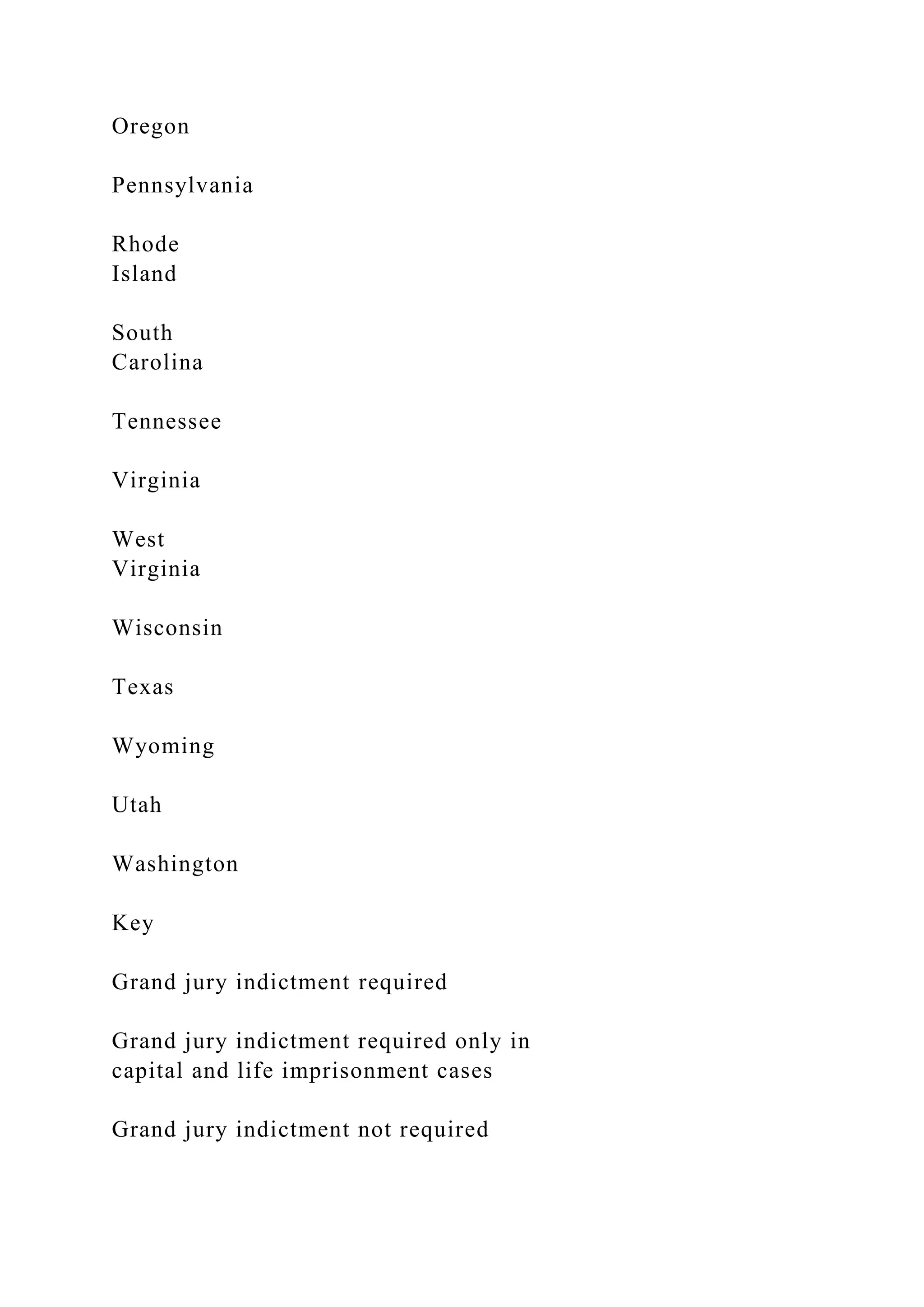
Most states, however, permit prosecution by indictment or
information. See Figure 11.3
for an overview of the mechanisms for filing serious charges in
each state.
So, since most states permit indictment or information, under
what circumstances
is one or the other method used? Typically, grand jury
indictment will be the charging
mechanism of choice when (1) the case is of great public and/or
political significance;
(2) the investigative power of the grand jury is useful; (3) the
grand jury may be able to
IS
B
N
1-
25
6-
63
92
1-
4
Criminal Procedure: From First Contact to Appeal, Fourth
Edition, by John L. Worrall. Published by Pearson. Copyright ©
2012 by Pearson Education, Inc.
352 Part 4 • The Beginnings of Formal Proceedings
Alaska
Alabama
Arizona
Arkansas
California
Colorado
Connecticut
Delaware
Georgia
Hawaii
Idaho
Illinois
Iowa
Kansas Kentucky
Louisiana
Maine
Massachusetts
Michigan
Minnesota
Florida
Missouri
Montana
Nebraska
Nevada
New
Hampshire
Vermont
New Jersey
Maryland
New Mexico
New York
North Carolina
Indiana
North Dakota
South Dakota
Ohio
Oklahoma
Oregon
Pennsylvania
Rhode
Island
South
Carolina
Tennessee
Virginia
West
Virginia
Wisconsin
Texas
Wyoming
Utah
Washington
Key
Grand jury indictment required
Grand jury indictment required only in
capital and life imprisonment cases
Grand jury indictment not required
Mississippi
FIGURE 11.3
Charging Methods for Serious Crimes by State
issue an indictment more quickly compared to holding a
preliminary hearing and then
issuing an information indictment; or (4) one or more witnesses
is hesitant to speak in
open court, preferring the secrecy surrounding grand jury
proceedings.
How a Grand Jury Is Constructed
A grand jury can be impaneled either by the court or by the
prosecutor. Usually, the court
has this responsibility, but prosecutors are becoming
increasingly able to decide
whether a grand jury is necessary.
The term grand jury should not be construed as singular; in
larger jurisdictions,
several grand juries may be acting at the same time. One or
more could be performing
investigative functions, and one or more others could be
working on specific cases.
Source: D. B. Rottman and S. M. Strickland, State Court
Organization, 2004 (Washington, DC: National Center for State
Courts,
2004). Note that some states requiring grand jury indictment do
so only for certain offenses. For example, Texas requires grand
jury
indictments for felonies, not misdemeanors.
IS
B
N
1-256-63921-4
Criminal Procedure: From First Contact to Appeal, Fourth
Edition, by John L. Worrall. Published by Pearson. Copyright ©
2012 by Pearson Education, Inc.
Chapter 11 • Prosecutors, Grand Juries, and Defense Attorneys
353
7 Ibid., Rule 6.
DURATION Once a grand jury has been convened, its members
serve for a specified
period of time. A term can last from one to three months but
sometimes less, if the court
or prosecutor believes that further deliberation is unnecessary.
Under the Federal Rules
of Criminal Procedure, a regular grand jury cannot serve for a
period longer than
18 months, unless the court extends the service “upon a
determination that such
extension is in the public interest.”7 Fortunately, people
selected for grand juries do not
have to meet every day; usually, a grand jury meets several days
a month.
SIZE Grand juries are larger than ordinary trial juries. In the
past, grand juries
consisting of 24 or so people were not uncommon. Today, grand
juries are usually
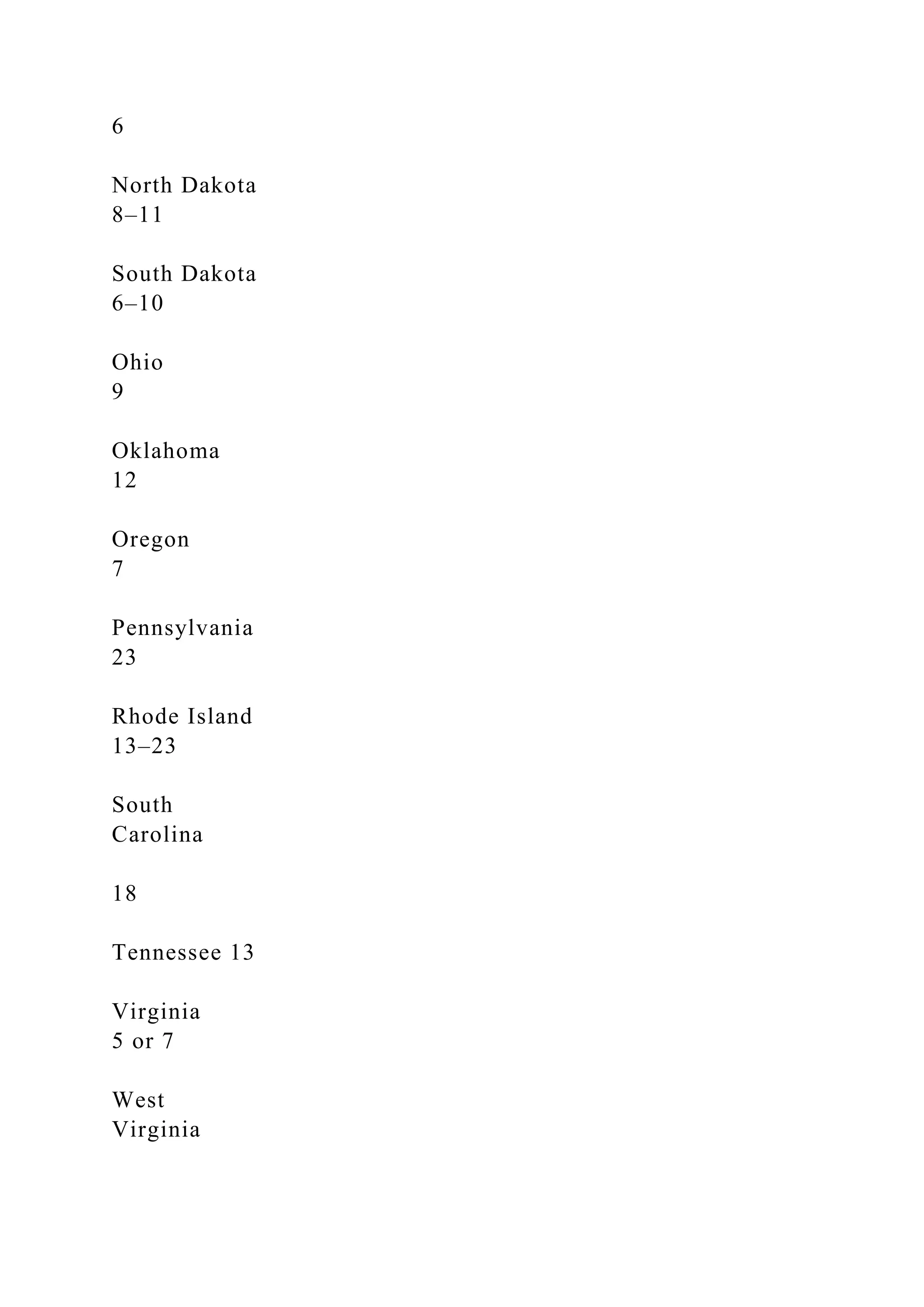
smaller, or in the neighborhood of 16–20 people. One state,
Tennessee, permits a grand
jury of 13 individuals, but the voting requirements in that state
are fairly restrictive.
See Figure 11.4 for an illustration of grand jury size
requirements by state.
Alaska
12–18
Alabama
18
Arizona
12–16
Arkansas
16
California
11, 19,
or 23
Colorado
12 or 23
Connecticut 1–3
Delaware 10 or 15
DC 16–23
Georgia
16–23
Hawaii
16
Idaho
16
Illinois
16
Iowa
7
Kansas
15
Kentucky
12
Louisiana
12
Maine
13–23
Massachusetts
23
Michigan
13–17
Minnesota
16–23
Mississippi
15–20
Florida
15–18
Missouri
12
Montana
11
Nebraska
16Nevada
17
New
Hampshire
23
Vermont
18–23
New Jersey 23
Maryland 23
New Mexico
12
New York
16–23
North Carolina
12–18
Indiana
6
North Dakota
8–11
South Dakota
6–10
Ohio
9
Oklahoma
12
Oregon
7
Pennsylvania
23
Rhode Island
13–23
South
Carolina
18
Tennessee 13
Virginia
5 or 7
West
Virginia
16
Wisconsin
17
Texas
12
Wyoming
2
Utah
9–15
Washington
12
FIGURE 11.4
Grand Jury Size Requirements by State
Source: www.uday ton.edu/~grandjur/stategj/sizegj.htm
(accessed March 10, 2011).
IS
B
N
1-
25
6-
63
92
1-
4
Criminal Procedure: From First Contact to Appeal, Fourth
Edition, by John L. Worrall. Published by Pearson. Copyright ©
2012 by Pearson Education, Inc.
354 Part 4 • The Beginnings of Formal Proceedings
FIGURE 11.5
Portions of Zacarias Moussaoui Indictment
IN THE UNITED STATES DISTRICT COURT
FOR THE EASTERN DISTRICT OF VIRGINIA
ALEXANDRIA DIVISION
UNITED STATES OF AMERICA ) CRIMINAL NO:
)
-v- ) Conspiracy to Commit Acts of Terrorism
) Transcending National Boundaries
ZACARIAS MOUSSAOUI, ) (18 U.S.C. §§ 2332b(a)(2) & (c))
a/k/a “Shaqil,” ) (Count One)
a/k/a “Abu Khalid al Sahrawi,” )
) Conspiracy to Commit Aircraft Piracy
) (49 U.S.C. §§ 46502(a)(1)(A) and (a)(2)(B))
Defendant. ) (Count Two)
)
) Conspiracy to Destroy Aircraft
) (18 U.S.C. §§ 32(a)(7) & 34)
) (Count Three)
)
) Conspiracy to Use Weapons of Mass Destruction
) (18 U.S.C. § 2332a(a))
) (Count Four)
)
) Conspiracy to Murder United States Employees
) (18 U.S.C. §§ 1114 & 1117)
) (Count Five)
)
) Conspiracy to Destroy Property
) (18 U.S.C. §§ 844(f), (i), (n))
) (Count Six)
VOTING REQUIREMENTS Grand jury voting requirements
also vary by state. The most
common voting requirement is that 12 grand jury members must
agree on an indictment.
However, one state, Virginia, requires only four votes for
issuance of a true bill, which is
the endorsement made by a grand jury when it finds sufficient
evidence to warrant a
criminal charge. Texas requires a vote of 9 out of 12.
As with a petit jury (i.e., that used in criminal trials), a grand
jury is headed by a
foreperson, who is charged with, among other duties, signing
the indictment and keeping
track of the votes of each member. Figure 11.5 presents portions
of the indictment against
Zacarias Moussaoui, one of the terrorists involved in the 9/11
attacks.
SELECTION OF MEMBERS People are selected for a grand
jury in the same way they are
selected for an ordinary trial (i.e., petit) jury: They are
subpoenaed. In some states, grand
jury members are selected from a list of eligible voters. In
others, they are selected from a
list of licensed drivers. Still other states select grand jury
members from a list of tax
returns, telephone directories, and so on. Most people do not get
the opportunity to
serve on a grand jury because grand juries are not convened that
frequently.
The grand jury selection process usually involves two stages.
First, a list of potential
grand jury members is compiled by any of the methods (or
others) just described. This list
IS
B
N
1-256-63921-4
Criminal Procedure: From First Contact to Appeal, Fourth
Edition, by John L. Worrall. Published by Pearson. Copyright ©
2012 by Pearson Education, Inc.
Chapter 11 • Prosecutors, Grand Juries, and Defense Attorneys
355
DECEMBER 2001 TERM - AT ALEXANDRIA
INDICTMENT
THE GRAND JURY CHARGES THAT:
COUNT TWO
(Conspiracy to Commit Aircraft Piracy)
1. The allegations contained in Count One are repeated.
2. From in or about 1989 until the date of the filing of this
Indictment, in the Eastern
District of Virginia, the Southern District of New York, and
elsewhere, the defendant,
ZACARIAS MOUSSAOUI, a/k/a “Shaqil,” a/k/a “Abu Khalid al
Sahrawi,” and
other members and associates of al Qaeda and others known and
unknown to the
Grand Jury, unlawfully, willfully and knowingly combined,
conspired, confederated
and agreed to commit aircraft piracy, by seizing and exercising
control of aircraft in
the special aircraft jurisdiction of the United States by force,
violence, threat of force
and violence, and intimidation, and with wrongful intent, with
the result that thou-
sands of people died on September 11, 2001.
Overt Acts
3. In furtherance of the conspiracy, and to effect its illegal
objects, the defendant,
and others known and unknown to the Grand Jury, committed
the overt acts
set forth in Count One of this Indictment, which are fully
incorporated by
reference.
(In violation of Title 49, United States Code, Sections
46502(a)(1)(A) and (a)(2)(B).)
COUNT THREE
(Conspiracy to Destroy Aircraft)
1. The allegations contained in Count One are repeated.
2. From in or about 1989 until the date of the filing of this
Indictment, in the Eastern
District of Virginia, the Southern District of New York, and
elsewhere, the defen-
dant, ZACARIAS MOUSSAOUI, a/k/a “Shaqil,” a/k/a “Abu
Khalid al Sahrawi,”
and other members and associates of al Qaeda and others known
and unknown to
the Grand Jury, unlawfully, willfully and knowingly combined,
conspired, confed-
erated and agreed to willfully destroy and wreck aircraft in the
special aircraft ju-
risdiction of the United States, and to willfully perform acts of
violence against and
incapacitate individuals on such aircraft, so as likely to
endanger the safety of such
aircraft, resulting in the deaths of thousands of persons on
September 11, 2001.
Overt Acts
3. In furtherance of the conspiracy, and to effect its illegal
objects, the defendant, and
others known and unknown to the Grand Jury, committed the
overt acts set forth
in Count One of this Indictment, which are fully incorporated
by reference.
(In violation of Title 18, United States Code, Sections 32(a)(7)
and 34.)
COUNT FOUR
(Conspiracy to Use Weapons of Mass Destruction)
1. The allegations contained in Count One are repeated.
2. From in or about 1989 until the date of the filing of this
Indictment, in the Eastern
District of Virginia, the Southern District of New York, and
elsewhere, the defen-
dant, ZACARIAS MOUSSAOUI, a/k/a “Shaqil,” a/k/a “Abu
Khalid al Sahrawi,”
Figure 11.5 continued
IS
B
N
1-
25
6-
63
92
1-
4
Criminal Procedure: From First Contact to Appeal, Fourth
Edition, by John L. Worrall. Published by Pearson. Copyright ©
2012 by Pearson Education, Inc.
356 Part 4 • The Beginnings of Formal Proceedings
Rose v. Mitchell
(443 U.S. 545 [1979])
of grand jury members is known as the venire. Next, people are
selected from the list to
serve on the grand jury. At both stages, constitutional
complications can arise.
First, special steps need to be taken to ensure that the list of
potential grand jurors,
like that for a typical petit jury, is fair and impartial. In
particular, the defendant can raise
constitutional challenges to the grand jury selection process if it
is not fair and impartial.
One such challenge is based on the equal protection clause. This
requires showing that
there is a significant disparity between a group’s representation
in the community and
its representation on the grand jury (see Casteneda v. Partida,
430 U.S. 482 [1977]).
Another constitutional challenge against the composition of the
grand jury pool
stems from the fair cross-section requirement announced in
Taylor v. Louisiana (419 U.S. 522
[1975]). There, the Court held that “systematic exclusion” of a
“large distinct group”
from the pool from which the (petit) jury is chosen violates the
Sixth Amendment.
The same logic carries over to the grand jury. If, for example, a
grand jury consists of all
white members and 40 percent of the community is black, the
fair cross-section
requirement will have been violated. By contrast, if the grand
jury does not contain a
snake handler, a militant feminist, a rabbi, or some such
specific type of individual, the
fair cross-section requirement will not have been violated
because these and other
individuals do not constitute large, distinct groups.
As for the selection of grand jury members from the pool,
similar constitutional
concerns can be raised. If, for instance, the grand jury pool is
representative of a fair
cross-section of the community, it is still possible that people
could be excluded from
the jury on a systematic basis. In Rose v. Mitchell (443 U.S.
545 [1979]), the Court held
that the “right to equal protection of the laws [is] denied when
[the defendant] is
indicted from a grand jury from which members of a racial
group purposefully have
been excluded” (p. 556). The final composition of the grand
jury can also be challenged
on due process grounds (see Beck v. Washington, 369 U.S. 541
[1962]).
Secrecy of Grand Jury Proceedings
Grand jury proceedings are intensely secret. In United States v.
Rose (215 F.2d 617 [1954]),
the Third Circuit Court of Appeals announced several reasons
for this:
(1) to prevent the escape of those whose indictment may be
contemplated;
(2) to insure the utmost freedom to the grand jury in its
deliberations, and to
and other members and associates of al Qaeda and others known
and unknown to
the Grand Jury, unlawfully, willfully and knowingly combined,
conspired, confed-
erated and agreed to use weapons of mass destruction, namely,
airplanes intended
for use as missiles, bombs, and similar devices, without lawful
authority against
persons within the United States, with the results of such use
affecting interstate
and foreign commerce, and against property that was owned,
leased and used by
the United States and by departments and agencies of the United
States, with the
result that thousands of people died on September 11, 2001.
Overt Acts
3. In furtherance of the conspiracy, and to effect its illegal
objects, the defendant, and
others known and unknown to the Grand Jury, committed the
overt acts set forth
in Count One of this Indictment, which are fully incorporated
by reference.
(In violation of Title 18, United States Code, Section 2332a(a).)
Source: http://www.usdoj.gov/ag/moussaouiindictment.htm
(accessed February 16, 2011).
Taylor v. Louisiana
(419 U.S. 522 [1975])
IS
B
N
1-256-63921-4
Criminal Procedure: From First Contact to Appeal, Fourth
Edition, by John L. Worrall. Published by Pearson. Copyright ©
2012 by Pearson Education, Inc.
Chapter 11 • Prosecutors, Grand Juries, and Defense Attorneys
357
Butterworth v. Smith
(494 U.S. 624 [1990])
8 Ibid.
prevent persons subject to indictment or their friends from
importuning the
grand jurors; (3) to prevent subornation of perjury or tampering
with the
witnesses who may testify before the grand jury and later
appear at the trial
of those indicted by it; (4) to encourage free and untrammeled
disclosures by
persons who have information with respect to the commission of
crimes;
[and] (5) to protect the innocent accused who is exonerated
from disclosure
of the fact that he has been under investigation, and from the
expense of
standing trial where there was no probability of guilt. (pp. 628–
629)
Notwithstanding these concerns, there are two categories of
case law concerning
grand jury secrecy: (1) cases addressing whether grand jury
witness testimony should be
supplied to the defense and (2) cases addressing the extent to
which grand jury witnesses
can share their testimony with other parties, such as other
government officials.
DISCLOSURE OF WITNESS TESTIMONY TO THE DEFENSE
According to the Federal Rules of
Criminal Procedure, grand jury proceedings can be shared with
the defense when the
defendant makes “a showing that grounds may exist for a
motion to dismiss the indict-
ment because of matters occurring before the grand jury.”8 This
type of disclosure is
exceedingly rare and generally limited to situations in which
there is evidence that
prosecutorial misconduct occurred before the grand jury
proceedings commenced.
DISCLOSURE OF WITNESS TESTIMONY TO OTHER
PARTIES In Butterworth v. Smith
(494 U.S. 624 [1990]), the Supreme Court declared that the
First Amendment may
provide an exception to the grand jury secrecy requirement. In
that case, the Court held
that a Florida statute that prohibited grand jury witnesses from
recounting their own
testimony violated freedom of speech.
Butterworth dealt with a defendant who wanted to share his
testimony with
third parties. However, many more cases deal with the issue of
whether other third
parties (i.e., besides the defense) should be able to access the
records of grand jury
proceedings. One such case is Douglas Oil Co. of California v.
Petrol Stops Northwest
(441 U.S. 211 [1979]). In that case, the Supreme Court held that
parties seeking access
to grand jury records “must show that the material they seek is
needed to avoid a
possible injustice to another judicial proceeding, that the need
for disclosure is
greater than the need for continued secrecy, and that their
request is structured to
cover only material so needed” (p. 222).
A third party that has traditionally been given greater latitude in
terms of access to
grand jury proceedings is the government. In fact, the Federal
Rules of Criminal Procedure
provide that no showing of “particularized need” is necessary in
order to disclose infor-
mation to other government attorneys who are assisting in
prosecution.9 However, when
disclosure is sought by government officials who are not
assisting in the prosecution, the
Supreme Court has held that a showing of need does have to be
made (see United States v.
Sells Engineering, Inc., 463 U.S. 418 [1983]).
Rights of Witnesses Testifying before Grand Juries
Grand juries rely heavily on witness testimony. However, the
rights afforded to grand jury
witnesses differ significantly from those afforded to witnesses
in other settings (e.g., at
trial). Also, the rights afforded to the individuals targeted by
grand jury investigations
differ from those afforded to criminal defendants.
9 Ibid.
IS
B
N
1-
25
6-
63
92
1-
4
Criminal Procedure: From First Contact to Appeal, Fourth
Edition, by John L. Worrall. Published by Pearson. Copyright ©
2012 by Pearson Education, Inc.
358 Part 4 • The Beginnings of Formal Proceedings
United States v.
Mandujano (425 U.S.
564 [1976])
The cases in this area revolve around three issues: (1) the right
of the individual
targeted by a grand jury investigation to testify, (2) whether
grand jury witnesses are
required to be advised of their right not to testify, and (3) the
right to counsel as applied
in grand jury proceedings.
RIGHT TO TESTIFY It is well known that the defendant in a
criminal trial has a constitu-
tional right to testify or not testify in his or her own defense. In
contrast, someone who is
the target of a grand jury investigation usually does not enjoy
the right to testify. Indeed,
several states do not even grant the target of a grand jury
investigation the right to be
present. This restriction is justified on the same secrecy grounds
discussed earlier. Also,
since many grand jury proceedings are investigative, there may
not be a specific target
until the proceedings have reached a close. In such a situation,
it would be cumbersome
to allow all potential targets to be present in order to give
testimony in their defense.
BEING ADVISED OF THE RIGHT NOT TO TESTIFY When
witnesses appear before grand
juries, they enjoy the Fifth Amendment’s privilege against self-
incrimination. This is no
different than in a criminal trial. However, a question has arisen
in the courts over
whether grand jury witnesses must be told that they can remain
silent. In other words,
the courts have grappled with whether the Miranda warnings
should apply in the grand
jury context.
As noted earlier in this book, the Miranda warnings are only
required during
custodial interrogation. Therefore, the following question must
be asked: Are grand
jury proceedings akin to custodial interrogations? At least one
decision suggests that
Miranda does not apply in the grand jury context because the
proceedings are not as
“inherently coercive” as traditional custodial interrogations
(e.g., Gollaher v. United
States, 419 F.2d 520 [9th Cir. 1969]). However, some states
require by law that the targets
of grand jury investigations, as well as grand jury witnesses, be
advised of their right
not to testify. The Supreme Court has yet to rule on this issue.
RIGHT TO COUNSEL Should grand jury witnesses and the
targets of grand jury
investigations be provided with counsel? The Supreme Court
has answered no to this
question in at least two cases: In re Groban’s Petition (352 U.S.
330 [1957]) and United
States v. Mandujano (425 U.S. 564 [1976]). A person who has
already been charged may
have a right to counsel before a grand jury proceeding, but such
an individual is rarely
the target of such a proceeding (see, e.g., Kirby v. Illinois, 406
U.S. 682 [1972]). The typi-
cal grand jury witness is someone called upon to shed light on a
particular case. Such
witnesses do not enjoy the right to counsel in grand jury
proceedings, but they can of
course assert Fifth Amendment protection and refuse to
incriminate themselves. As we
will see shortly, though, the grand jury may offer a grant of
immunity in exchange for a
witness’s testimony.
The Supreme Court has stated that grand jury proceedings take
place before the
initiation of adversarial criminal proceedings and, as such, are
outside the scope of the
Sixth Amendment’s right to counsel. There are also several
additional reasons for not
allowing counsel to be present during grand jury proceedings:
(1) the investigation
could be delayed if the witness repeatedly confers with his or
her attorney; (2) the
investigation could be disrupted if the witness raises objections
and arguments; and, of
course, (3) secrecy could be compromised.
Investigative Powers of the Grand Jury
One of the main duties of a grand jury is to investigate alleged
wrongdoing in order to
determine whether an indictment should be issued. Because of
this function, a grand
IS
B
N
1-256-63921-4
Criminal Procedure: From First Contact to Appeal, Fourth
Edition, by John L. Worrall. Published by Pearson. Copyright ©
2012 by Pearson Education, Inc.
Chapter 11 • Prosecutors, Grand Juries, and Defense Attorneys
359
Hale v. Henkel
(201 U.S. 43 [1906])
United States v. Calandra
(414 U.S. 338 [1974])
jury has a great deal of investigative power. For example, as
decided in United States v.
Calandra (414 U.S. 338 [1974]), a grand jury “may compel the
production of evidence or
the testimony of witnesses as it considers appropriate, and its
operation generally is
unrestrained by the technical procedural and evidentiary rules
governing the conduct
of criminal trials” (p. 343). In this vein, a grand jury can
subpoena witnesses and
evidence. However, it can also extend grants of immunity to
certain individuals in
exchange for their testimony, and it can find people in contempt
for failing to cooperate
with an investigation.
SUBPOENAS Two types of subpoenas are available to grand
juries: (1) a subpoena ad
testificandum and (2) a subpoena duces tecum. The former
compels a witness to
appear before the grand jury, and the latter compels the
production of tangible
evidence (e.g., a suspected murder weapon). The power of the
grand jury to utilize
both of these mechanisms is virtually unrestricted; however,
there have been a few
constitutional objections to their use.
First, some have argued that a subpoena to appear before the
grand jury amounts
to a seizure within the meaning of the Fourth Amendment. The
Supreme Court
acknowledged in United States v. Dioniso (410 U.S. 1 [1973])
that being forced to appear
before a grand jury may be inconvenient but not in comparison
to the “historically
grounded obligation of every person to appear and give his
evidence before the grand
jury” (pp. 9–10). Furthermore, Fourth Amendment restrictions
on the grand jury’s
subpoena power “would assuredly impede its investigation and
frustrate the public’s
interest in the fair and expeditious administration of the laws”
(p. 17).
As for tangible evidence, the Supreme Court has likewise held
that a subpoena
duces tecum does not amount to a Fourth Amendment seizure.
However, according to
the Court in Hale v. Henkel (201 U.S. 43 [1906]), such a
subpoena must comport with the
Fourth Amendment’s particularity requirement. In United States
v. Gurule (437 F.2d 239
[10th Cir. 1970]), the Tenth Circuit announced a three-prong
test for ensuring that a
grand jury subpoena satisfies the Fourth Amendment’s
reasonableness requirement:
“(1) the subpoena may command only the production of things
relevant to the
investigation being pursued; (2) specification of things to be
produced must be made
with reasonable particularity; and (3) production of records
covering only a reasonable
period of time may be required” (p. 241).
It has already been noted that grand jury witnesses enjoy the
Fifth Amendment
privilege, but could being forced to appear before a grand jury
itself be incriminating?
Not surprisingly, people have objected to grand jury subpoenas
for this reason. Few, if
any, have succeeded, however. Why? Someone who is appearing
before a grand jury
does not know in advance what questions will be asked and, as
such, cannot assert the
Fifth Amendment privilege prior to his or her appearance.
GRANTS OF IMMUNITY Even though witnesses appearing
before the grand jury enjoy
the Fifth Amendment privilege against self-incrimination, the
grand jury can get around
this. In particular, the grand jury can extend grants of immunity
to witnesses in exchange
for their testimony. A grant of transactional immunity prohibits
future prosecution on the
acts for which the witness testifies. In contrast, so-called use
and derivative use immunity
only bars the use of the witness’s testimony against him or her
in the future. If evidence is
obtained after the fact, independent of the witness’s testimony
before the grand jury, then
he or she can be charged (see Kastigar v. United States, 406
U.S. 441 [1972]).
FINDINGS OF CONTEMPT When someone is subpoenaed to
appear before the grand
jury but does not show up, the jury’s contempt power can be
utilized. That is, the
grand jury can impose civil and criminal sanctions on the
individual. For example, an
IS
B
N
1-
25
6-
63
92
1-
4
Criminal Procedure: From First Contact to Appeal, Fourth
Edition, by John L. Worrall. Published by Pearson. Copyright ©
2012 by Pearson Education, Inc.
360 Part 4 • The Beginnings of Formal Proceedings
individual who refuses to appear before the grand jury can be
jailed until which point
he or she agrees to appear. Note that the grand jury’s contempt
power is limited to
compelling the presence of the witness, not his or her
testimony. The witness who does
appear can still invoke the Fifth Amendment privilege and not
make a statement.
Challenging a Grand Jury Indictment
Restrictions on prosecutors’ charging decisions were discussed
earlier in this chapter.
Restrictions are also placed on grand jury indictments. That is,
it is possible to challenge
a grand jury indictment on constitutional and similar grounds,
including (1) lack of
evidence; (2) misconduct by the prosecutor as the adviser of the
grand jury; (3) unfair
selection of grand jury members; and (4) use of different
evidence at trial from that
presented to the grand jury. When any of these circumstances
exists, a grand jury
indictment will be quashed or declared invalid.
There is considerable variation among the states as to what
amount of evidence is
necessary to secure a valid indictment. Some states hold to the
probable cause standard.
Others state that the grand jury can only issue an indictment
when all the evidence
before it would, if unexplained, warrant a conviction at trial. In
Utah, an indictment can
only be issued on clear and convincing evidence that a crime
was committed and that
the person charged committed it. In either case, a grand jury
indictment can be quashed
if the evidence relied on to obtain the indictment is insufficient.
Also, if the evidence
used to obtain an indictment is obtained in an unconstitutional
fashion, the indictment
can be quashed by essentially invoking the exclusionary rule.
Flagrant prosecutorial misconduct can also lead to an
indictment being quashed.
If, for instance, the prosecutor fails to supply the grand jury
with exculpatory evidence,
a subsequent indictment may be quashed but only if such
misconduct violates existing
law. There is, surprisingly, very little existing case law in this
area. Indeed, the Supreme
Court held in United States v. Williams (504 U.S. 36 [1992])
that federal courts cannot
easily dismiss an indictment because of prosecutorial
misconduct. “Because the grand
jury is an institution separate from the courts, over whose
functioning the courts do not
preside, we think it clear that, as a general matter at least, no
such ‘supervisory’ judicial
authority exists” (p. 47).
While the courts have been hesitant to quash indictments based
on insufficient
evidence and prosecutorial misconduct, discrimination in the
selection of grand jury
members is taken very seriously. As indicated earlier in this
chapter, the composition of
the grand jury must comply with the due process and equal
protection requirements.
When it does not, subsequent indictments can be quashed. The
Court noted in United
States v. Mechanik (475 U.S. 66 [1986]) that “racial
discrimination in the selection of
grand jurors is so pernicious and other remedies so impractical,
that the remedy of
automatic reversal [may be] necessary as a prophylactic means
of deterring grand jury
discrimination in the future” (p. 70).
DECISION-MAKING EXERCISE 11.7
Grand Jury Investigations
Assume that the grand jury is investigating a major case of
corporate fraud. Assume further that the grand jury issues a
subpoena duces tecum, calling for “all understandings,
contracts or correspondence between the Fabulous Widgets
Company and all of its business partners, as well as all reports
made and accounts rendered by such companies from the
date of the organization of the Fabulous Widgets Company, as
well as all letters received by that company since its organiza-
tion from all of its business partners.” Can this subpoena be
considered sufficiently particular?
IS
B
N
1-256-63921-4
Criminal Procedure: From First Contact to Appeal, Fourth
Edition, by John L. Worrall. Published by Pearson. Copyright ©
2012 by Pearson Education, Inc.
Chapter 11 • Prosecutors, Grand Juries, and Defense Attorneys
361
Gideon v. Wainwright
(372 U.S. 335 [1963])
Finally, if the prosecutor presents evidence at trial that departs
significantly from
that relied on by the grand jury for the purpose of issuing an
indictment, sanctions will
be imposed. If this variance between the trial evidence and the
grand jury evidence is
minimal, the indictment will probably not be quashed.
Interpreted differently, if the
evidence presented by the prosecutor to secure an indictment is
“in no way essential to
the offense on which the jury convicted,” the indictment will
probably not be quashed
(see United States v. Miller, 471 U.S. 130 [1985]).
THE DEFENSE ATTORNEY
The Sixth Amendment to the U.S. Constitution provides “in all
criminal prosecutions,
the accused shall enjoy the right . . . to have the Assistance of
Counsel for his defense.”
This right was applied to the states in the landmark decision of
Gideon v. Wainwright
(372 U.S. 335 [1963]). While on its face, this portion of the
Sixth Amendment seems
straightforward, it has actually given rise to two important
questions: (1) What
constitutes a criminal prosecution? and (2) What does assistance
of counsel mean?
Answers to these two questions are provided in the subsections
that follow.
The right to counsel as applied at other stages of the criminal
process and waiver of
counsel and the right to counsel of one’s own choice are also
addressed.
The Right to Counsel in a Criminal Prosecution
DUE PROCESS ORIGINS Prior to Gideon, the right to counsel
did not exist for all individ-
uals. Usually, counsel was provided only for defendants who
could afford it. There
were occasions prior to the 1960s, however, in which counsel
was provided to criminal
defendants who could not afford it. For example, the
constitutional right of an indigent
defendant to be represented by counsel was first announced in
Powell v. Alabama
(287 U.S. 45 [1932]). In that case, the Supreme Court reversed
the convictions of several
indigent defendants who were not represented by counsel at
trial. Significantly, though,
the Court based its decision on the Fifth Amendment’s due
process clause, not the Sixth
Amendment. In the Court’s words:
The right to be heard would be, in many cases, of little avail if
it did not
comprehend the right to be heard by counsel. Even the
intelligent and
educated layman has small and sometimes no skill in the science
of law.
If charged with crimes, he is incapable, generally, of
determining for himself
whether the indictment is good or bad. He is unfamiliar with the
rules of
evidence. Left without aid of counsel he may be put on trial
without a proper
charge, and convicted upon incompetent evidence, or evidence
irrelevant to
DECISION-MAKING EXERCISE 11.8
Deciding on Variance
A grand jury returned an indictment against two women,
charging them both with conspiracy to commit murder.
Typically, a criminal conspiracy exists when two or more
persons agree to commit a crime and then commit some sort
of overt act in furtherance of that agreement (e.g., People v.
Cockrell, 63 Cal. 2d 779). The grand jury was presented with
a recorded telephone call between the two women, in which
they agreed to murder their husbands. The grand jury was
not presented with evidence that the women bought hand-
guns for themselves. That evidence was introduced by the
prosecutor at trial, however. The women were convicted and
are now appealing their convictions, claiming that there was
a variance between their indictment and the prosecutor’s
case. Will they succeed?
Powell v. Alabama
(287 U.S. 45 [1932])
IS
B
N
1-
25
6-
63
92
1-
4
Criminal Procedure: From First Contact to Appeal, Fourth
Edition, by John L. Worrall. Published by Pearson. Copyright ©
2012 by Pearson Education, Inc.
362 Part 4 • The Beginnings of Formal Proceedings
the issue or otherwise inadmissible. He lacks both the skill and
knowledge
adequately to prepare his defense, even though he may have a
perfect one.
He requires the guiding hand of counsel at every step in the
proceedings
against him. Without it, though he be not guilty, he faces the
danger of con-
viction because he does not know how to establish his
innocence. (pp. 68–69)
However, the right to counsel announced in Powell was not
without limitations.
It applied only to “capital case[s], where the defendant is unable
to employ counsel,
and is incapable adequately of making his own defense because
of ignorance, feeble-
mindedness, illiteracy, or the like” (p. 71).
THE CONTEMPORARY SIXTH AMENDMENT APPROACH In
Johnson v. Zerbst (304 U.S. 458
[1938]), the Court recognized the Sixth Amendment right to
counsel in all federal
prosecutions, stating that the Sixth Amendment “embodies a
realistic recognition of the
obvious truth that the average defendant does not have the
professional legal skill to
protect himself” (pp. 462–463).
But the Sixth Amendment’s right to counsel was still not
extended to the states.
In Johnson, the Court refused to apply its decision to the states,
and this holding was
reaffirmed a few years later in the case of Betts v. Brady (316
U.S. 455 [1942]). There, the
Court held that “[t]he Due Process Clause of the Fourteenth
Amendment does not
incorporate, as such, the specific guarantees found in the Sixth
Amendment”
(pp. 461–462). It would not be until the 1963 decision in
Gideon v. Wainwright that
the Sixth Amendment right to counsel became incorporated. In
that case, the Court
recognized that “lawyers in criminal courts are necessities, not
luxuries” (p. 344).
Gideon dealt with a felony, which led the Supreme Court to
conclude that the Sixth
Amendment right to counsel applies only in felony proceedings.
However, in
Argersinger v. Hamlin (407 U.S. 25 [1972]), the Court held that
the right to counsel applies
in misdemeanor cases, also. According to the Court, “The
requirement of counsel may
well be necessary for a fair trial even in petty-offense
prosecution. We are by no means
convinced that legal and constitutional questions involved in a
case that actually leads
to imprisonment even for a brief period are any less complex
than when a person can be
sent off for six months or more” (p. 33).
This decision was then clarified in Scott v. Illinois (440 U.S.
367 [1979]), in which the
Court held that the right to counsel does not apply where loss of
liberty is merely a
possibility. In short, when there is no possibility of
confinement, the Sixth Amendment
right to counsel does not apply. A twist on the Scott decision
was recently handed down
in Alabama v. Shelton (535 U.S. 654 [2002]), in which the
Court held that “[a] suspended
sentence that may ‘end up in the actual deprivation of a
person’s liberty’ may not be
imposed unless the defendant was accorded ‘the guiding hand of
counsel’ in the
prosecution for the crime charged” (p. 654). Shelton differed
from Scott because Shelton
was placed on probation; Scott was not.
The Right to Counsel at Other Stages of the Criminal Process
Until the Supreme Court’s 1963 decision in Gideon, its cases on
the right to counsel had
addressed this right primarily in the context of trials. After
Gideon, however, the Court
began to turn its attention to the right to counsel at other stages
of the criminal process.
This right can be tied to the Sixth Amendment, but the Court
has also defended it (i.e., to
the extent it exists) on grounds of self-incrimination, due
process, and equal protection.
THE SIXTH AMENDMENT APPROACH In order to determine
whether the Sixth
Amendment right to counsel applies outside the trial context,
the Court once held that a
Johnson v. Zerbst
(304 U.S. 458 [1938])
IS
B
N
1-256-63921-4
Criminal Procedure: From First Contact to Appeal, Fourth
Edition, by John L. Worrall. Published by Pearson. Copyright ©
2012 by Pearson Education, Inc.
Chapter 11 • Prosecutors, Grand Juries, and Defense Attorneys
363
Kirby v. Illinois
(406 U.S. 682 [1972])
critical stage analysis was necessary. In United States v. Wade
(388 U.S. 218 [1967]), the
Supreme Court announced a two-prong test for determining
when counsel is required
under the Sixth Amendment: (1) “whether potential substantial
prejudice to the
defendant’s rights inheres in the particular confrontation;” and
(2) whether counsel can
“help avoid that prejudice” (p. 227). In support of its decision,
the Court stated, “The
trial which might determine the accused’s fate may well not be
that in the courtroom but
that at the pretrial confrontation, with the State aligned against
the accused, the witness
the sole jury, and the accused unprotected against the
overreaching, intentional or
unintentional, [influence of the government]” (p. 235).
What, then, was considered a critical stage? The Court stated
that the period from
arraignment to trial was arguably the most critical period of the
proceedings. Preliminary
hearings and sentencing hearings were also considered critical
stages in the criminal
process (see Mempa v. Rhay, 389 U.S. 128 [1967]; Coleman v.
Alabama, 399 U.S. 1 [1970]).
In the 1973 decision United States v. Ash (413 U.S. 300
[1973]), the Court abandoned
the critical stage analysis and focused instead on whether “trial-
like confrontations”
necessitate counsel. The Court was unsatisfied with the open-
endedness of the critical
stage analysis. Trial-like confrontations, according to the Court,
were proceedings that
confronted the accused with the “intricacies of the law and the
advocacy of the public
prosecutor” (p. 309). Cases in which this definition was applied
include but are not
limited to Gerstein v. Pugh (420 U.S. 103 [1975]) and Estelle v.
Smith (451 U.S. 454 [1981]).
But since this definition is equally vague, the Court abandoned
it for a third and final
approach to the Sixth Amendment right to counsel outside trial.
In Kirby v. Illinois (406 U.S. 682 [1972]), the Court became
even more specific and
held, once and for all, that the right to counsel applies not only
in criminal prosecutions
but also at the “initiation of adversary proceedings.” This means
that the Sixth
Amendment right to counsel applies not only after indictment,
formal charging, and on
through sentencing, but also as early on as the initial
appearance (Rothgery v. Gillespie
County, No. 07-440 [2008]).
THE FIFTH AMENDMENT APPROACH As was already noted
in Chapter 8, the right to
counsel has also been applied through the Fifth Amendment. In
Miranda v. Arizona
(384 U.S. 436 [1966]), the Court held that the Fifth
Amendment’s privilege against self-
incrimination grants suspects the right to counsel during
custodial interrogations
because of the “inherent coerciveness” of such activities.
Furthermore, the right to
counsel during custodial interrogations applies before or after
commencement of
formal adversary proceedings.
THE DUE PROCESS APPROACH The right to counsel also
stems from the due process
clause of the Fourteenth Amendment, but only in certain
circumstances. The Fourteenth
Amendment has been used to justify the right to counsel
primarily in criminal appeals
and probation/parole revocation hearings. For example, in
Douglas v. California (372 U.S.
353 [1963], the Court held that the right to counsel extends to
convicted indigents for
appeals of right (i.e., appeals to which the individual is legally
entitled). And in Gagnon v.
Scarpelli (411 U.S. 778 [1973]), the Court held that as a matter
of due process, indigents
are entitled to counsel at probation and parole revocation
hearings but only on a
case-by-case basis (e.g., whether the complexity of the issues at
stake is significant).
In contrast, the right to counsel does not necessarily exist so
that indigent convicts
can prepare petitions for discretionary appeals (i.e., those that
the reviewing court gets to
decide it wants to hear) (see Ross v. Moffitt, 417 U.S. 600
[1974]). The Court noted that the
government “does not automatically . . . act . . . unfairly by
refusing to provide counsel
to indigent defendants at every stage of the [appellate process]”
(p. 611). Similarly, in
Pennsylvania v. Finley (481 U.S. 551 [1987]), the Court
announced that the right to
IS
B
N
1-
25
6-
63
92
1-
4
Criminal Procedure: From First Contact to Appeal, Fourth
Edition, by John L. Worrall. Published by Pearson. Copyright ©
2012 by Pearson Education, Inc.
364 Part 4 • The Beginnings of Formal Proceedings
counsel does not exist so that convicted criminals can prepare
habeas corpus petitions.
The reason offered by the Court is that “[post-]conviction relief
is even further removed
from the criminal trial than is discretionary direct review” (pp.
556–557).
Waiver of the Right to Counsel
Though the Sixth Amendment provides for the right to counsel,
accused individuals
sometimes prefer to represent themselves. Indeed, according to
the Supreme Court,
criminal defendants have a constitutional right to represent
themselves at trial (Faretta v.
California, 422 U.S. 806 [1975]). This is known as a pro se
defense. In reaching this
decision, the Court noted that the Sixth Amendment only
guarantees the assistance of
counsel, not necessarily representation by counsel:
The language and spirit of the Sixth Amendment contemplate
that counsel,
like the other defense tools guaranteed by the Amendment, shall
be an aid to
a willing defendant—not an organ of State interposed between
an unwilling
defendant and his right to defend himself personally. . . . An
unwanted
counsel “represents” the defendant only through a tenuous and
unaccept-
able legal fiction. Unless the accused has acquiesced in such
representation,
the defense presented is not the defense guaranteed him by the
Constitution,
for in a very real sense, it is not his defense. (pp. 820–821)
The Court also emphasized in Faretta that the framers viewed
the “inestimable worth
of free choice” as more important than the right to counsel.
Also, “[t]o force a lawyer
on a defendant can only lead [the defendant] to believe that the
law contrives against
him” (p. 834).
Not every defendant who wishes to proceed without counsel is
allowed to do so,
however. In Johnson v. Zerbst (304 U.S. 458 [1938]), the
Supreme Court stated that a
defendant may only waive counsel if the waiver is “competent
and intelligent.” According
to the Court in Carnley v. Cochran (369 U.S. 506 [1962]), “the
record must show, or there
must be an allegation and evidence must show, that an accused
was offered counsel but
intelligently and understandingly rejected the offer. Anything
less is not a waiver” (p. 516).
The Court elaborated further in Von Moltke v. Gillies (332 U.S.
708 [1948]):
To be valid such waiver must be made with an apprehension of
the nature
of the charges, the statutory offenses included within them, the
range of
allowable punishments thereunder, possible defenses to the
charges and
circumstances in mitigation thereof, and all other facts essential
to a broad
understanding of the whole matter. A judge can make certain
that an
accused’s professed waiver of counsel is understandingly and
wisely
made only from a penetrating and comprehensive examination
of all the
circumstances. (p. 724)
DECISION-MAKING EXERCISE 11.9
Right to Counsel in the Pretrial Phase
A man was arrested without a warrant when a police officer
caught him robbing the First Street branch of American Bank.
Four hours later, the man was brought before a judge for a
probable cause hearing. The judge decided that the officer
had probable cause to arrest. The man was convicted of the
crime and sentenced to prison. He is now appealing his
conviction, claiming that he should have been given access to
counsel at the probable cause hearing. Is he right?
Johnson v. Zerbst
(304 U.S. 458 [1938])
IS
B
N
1-256-63921-4
Criminal Procedure: From First Contact to Appeal, Fourth
Edition, by John L. Worrall. Published by Pearson. Copyright ©
2012 by Pearson Education, Inc.
Chapter 11 • Prosecutors, Grand Juries, and Defense Attorneys
365
What constitutes a knowing and intelligent waiver is not always
clear. However,
in Massey v. Moore (348 U.S. 105 [1954]), the Court offered
clarification by stating that
“[o]ne might not be insane in the sense of being incapable of
standing trial and yet lack
the capacity to stand trial without benefit of counsel” (p. 108).
But in Godinez v. Moran
(509 U.S. 389 [1993]), a case decided some years later, the
Court held that a person who
is competent to stand trial is also competent to waive counsel at
trial and for pleading
purposes. This decision all but reversed an earlier decision in
which the Court held that
competence to stand trial could be interpreted as competence to
waive counsel
(see Westbrook v. Arizona, 384 U.S. 150 [1966]).
In certain circumstances, while permitting waiver of counsel,
the court can
require that standby counsel be available to the defendant—that
is, an attorney who is
standing by in order to assist the accused, if necessary. This
was the decision reached in
McKaskle v. Wiggins (465 U.S. 168 [1984]), in which the Court
held that a judge can
appoint standby counsel “to relieve the judge of the need to
explain and enforce basic
rules of courtroom protocol or to assist the defendant in
overcoming routine obstacles
that stand in the way of the defendant’s achievement of his own
clearly indicated
goals” (p. 184). When waiver of counsel is knowing and
intelligent, a judge’s decision
to appoint standby counsel will not be unconstitutional as long
as (1) the defendant
retains control over the case and (2) the jury understands that
the defendant represents
himself or herself.
In 2004, the Supreme Court decided that waiver of the right to
counsel is one that the
defendant takes, potentially, at his or her own peril. In Iowa v.
Tovar (541 U.S. 77 [2004]), the
Court decided that a trial court was not required to warn the
accused that waiving
the right to counsel at a plea hearing involves two risks: (1) the
possibility that valid
defenses will be overlooked and (2) the accused will be
deprived of advice as to whether a
guilty plea is warranted. At the same time, though, the
Constitution does not prohibit a
court from insisting on representation of counsel for criminal
defendants who are compe-
tent to stand trial but who also suffer from serious mental
illness that would compromise
their ability to put on an effective defense (Indiana v. Edwards,
554 U.S. 164 [2008]).
Indigent versus Nonindigent Defendants’ Right to Counsel
of Their Choice
Clearly, the defendant who is not indigent can hire counsel of
his or her choosing.
What’s more, the wealthier the defendant, the better counsel he
or she can afford.
Unfortunately, the indigent defendant does not have such a
choice. The Sixth
Amendment right to counsel does not guarantee the indigent
defendant permission to
choose counsel; rather, counsel will be provided. Usually,
counsel will be a public
defender. If, however, an indigent can show good cause that the
attorney appointed to
represent him or her is not doing so adequately, another
attorney can be appointed.
What constitutes inadequate representation is discussed in the
next section.
Surprisingly, there are situations in which defendants, if they
can afford represen-
tation, cannot hire counsel of their choice. If, for example, the
defendant’s choice of an
attorney poses serious conflict-of-interest problems, the
defendant may be forced to hire
another attorney (e.g., Wheat v. United States, 486 U.S. 153
[1988]). Or if the defendant’s
attorney is not qualified to practice law, then another attorney
may be required (e.g., cf.
Leis v. Flynt, 439 U.S. 438 [1979]). And somewhat
controversially, if a defendant’s assets
are frozen pursuant to a civil forfeiture statute and he or she
cannot afford counsel of his
or her choosing, then a less expensive attorney may be required
or a public defender
may be appointed (see Caplin v. Drysdale v. United States, 491
U.S. 617 [1989]).
On the other hand, if a defendant with means has his or her eye
on a particular
attorney who is qualified to practice law and does not have any
conflicts of interest, the
IS
B
N
1-
25
6-
63
92
1-
4
Criminal Procedure: From First Contact to Appeal, Fourth
Edition, by John L. Worrall. Published by Pearson. Copyright ©
2012 by Pearson Education, Inc.
366 Part 4 • The Beginnings of Formal Proceedings
defendant must be able to hire the attorney. If a judge
wrongfully prohibits the defen-
dant from hiring the attorney of his or her choice, the
defendant’s ensuing conviction
must be overturned (United States v. Gonzalez-Lopez, 548 U.S.
140 [2006]).
An issue related to counsel of one’s choice is whether indigent
defendants can
retain expert witnesses of their own choosing. In Ake v.
Oklahoma (470 U.S. 68 [1985]),
the Supreme Court held that an indigent defendant enjoys a
constitutional right to an
expert witness when his or her sanity is at issue. However, the
Court limited its holding
to provide for only one expert and one who is state employed.
States vary in their rules
concerning expert witnesses for indigent defendants. Often
there are price caps that
limit how much an indigent defendant’s expert can be paid. At a
point, it becomes
necessary to assume that the state’s experts (e.g., ballistics
experts) present objective and
accurate testimony that is not prejudicial to the accused.
Effective Assistance of Counsel
If the Sixth Amendment’s right to counsel provision was
extended to indigent defendants
with a blind eye, then some defendants would be convicted and
others acquitted because
of varying levels of competence among attorneys. All attorneys
are not the same. Some,
while authorized to practice law, prove to be totally ineffective
in their duties. As such, the
courts have grappled with what constitutes effective assistance
of counsel.
WHEN THE RIGHT APPLIES The Sixth Amendment does not
explicitly state that effective
assistance of counsel is required, but the Supreme Court has
interpreted it in this way.
However, the right to effective assistance only applies when the
right to counsel applies.
For example, the Supreme Court has held that a defense
attorney’s failure to file a
timely discretionary appeal is not ineffective because the right
to counsel does not
extend to such appeals (Wainwright v. Torna, 455 U.S. 586
[1982]). Only when counsel is
required can an ineffective assistance claim be made out.
It is important to realize that claims of ineffective assistance
can be filed against both
retained and appointed counsel. For a time, the Supreme Court
held that a nonindigent
defendant who retained his or her own attorney was bound by
that attorney’s representa-
tion, for better or worse, because there was no state action
responsible for the ineffective
representation. However, in Cuyler v. Sullivan (446 U.S. 335
[1980]), the Court held that
privately retained counsel can be ineffective in the same way a
public defender can:
The vital guarantee of the Sixth Amendment would stand for
little if the
often uninformed decision to retain a particular lawyer could
reduce or
forfeit the defendant’s entitlement to constitutional protection.
Since the
State’s conduct of a criminal trial itself implicates the State in
the defendant’s
conviction, we see no basis for drawing a distinction between
retained and
appointed counsel that would deny equal justice to defendants
who must
choose their own lawyers. (p. 344)
THE MEANING OF EFFECTIVE ASSISTANCE So, what
constitutes effective assistance of
counsel? The lower courts are somewhat divided in terms of
how to answer this ques-
tion, so it is necessary to focus on the Supreme Court’s standard
for deciding whether
defense counsel’s assistance is or is not effective. Before
getting to the cases, however,
Figure 11.6 reprints portions of the Code of Conduct for Federal
Public Defender Employees,
published by the Administrative Office of the U.S. Courts.
Public defenders are defense
attorneys for indigent individuals, but the Code is informative
nevertheless.
In the first case, McMann v. Richardson (397 U.S. 759 [1970]),
the Court held that
counsel is effective when his or her legal advice is “within the
range of competence
IS
B
N
1-256-63921-4
Criminal Procedure: From First Contact to Appeal, Fourth
Edition, by John L. Worrall. Published by Pearson. Copyright ©
2012 by Pearson Education, Inc.
Chapter 11 • Prosecutors, Grand Juries, and Defense Attorneys
367
FIGURE 11.6
Code of Conduct for Federal Public Defender Employees
B. Code of Conduct for Federal Public Defender Employees
CANON 1: A FEDERAL PUBLIC DEFENDER EMPLOYEE
SHOULD UPHOLD THE
INTEGRITY AND INDEPENDENCE OF THE OFFICE
An independent and honorable defender system is indispensable
to justice in our society.
A defender employee should personally observe high standards
of conduct so that the
integrity and independence of the office are preserved and so
that the defender office
reflects a devotion to serving the public defender’s clients and
the principle of equal
justice under law. Defender employees should require adherence
to such standards by
personnel subject to their direction and control. The provisions
of this code should be
construed and applied to further these objectives. The standards
of this code shall not
affect or preclude other more stringent standards required by
law, by applicable codes of
professional responsibility, by court order, or by the federal
public defender.
CANON 2: A FEDERAL PUBLIC DEFENDER EMPLOYEE
SHOULD AVOID
IMPROPRIETY AND THE APPEARANCE OF IMPROPRIETY
IN ALL ACTIVITIES
A defender employee should not engage in any activities that
would put into question
the propriety of the defender employee’s conduct in carrying
out the duties of the
office. A defender employee should not use public office for
private gain.
CANON 3: A FEDERAL PUBLIC DEFENDER EMPLOYEE
SHOULD ADHERE TO
APPROPRIATE STANDARDS IN PERFORMING THE DUTIES
OF THE OFFICE
In performing the duties prescribed by law, by resolution of the
Judicial Conference of
the United States, by court order, or by the federal public
defender, the following
standards apply:
A. A defender employee should respect and comply with the law
and these canons.
A defender employee should report to the appropriate
supervising authority any
attempt to induce the defender employee to violate these
canons.
Note: A number of criminal statutes of general applicability
govern defender
employees’ performance of official duties. These include:
18 U.S.C. § 201 (bribery of public officials and witnesses);
18 U.S.C. § 211 (acceptance or solicitation to obtain appointive
public office);
18 U.S.C. § 285 (taking or using papers relating to government
claims);
18 U.S.C. § 287 (false, fictitious, or fraudulent claims against
the government);
18 U.S.C. § 508 (counterfeiting or forging transportation
requests);
18 U.S.C. § 641 (embezzlement or conversion of government
money, property,
or records);
18 U.S.C. § 643 (failing to account for public money);
18 U.S.C. § 798 and 50 U.S.C. § 783 (disclosure of classified
information);
18 U.S.C. § 1001 (fraud or false statements in a government
matter);
18 U.S.C. § 1719 (misuse of franking privilege);
Figure 11.6 continued
IS
B
N
1-
25
6-
63
92
1-
4
Criminal Procedure: From First Contact to Appeal, Fourth
Edition, by John L. Worrall. Published by Pearson. Copyright ©
2012 by Pearson Education, Inc.
368 Part 4 • The Beginnings of Formal Proceedings
18 U.S.C. § 2071 (concealing, removing, or mutilating a public
record);
31 U.S.C. § 1344 (misuse of government vehicle);
31 U.S.C. § 3729 (false claims against the government).
This is not a comprehensive listing but sets forth some of the
more significant
provisions with which defender employees should be familiar.
B. A defender employee should be faithful to professional
standards and maintain
competence in the defender employee’s profession.
C. A defender employee should be patient, dignified, respectful,
and courteous to all
persons with whom the defender employee deals in an official
capacity, and should
require similar conduct of personnel subject to the defender
employee’s direction and
control. A defender employee should diligently discharge the
responsibilities of the
office in a nondiscriminatory fashion.
D. A defender employee should not solicit or accept a payment
of money or anything of
value from a client, except that a defender employee may accept
an appropriate
memento or token that is neither money nor of commercial
value. A defender employee
should never disclose any confidential communications from a
client, or any other
confidential information received in the course of official
duties, except as authorized
by law. A former defender employee should observe the same
restrictions on disclosure
of confidential information that apply to a current defender
employee.
E. A defender employee should not engage in nepotism
prohibited by law.
Note: See also 5 U.S.C. § 3110 (employment of relatives); 28
U.S.C. § 458 (employment of
judges’ relatives).
F. Conflicts of Interest.
(1) In providing legal representation to clients, a public
defender should observe
applicable rules of professional conduct governing the
disclosure and avoidance of
conflicts of interest. . . .
CANON 4: A FEDERAL PUBLIC DEFENDER EMPLOYEE
MAY ENGAGE IN
ACTIVITIES TO IMPROVE THE LAW, THE LEGAL
SYSTEM, AND THE
ADMINISTRATION OF JUSTICE
A defender employee, subject to the proper performance of
official duties, may engage
in the law-related activities enumerated below.
A. A defender employee may speak, write, lecture, teach, and
participate in other
activities concerning defender services, the legal system, and
the administration of justice.
B. A defender employee may serve as a member, officer, or
director of an organization
or governmental agency devoted to the improvement of the law,
the legal system, or the
administration of justice. A defender employee may assist such
an organization in
raising funds and may participate in the management and
investment of such funds.
A defender employee may make recommendations to public and
private fund-granting
agencies on projects and programs concerning the law, the legal
profession, and the
administration of justice. A defender employee may solicit
funds for law-related
activities, subject to the following limitations:
(1) A defender employee should not use or permit the use of the
prestige of the office
in the solicitation of funds.
(2) A defender employee should not solicit subordinates to
contribute funds to any such
activity but may provide information to them about a general
fund-raising campaign.
IS
B
N
1-256-63921-4
Criminal Procedure: From First Contact to Appeal, Fourth
Edition, by John L. Worrall. Published by Pearson. Copyright ©
2012 by Pearson Education, Inc.
Chapter 11 • Prosecutors, Grand Juries, and Defense Attorneys
369
(3) A defender employee should not solicit or accept funds from
lawyers, clients, or
other persons likely to have official business with the federal
public defender office,
except as an incident to a general fund-raising activity.
C. A defender employee may promote the development of
professional organizations
and foster the interchange of information and experience with
others in the profession.
A defender employee may make himself or herself available to
the public at large for
speaking engagements and public appearances designed to
enhance the public’s
knowledge of the operation of defender services and the
criminal justice system.
CANON 5: A FEDERAL PUBLIC DEFENDER EMPLOYEE
SHOULD REGULATE
EXTRA-OFFICIAL ACTIVITIES TO MINIMIZE THE RISK OF
CONFLICT WITH
OFFICIAL DUTIES
A. Avocational Activities. A defender employee may write,
lecture, teach, and speak on
subjects unrelated to the profession, and may engage in the arts,
sports, and other social
and recreational activities, if such avocational activities do not
detract from the dignity
of the office, interfere with the performance of official duties,
or adversely reflect on the
public defender’s role as an advocate. A defender employee may
solicit funds for
avocational activities, subject to the limitations set forth in
canon 4B.
B. Civic and Charitable Activities. A defender employee may
participate in civic and
charitable activities that do not detract from the dignity of the
office, interfere with the
performance of official duties, or adversely reflect on the public
defender’s role as an
advocate. A defender employee may serve as an officer,
director, trustee or advisor of
an educational, religious, charitable, fraternal, or civic
organization, and may solicit
funds for any such organization subject to the limitations set
forth in canon 4B.
C. Financial Activities.
(1) A defender employee should refrain from financial and
business dealings that
tend to detract from the dignity of the office or interfere with
the performance of
official duties. . . .
CANON 6: A FEDERAL PUBLIC DEFENDER EMPLOYEE
SHOULD REGULARLY
FILE REPORTS OF COMPENSATION RECEIVED FOR ALL
EXTRA-OFFICIAL
ACTIVITIES
A defender employee may receive compensation and
reimbursement of expenses for
outside activities provided that receipt of such compensation or
reimbursement is not
prohibited or restricted by this code, the Ethics Reform Act, and
other applicable law,
and provided that the source or amount of such payments does
not influence or give
the appearance of influencing the defender employee in the
performance of official
duties or otherwise give the appearance of impropriety. Expense
reimbursement should
be limited to the actual cost of travel, food, and lodging
reasonably incurred by a
defender employee and, where appropriate to the occasion, by
the defender employee’s
spouse or relative. Any payment in excess of such an amount is
compensation.
A defender employee should make and file reports of
compensation and reimburse-
ment for outside activities to the extent prescribed by the Ethics
Reform Act, other
applicable law, or the Judicial Conference of the United States.
Notwithstanding the above, a defender employee (other than a
defender employee
serving without compensation) should not receive any salary, or
any supplementation
of salary, as compensation for official government services
from any source other than
the United States.
Figure 11.6 continued
IS
B
N
1-
25
6-
63
92
1-
4
Criminal Procedure: From First Contact to Appeal, Fourth
Edition, by John L. Worrall. Published by Pearson. Copyright ©
2012 by Pearson Education, Inc.
370 Part 4 • The Beginnings of Formal Proceedings
Note: See 5 U.S.C. App. § § 101 to 111 (Ethics Reform Act
financial disclosure provisions).
See also 5 U.S.C. App. § § 501 to 505 (outside earned income
and employment).
CANON 7: A FEDERAL PUBLIC DEFENDER EMPLOYEE
SHOULD REFRAIN
FROM INAPPROPRIATE POLITICAL ACTIVITY
A. A defender employee should not be a candidate for or hold
partisan elective office
and should not solicit partisan political contributions. A
defender employee should not
engage in any political activity while on duty or in the defender
employee’s workplace
and may not utilize any federal resources in any such activity.
Political activity includes,
but is not limited to, displaying campaign literature, badges,
stickers, signs or other
items of political advertising on behalf of any party, political
committee, or candidate
for political office and soliciting signatures for political
candidacy or membership in a
political party.
B. A defender employee may engage in political activity not
otherwise prohibited, pro-
vided that such activity does not detract from the dignity of the
office or interfere with the
proper performance of official duties. A defender employee who
participates in political
activity should not use his or her position or title in connection
with such activity.
Note: See also 18 U.S.C. Chapter 29 (elections and political
activities).
Source: From Code of Conduct for Federal Public Defender
Employees. Available Online: http://host4.us-
courts.gov/guide/vol2/ch2b.html (accessed February 16, 2011).
demanded of attorneys in criminal cases” (p. 771). This is
something of a vague
standard, so the Court created a new test in Strickland v.
Washington (466 U.S. 668 [1984]).
There, the Court held that a two-prong test must be applied in
order to determine
whether counsel is ineffective:
First, the defendant must show that counsel’s performance was
deficient.
This requires showing that counsel made errors so serious that
counsel was
not functioning as the “counsel” guaranteed the defendant by
the Sixth
Amendment. Second, the defendant must show that the deficient
performance
prejudiced the defense. This requires showing that counsel’s
errors were so
serious as to deprive the defendant of a fair trial, a trial whose
result is
unreliable. (p. 687)
The two prongs announced in this case are now known as the
performance prong
and the prejudice prong. With regard to the former, “The proper
measure of attorney
performance remains simply reasonableness under prevailing
professional norms”
(p. 688). Defense counsel’s performance will be considered
adequate if he or she
avoids conflicts of interest, serves as an advocate for the
defendant’s case, and brings
to bear “such skill and knowledge as will render the trial a
reliable adversarial test-
ing process” (p. 688). Furthermore, defense counsel “has a duty
to make reasonable
investigations or to make a reasonable decision that makes
particular investigations
unnecessary” (p. 691).
For example, in Strickland, the Court stated that “[a]ctual or
constructive denial of
the assistance of counsel” and “various kinds of state
interference with counsel’s
assistance” are “legally presumed to result in prejudice” (p.
692). State interference of
this sort can occur when the defendant is either denied counsel
or provided with
counsel too late. Also, if the state blocks counsel’s performance
to some degree or other-
wise interferes with the attorney/client relationship, an
ineffective assistance of counsel
claim is likely to succeed.
Strickland v. Washington
(466 U.S. 668 [1984])
IS
B
N
1-256-63921-4
Criminal Procedure: From First Contact to Appeal, Fourth
Edition, by John L. Worrall. Published by Pearson. Copyright ©
2012 by Pearson Education, Inc.
Chapter 11 • Prosecutors, Grand Juries, and Defense Attorneys
371
DECISION-MAKING EXERCISE 11.10
Effective Assistance of Counsel
A woman has been convicted of check fraud. On appeal, she
claims that she was denied access to effective counsel. She
argues that her attorney, a young public defender, had never
tried a jury case and did not have enough time to prepare an
adequate defense. Will her appeal succeed?
With regard to conflict of interest, this form of ineffective
assistance can be mani-
fested in several ways. For example, ineffective assistance is
likely if the attorney (1) tries to
represent more than one defendant in the same trial; (2) has
represented one of the
prosecution’s witnesses in a previous trial; (3) is being paid by
a third party; or (4) is
contracted with a publishing company to write the defendant’s
story. Numerous other
conflict-of-interest scenarios are possible, as well. Recently, in
Mickens v. Taylor (535 U.S. 162
[2002]), the Supreme Court considered the question of whether
a defense attorney’s
conflict of interest violates the defendant’s Sixth Amendment
rights. The defendant in this
case claimed his conviction should be overturned because the
judge should have inquired
about the conflict of interest at trial but did not. However, the
Supreme Court held that the
judge’s failure to do so did not entitle the defendant to an
automatic reversal. Instead, the
Court held that the defendant had to establish that the potential
conflict of interest
adversely affected the trial attorney’s performance.
In another case involving the ineffective assistance of counsel,
Bell v. Cone (535 U.S.
685 [2002]), the Supreme Court held that defense counsel’s
failure to present any
mitigating evidence or to make a closing statement at the
defendant’s capital sentencing
hearing was not ineffective. Among the reasons for the Court’s
decision was that the
mitigating evidence that was not presented during the
sentencing hearing was presented at
trial, so the jury did have an opportunity to review it. Likewise,
if the defense attorney
participates in a plea hearing by speakerphone, rather than in
person, it does not mean he
or she provides ineffective assistance (Wright v. Van Patten,
No. 07-212 [2008]).
In Rompilla v. Beard (545 U.S. 374 [2005]), the Court declared
that defense counsel is
bound to make reasonable efforts to obtain and review material
that it knows the
prosecution will probably rely on as part of its case, something
the defense attorney did
not do. But, contrast Beard with the Court’s decision in Florida
v. Nixon (543 U.S. 175
[2004]). There, the defense attorney acknowledged—in open
court—his client’s guilt
and instead focused his defense on reasons why the defendant’s
life should be spared.
The evidence was so clearly indicative of the defendant’s guilt,
that the Supreme Court
did not feel the defense attorney’s strategy was ineffective.
Likewise, in Schriro v. Landrigan (No. 05-1575 [2007]), the
Court held that a defense
attorney was not ineffective when his client instructed him not
to present mitigating
evidence during the death penalty sentencing phase. And in
Harrington v. Richter
(No. 09-587 [2011]), the Court decided that defense counsel
was not ineffective when it
failed to utilize the testimony of its own blood evidence expert
who could have testified
to the defendant’s account of the events. Blood evidence was
not central to the case, and
it was apparent that even the defense attorney questioned the
defendant’s account of
the crime for which he was on trial. Finally, the Supreme Court
held in Premo v. Moore
(No. 09-658 [2010]) that defense counsel was not ineffective for
failing to seek suppression
of the defendant’s unconstitutionally obtained confession.
Even without state interference or conflict of interest, there are
countless other
means by which counsel can be considered ineffective.
Attorneys’ errors can come in
several varieties. Generally, though, the defendant must point to
a specific error or set
of errors, not the overall performance of his or her counsel. If
defense counsel makes a
specific error and can offer no explanation for the error, then
the defendant will have a
IS
B
N
1-
25
6-
63
92
1-
4
Criminal Procedure: From First Contact to Appeal, Fourth
Edition, by John L. Worrall. Published by Pearson. Copyright ©
2012 by Pearson Education, Inc.
372 Part 4 • The Beginnings of Formal Proceedings
good chance in succeeding with a claim of ineffective assistance
of counsel. This chance
hinges, however, on the second prong announced in Strickland:
prejudice.
Proving defense counsel’s ineffective assistance is not enough
to ensure a
conviction will be overturned. In addition, the defendant must
prove that “there is a
reasonable probability that, but for counsel’s unprofessional
errors, the result of the
proceeding would have been different” (Strickland, p. 694). In
other words, the burden
falls on the defendant to show that the outcome of the case
hinged on the ineffective
assistance provided by his or her defense attorney. If defense
counsel acted ineffectively
but such actions did not influence the outcome of the case, then
a Strickland claim
cannot succeed. The Supreme Court has not elaborated
extensively on these issues, but
they have been touched on extensively in the lower courts.
THE COURTROOM WORK GROUP
It is fitting at this juncture to point out that prosecutors and
defense attorneys do not
always work independently of each other. In contrast, most
prosecutors and defense
attorneys see each other on a regular basis. Moreover, they
often appear before the same
judges. This leads to a great deal of familiarity among the three
parties. Researchers
have used the term courtroom work group to describe this
relationship. Walker has
described the process in this way:
Working together every day, members of the courtroom work
group reach a
general consensus about how different kinds of cases should be
handled.
This involves shared understanding about how much cases are
“worth.”
There are “heavy” cases (that is, serious violent crimes) and
“garbage” cases
(relatively minor theft). This valuation allows them to move
cases along
quickly. . . . Conflict between prosecution and defense is the
exception rather
than the rule. Although in theory we have an adversarial
process, in which
truth is to be determined through conflict between prosecution
and defense,
the reality is that an administrative system is in effect, with a
high degree of
consensus and cooperation. (Federal Rules of Criminal
Procedure, Rule 6)
Thus, even though this chapter has treated the prosecution and
defense as
distinctly separate, in reality this is not the case. Indeed, the
general perception is that
criminal procedure in the United States is combative and
adversarial. On the whole,
this is not true, either. It is in the interest of prosecutors and
defense attorneys,
especially public defenders, to work together, and also with the
judge, to speed up the
administration of justice. A lengthy, drawn-out adversarial
process would contribute
to delay.
Summary
1. DESCRIBE THE PROSECUTOR’S ROLE,
PROSECUTOR’S DISCRETION, AND THE ISSUES
SURROUNDING PROSECUTORIAL MISCONDUCT.
A prosecutor’s decision whether to charge is rarely
challenged. Reasons for nonprosecution include a
lack of evidence and too much court backlog.
However, a prosecutor’s decision not to press charges
can be challenged. On rare occasions, a court can
effectively overrule a prosecutor’s decision not to
charge someone. Also, a prosecutor’s superior can
demand that charges be brought.
Prosecutors’ charging decisions are subject to
certain constitutional restrictions. Unfair and selec-
tive prosecutions are inappropriate and violate the
IS
B
N
1-256-63921-4
Criminal Procedure: From First Contact to Appeal, Fourth
Edition, by John L. Worrall. Published by Pearson. Copyright ©
2012 by Pearson Education, Inc.
Chapter 11 • Prosecutors, Grand Juries, and Defense Attorneys
373
equal protection clause of the Fourteenth Amend-
ment. Vindictive prosecutions violate due process.
Prosecutors generally enjoy absolute immunity for
their charging decisions. Methods of dealing with
overzealous prosecutors range from reprimand to
disbarment.
2. EXPLAIN THE CONCEPT OF JOINDER AND REASONS
FOR IT.
Joinder refers either to (1) bringing several charges
against the same individual in the same trial or to
(2) bringing charges against multiple defendants in the
same trial. Both methods of joinder are generally
considered appropriate, but if the crimes (or defen-
dants) in question are only tied together because they
are similar, separate trials may be warranted. Assuming
the court permits joinder, then for separate trials to be
held, the defendant must prove that his or her interests
will be prejudiced in some fashion by a joint trial.
3. EXPLAIN THE PURPOSE, FUNCTIONS, AND POWERS
OF A GRAND JURY.
Approximately one-third of all states and the federal
system require that prosecution in felony cases
proceed by grand jury indictment. In the remaining
states, prosecution can proceed by indictment or
information. Grand juries are closely related to
prosecutors in terms of their charging decisions.
Frequently, the grand jury serves as a means of formal-
izing the prosecutor’s decision to charge. A grand jury
is useful when the case in question is of great public
and/or political significance, when its extensive inves-
tigative powers are helpful, when time is of the
essence, and when one or more witnesses is hesitant to
speak in open court, preferring the secrecy that
surrounds grand jury proceedings.
The size of a grand jury varies, depending on
location. Typically, the smaller the grand jury, the
higher the voting requirement. Grand jury selection
pools must be representative in terms of race and
gender. That is, a grand jury selection procedure that
purposefully discriminates on the basis of race
and/or gender will be unconstitutional. Indeed, if the
selection procedure systematically excludes an
identifiable segment of society, then it is inappropriate.
The final grand jury itself does not need to be repre-
sentative of the community.
Grand jury proceedings are typically held in
secret. Thus, there are significant restrictions on what
information from grand jury proceedings can be
shared with the defense as well as other parties. There
are several reasons for secrecy: (1) to prevent the
escape of possible indictees, (2) to ensure freedom to
the grand jury in its deliberations, (3) to prevent
tampering with the witnesses who may testify, (4) to
encourage persons who have information with
respect to the commission of crimes to come forward,
and (5) to protect the innocence of those who are ulti-
mately exonerated by grand jury investigations.
An individual who is the target of a grand jury
investigation does not have the right (1) to appear in
front of the grand jury, (2) to have the assistance of
counsel during the grand jury’s investigation, (3) to
be told he or she is the target of the investigation, or
(4) to be reminded that he or she has the right to
remain silent. In short, many of the constitutional
rights that apply in the context of a criminal trial
do not apply during the course of a grand jury
investigation.
Grand juries possess extensive investigative
powers. They can issue subpoenas ad testificandum,
which require witnesses to appear and testify, and
subpoenas duces tecum, which compel the production
of evidence. Unlike subpoenas to elicit testimony,
subpoenas to compel the production of tangible
evidence must be sufficiently particular, relevant to
the investigation, and not overly burdensome. As part
of their investigative powers, grand juries can also
grant immunity and hold people in contempt.
Just as there are constraints on prosecutors’ charg-
ing decisions, there are restrictions on grand juries’
indictment decisions; however, a grand jury indictment
is rarely quashed. Only when there is evidence of
serious prosecutorial tampering, discrimination in the
composition of the grand jury pool, or variance
between the evidence presented during the grand jury
investigation and that presented at trial will a grand
jury indictment possibly be quashed.
4. OUTLINE THE DEVELOPMENT OF THE RIGHT
TO COUNSEL.
Criminal defendants enjoy the Sixth Amendment right
to counsel once adversarial criminal proceedings have
commenced; this usually means once charges have been
filed. Otherwise, when there is no possibility of confine-
ment, the right to counsel does not apply. Like many
constitutional rights, the right to counsel can be waived,
but the court can appoint standby counsel in certain
circumstances. Finally, the Supreme Court has inter-
preted the right to counsel to mean the right to effective
counsel. Counsel is ineffective when specific errors are
made that are prejudicial to the defendant’s case.
IS
B
N
1-
25
6-
63
92
1-
4
Criminal Procedure: From First Contact to Appeal, Fourth
Edition, by John L. Worrall. Published by Pearson. Copyright ©
2012 by Pearson Education, Inc.
374 Part 4 • The Beginnings of Formal Proceedings
5. BE FAMILIAR WITH THE COURTROOM WORKGROUP
AND ITS FUNCTIONS.
The courtroom workgroup consists of the prosecutor,
defense attorney, and judge. Contrary to Hollywood’s
depictions, these professionals work closely together,
as doing so promotes efficiency in the adjudication
of cases.
Key Terms
contempt power 359
courtroom work
group 372
effective assistance
of counsel 366
grand jury 350
joinder 349
pretextual
prosecution 346
prosecutorial
discretion 340
pro se defense 364
selective
prosecution 345
severance 349
subpoena ad
testificandum 359
subpoena duces
tecum 359
true bill 354
variance 361
vindictive
prosecution 346
Key Cases
Prosecutor
• Oyler v. Boles, 368 U.S. 448 (1968)
• Blackledge v. Perry, 417 U.S. 21 (1974)
• United States v. Lane, 474 U.S. 438 (1986)
Grand Jury
• Hurtado v. California, 110 U.S. 516 (1884)
• Taylor v. Louisiana, 419 U.S. 522 (1975)
• Rose v. Mitchell, 443 U.S. 545 (1979)
• Butterworth v. Smith, 494 U.S. 624 (1990)
• United States v. Mandujano, 425 U.S. 564 (1976)
• United States v. Calandra, 414 U.S. 338 (1974)
• Hale v. Henkel, 201 U.S. 43 (1906)
Defense Attorney
• Gideon v. Wainwright, 372 U.S. 335 (1963)
• Powell v. Alabama, 287 U.S. 45 (1932)
• Kirby v. Illinois, 406 U.S. 682 (1972)
• Johnson v. Zerbst, 304 U.S. 458 (1938)
• Strickland v. Washington, 466 U.S. 668 (1984)
Review Questions
1. What is the role of the prosecutor?
2. What are some reasons for nonprosecution? What can
be done to challenge a prosecutor’s decision not to
pursue charges?
3. What types of restrictions exist on the ability of the
prosecutor to bring charges? Cite relevant cases.
4. How does qualified immunity and absolute immunity
operate in the prosecution context?
5. What can be done with overzealous prosecutors?
6. What is joinder? Explain the differences between joinder
of charges and joinder of defendants.
7. Referring to Figure 11.4, what is the size of the grand
jury in your state? Investigate the voting requirements
and selection methods of grand juries in your state.
8. Explain some significant Supreme Court decisions with
regard to the secrecy of grand jury proceedings.
9. Explain the rights of witnesses testifying before grand
juries.
10. Distinguish among three types of investigative powers
that grand juries possess.
11. Can a grand jury indictment be challenged? If so, how?
If not, why not?
12. What two constitutional provisions does the right to
counsel in a criminal prosecution come from?
13. Explain how the right to counsel applies at other stages
of the criminal process.
14. Can the Sixth Amendment right to counsel be waived?
If so, what are the requirements for a valid waiver? Also,
can a judge overrule a defendant’s decision to waive
counsel?
15. When might a defendant not be able to hire counsel of
his or her choice?
16. Explain the meaning of effective assistance of counsel.
17. What must a defendant show in order to succeed with
an ineffective assistance of counsel claim?
IS
B
N
1-256-63921-4
Criminal Procedure: From First Contact to Appeal, Fourth
Edition, by John L. Worrall. Published by Pearson. Copyright ©
2012 by Pearson Education, Inc.
Chapter 11 • Prosecutors, Grand Juries, and Defense Attorneys
375
Web Links and Exercises
1. Prosecutors: Read more about prosecutors at the Web
site of the National District Attorneys Association.
URL: http://www.ndaa.org (accessed February 16, 2011).
2. Grand juries: Read more about grand juries. How do
federal grand juries differ from state grand juries?
URL: http://campus.udayton.edu/~grandjur (accessed
February 16, 2011).
3. Defense attorneys: Read more about defense attorneys.
URL: http://www.nacdl.org (accessed February 16, 2011).
4. Public defenders: Read more about public defenders.
URL: http://www.nlada.org (accessed February 16, 2011).
IS
B
N
1-
25
6-
63
92
1-
4
Criminal Procedure: From First Contact to Appeal, Fourth
Edition, by John L. Worrall. Published by Pearson. Copyright ©
2012 by Pearson Education, Inc.
Running head: WRITING STYLE AND MECHANICS 1
Writing Style and Mechanics
Student Name
Course/Number
Date
Instructor Name*
REQUIRED TITLE PAGE INFORMATION
As shown above, center the following elements on the page in
this order:
or license information such as BSN
or RN)
n and Number
*Doctoral students must format the title page according to APA
guidelines as follows: title,
author’s name, and institution name.
All lines are double-spaced throughout the entire document. Use
black, 12-point Times New
Roman font throughout the document. Arial and Courier font
types are acceptable.
The Writing Style and Mechanics paper provided by the Center
for Writing Excellence represents the consensus of several
deans
and other key academic officials within Apollo Group. The
sample paper corresponds to APA style, which is the
University’s
preferred style. This document may contain more than 20% of
its information from a single source. The sample paper is
written to
help you format your paper. Typically, an academic paper will
include information from a variety of sources and should not
contain
more than 20% of its information from a single source.
Although this sample paper is offered as a tool to help students
with style, it is not a definitive or binding representation of
format
accepted by individual instructors. As a result, for all
unresolved style and format issues, it is essential that you
consult with your
instructor before submitting your paper for a grade. Your
instructor is the final authority regarding acceptable format and
style for
papers associated with a course, and the instructor's
recommendations will prevail over this sample paper in the
event that
differences occur between the two.
Revised: June 2011(new document heading section)
Pagination and Page
Header: Use the header
feature in Microsoft
®
Word
to set the page number and
to add the running head if
one is included. See
Appendix A for directions.
The title is in upper and lower case
letters, centered between the left and
right margins, and positioned on the
upper half of the page. Use black, 12-
point Times New Roman font
throughout. Arial and Courier font
types are acceptable. Doctoral
students: See the note below about
formatting the title page for your
program requirements.
Typically, the running head is required only for publication.
Check with your
instructor regarding the preference for using a running head.
Doctoral students
must include the running head. The words Running head only
appear on the
title page. Use no more than the first 50 characters of the title.
Center for Writing Excellence
© 2009-2010 Apollo Group, Inc. All rights reserved.
WRITING STYLE AND MECHANICS 2
Abstract
According to the Publication Manual of the American
Psychological Association (APA), An
abstract is “a brief, comprehensive summary of the contents of
the article; it allows readers
to survey the contents of an article quickly and, like a title, it
enables persons interested in
the document to retrieve it from abstracting and indexing
databases” (2010, p. 25). The first
line of the abstract is not indented. An abstract may range from
150 to 250 words (APA,
2010). Because an abstract is not always required for student
papers, adhere to your
instructor’s requirements.
WRITING STYLE AND MECHANICS 3
Quotations: All
quotations
require a page
number or
paragraph
number.
Indent the first
line of each
paragraph using
the tab key. The
tab key is
usually set at
five to seven
spaces or one-
half inch.
Writing Style and Mechanics
The Publication Manual of the American Psychological
Association (APA) began as
a journal article in 1929. That article reported results from a
meeting of scholars “to
establish a simple set of procedures, or style rules, that would
codify the many components
of scientific writing to increase the ease of reading
comprehension” (APA, 2010, p. xiii).
Today the Publication Manual is in its sixth edition, and the
APA style described in it is a
widely recognized standard for scholarly or professional writing
in the social sciences.
Although the style guide is designed to prepare manuscripts for
publication, many
universities and health care journals have adopted its use as a
guide to achieve uniformity
and consistency (Cuddy, 2002). Writing in the style prescribed
by the Publication Manual
can be a daunting experience for students. As with any new
skill, “practice makes perfect”
(S. Proofreader, personal communication, June 28, 2004). Points
of APA style most often
used by undergraduate and graduate students are listed below.
However, keep in mind that
this sample paper is a guide and should not be considered as a
replacement for the
Publication Manual.
Format Considerations
Some commonly used rules and formats from the sixth edition
of the Publication
Manual are listed below. Please note, however, that some
assignments may require unique
formatting, and you should consult with your instructor for
clarification.
Correct Margins
Margins are one inch on all sides. This rule is broken only to
avoid placing a lone
heading on the last line of the page or a single line of text on
the top of the next page.
Level One Heading: Level one
headings are centered and bolded in
upper and lower case letters.
.
Level Two Heading: Level two headings are placed at the
left margin and bolded in upper and lower case letters.
Personal
communication:
A personal
communication is
not included on
the reference
page.
Do not include Introduction as a level heading.
Instead, begin the text of the paper by
repeating the title from your title page. The title
of the paper is centered but not bolded.
Margins: Use
one-inch
margins on all
sides of the
document.
Use one space
or two spaces
after a period
at the end of a
sentence. Be
consistent with
usage
throughout the
document.
Doctoral
students
should use two
spaces after
sentence-
ending
punctuation in
the body of the
paper.
WRITING STYLE AND MECHANICS 4
Page Header
The page header contains the running head and the page
number. Check with your
instructor to see if a running head is required. The header is set
using the header feature in
Microsoft
®
Word. Consult Appendix A for format directions for the header
feature. The
words Running head only appear on the title page. Use no more
than the first 50 characters
of the title in running head. The page number is set at the right
margin, and the running head
is set at the left margin. The automatic header function of a
word-processing program should
be used to place the page numbers consecutively in the paper.
Arabic numerals (1, 2, 3, and
so on) are used to number each page, beginning with 1 on the
title page.
Document Headings
Paragraph headings should be used in long documents to
organize the essay, to break
it up into readable portions, and to make it easy for readers to
locate information. Using
headings in a short document before every paragraph can make
the writing appear choppy,
and the paper may not flow smoothly from point to point. Use
paragraph headings if your
document is longer than three or four pages and if your
instructor requires paragraph
headings.
Reference Page
Hanging indentation is used for the reference page. (See
Appendix B for format
directions to create hanging indents.) In a hanging indent, the
first line of the reference rests
against the left margin, and the lines that follow are indented
five to seven spaces or one-half
inch to the first tab stop. The reference page is alphabetized by
author or by title of the work
when no author is listed, and each entry contains the date of
publication in parentheses
directly after the author’s name. The title, the place of
publication, and the name of the
WRITING STYLE AND MECHANICS 5
publisher follow the date of publication for a book entry. The
proliferation of electronic
materials has prompted APA to create formats designed
specifically for Internet and web-
based written material. Visit the APA website at
www.apastyle.org for additional
information about formatting electronic references. You will
also find frequently asked
questions and helpful free tutorials about using APA style.
Only references that have been cited in the paper are listed on
the reference page.
Personal communications are cited in the text but do not appear
on the reference page
because the reader cannot retrieve them. Additional reference
examples are available in the
Reference and Citation Examples tutorial in the Center for
Writing Excellence at Tutorials
& Guides.
In-Text Citations
Direct quotations. Direct quotations must mirror the original
source word for word,
even if errors are contained in the original text. To alert the
reader that errors are part of the
original material, the word [sic], enclosed in brackets and
italicized, must follow the
erroneous material. The source of the quotation must be cited.
The format of direct
quotations may vary with the placement of the quoted material
in the sentence. The
following is an example of how you may use a direct quotation
from a website with an
author: “Diversity is emerging as one of the most serious issues
in the workplace today, yet
most employers are not prepared to deal with it” (Copeland,
2003, Erroneous Assumptions,
para. 1). The author’s last name, the year of publication, the
website title or section title, and
the paragraph number, when no page number is available, are
included in the citation.
The following is an example of how one may use a direct
quotation from a book with
one author: Venes (2001) stated, “The types of influenza
doctors must prepare for fall into
“Erroneous
Assumptions”
is the heading
of a section
within the web-
based article,
“Managing a
Multicultural
Workforce.”
Using the
heading of a
section for an
online article
will help your
reader quickly
locate the
content in the
original source.
Level Three
Heading:
Level three
headings are
indented and
bolded.
Capitalize only
the first word,
include a
period at the
end, and
continue the
text without
using a hard
return.
WRITING STYLE AND MECHANICS 6
three categories” (p. 106). If the author’s name is stated prior to
the quotation, include the
date of publication (in parentheses) after the author’s name, and
follow the quotation with
the page or paragraph number. For a work with two authors, use
both authors’ last names for
every citation. If the source has three or more authors but fewer
than six authors, list all
authors in the first citation, and use the first author’s last name
and the words et al. (without
italics) for the rest of the citations. If the source has more than
six authors, you may use the
first author’s last name and the words et al. (without italics) for
every citation (APA, 2010,
p. 175). Refer to the Reference and Citation Examples tutorial
in the Center for Writing
Excellence at Tutorials & Guides for examples of in-text
citations.
Quotations that contain fewer than 40 words are enclosed in
double quotation marks
within the text. Use single quotation marks for quotations
contained within a direct
quotation. Quotations of 40 words or more are indented in a
block format without quotation
marks. Use double quotation marks to indicate a quotation
within the block quotation. The
block quotation is started on a new line, and it is indented five
to seven spaces or one-half
inch. A sample block quotation appears on page 8 of this
document.
Paraphrased material. Paraphrasing allows the writer to present
someone else’s
ideas or intellectual property and to supply proper credit to the
original author or authors
(Lawton, Cousineau, & Hillard, 2001). When an author is
paraphrased, the source must be
cited in the text. If a source is mentioned more than once in a
paragraph, a citation must be
included each time. Page or paragraph numbers are not required
for paraphrased material,
but the Publication Manual recommends that writers include a
page or paragraph number to
help the reader easily locate the information (APA, 2010, p.
171). If a writer were to
paraphrase information from an article located in an online
database, the writer would
Write out and
with authors’
names
mentioned
within the
text. Use an
ampersand (&)
when they are
written within a
citation.
WRITING STYLE AND MECHANICS 7
format the citation as follows: Daniels (2004) included Darden
Restaurants on her list of the
50 best companies for minorities. Here is an example where the
author is not mentioned
within the text: A list of companies has been singled out as best
for minority employees
(Daniels, 2004). Both examples include the author’s last name
and the date of publication. If
the author’s name is not provided with the paraphrased text, it
must be included in the
citation. Refer to the Reference and Citation Examples tutorial
in the Center for Writing
Excellence at Tutorials & Guides for examples of paraphrasing.
Plagiarism. Plagiarism constitutes a serious academic concern.
According to
Lawton, Cousineau, and Hillard (2001), “Academic
communities demand that writers credit
others for their work and that the source of their material
clearly be acknowledged” (para.
6). Internet access has resulted in an increase in plagiarism.
McCabe noted (as cited in
Sterngold, 2004), 41% of students said they engaged in cut-and-
paste plagiarism from
online sources. The sentences and phrases used in one’s paper
must be original or cited and
referenced accordingly. Although it may be easier for a writer
to use someone else’s words,
doing so discredits the writer. When in doubt, cite. See the
Plagiarism Guide in the Center
for Writing Excellence at Tutorials & Guides for more
information about avoiding
plagiarism and about properly citing intellectual property.
Other Format Issues
The preferred typeface for APA style is black, 12-point Times
New Roman (APA,
2010). However, Arial and Courier font types are acceptable.
Avoid using any software
settings that reduce spacing between words or letters or that add
spacing between
paragraphs. Use double-spacing throughout the document. You
may use one space or two
spaces after sentence-ending punctuation in the body of your
essay, but use consistent
Secondary
Sources: A
secondary source
is also called an
indirect source. List
only the primary
source in the
reference list, and
cite the author of
the secondary
source only within
the text. Secondary
sources are not
ideal in academic
writing and should
be avoided.
Electronic
source and
quotation: If
the electronic
source does not
have page
numbers, use
the abbreviation
para. for the
paragraph
number.
WRITING STYLE AND MECHANICS 8
spacing at the end of a sentence throughout your essay. For
consistency with APA style,
Doctoral students must space twice after sentence-ending
punctuation in the body of an
essay and space once after a period separating each main
element in the reference list.
Although the Publication Manual (2010) requires an abstract to
precede the text, an
abstract is not used in most student papers. Instructors may
require an abstract if students are
submitting lengthy papers or project proposals. In those cases,
the direction to submit an
abstract will be in the assignment guidelines.
Writing Mechanics
Correct grammar, punctuation, spelling, and sentence
structure—in addition to
formatting—are essential components of scholarly writing.
Strunk (1918/1999) emphasized
the importance of being succinct:
Vigorous writing is concise. A sentence should contain no
unnecessary words, a
paragraph no unnecessary sentences, for the same reason that a
drawing should have
no unnecessary lines and a machine no unnecessary parts. This
requires not that the
writer make all his sentences short, or that he avoid all detail
and treat his subjects
only in outline, but that every word tell. (para. 1)
Grammar
In addition to the provision of a standardized format for
scientific writing, the
Publication Manual (2010) emphasizes the importance of proper
grammar. For a thorough
grammar review, refer to the Grammar and Writing Guides in
Tutorials & Guides from the
Center for Writing Excellence homepage. The Grammar and
Writing Guides are resources
that review grammar, mechanics, and style, and each section
contains practice quizzes.
Important basic grammar principles are listed below.
Block quotation:
Block quotations
are indented to
the tab margin
and do not
contain quotation
marks. The in-text
citation occurs
outside of the
punctuation that
ends the
sentence.
WRITING STYLE AND MECHANICS 9
Subject and verb agreement. A singular noun requires a singular
verb, and a plural
noun requires a plural verb (APA, 2010). Words that intervene
between the noun and the
verb do not change this basic rule.
Noun and pronoun agreement. When writers use a singular
noun, they must also
use a singular pronoun. To avoid using he/she (he or she) or
him/her (him or her), writers
may reword the sentence and use a plural noun and a plural
pronoun to eliminate the
problem of nouns and pronouns that do not agree. For example,
the sentence “A student
applying for a job must carefully proofread his or her
application” may be reworded to read,
“Students applying for jobs must carefully proofread their
applications.” Use of plural forms
also helps writers reduce bias, avoid stereotypes, and refrain
from using both singular and
plural in the same sentence or paragraph.
Passive voice. Passive voice obscures the actor in this sentence:
“The house was
painted,” because it omits who applied the paint. In contrast,
the same sentence written in
active voice would be something such as this: “Our company
painted the house.” The
passive voice, which is a form of “be” (is, was, were, will be,
have been, etc.) and a
participle (painted, etc.), is useful when the actor's identity is
not important to the sentence
or context. Overuse of the passive voice causes the document to
read similarly to an
instructional manual, dry and monotonous. According to Sigel
(2009), it weakens the
essay’s argument and prevents clear and concise writing.
Occasional use of the passive
voice is acceptable, but documents written primarily in the
active voice are more enjoyable
and more persuasive to read (Sigel, 2009).
Punctuation. Correct punctuation establishes the rhythm and
readability of
sentences. Use only one space after commas, colons, and
semicolons. Use one or two spaces
WRITING STYLE AND MECHANICS 10
after a period at the end of a sentence (be consistent with use).
When a hyphen or a dash is
used, no space appears before or after the hyphen or dash (APA,
2010). Correct use of
commas and semicolons can be challenging for students.
Writers are encouraged to
proofread their papers to ensure proper use of commas (Purdue
OWL, 2009).
Capitalization. Capitalization is used to designate a proper noun
or trade name as
well as major words in titles and in headings. Instances where
capitalization is not used
include laws, theories, models, or hypotheses, such as ethical
decision-making models and
names of conditions or groups in an experiment, such as
experimental or control groups
(APA, 2010). A common error in capitalization is its use with
the name of a job title or
department. An example is human resources, which is not
capitalized, versus the specific
title of ACME Human Resources Department, which is
capitalized.
Seriation (elements written in a series). Items contained in a list
help to clarify the
point being made or help to clarify components of a subject.
Bullets may be used for a list in
academic writing according to APA standards (2010). To show
seriation of separate
paragraphs, however, number each paragraph with an Arabic
numeral followed by a period
that is not enclosed in or followed by parentheses. To show
seriation within a paragraph or a
sentence, use lowercase letters in parentheses. An example of
seriation is shown in
Appendix C.
Numbers. Spell out numbers one through nine that appear in the
body text. Use
Arabic numerals to express numbers 10 and above. Exceptions
to this rule are discussed in
the Grammar and Writing Guides in the Center for Writing at
Tutorials & Guides. Once in
the Grammar and Writing Guides, go to Grammar Mechanics
and select Number Usage for
WRITING STYLE AND MECHANICS 11
a list of the exceptions. If you have the Publication Manual,
sixth edition (2010), refer to
pages 111-114 for detailed information about number usage.
Third person versus first person. Person refers to the point of
view or the source
of the writer’s opinions. Use third person (he, she, they) in
academic writing. When
referring to yourself, however, stating “The writer instructed
the patients” is ambiguous and
may give the impression that you did not participate. Instead,
use a first person personal
pronoun: “I instructed the patients.” For the most part, reference
to self in first person should
be limited to personal reflection or opinion papers.
Conclusion
By understanding mechanics and usage requirements and by
referencing materials
appropriately with in-text citations and reference entries, you
will clearly communicate the
content of your work. Use the information included in this paper
to develop effective
academic papers. You are also encouraged to refer to the
resources in the Center for Writing
Excellence and the style information from www.apastyle.org for
additional information
about academic writing.
TIP: Always include a conclusion that summarizes the main
points of the paper. Check with your instructor regarding the
preference for the inclusion of a Conclusion heading.
WRITING STYLE AND MECHANICS 12
Book with a
corporate author
Online Journal Article
A source
available on
a university
program or
department
website
Reference Page: Use a separate page to list the references and
double-
space the entire page. Note that throughout the paper and the
reference
list, titles of non-periodicals and the names of journals, book
titles, and
volume numbers are set in italics rather than being underlined.
A source
with a digital
object
identifier
(DOI)
References
American Psychological Association. (2010). Publication
manual of the American
Psychological Association (6th ed.). Washington, DC: Author.
Copeland, L. (2006). Managing a multicultural workforce.
California Job Journal.
Retrieved from http://www.jobjournal.com
Cuddy, C. M. (2002). Demystifying APA style. Orthopaedic
Nursing, 21(5), 35-42.
Retrieved from http://www.orthopaedicnursing.com
Daniels, C. (2004, June 28). 50 Best companies for minorities.
Fortune, 149(13), 136-
146. Retrieved from http://money.cnn.com/magazines/fortune
Lawton, K. A., Cousineau, L., & Hillard, V. E. (2001).
Plagiarism: Its nature and
consequences. Retrieved from Duke University Guide to Library
Research website:
http://www.lib.duke.edu/libguide/plagarism.htm
Purdue OWL. (2009). Commas: Quick rules. Retrieved from
Purdue University Online
Writing Lab website:
http://owl.english.purdue.edu/handouts/grammar/g_commaproof
.html
Sigel, T. (2009). How passive voice weakens your scholarly
argument. Journal of
Management Development, 28(5), 478-480.
doi:10.1108/02621710910955994
Sterngold, A. (2004). Confronting plagiarism: How
conventional teaching invites cyber-
cheating. Change, 36(3), 16. Retrieved from
http://www.changemag.org
Strunk, W., Jr. (1999). Elementary principles of composition:
Omit needless words. In The
elements of style. Retrieved from
http://www.bartelby.com/141/strunk5.html#13
(Original work published 1918)
Book with an edition
http://www.jobjournal.com/
javascript:__doLinkPostBack('','target~~URL||args~~http://www
.orthopaedicnursing.com/||type~~','');
WRITING STYLE AND MECHANICS 13
Venes, D. (2001). Taber's cyclopedic medical dictionary (19th
ed.). Philadelphia, PA: F.A.
Davis.
WRITING STYLE AND MECHANICS 14
Appendix A: Header Feature in Microsoft
®
Word
Page Headers
Identify each page with the running head at the left margin and
the page number
placed at the right margin. (Use a running head only if your
instructor requires it or if you
are a doctoral student.) Do not use your name to identify each
page. Be sure the font type
and size are the same in the header as that used throughout the
document.
Word 2003
To create a correct header with an automatic page number in
Word 2003, use the
following guidelines:
1. Select the View menu on the toolbar.
2. Select Header and Footer. (If you are not creating a running
head, skip to number 8
below.)
3. Place the cursor in the Header box and select the left
justification button on the
toolbar so that the cursor in the Header box moves to the left.
4. Type the running head, if required. Otherwise, continue with
number 8 below.
5. Select the Page Setup icon (the sixth icon in the Header and
Footer toolbar).
6. Select the different first page option in the Layout tab to
make the first page header
different from the rest of the document.
7. Adjust the first page header to include the words Running
head (without italics) with
the first 50 characters of the title, and adjust the header on the
second page to include
the first 50 characters of the title.
8. Tab to the right so that the cursor in the Header box moves to
the right margin.
9. Use the automatic function for inserting the page number as
illustrated in this picture
by selecting the first button with the # symbol.
10. Select Close. Your header is complete.
Word 2007
To create a correct header with an automatic page number
feature in Word 2007, use
the following guidelines:
1. Click on the Insert tab.
2. Select the Header icon.
WRITING STYLE AND MECHANICS 15
3. Choose the Blank header tab from the drop-down menu. This
places the cursor inside
the header at the left margin.
4. Type the running head (the first 50 characters of the title in
all capital letters. Do not
yet include the words, Running head:), if required. Otherwise,
continue with number
7 below.
5. Tab to the right margin, and click the Page Number icon.
6. Place the cursor over Current Position. A drop-down menu
should appear.
7. Select the Plain Number option. A number 1 will appear at
the right margin of your
document. (Once the different first page has been created, this
number will change to
2, 3 . . . when the document is typed.)
8. From the Design menu for Header & Footer, select the option
labeled Different first
page.
9. Create the new first page header to include the words
Running head: (do not,
however, use italics) and, as before, the first 50 characters of
the title in all capital
letters.
10. Once again, tab to the right margin, and click the Page
Number icon.
11. Place the cursor over Current Position. A drop-down menu
should appear.
12. Select the Plain Number option. A number 1 will appear at
the right margin of your
document.
13. Choose Close Header and Footer (the red X at the far right
on the menu). Your
cursor then appears at the beginning of the document, and
automatic page numbers
should be visible as you type each new page.
14. Verify that the page numbers at the right of the header for
page 1 and for page 2 are
at the same location for the right margin. (If not, use the ruler
bar to make
adjustments.)
Word 2010
To create a correct header with an automatic page number
feature in Word 2010, use
the following guidelines:
1. Click on the Insert tab.
2. Select the Header icon.
3. Choose the Blank header tab from the drop-down menu. This
places the cursor inside
the header at the left margin.
4. Type the running head (the first 50 characters of the title in
all capital letters. Do not
yet include the words, Running head:), if required. Otherwise,
continue with number
7 below.
WRITING STYLE AND MECHANICS 16
5. Tab to the right margin, and click the Page Number icon.
6. Place the cursor over Current Position. A drop-down menu
should appear.
7. Select the Plain Number option. A number 1 will appear at
the right margin of your
document. (Once the different first page has been created, this
number will change to
2, 3 . . . when the document is typed.)
8. From the Design menu for Header & Footer, select the option
labeled Different first
page.
9. Create the new first page header to include the words
Running head: (do not,
however, use italics) and, as before, the first 50 characters of
the title in all capital
letters.
10. Once again, tab to the right margin, and click the Page
Number icon.
11. Place the cursor over Current Position. A drop-down menu
should appear.
12. Select the Plain Number option. A number 1 will appear at
the right margin of your
document.
13. Choose Close Header and Footer (the red X at the far right
on the menu). Your
cursor then appears at the beginning of the document, and
automatic page numbers
should be visible as you type each new page.
14. Verify that the page numbers at the right of the header for
page 1 and for page 2 are
at the same location for the right margin. (If not, use the ruler
bar to make
adjustments.)
WRITING STYLE AND MECHANICS 17
Appendix B: Directions for a Hanging Indent
Microsoft
®
Word 2003
Select the text that requires a hanging indent or create a
hanging indent at the top of
the references page before typing the text. From the Format
menu, select the Paragraph
command (as shown in Picture One). In the Special list under
Indentation, select Hanging
(Picture Two).
Picture One
Picture Two
WRITING STYLE AND MECHANICS 18
Microsoft
®
Word 2007
Select the text that requires a hanging indent or create a
hanging indent at the top of
the references page before typing the text. From the Home
menu, click on the Paragraph
command (see Picture One). This will bring up the Indents and
Spacing tab (see Picture
Two). Under Indentation in the Special box, click on Hanging
and choose OK.
Picture One
Picture Two
WRITING STYLE AND MECHANICS 19
Microsoft
®
Word 2010
Select the text that requires a hanging indent or create a
hanging indent at the top of
the references page before typing the text. From the Page layout
menu, click on the
Paragraph command seen below. This will bring up the Indents
and Spacing tab. Under
Indentation in the Special box, click on Hanging and choose
OK.
WRITING STYLE AND MECHANICS 20
Appendix C: Seriation
Seriation
To show seriation (lists) within a paragraph or sentence, use
lowercase letters, not
italicized, in parentheses:
Job satisfaction is increased when nurses are provided with (a)
therapeutic massage,
(b) relaxation therapy, and (c) music therapy.
To show seriation of separate paragraphs, number each
paragraph with an Arabic
numeral, followed by a period but not enclosed in or followed
by parentheses. A numbered
list signifies that element 1 is more important than element 2
and so on. See the following
examples to create a numbered or bulleted list.
Berk (2001) suggests that parents determine suitability of books
for children by
using the following criteria:
1. Books are made from durable material . . . [paragraph
continues]
2. Books are action-oriented . . . [paragraph continues]
If all elements in the list are of equal importance, use bullets
instead of numbers as shown
below.
Berk (2001) suggests that parents determine suitability of books
for children by
using the following criteria:
continues]
-oriented . . . [paragraph continues]
LEARNING OBJECTIVES
When you complete this chapter, you should be able to:
� Outline pretrial suspect identification techniques.
� Explain the problem of witness misidentification.
� Summarize identification techniques during the trial and
issues involving witness credibility.
� Explain how the exclusionary rule operates in the
identification context.
IS
B
N
1-256-63921-4
Criminal Procedure: From First Contact to Appeal, Fourth
Edition, by John L. Worrall. Published by Pearson. Copyright ©
2012 by Pearson Education, Inc.
277
CHAPTER OUTLINE
Identification Procedures
and the Role of
Witnesses
C
H
A
P
T
E
R
OUTLINE
Introduction: Dealing with Witnesses to
Crimes
Constitutional Restrictions on Identification
Procedures
Right to Counsel
Due Process
Self-Incrimination
The Fourth Amendment
Pretrial Identification Techniques
Lineups
Steps to Minimize Suggestiveness
Showups
In-Court Showups
Photographic Identifications
Identification Procedures: flaws and fixes
Double-Blind Lineups
Virtual Officer Lineups
Identification during Trial
Forms of Questions
Refreshing a Witness’s Memory
Witness Credibility
Impeachment
Rehabilitation
The Exclusionary Rule and Identifications
Tainted Identifications
Identifications Resulting from Illegal
Searches and Seizures
Summary
Key Terms
Key Cases
Review Questions
Web Links and Exercises
INTRODUCTION
Dealing with Witnesses to Crimes
Identification procedures include those systems and activities
that allow witnesses of
crimes to identify suspected perpetrators. The three most
common types of
identification procedures are lineups, showups, and
photographic arrays. In a lineup,
the suspect is placed alongside several other people (sometimes
called “fillers,” “foils,”
or “distractors”) who resemble him or her, and the witness (or
victim) picks the suspect
out of the lineup. The fillers may be jail inmates, actors, or
volunteers. In a showup, the
suspect is brought before the witness alone, so the witness can
be asked whether that
person is the perpetrator. Finally, in a photographic array (or
photographic display),
several photographs, including one of the suspect, are shown to
a witness or victim,
and he or she is asked to pick out the perpetrator.
Identification procedures fall into two broad categories: (1) out
of court and (2) in
court. The three identification procedures just described—
lineups, showups, and
9
IS
B
N
1-
25
6-
63
92
1-
4
Criminal Procedure: From First Contact to Appeal, Fourth
Edition, by John L. Worrall. Published by Pearson. Copyright ©
2012 by Pearson Education, Inc.
278 Part 3 • Interrogations, Confessions, and Identification
Procedures
United States v. Wade
(388 U.S. 218 [1967])
photographic arrays—occur out of court and prior to trial. There
are, however, many
occasions in which the prosecution may wish to have a witness
identify the suspect in
court and during trial. Of course, not all witnesses recollect
accurately and/or can be
trusted with regard to a suspect’s identification. It is therefore
important to consider
the witness examination process with an eye toward witness
identification.
Naturally, it is in the prosecution’s interest to introduce
evidence that a witness or
victim picked the perpetrator out of a lineup. However, it is not
as simple as
demonstrating that a witness identified the perpetrator. The
identification procedure
must be fair as well as conform to constitutional requirements.
Those constitutional
requirements place restrictions on what officials can do in terms
of arranging lineups,
showups, and photographic arrays. And these restrictions are
critical because
witnesses to crimes are frequently inaccurate in their
descriptions.
Accordingly, this chapter begins with a discussion of the
constitutional restrictions
that govern the identification process. Next, out-of-court
identification procedures are
considered followed by in-court identification procedures and
the witness
examination process. The chapter concludes with a look at the
role of the exclusionary
rule as it applies to in-court and out-of-court identification
procedures.
CONSTITUTIONAL RESTRICTIONS ON IDENTIFICATION
PROCEDURES
Identification procedures have been challenged on several
grounds, stemming from the
Fourteenth Amendment’s due process clause, the Fifth
Amendment’s self-incrimina-
tion clause, and the Sixth Amendment’s right to counsel clause.
People have also chal-
lenged the constitutionality of identification procedures on
Fourth Amendment
grounds.
Right to Counsel
In United States v. Wade (388 U.S. 218 [1967]), a defendant
was placed in a police lineup,
without his attorney present, after he had been indicted for a
crime. The Supreme
Court held that this violated the Sixth Amendment because a
postindictment lineup is
a “critical stage” in the criminal process. Further, “the presence
of counsel [at postin-
dictment lineups] is necessary to preserve the defendant’s basic
right to a fair trial”
(p. 227). Indeed, the right to counsel extends well beyond the
identification stage
(see Chapter 11).
The key in Wade was that the lineup was postindictment—that
is, conducted after
charges had been filed. Had charges not been filed, a different
decision would have
probably resulted. Another important feature of the Wade
decision was that it distin-
guished lineups from “various other preparatory steps, such as
systematized or scien-
tific analyzing of the accused’s fingerprints, blood sample,
clothing, hair and the like”
(p. 227). Counsel is not required for these types of activities
because
[k]nowledge of the techniques of science and technology is
sufficiently avail-
able, and the variables in techniques few enough, that the
accused has the
opportunity for a meaningful confrontation of the Government’s
case at trial
through the ordinary processes of cross-examination of the
Government’s
expert witnesses and the presentation of the evidence of his own
experts.
(pp. 227–228)
Recently, the Supreme Court has extended the Sixth Amendment
right to counsel
to include other hearings, such as preliminary hearings and
arraignments (see, e.g.,
Kirby v. Illinois, 406 U.S. 682 [1972]).
IS
B
N
1-256-63921-4
Criminal Procedure: From First Contact to Appeal, Fourth
Edition, by John L. Worrall. Published by Pearson. Copyright ©
2012 by Pearson Education, Inc.
Chapter 9 • Identification Procedures and the Role of Witnesses
279
Manson v. Braithwaite
(432 U.S. 98 [1977])
Stovall v. Denno
(388 U.S. 293 [1967])
Due Process
The Supreme Court has also clearly stated that the Fourteenth
Amendment’s due
process clause bears on the constitutionality of identification
procedures. For example,
in Stovall v. Denno (388 U.S. 293 [1967]), the Court held that
the accused is entitled to
protection against procedures “so unnecessarily suggestive and
conducive to irrepara-
ble mistaken identification” (p. 293) as to amount to a due
process violation. In general,
for an identification procedure to satisfy the due process clause,
it must be (1) reliable
and (2) minimally suggestive.
Whether an identification procedure is reliable is determined in
light of the facts
and circumstances surrounding the case. The following factors
are used in determining
whether an identification procedure is reliable:
The opportunity of the witness to view the criminal at the time
of the crime,
the witness’s degree of attention, the accuracy of the witness’s
prior descrip-
tion of the criminal, the level of certainty demonstrated by the
witness at the
confrontation, and the length of time between the crime and the
confrontation.
(Neil v. Biggers, 409 U.S. 188 [1972], p. 199)
Indeed, the Court stated in Biggers that reliability is more
important than
suggestiveness. In the Court’s words, it is “the likelihood of
misidentification which vio-
lates a defendant’s right to due process” (p. 199). This position
was reaffirmed in the
case of Manson v. Braithwaite (432 U.S. 98 [1977]), where the
Court held that the totality
of circumstances determines whether an identification procedure
is unreliable.
Suggestiveness has also been important in determining whether
an identification
procedure violates the due process clause. If the procedure is set
up such that the
witness or victim is almost guaranteed to pick the perpetrator, it
is unnecessarily sug-
gestive. If, for example, an offender is 6 feet tall and placed in
a lineup with several
others who are considerably shorter, then the procedure will be
considered suggestive.
Self-Incrimination
The Fifth Amendment’s self-incrimination clause has been
invoked with regard to
identification procedures. In particular, some defendants have
argued that being forced
to participate in a lineup or photographic array is itself
incriminating and, as such,
violates the Fifth Amendment. However, in United States v.
Wade, the Court held that the
privilege against self-incrimination does not limit the use of
identification procedures.1
DECISION-MAKING EXERCISE 9.1
Counsel during a Lineup
Sam Linde has been arrested and charged with burglarizing
Paul’s Appliance Store. Authorities also suspect that Linde has
burglarized several other appliance stores in the area, including
John’s Appliance Store. Suppose the police want to place Linde
in a lineup for a witness who saw him leave John’s Appliance
Store in the middle of the night. Must counsel be present?
(You may recall a similar exercise from the previous chapter,
which dealt with confessions, but here the issue is a lineup.)
1 Note that the Fifth Amendment would apply if a defendant in
a lineup was forced to answer questions from
the police or witnesses.
IS
B
N
1-
25
6-
63
92
1-
4
Criminal Procedure: From First Contact to Appeal, Fourth
Edition, by John L. Worrall. Published by Pearson. Copyright ©
2012 by Pearson Education, Inc.
280 Part 3 • Interrogations, Confessions, and Identification
Procedures
Hayes v. Florida
(470 U.S. 811 [1985])
Schmerber v. California
(384 U.S. 757 [1966])
The reason the Court offered is that even though incriminating
information can result
from identification procedures, such evidence is physical or real
as opposed to testimo-
nial. In Wade, the Court decided on the constitutionality of an
identification procedure, in
which the accused was required to utter words that were
presumably uttered by the
perpetrator. The Court concluded that this type of identification
procedure was valid
because the defendant’s voice was used as an identifying
characteristic, not as a means to
get him to express his guilt. Thus, the Fifth Amendment does
not apply to identification
procedures.
The Fourth Amendment
Lastly, identification procedures have been challenged on
Fourth Amendment grounds.
Like the Fifth Amendment, the Fourth Amendment has yet to be
successfully invoked
with regard to identification procedures. According to the
Supreme Court, no one
enjoys a reasonable expectation of privacy in characteristics
that are exposed to the
public. For example, if an offender is viewed by a witness, the
witness’s identification of
the offender will be admissible in court, even though the
identification is incriminating.
The offender/defendant may argue that the act of being viewed
by the witness is
incriminating, but the courts consider this sort of knowing
exposure as beyond consti-
tutional protection.
One of the leading cases in this area is Schmerber v. California
(384 U.S. 757 [1966]).
There, a sample of the defendant’s blood was taken by a doctor
in a hospital following
the defendant’s arrest. The sample was used as evidence in the
defendant’s trial for
drunk-driving. The defendant argued that the blood sample was
incriminating and
should be excluded from trial. The Supreme Court disagreed:
Particularly in a case such as this, where time had to be taken to
bring the
accused to a hospital and to investigate the scene of the
accident, there was no
time to seek out a magistrate and secure a warrant. Given these
special facts,
we conclude that the attempt to secure evidence of blood-
alcohol content in
this case was an appropriate incident to petitioner’s arrest. (pp.
770–771)
Obviously, if the police want to seize a person so as to obtain
fingerprints, a voice
exemplar, or some other form of evidence, they are bound by
Fourth Amendment
restrictions. As noted elsewhere in this book, probable cause is
required before the
police can seize a person. Assuming a seizure is justified,
however, then any real or
physical evidence obtained by the arrestee will be admissible.
There is at least one exception to the Fourth Amendment’s
probable cause require-
ment as it pertains to identification procedures. In Hayes v.
Florida (470 U.S. 811 [1985]),
the Court stated:
There is . . . support in our cases for the view that the Fourth
Amendment
would permit seizures for the purpose of fingerprinting, if there
is reason-
able suspicion that the suspect has committed a criminal act, if
there is a
reasonable basis for believing that fingerprinting will establish
or negate the
suspect’s connection with that crime, and if the procedure is
carried out with
dispatch. (p. 817)
However, if conducted in the home, such a seizure must be
preceded by judicial
authorization.
Summary. Only two constitutional provisions actually place
restrictions on
identification procedures: the Fourteenth Amendment’s due
process clause and the
IS
B
N
1-256-63921-4
Criminal Procedure: From First Contact to Appeal, Fourth
Edition, by John L. Worrall. Published by Pearson. Copyright ©
2012 by Pearson Education, Inc.
Chapter 9 • Identification Procedures and the Role of Witnesses
281
Sixth Amendment’s right to counsel clause. The Fifth
Amendment, while important to
confession law, does not come into play when identification
procedures are at issue.
Similarly, the Fourth Amendment does not apply to
identification procedures directly,
but it does apply indirectly insofar as probable cause is required
if law enforcement
officials plan to seize somebody for the purpose of identifying
him or her. See Figure 9.1
for a summary of these issues.
PRETRIAL IDENTIFICATION TECHNIQUES
As described earlier, there are three types of pretrial
identification techniques: lineups,
showups, and photographic arrays. Each of these identification
procedures is described
in a following section, with particular focus on how the
constitutional restrictions
already discussed apply to it.
Lineups
Suspects can be forced to participate in lineups because lineups
exhibit physical charac-
teristics, not testimonial evidence. Indeed, suspects placed in
lineups can also be required
to supply voice exemplars but solely for identification purposes,
not as a confession. If a
suspect refuses to participate in a lineup, he or she can be cited
with contempt (Doss v.
United States, 431 F.2d 601 [9th Cir. 1970]), and the prosecutor
can comment at trial about
the suspect’s refusal to cooperate (United States v. Parhms, 424
F.2d 152 [9th Cir. 1970]).
STEPS TO MINIMIZE SUGGESTIVENESS As noted earlier,
the due process clause restricts
identification procedures. In particular, an overly suggestive
lineup violates due
process. In United States v. Wade, the Supreme Court noted that
a lineup becomes
suggestive when, for instance,
all in the lineup but the suspect were known to the identifying
witness, . . . the
other participants in a lineup were grossly dissimilar in
appearance to
the suspect, . . . only the suspect was required to wear
distinctive clothing
FIGURE 9.1
Summary of Constitutional Issues in Identification Procedures
• Fourth Amendment: The Fourth Amendment protects from an
unlawful search or
seizure conducted for the purpose of securing an identification.
There is an excep-
tion, however: A witness can identify a suspect who is
wrongfully seized if the
identification is sufficiently independent of the illegal seizure.
• Fifth Amendment: Technically, the Fifth Amendment does not
apply to identifica-
tion procedures. This is true even if a suspect is asked to supply
a voice exemplar,
if this is done for the purpose of identification (and not a
confession or admission).
• Sixth Amendment: The Sixth Amendment right to counsel
exists in the context of
making an identification but only in limited circumstances.
First, the right to
counsel only applies if formal adversarial charges have
commenced. Second, a
suspect in a photographic array does not enjoy Sixth
Amendment protection,
regardless of whether charges have been filed.
• Fourteenth Amendment: The Fourteenth Amendment’s due
process clause
always applies to identification procedures. In particular, if an
identification
procedure is too suggestive, it will violate the Fourteenth
Amendment.
IS
B
N
1-
25
6-
63
92
1-
4
Criminal Procedure: From First Contact to Appeal, Fourth
Edition, by John L. Worrall. Published by Pearson. Copyright ©
2012 by Pearson Education, Inc.
282 Part 3 • Interrogations, Confessions, and Identification
Procedures
which the culprit allegedly wore, . . . the suspect is pointed out
before or
during a lineup, and . . . the participants in the lineup are asked
to try on an
article of clothing which fits only the suspect. (p. 233)
The Project on Law Enforcement Policy and Rulemaking
proposes several guide-
lines for minimizing suggestiveness in a police lineup:
• The lineup should consist of at least five people, including the
suspect.
• The persons in the lineup should have similar physical
characteristics.
• The suspect should be permitted to choose his or her place in
line.
• Each person in the lineup should be required to take whatever
specialized action
is required (e.g., to utter certain words).
• The persons in the lineup should be warned to conduct
themselves such that the
suspect does not stand out.
• A lineup should be photographed or videotaped.2
The International Association of Chiefs of Police (IACP) Legal
Center has recom-
mended similar guidelines:
• A lineup should consist of five to six people.
• Each participant in the lineup must sign the appropriate waiver
form, unless his
or her counsel is present.
• Everyone in the lineup should be of the same sex and race,
approximately the
same age, and approximately the same height, weight, coloring,
build, and so on.
• Everyone in the lineup should wear approximately the same
clothing.
• The accused should be placed in the lineup at random, so as
not to stand out.
• Persons known to the witness should not be placed in the
lineup.
• Private citizens participating in the lineup (if insufficient
numbers of prisoners
are available) should sign a written consent form indicating they
are aware that
no charges have been filed against them, that they are free to
leave at any time,
and so on.
• Each witness should view the lineup separately so one witness
does not unduly
influence another in his or her identification of the perpetrator.
• Each participant in the lineup should be given the same
instructions and should
perform the same acts (e.g., supply a voice exemplar).
• Participants in the lineup should be instructed not to make any
statements or
comments unless ordered to do so.
• Frontal and side-profile photographs of the lineup should be
taken.
• A single officer should oversee the lineup procedure.
• A written waiver of counsel should be obtained if the suspect
waives his or her
Sixth Amendment right to have counsel present at a
postindictment lineup.3
An important restriction concerning lineups is that people
cannot be indiscrimi-
nately picked off the street for participation. If a person is not
already in custody, the
police must have reasonable suspicion that he or she has
committed the crime in
question (see Hayes v. Florida). However, if the person is in
custody prior to the lineup,
then he or she can be forced to stand in a lineup without any
judicial authorization
(see United States v. Anderson, 490 F.2d 785 [D.C. Cir. 1974]).
2 From Project on Law Enforcement Policy and Rulemaking,
“Eyewitness Identification,” Model Rules for Law
Enforcement (Tempe, AZ: Arizona State University, 1974).
3 International Association of Chiefs of Police, “Eyewitness
Identification,” in Legal Points (Gaithersburg,
MD: IACP Legal Center, 1975).
IS
B
N
1-256-63921-4
Criminal Procedure: From First Contact to Appeal, Fourth
Edition, by John L. Worrall. Published by Pearson. Copyright ©
2012 by Pearson Education, Inc.
Chapter 9 • Identification Procedures and the Role of Witnesses
283
Moore v. Illinois
(434 U.S. 220 [1977])
Neil v. Biggers
(409 U.S. 188 [1972])
Showups
A showup is a one-on-one victim/offender confrontation,
usually conducted outside
the courtroom setting. Specifically, a showup is usually held
when the suspect has been
apprehended shortly after having committed the crime and the
witness is still at or
near the scene of the crime. A lineup is always preferable to a
showup (because a
lineup consists of several potential suspects); however, a
showup is necessary under
certain circumstances.
For example, when a witness is immobile and cannot be present
at a lineup, a
showup is an effective alternative. In Stovall v. Denno, the
Supreme Court noted, “Faced
with the responsibility for identifying the attacker, with the
need for immediate action
and with the knowledge that [the victim] could not visit the jail,
the police followed the
only feasible procedure and took [the accused] to the hospital
room” (p. 295). In a simi-
lar vein, a showup is preferable when the suspect is immobile
(see Jackson v. United
States, 412 F.2d 149 [D.C. Cir. 1969]).
A showup is sometimes desirable to facilitate prompt
identification when time is
of the essence. If the witness is required to wait for a lineup, for
instance, misidentifica-
tion is more likely to result. A showup conducted more than 60
minutes after the crime,
however, will usually not be upheld (see United States v. Perry,
449 F.2d 1026 [D.C. Cir.
1971]). But in at least one case, the Supreme Court upheld a
stationhouse showup in
which no emergency existed. In Neil v. Biggers (409 U.S. 188
[1972]), the Court sanc-
tioned an arranged one-on-one showup, even though it took
place well after the point
at which the crime in question was committed. The Court noted,
given the facts, that
there was “no substantial likelihood of misidentification” (p.
201). This was because the
witness had an opportunity to view the suspect for almost 30
minutes, under good
lighting, prior to the showup.
The same constitutional provisions that govern lineups also
govern showups.
Specifically, the Sixth Amendment right to counsel applies but
only after adversarial
proceedings have commenced (see Moore v. Illinois, 434 U.S.
220 [1977]). Due process
DECISION-MAKING EXERCISE 9.2
Altering the Suspect’s Appearance
On December 24, the Toy Emporium was robbed. The sus-
pect escaped before security guards and police could capture
him, but store security cameras and several witnesses indi-
cated that the crime was committed by a white male who
was 6 feet, 3 inches tall, approximately 270 pounds, between
25 and 30 years of age, wearing a green trench coat, and
having long hair. Two hours after the robbery, a man was
arrested in a nearby town because he fit the general
description of the robber. However, he was bald and wearing
a brown trench coat. A lineup was conducted, in which the
suspect was required to wear a wig resembling the long hair
of the perpetrator. He was positively identified by several
witnesses. Does the act of requiring the suspect to alter his
appearance conform to constitutional requirements?
DECISION-MAKING EXERCISE 9.3
What Constitutes a Valid Showup?
The police believe that Anna Delgado was involved in a
hit-and-run car accident in which a man was killed. They
do not have the reasonable suspicion required to seize
Delgado for appearance in a lineup, but they do have a
witness to the accident. The police decide to take the wit-
ness to Delgado’s place of work to make an identification.
Delgado is identified at her place of employment. Is this
type of showup valid?
IS
B
N
1-
25
6-
63
92
1-
4
Criminal Procedure: From First Contact to Appeal, Fourth
Edition, by John L. Worrall. Published by Pearson. Copyright ©
2012 by Pearson Education, Inc.
284 Part 3 • Interrogations, Confessions, and Identification
Procedures
protections also exist. If the showup is unnecessarily suggestive
under a totality of
circumstances analysis, then any identification that comes from
it will not be admissible
in court.
IN-COURT SHOWUPS What happens when a witness identifies
the accused for the first
time in court? This has happened on occasion and is best
described as an in-court
showup. The key feature of an in-court showup is that the
witness has not identified the
suspect, either in a lineup or related procedure, prior to trial.
How do the courts deal
with this? The answer is important because an in-court
identification is highly sugges-
tive. Namely, the suspect has already been identified by virtue
of having been charged
with the crime.
The leading case dealing with in-court showups is Moore v.
Illinois, although the
focus of the case was on the preliminary hearing, not the trial.
The Court’s decision
would be expected to apply to criminal trials, as well as other
adversarial proceedings,
however. Here are the facts from that case, as described by the
Supreme Court:
After petitioner had been arrested for rape and related offenses,
he was iden-
tified by the complaining witness as her assailant at the ensuing
preliminary
hearing, during which petitioner was not represented by counsel
nor offered
appointed counsel. The victim had been asked to make an
identification
after being told that she was going to view a suspect, after
being told his
name and having heard it called as he was led before the bench,
and after
having heard the prosecutor recite the evidence believed to
implicate peti-
tioner. Subsequently, petitioner was indicted, and counsel was
appointed,
who moved to suppress the victim’s identification of petitioner.
The Illinois
trial court denied the motion on the ground that the prosecution
had shown
an independent basis for the victim’s identification. At trial, the
victim
testified on direct examination by the prosecution that she had
identified
petitioner as her assailant at the preliminary hearing, and there
was certain
other evidence linking petitioner to the crimes. He was
convicted and the
Illinois Supreme Court affirmed. (p. 220)
Notwithstanding the clear violation of the Sixth Amendment in
this case (which
the Supreme Court also pointed out), the Court pointed to the
suggestiveness that
occurs when a witness identifies a suspect for the first time at a
formal hearing:
It is difficult to imagine a more suggestive manner in which to
present a
suspect to a witness for their critical first confrontation than
was employed
in this case. The victim who had seen her assailant for only 10
to 15 seconds,
was asked to make her identification after she was told that she
was going
DECISION-MAKING EXERCISE 9.4
Making a Valid Identification
Wilma Hobbes was unable to identify the man suspected
of raping her, even after the police presented her with a
photographic array and a lineup. Some weeks later, in
a chance encounter while walking through the local
courthouse, Wilma passed a person whom she believed
was her rapist. He was subsequently arrested, and she
identified him at the trial. Should this identification be
considered valid? IS
B
N
1-256-63921-4
Criminal Procedure: From First Contact to Appeal, Fourth
Edition, by John L. Worrall. Published by Pearson. Copyright ©
2012 by Pearson Education, Inc.
Chapter 9 • Identification Procedures and the Role of Witnesses
285
Simmons v. United
States
(390 U.S. 377 [1968])
to view a suspect, after she was told his name and heard it
called as he
was led before the bench, and after she heard the prosecutor
recite the
evidence believed to implicate petitioner. Had petitioner been
represented
by counsel, some or all of this suggestiveness could have been
avoided.
(pp. 229–230)
What message is to be gleaned from Moore v. Illinois? In
general, law enforcement
officials should have witnesses identify suspects via lineups,
showups, or photographic
arrays prior to the point at which adversarial proceedings
commence. Any of these iden-
tification procedures would result in a less suggestive
identification than would be
likely at trial. Clearly, though, lineups, showups, and
photographic arrays can also
be suggestive.
Photographic Identifications
The last type of identification procedure to be considered in this
text is the photographic
identification array. It involves displaying a picture of the
suspect along with pictures of
several other people to a victim or witness for the purpose of
identification.
Photographic identification procedures approximate real-life
lineups by including
several people, but they are not subjected to the same
constitutional restrictions that
lineups are. In particular, there is no Sixth Amendment right to
counsel during a photo-
graphic identification. However, due process protections do
apply.
To minimize due process problems, several photographs of like
individuals
should be shown to the witness or victim so as to minimize
unnecessary suggestive-
ness. In Simmons v. United States (390 U.S. 377 [1968]), the
Supreme Court shed some
light on the importance of a carefully constructed photographic
array:
Despite the hazards of initial identification by photograph, this
procedure
has been used widely and effectively in criminal law
enforcement, from the
standpoint both of apprehending offenders and of sparing
innocent suspects
the ignominy of arrest by allowing eyewitnesses to exonerate
them through
scrutiny of photographs. The danger that use of the technique
may result in
convictions based on misidentification may be substantially
lessened by a
course of cross-examination at trial which exposes to the jury
the method’s
potential for error. We are unwilling to prohibit its employment,
either in the
exercise of our supervisory power or, still less, as a matter of
constitutional
requirement. Instead, we hold that each case must be considered
on its own
facts, and that convictions based on eyewitness identification at
trial follow-
ing a pretrial identification by photograph will be set aside on
that ground
only if the photographic identification procedure was so
impermissibly
suggestive as to give rise to a very substantial likelihood of
irreparable
misidentification. (p. 384)
As indicated, to conform to due process requirements, multiple
photographs of
like individuals are ideal for a photographic array. However, in
one case, the
Supreme Court sanctioned a photographic array consisting of
one picture. In Manson
v. Braithwaite (432 U.S. 98 [1977]), the Court sanctioned an in-
court identification
based on an earlier identification from a single photograph
because it was reliable
based on the totality of circumstances. The reasons the Court
cited are illustrative.
In particular, the Court described how Glover, the witness, who
was also a police
Manson v. Braithwaite
(432 U.S. 98 [1977])
IS
B
N
1-
25
6-
63
92
1-
4
Criminal Procedure: From First Contact to Appeal, Fourth
Edition, by John L. Worrall. Published by Pearson. Copyright ©
2012 by Pearson Education, Inc.
286 Part 3 • Interrogations, Confessions, and Identification
Procedures
officer, arrived at his conclusion that the suspect (referred to
below as the vendor of
illegal drugs) in the photograph was, in fact, the perpetrator.
Here are the criteria on
which the Court focused:
• The opportunity to view. Glover testified that for two to three
minutes he stood at
the apartment door, within two feet of the respondent. The door
opened twice,
and each time the man stood at the door. The moments passed,
the conversation
took place, and payment was made. Glover looked directly at
his vendor. It was
near sunset, to be sure, but the sun had not yet set, so it was not
dark or even dusk
or twilight. Natural light from outside entered the hallway
through a window.
There was natural light, as well, from inside the apartment.
• The degree of attention. Glover was not a casual or passing
observer, as is so often
the case with eyewitness identification. Trooper Glover was a
trained police
officer on duty—and specialized and dangerous duty—when he
called at the third
floor of 201 Westland in Hartford on May 5, 1970. . . . It is true
that Glover’s duty
was that of ferreting out narcotics offenders and that he would
be expected in his
work to produce results. But it is also true that, as a specially
trained, assigned,
and experienced officer, he could be expected to pay scrupulous
attention to
detail, for he knew that subsequently he would have to find and
arrest his vendor.
In addition, he knew that his claimed observations would be
subject later to close
scrutiny and examination at any trial.
• The accuracy of the description. Glover ’s description was
given to D’Onofrio
[a backup officer] within minutes after the transaction. It
included the vendor’s
race, his height, his build, the color and style of his hair, and
the high cheek-
bone facial feature. It also included clothing the vendor wore.
No claim has
been made that respondent did not possess the physical
characteristics so
described. D’Onofrio reacted positively at once. Two days later,
when Glover
was alone, he viewed the photograph D’Onofrio produced and
identified its
subject as the narcotics seller.
• The witness’s level of certainty. There is no dispute that the
photograph in question
was that of respondent.
• The time between the crime and the identification. Glover’s
description of his vendor
was given to D’Onofrio within minutes of the crime. The
photographic identifica-
tion took place only two days later. We do not have here the
passage of weeks or
months between the crime and the viewing of the photograph.
(pp. 114–116)
Taken together, these five considerations led the Court to this
conclusion:
These indicators of Glover’s ability to make an accurate
identification are
hardly outweighed by the corrupting effect of the challenged
identification
itself. Although identifications arising from single-photograph
displays may
be viewed in general with suspicion, see Simmons v. United
States, 390 U.S., at
383, we find in the instant case little pressure on the witness to
acquiesce in
the suggestion that such a display entails. D’Onofrio had left
the photograph
at Glover’s office and was not present when Glover first viewed
it two days
after the event. There thus was little urgency and Glover could
view the pho-
tograph at his leisure. And since Glover examined the
photograph alone,
there was no coercive pressure to make an identification arising
from the
presence of another. The identification was made in
circumstances allowing
care and reflection. (p. 116)
The Manson decision suggests that single-photograph arrays are
constitution-
ally permissible, but understand that the witness in this case
was a police officer and
that the facts were somewhat unusual. It is doubtful that the
Supreme Court would
IS
B
N
1-256-63921-4
Criminal Procedure: From First Contact to Appeal, Fourth
Edition, by John L. Worrall. Published by Pearson. Copyright ©
2012 by Pearson Education, Inc.
Chapter 9 • Identification Procedures and the Role of Witnesses
287
FIGURE 9.2
Lineup, Showup, and Photographic Array Policy (Gallatin, TN,
Police Department)
9.29 Showup, Lineup, and Photographic Identification
9.29.1 Showup
A showup is the presentation of a suspect to an eyewitness a
short time after the com-
mission of a crime. Many courts have suppressed evidence from
a showup due to the
inherent suggestiveness of the event. Because of this, a lineup is
preferred over a
showup when possible. However, when exigent circumstances
require the use of
a showup, the following guidelines will be used:
1. A showup will not be conducted when the suspect is in a cell,
restrained, or
dressed in jail clothing;
2. A showup will not be conducted with more than one witness
present at a time.
Witnesses will not be allowed to communicate with each other
regarding the iden-
tification of the suspect;
3. The same suspect will not be presented to the same witness
more than once;
4. The suspect will not be required to put on clothing worn by
the perpetrator, speak
words uttered by the perpetrator, or perform other actions of the
perpetrator; and
5. Officers will not say or do anything that might suggest to the
witness that the sus-
pect is or may be the perpetrator.
9.29.2 Photographic Identification
In conducting a photographic identification, an officer must use
multiple pho-
tographs shown individually to a witness or simultaneoulsy in a
book or array.
Additionally, an officer will adhere to the following guidelines
when conducting a
photographic identification:
1. Use at least six photographs of individuals who are
reasonably similar in age,
height, weight, and general appearance and of the same sex and
race;
2. Whenever possible, avoid mixing color and black and white
photos, use photos of
the same size and basic composition, and never mix mug shots
with other snap-
shots or include more than one photo of the same suspect;
3. Cover any portions of mug shots or other photographs that
provide identifying
information on the subject, and similarly cover those used in the
array;
4. Show the photo array to only one witness at a time;
5. Never make suggestive statements that may influence the
judgement or percep-
tion of the witness; and
6. Preserve the photo array, together with full information about
the identification
process, for future reference.
9.29.3 Lineup
A lineup is the live presentation of at least five individuals to a
victim. In conducting a
lineup, an officer will schedule the lineup on a date and at a
time that is convenient for
all concerned parties. Additionally, the officer must fulfill
necessary legal requirements
for the transfer of a subject to the lineup location should he/she
be incarcerated at a
detention center; make timely notice to the detention center
concerning the pickup; and
make arrangements for picking up the prisoner. Finally, the
officer must make arrange-
ments to have at least four other persons act as “fill ins” at the
lineup who are of the
Figure 9.2 continued
IS
B
N
1-
25
6-
63
92
1-
4
Criminal Procedure: From First Contact to Appeal, Fourth
Edition, by John L. Worrall. Published by Pearson. Copyright ©
2012 by Pearson Education, Inc.
288 Part 3 • Interrogations, Confessions, and Identification
Procedures
same race, sex, and approximate height, weight, age, and
physical appearance and who
are similarly clothed.
The officer in charge of conducting the lineup will ensure that
the following
requirements are adhered to:
1. Ensure that the prisoner has been informed of his/her right to
counsel if formal
charges have been made against him/her, and also ensure that
he/she has the
opportunity to retain counsel or request that one be provided;
2. Obtain a written waiver on the prescribed departmental form
should the prisoner
waive his/her right to counsel;
3. Allow counsel representing the accused an opportunity to
observe the manner in
which the lineup is conducted;
4. Advise the accused that he/she may take any position in the
lineup which he/she
prefers and may change positions prior to summoning a new
witness;
5. Ensure that all persons in the lineup are numbered
consecutively and are referred
to only by number;
6. Ensure that a complete written, audio, and video record of the
lineup proceedings
are made and retained when possible;
7. Ensure that witnesses are not permitted to see nor are they to
be shown any
photographs of the accused immediately prior to the lineup;
8. Ensure that not more than one witness views the lineup at a
time and that they are
not permitted to speak with one another during lineup
proceedings; and
9. Scrupulously avoid using statements, clues, casual comments,
or providing
unnecessary or irrelevant information that in any manner may
influence the
witnesses’ decision-making process or perception.
Source: From General Directives Manual, Gallatin, Tennessee,
Police Department (December 28, 1999).
Used courtesy of the Gallatin Police Department.
uphold a similar identification today. It is always preferable to
place multiple
pictures of like individuals in a photographic array.
To summarize the points made thus far, see Figure 9.2. It
contains the Gallatin,
Tennessee, Police Department’s policy for the use of showups,
lineups, and photo-
graphic arrays.
IDENTIFICATION PROCEDURES: FLAWS AND FIXES
Nearly every suspect identification procedure can be flawed in
some fashion, some
more than others. Consider showups. No matter what steps
police take to ensure fair-
ness, showups are prone to mistaken identification. And the
consequences of mistaken
identification can be serious:
Billy Wayne Miller was asleep in a back bedroom of his father’s
modest Oak
Cliff home when three Dallas police officers burst through the
front door
around 3 a.m., guns in hand, yelling another man’s name. Still
groggy and clad
only in his underwear, Mr. Miller was taken to the front porch.
There he spotted
a woman in a squad car glance at him and nod to an officer
seated beside her
before the car drove away. That split-second, one-man lineup
cost Mr. Miller
22 years of his life on a rape conviction that DNA evidence
later invalidated.4
4 S. McGonigle and J. Emily, “DNA Exoneree Fell Victim to
‘Drive-by’ Identification,” Dallas Morning News,
October 13, 2008:
http://www.dallasnews.com/sharedcontent/dws/dn/latestnews/st
ories/101308dnproDNA
showups.264c41d.html (accessed November 4, 2008).
IS
B
N
1-256-63921-4
Criminal Procedure: From First Contact to Appeal, Fourth
Edition, by John L. Worrall. Published by Pearson. Copyright ©
2012 by Pearson Education, Inc.
Chapter 9 • Identification Procedures and the Role of Witnesses
289
DECISION-MAKING EXERCISE 9.5
Creating a Valid Photographic Array
A rapist tells each of his victims that he has already been
imprisoned for rape. His latest victim, Sandy, tells the police
what he said. The police then show Sandy a single photo-
graph of a rape suspect who was previously imprisoned.
Sandy identifies the man in the photo as her rapist. Is this
photographic array constitutional? Next, assume that the
rapist does not tell his victims he has previously been impris-
oned and that the police place his photo in a photographic
array with the photos of two other individuals. Is this proce-
dure appropriate? What if five photos are shown: three of
the rapist (each from different points in time, with different
clothes, etc.) and one each of the other two individuals?
DECISION-MAKING EXERCISE 9.6
The Photo Array Revisited
What if for purposes of having several of a suspected rapist’s
victims identify him in a photographic lineup, the police tell
the second witness who the first witness identified, the third
witness who the first and second witnesses identified, and
so on? What if, instead, the police show five different photo-
graphic arrays to a single witness, but the suspected rapist
appears once in each array?
Stories like Billy Wayne Miller’s could be less common if
authorities relied exclu-
sively on lineups and photographic identification procedures.
However, even lineups
can be flawed. And so can photographic arrays. The Innocence
Project, an organization
that works to exonerate wrongfully convicted inmates, claims
that “eyewitness
misidentification is the single greatest cause of wrongful
convictions nationwide.”5 The
organization highlights some situations in which lineups and
photographic procedures
led to wrongful convictions:
• A witness in a rape case was shown a photo array where only
one photo—of the
person police suspected was the perpetrator—was marked with
an “R.”
• Witnesses substantially changed their description of a
perpetrator (including key
information such as height, weight, and presence of facial hair)
after they learned
more about a particular suspect.
• Witnesses only made an identification after multiple photo
arrays or lineups—and
then made hesitant identifications (saying they “thought” the
person “might be”
the perpetrator, for example), but at trial the jury was told the
witnesses did not
waver in identifying the suspect.6
Some might take issue with the Innocence Project’s arguments,
but many
researchers have also found that identification procedures can
be problematic, so
much so that in May of 1998, then U.S. attorney general Janet
Reno organized a
working group of prosecutors, defense attorneys, police
officers, and other experts
who were tasked with creating a set of “best practices” for
identification procedures.
The working group’s findings were echoed in an article
published by a group of
psychologists at around the same time. They identified “four
simple rules of proce-
dure that follow from the scientific literature that we argue
could largely relieve the
5 http://www.innocenceproject.org/understand/Eyewitness-
Misidentification.php (accessed November 4, 2008).
6 Ibid.
IS
B
N
1-
25
6-
63
92
1-
4
Criminal Procedure: From First Contact to Appeal, Fourth
Edition, by John L. Worrall. Published by Pearson. Copyright ©
2012 by Pearson Education, Inc.
290 Part 3 • Interrogations, Confessions, and Identification
Procedures
criminal justice system of its role in contributing to eyewitness
identification
problems.”7 The rules were:
• The person who conducts the lineup or photospread should not
be aware of
which member of the lineup or photospread is the suspect.
• Eyewitnesses should be told explicitly that the person in
question might not be in
the lineup or photospread and therefore should not feel that they
must make an
identification. They should also be told that the person
administering the lineup
does not know which person is the suspect in the case.
• The suspect should not stand out in the lineup or photospread
as being different
from the distractors based on the eyewitness’s previous
description of the culprit
or based on other factors that would draw extra attention to the
suspect.
• A clear statement should be taken from the eyewitness at the
time of the identifi-
cation and prior to any feedback as to his or her confidence that
the identified
person is the actual culprit.8
Double-Blind Lineups
When the investigator conducting a lineup knows who the
suspect is, he or she can
unintentionally (and even intentionally) influence the witness
and thereby taint the
identification procedure. For example, the investigator may say
to the witness, “Why
don’t you take another look at number three.” Assuming the
suspect is in the number
three position in a lineup, clearly this comment could sway the
witness in the direction
the investigatory prefers.
A double-blind lineup is one in which the investigator
conducting the lineup
(or assembling a photo array) does not know who the suspect is.
This helps ensure that
the investigator will not lead the witness in a particular
direction. Studies indeed show
that double-blind procedures reduce the risks of mistaken
identifications.9 Here is a
summary of the findings from one of the most recent studies in
this area:
8 Ibid., pp. 627–635.
9 See, e.g., S. M. Greathouse and M. B. Kovera, “Instruction
Bias and Lineup Presentation Moderate the Effects
of Administrator Knowledge on Eyewitness Identification,” Law
and Human Behavior 33 (2009): 70–82;
R. M. Haw and R. P. Fisher, “Effects of Administrator-Witness
Contact on Eyewitness Identification
Accuracy,” Journal of Applied Psychology 89 (2004): 1106–
1112; M. B. Russano, J. J. Dickinson, S. M. Greathouse,
and M. B. Kovera, “Why Don’t You Take Another Look at
Number Three: Investigator Knowledge and Its
Effects on Eyewitness Confidence and Identification
Decisions,” Cardozo Public Law, Policy, and Ethics Journal 4
(2006): 355–379.
DECISION-MAKING EXERCISE 9.7
Mistaken Identification?
Janice Bolan, a rape victim, was examined at a hospital and a
rape kit was collected. No sperm cells were identified in the
first examination of the swabs. Bolan then gave police a de-
scription of her attacker, saying he was an African American
male between 25 and 30 years of age, approximately 6 feet
tall, and had a beard. She then helped officers create a
sketch of the perpetrator, which was circulated throughout
the community. A week later, police received a call that a
man fitting the description was working in a nearby grocery
store. Police took Bolan by the store and asked if the man,
Dean Cage, was her attacker. She answered yes. Police then
conducted a lineup at the police station. Once again, Bolan
identified Cage as her attacker. Cage was arrested and con-
victed in a bench trial, after she testified in court that she
was “100 percent sure” Cage was the rapist—and pointed
to him in court. Is there anything wrong with these events?
7 G. L. Wells, M. Small, S. Penrod, R. S. Malpass, S. M.
Fulero, and C. A. E. Brimacombe, “Eyewitness
Identification Procedures: Recommendations for Lineups and
Photospreads,” Law and Human Behavior 22
(1998): 603–647.
IS
B
N
1-256-63921-4
Criminal Procedure: From First Contact to Appeal, Fourth
Edition, by John L. Worrall. Published by Pearson. Copyright ©
2012 by Pearson Education, Inc.
Chapter 9 • Identification Procedures and the Role of Witnesses
291
Administrator knowledge had the greatest effect on
identifications of the
suspect for simultaneous photospreads paired with biased
instructions, with
single-blind administrations increasing identifications of the
suspect. When
biased instructions were given, single-blind administrations
produced fewer
foil identifications than double-blind administrations.
Administrators
exhibited a greater proportion of biasing behaviors during
single-blind
administrations than during double-blind administrations.10
Virtual Officer Lineups
A problem with double-blind lineups is that they are resource
intensive. They require at
least two investigators instead of the usual one—one to know
the identity of the suspect
and another to administer the lineup without knowing the
suspect’s real identity. One
solution to this problem is to use a “virtual officer” to conduct
the procedure.11 One team
of researchers has gone so far as to develop software in which a
virtual officer (called
“Officer Garcia”) conducts a photographic display. Because the
virtual officer does not
know the identity of the suspect or his or her placement in the
array, the procedure is not
susceptible to investigator influence. A “YouTube”
demonstration is available online.12
IDENTIFICATION DURING TRIAL
Often, a witness will be called on to identify the perpetrator of
a crime (usually, the
defendant) during the trial. Sometimes, this process is
straightforward and subject to
little dispute by either party to the case. Other times, an in-
court identification can be
tainted by an out-of-court identification. (This problem is
discussed in the exclusionary
rule section toward the end of this chapter.) Accordingly, it is
worth considering the wit-
ness questioning process.
A criminal trial is a carefully choreographed event, in which
each party—the
defense and the prosecution—has the right to ask questions as
well as attack the credi-
bility or believability of a witness’s testimony. By custom, the
plaintiff in a civil case has
the burden of persuasion, so he or she goes first. That is, the
plaintiff calls all his or her
witnesses and presents the evidence required to build the case.
When the plaintiff rests,
then the defense has its turn.
Criminal cases are similarly choreographed. First, the
prosecutor presents the state’s
case, and, then, the defendant presents his or her case. The
process of examining witnesses,
however, is much more complicated than this simple
description. The following subsec-
tions are designed to shed light on this often confusing aspect
of criminal procedure.
Forms of Questions
Witness questioning in a criminal trial proceeds through four
stages. The first is direct
examination, in which the witness is questioned by one party.
Next, cross-examination
takes place. This is where the other party to the case has an
opportunity to question the
witness. The next two stages are redirect and recross-
examination, in which both parties
ask further questions of witnesses pursuant to direct and cross-
examination.
As a general rule, on direct examination, the questions must be
specific but not
leading. A specific question is one that does not call for a
narrative. If the party calling
the witness says, “Tell us what happened on the day of the
incident,” the opposing side
10 Greathouse and Kovera, p. 70.
11 O. H. MacLin, L. A. Zimmerman, and R. S. Malpass, “PC-
Eyewitness and the Sequential Superiority Effect:
Computer-Based Lineup Administration,” Law and Human
Behavior 29 (2005): 303–321.
12 http://www.youtube.com/watch?v=SEhcLQmwtjQ (accessed
November 4, 2008).
IS
B
N
1-
25
6-
63
92
1-
4
Criminal Procedure: From First Contact to Appeal, Fourth
Edition, by John L. Worrall. Published by Pearson. Copyright ©
2012 by Pearson Education, Inc.
292 Part 3 • Interrogations, Confessions, and Identification
Procedures
A witness is often called
on to identify a suspect
at trial.
will probably object. Instead, it is proper to ask something
along the lines of, “Were you
the victim of a burglary on August 6 of this year?”
At the other extreme, it is possible to be too specific, such that
a question becomes
leading. A leading question is, according to the California
Evidence Code, one “that sug-
gests to the witness the answer that the examining party
desires.”13 An example of a
leading question is, “Isn’t that the perpetrator sitting right there
at the defense table?”
Leading questions are generally impermissible on direct
examination (subject to some
exceptions, described later) but permissible on cross-
examination. Further, leading
questions are permissible on redirect examination but not on
recross-examination.
Figure 9.3 lists a number of other means for challenging the
questions asked of
witnesses, which are raised in the form of objections. If the
judge sustains an objection
raised by either party, the witness cannot answer the question.
If the witness answers
the question anyway, his or her response will be stricken from
the record.
Refreshing a Witness’s Memory
Witnesses frequently forget the facts to which they are supposed
to testify, particularly if a
great deal of time has expired between the event witnessed and
the date of the in-court
testimony. To remedy this problem, the Federal Rules of
Evidence provide that a witness’s
prior experience may be revived by referral to the witness’s
prior statements.14 Of course, if
a witness has no memory whatsoever of the event to which he or
she is to testify, then he or
she is an incompetent witness. But if a refresher is all that is
needed, then the examining
party should be able to remind the witness of what he or she
said in the past.
The process of refreshing a witness’s memory involves two
important concepts:
(1) present memory revived and (2) past memory recorded. With
regard to present
14 Ibid., Rule 612.
13 California Evidence Code, Section 764. Available online:
http://www.leginfo.ca.gov (accessed November
3, 2008).
IS
B
N
1-256-63921-4
Criminal Procedure: From First Contact to Appeal, Fourth
Edition, by John L. Worrall. Published by Pearson. Copyright ©
2012 by Pearson Education, Inc.
Chapter 9 • Identification Procedures and the Role of Witnesses
293
memory revived, the in-court testimony of the witness is the
evidence. By contrast, past
memory recorded refers to a written account as being the
evidence, not the witness’s
in-court testimony.
In the first concept, where a witness’s present memory is
revived when, for
example, he or she is asked to refer to records or other written
documents. After the
witness views the documents and has his or her memory
refreshed, his or her state-
ment to this effect is admitted as evidence. The document(s)
shown to the witness is
not read or shown to the jury because the document is not
evidence, only the witness’s
testimony. Assume, for example, that a witness to a car accident
is asked whether she
remembers the license plate number of the car that sped away
from the scene. She
replies that she is uncertain but may be able to recall the
number if she can consult
some notes she wrote on the day she witnessed the car leaving
the scene. If the
witness is permitted to rely on her notes and she then
remembers the license plate
number, then she will be permitted to testify to this effect under
a theory of present
memory revived.
The second theory of refreshing a witness’s memory is, as
indicated, past recollec-
tion recorded. Recall that in such an instance, it is the recording
itself that is admitted
FIGURE 9.3
Common Objections to the Questions Asked of Witnesses
1. “Asked and answered.” The question simply asked the
witness to repeat testimony
previously offered in response to a question.
2. “Assumption of facts not in evidence.” The question asked
the witness to comment
on information that has not been introduced as evidence.
3. “Argumentative.” The question was intended to argue with
the witness, rather
than elicit information from him or her. Such questions are
designed to win over
the jury.
4. “Compound.” The question asked more than one question,
thus requiring more
than one clear-cut answer.
5. “Misleading.” The question was based on inaccurate evidence
or a misinterpreta-
tion of events.
6. “Speculation and conjecture.” The question asked the witness
to offer a guess or
expectation. Witnesses, especially lay witnesses, are supposed
to answer ques-
tions based on what they know.
7. “Uncertain, ambiguous, or unintelligible.” The question has
either many meanings or
none at all.
8. “Nonresponsive to the question.” When asked a yes or no
question, the witness
responded evasively or vaguely.
9. “Substantive objection.” A rule of evidence has been
violated.
DECISION-MAKING EXERCISE 9.8
Identify the Leading Questions
What follows are several hypothetical questions that a prose-
cutor would ask a witness. Decide whether each is a leading
question: (1) “Is the man who assaulted you in the courtroom
today?” (2) “Could you point to the man who assaulted
you?” (3) “Isn’t the man who assaulted you sitting in this
courtroom today?” (4) “Isn’t that the man who assaulted
you?” (5) “Isn’t it true that the man who assaulted you is
sitting right there?”
IS
B
N
1-
25
6-
63
92
1-
4
Criminal Procedure: From First Contact to Appeal, Fourth
Edition, by John L. Worrall. Published by Pearson. Copyright ©
2012 by Pearson Education, Inc.
294 Part 3 • Interrogations, Confessions, and Identification
Procedures
as evidence. That is, the jury considers the document as
opposed to the witness’s
testimony. The written document essentially becomes a
substitute for the witness’s
memory.
Certain requirements must be met before a past recollection
recorded will be
admitted into evidence. First, the witness must testify that he or
she had personal
knowledge of the facts at one time. Second, the witness must
testify that the recording
was accurate. Third, the witness must testify that he or she does
not have adequate
recollection of the facts such that he or she could testify to them
in court. In addition, the
trial judge must be satisfied with the document in order for it to
be admissible into
evidence. Finally, once a past recollection recorded has been
admitted into evidence, the
opposing side should have the opportunity to view the document
(see United States v.
Kelly, 349 F.2d 720 [2nd Cir. 1965]; People v. Banks, 50 Mich.
App. 622 [1974]).
Witness Credibility
Credibility, first off, should be distinguished from competence.
Competence pertains to a
witness’s ability to remember events, communicate effectively,
and understand the
importance of telling the truth, as well as the consequences of
not doing so. Credibility
pertains to whether the witness’s testimony should be believed.
In other words, can the
witness’s statements be judged as truthful? If the witness is able
to remember events,
communicate clearly to the jury, and come across as convincing,
he or she will probably
be regarded as credible.
When discussing competence, courts often refer to the processes
of accrediting and
discrediting. A witness can be discredited when the prosecution
or defense challenges his
or her credibility. The process of accrediting is the opposite, or
when the prosecution or
defense attempts to support, bolster, or improve a witness’s
credibility.
It is important to note that specific rules govern the processes
of accrediting and
discrediting. First, it is universally agreed on that in absence of
an attack on a witness’s
credibility, no evidence may be introduced to support or bolster
his or her credibility.
According to the court in United States v. Price (722 F.2d 88
[5th Cir. 1983]), “[T]here is
no reason why time should be spent in proving that which may
be assumed to exist.
Every witness must be assumed to be of normal moral character
for veracity, just as he
is assumed to be of normal sanity” (p. 90). Simply put, a
witness generally cannot be
accredited until someone, whether the prosecution or the
defense, attempts to discredit
him or her.
Consider the situation in which a witness is asked to introduce
himself or herself
and describe his or her background. The prosecution or defense
may ask direct ques-
tions about the witness’s familiarity with the case or, in the case
of an expert witness,
questions about the witness’s occupation, background, and
professional accomplish-
ments. This type of questioning would appear to be accrediting,
but a certain amount of
background information can be supplied by introductory witness
questioning without
it being considered accreditation. However, there is a point
where accrediting must
stop, absent an attack on the witness’s credibility.
Unfortunately, there are few answers
as to what amount of accrediting background information is
permissible. According to
the court in Government of Virgin Islands v. Grant (938 F.2d
401 [1985]):
The jurisprudence of “background” evidence is essentially
undeveloped.
“Background” or “preliminary” evidence is not mentioned in the
evidence
codes, nor has it received attention in the treatises. One
justification for its
admission, at least in terms of the background of a witness qua
witness, is
that it may establish absence of bias or motive by showing the
witness’s rela-
tionship (or non-relationship) to the parties or to the case. (p.
513)
IS
B
N
1-256-63921-4
Criminal Procedure: From First Contact to Appeal, Fourth
Edition, by John L. Worrall. Published by Pearson. Copyright ©
2012 by Pearson Education, Inc.
Chapter 9 • Identification Procedures and the Role of Witnesses
295
It is safe to conclude, though, that when the introduction
process turns aggran-
dizing—that is, into more than an introduction—the accrediting
of a witness must
stop.
In one interesting case, Pointer v. State (74 So.2d 615 [Ala. Ct.
App. 1954]), the pros-
ecutor, during his closing statement, said that if the prosecution
witness had been of
bad character, the issue would have been raised by the defense.
The court reversed the
ensuing conviction, holding that because there was no attack on
the witness’s credibil-
ity during trial, the prosecutor was not permitted to bolster the
witness’s credibility (see
also Poole v. Commonwealth, 176 S.E.2d 917 [Va.1970]).
A controversial issue with regard to accrediting concerns what
can be done to bol-
ster a witness’s credibility when he or she cannot remember
important events. If, for
example, a witness testifies to a series of events but states that
she is unable to remem-
ber everything, may another witness be called to offer reasons
for the woman’s memory
lapse? A question similar to this was raised in United States v.
Awkward (597 F.2d 667 [9th
Cir.], cert. denied, 444 U.S. 885 [1979]). In that case, the Ninth
Circuit Court of Appeals
ruled that it was wrong for a prosecution witness to testify that
he had been hypnotized
and to permit a prosecution expert who had hypnotized that
individual to testify about
the effects of hypnosis on him or her. As the court observed:
[U]nless an adverse party attacks the witness’s ability to recall
by bringing
out or exploring the fact of hypnosis, the use of expert
testimony to support
the efficacy of hypnosis is improper. The party calling a witness
should not
be permitted to inquire in any way into the witness’s ability to
recall, or
methods of pretrial memory refreshment, until such questions
have been
raised by the adversary. (p. 679)
In sum, witness accrediting is permissible, but usually “only
after the character of
the witness for truthfulness has been attacked by opinion or
reputation evidence or
otherwise” (Blake v. Cich, 79 F.R.D. 398 [D. Minn. 1978], p.
403). In legal parlance, accred-
iting of this sort is also known as witness rehabilitation, which
is addressed following the
discussion of impeachment. Note, however, that this restriction
on accrediting is not
recognized in most modern evidence statutes, except with
regard to character evidence.
That is, most modern statutes do not allow accrediting of a
witness’s character but
remain silent as to other types of accrediting.15
IMPEACHMENT The formal term for attacking a witness’s
credibility is impeachment.
When faced with a witness who is not believed to be telling the
truth, the prosecution
or defense may decide to challenge the witness’s believability
before the jury. The jury
will then draw its own conclusions as to the witness’s
truthfulness and believability.
How does impeachment occur? It is most often used by one
party to a case
against another. Generally, the process begins on cross-
examination. The prosecution
or the defense can attack a witness’s credibility for a number of
different, well-
established reasons (see Figure 9.4). However, there is little
value in attempting to
impeach a witness if his or her testimony does not carry much
weight or is unpersua-
sive to the jury. Alternatively, if there is no basis for an attack
on a witness’s credibility
but the opposing side attempts to do so anyway, the
impeachment effort could
backfire.
15 Ibid., Rule 608(a)(2).
IS
B
N
1-
25
6-
63
92
1-
4
Criminal Procedure: From First Contact to Appeal, Fourth
Edition, by John L. Worrall. Published by Pearson. Copyright ©
2012 by Pearson Education, Inc.
296 Part 3 • Interrogations, Confessions, and Identification
Procedures
REHABILITATION When the credibility of a witness is
attacked, the side that produced
the witness can take steps to bolster his or her credibility, either
by calling other wit-
nesses or introducing other evidence. This process is known as
rehabilitation.
Rehabilitation occurs during redirect examination, which
follows cross-examination.
For example, assume the defense calls a witness. The defense
attorney will question the
witness in an effort to absolve the defendant of guilt. If the
prosecution sees fit to
impeach the defense witness and succeeds in doing so, the
defense attorney will work
to rehabilitate its witness during the redirect examination stage.
In discussing the importance of rehabilitation, one court
observed that “it is well
recognized that once a witness’s credibility has been attacked,
whether it be by the
introduction of evidence of bad reputation, conviction of crime,
inconsistent statements,
evidence of misconduct, or by incisive cross-examination, the
party calling the witness
has a right to present evidence designed to rehabilitate the
witness’s credibility” (State v.
Bowden, 439 A.2d 263 [R.I. 1982]).
Three common approaches are used to rehabilitate witnesses.
The first is to
argue that the witness was untruthful in the past but is telling
the truth now. Perhaps
the witness was once a deceptive miscreant but has been
reformed to the extent
that he or she can now be trusted. Alternatively, if a witness lies
in order to avoid
prosecution, it is possible that evidence could be admitted to
show that he or she
does not have a reputation for telling the truth (United States v.
Lechoco, 542 F.2d 84
[D.C. Cir. 1976]).
Second, the party seeking to rehabilitate its own witness may
argue that a contra-
dictory or inconsistent statement alluded to by the other side
was taken out of context.
For example, suppose that part of a police report is used to
impeach an officer who is
giving testimony. The party seeking to rehabilitate the officer
may then introduce other
portions of the police report that shed light on the part used to
impeach the officer (see
Short v. United States, 271 F.2d 73 [9th Cir. 1959]).
A third way to rehabilitate a witness is to introduce other
evidence to bolster his
or her credibility. For example, suppose that a witness makes a
statement prior to trial
that contradicts his or her statement at trial. The other side may
then elect to intro-
duce additional pretrial statements supportive of his or her
statements at trial. Refer
to the infamous O. J. Simpson case and recall that Detective
Mark Fuhrman was
impeached by the defense because he had made racially
discriminatory statements in
the past. Had the prosecution called other police witnesses to
testify as to Fuhrman’s
objectivity with regard to race, their testimony may have
rehabilitated Fuhrman as a
witness.
Given the importance of witness identification, it is useful to
know how to be a
good witness to criminal activity as well as a good in-court
witness. This information is
provided in Figures 9.5 and 9.6, respectively.
FIGURE 9.4
Methods of Witness Impeachment
1. Establish bias or prejudice.
2. Point to prior convictions.
3. Allege uncharged crimes and immoral acts.
4. Identify contradictions and prior inconsistent statements.
5. Suggest inability to observe events.
6. Challenge reputation.
IS
B
N
1-256-63921-4
Criminal Procedure: From First Contact to Appeal, Fourth
Edition, by John L. Worrall. Published by Pearson. Copyright ©
2012 by Pearson Education, Inc.
Chapter 9 • Identification Procedures and the Role of Witnesses
297
FIGURE 9.5
Tips for Being a Good Witness to Criminal Activity
1. Try to remember the basics:
a. Who was the person?
b. What did he or she do?
c. When and where did he or she do this?
2. Was the offender an acquaintance or a stranger? Would you
recognize the offender
if you saw him or her again?
3. Pay attention to details: Was the offender male or female?
What race or ethnicity was
he or she? What was his or her approximate age? Height?
Weight? Body build? Hair
color and length? Any distinguishing features? What clothes
was he or she wearing?
Was he or she wearing a coat? Hat? Glasses? Did he or she have
any weapons? What
car was he or she driving, if any? What was the license plate
number? What were the
make, model, and color of the car? Features of the vehicle?
4. What did the offender say? What did he or she do? How did
he or she act? Was
anyone injured?
5. Where is the offender, or where did he or she go? How did he
or she leave? How
long ago did this happen?
FIGURE 9.6
Tips for Testifying in Federal Court
TIPS FOR TESTIFYING IN FEDERAL COURT
United States Department of Justice
1. A neat and clean appearance is very important for court. You
should be comfortable,
yet appropriately dressed for court (i.e., no hats, shorts, etc.).
Avoid distracting
mannerisms such as chewing gum.
2. Jurors who are, or will be, sitting on the case in which you
are a witness may be
present in the same public areas as you. For that reason, you
should not discuss
the case with anyone. Remember, too, that jurors may have the
opportunity to
observe how you act outside of the courtroom. If you see a
juror, you are not
allowed to speak to the juror, even to say hello.
3. When you are called to testify, you will first be sworn in.
When you take the oath,
pay attention to the clerk, and say “I do” clearly.
4. When a witness gives testimony, he/she is first asked some
questions by the
lawyer calling him or her to the stand; in your case, this is an
Assistant United
States Attorney. This is called the “direct examination.” Then,
the witness is ques-
tioned by the opposing lawyer (the defense counsel) in “cross
examination.”
(Sometimes the process is repeated two or three times to help
clear up any confu-
sion.) The basic purpose of direct examination is for you to tell
the judge and jury
what you know about the case. The basic purpose of cross
examination is to
explore the accuracy of your testimony. Don’t get mad if you
feel you are being
doubted in cross examination.
DO NOT LOSE YOUR TEMPER. An angry or impolite witness
will probably not
be believed. Always be polite and courteous.
Figure 9.6 continued
IS
B
N
1-
25
6-
63
92
1-
4
Criminal Procedure: From First Contact to Appeal, Fourth
Edition, by John L. Worrall. Published by Pearson. Copyright ©
2012 by Pearson Education, Inc.
298 Part 3 • Interrogations, Confessions, and Identification
Procedures
5. OBJECTION is a legal term that means one of the attorneys
feels you are being
asked an improper kind of question. When you hear a lawyer
say “objection,”
simply stop speaking and wait for the judge to rule on the
objection. If the judge
decides the question is proper, he/she will OVERRULE the
objection. If the judge
decides the question is not proper, he/she will SUSTAIN the
objection. You will
be told either by the judge or the attorney whether to answer
that question or
another question.
Whenever you are asked a question, listen to the whole question
before you start
to answer. Make sure you understand the question and then give
your answer. If
you do not understand the question or if you want it repeated,
say so.
6. A SIDEBAR is when the judge and the attorneys meet at the
judge’s bench
to discuss various matters, including technical disputes over the
Federal Rules
of Evidence. They meet at the judge’s bench so the jury cannot
hear their
discussion.
7. Before you testify, try to picture the scene, the objects there,
the distances, and
exactly what happened so that you can recall the facts more
accurately when you
are asked. If the question is about distances or time, and if your
answer is only an
estimate, be sure you say it is only an estimate. Beware of
suggestions by attorneys
as to distances or times when you do not recall the actual time
or distance. Do not
agree with their estimate unless you independently arrive at the
same estimate.
8. Speak in your own words. Don’t try to memorize what you
are going to say.
Doing so will make your testimony sound rehearsed and
unconvincing. Instead,
be yourself, and prior to trial go over in your own mind those
matters about
which you will be questioned.
9. Most important of all, you are sworn to TELL THE TRUTH.
Tell it. Every true fact
should be readily admitted. Do not stop to figure out whether
your answer will
help or hurt either side. As a witness you are expected to be an
impartial
spokesperson for the facts as you know them.
10. Try to answer questions by stating what you saw or heard.
You should not give an
opinion unless you are asked to do so. You should not say what
somebody else
saw or heard unless you are asked.
11. Give positive, definite answers when at all possible. Avoid
saying, “I think,”
“ I believe,” or “In my opinion,” if you can be positive. If you
do know, say so.
Don’t make up an answer. Be positive about things which you
remember. If you
are asked about details which you do not remember, simply say
you don’t
remember.
12. You should answer only the questions asked and not
volunteer information.
13. Unless you are sure, don’t say “that’s all of the
conversation,” or “nothing else
happened”. Instead, say “that’s all I recall,” or “that’s all I
remember happening”.
It is possible that after more thought or another question, you
will remember
something important.
14. The court reporter must be able to hear all your answers, so
please don’t nod your
head for a “yes” or “no” answer. Speak loudly and clearly.
Also, you will sound
best if you don’t use words like “yah”, “nope”, and “uh-huh”.
15. When you answer a question, you may find it easiest to
simply look at the person
who asked the question. Use the same tone and effort when
answering questions
from both sides.
16. Do not exaggerate. Don’t make overly broad statements that
you may have to
correct. Be particularly careful in responding to a question that
begins, “Wouldn’t
you agree that . . . ?”. The explanation should be in your own
words. Do not allow
an attorney to put words in your mouth.
IS
B
N
1-256-63921-4
Criminal Procedure: From First Contact to Appeal, Fourth
Edition, by John L. Worrall. Published by Pearson. Copyright ©
2012 by Pearson Education, Inc.
Chapter 9 • Identification Procedures and the Role of Witnesses
299
THE EXCLUSIONARY RULE AND IDENTIFICATIONS
When identification procedures violate constitutional
protections, the results from such
procedures cannot be considered admissible in a criminal trial.
Generally, there are two
means by which identifications will be excluded: (1) when an
in-court identification is
tainted by an out-of-court identification and (2) when a suspect
is searched and/or
seized improperly and then identified by a witness.
Tainted Identifications
In-court identifications are viewed cautiously. In most such
situations, the defendant is
sitting in the court room, not surrounded by anyone else
matching his or her description
(as in a lineup), and sometimes looking sinister or even guilty
(e.g., wearing prison cover-
alls). Furthermore, given the fact that the defendant has been
identified—at least, for
trial purposes—as the one suspected of having committed a
crime, witnesses often jump
to the conclusion that the defendant is the one who should be
held responsible.
Nevertheless, courts routinely permit in-court identifications.
But if an in-court
identification is tainted by an out-of-court identification, it may
be excluded. This is
known as a tainted identification.
Unfortunately, it is not always easy to decide whether an in-
court identification is
“fruit of the poisonous tree.” In United States v. Wade, the
Supreme Court held that an
illegally conducted lineup does not invalidate later
identifications resulting from
an “independent source.” The independent source in this context
does not have to be
another person. Instead, if the witness had plenty of time to
view the perpetrator prior
to the police lineup, showup, or photographic array, then his or
her in-court identifica-
tion may be admissible. Some factors that are considered
include
the prior opportunity to observe the alleged criminal act, the
existence of
any discrepancy between any pre-lineup description and the
defendant’s
17. Listen carefully to the questions you are asked. Understand
the question, have it
repeated if necessary, then give your answer.
18. If your answer was not correctly stated, correct it
immediately. If your answer was
not clear, clarify it immediately. It is better to correct a mistake
yourself than to
have the attorney discover an error in your testimony. If you
realize you have an-
swered incorrectly, say, “May I correct something I said
earlier?”
19. Sometimes, witnesses give inconsistent testimony—
something they said before
doesn’t agree with something they said later. If this happens to
you, don’t get flus-
tered. Just explain honestly why you were mistaken. The jury,
like the rest of us,
understands that people make honest mistakes.
20. Sometimes an attorney may ask if you have talked to
anybody about the case. It is
perfectly proper for you to have talked to people before you
testified, and you
should, of course, respond truthfully to this question.
21. After you have completed testifying, you should not tell
other witnesses what was
said during your testimony until after the case is completed.
Thus, do not ask
other witnesses about their testimony and do not volunteer
information about
your own. Once you have been formally excused as a witness,
you are free to go.
Remember to fill out the witness voucher so you may be
reimbursed.
Source: United States Attorney’s Office, District of Colorado.
Available online: http://www.justice.gov/
usao/wie/vicwit/Tips.pdf (accessed February 16, 2011).
IS
B
N
1-
25
6-
63
92
1-
4
Criminal Procedure: From First Contact to Appeal, Fourth
Edition, by John L. Worrall. Published by Pearson. Copyright ©
2012 by Pearson Education, Inc.
300 Part 3 • Interrogations, Confessions, and Identification
Procedures
United States v. Crews
(445 U.S. 463 [1980])
actual description, any identification prior to lineup of another
person, the
identification by picture of the defendant prior to the lineup,
failure to iden-
tify the defendant on a prior occasion, and the lapse of time
between the
alleged act and the lineup identification. (p. 241)
Also, if the witness did not experience intense anxiety or
pressure during the
criminal act (and thus had plenty of opportunity to absorb what
was occurring), it is
likely that his or her in-court identification will not be tainted
by questionable police
conduct during a lineup (see United States v. Johnson, 412 F.2d
753 [1st Cir. 1969], cert.
denied, 397 U.S. 944 [1970]).
Identifications Resulting from Illegal Searches and Seizures
What happens if a person is wrongfully arrested—say, based on
less than probable
cause—and then placed in a lineup and identified by a witness?
Can the witness’s iden-
tification be considered admissible in a criminal trial? What if,
further, the lineup is
nonsuggestive and otherwise abides by constitutional
requirements? Unfortunately, the
Supreme Court has offered few answers to these questions.
Davis v. Mississippi (394 U.S. 721 [1969]) is a worthwhile
point of departure.
In Davis, the fingerprint identification of a rape suspect was
deemed inadmissible
because it was the product of an illegal arrest. However, in
United States v. Crews
(445 U.S. 463 [1980]), the Supreme Court decided otherwise. In
that case, Crews was
illegally arrested and photographed and then his photograph was
shown to a witness,
who identified him as the perpetrator. He was tried and
convicted based, in part, on the
witness’s identification. The Supreme Court agreed with the
trial court that the arrest
was illegal but still upheld Crews’s conviction. Three members
of the majority justified
this decision by arguing that the “fruit” was gathered at the
point of the illegal arrest, as
opposed to later, so the derivative evidence doctrine should not
apply. The Court
further noted that the identification had not “ ‘been come at by
exploitation’ of the
violation of the defendant’s Fourth Amendment rights” (p. 471).
Inasmuch as Crews was decided well after Davis v. Mississippi,
it would seem that
an identification resulting from an illegal search and/or seizure
would be admissible.
Think back, as well, to how the exclusionary rule applies in the
Miranda context.
The Supreme Court held in United States v. Bayer (331 U.S.
532 [1947]) that the “fruit of
the poisonous tree” doctrine does not control the admissibility
of physical evidence
obtained from illegal confessions. These decisions, taken
together, chip away at the
DECISION-MAKING EXERCISE 9.9
When Is an In-Court Identification Tainted?
Joan Vines heard noises emanating from Sarah Locklear’s apart-
ment and minutes later saw two men, one with black gloves
and a brown paper bag, exit from the basement of the building
and leave in a green 1956 Plymouth. Vines left her apartment
immediately to check on things. She found the door to the
Locklear apartment open, and she located a piece of stereo
equipment just outside the building. Suddenly, the Plymouth
returned, so Vines retreated to her apartment. Through her
window, she watched the same two men put the piece of
stereo equipment into the car. The men left again in the car, but
not before Vines jotted down the license plate number. She
later gave it to the police, together with physical descriptions of
the two men. Vines was then brought to the station for the
purpose of identifying one of the suspects. She was taken to a
room in which the suspect was seated. The suspect was
requested to stand and turn around, which he did. Vines identi-
fied him as one of the two participants in the burglary of
Locklear’s apartment. Vines later identified the man at his trial
for burglary. Will the in-court identification be tainted by the
stationhouse identification?
IS
B
N
1-256-63921-4
Criminal Procedure: From First Contact to Appeal, Fourth
Edition, by John L. Worrall. Published by Pearson. Copyright ©
2012 by Pearson Education, Inc.
Chapter 9 • Identification Procedures and the Role of Witnesses
301
Summary
1. OUTLINE PRETRIAL SUSPECT IDENTIFICATION
TECHNIQUES.
Identification procedures are of three types: (1) line-
ups, (2) showups, and (3) photographic identifications
or arrays. All are bound by the Fourteenth Amend-
ment’s due process clause. That is, if they are too
suggestive, they will be declared unconstitutional.
Lineups and showups are also restricted by the Sixth
Amendment’s right to counsel clause, but this clause
does not apply to photographic identifications.
Identification procedures are not protected by the Fifth
and Fourth Amendments because an identification is
not considered testimony or a seizure.
2. EXPLAIN THE PROBLEM OF WITNESS
MISIDENTIFICATION.
Witnesses are prone to mistaken identification, espe-
cially in showup situations. Even lineups and photo
arrays can result in mistaken identification. As such,
various procedures have been developed to improve
identification procedures. Two recent examples include
double-blind lineups and virtual officer lineups.
3.SUMMARIZE IDENTIFICATION TECHNIQUES
DURING THE TRIAL AND ISSUES INVOLVING
WITNESS CREDIBILITY.
In addition to pretrial identification, identification
during trial is important. As such, it is subject to a
number of important restrictions. A criminal trial is a
carefully choreographed event, so the order of the
questioning proceeds in specific stages. The form of
questions, even if simply geared toward having a wit-
ness identify the defendant, is also significantly
restricted. As a general rule, leading questions are not
permissible except on cross-examination. Finally,
since some witnesses tend to be untrustworthy, steps
can be taken to cast doubt on their credibility. This
process is known as impeachment.
4. EXPLAIN HOW THE EXCLUSIONARY
RULE OPERATES IN THE IDENTIFICATION
CONTEXT.
An identification, whether occurring during trial or
prior to trial, can be excluded as evidence. First, if an
in-court identification is tainted by an improper out-
of-court identification, it will be inadmissible.
Similarly, if an identification takes place following
the illegal arrest and/or search of a suspect, it can be
excluded, as well. There are exceptions to these
rules, however. Usually, if the identification is suffi-
ciently divorced from any prior illegality, it will be
admissible at trial.
DECISION-MAKING EXERCISE 9.10
When Is an In-Court Identification Valid?
Valerie DeLuca’s house has been burglarized so many times
that she has given up all hope that the police will be able to
find the perpetrator. She has told them the burglar’s modus
operandi several times and even that he has worn dark
clothes and a black ski cap, but the police have still been
unable to catch the burglar. Then, one night, the police
apprehend a suspicious man, wearing dark clothing and a
black ski cap, walking the streets of DeLuca’s neighborhood.
They don’t have probable cause but arrest him anyway. They
call DeLuca in to the stationhouse, hoping she can identify
the burglar in a lineup. In fact, she is not sure precisely who
the burglar is, but she doesn’t tell the police she is uncertain.
Instead, she is so desperate to put an end to the burglaries
that she plays the odds and identifies one of the men in the
lineup. That man is then charged with burglary. Later, at trial,
DeLuca identifies the man as the one who burglarized her
house on several occasions. Will her in-court identification
be valid? In other words, even though her testimony would
not be truthful, would her in-court identification of the
suspect conform to constitutional requirements?
exclusionary rule and reinforce the notion that the “fruit of the
poisonous tree” doctrine
applies in limited circumstances—primarily, when an illegal
search and/or seizure
(as opposed to an improper confession or identification) results
in the subsequent
seizure of tangible evidence.
IS
B
N
1-
25
6-
63
92
1-
4
Criminal Procedure: From First Contact to Appeal, Fourth
Edition, by John L. Worrall. Published by Pearson. Copyright ©
2012 by Pearson Education, Inc.
302 Part 3 • Interrogations, Confessions, and Identification
Procedures
Key Terms
accrediting 294
Competence 294
Credibility 294
cross-examination 291
direct examination 291
discrediting 294
double-blind
lineup 290
impeachment 295
in-court showup 284
leading question 291
lineup 277
photographic
array 294
rehabilitation 296
showup 277
specific question 291
suggestive lineup 281
tainted
identification 299
Key Cases
Constitutional Restrictions on Identifications
• United States v. Wade, 388 U.S. 218 (1967)
• Stovall v. Denno, 388 U.S. 293 (1967)
• Manson v. Braithwaite, 432 U.S. 98 (1977)
• Schmerber v. California, 384 U.S. 757 (1966)
• Hayes v. Florida, 470 U.S. 811 (1985)
Pretrial Identification
• Neil v. Biggers, 409 U.S. 188 (1972)
• Moore v. Illinois, 434 U.S. 220 (1977)
• Simmons v. United States, 390 U.S. 377 (1968)
• Manson v. Braithwaite, 432 U.S. 98 (1977)
Exclusionary Rule and Identifications
• United States v. Crews, 445 U.S. 463 (1980)
Review Questions
1. Explain how the Sixth Amendment right to counsel
applies in the identification context.
2. Explain how due process applies in the identification
context.
3. Why are the Fourth and Fifth Amendments not applica-
ble in the identification context?
4. Explain the three types of pretrial identification proce-
dures. How do they differ from one another?
5. What are some methods of reducing the suggestiveness
of a lineup?
6. What is an in-court showup?
7. What does a constitutionally valid photographic array
look like?
8. Explain how a witness is questioned during trial.
9. What is a leading question? Is it possible for the prose-
cutor to ask a leading question of a witness who is to
identify the suspect in court? If so, how would such a
question be phrased?
10. Distinguish between credibility and competence.
11. Distinguish between impeachment and rehabilitation.
12. What is a tainted identification? Why is it important in
criminal procedure?
13. Explain the Supreme Court’s view on identifications
that result from illegal searches and/or seizures.
14. Summarize the tips for being a good witness to criminal
activity.
15. Summarize the tips for being a good witness during
court.
Web Links and Exercises
1. Improving identification procedure: What steps can be
taken to improve identification procedures?
Suggested URL: http://www.ncjrs.gov/pdffiles1/nij/
178240.pdf (accessed February 16, 2011).
2. Wrongful convictions: Read about the causes of
wrongful convictions, according to the Innocence
Project.
URL: http://innocenceproject.org (accessed February
16, 2011).
3. Double-blind lineups: Read more about making eyewit-
ness identification more reliable. Do they improve on
traditional lineup procedures?
Suggested URL: http://www.ojp.usdoj.gov/nij/journals/
258/police-lineups.html (accessed February 16, 2011).
4. Virtual identification procedures: See a video demon-
stration with “Officer Garcia,” the virtual officer.
URL: http://www.youtube.com/watch?v=SEhcLQmwtjQ
(accessed February 16, 2011). ISB
N
1-256-63921-4
Criminal Procedure: From First Contact to Appeal, Fourth
Edition, by John L. Worrall. Published by Pearson. Copyright ©
2012 by Pearson Education, Inc.
Part 3
INTERROGATIONS, CONFESSIONS,
AND IDENTIFICATION
PROCEDURES
Chapter 8 Interrogations and Confessions
Chapter 9 Identification Procedures and the Role of Witnesses
IS
B
N
1-
25
6-
63
92
1-
4
Criminal Procedure: From First Contact to Appeal, Fourth
Edition, by John L. Worrall. Published by Pearson. Copyright ©
2012 by Pearson Education, Inc.
LEARNING OBJECTIVES
When you complete this chapter, you should be able to:
� Summarize how suspects may use the Fifth Amendment to
protect themselves against self-incrimination.
� Explain Miranda rights and how they impact interrogations
and confessions.
� Summarize how the Sixth Amendment impacts interrogations
and confessions.
� Summarize how due process and voluntariness impact
interrogations and confessions.
� Know when unconstitutionally obtained confessions are
admissible in court to prove guilt.
IS
B
N
1-256-63921-4
Criminal Procedure: From First Contact to Appeal, Fourth
Edition, by John L. Worrall. Published by Pearson. Copyright ©
2012 by Pearson Education, Inc.
245
CHAPTER OUTLINE
Interrogations
and Confessions
C
H
A
P
T
E
R
OUTLINE
Introduction: Getting Suspects to Talk
The Fifth Amendment and Self-Incrimination
What It Means to Be Compelled
Compulsion during Questioning
Distinguishing between Criminal and
Noncriminal Proceedings
Some Complications
What It Means to Be a Witness
What It Means to Be a Witness against Oneself
Interrogations and Confessions
Various Approaches to Confession Law
The Due Process Voluntariness Approach
Police Conduct
Characteristics of the Accused
The Sixth Amendment Approach
Deliberate Elicitation
Formal Criminal Proceedings
Waiver of the Sixth Amendment Right
to Counsel (Confessions)
The Miranda Approach
Custody
Interrogation
Other Miranda Issues
Challenging Miranda
More Recent Miranda Decisions
The Exclusionary Rule and Confession Analysis
Confessions and Standing
Confessions and Impeachment
Confessions and “Fruit of the Poisonous Tree”
The Importance of Documenting a Confession
Summary
Key Terms
Key Cases
Review Questions
Web Links and Exercises
INTRODUCTION
Getting Suspects to Talk
This chapter turns to the law of confessions and interrogations.
The Fifth Amendment
is what protects suspects from improper interrogation
procedures and from being
forced to supply illegally obtained confessions, but it is not the
only protection offered
to suspects in the confession context. Other amendments, such
as the Sixth and the
Fourteenth, also apply, but the Fifth is most applicable.
Accordingly, this chapter
begins with an in-depth look at the protections afforded to
criminal suspects by the
Fifth Amendment.
8
IS
B
N
1-
25
6-
63
92
1-
4
Criminal Procedure: From First Contact to Appeal, Fourth
Edition, by John L. Worrall. Published by Pearson. Copyright ©
2012 by Pearson Education, Inc.
246 Part 3 • Interrogations, Confessions, and Identification
Procedures
Miranda v. Arizona
(384 U.S. 436 [1966])
THE FIFTH AMENDMENT AND SELF-INCRIMINATION
The Fifth Amendment protects against much more than self-
incrimination (e.g., it also
contains the so-called eminent domain clause), but such
protections are beyond the scope
of a criminal procedures text. Instead, this chapter focuses
squarely on what is known
as the self-incrimination clause of the Fifth Amendment, which
states, in relevant part,
that no person “shall be compelled in any criminal case to be a
witness against himself.”
The self-incrimination clause seems straightforward on its face,
but it has been
litigated extensively in the courts over the years. For ease of
exposition, the self-incrim-
ination clause can be broken into four specific components,
each of which has come
before the U.S. Supreme Court more than once. The four
components are what it means
to be (1) compelled and (2) in a criminal proceeding as well as
what it means (3) to be a
witness and (4) a witness against oneself.
What It Means to Be Compelled
Former chief justice Burger once wrote that “absent some
officially coerced self-accusa-
tion, the Fifth Amendment privilege is not violated by even the
most damning admis-
sions” (United States v. Washington, 431 U.S. 181 [1977]).
What Justice Burger meant by
this was that voluntary (i.e., noncompelled) admissions are not
subject to Fifth
Amendment protection. That is, if a person fails to assert Fifth
Amendment protection
and a waiver is “voluntary and intelligent,” then whatever that
person says will be
admissible (see Garner v. United States, 424 U.S. 648 [1976]).
When, then, can a confession or admission be considered
compelled? According to
the Supreme Court, compulsion can occur in a number of formal
as well as informal cir-
cumstances. As noted in the landmark case of Miranda v.
Arizona (384 U.S. 436 [1966]),
discussed at length later in this chapter, if the Fifth Amendment
applied only in formal
settings, such as during trial, then “all the careful safeguards
erected around the giving
of testimony, whether by an accused or a witness, would
become empty formalities in a
procedure where the most compelling possible evidence of guilt,
a confession, would
have already been obtained at the unsupervised pleasure of the
police” (p. 466).
Compulsion can occur via several means, but since our interest
in this chapter lies
with confessions and interrogations, we will limit the discussion
to how compulsion
can occur during questioning.
COMPULSION DURING QUESTIONING Whether a person can
be compelled to testify
against himself or herself, in violation of the Fifth Amendment,
requires attention to
several distinct varieties of questioning as well as to whom is
being asked the question:
the suspect/defendant or a witness. Specifically, compulsion can
occur when certain
types of questions are asked of people suspected of being
involved in criminal activity.
By contrast, compulsion rarely occurs when witnesses are asked
questions.
Questioning of Suspects/Defendants. First, if a person is
arrested and interrogated
after asserting Fifth Amendment protection (and is not provided
with counsel), then the
Fifth Amendment will be violated. This simple rule stems from
the Miranda decision,
which, as already indicated, is reviewed in depth later in this
chapter.
Second, a defendant in a criminal trial cannot be compelled to
testify under any
circumstances. The defendant enjoys absolute Fifth Amendment
protection from self-
incrimination during a criminal proceeding. However, once a
defendant takes the
stand, he or she can be compelled to answer questions. Indeed,
the defendant can be
held in contempt for failing to answer questions once he or she
has taken the stand. The
same rule applies to witnesses. The so-called fair examination
rule ensures that wit-
nesses at either a trial or a grand jury hearing can be compelled
to answer questions
IS
B
N
1-256-63921-4
Criminal Procedure: From First Contact to Appeal, Fourth
Edition, by John L. Worrall. Published by Pearson. Copyright ©
2012 by Pearson Education, Inc.
Chapter 8 • Interrogations and Confessions 247
Brown v. United States
356 U.S. 148 [1958]
once they waive their Fifth Amendment privilege and begin to
testify (see, e.g., Brown v.
United States, 356 U.S. 148 [1958]; Rogers v. United States,
340 U.S. 367 [1951]).
Questioning of Witnesses. Questioning of witnesses at trial,
questioning of witnesses
appearing before grand juries, and noncustodial questioning
cannot be considered
compelled. First, in stark contrast to the Miranda decision,
which requires officials to
notify people of their right to counsel before custodial
interrogation, the Supreme Court
has held that trial witnesses are not entitled to notification of
their right to remain silent.
No assessment as to whether the person’s testimony at trial is
the product of a
voluntary and intelligent waiver is required, either. According
to Justice Frankfurter in
United States v. Monia (317 U.S. 424 [1943]), “[I]f [a witness]
desires the protection of the
[Fifth Amendment’s privilege against self-incrimination], he
must claim it or he will not
be considered to have been ‘compelled’ within the meaning of
the Amendment”
(p. 427).
Trial witnesses do not need to be advised of their privilege
against self-incrimina-
tion for two reasons. First, it is likely that testimony given at a
public trial will be less
coercive than any statements made out of view of the court.
Second, since a trial witness
is not the defendant, the process of questioning will likely be
less adversarial; rather, the
prosecution will simply question the witness.
Next, witnesses who testify before grand juries are not required
to be advised of
their privilege against self-incrimination and, as such, cannot be
compelled in Fifth
Amendment terms. This was the decision reached in the case of
United States v.
Mandujano (425 U.S. 564 [1976]), in which the respondent was
charged with perjury for
making false statements while testifying before a grand jury. He
moved to have his false
statements suppressed in his criminal trial, but the Supreme
Court held that the failure
of the state to provide him with Miranda-like warnings did not
violate the Fifth
Amendment (see also United States v. Wong, 431 U.S. 174
[1977]; United States v.
Washington). The reasoning for this rule is simple: Since such
testimony takes place
before members of the public (i.e., the grand jury itself) and is
usually monitored by the
court, the potential for coercion is considerably less likely than
is possible in a private
setting.
Finally, noncustodial questioning of witnesses outside the
courtroom contains the
potential for coercion, but the courts have held that out-of-court
witnesses do not need
to be advised of their privilege against self-incrimination. As
Justice Scalia noted in
Brogan v. United States (522 U.S. 398 [1998]), it is
“implausible” that people are not
aware of their right to remain silent “in the modern age of
frequently dramatized
‘Miranda’ warnings” (p. 405). In other words, witnesses who
are questioned outside
court, in noncustodial situations, cannot be considered
compelled for Fifth
Amendment purposes.
Distinguishing between Criminal and Noncriminal Proceedings
The previous section considered several means by which the
government can compel
people to incriminate themselves. It is now necessary to focus
on the definition of
“criminal proceeding,” one of the other important elements of
the Fifth Amendment’s
self-incrimination clause. Stated simply, if a statement is
compelled but is not used in a
criminal proceeding, it cannot have been obtained in violation
of the Fifth
Amendment’s self-incrimination clause. This is because the
Fifth Amendment does not
apply in noncriminal proceedings.
As a general rule, any criminal defendant has the right to
remain silent at grand
jury as well as trial proceedings. However, such an individual
can also refuse “to
answer official questions put to him in any . . . proceeding, civil
or criminal, formal or
IS
B
N
1-
25
6-
63
92
1-
4
Criminal Procedure: From First Contact to Appeal, Fourth
Edition, by John L. Worrall. Published by Pearson. Copyright ©
2012 by Pearson Education, Inc.
248 Part 3 • Interrogations, Confessions, and Identification
Procedures
In re Gault (387 U.S.
1 [1967])
informal, where the answers might incriminate him in future
criminal proceedings”
(Lefkowitz v. Turley). Criminal proceedings can thus include
more than criminal trials.
It is important to note that just because an answer is compelled
before a criminal
proceeding, it will not necessarily be held in violation of the
Fifth Amendment. For
example, in Estelle v. Smith (451 U.S. 454 [1981]), the
Supreme Court held that the state
may compel answers from a defendant during pretrial hearings
to determine his or her
competence to stand trial. Such questioning is not considered
criminal, for purposes of
the Fifth Amendment.
SOME COMPLICATIONS Outside the criminal trial context
(i.e., in civil cases), determin-
ing whether a proceeding is criminal for Fifth Amendment
purposes is not as easy as
one might expect. To deal with this complex determination, the
courts usually focus on
the issue of punitive sanctions. That way, there is no need to
distinguish between civil
and criminal proceedings. Both types of proceedings possess the
potential to hand
down punitive sanctions (e.g., forfeiture of one’s property or
punitive damages in a
liability lawsuit).
That a civil proceeding can be considered criminal for self-
incrimination purposes
is evidenced in In re Gault (387 U.S. 1 [1967]). In that case, the
Supreme Court had the
opportunity to determine whether a state’s civil designation of
juvenile proceedings
diminished the Fifth Amendment’s applicability in such
proceedings. The Court noted
that “our Constitution guarantees that no person shall be
‘compelled’ to be a witness
against himself when he is threatened with deprivation of his
liberty” (p. 50). Because
juveniles’ liberty is often at stake in juvenile trials
(adjudicatory hearings as they are
sometimes called), even if such trials are designated civil, the
Fifth Amendment applies.
However, in Minnesota v. Murphy (465 U.S. 420 [1984]), the
Court noted that ques-
tions asked of a probationer that were relevant only to his or her
probationary status
and “posed no realistic threat of incrimination in a separate
criminal proceeding”
(p. 435, n. 7) did not violate the Fifth Amendment. That is, the
questions did not take
place in a criminal proceeding.
In one interesting case, Allen v. Illinois (478 U.S. 364 [1986]),
the Supreme Court
noted that the Gault decision’s deprivation of liberty criterion
was “plainly not good
law” (p. 372). Instead, the Court focused on “the traditional
aims of punishment—retri-
bution or deterrence” (p. 370). Specifically, the Court
considered in Allen whether an
Illinois statute that provided for the civil commitment of people
deemed to be “sexually
dangerous” was constitutional. The Court’s decision was that
civil confinement under
the Illinois Sexually Dangerous Persons Act did not meet the
traditional aims of punish-
ment but was instead rehabilitative. According to the Court, had
the civil confinement
imposed on the offenders “a regimen which is essentially
identical to that imposed
upon felons with no need for psychiatric care, this might well
be a different case”
(p. 373).
So, what exactly is a criminal proceeding, for purposes of the
Fifth Amendment? It is
safe to conclude that a criminal proceeding is one that may
result in criminal punish-
ment. This includes not only criminal trials but also such
proceedings as juvenile delin-
quency hearings, grand jury investigations, capital sentencing
hearings, and the like.
Civil commitment proceedings and other proceedings intended
to serve a rehabilitative
or similar purpose (i.e., other than punishment) are not
considered criminal for
purposes of the Fifth Amendment.
What It Means to Be a Witness
Still another issue is relevant concerning the scope of the Fifth
Amendment’s protection
against self-incrimination—namely, the definition of a witness.
Everyone knows what a
witness is in the conventional sense of the term, but in this
context, the Supreme Court
IS
B
N
1-256-63921-4
Criminal Procedure: From First Contact to Appeal, Fourth
Edition, by John L. Worrall. Published by Pearson. Copyright ©
2012 by Pearson Education, Inc.
Chapter 8 • Interrogations and Confessions 249
Couch v. United States
(409 U.S. 322 [1973],
p. 328)
has declared that the term witness can be defined as “one who
supplies testimonial
evidence.” The Fifth Amendment protection against compelled
self-incrimination also
extends to things that people say which are communicative in
nature—but not neces-
sarily testimonial. An example is an incriminating statement
given in a police interroga-
tion room. Testimony thus comes in two forms: (1) that which is
given at trial under oath
and (2) that which is communicative information given by a
person who is not under oath.
The testimonial evidence requirement does not cover physical
evidence (e.g., tan-
gible property and the like). In other words, physical evidence
is not protected by the
Fifth Amendment. As Justice Holmes pointed out, “[T]he
prohibition of compelling a
man in a criminal court to be witness against himself is a
prohibition of the use of phys-
ical or moral compulsion to extort communications from him,
not an exclusion of his
body as evidence when it may be material” (Holt v. United
States, 218 U.S. 245 [1910],
pp. 252–253).
More recently, in Schmerber v. California (384 U.S. 757
[1966]), the Court held that
“the privilege protects an accused only from being compelled to
testify against himself,
or otherwise provide the State with evidence of a testimonial or
communicative nature”
(p. 761). As a general rule, then, the government can compel
any criminal defendant to
supply incriminating physical evidence without violating the
Fifth Amendment. Indeed,
the government can force the accused to wear a particular outfit
(e.g., Holt), to submit to
the extraction of a blood sample (e.g., Schmerber), to
participate in a lineup (e.g., United
States v. Wade, 388 U.S. 218 [1967]), or to produce a sample of
handwriting (e.g., Gilbert
v. California, 388 U.S. 263 [1967]; United States v. Mara, 410
U.S. 19 [1973]) or a voice
exemplar (e.g., United States v. Dionisio, 410 U.S. 1 [1973]).
In addition, the Fifth Amendment “offers no protection against
compulsion to
submit to fingerprinting, photography, or measurements, . . . to
appear in court, to
stand, to assume a stance, to walk, or to make a particular
gesture” (United States v.
Wade, p. 223). As long as the government does not seek
testimonial evidence, the Fifth
Amendment cannot be violated, even at trial.
It should be pointed out that some verbal responses to questions
can be considered
noncommunicative and thus exempt from the Fifth Amendment.
For example, in
Pennsylvania v. Muniz (496 U.S. 582 [1990]), the Court held
unanimously that the inabil-
ity to articulate words in a clear manner was not testimonial
evidence and could be
used against the defendant. In that case, the state introduced the
defendant’s slurred
responses to numerous routine booking questions in order to
prove he was guilty of
drunk-driving.
What It Means to Be a Witness against Oneself
The fourth and last element of the Fifth Amendment’s self-
incrimination clause is that it
is limited, not surprisingly, to the person making the
incriminating statement. That is,
the only person who can assert Fifth Amendment protection is
the person being com-
pelled to answer a question. According to the Supreme Court,
“The Constitution explic-
itly prohibits compelling an accused to bear witness ‘against
himself’: it necessarily
does not proscribe incriminating statements elicited from
another. Compulsion upon
the person asserting it is an important element of the privilege”
(Couch v. United States,
409 U.S. 322 [1973], p. 328).
Furthermore, the Court noted that “[w]e cannot cut the Fifth
Amendment com-
pletely loose from the moorings of its language and make it
serve as a general protector
of privacy—a word not mentioned in its text and a concept
directly addressed in the
Fourth Amendment” (Fisher v. United States, 425 U.S. 391
[1976], p. 401). Thus, in Couch,
the Fifth Amendment did not protect a business owner whose
accountant turned over
documents that incriminated the owner.
IS
B
N
1-
25
6-
63
92
1-
4
Criminal Procedure: From First Contact to Appeal, Fourth
Edition, by John L. Worrall. Published by Pearson. Copyright ©
2012 by Pearson Education, Inc.
250 Part 3 • Interrogations, Confessions, and Identification
Procedures
Brown v. Mississippi
(297 U.S. 278 [1936])
There are some exceptions to the rule that only the person being
compelled can
assert Fifth Amendment privilege. For example, when
documents are transferred to an
attorney for the purpose of obtaining legal advice, the attorney
may assert Fifth
Amendment protection in place of his or her client. This
exception is not based on the
Fifth Amendment, however. (Rather, it is a privileged
communication.)
INTERROGATIONS AND CONFESSIONS
Most of the law concerning confessions and admissions has
arisen in the context of police
interrogation. The courts have imposed a litany of restrictions
on what law enforcement
officials can do in order to elicit incriminating statements from
suspected criminals.
It is worthwhile, before continuing, to define the terms
confession and admission.
A confession occurs when a person implicates himself or herself
in criminal activity fol-
lowing police questioning and/or interrogation. An admission,
by contrast, need not
be preceded by police questioning; a person can simply admit to
involvement in a crime
without any police encouragement. Despite these differences, a
confession and an
admission will be treated synonymously throughout the
remainder of this chapter.
Toward the end of the chapter, the discussion will turn to what
steps law enforcement
officials should take to secure a valid, documented confession.
Various Approaches to Confession Law
Confessions and admissions are protected by the Fifth
Amendment. The Miranda rights,
for example, stem from the Fifth Amendment. However,
confessions and admissions
are also protected by the Fourteenth Amendment’s due process
clause as well as the
Sixth Amendment’s right to counsel clause.
The primary focus in this chapter is on the Fifth Amendment,
but for the sake of
placing Fifth Amendment confession law into context, it is
important to briefly consider
the extent to which confessions are protected by other
constitutional provisions.
Indeed, the very fact that three amendments place restrictions
on what the government
can do in order to obtain confessions suggests that the U.S.
Constitution places a high
degree of value on people’s rights to be free from certain forms
of questioning.
The Due Process Voluntariness Approach
One approach to confessions and admissions can be termed the
due process voluntari-
ness approach. In general, when a suspect makes an involuntary
statement, his or her
statement will not be admissible in a criminal trial (or, as
indicated earlier, in any other
criminal proceeding) to prove his or her guilt.
At one time, the Fifth and Sixth Amendments did not apply to
the states. An illus-
trative case is Brown v. Mississippi (297 U.S. 278 [1936]).
There, police officers resorted to
whippings and other brutal methods in order to obtain
confessions from three African
American defendants who were later convicted based on their
confessions alone. The
Supreme Court analyzed this case under the Fourteenth
Amendment’s due process
clause and found the convictions invalid because the
interrogation techniques had been
so offensive.
When, then, is a confession involuntary? As decided in Fikes v.
Alabama (352 U.S.
191 [1957]), the answer is when, under the “totality of
circumstances that preceded the
confessions,” the defendant is deprived of his or her “power of
resistance” (p. 198). This
answer, unfortunately, does not provide any uniform criteria for
determining voluntari-
ness. Instead, the courts take a case-by-case approach to
determining voluntariness.
Usually, this requires focusing on two issues: (1) the police
conduct in question and
(2) the characteristics of the accused.
IS
B
N
1-256-63921-4
Criminal Procedure: From First Contact to Appeal, Fourth
Edition, by John L. Worrall. Published by Pearson. Copyright ©
2012 by Pearson Education, Inc.
Chapter 8 • Interrogations and Confessions 251
Williams v. United
States (341 U.S. 97
[1951])
POLICE CONDUCT It has been made patently clear that
physical brutality to coerce a
confession violates the Fourteenth Amendment. As Justice
Douglas stated in Williams v.
United States (341 U.S. 97 [1951]), “Where police take matters
into their own hands, seize
victims, and beat them until they confess, they deprive the
victims of rights under the
Constitution” (p. 101).
In many other situations, however, the police conduct in
question may not rise to
the level of torture but may still be questionable. For example,
in Rogers v. Richmond
(365 U.S. 534 [1963]), a man confessed after the police told
him they were going to take
his wife into custody. And in Lynumm v. Illinois (372 U.S. 528
[1963]), a defendant con-
fessed after being promised leniency. Both confessions were
found to be coerced. This
is not to suggest that deception on the part of the police
necessarily gives rise to an
involuntary confession but only that it is one of several
considerations in determining
voluntariness.
It is safe to conclude that psychological pressures, promises of
leniency, and
deception are rarely by themselves enough to render a statement
involuntary, but two or
more such acts (especially if coupled with physical force) will
more than likely result in
an involuntary confession. Some illustrative cases are worth
considering.
For example, in Spano v. New York (360 U.S. 315 [1959]),
detectives relied on a
police officer who was a friend of the accused to question him.
The officer falsely stated
that his job would be in jeopardy if he did not get a statement
from the accused. The
Supreme Court concluded that the false statement, including the
sympathy thereby
obtained, was sufficient to render the accused’s statement
involuntary.
Next, in Leyra v. Denno (347 U.S. 556 [1954]), police relied on
a psychiatrist who
posed as a doctor in order to give the accused relief from a
sinus problem. The psychi-
atrist used subtle forms of questions and ultimately obtained a
statement from the
accused. The Court felt that the suspect was unable to resist the
psychiatrist’s subtle
questioning.
Contrast Spano and Denno with Frazier v. Cupp (394 U.S. 731
[1969]). There, the
Supreme Court held that a police officer’s false statement that a
co-defendant impli-
cated the accused was not sufficient to produce an involuntary
statement. However, if
the accused is questioned far from home and denied access to
friends and family for
several days, his or her resulting statements will probably be
deemed involuntary (see
Fikes v. Alabama). Similarly, an overly lengthy period of
questioning and/or a denial of
basic amenities, such as food, may result in a determination of
involuntariness (see, e.g.,
Crooker v. California, 357 U.S. 433 [1958]; Payne v. Arkansas,
356 U.S. 560 [1958]; Ashcraft v.
Tennessee, 322 U.S. 143 [1944]; Chambers v. Florida, 309 U.S.
227 [1940]).
CHARACTERISTICS OF THE ACCUSED As far as
characteristics of the accused are
concerned, conditions such as disabilities and immaturity have
resulted in excluded
confessions. For example, in Haley v. Ohio (332 U.S. 596
[1948]), the Supreme Court
reversed a 15-year-old boy’s confession. In the Court’s words,
“Mature men possibly
DECISION-MAKING EXERCISE 8.1
Police Conduct and Voluntariness
A suspect was interrogated by five officers who, with their
guns drawn, stood over him as he lay handcuffed on the
ground, semiconscious from a gunshot he had received
earlier (a wound that was not inflicted by the officers). The
officers did not threaten to shoot the suspect if he failed to
confess. Rather, they simply pointed their guns at him.
Assuming the suspect confessed, would his confession be
considered involuntary under the Fourteenth Amendment?
IS
B
N
1-
25
6-
63
92
1-
4
Criminal Procedure: From First Contact to Appeal, Fourth
Edition, by John L. Worrall. Published by Pearson. Copyright ©
2012 by Pearson Education, Inc.
252 Part 3 • Interrogations, Confessions, and Identification
Procedures
Massiah v. United States
(377 U.S. 201 [1964])
Colorado v. Connelly
(479 U.S. 157 [1986])
might stand the ordeal from midnight to 5 a.m. but we cannot
believe that a lad of
tender years is a match for the police in such a contest” (pp.
599–600).1
In some instances, fatigue and pain (e.g., as the result of an
injury) can also render
an accused’s statement involuntary; however, such a result
usually requires some ques-
tionable conduct on the part of the officials engaged in
questioning of the accused
(see Ashcraft v. Tennessee; Mincey v. Arizona, 437 U.S. 385
[1978]; and Beecher v. Alabama,
408 U.S. 234 [1972]).
As a general rule, voluntariness is overcome when (1) the police
subject the
suspect to coercive conduct and (2) the conduct is sufficient to
overcome the will of the
suspect. Another requirement is to look at the totality of
circumstances to determine if
the suspect’s vulnerabilities and condition, coupled with the
police conduct, led
to giving an involuntary confession (see Colorado v. Connelly,
479 U.S. 157 [1986]).
See Figure 8.1 for a list of factors used to determine whether a
confession is voluntary.
The Sixth Amendment Approach
The Sixth Amendment also places restrictions on what the
police can do to obtain
confessions and admissions from criminal suspects. In
particular, the Supreme Court’s
decision in Massiah v. United States (377 U.S. 201 [1964]) led
to the rule that the Sixth
Amendment’s guarantee to counsel in all “formal criminal
proceedings” is violated
when the government “deliberately elicits” incriminating
responses from a person. The
two key elements to the Sixth Amendment approach are
deliberate elicitation and
formal criminal proceedings. The following subsections define
each element.
DELIBERATE ELICITATION In the Massiah case, the
defendant was released on bail pend-
ing a trial for violations of federal narcotics laws and
subsequently made an incriminat-
ing statement in the car of a friend who had allowed the
government to install a radio
designed to eavesdrop on the conversation. Justice Stewart,
writing for the majority,
argued that if the Sixth Amendment’s right to counsel is “to
have any efficacy it must
apply to indirect and surreptitious interrogations as well as
those conducted in the jail-
house” (p. 206). Furthermore, “Massiah [the defendant] was
more seriously imposed
1 Note that Haley dealt with due process, not Miranda. The
Court held in Fare v. Michael C. (442 U.S. 707 [1979])
that juveniles are not to be treated differently than adults in the
Miranda context.
FIGURE 8.1
Factors Considered in Determining Voluntariness
Police Behavior Characteristics of the Suspect
• Psychological pressure by the police
• Promises of leniency
• Deception
• Length of detention
• Duration of questioning
• Intensity of questioning
• Deprivation of access to family, friends,
nourishment, and counsel
• Whether the suspect was advised of his or her right
• Disability
• Immaturity
• Intoxication
• Fatigue
• Pain
• Age
• Level of education
• Familiarity with the criminal process
IS
B
N
1-256-63921-4
Criminal Procedure: From First Contact to Appeal, Fourth
Edition, by John L. Worrall. Published by Pearson. Copyright ©
2012 by Pearson Education, Inc.
Chapter 8 • Interrogations and Confessions 253
United States v. Henry
(447 U.S. 264 [1980])
Brewer v. Williams
(430 U.S. 387 [1977])
upon . . . because he did not even know that he was under
interrogation by a govern-
ment agent” (p. 206). These are issues of deliberate elicitation,
in which police officers
create a situation likely to induce a suspect into making an
incriminating statement.
In another Sixth Amendment case, Brewer v. Williams (430
U.S. 387 [1977]), a
defendant was suspected of killing a 10-year-old girl. Before he
was to be taken by
police officers to another city, his attorneys advised him not to
make any statements
during the trip. The attorneys were also promised by the police
officers that they
would not question the defendant during the trip. Nevertheless,
during the trip, one
of the officers suggested that the girl deserved a “Christian
burial.” The officer fur-
ther mentioned that an incoming snowstorm would make it
difficult to find the girl’s
body. The officer then stated, “I do not want you to answer me.
I don’t want to dis-
cuss it further. Just think about it as we’re riding down the
road” (p. 432). Shortly
thereafter, the defendant admitted to killing the girl and
directed the police to her
body. The Court reversed the defendant’s conviction, arguing
that the officer
had “deliberately and designedly set out to elicit information
from Williams [the
defendant] just as surely as—and perhaps more effectively
than—if he had formally
interrogated him” (p. 399).
In a related case, United States v. Henry (447 U.S. 264 [1980]),
the Supreme Court
focused on whether the officers “intentionally creat[ed] a
situation likely to induce
Henry [the defendant] to make incriminating statements without
the assistance of
counsel” (p. 274). In that case, a man named Nichols, who was
in jail with Henry, was
enlisted by the police to be alert to any statements Henry made
concerning a robbery.
The police did not ask Nichols to start a conversation with
Henry, only to be alert to what
he said. The Supreme Court found that the officers created a
situation likely to elicit an
incriminating response but only because Nichols was a paid
informant.
However, when law enforcement officers place an informant
who is not paid but
is working closely with the police in the same cell as the
defendant, deliberate elicita-
tion does not necessarily occur. This was the decision reached
in Kuhlmann v. Wilson
(477 U.S. 436 [1986]). Kuhlmann, the informant, did not ask the
defendant any ques-
tions concerning the crime for which the defendant was charged
but instead listened
to (and later reported on) the defendant’s “spontaneous” and
“unsolicited” state-
ments. Clearly, the line between these two cases is thin. The
only distinction appears
to be that Nichols, the informant in Henry, had worked with the
police in the past and
was being paid.
FORMAL CRIMINAL PROCEEDINGS A case closely related to
Massiah (and decided
shortly after it) is Escobedo v. Illinois (378 U.S. 478 [1964]).
Escobedo was arrested for
murder, questioned, and released. Then, 10 days later, an
accomplice implicated
Escobedo and he was rearrested. He requested to consult with
his attorney, but that
DECISION-MAKING EXERCISE 8.2
Suspect Characteristics and Voluntariness
Ed Hornby approached a police officer on the street and said
that he had killed someone and wanted to talk about it. He
later confessed to an unsolved murder that had occurred
several years earlier. Prior to trial, Hornby sought to have his
confession excluded, arguing that it was involuntary. At trial,
a psychiatrist testified for the defense that Hornby suffered
from command auditory hallucinations, a condition that
rendered him unable to resist what the “voices in his head”
told him to do. How should the court decide? What if,
instead, Hornby had become hesitant to talk and his confes-
sion had been preceded by a lengthy middle-of-the-night
interrogation, during which he had been denied food and a
desperately needed trip to the restroom?
IS
B
N
1-
25
6-
63
92
1-
4
Criminal Procedure: From First Contact to Appeal, Fourth
Edition, by John L. Worrall. Published by Pearson. Copyright ©
2012 by Pearson Education, Inc.
254 Part 3 • Interrogations, Confessions, and Identification
Procedures
request was denied. Escobedo was convicted of murder, based
partly on the statement
provided by his accomplice. The Supreme Court reversed this
decision, however:
We hold . . . that where, as here, the investigation is no longer a
general
inquiry into an unsolved crime but has begun to focus on a
particular sus-
pect, the suspect has been taken into police custody, the police
carry out a
process of interrogations that lends itself to eliciting
incriminating state-
ments, the suspect has requested and been denied an opportunity
to consult
with his lawyer, and the police have not effectively warned him
of his
absolute constitutional right to remain silent, the accused has
been denied
“the Assistance of Counsel” in violation of the Sixth
Amendment . . . and
that no statement elicited by the police during the interrogation
may be used
against him at a criminal trial. (pp. 490–491)
Unfortunately, Escobedo was cause for some confusion. In
Massiah, the Court held
that the Sixth Amendment right to counsel applies once formal
proceedings have begun
(e.g., a preliminary hearing, trial, or anything in between).
However, in Escobedo, the
Court seemed to broaden the scope of the Sixth Amendment by
holding that it also
applies once the accused becomes the focus of an investigation
by the police. This left a
significant question unanswered: When does a person become
an accused? That is,
when do formal criminal proceedings commence?
Massiah was indicted, so many courts have concluded that
formal criminal
proceedings begin with indictment (e.g., United States ex rel.
Forella v. Follette, 405 F.2d
680 [2nd Cir. 1969]). However, eight years after Massiah (and
after Miranda), the
Supreme Court decided Kirby v. Illinois (406 U.S. 682 [1972]).
In that case, the Court held
that the Sixth Amendment is implicated whenever the “adverse
positions of the govern-
ment and defendant have solidified” so that “a defendant finds
himself faced with the
prosecutorial forces of organized society, and immersed in the
intricacies of substantive
and procedural criminal law” (p. 689). Fortunately, the Court
clarified this statement by
noting that the Sixth Amendment applies “whether by way of
formal charge, preliminary
hearing, indictment, information, or arraignment” (p. 689,
emphasis added). This was
echoed in Rothgery v. Gillespie County (554 U.S. 1 [2008]),
wherein the Court held that the
Sixth Amendment right to counsel can attach at the initial
appearance (see Chapter 10
for more on the initial appearance).
Massiah does not apply simply because a suspect or arrestee has
retained the ser-
vices of counsel. In Moran v. Burbine (475 U.S. 412 [1986]),
the Supreme Court held that
what is important in determining whether the Sixth Amendment
right to counsel
applies is whether “the government’s role [has] shift[ed] from
investigation to accusa-
tion” (p. 430). Similarly, in Maine v. Moulton (474 U.S. 159
[1985]), the Court held that “to
exclude evidence pertaining to charges as to which the Sixth
Amendment right to coun-
sel had not attached at the time the evidence was obtained,
simply because other
charges were pending at that time, would unnecessarily frustrate
the public’s interest in
the investigation of criminal activities” (p. 180).
It should be noted that the Sixth Amendment approach to
interrogations and
confessions is offense-specific. This was reiterated by the
Supreme Court in Texas v.
Cobb (531 U.S. 162 [2001]), where it held that a man’s
confession to a crime with which
he had not been charged did not violate the Sixth Amendment.
In that case, the defen-
dant was indicted for burglary and given access to counsel,
which obviously prohibits
deliberate elicitation of incriminating information. However, he
confessed to murder-
ing the woman and child who lived in the home he allegedly
burglarized. He later
sought to have his confession excluded, but the Supreme Court
disagreed, in essence,
finding that the burglary charge did not trigger the Sixth
Amendment protection for
the murder charge.
IS
B
N
1-256-63921-4
Criminal Procedure: From First Contact to Appeal, Fourth
Edition, by John L. Worrall. Published by Pearson. Copyright ©
2012 by Pearson Education, Inc.
Chapter 8 • Interrogations and Confessions 255
WAIVER OF THE SIXTH AMENDMENT RIGHT TO
COUNSEL (CONFESSIONS) One’s Sixth
Amendment right to counsel can be waived in the confession
context (just as in the case
of trial context, as you will see in Chapter 11). In Michigan v.
Jackson (475 U.S. 625 [1986]),
the Supreme Court held that once an accused individual has
asserted his or her Sixth
Amendment right to counsel, any statements obtained from
subsequent questioning
would be inadmissable at trial unless the accused initiated the
communication.
This decision was recently overturned, however, in Montejo v.
Louisiana (No. 07-1529
[2009]). Unbeknownst to police, Montejo had been appointed an
attorney, but he was
encouraged by a detective to write a letter of apology to the
wife of the man he had killed.
Before doing so, he was advised of his Miranda rights, but
again, he had been appointed
counsel—it was just that police did not know this. The
prosecution introduced the apol-
ogy letter at trial. Montejo sought to have it excluded since, he
felt, his attorney was not
present when it was written. The Supreme Court disagreed. It
felt that Miranda and other
decisions offer sufficient protection. Also, had Montejo asserted
his right to counsel, the
outcome would have likely been different.
What is the practical meaning of the Montejo decision? Law
enforcement is now
allowed, after reading a suspect the Miranda rights and
receiving a voluntary waiver of
the right to counsel, to interrogate a suspect who has been
appointed counsel, provided
that the suspect (1) has not previously asserted Miranda
protection or (2) has previously
asserted Miranda protection and subequently waived it. The
decision is beneficial to law
enforcement because it offers more opportunities for them to
secure incriminating state-
ments from criminal suspects.
The Miranda Approach
In a very important yet frequently overlooked case, Malloy v.
Hogan (378 U.S. 1 [1964]),
the Supreme Court held that the Fifth Amendment’s self-
incrimination clause applies to
the states. In announcing that ruling some 40 years ago, the
Court said that “today the
admissibility of a confession in a state criminal prosecution is
tested by the same
standard applied in federal prosecution since 1897” (p. 7).
Not long after that decision, the Supreme Court moved beyond
Massiah, Escobedo,
and the due process voluntariness approaches to interrogation
law, focusing instead on
the Fifth Amendment. In Miranda v. Arizona (384 U.S. 436
[1966]) the Court announced
the following important rule: “[T]he prosecution may not use
statements, whether
exculpatory or inculpatory, stemming from custodial
interrogation of the defendant
unless it demonstrates the use of procedural safeguards
effective to secure the privilege
against self-incrimination” (p. 444, emphasis added). This
wording clearly established
that the Fifth Amendment should serve as the basis for
determining the constitutional-
ity of a confession.
Importantly, the Sixth and Fourteenth Amendments still apply
to interrogations
and confessions in certain situations. For example, if the police
conduct in question is
not a custodial interrogation (as in Miranda) but formal charges
have been filed, the
Sixth Amendment will apply. Similarly, if custody and
interrogation do not take place
and formal charges are not filed, the due process voluntariness
test can still be relevant
for the purpose of determining the constitutionality of a
confession or admission. In
fact, think of the Fourteenth Amendment’s due process clause,
in particular, as being
something of a fallback. If no other constitutional protections
apply, the guarantee of
due process almost always does.
The Miranda warnings, which are most often read by police to
an arrestee, often
comprise a series of statements like this: “You have the right to
remain silent. Anything
you say can and will be used against you in a court of law. You
also have the right to an
attorney. If you cannot afford an attorney, one will be provided
to you at no cost. Do you
understand these rights as they have been read to you?”
IS
B
N
1-
25
6-
63
92
1-
4
Criminal Procedure: From First Contact to Appeal, Fourth
Edition, by John L. Worrall. Published by Pearson. Copyright ©
2012 by Pearson Education, Inc.
256 Part 3 • Interrogations, Confessions, and Identification
Procedures
Berkemer v. McCarty
468 U.S. 420 [1984], p. 442
The discussion will return to some Supreme Court cases
addressing the substance
and adequacy of these warnings, particularly when they are read
differently. But for
now, the concepts of custody and interrogation require
attention. Since the Supreme
Court limited its decision in Miranda to custodial
interrogations, it is important to
understand the definitions of these two important terms: custody
and interrogation.
CUSTODY Many people believe that Miranda rights apply
whenever the police begin to
question a person. This is not the case; if the person being
questioned is not in custody,
Miranda rights do not apply. Simple police questioning, or even
a full-blown interroga-
tion, is not enough to trigger the protections afforded by the
Fifth Amendment. The
person subjected to such questioning must be in police custody.
What is custody? The Court announced that Miranda applies
when “a person has
been taken into custody or otherwise deprived of his freedom of
action in any signifi-
cant way.” An arrest is a clear-cut case of police custody, but
what about a lesser intru-
sion? Unfortunately, there is no easy answer to this question.
Instead, the courts have
chosen to focus on the circumstances surrounding each
individual case. The Court has
stated, however, that “the only relevant inquiry [in analyzing
the custody issue] is how
a reasonable man in the suspect’s position would have
understood his situation”
(Berkemer v. McCarty, 468 U.S. 420 [1984], p. 442).
In the absence of a full-blown arrest, the courts have focused on
four types of
police/citizen encounters in determining whether custody exists
for purposes of
Miranda: (1) traffic and field stops; (2) questioning in the
home; (3) questioning at the
police station or equivalent facility; and (4) questioning for
minor crimes.
First, custody does not take place in the typical traffic stop.
This was the decision
reached in Berkemer v. McCarty. There, a motorist was stopped
for weaving in and out of
traffic. After he admitted to drinking and smoking marijuana,
the officer arrested him.
The motorist argued that he should have been advised of his
right to remain silent, but
the Supreme Court disagreed, noting that vehicle stops are
“presumptively temporary
and brief” and sufficiently public to avoid the appearance of
being coercive. The Court
added, “From all that appears in the stipulation of facts, a single
police officer asked
[the defendant] a modest number of questions and requested him
to perform a simple
balancing test at a location visible to passing motorists” (p.
442) and thus did not violate
the Fifth Amendment.
The same applies to stops not involving vehicles. Miranda
permits law enforce-
ment officers to engage in “[g]eneral on-the-scene questioning
as to facts surrounding a
crime or other general questioning of citizens in the factfinding
process” (p. 477). With
regard to Terry stops in particular, “[t]he comparatively
nonthreatening character of
[investigative] detentions explains the absence of any
suggestion in our opinions that
Terry stops are subject to the dictates of Miranda” (p. 440). But
what if an investigative
DECISION-MAKING EXERCISE 8.3
Formal Criminal Proceedings
An arrest warrant was issued for Mark Eddie for the crime of
burglary, following an indictment for his latest heist. A de-
tective arrested Eddie, brought him to the stationhouse, and
then interrogated him at length concerning the burglary
without counsel present. The detective also interrogated
Eddie about additional burglaries of which he was suspected
of being involved in. While Eddie refused to talk about the
most recent burglary (in which he made off with a substan-
tial amount of money), he did admit to two prior burglaries.
Was the questioning constitutional?
IS
B
N
1-256-63921-4
Criminal Procedure: From First Contact to Appeal, Fourth
Edition, by John L. Worrall. Published by Pearson. Copyright ©
2012 by Pearson Education, Inc.
Chapter 8 • Interrogations and Confessions 257
California v. Beheler
(463 U.S. 1121 [1983])
stop becomes more intrusive than a Terry stop, say, by taking
place over a long period of
time and/or in a private setting? Then, the Fifth Amendment’s
self-incrimination
clause, made known to suspects through the Miranda warnings,
will usually apply.
Second, it is possible for questioning in one’s home to rise to
the level of custody.
In Orozco v. Texas (394 U.S. 324 [1969]), the Supreme Court
declared that custody
existed when four police officers woke a man in his own home
and began questioning
him. However, in contrast to Orozco is Beckwith v. United
States (425 U.S. 341 [1976]).
There, Internal Revenue Service (IRS) agents interviewed a man
in his home, an action
that the Supreme Court declared noncustodial. The man argued
that because he was
the focus of a criminal investigation, he should have been
advised of his right to
remain silent. However, Chief Justice Burger noted that
“Miranda specifically defined
‘focus,’ for its purposes, as ‘questioning initiated by law
enforcement officers after a
person has been taken into custody or otherwise deprived of his
freedom of action in
any significant way’ ” (p. 347).
Third, questioning at the police station or an equivalent facility
can also rise to
the level of custody. However, not all stationhouse questioning
can be considered cus-
todial. Consider what the Supreme Court said in Oregon v.
Mathiason (429 U.S. 492
[1977]), a case involving a man who voluntarily agreed to meet
officers at the police
station for questioning. He admitted to involvement in a crime
but later argued that
his visit to the stationhouse was custodial because of its
inherently coercive nature.
The Court said:
Any interview of one suspected of a crime by a police officer
will have coer-
cive aspects to it, simply by virtue of the fact that the police
officer is part of
a law enforcement system which may ultimately cause the
suspect to be
charged with a crime. But police officers are not required to
administer
Miranda warnings to everyone whom they question. Nor is the
requirement
of warnings to be imposed simply because the questioning takes
place in the
stationhouse, or because the questioned person is one whom the
police
suspect. (p. 495)
In a later case, California v. Beheler (463 U.S. 1121 [1983]),
the Court offered some
clarification concerning its decision in Mathiason. It pointed
out that Miranda is not
implicated “if the suspect is not placed under arrest, voluntarily
comes to the police
station, and is allowed to leave unhindered by the police after a
brief interview”
(p. 1121).
Interestingly, the Beheler decision seems to hold even if a
person is pressured to
come to the police station for questioning (see, e.g., Yarborough
v. Alvarado, 541 U.S.
652 [2004]). For example, in Minnesota v. Murphy, a
probationer was ordered to meet
with his probation officer for questioning. During the meeting,
the probationer con-
fessed to a rape and a murder. He later argued that he should
have been advised of
his Miranda rights, but the Court disagreed, holding that
Murphy’s “freedom of
movement [was] not restricted to the degree associated with
formal arrest” (p. 430).
Furthermore, while “[c]ustodial arrest is said to convey to the
suspect a message that
he has no choice but to submit to the officers’ will and to
confess . . . [i]t is unlikely
that a probation interview, arranged by appointment at a
mutually convenient time,
would give rise to a similar impression” (p. 433). The Court
commented further
in Murphy:
Many of the psychological ploys discussed in Miranda
capitalize on the sus-
pect’s unfamiliarity with the officers and the environment.
Murphy’s regular
IS
B
N
1-
25
6-
63
92
1-
4
Criminal Procedure: From First Contact to Appeal, Fourth
Edition, by John L. Worrall. Published by Pearson. Copyright ©
2012 by Pearson Education, Inc.
258 Part 3 • Interrogations, Confessions, and Identification
Procedures
meetings with his probation officer should have served to
familiarize him
with her and her office and to insulate him from psychological
intimidation
that might overbear his desire to claim the privilege. Finally,
the coercion
inherent in custodial interrogation derives in large measure
from an inter-
rogator’s insinuation that the interrogation will continue until a
confession is
obtained. . . . Since Murphy was not physically restrained and
could have
left the office, any compulsion he might have felt from the
possibility that
terminating the meeting would have led to revocation of
probation was not
comparable to the pressure on a suspect who is painfully aware
that he liter-
ally cannot escape a persistent custodial interrogator. (p. 433)
Fourth, the Supreme Court has had occasion to determine
whether Miranda
applies—specifically, whether people can be considered in
custody for minor offenses.
Again, Berkemer was a case involving a traffic stop. The second
issue before the Court in
that case was whether an exception to Miranda should exist for
relatively minor crimes,
such as misdemeanors. The Court declared that no distinction
should be drawn
between types of crimes as far as Miranda is concerned. Instead,
the only relevant issue
is whether a person is in custody (and, of course, interrogated).
Even for a misde-
meanor, the incentive for police to try to induce the defendant
to incriminate himself or
herself may well be significant.
It should be underscored before moving on that a key
component of Miranda is
that the questioning (and detention) must be conducted by
government actors. If the
people engaged in questioning cannot be considered government
actors, then Fifth
Amendment protections do not apply. However, when a private
individual conducts a
custodial interrogation as an agent of the police (i.e., working
for the police), Miranda
applies (see, e.g., Wilson v. O’Leary, 895 F.2d 378 [7th Cir.
1990]). Figure 8.2 provides a list
of factors that are used to distinguish custodial from
noncustodial encounters.
FIGURE 8.2
Distinguishing between Custodial and Noncustodial Situations
Custodial Situation Noncustodial Situation
Arrest Typical traffic stop
Excessively lengthy confrontation General on-the-scene
questioning
Not free to leave Free to leave
Involuntary encounter Voluntary encounter
Private place, such as a police station Public place, where
movement is not restricted
DECISION-MAKING EXERCISE 8.4
The Nature of Custody
Carole Reynolds was being held in jail while awaiting trial on
narcotics offenses. The police had been unable to get her to
make an incriminating statement, so they decided to place
an undercover agent in her cell. The two women eventually
struck up a conversation, and the agent asked Reynolds,
“What do you do for a living?” She responded, “I’m a drug
kingpin.” Could Reynolds’s statement be used against her at
her trial for narcotics offenses?
IS
B
N
1-256-63921-4
Criminal Procedure: From First Contact to Appeal, Fourth
Edition, by John L. Worrall. Published by Pearson. Copyright ©
2012 by Pearson Education, Inc.
Chapter 8 • Interrogations and Confessions 259
INTERROGATION The second major component of Miranda is
interrogation. Custody by
itself is not enough to require that the Miranda warnings be
given. For a person to be
afforded Fifth Amendment protection—and particularly, to be
advised of his or her
right to remain silent—he or she must be subjected to
interrogation.
Miranda defined interrogation as “questioning initiated by law
enforcement offi-
cers.” Then, in Rhode Island v. Innis (446 U.S. 291 [1980]), the
Court noted that interroga-
tion “must reflect a measure of compulsion above and beyond
that inherent in custody
itself” (p. 300). Thus, any questions that tend to incriminate—
that is, those that are
directed toward an individual about his or her suspected
involvement in a crime—are
considered interrogation.
Unfortunately, many questions are not readily identifiable as
such. In Innis, the
Supreme Court noted that in addition to “express questioning,”
the “functional equiva-
lent” of a question is also possible. The functional equivalent of
a question includes
“any words or actions on the part of the police (other than those
normally attendant
to arrest and custody) that the police should know are
reasonably likely to elicit an
incriminating response from the suspect” (p. 302, n. 8).
In Innis, while police officers were driving the defendant to the
police station after
his arrest for armed robbery, they engaged in a conversation
about the danger the miss-
ing robbery weapon posed to schoolchildren with disabilities.
Apparently in response
to the conversation, the defendant directed the officers to the
location of the weapon.
Interestingly, though, the Supreme Court held that the officers’
conversation did not
constitute interrogation: It was “nothing more than a dialogue
between the two officers
DECISION-MAKING EXERCISE 8.5
Can Reading the Miranda Rights Create a Custodial Situation?
Assume that with reasonable suspicion, police officers
approach a man whom they suspect of recently robbing
the First National Bank. They confront the man, and before
initiating any questioning, they immediately read him his
Miranda rights. Shortly after being read his rights but before
questioning, the suspect states, “I’m glad you guys found
me. I can’t go on like this. I robbed First National.” Does the
officers’ reading of Miranda convert a noncustodial situation
(the case here) into a custodial one?
Suspects who are custodially interrogated must
be advised of their Miranda rights. If the
suspect is not in custody or is not interrogated,
the Miranda rights do not need to be read.
Rhode Island v. Innis
(446 U.S. 291 [1980])
IS
B
N
1-
25
6-
63
92
1-
4
Criminal Procedure: From First Contact to Appeal, Fourth
Edition, by John L. Worrall. Published by Pearson. Copyright ©
2012 by Pearson Education, Inc.
260 Part 3 • Interrogations, Confessions, and Identification
Procedures
California v. Prysock
(453 U.S. 355 [1981])
to which no response from the respondent was invited” (p. 315).
The majority assumed
implicitly that suspects will not respond to “indirect appeals to .
. . humanitarian
impulses,” but Justice Stevens dissented and argued that such an
assumption “is
directly contrary to the teachings of police interrogation
manuals, which recommend
appealing to a suspect’s sense of morality as a standard and
often successful interroga-
tion technique” (p. 315).
Even though Innis did not ultimately involve the functional
equivalent of a ques-
tion, the Court essentially expanded the definition of
questioning. Namely, a mere con-
versation between police officers designed to elicit an
incriminating response—even if
the conversation is not directed toward the suspect—can require
giving the Miranda
warnings. Of course, the person must also be in custody for the
Miranda warnings to
apply. Figure 8.3 lists some of the factors considered when
distinguishing between
interrogation and general questioning.
OTHER MIRANDA ISSUES A number of important Supreme
Court cases have hinged on
(1) the substance and adequacy of the Miranda warnings and (2)
waivers of Miranda. If, for
example, the Miranda warnings are not given adequately, then
the police risk having a
confession being thrown out of court. Also, like many rights,
those provided by Miranda
can be waived. That is, suspects can elect not to remain silent.
Finally, suspects are not re-
quired to be advised of their Miranda rights when doing so
could compromise public
safety. These and other Miranda issues are considered in the
four subsections that follow.
Substance and Adequacy of the Warnings. There is a long line
of cases involving people
who have sought to have their confessions excluded at trial
because all or some of the
Miranda warnings were not read adequately. For example, in
California v. Prysock
(453 U.S. 355 [1981]), the juvenile defendant was told, “You
have the right to talk to a
lawyer before you are questioned, have him present with you
while you are being
questioned, and all during the questioning” (p. 359). The
defendant was then told that
he had the right to a court-appointed lawyer but not that one
would be provided for
him if he was indigent.
The defendant challenged his conviction, but the Court
concluded that the warn-
ings given to him were sufficient and that “Miranda itself
indicates that no talismanic
incantation was required to satisfy its strictures” (p. 359).
In another interesting case, Duckworth v. Eagan (492 U.S. 192
[1989]), the following
warnings were given:
Before we ask you any questions, you must understand your
rights. You
have the right to remain silent. Anything you say can be used
against you in
court. You have the right to talk to a lawyer for advice before
we ask you any
questions, and to have him with you during questioning. You
have this right
to the advice and presence of a lawyer even if you cannot afford
to hire one.
We have no way of giving you a lawyer, but one will be
appointed for you, if
FIGURE 8.3
Distinguishing between Interrogation and General Questioning
Interrogation General Questioning
Guilt-seeking questions Information-gathering questions
Conversation intended to elicit a response Conversation not
intended to elicit a response
IS
B
N
1-256-63921-4
Criminal Procedure: From First Contact to Appeal, Fourth
Edition, by John L. Worrall. Published by Pearson. Copyright ©
2012 by Pearson Education, Inc.
Chapter 8 • Interrogations and Confessions 261
you wish, if and when you go to court. If you wish to answer
questions now
without a lawyer present, you have the right to stop answering
questions at
any time. You also have the right to stop answering at any time
until you’ve
talked to a lawyer. (p. 198)
Even though the warnings in this version suggested that counsel
would only be
provided at court, the Supreme Court held, in a 5 to 4 decision,
that these warnings
“touched all the bases required by Miranda” (p. 203). Thus, as
long as all the essential
Miranda information is communicated, simple departures will
not render a confession
thereby obtained inadmissible in a criminal trial.
Another factor involving the substance and adequacy of the
Miranda warnings
concerns the role of additional, unnecessary information. If
more information than the
original Miranda warnings is provided to a suspect, will any
subsequent confession be
inadmissible? For example, must the defendant be advised of
the consequences of
deciding to answer questions? The case of Colorado v. Spring
(479 U.S. 564 [1987]) is a
useful point of departure. There, the defendant was arrested and
questioned on suspi-
cion of transporting stolen firearms. He was also questioned
about a homicide. He
admitted that he had been given his Miranda warnings and that
he understood them;
however, he argued that the statements he made about the
homicide were not admissi-
ble because he had not been informed that he was going to be
questioned about the
homicide (i.e., he was arrested on suspicion of transporting
stolen firearms).
Unfortunately for the defendant, the majority held that “a
suspect’s awareness of all
the possible subjects of questioning in advance of interrogation
is not relevant to deter-
mining whether the suspect voluntarily, knowingly, and
intelligently waived his Fifth
Amendment privilege” (p. 577).
A similar issue came up in Florida v. Powell (No. 08-1175
[2010]), a case in which
the following was added to the Miranda warning: “You have the
right to use any of
these rights at any time you want during this interview.” The
Supreme Court held that
DECISION-MAKING EXERCISE 8.6
Incriminating Evidence and Interrogation
Police officers lawfully executed a search warrant on Don
Cheney’s house. Cheney was not at home, but the officers
were let into the house by his wife. When Cheney arrived
at home, he was immediately arrested. He was then seated
on the living room couch, and one of the officers brought
in a potted marijuana plant and placed it on the coffee
table in front of him. When Cheney saw the plant, he
began crying and said, “OK, you got me. The plant is
mine. As you probably know, there are plenty more where
that came from.” At trial, Cheney sought to have his
statement suppressed on the grounds that a custodial
interrogation without the Miranda warnings took place in
his living room on the night of the search. How should the
court decide?
DECISION-MAKING EXERCISE 8.7
Another Interrogation?
The police permitted a man who was the suspect in a
murder investigation to converse with his wife at the police
station where he was being held. Their conversation
occurred during the presence of a police officer and was
recorded. The man made an incriminating response during
the conversation, which was later introduced at his trial for
the murder of his child. The man argued that he had been
subjected to the functional equivalent of an interrogation
when the police officer was present with a tape recorder. Is
he correct?
IS
B
N
1-
25
6-
63
92
1-
4
Criminal Procedure: From First Contact to Appeal, Fourth
Edition, by John L. Worrall. Published by Pearson. Copyright ©
2012 by Pearson Education, Inc.
262 Part 3 • Interrogations, Confessions, and Identification
Procedures
advising a suspect that he or she has the right to talk with an
attorney before
answering any questions and that the suspect can invoke that
right at any time during
questions conformed to Miranda.
To ensure that the Miranda warnings are read properly, most
police departments
have a policy describing what that should entail. Figure 8.4
provides an example of one
such policy, from the San Bernardino, California, Police
Department.
Waiver of Miranda. In Miranda, the Supreme Court stated that if
a person talks after
he or she has been read the warnings, “a heavy burden rests on
the government to
demonstrate that the defendant knowingly and intelligently
waived his privilege
against self-incrimination and his right to retained or appointed
counsel” (p. 475).
Furthermore, “a valid waiver will not be presumed simply from
the silence of the
accused after warnings are given or simply from the fact that a
confession was in fact
eventually obtained” (p. 475). According to the Supreme Court:
Whatever the testimony of the authorities as to waiver of rights
by an ac-
cused, the fact of lengthy interrogation or incommunicado
incarceration be-
fore a statement is made is strong evidence that the accused did
not validly
waive his rights. In these circumstances the fact that the
individual eventu-
ally made a statement is consistent with the conclusion that the
compelling
influence of the interrogation finally forced him to do so. It is
inconsistent
with any notion of a voluntary relinquishment of the privilege.
Moreover,
any evidence that the accused was threatened, tricked, or
cajoled into a
waiver will, of course, show that the defendant did not
voluntarily waive his
privilege. (p. 476)
In recent years, the courts have interpreted this language
loosely. That is, whereas
Miranda declared that a waiver should be viewed with
considerable caution, later deci-
sions have suggested that the burden of demonstrating a valid
waiver is not difficult to
meet. For example, in Colorado v. Connelly, the Court held that
the government need
only show the validity of a waiver by a “preponderance of
evidence.” And in Fare v.
Michael C., the Court held that the “totality of the
circumstances approach is adequate to
determine whether there has been a waiver” (p. 725). This latter
test is not unlike the
due process voluntariness test, discussed earlier in this chapter.
It is used to assess juve-
nile waivers, as well.
Must the waiver be express? That is, must a person
affirmatively state some-
thing to the effect that “I am willing to answer questions” for a
waiver of Miranda to
take place? The answer to this question is, “no.” In the past, the
Court preferred an
DECISION-MAKING EXERCISE 8.8
Were the Miranda Rights Read Properly?
William Wentworth was interrogated while in police custody.
He wore an expensive suit, sported lavish jewelry, and
otherwise exhibited an aura of financial success. Before
being interrogated, he was read the following rights: “You
have the right to remain silent. Anything you say can and will
be used against you in court. You have the right to talk with
an attorney, either retained by you or appointed by the
court, before giving a statement, and to have your attorney
present when answering any questions.” Wentworth made
an incriminating statement during the interrogation and
later moved to suppress it on the grounds that he was not
informed that counsel would be provided if he was indigent.
How should the court decide?
IS
B
N
1-256-63921-4
Criminal Procedure: From First Contact to Appeal, Fourth
Edition, by John L. Worrall. Published by Pearson. Copyright ©
2012 by Pearson Education, Inc.
Chapter 8 • Interrogations and Confessions 263
FIGURE 8.4
Miranda Advisement Policy (San Bernardino, CA, Police
Department)
STANDARD OPERATING PROCEDURE CHAPTER #15
PROCEDURE #1
PROCEDURE FOR MIRANDA ADVISEMENT (Revised) 10-
26-88
PURPOSE
To ensure uniformity when advising persons of their Miranda
rights.
PROCEDURE
It is not necessary that the defendant sign a written waiver of
his rights. The law only
requires that the waiver be free, intelligent, and voluntary.
The Miranda warning should always be read to the suspect
rather than relying on
memory, using the following wording:
1. You have the right to remain silent.
2. Anything you say can and will be used against you in court.
3. You have the right to talk with an attorney and to have an
attorney present before
and during any questioning.
4. If you cannot afford an attorney, one will be appointed free
of charge to represent
you before and during any questioning.
After the warning and in order to secure a waiver, the following
questions should be
asked and an affirmative reply secured to each question. The
officer should always
make a record of the exact words used by the defendant when he
answers each of the
following questions.
1. Do you understand the rights I have just explained to you?
2. With these rights in mind, do you wish to talk to me/us now?
When the person being advised of his Miranda rights speaks
only Spanish, the
following waiver shall be read:
1. Usted tiene el derecho de no decir nada.
2. Cualquier cosa que usted diga puede usarse contra usted y se
usara contra usted
en una corte de leyes.
3. Usted tiene el derecho de hablar on un abogado, y de tener un
abogado presente
antes y durante cualquier interrogacion.
4. Si usted no puede pagarle a un abogado, uno le sera
nombrado gratis para que le
represente a usted antes ye durante la interrogacion.
Renucia
1. ¿Entiende usted cada uno de los derechos que acabo de
explicarle a usted? ¿Si o no?
2. ¿Teniendo en cuenta estos derechos suyos, desea usted hablar
on nosotros ahora?
¿Si o no?
Source: Chapter 15, Procedure 1, “Use of Force,” from Standard
Operating Procedure, San Bernardino,
California, Police Department (rev. December 22, 2004).
Reprinted with permission.
IS
B
N
1-
25
6-
63
92
1-
4
Criminal Procedure: From First Contact to Appeal, Fourth
Edition, by John L. Worrall. Published by Pearson. Copyright ©
2012 by Pearson Education, Inc.
264 Part 3 • Interrogations, Confessions, and Identification
Procedures
express waiver. But in Miranda, the Court noted that “a valid
wavier will not be
presumed.” Similarly, in Westover v. United States (a case
joined with Miranda), the
Court stated that an articulated waiver is required before a
confession will be
considered admissible.
However, in North Carolina v. Butler (441 U.S. 369 [1979]), the
Court decided other-
wise. According to Justice Stewart, “The question [of a waiver]
is not one of form, but
rather whether the defendant in fact knowingly and voluntarily
waived his rights
delineated in the Miranda case” (p. 373). Further, a “course of
conduct indicating
waiver” (such as the suspect deciding to converse with the
police) is sufficient for a
valid waiver to take place. Based on this decision, the current
rule is that the govern-
ment must show a valid waiver based on “the particular facts
and circumstances sur-
rounding [the] case, including the background, experience, and
conduct of the accused”
(pp. 374–375). In other words, the courts now take a case-by-
case approach in determin-
ing whether Miranda waivers are obtained legally.
As was made clear in Butler, a valid Miranda waiver requires a
showing that the
waiver was knowing and intelligent. What, then, is a knowing
and intelligent waiver?
There is no clear answer to this question, but the Court has
noted that a full and
complete understanding of the Miranda warnings is not
necessary for a valid waiver
to take place. This was the decision reached in Connecticut v.
Barrett (479 U.S. 523
[1987]). In that case, the defendant refused to give the police
any written statements
before he talked to an attorney. He did state, however, that he
had no problem talking
to the police. As it turned out, the defendant thought that only
written statements
could be used against him in court. The Court called his actions
“illogical” but
nonetheless held that his oral statements were admissible. A
similar conclusion was
reached in Berghuis v. Thompkins (08-1470 [2010]). The Court
held that “where the
prosecution shows that a Miranda warning was given and that it
was understood by
the accused, an accused’s uncoerced statement establishes an
implied waiver of the
right to remain silent.”
Another case focusing on the knowing and intelligent
requirement was
Wyrick v. Fields (459 U.S. 42 [1982]). In that case, the
defendant expressed some
confusion about the duration of a Miranda waiver. He had
agreed to take a polygraph
examination without counsel present. After the examination, he
also answered ques-
tions from the examiner about his feelings concerning the
examination, which led to
him supplying incriminating information. When the defendant’s
statements were
used against him, he argued that neither he nor his attorney
believed that the poly-
graph procedure also included post-examination questioning.
However, the
Supreme Court pointed out that “it would have been
unreasonable for Fields [the
defendant] and his attorney to assume that Fields would not be
informed of the poly-
graph readings and asked to explain any unfavorable result” (p.
47). In addition, the
Court concluded that “the questions put to Fields after the
examination would not
have caused him to forget the rights of which he had been
advised and which he had
understood moments before” (p. 49).
Two additional Supreme Court decisions focused on whether the
police can use
trickery to obtain a Miranda waiver and/or statement. In
Colorado v. Spring, the Court
held that trickery had not taken place when the police failed to
advise the defendant
that he would be questioned about a different crime than the one
for which he was ar-
rested. It did point out, however, that “any evidence that the
accused was . . . tricked
. . . into a waiver will, of course, show that the defendant did
not voluntarily waive
his privilege” (p. 575).
In another interesting case, Moran v. Burbine, the Supreme
Court held that a confes-
sion was validly obtained even though the police questioned the
defendant after assuring
his attorney that he would not be questioned until the following
day. In a 6 to 3 decision,
IS
B
N
1-256-63921-4
Criminal Procedure: From First Contact to Appeal, Fourth
Edition, by John L. Worrall. Published by Pearson. Copyright ©
2012 by Pearson Education, Inc.
Chapter 8 • Interrogations and Confessions 265
the Court held that this action did not result in a coerced
confession. As Justice O’Connor
noted, “[T]he same defendant, armed with the same information
and confronted with
precisely the same police conduct, would have knowingly
waived his Miranda rights had
a lawyer not telephoned the police station to inquire about his
status” (p. 422).
In light of these two cases, it seems somewhat difficult to
determine what consti-
tutes trickery. A general rule is this: If officials lead a
defendant to believe that he or she
has no right to remain silent, then trickery is taking place.
However, if the police merely
lead a defendant to believe there is no point in remaining silent
(as in Butler, Barrett,
Fields, Spring, and Burbine), then any subsequent incriminating
statements that are
made will probably be viewed as knowing and intelligent.
Before moving on, it is worth mentioning that in addition to the
requirement that
a valid Miranda waiver must be knowing and intelligent, it must
also be voluntary. The
test for voluntariness is similar to the due process voluntariness
test discussed earlier in
this chapter. Threats, physical force, and the like can lead to
defendants issuing invol-
untary confessions. However, in Fare v. Michael C., the Court
held that the confession
obtained from a 16-year-old was not involuntary. In a strongly
worded dissent, Justice
Powell argued that the juvenile in this case “was immature,
emotional, and unedu-
cated, and therefore was likely to be vulnerable to the skillful,
two-on-one, repetitive
style of interrogation to which he was subjected” (p. 733). A
safe rule is that the police
must engage in seriously questionable conduct for the
voluntariness requirement of a
Miranda waiver to be violated.
Again, to be safe, many police departments require that each
suspect completes a
Miranda waiver before interrogation commences. Doing so
helps ensure that the waiver
is documented. An example of a Miranda waiver form, from the
San Bernardino,
California, Police Department, is reprinted in Figure 8.5.
In a recent twist on the notion of Miranda waivers (United
States v. Patane, 542 U.S.
630 [2004]), the Supreme Court considered whether police
officers’ failure to complete
the Miranda warnings—after the suspect interrupted midway
through by saying,
“I understand my rights”—violated the Fifth Amendment. In
that case, after the suspect
had interrupted the reading of Miranda and said he understood
his rights, he informed
police of the location of a pistol. He was indicted for possession
of a firearm by a
convicted felon and sought suppression of the pistol, claiming
his Fifth Amendment
privilege was violated. The Supreme Court disagreed.
Questioning after Assertion of One’s Right to Remain Silent. As
a general rule,
questioning must cease once the accused asserts his or her right
to remain silent.
According to the Supreme Court in Miranda:
If the individual indicates in any manner, at any time prior to or
during
questioning, that he wishes to remain silent, the interrogation
must cease. . . .
Without the right to cut off questioning, the setting of in-
custody interroga-
DECISION-MAKING EXERCISE 8.9
The Circumstances for a Voluntary Waiver
Fred Nicholas was arrested for murder, taken to the police
station, and advised of his Miranda rights. He stated that he
wished his attorney could be present but that he was away
on business. Given that, Nicholas said that he “might as well
talk.” Unknown to Nicholas, his attorney was in town after
all, had heard about Nicholas’s arrest, and had tried unsuc-
cessfully to contact him. In fact, the police had explicitly
refused to let Nicholas meet with his attorney. Nicholas
made an incriminating statement. Should it be admissible
at trial?
IS
B
N
1-
25
6-
63
92
1-
4
Criminal Procedure: From First Contact to Appeal, Fourth
Edition, by John L. Worrall. Published by Pearson. Copyright ©
2012 by Pearson Education, Inc.
266 Part 3 • Interrogations, Confessions, and Identification
Procedures
FIGURE 8.5
MirandaWaiver Form (San Bernardino, CA, Police Department)
WAIVER
I have been advised that:
1. I have the absolute right to remain silent.
2. Anything i say can and will be used as evidence against me in
court.
3. I have the right to be represented by an attorney and to
consult with him before
making any statement or answering any questions and I have the
right to have an
attorney present during any questioning.
4. If I cannot afford an attorney, one will be appointed by the
court, free of charge, to
represent me before any questioning, if I desire.
I understand these rights. these rights have been explained to
me. With these rights in
mind, I am willing to talk to officers about the charges against
me.
Date___________________________
Signed________________________
Witness________________________
Source: San Bernardino, California, Police Department.
Reprinted with permission.
Michigan v. Mosley
(423 U.S. 96 [1975])
tion operates on the individual to overcome free choice in
producing a state-
ment after the privilege has been once invoked. If the individual
states that
he wants an attorney, the interrogation must cease until an
attorney is
present. . . . If the individual cannot obtain an attorney and he
indicates that
he wants one before speaking to police, they must respect his
decision to
remain silent. . . . If authorities conclude that they will not
provide counsel
during a reasonable period of time in which investigation in the
field is
carried out, they may refrain from doing so without violating
the person’s
Fifth Amendment privilege so long as they do not question him
during that
time. (pp. 473–474)
However, there is at least one circumstance in which the police
can question a sus-
pect after he or she has asserted the Miranda rights. In Michigan
v. Mosley (423 U.S. 96
[1975]), the Supreme Court permitted questioning after an
assertion of Miranda. In that
case, two hours after the defendant had stated that he did not
want to talk, a different
police officer confronted him in a different room about another
crime and read him the
Miranda rights for a second time. After this, the man made
incriminating statements. In
a 7 to 2 decision, the Court held that the suspect’s Miranda
rights had been “scrupu-
lously honored.” The Court said that the second officer’s
actions were acceptable
because “the police here immediately ceased the interrogation,
resumed questioning
IS
B
N
1-256-63921-4
Criminal Procedure: From First Contact to Appeal, Fourth
Edition, by John L. Worrall. Published by Pearson. Copyright ©
2012 by Pearson Education, Inc.
Chapter 8 • Interrogations and Confessions 267
New York v. Quarles
(467 U.S. 649 [1984])
Maryland v. Shatzer
(08-680 [2010])
only after the passage of a significant period of time and the
provision of a fresh set of
warnings, and restricted the second interrogation to a crime that
had not been a subject
of the earlier interrogation” (p. 106).
The key to Michigan v. Mosley was that the second set of
questions concerned a
separate crime. What if police had continued to ask questions
about the same crime?
Had they done so immediately, the questioning would have been
inappropriate. But
the issue is less than black and white according to the Supreme
Court’s recent decision
in Maryland v. Shatzer (08-680 [2010]). In that case, police
(albeit a different officer)
resumed questioning about the same crime more than two weeks
after the suspect was
released following initial questioning. The suspect was reread
his Miranda rights,
which he then waived. He confessed to various crimes of sex
abuse. The Supreme
Court decided that his confession was admissible, in part
because “[h]is change of
heart [was] . . . likely attributable to the fact that further
deliberation in familiar sur-
roundings [had] caused him to believe (rightly or wrongly) that
cooperating with the
investigation [was] in his interest.”
The Public Safety Exception to Miranda. On some occasions,
custodial interrogation is
permissible without the Miranda warnings. Specifically, if
public safety is in jeopardy,
no warnings are required. This was the decision reached in New
York v. Quarles (467 U.S.
649 [1984]). There, the Court held that the warnings need not be
given if the suspect
could have endangered public safety.
The facts from Quarles are as follows: After receiving
information that a man with
a gun had just entered a supermarket, Officer Kraft, along with
three other officers,
entered the store. Kraft spotted the defendant, drew his gun, and
ordered the man to
stop and put his hands over his head. When the officers frisked
the man, they found an
empty shoulder holster on him. When they asked where the man
had put the gun, he
replied, “The gun is over there.” Officer Kraft retrieved the
revolver and then placed
the man under arrest and read him the Miranda warnings. The
trial court and the lower
appellate courts excluded the gun on the grounds that it was
obtained in violation of
Miranda (i.e., the man had not been advised of his right to
remain silent at the time the
gun was found).
The Supreme Court disagreed. Justice Rehnquist wrote the
majority opinion,
arguing that rigid application of Miranda is not always
warranted, particularly when
public safety is a concern:
[T]he need for answers to questions in a situation posing a
threat to public
safety outweighs the need for the prophylactic rule protecting
the Fifth
Amendment’s privilege against self-incrimination. We decline
to place offi-
cers such as Officer Kraft in the untenable position of having to
consider,
often in a matter of seconds, whether it best serves society for
them to ask the
necessary questions without the Miranda warnings and render
whatever
probative evidence they uncover inadmissible, or for them to
give the warn-
ings in order to preserve the admissibility of evidence they
might uncover
but possibly damage or destroy their ability to obtain that
evidence and
neutralize the volatile situation confronting them. (pp. 657–658)
The Court also made it clear that the appropriate test for
determining whether
a threat to public safety exists is an objective one—that is, one
based on what a rea-
sonable person in the same circumstances would believe:
“[W]here spontaneity
rather than adherence to a police manual is necessarily the order
of the day, the
application of the [public safety] exception . . . should not be
made to depend on
IS
B
N
1-
25
6-
63
92
1-
4
Criminal Procedure: From First Contact to Appeal, Fourth
Edition, by John L. Worrall. Published by Pearson. Copyright ©
2012 by Pearson Education, Inc.
268 Part 3 • Interrogations, Confessions, and Identification
Procedures
Dickerson v. United
States (530 U.S. 428
[2000])
post hoc findings at a suppression hearing concerning the
subjective motivation of the
arresting officer” (p. 656). The majority in Quarles apparently
believed that an objec-
tive threat to public safety existed. Insofar as the officers did
not know where the
gun was located, not knowing “obviously posed more than one
danger to the public
safety: an accomplice might make use of it [or] a customer or
employee might later
come upon it” (p. 657).
The Quarles decision is a controversial one. As Justice
O’Connor noted in disagree-
ment with the newly issued public safety exception to Miranda
(though not with the
majority’s ultimate decision):
Miranda has never been read to prohibit the police from asking
questions to
secure the public safety. Rather, the critical question Miranda
addresses is
who shall bear the cost of securing the public safety when such
questions are
asked and answered: the defendant or the state. Miranda, for
better or worse,
found the resolution of that question implicit in the prohibition
against
compulsory self-incrimination and placed the burden on the
State. (p. 664)
Quarles, by contrast, appears to place the burden on the
defendant. It does so, in
Justice O’Connor’s view, not by ensuring that public safety is
preserved but by creating
a Miranda loophole that helps ensure that otherwise
inadmissible evidence can be used
against the defendant.
CHALLENGING MIRANDA The Miranda decision was not
without controversy. In 1968,
shortly after the decision was announced, Congress passed a
Crime Control Act that,
among other things, attempted to overrule the Miranda decision.
The statute, codified
as 18 U.S.C. Section 3501, states that in any federal
prosecution, a confession “shall be
admissible in evidence if it is voluntarily given.” Under the law,
suspects are not
required to be advised of their right to counsel, their right not to
incriminate them-
selves, and so on.
For several years, Section 3501 remained dormant. The U.S.
attorneys general
have known that to utilize the statute would be to challenge the
authority of the U.S.
Supreme Court. But critics of Miranda were looking for an
opportunity to bring
Section 3501 before the Court. That opportunity arose in 2000:
Charles Dickerson was
indicted for bank robbery and related crimes. He moved to
suppress a statement he
made to Federal Bureau of Investigation (FBI) agents on the
ground that he had not
received his Miranda warnings. The district court granted
Dickerson’s motion to
suppress but also noted that the confession was voluntary,
despite the apparent
Miranda violation.
Then, the Court of Appeals for the Fourth Circuit held (in a 2 to
1 decision) that
“Congress, pursuant to its power to establish the rules of
evidence and procedure in the
federal courts, acted well within its authority in enacting
Section 3501, [and] Section
3501, rather than Miranda, governs the admissibility of
confession in federal court”
(United States v. Dickerson, 166 F.3d 667 [4th Cir. 1999], p.
671). The case, Dickerson v.
United States (530 U.S. 428 [2000]), then went before the
Supreme Court. In a 7 to 2 opin-
ion, Chief Justice Rehnquist wrote for the Court:
We hold that Miranda, being a constitutional decision of this
Court, may not
be in effect overruled by an Act of Congress, and we decline to
overrule
Miranda ourselves. We therefore hold that Miranda and its
progeny in this
Court govern the admissibility of statements made during
custodial interro-
gation in both state and federal courts. (p. 431)
IS
B
N
1-256-63921-4
Criminal Procedure: From First Contact to Appeal, Fourth
Edition, by John L. Worrall. Published by Pearson. Copyright ©
2012 by Pearson Education, Inc.
Chapter 8 • Interrogations and Confessions 269
Couch v. United States
(409 U.S. 322 [1973])
The Court further noted:
Whether or not we would agree with Miranda’s reasoning and
its resulting
rule, were we addressing the issue in the first instance, the
principles of stare
decisis weigh heavily against overruling it now. . . . While stare
decisis is not
an inexorable command, particularly when we are interpreting
the
Constitution, even in constitutional cases, the doctrine carries
such persua-
sive force that we have always required a departure from
precedent to be
supported by some special justification.
We do not think there is such justification for overruling
Miranda.
Miranda has become embedded in routine police practice to the
point where
the warnings have become part of our national culture. (p. 443)
OTHER RECENT MIRANDA DECISIONS In Chavez v.
Martinez (538 U.S. 760 [2003]), the
Supreme Court seems to have shifted its view on Miranda. In
that case, a police officer
interrogated a man while he was receiving treatment for a
gunshot wound. The man
was not advised of his Miranda rights. He was never charged
with a crime, but later
sued under 42 U.S.C. Section 1983 (see Chapter 2), arguing that
his constitutional rights
were violated. The Supreme Court disagreed because the man
was not compelled to be
a “witness” against himself in a “criminal case.” This decision
would seem to suggest
Miranda warnings are never required, unless statements
obtained without the warnings
are actually used against the accused in a criminal case.
In Missouri v. Seibert (542 U.S. 600 [2004]), the Supreme Court
made it clear that
Miranda warnings must be given before interrogation
commences. In that case, the
accused was interrogated—without Miranda warnings having
been read—and she con-
fessed. She was then advised of her Miranda rights and “re-
confessed.” The Supreme
Court declared that the interrogating officer’s pre-Miranda
questioning was improper.
The confession was deemed inadmissible at trial.
The Exclusionary Rule and Confession Analysis
It is important to focus on the role of the exclusionary rule in
the confession analysis. It is
often said that the exclusionary rule applies only to the Fourth
Amendment. Part of the
reason for this is that the Fifth Amendment essentially contains
its own exclusionary
rule by prohibiting compulsion of testimony. Whatever view
one takes, the debate is
largely semantic. In the end, evidence obtained in violation of
any constitutional
amendment will not be admissible in a criminal trial.
Generally speaking, a confession obtained in violation of
Miranda or some consti-
tutional provision will be excluded. However, just because a
confession is obtained ille-
gally does not mean that any subsequently obtained evidence
will automatically be
excluded. In fact, illegally obtained statements are themselves
considered admissible in
certain instances. Accordingly, the following subsections focus
on three lines of cases
involving confessions and the exclusionary rule: (1) standing
cases, (2) impeachment
cases, and (3) “fruit of the poisonous tree” cases.
CONFESSIONS AND STANDING For a confession (or
evidence thereby obtained) to be
excluded, the person arguing for exclusion must have standing;
that is, one person can-
not seek to exclude the confession of another, even if that
confession was obtained in
violation of Miranda. As noted in Couch v. United States (409
U.S. 322 [1973]), being
advised of Miranda is considered a personal right. Thus, a
person arguing for exclusion
of an (unconstitutionally obtained) incriminating statement must
have standing;
IS
B
N
1-
25
6-
63
92
1-
4
Criminal Procedure: From First Contact to Appeal, Fourth
Edition, by John L. Worrall. Published by Pearson. Copyright ©
2012 by Pearson Education, Inc.
270 Part 3 • Interrogations, Confessions, and Identification
Procedures
United States v. Bayer
(331 U.S. 532 [1947])
Harris v. New York
(401 U.S. 222 [1971])
otherwise, the statement and subsequent evidence will be
deemed admissible.
(Standing was covered in Chapter 3.)
CONFESSIONS AND IMPEACHMENT Another situation in
which improperly
obtained incriminating statements may be admissible is when
such statements are
used for purposes of impeachment. A key restriction on this
rule, however, is that
the statement must be obtained voluntarily in the due process
sense. Also, the rules
vary depending on whether it is a Miranda case or Sixth
Amendment right to
counsel case.
For an example of a Miranda case, consider Harris v. New York
(401 U.S. 222 [1971]).
The prosecution sought to introduce an out-of-court statement
that was inconsistent
with the defendant’s in-court testimony, even though the out-of-
court statement was
obtained in violation of Miranda. The Supreme Court held that
the out-of-court-state-
ment was admissible—to only for impeachment purposes, not to
be used as evidence
against Harris. The Court noted further that such a statement
must be obtained volun-
tarily, which it was in Harris’s case (see also Oregon v. Hass,
420 U.S. 714 [1975]; New
Jersey v. Portash, 437 U.S. 385 [1978]).
Note that for a statement obtained in violation of Miranda to be
admissible for
impeachment purposes, the statement must, in fact, be an oral
communication. The
prosecution cannot introduce evidence of an accused’s out-of-
court silence for
impeachment purposes. This issue arose in the case of Doyle v.
Ohio (426 U.S. 610
[1976]), in which after the defendant’s in-court exculpatory
story, the prosecution
sought to introduce evidence that the defendant did not offer the
same explanation
to the police. The Supreme Court held that the defendant’s
silence was not admissi-
ble for purposes of impeachment (see also Wainwright v.
Greenfield, 474 U.S. 284
[1986]).
As for the Sixth Amendment approach, in Michigan v. Harvey
(494 U.S. 344
[1990]), the Supreme Court held that a statement obtained in
violation of the right to
counsel (police questioned with the defendant after he invoked
his right to counsel
and later waived it) could be admitted for impeachment
purposes. Recently, in Kansas
v. Ventris (No. 07-1356 [2009]), the Supreme Court reached a
similar conclusion. In that
case a police relied on an informant to obtain a statement from
Ventris—after Ventris
had been formally charged with a crime. It admitted the
statement, but for impeach-
ment purposes, not as part of the government’s case in chief,
even though the incrimi-
nating statement was obtained in violation of the Sixth
Amendment. The difference is
subtle, but important.
CONFESSIONS AND “FRUIT OF THE POISONOUS TREE” As
discussed in Chapter 2,
unconstitutionally obtained derivative evidence is not
admissible under the so-called
“fruit of the poisonous tree” doctrine. However, the Supreme
Court has not been so
quick to apply the same rule in the case of illegally obtained
confessions. It has held that
physical evidence obtained in violation of Miranda is
admissible, as long as the informa-
tion supplied by the accused is voluntary in the due process
sense.
The first case of note concerning the derivative evidence
doctrine in the confession
context was United States v. Bayer (331 U.S. 532 [1947]), a
case decided well before the
Miranda decision was handed down. There, the Court held that
the Fourth Amendment
“fruit of the poisonous tree” doctrine did not control the
admissibility of improperly
obtained confessions.
Then, in Michigan v. Tucker (417 U.S. 433 [1974]), a case
decided after Miranda,
but involving an interrogation that took place before Miranda,
the Court suggested that
it had not changed its position. In Tucker, a suspect was
questioned about a rape with-
out being advised of his right to counsel. Tucker claimed he was
with a friend at the
IS
B
N
1-256-63921-4
Criminal Procedure: From First Contact to Appeal, Fourth
Edition, by John L. Worrall. Published by Pearson. Copyright ©
2012 by Pearson Education, Inc.
Chapter 8 • Interrogations and Confessions 271
time of the crime. The police then obtained incriminating
evidence against Tucker
from the friend. Although this information was clearly fruit of
the initial interroga-
tion, the Court stated that “[t]he police conduct at issue here did
not abridge respon-
dent’s constitutional privilege against compulsory self-
incrimination, but departed
only from the prophylactic standards later laid down by this
Court in Miranda to safe-
guard this privilege” (p. 446). In other words, the Court saw no
reason to exclude the
friend’s statement.
In Oregon v. Elstad (470 U.S. 298 [1985]), the Court reaffirmed
its Tucker decision,
making clear that it would continue to treat Miranda as a
prophylactic rule, at least inso-
far as it governs the admissibility of derivative evidence.
What’s more, derivative
evidence obtained from a violation of Miranda is admissible but
only if voluntarily
obtained. In sum, these decisions govern derivative evidence,
not the initial incriminat-
ing statements (such as Tucker’s claim that he was with a
friend). The latter are
inadmissible when obtained in violation of the Fifth
Amendment.
THE IMPORTANCE OF DOCUMENTING A CONFESSION
So far, this chapter has been concerned with the methods by
which the police can
extract incriminating information from a criminal suspect.
Assuming the police are suc-
cessful in terms of eliciting an incriminating response, it is not
enough for the suspect to
say, “I did it” or to otherwise offer some form of verbal
confession. In fact, if the police
hand the suspect a pencil and paper and say, “Write down your
confession,” this will
not be enough, either. Instead, the police need to follow specific
procedures for docu-
menting and reporting a confession.
According to one source,2 the police should document every
interrogation and
even keep an interview log: a document containing information
about the individuals in-
volved in the interrogations and actions taken by both sides. A
list of topics to be cited
in an interview log is shown in Figure 8.6.
Also, a signed statement from the accused should be secured.
First, the signed
statement should identify the suspect, the investigators, and the
crime involved.
Second, the statement should describe, in language the suspect
can understand, the
details of the crime, what the suspect did, and how he or she did
it. The statement
should then be carefully reviewed with the suspect, even read
aloud, so its content is
clear. Finally, the statement should be signed by the suspect,
the officer who conducted
the interrogation, and at least one witness—preferably another
officer. Figure 8.7 shows
a model statement form for securing a written confession from a
criminal suspect.
2 T. T. Burke, “Documenting and Reporting a Confession with a
Signed Statement: A Guide for Law
Enforcement,” FBI Law Enforcement Bulletin 70 (2001): 17–22.
DECISION-MAKING EXERCISE 8.10
Should the Exclusionary Rule Apply?
Assume the police have Jack Richter in custody and are inter-
rogating him about his suspected involvement in a gruesome
murder. They do not advise him of his Miranda rights.
Further, one of the officers, who is notorious for his aggres-
sive interrogation techniques, holds a .357 revolver (loaded
with one round) to Richter’s head and plays “Russian
roulette” in order to obtain a confession. Richter succumbs
to the pressure and admits to the murder. He also points the
police to the location of the murder weapon. Obviously, his
statement will not be admissible. What about the murder
weapon?
IS
B
N
1-
25
6-
63
92
1-
4
Criminal Procedure: From First Contact to Appeal, Fourth
Edition, by John L. Worrall. Published by Pearson. Copyright ©
2012 by Pearson Education, Inc.
272 Part 3 • Interrogations, Confessions, and Identification
Procedures
FIGURE 8.7
Sample Form for Securing a Written Confession: White-Collar
Crime
Signed Statement Format
White Collar Crime Sample
I, (subject’s name and address) hereby make the following free
and voluntary state-
ment to (officer’s official name and title) who has identified
himself/herself as a (title of
officer and name of department or agency). I have been advised
that I have been inter-
viewed concerning my involvement in (phrase describing
scheme or nature of crime and
victim, such as “the misappropriation and theft of $100,000
from the First National Bank while
I was employed there during 1999”).
I was born on (subject’s date of birth) at (subject’s place of
birth). I attended (last
school attended) and completed (last grade or graduation date).
I read and write the
English language.
FIGURE 8.6
Content of Typical Interview Log
Interview Log
1. Identity of person interviewed
2. Identity of officers conducting interview
3. Location of interview
4. Date of interview
5. Time of arrest, if applicable
6. Location of arrest
7. Identity of officers making arrest
8. Time interview began
9. Time officers informed subject or suspect of his or her rights,
and if more than one
officer, name of officer advising subject or suspect
10. Time subject or suspect waived his or her rights
11. Time interview concluded
12. Time preparation of statement commenced
13. Identity of person preparing statement
14. Time statement completed
15. Time subject or suspect reviewed statement
16. Time subject or suspect signed written statement
17. A record of request and complaints of subject and the action
taken thereon,
such as the time a subject requests permission to call an
attorney, the time he or
she made a call to his attorney, the time subject complained of
illness, the time
and action taken on this complaint, the time subject requested
food, the time
and action taking on this request, and the details as to how this
request was
handled.
Source: T. T. Bruke, “Documenting and Reporting a Confession
with a Signed Statement: A Guide for
Law Enforcement,” FBI Law Enforcement Bulletin (February
2001): 21.
IS
B
N
1-256-63921-4
Criminal Procedure: From First Contact to Appeal, Fourth
Edition, by John L. Worrall. Published by Pearson. Copyright ©
2012 by Pearson Education, Inc.
Chapter 8 • Interrogations and Confessions 273
Officers should use the next few paragraphs to summarize what
the subject
did and how the subject did it, in his own words. Because this
statement
occurs after the subject’s confession, officers can assist the
subject in formulat-
ing the statement, using information previously provided.
Officers should
include any information the subject provides regarding what
happened to the
stolen money, how it was spent, items purchased, and other
related details.
I knew that what I was doing was wrong, and I regret my
actions. I wish to coop-
erate with the (name of agency) investigation and get this
matter resolved. (Optional para-
graph, depending on circumstances and subject’s remorse)
I have read this (number of pages) page statement, have
initialed all corrections, and
I am signing it because it is true and correct. (The subject
writes this after reading the state-
ment aloud and accepting its contents.)
________________________________________________
(subject’s signature and date)
First witness:
_____________________________________________________
______
(officer taking statement, title, agency, location, and date)
Second
witness:______________________________________________
___________
(third-party individual, title, agency, location, and date)
(NOTE: Officers should always have the subject read the
statement aloud to them and initial any
corrections. Also, they should avoid blank lines between
sentences and paragraphs in the
statement.)
Source: T. T. Burke, “Documenting and Reporting a Confession
with a Signed Statement: A Guide for
Law Enforcement,” FBI Law Enforcement Bulletin (February
2001): 19.
Summary
1. SUMMARIZE HOW SUSPECTS MAY USE THE FIFTH
AMENDMENT TO PROTECT THEMSELVES AGAINST
SELF-INCRIMINATION.
The Fifth Amendment’s self-incrimination clause is
frequently relied on in challenges to the constitutional-
ity of confessions. However, for the Fifth Amendment
to be successfully invoked, several requirements must
be met. First, the police must compel a statement that
is incriminating as well as testimonial. And, of course,
the accused individual is the only one who can assert
his or her Fifth Amendment protection against an
unconstitutionally obtained confession.
2. EXPLAIN MIRANDA RIGHTS AND HOW THEY IMPACT
INTERROGATIONS AND CONFESSIONS.
A confession will be thrown out, as was the decision
in Miranda v. Arizona, if a suspect’s incriminating
statement is a result of custodial interrogation in
which the suspect was not advised of his or her
constitutional right to have counsel present. Before
custodial interrogation can commence, suspects must
be advised of their so-called Miranda rights.
3. SUMMARIZE HOW THE SIXTH AMENDMENT
IMPACTS INTERROGATIONS AND CONFESSIONS.
Confessions are also governed by the Sixth
Amendment’s right to counsel clause but only when
formal charges have been filed. If the police deliber-
ately elicit information from a person who has already
been charged with a crime, the charged individual has
the right to have counsel present during questioning.
4. SUMMARIZE HOW DUE PROCESS AND VOLUNTARI-
NESS IMPACT INTERROGATIONS AND CONFESSIONS.
An involuntarily obtained confession violates due
process. Figure 8.8 illustrates the relationships among
IS
B
N
1-
25
6-
63
92
1-
4
Criminal Procedure: From First Contact to Appeal, Fourth
Edition, by John L. Worrall. Published by Pearson. Copyright ©
2012 by Pearson Education, Inc.
274 Part 3 • Interrogations, Confessions, and Identification
Procedures
Due Process
Voluntariness
• Involuntary under totality of circumstances
All three approaches applicable
Miranda
• Custody
• Interrogation
Sixth Amendment
• Formal charges
• Deliberate elicitation
FIGURE 8.8
Relationship among the Various Approaches to Confession Law
the various constitutional provisions governing police
interrogation procedures. The due process voluntari-
ness approach acts as a fallback and is always applic-
able. The Sixth and Fifth Amendments, by contrast,
apply in specific circumstances, as described. And it is
possible (albeit rare) for all three provisions to come
into play.
5. KNOW WHEN UNCONSTITUTIONALLY OBTAINED
CON-
FESSIONS ARE ADMISSIBLE IN COURT TO PROVE GUILT.
For a confession (or evidence thereby obtained) to be
excluded, the person arguing for exclusion must have
standing; that is, one person cannot seek to exclude the
confession of another, even if that confession was
obtained in violation of Miranda. Another situation in
which improperly obtained incriminating statements
may be admissible is when such statements are used
for purposes of impeachment. A key restriction on
this rule, however, is that the statement must be ob-
tained voluntarily in the due process sense. Finally,
the Supreme Court has held that physical evidence
obtained in violation of Miranda is admissible, as long
as the information supplied by the accused is volun-
tary in the due process sense.
Source: Adapted from R. M. Bloom and M. S. Brodin, Criminal
Procedure: Examples and Explanations, 2nd ed. (New York:
Little,
Brown, 1996)
Key Terms
18 U.S.C. Section
3501 268
admission 250
confession 250
custody 256
deliberate
elicitation 253
due process
voluntariness
approach 250
fair examination rule 246
formal criminal
proceeding 254
functional equivalent
of a question 259
interrogation 259
Miranda warnings 255
physical evidence 249
testimonial
evidence 249
IS
B
N
1-256-63921-4
Criminal Procedure: From First Contact to Appeal, Fourth
Edition, by John L. Worrall. Published by Pearson. Copyright ©
2012 by Pearson Education, Inc.
Chapter 8 • Interrogations and Confessions 275
Key Cases
Fifth Amendment in General
• Brown v. United States, 356 U.S. 148 (1958)
• In re Gault, 387 U.S. 1 (1967)
• Couch v. United States, 409 U.S. 322 (1973)
Due Process Voluntariness Approach
• Brown v. Mississippi, 297 U.S. 278 (1936)
• Williams v. United States, 341 U.S. 97 (1951)
• Colorado v. Connelly, 479 U.S. 157 (1986)
Sixth Amendment Approach
• Massiah v. United States, 377 U.S. 201 (1964)
• Brewer v. Williams, 430 U.S. 387 (1977)
• United States v. Henry, 447 U.S. 264 (1980)
Miranda
• Miranda v. Arizona, 384 U.S. 436 (1966)
• Berkemer v. McCarty, 468 U.S. 420 (1984)
• California v. Beheler, 463 U.S. 1121 (1983)
• Rhode Island v. Innis, 446 U.S. 291 (1980)
• California v. Prysock, 453 U.S. 355 (1981)
• Michigan v. Mosley, 423 U.S. 96 (1975)
• Maryland v. Shatzer, 08-680 (2010)
• New York v. Quarles, 467 U.S. 649 (1984)
• Dickerson v. United States, 530 U.S. 428 (2000)
Exclusionary Rule and Confessions
• Couch v. United States, 409 U.S. 322 (1973)
• Harris v. New York, 401 U.S. 222 (1971)
• United States v. Bayer, 331 U.S. 532 (1947)
Review Questions
1. Explain the means by which compulsion can occur,
in Fifth Amendment terms.
2. What is the difference between a criminal and a
noncriminal proceeding?
3. What does it mean to be a witness, in Fifth Amendment
terms?
4. What does it mean, in Fifth Amendment terms, to be a
witness against oneself?
5. Summarize the due process voluntariness approach to
interrogations and confessions.
6. What factors affect voluntariness?
7. Summarize the Sixth Amendment approach to interro-
gations and confessions.
8. Explain deliberate elicitation.
9. What are formal criminal proceedings, for purposes of
the Sixth Amendment approach to interrogations and
confessions?
10. What are the Miranda warnings?
11. When does Miranda apply?
12. Citing relevant cases, distinguish between custody and
interrogation, for Miranda purposes.
13. Summarize the requirements for a valid Miranda waiver.
14. What is the public safety exception to Miranda?
15. How does the exclusionary rule operate in the context of
confessions and interrogations?
Web Links and Exercises
1. Interviewing: Read Simon and Boetig’s article about
how to conduct a structured investigative interview.
URL (read the article, “The Structured Investigative
Interview”): http://www.fbi.gov/stats-services/publi-
cations/law-enforcement-bulletin/2007-pdfs/
june07leb.pdf (accessed February 16, 2011).
2. More on Miranda: Learn more about the Supreme
Court’s important decision in Miranda v. Arizona.
URL: http://www.mirandawarning.org (accessed February
16, 2011).
3. Vague invocations of the right to counsel: What if a sus-
pect makes an ambiguous reference to his or her right to
counsel in the interrogation context?
Suggested URL: http://www.aele.org/interrogations.html
(accessed February 16, 2011).
4. How interrogation works: Read more about how inter-
rogation actually plays out.
Suggested URL: http://people.howstuffworks.com/police-
interrogation4.htm (accessed February 16, 2011).
IS
B
N
1-
25
6-
63
92
1-
4
Criminal Procedure: From First Contact to Appeal, Fourth
Edition, by John L. Worrall. Published by Pearson. Copyright ©
2012 by Pearson Education, Inc.

LEARNING OBJECTIVESWhen you complete this chapter, you shoul.docx

  • 1.
    LEARNING OBJECTIVES When youcomplete this chapter, you should be able to: � Describe the prosecutor’s role, prosecutor’s discretion, and the issues surrounding prosecutorial misconduct. � Explain the concept of joinder and reasons for it. � Explain the purpose, functions, and powers of a grand jury. � Outline the development of the right to counsel. � Be familiar with the courtroom workgroup and its functions. IS B N 1-256-63921-4 Criminal Procedure: From First Contact to Appeal, Fourth Edition, by John L. Worrall. Published by Pearson. Copyright © 2012 by Pearson Education, Inc. 337 CHAPTER OUTLINE Prosecutors, Grand Juries, and Defense Attorneys
  • 2.
    C H A P T E R OUTLINE Introduction: Bringing Chargesand Mounting a Defense The Prosecutor The Charging Decision Deciding Not to Prosecute Challenging the Decision Not to Prosecute Restrictions on Bringing Charges Unfair and Selective Prosecution Vindictive Prosecution Dealing with Overzealous Prosecutors Recourse Joinder Multiple Charges against the Same Individual Charges against Multiple Defendants The Grand Jury How a Grand Jury Is Constructed
  • 3.
    Duration Size Voting Requirements Selection ofMembers Secrecy of Grand Jury Proceedings Disclosure of Witness Testimony to the Defense Disclosure of Witness Testimony to Other Parties Rights of Witnesses Testifying before Grand Juries Right to Testify Being Advised of the Right Not to Testify Right to Counsel Investigative Powers of the Grand Jury Subpoenas Grants of Immunity Findings of Contempt Challenging a Grand Jury Indictment The Defense Attorney The Right to Counsel in a Criminal Prosecution Due Process Origins The Contemporary Sixth Amendment Approach The Right to Counsel at Other Stages of the Criminal Process The Sixth Amendment Approach The Fifth Amendment Approach The Due Process Approach
  • 4.
    Waiver of theRight to Counsel Indigent versus Nonindigent Defendants’ Right to Counsel of Their Choice Effective Assistance of Counsel When the Right Applies The Meaning of Effective Assistance The Courtroom Work Group Summary Key Terms Key Cases Review Questions Web Links and Exercises 11 IS B N 1- 25 6- 63 92 1- 4 Criminal Procedure: From First Contact to Appeal, Fourth Edition, by John L. Worrall. Published by Pearson. Copyright © 2012 by Pearson Education, Inc.
  • 5.
    338 Part 4• The Beginnings of Formal Proceedings INTRODUCTION Bringing Charges and Mounting a Defense This chapter turns attention to the roles of the prosecutor, grand jury, and defense attorney. In a way, this chapter does not flow directly from the preceding chapter; for example, the right to counsel attaches to varying degrees well before the pretrial process is set into motion. Similarly, when the services of the grand jury are required, it can perform an investigative function well before the arrest stage of the criminal process. Prosecutors, too, perform a great deal of work before the pretrial process. Nevertheless, the functions of all three parties will be considered here for the sake of an orderly presentation. Just understand that the prosecutor, grand jury, and defense attorney do not necessarily enter the picture after the pretrial process has commenced. This chapter begins by focusing on the prosecutor and, in particular, the decision whether or not to charge. In this vein, this chapter also introduces restrictions on the prosecutor’s charging decision as well as the notion of joinder. Most of the discussion will be limited to the prosecutor’s role leading up to a criminal
  • 6.
    trial. To delveinto the prosecutor’s role at trial (e.g., the order and method by which the state’s case is presented) would take the discussion into another area. The prosecutor’s role at trial is best understood in terms of the law of evidence, a topic not typically taken up in criminal procedure class. Next, this chapter turns attention to the grand jury. The function of the grand jury is a source of some confusion to criminal procedure students. As such, the role of the grand jury is considered in detail, particularly when a grand jury is required and what roles it performs. This chapter also discusses the secrecy of grand juries, the rights of witnesses testifying before grand juries, and the various methods for challenging indictments. As with the section on the prosecutor, the grand jury section of this chapter is pretrial in nature. Indeed, the grand jury’s function ceases once the charging decision has been made. Finally, this chapter turns to the role of the defense attorney in criminal procedure. The Fourth Amendment and interrogation sections of this text have already discussed the function of defense counsel at various stages of the criminal process. Those functions are revisited briefly in this chapter, but the focus is primarily on the defense attorney’s role at trial. The bulk of the defense attorney section of this chapter concerns the accused’s right to effective
  • 7.
    assistance of counsel. Thischapter also discusses the waiver of counsel and the distinctions between privately retained counsel and public defenders. It concludes with some attention to the so-called courtroom work group. THE PROSECUTOR The prosecutor performs a valuable function in reinforcing the notion that a crime is an offense against the state. In fact, Article II, Section 3, of the U.S. Constitution states that the executive branch of the federal government “shall take Care that the Laws be faith- fully executed.” This constitutionally mandated duty to execute the law usually falls on prosecutors. Of course, police officers, as part of the executive branch, do their part to execute the laws, but a strong argument can be made that prosecutors possess even more authority because of their ability to decide whether to bring formal charges against suspected criminals. Just as police officers have the discretion to decide whether to make an arrest, so, too, do prosecutors have enormous discretion. As the Supreme Court noted in Bordenkircher v. IS B N 1-256-63921-4
  • 8.
    Criminal Procedure: FromFirst Contact to Appeal, Fourth Edition, by John L. Worrall. Published by Pearson. Copyright © 2012 by Pearson Education, Inc. Chapter 11 • Prosecutors, Grand Juries, and Defense Attorneys 339 Hayes (434 U.S. 357 [1978]), “[S]o long as the prosecutor has probable cause to believe that the accused committed an offense defined by statute, the decision whether or not to prosecute, and what charge to file or bring before a grand jury, generally rests entirely on his discretion” (p. 364). Figure 11.1 presents portions of a federal prosecutor’s charging document (a.k.a., “information”). Prosecutors do not have unlimited discretion, however. There are important restrictions on their decision to charge. Some stem from the Constitution, while others stem from statutes and other related sources. FIGURE 11.1 Portions of a Federal Prosecutor’s Charging Document (Information) United States District Court Northern District Of Illinois Eastern Division COUNT ONE
  • 9.
    The UNITED STATESATTORNEY charges: 1. At times material to this information: a. Defendant ANTHONY MATTHEWS owned and controlled Express Mortgage, a licensed Illinois mortgage brokerage located on Wabash Street and on Western Boulevard in Chicago, Illinois. b. Bank One was a financial institution, the deposits of which were insured by the Federal Deposit Insurance Corporation (“FDIC”). Wells Fargo Home Mortgage was a subsidiary of Wells Fargo Bank. c. MIT Lending and St. Francis Mortgage were mortgage companies engaged in the business of issuing mortgage loans for the purchase of residential property. 2. Beginning no later than 2003 and continuing through at least 2006, at Chicago, in the Northern District of Illinois, Eastern Division, and elsewhere, ANTHONY MATTHEWS, defendant herein, together with other co-schemers known to the United States Attorney, devised, intended to devise, and participated in a scheme to defraud and to obtain money by means of materially false and fraudulent pretenses, representations, and promises, which scheme affected financial institutions.
  • 10.
    More specifically, defendantschemed to fraudulently obtain over $1 million in mortgage loan proceeds from various banks and mortgage lending institutions, including Bank One, Wells Fargo Bank. MIT Lending. St. Francis Mortgage and Wells Fargo Home Mortgage, among others (hereinafter referred to collectively as “lenders”), as described below. Source: http://www.usdoj.gov/usao/iln/pr/chicago/2008/pr0619_01i.pdf (accessed November 7, 2008). UNITED STATES OF AMERICA ) ) v. ) No._____ ) ANTHONY MATTHEWS ) Violations: Title 18, United States Code, ) Section 1343 IS B N 1- 25 6- 63 92
  • 11.
    1- 4 Criminal Procedure: FromFirst Contact to Appeal, Fourth Edition, by John L. Worrall. Published by Pearson. Copyright © 2012 by Pearson Education, Inc. 340 Part 4 • The Beginnings of Formal Proceedings The Charging Decision The prosecutor generally has the authority to decide whether to proceed with charges. This is known as prosecutorial discretion. He or she can elect not to charge for a number of reasons, even over strenuous objection on the part of the complainant or victim. The prosecutor’s discretion can be further manifested by the act of plea bargaining (see Chapter 12); that is, he or she can accept a guilty plea for a lesser offense than the one charged. Finally, prosecutors sometimes have to answer to authorities that mandate, or at least strongly encourage, prosecution. DECIDING NOT TO PROSECUTE The most obvious reason for nonprosecution is lack of evidence. The prosecutor may determine that, based on the evidence presented to him or her by the police, the suspect is innocent. In such an event, there would be no point in proceeding to trial on the slight chance that a conviction would be obtained. Even if the prosecutor believes the suspect is guilty, if there is not
  • 12.
    enough evidence toobtain a conviction, then he or she will likely elect not to prosecute. There are other reasons not to prosecute, as well. For example, even if the state’s case is strong, there may be an incentive not to prosecute. In particular, if it appears the defense’s case is stronger, then it may behoove the prosecutor to proceed with charges against a different individual. Nonetheless, prosecutors are human and, as such, can be influenced by the facts of a particular case. Say, for instance, that a law mandates life in prison for growing in excess of 1,000 marijuana plants. Assume further that a suspect apprehended for violating such a law has a spotless record, is married, and has four children. Would life in prison be the best punishment for such an individual, or would a fine community service or other sanction be more appropriate? This decision is up to the prosecutor, and depending on the nature of the case, he or she may elect not to proceed with charges. As another example, California’s “three strikes” law requires life in prison for third-time felons. The first two felonies that qualify as “strikeable” under California’s law can only be of certain varieties; typically, they are serious offenses. However, the third felony can be of any type. Critics of California’s “three strikes” law often point to the man who was sentenced to prison for life for stealing a slice of pizza. Had the prosecutor who charged this individual been more sensible in
  • 13.
    exercising his orher discretion, then public outcry may not have been so significant. Another reason for not charging traces to economic concerns. Simply put, it is not possible, given the resource restrictions that exist in most public agencies (prosecutors’ offices included), to proceed with charges against every suspect. Not DECISION-MAKING EXERCISE 11.1 Reasons for Nonprosecution Another controversial reason for nonprosecution is a by-product of the United States’ so-called war on drugs. Civil asset forfeiture statutes permit the forfeiture of money and property tied to criminal activity—most frequently, the illicit drug trade. Many asset forfeiture statutes permit forfeited proceeds to go to the executive branch, which usually means the police but sometimes prosecutors. Some have argued that when there is not enough evidence to proceed with a criminal case, prosecutors can opt to pursue civil forfeiture, for which the burden of proof is generally lower. And as an added bonus, if a forfeiture action succeeds and a person’s property is forfeited to the state, then the prosecutor may reap a financial reward for selecting a civil proceeding instead of a criminal one. Is the possibility of civil asset forfeiture a legitimate reason not to prosecute? That is, if a prosecutor chooses not to press criminal charges against someone, instead opting for forfeiture, should the decision be considered constitutional? IS B
  • 14.
    N 1-256-63921-4 Criminal Procedure: FromFirst Contact to Appeal, Fourth Edition, by John L. Worrall. Published by Pearson. Copyright © 2012 by Pearson Education, Inc. Chapter 11 • Prosecutors, Grand Juries, and Defense Attorneys 341 having the time to build a case because of a high caseload may effectively force a prosecutor to be lenient with certain individuals. CHALLENGING THE DECISION NOT TO PROSECUTE A prosecutor’s decision not to press charges is rarely challenged, but on occasion, higher authorities may get involved when they disagree with a prosecutor’s decision. Failure to press charges can sometimes be questioned by a court, which can provide relief to individuals who disagree with the prosecutor’s decision (e.g., NAACP v. Levi, 418 F. Supp. 1109 [D.D.C. 1976]). Other times, a prosecutor’s supervisor or other high-ranking official may step in. According to one source, “Many states by statute confer upon the attorney general the power to initiate pros- ecution in cases where the local prosecutor has failed to act. In practice, however, attorneys general have seldom exercised much control over local prosecuting attorneys.”1
  • 15.
    Another way ofpreventing prosecutors from abusing their discretion (i.e., by failing to act) is to require them to abide by standards of conduct. These standards help prosecutors decide which cases are worthy of prosecution as well as what charges to pursue, all the while ensuring that they act in accordance with the law. Figure 11.2 presents portions of the Code of Conduct for Judicial Employees, published by the Administrative Office of the U.S. Courts. Some U.S. jurisdictions require court approval of a prosecutor’s decision not to pursue charges. The prosecutor is typically required to explain to the court in writing his or her reasons for failing to prosecute. While this approach may seem sensible on its 1 Y. Kamisar, W. LaFave, and J. Israel, Modern Criminal Procedure, 9th ed. (St. Paul, MN: West, 1999), p. 894. FIGURE 11.2 Code of Conduct for Judicial Employees A. Code of Conduct for Judicial Employees. CANON 1: A JUDICIAL EMPLOYEE SHOULD UPHOLD THE INTEGRITY AND INDEPENDENCE OF THE JUDICIARY AND OF THE JUDICIAL EMPLOYEE’S OFFICE An independent and honorable Judiciary is indispensable to justice in our society. A judicial employee should personally observe high standards
  • 16.
    of conduct sothat the integrity and independence of the Judiciary are preserved and the judicial employee’s office reflects a devotion to serving the public. Judicial employees should require adherence to such standards by personnel subject to their direction and control. The provisions of this code should be construed and applied to further these objectives. The standards of this code shall not affect or preclude other more stringent standards required by law, by court order, or by the appointing authority. CANON 2: A JUDICIAL EMPLOYEE SHOULD AVOID IMPROPRIETY AND THE APPEARANCE OF IMPROPRIETY IN ALL ACTIVITIES A judicial employee should not engage in any activities that would put into question the propriety of the judicial employee’s conduct in carrying out the duties of the office. A judicial employee should not allow family, social, or other relationships to influence official conduct or judgment. A judicial employee should not lend the prestige of the office to advance or to appear to advance the private interests of others. A judicial employee should not use public office for private gain. Figure 11.2 continued IS B N
  • 17.
    1- 25 6- 63 92 1- 4 Criminal Procedure: FromFirst Contact to Appeal, Fourth Edition, by John L. Worrall. Published by Pearson. Copyright © 2012 by Pearson Education, Inc. 342 Part 4 • The Beginnings of Formal Proceedings CANON 3: A JUDICIAL EMPLOYEE SHOULD ADHERE TO APPROPRIATE STANDARDS IN PERFORMING THE DUTIES OF THE OFFICE In performing the duties prescribed by law, by resolution of the Judicial Conference of the United States, by court order, or by the judicial employee’s appointing authority, the following standards apply: A. A judicial employee should respect and comply with the law and these canons. A judicial employee should report to the appropriate supervising authority any attempt to induce the judicial employee to violate these canons.
  • 18.
    Note: A numberof criminal statutes of general applicability govern federal employees’ performance of official duties. These include: 18 U.S.C. § 201 (bribery of public officials and witnesses); 18 U.S.C. § 211 (acceptance or solicitation to obtain appointive public office); 18 U.S.C. § 285 (taking or using papers relating to government claims); 18 U.S.C. § 287 (false, fictitious, or fraudulent claims against the government); 18 U.S.C. § 508 (counterfeiting or forging transportation requests); 18 U.S.C. § 641 (embezzlement or conversion of government money, property, or records); 18 U.S.C. § 643 (failing to account for public money); 18 U.S.C. § 798 and 50 U.S.C. § 783 (disclosure of classified information); 18 U.S.C. § 1001 (fraud or false statements in a government matter); 18 U.S.C. § 1719 (misuse of franking privilege); 18 U.S.C. § 2071 (concealing, removing, or mutilating a public record); 31 U.S.C. § 1344 (misuse of government vehicle);
  • 19.
    31 U.S.C. §3729 (false claims against the government). In addition, provisions of specific applicability to court officers include: 18 U.S.C. § § 153,154 (court officers embezzling or purchasing property from bankruptcy estate); 18 U.S.C. § 645 (embezzlement and theft by court officers); 18 U.S.C. § 646 (court officers failing to deposit registry moneys); 18 U.S.C. § 647 (receiving loans from registry moneys from court officer). This is not a comprehensive listing but sets forth some of the more significant provisions with which judicial employees should be familiar. B. A judicial employee should be faithful to professional standards and maintain competence in the judicial employee’s profession. C. A judicial employee should be patient, dignified, respectful, and courteous to all persons with whom the judicial employee deals in an official capacity, including the general public, and should require similar conduct of personnel subject to the judicial employee’s direction and control. A judicial employee should diligently discharge the responsibilities of the office in a prompt, efficient, nondiscriminatory, fair, and profes-
  • 20.
    sional manner. Ajudicial employee should never influence or attempt to influence the assignment of cases, or perform any discretionary or ministerial function of the court in IS B N 1-256-63921-4 Criminal Procedure: From First Contact to Appeal, Fourth Edition, by John L. Worrall. Published by Pearson. Copyright © 2012 by Pearson Education, Inc. Chapter 11 • Prosecutors, Grand Juries, and Defense Attorneys 343 a manner that improperly favors any litigant or attorney, nor should a judicial employee imply that he or she is in a position to do so. D. A judicial employee should avoid making public comment on the merits of a pending or impending action and should require similar restraint by personnel subject to the judicial employee’s direction and control. This proscription does not extend to public statements made in the course of official duties or to the explanation of court procedures. A judicial employee should never disclose any confidential information received in the course of official duties except as required in the performance of such duties, nor should a
  • 21.
    judicial employee employsuch information for personal gain. A former judicial employee should observe the same restrictions on disclosure of confidential information that apply to a current judicial employee, except as modified by the appointing authority. E. A judicial employee should not engage in nepotism prohibited by law. Note: See also 5 U.S.C. § 3110 (employment of relatives); 28 U.S.C. § 458 (employment of judges’ relatives). F. Conflicts of Interest. (1) A judicial employee should avoid conflicts of interest in the performance of offi- cial duties. A conflict of interest arises when a judicial employee knows that he or she (or the spouse, minor child residing in the judicial employee’s household, or other close relative of the judicial employee) might be so personally or financially affected by a matter that a reasonable person with knowledge of the relevant facts would question the judicial employee’s ability properly to perform official duties in an impartial manner. . . . CANON 4: IN ENGAGING IN OUTSIDE ACTIVITIES, A JUDICIAL EMPLOYEE SHOULD AVOID THE RISK OF CONFLICT WITH OFFICIAL DUTIES, SHOULD AVOID THE APPEARANCE OF IMPROPRIETY, AND SHOULD COMPLY WITH
  • 22.
    DISCLOSURE REQUIREMENTS A. OutsideActivities. A judicial employee’s activities outside of official duties should not detract from the dignity of the court, interfere with the performance of official duties, or adversely reflect on the operation and dignity of the court or office the judicial employee serves. Subject to the foregoing standards and the other provisions of this code, a judicial employee may engage in such activities as civic, charitable, religious, professional, educational, cultural, avocational, social, fraternal, and recreational activities, and may speak, write, lecture, and teach. If such outside activities concern the law, the legal system, or the administration of justice, the judicial employee should first consult with the appointing authority to determine whether the proposed activities are consistent with the foregoing standards and the other provisions of this code. . . . CANON 5: A JUDICIAL EMPLOYEE SHOULD REFRAIN FROM INAPPROPRIATE POLITICAL ACTIVITY A. Partisan Political Activity. A judicial employee should refrain from partisan political activity; should not act as a leader or hold any office in a partisan political organization; should not make speeches for or publicly endorse or oppose a partisan political organi- zation or candidate; should not solicit funds for or contribute to a partisan political organization, candidate, or event; should not become a
  • 23.
    candidate for partisanpolitical office; and should not otherwise actively engage in partisan political activities. B. Nonpartisan Political Activity. A member of a judge’s personal staff, clerk of court, chief probation officer, chief pretrial services officer, circuit executive, and district court Figure 11.2 continued IS B N 1- 25 6- 63 92 1- 4 Criminal Procedure: From First Contact to Appeal, Fourth Edition, by John L. Worrall. Published by Pearson. Copyright © 2012 by Pearson Education, Inc. 344 Part 4 • The Beginnings of Formal Proceedings face, the Supreme Court has been somewhat critical of judicial review of prosecutorial
  • 24.
    decisions. In Waytev. United States (470 U.S. 598 [1985]), the Court gave this reason for avoiding judicial oversight: “Such factors as the strength of the case, the prosecution’s general deterrence value, the Government’s overall enforcement plan are not readily susceptible to the kind of analysis the courts are competent to make” (p. 606). In general, if the prosecutor’s decision not to press charges stems from legitimate factors, such as lack of evidence or case backlog, then the decision should be honored. The prosecutor’s decision should be honored even if he or she agrees to dismiss criminal charges if the defendant agrees not to file a civil suit. Restrictions on Bringing Charges This section turns to situations in which charges are filed but for inappropriate reasons. In other words, whereas the previous sections considered situations in which the pros- ecutor fails to bring charges, this section considers situations in which the prosecutor cannot bring charges. There are two primary reasons a prosecutor cannot bring charges against an accused individual: (1) if the prosecution is unfair and selective (i.e., targets a certain individual unfairly) and (2) if the prosecution is pursued for vindictive reasons. The following subsections focus in detail on these situations. Before going ahead, it is important to point out that prosecutors
  • 25.
    may occasionally bring charges,say, for vindictive reasons. Assuming such conduct comes to the attention of someone in a higher position of authority, the prosecuting decision will essentially be overruled. That is, the charges against the accused will be dropped, or in the event that the person is charged and convicted, his or her conviction will be overturned. However, if a prosecutor brings charges for inappropriate reasons and this decision goes uncontested, then the charges will most likely stand. UNFAIR AND SELECTIVE PROSECUTION If the prosecutor’s decision to press charges is discriminatory in nature, the Fourteenth Amendment’s equal protection clause can be violated. For example, in Yick Wo v. Hopkins (118 U.S. 356 [1886]), the Supreme Court stated: Though the law itself be fair on its face and impartial in appearance, yet, if it is applied and administered by public authority with an evil eye and an unequal hand, so as practically to make unjust and illegal discriminations between persons in similar circumstances, material to their rights, the denial of equal justice is still within the prohibition of the Constitution. (pp. 373–374) executive should refrain from nonpartisan political activity such as campaigning for or publicly endorsing or opposing a nonpartisan political
  • 26.
    candidate; soliciting fundsfor or contributing to a nonpartisan political candidate or event; and becoming a candidate for nonpartisan political office. Other judicial employees may engage in nonpartisan political activity only if such activity does not tend to reflect adversely on the dignity or impartiality of the court or office and does not interfere with the proper performance of official duties. A judicial employee may not engage in such activity while on duty or in the judicial employee’s workplace and may not utilize any federal resources in connec- tion with any such activity. Note: See also 18 U.S.C. chapter 29 (elections and political activities). Source: From Code of Conduct for Judicial Employees. Available Online: http://www.uscourts.gov/ RulesAndPolicies/CodesOfConduct.aspx (accessed February 16, 2011). IS B N 1-256-63921-4 Criminal Procedure: From First Contact to Appeal, Fourth Edition, by John L. Worrall. Published by Pearson. Copyright © 2012 by Pearson Education, Inc.
  • 27.
    Chapter 11 •Prosecutors, Grand Juries, and Defense Attorneys 345 Oyler v. Boles (368 U.S. 448 [1968]) Simply put, if an individual is targeted for prosecution merely because he or she falls into a certain group (e.g., a minority group), then his or her constitutional rights will be violated. This is known as selective prosecution. Since Yick Wo, the Court has become more specific as to what constitutes selective prosecution. In Oyler v. Boles (368 U.S. 448 [1968]), the Court held that prosecution becomes selective and in violation of the equal protection clause only when it is inten- tional and is intended to target “a certain class of cases . . . or specific persons.” In that case, the defendant presented evidence that he was the only individual of six sentenced under a particular statute. The Court held that this was not discriminatory because the defendant was unable to demonstrate intent by the prosecutor or provide evidence that he fit the group targeted for prosecution. In fact, the Court noted: The conscious exercise of some selectivity in enforcement is not in itself a federal constitutional violation. Even though the statistics in this case might imply a policy of selective enforcement, it was not stated that the selection was deliberately based upon an unjustifiable standard such as
  • 28.
    race, religion, or otherarbitrary classification. (p. 456) DECISION-MAKING EXERCISE 11.2 The Decision Not to Charge Following are the facts reported by the U.S. District Court for the District of Columbia in NAACP v. Levi, discussed previously on Page xx: On May 31, 1971, Carnell Russ, a 24-year-old black, while operating his motor vehicle on an Arkansas highway, was arrested for an alleged speeding violation by Jerry Mac Green, a white state trooper. Russ was accompanied by his wife, their minor children, and an adult cousin. The trooper directed him to the county court- house. Russ complied and upon arrival, parked his vehicle and was escorted into the court- house by the arresting trooper and two other white law enforcement officers, Charles Ratliff and Norman Draper. Minutes later, Russ returned to the vehicle where his family awaited. He requested and received from his wife sufficient money to post the necessary collateral. He then joined the three officers who were close by observing his actions. The four retraced their steps with Russ again in custody. A short time thereafter, Mrs. Russ first observed two of the officers leave and minutes later an ambulance depart from the rear of the courthouse area where her husband had just entered in the officers’ custody. She later learned that
  • 29.
    Mr. Russ, whileunder detention, had been shot in the center of his forehead by Ratliff and then transported to a hospital. Green and Draper were the sole witnesses to the shooting. Her husband died from the gunshot wound within hours. (p. 1112) Ratliff was indicted and found not guilty of voluntary manslaughter pursuant to an investigation by the state police. Criminal charges were not brought against the other two officers, and the case was closed. Does the prosecutor’s decision not to pursue charges against the other officers seem reasonable? DECISION-MAKING EXERCISE 11.3 Another Decision Not to Charge Chief Lord, of the Springfield Police Department, arrested Nancy Simpson for tampering with a witness, Terri Flanders, the alleged victim of an assault by a friend of Simpson’s. Simpson hired an attorney, and discussions with the local prosecutor ensued. Simpson agreed to sign a written release—in which she promised not to sue the city, its officials, or the alleged victim of the assault—if the prosecutor dismissed the criminal charges. The criminal charges were dropped. Is fear of being sued a valid reason not to prosecute? IS B N 1- 25
  • 30.
    6- 63 92 1- 4 Criminal Procedure: FromFirst Contact to Appeal, Fourth Edition, by John L. Worrall. Published by Pearson. Copyright © 2012 by Pearson Education, Inc. 346 Part 4 • The Beginnings of Formal Proceedings Blackledge v. Perry (417 U.S. 21 [1974]) Since the Oyler decision, the courts have imposed a three- pronged test for determining whether prosecution violates equal protection. It must be shown that (1) similarly situated individuals were not prosecuted, (2) the prosecutor intended for this to happen, and (3) the decision resulted from an arbitrary, rather than rational, classification scheme. An arbitrary classification scheme would be based on, for example, race or sex. A rational classification scheme would be one that considers the evidence against each individual without regard to the color of his or her skin, country of origin, religious preference, sex, or other such criteria.
  • 31.
    Filing charges fordiscriminatory reasons is not the only type of unfair prosecu- tion. Sometimes, prosecutors aggressively pursue conspicuous individuals and open themselves to criticism. This is not to say that highly public lawbreakers cannot be charged, however. Indeed, the courts have justified prosecution on the highest charge of certain individuals for the sole purpose of discouraging other people from committing the same offense. As one court noted, “Selective enforcement may . . . be justified when a striking example or a few examples are sought in order to deter other violators” (People v. Utica Daw’s Drug Co., 16 A.D.2d 12 [1962], p. 21). In addition to being criticized for prosecuting high-profile offenders, prosecutors can also get into trouble for targeting the most significant offender in a group of offenders. To clarify, think of the conspicuous person cases discussed in the previous paragraphs, in which prosecutors opted to charge one offender instead of another, even though both were suspected of having committed the same offense. When a group of individuals is suspected of having committed various degrees of the same offense, why does the prosecutor only pursue the individual suspected of having committed the most serious offense? An example of a case illustrating this practice is State v. McCollum (159 Wis.2d 184 [App. 1990]). In that case, the court dismissed prostitution charges against nude female
  • 32.
    dancers. In itsdecision, the court pointed out that the male patrons of these dancers were not charged, even though Wisconsin law criminalized their behavior, as well. A fourth method by which prosecutors can open themselves to allegations of unfair and selective prosecution is through what is known as pretextual prosecution. This occurs when the prosecutor lacks the evidence to charge someone with a particular crime and so charges him or her with a lesser crime. However, prosecutors are rarely chastised for this type of conduct. For example, in United States v. Sacco (428 F.2d 164 [9th Cir. 1970]), a court noted that allowing a prosecutor to pursue lesser charges when the evidence to mount a more serious charge does not exist is perfectly acceptable. The Supreme Court recently decided a case dealing with alleged discriminatory prosecution. Specifically, in United States v. Bass (536 U.S. 862 [2002]), the Court considered a defendant’s request for discovery of the Department of Justice’s charging practices in capital cases. He alleged that blacks were disproportionately charged in such cases and that he was charged because of his race. His argument did not succeed, however. VINDICTIVE PROSECUTION If a prosecutor’s charging decision is motivated by revenge, then the resulting charge violates the due process clause of the Fourteenth Amendment. Specifically, if a prosecutor charges an individual simply
  • 33.
    because he orshe is exercising his or her constitutional rights, such charges will not be allowed. This is known as vindictive prosecution. This was the decision reached in Blackledge v. Perry (417 U.S. 21 [1974]). In that case, the defendant was convicted in a lower court for misdemeanor assault with a deadly weapon. After the defendant filed an appeal with the county superior court, the prosecutor obtained an indictment charging the offender with felony assault for the same conduct. The defendant pled guilty to this offense and was sentenced to five to seven years. Notwithstanding the obvious double-jeopardy concerns (covered further IS B N 1-256-63921-4 Criminal Procedure: From First Contact to Appeal, Fourth Edition, by John L. Worrall. Published by Pearson. Copyright © 2012 by Pearson Education, Inc. Chapter 11 • Prosecutors, Grand Juries, and Defense Attorneys 347 in Chapter 14) raised by the prosecutor’s conduct in this case, the Supreme Court con- cluded that “vindictiveness against a defendant for having
  • 34.
    successfully attacked his firstconviction must play no part in the sentence he receives after a new trial” (p. 33). The Court concluded further that such punishment after the fact must be overturned, unless the prosecutor can explain the increase in charges. The Supreme Court’s decision in Blackledge applies only in limited contexts, a point that cannot be overemphasized. Namely, it applies only after (1) the charged indi- vidual exercises his or her legal rights and (2) the prosecutor increases the charges after the first trial. With regard to the latter restriction, this means that if the prosecutor threatens the defendant with more serious charges during the pretrial phase, the Fourteenth Amendment will not be violated. New evidence could come along during this phase, which may legitimately warrant a more serious charge. However, in United States v. Goodwin (457 U.S. 368 [1982]), the Supreme Court noted that it is possible for a prosecutor to act vengefully during the pretrial phase. It is possible, the Court noted, that “a defendant in an appropriate case might prove objectively that the prosecutor’s [pretrial] charging decision was motivated by a desire to punish him for doing something that the law plainly allowed him to do” (p. 384). Furthermore, while “the defendant is free to tender evidence to the court to support a claim that enhanced charges are a direct and unjustifiable penalty for the
  • 35.
    exercise of aprocedural right . . . only in rare cases [will] a defendant be able to overcome the presumptive validity of the prosecutor ’s actions through such a demonstration” (p. 384). In other words, if the more serious charging decision is made prior to trial, it is presumed that the prosecutor is not acting in a vindictive fashion, and the defendant must prove otherwise. DECISION-MAKING EXERCISE 11.4 What Is Selective Prosecution? In July 1980, a Presidential Proclamation was issued requiring certain young males to register with the Selective Service System (the information is used for drafting potential soldiers if the need arises). David Elders refused to register and even went so far as the writing letters to government officials, including the President, in which he declared no intention to register. Elders’ case, along with cases involving other men who refused to register, was placed in a “Selective Service” file. Only cases in the Selective Service file were selected for prosecution. Elders was prosecuted for failure to register. He claims the prosecution was selective. Is he right? DECISION-MAKING EXERCISE 11.5 What Is Pretextual Prosecution? The district attorney (D.A.) suspects that Corinne Dwyer is running a call-girl service out of her suburban home. The D.A. does not have enough evidence to prosecute Dwyer for her prostitution activities, but he does have sufficient
  • 36.
    evidence to prosecuteDwyer for abandoning an appliance. Dwyer had put a refrigerator at the end of her driveway with a “Free” sign on it, in violation of a statute that provides that “any person who discards or abandons or leaves in any place accessible to children, any refrigerator, icebox, deep freeze locker, . . . which is no longer in use, and which has not had the door removed or the hinges and such portion of the latch mechanism removed to prevent latching or locking of the door, is guilty of a misdemeanor.” (This is an actual offense under the California Penal Code, Section 402b.) Dwyer is thus charged and argues that she has been unfairly targeted for pretextual prosecution, in violation of her Fourteenth Amendment right to equal protection. What should the court decide? IS B N 1- 25 6- 63 92 1- 4 Criminal Procedure: From First Contact to Appeal, Fourth Edition, by John L. Worrall. Published by Pearson. Copyright © 2012 by Pearson Education, Inc.
  • 37.
    348 Part 4• The Beginnings of Formal Proceedings Dealing with Overzealous Prosecutors By charging offenders, prosecutors serve as advocates for the government. In this capacity, they are immune from suit for charging suspects with crimes.2 This is reason- able because imagine what would happen to the criminal process if prosecutors could be sued at every turn for charging offenders! Prosecutors also act as advocates when they argue the government’s case. And they can do almost anything in this capacity to secure a conviction without fear of being held liable. Prosecutors have been shielded from such actions as using false statements at pretrial hearings (Burns v. Reed, 500 U.S. 478 [1991]), using false testimony at trial (Imbler v. Pachtman, 424 U.S. 409 [1976]), failing to disclose exculpatory evidence (Kalina v. Fletcher, 522 U.S. 118 [1997]), fabricating evidence, influencing witnesses, and even breaching plea agreements. In a recent case, Connick v. Thompson, (No. 09-571 [2011]), the Supreme Court also held that a district attorney’s office may not be held liable for failing to train its prosecutors in the event of a single Brady violation (i.e., failure to disclose exculpatory evidence). Not everyone agrees prosecutors should enjoy absolute immunity, especially in light of recent DNA exonerations and high-profile scandals.
  • 38.
    According to onecritic, prosecutors should only enjoy qualified immunity. Absolute immunity frustrates the purpose of civil rights legislation by failing to deter frequent and egregious misconduct. It also hinders the development of constitutional standards and the implementation of structural solutions for systemic problems. Prosecutorial liability—with the safeguard of qualified immunity to prevent vexatious litigation—is necessary to ensure the integrity of the criminal justice system.3 Qualified immunity was introduced in Chapter 2 in the Section 1983 context. In the prosecution context, it works somewhat differently. Prosecutorial qualified immunity attaches (1) when prosecutors act as administrators or investigators and (2) when they make reasonable mistakes. Alternatively, if the plaintiff in a lawsuit can show a prosecutor acted as an administrator or investigator and violated clearly established constitutional law, the prosecutor can be held liable. 2 M. Z. Johns, “Reconsidering Absolute Prosecutorial Immunity,” Brigham Young University Law Review 2005 (2005): 53–154. 3 Ibid., p. 56. DECISION-MAKING EXERCISE 11.6 What Is Vindictive Prosecution?
  • 39.
    Cesar Fresco wasarrested for uttering (i.e., giving, offering, cashing, or passing or attempting to pass) a forged document, which is a felony punishable by a prison term of 2–10 years. He has an extensive criminal history and has committed forgery in the past. The prosecutor offers a plea bargain to Fresco, giving him two choices: (1) He can plead guilty to the crime and the prosecutor will recommend a five-year sentence; or (2) he can reject the plea, be prosecuted under the habitual offender statute, and face a potential life term. The prosecu- tor tells Fresco, “If you do not accept this agreement, I will prosecute you as a habitual offender and you will go to prison for the rest of your life.” Fresco rejects the plea and is convicted. Later, he sues, claiming that the prosecution was vindictive. Will he succeed? IS B N 1-256-63921-4 Criminal Procedure: From First Contact to Appeal, Fourth Edition, by John L. Worrall. Published by Pearson. Copyright © 2012 by Pearson Education, Inc. Chapter 11 • Prosecutors, Grand Juries, and Defense Attorneys 349 United States v. Lane (474 U.S. 438 [1986]) RECOURSE Despite the immunity they enjoy, there is recourse for dealing with
  • 40.
    overzealous prosecutors. Suchrecourse generally comes in one of four varieties: • Private admonition or reprimand • Public reprimand • Suspension from law practice • Permanent disbarment Prosecutors’ supervisors and state bar associations can take the first three actions. The fourth action, disbarment, is usually taken by bar associations alone. How often are prosecutors punished for their wrongdoing? Not very often. According to the Center for Public Integrity, out of more than 11,000 cases of prosecutorial misconduct, only two prosecutors were disbarred.4 Reprimand was the most common sanction. The story of Mike Nifong, the prosecutor in the infamous Duke lacrosse case (where three white Duke University lacrosse players were accused of rape by a black stripper), sheds some light on the problem of prosecutorial misconduct. He was the prototypical overzealous prosecutor. For example, he repeatedly made statements to the press that were unsupported and controversial. He also continued to pursue criminal charges, even as new evidence that would have made securing a conviction difficult came to light. The state bar association filed complaints against Nifong. He was ultimately disbarred and held in contempt of court. Also, since some of
  • 41.
    Nifong’s actions maynot have been consistent with the role of an “advocate,” his immunity may have been “qualified” rather than absolute. He was sued by the wrongfully accused lacrosse players and their families and claimed bankruptcy. Joinder Joinder refers to a situation in which the prosecutor either (1) brings multiple charges against the same individual in the same trial or (2) brings charges against multiple indi- viduals in the same trial. In determining whether either is appropriate, two questions must be asked: First, based on the jurisdiction in question, is joinder appropriate? Second, if joinder is appropriate, will it be unfairly prejudicial? An answer of no to the first question and yes to the second requires what is known as a severance. The question of whether joinder is appropriate is best resolved prior to trial, but sometimes joinder is not addressed until after trial. Assume, for example, that a single defendant is charged in the same trial for assault and robbery. Assume further that he is convicted on both counts. If he later claims that joinder was inappropriate (which, incidentally, means the burden of proof falls on him) and succeeds with this argument, what will the result be? According to the Supreme Court in United States v. Lane (474 U.S. 438 [1986]), if this joinder has “a substantial and injurious effect or influence in
  • 42.
    determining the jury’sverdict” (p. 449), then new and separate trials must be held. MULTIPLE CHARGES AGAINST THE SAME INDIVIDUAL According to the Federal Rules of Criminal Procedure, multiple charges can be brought against the same individual under the following circumstances: when the charges arise out of (1) the same criminal event (e.g., robbery of a convenience store and assault when fleeing the scene); (2) two separate criminal acts that are tied together in some fashion (e.g., a convenience store robbery to obtain cash to buy and sell illegal drugs); or (3) two criminal acts that are the 4 Center for Public Integrity, Harmful Error: Investigating America’s Local Prosecutors, http://projects.publicin- tegrity.org/pm (accessed November 7, 2008). IS B N 1- 25 6- 63 92 1- 4 Criminal Procedure: From First Contact to Appeal, Fourth
  • 43.
    Edition, by JohnL. Worrall. Published by Pearson. Copyright © 2012 by Pearson Education, Inc. 350 Part 4 • The Beginnings of Formal Proceedings same or similar in character.5 This latter circumstance is somewhat vague, but an example should clarify: If a serial killer uses the same modus operandi against his victims, he may be tried for several homicides in the same criminal trial. When the defense argues against joinder, there are a number of motivating concerns. First, there is the concern that the jury (or the judge, if a bench trial is held) will not consider the criminal acts for which the accused is charged separately. Another concern is that the jury will view all the evidence against the accused in a cumulative, rather than separate, fashion. Say, for example, that the prosecution presents eyewitness testimony against a defendant accused of robbery. Also assume that the prosecution presents a murder weapon allegedly used by the defendant on the victim of the robbery. The jury may consider together the eyewitness testimony and the murder weapon and arrive at the conclusion that the accused is guilty. But if the robbery and homicide were tried separately, the jury may not arrive at this conclusion so easily. Finally, another defense argument against joinder is that by trying an individual on several charges in
  • 44.
    the same trial,he or she will have difficulty asserting separate defenses to the criminal acts at issue. An obvious problem with joinder is the possibility of double jeopardy. When a prosecutor tries a person on several related crimes in the same trial, he or she must do so carefully. In short, the criminal acts alleged must be similar but not identical. Double jeopardy is considered in Chapter 14, but for now, an example may prove helpful: If the prosecutor charges an individual for first-degree as well as second-degree murder of the same victim in the same trial and the individual is convicted of both offenses, then it will be deemed unconstitutional. CHARGES AGAINST MULTIPLE DEFENDANTS The second form of joinder is when multiple defendants are charged in the same criminal trial. The Federal Rules of Criminal Procedure state, “Two or more defendants may be charged in the same indictment or information if they are alleged to have participated in the same act or transaction or in the same series of acts or transactions constituting an offense or offenses.”6 In other words, joinder of defendants is reserved in most instances for crimes of conspiracy (i.e., crimes where two or more individuals plot during a criminal act). As with joinder of charges, joinder of defendants raises a number of concerns. For instance, the jury may get confused as to who, if anyone, is
  • 45.
    guilty and simplyconvict all of the defendants. Or the jury may convict one defendant who is perhaps less guilty than another defendant who is clearly guilty simply because they associated together. Also, it is conceivable that one defendant may testify against another but then refuse to answer questions on cross-examination, citing self- incrimination concerns. There are clearly arguments against joinder, concerning both charges and defendants. However, there is one clear argument in favor of joinder—namely, efficiency. Allowing prosecutors to join charges and defendants reduces court backlog and speeds up the administration of justice. THE GRAND JURY According to the Fifth Amendment, “No person shall be held to answer for a capital, or otherwise infamous crime, unless on a presentment or indictment of a grand jury.” This part of the Fifth Amendment cannot be fully appreciated without considering the time in which it was written. The framers favored grand jury indictments in certain 6 Ibid. 5 Federal Rules of Criminal Procedure, Rule 8. Available online at http://www.law.cornell.edu/rules/frcrmp/ IS B
  • 46.
    N 1-256-63921-4 Criminal Procedure: FromFirst Contact to Appeal, Fourth Edition, by John L. Worrall. Published by Pearson. Copyright © 2012 by Pearson Education, Inc. Chapter 11 • Prosecutors, Grand Juries, and Defense Attorneys 351 Hurtado v. California (110 U.S. 516 [1884]) The pool from which a grand jury is selected must be a fair cross-section of the community. situations for fear that the prosecutor, a representative of government, could become too powerful in terms of making charging decisions. Indeed, the framers shared a clear sentiment that government should be kept in check, and the grand jury was one method of ensuring this. Despite that intent, the grand jury is no longer so independent. Instead, the grand jury is now highly dependent on the actions of the prosecutor. Grand juries still perform important investigative functions, and they are quite powerful in terms of, for instance, being able to subpoena witnesses and records. But their role today is tied closely to the prosecutor. In fact, almost every state makes the prosecutor the
  • 47.
    main legal adviserof the grand jury and requires him or her to be present during all grand jury sessions. However, in some states, the grand jury functions independently of the prosecutor. Even though the Fifth Amendment suggests that indictment by grand jury is guaranteed for certain offenses, this right has not been incorporated. In the 1884 decision of Hurtado v. California (110 U.S. 516 [1884]), the Supreme Court stated that indictment by a grand jury is not a right guaranteed by the due process clause of the Fourteenth Amendment. The Court stated: [W]e are unable to say that the substitution for a presentment or indictment by a grand jury of [a] proceeding by information after examination and commit- ment by a magistrate, certifying to the probable guilt of the defendant, with the right on his part to the aid of counsel, and to the cross- examination of the witnesses produced for the prosecution, is not due process of law. (p. 538) It should be emphasized that just because the right to grand jury indictment has not been incorporated to the states, this does not mean that states do not require this method of prosecution. Several states do require that, for the most part, felonies are to be prosecuted only by grand jury indictment. The same is true for the federal system. Most states, however, permit prosecution by indictment or
  • 48.
    information. See Figure11.3 for an overview of the mechanisms for filing serious charges in each state. So, since most states permit indictment or information, under what circumstances is one or the other method used? Typically, grand jury indictment will be the charging mechanism of choice when (1) the case is of great public and/or political significance; (2) the investigative power of the grand jury is useful; (3) the grand jury may be able to IS B N 1- 25 6- 63 92 1- 4 Criminal Procedure: From First Contact to Appeal, Fourth Edition, by John L. Worrall. Published by Pearson. Copyright © 2012 by Pearson Education, Inc. 352 Part 4 • The Beginnings of Formal Proceedings
  • 49.
  • 50.
    Florida Missouri Montana Nebraska Nevada New Hampshire Vermont New Jersey Maryland New Mexico NewYork North Carolina Indiana North Dakota South Dakota Ohio Oklahoma
  • 51.
    Oregon Pennsylvania Rhode Island South Carolina Tennessee Virginia West Virginia Wisconsin Texas Wyoming Utah Washington Key Grand jury indictmentrequired Grand jury indictment required only in capital and life imprisonment cases Grand jury indictment not required
  • 52.
    Mississippi FIGURE 11.3 Charging Methodsfor Serious Crimes by State issue an indictment more quickly compared to holding a preliminary hearing and then issuing an information indictment; or (4) one or more witnesses is hesitant to speak in open court, preferring the secrecy surrounding grand jury proceedings. How a Grand Jury Is Constructed A grand jury can be impaneled either by the court or by the prosecutor. Usually, the court has this responsibility, but prosecutors are becoming increasingly able to decide whether a grand jury is necessary. The term grand jury should not be construed as singular; in larger jurisdictions, several grand juries may be acting at the same time. One or more could be performing investigative functions, and one or more others could be working on specific cases. Source: D. B. Rottman and S. M. Strickland, State Court Organization, 2004 (Washington, DC: National Center for State Courts, 2004). Note that some states requiring grand jury indictment do so only for certain offenses. For example, Texas requires grand jury indictments for felonies, not misdemeanors.
  • 53.
    IS B N 1-256-63921-4 Criminal Procedure: FromFirst Contact to Appeal, Fourth Edition, by John L. Worrall. Published by Pearson. Copyright © 2012 by Pearson Education, Inc. Chapter 11 • Prosecutors, Grand Juries, and Defense Attorneys 353 7 Ibid., Rule 6. DURATION Once a grand jury has been convened, its members serve for a specified period of time. A term can last from one to three months but sometimes less, if the court or prosecutor believes that further deliberation is unnecessary. Under the Federal Rules of Criminal Procedure, a regular grand jury cannot serve for a period longer than 18 months, unless the court extends the service “upon a determination that such extension is in the public interest.”7 Fortunately, people selected for grand juries do not have to meet every day; usually, a grand jury meets several days a month. SIZE Grand juries are larger than ordinary trial juries. In the past, grand juries consisting of 24 or so people were not uncommon. Today, grand
  • 54.
    juries are usually smaller,or in the neighborhood of 16–20 people. One state, Tennessee, permits a grand jury of 13 individuals, but the voting requirements in that state are fairly restrictive. See Figure 11.4 for an illustration of grand jury size requirements by state. Alaska 12–18 Alabama 18 Arizona 12–16 Arkansas 16 California 11, 19, or 23 Colorado 12 or 23 Connecticut 1–3 Delaware 10 or 15 DC 16–23 Georgia 16–23
  • 55.
  • 56.
  • 57.
    6 North Dakota 8–11 South Dakota 6–10 Ohio 9 Oklahoma 12 Oregon 7 Pennsylvania 23 RhodeIsland 13–23 South Carolina 18 Tennessee 13 Virginia 5 or 7 West Virginia
  • 58.
    16 Wisconsin 17 Texas 12 Wyoming 2 Utah 9–15 Washington 12 FIGURE 11.4 Grand JurySize Requirements by State Source: www.uday ton.edu/~grandjur/stategj/sizegj.htm (accessed March 10, 2011). IS B N 1- 25 6- 63 92 1-
  • 59.
    4 Criminal Procedure: FromFirst Contact to Appeal, Fourth Edition, by John L. Worrall. Published by Pearson. Copyright © 2012 by Pearson Education, Inc. 354 Part 4 • The Beginnings of Formal Proceedings FIGURE 11.5 Portions of Zacarias Moussaoui Indictment IN THE UNITED STATES DISTRICT COURT FOR THE EASTERN DISTRICT OF VIRGINIA ALEXANDRIA DIVISION UNITED STATES OF AMERICA ) CRIMINAL NO: ) -v- ) Conspiracy to Commit Acts of Terrorism ) Transcending National Boundaries ZACARIAS MOUSSAOUI, ) (18 U.S.C. §§ 2332b(a)(2) & (c)) a/k/a “Shaqil,” ) (Count One) a/k/a “Abu Khalid al Sahrawi,” ) ) Conspiracy to Commit Aircraft Piracy ) (49 U.S.C. §§ 46502(a)(1)(A) and (a)(2)(B)) Defendant. ) (Count Two) ) ) Conspiracy to Destroy Aircraft ) (18 U.S.C. §§ 32(a)(7) & 34) ) (Count Three)
  • 60.
    ) ) Conspiracy toUse Weapons of Mass Destruction ) (18 U.S.C. § 2332a(a)) ) (Count Four) ) ) Conspiracy to Murder United States Employees ) (18 U.S.C. §§ 1114 & 1117) ) (Count Five) ) ) Conspiracy to Destroy Property ) (18 U.S.C. §§ 844(f), (i), (n)) ) (Count Six) VOTING REQUIREMENTS Grand jury voting requirements also vary by state. The most common voting requirement is that 12 grand jury members must agree on an indictment. However, one state, Virginia, requires only four votes for issuance of a true bill, which is the endorsement made by a grand jury when it finds sufficient evidence to warrant a criminal charge. Texas requires a vote of 9 out of 12. As with a petit jury (i.e., that used in criminal trials), a grand jury is headed by a foreperson, who is charged with, among other duties, signing the indictment and keeping track of the votes of each member. Figure 11.5 presents portions of the indictment against Zacarias Moussaoui, one of the terrorists involved in the 9/11 attacks. SELECTION OF MEMBERS People are selected for a grand jury in the same way they are selected for an ordinary trial (i.e., petit) jury: They are subpoenaed. In some states, grand
  • 61.
    jury members areselected from a list of eligible voters. In others, they are selected from a list of licensed drivers. Still other states select grand jury members from a list of tax returns, telephone directories, and so on. Most people do not get the opportunity to serve on a grand jury because grand juries are not convened that frequently. The grand jury selection process usually involves two stages. First, a list of potential grand jury members is compiled by any of the methods (or others) just described. This list IS B N 1-256-63921-4 Criminal Procedure: From First Contact to Appeal, Fourth Edition, by John L. Worrall. Published by Pearson. Copyright © 2012 by Pearson Education, Inc. Chapter 11 • Prosecutors, Grand Juries, and Defense Attorneys 355 DECEMBER 2001 TERM - AT ALEXANDRIA INDICTMENT THE GRAND JURY CHARGES THAT: COUNT TWO
  • 62.
    (Conspiracy to CommitAircraft Piracy) 1. The allegations contained in Count One are repeated. 2. From in or about 1989 until the date of the filing of this Indictment, in the Eastern District of Virginia, the Southern District of New York, and elsewhere, the defendant, ZACARIAS MOUSSAOUI, a/k/a “Shaqil,” a/k/a “Abu Khalid al Sahrawi,” and other members and associates of al Qaeda and others known and unknown to the Grand Jury, unlawfully, willfully and knowingly combined, conspired, confederated and agreed to commit aircraft piracy, by seizing and exercising control of aircraft in the special aircraft jurisdiction of the United States by force, violence, threat of force and violence, and intimidation, and with wrongful intent, with the result that thou- sands of people died on September 11, 2001. Overt Acts 3. In furtherance of the conspiracy, and to effect its illegal objects, the defendant, and others known and unknown to the Grand Jury, committed the overt acts set forth in Count One of this Indictment, which are fully incorporated by reference. (In violation of Title 49, United States Code, Sections 46502(a)(1)(A) and (a)(2)(B).) COUNT THREE
  • 63.
    (Conspiracy to DestroyAircraft) 1. The allegations contained in Count One are repeated. 2. From in or about 1989 until the date of the filing of this Indictment, in the Eastern District of Virginia, the Southern District of New York, and elsewhere, the defen- dant, ZACARIAS MOUSSAOUI, a/k/a “Shaqil,” a/k/a “Abu Khalid al Sahrawi,” and other members and associates of al Qaeda and others known and unknown to the Grand Jury, unlawfully, willfully and knowingly combined, conspired, confed- erated and agreed to willfully destroy and wreck aircraft in the special aircraft ju- risdiction of the United States, and to willfully perform acts of violence against and incapacitate individuals on such aircraft, so as likely to endanger the safety of such aircraft, resulting in the deaths of thousands of persons on September 11, 2001. Overt Acts 3. In furtherance of the conspiracy, and to effect its illegal objects, the defendant, and others known and unknown to the Grand Jury, committed the overt acts set forth in Count One of this Indictment, which are fully incorporated by reference. (In violation of Title 18, United States Code, Sections 32(a)(7) and 34.) COUNT FOUR
  • 64.
    (Conspiracy to UseWeapons of Mass Destruction) 1. The allegations contained in Count One are repeated. 2. From in or about 1989 until the date of the filing of this Indictment, in the Eastern District of Virginia, the Southern District of New York, and elsewhere, the defen- dant, ZACARIAS MOUSSAOUI, a/k/a “Shaqil,” a/k/a “Abu Khalid al Sahrawi,” Figure 11.5 continued IS B N 1- 25 6- 63 92 1- 4 Criminal Procedure: From First Contact to Appeal, Fourth Edition, by John L. Worrall. Published by Pearson. Copyright © 2012 by Pearson Education, Inc. 356 Part 4 • The Beginnings of Formal Proceedings
  • 65.
    Rose v. Mitchell (443U.S. 545 [1979]) of grand jury members is known as the venire. Next, people are selected from the list to serve on the grand jury. At both stages, constitutional complications can arise. First, special steps need to be taken to ensure that the list of potential grand jurors, like that for a typical petit jury, is fair and impartial. In particular, the defendant can raise constitutional challenges to the grand jury selection process if it is not fair and impartial. One such challenge is based on the equal protection clause. This requires showing that there is a significant disparity between a group’s representation in the community and its representation on the grand jury (see Casteneda v. Partida, 430 U.S. 482 [1977]). Another constitutional challenge against the composition of the grand jury pool stems from the fair cross-section requirement announced in Taylor v. Louisiana (419 U.S. 522 [1975]). There, the Court held that “systematic exclusion” of a “large distinct group” from the pool from which the (petit) jury is chosen violates the Sixth Amendment. The same logic carries over to the grand jury. If, for example, a grand jury consists of all white members and 40 percent of the community is black, the fair cross-section requirement will have been violated. By contrast, if the grand jury does not contain a snake handler, a militant feminist, a rabbi, or some such
  • 66.
    specific type ofindividual, the fair cross-section requirement will not have been violated because these and other individuals do not constitute large, distinct groups. As for the selection of grand jury members from the pool, similar constitutional concerns can be raised. If, for instance, the grand jury pool is representative of a fair cross-section of the community, it is still possible that people could be excluded from the jury on a systematic basis. In Rose v. Mitchell (443 U.S. 545 [1979]), the Court held that the “right to equal protection of the laws [is] denied when [the defendant] is indicted from a grand jury from which members of a racial group purposefully have been excluded” (p. 556). The final composition of the grand jury can also be challenged on due process grounds (see Beck v. Washington, 369 U.S. 541 [1962]). Secrecy of Grand Jury Proceedings Grand jury proceedings are intensely secret. In United States v. Rose (215 F.2d 617 [1954]), the Third Circuit Court of Appeals announced several reasons for this: (1) to prevent the escape of those whose indictment may be contemplated; (2) to insure the utmost freedom to the grand jury in its deliberations, and to and other members and associates of al Qaeda and others known and unknown to
  • 67.
    the Grand Jury,unlawfully, willfully and knowingly combined, conspired, confed- erated and agreed to use weapons of mass destruction, namely, airplanes intended for use as missiles, bombs, and similar devices, without lawful authority against persons within the United States, with the results of such use affecting interstate and foreign commerce, and against property that was owned, leased and used by the United States and by departments and agencies of the United States, with the result that thousands of people died on September 11, 2001. Overt Acts 3. In furtherance of the conspiracy, and to effect its illegal objects, the defendant, and others known and unknown to the Grand Jury, committed the overt acts set forth in Count One of this Indictment, which are fully incorporated by reference. (In violation of Title 18, United States Code, Section 2332a(a).) Source: http://www.usdoj.gov/ag/moussaouiindictment.htm (accessed February 16, 2011). Taylor v. Louisiana (419 U.S. 522 [1975]) IS B N 1-256-63921-4
  • 68.
    Criminal Procedure: FromFirst Contact to Appeal, Fourth Edition, by John L. Worrall. Published by Pearson. Copyright © 2012 by Pearson Education, Inc. Chapter 11 • Prosecutors, Grand Juries, and Defense Attorneys 357 Butterworth v. Smith (494 U.S. 624 [1990]) 8 Ibid. prevent persons subject to indictment or their friends from importuning the grand jurors; (3) to prevent subornation of perjury or tampering with the witnesses who may testify before the grand jury and later appear at the trial of those indicted by it; (4) to encourage free and untrammeled disclosures by persons who have information with respect to the commission of crimes; [and] (5) to protect the innocent accused who is exonerated from disclosure of the fact that he has been under investigation, and from the expense of standing trial where there was no probability of guilt. (pp. 628– 629) Notwithstanding these concerns, there are two categories of case law concerning grand jury secrecy: (1) cases addressing whether grand jury witness testimony should be
  • 69.
    supplied to thedefense and (2) cases addressing the extent to which grand jury witnesses can share their testimony with other parties, such as other government officials. DISCLOSURE OF WITNESS TESTIMONY TO THE DEFENSE According to the Federal Rules of Criminal Procedure, grand jury proceedings can be shared with the defense when the defendant makes “a showing that grounds may exist for a motion to dismiss the indict- ment because of matters occurring before the grand jury.”8 This type of disclosure is exceedingly rare and generally limited to situations in which there is evidence that prosecutorial misconduct occurred before the grand jury proceedings commenced. DISCLOSURE OF WITNESS TESTIMONY TO OTHER PARTIES In Butterworth v. Smith (494 U.S. 624 [1990]), the Supreme Court declared that the First Amendment may provide an exception to the grand jury secrecy requirement. In that case, the Court held that a Florida statute that prohibited grand jury witnesses from recounting their own testimony violated freedom of speech. Butterworth dealt with a defendant who wanted to share his testimony with third parties. However, many more cases deal with the issue of whether other third parties (i.e., besides the defense) should be able to access the records of grand jury proceedings. One such case is Douglas Oil Co. of California v. Petrol Stops Northwest
  • 70.
    (441 U.S. 211[1979]). In that case, the Supreme Court held that parties seeking access to grand jury records “must show that the material they seek is needed to avoid a possible injustice to another judicial proceeding, that the need for disclosure is greater than the need for continued secrecy, and that their request is structured to cover only material so needed” (p. 222). A third party that has traditionally been given greater latitude in terms of access to grand jury proceedings is the government. In fact, the Federal Rules of Criminal Procedure provide that no showing of “particularized need” is necessary in order to disclose infor- mation to other government attorneys who are assisting in prosecution.9 However, when disclosure is sought by government officials who are not assisting in the prosecution, the Supreme Court has held that a showing of need does have to be made (see United States v. Sells Engineering, Inc., 463 U.S. 418 [1983]). Rights of Witnesses Testifying before Grand Juries Grand juries rely heavily on witness testimony. However, the rights afforded to grand jury witnesses differ significantly from those afforded to witnesses in other settings (e.g., at trial). Also, the rights afforded to the individuals targeted by grand jury investigations differ from those afforded to criminal defendants. 9 Ibid.
  • 71.
    IS B N 1- 25 6- 63 92 1- 4 Criminal Procedure: FromFirst Contact to Appeal, Fourth Edition, by John L. Worrall. Published by Pearson. Copyright © 2012 by Pearson Education, Inc. 358 Part 4 • The Beginnings of Formal Proceedings United States v. Mandujano (425 U.S. 564 [1976]) The cases in this area revolve around three issues: (1) the right of the individual targeted by a grand jury investigation to testify, (2) whether grand jury witnesses are required to be advised of their right not to testify, and (3) the right to counsel as applied in grand jury proceedings. RIGHT TO TESTIFY It is well known that the defendant in a
  • 72.
    criminal trial hasa constitu- tional right to testify or not testify in his or her own defense. In contrast, someone who is the target of a grand jury investigation usually does not enjoy the right to testify. Indeed, several states do not even grant the target of a grand jury investigation the right to be present. This restriction is justified on the same secrecy grounds discussed earlier. Also, since many grand jury proceedings are investigative, there may not be a specific target until the proceedings have reached a close. In such a situation, it would be cumbersome to allow all potential targets to be present in order to give testimony in their defense. BEING ADVISED OF THE RIGHT NOT TO TESTIFY When witnesses appear before grand juries, they enjoy the Fifth Amendment’s privilege against self- incrimination. This is no different than in a criminal trial. However, a question has arisen in the courts over whether grand jury witnesses must be told that they can remain silent. In other words, the courts have grappled with whether the Miranda warnings should apply in the grand jury context. As noted earlier in this book, the Miranda warnings are only required during custodial interrogation. Therefore, the following question must be asked: Are grand jury proceedings akin to custodial interrogations? At least one decision suggests that Miranda does not apply in the grand jury context because the proceedings are not as
  • 73.
    “inherently coercive” astraditional custodial interrogations (e.g., Gollaher v. United States, 419 F.2d 520 [9th Cir. 1969]). However, some states require by law that the targets of grand jury investigations, as well as grand jury witnesses, be advised of their right not to testify. The Supreme Court has yet to rule on this issue. RIGHT TO COUNSEL Should grand jury witnesses and the targets of grand jury investigations be provided with counsel? The Supreme Court has answered no to this question in at least two cases: In re Groban’s Petition (352 U.S. 330 [1957]) and United States v. Mandujano (425 U.S. 564 [1976]). A person who has already been charged may have a right to counsel before a grand jury proceeding, but such an individual is rarely the target of such a proceeding (see, e.g., Kirby v. Illinois, 406 U.S. 682 [1972]). The typi- cal grand jury witness is someone called upon to shed light on a particular case. Such witnesses do not enjoy the right to counsel in grand jury proceedings, but they can of course assert Fifth Amendment protection and refuse to incriminate themselves. As we will see shortly, though, the grand jury may offer a grant of immunity in exchange for a witness’s testimony. The Supreme Court has stated that grand jury proceedings take place before the initiation of adversarial criminal proceedings and, as such, are outside the scope of the Sixth Amendment’s right to counsel. There are also several additional reasons for not
  • 74.
    allowing counsel tobe present during grand jury proceedings: (1) the investigation could be delayed if the witness repeatedly confers with his or her attorney; (2) the investigation could be disrupted if the witness raises objections and arguments; and, of course, (3) secrecy could be compromised. Investigative Powers of the Grand Jury One of the main duties of a grand jury is to investigate alleged wrongdoing in order to determine whether an indictment should be issued. Because of this function, a grand IS B N 1-256-63921-4 Criminal Procedure: From First Contact to Appeal, Fourth Edition, by John L. Worrall. Published by Pearson. Copyright © 2012 by Pearson Education, Inc. Chapter 11 • Prosecutors, Grand Juries, and Defense Attorneys 359 Hale v. Henkel (201 U.S. 43 [1906]) United States v. Calandra (414 U.S. 338 [1974])
  • 75.
    jury has agreat deal of investigative power. For example, as decided in United States v. Calandra (414 U.S. 338 [1974]), a grand jury “may compel the production of evidence or the testimony of witnesses as it considers appropriate, and its operation generally is unrestrained by the technical procedural and evidentiary rules governing the conduct of criminal trials” (p. 343). In this vein, a grand jury can subpoena witnesses and evidence. However, it can also extend grants of immunity to certain individuals in exchange for their testimony, and it can find people in contempt for failing to cooperate with an investigation. SUBPOENAS Two types of subpoenas are available to grand juries: (1) a subpoena ad testificandum and (2) a subpoena duces tecum. The former compels a witness to appear before the grand jury, and the latter compels the production of tangible evidence (e.g., a suspected murder weapon). The power of the grand jury to utilize both of these mechanisms is virtually unrestricted; however, there have been a few constitutional objections to their use. First, some have argued that a subpoena to appear before the grand jury amounts to a seizure within the meaning of the Fourth Amendment. The Supreme Court acknowledged in United States v. Dioniso (410 U.S. 1 [1973]) that being forced to appear before a grand jury may be inconvenient but not in comparison to the “historically
  • 76.
    grounded obligation ofevery person to appear and give his evidence before the grand jury” (pp. 9–10). Furthermore, Fourth Amendment restrictions on the grand jury’s subpoena power “would assuredly impede its investigation and frustrate the public’s interest in the fair and expeditious administration of the laws” (p. 17). As for tangible evidence, the Supreme Court has likewise held that a subpoena duces tecum does not amount to a Fourth Amendment seizure. However, according to the Court in Hale v. Henkel (201 U.S. 43 [1906]), such a subpoena must comport with the Fourth Amendment’s particularity requirement. In United States v. Gurule (437 F.2d 239 [10th Cir. 1970]), the Tenth Circuit announced a three-prong test for ensuring that a grand jury subpoena satisfies the Fourth Amendment’s reasonableness requirement: “(1) the subpoena may command only the production of things relevant to the investigation being pursued; (2) specification of things to be produced must be made with reasonable particularity; and (3) production of records covering only a reasonable period of time may be required” (p. 241). It has already been noted that grand jury witnesses enjoy the Fifth Amendment privilege, but could being forced to appear before a grand jury itself be incriminating? Not surprisingly, people have objected to grand jury subpoenas for this reason. Few, if any, have succeeded, however. Why? Someone who is appearing
  • 77.
    before a grandjury does not know in advance what questions will be asked and, as such, cannot assert the Fifth Amendment privilege prior to his or her appearance. GRANTS OF IMMUNITY Even though witnesses appearing before the grand jury enjoy the Fifth Amendment privilege against self-incrimination, the grand jury can get around this. In particular, the grand jury can extend grants of immunity to witnesses in exchange for their testimony. A grant of transactional immunity prohibits future prosecution on the acts for which the witness testifies. In contrast, so-called use and derivative use immunity only bars the use of the witness’s testimony against him or her in the future. If evidence is obtained after the fact, independent of the witness’s testimony before the grand jury, then he or she can be charged (see Kastigar v. United States, 406 U.S. 441 [1972]). FINDINGS OF CONTEMPT When someone is subpoenaed to appear before the grand jury but does not show up, the jury’s contempt power can be utilized. That is, the grand jury can impose civil and criminal sanctions on the individual. For example, an IS B N 1- 25
  • 78.
    6- 63 92 1- 4 Criminal Procedure: FromFirst Contact to Appeal, Fourth Edition, by John L. Worrall. Published by Pearson. Copyright © 2012 by Pearson Education, Inc. 360 Part 4 • The Beginnings of Formal Proceedings individual who refuses to appear before the grand jury can be jailed until which point he or she agrees to appear. Note that the grand jury’s contempt power is limited to compelling the presence of the witness, not his or her testimony. The witness who does appear can still invoke the Fifth Amendment privilege and not make a statement. Challenging a Grand Jury Indictment Restrictions on prosecutors’ charging decisions were discussed earlier in this chapter. Restrictions are also placed on grand jury indictments. That is, it is possible to challenge a grand jury indictment on constitutional and similar grounds, including (1) lack of evidence; (2) misconduct by the prosecutor as the adviser of the grand jury; (3) unfair selection of grand jury members; and (4) use of different
  • 79.
    evidence at trialfrom that presented to the grand jury. When any of these circumstances exists, a grand jury indictment will be quashed or declared invalid. There is considerable variation among the states as to what amount of evidence is necessary to secure a valid indictment. Some states hold to the probable cause standard. Others state that the grand jury can only issue an indictment when all the evidence before it would, if unexplained, warrant a conviction at trial. In Utah, an indictment can only be issued on clear and convincing evidence that a crime was committed and that the person charged committed it. In either case, a grand jury indictment can be quashed if the evidence relied on to obtain the indictment is insufficient. Also, if the evidence used to obtain an indictment is obtained in an unconstitutional fashion, the indictment can be quashed by essentially invoking the exclusionary rule. Flagrant prosecutorial misconduct can also lead to an indictment being quashed. If, for instance, the prosecutor fails to supply the grand jury with exculpatory evidence, a subsequent indictment may be quashed but only if such misconduct violates existing law. There is, surprisingly, very little existing case law in this area. Indeed, the Supreme Court held in United States v. Williams (504 U.S. 36 [1992]) that federal courts cannot easily dismiss an indictment because of prosecutorial misconduct. “Because the grand jury is an institution separate from the courts, over whose
  • 80.
    functioning the courtsdo not preside, we think it clear that, as a general matter at least, no such ‘supervisory’ judicial authority exists” (p. 47). While the courts have been hesitant to quash indictments based on insufficient evidence and prosecutorial misconduct, discrimination in the selection of grand jury members is taken very seriously. As indicated earlier in this chapter, the composition of the grand jury must comply with the due process and equal protection requirements. When it does not, subsequent indictments can be quashed. The Court noted in United States v. Mechanik (475 U.S. 66 [1986]) that “racial discrimination in the selection of grand jurors is so pernicious and other remedies so impractical, that the remedy of automatic reversal [may be] necessary as a prophylactic means of deterring grand jury discrimination in the future” (p. 70). DECISION-MAKING EXERCISE 11.7 Grand Jury Investigations Assume that the grand jury is investigating a major case of corporate fraud. Assume further that the grand jury issues a subpoena duces tecum, calling for “all understandings, contracts or correspondence between the Fabulous Widgets Company and all of its business partners, as well as all reports made and accounts rendered by such companies from the date of the organization of the Fabulous Widgets Company, as well as all letters received by that company since its organiza-
  • 81.
    tion from allof its business partners.” Can this subpoena be considered sufficiently particular? IS B N 1-256-63921-4 Criminal Procedure: From First Contact to Appeal, Fourth Edition, by John L. Worrall. Published by Pearson. Copyright © 2012 by Pearson Education, Inc. Chapter 11 • Prosecutors, Grand Juries, and Defense Attorneys 361 Gideon v. Wainwright (372 U.S. 335 [1963]) Finally, if the prosecutor presents evidence at trial that departs significantly from that relied on by the grand jury for the purpose of issuing an indictment, sanctions will be imposed. If this variance between the trial evidence and the grand jury evidence is minimal, the indictment will probably not be quashed. Interpreted differently, if the evidence presented by the prosecutor to secure an indictment is “in no way essential to the offense on which the jury convicted,” the indictment will probably not be quashed (see United States v. Miller, 471 U.S. 130 [1985]). THE DEFENSE ATTORNEY
  • 82.
    The Sixth Amendmentto the U.S. Constitution provides “in all criminal prosecutions, the accused shall enjoy the right . . . to have the Assistance of Counsel for his defense.” This right was applied to the states in the landmark decision of Gideon v. Wainwright (372 U.S. 335 [1963]). While on its face, this portion of the Sixth Amendment seems straightforward, it has actually given rise to two important questions: (1) What constitutes a criminal prosecution? and (2) What does assistance of counsel mean? Answers to these two questions are provided in the subsections that follow. The right to counsel as applied at other stages of the criminal process and waiver of counsel and the right to counsel of one’s own choice are also addressed. The Right to Counsel in a Criminal Prosecution DUE PROCESS ORIGINS Prior to Gideon, the right to counsel did not exist for all individ- uals. Usually, counsel was provided only for defendants who could afford it. There were occasions prior to the 1960s, however, in which counsel was provided to criminal defendants who could not afford it. For example, the constitutional right of an indigent defendant to be represented by counsel was first announced in Powell v. Alabama (287 U.S. 45 [1932]). In that case, the Supreme Court reversed the convictions of several indigent defendants who were not represented by counsel at
  • 83.
    trial. Significantly, though, theCourt based its decision on the Fifth Amendment’s due process clause, not the Sixth Amendment. In the Court’s words: The right to be heard would be, in many cases, of little avail if it did not comprehend the right to be heard by counsel. Even the intelligent and educated layman has small and sometimes no skill in the science of law. If charged with crimes, he is incapable, generally, of determining for himself whether the indictment is good or bad. He is unfamiliar with the rules of evidence. Left without aid of counsel he may be put on trial without a proper charge, and convicted upon incompetent evidence, or evidence irrelevant to DECISION-MAKING EXERCISE 11.8 Deciding on Variance A grand jury returned an indictment against two women, charging them both with conspiracy to commit murder. Typically, a criminal conspiracy exists when two or more persons agree to commit a crime and then commit some sort of overt act in furtherance of that agreement (e.g., People v. Cockrell, 63 Cal. 2d 779). The grand jury was presented with a recorded telephone call between the two women, in which they agreed to murder their husbands. The grand jury was not presented with evidence that the women bought hand- guns for themselves. That evidence was introduced by the prosecutor at trial, however. The women were convicted and
  • 84.
    are now appealingtheir convictions, claiming that there was a variance between their indictment and the prosecutor’s case. Will they succeed? Powell v. Alabama (287 U.S. 45 [1932]) IS B N 1- 25 6- 63 92 1- 4 Criminal Procedure: From First Contact to Appeal, Fourth Edition, by John L. Worrall. Published by Pearson. Copyright © 2012 by Pearson Education, Inc. 362 Part 4 • The Beginnings of Formal Proceedings the issue or otherwise inadmissible. He lacks both the skill and knowledge adequately to prepare his defense, even though he may have a perfect one. He requires the guiding hand of counsel at every step in the proceedings
  • 85.
    against him. Withoutit, though he be not guilty, he faces the danger of con- viction because he does not know how to establish his innocence. (pp. 68–69) However, the right to counsel announced in Powell was not without limitations. It applied only to “capital case[s], where the defendant is unable to employ counsel, and is incapable adequately of making his own defense because of ignorance, feeble- mindedness, illiteracy, or the like” (p. 71). THE CONTEMPORARY SIXTH AMENDMENT APPROACH In Johnson v. Zerbst (304 U.S. 458 [1938]), the Court recognized the Sixth Amendment right to counsel in all federal prosecutions, stating that the Sixth Amendment “embodies a realistic recognition of the obvious truth that the average defendant does not have the professional legal skill to protect himself” (pp. 462–463). But the Sixth Amendment’s right to counsel was still not extended to the states. In Johnson, the Court refused to apply its decision to the states, and this holding was reaffirmed a few years later in the case of Betts v. Brady (316 U.S. 455 [1942]). There, the Court held that “[t]he Due Process Clause of the Fourteenth Amendment does not incorporate, as such, the specific guarantees found in the Sixth Amendment” (pp. 461–462). It would not be until the 1963 decision in Gideon v. Wainwright that the Sixth Amendment right to counsel became incorporated. In
  • 86.
    that case, theCourt recognized that “lawyers in criminal courts are necessities, not luxuries” (p. 344). Gideon dealt with a felony, which led the Supreme Court to conclude that the Sixth Amendment right to counsel applies only in felony proceedings. However, in Argersinger v. Hamlin (407 U.S. 25 [1972]), the Court held that the right to counsel applies in misdemeanor cases, also. According to the Court, “The requirement of counsel may well be necessary for a fair trial even in petty-offense prosecution. We are by no means convinced that legal and constitutional questions involved in a case that actually leads to imprisonment even for a brief period are any less complex than when a person can be sent off for six months or more” (p. 33). This decision was then clarified in Scott v. Illinois (440 U.S. 367 [1979]), in which the Court held that the right to counsel does not apply where loss of liberty is merely a possibility. In short, when there is no possibility of confinement, the Sixth Amendment right to counsel does not apply. A twist on the Scott decision was recently handed down in Alabama v. Shelton (535 U.S. 654 [2002]), in which the Court held that “[a] suspended sentence that may ‘end up in the actual deprivation of a person’s liberty’ may not be imposed unless the defendant was accorded ‘the guiding hand of counsel’ in the prosecution for the crime charged” (p. 654). Shelton differed from Scott because Shelton
  • 87.
    was placed onprobation; Scott was not. The Right to Counsel at Other Stages of the Criminal Process Until the Supreme Court’s 1963 decision in Gideon, its cases on the right to counsel had addressed this right primarily in the context of trials. After Gideon, however, the Court began to turn its attention to the right to counsel at other stages of the criminal process. This right can be tied to the Sixth Amendment, but the Court has also defended it (i.e., to the extent it exists) on grounds of self-incrimination, due process, and equal protection. THE SIXTH AMENDMENT APPROACH In order to determine whether the Sixth Amendment right to counsel applies outside the trial context, the Court once held that a Johnson v. Zerbst (304 U.S. 458 [1938]) IS B N 1-256-63921-4 Criminal Procedure: From First Contact to Appeal, Fourth Edition, by John L. Worrall. Published by Pearson. Copyright © 2012 by Pearson Education, Inc. Chapter 11 • Prosecutors, Grand Juries, and Defense Attorneys
  • 88.
    363 Kirby v. Illinois (406U.S. 682 [1972]) critical stage analysis was necessary. In United States v. Wade (388 U.S. 218 [1967]), the Supreme Court announced a two-prong test for determining when counsel is required under the Sixth Amendment: (1) “whether potential substantial prejudice to the defendant’s rights inheres in the particular confrontation;” and (2) whether counsel can “help avoid that prejudice” (p. 227). In support of its decision, the Court stated, “The trial which might determine the accused’s fate may well not be that in the courtroom but that at the pretrial confrontation, with the State aligned against the accused, the witness the sole jury, and the accused unprotected against the overreaching, intentional or unintentional, [influence of the government]” (p. 235). What, then, was considered a critical stage? The Court stated that the period from arraignment to trial was arguably the most critical period of the proceedings. Preliminary hearings and sentencing hearings were also considered critical stages in the criminal process (see Mempa v. Rhay, 389 U.S. 128 [1967]; Coleman v. Alabama, 399 U.S. 1 [1970]). In the 1973 decision United States v. Ash (413 U.S. 300 [1973]), the Court abandoned the critical stage analysis and focused instead on whether “trial- like confrontations”
  • 89.
    necessitate counsel. TheCourt was unsatisfied with the open- endedness of the critical stage analysis. Trial-like confrontations, according to the Court, were proceedings that confronted the accused with the “intricacies of the law and the advocacy of the public prosecutor” (p. 309). Cases in which this definition was applied include but are not limited to Gerstein v. Pugh (420 U.S. 103 [1975]) and Estelle v. Smith (451 U.S. 454 [1981]). But since this definition is equally vague, the Court abandoned it for a third and final approach to the Sixth Amendment right to counsel outside trial. In Kirby v. Illinois (406 U.S. 682 [1972]), the Court became even more specific and held, once and for all, that the right to counsel applies not only in criminal prosecutions but also at the “initiation of adversary proceedings.” This means that the Sixth Amendment right to counsel applies not only after indictment, formal charging, and on through sentencing, but also as early on as the initial appearance (Rothgery v. Gillespie County, No. 07-440 [2008]). THE FIFTH AMENDMENT APPROACH As was already noted in Chapter 8, the right to counsel has also been applied through the Fifth Amendment. In Miranda v. Arizona (384 U.S. 436 [1966]), the Court held that the Fifth Amendment’s privilege against self- incrimination grants suspects the right to counsel during custodial interrogations because of the “inherent coerciveness” of such activities. Furthermore, the right to
  • 90.
    counsel during custodialinterrogations applies before or after commencement of formal adversary proceedings. THE DUE PROCESS APPROACH The right to counsel also stems from the due process clause of the Fourteenth Amendment, but only in certain circumstances. The Fourteenth Amendment has been used to justify the right to counsel primarily in criminal appeals and probation/parole revocation hearings. For example, in Douglas v. California (372 U.S. 353 [1963], the Court held that the right to counsel extends to convicted indigents for appeals of right (i.e., appeals to which the individual is legally entitled). And in Gagnon v. Scarpelli (411 U.S. 778 [1973]), the Court held that as a matter of due process, indigents are entitled to counsel at probation and parole revocation hearings but only on a case-by-case basis (e.g., whether the complexity of the issues at stake is significant). In contrast, the right to counsel does not necessarily exist so that indigent convicts can prepare petitions for discretionary appeals (i.e., those that the reviewing court gets to decide it wants to hear) (see Ross v. Moffitt, 417 U.S. 600 [1974]). The Court noted that the government “does not automatically . . . act . . . unfairly by refusing to provide counsel to indigent defendants at every stage of the [appellate process]” (p. 611). Similarly, in Pennsylvania v. Finley (481 U.S. 551 [1987]), the Court announced that the right to
  • 91.
    IS B N 1- 25 6- 63 92 1- 4 Criminal Procedure: FromFirst Contact to Appeal, Fourth Edition, by John L. Worrall. Published by Pearson. Copyright © 2012 by Pearson Education, Inc. 364 Part 4 • The Beginnings of Formal Proceedings counsel does not exist so that convicted criminals can prepare habeas corpus petitions. The reason offered by the Court is that “[post-]conviction relief is even further removed from the criminal trial than is discretionary direct review” (pp. 556–557). Waiver of the Right to Counsel Though the Sixth Amendment provides for the right to counsel, accused individuals sometimes prefer to represent themselves. Indeed, according to the Supreme Court,
  • 92.
    criminal defendants havea constitutional right to represent themselves at trial (Faretta v. California, 422 U.S. 806 [1975]). This is known as a pro se defense. In reaching this decision, the Court noted that the Sixth Amendment only guarantees the assistance of counsel, not necessarily representation by counsel: The language and spirit of the Sixth Amendment contemplate that counsel, like the other defense tools guaranteed by the Amendment, shall be an aid to a willing defendant—not an organ of State interposed between an unwilling defendant and his right to defend himself personally. . . . An unwanted counsel “represents” the defendant only through a tenuous and unaccept- able legal fiction. Unless the accused has acquiesced in such representation, the defense presented is not the defense guaranteed him by the Constitution, for in a very real sense, it is not his defense. (pp. 820–821) The Court also emphasized in Faretta that the framers viewed the “inestimable worth of free choice” as more important than the right to counsel. Also, “[t]o force a lawyer on a defendant can only lead [the defendant] to believe that the law contrives against him” (p. 834). Not every defendant who wishes to proceed without counsel is allowed to do so, however. In Johnson v. Zerbst (304 U.S. 458 [1938]), the Supreme Court stated that a
  • 93.
    defendant may onlywaive counsel if the waiver is “competent and intelligent.” According to the Court in Carnley v. Cochran (369 U.S. 506 [1962]), “the record must show, or there must be an allegation and evidence must show, that an accused was offered counsel but intelligently and understandingly rejected the offer. Anything less is not a waiver” (p. 516). The Court elaborated further in Von Moltke v. Gillies (332 U.S. 708 [1948]): To be valid such waiver must be made with an apprehension of the nature of the charges, the statutory offenses included within them, the range of allowable punishments thereunder, possible defenses to the charges and circumstances in mitigation thereof, and all other facts essential to a broad understanding of the whole matter. A judge can make certain that an accused’s professed waiver of counsel is understandingly and wisely made only from a penetrating and comprehensive examination of all the circumstances. (p. 724) DECISION-MAKING EXERCISE 11.9 Right to Counsel in the Pretrial Phase A man was arrested without a warrant when a police officer caught him robbing the First Street branch of American Bank. Four hours later, the man was brought before a judge for a probable cause hearing. The judge decided that the officer
  • 94.
    had probable causeto arrest. The man was convicted of the crime and sentenced to prison. He is now appealing his conviction, claiming that he should have been given access to counsel at the probable cause hearing. Is he right? Johnson v. Zerbst (304 U.S. 458 [1938]) IS B N 1-256-63921-4 Criminal Procedure: From First Contact to Appeal, Fourth Edition, by John L. Worrall. Published by Pearson. Copyright © 2012 by Pearson Education, Inc. Chapter 11 • Prosecutors, Grand Juries, and Defense Attorneys 365 What constitutes a knowing and intelligent waiver is not always clear. However, in Massey v. Moore (348 U.S. 105 [1954]), the Court offered clarification by stating that “[o]ne might not be insane in the sense of being incapable of standing trial and yet lack the capacity to stand trial without benefit of counsel” (p. 108). But in Godinez v. Moran (509 U.S. 389 [1993]), a case decided some years later, the Court held that a person who is competent to stand trial is also competent to waive counsel at trial and for pleading purposes. This decision all but reversed an earlier decision in
  • 95.
    which the Courtheld that competence to stand trial could be interpreted as competence to waive counsel (see Westbrook v. Arizona, 384 U.S. 150 [1966]). In certain circumstances, while permitting waiver of counsel, the court can require that standby counsel be available to the defendant—that is, an attorney who is standing by in order to assist the accused, if necessary. This was the decision reached in McKaskle v. Wiggins (465 U.S. 168 [1984]), in which the Court held that a judge can appoint standby counsel “to relieve the judge of the need to explain and enforce basic rules of courtroom protocol or to assist the defendant in overcoming routine obstacles that stand in the way of the defendant’s achievement of his own clearly indicated goals” (p. 184). When waiver of counsel is knowing and intelligent, a judge’s decision to appoint standby counsel will not be unconstitutional as long as (1) the defendant retains control over the case and (2) the jury understands that the defendant represents himself or herself. In 2004, the Supreme Court decided that waiver of the right to counsel is one that the defendant takes, potentially, at his or her own peril. In Iowa v. Tovar (541 U.S. 77 [2004]), the Court decided that a trial court was not required to warn the accused that waiving the right to counsel at a plea hearing involves two risks: (1) the possibility that valid defenses will be overlooked and (2) the accused will be
  • 96.
    deprived of adviceas to whether a guilty plea is warranted. At the same time, though, the Constitution does not prohibit a court from insisting on representation of counsel for criminal defendants who are compe- tent to stand trial but who also suffer from serious mental illness that would compromise their ability to put on an effective defense (Indiana v. Edwards, 554 U.S. 164 [2008]). Indigent versus Nonindigent Defendants’ Right to Counsel of Their Choice Clearly, the defendant who is not indigent can hire counsel of his or her choosing. What’s more, the wealthier the defendant, the better counsel he or she can afford. Unfortunately, the indigent defendant does not have such a choice. The Sixth Amendment right to counsel does not guarantee the indigent defendant permission to choose counsel; rather, counsel will be provided. Usually, counsel will be a public defender. If, however, an indigent can show good cause that the attorney appointed to represent him or her is not doing so adequately, another attorney can be appointed. What constitutes inadequate representation is discussed in the next section. Surprisingly, there are situations in which defendants, if they can afford represen- tation, cannot hire counsel of their choice. If, for example, the defendant’s choice of an attorney poses serious conflict-of-interest problems, the defendant may be forced to hire
  • 97.
    another attorney (e.g.,Wheat v. United States, 486 U.S. 153 [1988]). Or if the defendant’s attorney is not qualified to practice law, then another attorney may be required (e.g., cf. Leis v. Flynt, 439 U.S. 438 [1979]). And somewhat controversially, if a defendant’s assets are frozen pursuant to a civil forfeiture statute and he or she cannot afford counsel of his or her choosing, then a less expensive attorney may be required or a public defender may be appointed (see Caplin v. Drysdale v. United States, 491 U.S. 617 [1989]). On the other hand, if a defendant with means has his or her eye on a particular attorney who is qualified to practice law and does not have any conflicts of interest, the IS B N 1- 25 6- 63 92 1- 4 Criminal Procedure: From First Contact to Appeal, Fourth Edition, by John L. Worrall. Published by Pearson. Copyright © 2012 by Pearson Education, Inc.
  • 98.
    366 Part 4• The Beginnings of Formal Proceedings defendant must be able to hire the attorney. If a judge wrongfully prohibits the defen- dant from hiring the attorney of his or her choice, the defendant’s ensuing conviction must be overturned (United States v. Gonzalez-Lopez, 548 U.S. 140 [2006]). An issue related to counsel of one’s choice is whether indigent defendants can retain expert witnesses of their own choosing. In Ake v. Oklahoma (470 U.S. 68 [1985]), the Supreme Court held that an indigent defendant enjoys a constitutional right to an expert witness when his or her sanity is at issue. However, the Court limited its holding to provide for only one expert and one who is state employed. States vary in their rules concerning expert witnesses for indigent defendants. Often there are price caps that limit how much an indigent defendant’s expert can be paid. At a point, it becomes necessary to assume that the state’s experts (e.g., ballistics experts) present objective and accurate testimony that is not prejudicial to the accused. Effective Assistance of Counsel If the Sixth Amendment’s right to counsel provision was extended to indigent defendants with a blind eye, then some defendants would be convicted and others acquitted because
  • 99.
    of varying levelsof competence among attorneys. All attorneys are not the same. Some, while authorized to practice law, prove to be totally ineffective in their duties. As such, the courts have grappled with what constitutes effective assistance of counsel. WHEN THE RIGHT APPLIES The Sixth Amendment does not explicitly state that effective assistance of counsel is required, but the Supreme Court has interpreted it in this way. However, the right to effective assistance only applies when the right to counsel applies. For example, the Supreme Court has held that a defense attorney’s failure to file a timely discretionary appeal is not ineffective because the right to counsel does not extend to such appeals (Wainwright v. Torna, 455 U.S. 586 [1982]). Only when counsel is required can an ineffective assistance claim be made out. It is important to realize that claims of ineffective assistance can be filed against both retained and appointed counsel. For a time, the Supreme Court held that a nonindigent defendant who retained his or her own attorney was bound by that attorney’s representa- tion, for better or worse, because there was no state action responsible for the ineffective representation. However, in Cuyler v. Sullivan (446 U.S. 335 [1980]), the Court held that privately retained counsel can be ineffective in the same way a public defender can: The vital guarantee of the Sixth Amendment would stand for little if the
  • 100.
    often uninformed decisionto retain a particular lawyer could reduce or forfeit the defendant’s entitlement to constitutional protection. Since the State’s conduct of a criminal trial itself implicates the State in the defendant’s conviction, we see no basis for drawing a distinction between retained and appointed counsel that would deny equal justice to defendants who must choose their own lawyers. (p. 344) THE MEANING OF EFFECTIVE ASSISTANCE So, what constitutes effective assistance of counsel? The lower courts are somewhat divided in terms of how to answer this ques- tion, so it is necessary to focus on the Supreme Court’s standard for deciding whether defense counsel’s assistance is or is not effective. Before getting to the cases, however, Figure 11.6 reprints portions of the Code of Conduct for Federal Public Defender Employees, published by the Administrative Office of the U.S. Courts. Public defenders are defense attorneys for indigent individuals, but the Code is informative nevertheless. In the first case, McMann v. Richardson (397 U.S. 759 [1970]), the Court held that counsel is effective when his or her legal advice is “within the range of competence IS B N
  • 101.
    1-256-63921-4 Criminal Procedure: FromFirst Contact to Appeal, Fourth Edition, by John L. Worrall. Published by Pearson. Copyright © 2012 by Pearson Education, Inc. Chapter 11 • Prosecutors, Grand Juries, and Defense Attorneys 367 FIGURE 11.6 Code of Conduct for Federal Public Defender Employees B. Code of Conduct for Federal Public Defender Employees CANON 1: A FEDERAL PUBLIC DEFENDER EMPLOYEE SHOULD UPHOLD THE INTEGRITY AND INDEPENDENCE OF THE OFFICE An independent and honorable defender system is indispensable to justice in our society. A defender employee should personally observe high standards of conduct so that the integrity and independence of the office are preserved and so that the defender office reflects a devotion to serving the public defender’s clients and the principle of equal justice under law. Defender employees should require adherence to such standards by personnel subject to their direction and control. The provisions of this code should be construed and applied to further these objectives. The standards of this code shall not affect or preclude other more stringent standards required by law, by applicable codes of
  • 102.
    professional responsibility, bycourt order, or by the federal public defender. CANON 2: A FEDERAL PUBLIC DEFENDER EMPLOYEE SHOULD AVOID IMPROPRIETY AND THE APPEARANCE OF IMPROPRIETY IN ALL ACTIVITIES A defender employee should not engage in any activities that would put into question the propriety of the defender employee’s conduct in carrying out the duties of the office. A defender employee should not use public office for private gain. CANON 3: A FEDERAL PUBLIC DEFENDER EMPLOYEE SHOULD ADHERE TO APPROPRIATE STANDARDS IN PERFORMING THE DUTIES OF THE OFFICE In performing the duties prescribed by law, by resolution of the Judicial Conference of the United States, by court order, or by the federal public defender, the following standards apply: A. A defender employee should respect and comply with the law and these canons. A defender employee should report to the appropriate supervising authority any attempt to induce the defender employee to violate these canons. Note: A number of criminal statutes of general applicability govern defender employees’ performance of official duties. These include:
  • 103.
    18 U.S.C. §201 (bribery of public officials and witnesses); 18 U.S.C. § 211 (acceptance or solicitation to obtain appointive public office); 18 U.S.C. § 285 (taking or using papers relating to government claims); 18 U.S.C. § 287 (false, fictitious, or fraudulent claims against the government); 18 U.S.C. § 508 (counterfeiting or forging transportation requests); 18 U.S.C. § 641 (embezzlement or conversion of government money, property, or records); 18 U.S.C. § 643 (failing to account for public money); 18 U.S.C. § 798 and 50 U.S.C. § 783 (disclosure of classified information); 18 U.S.C. § 1001 (fraud or false statements in a government matter); 18 U.S.C. § 1719 (misuse of franking privilege); Figure 11.6 continued IS B N 1-
  • 104.
    25 6- 63 92 1- 4 Criminal Procedure: FromFirst Contact to Appeal, Fourth Edition, by John L. Worrall. Published by Pearson. Copyright © 2012 by Pearson Education, Inc. 368 Part 4 • The Beginnings of Formal Proceedings 18 U.S.C. § 2071 (concealing, removing, or mutilating a public record); 31 U.S.C. § 1344 (misuse of government vehicle); 31 U.S.C. § 3729 (false claims against the government). This is not a comprehensive listing but sets forth some of the more significant provisions with which defender employees should be familiar. B. A defender employee should be faithful to professional standards and maintain competence in the defender employee’s profession. C. A defender employee should be patient, dignified, respectful, and courteous to all persons with whom the defender employee deals in an official
  • 105.
    capacity, and should requiresimilar conduct of personnel subject to the defender employee’s direction and control. A defender employee should diligently discharge the responsibilities of the office in a nondiscriminatory fashion. D. A defender employee should not solicit or accept a payment of money or anything of value from a client, except that a defender employee may accept an appropriate memento or token that is neither money nor of commercial value. A defender employee should never disclose any confidential communications from a client, or any other confidential information received in the course of official duties, except as authorized by law. A former defender employee should observe the same restrictions on disclosure of confidential information that apply to a current defender employee. E. A defender employee should not engage in nepotism prohibited by law. Note: See also 5 U.S.C. § 3110 (employment of relatives); 28 U.S.C. § 458 (employment of judges’ relatives). F. Conflicts of Interest. (1) In providing legal representation to clients, a public defender should observe applicable rules of professional conduct governing the disclosure and avoidance of conflicts of interest. . . .
  • 106.
    CANON 4: AFEDERAL PUBLIC DEFENDER EMPLOYEE MAY ENGAGE IN ACTIVITIES TO IMPROVE THE LAW, THE LEGAL SYSTEM, AND THE ADMINISTRATION OF JUSTICE A defender employee, subject to the proper performance of official duties, may engage in the law-related activities enumerated below. A. A defender employee may speak, write, lecture, teach, and participate in other activities concerning defender services, the legal system, and the administration of justice. B. A defender employee may serve as a member, officer, or director of an organization or governmental agency devoted to the improvement of the law, the legal system, or the administration of justice. A defender employee may assist such an organization in raising funds and may participate in the management and investment of such funds. A defender employee may make recommendations to public and private fund-granting agencies on projects and programs concerning the law, the legal profession, and the administration of justice. A defender employee may solicit funds for law-related activities, subject to the following limitations: (1) A defender employee should not use or permit the use of the prestige of the office in the solicitation of funds. (2) A defender employee should not solicit subordinates to
  • 107.
    contribute funds toany such activity but may provide information to them about a general fund-raising campaign. IS B N 1-256-63921-4 Criminal Procedure: From First Contact to Appeal, Fourth Edition, by John L. Worrall. Published by Pearson. Copyright © 2012 by Pearson Education, Inc. Chapter 11 • Prosecutors, Grand Juries, and Defense Attorneys 369 (3) A defender employee should not solicit or accept funds from lawyers, clients, or other persons likely to have official business with the federal public defender office, except as an incident to a general fund-raising activity. C. A defender employee may promote the development of professional organizations and foster the interchange of information and experience with others in the profession. A defender employee may make himself or herself available to the public at large for speaking engagements and public appearances designed to enhance the public’s knowledge of the operation of defender services and the criminal justice system.
  • 108.
    CANON 5: AFEDERAL PUBLIC DEFENDER EMPLOYEE SHOULD REGULATE EXTRA-OFFICIAL ACTIVITIES TO MINIMIZE THE RISK OF CONFLICT WITH OFFICIAL DUTIES A. Avocational Activities. A defender employee may write, lecture, teach, and speak on subjects unrelated to the profession, and may engage in the arts, sports, and other social and recreational activities, if such avocational activities do not detract from the dignity of the office, interfere with the performance of official duties, or adversely reflect on the public defender’s role as an advocate. A defender employee may solicit funds for avocational activities, subject to the limitations set forth in canon 4B. B. Civic and Charitable Activities. A defender employee may participate in civic and charitable activities that do not detract from the dignity of the office, interfere with the performance of official duties, or adversely reflect on the public defender’s role as an advocate. A defender employee may serve as an officer, director, trustee or advisor of an educational, religious, charitable, fraternal, or civic organization, and may solicit funds for any such organization subject to the limitations set forth in canon 4B. C. Financial Activities. (1) A defender employee should refrain from financial and business dealings that
  • 109.
    tend to detractfrom the dignity of the office or interfere with the performance of official duties. . . . CANON 6: A FEDERAL PUBLIC DEFENDER EMPLOYEE SHOULD REGULARLY FILE REPORTS OF COMPENSATION RECEIVED FOR ALL EXTRA-OFFICIAL ACTIVITIES A defender employee may receive compensation and reimbursement of expenses for outside activities provided that receipt of such compensation or reimbursement is not prohibited or restricted by this code, the Ethics Reform Act, and other applicable law, and provided that the source or amount of such payments does not influence or give the appearance of influencing the defender employee in the performance of official duties or otherwise give the appearance of impropriety. Expense reimbursement should be limited to the actual cost of travel, food, and lodging reasonably incurred by a defender employee and, where appropriate to the occasion, by the defender employee’s spouse or relative. Any payment in excess of such an amount is compensation. A defender employee should make and file reports of compensation and reimburse- ment for outside activities to the extent prescribed by the Ethics Reform Act, other applicable law, or the Judicial Conference of the United States. Notwithstanding the above, a defender employee (other than a defender employee
  • 110.
    serving without compensation)should not receive any salary, or any supplementation of salary, as compensation for official government services from any source other than the United States. Figure 11.6 continued IS B N 1- 25 6- 63 92 1- 4 Criminal Procedure: From First Contact to Appeal, Fourth Edition, by John L. Worrall. Published by Pearson. Copyright © 2012 by Pearson Education, Inc. 370 Part 4 • The Beginnings of Formal Proceedings Note: See 5 U.S.C. App. § § 101 to 111 (Ethics Reform Act financial disclosure provisions). See also 5 U.S.C. App. § § 501 to 505 (outside earned income and employment).
  • 111.
    CANON 7: AFEDERAL PUBLIC DEFENDER EMPLOYEE SHOULD REFRAIN FROM INAPPROPRIATE POLITICAL ACTIVITY A. A defender employee should not be a candidate for or hold partisan elective office and should not solicit partisan political contributions. A defender employee should not engage in any political activity while on duty or in the defender employee’s workplace and may not utilize any federal resources in any such activity. Political activity includes, but is not limited to, displaying campaign literature, badges, stickers, signs or other items of political advertising on behalf of any party, political committee, or candidate for political office and soliciting signatures for political candidacy or membership in a political party. B. A defender employee may engage in political activity not otherwise prohibited, pro- vided that such activity does not detract from the dignity of the office or interfere with the proper performance of official duties. A defender employee who participates in political activity should not use his or her position or title in connection with such activity. Note: See also 18 U.S.C. Chapter 29 (elections and political activities). Source: From Code of Conduct for Federal Public Defender Employees. Available Online: http://host4.us- courts.gov/guide/vol2/ch2b.html (accessed February 16, 2011).
  • 112.
    demanded of attorneysin criminal cases” (p. 771). This is something of a vague standard, so the Court created a new test in Strickland v. Washington (466 U.S. 668 [1984]). There, the Court held that a two-prong test must be applied in order to determine whether counsel is ineffective: First, the defendant must show that counsel’s performance was deficient. This requires showing that counsel made errors so serious that counsel was not functioning as the “counsel” guaranteed the defendant by the Sixth Amendment. Second, the defendant must show that the deficient performance prejudiced the defense. This requires showing that counsel’s errors were so serious as to deprive the defendant of a fair trial, a trial whose result is unreliable. (p. 687) The two prongs announced in this case are now known as the performance prong and the prejudice prong. With regard to the former, “The proper measure of attorney performance remains simply reasonableness under prevailing professional norms” (p. 688). Defense counsel’s performance will be considered adequate if he or she avoids conflicts of interest, serves as an advocate for the defendant’s case, and brings to bear “such skill and knowledge as will render the trial a reliable adversarial test- ing process” (p. 688). Furthermore, defense counsel “has a duty
  • 113.
    to make reasonable investigationsor to make a reasonable decision that makes particular investigations unnecessary” (p. 691). For example, in Strickland, the Court stated that “[a]ctual or constructive denial of the assistance of counsel” and “various kinds of state interference with counsel’s assistance” are “legally presumed to result in prejudice” (p. 692). State interference of this sort can occur when the defendant is either denied counsel or provided with counsel too late. Also, if the state blocks counsel’s performance to some degree or other- wise interferes with the attorney/client relationship, an ineffective assistance of counsel claim is likely to succeed. Strickland v. Washington (466 U.S. 668 [1984]) IS B N 1-256-63921-4 Criminal Procedure: From First Contact to Appeal, Fourth Edition, by John L. Worrall. Published by Pearson. Copyright © 2012 by Pearson Education, Inc. Chapter 11 • Prosecutors, Grand Juries, and Defense Attorneys 371
  • 114.
    DECISION-MAKING EXERCISE 11.10 EffectiveAssistance of Counsel A woman has been convicted of check fraud. On appeal, she claims that she was denied access to effective counsel. She argues that her attorney, a young public defender, had never tried a jury case and did not have enough time to prepare an adequate defense. Will her appeal succeed? With regard to conflict of interest, this form of ineffective assistance can be mani- fested in several ways. For example, ineffective assistance is likely if the attorney (1) tries to represent more than one defendant in the same trial; (2) has represented one of the prosecution’s witnesses in a previous trial; (3) is being paid by a third party; or (4) is contracted with a publishing company to write the defendant’s story. Numerous other conflict-of-interest scenarios are possible, as well. Recently, in Mickens v. Taylor (535 U.S. 162 [2002]), the Supreme Court considered the question of whether a defense attorney’s conflict of interest violates the defendant’s Sixth Amendment rights. The defendant in this case claimed his conviction should be overturned because the judge should have inquired about the conflict of interest at trial but did not. However, the Supreme Court held that the judge’s failure to do so did not entitle the defendant to an automatic reversal. Instead, the Court held that the defendant had to establish that the potential conflict of interest
  • 115.
    adversely affected thetrial attorney’s performance. In another case involving the ineffective assistance of counsel, Bell v. Cone (535 U.S. 685 [2002]), the Supreme Court held that defense counsel’s failure to present any mitigating evidence or to make a closing statement at the defendant’s capital sentencing hearing was not ineffective. Among the reasons for the Court’s decision was that the mitigating evidence that was not presented during the sentencing hearing was presented at trial, so the jury did have an opportunity to review it. Likewise, if the defense attorney participates in a plea hearing by speakerphone, rather than in person, it does not mean he or she provides ineffective assistance (Wright v. Van Patten, No. 07-212 [2008]). In Rompilla v. Beard (545 U.S. 374 [2005]), the Court declared that defense counsel is bound to make reasonable efforts to obtain and review material that it knows the prosecution will probably rely on as part of its case, something the defense attorney did not do. But, contrast Beard with the Court’s decision in Florida v. Nixon (543 U.S. 175 [2004]). There, the defense attorney acknowledged—in open court—his client’s guilt and instead focused his defense on reasons why the defendant’s life should be spared. The evidence was so clearly indicative of the defendant’s guilt, that the Supreme Court did not feel the defense attorney’s strategy was ineffective. Likewise, in Schriro v. Landrigan (No. 05-1575 [2007]), the
  • 116.
    Court held thata defense attorney was not ineffective when his client instructed him not to present mitigating evidence during the death penalty sentencing phase. And in Harrington v. Richter (No. 09-587 [2011]), the Court decided that defense counsel was not ineffective when it failed to utilize the testimony of its own blood evidence expert who could have testified to the defendant’s account of the events. Blood evidence was not central to the case, and it was apparent that even the defense attorney questioned the defendant’s account of the crime for which he was on trial. Finally, the Supreme Court held in Premo v. Moore (No. 09-658 [2010]) that defense counsel was not ineffective for failing to seek suppression of the defendant’s unconstitutionally obtained confession. Even without state interference or conflict of interest, there are countless other means by which counsel can be considered ineffective. Attorneys’ errors can come in several varieties. Generally, though, the defendant must point to a specific error or set of errors, not the overall performance of his or her counsel. If defense counsel makes a specific error and can offer no explanation for the error, then the defendant will have a IS B N 1-
  • 117.
    25 6- 63 92 1- 4 Criminal Procedure: FromFirst Contact to Appeal, Fourth Edition, by John L. Worrall. Published by Pearson. Copyright © 2012 by Pearson Education, Inc. 372 Part 4 • The Beginnings of Formal Proceedings good chance in succeeding with a claim of ineffective assistance of counsel. This chance hinges, however, on the second prong announced in Strickland: prejudice. Proving defense counsel’s ineffective assistance is not enough to ensure a conviction will be overturned. In addition, the defendant must prove that “there is a reasonable probability that, but for counsel’s unprofessional errors, the result of the proceeding would have been different” (Strickland, p. 694). In other words, the burden falls on the defendant to show that the outcome of the case hinged on the ineffective assistance provided by his or her defense attorney. If defense counsel acted ineffectively but such actions did not influence the outcome of the case, then a Strickland claim
  • 118.
    cannot succeed. TheSupreme Court has not elaborated extensively on these issues, but they have been touched on extensively in the lower courts. THE COURTROOM WORK GROUP It is fitting at this juncture to point out that prosecutors and defense attorneys do not always work independently of each other. In contrast, most prosecutors and defense attorneys see each other on a regular basis. Moreover, they often appear before the same judges. This leads to a great deal of familiarity among the three parties. Researchers have used the term courtroom work group to describe this relationship. Walker has described the process in this way: Working together every day, members of the courtroom work group reach a general consensus about how different kinds of cases should be handled. This involves shared understanding about how much cases are “worth.” There are “heavy” cases (that is, serious violent crimes) and “garbage” cases (relatively minor theft). This valuation allows them to move cases along quickly. . . . Conflict between prosecution and defense is the exception rather than the rule. Although in theory we have an adversarial process, in which truth is to be determined through conflict between prosecution and defense, the reality is that an administrative system is in effect, with a high degree of
  • 119.
    consensus and cooperation.(Federal Rules of Criminal Procedure, Rule 6) Thus, even though this chapter has treated the prosecution and defense as distinctly separate, in reality this is not the case. Indeed, the general perception is that criminal procedure in the United States is combative and adversarial. On the whole, this is not true, either. It is in the interest of prosecutors and defense attorneys, especially public defenders, to work together, and also with the judge, to speed up the administration of justice. A lengthy, drawn-out adversarial process would contribute to delay. Summary 1. DESCRIBE THE PROSECUTOR’S ROLE, PROSECUTOR’S DISCRETION, AND THE ISSUES SURROUNDING PROSECUTORIAL MISCONDUCT. A prosecutor’s decision whether to charge is rarely challenged. Reasons for nonprosecution include a lack of evidence and too much court backlog. However, a prosecutor’s decision not to press charges can be challenged. On rare occasions, a court can effectively overrule a prosecutor’s decision not to charge someone. Also, a prosecutor’s superior can demand that charges be brought. Prosecutors’ charging decisions are subject to certain constitutional restrictions. Unfair and selec- tive prosecutions are inappropriate and violate the
  • 120.
    IS B N 1-256-63921-4 Criminal Procedure: FromFirst Contact to Appeal, Fourth Edition, by John L. Worrall. Published by Pearson. Copyright © 2012 by Pearson Education, Inc. Chapter 11 • Prosecutors, Grand Juries, and Defense Attorneys 373 equal protection clause of the Fourteenth Amend- ment. Vindictive prosecutions violate due process. Prosecutors generally enjoy absolute immunity for their charging decisions. Methods of dealing with overzealous prosecutors range from reprimand to disbarment. 2. EXPLAIN THE CONCEPT OF JOINDER AND REASONS FOR IT. Joinder refers either to (1) bringing several charges against the same individual in the same trial or to (2) bringing charges against multiple defendants in the same trial. Both methods of joinder are generally considered appropriate, but if the crimes (or defen- dants) in question are only tied together because they are similar, separate trials may be warranted. Assuming the court permits joinder, then for separate trials to be held, the defendant must prove that his or her interests will be prejudiced in some fashion by a joint trial.
  • 121.
    3. EXPLAIN THEPURPOSE, FUNCTIONS, AND POWERS OF A GRAND JURY. Approximately one-third of all states and the federal system require that prosecution in felony cases proceed by grand jury indictment. In the remaining states, prosecution can proceed by indictment or information. Grand juries are closely related to prosecutors in terms of their charging decisions. Frequently, the grand jury serves as a means of formal- izing the prosecutor’s decision to charge. A grand jury is useful when the case in question is of great public and/or political significance, when its extensive inves- tigative powers are helpful, when time is of the essence, and when one or more witnesses is hesitant to speak in open court, preferring the secrecy that surrounds grand jury proceedings. The size of a grand jury varies, depending on location. Typically, the smaller the grand jury, the higher the voting requirement. Grand jury selection pools must be representative in terms of race and gender. That is, a grand jury selection procedure that purposefully discriminates on the basis of race and/or gender will be unconstitutional. Indeed, if the selection procedure systematically excludes an identifiable segment of society, then it is inappropriate. The final grand jury itself does not need to be repre- sentative of the community. Grand jury proceedings are typically held in secret. Thus, there are significant restrictions on what information from grand jury proceedings can be shared with the defense as well as other parties. There
  • 122.
    are several reasonsfor secrecy: (1) to prevent the escape of possible indictees, (2) to ensure freedom to the grand jury in its deliberations, (3) to prevent tampering with the witnesses who may testify, (4) to encourage persons who have information with respect to the commission of crimes to come forward, and (5) to protect the innocence of those who are ulti- mately exonerated by grand jury investigations. An individual who is the target of a grand jury investigation does not have the right (1) to appear in front of the grand jury, (2) to have the assistance of counsel during the grand jury’s investigation, (3) to be told he or she is the target of the investigation, or (4) to be reminded that he or she has the right to remain silent. In short, many of the constitutional rights that apply in the context of a criminal trial do not apply during the course of a grand jury investigation. Grand juries possess extensive investigative powers. They can issue subpoenas ad testificandum, which require witnesses to appear and testify, and subpoenas duces tecum, which compel the production of evidence. Unlike subpoenas to elicit testimony, subpoenas to compel the production of tangible evidence must be sufficiently particular, relevant to the investigation, and not overly burdensome. As part of their investigative powers, grand juries can also grant immunity and hold people in contempt. Just as there are constraints on prosecutors’ charg- ing decisions, there are restrictions on grand juries’ indictment decisions; however, a grand jury indictment is rarely quashed. Only when there is evidence of serious prosecutorial tampering, discrimination in the
  • 123.
    composition of thegrand jury pool, or variance between the evidence presented during the grand jury investigation and that presented at trial will a grand jury indictment possibly be quashed. 4. OUTLINE THE DEVELOPMENT OF THE RIGHT TO COUNSEL. Criminal defendants enjoy the Sixth Amendment right to counsel once adversarial criminal proceedings have commenced; this usually means once charges have been filed. Otherwise, when there is no possibility of confine- ment, the right to counsel does not apply. Like many constitutional rights, the right to counsel can be waived, but the court can appoint standby counsel in certain circumstances. Finally, the Supreme Court has inter- preted the right to counsel to mean the right to effective counsel. Counsel is ineffective when specific errors are made that are prejudicial to the defendant’s case. IS B N 1- 25 6- 63 92 1- 4 Criminal Procedure: From First Contact to Appeal, Fourth
  • 124.
    Edition, by JohnL. Worrall. Published by Pearson. Copyright © 2012 by Pearson Education, Inc. 374 Part 4 • The Beginnings of Formal Proceedings 5. BE FAMILIAR WITH THE COURTROOM WORKGROUP AND ITS FUNCTIONS. The courtroom workgroup consists of the prosecutor, defense attorney, and judge. Contrary to Hollywood’s depictions, these professionals work closely together, as doing so promotes efficiency in the adjudication of cases. Key Terms contempt power 359 courtroom work group 372 effective assistance of counsel 366 grand jury 350 joinder 349 pretextual prosecution 346 prosecutorial discretion 340 pro se defense 364
  • 125.
    selective prosecution 345 severance 349 subpoenaad testificandum 359 subpoena duces tecum 359 true bill 354 variance 361 vindictive prosecution 346 Key Cases Prosecutor • Oyler v. Boles, 368 U.S. 448 (1968) • Blackledge v. Perry, 417 U.S. 21 (1974) • United States v. Lane, 474 U.S. 438 (1986) Grand Jury • Hurtado v. California, 110 U.S. 516 (1884) • Taylor v. Louisiana, 419 U.S. 522 (1975) • Rose v. Mitchell, 443 U.S. 545 (1979) • Butterworth v. Smith, 494 U.S. 624 (1990) • United States v. Mandujano, 425 U.S. 564 (1976) • United States v. Calandra, 414 U.S. 338 (1974) • Hale v. Henkel, 201 U.S. 43 (1906)
  • 126.
    Defense Attorney • Gideonv. Wainwright, 372 U.S. 335 (1963) • Powell v. Alabama, 287 U.S. 45 (1932) • Kirby v. Illinois, 406 U.S. 682 (1972) • Johnson v. Zerbst, 304 U.S. 458 (1938) • Strickland v. Washington, 466 U.S. 668 (1984) Review Questions 1. What is the role of the prosecutor? 2. What are some reasons for nonprosecution? What can be done to challenge a prosecutor’s decision not to pursue charges? 3. What types of restrictions exist on the ability of the prosecutor to bring charges? Cite relevant cases. 4. How does qualified immunity and absolute immunity operate in the prosecution context? 5. What can be done with overzealous prosecutors? 6. What is joinder? Explain the differences between joinder of charges and joinder of defendants. 7. Referring to Figure 11.4, what is the size of the grand jury in your state? Investigate the voting requirements and selection methods of grand juries in your state. 8. Explain some significant Supreme Court decisions with regard to the secrecy of grand jury proceedings. 9. Explain the rights of witnesses testifying before grand
  • 127.
    juries. 10. Distinguish amongthree types of investigative powers that grand juries possess. 11. Can a grand jury indictment be challenged? If so, how? If not, why not? 12. What two constitutional provisions does the right to counsel in a criminal prosecution come from? 13. Explain how the right to counsel applies at other stages of the criminal process. 14. Can the Sixth Amendment right to counsel be waived? If so, what are the requirements for a valid waiver? Also, can a judge overrule a defendant’s decision to waive counsel? 15. When might a defendant not be able to hire counsel of his or her choice? 16. Explain the meaning of effective assistance of counsel. 17. What must a defendant show in order to succeed with an ineffective assistance of counsel claim? IS B N 1-256-63921-4 Criminal Procedure: From First Contact to Appeal, Fourth Edition, by John L. Worrall. Published by Pearson. Copyright © 2012 by Pearson Education, Inc.
  • 128.
    Chapter 11 •Prosecutors, Grand Juries, and Defense Attorneys 375 Web Links and Exercises 1. Prosecutors: Read more about prosecutors at the Web site of the National District Attorneys Association. URL: http://www.ndaa.org (accessed February 16, 2011). 2. Grand juries: Read more about grand juries. How do federal grand juries differ from state grand juries? URL: http://campus.udayton.edu/~grandjur (accessed February 16, 2011). 3. Defense attorneys: Read more about defense attorneys. URL: http://www.nacdl.org (accessed February 16, 2011). 4. Public defenders: Read more about public defenders. URL: http://www.nlada.org (accessed February 16, 2011). IS B N 1- 25 6- 63 92
  • 129.
    1- 4 Criminal Procedure: FromFirst Contact to Appeal, Fourth Edition, by John L. Worrall. Published by Pearson. Copyright © 2012 by Pearson Education, Inc. Running head: WRITING STYLE AND MECHANICS 1 Writing Style and Mechanics Student Name Course/Number Date Instructor Name*
  • 130.
    REQUIRED TITLE PAGEINFORMATION As shown above, center the following elements on the page in this order: or license information such as BSN or RN) n and Number *Doctoral students must format the title page according to APA guidelines as follows: title, author’s name, and institution name. All lines are double-spaced throughout the entire document. Use black, 12-point Times New Roman font throughout the document. Arial and Courier font types are acceptable. The Writing Style and Mechanics paper provided by the Center for Writing Excellence represents the consensus of several deans and other key academic officials within Apollo Group. The sample paper corresponds to APA style, which is the
  • 131.
    University’s preferred style. Thisdocument may contain more than 20% of its information from a single source. The sample paper is written to help you format your paper. Typically, an academic paper will include information from a variety of sources and should not contain more than 20% of its information from a single source. Although this sample paper is offered as a tool to help students with style, it is not a definitive or binding representation of format accepted by individual instructors. As a result, for all unresolved style and format issues, it is essential that you consult with your instructor before submitting your paper for a grade. Your instructor is the final authority regarding acceptable format and style for papers associated with a course, and the instructor's recommendations will prevail over this sample paper in the event that differences occur between the two. Revised: June 2011(new document heading section) Pagination and Page Header: Use the header feature in Microsoft ® Word to set the page number and to add the running head if one is included. See Appendix A for directions.
  • 132.
    The title isin upper and lower case letters, centered between the left and right margins, and positioned on the upper half of the page. Use black, 12- point Times New Roman font throughout. Arial and Courier font types are acceptable. Doctoral students: See the note below about formatting the title page for your program requirements. Typically, the running head is required only for publication. Check with your instructor regarding the preference for using a running head. Doctoral students must include the running head. The words Running head only appear on the title page. Use no more than the first 50 characters of the title. Center for Writing Excellence © 2009-2010 Apollo Group, Inc. All rights reserved. WRITING STYLE AND MECHANICS 2 Abstract According to the Publication Manual of the American Psychological Association (APA), An
  • 133.
    abstract is “abrief, comprehensive summary of the contents of the article; it allows readers to survey the contents of an article quickly and, like a title, it enables persons interested in the document to retrieve it from abstracting and indexing databases” (2010, p. 25). The first line of the abstract is not indented. An abstract may range from 150 to 250 words (APA, 2010). Because an abstract is not always required for student papers, adhere to your instructor’s requirements. WRITING STYLE AND MECHANICS 3 Quotations: All quotations require a page number or paragraph number. Indent the first line of each paragraph using the tab key. The
  • 134.
    tab key is usuallyset at five to seven spaces or one- half inch. Writing Style and Mechanics The Publication Manual of the American Psychological Association (APA) began as a journal article in 1929. That article reported results from a meeting of scholars “to establish a simple set of procedures, or style rules, that would codify the many components of scientific writing to increase the ease of reading comprehension” (APA, 2010, p. xiii). Today the Publication Manual is in its sixth edition, and the APA style described in it is a widely recognized standard for scholarly or professional writing in the social sciences. Although the style guide is designed to prepare manuscripts for publication, many universities and health care journals have adopted its use as a guide to achieve uniformity and consistency (Cuddy, 2002). Writing in the style prescribed by the Publication Manual can be a daunting experience for students. As with any new
  • 135.
    skill, “practice makesperfect” (S. Proofreader, personal communication, June 28, 2004). Points of APA style most often used by undergraduate and graduate students are listed below. However, keep in mind that this sample paper is a guide and should not be considered as a replacement for the Publication Manual. Format Considerations Some commonly used rules and formats from the sixth edition of the Publication Manual are listed below. Please note, however, that some assignments may require unique formatting, and you should consult with your instructor for clarification. Correct Margins Margins are one inch on all sides. This rule is broken only to avoid placing a lone heading on the last line of the page or a single line of text on the top of the next page. Level One Heading: Level one headings are centered and bolded in upper and lower case letters. .
  • 136.
    Level Two Heading:Level two headings are placed at the left margin and bolded in upper and lower case letters. Personal communication: A personal communication is not included on the reference page. Do not include Introduction as a level heading. Instead, begin the text of the paper by repeating the title from your title page. The title of the paper is centered but not bolded. Margins: Use one-inch margins on all sides of the document. Use one space or two spaces after a period at the end of a sentence. Be consistent with usage throughout the document.
  • 137.
    Doctoral students should use two spacesafter sentence- ending punctuation in the body of the paper. WRITING STYLE AND MECHANICS 4 Page Header The page header contains the running head and the page number. Check with your instructor to see if a running head is required. The header is set using the header feature in Microsoft ® Word. Consult Appendix A for format directions for the header feature. The words Running head only appear on the title page. Use no more than the first 50 characters of the title in running head. The page number is set at the right margin, and the running head is set at the left margin. The automatic header function of a word-processing program should
  • 138.
    be used toplace the page numbers consecutively in the paper. Arabic numerals (1, 2, 3, and so on) are used to number each page, beginning with 1 on the title page. Document Headings Paragraph headings should be used in long documents to organize the essay, to break it up into readable portions, and to make it easy for readers to locate information. Using headings in a short document before every paragraph can make the writing appear choppy, and the paper may not flow smoothly from point to point. Use paragraph headings if your document is longer than three or four pages and if your instructor requires paragraph headings. Reference Page Hanging indentation is used for the reference page. (See Appendix B for format directions to create hanging indents.) In a hanging indent, the first line of the reference rests against the left margin, and the lines that follow are indented five to seven spaces or one-half
  • 139.
    inch to thefirst tab stop. The reference page is alphabetized by author or by title of the work when no author is listed, and each entry contains the date of publication in parentheses directly after the author’s name. The title, the place of publication, and the name of the WRITING STYLE AND MECHANICS 5 publisher follow the date of publication for a book entry. The proliferation of electronic materials has prompted APA to create formats designed specifically for Internet and web- based written material. Visit the APA website at www.apastyle.org for additional information about formatting electronic references. You will also find frequently asked questions and helpful free tutorials about using APA style. Only references that have been cited in the paper are listed on the reference page. Personal communications are cited in the text but do not appear on the reference page because the reader cannot retrieve them. Additional reference examples are available in the
  • 140.
    Reference and CitationExamples tutorial in the Center for Writing Excellence at Tutorials & Guides. In-Text Citations Direct quotations. Direct quotations must mirror the original source word for word, even if errors are contained in the original text. To alert the reader that errors are part of the original material, the word [sic], enclosed in brackets and italicized, must follow the erroneous material. The source of the quotation must be cited. The format of direct quotations may vary with the placement of the quoted material in the sentence. The following is an example of how you may use a direct quotation from a website with an author: “Diversity is emerging as one of the most serious issues in the workplace today, yet most employers are not prepared to deal with it” (Copeland, 2003, Erroneous Assumptions, para. 1). The author’s last name, the year of publication, the website title or section title, and the paragraph number, when no page number is available, are included in the citation.
  • 141.
    The following isan example of how one may use a direct quotation from a book with one author: Venes (2001) stated, “The types of influenza doctors must prepare for fall into “Erroneous Assumptions” is the heading of a section within the web- based article, “Managing a Multicultural Workforce.” Using the heading of a section for an online article will help your reader quickly locate the content in the original source. Level Three Heading: Level three headings are indented and bolded. Capitalize only the first word, include a
  • 142.
    period at the end,and continue the text without using a hard return. WRITING STYLE AND MECHANICS 6 three categories” (p. 106). If the author’s name is stated prior to the quotation, include the date of publication (in parentheses) after the author’s name, and follow the quotation with the page or paragraph number. For a work with two authors, use both authors’ last names for every citation. If the source has three or more authors but fewer than six authors, list all authors in the first citation, and use the first author’s last name and the words et al. (without italics) for the rest of the citations. If the source has more than six authors, you may use the first author’s last name and the words et al. (without italics) for every citation (APA, 2010, p. 175). Refer to the Reference and Citation Examples tutorial in the Center for Writing
  • 143.
    Excellence at Tutorials& Guides for examples of in-text citations. Quotations that contain fewer than 40 words are enclosed in double quotation marks within the text. Use single quotation marks for quotations contained within a direct quotation. Quotations of 40 words or more are indented in a block format without quotation marks. Use double quotation marks to indicate a quotation within the block quotation. The block quotation is started on a new line, and it is indented five to seven spaces or one-half inch. A sample block quotation appears on page 8 of this document. Paraphrased material. Paraphrasing allows the writer to present someone else’s ideas or intellectual property and to supply proper credit to the original author or authors (Lawton, Cousineau, & Hillard, 2001). When an author is paraphrased, the source must be cited in the text. If a source is mentioned more than once in a paragraph, a citation must be included each time. Page or paragraph numbers are not required for paraphrased material,
  • 144.
    but the PublicationManual recommends that writers include a page or paragraph number to help the reader easily locate the information (APA, 2010, p. 171). If a writer were to paraphrase information from an article located in an online database, the writer would Write out and with authors’ names mentioned within the text. Use an ampersand (&) when they are written within a citation. WRITING STYLE AND MECHANICS 7 format the citation as follows: Daniels (2004) included Darden Restaurants on her list of the 50 best companies for minorities. Here is an example where the author is not mentioned within the text: A list of companies has been singled out as best for minority employees
  • 145.
    (Daniels, 2004). Bothexamples include the author’s last name and the date of publication. If the author’s name is not provided with the paraphrased text, it must be included in the citation. Refer to the Reference and Citation Examples tutorial in the Center for Writing Excellence at Tutorials & Guides for examples of paraphrasing. Plagiarism. Plagiarism constitutes a serious academic concern. According to Lawton, Cousineau, and Hillard (2001), “Academic communities demand that writers credit others for their work and that the source of their material clearly be acknowledged” (para. 6). Internet access has resulted in an increase in plagiarism. McCabe noted (as cited in Sterngold, 2004), 41% of students said they engaged in cut-and- paste plagiarism from online sources. The sentences and phrases used in one’s paper must be original or cited and referenced accordingly. Although it may be easier for a writer to use someone else’s words, doing so discredits the writer. When in doubt, cite. See the Plagiarism Guide in the Center for Writing Excellence at Tutorials & Guides for more
  • 146.
    information about avoiding plagiarismand about properly citing intellectual property. Other Format Issues The preferred typeface for APA style is black, 12-point Times New Roman (APA, 2010). However, Arial and Courier font types are acceptable. Avoid using any software settings that reduce spacing between words or letters or that add spacing between paragraphs. Use double-spacing throughout the document. You may use one space or two spaces after sentence-ending punctuation in the body of your essay, but use consistent Secondary Sources: A secondary source is also called an indirect source. List only the primary source in the reference list, and cite the author of the secondary source only within the text. Secondary sources are not ideal in academic
  • 147.
    writing and should beavoided. Electronic source and quotation: If the electronic source does not have page numbers, use the abbreviation para. for the paragraph number. WRITING STYLE AND MECHANICS 8 spacing at the end of a sentence throughout your essay. For consistency with APA style, Doctoral students must space twice after sentence-ending punctuation in the body of an essay and space once after a period separating each main element in the reference list. Although the Publication Manual (2010) requires an abstract to precede the text, an abstract is not used in most student papers. Instructors may require an abstract if students are
  • 148.
    submitting lengthy papersor project proposals. In those cases, the direction to submit an abstract will be in the assignment guidelines. Writing Mechanics Correct grammar, punctuation, spelling, and sentence structure—in addition to formatting—are essential components of scholarly writing. Strunk (1918/1999) emphasized the importance of being succinct: Vigorous writing is concise. A sentence should contain no unnecessary words, a paragraph no unnecessary sentences, for the same reason that a drawing should have no unnecessary lines and a machine no unnecessary parts. This requires not that the writer make all his sentences short, or that he avoid all detail and treat his subjects only in outline, but that every word tell. (para. 1) Grammar In addition to the provision of a standardized format for scientific writing, the Publication Manual (2010) emphasizes the importance of proper
  • 149.
    grammar. For athorough grammar review, refer to the Grammar and Writing Guides in Tutorials & Guides from the Center for Writing Excellence homepage. The Grammar and Writing Guides are resources that review grammar, mechanics, and style, and each section contains practice quizzes. Important basic grammar principles are listed below. Block quotation: Block quotations are indented to the tab margin and do not contain quotation marks. The in-text citation occurs outside of the punctuation that ends the sentence. WRITING STYLE AND MECHANICS 9 Subject and verb agreement. A singular noun requires a singular verb, and a plural noun requires a plural verb (APA, 2010). Words that intervene
  • 150.
    between the nounand the verb do not change this basic rule. Noun and pronoun agreement. When writers use a singular noun, they must also use a singular pronoun. To avoid using he/she (he or she) or him/her (him or her), writers may reword the sentence and use a plural noun and a plural pronoun to eliminate the problem of nouns and pronouns that do not agree. For example, the sentence “A student applying for a job must carefully proofread his or her application” may be reworded to read, “Students applying for jobs must carefully proofread their applications.” Use of plural forms also helps writers reduce bias, avoid stereotypes, and refrain from using both singular and plural in the same sentence or paragraph. Passive voice. Passive voice obscures the actor in this sentence: “The house was painted,” because it omits who applied the paint. In contrast, the same sentence written in active voice would be something such as this: “Our company painted the house.” The
  • 151.
    passive voice, whichis a form of “be” (is, was, were, will be, have been, etc.) and a participle (painted, etc.), is useful when the actor's identity is not important to the sentence or context. Overuse of the passive voice causes the document to read similarly to an instructional manual, dry and monotonous. According to Sigel (2009), it weakens the essay’s argument and prevents clear and concise writing. Occasional use of the passive voice is acceptable, but documents written primarily in the active voice are more enjoyable and more persuasive to read (Sigel, 2009). Punctuation. Correct punctuation establishes the rhythm and readability of sentences. Use only one space after commas, colons, and semicolons. Use one or two spaces WRITING STYLE AND MECHANICS 10 after a period at the end of a sentence (be consistent with use). When a hyphen or a dash is used, no space appears before or after the hyphen or dash (APA, 2010). Correct use of
  • 152.
    commas and semicolonscan be challenging for students. Writers are encouraged to proofread their papers to ensure proper use of commas (Purdue OWL, 2009). Capitalization. Capitalization is used to designate a proper noun or trade name as well as major words in titles and in headings. Instances where capitalization is not used include laws, theories, models, or hypotheses, such as ethical decision-making models and names of conditions or groups in an experiment, such as experimental or control groups (APA, 2010). A common error in capitalization is its use with the name of a job title or department. An example is human resources, which is not capitalized, versus the specific title of ACME Human Resources Department, which is capitalized. Seriation (elements written in a series). Items contained in a list help to clarify the point being made or help to clarify components of a subject. Bullets may be used for a list in academic writing according to APA standards (2010). To show seriation of separate
  • 153.
    paragraphs, however, numbereach paragraph with an Arabic numeral followed by a period that is not enclosed in or followed by parentheses. To show seriation within a paragraph or a sentence, use lowercase letters in parentheses. An example of seriation is shown in Appendix C. Numbers. Spell out numbers one through nine that appear in the body text. Use Arabic numerals to express numbers 10 and above. Exceptions to this rule are discussed in the Grammar and Writing Guides in the Center for Writing at Tutorials & Guides. Once in the Grammar and Writing Guides, go to Grammar Mechanics and select Number Usage for WRITING STYLE AND MECHANICS 11 a list of the exceptions. If you have the Publication Manual, sixth edition (2010), refer to pages 111-114 for detailed information about number usage. Third person versus first person. Person refers to the point of view or the source of the writer’s opinions. Use third person (he, she, they) in
  • 154.
    academic writing. When referringto yourself, however, stating “The writer instructed the patients” is ambiguous and may give the impression that you did not participate. Instead, use a first person personal pronoun: “I instructed the patients.” For the most part, reference to self in first person should be limited to personal reflection or opinion papers. Conclusion By understanding mechanics and usage requirements and by referencing materials appropriately with in-text citations and reference entries, you will clearly communicate the content of your work. Use the information included in this paper to develop effective academic papers. You are also encouraged to refer to the resources in the Center for Writing Excellence and the style information from www.apastyle.org for additional information about academic writing. TIP: Always include a conclusion that summarizes the main points of the paper. Check with your instructor regarding the preference for the inclusion of a Conclusion heading.
  • 155.
    WRITING STYLE ANDMECHANICS 12 Book with a corporate author Online Journal Article A source available on a university program or department website Reference Page: Use a separate page to list the references and double- space the entire page. Note that throughout the paper and the reference list, titles of non-periodicals and the names of journals, book titles, and volume numbers are set in italics rather than being underlined. A source with a digital object identifier (DOI) References American Psychological Association. (2010). Publication manual of the American
  • 156.
    Psychological Association (6thed.). Washington, DC: Author. Copeland, L. (2006). Managing a multicultural workforce. California Job Journal. Retrieved from http://www.jobjournal.com Cuddy, C. M. (2002). Demystifying APA style. Orthopaedic Nursing, 21(5), 35-42. Retrieved from http://www.orthopaedicnursing.com Daniels, C. (2004, June 28). 50 Best companies for minorities. Fortune, 149(13), 136- 146. Retrieved from http://money.cnn.com/magazines/fortune Lawton, K. A., Cousineau, L., & Hillard, V. E. (2001). Plagiarism: Its nature and consequences. Retrieved from Duke University Guide to Library Research website: http://www.lib.duke.edu/libguide/plagarism.htm Purdue OWL. (2009). Commas: Quick rules. Retrieved from Purdue University Online Writing Lab website: http://owl.english.purdue.edu/handouts/grammar/g_commaproof .html Sigel, T. (2009). How passive voice weakens your scholarly argument. Journal of
  • 157.
    Management Development, 28(5),478-480. doi:10.1108/02621710910955994 Sterngold, A. (2004). Confronting plagiarism: How conventional teaching invites cyber- cheating. Change, 36(3), 16. Retrieved from http://www.changemag.org Strunk, W., Jr. (1999). Elementary principles of composition: Omit needless words. In The elements of style. Retrieved from http://www.bartelby.com/141/strunk5.html#13 (Original work published 1918) Book with an edition http://www.jobjournal.com/ javascript:__doLinkPostBack('','target~~URL||args~~http://www .orthopaedicnursing.com/||type~~',''); WRITING STYLE AND MECHANICS 13 Venes, D. (2001). Taber's cyclopedic medical dictionary (19th ed.). Philadelphia, PA: F.A. Davis. WRITING STYLE AND MECHANICS 14 Appendix A: Header Feature in Microsoft
  • 158.
    ® Word Page Headers Identify eachpage with the running head at the left margin and the page number placed at the right margin. (Use a running head only if your instructor requires it or if you are a doctoral student.) Do not use your name to identify each page. Be sure the font type and size are the same in the header as that used throughout the document. Word 2003 To create a correct header with an automatic page number in Word 2003, use the following guidelines: 1. Select the View menu on the toolbar. 2. Select Header and Footer. (If you are not creating a running head, skip to number 8 below.) 3. Place the cursor in the Header box and select the left justification button on the toolbar so that the cursor in the Header box moves to the left. 4. Type the running head, if required. Otherwise, continue with number 8 below.
  • 159.
    5. Select thePage Setup icon (the sixth icon in the Header and Footer toolbar). 6. Select the different first page option in the Layout tab to make the first page header different from the rest of the document. 7. Adjust the first page header to include the words Running head (without italics) with the first 50 characters of the title, and adjust the header on the second page to include the first 50 characters of the title. 8. Tab to the right so that the cursor in the Header box moves to the right margin. 9. Use the automatic function for inserting the page number as illustrated in this picture by selecting the first button with the # symbol. 10. Select Close. Your header is complete. Word 2007 To create a correct header with an automatic page number feature in Word 2007, use the following guidelines: 1. Click on the Insert tab. 2. Select the Header icon.
  • 160.
    WRITING STYLE ANDMECHANICS 15 3. Choose the Blank header tab from the drop-down menu. This places the cursor inside the header at the left margin. 4. Type the running head (the first 50 characters of the title in all capital letters. Do not yet include the words, Running head:), if required. Otherwise, continue with number 7 below. 5. Tab to the right margin, and click the Page Number icon. 6. Place the cursor over Current Position. A drop-down menu should appear. 7. Select the Plain Number option. A number 1 will appear at the right margin of your document. (Once the different first page has been created, this number will change to 2, 3 . . . when the document is typed.) 8. From the Design menu for Header & Footer, select the option labeled Different first page. 9. Create the new first page header to include the words Running head: (do not, however, use italics) and, as before, the first 50 characters of the title in all capital
  • 161.
    letters. 10. Once again,tab to the right margin, and click the Page Number icon. 11. Place the cursor over Current Position. A drop-down menu should appear. 12. Select the Plain Number option. A number 1 will appear at the right margin of your document. 13. Choose Close Header and Footer (the red X at the far right on the menu). Your cursor then appears at the beginning of the document, and automatic page numbers should be visible as you type each new page. 14. Verify that the page numbers at the right of the header for page 1 and for page 2 are at the same location for the right margin. (If not, use the ruler bar to make adjustments.) Word 2010 To create a correct header with an automatic page number feature in Word 2010, use the following guidelines: 1. Click on the Insert tab.
  • 162.
    2. Select theHeader icon. 3. Choose the Blank header tab from the drop-down menu. This places the cursor inside the header at the left margin. 4. Type the running head (the first 50 characters of the title in all capital letters. Do not yet include the words, Running head:), if required. Otherwise, continue with number 7 below. WRITING STYLE AND MECHANICS 16 5. Tab to the right margin, and click the Page Number icon. 6. Place the cursor over Current Position. A drop-down menu should appear. 7. Select the Plain Number option. A number 1 will appear at the right margin of your document. (Once the different first page has been created, this number will change to 2, 3 . . . when the document is typed.) 8. From the Design menu for Header & Footer, select the option labeled Different first page. 9. Create the new first page header to include the words Running head: (do not,
  • 163.
    however, use italics)and, as before, the first 50 characters of the title in all capital letters. 10. Once again, tab to the right margin, and click the Page Number icon. 11. Place the cursor over Current Position. A drop-down menu should appear. 12. Select the Plain Number option. A number 1 will appear at the right margin of your document. 13. Choose Close Header and Footer (the red X at the far right on the menu). Your cursor then appears at the beginning of the document, and automatic page numbers should be visible as you type each new page. 14. Verify that the page numbers at the right of the header for page 1 and for page 2 are at the same location for the right margin. (If not, use the ruler bar to make adjustments.)
  • 164.
    WRITING STYLE ANDMECHANICS 17 Appendix B: Directions for a Hanging Indent Microsoft ® Word 2003 Select the text that requires a hanging indent or create a hanging indent at the top of the references page before typing the text. From the Format menu, select the Paragraph command (as shown in Picture One). In the Special list under Indentation, select Hanging (Picture Two). Picture One Picture Two WRITING STYLE AND MECHANICS 18 Microsoft ®
  • 165.
    Word 2007 Select thetext that requires a hanging indent or create a hanging indent at the top of the references page before typing the text. From the Home menu, click on the Paragraph command (see Picture One). This will bring up the Indents and Spacing tab (see Picture Two). Under Indentation in the Special box, click on Hanging and choose OK. Picture One Picture Two WRITING STYLE AND MECHANICS 19 Microsoft ® Word 2010 Select the text that requires a hanging indent or create a hanging indent at the top of
  • 166.
    the references pagebefore typing the text. From the Page layout menu, click on the Paragraph command seen below. This will bring up the Indents and Spacing tab. Under Indentation in the Special box, click on Hanging and choose OK. WRITING STYLE AND MECHANICS 20 Appendix C: Seriation Seriation To show seriation (lists) within a paragraph or sentence, use lowercase letters, not italicized, in parentheses: Job satisfaction is increased when nurses are provided with (a) therapeutic massage, (b) relaxation therapy, and (c) music therapy. To show seriation of separate paragraphs, number each paragraph with an Arabic
  • 167.
    numeral, followed bya period but not enclosed in or followed by parentheses. A numbered list signifies that element 1 is more important than element 2 and so on. See the following examples to create a numbered or bulleted list. Berk (2001) suggests that parents determine suitability of books for children by using the following criteria: 1. Books are made from durable material . . . [paragraph continues] 2. Books are action-oriented . . . [paragraph continues] If all elements in the list are of equal importance, use bullets instead of numbers as shown below. Berk (2001) suggests that parents determine suitability of books for children by using the following criteria: continues] -oriented . . . [paragraph continues]
  • 168.
    LEARNING OBJECTIVES When youcomplete this chapter, you should be able to: � Outline pretrial suspect identification techniques. � Explain the problem of witness misidentification. � Summarize identification techniques during the trial and issues involving witness credibility. � Explain how the exclusionary rule operates in the identification context. IS B N 1-256-63921-4 Criminal Procedure: From First Contact to Appeal, Fourth Edition, by John L. Worrall. Published by Pearson. Copyright © 2012 by Pearson Education, Inc. 277 CHAPTER OUTLINE Identification Procedures and the Role of Witnesses C H A
  • 169.
    P T E R OUTLINE Introduction: Dealing withWitnesses to Crimes Constitutional Restrictions on Identification Procedures Right to Counsel Due Process Self-Incrimination The Fourth Amendment Pretrial Identification Techniques Lineups Steps to Minimize Suggestiveness Showups In-Court Showups Photographic Identifications Identification Procedures: flaws and fixes Double-Blind Lineups Virtual Officer Lineups Identification during Trial Forms of Questions Refreshing a Witness’s Memory
  • 170.
    Witness Credibility Impeachment Rehabilitation The ExclusionaryRule and Identifications Tainted Identifications Identifications Resulting from Illegal Searches and Seizures Summary Key Terms Key Cases Review Questions Web Links and Exercises INTRODUCTION Dealing with Witnesses to Crimes Identification procedures include those systems and activities that allow witnesses of crimes to identify suspected perpetrators. The three most common types of identification procedures are lineups, showups, and photographic arrays. In a lineup, the suspect is placed alongside several other people (sometimes called “fillers,” “foils,” or “distractors”) who resemble him or her, and the witness (or victim) picks the suspect out of the lineup. The fillers may be jail inmates, actors, or volunteers. In a showup, the suspect is brought before the witness alone, so the witness can be asked whether that person is the perpetrator. Finally, in a photographic array (or photographic display),
  • 171.
    several photographs, includingone of the suspect, are shown to a witness or victim, and he or she is asked to pick out the perpetrator. Identification procedures fall into two broad categories: (1) out of court and (2) in court. The three identification procedures just described— lineups, showups, and 9 IS B N 1- 25 6- 63 92 1- 4 Criminal Procedure: From First Contact to Appeal, Fourth Edition, by John L. Worrall. Published by Pearson. Copyright © 2012 by Pearson Education, Inc. 278 Part 3 • Interrogations, Confessions, and Identification Procedures United States v. Wade
  • 172.
    (388 U.S. 218[1967]) photographic arrays—occur out of court and prior to trial. There are, however, many occasions in which the prosecution may wish to have a witness identify the suspect in court and during trial. Of course, not all witnesses recollect accurately and/or can be trusted with regard to a suspect’s identification. It is therefore important to consider the witness examination process with an eye toward witness identification. Naturally, it is in the prosecution’s interest to introduce evidence that a witness or victim picked the perpetrator out of a lineup. However, it is not as simple as demonstrating that a witness identified the perpetrator. The identification procedure must be fair as well as conform to constitutional requirements. Those constitutional requirements place restrictions on what officials can do in terms of arranging lineups, showups, and photographic arrays. And these restrictions are critical because witnesses to crimes are frequently inaccurate in their descriptions. Accordingly, this chapter begins with a discussion of the constitutional restrictions that govern the identification process. Next, out-of-court identification procedures are considered followed by in-court identification procedures and the witness examination process. The chapter concludes with a look at the role of the exclusionary
  • 173.
    rule as itapplies to in-court and out-of-court identification procedures. CONSTITUTIONAL RESTRICTIONS ON IDENTIFICATION PROCEDURES Identification procedures have been challenged on several grounds, stemming from the Fourteenth Amendment’s due process clause, the Fifth Amendment’s self-incrimina- tion clause, and the Sixth Amendment’s right to counsel clause. People have also chal- lenged the constitutionality of identification procedures on Fourth Amendment grounds. Right to Counsel In United States v. Wade (388 U.S. 218 [1967]), a defendant was placed in a police lineup, without his attorney present, after he had been indicted for a crime. The Supreme Court held that this violated the Sixth Amendment because a postindictment lineup is a “critical stage” in the criminal process. Further, “the presence of counsel [at postin- dictment lineups] is necessary to preserve the defendant’s basic right to a fair trial” (p. 227). Indeed, the right to counsel extends well beyond the identification stage (see Chapter 11). The key in Wade was that the lineup was postindictment—that is, conducted after charges had been filed. Had charges not been filed, a different decision would have
  • 174.
    probably resulted. Anotherimportant feature of the Wade decision was that it distin- guished lineups from “various other preparatory steps, such as systematized or scien- tific analyzing of the accused’s fingerprints, blood sample, clothing, hair and the like” (p. 227). Counsel is not required for these types of activities because [k]nowledge of the techniques of science and technology is sufficiently avail- able, and the variables in techniques few enough, that the accused has the opportunity for a meaningful confrontation of the Government’s case at trial through the ordinary processes of cross-examination of the Government’s expert witnesses and the presentation of the evidence of his own experts. (pp. 227–228) Recently, the Supreme Court has extended the Sixth Amendment right to counsel to include other hearings, such as preliminary hearings and arraignments (see, e.g., Kirby v. Illinois, 406 U.S. 682 [1972]). IS B N 1-256-63921-4 Criminal Procedure: From First Contact to Appeal, Fourth Edition, by John L. Worrall. Published by Pearson. Copyright © 2012 by Pearson Education, Inc.
  • 175.
    Chapter 9 •Identification Procedures and the Role of Witnesses 279 Manson v. Braithwaite (432 U.S. 98 [1977]) Stovall v. Denno (388 U.S. 293 [1967]) Due Process The Supreme Court has also clearly stated that the Fourteenth Amendment’s due process clause bears on the constitutionality of identification procedures. For example, in Stovall v. Denno (388 U.S. 293 [1967]), the Court held that the accused is entitled to protection against procedures “so unnecessarily suggestive and conducive to irrepara- ble mistaken identification” (p. 293) as to amount to a due process violation. In general, for an identification procedure to satisfy the due process clause, it must be (1) reliable and (2) minimally suggestive. Whether an identification procedure is reliable is determined in light of the facts and circumstances surrounding the case. The following factors are used in determining whether an identification procedure is reliable: The opportunity of the witness to view the criminal at the time of the crime,
  • 176.
    the witness’s degreeof attention, the accuracy of the witness’s prior descrip- tion of the criminal, the level of certainty demonstrated by the witness at the confrontation, and the length of time between the crime and the confrontation. (Neil v. Biggers, 409 U.S. 188 [1972], p. 199) Indeed, the Court stated in Biggers that reliability is more important than suggestiveness. In the Court’s words, it is “the likelihood of misidentification which vio- lates a defendant’s right to due process” (p. 199). This position was reaffirmed in the case of Manson v. Braithwaite (432 U.S. 98 [1977]), where the Court held that the totality of circumstances determines whether an identification procedure is unreliable. Suggestiveness has also been important in determining whether an identification procedure violates the due process clause. If the procedure is set up such that the witness or victim is almost guaranteed to pick the perpetrator, it is unnecessarily sug- gestive. If, for example, an offender is 6 feet tall and placed in a lineup with several others who are considerably shorter, then the procedure will be considered suggestive. Self-Incrimination The Fifth Amendment’s self-incrimination clause has been invoked with regard to identification procedures. In particular, some defendants have argued that being forced
  • 177.
    to participate ina lineup or photographic array is itself incriminating and, as such, violates the Fifth Amendment. However, in United States v. Wade, the Court held that the privilege against self-incrimination does not limit the use of identification procedures.1 DECISION-MAKING EXERCISE 9.1 Counsel during a Lineup Sam Linde has been arrested and charged with burglarizing Paul’s Appliance Store. Authorities also suspect that Linde has burglarized several other appliance stores in the area, including John’s Appliance Store. Suppose the police want to place Linde in a lineup for a witness who saw him leave John’s Appliance Store in the middle of the night. Must counsel be present? (You may recall a similar exercise from the previous chapter, which dealt with confessions, but here the issue is a lineup.) 1 Note that the Fifth Amendment would apply if a defendant in a lineup was forced to answer questions from the police or witnesses. IS B N 1- 25 6- 63 92
  • 178.
    1- 4 Criminal Procedure: FromFirst Contact to Appeal, Fourth Edition, by John L. Worrall. Published by Pearson. Copyright © 2012 by Pearson Education, Inc. 280 Part 3 • Interrogations, Confessions, and Identification Procedures Hayes v. Florida (470 U.S. 811 [1985]) Schmerber v. California (384 U.S. 757 [1966]) The reason the Court offered is that even though incriminating information can result from identification procedures, such evidence is physical or real as opposed to testimo- nial. In Wade, the Court decided on the constitutionality of an identification procedure, in which the accused was required to utter words that were presumably uttered by the perpetrator. The Court concluded that this type of identification procedure was valid because the defendant’s voice was used as an identifying characteristic, not as a means to get him to express his guilt. Thus, the Fifth Amendment does not apply to identification procedures. The Fourth Amendment
  • 179.
    Lastly, identification procedureshave been challenged on Fourth Amendment grounds. Like the Fifth Amendment, the Fourth Amendment has yet to be successfully invoked with regard to identification procedures. According to the Supreme Court, no one enjoys a reasonable expectation of privacy in characteristics that are exposed to the public. For example, if an offender is viewed by a witness, the witness’s identification of the offender will be admissible in court, even though the identification is incriminating. The offender/defendant may argue that the act of being viewed by the witness is incriminating, but the courts consider this sort of knowing exposure as beyond consti- tutional protection. One of the leading cases in this area is Schmerber v. California (384 U.S. 757 [1966]). There, a sample of the defendant’s blood was taken by a doctor in a hospital following the defendant’s arrest. The sample was used as evidence in the defendant’s trial for drunk-driving. The defendant argued that the blood sample was incriminating and should be excluded from trial. The Supreme Court disagreed: Particularly in a case such as this, where time had to be taken to bring the accused to a hospital and to investigate the scene of the accident, there was no time to seek out a magistrate and secure a warrant. Given these special facts, we conclude that the attempt to secure evidence of blood-
  • 180.
    alcohol content in thiscase was an appropriate incident to petitioner’s arrest. (pp. 770–771) Obviously, if the police want to seize a person so as to obtain fingerprints, a voice exemplar, or some other form of evidence, they are bound by Fourth Amendment restrictions. As noted elsewhere in this book, probable cause is required before the police can seize a person. Assuming a seizure is justified, however, then any real or physical evidence obtained by the arrestee will be admissible. There is at least one exception to the Fourth Amendment’s probable cause require- ment as it pertains to identification procedures. In Hayes v. Florida (470 U.S. 811 [1985]), the Court stated: There is . . . support in our cases for the view that the Fourth Amendment would permit seizures for the purpose of fingerprinting, if there is reason- able suspicion that the suspect has committed a criminal act, if there is a reasonable basis for believing that fingerprinting will establish or negate the suspect’s connection with that crime, and if the procedure is carried out with dispatch. (p. 817) However, if conducted in the home, such a seizure must be preceded by judicial authorization.
  • 181.
    Summary. Only twoconstitutional provisions actually place restrictions on identification procedures: the Fourteenth Amendment’s due process clause and the IS B N 1-256-63921-4 Criminal Procedure: From First Contact to Appeal, Fourth Edition, by John L. Worrall. Published by Pearson. Copyright © 2012 by Pearson Education, Inc. Chapter 9 • Identification Procedures and the Role of Witnesses 281 Sixth Amendment’s right to counsel clause. The Fifth Amendment, while important to confession law, does not come into play when identification procedures are at issue. Similarly, the Fourth Amendment does not apply to identification procedures directly, but it does apply indirectly insofar as probable cause is required if law enforcement officials plan to seize somebody for the purpose of identifying him or her. See Figure 9.1 for a summary of these issues. PRETRIAL IDENTIFICATION TECHNIQUES As described earlier, there are three types of pretrial identification techniques: lineups,
  • 182.
    showups, and photographicarrays. Each of these identification procedures is described in a following section, with particular focus on how the constitutional restrictions already discussed apply to it. Lineups Suspects can be forced to participate in lineups because lineups exhibit physical charac- teristics, not testimonial evidence. Indeed, suspects placed in lineups can also be required to supply voice exemplars but solely for identification purposes, not as a confession. If a suspect refuses to participate in a lineup, he or she can be cited with contempt (Doss v. United States, 431 F.2d 601 [9th Cir. 1970]), and the prosecutor can comment at trial about the suspect’s refusal to cooperate (United States v. Parhms, 424 F.2d 152 [9th Cir. 1970]). STEPS TO MINIMIZE SUGGESTIVENESS As noted earlier, the due process clause restricts identification procedures. In particular, an overly suggestive lineup violates due process. In United States v. Wade, the Supreme Court noted that a lineup becomes suggestive when, for instance, all in the lineup but the suspect were known to the identifying witness, . . . the other participants in a lineup were grossly dissimilar in appearance to the suspect, . . . only the suspect was required to wear distinctive clothing
  • 183.
    FIGURE 9.1 Summary ofConstitutional Issues in Identification Procedures • Fourth Amendment: The Fourth Amendment protects from an unlawful search or seizure conducted for the purpose of securing an identification. There is an excep- tion, however: A witness can identify a suspect who is wrongfully seized if the identification is sufficiently independent of the illegal seizure. • Fifth Amendment: Technically, the Fifth Amendment does not apply to identifica- tion procedures. This is true even if a suspect is asked to supply a voice exemplar, if this is done for the purpose of identification (and not a confession or admission). • Sixth Amendment: The Sixth Amendment right to counsel exists in the context of making an identification but only in limited circumstances. First, the right to counsel only applies if formal adversarial charges have commenced. Second, a suspect in a photographic array does not enjoy Sixth Amendment protection, regardless of whether charges have been filed. • Fourteenth Amendment: The Fourteenth Amendment’s due process clause always applies to identification procedures. In particular, if an identification procedure is too suggestive, it will violate the Fourteenth Amendment. IS
  • 184.
    B N 1- 25 6- 63 92 1- 4 Criminal Procedure: FromFirst Contact to Appeal, Fourth Edition, by John L. Worrall. Published by Pearson. Copyright © 2012 by Pearson Education, Inc. 282 Part 3 • Interrogations, Confessions, and Identification Procedures which the culprit allegedly wore, . . . the suspect is pointed out before or during a lineup, and . . . the participants in the lineup are asked to try on an article of clothing which fits only the suspect. (p. 233) The Project on Law Enforcement Policy and Rulemaking proposes several guide- lines for minimizing suggestiveness in a police lineup: • The lineup should consist of at least five people, including the suspect. • The persons in the lineup should have similar physical
  • 185.
    characteristics. • The suspectshould be permitted to choose his or her place in line. • Each person in the lineup should be required to take whatever specialized action is required (e.g., to utter certain words). • The persons in the lineup should be warned to conduct themselves such that the suspect does not stand out. • A lineup should be photographed or videotaped.2 The International Association of Chiefs of Police (IACP) Legal Center has recom- mended similar guidelines: • A lineup should consist of five to six people. • Each participant in the lineup must sign the appropriate waiver form, unless his or her counsel is present. • Everyone in the lineup should be of the same sex and race, approximately the same age, and approximately the same height, weight, coloring, build, and so on. • Everyone in the lineup should wear approximately the same clothing. • The accused should be placed in the lineup at random, so as not to stand out. • Persons known to the witness should not be placed in the lineup. • Private citizens participating in the lineup (if insufficient numbers of prisoners
  • 186.
    are available) shouldsign a written consent form indicating they are aware that no charges have been filed against them, that they are free to leave at any time, and so on. • Each witness should view the lineup separately so one witness does not unduly influence another in his or her identification of the perpetrator. • Each participant in the lineup should be given the same instructions and should perform the same acts (e.g., supply a voice exemplar). • Participants in the lineup should be instructed not to make any statements or comments unless ordered to do so. • Frontal and side-profile photographs of the lineup should be taken. • A single officer should oversee the lineup procedure. • A written waiver of counsel should be obtained if the suspect waives his or her Sixth Amendment right to have counsel present at a postindictment lineup.3 An important restriction concerning lineups is that people cannot be indiscrimi- nately picked off the street for participation. If a person is not already in custody, the police must have reasonable suspicion that he or she has committed the crime in question (see Hayes v. Florida). However, if the person is in custody prior to the lineup, then he or she can be forced to stand in a lineup without any
  • 187.
    judicial authorization (see UnitedStates v. Anderson, 490 F.2d 785 [D.C. Cir. 1974]). 2 From Project on Law Enforcement Policy and Rulemaking, “Eyewitness Identification,” Model Rules for Law Enforcement (Tempe, AZ: Arizona State University, 1974). 3 International Association of Chiefs of Police, “Eyewitness Identification,” in Legal Points (Gaithersburg, MD: IACP Legal Center, 1975). IS B N 1-256-63921-4 Criminal Procedure: From First Contact to Appeal, Fourth Edition, by John L. Worrall. Published by Pearson. Copyright © 2012 by Pearson Education, Inc. Chapter 9 • Identification Procedures and the Role of Witnesses 283 Moore v. Illinois (434 U.S. 220 [1977]) Neil v. Biggers (409 U.S. 188 [1972]) Showups A showup is a one-on-one victim/offender confrontation, usually conducted outside the courtroom setting. Specifically, a showup is usually held
  • 188.
    when the suspecthas been apprehended shortly after having committed the crime and the witness is still at or near the scene of the crime. A lineup is always preferable to a showup (because a lineup consists of several potential suspects); however, a showup is necessary under certain circumstances. For example, when a witness is immobile and cannot be present at a lineup, a showup is an effective alternative. In Stovall v. Denno, the Supreme Court noted, “Faced with the responsibility for identifying the attacker, with the need for immediate action and with the knowledge that [the victim] could not visit the jail, the police followed the only feasible procedure and took [the accused] to the hospital room” (p. 295). In a simi- lar vein, a showup is preferable when the suspect is immobile (see Jackson v. United States, 412 F.2d 149 [D.C. Cir. 1969]). A showup is sometimes desirable to facilitate prompt identification when time is of the essence. If the witness is required to wait for a lineup, for instance, misidentifica- tion is more likely to result. A showup conducted more than 60 minutes after the crime, however, will usually not be upheld (see United States v. Perry, 449 F.2d 1026 [D.C. Cir. 1971]). But in at least one case, the Supreme Court upheld a stationhouse showup in which no emergency existed. In Neil v. Biggers (409 U.S. 188 [1972]), the Court sanc- tioned an arranged one-on-one showup, even though it took
  • 189.
    place well afterthe point at which the crime in question was committed. The Court noted, given the facts, that there was “no substantial likelihood of misidentification” (p. 201). This was because the witness had an opportunity to view the suspect for almost 30 minutes, under good lighting, prior to the showup. The same constitutional provisions that govern lineups also govern showups. Specifically, the Sixth Amendment right to counsel applies but only after adversarial proceedings have commenced (see Moore v. Illinois, 434 U.S. 220 [1977]). Due process DECISION-MAKING EXERCISE 9.2 Altering the Suspect’s Appearance On December 24, the Toy Emporium was robbed. The sus- pect escaped before security guards and police could capture him, but store security cameras and several witnesses indi- cated that the crime was committed by a white male who was 6 feet, 3 inches tall, approximately 270 pounds, between 25 and 30 years of age, wearing a green trench coat, and having long hair. Two hours after the robbery, a man was arrested in a nearby town because he fit the general description of the robber. However, he was bald and wearing a brown trench coat. A lineup was conducted, in which the suspect was required to wear a wig resembling the long hair of the perpetrator. He was positively identified by several witnesses. Does the act of requiring the suspect to alter his appearance conform to constitutional requirements?
  • 190.
    DECISION-MAKING EXERCISE 9.3 WhatConstitutes a Valid Showup? The police believe that Anna Delgado was involved in a hit-and-run car accident in which a man was killed. They do not have the reasonable suspicion required to seize Delgado for appearance in a lineup, but they do have a witness to the accident. The police decide to take the wit- ness to Delgado’s place of work to make an identification. Delgado is identified at her place of employment. Is this type of showup valid? IS B N 1- 25 6- 63 92 1- 4 Criminal Procedure: From First Contact to Appeal, Fourth Edition, by John L. Worrall. Published by Pearson. Copyright © 2012 by Pearson Education, Inc. 284 Part 3 • Interrogations, Confessions, and Identification
  • 191.
    Procedures protections also exist.If the showup is unnecessarily suggestive under a totality of circumstances analysis, then any identification that comes from it will not be admissible in court. IN-COURT SHOWUPS What happens when a witness identifies the accused for the first time in court? This has happened on occasion and is best described as an in-court showup. The key feature of an in-court showup is that the witness has not identified the suspect, either in a lineup or related procedure, prior to trial. How do the courts deal with this? The answer is important because an in-court identification is highly sugges- tive. Namely, the suspect has already been identified by virtue of having been charged with the crime. The leading case dealing with in-court showups is Moore v. Illinois, although the focus of the case was on the preliminary hearing, not the trial. The Court’s decision would be expected to apply to criminal trials, as well as other adversarial proceedings, however. Here are the facts from that case, as described by the Supreme Court: After petitioner had been arrested for rape and related offenses, he was iden- tified by the complaining witness as her assailant at the ensuing preliminary hearing, during which petitioner was not represented by counsel
  • 192.
    nor offered appointed counsel.The victim had been asked to make an identification after being told that she was going to view a suspect, after being told his name and having heard it called as he was led before the bench, and after having heard the prosecutor recite the evidence believed to implicate peti- tioner. Subsequently, petitioner was indicted, and counsel was appointed, who moved to suppress the victim’s identification of petitioner. The Illinois trial court denied the motion on the ground that the prosecution had shown an independent basis for the victim’s identification. At trial, the victim testified on direct examination by the prosecution that she had identified petitioner as her assailant at the preliminary hearing, and there was certain other evidence linking petitioner to the crimes. He was convicted and the Illinois Supreme Court affirmed. (p. 220) Notwithstanding the clear violation of the Sixth Amendment in this case (which the Supreme Court also pointed out), the Court pointed to the suggestiveness that occurs when a witness identifies a suspect for the first time at a formal hearing: It is difficult to imagine a more suggestive manner in which to present a suspect to a witness for their critical first confrontation than was employed
  • 193.
    in this case.The victim who had seen her assailant for only 10 to 15 seconds, was asked to make her identification after she was told that she was going DECISION-MAKING EXERCISE 9.4 Making a Valid Identification Wilma Hobbes was unable to identify the man suspected of raping her, even after the police presented her with a photographic array and a lineup. Some weeks later, in a chance encounter while walking through the local courthouse, Wilma passed a person whom she believed was her rapist. He was subsequently arrested, and she identified him at the trial. Should this identification be considered valid? IS B N 1-256-63921-4 Criminal Procedure: From First Contact to Appeal, Fourth Edition, by John L. Worrall. Published by Pearson. Copyright © 2012 by Pearson Education, Inc. Chapter 9 • Identification Procedures and the Role of Witnesses 285 Simmons v. United States (390 U.S. 377 [1968])
  • 194.
    to view asuspect, after she was told his name and heard it called as he was led before the bench, and after she heard the prosecutor recite the evidence believed to implicate petitioner. Had petitioner been represented by counsel, some or all of this suggestiveness could have been avoided. (pp. 229–230) What message is to be gleaned from Moore v. Illinois? In general, law enforcement officials should have witnesses identify suspects via lineups, showups, or photographic arrays prior to the point at which adversarial proceedings commence. Any of these iden- tification procedures would result in a less suggestive identification than would be likely at trial. Clearly, though, lineups, showups, and photographic arrays can also be suggestive. Photographic Identifications The last type of identification procedure to be considered in this text is the photographic identification array. It involves displaying a picture of the suspect along with pictures of several other people to a victim or witness for the purpose of identification. Photographic identification procedures approximate real-life lineups by including several people, but they are not subjected to the same constitutional restrictions that
  • 195.
    lineups are. Inparticular, there is no Sixth Amendment right to counsel during a photo- graphic identification. However, due process protections do apply. To minimize due process problems, several photographs of like individuals should be shown to the witness or victim so as to minimize unnecessary suggestive- ness. In Simmons v. United States (390 U.S. 377 [1968]), the Supreme Court shed some light on the importance of a carefully constructed photographic array: Despite the hazards of initial identification by photograph, this procedure has been used widely and effectively in criminal law enforcement, from the standpoint both of apprehending offenders and of sparing innocent suspects the ignominy of arrest by allowing eyewitnesses to exonerate them through scrutiny of photographs. The danger that use of the technique may result in convictions based on misidentification may be substantially lessened by a course of cross-examination at trial which exposes to the jury the method’s potential for error. We are unwilling to prohibit its employment, either in the exercise of our supervisory power or, still less, as a matter of constitutional requirement. Instead, we hold that each case must be considered on its own facts, and that convictions based on eyewitness identification at trial follow-
  • 196.
    ing a pretrialidentification by photograph will be set aside on that ground only if the photographic identification procedure was so impermissibly suggestive as to give rise to a very substantial likelihood of irreparable misidentification. (p. 384) As indicated, to conform to due process requirements, multiple photographs of like individuals are ideal for a photographic array. However, in one case, the Supreme Court sanctioned a photographic array consisting of one picture. In Manson v. Braithwaite (432 U.S. 98 [1977]), the Court sanctioned an in- court identification based on an earlier identification from a single photograph because it was reliable based on the totality of circumstances. The reasons the Court cited are illustrative. In particular, the Court described how Glover, the witness, who was also a police Manson v. Braithwaite (432 U.S. 98 [1977]) IS B N 1- 25 6- 63
  • 197.
    92 1- 4 Criminal Procedure: FromFirst Contact to Appeal, Fourth Edition, by John L. Worrall. Published by Pearson. Copyright © 2012 by Pearson Education, Inc. 286 Part 3 • Interrogations, Confessions, and Identification Procedures officer, arrived at his conclusion that the suspect (referred to below as the vendor of illegal drugs) in the photograph was, in fact, the perpetrator. Here are the criteria on which the Court focused: • The opportunity to view. Glover testified that for two to three minutes he stood at the apartment door, within two feet of the respondent. The door opened twice, and each time the man stood at the door. The moments passed, the conversation took place, and payment was made. Glover looked directly at his vendor. It was near sunset, to be sure, but the sun had not yet set, so it was not dark or even dusk or twilight. Natural light from outside entered the hallway through a window. There was natural light, as well, from inside the apartment. • The degree of attention. Glover was not a casual or passing observer, as is so often
  • 198.
    the case witheyewitness identification. Trooper Glover was a trained police officer on duty—and specialized and dangerous duty—when he called at the third floor of 201 Westland in Hartford on May 5, 1970. . . . It is true that Glover’s duty was that of ferreting out narcotics offenders and that he would be expected in his work to produce results. But it is also true that, as a specially trained, assigned, and experienced officer, he could be expected to pay scrupulous attention to detail, for he knew that subsequently he would have to find and arrest his vendor. In addition, he knew that his claimed observations would be subject later to close scrutiny and examination at any trial. • The accuracy of the description. Glover ’s description was given to D’Onofrio [a backup officer] within minutes after the transaction. It included the vendor’s race, his height, his build, the color and style of his hair, and the high cheek- bone facial feature. It also included clothing the vendor wore. No claim has been made that respondent did not possess the physical characteristics so described. D’Onofrio reacted positively at once. Two days later, when Glover was alone, he viewed the photograph D’Onofrio produced and identified its subject as the narcotics seller. • The witness’s level of certainty. There is no dispute that the photograph in question
  • 199.
    was that ofrespondent. • The time between the crime and the identification. Glover’s description of his vendor was given to D’Onofrio within minutes of the crime. The photographic identifica- tion took place only two days later. We do not have here the passage of weeks or months between the crime and the viewing of the photograph. (pp. 114–116) Taken together, these five considerations led the Court to this conclusion: These indicators of Glover’s ability to make an accurate identification are hardly outweighed by the corrupting effect of the challenged identification itself. Although identifications arising from single-photograph displays may be viewed in general with suspicion, see Simmons v. United States, 390 U.S., at 383, we find in the instant case little pressure on the witness to acquiesce in the suggestion that such a display entails. D’Onofrio had left the photograph at Glover’s office and was not present when Glover first viewed it two days after the event. There thus was little urgency and Glover could view the pho- tograph at his leisure. And since Glover examined the photograph alone, there was no coercive pressure to make an identification arising from the presence of another. The identification was made in circumstances allowing
  • 200.
    care and reflection.(p. 116) The Manson decision suggests that single-photograph arrays are constitution- ally permissible, but understand that the witness in this case was a police officer and that the facts were somewhat unusual. It is doubtful that the Supreme Court would IS B N 1-256-63921-4 Criminal Procedure: From First Contact to Appeal, Fourth Edition, by John L. Worrall. Published by Pearson. Copyright © 2012 by Pearson Education, Inc. Chapter 9 • Identification Procedures and the Role of Witnesses 287 FIGURE 9.2 Lineup, Showup, and Photographic Array Policy (Gallatin, TN, Police Department) 9.29 Showup, Lineup, and Photographic Identification 9.29.1 Showup A showup is the presentation of a suspect to an eyewitness a short time after the com- mission of a crime. Many courts have suppressed evidence from a showup due to the
  • 201.
    inherent suggestiveness ofthe event. Because of this, a lineup is preferred over a showup when possible. However, when exigent circumstances require the use of a showup, the following guidelines will be used: 1. A showup will not be conducted when the suspect is in a cell, restrained, or dressed in jail clothing; 2. A showup will not be conducted with more than one witness present at a time. Witnesses will not be allowed to communicate with each other regarding the iden- tification of the suspect; 3. The same suspect will not be presented to the same witness more than once; 4. The suspect will not be required to put on clothing worn by the perpetrator, speak words uttered by the perpetrator, or perform other actions of the perpetrator; and 5. Officers will not say or do anything that might suggest to the witness that the sus- pect is or may be the perpetrator. 9.29.2 Photographic Identification In conducting a photographic identification, an officer must use multiple pho- tographs shown individually to a witness or simultaneoulsy in a book or array. Additionally, an officer will adhere to the following guidelines when conducting a
  • 202.
    photographic identification: 1. Useat least six photographs of individuals who are reasonably similar in age, height, weight, and general appearance and of the same sex and race; 2. Whenever possible, avoid mixing color and black and white photos, use photos of the same size and basic composition, and never mix mug shots with other snap- shots or include more than one photo of the same suspect; 3. Cover any portions of mug shots or other photographs that provide identifying information on the subject, and similarly cover those used in the array; 4. Show the photo array to only one witness at a time; 5. Never make suggestive statements that may influence the judgement or percep- tion of the witness; and 6. Preserve the photo array, together with full information about the identification process, for future reference. 9.29.3 Lineup A lineup is the live presentation of at least five individuals to a victim. In conducting a lineup, an officer will schedule the lineup on a date and at a time that is convenient for all concerned parties. Additionally, the officer must fulfill necessary legal requirements
  • 203.
    for the transferof a subject to the lineup location should he/she be incarcerated at a detention center; make timely notice to the detention center concerning the pickup; and make arrangements for picking up the prisoner. Finally, the officer must make arrange- ments to have at least four other persons act as “fill ins” at the lineup who are of the Figure 9.2 continued IS B N 1- 25 6- 63 92 1- 4 Criminal Procedure: From First Contact to Appeal, Fourth Edition, by John L. Worrall. Published by Pearson. Copyright © 2012 by Pearson Education, Inc. 288 Part 3 • Interrogations, Confessions, and Identification Procedures same race, sex, and approximate height, weight, age, and
  • 204.
    physical appearance andwho are similarly clothed. The officer in charge of conducting the lineup will ensure that the following requirements are adhered to: 1. Ensure that the prisoner has been informed of his/her right to counsel if formal charges have been made against him/her, and also ensure that he/she has the opportunity to retain counsel or request that one be provided; 2. Obtain a written waiver on the prescribed departmental form should the prisoner waive his/her right to counsel; 3. Allow counsel representing the accused an opportunity to observe the manner in which the lineup is conducted; 4. Advise the accused that he/she may take any position in the lineup which he/she prefers and may change positions prior to summoning a new witness; 5. Ensure that all persons in the lineup are numbered consecutively and are referred to only by number; 6. Ensure that a complete written, audio, and video record of the lineup proceedings are made and retained when possible; 7. Ensure that witnesses are not permitted to see nor are they to be shown any
  • 205.
    photographs of theaccused immediately prior to the lineup; 8. Ensure that not more than one witness views the lineup at a time and that they are not permitted to speak with one another during lineup proceedings; and 9. Scrupulously avoid using statements, clues, casual comments, or providing unnecessary or irrelevant information that in any manner may influence the witnesses’ decision-making process or perception. Source: From General Directives Manual, Gallatin, Tennessee, Police Department (December 28, 1999). Used courtesy of the Gallatin Police Department. uphold a similar identification today. It is always preferable to place multiple pictures of like individuals in a photographic array. To summarize the points made thus far, see Figure 9.2. It contains the Gallatin, Tennessee, Police Department’s policy for the use of showups, lineups, and photo- graphic arrays. IDENTIFICATION PROCEDURES: FLAWS AND FIXES Nearly every suspect identification procedure can be flawed in some fashion, some more than others. Consider showups. No matter what steps police take to ensure fair- ness, showups are prone to mistaken identification. And the consequences of mistaken
  • 206.
    identification can beserious: Billy Wayne Miller was asleep in a back bedroom of his father’s modest Oak Cliff home when three Dallas police officers burst through the front door around 3 a.m., guns in hand, yelling another man’s name. Still groggy and clad only in his underwear, Mr. Miller was taken to the front porch. There he spotted a woman in a squad car glance at him and nod to an officer seated beside her before the car drove away. That split-second, one-man lineup cost Mr. Miller 22 years of his life on a rape conviction that DNA evidence later invalidated.4 4 S. McGonigle and J. Emily, “DNA Exoneree Fell Victim to ‘Drive-by’ Identification,” Dallas Morning News, October 13, 2008: http://www.dallasnews.com/sharedcontent/dws/dn/latestnews/st ories/101308dnproDNA showups.264c41d.html (accessed November 4, 2008). IS B N 1-256-63921-4 Criminal Procedure: From First Contact to Appeal, Fourth Edition, by John L. Worrall. Published by Pearson. Copyright © 2012 by Pearson Education, Inc.
  • 207.
    Chapter 9 •Identification Procedures and the Role of Witnesses 289 DECISION-MAKING EXERCISE 9.5 Creating a Valid Photographic Array A rapist tells each of his victims that he has already been imprisoned for rape. His latest victim, Sandy, tells the police what he said. The police then show Sandy a single photo- graph of a rape suspect who was previously imprisoned. Sandy identifies the man in the photo as her rapist. Is this photographic array constitutional? Next, assume that the rapist does not tell his victims he has previously been impris- oned and that the police place his photo in a photographic array with the photos of two other individuals. Is this proce- dure appropriate? What if five photos are shown: three of the rapist (each from different points in time, with different clothes, etc.) and one each of the other two individuals? DECISION-MAKING EXERCISE 9.6 The Photo Array Revisited What if for purposes of having several of a suspected rapist’s victims identify him in a photographic lineup, the police tell the second witness who the first witness identified, the third witness who the first and second witnesses identified, and so on? What if, instead, the police show five different photo- graphic arrays to a single witness, but the suspected rapist appears once in each array? Stories like Billy Wayne Miller’s could be less common if authorities relied exclu-
  • 208.
    sively on lineupsand photographic identification procedures. However, even lineups can be flawed. And so can photographic arrays. The Innocence Project, an organization that works to exonerate wrongfully convicted inmates, claims that “eyewitness misidentification is the single greatest cause of wrongful convictions nationwide.”5 The organization highlights some situations in which lineups and photographic procedures led to wrongful convictions: • A witness in a rape case was shown a photo array where only one photo—of the person police suspected was the perpetrator—was marked with an “R.” • Witnesses substantially changed their description of a perpetrator (including key information such as height, weight, and presence of facial hair) after they learned more about a particular suspect. • Witnesses only made an identification after multiple photo arrays or lineups—and then made hesitant identifications (saying they “thought” the person “might be” the perpetrator, for example), but at trial the jury was told the witnesses did not waver in identifying the suspect.6 Some might take issue with the Innocence Project’s arguments, but many researchers have also found that identification procedures can be problematic, so much so that in May of 1998, then U.S. attorney general Janet
  • 209.
    Reno organized a workinggroup of prosecutors, defense attorneys, police officers, and other experts who were tasked with creating a set of “best practices” for identification procedures. The working group’s findings were echoed in an article published by a group of psychologists at around the same time. They identified “four simple rules of proce- dure that follow from the scientific literature that we argue could largely relieve the 5 http://www.innocenceproject.org/understand/Eyewitness- Misidentification.php (accessed November 4, 2008). 6 Ibid. IS B N 1- 25 6- 63 92 1- 4 Criminal Procedure: From First Contact to Appeal, Fourth Edition, by John L. Worrall. Published by Pearson. Copyright © 2012 by Pearson Education, Inc.
  • 210.
    290 Part 3• Interrogations, Confessions, and Identification Procedures criminal justice system of its role in contributing to eyewitness identification problems.”7 The rules were: • The person who conducts the lineup or photospread should not be aware of which member of the lineup or photospread is the suspect. • Eyewitnesses should be told explicitly that the person in question might not be in the lineup or photospread and therefore should not feel that they must make an identification. They should also be told that the person administering the lineup does not know which person is the suspect in the case. • The suspect should not stand out in the lineup or photospread as being different from the distractors based on the eyewitness’s previous description of the culprit or based on other factors that would draw extra attention to the suspect. • A clear statement should be taken from the eyewitness at the time of the identifi- cation and prior to any feedback as to his or her confidence that the identified person is the actual culprit.8 Double-Blind Lineups When the investigator conducting a lineup knows who the
  • 211.
    suspect is, heor she can unintentionally (and even intentionally) influence the witness and thereby taint the identification procedure. For example, the investigator may say to the witness, “Why don’t you take another look at number three.” Assuming the suspect is in the number three position in a lineup, clearly this comment could sway the witness in the direction the investigatory prefers. A double-blind lineup is one in which the investigator conducting the lineup (or assembling a photo array) does not know who the suspect is. This helps ensure that the investigator will not lead the witness in a particular direction. Studies indeed show that double-blind procedures reduce the risks of mistaken identifications.9 Here is a summary of the findings from one of the most recent studies in this area: 8 Ibid., pp. 627–635. 9 See, e.g., S. M. Greathouse and M. B. Kovera, “Instruction Bias and Lineup Presentation Moderate the Effects of Administrator Knowledge on Eyewitness Identification,” Law and Human Behavior 33 (2009): 70–82; R. M. Haw and R. P. Fisher, “Effects of Administrator-Witness Contact on Eyewitness Identification Accuracy,” Journal of Applied Psychology 89 (2004): 1106– 1112; M. B. Russano, J. J. Dickinson, S. M. Greathouse, and M. B. Kovera, “Why Don’t You Take Another Look at Number Three: Investigator Knowledge and Its Effects on Eyewitness Confidence and Identification Decisions,” Cardozo Public Law, Policy, and Ethics Journal 4 (2006): 355–379.
  • 212.
    DECISION-MAKING EXERCISE 9.7 MistakenIdentification? Janice Bolan, a rape victim, was examined at a hospital and a rape kit was collected. No sperm cells were identified in the first examination of the swabs. Bolan then gave police a de- scription of her attacker, saying he was an African American male between 25 and 30 years of age, approximately 6 feet tall, and had a beard. She then helped officers create a sketch of the perpetrator, which was circulated throughout the community. A week later, police received a call that a man fitting the description was working in a nearby grocery store. Police took Bolan by the store and asked if the man, Dean Cage, was her attacker. She answered yes. Police then conducted a lineup at the police station. Once again, Bolan identified Cage as her attacker. Cage was arrested and con- victed in a bench trial, after she testified in court that she was “100 percent sure” Cage was the rapist—and pointed to him in court. Is there anything wrong with these events? 7 G. L. Wells, M. Small, S. Penrod, R. S. Malpass, S. M. Fulero, and C. A. E. Brimacombe, “Eyewitness Identification Procedures: Recommendations for Lineups and Photospreads,” Law and Human Behavior 22 (1998): 603–647. IS B N 1-256-63921-4 Criminal Procedure: From First Contact to Appeal, Fourth
  • 213.
    Edition, by JohnL. Worrall. Published by Pearson. Copyright © 2012 by Pearson Education, Inc. Chapter 9 • Identification Procedures and the Role of Witnesses 291 Administrator knowledge had the greatest effect on identifications of the suspect for simultaneous photospreads paired with biased instructions, with single-blind administrations increasing identifications of the suspect. When biased instructions were given, single-blind administrations produced fewer foil identifications than double-blind administrations. Administrators exhibited a greater proportion of biasing behaviors during single-blind administrations than during double-blind administrations.10 Virtual Officer Lineups A problem with double-blind lineups is that they are resource intensive. They require at least two investigators instead of the usual one—one to know the identity of the suspect and another to administer the lineup without knowing the suspect’s real identity. One solution to this problem is to use a “virtual officer” to conduct the procedure.11 One team of researchers has gone so far as to develop software in which a virtual officer (called “Officer Garcia”) conducts a photographic display. Because the virtual officer does not
  • 214.
    know the identityof the suspect or his or her placement in the array, the procedure is not susceptible to investigator influence. A “YouTube” demonstration is available online.12 IDENTIFICATION DURING TRIAL Often, a witness will be called on to identify the perpetrator of a crime (usually, the defendant) during the trial. Sometimes, this process is straightforward and subject to little dispute by either party to the case. Other times, an in- court identification can be tainted by an out-of-court identification. (This problem is discussed in the exclusionary rule section toward the end of this chapter.) Accordingly, it is worth considering the wit- ness questioning process. A criminal trial is a carefully choreographed event, in which each party—the defense and the prosecution—has the right to ask questions as well as attack the credi- bility or believability of a witness’s testimony. By custom, the plaintiff in a civil case has the burden of persuasion, so he or she goes first. That is, the plaintiff calls all his or her witnesses and presents the evidence required to build the case. When the plaintiff rests, then the defense has its turn. Criminal cases are similarly choreographed. First, the prosecutor presents the state’s case, and, then, the defendant presents his or her case. The process of examining witnesses, however, is much more complicated than this simple
  • 215.
    description. The followingsubsec- tions are designed to shed light on this often confusing aspect of criminal procedure. Forms of Questions Witness questioning in a criminal trial proceeds through four stages. The first is direct examination, in which the witness is questioned by one party. Next, cross-examination takes place. This is where the other party to the case has an opportunity to question the witness. The next two stages are redirect and recross- examination, in which both parties ask further questions of witnesses pursuant to direct and cross- examination. As a general rule, on direct examination, the questions must be specific but not leading. A specific question is one that does not call for a narrative. If the party calling the witness says, “Tell us what happened on the day of the incident,” the opposing side 10 Greathouse and Kovera, p. 70. 11 O. H. MacLin, L. A. Zimmerman, and R. S. Malpass, “PC- Eyewitness and the Sequential Superiority Effect: Computer-Based Lineup Administration,” Law and Human Behavior 29 (2005): 303–321. 12 http://www.youtube.com/watch?v=SEhcLQmwtjQ (accessed November 4, 2008). IS B N
  • 216.
    1- 25 6- 63 92 1- 4 Criminal Procedure: FromFirst Contact to Appeal, Fourth Edition, by John L. Worrall. Published by Pearson. Copyright © 2012 by Pearson Education, Inc. 292 Part 3 • Interrogations, Confessions, and Identification Procedures A witness is often called on to identify a suspect at trial. will probably object. Instead, it is proper to ask something along the lines of, “Were you the victim of a burglary on August 6 of this year?” At the other extreme, it is possible to be too specific, such that a question becomes leading. A leading question is, according to the California Evidence Code, one “that sug- gests to the witness the answer that the examining party desires.”13 An example of a leading question is, “Isn’t that the perpetrator sitting right there at the defense table?”
  • 217.
    Leading questions aregenerally impermissible on direct examination (subject to some exceptions, described later) but permissible on cross- examination. Further, leading questions are permissible on redirect examination but not on recross-examination. Figure 9.3 lists a number of other means for challenging the questions asked of witnesses, which are raised in the form of objections. If the judge sustains an objection raised by either party, the witness cannot answer the question. If the witness answers the question anyway, his or her response will be stricken from the record. Refreshing a Witness’s Memory Witnesses frequently forget the facts to which they are supposed to testify, particularly if a great deal of time has expired between the event witnessed and the date of the in-court testimony. To remedy this problem, the Federal Rules of Evidence provide that a witness’s prior experience may be revived by referral to the witness’s prior statements.14 Of course, if a witness has no memory whatsoever of the event to which he or she is to testify, then he or she is an incompetent witness. But if a refresher is all that is needed, then the examining party should be able to remind the witness of what he or she said in the past. The process of refreshing a witness’s memory involves two important concepts: (1) present memory revived and (2) past memory recorded. With
  • 218.
    regard to present 14Ibid., Rule 612. 13 California Evidence Code, Section 764. Available online: http://www.leginfo.ca.gov (accessed November 3, 2008). IS B N 1-256-63921-4 Criminal Procedure: From First Contact to Appeal, Fourth Edition, by John L. Worrall. Published by Pearson. Copyright © 2012 by Pearson Education, Inc. Chapter 9 • Identification Procedures and the Role of Witnesses 293 memory revived, the in-court testimony of the witness is the evidence. By contrast, past memory recorded refers to a written account as being the evidence, not the witness’s in-court testimony. In the first concept, where a witness’s present memory is revived when, for example, he or she is asked to refer to records or other written documents. After the witness views the documents and has his or her memory refreshed, his or her state- ment to this effect is admitted as evidence. The document(s)
  • 219.
    shown to thewitness is not read or shown to the jury because the document is not evidence, only the witness’s testimony. Assume, for example, that a witness to a car accident is asked whether she remembers the license plate number of the car that sped away from the scene. She replies that she is uncertain but may be able to recall the number if she can consult some notes she wrote on the day she witnessed the car leaving the scene. If the witness is permitted to rely on her notes and she then remembers the license plate number, then she will be permitted to testify to this effect under a theory of present memory revived. The second theory of refreshing a witness’s memory is, as indicated, past recollec- tion recorded. Recall that in such an instance, it is the recording itself that is admitted FIGURE 9.3 Common Objections to the Questions Asked of Witnesses 1. “Asked and answered.” The question simply asked the witness to repeat testimony previously offered in response to a question. 2. “Assumption of facts not in evidence.” The question asked the witness to comment on information that has not been introduced as evidence. 3. “Argumentative.” The question was intended to argue with the witness, rather than elicit information from him or her. Such questions are
  • 220.
    designed to winover the jury. 4. “Compound.” The question asked more than one question, thus requiring more than one clear-cut answer. 5. “Misleading.” The question was based on inaccurate evidence or a misinterpreta- tion of events. 6. “Speculation and conjecture.” The question asked the witness to offer a guess or expectation. Witnesses, especially lay witnesses, are supposed to answer ques- tions based on what they know. 7. “Uncertain, ambiguous, or unintelligible.” The question has either many meanings or none at all. 8. “Nonresponsive to the question.” When asked a yes or no question, the witness responded evasively or vaguely. 9. “Substantive objection.” A rule of evidence has been violated. DECISION-MAKING EXERCISE 9.8 Identify the Leading Questions What follows are several hypothetical questions that a prose- cutor would ask a witness. Decide whether each is a leading question: (1) “Is the man who assaulted you in the courtroom today?” (2) “Could you point to the man who assaulted
  • 221.
    you?” (3) “Isn’tthe man who assaulted you sitting in this courtroom today?” (4) “Isn’t that the man who assaulted you?” (5) “Isn’t it true that the man who assaulted you is sitting right there?” IS B N 1- 25 6- 63 92 1- 4 Criminal Procedure: From First Contact to Appeal, Fourth Edition, by John L. Worrall. Published by Pearson. Copyright © 2012 by Pearson Education, Inc. 294 Part 3 • Interrogations, Confessions, and Identification Procedures as evidence. That is, the jury considers the document as opposed to the witness’s testimony. The written document essentially becomes a substitute for the witness’s memory.
  • 222.
    Certain requirements mustbe met before a past recollection recorded will be admitted into evidence. First, the witness must testify that he or she had personal knowledge of the facts at one time. Second, the witness must testify that the recording was accurate. Third, the witness must testify that he or she does not have adequate recollection of the facts such that he or she could testify to them in court. In addition, the trial judge must be satisfied with the document in order for it to be admissible into evidence. Finally, once a past recollection recorded has been admitted into evidence, the opposing side should have the opportunity to view the document (see United States v. Kelly, 349 F.2d 720 [2nd Cir. 1965]; People v. Banks, 50 Mich. App. 622 [1974]). Witness Credibility Credibility, first off, should be distinguished from competence. Competence pertains to a witness’s ability to remember events, communicate effectively, and understand the importance of telling the truth, as well as the consequences of not doing so. Credibility pertains to whether the witness’s testimony should be believed. In other words, can the witness’s statements be judged as truthful? If the witness is able to remember events, communicate clearly to the jury, and come across as convincing, he or she will probably be regarded as credible. When discussing competence, courts often refer to the processes
  • 223.
    of accrediting and discrediting.A witness can be discredited when the prosecution or defense challenges his or her credibility. The process of accrediting is the opposite, or when the prosecution or defense attempts to support, bolster, or improve a witness’s credibility. It is important to note that specific rules govern the processes of accrediting and discrediting. First, it is universally agreed on that in absence of an attack on a witness’s credibility, no evidence may be introduced to support or bolster his or her credibility. According to the court in United States v. Price (722 F.2d 88 [5th Cir. 1983]), “[T]here is no reason why time should be spent in proving that which may be assumed to exist. Every witness must be assumed to be of normal moral character for veracity, just as he is assumed to be of normal sanity” (p. 90). Simply put, a witness generally cannot be accredited until someone, whether the prosecution or the defense, attempts to discredit him or her. Consider the situation in which a witness is asked to introduce himself or herself and describe his or her background. The prosecution or defense may ask direct ques- tions about the witness’s familiarity with the case or, in the case of an expert witness, questions about the witness’s occupation, background, and professional accomplish- ments. This type of questioning would appear to be accrediting, but a certain amount of
  • 224.
    background information canbe supplied by introductory witness questioning without it being considered accreditation. However, there is a point where accrediting must stop, absent an attack on the witness’s credibility. Unfortunately, there are few answers as to what amount of accrediting background information is permissible. According to the court in Government of Virgin Islands v. Grant (938 F.2d 401 [1985]): The jurisprudence of “background” evidence is essentially undeveloped. “Background” or “preliminary” evidence is not mentioned in the evidence codes, nor has it received attention in the treatises. One justification for its admission, at least in terms of the background of a witness qua witness, is that it may establish absence of bias or motive by showing the witness’s rela- tionship (or non-relationship) to the parties or to the case. (p. 513) IS B N 1-256-63921-4 Criminal Procedure: From First Contact to Appeal, Fourth Edition, by John L. Worrall. Published by Pearson. Copyright © 2012 by Pearson Education, Inc.
  • 225.
    Chapter 9 •Identification Procedures and the Role of Witnesses 295 It is safe to conclude, though, that when the introduction process turns aggran- dizing—that is, into more than an introduction—the accrediting of a witness must stop. In one interesting case, Pointer v. State (74 So.2d 615 [Ala. Ct. App. 1954]), the pros- ecutor, during his closing statement, said that if the prosecution witness had been of bad character, the issue would have been raised by the defense. The court reversed the ensuing conviction, holding that because there was no attack on the witness’s credibil- ity during trial, the prosecutor was not permitted to bolster the witness’s credibility (see also Poole v. Commonwealth, 176 S.E.2d 917 [Va.1970]). A controversial issue with regard to accrediting concerns what can be done to bol- ster a witness’s credibility when he or she cannot remember important events. If, for example, a witness testifies to a series of events but states that she is unable to remem- ber everything, may another witness be called to offer reasons for the woman’s memory lapse? A question similar to this was raised in United States v. Awkward (597 F.2d 667 [9th Cir.], cert. denied, 444 U.S. 885 [1979]). In that case, the Ninth Circuit Court of Appeals ruled that it was wrong for a prosecution witness to testify that he had been hypnotized and to permit a prosecution expert who had hypnotized that
  • 226.
    individual to testifyabout the effects of hypnosis on him or her. As the court observed: [U]nless an adverse party attacks the witness’s ability to recall by bringing out or exploring the fact of hypnosis, the use of expert testimony to support the efficacy of hypnosis is improper. The party calling a witness should not be permitted to inquire in any way into the witness’s ability to recall, or methods of pretrial memory refreshment, until such questions have been raised by the adversary. (p. 679) In sum, witness accrediting is permissible, but usually “only after the character of the witness for truthfulness has been attacked by opinion or reputation evidence or otherwise” (Blake v. Cich, 79 F.R.D. 398 [D. Minn. 1978], p. 403). In legal parlance, accred- iting of this sort is also known as witness rehabilitation, which is addressed following the discussion of impeachment. Note, however, that this restriction on accrediting is not recognized in most modern evidence statutes, except with regard to character evidence. That is, most modern statutes do not allow accrediting of a witness’s character but remain silent as to other types of accrediting.15 IMPEACHMENT The formal term for attacking a witness’s credibility is impeachment. When faced with a witness who is not believed to be telling the truth, the prosecution or defense may decide to challenge the witness’s believability
  • 227.
    before the jury.The jury will then draw its own conclusions as to the witness’s truthfulness and believability. How does impeachment occur? It is most often used by one party to a case against another. Generally, the process begins on cross- examination. The prosecution or the defense can attack a witness’s credibility for a number of different, well- established reasons (see Figure 9.4). However, there is little value in attempting to impeach a witness if his or her testimony does not carry much weight or is unpersua- sive to the jury. Alternatively, if there is no basis for an attack on a witness’s credibility but the opposing side attempts to do so anyway, the impeachment effort could backfire. 15 Ibid., Rule 608(a)(2). IS B N 1- 25 6- 63 92 1- 4
  • 228.
    Criminal Procedure: FromFirst Contact to Appeal, Fourth Edition, by John L. Worrall. Published by Pearson. Copyright © 2012 by Pearson Education, Inc. 296 Part 3 • Interrogations, Confessions, and Identification Procedures REHABILITATION When the credibility of a witness is attacked, the side that produced the witness can take steps to bolster his or her credibility, either by calling other wit- nesses or introducing other evidence. This process is known as rehabilitation. Rehabilitation occurs during redirect examination, which follows cross-examination. For example, assume the defense calls a witness. The defense attorney will question the witness in an effort to absolve the defendant of guilt. If the prosecution sees fit to impeach the defense witness and succeeds in doing so, the defense attorney will work to rehabilitate its witness during the redirect examination stage. In discussing the importance of rehabilitation, one court observed that “it is well recognized that once a witness’s credibility has been attacked, whether it be by the introduction of evidence of bad reputation, conviction of crime, inconsistent statements, evidence of misconduct, or by incisive cross-examination, the party calling the witness has a right to present evidence designed to rehabilitate the witness’s credibility” (State v.
  • 229.
    Bowden, 439 A.2d263 [R.I. 1982]). Three common approaches are used to rehabilitate witnesses. The first is to argue that the witness was untruthful in the past but is telling the truth now. Perhaps the witness was once a deceptive miscreant but has been reformed to the extent that he or she can now be trusted. Alternatively, if a witness lies in order to avoid prosecution, it is possible that evidence could be admitted to show that he or she does not have a reputation for telling the truth (United States v. Lechoco, 542 F.2d 84 [D.C. Cir. 1976]). Second, the party seeking to rehabilitate its own witness may argue that a contra- dictory or inconsistent statement alluded to by the other side was taken out of context. For example, suppose that part of a police report is used to impeach an officer who is giving testimony. The party seeking to rehabilitate the officer may then introduce other portions of the police report that shed light on the part used to impeach the officer (see Short v. United States, 271 F.2d 73 [9th Cir. 1959]). A third way to rehabilitate a witness is to introduce other evidence to bolster his or her credibility. For example, suppose that a witness makes a statement prior to trial that contradicts his or her statement at trial. The other side may then elect to intro- duce additional pretrial statements supportive of his or her statements at trial. Refer
  • 230.
    to the infamousO. J. Simpson case and recall that Detective Mark Fuhrman was impeached by the defense because he had made racially discriminatory statements in the past. Had the prosecution called other police witnesses to testify as to Fuhrman’s objectivity with regard to race, their testimony may have rehabilitated Fuhrman as a witness. Given the importance of witness identification, it is useful to know how to be a good witness to criminal activity as well as a good in-court witness. This information is provided in Figures 9.5 and 9.6, respectively. FIGURE 9.4 Methods of Witness Impeachment 1. Establish bias or prejudice. 2. Point to prior convictions. 3. Allege uncharged crimes and immoral acts. 4. Identify contradictions and prior inconsistent statements. 5. Suggest inability to observe events. 6. Challenge reputation. IS B N 1-256-63921-4 Criminal Procedure: From First Contact to Appeal, Fourth Edition, by John L. Worrall. Published by Pearson. Copyright © 2012 by Pearson Education, Inc.
  • 231.
    Chapter 9 •Identification Procedures and the Role of Witnesses 297 FIGURE 9.5 Tips for Being a Good Witness to Criminal Activity 1. Try to remember the basics: a. Who was the person? b. What did he or she do? c. When and where did he or she do this? 2. Was the offender an acquaintance or a stranger? Would you recognize the offender if you saw him or her again? 3. Pay attention to details: Was the offender male or female? What race or ethnicity was he or she? What was his or her approximate age? Height? Weight? Body build? Hair color and length? Any distinguishing features? What clothes was he or she wearing? Was he or she wearing a coat? Hat? Glasses? Did he or she have any weapons? What car was he or she driving, if any? What was the license plate number? What were the make, model, and color of the car? Features of the vehicle? 4. What did the offender say? What did he or she do? How did he or she act? Was anyone injured? 5. Where is the offender, or where did he or she go? How did he or she leave? How long ago did this happen?
  • 232.
    FIGURE 9.6 Tips forTestifying in Federal Court TIPS FOR TESTIFYING IN FEDERAL COURT United States Department of Justice 1. A neat and clean appearance is very important for court. You should be comfortable, yet appropriately dressed for court (i.e., no hats, shorts, etc.). Avoid distracting mannerisms such as chewing gum. 2. Jurors who are, or will be, sitting on the case in which you are a witness may be present in the same public areas as you. For that reason, you should not discuss the case with anyone. Remember, too, that jurors may have the opportunity to observe how you act outside of the courtroom. If you see a juror, you are not allowed to speak to the juror, even to say hello. 3. When you are called to testify, you will first be sworn in. When you take the oath, pay attention to the clerk, and say “I do” clearly. 4. When a witness gives testimony, he/she is first asked some questions by the lawyer calling him or her to the stand; in your case, this is an Assistant United States Attorney. This is called the “direct examination.” Then, the witness is ques- tioned by the opposing lawyer (the defense counsel) in “cross examination.”
  • 233.
    (Sometimes the processis repeated two or three times to help clear up any confu- sion.) The basic purpose of direct examination is for you to tell the judge and jury what you know about the case. The basic purpose of cross examination is to explore the accuracy of your testimony. Don’t get mad if you feel you are being doubted in cross examination. DO NOT LOSE YOUR TEMPER. An angry or impolite witness will probably not be believed. Always be polite and courteous. Figure 9.6 continued IS B N 1- 25 6- 63 92 1- 4 Criminal Procedure: From First Contact to Appeal, Fourth Edition, by John L. Worrall. Published by Pearson. Copyright © 2012 by Pearson Education, Inc.
  • 234.
    298 Part 3• Interrogations, Confessions, and Identification Procedures 5. OBJECTION is a legal term that means one of the attorneys feels you are being asked an improper kind of question. When you hear a lawyer say “objection,” simply stop speaking and wait for the judge to rule on the objection. If the judge decides the question is proper, he/she will OVERRULE the objection. If the judge decides the question is not proper, he/she will SUSTAIN the objection. You will be told either by the judge or the attorney whether to answer that question or another question. Whenever you are asked a question, listen to the whole question before you start to answer. Make sure you understand the question and then give your answer. If you do not understand the question or if you want it repeated, say so. 6. A SIDEBAR is when the judge and the attorneys meet at the judge’s bench to discuss various matters, including technical disputes over the Federal Rules of Evidence. They meet at the judge’s bench so the jury cannot hear their discussion. 7. Before you testify, try to picture the scene, the objects there, the distances, and exactly what happened so that you can recall the facts more
  • 235.
    accurately when you areasked. If the question is about distances or time, and if your answer is only an estimate, be sure you say it is only an estimate. Beware of suggestions by attorneys as to distances or times when you do not recall the actual time or distance. Do not agree with their estimate unless you independently arrive at the same estimate. 8. Speak in your own words. Don’t try to memorize what you are going to say. Doing so will make your testimony sound rehearsed and unconvincing. Instead, be yourself, and prior to trial go over in your own mind those matters about which you will be questioned. 9. Most important of all, you are sworn to TELL THE TRUTH. Tell it. Every true fact should be readily admitted. Do not stop to figure out whether your answer will help or hurt either side. As a witness you are expected to be an impartial spokesperson for the facts as you know them. 10. Try to answer questions by stating what you saw or heard. You should not give an opinion unless you are asked to do so. You should not say what somebody else saw or heard unless you are asked. 11. Give positive, definite answers when at all possible. Avoid saying, “I think,” “ I believe,” or “In my opinion,” if you can be positive. If you do know, say so.
  • 236.
    Don’t make upan answer. Be positive about things which you remember. If you are asked about details which you do not remember, simply say you don’t remember. 12. You should answer only the questions asked and not volunteer information. 13. Unless you are sure, don’t say “that’s all of the conversation,” or “nothing else happened”. Instead, say “that’s all I recall,” or “that’s all I remember happening”. It is possible that after more thought or another question, you will remember something important. 14. The court reporter must be able to hear all your answers, so please don’t nod your head for a “yes” or “no” answer. Speak loudly and clearly. Also, you will sound best if you don’t use words like “yah”, “nope”, and “uh-huh”. 15. When you answer a question, you may find it easiest to simply look at the person who asked the question. Use the same tone and effort when answering questions from both sides. 16. Do not exaggerate. Don’t make overly broad statements that you may have to correct. Be particularly careful in responding to a question that begins, “Wouldn’t you agree that . . . ?”. The explanation should be in your own words. Do not allow an attorney to put words in your mouth.
  • 237.
    IS B N 1-256-63921-4 Criminal Procedure: FromFirst Contact to Appeal, Fourth Edition, by John L. Worrall. Published by Pearson. Copyright © 2012 by Pearson Education, Inc. Chapter 9 • Identification Procedures and the Role of Witnesses 299 THE EXCLUSIONARY RULE AND IDENTIFICATIONS When identification procedures violate constitutional protections, the results from such procedures cannot be considered admissible in a criminal trial. Generally, there are two means by which identifications will be excluded: (1) when an in-court identification is tainted by an out-of-court identification and (2) when a suspect is searched and/or seized improperly and then identified by a witness. Tainted Identifications In-court identifications are viewed cautiously. In most such situations, the defendant is sitting in the court room, not surrounded by anyone else matching his or her description (as in a lineup), and sometimes looking sinister or even guilty (e.g., wearing prison cover-
  • 238.
    alls). Furthermore, giventhe fact that the defendant has been identified—at least, for trial purposes—as the one suspected of having committed a crime, witnesses often jump to the conclusion that the defendant is the one who should be held responsible. Nevertheless, courts routinely permit in-court identifications. But if an in-court identification is tainted by an out-of-court identification, it may be excluded. This is known as a tainted identification. Unfortunately, it is not always easy to decide whether an in- court identification is “fruit of the poisonous tree.” In United States v. Wade, the Supreme Court held that an illegally conducted lineup does not invalidate later identifications resulting from an “independent source.” The independent source in this context does not have to be another person. Instead, if the witness had plenty of time to view the perpetrator prior to the police lineup, showup, or photographic array, then his or her in-court identifica- tion may be admissible. Some factors that are considered include the prior opportunity to observe the alleged criminal act, the existence of any discrepancy between any pre-lineup description and the defendant’s 17. Listen carefully to the questions you are asked. Understand the question, have it repeated if necessary, then give your answer.
  • 239.
    18. If youranswer was not correctly stated, correct it immediately. If your answer was not clear, clarify it immediately. It is better to correct a mistake yourself than to have the attorney discover an error in your testimony. If you realize you have an- swered incorrectly, say, “May I correct something I said earlier?” 19. Sometimes, witnesses give inconsistent testimony— something they said before doesn’t agree with something they said later. If this happens to you, don’t get flus- tered. Just explain honestly why you were mistaken. The jury, like the rest of us, understands that people make honest mistakes. 20. Sometimes an attorney may ask if you have talked to anybody about the case. It is perfectly proper for you to have talked to people before you testified, and you should, of course, respond truthfully to this question. 21. After you have completed testifying, you should not tell other witnesses what was said during your testimony until after the case is completed. Thus, do not ask other witnesses about their testimony and do not volunteer information about your own. Once you have been formally excused as a witness, you are free to go. Remember to fill out the witness voucher so you may be reimbursed. Source: United States Attorney’s Office, District of Colorado.
  • 240.
    Available online: http://www.justice.gov/ usao/wie/vicwit/Tips.pdf(accessed February 16, 2011). IS B N 1- 25 6- 63 92 1- 4 Criminal Procedure: From First Contact to Appeal, Fourth Edition, by John L. Worrall. Published by Pearson. Copyright © 2012 by Pearson Education, Inc. 300 Part 3 • Interrogations, Confessions, and Identification Procedures United States v. Crews (445 U.S. 463 [1980]) actual description, any identification prior to lineup of another person, the identification by picture of the defendant prior to the lineup, failure to iden- tify the defendant on a prior occasion, and the lapse of time
  • 241.
    between the alleged actand the lineup identification. (p. 241) Also, if the witness did not experience intense anxiety or pressure during the criminal act (and thus had plenty of opportunity to absorb what was occurring), it is likely that his or her in-court identification will not be tainted by questionable police conduct during a lineup (see United States v. Johnson, 412 F.2d 753 [1st Cir. 1969], cert. denied, 397 U.S. 944 [1970]). Identifications Resulting from Illegal Searches and Seizures What happens if a person is wrongfully arrested—say, based on less than probable cause—and then placed in a lineup and identified by a witness? Can the witness’s iden- tification be considered admissible in a criminal trial? What if, further, the lineup is nonsuggestive and otherwise abides by constitutional requirements? Unfortunately, the Supreme Court has offered few answers to these questions. Davis v. Mississippi (394 U.S. 721 [1969]) is a worthwhile point of departure. In Davis, the fingerprint identification of a rape suspect was deemed inadmissible because it was the product of an illegal arrest. However, in United States v. Crews (445 U.S. 463 [1980]), the Supreme Court decided otherwise. In that case, Crews was illegally arrested and photographed and then his photograph was shown to a witness, who identified him as the perpetrator. He was tried and
  • 242.
    convicted based, inpart, on the witness’s identification. The Supreme Court agreed with the trial court that the arrest was illegal but still upheld Crews’s conviction. Three members of the majority justified this decision by arguing that the “fruit” was gathered at the point of the illegal arrest, as opposed to later, so the derivative evidence doctrine should not apply. The Court further noted that the identification had not “ ‘been come at by exploitation’ of the violation of the defendant’s Fourth Amendment rights” (p. 471). Inasmuch as Crews was decided well after Davis v. Mississippi, it would seem that an identification resulting from an illegal search and/or seizure would be admissible. Think back, as well, to how the exclusionary rule applies in the Miranda context. The Supreme Court held in United States v. Bayer (331 U.S. 532 [1947]) that the “fruit of the poisonous tree” doctrine does not control the admissibility of physical evidence obtained from illegal confessions. These decisions, taken together, chip away at the DECISION-MAKING EXERCISE 9.9 When Is an In-Court Identification Tainted? Joan Vines heard noises emanating from Sarah Locklear’s apart- ment and minutes later saw two men, one with black gloves and a brown paper bag, exit from the basement of the building and leave in a green 1956 Plymouth. Vines left her apartment immediately to check on things. She found the door to the Locklear apartment open, and she located a piece of stereo
  • 243.
    equipment just outsidethe building. Suddenly, the Plymouth returned, so Vines retreated to her apartment. Through her window, she watched the same two men put the piece of stereo equipment into the car. The men left again in the car, but not before Vines jotted down the license plate number. She later gave it to the police, together with physical descriptions of the two men. Vines was then brought to the station for the purpose of identifying one of the suspects. She was taken to a room in which the suspect was seated. The suspect was requested to stand and turn around, which he did. Vines identi- fied him as one of the two participants in the burglary of Locklear’s apartment. Vines later identified the man at his trial for burglary. Will the in-court identification be tainted by the stationhouse identification? IS B N 1-256-63921-4 Criminal Procedure: From First Contact to Appeal, Fourth Edition, by John L. Worrall. Published by Pearson. Copyright © 2012 by Pearson Education, Inc. Chapter 9 • Identification Procedures and the Role of Witnesses 301 Summary 1. OUTLINE PRETRIAL SUSPECT IDENTIFICATION TECHNIQUES.
  • 244.
    Identification procedures areof three types: (1) line- ups, (2) showups, and (3) photographic identifications or arrays. All are bound by the Fourteenth Amend- ment’s due process clause. That is, if they are too suggestive, they will be declared unconstitutional. Lineups and showups are also restricted by the Sixth Amendment’s right to counsel clause, but this clause does not apply to photographic identifications. Identification procedures are not protected by the Fifth and Fourth Amendments because an identification is not considered testimony or a seizure. 2. EXPLAIN THE PROBLEM OF WITNESS MISIDENTIFICATION. Witnesses are prone to mistaken identification, espe- cially in showup situations. Even lineups and photo arrays can result in mistaken identification. As such, various procedures have been developed to improve identification procedures. Two recent examples include double-blind lineups and virtual officer lineups. 3.SUMMARIZE IDENTIFICATION TECHNIQUES DURING THE TRIAL AND ISSUES INVOLVING WITNESS CREDIBILITY. In addition to pretrial identification, identification during trial is important. As such, it is subject to a number of important restrictions. A criminal trial is a carefully choreographed event, so the order of the questioning proceeds in specific stages. The form of questions, even if simply geared toward having a wit- ness identify the defendant, is also significantly restricted. As a general rule, leading questions are not permissible except on cross-examination. Finally,
  • 245.
    since some witnessestend to be untrustworthy, steps can be taken to cast doubt on their credibility. This process is known as impeachment. 4. EXPLAIN HOW THE EXCLUSIONARY RULE OPERATES IN THE IDENTIFICATION CONTEXT. An identification, whether occurring during trial or prior to trial, can be excluded as evidence. First, if an in-court identification is tainted by an improper out- of-court identification, it will be inadmissible. Similarly, if an identification takes place following the illegal arrest and/or search of a suspect, it can be excluded, as well. There are exceptions to these rules, however. Usually, if the identification is suffi- ciently divorced from any prior illegality, it will be admissible at trial. DECISION-MAKING EXERCISE 9.10 When Is an In-Court Identification Valid? Valerie DeLuca’s house has been burglarized so many times that she has given up all hope that the police will be able to find the perpetrator. She has told them the burglar’s modus operandi several times and even that he has worn dark clothes and a black ski cap, but the police have still been unable to catch the burglar. Then, one night, the police apprehend a suspicious man, wearing dark clothing and a black ski cap, walking the streets of DeLuca’s neighborhood. They don’t have probable cause but arrest him anyway. They call DeLuca in to the stationhouse, hoping she can identify the burglar in a lineup. In fact, she is not sure precisely who the burglar is, but she doesn’t tell the police she is uncertain.
  • 246.
    Instead, she isso desperate to put an end to the burglaries that she plays the odds and identifies one of the men in the lineup. That man is then charged with burglary. Later, at trial, DeLuca identifies the man as the one who burglarized her house on several occasions. Will her in-court identification be valid? In other words, even though her testimony would not be truthful, would her in-court identification of the suspect conform to constitutional requirements? exclusionary rule and reinforce the notion that the “fruit of the poisonous tree” doctrine applies in limited circumstances—primarily, when an illegal search and/or seizure (as opposed to an improper confession or identification) results in the subsequent seizure of tangible evidence. IS B N 1- 25 6- 63 92 1- 4 Criminal Procedure: From First Contact to Appeal, Fourth Edition, by John L. Worrall. Published by Pearson. Copyright © 2012 by Pearson Education, Inc.
  • 247.
    302 Part 3• Interrogations, Confessions, and Identification Procedures Key Terms accrediting 294 Competence 294 Credibility 294 cross-examination 291 direct examination 291 discrediting 294 double-blind lineup 290 impeachment 295 in-court showup 284 leading question 291 lineup 277 photographic array 294 rehabilitation 296 showup 277 specific question 291 suggestive lineup 281 tainted identification 299 Key Cases
  • 248.
    Constitutional Restrictions onIdentifications • United States v. Wade, 388 U.S. 218 (1967) • Stovall v. Denno, 388 U.S. 293 (1967) • Manson v. Braithwaite, 432 U.S. 98 (1977) • Schmerber v. California, 384 U.S. 757 (1966) • Hayes v. Florida, 470 U.S. 811 (1985) Pretrial Identification • Neil v. Biggers, 409 U.S. 188 (1972) • Moore v. Illinois, 434 U.S. 220 (1977) • Simmons v. United States, 390 U.S. 377 (1968) • Manson v. Braithwaite, 432 U.S. 98 (1977) Exclusionary Rule and Identifications • United States v. Crews, 445 U.S. 463 (1980) Review Questions 1. Explain how the Sixth Amendment right to counsel applies in the identification context. 2. Explain how due process applies in the identification context. 3. Why are the Fourth and Fifth Amendments not applica- ble in the identification context? 4. Explain the three types of pretrial identification proce- dures. How do they differ from one another? 5. What are some methods of reducing the suggestiveness of a lineup?
  • 249.
    6. What isan in-court showup? 7. What does a constitutionally valid photographic array look like? 8. Explain how a witness is questioned during trial. 9. What is a leading question? Is it possible for the prose- cutor to ask a leading question of a witness who is to identify the suspect in court? If so, how would such a question be phrased? 10. Distinguish between credibility and competence. 11. Distinguish between impeachment and rehabilitation. 12. What is a tainted identification? Why is it important in criminal procedure? 13. Explain the Supreme Court’s view on identifications that result from illegal searches and/or seizures. 14. Summarize the tips for being a good witness to criminal activity. 15. Summarize the tips for being a good witness during court. Web Links and Exercises 1. Improving identification procedure: What steps can be taken to improve identification procedures? Suggested URL: http://www.ncjrs.gov/pdffiles1/nij/ 178240.pdf (accessed February 16, 2011). 2. Wrongful convictions: Read about the causes of
  • 250.
    wrongful convictions, accordingto the Innocence Project. URL: http://innocenceproject.org (accessed February 16, 2011). 3. Double-blind lineups: Read more about making eyewit- ness identification more reliable. Do they improve on traditional lineup procedures? Suggested URL: http://www.ojp.usdoj.gov/nij/journals/ 258/police-lineups.html (accessed February 16, 2011). 4. Virtual identification procedures: See a video demon- stration with “Officer Garcia,” the virtual officer. URL: http://www.youtube.com/watch?v=SEhcLQmwtjQ (accessed February 16, 2011). ISB N 1-256-63921-4 Criminal Procedure: From First Contact to Appeal, Fourth Edition, by John L. Worrall. Published by Pearson. Copyright © 2012 by Pearson Education, Inc. Part 3 INTERROGATIONS, CONFESSIONS, AND IDENTIFICATION PROCEDURES Chapter 8 Interrogations and Confessions Chapter 9 Identification Procedures and the Role of Witnesses
  • 251.
    IS B N 1- 25 6- 63 92 1- 4 Criminal Procedure: FromFirst Contact to Appeal, Fourth Edition, by John L. Worrall. Published by Pearson. Copyright © 2012 by Pearson Education, Inc. LEARNING OBJECTIVES When you complete this chapter, you should be able to: � Summarize how suspects may use the Fifth Amendment to protect themselves against self-incrimination. � Explain Miranda rights and how they impact interrogations and confessions. � Summarize how the Sixth Amendment impacts interrogations and confessions. � Summarize how due process and voluntariness impact interrogations and confessions. � Know when unconstitutionally obtained confessions are admissible in court to prove guilt.
  • 252.
    IS B N 1-256-63921-4 Criminal Procedure: FromFirst Contact to Appeal, Fourth Edition, by John L. Worrall. Published by Pearson. Copyright © 2012 by Pearson Education, Inc. 245 CHAPTER OUTLINE Interrogations and Confessions C H A P T E R OUTLINE Introduction: Getting Suspects to Talk The Fifth Amendment and Self-Incrimination What It Means to Be Compelled
  • 253.
    Compulsion during Questioning Distinguishingbetween Criminal and Noncriminal Proceedings Some Complications What It Means to Be a Witness What It Means to Be a Witness against Oneself Interrogations and Confessions Various Approaches to Confession Law The Due Process Voluntariness Approach Police Conduct Characteristics of the Accused The Sixth Amendment Approach Deliberate Elicitation Formal Criminal Proceedings Waiver of the Sixth Amendment Right to Counsel (Confessions) The Miranda Approach Custody Interrogation Other Miranda Issues Challenging Miranda More Recent Miranda Decisions The Exclusionary Rule and Confession Analysis Confessions and Standing Confessions and Impeachment Confessions and “Fruit of the Poisonous Tree” The Importance of Documenting a Confession
  • 254.
    Summary Key Terms Key Cases ReviewQuestions Web Links and Exercises INTRODUCTION Getting Suspects to Talk This chapter turns to the law of confessions and interrogations. The Fifth Amendment is what protects suspects from improper interrogation procedures and from being forced to supply illegally obtained confessions, but it is not the only protection offered to suspects in the confession context. Other amendments, such as the Sixth and the Fourteenth, also apply, but the Fifth is most applicable. Accordingly, this chapter begins with an in-depth look at the protections afforded to criminal suspects by the Fifth Amendment. 8 IS B N 1- 25 6- 63
  • 255.
    92 1- 4 Criminal Procedure: FromFirst Contact to Appeal, Fourth Edition, by John L. Worrall. Published by Pearson. Copyright © 2012 by Pearson Education, Inc. 246 Part 3 • Interrogations, Confessions, and Identification Procedures Miranda v. Arizona (384 U.S. 436 [1966]) THE FIFTH AMENDMENT AND SELF-INCRIMINATION The Fifth Amendment protects against much more than self- incrimination (e.g., it also contains the so-called eminent domain clause), but such protections are beyond the scope of a criminal procedures text. Instead, this chapter focuses squarely on what is known as the self-incrimination clause of the Fifth Amendment, which states, in relevant part, that no person “shall be compelled in any criminal case to be a witness against himself.” The self-incrimination clause seems straightforward on its face, but it has been litigated extensively in the courts over the years. For ease of exposition, the self-incrim- ination clause can be broken into four specific components, each of which has come
  • 256.
    before the U.S.Supreme Court more than once. The four components are what it means to be (1) compelled and (2) in a criminal proceeding as well as what it means (3) to be a witness and (4) a witness against oneself. What It Means to Be Compelled Former chief justice Burger once wrote that “absent some officially coerced self-accusa- tion, the Fifth Amendment privilege is not violated by even the most damning admis- sions” (United States v. Washington, 431 U.S. 181 [1977]). What Justice Burger meant by this was that voluntary (i.e., noncompelled) admissions are not subject to Fifth Amendment protection. That is, if a person fails to assert Fifth Amendment protection and a waiver is “voluntary and intelligent,” then whatever that person says will be admissible (see Garner v. United States, 424 U.S. 648 [1976]). When, then, can a confession or admission be considered compelled? According to the Supreme Court, compulsion can occur in a number of formal as well as informal cir- cumstances. As noted in the landmark case of Miranda v. Arizona (384 U.S. 436 [1966]), discussed at length later in this chapter, if the Fifth Amendment applied only in formal settings, such as during trial, then “all the careful safeguards erected around the giving of testimony, whether by an accused or a witness, would become empty formalities in a procedure where the most compelling possible evidence of guilt, a confession, would
  • 257.
    have already beenobtained at the unsupervised pleasure of the police” (p. 466). Compulsion can occur via several means, but since our interest in this chapter lies with confessions and interrogations, we will limit the discussion to how compulsion can occur during questioning. COMPULSION DURING QUESTIONING Whether a person can be compelled to testify against himself or herself, in violation of the Fifth Amendment, requires attention to several distinct varieties of questioning as well as to whom is being asked the question: the suspect/defendant or a witness. Specifically, compulsion can occur when certain types of questions are asked of people suspected of being involved in criminal activity. By contrast, compulsion rarely occurs when witnesses are asked questions. Questioning of Suspects/Defendants. First, if a person is arrested and interrogated after asserting Fifth Amendment protection (and is not provided with counsel), then the Fifth Amendment will be violated. This simple rule stems from the Miranda decision, which, as already indicated, is reviewed in depth later in this chapter. Second, a defendant in a criminal trial cannot be compelled to testify under any circumstances. The defendant enjoys absolute Fifth Amendment protection from self- incrimination during a criminal proceeding. However, once a
  • 258.
    defendant takes the stand,he or she can be compelled to answer questions. Indeed, the defendant can be held in contempt for failing to answer questions once he or she has taken the stand. The same rule applies to witnesses. The so-called fair examination rule ensures that wit- nesses at either a trial or a grand jury hearing can be compelled to answer questions IS B N 1-256-63921-4 Criminal Procedure: From First Contact to Appeal, Fourth Edition, by John L. Worrall. Published by Pearson. Copyright © 2012 by Pearson Education, Inc. Chapter 8 • Interrogations and Confessions 247 Brown v. United States 356 U.S. 148 [1958] once they waive their Fifth Amendment privilege and begin to testify (see, e.g., Brown v. United States, 356 U.S. 148 [1958]; Rogers v. United States, 340 U.S. 367 [1951]). Questioning of Witnesses. Questioning of witnesses at trial, questioning of witnesses appearing before grand juries, and noncustodial questioning cannot be considered
  • 259.
    compelled. First, instark contrast to the Miranda decision, which requires officials to notify people of their right to counsel before custodial interrogation, the Supreme Court has held that trial witnesses are not entitled to notification of their right to remain silent. No assessment as to whether the person’s testimony at trial is the product of a voluntary and intelligent waiver is required, either. According to Justice Frankfurter in United States v. Monia (317 U.S. 424 [1943]), “[I]f [a witness] desires the protection of the [Fifth Amendment’s privilege against self-incrimination], he must claim it or he will not be considered to have been ‘compelled’ within the meaning of the Amendment” (p. 427). Trial witnesses do not need to be advised of their privilege against self-incrimina- tion for two reasons. First, it is likely that testimony given at a public trial will be less coercive than any statements made out of view of the court. Second, since a trial witness is not the defendant, the process of questioning will likely be less adversarial; rather, the prosecution will simply question the witness. Next, witnesses who testify before grand juries are not required to be advised of their privilege against self-incrimination and, as such, cannot be compelled in Fifth Amendment terms. This was the decision reached in the case of United States v. Mandujano (425 U.S. 564 [1976]), in which the respondent was charged with perjury for
  • 260.
    making false statementswhile testifying before a grand jury. He moved to have his false statements suppressed in his criminal trial, but the Supreme Court held that the failure of the state to provide him with Miranda-like warnings did not violate the Fifth Amendment (see also United States v. Wong, 431 U.S. 174 [1977]; United States v. Washington). The reasoning for this rule is simple: Since such testimony takes place before members of the public (i.e., the grand jury itself) and is usually monitored by the court, the potential for coercion is considerably less likely than is possible in a private setting. Finally, noncustodial questioning of witnesses outside the courtroom contains the potential for coercion, but the courts have held that out-of-court witnesses do not need to be advised of their privilege against self-incrimination. As Justice Scalia noted in Brogan v. United States (522 U.S. 398 [1998]), it is “implausible” that people are not aware of their right to remain silent “in the modern age of frequently dramatized ‘Miranda’ warnings” (p. 405). In other words, witnesses who are questioned outside court, in noncustodial situations, cannot be considered compelled for Fifth Amendment purposes. Distinguishing between Criminal and Noncriminal Proceedings The previous section considered several means by which the government can compel
  • 261.
    people to incriminatethemselves. It is now necessary to focus on the definition of “criminal proceeding,” one of the other important elements of the Fifth Amendment’s self-incrimination clause. Stated simply, if a statement is compelled but is not used in a criminal proceeding, it cannot have been obtained in violation of the Fifth Amendment’s self-incrimination clause. This is because the Fifth Amendment does not apply in noncriminal proceedings. As a general rule, any criminal defendant has the right to remain silent at grand jury as well as trial proceedings. However, such an individual can also refuse “to answer official questions put to him in any . . . proceeding, civil or criminal, formal or IS B N 1- 25 6- 63 92 1- 4 Criminal Procedure: From First Contact to Appeal, Fourth Edition, by John L. Worrall. Published by Pearson. Copyright ©
  • 262.
    2012 by PearsonEducation, Inc. 248 Part 3 • Interrogations, Confessions, and Identification Procedures In re Gault (387 U.S. 1 [1967]) informal, where the answers might incriminate him in future criminal proceedings” (Lefkowitz v. Turley). Criminal proceedings can thus include more than criminal trials. It is important to note that just because an answer is compelled before a criminal proceeding, it will not necessarily be held in violation of the Fifth Amendment. For example, in Estelle v. Smith (451 U.S. 454 [1981]), the Supreme Court held that the state may compel answers from a defendant during pretrial hearings to determine his or her competence to stand trial. Such questioning is not considered criminal, for purposes of the Fifth Amendment. SOME COMPLICATIONS Outside the criminal trial context (i.e., in civil cases), determin- ing whether a proceeding is criminal for Fifth Amendment purposes is not as easy as one might expect. To deal with this complex determination, the courts usually focus on the issue of punitive sanctions. That way, there is no need to distinguish between civil and criminal proceedings. Both types of proceedings possess the
  • 263.
    potential to hand downpunitive sanctions (e.g., forfeiture of one’s property or punitive damages in a liability lawsuit). That a civil proceeding can be considered criminal for self- incrimination purposes is evidenced in In re Gault (387 U.S. 1 [1967]). In that case, the Supreme Court had the opportunity to determine whether a state’s civil designation of juvenile proceedings diminished the Fifth Amendment’s applicability in such proceedings. The Court noted that “our Constitution guarantees that no person shall be ‘compelled’ to be a witness against himself when he is threatened with deprivation of his liberty” (p. 50). Because juveniles’ liberty is often at stake in juvenile trials (adjudicatory hearings as they are sometimes called), even if such trials are designated civil, the Fifth Amendment applies. However, in Minnesota v. Murphy (465 U.S. 420 [1984]), the Court noted that ques- tions asked of a probationer that were relevant only to his or her probationary status and “posed no realistic threat of incrimination in a separate criminal proceeding” (p. 435, n. 7) did not violate the Fifth Amendment. That is, the questions did not take place in a criminal proceeding. In one interesting case, Allen v. Illinois (478 U.S. 364 [1986]), the Supreme Court noted that the Gault decision’s deprivation of liberty criterion was “plainly not good
  • 264.
    law” (p. 372).Instead, the Court focused on “the traditional aims of punishment—retri- bution or deterrence” (p. 370). Specifically, the Court considered in Allen whether an Illinois statute that provided for the civil commitment of people deemed to be “sexually dangerous” was constitutional. The Court’s decision was that civil confinement under the Illinois Sexually Dangerous Persons Act did not meet the traditional aims of punish- ment but was instead rehabilitative. According to the Court, had the civil confinement imposed on the offenders “a regimen which is essentially identical to that imposed upon felons with no need for psychiatric care, this might well be a different case” (p. 373). So, what exactly is a criminal proceeding, for purposes of the Fifth Amendment? It is safe to conclude that a criminal proceeding is one that may result in criminal punish- ment. This includes not only criminal trials but also such proceedings as juvenile delin- quency hearings, grand jury investigations, capital sentencing hearings, and the like. Civil commitment proceedings and other proceedings intended to serve a rehabilitative or similar purpose (i.e., other than punishment) are not considered criminal for purposes of the Fifth Amendment. What It Means to Be a Witness Still another issue is relevant concerning the scope of the Fifth Amendment’s protection
  • 265.
    against self-incrimination—namely, thedefinition of a witness. Everyone knows what a witness is in the conventional sense of the term, but in this context, the Supreme Court IS B N 1-256-63921-4 Criminal Procedure: From First Contact to Appeal, Fourth Edition, by John L. Worrall. Published by Pearson. Copyright © 2012 by Pearson Education, Inc. Chapter 8 • Interrogations and Confessions 249 Couch v. United States (409 U.S. 322 [1973], p. 328) has declared that the term witness can be defined as “one who supplies testimonial evidence.” The Fifth Amendment protection against compelled self-incrimination also extends to things that people say which are communicative in nature—but not neces- sarily testimonial. An example is an incriminating statement given in a police interroga- tion room. Testimony thus comes in two forms: (1) that which is given at trial under oath and (2) that which is communicative information given by a person who is not under oath.
  • 266.
    The testimonial evidencerequirement does not cover physical evidence (e.g., tan- gible property and the like). In other words, physical evidence is not protected by the Fifth Amendment. As Justice Holmes pointed out, “[T]he prohibition of compelling a man in a criminal court to be witness against himself is a prohibition of the use of phys- ical or moral compulsion to extort communications from him, not an exclusion of his body as evidence when it may be material” (Holt v. United States, 218 U.S. 245 [1910], pp. 252–253). More recently, in Schmerber v. California (384 U.S. 757 [1966]), the Court held that “the privilege protects an accused only from being compelled to testify against himself, or otherwise provide the State with evidence of a testimonial or communicative nature” (p. 761). As a general rule, then, the government can compel any criminal defendant to supply incriminating physical evidence without violating the Fifth Amendment. Indeed, the government can force the accused to wear a particular outfit (e.g., Holt), to submit to the extraction of a blood sample (e.g., Schmerber), to participate in a lineup (e.g., United States v. Wade, 388 U.S. 218 [1967]), or to produce a sample of handwriting (e.g., Gilbert v. California, 388 U.S. 263 [1967]; United States v. Mara, 410 U.S. 19 [1973]) or a voice exemplar (e.g., United States v. Dionisio, 410 U.S. 1 [1973]). In addition, the Fifth Amendment “offers no protection against compulsion to
  • 267.
    submit to fingerprinting,photography, or measurements, . . . to appear in court, to stand, to assume a stance, to walk, or to make a particular gesture” (United States v. Wade, p. 223). As long as the government does not seek testimonial evidence, the Fifth Amendment cannot be violated, even at trial. It should be pointed out that some verbal responses to questions can be considered noncommunicative and thus exempt from the Fifth Amendment. For example, in Pennsylvania v. Muniz (496 U.S. 582 [1990]), the Court held unanimously that the inabil- ity to articulate words in a clear manner was not testimonial evidence and could be used against the defendant. In that case, the state introduced the defendant’s slurred responses to numerous routine booking questions in order to prove he was guilty of drunk-driving. What It Means to Be a Witness against Oneself The fourth and last element of the Fifth Amendment’s self- incrimination clause is that it is limited, not surprisingly, to the person making the incriminating statement. That is, the only person who can assert Fifth Amendment protection is the person being com- pelled to answer a question. According to the Supreme Court, “The Constitution explic- itly prohibits compelling an accused to bear witness ‘against himself’: it necessarily does not proscribe incriminating statements elicited from another. Compulsion upon
  • 268.
    the person assertingit is an important element of the privilege” (Couch v. United States, 409 U.S. 322 [1973], p. 328). Furthermore, the Court noted that “[w]e cannot cut the Fifth Amendment com- pletely loose from the moorings of its language and make it serve as a general protector of privacy—a word not mentioned in its text and a concept directly addressed in the Fourth Amendment” (Fisher v. United States, 425 U.S. 391 [1976], p. 401). Thus, in Couch, the Fifth Amendment did not protect a business owner whose accountant turned over documents that incriminated the owner. IS B N 1- 25 6- 63 92 1- 4 Criminal Procedure: From First Contact to Appeal, Fourth Edition, by John L. Worrall. Published by Pearson. Copyright © 2012 by Pearson Education, Inc.
  • 269.
    250 Part 3• Interrogations, Confessions, and Identification Procedures Brown v. Mississippi (297 U.S. 278 [1936]) There are some exceptions to the rule that only the person being compelled can assert Fifth Amendment privilege. For example, when documents are transferred to an attorney for the purpose of obtaining legal advice, the attorney may assert Fifth Amendment protection in place of his or her client. This exception is not based on the Fifth Amendment, however. (Rather, it is a privileged communication.) INTERROGATIONS AND CONFESSIONS Most of the law concerning confessions and admissions has arisen in the context of police interrogation. The courts have imposed a litany of restrictions on what law enforcement officials can do in order to elicit incriminating statements from suspected criminals. It is worthwhile, before continuing, to define the terms confession and admission. A confession occurs when a person implicates himself or herself in criminal activity fol- lowing police questioning and/or interrogation. An admission, by contrast, need not be preceded by police questioning; a person can simply admit to involvement in a crime without any police encouragement. Despite these differences, a
  • 270.
    confession and an admissionwill be treated synonymously throughout the remainder of this chapter. Toward the end of the chapter, the discussion will turn to what steps law enforcement officials should take to secure a valid, documented confession. Various Approaches to Confession Law Confessions and admissions are protected by the Fifth Amendment. The Miranda rights, for example, stem from the Fifth Amendment. However, confessions and admissions are also protected by the Fourteenth Amendment’s due process clause as well as the Sixth Amendment’s right to counsel clause. The primary focus in this chapter is on the Fifth Amendment, but for the sake of placing Fifth Amendment confession law into context, it is important to briefly consider the extent to which confessions are protected by other constitutional provisions. Indeed, the very fact that three amendments place restrictions on what the government can do in order to obtain confessions suggests that the U.S. Constitution places a high degree of value on people’s rights to be free from certain forms of questioning. The Due Process Voluntariness Approach One approach to confessions and admissions can be termed the due process voluntari- ness approach. In general, when a suspect makes an involuntary statement, his or her
  • 271.
    statement will notbe admissible in a criminal trial (or, as indicated earlier, in any other criminal proceeding) to prove his or her guilt. At one time, the Fifth and Sixth Amendments did not apply to the states. An illus- trative case is Brown v. Mississippi (297 U.S. 278 [1936]). There, police officers resorted to whippings and other brutal methods in order to obtain confessions from three African American defendants who were later convicted based on their confessions alone. The Supreme Court analyzed this case under the Fourteenth Amendment’s due process clause and found the convictions invalid because the interrogation techniques had been so offensive. When, then, is a confession involuntary? As decided in Fikes v. Alabama (352 U.S. 191 [1957]), the answer is when, under the “totality of circumstances that preceded the confessions,” the defendant is deprived of his or her “power of resistance” (p. 198). This answer, unfortunately, does not provide any uniform criteria for determining voluntari- ness. Instead, the courts take a case-by-case approach to determining voluntariness. Usually, this requires focusing on two issues: (1) the police conduct in question and (2) the characteristics of the accused. IS B N
  • 272.
    1-256-63921-4 Criminal Procedure: FromFirst Contact to Appeal, Fourth Edition, by John L. Worrall. Published by Pearson. Copyright © 2012 by Pearson Education, Inc. Chapter 8 • Interrogations and Confessions 251 Williams v. United States (341 U.S. 97 [1951]) POLICE CONDUCT It has been made patently clear that physical brutality to coerce a confession violates the Fourteenth Amendment. As Justice Douglas stated in Williams v. United States (341 U.S. 97 [1951]), “Where police take matters into their own hands, seize victims, and beat them until they confess, they deprive the victims of rights under the Constitution” (p. 101). In many other situations, however, the police conduct in question may not rise to the level of torture but may still be questionable. For example, in Rogers v. Richmond (365 U.S. 534 [1963]), a man confessed after the police told him they were going to take his wife into custody. And in Lynumm v. Illinois (372 U.S. 528 [1963]), a defendant con- fessed after being promised leniency. Both confessions were found to be coerced. This is not to suggest that deception on the part of the police necessarily gives rise to an
  • 273.
    involuntary confession butonly that it is one of several considerations in determining voluntariness. It is safe to conclude that psychological pressures, promises of leniency, and deception are rarely by themselves enough to render a statement involuntary, but two or more such acts (especially if coupled with physical force) will more than likely result in an involuntary confession. Some illustrative cases are worth considering. For example, in Spano v. New York (360 U.S. 315 [1959]), detectives relied on a police officer who was a friend of the accused to question him. The officer falsely stated that his job would be in jeopardy if he did not get a statement from the accused. The Supreme Court concluded that the false statement, including the sympathy thereby obtained, was sufficient to render the accused’s statement involuntary. Next, in Leyra v. Denno (347 U.S. 556 [1954]), police relied on a psychiatrist who posed as a doctor in order to give the accused relief from a sinus problem. The psychi- atrist used subtle forms of questions and ultimately obtained a statement from the accused. The Court felt that the suspect was unable to resist the psychiatrist’s subtle questioning. Contrast Spano and Denno with Frazier v. Cupp (394 U.S. 731 [1969]). There, the
  • 274.
    Supreme Court heldthat a police officer’s false statement that a co-defendant impli- cated the accused was not sufficient to produce an involuntary statement. However, if the accused is questioned far from home and denied access to friends and family for several days, his or her resulting statements will probably be deemed involuntary (see Fikes v. Alabama). Similarly, an overly lengthy period of questioning and/or a denial of basic amenities, such as food, may result in a determination of involuntariness (see, e.g., Crooker v. California, 357 U.S. 433 [1958]; Payne v. Arkansas, 356 U.S. 560 [1958]; Ashcraft v. Tennessee, 322 U.S. 143 [1944]; Chambers v. Florida, 309 U.S. 227 [1940]). CHARACTERISTICS OF THE ACCUSED As far as characteristics of the accused are concerned, conditions such as disabilities and immaturity have resulted in excluded confessions. For example, in Haley v. Ohio (332 U.S. 596 [1948]), the Supreme Court reversed a 15-year-old boy’s confession. In the Court’s words, “Mature men possibly DECISION-MAKING EXERCISE 8.1 Police Conduct and Voluntariness A suspect was interrogated by five officers who, with their guns drawn, stood over him as he lay handcuffed on the ground, semiconscious from a gunshot he had received earlier (a wound that was not inflicted by the officers). The officers did not threaten to shoot the suspect if he failed to
  • 275.
    confess. Rather, theysimply pointed their guns at him. Assuming the suspect confessed, would his confession be considered involuntary under the Fourteenth Amendment? IS B N 1- 25 6- 63 92 1- 4 Criminal Procedure: From First Contact to Appeal, Fourth Edition, by John L. Worrall. Published by Pearson. Copyright © 2012 by Pearson Education, Inc. 252 Part 3 • Interrogations, Confessions, and Identification Procedures Massiah v. United States (377 U.S. 201 [1964]) Colorado v. Connelly (479 U.S. 157 [1986]) might stand the ordeal from midnight to 5 a.m. but we cannot believe that a lad of
  • 276.
    tender years isa match for the police in such a contest” (pp. 599–600).1 In some instances, fatigue and pain (e.g., as the result of an injury) can also render an accused’s statement involuntary; however, such a result usually requires some ques- tionable conduct on the part of the officials engaged in questioning of the accused (see Ashcraft v. Tennessee; Mincey v. Arizona, 437 U.S. 385 [1978]; and Beecher v. Alabama, 408 U.S. 234 [1972]). As a general rule, voluntariness is overcome when (1) the police subject the suspect to coercive conduct and (2) the conduct is sufficient to overcome the will of the suspect. Another requirement is to look at the totality of circumstances to determine if the suspect’s vulnerabilities and condition, coupled with the police conduct, led to giving an involuntary confession (see Colorado v. Connelly, 479 U.S. 157 [1986]). See Figure 8.1 for a list of factors used to determine whether a confession is voluntary. The Sixth Amendment Approach The Sixth Amendment also places restrictions on what the police can do to obtain confessions and admissions from criminal suspects. In particular, the Supreme Court’s decision in Massiah v. United States (377 U.S. 201 [1964]) led to the rule that the Sixth Amendment’s guarantee to counsel in all “formal criminal proceedings” is violated
  • 277.
    when the government“deliberately elicits” incriminating responses from a person. The two key elements to the Sixth Amendment approach are deliberate elicitation and formal criminal proceedings. The following subsections define each element. DELIBERATE ELICITATION In the Massiah case, the defendant was released on bail pend- ing a trial for violations of federal narcotics laws and subsequently made an incriminat- ing statement in the car of a friend who had allowed the government to install a radio designed to eavesdrop on the conversation. Justice Stewart, writing for the majority, argued that if the Sixth Amendment’s right to counsel is “to have any efficacy it must apply to indirect and surreptitious interrogations as well as those conducted in the jail- house” (p. 206). Furthermore, “Massiah [the defendant] was more seriously imposed 1 Note that Haley dealt with due process, not Miranda. The Court held in Fare v. Michael C. (442 U.S. 707 [1979]) that juveniles are not to be treated differently than adults in the Miranda context. FIGURE 8.1 Factors Considered in Determining Voluntariness Police Behavior Characteristics of the Suspect • Psychological pressure by the police • Promises of leniency • Deception • Length of detention
  • 278.
    • Duration ofquestioning • Intensity of questioning • Deprivation of access to family, friends, nourishment, and counsel • Whether the suspect was advised of his or her right • Disability • Immaturity • Intoxication • Fatigue • Pain • Age • Level of education • Familiarity with the criminal process IS B N 1-256-63921-4 Criminal Procedure: From First Contact to Appeal, Fourth Edition, by John L. Worrall. Published by Pearson. Copyright © 2012 by Pearson Education, Inc. Chapter 8 • Interrogations and Confessions 253 United States v. Henry (447 U.S. 264 [1980]) Brewer v. Williams (430 U.S. 387 [1977])
  • 279.
    upon . .. because he did not even know that he was under interrogation by a govern- ment agent” (p. 206). These are issues of deliberate elicitation, in which police officers create a situation likely to induce a suspect into making an incriminating statement. In another Sixth Amendment case, Brewer v. Williams (430 U.S. 387 [1977]), a defendant was suspected of killing a 10-year-old girl. Before he was to be taken by police officers to another city, his attorneys advised him not to make any statements during the trip. The attorneys were also promised by the police officers that they would not question the defendant during the trip. Nevertheless, during the trip, one of the officers suggested that the girl deserved a “Christian burial.” The officer fur- ther mentioned that an incoming snowstorm would make it difficult to find the girl’s body. The officer then stated, “I do not want you to answer me. I don’t want to dis- cuss it further. Just think about it as we’re riding down the road” (p. 432). Shortly thereafter, the defendant admitted to killing the girl and directed the police to her body. The Court reversed the defendant’s conviction, arguing that the officer had “deliberately and designedly set out to elicit information from Williams [the defendant] just as surely as—and perhaps more effectively than—if he had formally interrogated him” (p. 399).
  • 280.
    In a relatedcase, United States v. Henry (447 U.S. 264 [1980]), the Supreme Court focused on whether the officers “intentionally creat[ed] a situation likely to induce Henry [the defendant] to make incriminating statements without the assistance of counsel” (p. 274). In that case, a man named Nichols, who was in jail with Henry, was enlisted by the police to be alert to any statements Henry made concerning a robbery. The police did not ask Nichols to start a conversation with Henry, only to be alert to what he said. The Supreme Court found that the officers created a situation likely to elicit an incriminating response but only because Nichols was a paid informant. However, when law enforcement officers place an informant who is not paid but is working closely with the police in the same cell as the defendant, deliberate elicita- tion does not necessarily occur. This was the decision reached in Kuhlmann v. Wilson (477 U.S. 436 [1986]). Kuhlmann, the informant, did not ask the defendant any ques- tions concerning the crime for which the defendant was charged but instead listened to (and later reported on) the defendant’s “spontaneous” and “unsolicited” state- ments. Clearly, the line between these two cases is thin. The only distinction appears to be that Nichols, the informant in Henry, had worked with the police in the past and was being paid. FORMAL CRIMINAL PROCEEDINGS A case closely related to
  • 281.
    Massiah (and decided shortlyafter it) is Escobedo v. Illinois (378 U.S. 478 [1964]). Escobedo was arrested for murder, questioned, and released. Then, 10 days later, an accomplice implicated Escobedo and he was rearrested. He requested to consult with his attorney, but that DECISION-MAKING EXERCISE 8.2 Suspect Characteristics and Voluntariness Ed Hornby approached a police officer on the street and said that he had killed someone and wanted to talk about it. He later confessed to an unsolved murder that had occurred several years earlier. Prior to trial, Hornby sought to have his confession excluded, arguing that it was involuntary. At trial, a psychiatrist testified for the defense that Hornby suffered from command auditory hallucinations, a condition that rendered him unable to resist what the “voices in his head” told him to do. How should the court decide? What if, instead, Hornby had become hesitant to talk and his confes- sion had been preceded by a lengthy middle-of-the-night interrogation, during which he had been denied food and a desperately needed trip to the restroom? IS B N 1- 25 6-
  • 282.
    63 92 1- 4 Criminal Procedure: FromFirst Contact to Appeal, Fourth Edition, by John L. Worrall. Published by Pearson. Copyright © 2012 by Pearson Education, Inc. 254 Part 3 • Interrogations, Confessions, and Identification Procedures request was denied. Escobedo was convicted of murder, based partly on the statement provided by his accomplice. The Supreme Court reversed this decision, however: We hold . . . that where, as here, the investigation is no longer a general inquiry into an unsolved crime but has begun to focus on a particular sus- pect, the suspect has been taken into police custody, the police carry out a process of interrogations that lends itself to eliciting incriminating state- ments, the suspect has requested and been denied an opportunity to consult with his lawyer, and the police have not effectively warned him of his absolute constitutional right to remain silent, the accused has been denied “the Assistance of Counsel” in violation of the Sixth Amendment . . . and
  • 283.
    that no statementelicited by the police during the interrogation may be used against him at a criminal trial. (pp. 490–491) Unfortunately, Escobedo was cause for some confusion. In Massiah, the Court held that the Sixth Amendment right to counsel applies once formal proceedings have begun (e.g., a preliminary hearing, trial, or anything in between). However, in Escobedo, the Court seemed to broaden the scope of the Sixth Amendment by holding that it also applies once the accused becomes the focus of an investigation by the police. This left a significant question unanswered: When does a person become an accused? That is, when do formal criminal proceedings commence? Massiah was indicted, so many courts have concluded that formal criminal proceedings begin with indictment (e.g., United States ex rel. Forella v. Follette, 405 F.2d 680 [2nd Cir. 1969]). However, eight years after Massiah (and after Miranda), the Supreme Court decided Kirby v. Illinois (406 U.S. 682 [1972]). In that case, the Court held that the Sixth Amendment is implicated whenever the “adverse positions of the govern- ment and defendant have solidified” so that “a defendant finds himself faced with the prosecutorial forces of organized society, and immersed in the intricacies of substantive and procedural criminal law” (p. 689). Fortunately, the Court clarified this statement by noting that the Sixth Amendment applies “whether by way of formal charge, preliminary
  • 284.
    hearing, indictment, information,or arraignment” (p. 689, emphasis added). This was echoed in Rothgery v. Gillespie County (554 U.S. 1 [2008]), wherein the Court held that the Sixth Amendment right to counsel can attach at the initial appearance (see Chapter 10 for more on the initial appearance). Massiah does not apply simply because a suspect or arrestee has retained the ser- vices of counsel. In Moran v. Burbine (475 U.S. 412 [1986]), the Supreme Court held that what is important in determining whether the Sixth Amendment right to counsel applies is whether “the government’s role [has] shift[ed] from investigation to accusa- tion” (p. 430). Similarly, in Maine v. Moulton (474 U.S. 159 [1985]), the Court held that “to exclude evidence pertaining to charges as to which the Sixth Amendment right to coun- sel had not attached at the time the evidence was obtained, simply because other charges were pending at that time, would unnecessarily frustrate the public’s interest in the investigation of criminal activities” (p. 180). It should be noted that the Sixth Amendment approach to interrogations and confessions is offense-specific. This was reiterated by the Supreme Court in Texas v. Cobb (531 U.S. 162 [2001]), where it held that a man’s confession to a crime with which he had not been charged did not violate the Sixth Amendment. In that case, the defen- dant was indicted for burglary and given access to counsel, which obviously prohibits
  • 285.
    deliberate elicitation ofincriminating information. However, he confessed to murder- ing the woman and child who lived in the home he allegedly burglarized. He later sought to have his confession excluded, but the Supreme Court disagreed, in essence, finding that the burglary charge did not trigger the Sixth Amendment protection for the murder charge. IS B N 1-256-63921-4 Criminal Procedure: From First Contact to Appeal, Fourth Edition, by John L. Worrall. Published by Pearson. Copyright © 2012 by Pearson Education, Inc. Chapter 8 • Interrogations and Confessions 255 WAIVER OF THE SIXTH AMENDMENT RIGHT TO COUNSEL (CONFESSIONS) One’s Sixth Amendment right to counsel can be waived in the confession context (just as in the case of trial context, as you will see in Chapter 11). In Michigan v. Jackson (475 U.S. 625 [1986]), the Supreme Court held that once an accused individual has asserted his or her Sixth Amendment right to counsel, any statements obtained from subsequent questioning would be inadmissable at trial unless the accused initiated the communication.
  • 286.
    This decision wasrecently overturned, however, in Montejo v. Louisiana (No. 07-1529 [2009]). Unbeknownst to police, Montejo had been appointed an attorney, but he was encouraged by a detective to write a letter of apology to the wife of the man he had killed. Before doing so, he was advised of his Miranda rights, but again, he had been appointed counsel—it was just that police did not know this. The prosecution introduced the apol- ogy letter at trial. Montejo sought to have it excluded since, he felt, his attorney was not present when it was written. The Supreme Court disagreed. It felt that Miranda and other decisions offer sufficient protection. Also, had Montejo asserted his right to counsel, the outcome would have likely been different. What is the practical meaning of the Montejo decision? Law enforcement is now allowed, after reading a suspect the Miranda rights and receiving a voluntary waiver of the right to counsel, to interrogate a suspect who has been appointed counsel, provided that the suspect (1) has not previously asserted Miranda protection or (2) has previously asserted Miranda protection and subequently waived it. The decision is beneficial to law enforcement because it offers more opportunities for them to secure incriminating state- ments from criminal suspects. The Miranda Approach In a very important yet frequently overlooked case, Malloy v.
  • 287.
    Hogan (378 U.S.1 [1964]), the Supreme Court held that the Fifth Amendment’s self- incrimination clause applies to the states. In announcing that ruling some 40 years ago, the Court said that “today the admissibility of a confession in a state criminal prosecution is tested by the same standard applied in federal prosecution since 1897” (p. 7). Not long after that decision, the Supreme Court moved beyond Massiah, Escobedo, and the due process voluntariness approaches to interrogation law, focusing instead on the Fifth Amendment. In Miranda v. Arizona (384 U.S. 436 [1966]) the Court announced the following important rule: “[T]he prosecution may not use statements, whether exculpatory or inculpatory, stemming from custodial interrogation of the defendant unless it demonstrates the use of procedural safeguards effective to secure the privilege against self-incrimination” (p. 444, emphasis added). This wording clearly established that the Fifth Amendment should serve as the basis for determining the constitutional- ity of a confession. Importantly, the Sixth and Fourteenth Amendments still apply to interrogations and confessions in certain situations. For example, if the police conduct in question is not a custodial interrogation (as in Miranda) but formal charges have been filed, the Sixth Amendment will apply. Similarly, if custody and interrogation do not take place and formal charges are not filed, the due process voluntariness
  • 288.
    test can stillbe relevant for the purpose of determining the constitutionality of a confession or admission. In fact, think of the Fourteenth Amendment’s due process clause, in particular, as being something of a fallback. If no other constitutional protections apply, the guarantee of due process almost always does. The Miranda warnings, which are most often read by police to an arrestee, often comprise a series of statements like this: “You have the right to remain silent. Anything you say can and will be used against you in a court of law. You also have the right to an attorney. If you cannot afford an attorney, one will be provided to you at no cost. Do you understand these rights as they have been read to you?” IS B N 1- 25 6- 63 92 1- 4 Criminal Procedure: From First Contact to Appeal, Fourth Edition, by John L. Worrall. Published by Pearson. Copyright ©
  • 289.
    2012 by PearsonEducation, Inc. 256 Part 3 • Interrogations, Confessions, and Identification Procedures Berkemer v. McCarty 468 U.S. 420 [1984], p. 442 The discussion will return to some Supreme Court cases addressing the substance and adequacy of these warnings, particularly when they are read differently. But for now, the concepts of custody and interrogation require attention. Since the Supreme Court limited its decision in Miranda to custodial interrogations, it is important to understand the definitions of these two important terms: custody and interrogation. CUSTODY Many people believe that Miranda rights apply whenever the police begin to question a person. This is not the case; if the person being questioned is not in custody, Miranda rights do not apply. Simple police questioning, or even a full-blown interroga- tion, is not enough to trigger the protections afforded by the Fifth Amendment. The person subjected to such questioning must be in police custody. What is custody? The Court announced that Miranda applies when “a person has been taken into custody or otherwise deprived of his freedom of action in any signifi- cant way.” An arrest is a clear-cut case of police custody, but
  • 290.
    what about alesser intru- sion? Unfortunately, there is no easy answer to this question. Instead, the courts have chosen to focus on the circumstances surrounding each individual case. The Court has stated, however, that “the only relevant inquiry [in analyzing the custody issue] is how a reasonable man in the suspect’s position would have understood his situation” (Berkemer v. McCarty, 468 U.S. 420 [1984], p. 442). In the absence of a full-blown arrest, the courts have focused on four types of police/citizen encounters in determining whether custody exists for purposes of Miranda: (1) traffic and field stops; (2) questioning in the home; (3) questioning at the police station or equivalent facility; and (4) questioning for minor crimes. First, custody does not take place in the typical traffic stop. This was the decision reached in Berkemer v. McCarty. There, a motorist was stopped for weaving in and out of traffic. After he admitted to drinking and smoking marijuana, the officer arrested him. The motorist argued that he should have been advised of his right to remain silent, but the Supreme Court disagreed, noting that vehicle stops are “presumptively temporary and brief” and sufficiently public to avoid the appearance of being coercive. The Court added, “From all that appears in the stipulation of facts, a single police officer asked [the defendant] a modest number of questions and requested him to perform a simple
  • 291.
    balancing test ata location visible to passing motorists” (p. 442) and thus did not violate the Fifth Amendment. The same applies to stops not involving vehicles. Miranda permits law enforce- ment officers to engage in “[g]eneral on-the-scene questioning as to facts surrounding a crime or other general questioning of citizens in the factfinding process” (p. 477). With regard to Terry stops in particular, “[t]he comparatively nonthreatening character of [investigative] detentions explains the absence of any suggestion in our opinions that Terry stops are subject to the dictates of Miranda” (p. 440). But what if an investigative DECISION-MAKING EXERCISE 8.3 Formal Criminal Proceedings An arrest warrant was issued for Mark Eddie for the crime of burglary, following an indictment for his latest heist. A de- tective arrested Eddie, brought him to the stationhouse, and then interrogated him at length concerning the burglary without counsel present. The detective also interrogated Eddie about additional burglaries of which he was suspected of being involved in. While Eddie refused to talk about the most recent burglary (in which he made off with a substan- tial amount of money), he did admit to two prior burglaries. Was the questioning constitutional? IS B
  • 292.
    N 1-256-63921-4 Criminal Procedure: FromFirst Contact to Appeal, Fourth Edition, by John L. Worrall. Published by Pearson. Copyright © 2012 by Pearson Education, Inc. Chapter 8 • Interrogations and Confessions 257 California v. Beheler (463 U.S. 1121 [1983]) stop becomes more intrusive than a Terry stop, say, by taking place over a long period of time and/or in a private setting? Then, the Fifth Amendment’s self-incrimination clause, made known to suspects through the Miranda warnings, will usually apply. Second, it is possible for questioning in one’s home to rise to the level of custody. In Orozco v. Texas (394 U.S. 324 [1969]), the Supreme Court declared that custody existed when four police officers woke a man in his own home and began questioning him. However, in contrast to Orozco is Beckwith v. United States (425 U.S. 341 [1976]). There, Internal Revenue Service (IRS) agents interviewed a man in his home, an action that the Supreme Court declared noncustodial. The man argued that because he was the focus of a criminal investigation, he should have been advised of his right to remain silent. However, Chief Justice Burger noted that
  • 293.
    “Miranda specifically defined ‘focus,’for its purposes, as ‘questioning initiated by law enforcement officers after a person has been taken into custody or otherwise deprived of his freedom of action in any significant way’ ” (p. 347). Third, questioning at the police station or an equivalent facility can also rise to the level of custody. However, not all stationhouse questioning can be considered cus- todial. Consider what the Supreme Court said in Oregon v. Mathiason (429 U.S. 492 [1977]), a case involving a man who voluntarily agreed to meet officers at the police station for questioning. He admitted to involvement in a crime but later argued that his visit to the stationhouse was custodial because of its inherently coercive nature. The Court said: Any interview of one suspected of a crime by a police officer will have coer- cive aspects to it, simply by virtue of the fact that the police officer is part of a law enforcement system which may ultimately cause the suspect to be charged with a crime. But police officers are not required to administer Miranda warnings to everyone whom they question. Nor is the requirement of warnings to be imposed simply because the questioning takes place in the stationhouse, or because the questioned person is one whom the police suspect. (p. 495)
  • 294.
    In a latercase, California v. Beheler (463 U.S. 1121 [1983]), the Court offered some clarification concerning its decision in Mathiason. It pointed out that Miranda is not implicated “if the suspect is not placed under arrest, voluntarily comes to the police station, and is allowed to leave unhindered by the police after a brief interview” (p. 1121). Interestingly, the Beheler decision seems to hold even if a person is pressured to come to the police station for questioning (see, e.g., Yarborough v. Alvarado, 541 U.S. 652 [2004]). For example, in Minnesota v. Murphy, a probationer was ordered to meet with his probation officer for questioning. During the meeting, the probationer con- fessed to a rape and a murder. He later argued that he should have been advised of his Miranda rights, but the Court disagreed, holding that Murphy’s “freedom of movement [was] not restricted to the degree associated with formal arrest” (p. 430). Furthermore, while “[c]ustodial arrest is said to convey to the suspect a message that he has no choice but to submit to the officers’ will and to confess . . . [i]t is unlikely that a probation interview, arranged by appointment at a mutually convenient time, would give rise to a similar impression” (p. 433). The Court commented further in Murphy: Many of the psychological ploys discussed in Miranda
  • 295.
    capitalize on thesus- pect’s unfamiliarity with the officers and the environment. Murphy’s regular IS B N 1- 25 6- 63 92 1- 4 Criminal Procedure: From First Contact to Appeal, Fourth Edition, by John L. Worrall. Published by Pearson. Copyright © 2012 by Pearson Education, Inc. 258 Part 3 • Interrogations, Confessions, and Identification Procedures meetings with his probation officer should have served to familiarize him with her and her office and to insulate him from psychological intimidation that might overbear his desire to claim the privilege. Finally, the coercion inherent in custodial interrogation derives in large measure from an inter-
  • 296.
    rogator’s insinuation thatthe interrogation will continue until a confession is obtained. . . . Since Murphy was not physically restrained and could have left the office, any compulsion he might have felt from the possibility that terminating the meeting would have led to revocation of probation was not comparable to the pressure on a suspect who is painfully aware that he liter- ally cannot escape a persistent custodial interrogator. (p. 433) Fourth, the Supreme Court has had occasion to determine whether Miranda applies—specifically, whether people can be considered in custody for minor offenses. Again, Berkemer was a case involving a traffic stop. The second issue before the Court in that case was whether an exception to Miranda should exist for relatively minor crimes, such as misdemeanors. The Court declared that no distinction should be drawn between types of crimes as far as Miranda is concerned. Instead, the only relevant issue is whether a person is in custody (and, of course, interrogated). Even for a misde- meanor, the incentive for police to try to induce the defendant to incriminate himself or herself may well be significant. It should be underscored before moving on that a key component of Miranda is that the questioning (and detention) must be conducted by government actors. If the people engaged in questioning cannot be considered government actors, then Fifth
  • 297.
    Amendment protections donot apply. However, when a private individual conducts a custodial interrogation as an agent of the police (i.e., working for the police), Miranda applies (see, e.g., Wilson v. O’Leary, 895 F.2d 378 [7th Cir. 1990]). Figure 8.2 provides a list of factors that are used to distinguish custodial from noncustodial encounters. FIGURE 8.2 Distinguishing between Custodial and Noncustodial Situations Custodial Situation Noncustodial Situation Arrest Typical traffic stop Excessively lengthy confrontation General on-the-scene questioning Not free to leave Free to leave Involuntary encounter Voluntary encounter Private place, such as a police station Public place, where movement is not restricted DECISION-MAKING EXERCISE 8.4 The Nature of Custody Carole Reynolds was being held in jail while awaiting trial on narcotics offenses. The police had been unable to get her to make an incriminating statement, so they decided to place an undercover agent in her cell. The two women eventually struck up a conversation, and the agent asked Reynolds, “What do you do for a living?” She responded, “I’m a drug kingpin.” Could Reynolds’s statement be used against her at her trial for narcotics offenses?
  • 298.
    IS B N 1-256-63921-4 Criminal Procedure: FromFirst Contact to Appeal, Fourth Edition, by John L. Worrall. Published by Pearson. Copyright © 2012 by Pearson Education, Inc. Chapter 8 • Interrogations and Confessions 259 INTERROGATION The second major component of Miranda is interrogation. Custody by itself is not enough to require that the Miranda warnings be given. For a person to be afforded Fifth Amendment protection—and particularly, to be advised of his or her right to remain silent—he or she must be subjected to interrogation. Miranda defined interrogation as “questioning initiated by law enforcement offi- cers.” Then, in Rhode Island v. Innis (446 U.S. 291 [1980]), the Court noted that interroga- tion “must reflect a measure of compulsion above and beyond that inherent in custody itself” (p. 300). Thus, any questions that tend to incriminate— that is, those that are directed toward an individual about his or her suspected involvement in a crime—are considered interrogation. Unfortunately, many questions are not readily identifiable as
  • 299.
    such. In Innis,the Supreme Court noted that in addition to “express questioning,” the “functional equiva- lent” of a question is also possible. The functional equivalent of a question includes “any words or actions on the part of the police (other than those normally attendant to arrest and custody) that the police should know are reasonably likely to elicit an incriminating response from the suspect” (p. 302, n. 8). In Innis, while police officers were driving the defendant to the police station after his arrest for armed robbery, they engaged in a conversation about the danger the miss- ing robbery weapon posed to schoolchildren with disabilities. Apparently in response to the conversation, the defendant directed the officers to the location of the weapon. Interestingly, though, the Supreme Court held that the officers’ conversation did not constitute interrogation: It was “nothing more than a dialogue between the two officers DECISION-MAKING EXERCISE 8.5 Can Reading the Miranda Rights Create a Custodial Situation? Assume that with reasonable suspicion, police officers approach a man whom they suspect of recently robbing the First National Bank. They confront the man, and before initiating any questioning, they immediately read him his Miranda rights. Shortly after being read his rights but before questioning, the suspect states, “I’m glad you guys found me. I can’t go on like this. I robbed First National.” Does the
  • 300.
    officers’ reading ofMiranda convert a noncustodial situation (the case here) into a custodial one? Suspects who are custodially interrogated must be advised of their Miranda rights. If the suspect is not in custody or is not interrogated, the Miranda rights do not need to be read. Rhode Island v. Innis (446 U.S. 291 [1980]) IS B N 1- 25 6- 63 92 1- 4 Criminal Procedure: From First Contact to Appeal, Fourth Edition, by John L. Worrall. Published by Pearson. Copyright © 2012 by Pearson Education, Inc. 260 Part 3 • Interrogations, Confessions, and Identification Procedures California v. Prysock
  • 301.
    (453 U.S. 355[1981]) to which no response from the respondent was invited” (p. 315). The majority assumed implicitly that suspects will not respond to “indirect appeals to . . . humanitarian impulses,” but Justice Stevens dissented and argued that such an assumption “is directly contrary to the teachings of police interrogation manuals, which recommend appealing to a suspect’s sense of morality as a standard and often successful interroga- tion technique” (p. 315). Even though Innis did not ultimately involve the functional equivalent of a ques- tion, the Court essentially expanded the definition of questioning. Namely, a mere con- versation between police officers designed to elicit an incriminating response—even if the conversation is not directed toward the suspect—can require giving the Miranda warnings. Of course, the person must also be in custody for the Miranda warnings to apply. Figure 8.3 lists some of the factors considered when distinguishing between interrogation and general questioning. OTHER MIRANDA ISSUES A number of important Supreme Court cases have hinged on (1) the substance and adequacy of the Miranda warnings and (2) waivers of Miranda. If, for example, the Miranda warnings are not given adequately, then the police risk having a confession being thrown out of court. Also, like many rights, those provided by Miranda
  • 302.
    can be waived.That is, suspects can elect not to remain silent. Finally, suspects are not re- quired to be advised of their Miranda rights when doing so could compromise public safety. These and other Miranda issues are considered in the four subsections that follow. Substance and Adequacy of the Warnings. There is a long line of cases involving people who have sought to have their confessions excluded at trial because all or some of the Miranda warnings were not read adequately. For example, in California v. Prysock (453 U.S. 355 [1981]), the juvenile defendant was told, “You have the right to talk to a lawyer before you are questioned, have him present with you while you are being questioned, and all during the questioning” (p. 359). The defendant was then told that he had the right to a court-appointed lawyer but not that one would be provided for him if he was indigent. The defendant challenged his conviction, but the Court concluded that the warn- ings given to him were sufficient and that “Miranda itself indicates that no talismanic incantation was required to satisfy its strictures” (p. 359). In another interesting case, Duckworth v. Eagan (492 U.S. 192 [1989]), the following warnings were given: Before we ask you any questions, you must understand your rights. You have the right to remain silent. Anything you say can be used
  • 303.
    against you in court.You have the right to talk to a lawyer for advice before we ask you any questions, and to have him with you during questioning. You have this right to the advice and presence of a lawyer even if you cannot afford to hire one. We have no way of giving you a lawyer, but one will be appointed for you, if FIGURE 8.3 Distinguishing between Interrogation and General Questioning Interrogation General Questioning Guilt-seeking questions Information-gathering questions Conversation intended to elicit a response Conversation not intended to elicit a response IS B N 1-256-63921-4 Criminal Procedure: From First Contact to Appeal, Fourth Edition, by John L. Worrall. Published by Pearson. Copyright © 2012 by Pearson Education, Inc. Chapter 8 • Interrogations and Confessions 261 you wish, if and when you go to court. If you wish to answer questions now without a lawyer present, you have the right to stop answering
  • 304.
    questions at any time.You also have the right to stop answering at any time until you’ve talked to a lawyer. (p. 198) Even though the warnings in this version suggested that counsel would only be provided at court, the Supreme Court held, in a 5 to 4 decision, that these warnings “touched all the bases required by Miranda” (p. 203). Thus, as long as all the essential Miranda information is communicated, simple departures will not render a confession thereby obtained inadmissible in a criminal trial. Another factor involving the substance and adequacy of the Miranda warnings concerns the role of additional, unnecessary information. If more information than the original Miranda warnings is provided to a suspect, will any subsequent confession be inadmissible? For example, must the defendant be advised of the consequences of deciding to answer questions? The case of Colorado v. Spring (479 U.S. 564 [1987]) is a useful point of departure. There, the defendant was arrested and questioned on suspi- cion of transporting stolen firearms. He was also questioned about a homicide. He admitted that he had been given his Miranda warnings and that he understood them; however, he argued that the statements he made about the homicide were not admissi- ble because he had not been informed that he was going to be questioned about the homicide (i.e., he was arrested on suspicion of transporting
  • 305.
    stolen firearms). Unfortunately forthe defendant, the majority held that “a suspect’s awareness of all the possible subjects of questioning in advance of interrogation is not relevant to deter- mining whether the suspect voluntarily, knowingly, and intelligently waived his Fifth Amendment privilege” (p. 577). A similar issue came up in Florida v. Powell (No. 08-1175 [2010]), a case in which the following was added to the Miranda warning: “You have the right to use any of these rights at any time you want during this interview.” The Supreme Court held that DECISION-MAKING EXERCISE 8.6 Incriminating Evidence and Interrogation Police officers lawfully executed a search warrant on Don Cheney’s house. Cheney was not at home, but the officers were let into the house by his wife. When Cheney arrived at home, he was immediately arrested. He was then seated on the living room couch, and one of the officers brought in a potted marijuana plant and placed it on the coffee table in front of him. When Cheney saw the plant, he began crying and said, “OK, you got me. The plant is mine. As you probably know, there are plenty more where that came from.” At trial, Cheney sought to have his statement suppressed on the grounds that a custodial interrogation without the Miranda warnings took place in his living room on the night of the search. How should the court decide?
  • 306.
    DECISION-MAKING EXERCISE 8.7 AnotherInterrogation? The police permitted a man who was the suspect in a murder investigation to converse with his wife at the police station where he was being held. Their conversation occurred during the presence of a police officer and was recorded. The man made an incriminating response during the conversation, which was later introduced at his trial for the murder of his child. The man argued that he had been subjected to the functional equivalent of an interrogation when the police officer was present with a tape recorder. Is he correct? IS B N 1- 25 6- 63 92 1- 4 Criminal Procedure: From First Contact to Appeal, Fourth Edition, by John L. Worrall. Published by Pearson. Copyright © 2012 by Pearson Education, Inc.
  • 307.
    262 Part 3• Interrogations, Confessions, and Identification Procedures advising a suspect that he or she has the right to talk with an attorney before answering any questions and that the suspect can invoke that right at any time during questions conformed to Miranda. To ensure that the Miranda warnings are read properly, most police departments have a policy describing what that should entail. Figure 8.4 provides an example of one such policy, from the San Bernardino, California, Police Department. Waiver of Miranda. In Miranda, the Supreme Court stated that if a person talks after he or she has been read the warnings, “a heavy burden rests on the government to demonstrate that the defendant knowingly and intelligently waived his privilege against self-incrimination and his right to retained or appointed counsel” (p. 475). Furthermore, “a valid waiver will not be presumed simply from the silence of the accused after warnings are given or simply from the fact that a confession was in fact eventually obtained” (p. 475). According to the Supreme Court: Whatever the testimony of the authorities as to waiver of rights by an ac- cused, the fact of lengthy interrogation or incommunicado incarceration be- fore a statement is made is strong evidence that the accused did
  • 308.
    not validly waive hisrights. In these circumstances the fact that the individual eventu- ally made a statement is consistent with the conclusion that the compelling influence of the interrogation finally forced him to do so. It is inconsistent with any notion of a voluntary relinquishment of the privilege. Moreover, any evidence that the accused was threatened, tricked, or cajoled into a waiver will, of course, show that the defendant did not voluntarily waive his privilege. (p. 476) In recent years, the courts have interpreted this language loosely. That is, whereas Miranda declared that a waiver should be viewed with considerable caution, later deci- sions have suggested that the burden of demonstrating a valid waiver is not difficult to meet. For example, in Colorado v. Connelly, the Court held that the government need only show the validity of a waiver by a “preponderance of evidence.” And in Fare v. Michael C., the Court held that the “totality of the circumstances approach is adequate to determine whether there has been a waiver” (p. 725). This latter test is not unlike the due process voluntariness test, discussed earlier in this chapter. It is used to assess juve- nile waivers, as well. Must the waiver be express? That is, must a person affirmatively state some- thing to the effect that “I am willing to answer questions” for a
  • 309.
    waiver of Mirandato take place? The answer to this question is, “no.” In the past, the Court preferred an DECISION-MAKING EXERCISE 8.8 Were the Miranda Rights Read Properly? William Wentworth was interrogated while in police custody. He wore an expensive suit, sported lavish jewelry, and otherwise exhibited an aura of financial success. Before being interrogated, he was read the following rights: “You have the right to remain silent. Anything you say can and will be used against you in court. You have the right to talk with an attorney, either retained by you or appointed by the court, before giving a statement, and to have your attorney present when answering any questions.” Wentworth made an incriminating statement during the interrogation and later moved to suppress it on the grounds that he was not informed that counsel would be provided if he was indigent. How should the court decide? IS B N 1-256-63921-4 Criminal Procedure: From First Contact to Appeal, Fourth Edition, by John L. Worrall. Published by Pearson. Copyright © 2012 by Pearson Education, Inc. Chapter 8 • Interrogations and Confessions 263
  • 310.
    FIGURE 8.4 Miranda AdvisementPolicy (San Bernardino, CA, Police Department) STANDARD OPERATING PROCEDURE CHAPTER #15 PROCEDURE #1 PROCEDURE FOR MIRANDA ADVISEMENT (Revised) 10- 26-88 PURPOSE To ensure uniformity when advising persons of their Miranda rights. PROCEDURE It is not necessary that the defendant sign a written waiver of his rights. The law only requires that the waiver be free, intelligent, and voluntary. The Miranda warning should always be read to the suspect rather than relying on memory, using the following wording: 1. You have the right to remain silent. 2. Anything you say can and will be used against you in court. 3. You have the right to talk with an attorney and to have an attorney present before and during any questioning. 4. If you cannot afford an attorney, one will be appointed free of charge to represent you before and during any questioning.
  • 311.
    After the warningand in order to secure a waiver, the following questions should be asked and an affirmative reply secured to each question. The officer should always make a record of the exact words used by the defendant when he answers each of the following questions. 1. Do you understand the rights I have just explained to you? 2. With these rights in mind, do you wish to talk to me/us now? When the person being advised of his Miranda rights speaks only Spanish, the following waiver shall be read: 1. Usted tiene el derecho de no decir nada. 2. Cualquier cosa que usted diga puede usarse contra usted y se usara contra usted en una corte de leyes. 3. Usted tiene el derecho de hablar on un abogado, y de tener un abogado presente antes y durante cualquier interrogacion. 4. Si usted no puede pagarle a un abogado, uno le sera nombrado gratis para que le represente a usted antes ye durante la interrogacion. Renucia 1. ¿Entiende usted cada uno de los derechos que acabo de explicarle a usted? ¿Si o no? 2. ¿Teniendo en cuenta estos derechos suyos, desea usted hablar on nosotros ahora?
  • 312.
    ¿Si o no? Source:Chapter 15, Procedure 1, “Use of Force,” from Standard Operating Procedure, San Bernardino, California, Police Department (rev. December 22, 2004). Reprinted with permission. IS B N 1- 25 6- 63 92 1- 4 Criminal Procedure: From First Contact to Appeal, Fourth Edition, by John L. Worrall. Published by Pearson. Copyright © 2012 by Pearson Education, Inc. 264 Part 3 • Interrogations, Confessions, and Identification Procedures express waiver. But in Miranda, the Court noted that “a valid wavier will not be presumed.” Similarly, in Westover v. United States (a case joined with Miranda), the
  • 313.
    Court stated thatan articulated waiver is required before a confession will be considered admissible. However, in North Carolina v. Butler (441 U.S. 369 [1979]), the Court decided other- wise. According to Justice Stewart, “The question [of a waiver] is not one of form, but rather whether the defendant in fact knowingly and voluntarily waived his rights delineated in the Miranda case” (p. 373). Further, a “course of conduct indicating waiver” (such as the suspect deciding to converse with the police) is sufficient for a valid waiver to take place. Based on this decision, the current rule is that the govern- ment must show a valid waiver based on “the particular facts and circumstances sur- rounding [the] case, including the background, experience, and conduct of the accused” (pp. 374–375). In other words, the courts now take a case-by- case approach in determin- ing whether Miranda waivers are obtained legally. As was made clear in Butler, a valid Miranda waiver requires a showing that the waiver was knowing and intelligent. What, then, is a knowing and intelligent waiver? There is no clear answer to this question, but the Court has noted that a full and complete understanding of the Miranda warnings is not necessary for a valid waiver to take place. This was the decision reached in Connecticut v. Barrett (479 U.S. 523 [1987]). In that case, the defendant refused to give the police any written statements
  • 314.
    before he talkedto an attorney. He did state, however, that he had no problem talking to the police. As it turned out, the defendant thought that only written statements could be used against him in court. The Court called his actions “illogical” but nonetheless held that his oral statements were admissible. A similar conclusion was reached in Berghuis v. Thompkins (08-1470 [2010]). The Court held that “where the prosecution shows that a Miranda warning was given and that it was understood by the accused, an accused’s uncoerced statement establishes an implied waiver of the right to remain silent.” Another case focusing on the knowing and intelligent requirement was Wyrick v. Fields (459 U.S. 42 [1982]). In that case, the defendant expressed some confusion about the duration of a Miranda waiver. He had agreed to take a polygraph examination without counsel present. After the examination, he also answered ques- tions from the examiner about his feelings concerning the examination, which led to him supplying incriminating information. When the defendant’s statements were used against him, he argued that neither he nor his attorney believed that the poly- graph procedure also included post-examination questioning. However, the Supreme Court pointed out that “it would have been unreasonable for Fields [the defendant] and his attorney to assume that Fields would not be informed of the poly-
  • 315.
    graph readings andasked to explain any unfavorable result” (p. 47). In addition, the Court concluded that “the questions put to Fields after the examination would not have caused him to forget the rights of which he had been advised and which he had understood moments before” (p. 49). Two additional Supreme Court decisions focused on whether the police can use trickery to obtain a Miranda waiver and/or statement. In Colorado v. Spring, the Court held that trickery had not taken place when the police failed to advise the defendant that he would be questioned about a different crime than the one for which he was ar- rested. It did point out, however, that “any evidence that the accused was . . . tricked . . . into a waiver will, of course, show that the defendant did not voluntarily waive his privilege” (p. 575). In another interesting case, Moran v. Burbine, the Supreme Court held that a confes- sion was validly obtained even though the police questioned the defendant after assuring his attorney that he would not be questioned until the following day. In a 6 to 3 decision, IS B N 1-256-63921-4 Criminal Procedure: From First Contact to Appeal, Fourth
  • 316.
    Edition, by JohnL. Worrall. Published by Pearson. Copyright © 2012 by Pearson Education, Inc. Chapter 8 • Interrogations and Confessions 265 the Court held that this action did not result in a coerced confession. As Justice O’Connor noted, “[T]he same defendant, armed with the same information and confronted with precisely the same police conduct, would have knowingly waived his Miranda rights had a lawyer not telephoned the police station to inquire about his status” (p. 422). In light of these two cases, it seems somewhat difficult to determine what consti- tutes trickery. A general rule is this: If officials lead a defendant to believe that he or she has no right to remain silent, then trickery is taking place. However, if the police merely lead a defendant to believe there is no point in remaining silent (as in Butler, Barrett, Fields, Spring, and Burbine), then any subsequent incriminating statements that are made will probably be viewed as knowing and intelligent. Before moving on, it is worth mentioning that in addition to the requirement that a valid Miranda waiver must be knowing and intelligent, it must also be voluntary. The test for voluntariness is similar to the due process voluntariness test discussed earlier in this chapter. Threats, physical force, and the like can lead to defendants issuing invol-
  • 317.
    untary confessions. However,in Fare v. Michael C., the Court held that the confession obtained from a 16-year-old was not involuntary. In a strongly worded dissent, Justice Powell argued that the juvenile in this case “was immature, emotional, and unedu- cated, and therefore was likely to be vulnerable to the skillful, two-on-one, repetitive style of interrogation to which he was subjected” (p. 733). A safe rule is that the police must engage in seriously questionable conduct for the voluntariness requirement of a Miranda waiver to be violated. Again, to be safe, many police departments require that each suspect completes a Miranda waiver before interrogation commences. Doing so helps ensure that the waiver is documented. An example of a Miranda waiver form, from the San Bernardino, California, Police Department, is reprinted in Figure 8.5. In a recent twist on the notion of Miranda waivers (United States v. Patane, 542 U.S. 630 [2004]), the Supreme Court considered whether police officers’ failure to complete the Miranda warnings—after the suspect interrupted midway through by saying, “I understand my rights”—violated the Fifth Amendment. In that case, after the suspect had interrupted the reading of Miranda and said he understood his rights, he informed police of the location of a pistol. He was indicted for possession of a firearm by a convicted felon and sought suppression of the pistol, claiming his Fifth Amendment
  • 318.
    privilege was violated.The Supreme Court disagreed. Questioning after Assertion of One’s Right to Remain Silent. As a general rule, questioning must cease once the accused asserts his or her right to remain silent. According to the Supreme Court in Miranda: If the individual indicates in any manner, at any time prior to or during questioning, that he wishes to remain silent, the interrogation must cease. . . . Without the right to cut off questioning, the setting of in- custody interroga- DECISION-MAKING EXERCISE 8.9 The Circumstances for a Voluntary Waiver Fred Nicholas was arrested for murder, taken to the police station, and advised of his Miranda rights. He stated that he wished his attorney could be present but that he was away on business. Given that, Nicholas said that he “might as well talk.” Unknown to Nicholas, his attorney was in town after all, had heard about Nicholas’s arrest, and had tried unsuc- cessfully to contact him. In fact, the police had explicitly refused to let Nicholas meet with his attorney. Nicholas made an incriminating statement. Should it be admissible at trial? IS B N 1-
  • 319.
    25 6- 63 92 1- 4 Criminal Procedure: FromFirst Contact to Appeal, Fourth Edition, by John L. Worrall. Published by Pearson. Copyright © 2012 by Pearson Education, Inc. 266 Part 3 • Interrogations, Confessions, and Identification Procedures FIGURE 8.5 MirandaWaiver Form (San Bernardino, CA, Police Department) WAIVER I have been advised that: 1. I have the absolute right to remain silent. 2. Anything i say can and will be used as evidence against me in court. 3. I have the right to be represented by an attorney and to consult with him before making any statement or answering any questions and I have the right to have an attorney present during any questioning.
  • 320.
    4. If Icannot afford an attorney, one will be appointed by the court, free of charge, to represent me before any questioning, if I desire. I understand these rights. these rights have been explained to me. With these rights in mind, I am willing to talk to officers about the charges against me. Date___________________________ Signed________________________ Witness________________________ Witness________________________ Source: San Bernardino, California, Police Department. Reprinted with permission. Michigan v. Mosley (423 U.S. 96 [1975]) tion operates on the individual to overcome free choice in producing a state- ment after the privilege has been once invoked. If the individual states that he wants an attorney, the interrogation must cease until an attorney is present. . . . If the individual cannot obtain an attorney and he indicates that he wants one before speaking to police, they must respect his decision to remain silent. . . . If authorities conclude that they will not provide counsel during a reasonable period of time in which investigation in the field is
  • 321.
    carried out, theymay refrain from doing so without violating the person’s Fifth Amendment privilege so long as they do not question him during that time. (pp. 473–474) However, there is at least one circumstance in which the police can question a sus- pect after he or she has asserted the Miranda rights. In Michigan v. Mosley (423 U.S. 96 [1975]), the Supreme Court permitted questioning after an assertion of Miranda. In that case, two hours after the defendant had stated that he did not want to talk, a different police officer confronted him in a different room about another crime and read him the Miranda rights for a second time. After this, the man made incriminating statements. In a 7 to 2 decision, the Court held that the suspect’s Miranda rights had been “scrupu- lously honored.” The Court said that the second officer’s actions were acceptable because “the police here immediately ceased the interrogation, resumed questioning IS B N 1-256-63921-4 Criminal Procedure: From First Contact to Appeal, Fourth Edition, by John L. Worrall. Published by Pearson. Copyright © 2012 by Pearson Education, Inc.
  • 322.
    Chapter 8 •Interrogations and Confessions 267 New York v. Quarles (467 U.S. 649 [1984]) Maryland v. Shatzer (08-680 [2010]) only after the passage of a significant period of time and the provision of a fresh set of warnings, and restricted the second interrogation to a crime that had not been a subject of the earlier interrogation” (p. 106). The key to Michigan v. Mosley was that the second set of questions concerned a separate crime. What if police had continued to ask questions about the same crime? Had they done so immediately, the questioning would have been inappropriate. But the issue is less than black and white according to the Supreme Court’s recent decision in Maryland v. Shatzer (08-680 [2010]). In that case, police (albeit a different officer) resumed questioning about the same crime more than two weeks after the suspect was released following initial questioning. The suspect was reread his Miranda rights, which he then waived. He confessed to various crimes of sex abuse. The Supreme Court decided that his confession was admissible, in part because “[h]is change of heart [was] . . . likely attributable to the fact that further deliberation in familiar sur- roundings [had] caused him to believe (rightly or wrongly) that
  • 323.
    cooperating with the investigation[was] in his interest.” The Public Safety Exception to Miranda. On some occasions, custodial interrogation is permissible without the Miranda warnings. Specifically, if public safety is in jeopardy, no warnings are required. This was the decision reached in New York v. Quarles (467 U.S. 649 [1984]). There, the Court held that the warnings need not be given if the suspect could have endangered public safety. The facts from Quarles are as follows: After receiving information that a man with a gun had just entered a supermarket, Officer Kraft, along with three other officers, entered the store. Kraft spotted the defendant, drew his gun, and ordered the man to stop and put his hands over his head. When the officers frisked the man, they found an empty shoulder holster on him. When they asked where the man had put the gun, he replied, “The gun is over there.” Officer Kraft retrieved the revolver and then placed the man under arrest and read him the Miranda warnings. The trial court and the lower appellate courts excluded the gun on the grounds that it was obtained in violation of Miranda (i.e., the man had not been advised of his right to remain silent at the time the gun was found). The Supreme Court disagreed. Justice Rehnquist wrote the majority opinion, arguing that rigid application of Miranda is not always
  • 324.
    warranted, particularly when publicsafety is a concern: [T]he need for answers to questions in a situation posing a threat to public safety outweighs the need for the prophylactic rule protecting the Fifth Amendment’s privilege against self-incrimination. We decline to place offi- cers such as Officer Kraft in the untenable position of having to consider, often in a matter of seconds, whether it best serves society for them to ask the necessary questions without the Miranda warnings and render whatever probative evidence they uncover inadmissible, or for them to give the warn- ings in order to preserve the admissibility of evidence they might uncover but possibly damage or destroy their ability to obtain that evidence and neutralize the volatile situation confronting them. (pp. 657–658) The Court also made it clear that the appropriate test for determining whether a threat to public safety exists is an objective one—that is, one based on what a rea- sonable person in the same circumstances would believe: “[W]here spontaneity rather than adherence to a police manual is necessarily the order of the day, the application of the [public safety] exception . . . should not be made to depend on IS B
  • 325.
    N 1- 25 6- 63 92 1- 4 Criminal Procedure: FromFirst Contact to Appeal, Fourth Edition, by John L. Worrall. Published by Pearson. Copyright © 2012 by Pearson Education, Inc. 268 Part 3 • Interrogations, Confessions, and Identification Procedures Dickerson v. United States (530 U.S. 428 [2000]) post hoc findings at a suppression hearing concerning the subjective motivation of the arresting officer” (p. 656). The majority in Quarles apparently believed that an objec- tive threat to public safety existed. Insofar as the officers did not know where the gun was located, not knowing “obviously posed more than one danger to the public safety: an accomplice might make use of it [or] a customer or employee might later
  • 326.
    come upon it”(p. 657). The Quarles decision is a controversial one. As Justice O’Connor noted in disagree- ment with the newly issued public safety exception to Miranda (though not with the majority’s ultimate decision): Miranda has never been read to prohibit the police from asking questions to secure the public safety. Rather, the critical question Miranda addresses is who shall bear the cost of securing the public safety when such questions are asked and answered: the defendant or the state. Miranda, for better or worse, found the resolution of that question implicit in the prohibition against compulsory self-incrimination and placed the burden on the State. (p. 664) Quarles, by contrast, appears to place the burden on the defendant. It does so, in Justice O’Connor’s view, not by ensuring that public safety is preserved but by creating a Miranda loophole that helps ensure that otherwise inadmissible evidence can be used against the defendant. CHALLENGING MIRANDA The Miranda decision was not without controversy. In 1968, shortly after the decision was announced, Congress passed a Crime Control Act that, among other things, attempted to overrule the Miranda decision. The statute, codified as 18 U.S.C. Section 3501, states that in any federal
  • 327.
    prosecution, a confession“shall be admissible in evidence if it is voluntarily given.” Under the law, suspects are not required to be advised of their right to counsel, their right not to incriminate them- selves, and so on. For several years, Section 3501 remained dormant. The U.S. attorneys general have known that to utilize the statute would be to challenge the authority of the U.S. Supreme Court. But critics of Miranda were looking for an opportunity to bring Section 3501 before the Court. That opportunity arose in 2000: Charles Dickerson was indicted for bank robbery and related crimes. He moved to suppress a statement he made to Federal Bureau of Investigation (FBI) agents on the ground that he had not received his Miranda warnings. The district court granted Dickerson’s motion to suppress but also noted that the confession was voluntary, despite the apparent Miranda violation. Then, the Court of Appeals for the Fourth Circuit held (in a 2 to 1 decision) that “Congress, pursuant to its power to establish the rules of evidence and procedure in the federal courts, acted well within its authority in enacting Section 3501, [and] Section 3501, rather than Miranda, governs the admissibility of confession in federal court” (United States v. Dickerson, 166 F.3d 667 [4th Cir. 1999], p. 671). The case, Dickerson v. United States (530 U.S. 428 [2000]), then went before the
  • 328.
    Supreme Court. Ina 7 to 2 opin- ion, Chief Justice Rehnquist wrote for the Court: We hold that Miranda, being a constitutional decision of this Court, may not be in effect overruled by an Act of Congress, and we decline to overrule Miranda ourselves. We therefore hold that Miranda and its progeny in this Court govern the admissibility of statements made during custodial interro- gation in both state and federal courts. (p. 431) IS B N 1-256-63921-4 Criminal Procedure: From First Contact to Appeal, Fourth Edition, by John L. Worrall. Published by Pearson. Copyright © 2012 by Pearson Education, Inc. Chapter 8 • Interrogations and Confessions 269 Couch v. United States (409 U.S. 322 [1973]) The Court further noted: Whether or not we would agree with Miranda’s reasoning and its resulting rule, were we addressing the issue in the first instance, the principles of stare
  • 329.
    decisis weigh heavilyagainst overruling it now. . . . While stare decisis is not an inexorable command, particularly when we are interpreting the Constitution, even in constitutional cases, the doctrine carries such persua- sive force that we have always required a departure from precedent to be supported by some special justification. We do not think there is such justification for overruling Miranda. Miranda has become embedded in routine police practice to the point where the warnings have become part of our national culture. (p. 443) OTHER RECENT MIRANDA DECISIONS In Chavez v. Martinez (538 U.S. 760 [2003]), the Supreme Court seems to have shifted its view on Miranda. In that case, a police officer interrogated a man while he was receiving treatment for a gunshot wound. The man was not advised of his Miranda rights. He was never charged with a crime, but later sued under 42 U.S.C. Section 1983 (see Chapter 2), arguing that his constitutional rights were violated. The Supreme Court disagreed because the man was not compelled to be a “witness” against himself in a “criminal case.” This decision would seem to suggest Miranda warnings are never required, unless statements obtained without the warnings are actually used against the accused in a criminal case. In Missouri v. Seibert (542 U.S. 600 [2004]), the Supreme Court made it clear that
  • 330.
    Miranda warnings mustbe given before interrogation commences. In that case, the accused was interrogated—without Miranda warnings having been read—and she con- fessed. She was then advised of her Miranda rights and “re- confessed.” The Supreme Court declared that the interrogating officer’s pre-Miranda questioning was improper. The confession was deemed inadmissible at trial. The Exclusionary Rule and Confession Analysis It is important to focus on the role of the exclusionary rule in the confession analysis. It is often said that the exclusionary rule applies only to the Fourth Amendment. Part of the reason for this is that the Fifth Amendment essentially contains its own exclusionary rule by prohibiting compulsion of testimony. Whatever view one takes, the debate is largely semantic. In the end, evidence obtained in violation of any constitutional amendment will not be admissible in a criminal trial. Generally speaking, a confession obtained in violation of Miranda or some consti- tutional provision will be excluded. However, just because a confession is obtained ille- gally does not mean that any subsequently obtained evidence will automatically be excluded. In fact, illegally obtained statements are themselves considered admissible in certain instances. Accordingly, the following subsections focus on three lines of cases involving confessions and the exclusionary rule: (1) standing cases, (2) impeachment
  • 331.
    cases, and (3)“fruit of the poisonous tree” cases. CONFESSIONS AND STANDING For a confession (or evidence thereby obtained) to be excluded, the person arguing for exclusion must have standing; that is, one person can- not seek to exclude the confession of another, even if that confession was obtained in violation of Miranda. As noted in Couch v. United States (409 U.S. 322 [1973]), being advised of Miranda is considered a personal right. Thus, a person arguing for exclusion of an (unconstitutionally obtained) incriminating statement must have standing; IS B N 1- 25 6- 63 92 1- 4 Criminal Procedure: From First Contact to Appeal, Fourth Edition, by John L. Worrall. Published by Pearson. Copyright © 2012 by Pearson Education, Inc.
  • 332.
    270 Part 3• Interrogations, Confessions, and Identification Procedures United States v. Bayer (331 U.S. 532 [1947]) Harris v. New York (401 U.S. 222 [1971]) otherwise, the statement and subsequent evidence will be deemed admissible. (Standing was covered in Chapter 3.) CONFESSIONS AND IMPEACHMENT Another situation in which improperly obtained incriminating statements may be admissible is when such statements are used for purposes of impeachment. A key restriction on this rule, however, is that the statement must be obtained voluntarily in the due process sense. Also, the rules vary depending on whether it is a Miranda case or Sixth Amendment right to counsel case. For an example of a Miranda case, consider Harris v. New York (401 U.S. 222 [1971]). The prosecution sought to introduce an out-of-court statement that was inconsistent with the defendant’s in-court testimony, even though the out-of- court statement was obtained in violation of Miranda. The Supreme Court held that the out-of-court-state- ment was admissible—to only for impeachment purposes, not to be used as evidence against Harris. The Court noted further that such a statement
  • 333.
    must be obtainedvolun- tarily, which it was in Harris’s case (see also Oregon v. Hass, 420 U.S. 714 [1975]; New Jersey v. Portash, 437 U.S. 385 [1978]). Note that for a statement obtained in violation of Miranda to be admissible for impeachment purposes, the statement must, in fact, be an oral communication. The prosecution cannot introduce evidence of an accused’s out-of- court silence for impeachment purposes. This issue arose in the case of Doyle v. Ohio (426 U.S. 610 [1976]), in which after the defendant’s in-court exculpatory story, the prosecution sought to introduce evidence that the defendant did not offer the same explanation to the police. The Supreme Court held that the defendant’s silence was not admissi- ble for purposes of impeachment (see also Wainwright v. Greenfield, 474 U.S. 284 [1986]). As for the Sixth Amendment approach, in Michigan v. Harvey (494 U.S. 344 [1990]), the Supreme Court held that a statement obtained in violation of the right to counsel (police questioned with the defendant after he invoked his right to counsel and later waived it) could be admitted for impeachment purposes. Recently, in Kansas v. Ventris (No. 07-1356 [2009]), the Supreme Court reached a similar conclusion. In that case a police relied on an informant to obtain a statement from Ventris—after Ventris had been formally charged with a crime. It admitted the
  • 334.
    statement, but forimpeach- ment purposes, not as part of the government’s case in chief, even though the incrimi- nating statement was obtained in violation of the Sixth Amendment. The difference is subtle, but important. CONFESSIONS AND “FRUIT OF THE POISONOUS TREE” As discussed in Chapter 2, unconstitutionally obtained derivative evidence is not admissible under the so-called “fruit of the poisonous tree” doctrine. However, the Supreme Court has not been so quick to apply the same rule in the case of illegally obtained confessions. It has held that physical evidence obtained in violation of Miranda is admissible, as long as the informa- tion supplied by the accused is voluntary in the due process sense. The first case of note concerning the derivative evidence doctrine in the confession context was United States v. Bayer (331 U.S. 532 [1947]), a case decided well before the Miranda decision was handed down. There, the Court held that the Fourth Amendment “fruit of the poisonous tree” doctrine did not control the admissibility of improperly obtained confessions. Then, in Michigan v. Tucker (417 U.S. 433 [1974]), a case decided after Miranda, but involving an interrogation that took place before Miranda, the Court suggested that it had not changed its position. In Tucker, a suspect was questioned about a rape with-
  • 335.
    out being advisedof his right to counsel. Tucker claimed he was with a friend at the IS B N 1-256-63921-4 Criminal Procedure: From First Contact to Appeal, Fourth Edition, by John L. Worrall. Published by Pearson. Copyright © 2012 by Pearson Education, Inc. Chapter 8 • Interrogations and Confessions 271 time of the crime. The police then obtained incriminating evidence against Tucker from the friend. Although this information was clearly fruit of the initial interroga- tion, the Court stated that “[t]he police conduct at issue here did not abridge respon- dent’s constitutional privilege against compulsory self- incrimination, but departed only from the prophylactic standards later laid down by this Court in Miranda to safe- guard this privilege” (p. 446). In other words, the Court saw no reason to exclude the friend’s statement. In Oregon v. Elstad (470 U.S. 298 [1985]), the Court reaffirmed its Tucker decision, making clear that it would continue to treat Miranda as a prophylactic rule, at least inso- far as it governs the admissibility of derivative evidence.
  • 336.
    What’s more, derivative evidenceobtained from a violation of Miranda is admissible but only if voluntarily obtained. In sum, these decisions govern derivative evidence, not the initial incriminat- ing statements (such as Tucker’s claim that he was with a friend). The latter are inadmissible when obtained in violation of the Fifth Amendment. THE IMPORTANCE OF DOCUMENTING A CONFESSION So far, this chapter has been concerned with the methods by which the police can extract incriminating information from a criminal suspect. Assuming the police are suc- cessful in terms of eliciting an incriminating response, it is not enough for the suspect to say, “I did it” or to otherwise offer some form of verbal confession. In fact, if the police hand the suspect a pencil and paper and say, “Write down your confession,” this will not be enough, either. Instead, the police need to follow specific procedures for docu- menting and reporting a confession. According to one source,2 the police should document every interrogation and even keep an interview log: a document containing information about the individuals in- volved in the interrogations and actions taken by both sides. A list of topics to be cited in an interview log is shown in Figure 8.6. Also, a signed statement from the accused should be secured. First, the signed
  • 337.
    statement should identifythe suspect, the investigators, and the crime involved. Second, the statement should describe, in language the suspect can understand, the details of the crime, what the suspect did, and how he or she did it. The statement should then be carefully reviewed with the suspect, even read aloud, so its content is clear. Finally, the statement should be signed by the suspect, the officer who conducted the interrogation, and at least one witness—preferably another officer. Figure 8.7 shows a model statement form for securing a written confession from a criminal suspect. 2 T. T. Burke, “Documenting and Reporting a Confession with a Signed Statement: A Guide for Law Enforcement,” FBI Law Enforcement Bulletin 70 (2001): 17–22. DECISION-MAKING EXERCISE 8.10 Should the Exclusionary Rule Apply? Assume the police have Jack Richter in custody and are inter- rogating him about his suspected involvement in a gruesome murder. They do not advise him of his Miranda rights. Further, one of the officers, who is notorious for his aggres- sive interrogation techniques, holds a .357 revolver (loaded with one round) to Richter’s head and plays “Russian roulette” in order to obtain a confession. Richter succumbs to the pressure and admits to the murder. He also points the police to the location of the murder weapon. Obviously, his statement will not be admissible. What about the murder weapon?
  • 338.
    IS B N 1- 25 6- 63 92 1- 4 Criminal Procedure: FromFirst Contact to Appeal, Fourth Edition, by John L. Worrall. Published by Pearson. Copyright © 2012 by Pearson Education, Inc. 272 Part 3 • Interrogations, Confessions, and Identification Procedures FIGURE 8.7 Sample Form for Securing a Written Confession: White-Collar Crime Signed Statement Format White Collar Crime Sample I, (subject’s name and address) hereby make the following free and voluntary state- ment to (officer’s official name and title) who has identified himself/herself as a (title of officer and name of department or agency). I have been advised
  • 339.
    that I havebeen inter- viewed concerning my involvement in (phrase describing scheme or nature of crime and victim, such as “the misappropriation and theft of $100,000 from the First National Bank while I was employed there during 1999”). I was born on (subject’s date of birth) at (subject’s place of birth). I attended (last school attended) and completed (last grade or graduation date). I read and write the English language. FIGURE 8.6 Content of Typical Interview Log Interview Log 1. Identity of person interviewed 2. Identity of officers conducting interview 3. Location of interview 4. Date of interview 5. Time of arrest, if applicable 6. Location of arrest 7. Identity of officers making arrest 8. Time interview began 9. Time officers informed subject or suspect of his or her rights, and if more than one officer, name of officer advising subject or suspect 10. Time subject or suspect waived his or her rights 11. Time interview concluded 12. Time preparation of statement commenced 13. Identity of person preparing statement 14. Time statement completed 15. Time subject or suspect reviewed statement
  • 340.
    16. Time subjector suspect signed written statement 17. A record of request and complaints of subject and the action taken thereon, such as the time a subject requests permission to call an attorney, the time he or she made a call to his attorney, the time subject complained of illness, the time and action taken on this complaint, the time subject requested food, the time and action taking on this request, and the details as to how this request was handled. Source: T. T. Bruke, “Documenting and Reporting a Confession with a Signed Statement: A Guide for Law Enforcement,” FBI Law Enforcement Bulletin (February 2001): 21. IS B N 1-256-63921-4 Criminal Procedure: From First Contact to Appeal, Fourth Edition, by John L. Worrall. Published by Pearson. Copyright © 2012 by Pearson Education, Inc. Chapter 8 • Interrogations and Confessions 273 Officers should use the next few paragraphs to summarize what the subject
  • 341.
    did and howthe subject did it, in his own words. Because this statement occurs after the subject’s confession, officers can assist the subject in formulat- ing the statement, using information previously provided. Officers should include any information the subject provides regarding what happened to the stolen money, how it was spent, items purchased, and other related details. I knew that what I was doing was wrong, and I regret my actions. I wish to coop- erate with the (name of agency) investigation and get this matter resolved. (Optional para- graph, depending on circumstances and subject’s remorse) I have read this (number of pages) page statement, have initialed all corrections, and I am signing it because it is true and correct. (The subject writes this after reading the state- ment aloud and accepting its contents.) ________________________________________________ (subject’s signature and date) First witness: _____________________________________________________ ______ (officer taking statement, title, agency, location, and date) Second witness:______________________________________________ ___________ (third-party individual, title, agency, location, and date)
  • 342.
    (NOTE: Officers shouldalways have the subject read the statement aloud to them and initial any corrections. Also, they should avoid blank lines between sentences and paragraphs in the statement.) Source: T. T. Burke, “Documenting and Reporting a Confession with a Signed Statement: A Guide for Law Enforcement,” FBI Law Enforcement Bulletin (February 2001): 19. Summary 1. SUMMARIZE HOW SUSPECTS MAY USE THE FIFTH AMENDMENT TO PROTECT THEMSELVES AGAINST SELF-INCRIMINATION. The Fifth Amendment’s self-incrimination clause is frequently relied on in challenges to the constitutional- ity of confessions. However, for the Fifth Amendment to be successfully invoked, several requirements must be met. First, the police must compel a statement that is incriminating as well as testimonial. And, of course, the accused individual is the only one who can assert his or her Fifth Amendment protection against an unconstitutionally obtained confession. 2. EXPLAIN MIRANDA RIGHTS AND HOW THEY IMPACT INTERROGATIONS AND CONFESSIONS. A confession will be thrown out, as was the decision in Miranda v. Arizona, if a suspect’s incriminating statement is a result of custodial interrogation in which the suspect was not advised of his or her
  • 343.
    constitutional right tohave counsel present. Before custodial interrogation can commence, suspects must be advised of their so-called Miranda rights. 3. SUMMARIZE HOW THE SIXTH AMENDMENT IMPACTS INTERROGATIONS AND CONFESSIONS. Confessions are also governed by the Sixth Amendment’s right to counsel clause but only when formal charges have been filed. If the police deliber- ately elicit information from a person who has already been charged with a crime, the charged individual has the right to have counsel present during questioning. 4. SUMMARIZE HOW DUE PROCESS AND VOLUNTARI- NESS IMPACT INTERROGATIONS AND CONFESSIONS. An involuntarily obtained confession violates due process. Figure 8.8 illustrates the relationships among IS B N 1- 25 6- 63 92 1- 4 Criminal Procedure: From First Contact to Appeal, Fourth
  • 344.
    Edition, by JohnL. Worrall. Published by Pearson. Copyright © 2012 by Pearson Education, Inc. 274 Part 3 • Interrogations, Confessions, and Identification Procedures Due Process Voluntariness • Involuntary under totality of circumstances All three approaches applicable Miranda • Custody • Interrogation Sixth Amendment • Formal charges • Deliberate elicitation FIGURE 8.8 Relationship among the Various Approaches to Confession Law the various constitutional provisions governing police interrogation procedures. The due process voluntari- ness approach acts as a fallback and is always applic- able. The Sixth and Fifth Amendments, by contrast, apply in specific circumstances, as described. And it is possible (albeit rare) for all three provisions to come into play. 5. KNOW WHEN UNCONSTITUTIONALLY OBTAINED CON-
  • 345.
    FESSIONS ARE ADMISSIBLEIN COURT TO PROVE GUILT. For a confession (or evidence thereby obtained) to be excluded, the person arguing for exclusion must have standing; that is, one person cannot seek to exclude the confession of another, even if that confession was obtained in violation of Miranda. Another situation in which improperly obtained incriminating statements may be admissible is when such statements are used for purposes of impeachment. A key restriction on this rule, however, is that the statement must be ob- tained voluntarily in the due process sense. Finally, the Supreme Court has held that physical evidence obtained in violation of Miranda is admissible, as long as the information supplied by the accused is volun- tary in the due process sense. Source: Adapted from R. M. Bloom and M. S. Brodin, Criminal Procedure: Examples and Explanations, 2nd ed. (New York: Little, Brown, 1996) Key Terms 18 U.S.C. Section 3501 268 admission 250 confession 250 custody 256 deliberate elicitation 253
  • 346.
    due process voluntariness approach 250 fairexamination rule 246 formal criminal proceeding 254 functional equivalent of a question 259 interrogation 259 Miranda warnings 255 physical evidence 249 testimonial evidence 249 IS B N 1-256-63921-4 Criminal Procedure: From First Contact to Appeal, Fourth Edition, by John L. Worrall. Published by Pearson. Copyright © 2012 by Pearson Education, Inc. Chapter 8 • Interrogations and Confessions 275 Key Cases Fifth Amendment in General
  • 347.
    • Brown v.United States, 356 U.S. 148 (1958) • In re Gault, 387 U.S. 1 (1967) • Couch v. United States, 409 U.S. 322 (1973) Due Process Voluntariness Approach • Brown v. Mississippi, 297 U.S. 278 (1936) • Williams v. United States, 341 U.S. 97 (1951) • Colorado v. Connelly, 479 U.S. 157 (1986) Sixth Amendment Approach • Massiah v. United States, 377 U.S. 201 (1964) • Brewer v. Williams, 430 U.S. 387 (1977) • United States v. Henry, 447 U.S. 264 (1980) Miranda • Miranda v. Arizona, 384 U.S. 436 (1966) • Berkemer v. McCarty, 468 U.S. 420 (1984) • California v. Beheler, 463 U.S. 1121 (1983) • Rhode Island v. Innis, 446 U.S. 291 (1980) • California v. Prysock, 453 U.S. 355 (1981) • Michigan v. Mosley, 423 U.S. 96 (1975) • Maryland v. Shatzer, 08-680 (2010) • New York v. Quarles, 467 U.S. 649 (1984) • Dickerson v. United States, 530 U.S. 428 (2000) Exclusionary Rule and Confessions • Couch v. United States, 409 U.S. 322 (1973) • Harris v. New York, 401 U.S. 222 (1971) • United States v. Bayer, 331 U.S. 532 (1947) Review Questions
  • 348.
    1. Explain themeans by which compulsion can occur, in Fifth Amendment terms. 2. What is the difference between a criminal and a noncriminal proceeding? 3. What does it mean to be a witness, in Fifth Amendment terms? 4. What does it mean, in Fifth Amendment terms, to be a witness against oneself? 5. Summarize the due process voluntariness approach to interrogations and confessions. 6. What factors affect voluntariness? 7. Summarize the Sixth Amendment approach to interro- gations and confessions. 8. Explain deliberate elicitation. 9. What are formal criminal proceedings, for purposes of the Sixth Amendment approach to interrogations and confessions? 10. What are the Miranda warnings? 11. When does Miranda apply? 12. Citing relevant cases, distinguish between custody and interrogation, for Miranda purposes. 13. Summarize the requirements for a valid Miranda waiver. 14. What is the public safety exception to Miranda? 15. How does the exclusionary rule operate in the context of
  • 349.
    confessions and interrogations? WebLinks and Exercises 1. Interviewing: Read Simon and Boetig’s article about how to conduct a structured investigative interview. URL (read the article, “The Structured Investigative Interview”): http://www.fbi.gov/stats-services/publi- cations/law-enforcement-bulletin/2007-pdfs/ june07leb.pdf (accessed February 16, 2011). 2. More on Miranda: Learn more about the Supreme Court’s important decision in Miranda v. Arizona. URL: http://www.mirandawarning.org (accessed February 16, 2011). 3. Vague invocations of the right to counsel: What if a sus- pect makes an ambiguous reference to his or her right to counsel in the interrogation context? Suggested URL: http://www.aele.org/interrogations.html (accessed February 16, 2011). 4. How interrogation works: Read more about how inter- rogation actually plays out. Suggested URL: http://people.howstuffworks.com/police- interrogation4.htm (accessed February 16, 2011). IS B N 1-
  • 350.
    25 6- 63 92 1- 4 Criminal Procedure: FromFirst Contact to Appeal, Fourth Edition, by John L. Worrall. Published by Pearson. Copyright © 2012 by Pearson Education, Inc.