SOC 3880 – Criminal
Justice
mbritz@clemson.edu
Criminal Justice
CHAPTER 3
CRIMINAL LAW
AND THE
CRIMINAL JUSTICE
PROCESS
© 2013 by Pearson Higher Education, Inc
Upper Saddle River, New Jersey 07458 • All Rights Reserved
© 2013 by Pearson Higher Education, Inc
Upper Saddle River, New Jersey 07458 • All Rights Reserved
3.1
3.2
3.3
3.4
3.5
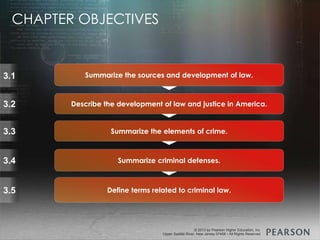
Summarize the sources and development of law.
Describe the development of law and justice in America.
Summarize the elements of crime.
Summarize criminal defenses.
Define terms related to criminal law.
CHAPTER OBJECTIVES
© 2013 by Pearson Higher Education, Inc
Upper Saddle River, New Jersey 07458 • All Rights Reserved
© 2013 by Pearson Higher Education, Inc
Upper Saddle River, New Jersey 07458 • All Rights Reserved
3.6
3.7
3.8
3.9
3.10
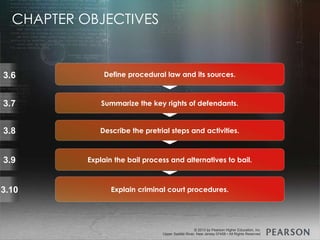
Define procedural law and its sources.
Summarize the key rights of defendants.
Describe the pretrial steps and activities.
Explain the bail process and alternatives to bail.
Explain criminal court procedures.
CHAPTER OBJECTIVES
© 2013 by Pearson Higher Education, Inc
Upper Saddle River, New Jersey 07458 • All Rights Reserved
© 2013 by Pearson Higher Education, Inc
Upper Saddle River, New Jersey 07458 • All Rights Reserved
Summarize the sources and
development of law.
Learning Objectives
After this lecture, you should be able to complete the following Learning Outcomes
3.1
© 2013 by Pearson Higher Education, Inc
Upper Saddle River, New Jersey 07458 • All Rights Reserved
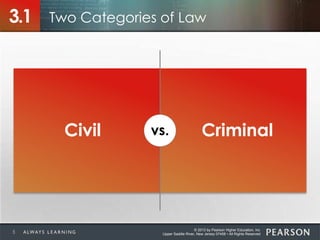
Two Categories of Law3.1
Civil Criminalvs.
5
© 2013 by Pearson Higher Education, Inc
Upper Saddle River, New Jersey 07458 • All Rights Reserved
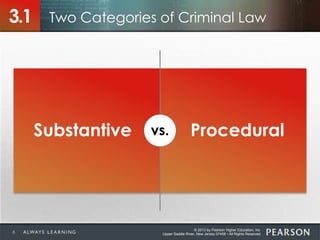
Two Categories of Criminal Law3.1
Substantive Proceduralvs.
6
© 2013 by Pearson Higher Education, Inc
Upper Saddle River, New Jersey 07458 • All Rights Reserved
© 2013 by Pearson Higher Education, Inc
Upper Saddle River, New Jersey 07458 • All Rights Reserved
Describe the development of law
and justice in America.
Learning Objectives
After this lecture, you should be able to complete the following Learning Outcomes
3.2
© 2013 by Pearson Higher Education, Inc
Upper Saddle River, New Jersey 07458 • All Rights Reserved
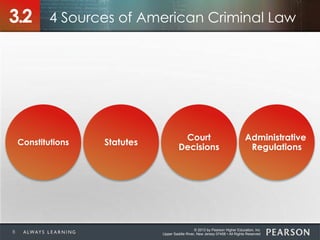
4 Sources of American Criminal Law3.2
Administrative
Regulations
Court
Decisions
StatutesConstitutions
8
© 2013 by Pearson Higher Education, Inc
Upper Saddle River, New Jersey 07458 • All Rights Reserved
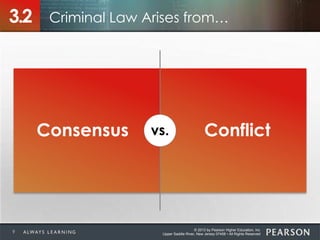
Criminal Law Arises from…3.2
Consensus Conflictvs.
9
© 2013 by Pearson Higher Education, Inc
Upper Saddle River, New Jersey 07458 • All Rights Reserved
3.2
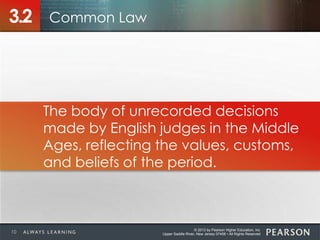
The body of unrecorded decisions
made by English judges in the Middle
Ages, reflecting the values, customs,
and beliefs of the period.
Common Law
10
© 2013 by Pearson Higher Education, Inc
Upper Saddle River, New Jersey 07458 • All Rights Reserved
© 2013 by Pearson Higher Education, Inc
Upper Saddle River, New Jersey 07458 • All Rights Reserved
Summarize the elements of crime.
Learning Objectives
After this lecture, you should be able to complete the following Learning Outcomes
3.3
© 2013 by Pearson Higher Education, Inc
Upper Saddle River, New Jersey 07458 • All Rights Reserved
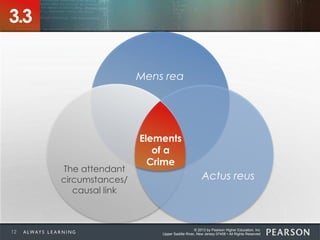
3.3
Elements
of a
Crime
Mens rea
Actus reus
The attendant
circumstances/
causal link
12
© 2013 by Pearson Higher Education, Inc
Upper Saddle River, New Jersey 07458 • All Rights Reserved
© 2013 by Pearson Higher Education, Inc
Upper Saddle River, New Jersey 07458 • All Rights Reserved
Summarize criminal defenses.
Learning Objectives
After this lecture, you should be able to complete the following Learning Outcomes
3.4
© 2013 by Pearson Higher Education, Inc
Upper Saddle River, New Jersey 07458 • All Rights Reserved
Criminal Defenses3.4
Mental
Illness
Competent to stand
trial
Insanity defense
Force
Self-defense
Defense of others
Defense of property
Justification
of Excuse
Duress
Necessity
Mistake of fact
Ignorance of law
Entrapment
14
© 2013 by Pearson Higher Education, Inc
Upper Saddle River, New Jersey 07458 • All Rights Reserved
© 2013 by Pearson Higher Education, Inc
Upper Saddle River, New Jersey 07458 • All Rights Reserved
Define terms related to criminal law.
Learning Objectives
After this lecture, you should be able to complete the following Learning Outcomes
3.5
© 2013 by Pearson Higher Education, Inc
Upper Saddle River, New Jersey 07458 • All Rights Reserved
© 2013 by Pearson Higher Education, Inc
Upper Saddle River, New Jersey 07458 • All Rights Reserved
Define procedural law and its
sources.
Learning Objectives
After this lecture, you should be able to complete the following Learning Outcomes
3.6
© 2013 by Pearson Higher Education, Inc
Upper Saddle River, New Jersey 07458 • All Rights Reserved
© 2013 by Pearson Higher Education, Inc
Upper Saddle River, New Jersey 07458 • All Rights Reserved
Summarize the key rights of
defendants.
Learning Objectives
After this lecture, you should be able to complete the following Learning Outcomes
3.7
© 2013 by Pearson Higher Education, Inc
Upper Saddle River, New Jersey 07458 • All Rights Reserved18
3.7
© 2013 by Pearson Higher Education, Inc
Upper Saddle River, New Jersey 07458 • All Rights Reserved
© 2013 by Pearson Higher Education, Inc
Upper Saddle River, New Jersey 07458 • All Rights Reserved
Describe the pretrial steps and
activities.
Learning Objectives
After this lecture, you should be able to complete the following Learning Outcomes
3.8
© 2013 by Pearson Higher Education, Inc
Upper Saddle River, New Jersey 07458 • All Rights Reserved
Pretrial Steps/Activities3.8
ArrestInvestigationLaw
20
© 2013 by Pearson Higher Education, Inc
Upper Saddle River, New Jersey 07458 • All Rights Reserved
© 2013 by Pearson Higher Education, Inc
Upper Saddle River, New Jersey 07458 • All Rights Reserved
Explain the bail process and
alternatives to bail.
Learning Objectives
After this lecture, you should be able to complete the following Learning Outcomes
3.9
© 2013 by Pearson Higher Education, Inc
Upper Saddle River, New Jersey 07458 • All Rights Reserved
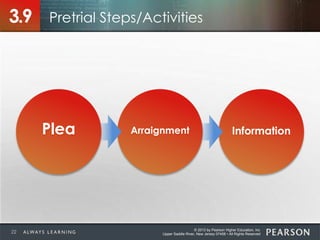
Pretrial Steps/Activities3.9
InformationArraignmentPlea
22
© 2013 by Pearson Higher Education, Inc
Upper Saddle River, New Jersey 07458 • All Rights Reserved
© 2013 by Pearson Higher Education, Inc
Upper Saddle River, New Jersey 07458 • All Rights Reserved
Explain criminal court procedures.
Learning Objectives
After this lecture, you should be able to complete the following Learning Outcomes
3.10
© 2013 by Pearson Higher Education, Inc
Upper Saddle River, New Jersey 07458 • All Rights Reserved
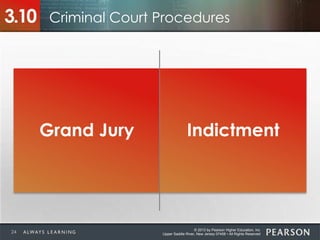
Criminal Court Procedures3.10
Grand Jury Indictment
24
© 2013 by Pearson Higher Education, Inc
Upper Saddle River, New Jersey 07458 • All Rights Reserved
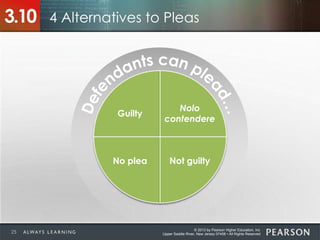
4 Alternatives to Pleas3.10
Guilty
Nolo
contendere
No plea Not guilty
25
© 2013 by Pearson Higher Education, Inc
Upper Saddle River, New Jersey 07458 • All Rights Reserved
Trial Formats3.10
Bench Trial Jury Trialvs.
26
© 2013 by Pearson Higher Education, Inc
Upper Saddle River, New Jersey 07458 • All Rights Reserved
Verdicts3.10
Acquittal Convictionvs.
27
© 2013 by Pearson Higher Education, Inc
Upper Saddle River, New Jersey 07458 • All Rights Reserved
© 2013 by Pearson Higher Education, Inc
Upper Saddle River, New Jersey 07458 • All Rights Reserved
3.1
3.2
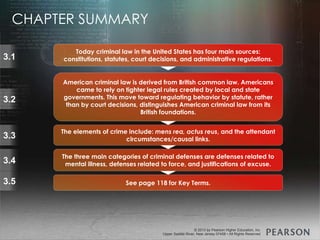
Today criminal law in the United States has four main sources:
constitutions, statutes, court decisions, and administrative regulations.
American criminal law is derived from British common law. Americans
came to rely on tighter legal rules created by local and state
governments. This move toward regulating behavior by statute, rather
than by court decisions, distinguishes American criminal law from its
British foundations.
The elements of crime include: mens rea, actus reus, and the attendant
circumstances/causal links.3.3
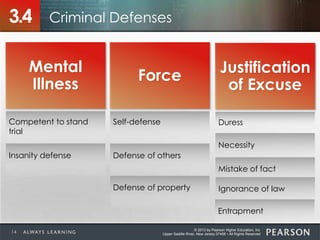
The three main categories of criminal defenses are defenses related to
mental illness, defenses related to force, and justifications of excuse.3.4
See page 118 for Key Terms.3.5
CHAPTER SUMMARY
© 2013 by Pearson Higher Education, Inc
Upper Saddle River, New Jersey 07458 • All Rights Reserved
© 2013 by Pearson Higher Education, Inc
Upper Saddle River, New Jersey 07458 • All Rights Reserved
3.6
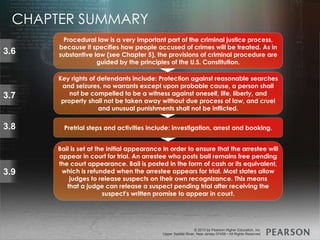
Procedural law is a very important part of the criminal justice process,
because it specifies how people accused of crimes will be treated. As in
substantive law (see Chapter 5), the provisions of criminal procedure are
guided by the principles of the U.S. Constitution.
3.7
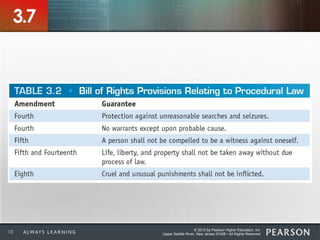
Key rights of defendants include: Protection against reasonable searches
and seizures, no warrants except upon probable cause, a person shall
not be compelled to be a witness against oneself, life, liberty, and
property shall not be taken away without due process of law, and cruel
and unusual punishments shall not be inflicted.
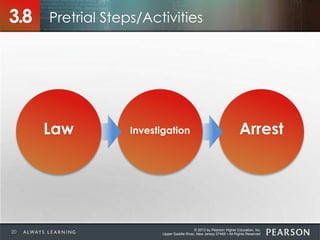
Pretrial steps and activities include: investigation, arrest and booking.3.8
Bail is set at the initial appearance in order to ensure that the arrestee will
appear in court for trial. An arrestee who posts bail remains free pending
the court appearance. Bail is posted in the form of cash or its equivalent,
which is refunded when the arrestee appears for trial. Most states allow
judges to release suspects on their own recognizance. This means
that a judge can release a suspect pending trial after receiving the
suspect's written promise to appear in court.
3.9
CHAPTER SUMMARY
© 2013 by Pearson Higher Education, Inc
Upper Saddle River, New Jersey 07458 • All Rights Reserved
© 2013 by Pearson Higher Education, Inc
Upper Saddle River, New Jersey 07458 • All Rights Reserved
3.10
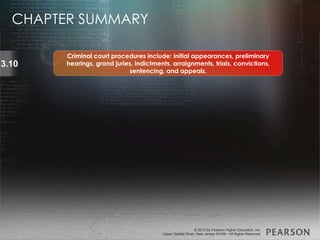
Criminal court procedures include: initial appearances, preliminary
hearings, grand juries, indictments, arraignments, trials, convictions,
sentencing, and appeals.
CHAPTER SUMMARY

Chapter 3.ppt 1

  • 1.
    SOC 3880 –Criminal Justice mbritz@clemson.edu Criminal Justice CHAPTER 3 CRIMINAL LAW AND THE CRIMINAL JUSTICE PROCESS
  • 2.
    © 2013 byPearson Higher Education, Inc Upper Saddle River, New Jersey 07458 • All Rights Reserved © 2013 by Pearson Higher Education, Inc Upper Saddle River, New Jersey 07458 • All Rights Reserved 3.1 3.2 3.3 3.4 3.5 Summarize the sources and development of law. Describe the development of law and justice in America. Summarize the elements of crime. Summarize criminal defenses. Define terms related to criminal law. CHAPTER OBJECTIVES
  • 3.
    © 2013 byPearson Higher Education, Inc Upper Saddle River, New Jersey 07458 • All Rights Reserved © 2013 by Pearson Higher Education, Inc Upper Saddle River, New Jersey 07458 • All Rights Reserved 3.6 3.7 3.8 3.9 3.10 Define procedural law and its sources. Summarize the key rights of defendants. Describe the pretrial steps and activities. Explain the bail process and alternatives to bail. Explain criminal court procedures. CHAPTER OBJECTIVES
  • 4.
    © 2013 byPearson Higher Education, Inc Upper Saddle River, New Jersey 07458 • All Rights Reserved © 2013 by Pearson Higher Education, Inc Upper Saddle River, New Jersey 07458 • All Rights Reserved Summarize the sources and development of law. Learning Objectives After this lecture, you should be able to complete the following Learning Outcomes 3.1
  • 5.
    © 2013 byPearson Higher Education, Inc Upper Saddle River, New Jersey 07458 • All Rights Reserved Two Categories of Law3.1 Civil Criminalvs. 5
  • 6.
    © 2013 byPearson Higher Education, Inc Upper Saddle River, New Jersey 07458 • All Rights Reserved Two Categories of Criminal Law3.1 Substantive Proceduralvs. 6
  • 7.
    © 2013 byPearson Higher Education, Inc Upper Saddle River, New Jersey 07458 • All Rights Reserved © 2013 by Pearson Higher Education, Inc Upper Saddle River, New Jersey 07458 • All Rights Reserved Describe the development of law and justice in America. Learning Objectives After this lecture, you should be able to complete the following Learning Outcomes 3.2
  • 8.
    © 2013 byPearson Higher Education, Inc Upper Saddle River, New Jersey 07458 • All Rights Reserved 4 Sources of American Criminal Law3.2 Administrative Regulations Court Decisions StatutesConstitutions 8
  • 9.
    © 2013 byPearson Higher Education, Inc Upper Saddle River, New Jersey 07458 • All Rights Reserved Criminal Law Arises from…3.2 Consensus Conflictvs. 9
  • 10.
    © 2013 byPearson Higher Education, Inc Upper Saddle River, New Jersey 07458 • All Rights Reserved 3.2 The body of unrecorded decisions made by English judges in the Middle Ages, reflecting the values, customs, and beliefs of the period. Common Law 10
  • 11.
    © 2013 byPearson Higher Education, Inc Upper Saddle River, New Jersey 07458 • All Rights Reserved © 2013 by Pearson Higher Education, Inc Upper Saddle River, New Jersey 07458 • All Rights Reserved Summarize the elements of crime. Learning Objectives After this lecture, you should be able to complete the following Learning Outcomes 3.3
  • 12.
    © 2013 byPearson Higher Education, Inc Upper Saddle River, New Jersey 07458 • All Rights Reserved 3.3 Elements of a Crime Mens rea Actus reus The attendant circumstances/ causal link 12
  • 13.
    © 2013 byPearson Higher Education, Inc Upper Saddle River, New Jersey 07458 • All Rights Reserved © 2013 by Pearson Higher Education, Inc Upper Saddle River, New Jersey 07458 • All Rights Reserved Summarize criminal defenses. Learning Objectives After this lecture, you should be able to complete the following Learning Outcomes 3.4
  • 14.
    © 2013 byPearson Higher Education, Inc Upper Saddle River, New Jersey 07458 • All Rights Reserved Criminal Defenses3.4 Mental Illness Competent to stand trial Insanity defense Force Self-defense Defense of others Defense of property Justification of Excuse Duress Necessity Mistake of fact Ignorance of law Entrapment 14
  • 15.
    © 2013 byPearson Higher Education, Inc Upper Saddle River, New Jersey 07458 • All Rights Reserved © 2013 by Pearson Higher Education, Inc Upper Saddle River, New Jersey 07458 • All Rights Reserved Define terms related to criminal law. Learning Objectives After this lecture, you should be able to complete the following Learning Outcomes 3.5
  • 16.
    © 2013 byPearson Higher Education, Inc Upper Saddle River, New Jersey 07458 • All Rights Reserved © 2013 by Pearson Higher Education, Inc Upper Saddle River, New Jersey 07458 • All Rights Reserved Define procedural law and its sources. Learning Objectives After this lecture, you should be able to complete the following Learning Outcomes 3.6
  • 17.
    © 2013 byPearson Higher Education, Inc Upper Saddle River, New Jersey 07458 • All Rights Reserved © 2013 by Pearson Higher Education, Inc Upper Saddle River, New Jersey 07458 • All Rights Reserved Summarize the key rights of defendants. Learning Objectives After this lecture, you should be able to complete the following Learning Outcomes 3.7
  • 18.
    © 2013 byPearson Higher Education, Inc Upper Saddle River, New Jersey 07458 • All Rights Reserved18 3.7
  • 19.
    © 2013 byPearson Higher Education, Inc Upper Saddle River, New Jersey 07458 • All Rights Reserved © 2013 by Pearson Higher Education, Inc Upper Saddle River, New Jersey 07458 • All Rights Reserved Describe the pretrial steps and activities. Learning Objectives After this lecture, you should be able to complete the following Learning Outcomes 3.8
  • 20.
    © 2013 byPearson Higher Education, Inc Upper Saddle River, New Jersey 07458 • All Rights Reserved Pretrial Steps/Activities3.8 ArrestInvestigationLaw 20
  • 21.
    © 2013 byPearson Higher Education, Inc Upper Saddle River, New Jersey 07458 • All Rights Reserved © 2013 by Pearson Higher Education, Inc Upper Saddle River, New Jersey 07458 • All Rights Reserved Explain the bail process and alternatives to bail. Learning Objectives After this lecture, you should be able to complete the following Learning Outcomes 3.9
  • 22.
    © 2013 byPearson Higher Education, Inc Upper Saddle River, New Jersey 07458 • All Rights Reserved Pretrial Steps/Activities3.9 InformationArraignmentPlea 22
  • 23.
    © 2013 byPearson Higher Education, Inc Upper Saddle River, New Jersey 07458 • All Rights Reserved © 2013 by Pearson Higher Education, Inc Upper Saddle River, New Jersey 07458 • All Rights Reserved Explain criminal court procedures. Learning Objectives After this lecture, you should be able to complete the following Learning Outcomes 3.10
  • 24.
    © 2013 byPearson Higher Education, Inc Upper Saddle River, New Jersey 07458 • All Rights Reserved Criminal Court Procedures3.10 Grand Jury Indictment 24
  • 25.
    © 2013 byPearson Higher Education, Inc Upper Saddle River, New Jersey 07458 • All Rights Reserved 4 Alternatives to Pleas3.10 Guilty Nolo contendere No plea Not guilty 25
  • 26.
    © 2013 byPearson Higher Education, Inc Upper Saddle River, New Jersey 07458 • All Rights Reserved Trial Formats3.10 Bench Trial Jury Trialvs. 26
  • 27.
    © 2013 byPearson Higher Education, Inc Upper Saddle River, New Jersey 07458 • All Rights Reserved Verdicts3.10 Acquittal Convictionvs. 27
  • 28.
    © 2013 byPearson Higher Education, Inc Upper Saddle River, New Jersey 07458 • All Rights Reserved © 2013 by Pearson Higher Education, Inc Upper Saddle River, New Jersey 07458 • All Rights Reserved 3.1 3.2 Today criminal law in the United States has four main sources: constitutions, statutes, court decisions, and administrative regulations. American criminal law is derived from British common law. Americans came to rely on tighter legal rules created by local and state governments. This move toward regulating behavior by statute, rather than by court decisions, distinguishes American criminal law from its British foundations. The elements of crime include: mens rea, actus reus, and the attendant circumstances/causal links.3.3 The three main categories of criminal defenses are defenses related to mental illness, defenses related to force, and justifications of excuse.3.4 See page 118 for Key Terms.3.5 CHAPTER SUMMARY
  • 29.
    © 2013 byPearson Higher Education, Inc Upper Saddle River, New Jersey 07458 • All Rights Reserved © 2013 by Pearson Higher Education, Inc Upper Saddle River, New Jersey 07458 • All Rights Reserved 3.6 Procedural law is a very important part of the criminal justice process, because it specifies how people accused of crimes will be treated. As in substantive law (see Chapter 5), the provisions of criminal procedure are guided by the principles of the U.S. Constitution. 3.7 Key rights of defendants include: Protection against reasonable searches and seizures, no warrants except upon probable cause, a person shall not be compelled to be a witness against oneself, life, liberty, and property shall not be taken away without due process of law, and cruel and unusual punishments shall not be inflicted. Pretrial steps and activities include: investigation, arrest and booking.3.8 Bail is set at the initial appearance in order to ensure that the arrestee will appear in court for trial. An arrestee who posts bail remains free pending the court appearance. Bail is posted in the form of cash or its equivalent, which is refunded when the arrestee appears for trial. Most states allow judges to release suspects on their own recognizance. This means that a judge can release a suspect pending trial after receiving the suspect's written promise to appear in court. 3.9 CHAPTER SUMMARY
  • 30.
    © 2013 byPearson Higher Education, Inc Upper Saddle River, New Jersey 07458 • All Rights Reserved © 2013 by Pearson Higher Education, Inc Upper Saddle River, New Jersey 07458 • All Rights Reserved 3.10 Criminal court procedures include: initial appearances, preliminary hearings, grand juries, indictments, arraignments, trials, convictions, sentencing, and appeals. CHAPTER SUMMARY