The Courts and Judicial Branch
Question?What is the Supreme Court?
Article III of the ConstitutionSpecifically creates only the Supreme CourtGives Congress the power to create lower federal courts or “inferior courts”Provides guidelines of the terms of office and compensation of federal judges.Justices serve for the rest of their life or as long as they practice “good behavior.”
Different courtsSupreme CourtLower federal courts State courtsState and Federal courts create a dual court system.
Define: JurisdictionThe right to interpret and apply the law; a courts range of authority. According to Article III, Section 2Federal courts jurisdiction allows them to try cases involving:Ambassadors or other representative of foreign governmentsMaritime law (the law of the sea)Bankruptcy casesTwo or more state governments Citizens of different states A state and a citizen of a different or foreign countryCitizens of the same state claiming lands under grants of different states U.S. laws and treaties, or the interpretation of the Constitution
Define: Exclusive JurisdictionThe authority of the federal courts alone to hear and rule in certain casesDefine: Concurrent JurisdictionThe authority to hear cases shared by federal and state courtsWhich Court?Federal criminal law is broken but not a state one?Federal courtA dispute between two state governments? The Supreme CourtCases involving the interpretation of an act of Congress?Federal courtDisputes involving citizens of different states?Either state or federal courtCrime that breaks both state and federal law?Either state or federal court
Define: Dual Sovereignty5th Amendment of the ConstitutionProhibits double jeopardySame action violates both state and federal lawDefine: Original JurisdictionThe court’s authority to hear and decide a case for the first time. Define: Appellate Jurisdiction The court’s authority to hear cases on appeal. Types of LawBoth federal and state courts deal with civil law, criminal law, and constitutional law. Define: Civil LawThe type of law dealing with the rights and relationships of private citizens. Define: Criminal LawThe type of law dealing with crimes and providing for their punishment.Define: Constitutional LawThe type of law relating to the interpretation of the Constitution.
Define: Judicial reviewThe power of the courts to establish the constitutionality of national, state, or local acts of government. Define: Strict ConstructionistThe view that judges ought to base their decisions on a narrow interpretation of the language of the ConstitutionDefine: Loose ConstructionistThe view that judges have considerable freedom in interpreting the constitution How did we get it?John Marshall served from 1801 to 1835The debate!Thomas Jefferson – Strict Alexander Hamilton – Loose Marbury v. Madison (1803)Marshall sided with the Loose Constitutional lawMarshall: “An act of the legislature repugnant to the Constitution is void” and “it is emphatically the province of the judicial department to say what the law is”
Constitutional CourtsThe District Court The Courts of Appeal The Courts of International Trade
The District Courts94 district courtsEach district court has 2 to 28 judgesAll courts of original jurisdiction No AppealsExcept: they may take appeals from state courts if constitutional questions are involved Hear both criminal and civil cases
Courts of Appeals 13 Courts of appeal 12 judicial circuits Never original jurisdiction 3 judges on most caseMore on big cases Majority vote 1 Court of appeals for the Federal Circuit Hears cases from the legislative courts And some cases from district courts Cases can then be taken to the Supreme Court
The Court of international tradeCivil cases regarding tariffs and tradeBased in New York CityCases are also heard in other major port cities
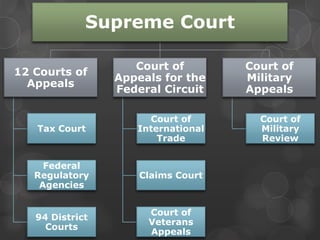
Supreme CourtThe Federal Court System12 Courts of AppealsCourt of Appeals for the Federal CircuitCourt of Military AppealsTax CourtCourt of International TradeCourt of Military ReviewFederal Regulatory AgenciesClaims Court94 District CourtsCourt of Veterans Appeals
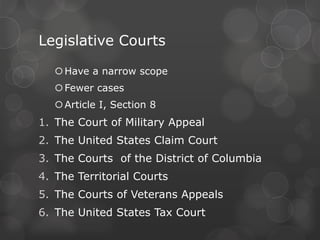
Legislative CourtsHave a narrow scopeFewer cases Article I, Section 8The Court of Military Appeal The United States Claim CourtThe Courts  of the District of ColumbiaThe Territorial CourtsThe Courts of Veterans AppealsThe United States Tax Court
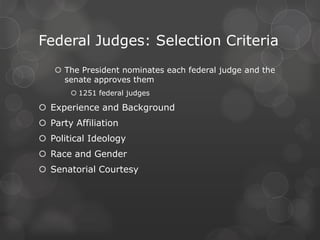
Federal Judges: Selection CriteriaThe President nominates each federal judge and the senate approves them 1251 federal judgesExperience and Background Party Affiliation Political IdeologyRace and GenderSenatorial Courtesy
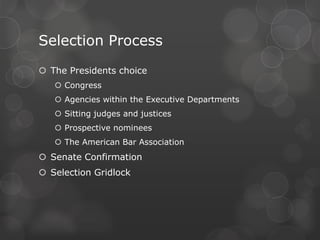
Selection ProcessThe Presidents choice CongressAgencies within the Executive Departments Sitting judges and justicesProspective nomineesThe American Bar Association Senate ConfirmationSelection Gridlock
The Supreme Court
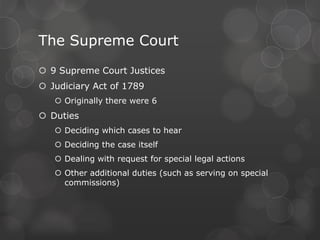
The Supreme Court9 Supreme Court Justices Judiciary Act of 1789Originally there were 6DutiesDeciding which cases to hearDeciding the case itself Dealing with request for special legal actions Other additional duties (such as serving on special commissions)
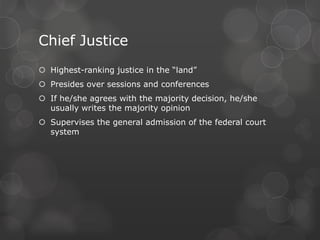
Chief JusticeHighest-ranking justice in the “land”Presides over sessions and conferencesIf he/she agrees with the majority decision, he/she usually writes the majority opinionSupervises the general admission of the federal court system
The Supreme Court at WorkChoosing The Case Hearing the CaseDeciding the CaseImplementing Decisions
Choosing the Case7,738 Case Submitted in the 2008-2009 term First Monday in OctoberThe justices sort through the petitions The Supreme Court does not have to hear any appeals that they do not want to consider. About 90% come from the writ of certiorariCase that the lower courts “mishandled”They never explain why the pic the case they do
Three Important FactorsWhether the legal question has bee decided differently by two lower-courts.If a lower-court decision conflicts with an existing Supreme Court ruling.If the issue could have significance beyond the two parties in the case.
Choosing the Case (continued)After reading through all of the cases they vote one by one out loudStarting with the chief justice and moving down in seniorityIf a minimum of 4 justices vote to accept it then they will hear that caseThe most junior justice takes notes on the decisions.
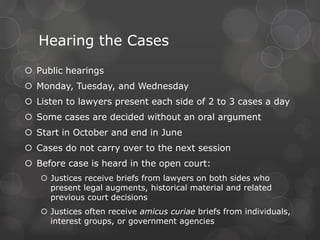
Hearing the CasesPublic hearingsMonday, Tuesday, and WednesdayListen to lawyers present each side of 2 to 3 cases a daySome cases are decided without an oral argumentStart in October and end in JuneCases do not carry over to the next session Before case is heard in the open court:Justices receive briefs from lawyers on both sides who present legal augments, historical material and related previous court decisions Justices often receive amicus curiae briefs from individuals, interest groups, or government agencies
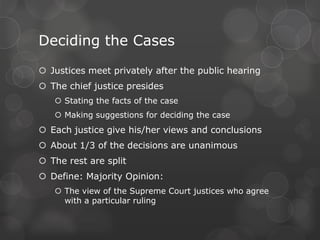
Deciding the CasesJustices meet privately after the public hearingThe chief justice presidesStating the facts of the caseMaking suggestions for deciding the caseEach justice give his/her views and conclusionsAbout 1/3 of the decisions are unanimous The rest are splitDefine: Majority Opinion:The view of the Supreme Court justices who agree with a particular ruling
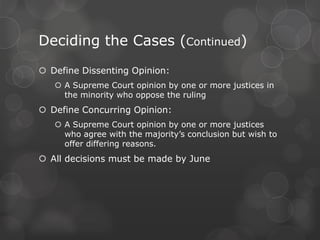
Deciding the Cases (Continued)Define Dissenting Opinion: A Supreme Court opinion by one or more justices in the minority who oppose the rulingDefine Concurring Opinion:A Supreme Court opinion by one or more justices who agree with the majority’s conclusion but wish to offer differing reasons. All decisions must be made by June
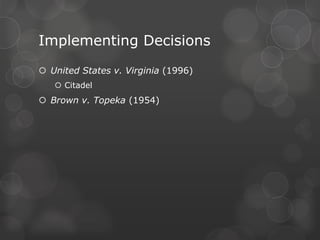
Implementing DecisionsUnited States v. Virginia (1996)CitadelBrown v. Topeka (1954)
Policy-Making Power of the Supreme Court
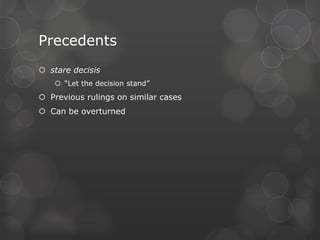
Precedentsstare decisis“Let the decision stand”Previous rulings on similar cases Can be overturned
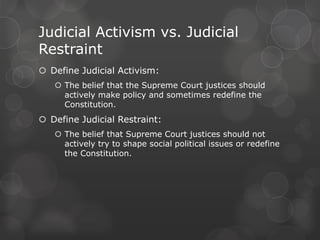
Judicial Activism vs. Judicial RestraintDefine Judicial Activism:The belief that the Supreme Court justices should actively make policy and sometimes redefine the Constitution.Define Judicial Restraint:The belief that Supreme Court justices should not actively try to shape social political issues or redefine the Constitution.
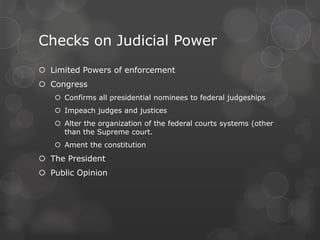
Checks on Judicial PowerLimited Powers of enforcement CongressConfirms all presidential nominees to federal judgeshipsImpeach judges and justicesAlter the organization of the federal courts systems (other than the Supreme court.Ament the constitution The PresidentPublic Opinion
The EndFor today…
American Government: A Complete Coursebook - Chapter 13

American Government: A Complete Coursebook - Chapter 13

  • 1.
    The Courts andJudicial Branch
  • 2.
    Question?What is theSupreme Court?
  • 3.
    Article III ofthe ConstitutionSpecifically creates only the Supreme CourtGives Congress the power to create lower federal courts or “inferior courts”Provides guidelines of the terms of office and compensation of federal judges.Justices serve for the rest of their life or as long as they practice “good behavior.”
  • 4.
    Different courtsSupreme CourtLowerfederal courts State courtsState and Federal courts create a dual court system.
  • 5.
    Define: JurisdictionThe rightto interpret and apply the law; a courts range of authority. According to Article III, Section 2Federal courts jurisdiction allows them to try cases involving:Ambassadors or other representative of foreign governmentsMaritime law (the law of the sea)Bankruptcy casesTwo or more state governments Citizens of different states A state and a citizen of a different or foreign countryCitizens of the same state claiming lands under grants of different states U.S. laws and treaties, or the interpretation of the Constitution
  • 6.
    Define: Exclusive JurisdictionTheauthority of the federal courts alone to hear and rule in certain casesDefine: Concurrent JurisdictionThe authority to hear cases shared by federal and state courtsWhich Court?Federal criminal law is broken but not a state one?Federal courtA dispute between two state governments? The Supreme CourtCases involving the interpretation of an act of Congress?Federal courtDisputes involving citizens of different states?Either state or federal courtCrime that breaks both state and federal law?Either state or federal court
  • 7.
    Define: Dual Sovereignty5thAmendment of the ConstitutionProhibits double jeopardySame action violates both state and federal lawDefine: Original JurisdictionThe court’s authority to hear and decide a case for the first time. Define: Appellate Jurisdiction The court’s authority to hear cases on appeal. Types of LawBoth federal and state courts deal with civil law, criminal law, and constitutional law. Define: Civil LawThe type of law dealing with the rights and relationships of private citizens. Define: Criminal LawThe type of law dealing with crimes and providing for their punishment.Define: Constitutional LawThe type of law relating to the interpretation of the Constitution.
  • 8.
    Define: Judicial reviewThepower of the courts to establish the constitutionality of national, state, or local acts of government. Define: Strict ConstructionistThe view that judges ought to base their decisions on a narrow interpretation of the language of the ConstitutionDefine: Loose ConstructionistThe view that judges have considerable freedom in interpreting the constitution How did we get it?John Marshall served from 1801 to 1835The debate!Thomas Jefferson – Strict Alexander Hamilton – Loose Marbury v. Madison (1803)Marshall sided with the Loose Constitutional lawMarshall: “An act of the legislature repugnant to the Constitution is void” and “it is emphatically the province of the judicial department to say what the law is”
  • 9.
    Constitutional CourtsThe DistrictCourt The Courts of Appeal The Courts of International Trade
  • 10.
    The District Courts94district courtsEach district court has 2 to 28 judgesAll courts of original jurisdiction No AppealsExcept: they may take appeals from state courts if constitutional questions are involved Hear both criminal and civil cases
  • 11.
    Courts of Appeals13 Courts of appeal 12 judicial circuits Never original jurisdiction 3 judges on most caseMore on big cases Majority vote 1 Court of appeals for the Federal Circuit Hears cases from the legislative courts And some cases from district courts Cases can then be taken to the Supreme Court
  • 12.
    The Court ofinternational tradeCivil cases regarding tariffs and tradeBased in New York CityCases are also heard in other major port cities
  • 13.
    Supreme CourtThe FederalCourt System12 Courts of AppealsCourt of Appeals for the Federal CircuitCourt of Military AppealsTax CourtCourt of International TradeCourt of Military ReviewFederal Regulatory AgenciesClaims Court94 District CourtsCourt of Veterans Appeals
  • 14.
    Legislative CourtsHave anarrow scopeFewer cases Article I, Section 8The Court of Military Appeal The United States Claim CourtThe Courts of the District of ColumbiaThe Territorial CourtsThe Courts of Veterans AppealsThe United States Tax Court
  • 16.
    Federal Judges: SelectionCriteriaThe President nominates each federal judge and the senate approves them 1251 federal judgesExperience and Background Party Affiliation Political IdeologyRace and GenderSenatorial Courtesy
  • 17.
    Selection ProcessThe Presidentschoice CongressAgencies within the Executive Departments Sitting judges and justicesProspective nomineesThe American Bar Association Senate ConfirmationSelection Gridlock
  • 18.
  • 19.
    The Supreme Court9Supreme Court Justices Judiciary Act of 1789Originally there were 6DutiesDeciding which cases to hearDeciding the case itself Dealing with request for special legal actions Other additional duties (such as serving on special commissions)
  • 20.
    Chief JusticeHighest-ranking justicein the “land”Presides over sessions and conferencesIf he/she agrees with the majority decision, he/she usually writes the majority opinionSupervises the general admission of the federal court system
  • 22.
    The Supreme Courtat WorkChoosing The Case Hearing the CaseDeciding the CaseImplementing Decisions
  • 23.
    Choosing the Case7,738Case Submitted in the 2008-2009 term First Monday in OctoberThe justices sort through the petitions The Supreme Court does not have to hear any appeals that they do not want to consider. About 90% come from the writ of certiorariCase that the lower courts “mishandled”They never explain why the pic the case they do
  • 24.
    Three Important FactorsWhetherthe legal question has bee decided differently by two lower-courts.If a lower-court decision conflicts with an existing Supreme Court ruling.If the issue could have significance beyond the two parties in the case.
  • 25.
    Choosing the Case(continued)After reading through all of the cases they vote one by one out loudStarting with the chief justice and moving down in seniorityIf a minimum of 4 justices vote to accept it then they will hear that caseThe most junior justice takes notes on the decisions.
  • 26.
    Hearing the CasesPublichearingsMonday, Tuesday, and WednesdayListen to lawyers present each side of 2 to 3 cases a daySome cases are decided without an oral argumentStart in October and end in JuneCases do not carry over to the next session Before case is heard in the open court:Justices receive briefs from lawyers on both sides who present legal augments, historical material and related previous court decisions Justices often receive amicus curiae briefs from individuals, interest groups, or government agencies
  • 27.
    Deciding the CasesJusticesmeet privately after the public hearingThe chief justice presidesStating the facts of the caseMaking suggestions for deciding the caseEach justice give his/her views and conclusionsAbout 1/3 of the decisions are unanimous The rest are splitDefine: Majority Opinion:The view of the Supreme Court justices who agree with a particular ruling
  • 28.
    Deciding the Cases(Continued)Define Dissenting Opinion: A Supreme Court opinion by one or more justices in the minority who oppose the rulingDefine Concurring Opinion:A Supreme Court opinion by one or more justices who agree with the majority’s conclusion but wish to offer differing reasons. All decisions must be made by June
  • 29.
    Implementing DecisionsUnited Statesv. Virginia (1996)CitadelBrown v. Topeka (1954)
  • 30.
    Policy-Making Power ofthe Supreme Court
  • 31.
    Precedentsstare decisis“Let thedecision stand”Previous rulings on similar cases Can be overturned
  • 32.
    Judicial Activism vs.Judicial RestraintDefine Judicial Activism:The belief that the Supreme Court justices should actively make policy and sometimes redefine the Constitution.Define Judicial Restraint:The belief that Supreme Court justices should not actively try to shape social political issues or redefine the Constitution.
  • 33.
    Checks on JudicialPowerLimited Powers of enforcement CongressConfirms all presidential nominees to federal judgeshipsImpeach judges and justicesAlter the organization of the federal courts systems (other than the Supreme court.Ament the constitution The PresidentPublic Opinion
  • 34.