Risk
Assessment
Score
ILAAP
Internal Target
ECB in the starting block for SREP review
The Supervisory Review and Evaluation Process (SREP) is a wide risk assessment of the bank business
model, governance, capital and liquidity performed by the European Central Bank (ECB) starting end
of 2015
SREP quantitative assessment will be based on banks regulatory reportings (COREP, FINREP, STE, …),
whereas qualitative assessment will be performed through the supervisory dialog
Final objectives of the supervisor are to quantify Pillar II capital and liquidity extra requirements and
to start building benchmarks for banks under its supervision
Supervisory Review and Evaluation Process
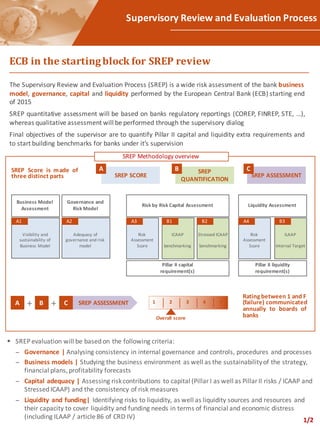
SREP Score is made of
three distinct parts
1 2 3 4 F
SREP SCORE
SREP
QUANTIFICATION
SREP ASSESSMENT
A B C
Business Model
Assessment
Governance and
Risk Model
Risk by Risk Capital Assessment Liquidity Assessment
Visibility and
sustainability of
Business Model
Adequacy of
governance and risk
model
ICAAP
benchmarking
Stressed ICAAP
benchmarking
Risk
Assessment
Score
Pillar II capital
requirement(s)
Pillar II liquidity
requirement(s)
A1 A2 A3 B1 B2 A4 B3
B SREP ASSESSMENT
Rating between 1 and F
(failure) communicated
annually to boards of
banks
A C+ +
Overall score
 SREP evaluation will be based on the following criteria:
 Governance | Analysing consistency in internal governance and controls, procedures and processes
 Business models | Studying the business environment as well as the sustainability of the strategy,
financial plans, profitability forecasts
 Capital adequacy | Assessing risk contributions to capital (Pillar I as well as Pillar II risks / ICAAP and
Stressed ICAAP) and the consistency of risk measures
 Liquidity and funding| Identifying risks to liquidity, as well as liquidity sources and resources and
their capacity to cover liquidity and funding needs in terms of financial and economic distress
(including ILAAP / article 86 of CRD IV) 1/2
SREP Methodology overview
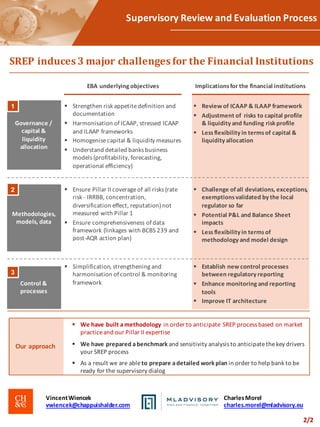
Governance /
capital &
liquidity
allocation
Methodologies,
models, data
EBA underlying objectives Implications for financial institutions
Control &
processes
 Strengthen risk appetite definition and
documentation
 Harmonisation of ICAAP, stressed ICAAP
and ILAAP frameworks
 Homogenise capital & liquidity measures
 Understand detailed banks business
models (profitability, forecasting,
operational efficiency)
 Ensure Pillar II coverage of all risks (rate
risk - IRRBB, concentration,
diversification effect, reputation) not
measured with Pillar 1
 Ensure comprehensiveness of data
framework (linkages with BCBS 239 and
post-AQR action plan)
 Simplification, strengthening and
harmonisation of control & monitoring
framework
 Review of ICAAP & ILAAP framework
 Adjustment of risks to capital profile
& liquidity and funding risk profile
 Less flexibility in terms of capital &
liquidity allocation
 Challenge of all deviations, exceptions,
exemptions validated by the local
regulator so far
 Potential P&L and Balance Sheet
impacts
 Less flexibility in terms of
methodology and model design
 Establish new control processes
between regulatory reporting
 Enhance monitoring and reporting
tools
 Improve IT architecture
1
2
3
2/2
Supervisory Review and Evaluation Process
Vincent Wiencek
vwiencek@chappuishalder.com
Charles Morel
charles.morel@mladvisory.eu
SREP induces 3 major challenges for Financial Institutions
Our approach
 We have built a methodology in order to anticipate SREP process based on market
practice and our Pillar II expertise
 We have prepared a benchmark and sensitivity analyses to anticipate the key
drivers of your SREP process
 As a result we are able to prepare a detailed work plan in order to help banks to be
ready for the supervisory dialog

Supervisory Review and Evaluation Process - ECB in the starting block for SREP review

  • 1.
    Risk Assessment Score ILAAP Internal Target ECB inthe starting block for SREP review The Supervisory Review and Evaluation Process (SREP) is a wide risk assessment of the bank business model, governance, capital and liquidity performed by the European Central Bank (ECB) starting end of 2015 SREP quantitative assessment will be based on banks regulatory reportings (COREP, FINREP, STE, …), whereas qualitative assessment will be performed through the supervisory dialog Final objectives of the supervisor are to quantify Pillar II capital and liquidity extra requirements and to start building benchmarks for banks under its supervision Supervisory Review and Evaluation Process SREP Score is made of three distinct parts 1 2 3 4 F SREP SCORE SREP QUANTIFICATION SREP ASSESSMENT A B C Business Model Assessment Governance and Risk Model Risk by Risk Capital Assessment Liquidity Assessment Visibility and sustainability of Business Model Adequacy of governance and risk model ICAAP benchmarking Stressed ICAAP benchmarking Risk Assessment Score Pillar II capital requirement(s) Pillar II liquidity requirement(s) A1 A2 A3 B1 B2 A4 B3 B SREP ASSESSMENT Rating between 1 and F (failure) communicated annually to boards of banks A C+ + Overall score  SREP evaluation will be based on the following criteria:  Governance | Analysing consistency in internal governance and controls, procedures and processes  Business models | Studying the business environment as well as the sustainability of the strategy, financial plans, profitability forecasts  Capital adequacy | Assessing risk contributions to capital (Pillar I as well as Pillar II risks / ICAAP and Stressed ICAAP) and the consistency of risk measures  Liquidity and funding| Identifying risks to liquidity, as well as liquidity sources and resources and their capacity to cover liquidity and funding needs in terms of financial and economic distress (including ILAAP / article 86 of CRD IV) 1/2 SREP Methodology overview
  • 2.
    Governance / capital & liquidity allocation Methodologies, models,data EBA underlying objectives Implications for financial institutions Control & processes  Strengthen risk appetite definition and documentation  Harmonisation of ICAAP, stressed ICAAP and ILAAP frameworks  Homogenise capital & liquidity measures  Understand detailed banks business models (profitability, forecasting, operational efficiency)  Ensure Pillar II coverage of all risks (rate risk - IRRBB, concentration, diversification effect, reputation) not measured with Pillar 1  Ensure comprehensiveness of data framework (linkages with BCBS 239 and post-AQR action plan)  Simplification, strengthening and harmonisation of control & monitoring framework  Review of ICAAP & ILAAP framework  Adjustment of risks to capital profile & liquidity and funding risk profile  Less flexibility in terms of capital & liquidity allocation  Challenge of all deviations, exceptions, exemptions validated by the local regulator so far  Potential P&L and Balance Sheet impacts  Less flexibility in terms of methodology and model design  Establish new control processes between regulatory reporting  Enhance monitoring and reporting tools  Improve IT architecture 1 2 3 2/2 Supervisory Review and Evaluation Process Vincent Wiencek vwiencek@chappuishalder.com Charles Morel charles.morel@mladvisory.eu SREP induces 3 major challenges for Financial Institutions Our approach  We have built a methodology in order to anticipate SREP process based on market practice and our Pillar II expertise  We have prepared a benchmark and sensitivity analyses to anticipate the key drivers of your SREP process  As a result we are able to prepare a detailed work plan in order to help banks to be ready for the supervisory dialog