
(Year 2009-2011)
Professor Dr. Mahmood Osman Imam
Course
Instructor
(F-503)
Department
of Finance
University of
Dhaka
Banking Sector of Bangladesh
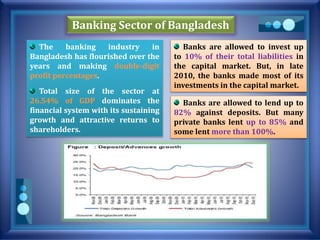
Banks are allowed to lend up to
82% against deposits. But many
private banks lent up to 85% and
some lent more than 100%.
The banking industry in
Bangladesh has flourished over the
years and making double-digit
profit percentages.
Total size of the sector at
26.54% of GDP dominates the
financial system with its sustaining
growth and attractive returns to
shareholders.
Banks are allowed to invest up
to 10% of their total liabilities in
the capital market. But, in late
2010, the banks made most of its
investments in the capital market.
Banking Sector of Bangladesh
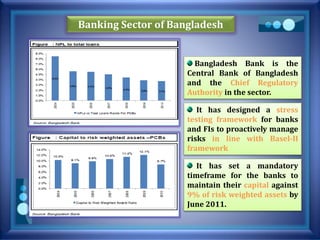
It has set a mandatory
timeframe for the banks to
maintain their capital against
9% of risk weighted assets by
June 2011.
It has designed a stress
testing framework for banks
and FIs to proactively manage
risks in line with Basel-II
framework
Bangladesh Bank is the
Central Bank of Bangladesh
and the Chief Regulatory
Authority in the sector.
Stress Testing
At institutional level, stress testing techniques provide a way to
quantify the impact of changes in a number of risk factors on the
assets and liabilities portfolio of the institution.
It provides an indication how much Capital Adequacy Ratio
(CAR) might be needed to absorb losses if any large shocks occur.
It is mandatory for all banks and FIs to carry out stress testing on
half-yearly basis i.e. on June 30 and December 31 each year and
reporting the results to Bangladesh Bank.
Prime Bank Limited
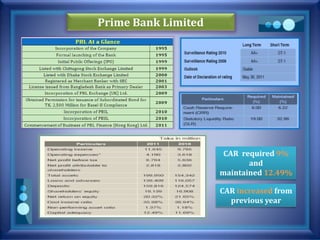
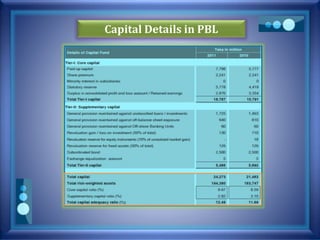
CAR required 9%
and
maintained 12.49%
CAR increased from
previous year
Capital Details in PBL
Stress Testing in PBL
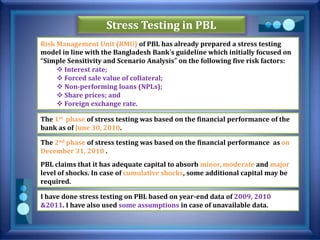
Risk Management Unit (RMU) of PBL has already prepared a stress testing
model in line with the Bangladesh Bank’s guideline which initially focused on
“Simple Sensitivity and Scenario Analysis” on the following five risk factors:
 Interest rate;
 Forced sale value of collateral;
 Non-performing loans (NPLs);
 Share prices; and
 Foreign exchange rate.
The 1st phase of stress testing was based on the financial performance of the
bank as of June 30, 2010.
The 2nd phase of stress testing was based on the financial performance as on
December 31, 2010 .
PBL claims that it has adequate capital to absorb minor, moderate and major
level of shocks. In case of cumulative shocks, some additional capital may be
required.
I have done stress testing on PBL based on year-end data of 2009, 2010
&2011. I have also used some assumptions in case of unavailable data.
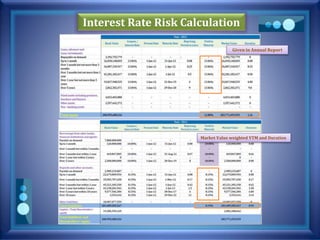
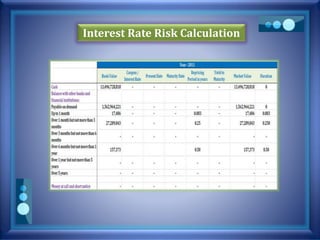
Interest Rate Risk Calculation
Current market rate PV (rate, nper, pmt, [fv] )
DURATION (settlement, maturity, coupon,
yield, frequency)
Settlement date = Present date
Maturity date = Settlement Date + Repricing Period
Assumption
Excel File
Interest Rate Risk Calculation
Given in Annual Report
Market Value weighted YTM and Duration
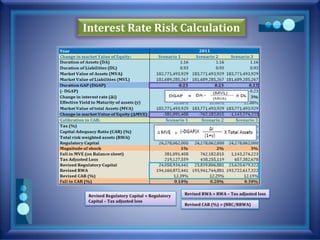
Interest Rate Risk Calculation
Revised Regulatory Capital = Regulatory
Capital – Tax adjusted loss
Revised RWA = RWA – Tax adjusted loss
Revised CAR (%) = (RRC/RRWA)
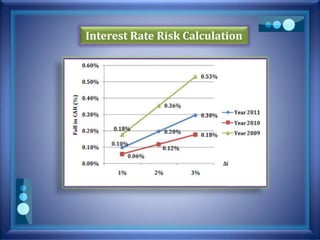
Interest Rate Risk Calculation
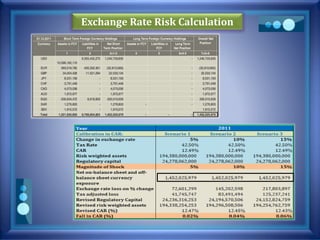
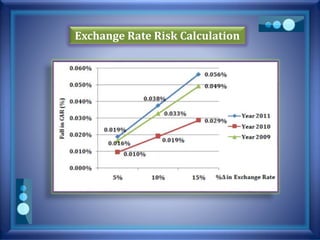
Exchange Rate Risk Calculation
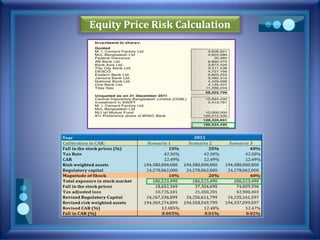
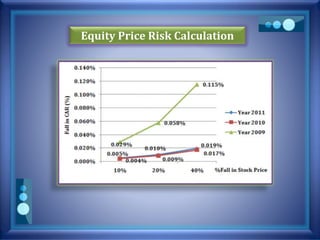
Equity Price Risk Calculation
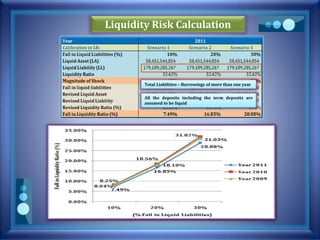
Liquidity Risk Calculation
Total Liabilities – Borrowings of more than one year
All the deposits including the term deposits are
assumed to be liquid
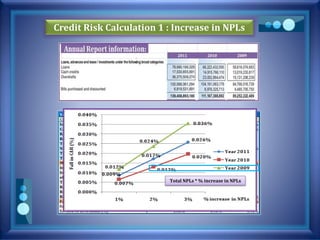
Credit Risk Calculation 1 : Increase in NPLs
Total NPLs * % increase in NPLs
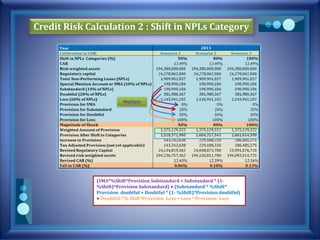
Credit Risk Calculation 2 : Shift in NPLs Category
Multiply
(SMA*%Shift*Provision Substandard + Substandard * (1-
%Shift)*Provision Substandard) + (Substandard * %Shift*
Provision doubtful + Doubtful * (1- %Shift)*Provision doubtful)
+ Doubtful *% Shift*Provision Loss + Loss * Provision Loss
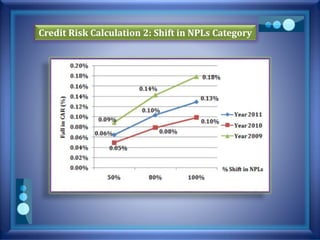
Credit Risk Calculation 2: Shift in NPLs Category
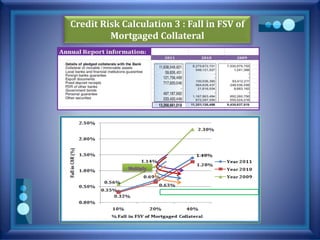
Credit Risk Calculation 3 : Fall in FSV of
Mortgaged Collateral
Multiply
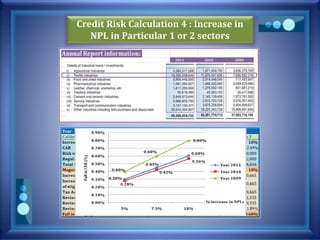
Credit Risk Calculation 4 : Increase in
NPL in Particular 1 or 2 sectors
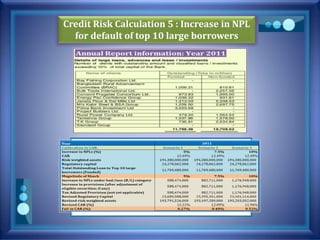
Credit Risk Calculation 5 : Increase in NPL
for default of top 10 large borrowers
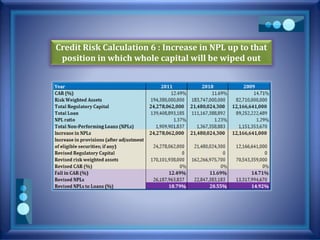
Credit Risk Calculation 6 : Increase in NPL up to that
position in which whole capital will be wiped out
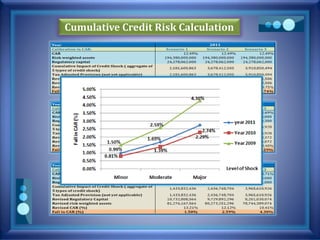
Cumulative Credit Risk Calculation
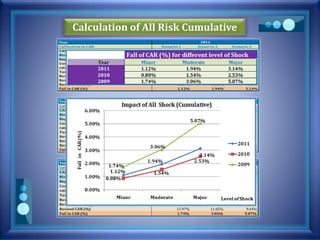
Calculation of All Risk Cumulative
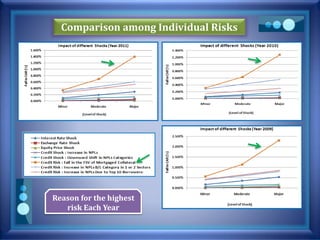
Comparison among Individual Risks
Reason for the highest
risk Each Year
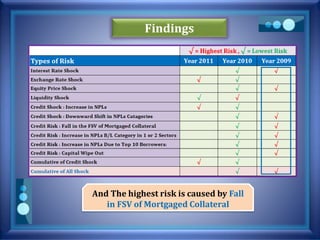
Findings
And The highest risk is caused by Fall
in FSV of Mortgaged Collateral
Pubali Bank Limited stress testing

Pubali Bank Limited stress testing

  • 2.
  • 3.
    Professor Dr. MahmoodOsman Imam Course Instructor (F-503) Department of Finance University of Dhaka
  • 4.
    Banking Sector ofBangladesh Banks are allowed to lend up to 82% against deposits. But many private banks lent up to 85% and some lent more than 100%. The banking industry in Bangladesh has flourished over the years and making double-digit profit percentages. Total size of the sector at 26.54% of GDP dominates the financial system with its sustaining growth and attractive returns to shareholders. Banks are allowed to invest up to 10% of their total liabilities in the capital market. But, in late 2010, the banks made most of its investments in the capital market.
  • 5.
    Banking Sector ofBangladesh It has set a mandatory timeframe for the banks to maintain their capital against 9% of risk weighted assets by June 2011. It has designed a stress testing framework for banks and FIs to proactively manage risks in line with Basel-II framework Bangladesh Bank is the Central Bank of Bangladesh and the Chief Regulatory Authority in the sector.
  • 6.
    Stress Testing At institutionallevel, stress testing techniques provide a way to quantify the impact of changes in a number of risk factors on the assets and liabilities portfolio of the institution. It provides an indication how much Capital Adequacy Ratio (CAR) might be needed to absorb losses if any large shocks occur. It is mandatory for all banks and FIs to carry out stress testing on half-yearly basis i.e. on June 30 and December 31 each year and reporting the results to Bangladesh Bank.
  • 7.
    Prime Bank Limited CARrequired 9% and maintained 12.49% CAR increased from previous year
  • 8.
  • 9.
    Stress Testing inPBL Risk Management Unit (RMU) of PBL has already prepared a stress testing model in line with the Bangladesh Bank’s guideline which initially focused on “Simple Sensitivity and Scenario Analysis” on the following five risk factors:  Interest rate;  Forced sale value of collateral;  Non-performing loans (NPLs);  Share prices; and  Foreign exchange rate. The 1st phase of stress testing was based on the financial performance of the bank as of June 30, 2010. The 2nd phase of stress testing was based on the financial performance as on December 31, 2010 . PBL claims that it has adequate capital to absorb minor, moderate and major level of shocks. In case of cumulative shocks, some additional capital may be required. I have done stress testing on PBL based on year-end data of 2009, 2010 &2011. I have also used some assumptions in case of unavailable data.
  • 10.
    Interest Rate RiskCalculation
  • 11.
    Interest Rate RiskCalculation Current market rate PV (rate, nper, pmt, [fv] ) DURATION (settlement, maturity, coupon, yield, frequency) Settlement date = Present date Maturity date = Settlement Date + Repricing Period Assumption Excel File
  • 12.
    Interest Rate RiskCalculation Given in Annual Report Market Value weighted YTM and Duration
  • 13.
    Interest Rate RiskCalculation Revised Regulatory Capital = Regulatory Capital – Tax adjusted loss Revised RWA = RWA – Tax adjusted loss Revised CAR (%) = (RRC/RRWA)
  • 14.
    Interest Rate RiskCalculation
  • 15.
    Exchange Rate RiskCalculation
  • 16.
    Exchange Rate RiskCalculation
  • 17.
    Equity Price RiskCalculation
  • 18.
    Equity Price RiskCalculation
  • 19.
    Liquidity Risk Calculation TotalLiabilities – Borrowings of more than one year All the deposits including the term deposits are assumed to be liquid
  • 20.
    Credit Risk Calculation1 : Increase in NPLs Total NPLs * % increase in NPLs
  • 21.
    Credit Risk Calculation2 : Shift in NPLs Category Multiply (SMA*%Shift*Provision Substandard + Substandard * (1- %Shift)*Provision Substandard) + (Substandard * %Shift* Provision doubtful + Doubtful * (1- %Shift)*Provision doubtful) + Doubtful *% Shift*Provision Loss + Loss * Provision Loss
  • 22.
    Credit Risk Calculation2: Shift in NPLs Category
  • 23.
    Credit Risk Calculation3 : Fall in FSV of Mortgaged Collateral Multiply
  • 24.
    Credit Risk Calculation4 : Increase in NPL in Particular 1 or 2 sectors
  • 25.
    Credit Risk Calculation5 : Increase in NPL for default of top 10 large borrowers
  • 26.
    Credit Risk Calculation6 : Increase in NPL up to that position in which whole capital will be wiped out
  • 27.
  • 28.
    Calculation of AllRisk Cumulative
  • 29.
    Comparison among IndividualRisks Reason for the highest risk Each Year
  • 30.
    Findings And The highestrisk is caused by Fall in FSV of Mortgaged Collateral