Lecture 14: Temporal
Distribution
Autobiographical Memory
(PSGY3040)
Previous Lecture
• In the previous lecture, we saw how personal circumstances for public
events are remembered in larger groups
– Flashbulb memories
• We found no support for idea that flashbulb memories require a special
mechanism
– Many of the characteristics can be explained by existing cognitive-
emotional mechanisms
• However, the function of flashbulb memories is social
– Flashbulb memories are shared experiences
– They, on the one hand, reinforce one’s group membership, but, they,
on the other hand, only occur when the event is related to one’s group
membership
2
Pop Quiz
• Go to: https://socrative.com
• Login: Student Login
• Room name: JANSSEN2363
• Five questions about Lecture 13
3
Aims Lecture
• The aim of today’s lecture is to introduce students to the reminiscence
bump in the temporal distribution of autobiographical memory
• We will see what the reminiscence bump is and how robust the
phenomenon is, and we will assess four theories that aim to explain the
reminiscence bump
• At the end of the lecture, students should be able to describe the shape of
the temporal distribution of autobiographical memory and to evaluate
theories that might explain the shape
4
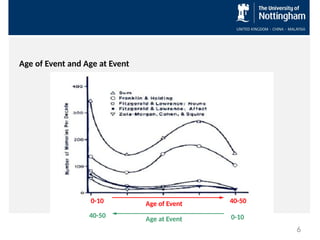
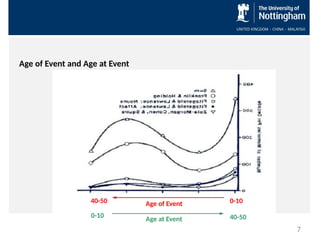
Three types of ‘age’ information
• With the Galton-Crovitz cueing technique and several other methods,
participants have to date the personal events that they had retrieved
– With this information, temporal distributions can be formed
• When one examines the dates of personal events, there are three types of
‘age’ information
– Age of the participant, age of the event, and age at the event
– When a participant who at the time of the test is 50 years recalls an
event from 10 years ago, then the (present) age of the participant is
50, the age of the event is 10, and the age at the event is 40
5
Age of Event and Age at Event
Age of Event
0-10 40-50
Age at Event
40-50 0-10
6
Age of Event and Age at Event
Age of Event
40-50 0-10
Age at Event
0-10 40-50
7
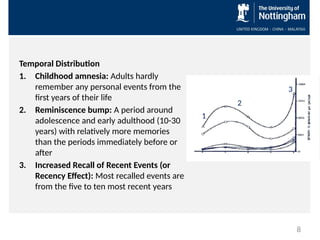
Temporal Distribution
1. Childhood amnesia: Adults hardly
remember any personal events from the
first years of their life
2. Reminiscence bump: A period around
adolescence and early adulthood (10-30
years) with relatively more memories
than the periods immediately before or
after
3. Increased Recall of Recent Events (or
Recency Effect): Most recalled events are
from the five to ten most recent years
2
3
1
8
Increased Recall of Recent Events
• See Lecture 7
• When autobiographical memories are elicited with the help of cue words,
most recalled events are from the 5 to 10 most recent years (Rubin &
Schulkind, 1997)
– Sometimes referred to as “recency effect”
– A function of the age of the event
• Remote events are more likely to be forgotten than recent events, causing
a high proportion of recent events (i.e., availability)
• Recent events might also have a higher level of activation and less
interference (i.e., accessibility)
• This increased recall of recent events tends to be absent in the distribution
of highly important events
9
Childhood Amnesia
• See Lecture 8
• Whereas infants are able to recall recent past events (e.g., what they ate
for breakfast or which animals they had seen at the zoo), adults hardly
remember any personal events from the first three or four years of their
life (Nelson & Fivush, 2004)
– Sometimes referred to as “infantile amnesia”
– A function of the age at the event
• Brain development (i.e., hippocampus), development of a cognitive self,
language skills of infant, and caregiver’s reminiscing style affect the age of
the first autobiographical memory
10
Reminiscence Bump
• Until 2005, the reminiscence bump had only been found in distributions of
participants who were 40 years or older (Rubin, Wetzler, & Nebes, 1986)
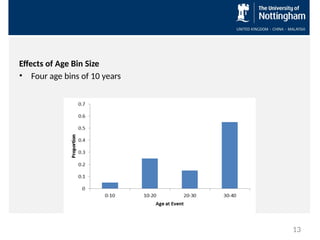
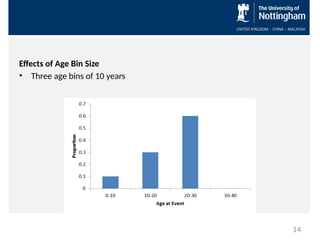
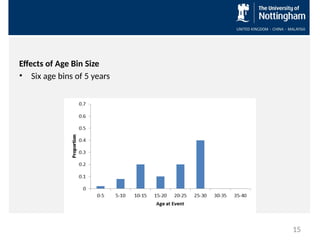
• However, if one examines the distribution using ten-year age bins, one
needs at least four data points to find a reminiscence bump
• People recall few events from the first decade (childhood amnesia) and
many events from the second decade (reminiscence bump)
• They also recall many events from the last decade (increased recall of
recent events)
• To distinguish the reminiscence bump from a constantly increasing
function, one needs at least one data point (between the reminiscence
bump and the recency effect) that has fewer memories (e.g., third decade)
11
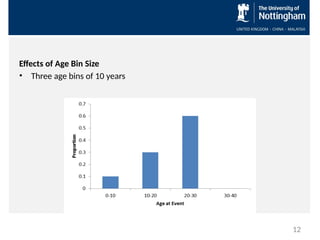
Effects of Age Bin Size
• Three age bins of 10 years
12
Effects of Age Bin Size
• Four age bins of 10 years
13
Effects of Age Bin Size
• Three age bins of 10 years
14
Effects of Age Bin Size
• Six age bins of 5 years
15
Larger Sample for Smaller Age Bins
• In our first study, we examined whether age, gender, culture and
education had an effect on the reminiscence bump (Janssen, Chessa, &
Murre, 2005)
• We presented the Galton-Crovitz cueing technique on the Internet to
obtain a very large sample, so we could divide the results in smaller age
bins and the reminiscence bump could be examined in the results of
young adults
– The test was presented in Dutch as well as in English to examine the
effect of culture
• We also proposed a mathematical method to Remove the Increased Recall
of Recent Events (i.e., the RIRRE model) from the observed distribution to
obtain an encoding function (also see Janssen, Gralak, & Murre, 2011)
16
Janssen, Chessa, & Murre (2005)
• We tested 1,958 participants from the Netherlands and the United States
• The participants were between 11 and 70 years old and had an average
age of 38.4 years (SD = 13.7)
• The group consisted of 963 men and 995 women
• Participants received 10 cue words semi-randomly selected from a list of
64 common neutral object words, such as bird, bottle, coffee, factory, and
woman
17
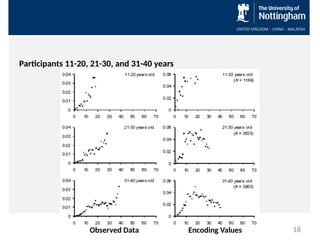
Participants 11-20, 21-30, and 31-40 years
Observed Data Encoding Values 18
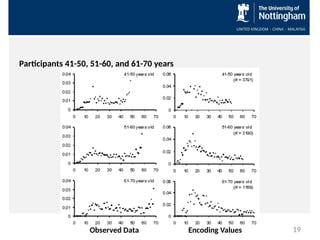
Participants 41-50, 51-60, and 61-70 years
Observed Data Encoding Values 19
Janssen, Chessa, & Murre (2005)
• After applying the RIRRE model, we found that the reminiscence bump
was located between the ages 10 and 20 in each age group
• There were minor differences between men and women and between
American and Dutch participants but no effects of age or education
• The reminiscence bump could even be identified in the distributions of
young adults (i.e., 21-30 years)
• Kawasaki, Janssen, and Inoue (2011) found that the reminiscence bump in
the temporal distribution of autobiographical memory of Japanese
participants was located in the same period as the participants from the
United States and the Netherlands
• The results of Polish participants also showed a peak in the same period
(Janssen, Gralak, & Murre, 2011)
20
Favourite Books, Films, and Records
• Socrative
21
Favourite Books, Films, and Records
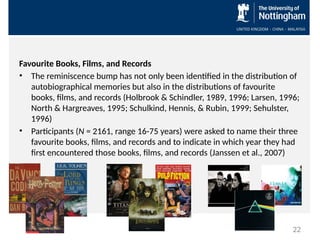
• The reminiscence bump has not only been identified in the distribution of
autobiographical memories but also in the distributions of favourite
books, films, and records (Holbrook & Schindler, 1989, 1996; Larsen, 1996;
North & Hargreaves, 1995; Schulkind, Hennis, & Rubin, 1999; Sehulster,
1996)
• Participants (N = 2161, range 16-75 years) were asked to name their three
favourite books, films, and records and to indicate in which year they had
first encountered those books, films, and records (Janssen et al., 2007)
22
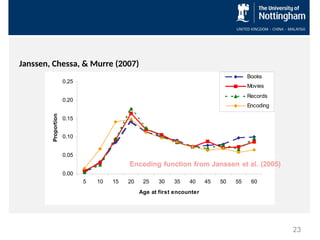
Janssen, Chessa, & Murre (2007)
0.00
0.05
0.10
0.15
0.20
0.25
5 10 15 20 25 30 35 40 45 50 55 60
Age at first encounter
Proportion
Books
Movies
Records
Encoding
23
Public Events
• Socrative
24
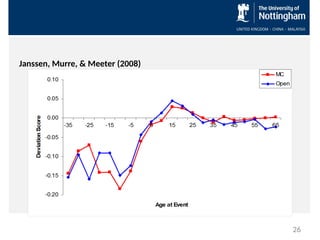
Janssen, Murre, & Meeter (2008)
• The reminiscence bump can also be found in the distribution of memory
for public events (Holmes & Conway, 1999; Howes & Katz, 1992; Rubin,
Rahhal, & Poon, 1998; Schuman, Belli, & Bischoping, 1997)
• Participants (N = 1334, range 16-75 years) were asked to answer 15 open-
ended (i.e., cued recall) and 15 multiple-choice (i.e., recognition)
questions about news events that had occurred in the last 60 years
• Questions were selected from a database with 240 questions: 75% of the
events came from the period after the participant’s 10th birthday,
whereas the remaining 25% were randomly selected from the entire
period
• We corrected the score of each trial for the overall performance of the
participant and the overall difficulty of the question (i.e., deviation scores),
which counters the increased performance on recent events and the
unequal distribution of participants
25
Janssen, Murre, & Meeter (2008)
26
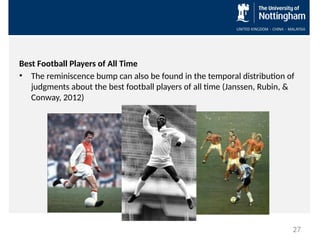
Best Football Players of All Time
• The reminiscence bump can also be found in the temporal distribution of
judgments about the best football players of all time (Janssen, Rubin, &
Conway, 2012)
27
Robustness Reminiscence Bump
• In the first part of the lecture, we have seen what the reminiscence bump
in the temporal distribution of autobiographical memory is and how
robust the phenomenon is
• In the second part of the lecture, four theories that might explain the
reminiscence bump will be assessed
28
Accounts for the Reminiscence Bump
• At least three accounts are given in the literature, but they are not
mutually exclusive (Rubin et al., 1998)
1. Cognitive account: There may be more novel events in adolescence
and early adulthood, such as the first driving lesson or the first kiss
(Pillemer, 2001; Robinson, 1992)
2. Identity Formation or Self Narrative account: Many self-defining
memories, which are vivid and emotional memories of personal
events that have a large impact on the identity of a person, come
from those lifetime periods (Conway, 2005; Conway, Singer, & Tagini,
2004; Fitzgerald, 1988, 1996)
3. Life Scripts account: More normative life events that are important
and positive may occur during those lifetime periods (Berntsen &
Rubin, 2002, 2004; Rubin & Berntsen, 2003)
29
Janssen & Murre (2008)
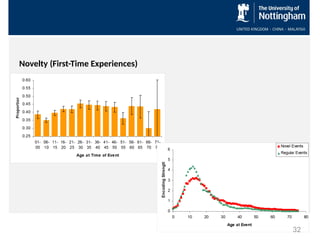
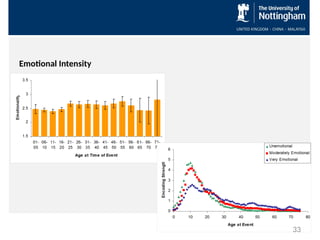
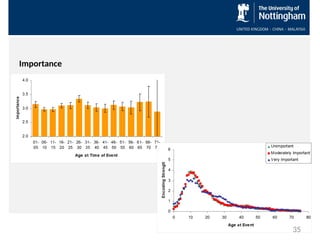
• The three accounts predict that the reminiscence bump consists of relative
more novel, emotional, positive, or important events
• We examined whether the personal events from adolescence and early
adulthood indeed consisted of relatively more novel, emotional, positive,
and important events
• Another 3,492 Dutch participants (between 16 and 75 years old) took the
afore-mentioned Galton-Crovitz test
• Besides recalling and dating personal events, the participants also
indicated whether the event was a first-time experience (novelty) or rated
the event on emotional intensity, emotional valence (positive-negative), or
importance on Likert-type scales
30
Janssen & Murre (2008)
• We analyzed the results with the same mathematical method as in
Janssen et al. (2005), although we did add a moving (or rolling) average for
the encoding functions
• We found – surprisingly – that memories from adolescence consisted of
relatively fewer novel, emotional, positive, and important events
31
Novelty (First-Time Experiences)
32
Emotional Intensity
33
Emotional Valence (Positive-Negative)
34
Importance
35
Vividness and Recollective Experience
• In Janssen, Rubin, and St. Jacques (2011), we found similar results when
we looked at the temporal distribution of recollective memory (i.e.,
vividness and sense of reliving)
• Memories about events from the reminiscence bump were not more
frequently remembered vividly and did not elicit more frequently strong
feelings of reliving
36
Mundane events
• We found that relatively more mundane (i.e., regular, unemotional,
neutral, or unimportant) events than remarkable (i.e., novel, emotional,
positive, or important) events occurred during the reminiscence bump
• None of the existing accounts predicted this higher prevalence of
mundane events
• They, in fact, predicted more novel (cognitive account), more emotional
(identity-formation account), or more positive and important (life script
account) events
• So, why do people remember those seemingly unimportant events?
• ‘What the hell are they for?’
– After: Baddeley (1988) in Gruneberg, Morris, and Sykes’ Memory in
Everyday Life
37
Methods to Gather Autobiographical Memories (see Lecture 5)
1. Autobiographical Memory Interview
2. Free narratives
3. Timelines
4. Requests for the most important events
5. I Am Memory Task
6. Autobiographical Fluency task
7. Diary Studies
8. Experience-Sampling technique
9. Galton-Crovitz cueing technique
10. Autobiographical Memory Test
38
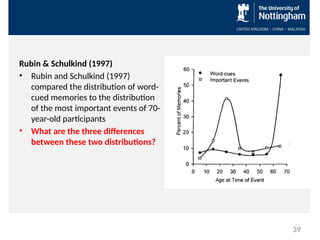
Rubin & Schulkind (1997)
• Rubin and Schulkind (1997)
compared the distribution of word-
cued memories to the distribution
of the most important events of 70-
year-old participants
• What are the three differences
between these two distributions?
39
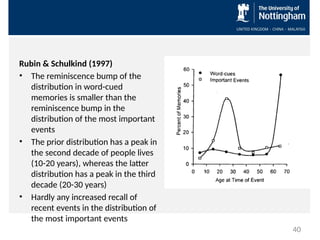
Rubin & Schulkind (1997)
• The reminiscence bump of the
distribution in word-cued
memories is smaller than the
reminiscence bump in the
distribution of the most important
events
• The prior distribution has a peak in
the second decade of people lives
(10-20 years), whereas the latter
distribution has a peak in the third
decade (20-30 years)
• Hardly any increased recall of
recent events in the distribution of
the most important events
40
Rubin & Schulkind (1997)
• The reminiscence bump might, however, be actually two (or more)
separate effects (cf., Janssen, 2015; Rubin, 2015)
• The afore-mentioned accounts seem to predict the reminiscence bump in
the distribution of highly important events but not in the distribution of
word-cued memories
• One of those accounts was the Life Script account
41
A Ten-Minute Break?
42
Cultural Life Scripts
• Life scripts are culturally shared knowledge about the order and timing of
highly important and prevalent personal events (Berntsen & Rubin, 2002,
2004; Rubin & Berntsen, 2003)
• Life scripts combine the concept of story scripts (Schank & Abelson, 1977)
with cultural norms for the timing of salient life events (e.g., Neugarten,
Moore, & Lowe, 1965)
• The Life Script account assumes that people have culturally shared
knowledge about the sequence in which significant personal events
should happen within the course of a person’s life
43
Cultural Life Scripts
• These cultural life scripts are used when they are asked to give the most
important events or when they tell their life stories (which include the
most important events)
• They are also used when people generate future events (Berntsen & Bohn,
2010)
• Life scripts are distorted from actual lives to favour positive events and
events expected to occur in the early adulthood
• Other critical properties of the model are that life scripts are semantic
knowledge and that this knowledge already exists before people have
experienced large parts of their own life
44
Janssen & Rubin (2011)
• Although older adults have lived through a larger part of their lives than
young or middle-aged adults from the same culture, all three age groups
should still share the same cultural life script
• Dutch participants were divided over three age groups: Young adults (16-
35 years, N = 214), middle-aged adults (36-55 years, N = 258), and older
adults (56-75 years, N = 123)
• First, participants were asked to imagine a normal infant from the
Netherlands which had an ordinary life ahead
• Then, participants had to write down the seven most important events
that were most likely to take place in the rest of this infant’s life
• Later, participants had to categorize these events and rate them on
prevalence, importance, valence, and age at occurrence
45
Janssen & Rubin (2011)
• As instructed, the events were rated as very important (M = 5.94 on a
seven-point scale) and very prevalent (M = 80.1%)
• The seven most frequently mentioned event categories were
– Having children (72.1%)
– Begin primary school (60.5%)
– Marriage (53.1%)
– Death of parents (43.5%)
– Falling in love (40.8%)
– First full-time job (32.4%)
– Leaving home (19.0%)
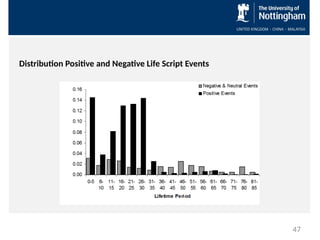
• The events were mostly positive (73.3%) and often came from the period
in which the prototypical person would be between 16 and 30 years old
(45.7%)
46
Distribution Positive and Negative Life Script Events
47
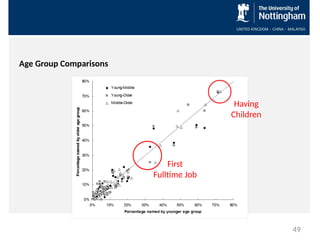
Age Group Comparisons
• For each category of events (e.g., having children, first fulltime job), the
percentage of mentions per age group was calculated and the correlations
across the three age groups were extremely high (r = .962, r = .946, and r =
.978, p < .001), suggesting that each age group mentioned the same
events with equal proportions
48
Age Group Comparisons
Having
Children
First
Fulltime Job
49
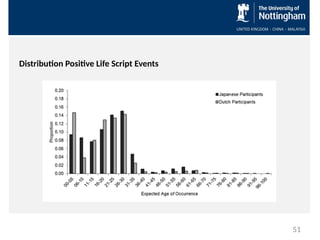
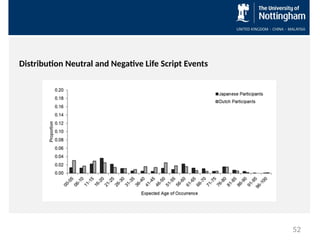
Japanese Life Script
• Janssen, Uemiya, and Naka (2014) replicated the results with a sample of
Japanese participants (N = 759, range 20-80 years)
• The events were rated as very important (M = 6.25 on a seven-point scale)
and very prevalent (M = 76.9%)
• The seven most frequently mentioned event categories were
– Marriage (83.1%), first full-time job (74.7%), having children (60.1%),
begin primary school (56.8%), university entrance exam (42.2%), high
school entrance exam (37.4%), and death of parents (24.0%)
• The events were mostly positive (76.7%) and often came from the period
in which the infant would be between 16 and 30 years old (46.8%)
• Results were similar to results of the previous study (with Dutch
participants)
50
Distribution Positive Life Script Events
51
Distribution Neutral and Negative Life Script Events
52
Malaysian Life Script
• Results with 124 participants (range = 15-25 years)
• In this study (Janssen & Haque, 2018), we did not emphasize ethnicity
• The events were rated as very important (M = 5.80 on a seven-point scale)
and very prevalent (M = 76.7%)
• Marriage (89.3%), having children (67.8%), university graduation (49.6%),
first full-time job (44.6%), fall in love (39.7%), begin university (29.8%),
begin primary school (26.4%), and death of parents (25.6%)
• The events were mostly positive (75.2%) and often came from the period
in which the prototypical infant would be between 16 and 30 years old
(61.2%)
53
Distribution of Word-Cued Memories
• The Life Script account is able to explain why the distribution of most
important events is different from the distribution of word-cued memories
• It, however, does not explain why the distribution of word-cued memories
peaks in the second decade of people’s lives
• One alternative explanation might be that the memory system works
more efficiently during adolescence and early adulthood, which causes
more events to be stored (or events to be stored better)
• This fourth explanation is called the cognitive abilities account (Janssen,
2020)
54
Do people process information better in adolescence and early adulthood?
• Cerella and Hale (1994) found that the reaction times of adolescents and
young adults were faster than the reaction times of middle-aged and older
adults
• The norms of the number of items correct for a participant to score on the
median level on cognitive tests, such as the California Verbal Learning Test
and the Woodcock-Johnson Revised Tests of Cognitive Abilities, also peak
in young adults (see Rubin et al., 1998)
• Li et al. (2004; also see Park et al., 2002; Salthouse, 2004) found an earlier
and higher peak in the temporal distribution of fluid cognitive abilities
(e.g., reaction times) than in the distribution of crystallized cognitive
abilities (e.g., reasoning)
55
The Cognitive Abilities Account
• The cognitive abilities account assumes that cognitive abilities and their
neural substrates, to which encoding efficiency is assumed to be linked,
function optimally in adolescence and early adulthood, which may cause
more memories to be stored (or memories to be stored more strongly) in
those lifetime periods
– Sometimes called ‘biological’ or ‘maturation’ account
• It builds upon the basic-systems approach (Rubin, 2005, 2006), which
assumes that autobiographical memory is supported by other cognitive
systems, and upon the findings that episodic memory improves until
adolescence and slowly diminishes after early adulthood (cf., Lecture 6)
– Binding and source monitoring (cf., Lecture 9)
• This account can explain the results of studies in which participants
retrieve personal events with cue words but not the results of studies in
which participants only report highly significant events
56
Reminiscence Bump in Verbal and Visuospatial Memory
• Ten online verbal memory and visuospatial memory tests were developed
to examine whether the reminiscence bump also can be found in short-
term and long-term memory (Murre, Janssen, Rouw, & Meeter, 2013)
• The tests included among others a ten-words test (10WT), story-telling
immediate recall (ST-IR) and delayed recall (ST-DR), digit span task (Dig-S),
pattern span task (Pat-S), and color memory test (SPWM)
• We analyzed the results of 28,116 participants (range 11-80 years), who
took at least one test, using z-scores
57
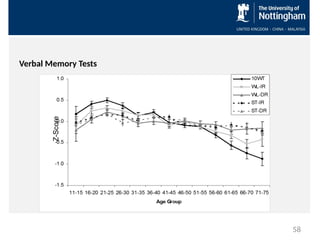
Verbal Memory Tests
58
Z-Score
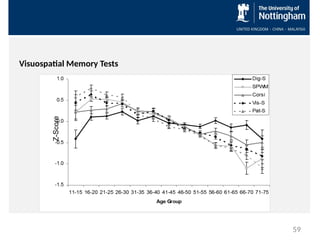
Visuospatial Memory Tests
59
Z-Score
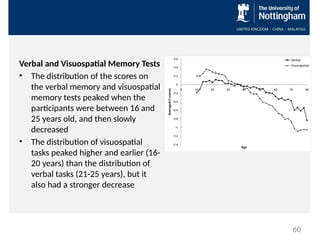
Verbal and Visuospatial Memory Tests
• The distribution of the scores on
the verbal memory and visuospatial
memory tests peaked when the
participants were between 16 and
25 years old, and then slowly
decreased
• The distribution of visuospatial
tasks peaked higher and earlier (16-
20 years) than the distribution of
verbal tasks (21-25 years), but it
also had a stronger decrease
60
Verbal and Visuospatial Memory Tests
• The shape of verbal and visuospatial
memory across the lifespan mirror the
shape of crystallized and fluid cognitive
abilities, respectively
– Higher and earlier peak for fluid
cognitive abilities but stronger
decrease
61
Relation Autobiographical Memory and Verbal and Visuospatial Memory
• The scores on the verbal memory and visuospatial memory tests were
between-subjects measurements, whereas the temporal distribution of
autobiographical memory is a product of within-subjects measurements
• This issue raises the question whether people with a stronger short-term
memory and long-term memory capabilities have indeed a better
retention for personal events
• To measure the retention of autobiographical memory, we developed a
sort of diary test (Kristo, Janssen, & Murre, 2009), which consisted of two
phases (i.e., a recording and a recall phase)
62
Diary Study – First Phase
• In the first phase of this study, participants (N = 858, range 18-80 years)
were asked to describe one recent personal event (i.e., one that happened
within the last three days)
• They were then asked to answer questions about what the event was,
who was involved in the event, and where the event had taken place
• They also dated the event (i.e., when the event had happened) and wrote
down one important and one unimportant detail about the event
• Finally, they rated the event on importance, emotional intensity,
emotional valence and frequency of occurrence
63
Diary Study – Second Phase
• After 2, 7, 15, 30/31, or 45/46 days, participants were contacted by e-mail
and asked to take part in the second phase of the study
• Participants were first asked one of the three content questions (i.e., what,
who, or where)
• They were then given the correct answer to this question and then given
another content question
• After they had answered all three content questions, they dated the event
and wrote down the important and unimportant details
• Finally, they rated the event on reminiscing (i.e., how often they had
thought about it) and social sharing (i.e., how often they had talked about
it)
64
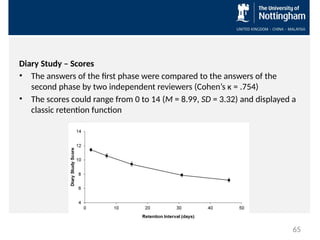
Diary Study – Scores
• The answers of the first phase were compared to the answers of the
second phase by two independent reviewers (Cohen’s κ = .754)
• The scores could range from 0 to 14 (M = 8.99, SD = 3.32) and displayed a
classic retention function
65
Diary Study – Scores
• People recalled the content (who, what, where) of the event better than
the time (when) or details (important, unimportant) of the event
• Performance on the test depended on retention interval, valence,
frequency of occurrence, reminiscing, and social sharing, but, surprisingly,
not on importance and emotionality
66
Relation Autobiographical Memory and Verbal and Visuospatial Memory
• In a third study, the scores on the diary study (retention of personal
events) were combined with the scores on the verbal memory and
visuospatial memory tests (cognitive abilities) to examine whether
participants, who perform better on the prior test, also perform better on
the latter tests (Janssen, Kristo, Rouw, & Murre, 2015)
• In these analyses, event factors (retention interval, frequency of
occurrence, emotionality, reminiscing, etc.) and subject factors (age,
gender, educational attainment) were also included
• Due to the complex nature of autobiographical memory retrieval (Rubin,
2005, 2006), the effect of cognitive abilities on the retention of personal
events was expected to be small
67
Janssen, Kristo, Rouw, & Murre (2015)
• We analysed the results of 617 participants (range: 18-80 years) who
completed at least one verbal memory or visuospatial memory test (M =
4.62) and the diary study
• For each participant, one average z-score for the verbal memory and
visuospatial memory tests was calculated
• This variable was added to the other independent variables in a linear
regression analysis examining the score on the diary study, F(10, 606) =
24.45, p < .001
• Retention interval was the strongest variable (β = -.478), followed by
reminiscing and importance
• The results on the verbal memory and visuospatial memory tests were less
strong (β = .074) but still had a significant influence on the diary study
score (p = .035)
68
Janssen, Kristo, Rouw, & Murre (2015)
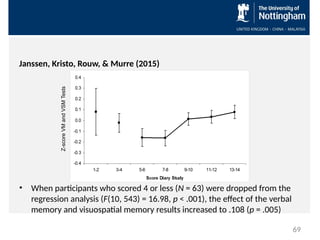
• When participants who scored 4 or less (N = 63) were dropped from the
regression analysis (F(10, 543) = 16.98, p < .001), the effect of the verbal
memory and visuospatial memory results increased to .108 (p = .005)
69
Z-score
VM
and
VSM
Tests
The Cognitive Abilities Account
• Although the effect size was small, the performance on the verbal
memory and visuospatial memory tests was directly related to the
retention of the personal event
• This relation became stronger after a small proportion of the participants
(10.2%) had been removed because they could not recall the event at all
at the second phase
• When given cue words, middle-aged or older adults tend to recall more
personal events from adolescence and early adulthood, not because the
events from these lifetime periods are more important, more emotional,
or more positive (as predicted by the existing accounts) but because the
memory system was operating more efficiently and stored more events in
these lifetime periods
70
Additional Support
• The cognitive abilities account predicts that the temporal distributions of
word-cued memories will be similar across cultures
• A comparison of the distribution of word-cued memories of American,
Dutch, Japanese, and Polish samples who were given the same
instructions and the same cue words suggests that there are no cross-
cultural differences (Janssen et al., 2005; Janssen, Gralak, & Murre, 2011;
Kawasaki et al., 2011)
• The cognitive abilities account is also supported by findings from outside
the autobiographical memory domain, such as the distribution of memory
for public events (e.g., Holmes & Conway, 1999; Howes & Katz, 1992;
Janssen et al., 2008; Rubin et al., 1998; Schuman et al., 1997)
71
Conclusions
• In today’s lecture, we have seen what the reminiscence bump in the
temporal distribution of autobiographical memory is
• We have also seen how robust the effect is (i.e., favourite books, movies,
and records, public events, best football players of all time)
• The reminiscence bump might, however, be actually two separate effects
(i.e., one for word-cued memories and one for most important events)
• Existing theories, like the Life Scripts account, can explain the
reminiscence bump in the distribution of important events but have
difficulties explaining the reminiscence bump in the distribution of word-
cued memories
• The latter effect might be explained by an alternative explanation, which
looks at the efficiency of the memory system (i.e., the cognitive abilities
account)
72
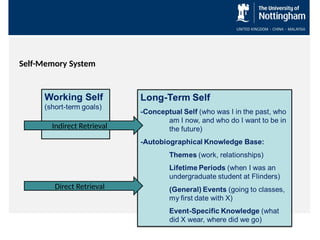
Self-Memory System
• This view is not in contradiction with Conway’s Self-Memory System
(Conway & Pleydell-Pearce, 2000), although we did not find any direct
support for the identity-formation account
• The autobiographical knowledge base could consist of more event-specific
information about single or repeated events from the period in which
people are between 6 and 20 years old
• These events are easily retrieved with cue words (direct retrieval)
• Life story events tend to occur in the period in which people are between
16 and 30 years old
• The life story events tend to be retrieved through the conceptual self,
which may contain the cultural life script (indirect retrieval)
73
Self-Memory System
Indirect Retrieval
Direct Retrieval
Key Words
• Childhood amnesia
• Reminiscence bump
• Increased recall of recent events
• Identity formation account
• Cognitive account
• Life script account
• Cognitive abilities account
75
Questions

Go to: https://socrative.com

Login: Student Log In

Room name: JANSSEN2363
76
Next Lecture
• Lecture 17: Forensic Perspective
• Readings
– Kassin, S. M. (2008). False confessions: Causes, consequences, and implications. Current
Directions in Psychological Science, 17, 249-253.
– Lindsay, D. S., Allen, B. P., Chan, J. C. K., & Dahl, L. C. (2004). Eyewitness suggestibility and
source similarity: Intrusions of details from one event into memory reports of another
event. Journal of Memory and Language, 50, 96-111.
– Schooler, J. W., & Engstler-Schooler, T. Y. (1990). Verbal overshadowing of visual
memories: Some things are better left unsaid. Cognitive Psychology, 22, 36-71.
77
78
Thank you!
Questions?
steve.janssen@nottingham.edu.my
B1B21

PSGY3040 - L14 - Temporal Distribution.pptx

  • 1.
  • 2.
    Previous Lecture • Inthe previous lecture, we saw how personal circumstances for public events are remembered in larger groups – Flashbulb memories • We found no support for idea that flashbulb memories require a special mechanism – Many of the characteristics can be explained by existing cognitive- emotional mechanisms • However, the function of flashbulb memories is social – Flashbulb memories are shared experiences – They, on the one hand, reinforce one’s group membership, but, they, on the other hand, only occur when the event is related to one’s group membership 2
  • 3.
    Pop Quiz • Goto: https://socrative.com • Login: Student Login • Room name: JANSSEN2363 • Five questions about Lecture 13 3
  • 4.
    Aims Lecture • Theaim of today’s lecture is to introduce students to the reminiscence bump in the temporal distribution of autobiographical memory • We will see what the reminiscence bump is and how robust the phenomenon is, and we will assess four theories that aim to explain the reminiscence bump • At the end of the lecture, students should be able to describe the shape of the temporal distribution of autobiographical memory and to evaluate theories that might explain the shape 4
  • 5.
    Three types of‘age’ information • With the Galton-Crovitz cueing technique and several other methods, participants have to date the personal events that they had retrieved – With this information, temporal distributions can be formed • When one examines the dates of personal events, there are three types of ‘age’ information – Age of the participant, age of the event, and age at the event – When a participant who at the time of the test is 50 years recalls an event from 10 years ago, then the (present) age of the participant is 50, the age of the event is 10, and the age at the event is 40 5
  • 6.
    Age of Eventand Age at Event Age of Event 0-10 40-50 Age at Event 40-50 0-10 6
  • 7.
    Age of Eventand Age at Event Age of Event 40-50 0-10 Age at Event 0-10 40-50 7
  • 8.
    Temporal Distribution 1. Childhoodamnesia: Adults hardly remember any personal events from the first years of their life 2. Reminiscence bump: A period around adolescence and early adulthood (10-30 years) with relatively more memories than the periods immediately before or after 3. Increased Recall of Recent Events (or Recency Effect): Most recalled events are from the five to ten most recent years 2 3 1 8
  • 9.
    Increased Recall ofRecent Events • See Lecture 7 • When autobiographical memories are elicited with the help of cue words, most recalled events are from the 5 to 10 most recent years (Rubin & Schulkind, 1997) – Sometimes referred to as “recency effect” – A function of the age of the event • Remote events are more likely to be forgotten than recent events, causing a high proportion of recent events (i.e., availability) • Recent events might also have a higher level of activation and less interference (i.e., accessibility) • This increased recall of recent events tends to be absent in the distribution of highly important events 9
  • 10.
    Childhood Amnesia • SeeLecture 8 • Whereas infants are able to recall recent past events (e.g., what they ate for breakfast or which animals they had seen at the zoo), adults hardly remember any personal events from the first three or four years of their life (Nelson & Fivush, 2004) – Sometimes referred to as “infantile amnesia” – A function of the age at the event • Brain development (i.e., hippocampus), development of a cognitive self, language skills of infant, and caregiver’s reminiscing style affect the age of the first autobiographical memory 10
  • 11.
    Reminiscence Bump • Until2005, the reminiscence bump had only been found in distributions of participants who were 40 years or older (Rubin, Wetzler, & Nebes, 1986) • However, if one examines the distribution using ten-year age bins, one needs at least four data points to find a reminiscence bump • People recall few events from the first decade (childhood amnesia) and many events from the second decade (reminiscence bump) • They also recall many events from the last decade (increased recall of recent events) • To distinguish the reminiscence bump from a constantly increasing function, one needs at least one data point (between the reminiscence bump and the recency effect) that has fewer memories (e.g., third decade) 11
  • 12.
    Effects of AgeBin Size • Three age bins of 10 years 12
  • 13.
    Effects of AgeBin Size • Four age bins of 10 years 13
  • 14.
    Effects of AgeBin Size • Three age bins of 10 years 14
  • 15.
    Effects of AgeBin Size • Six age bins of 5 years 15
  • 16.
    Larger Sample forSmaller Age Bins • In our first study, we examined whether age, gender, culture and education had an effect on the reminiscence bump (Janssen, Chessa, & Murre, 2005) • We presented the Galton-Crovitz cueing technique on the Internet to obtain a very large sample, so we could divide the results in smaller age bins and the reminiscence bump could be examined in the results of young adults – The test was presented in Dutch as well as in English to examine the effect of culture • We also proposed a mathematical method to Remove the Increased Recall of Recent Events (i.e., the RIRRE model) from the observed distribution to obtain an encoding function (also see Janssen, Gralak, & Murre, 2011) 16
  • 17.
    Janssen, Chessa, &Murre (2005) • We tested 1,958 participants from the Netherlands and the United States • The participants were between 11 and 70 years old and had an average age of 38.4 years (SD = 13.7) • The group consisted of 963 men and 995 women • Participants received 10 cue words semi-randomly selected from a list of 64 common neutral object words, such as bird, bottle, coffee, factory, and woman 17
  • 18.
    Participants 11-20, 21-30,and 31-40 years Observed Data Encoding Values 18
  • 19.
    Participants 41-50, 51-60,and 61-70 years Observed Data Encoding Values 19
  • 20.
    Janssen, Chessa, &Murre (2005) • After applying the RIRRE model, we found that the reminiscence bump was located between the ages 10 and 20 in each age group • There were minor differences between men and women and between American and Dutch participants but no effects of age or education • The reminiscence bump could even be identified in the distributions of young adults (i.e., 21-30 years) • Kawasaki, Janssen, and Inoue (2011) found that the reminiscence bump in the temporal distribution of autobiographical memory of Japanese participants was located in the same period as the participants from the United States and the Netherlands • The results of Polish participants also showed a peak in the same period (Janssen, Gralak, & Murre, 2011) 20
  • 21.
    Favourite Books, Films,and Records • Socrative 21
  • 22.
    Favourite Books, Films,and Records • The reminiscence bump has not only been identified in the distribution of autobiographical memories but also in the distributions of favourite books, films, and records (Holbrook & Schindler, 1989, 1996; Larsen, 1996; North & Hargreaves, 1995; Schulkind, Hennis, & Rubin, 1999; Sehulster, 1996) • Participants (N = 2161, range 16-75 years) were asked to name their three favourite books, films, and records and to indicate in which year they had first encountered those books, films, and records (Janssen et al., 2007) 22
  • 23.
    Janssen, Chessa, &Murre (2007) 0.00 0.05 0.10 0.15 0.20 0.25 5 10 15 20 25 30 35 40 45 50 55 60 Age at first encounter Proportion Books Movies Records Encoding 23
  • 24.
  • 25.
    Janssen, Murre, &Meeter (2008) • The reminiscence bump can also be found in the distribution of memory for public events (Holmes & Conway, 1999; Howes & Katz, 1992; Rubin, Rahhal, & Poon, 1998; Schuman, Belli, & Bischoping, 1997) • Participants (N = 1334, range 16-75 years) were asked to answer 15 open- ended (i.e., cued recall) and 15 multiple-choice (i.e., recognition) questions about news events that had occurred in the last 60 years • Questions were selected from a database with 240 questions: 75% of the events came from the period after the participant’s 10th birthday, whereas the remaining 25% were randomly selected from the entire period • We corrected the score of each trial for the overall performance of the participant and the overall difficulty of the question (i.e., deviation scores), which counters the increased performance on recent events and the unequal distribution of participants 25
  • 26.
    Janssen, Murre, &Meeter (2008) 26
  • 27.
    Best Football Playersof All Time • The reminiscence bump can also be found in the temporal distribution of judgments about the best football players of all time (Janssen, Rubin, & Conway, 2012) 27
  • 28.
    Robustness Reminiscence Bump •In the first part of the lecture, we have seen what the reminiscence bump in the temporal distribution of autobiographical memory is and how robust the phenomenon is • In the second part of the lecture, four theories that might explain the reminiscence bump will be assessed 28
  • 29.
    Accounts for theReminiscence Bump • At least three accounts are given in the literature, but they are not mutually exclusive (Rubin et al., 1998) 1. Cognitive account: There may be more novel events in adolescence and early adulthood, such as the first driving lesson or the first kiss (Pillemer, 2001; Robinson, 1992) 2. Identity Formation or Self Narrative account: Many self-defining memories, which are vivid and emotional memories of personal events that have a large impact on the identity of a person, come from those lifetime periods (Conway, 2005; Conway, Singer, & Tagini, 2004; Fitzgerald, 1988, 1996) 3. Life Scripts account: More normative life events that are important and positive may occur during those lifetime periods (Berntsen & Rubin, 2002, 2004; Rubin & Berntsen, 2003) 29
  • 30.
    Janssen & Murre(2008) • The three accounts predict that the reminiscence bump consists of relative more novel, emotional, positive, or important events • We examined whether the personal events from adolescence and early adulthood indeed consisted of relatively more novel, emotional, positive, and important events • Another 3,492 Dutch participants (between 16 and 75 years old) took the afore-mentioned Galton-Crovitz test • Besides recalling and dating personal events, the participants also indicated whether the event was a first-time experience (novelty) or rated the event on emotional intensity, emotional valence (positive-negative), or importance on Likert-type scales 30
  • 31.
    Janssen & Murre(2008) • We analyzed the results with the same mathematical method as in Janssen et al. (2005), although we did add a moving (or rolling) average for the encoding functions • We found – surprisingly – that memories from adolescence consisted of relatively fewer novel, emotional, positive, and important events 31
  • 32.
  • 33.
  • 34.
  • 35.
  • 36.
    Vividness and RecollectiveExperience • In Janssen, Rubin, and St. Jacques (2011), we found similar results when we looked at the temporal distribution of recollective memory (i.e., vividness and sense of reliving) • Memories about events from the reminiscence bump were not more frequently remembered vividly and did not elicit more frequently strong feelings of reliving 36
  • 37.
    Mundane events • Wefound that relatively more mundane (i.e., regular, unemotional, neutral, or unimportant) events than remarkable (i.e., novel, emotional, positive, or important) events occurred during the reminiscence bump • None of the existing accounts predicted this higher prevalence of mundane events • They, in fact, predicted more novel (cognitive account), more emotional (identity-formation account), or more positive and important (life script account) events • So, why do people remember those seemingly unimportant events? • ‘What the hell are they for?’ – After: Baddeley (1988) in Gruneberg, Morris, and Sykes’ Memory in Everyday Life 37
  • 38.
    Methods to GatherAutobiographical Memories (see Lecture 5) 1. Autobiographical Memory Interview 2. Free narratives 3. Timelines 4. Requests for the most important events 5. I Am Memory Task 6. Autobiographical Fluency task 7. Diary Studies 8. Experience-Sampling technique 9. Galton-Crovitz cueing technique 10. Autobiographical Memory Test 38
  • 39.
    Rubin & Schulkind(1997) • Rubin and Schulkind (1997) compared the distribution of word- cued memories to the distribution of the most important events of 70- year-old participants • What are the three differences between these two distributions? 39
  • 40.
    Rubin & Schulkind(1997) • The reminiscence bump of the distribution in word-cued memories is smaller than the reminiscence bump in the distribution of the most important events • The prior distribution has a peak in the second decade of people lives (10-20 years), whereas the latter distribution has a peak in the third decade (20-30 years) • Hardly any increased recall of recent events in the distribution of the most important events 40
  • 41.
    Rubin & Schulkind(1997) • The reminiscence bump might, however, be actually two (or more) separate effects (cf., Janssen, 2015; Rubin, 2015) • The afore-mentioned accounts seem to predict the reminiscence bump in the distribution of highly important events but not in the distribution of word-cued memories • One of those accounts was the Life Script account 41
  • 42.
  • 43.
    Cultural Life Scripts •Life scripts are culturally shared knowledge about the order and timing of highly important and prevalent personal events (Berntsen & Rubin, 2002, 2004; Rubin & Berntsen, 2003) • Life scripts combine the concept of story scripts (Schank & Abelson, 1977) with cultural norms for the timing of salient life events (e.g., Neugarten, Moore, & Lowe, 1965) • The Life Script account assumes that people have culturally shared knowledge about the sequence in which significant personal events should happen within the course of a person’s life 43
  • 44.
    Cultural Life Scripts •These cultural life scripts are used when they are asked to give the most important events or when they tell their life stories (which include the most important events) • They are also used when people generate future events (Berntsen & Bohn, 2010) • Life scripts are distorted from actual lives to favour positive events and events expected to occur in the early adulthood • Other critical properties of the model are that life scripts are semantic knowledge and that this knowledge already exists before people have experienced large parts of their own life 44
  • 45.
    Janssen & Rubin(2011) • Although older adults have lived through a larger part of their lives than young or middle-aged adults from the same culture, all three age groups should still share the same cultural life script • Dutch participants were divided over three age groups: Young adults (16- 35 years, N = 214), middle-aged adults (36-55 years, N = 258), and older adults (56-75 years, N = 123) • First, participants were asked to imagine a normal infant from the Netherlands which had an ordinary life ahead • Then, participants had to write down the seven most important events that were most likely to take place in the rest of this infant’s life • Later, participants had to categorize these events and rate them on prevalence, importance, valence, and age at occurrence 45
  • 46.
    Janssen & Rubin(2011) • As instructed, the events were rated as very important (M = 5.94 on a seven-point scale) and very prevalent (M = 80.1%) • The seven most frequently mentioned event categories were – Having children (72.1%) – Begin primary school (60.5%) – Marriage (53.1%) – Death of parents (43.5%) – Falling in love (40.8%) – First full-time job (32.4%) – Leaving home (19.0%) • The events were mostly positive (73.3%) and often came from the period in which the prototypical person would be between 16 and 30 years old (45.7%) 46
  • 47.
    Distribution Positive andNegative Life Script Events 47
  • 48.
    Age Group Comparisons •For each category of events (e.g., having children, first fulltime job), the percentage of mentions per age group was calculated and the correlations across the three age groups were extremely high (r = .962, r = .946, and r = .978, p < .001), suggesting that each age group mentioned the same events with equal proportions 48
  • 49.
  • 50.
    Japanese Life Script •Janssen, Uemiya, and Naka (2014) replicated the results with a sample of Japanese participants (N = 759, range 20-80 years) • The events were rated as very important (M = 6.25 on a seven-point scale) and very prevalent (M = 76.9%) • The seven most frequently mentioned event categories were – Marriage (83.1%), first full-time job (74.7%), having children (60.1%), begin primary school (56.8%), university entrance exam (42.2%), high school entrance exam (37.4%), and death of parents (24.0%) • The events were mostly positive (76.7%) and often came from the period in which the infant would be between 16 and 30 years old (46.8%) • Results were similar to results of the previous study (with Dutch participants) 50
  • 51.
  • 52.
    Distribution Neutral andNegative Life Script Events 52
  • 53.
    Malaysian Life Script •Results with 124 participants (range = 15-25 years) • In this study (Janssen & Haque, 2018), we did not emphasize ethnicity • The events were rated as very important (M = 5.80 on a seven-point scale) and very prevalent (M = 76.7%) • Marriage (89.3%), having children (67.8%), university graduation (49.6%), first full-time job (44.6%), fall in love (39.7%), begin university (29.8%), begin primary school (26.4%), and death of parents (25.6%) • The events were mostly positive (75.2%) and often came from the period in which the prototypical infant would be between 16 and 30 years old (61.2%) 53
  • 54.
    Distribution of Word-CuedMemories • The Life Script account is able to explain why the distribution of most important events is different from the distribution of word-cued memories • It, however, does not explain why the distribution of word-cued memories peaks in the second decade of people’s lives • One alternative explanation might be that the memory system works more efficiently during adolescence and early adulthood, which causes more events to be stored (or events to be stored better) • This fourth explanation is called the cognitive abilities account (Janssen, 2020) 54
  • 55.
    Do people processinformation better in adolescence and early adulthood? • Cerella and Hale (1994) found that the reaction times of adolescents and young adults were faster than the reaction times of middle-aged and older adults • The norms of the number of items correct for a participant to score on the median level on cognitive tests, such as the California Verbal Learning Test and the Woodcock-Johnson Revised Tests of Cognitive Abilities, also peak in young adults (see Rubin et al., 1998) • Li et al. (2004; also see Park et al., 2002; Salthouse, 2004) found an earlier and higher peak in the temporal distribution of fluid cognitive abilities (e.g., reaction times) than in the distribution of crystallized cognitive abilities (e.g., reasoning) 55
  • 56.
    The Cognitive AbilitiesAccount • The cognitive abilities account assumes that cognitive abilities and their neural substrates, to which encoding efficiency is assumed to be linked, function optimally in adolescence and early adulthood, which may cause more memories to be stored (or memories to be stored more strongly) in those lifetime periods – Sometimes called ‘biological’ or ‘maturation’ account • It builds upon the basic-systems approach (Rubin, 2005, 2006), which assumes that autobiographical memory is supported by other cognitive systems, and upon the findings that episodic memory improves until adolescence and slowly diminishes after early adulthood (cf., Lecture 6) – Binding and source monitoring (cf., Lecture 9) • This account can explain the results of studies in which participants retrieve personal events with cue words but not the results of studies in which participants only report highly significant events 56
  • 57.
    Reminiscence Bump inVerbal and Visuospatial Memory • Ten online verbal memory and visuospatial memory tests were developed to examine whether the reminiscence bump also can be found in short- term and long-term memory (Murre, Janssen, Rouw, & Meeter, 2013) • The tests included among others a ten-words test (10WT), story-telling immediate recall (ST-IR) and delayed recall (ST-DR), digit span task (Dig-S), pattern span task (Pat-S), and color memory test (SPWM) • We analyzed the results of 28,116 participants (range 11-80 years), who took at least one test, using z-scores 57
  • 58.
  • 59.
  • 60.
    Verbal and VisuospatialMemory Tests • The distribution of the scores on the verbal memory and visuospatial memory tests peaked when the participants were between 16 and 25 years old, and then slowly decreased • The distribution of visuospatial tasks peaked higher and earlier (16- 20 years) than the distribution of verbal tasks (21-25 years), but it also had a stronger decrease 60
  • 61.
    Verbal and VisuospatialMemory Tests • The shape of verbal and visuospatial memory across the lifespan mirror the shape of crystallized and fluid cognitive abilities, respectively – Higher and earlier peak for fluid cognitive abilities but stronger decrease 61
  • 62.
    Relation Autobiographical Memoryand Verbal and Visuospatial Memory • The scores on the verbal memory and visuospatial memory tests were between-subjects measurements, whereas the temporal distribution of autobiographical memory is a product of within-subjects measurements • This issue raises the question whether people with a stronger short-term memory and long-term memory capabilities have indeed a better retention for personal events • To measure the retention of autobiographical memory, we developed a sort of diary test (Kristo, Janssen, & Murre, 2009), which consisted of two phases (i.e., a recording and a recall phase) 62
  • 63.
    Diary Study –First Phase • In the first phase of this study, participants (N = 858, range 18-80 years) were asked to describe one recent personal event (i.e., one that happened within the last three days) • They were then asked to answer questions about what the event was, who was involved in the event, and where the event had taken place • They also dated the event (i.e., when the event had happened) and wrote down one important and one unimportant detail about the event • Finally, they rated the event on importance, emotional intensity, emotional valence and frequency of occurrence 63
  • 64.
    Diary Study –Second Phase • After 2, 7, 15, 30/31, or 45/46 days, participants were contacted by e-mail and asked to take part in the second phase of the study • Participants were first asked one of the three content questions (i.e., what, who, or where) • They were then given the correct answer to this question and then given another content question • After they had answered all three content questions, they dated the event and wrote down the important and unimportant details • Finally, they rated the event on reminiscing (i.e., how often they had thought about it) and social sharing (i.e., how often they had talked about it) 64
  • 65.
    Diary Study –Scores • The answers of the first phase were compared to the answers of the second phase by two independent reviewers (Cohen’s κ = .754) • The scores could range from 0 to 14 (M = 8.99, SD = 3.32) and displayed a classic retention function 65
  • 66.
    Diary Study –Scores • People recalled the content (who, what, where) of the event better than the time (when) or details (important, unimportant) of the event • Performance on the test depended on retention interval, valence, frequency of occurrence, reminiscing, and social sharing, but, surprisingly, not on importance and emotionality 66
  • 67.
    Relation Autobiographical Memoryand Verbal and Visuospatial Memory • In a third study, the scores on the diary study (retention of personal events) were combined with the scores on the verbal memory and visuospatial memory tests (cognitive abilities) to examine whether participants, who perform better on the prior test, also perform better on the latter tests (Janssen, Kristo, Rouw, & Murre, 2015) • In these analyses, event factors (retention interval, frequency of occurrence, emotionality, reminiscing, etc.) and subject factors (age, gender, educational attainment) were also included • Due to the complex nature of autobiographical memory retrieval (Rubin, 2005, 2006), the effect of cognitive abilities on the retention of personal events was expected to be small 67
  • 68.
    Janssen, Kristo, Rouw,& Murre (2015) • We analysed the results of 617 participants (range: 18-80 years) who completed at least one verbal memory or visuospatial memory test (M = 4.62) and the diary study • For each participant, one average z-score for the verbal memory and visuospatial memory tests was calculated • This variable was added to the other independent variables in a linear regression analysis examining the score on the diary study, F(10, 606) = 24.45, p < .001 • Retention interval was the strongest variable (β = -.478), followed by reminiscing and importance • The results on the verbal memory and visuospatial memory tests were less strong (β = .074) but still had a significant influence on the diary study score (p = .035) 68
  • 69.
    Janssen, Kristo, Rouw,& Murre (2015) • When participants who scored 4 or less (N = 63) were dropped from the regression analysis (F(10, 543) = 16.98, p < .001), the effect of the verbal memory and visuospatial memory results increased to .108 (p = .005) 69 Z-score VM and VSM Tests
  • 70.
    The Cognitive AbilitiesAccount • Although the effect size was small, the performance on the verbal memory and visuospatial memory tests was directly related to the retention of the personal event • This relation became stronger after a small proportion of the participants (10.2%) had been removed because they could not recall the event at all at the second phase • When given cue words, middle-aged or older adults tend to recall more personal events from adolescence and early adulthood, not because the events from these lifetime periods are more important, more emotional, or more positive (as predicted by the existing accounts) but because the memory system was operating more efficiently and stored more events in these lifetime periods 70
  • 71.
    Additional Support • Thecognitive abilities account predicts that the temporal distributions of word-cued memories will be similar across cultures • A comparison of the distribution of word-cued memories of American, Dutch, Japanese, and Polish samples who were given the same instructions and the same cue words suggests that there are no cross- cultural differences (Janssen et al., 2005; Janssen, Gralak, & Murre, 2011; Kawasaki et al., 2011) • The cognitive abilities account is also supported by findings from outside the autobiographical memory domain, such as the distribution of memory for public events (e.g., Holmes & Conway, 1999; Howes & Katz, 1992; Janssen et al., 2008; Rubin et al., 1998; Schuman et al., 1997) 71
  • 72.
    Conclusions • In today’slecture, we have seen what the reminiscence bump in the temporal distribution of autobiographical memory is • We have also seen how robust the effect is (i.e., favourite books, movies, and records, public events, best football players of all time) • The reminiscence bump might, however, be actually two separate effects (i.e., one for word-cued memories and one for most important events) • Existing theories, like the Life Scripts account, can explain the reminiscence bump in the distribution of important events but have difficulties explaining the reminiscence bump in the distribution of word- cued memories • The latter effect might be explained by an alternative explanation, which looks at the efficiency of the memory system (i.e., the cognitive abilities account) 72
  • 73.
    Self-Memory System • Thisview is not in contradiction with Conway’s Self-Memory System (Conway & Pleydell-Pearce, 2000), although we did not find any direct support for the identity-formation account • The autobiographical knowledge base could consist of more event-specific information about single or repeated events from the period in which people are between 6 and 20 years old • These events are easily retrieved with cue words (direct retrieval) • Life story events tend to occur in the period in which people are between 16 and 30 years old • The life story events tend to be retrieved through the conceptual self, which may contain the cultural life script (indirect retrieval) 73
  • 74.
  • 75.
    Key Words • Childhoodamnesia • Reminiscence bump • Increased recall of recent events • Identity formation account • Cognitive account • Life script account • Cognitive abilities account 75
  • 76.
    Questions  Go to: https://socrative.com  Login:Student Log In  Room name: JANSSEN2363 76
  • 77.
    Next Lecture • Lecture17: Forensic Perspective • Readings – Kassin, S. M. (2008). False confessions: Causes, consequences, and implications. Current Directions in Psychological Science, 17, 249-253. – Lindsay, D. S., Allen, B. P., Chan, J. C. K., & Dahl, L. C. (2004). Eyewitness suggestibility and source similarity: Intrusions of details from one event into memory reports of another event. Journal of Memory and Language, 50, 96-111. – Schooler, J. W., & Engstler-Schooler, T. Y. (1990). Verbal overshadowing of visual memories: Some things are better left unsaid. Cognitive Psychology, 22, 36-71. 77
  • 78.
  • 79.