
Subject: Environmental Studies
CHAPTER NO.7
ENVIRONMENTAL PROTECTION
By
Prof. KOKARE A.Y.
BABASAHEB PHADTARE POLYTECHNIC.
KALAMB- WALCHANDNAGAR
B.P.P. Kalamb-Walchandnagar Prof. Kokare A.Y.
ENVIRONMENTAL LEGISLATION
•
•
•
•
•
India first country to have made provisions
for environment protection in its constitution
After Stockholm Conference , 1972
Many laws and rules have been made
Article 48- A : The state shall endeavour to
protect and improve the environment and to
safeguard forests and wildlife of the country.
Article 51 A (g): - It shall be the duty of every
citizen of India to protect and improve the
natural environment including forests, lakes,
rivers and wildlife and to have compasion for
living creatures
B.P.P. Kalamb-Walchandnagar Prof. Kokare A.Y.
ACTS
•
•
•
•
•
•
•
•
•
Wildlife (Protection ) Act, 1972
Water (Prevention and Control of Pollution) Act,
1974
Forest (Conservation )Act, 1980
Air (Prevention and Control of Pollution) Act, 1981
The Environment (Protection) Act, 1986
The Biomedical waste (Management and Handling)
Rules , 1998
The Municipal Solid Waste (Management and
Handling) Rules, 2000
The Noise Pollution (Regulation and Control)
(Amendment) Rules,2002
The Biological Diversity Act,2002
B.P.P. Kalamb-Walchandnagar Prof. Kokare A.Y.
Environmental Ethics
• Ethical behaviour is of utmost
importance
• We believe and think: Man is all
powerful and supreme creature of
the earth.
• Nature has provided us with
resources and she nourishes us like
our mother, so we should respect
and nurture her
• Live sustainably.
B.P.P. Kalamb-Walchandnagar Prof. Kokare A.Y.
•
•
•
•
•
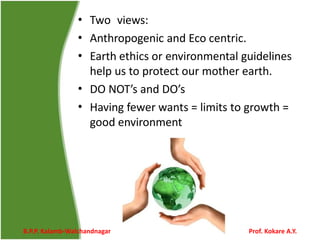
Two views:
Anthropogenic and Eco centric.
Earth ethics or environmental guidelines
help us to protect our mother earth.
DO NOT’s and DO’s
Having fewer wants = limits to growth =
good environment
B.P.P. Kalamb-Walchandnagar Prof. Kokare A.Y.
ENVIRONMENTAL PROTECTION ACT
• Constitution of India has a number of
provisions demarcating the
responsibility of the central and state
government towards Environmental
Protection.
According to section 2(a) of Environmental
Protection Act (1986), .Environment. includes,
(i)Water, air and land,
(ii)The interrelationship which exists among and
between,
(a)Water, air and land and
(b)Human beings, other living creatures, plants,
micro-organisms and property.
B.P.P. Kalamb-Walchandnagar Prof. Kokare A.Y.
Various statues / legislations are
enacted in India exclusively for
Environment Protection are,
The Water (Prevention and Control
of Pollution) Act, 1974
The Air (Prevention and Control of
Pollution) Act, 1981
 The Environmental Protection Act, 1986
The Forest Conservation Act, 1980
The Wild Life Protection Act, 1972
B.P.P. Kalamb-Walchandnagar Prof. Kokare A.Y.
AIR (PREVENTION AND CONTROL OF
POLLUTION) ACT, 1981
The objective of the Act is to provide for
the prevention, control and abatement of air
pollution
Functions of Central Board
Advice to central government on any
matter related to air quality
To execute nation wide awareness programme
To provide technical assistance and guidance to
state boards
Collect technical and statistical data to
prepare manuals, code, and guide related to
air.
 To lay down standards for the quality of air.
B.P.P. Kalamb-Walchandnagar Prof. Kokare A.Y.
Penalty for Contravention of
Certain Provision of the Act
This act shall be punishable with imprisonment
for a term
which may extend to 3 month or with a fine
extend to Rs. 10,000/- or with both.
Both companies and government
departments are also prosecuted under the Air
Act.
No court shall take cognizance of any offence
except on a complaint made by any person who has
given notice of not less than 60 days, in the manner
prescribed of the alleged offence and his intention to
make a complaint to the board.
B.P.P. Kalamb-Walchandnagar Prof. Kokare A.Y.
ENVIRONMENTAL PROTECTION ACT,
1986 (EPA)
Environment. includes water, air and land and
the interrelationship which exists among and
between them and human beings, other living
creature, plants, micro-organisms and property.
Environmental Pollutant. means any solid, liquid
or gaseous substances present in such concentration
as may be or tend to be injurious to environment.
Hazardous Substance. means any substance or
preparation which by reason of its chemical or
physico-chemical properties or handling is liable to
cause harm to human beings, other living creatures,
plants, micro-organisms, property of the environment.
B.P.P. Kalamb-Walchandnagar Prof. Kokare A.Y.
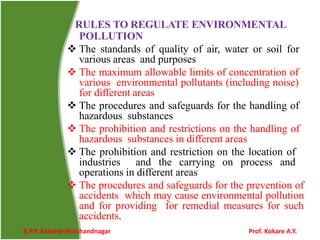
RULES TO REGULATE ENVIRONMENTAL
POLLUTION
 The standards of quality of air, water or soil for
various areas and purposes
 The maximum allowable limits of concentration of
various environmental pollutants (including noise)
for different areas
 The procedures and safeguards for the handling of
hazardous substances
 The prohibition and restrictions on the handling of
hazardous substances in different areas
 The prohibition and restriction on the location of
industries and the carrying on process and
operations in different areas
 The procedures and safeguards for the prevention of
accidents which may cause environmental pollution
and for providing for remedial measures for such
accidents.
B.P.P. Kalamb-Walchandnagar Prof. Kokare A.Y.
THE FORESTS CONSERVATIONACT,1980
 It is well known that breaking up the soil or
clearing of the forest land affects seriously
reforestation or regeneration of forests and
therefore, such breaking up of soil can only be
permitted after taking into consideration all
aspects of the question, the over all
advantages and disadvantages to the
economy of the country.
 Environmental conditions, ecological imbalance
that is likely to occur, its effects on the flora and
the fauna in the area, etc., it was therefore
thought that the entire control of the forest areas
B.P.P. Kalamb-Walchandnagar Prof. Kokare A.Y.
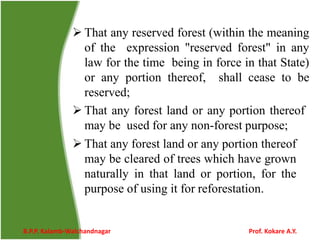
 That any reserved forest (within the meaning
of the expression "reserved forest" in any
law for the time being in force in that State)
or any portion thereof, shall cease to be
reserved;
 That any forest land or any portion thereof
may be used for any non-forest purpose;
 That any forest land or any portion thereof
may be cleared of trees which have grown
naturally in that land or portion, for the
purpose of using it for reforestation.
B.P.P. Kalamb-Walchandnagar Prof. Kokare A.Y.
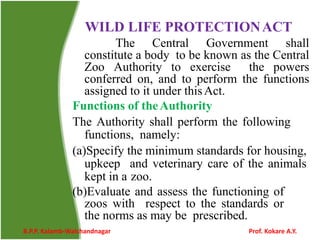
WILD LIFE PROTECTIONACT
The Central Government shall
constitute a body to be known as the Central
Zoo Authority to exercise the powers
conferred on, and to perform the functions
assigned to it under thisAct.
Functions of theAuthority
The Authority shall perform the following
functions, namely:
(a)Specify the minimum standards for housing,
upkeep and veterinary care of the animals
kept in a zoo.
(b)Evaluate and assess the functioning of
zoos with respect to the standards or
the norms as may be prescribed.
B.P.P. Kalamb-Walchandnagar Prof. Kokare A.Y.
(c)Recognize or derecognize zoos;
(d)Identify endangered species of wild animals
for purposes of captive breeding and
assigning responsibility in this regard to a
zoo.
(e)Co-ordinate the acquisition, exchange
and loaning of animals for breeding
purposes.
(f)Ensure maintenance of stud books of
endangered species of wild animals breed
in captivity.
B.P.P. Kalamb-Walchandnagar Prof. Kokare A.Y.
•THANK YOU
B.P.P. Kalamb-Walchandnagar Prof. Kokare A.Y.

Ch 7 Environmental Protection

  • 1.
    Subject: Environmental Studies CHAPTERNO.7 ENVIRONMENTAL PROTECTION By Prof. KOKARE A.Y. BABASAHEB PHADTARE POLYTECHNIC. KALAMB- WALCHANDNAGAR B.P.P. Kalamb-Walchandnagar Prof. Kokare A.Y.
  • 2.
    ENVIRONMENTAL LEGISLATION • • • • • India firstcountry to have made provisions for environment protection in its constitution After Stockholm Conference , 1972 Many laws and rules have been made Article 48- A : The state shall endeavour to protect and improve the environment and to safeguard forests and wildlife of the country. Article 51 A (g): - It shall be the duty of every citizen of India to protect and improve the natural environment including forests, lakes, rivers and wildlife and to have compasion for living creatures B.P.P. Kalamb-Walchandnagar Prof. Kokare A.Y.
  • 3.
    ACTS • • • • • • • • • Wildlife (Protection )Act, 1972 Water (Prevention and Control of Pollution) Act, 1974 Forest (Conservation )Act, 1980 Air (Prevention and Control of Pollution) Act, 1981 The Environment (Protection) Act, 1986 The Biomedical waste (Management and Handling) Rules , 1998 The Municipal Solid Waste (Management and Handling) Rules, 2000 The Noise Pollution (Regulation and Control) (Amendment) Rules,2002 The Biological Diversity Act,2002 B.P.P. Kalamb-Walchandnagar Prof. Kokare A.Y.
  • 4.
    Environmental Ethics • Ethicalbehaviour is of utmost importance • We believe and think: Man is all powerful and supreme creature of the earth. • Nature has provided us with resources and she nourishes us like our mother, so we should respect and nurture her • Live sustainably. B.P.P. Kalamb-Walchandnagar Prof. Kokare A.Y.
  • 5.
    • • • • • Two views: Anthropogenic andEco centric. Earth ethics or environmental guidelines help us to protect our mother earth. DO NOT’s and DO’s Having fewer wants = limits to growth = good environment B.P.P. Kalamb-Walchandnagar Prof. Kokare A.Y.
  • 6.
    ENVIRONMENTAL PROTECTION ACT •Constitution of India has a number of provisions demarcating the responsibility of the central and state government towards Environmental Protection. According to section 2(a) of Environmental Protection Act (1986), .Environment. includes, (i)Water, air and land, (ii)The interrelationship which exists among and between, (a)Water, air and land and (b)Human beings, other living creatures, plants, micro-organisms and property. B.P.P. Kalamb-Walchandnagar Prof. Kokare A.Y.
  • 7.
    Various statues /legislations are enacted in India exclusively for Environment Protection are, The Water (Prevention and Control of Pollution) Act, 1974 The Air (Prevention and Control of Pollution) Act, 1981  The Environmental Protection Act, 1986 The Forest Conservation Act, 1980 The Wild Life Protection Act, 1972 B.P.P. Kalamb-Walchandnagar Prof. Kokare A.Y.
  • 8.
    AIR (PREVENTION ANDCONTROL OF POLLUTION) ACT, 1981 The objective of the Act is to provide for the prevention, control and abatement of air pollution Functions of Central Board Advice to central government on any matter related to air quality To execute nation wide awareness programme To provide technical assistance and guidance to state boards Collect technical and statistical data to prepare manuals, code, and guide related to air.  To lay down standards for the quality of air. B.P.P. Kalamb-Walchandnagar Prof. Kokare A.Y.
  • 9.
    Penalty for Contraventionof Certain Provision of the Act This act shall be punishable with imprisonment for a term which may extend to 3 month or with a fine extend to Rs. 10,000/- or with both. Both companies and government departments are also prosecuted under the Air Act. No court shall take cognizance of any offence except on a complaint made by any person who has given notice of not less than 60 days, in the manner prescribed of the alleged offence and his intention to make a complaint to the board. B.P.P. Kalamb-Walchandnagar Prof. Kokare A.Y.
  • 10.
    ENVIRONMENTAL PROTECTION ACT, 1986(EPA) Environment. includes water, air and land and the interrelationship which exists among and between them and human beings, other living creature, plants, micro-organisms and property. Environmental Pollutant. means any solid, liquid or gaseous substances present in such concentration as may be or tend to be injurious to environment. Hazardous Substance. means any substance or preparation which by reason of its chemical or physico-chemical properties or handling is liable to cause harm to human beings, other living creatures, plants, micro-organisms, property of the environment. B.P.P. Kalamb-Walchandnagar Prof. Kokare A.Y.
  • 11.
    RULES TO REGULATEENVIRONMENTAL POLLUTION  The standards of quality of air, water or soil for various areas and purposes  The maximum allowable limits of concentration of various environmental pollutants (including noise) for different areas  The procedures and safeguards for the handling of hazardous substances  The prohibition and restrictions on the handling of hazardous substances in different areas  The prohibition and restriction on the location of industries and the carrying on process and operations in different areas  The procedures and safeguards for the prevention of accidents which may cause environmental pollution and for providing for remedial measures for such accidents. B.P.P. Kalamb-Walchandnagar Prof. Kokare A.Y.
  • 12.
    THE FORESTS CONSERVATIONACT,1980 It is well known that breaking up the soil or clearing of the forest land affects seriously reforestation or regeneration of forests and therefore, such breaking up of soil can only be permitted after taking into consideration all aspects of the question, the over all advantages and disadvantages to the economy of the country.  Environmental conditions, ecological imbalance that is likely to occur, its effects on the flora and the fauna in the area, etc., it was therefore thought that the entire control of the forest areas B.P.P. Kalamb-Walchandnagar Prof. Kokare A.Y.
  • 13.
     That anyreserved forest (within the meaning of the expression "reserved forest" in any law for the time being in force in that State) or any portion thereof, shall cease to be reserved;  That any forest land or any portion thereof may be used for any non-forest purpose;  That any forest land or any portion thereof may be cleared of trees which have grown naturally in that land or portion, for the purpose of using it for reforestation. B.P.P. Kalamb-Walchandnagar Prof. Kokare A.Y.
  • 14.
    WILD LIFE PROTECTIONACT TheCentral Government shall constitute a body to be known as the Central Zoo Authority to exercise the powers conferred on, and to perform the functions assigned to it under thisAct. Functions of theAuthority The Authority shall perform the following functions, namely: (a)Specify the minimum standards for housing, upkeep and veterinary care of the animals kept in a zoo. (b)Evaluate and assess the functioning of zoos with respect to the standards or the norms as may be prescribed. B.P.P. Kalamb-Walchandnagar Prof. Kokare A.Y.
  • 15.
    (c)Recognize or derecognizezoos; (d)Identify endangered species of wild animals for purposes of captive breeding and assigning responsibility in this regard to a zoo. (e)Co-ordinate the acquisition, exchange and loaning of animals for breeding purposes. (f)Ensure maintenance of stud books of endangered species of wild animals breed in captivity. B.P.P. Kalamb-Walchandnagar Prof. Kokare A.Y.
  • 16.