Objectives
Identify the following:
 Characteristics of an approved supplier
 Guidelines for receiving and inspecting deliveries
 Requirements for key drop deliveries
 Procedure for handling food recalls
 Procedures for checking the temperatures of various food items
 Temperature requirements when receiving food
6-2
Objectives
Identify the following:
 Packaging requirements when receiving food
 Documentation required when receiving food
 Government inspection stamps required when receiving food
 Quality requirements when receiving food
 Receiving criteria for specific food items
6-3
Purchasing Considerations
Purchase food from approved, reputable
suppliers:
 They have been inspected
 They meet all applicable local, state, and
federal laws
6-4
Purchasing Considerations
A supplier’s inspection report should
review these areas:
 Receiving and storage
 Processing
 Shipping
 Cleaning and sanitizing
 Personal hygiene
 Staff training
 Recall program
 HACCP program or other food safety system
6-5
Receiving Considerations
Receiving guidelines:
 Have food delivered when staff can inspect it.
 Make specific staff responsible for receiving.
o Train them to follow food safety procedures.
o Allow them to accept, reject, and sign for
deliveries.
o Provide staff with tools.
 Plan ahead for shipments.
 Inspect deliveries immediately.
6-6
Receiving Considerations
Inspection process:
 Inspect the delivery truck.
 Inspect the food items.
o Count quantities and spot-check weights.
o Check for damage, repackaging, and
mishandling.
o Take sample temperatures of all TCS food.
 Inspect and store each delivery before
accepting another one.
6-7
Receiving Considerations
Key drop deliveries:
 Supplier is given after-hour access to the operation
to make deliveries.
 Staff must inspect the deliveries upon arrival at the operation.
 Deliveries must meet the following criteria.
o From an approved source
o Placed in the correct storage location to
maintain the required temperature
o Protected from contamination in storage
o NOT contaminated
o Presented honestly
6-8
Receiving Considerations
Rejecting items:
 Separate rejected items from accepted items.
 Tell the delivery person what is wrong with the item.
 Get a signed adjustment or credit slip before giving
the rejected item to the delivery person.
 Log the incident on the invoice or receiving document.
6-9
Receiving and Inspecting
Recalls:
 Identify the recalled food items.
 Remove the item from inventory.
 Store the item separately.
 Label the item to prevent it from being placed
back in inventory.
 Inform staff not to use the product.
 Refer to the vendor’s notification or recall
notice for what to do with the item.
6-10
6-11
Checking Temperatures
Checking the temperature of meat, poultry,
and fish:
 Insert the thermometer stem or probe into the
thickest part of the food (usually the center).
6-12
Checking Temperatures
Checking the temperature of ROP Food
(MAP, vacuum-packed, and sous vide
food):
 Insert the thermometer stem or probe between
two packages.
 As an alternative, fold packaging around the
thermometer stem or probe.
6-13
Checking Temperatures
Checking the temperature of other
packaged food:
 Open the package and insert the thermometer
stem or probe into the food.
Temperature Requirements
Temperature criteria for deliveries:
 Cold TCS food: Receive at 41˚F (5˚C) or lower,
unless otherwise specified.
 Live shellfish (oysters, mussels, clams, and
scallops ): Receive at an air temperature of 45˚F
(7˚C) and an internal temperature no greater than
50˚F (10˚C).
o Once received, the shellfish must be cooled to
41˚F (5˚C) or lower in four hours.
 Shucked shellfish: Receive at 45˚F (7˚C)
or lower.
o Cool the shellfish to 41˚F (5˚F) or lower in
four hours.
6-14
Temperature Requirements
Temperature criteria for deliveries:
 Milk: Receive at 45˚F (7˚C) or lower.
o Cool the milk to 41˚F (5˚C) or lower in four hours.
 Shell eggs: Receive at an air temperature of
45˚F (7˚C) or lower.
 Hot TCS food: Receive at 135˚F (57˚C) or
higher.
6-15
Temperature Requirements
Temperature criteria for deliveries:
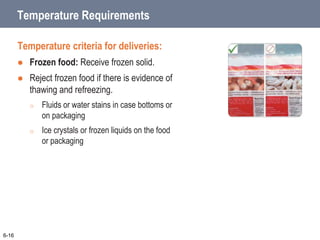
 Frozen food: Receive frozen solid.
 Reject frozen food if there is evidence of
thawing and refreezing.
o Fluids or water stains in case bottoms or
on packaging
o Ice crystals or frozen liquids on the food
or packaging
6-16
Packaging
Reject packaged items with:
 Tears, holes, or punctures in packaging
 Cans—Severe dents in the seam or body,
missing labels, swollen or bulging ends, holes,
leaks, rust
 ROP food—Bloating or leaking
 Broken cartons or seals
6-17
Packaging
Reject packaged items with:
 Dirty and discolored packaging
 Leaks, dampness, or water stains
 Signs of pests or pest damage
 Signs of tampering
 Missing or incorrect labels
 Expired use-by/expiration dates
6-18
Documents and Stamps
Required documents:
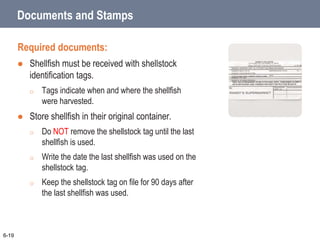
 Shellfish must be received with shellstock
identification tags.
o Tags indicate when and where the shellfish
were harvested.
 Store shellfish in their original container.
o Do NOT remove the shellstock tag until the last
shellfish is used.
o Write the date the last shellfish was used on the
shellstock tag.
o Keep the shellstock tag on file for 90 days after
the last shellfish was used.
6-19
Documents and Stamps
Required documents:
 Fish that will be eaten raw or partially cooked
o Documentation must show the fish was correctly frozen before being received
o Keep documents for 90 days from the sale of the fish
 Farm raised fish
o Must have documentation stating the fish was raised to FDA standards
o Keep documents for 90 days from the sale of the fish
6-20
Documents and Stamps
Products requiring inspection stamps:
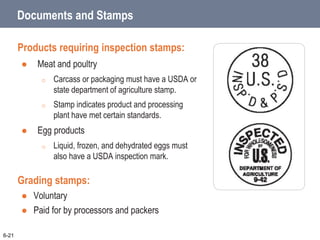
 Meat and poultry
o Carcass or packaging must have a USDA or
state department of agriculture stamp.
o Stamp indicates product and processing
plant have met certain standards.
 Egg products
o Liquid, frozen, and dehydrated eggs must
also have a USDA inspection mark.
Grading stamps:
 Voluntary
 Paid for by processors and packers
6-21
Food Quality
Assessing food quality:
 Appearance: Reject food that is moldy or has
an abnormal color.
 Texture: Reject meat, fish, or poultry if
o It is slimy, sticky, or dry
o It has soft flesh that leaves an imprint when
touched
 Odor: Reject food with an abnormal or
unpleasant odor.
6-22
Fresh fish:
Inspecting Specific Types of Food
Reject criteria:
 Dull gray gills; dull
dry skin
 Soft flesh that
leaves an imprint
when touched
 Strong fishy or
ammonia smell
 Cloudy, red-
rimmed, sunken
eyes
 Tumors,
abscesses, or
cysts on the skin
Accept criteria:
 Bright red gills;
bright shiny skin
 Firm flesh that
springs back when
touched
 Mild ocean or
seaweed smell
 Bright, clear, full
eyes
 Product
surrounded by
crushed, self-
draining ice
6-23
Shellfish:
Inspecting Specific Types of Food
Reject criteria:
 Slimy, sticky, or
dry
 Strong fishy
smell
 Shells are
excessively
muddy or broken
 Dead on arrival
(open shells that
do not close
when tapped)
Accept criteria:
 Mild ocean or
seaweed smell
 Shells are closed
and unbroken,
indicating that
the shellfish are
alive
 If fresh, they
must be received
alive
6-24
Crustaceans:
Inspecting Specific Types of Food
Reject criteria:
 Strong fishy
smell
 Dead on arrival
Accept criteria:
 Mild ocean or
seaweed smell
 Shipped alive,
packed in
seaweed, and
kept moist
6-25
Meat:
Inspecting Specific Types of Food
Reject criteria—
color:
 Beef: brown or
green
 Lamb: brown,
whitish surface
covering the lean
meat
 Pork:
excessively dark
color; soft or
rancid fat
Accept criteria—
color:
 Beef: bright
cherry red; aged
beef may be
darker; vacuum-
packed beef will
appear purplish
 Lamb: light red
 Pork: light pink
meat; firm, white
fat
6-26
Meat:
Inspecting Specific Types of Food
Reject—other
criteria:
 Slimy, sticky, or
dry
 Sour odor
 Broken cartons;
dirty wrappers;
torn packaging;
broken seals
Accept—other
criteria:
 Firm flesh that
springs back
when touched
 No odor
 Packaging is
intact and clean
6-27
Poultry:
Inspecting Specific Types of Food
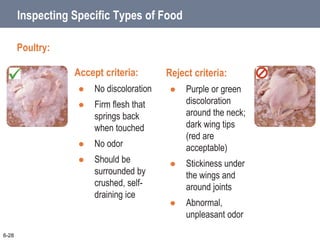
Reject criteria:
 Purple or green
discoloration
around the neck;
dark wing tips
(red are
acceptable)
 Stickiness under
the wings and
around joints
 Abnormal,
unpleasant odor
Accept criteria:
 No discoloration
 Firm flesh that
springs back
when touched
 No odor
 Should be
surrounded by
crushed, self-
draining ice
6-28
Eggs:
Inspecting Specific Types of Food
Reject criteria:
 Sulfur smell or
off odor
 Dirty or cracked
shells
Accept criteria:
 No odor
 Clean and
unbroken shells
6-29
Dairy products:
Inspecting Specific Types of Food
Reject criteria:
 Milk: Sour, bitter, or
moldy taste; off
odor; expired sell-by
date
 Butter: Sour, bitter,
or moldy taste;
uneven color; soft
texture; contains
foreign matter
 Cheese: Abnormal
flavor or texture;
uneven color;
unnatural mold;
unclean or broken
rind
Accept criteria:
 Milk: Sweetish
flavor
 Butter: Sweet
flavor; uniform
color; firm texture
 Cheese: Typical
flavor and
texture; uniform
color; clean and
unbroken rind
6-30
Fresh produce:
Inspecting Specific Types of Food
Reject criteria:
 Evidence of
mishandling or
insects (including
insect eggs and
egg cases)
 Mold, cuts,
wilting,
unpleasant
odors,
discoloration,
etc. (will depend
on the produce
involved)
Accept criteria:
 Temperature
varies according
to the product
 Condition varies
according to the
product
6-31

Chapter 6 (College HIA)

  • 2.
    Objectives Identify the following: Characteristics of an approved supplier  Guidelines for receiving and inspecting deliveries  Requirements for key drop deliveries  Procedure for handling food recalls  Procedures for checking the temperatures of various food items  Temperature requirements when receiving food 6-2
  • 3.
    Objectives Identify the following: Packaging requirements when receiving food  Documentation required when receiving food  Government inspection stamps required when receiving food  Quality requirements when receiving food  Receiving criteria for specific food items 6-3
  • 4.
    Purchasing Considerations Purchase foodfrom approved, reputable suppliers:  They have been inspected  They meet all applicable local, state, and federal laws 6-4
  • 5.
    Purchasing Considerations A supplier’sinspection report should review these areas:  Receiving and storage  Processing  Shipping  Cleaning and sanitizing  Personal hygiene  Staff training  Recall program  HACCP program or other food safety system 6-5
  • 6.
    Receiving Considerations Receiving guidelines: Have food delivered when staff can inspect it.  Make specific staff responsible for receiving. o Train them to follow food safety procedures. o Allow them to accept, reject, and sign for deliveries. o Provide staff with tools.  Plan ahead for shipments.  Inspect deliveries immediately. 6-6
  • 7.
    Receiving Considerations Inspection process: Inspect the delivery truck.  Inspect the food items. o Count quantities and spot-check weights. o Check for damage, repackaging, and mishandling. o Take sample temperatures of all TCS food.  Inspect and store each delivery before accepting another one. 6-7
  • 8.
    Receiving Considerations Key dropdeliveries:  Supplier is given after-hour access to the operation to make deliveries.  Staff must inspect the deliveries upon arrival at the operation.  Deliveries must meet the following criteria. o From an approved source o Placed in the correct storage location to maintain the required temperature o Protected from contamination in storage o NOT contaminated o Presented honestly 6-8
  • 9.
    Receiving Considerations Rejecting items: Separate rejected items from accepted items.  Tell the delivery person what is wrong with the item.  Get a signed adjustment or credit slip before giving the rejected item to the delivery person.  Log the incident on the invoice or receiving document. 6-9
  • 10.
    Receiving and Inspecting Recalls: Identify the recalled food items.  Remove the item from inventory.  Store the item separately.  Label the item to prevent it from being placed back in inventory.  Inform staff not to use the product.  Refer to the vendor’s notification or recall notice for what to do with the item. 6-10
  • 11.
    6-11 Checking Temperatures Checking thetemperature of meat, poultry, and fish:  Insert the thermometer stem or probe into the thickest part of the food (usually the center).
  • 12.
    6-12 Checking Temperatures Checking thetemperature of ROP Food (MAP, vacuum-packed, and sous vide food):  Insert the thermometer stem or probe between two packages.  As an alternative, fold packaging around the thermometer stem or probe.
  • 13.
    6-13 Checking Temperatures Checking thetemperature of other packaged food:  Open the package and insert the thermometer stem or probe into the food.
  • 14.
    Temperature Requirements Temperature criteriafor deliveries:  Cold TCS food: Receive at 41˚F (5˚C) or lower, unless otherwise specified.  Live shellfish (oysters, mussels, clams, and scallops ): Receive at an air temperature of 45˚F (7˚C) and an internal temperature no greater than 50˚F (10˚C). o Once received, the shellfish must be cooled to 41˚F (5˚C) or lower in four hours.  Shucked shellfish: Receive at 45˚F (7˚C) or lower. o Cool the shellfish to 41˚F (5˚F) or lower in four hours. 6-14
  • 15.
    Temperature Requirements Temperature criteriafor deliveries:  Milk: Receive at 45˚F (7˚C) or lower. o Cool the milk to 41˚F (5˚C) or lower in four hours.  Shell eggs: Receive at an air temperature of 45˚F (7˚C) or lower.  Hot TCS food: Receive at 135˚F (57˚C) or higher. 6-15
  • 16.
    Temperature Requirements Temperature criteriafor deliveries:  Frozen food: Receive frozen solid.  Reject frozen food if there is evidence of thawing and refreezing. o Fluids or water stains in case bottoms or on packaging o Ice crystals or frozen liquids on the food or packaging 6-16
  • 17.
    Packaging Reject packaged itemswith:  Tears, holes, or punctures in packaging  Cans—Severe dents in the seam or body, missing labels, swollen or bulging ends, holes, leaks, rust  ROP food—Bloating or leaking  Broken cartons or seals 6-17
  • 18.
    Packaging Reject packaged itemswith:  Dirty and discolored packaging  Leaks, dampness, or water stains  Signs of pests or pest damage  Signs of tampering  Missing or incorrect labels  Expired use-by/expiration dates 6-18
  • 19.
    Documents and Stamps Requireddocuments:  Shellfish must be received with shellstock identification tags. o Tags indicate when and where the shellfish were harvested.  Store shellfish in their original container. o Do NOT remove the shellstock tag until the last shellfish is used. o Write the date the last shellfish was used on the shellstock tag. o Keep the shellstock tag on file for 90 days after the last shellfish was used. 6-19
  • 20.
    Documents and Stamps Requireddocuments:  Fish that will be eaten raw or partially cooked o Documentation must show the fish was correctly frozen before being received o Keep documents for 90 days from the sale of the fish  Farm raised fish o Must have documentation stating the fish was raised to FDA standards o Keep documents for 90 days from the sale of the fish 6-20
  • 21.
    Documents and Stamps Productsrequiring inspection stamps:  Meat and poultry o Carcass or packaging must have a USDA or state department of agriculture stamp. o Stamp indicates product and processing plant have met certain standards.  Egg products o Liquid, frozen, and dehydrated eggs must also have a USDA inspection mark. Grading stamps:  Voluntary  Paid for by processors and packers 6-21
  • 22.
    Food Quality Assessing foodquality:  Appearance: Reject food that is moldy or has an abnormal color.  Texture: Reject meat, fish, or poultry if o It is slimy, sticky, or dry o It has soft flesh that leaves an imprint when touched  Odor: Reject food with an abnormal or unpleasant odor. 6-22
  • 23.
    Fresh fish: Inspecting SpecificTypes of Food Reject criteria:  Dull gray gills; dull dry skin  Soft flesh that leaves an imprint when touched  Strong fishy or ammonia smell  Cloudy, red- rimmed, sunken eyes  Tumors, abscesses, or cysts on the skin Accept criteria:  Bright red gills; bright shiny skin  Firm flesh that springs back when touched  Mild ocean or seaweed smell  Bright, clear, full eyes  Product surrounded by crushed, self- draining ice 6-23
  • 24.
    Shellfish: Inspecting Specific Typesof Food Reject criteria:  Slimy, sticky, or dry  Strong fishy smell  Shells are excessively muddy or broken  Dead on arrival (open shells that do not close when tapped) Accept criteria:  Mild ocean or seaweed smell  Shells are closed and unbroken, indicating that the shellfish are alive  If fresh, they must be received alive 6-24
  • 25.
    Crustaceans: Inspecting Specific Typesof Food Reject criteria:  Strong fishy smell  Dead on arrival Accept criteria:  Mild ocean or seaweed smell  Shipped alive, packed in seaweed, and kept moist 6-25
  • 26.
    Meat: Inspecting Specific Typesof Food Reject criteria— color:  Beef: brown or green  Lamb: brown, whitish surface covering the lean meat  Pork: excessively dark color; soft or rancid fat Accept criteria— color:  Beef: bright cherry red; aged beef may be darker; vacuum- packed beef will appear purplish  Lamb: light red  Pork: light pink meat; firm, white fat 6-26
  • 27.
    Meat: Inspecting Specific Typesof Food Reject—other criteria:  Slimy, sticky, or dry  Sour odor  Broken cartons; dirty wrappers; torn packaging; broken seals Accept—other criteria:  Firm flesh that springs back when touched  No odor  Packaging is intact and clean 6-27
  • 28.
    Poultry: Inspecting Specific Typesof Food Reject criteria:  Purple or green discoloration around the neck; dark wing tips (red are acceptable)  Stickiness under the wings and around joints  Abnormal, unpleasant odor Accept criteria:  No discoloration  Firm flesh that springs back when touched  No odor  Should be surrounded by crushed, self- draining ice 6-28
  • 29.
    Eggs: Inspecting Specific Typesof Food Reject criteria:  Sulfur smell or off odor  Dirty or cracked shells Accept criteria:  No odor  Clean and unbroken shells 6-29
  • 30.
    Dairy products: Inspecting SpecificTypes of Food Reject criteria:  Milk: Sour, bitter, or moldy taste; off odor; expired sell-by date  Butter: Sour, bitter, or moldy taste; uneven color; soft texture; contains foreign matter  Cheese: Abnormal flavor or texture; uneven color; unnatural mold; unclean or broken rind Accept criteria:  Milk: Sweetish flavor  Butter: Sweet flavor; uniform color; firm texture  Cheese: Typical flavor and texture; uniform color; clean and unbroken rind 6-30
  • 31.
    Fresh produce: Inspecting SpecificTypes of Food Reject criteria:  Evidence of mishandling or insects (including insect eggs and egg cases)  Mold, cuts, wilting, unpleasant odors, discoloration, etc. (will depend on the produce involved) Accept criteria:  Temperature varies according to the product  Condition varies according to the product 6-31