WHAT IS ARREST
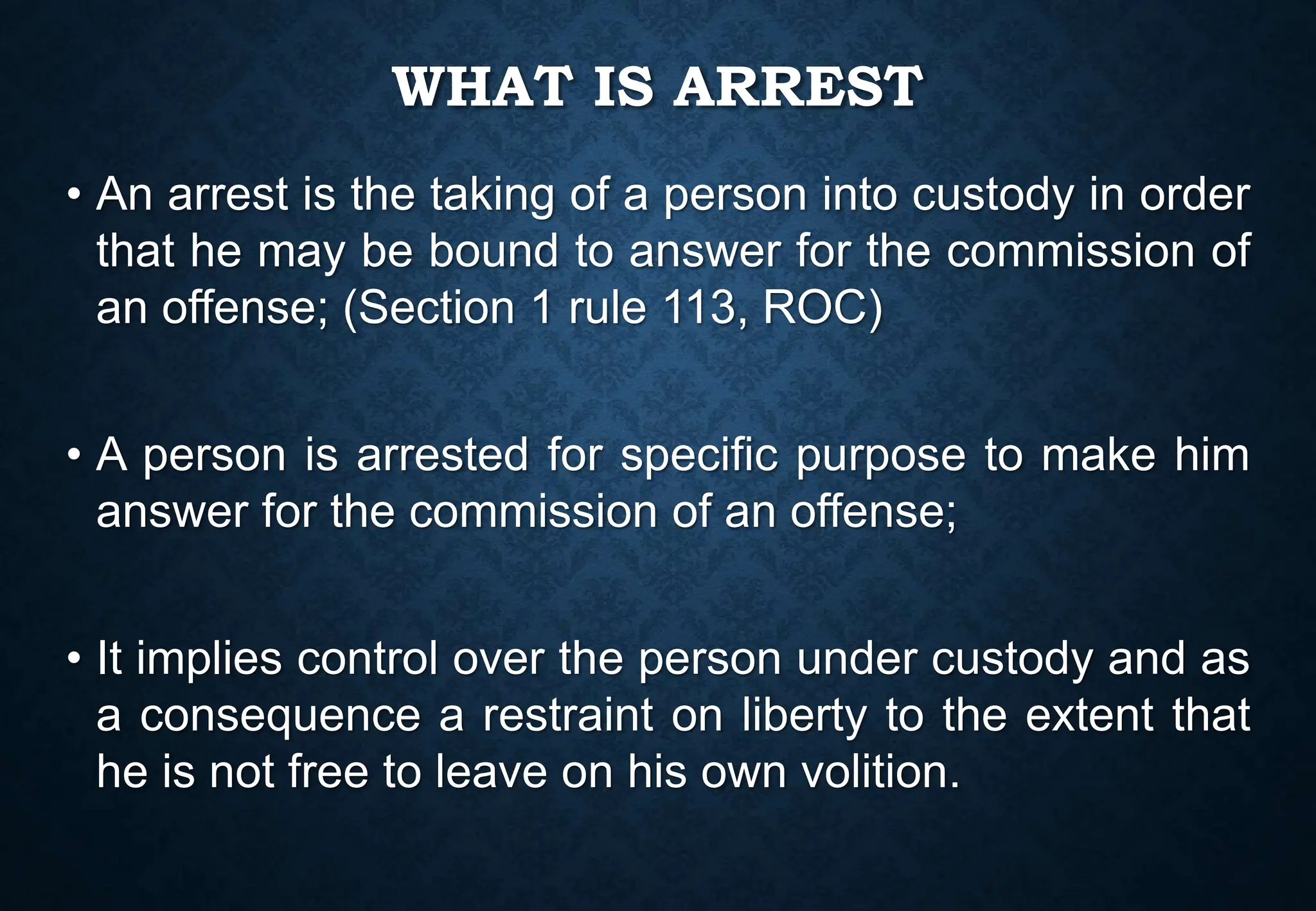
• An arrest is the taking of a person into custody in order
that he may be bound to answer for the commission of
an offense; (Section 1 rule 113, ROC)
• A person is arrested for specific purpose to make him
answer for the commission of an offense;
• It implies control over the person under custody and as
a consequence a restraint on liberty to the extent that
he is not free to leave on his own volition.
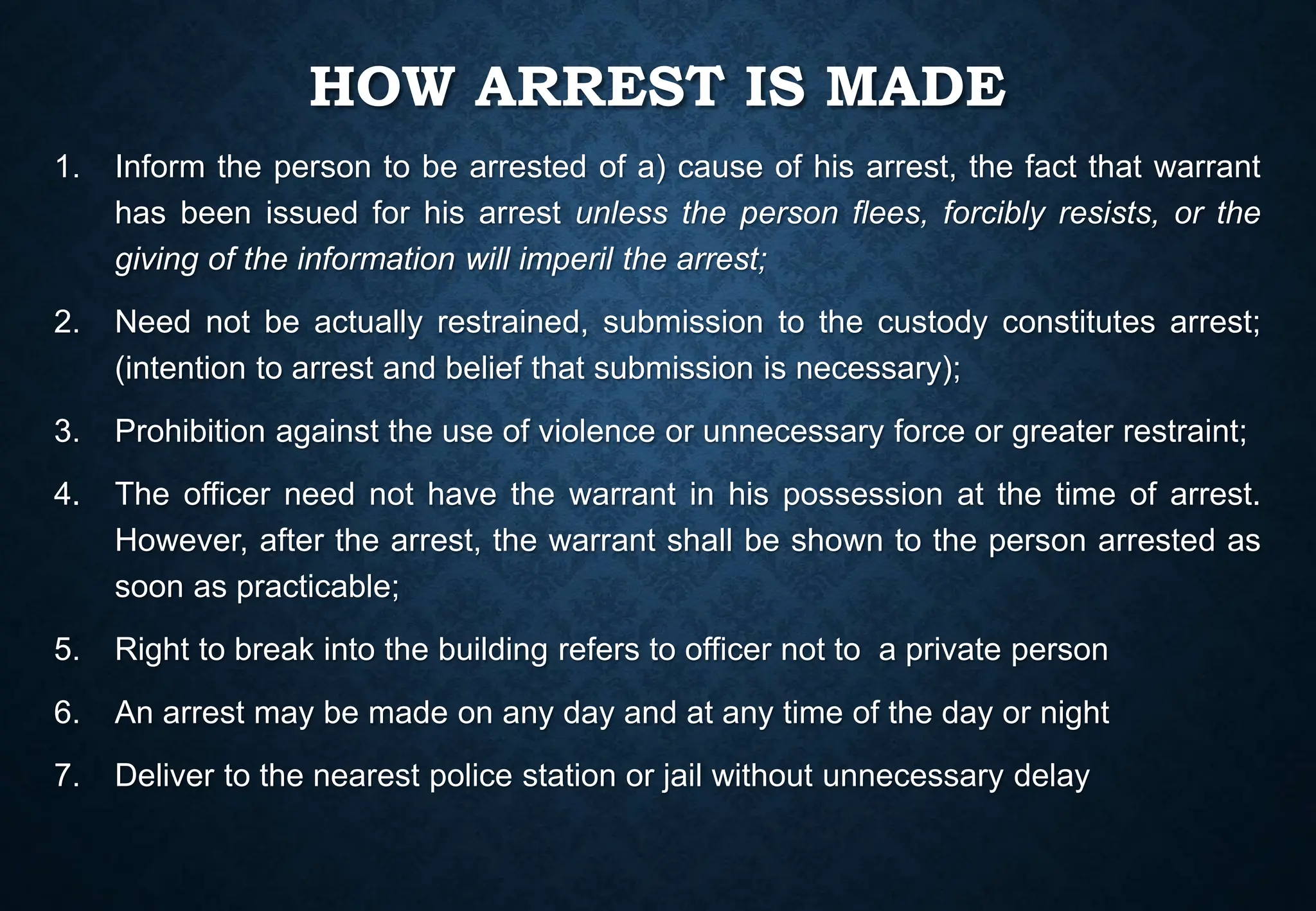
HOW ARREST IS MADE
1. Inform the person to be arrested of a) cause of his arrest, the fact that warrant
has been issued for his arrest unless the person flees, forcibly resists, or the
giving of the information will imperil the arrest;
2. Need not be actually restrained, submission to the custody constitutes arrest;
(intention to arrest and belief that submission is necessary);
3. Prohibition against the use of violence or unnecessary force or greater restraint;
4. The officer need not have the warrant in his possession at the time of arrest.
However, after the arrest, the warrant shall be shown to the person arrested as
soon as practicable;
5. Right to break into the building refers to officer not to a private person
6. An arrest may be made on any day and at any time of the day or night
7. Deliver to the nearest police station or jail without unnecessary delay
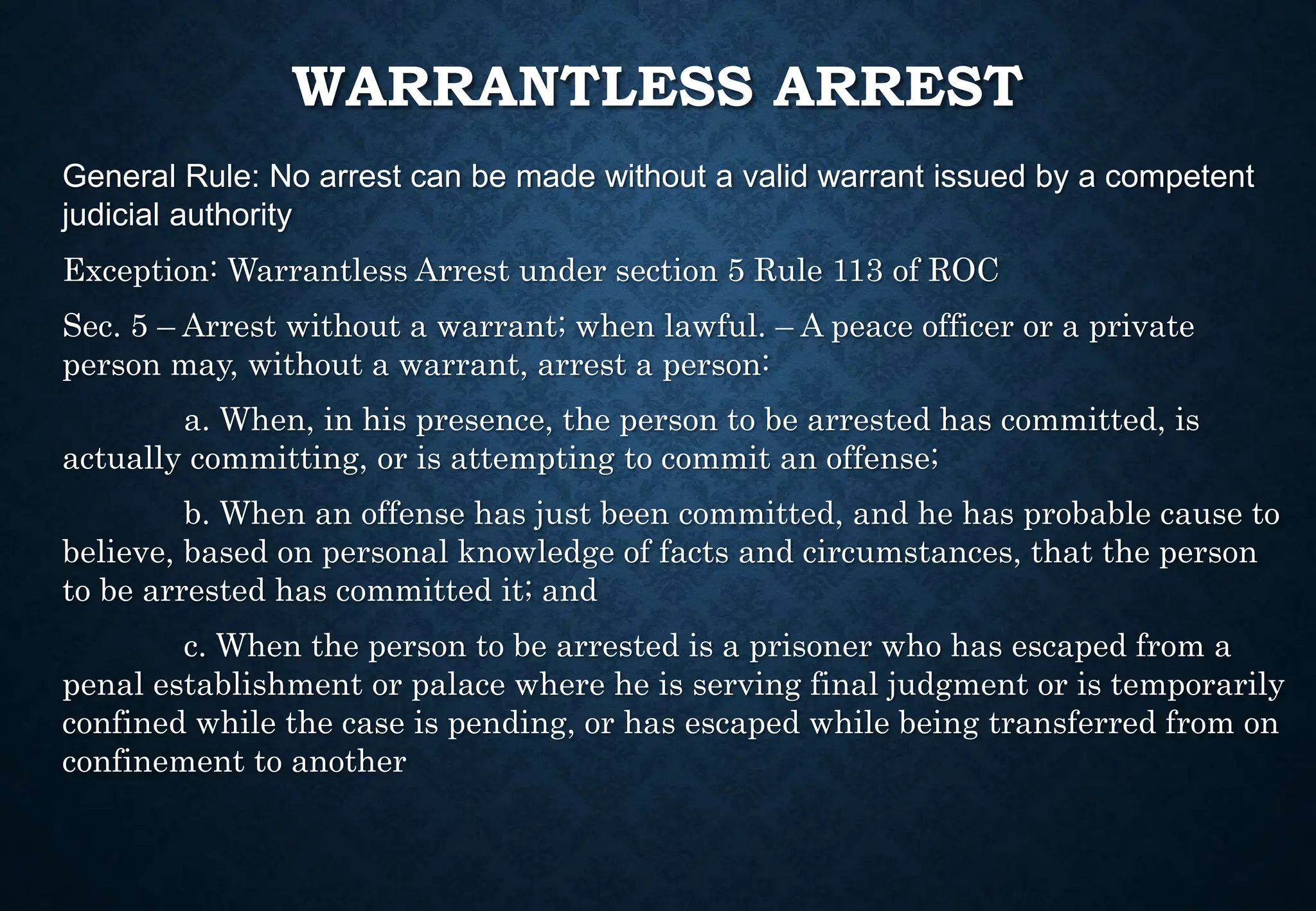
General Rule: No arrest can be made without a valid warrant issued by a competent
judicial authority
Exception: Warrantless Arrest under section 5 Rule 113 of ROC
Sec. 5 – Arrest without a warrant; when lawful. – A peace officer or a private
person may, without a warrant, arrest a person:
a. When, in his presence, the person to be arrested has committed, is
actually committing, or is attempting to commit an offense;
b. When an offense has just been committed, and he has probable cause to
believe, based on personal knowledge of facts and circumstances, that the person
to be arrested has committed it; and
c. When the person to be arrested is a prisoner who has escaped from a
penal establishment or palace where he is serving final judgment or is temporarily
confined while the case is pending, or has escaped while being transferred from on
confinement to another
WARRANTLESS ARREST
a. When, in his presence, the person to be arrested has committed, is actually
committing, or is attempting to commit an offense;
 In flagrante Delicto – The person to be arrested must execute an overt act indicating
that he has just committed, is actually committing, or is attempting to commit a crime
and such overt act is done in the presence or within the view of the arresting officer.
 The person making the arrest himself witnesses the crime and has personal knowledge
of the commission of the offense. (ex. Mr. A fired a gun to Mr. B/
buy-bust operation)
 Seeing the offense at a distance, or hears the disturbance created and proceeds at once
to the scene – can effect arrest without warrant as this is committed in his presence
 Flight per se or act of darting away – not reliable indicator of guilt
 Reliable information alone absent any overt act in the presence of arresting officer and
looking at every person passing by – not sufficient to constitute probable cause
WARRANTLESS ARREST
PEOPLE VS MENGOTE
• The issue on the legality of the arrest, search and seizure stemmed from a
telephone call to the police by an alleged informer that suspicious-looking men
were at a street corner in Tondo shortly before noon. The police operatives
,dispatched to the place, saw three men, one of whom turned out to be Mengote,
who was looking from side to side clutching his abdomen. The operatives
approached the three men and introduced themselves as policemen. Two of
them tried to run away but the attempt was foiled. The search yielded a revolver
in the possession of Mengote and a fan knife in the pocket of another. Mengote
contends that the revolver should not have been admitted in evidence because its
seizure was a product of an illegal search and made not as an incident to a lawful
arrest.
The court observed that there was nothing clandestine about his being on
that street at that busy hour in the blaze of the noonday sun. By no stretch of
the imagination could have been inferred from these acts that an offense
had just been committed, or was at least being attempted in their presence
WARRANTLESS ARREST
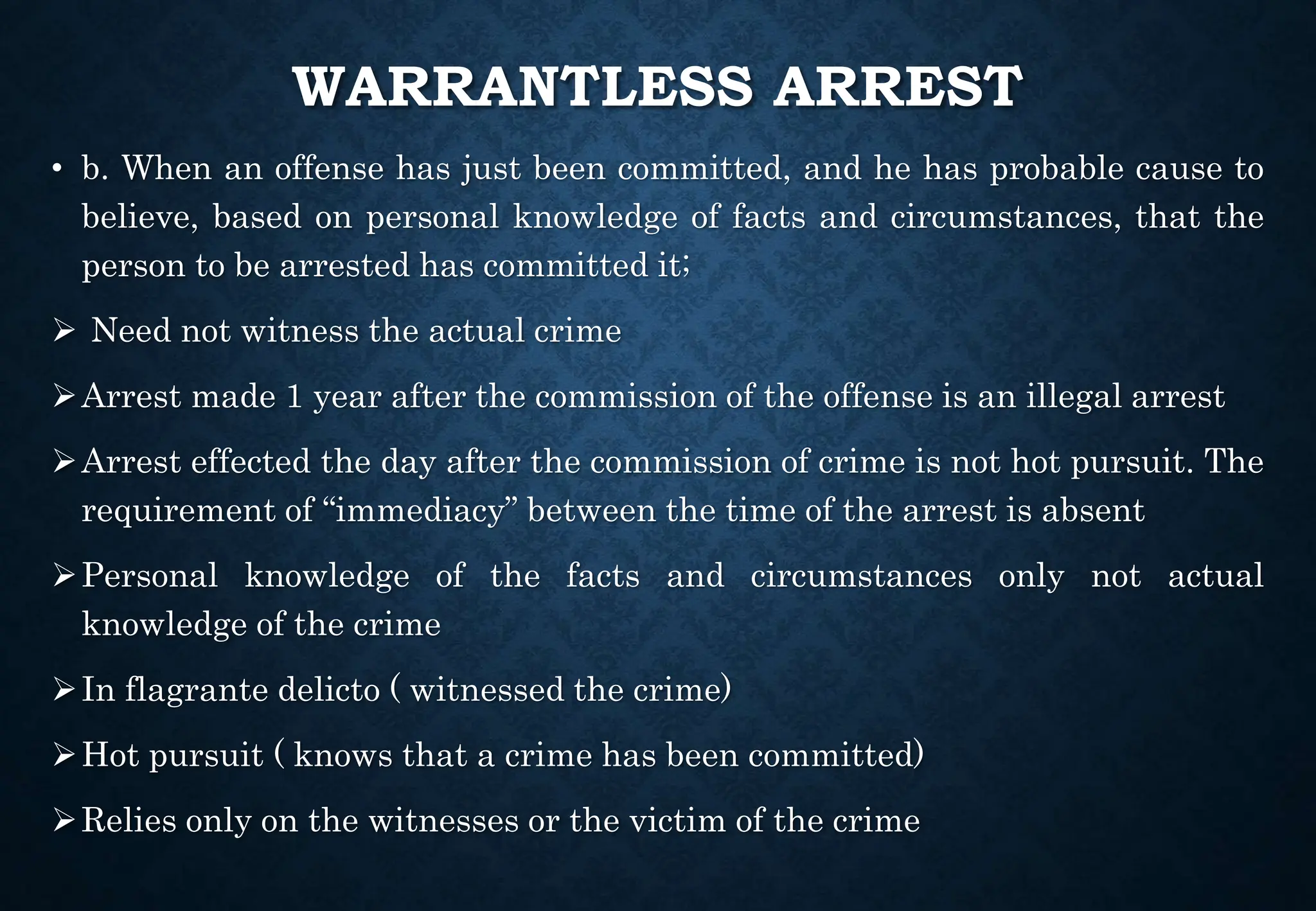
• b. When an offense has just been committed, and he has probable cause to
believe, based on personal knowledge of facts and circumstances, that the
person to be arrested has committed it;
 Need not witness the actual crime
Arrest made 1 year after the commission of the offense is an illegal arrest
Arrest effected the day after the commission of crime is not hot pursuit. The
requirement of “immediacy” between the time of the arrest is absent
Personal knowledge of the facts and circumstances only not actual
knowledge of the crime
In flagrante delicto ( witnessed the crime)
Hot pursuit ( knows that a crime has been committed)
Relies only on the witnesses or the victim of the crime
• Personal knowledge based on PROBABLE CAUSE
• PROBABLE CAUSE- actual belief or reasonable
grounds of suspicion
• The person to be arrested is probably guilty based on
actual facts
SEARCH WARRANT
• A search warrant is an order in writing issued in the name of the People of
the Philippines, signed by the judge and directed to a peace officer,
commanding him to search for personal property described therein and
bring it before the court. (sec. 1, Rule 126)
• Intended as a restraint against the government and its agents tasked with
the law enforcement and NOT against acts of private individuals
• Searches made by members of barangay based volunteer group or bantay
bayan operatives relating to preservation of peace and order – have the
color of state related function and deemed as law enforcement authorities
for purposes of applying the bill of rights
• Served on daytime only and valid for 10 days only.
SEARCH WARRANT
• Principle of Ejusdem Generis – if a statute describes things of a particular
class or kind accompanied by words of generic character, the generic word
will be limited to things of nature with those particularly enumerated.
• Ex. Methamphetamine Hydrochloride and paraphernalia
( cash, component, speaker, hammer, wallet – not included)
 Constitutional Requirement of particular description is to limit the things
to be taken only those particularly described in the warrant to avoid
fishing expedition to confiscate all kinds of articles relating to crime
 Personal property subject of the offense, stolen or embezzled and other
proceeds, or fruits of the offense, or personal property used or intended to
be used as a means of committing an offense.
EXCEPTIONS
• Warrantless Search incidental to lawful arrest;
• Seizure of evidence in “Plain View”
• Search of a moving vehicle’;
• Consented warrantless search;
• Customs search;
• Stop and frisk or Terry Searches
• Exigent and emergency circumstances
• Search of vessel and aircraft
• Inspection of Buildings and other premises for the
enforcement of fire, sanitary and building regulations
SEARCH INCIDENTAL TO LAWFUL
ARREST
• Sec 13 Rule 126 – A person lawfully arrested may be searched for
dangerous weapons or anything which may have been used or
constitute proof on the commission of an offense without a search
warrant
• Purpose – To protect law enforcers from the injury that may be inflicted
on them and prevent evidence from being destroyed
IS THE SEARCH CONFINED TO THE
SEARCH OF THE PERSON LAWFULLY
ARRESTED?
• No, it is the duty and the right of the arresting officer to conduct a
warrantless search not only on the person of the suspect but also within
the permissible area within the latter’s reach or within the area of
immediate control.
• It means the area from within which he might gain possession of a
weapon or destructible evidence.
• Ex. A gun on a table or in the drawer in front of the person arrested can
be as dangerous as one concealed in the clothing of the person arrested.
PLAIN VIEW DOCTRINE
Objects falling in the plain view of an officer who has the right to
be in the position to have that view are subject to seizure and may
be presented as evidence.
The officer has prior justification of intrusion;
The discovery is inadvertent;
Immediately apparent to the officer that the item he observes
may be evidence of crime, contraband or otherwise subject of
seizure;
It is plain view when exposed to the sight and if the package
proclaims its contents by distinctive configuration, transparency,
and contents are obvious to the observer;
THE INADVERTENCE REQUIREMENT
UNDER THE PLAIN VIEW DOCTRINE
•The requirement of inadvertence means
that the officer must not have known in
advance of the location of the evidence
and discovery is not anticipated
THE IMMEDIATELY APPARENT REQUIREMENT
UNDER THE PLAIN VIEW DOCTRINE
• This requirement means that the incriminating nature of the
evidence becomes apparent if the officer, at the moment of
seizure, had probable cause to connect to a crime without the
benefit of an unlawful search or seizure
• It requires merely that the seizure be presumptively
reasonable assuming that there is probable cause to
associate the property with the criminal activity; that nexus
exists between a viewed object and criminal activity.
PLAIN VIEW DOCTRINE
Examples:
1. Seeing a sub-machine gun and two hand grenades in front
seat of the car items not normally issued to civilian;
2. Seeing on the table plastic sachets containing crystalline
substance not described in the warrant to search antique
images
3. Seeing a gun tucked in the waist
4. Seeing a person placing sachet of white crystalline
substance into the cigarette;
STOP AND FRISK SEARCHES
• Terry vs Ohio- The court held that were the police officer observes
unusual conduct which leads him reasonably to conclude in the light of
his experience that criminal activity may be afoot and that the persons
with whom he is dealing may be armed and presently dangerous,
where in the course of investigating this behavior he identifies himself
as a policeman and makes reasonable inquiries, and where nothing in
the initial stages of the encounter serves to dispel his reasonable fear
for his own or other’s safety, he is entitled for the protection of himself
and others in the area to conduct a carefully limited search of the outer
clothing of such persons in an attempt to discover weapons which
might be used to assault him. Such search is reasonable search and
any weapons seized may properly be introduced in evidence against
the persons from whom they were taken
SUMMARY OF TERRY DOCTRINE
• The “STOP” and the “FRISK”
• A valid stop by an officer requires that he has reasonable belief that
criminal activity has happened or is about to happen.
• The frisk made after the stop must be done because of a reasonable
belief that he is in possession of a weapon that will pose danger to
the officer and others. It must be a mere pat down outside the
person’s outer garment and not unreasonably intrusive.
• Based on “specific and articulable facts”
The general rule is that all searches and seizure made without
a warrant are invalid. The failure to obtain a warrant will
result in the application of the exclusionary rule
The exclusionary rule prevents, upon proper motion or
objection, the admission of evidence illegally obtained. Thus,
the most important effect of an illegal search and seizure is
the exclusion of the evidence obtained from being used against
the person whose rights were violated, the proverbial and
jurisprudential “Fruit of the Poisonous Tree”.

Presentation regarding Arrest Search and Seizure.pptx

  • 1.
    WHAT IS ARREST •An arrest is the taking of a person into custody in order that he may be bound to answer for the commission of an offense; (Section 1 rule 113, ROC) • A person is arrested for specific purpose to make him answer for the commission of an offense; • It implies control over the person under custody and as a consequence a restraint on liberty to the extent that he is not free to leave on his own volition.
  • 2.
    HOW ARREST ISMADE 1. Inform the person to be arrested of a) cause of his arrest, the fact that warrant has been issued for his arrest unless the person flees, forcibly resists, or the giving of the information will imperil the arrest; 2. Need not be actually restrained, submission to the custody constitutes arrest; (intention to arrest and belief that submission is necessary); 3. Prohibition against the use of violence or unnecessary force or greater restraint; 4. The officer need not have the warrant in his possession at the time of arrest. However, after the arrest, the warrant shall be shown to the person arrested as soon as practicable; 5. Right to break into the building refers to officer not to a private person 6. An arrest may be made on any day and at any time of the day or night 7. Deliver to the nearest police station or jail without unnecessary delay
  • 3.
    General Rule: Noarrest can be made without a valid warrant issued by a competent judicial authority Exception: Warrantless Arrest under section 5 Rule 113 of ROC Sec. 5 – Arrest without a warrant; when lawful. – A peace officer or a private person may, without a warrant, arrest a person: a. When, in his presence, the person to be arrested has committed, is actually committing, or is attempting to commit an offense; b. When an offense has just been committed, and he has probable cause to believe, based on personal knowledge of facts and circumstances, that the person to be arrested has committed it; and c. When the person to be arrested is a prisoner who has escaped from a penal establishment or palace where he is serving final judgment or is temporarily confined while the case is pending, or has escaped while being transferred from on confinement to another WARRANTLESS ARREST
  • 4.
    a. When, inhis presence, the person to be arrested has committed, is actually committing, or is attempting to commit an offense;  In flagrante Delicto – The person to be arrested must execute an overt act indicating that he has just committed, is actually committing, or is attempting to commit a crime and such overt act is done in the presence or within the view of the arresting officer.  The person making the arrest himself witnesses the crime and has personal knowledge of the commission of the offense. (ex. Mr. A fired a gun to Mr. B/ buy-bust operation)  Seeing the offense at a distance, or hears the disturbance created and proceeds at once to the scene – can effect arrest without warrant as this is committed in his presence  Flight per se or act of darting away – not reliable indicator of guilt  Reliable information alone absent any overt act in the presence of arresting officer and looking at every person passing by – not sufficient to constitute probable cause WARRANTLESS ARREST
  • 5.
    PEOPLE VS MENGOTE •The issue on the legality of the arrest, search and seizure stemmed from a telephone call to the police by an alleged informer that suspicious-looking men were at a street corner in Tondo shortly before noon. The police operatives ,dispatched to the place, saw three men, one of whom turned out to be Mengote, who was looking from side to side clutching his abdomen. The operatives approached the three men and introduced themselves as policemen. Two of them tried to run away but the attempt was foiled. The search yielded a revolver in the possession of Mengote and a fan knife in the pocket of another. Mengote contends that the revolver should not have been admitted in evidence because its seizure was a product of an illegal search and made not as an incident to a lawful arrest. The court observed that there was nothing clandestine about his being on that street at that busy hour in the blaze of the noonday sun. By no stretch of the imagination could have been inferred from these acts that an offense had just been committed, or was at least being attempted in their presence
  • 6.
    WARRANTLESS ARREST • b.When an offense has just been committed, and he has probable cause to believe, based on personal knowledge of facts and circumstances, that the person to be arrested has committed it;  Need not witness the actual crime Arrest made 1 year after the commission of the offense is an illegal arrest Arrest effected the day after the commission of crime is not hot pursuit. The requirement of “immediacy” between the time of the arrest is absent Personal knowledge of the facts and circumstances only not actual knowledge of the crime In flagrante delicto ( witnessed the crime) Hot pursuit ( knows that a crime has been committed) Relies only on the witnesses or the victim of the crime
  • 7.
    • Personal knowledgebased on PROBABLE CAUSE • PROBABLE CAUSE- actual belief or reasonable grounds of suspicion • The person to be arrested is probably guilty based on actual facts
  • 8.
    SEARCH WARRANT • Asearch warrant is an order in writing issued in the name of the People of the Philippines, signed by the judge and directed to a peace officer, commanding him to search for personal property described therein and bring it before the court. (sec. 1, Rule 126) • Intended as a restraint against the government and its agents tasked with the law enforcement and NOT against acts of private individuals • Searches made by members of barangay based volunteer group or bantay bayan operatives relating to preservation of peace and order – have the color of state related function and deemed as law enforcement authorities for purposes of applying the bill of rights • Served on daytime only and valid for 10 days only.
  • 9.
    SEARCH WARRANT • Principleof Ejusdem Generis – if a statute describes things of a particular class or kind accompanied by words of generic character, the generic word will be limited to things of nature with those particularly enumerated. • Ex. Methamphetamine Hydrochloride and paraphernalia ( cash, component, speaker, hammer, wallet – not included)  Constitutional Requirement of particular description is to limit the things to be taken only those particularly described in the warrant to avoid fishing expedition to confiscate all kinds of articles relating to crime  Personal property subject of the offense, stolen or embezzled and other proceeds, or fruits of the offense, or personal property used or intended to be used as a means of committing an offense.
  • 10.
    EXCEPTIONS • Warrantless Searchincidental to lawful arrest; • Seizure of evidence in “Plain View” • Search of a moving vehicle’; • Consented warrantless search; • Customs search; • Stop and frisk or Terry Searches • Exigent and emergency circumstances • Search of vessel and aircraft • Inspection of Buildings and other premises for the enforcement of fire, sanitary and building regulations
  • 11.
    SEARCH INCIDENTAL TOLAWFUL ARREST • Sec 13 Rule 126 – A person lawfully arrested may be searched for dangerous weapons or anything which may have been used or constitute proof on the commission of an offense without a search warrant • Purpose – To protect law enforcers from the injury that may be inflicted on them and prevent evidence from being destroyed
  • 12.
    IS THE SEARCHCONFINED TO THE SEARCH OF THE PERSON LAWFULLY ARRESTED? • No, it is the duty and the right of the arresting officer to conduct a warrantless search not only on the person of the suspect but also within the permissible area within the latter’s reach or within the area of immediate control. • It means the area from within which he might gain possession of a weapon or destructible evidence. • Ex. A gun on a table or in the drawer in front of the person arrested can be as dangerous as one concealed in the clothing of the person arrested.
  • 13.
    PLAIN VIEW DOCTRINE Objectsfalling in the plain view of an officer who has the right to be in the position to have that view are subject to seizure and may be presented as evidence. The officer has prior justification of intrusion; The discovery is inadvertent; Immediately apparent to the officer that the item he observes may be evidence of crime, contraband or otherwise subject of seizure; It is plain view when exposed to the sight and if the package proclaims its contents by distinctive configuration, transparency, and contents are obvious to the observer;
  • 14.
    THE INADVERTENCE REQUIREMENT UNDERTHE PLAIN VIEW DOCTRINE •The requirement of inadvertence means that the officer must not have known in advance of the location of the evidence and discovery is not anticipated
  • 15.
    THE IMMEDIATELY APPARENTREQUIREMENT UNDER THE PLAIN VIEW DOCTRINE • This requirement means that the incriminating nature of the evidence becomes apparent if the officer, at the moment of seizure, had probable cause to connect to a crime without the benefit of an unlawful search or seizure • It requires merely that the seizure be presumptively reasonable assuming that there is probable cause to associate the property with the criminal activity; that nexus exists between a viewed object and criminal activity.
  • 16.
    PLAIN VIEW DOCTRINE Examples: 1.Seeing a sub-machine gun and two hand grenades in front seat of the car items not normally issued to civilian; 2. Seeing on the table plastic sachets containing crystalline substance not described in the warrant to search antique images 3. Seeing a gun tucked in the waist 4. Seeing a person placing sachet of white crystalline substance into the cigarette;
  • 17.
    STOP AND FRISKSEARCHES • Terry vs Ohio- The court held that were the police officer observes unusual conduct which leads him reasonably to conclude in the light of his experience that criminal activity may be afoot and that the persons with whom he is dealing may be armed and presently dangerous, where in the course of investigating this behavior he identifies himself as a policeman and makes reasonable inquiries, and where nothing in the initial stages of the encounter serves to dispel his reasonable fear for his own or other’s safety, he is entitled for the protection of himself and others in the area to conduct a carefully limited search of the outer clothing of such persons in an attempt to discover weapons which might be used to assault him. Such search is reasonable search and any weapons seized may properly be introduced in evidence against the persons from whom they were taken
  • 18.
    SUMMARY OF TERRYDOCTRINE • The “STOP” and the “FRISK” • A valid stop by an officer requires that he has reasonable belief that criminal activity has happened or is about to happen. • The frisk made after the stop must be done because of a reasonable belief that he is in possession of a weapon that will pose danger to the officer and others. It must be a mere pat down outside the person’s outer garment and not unreasonably intrusive. • Based on “specific and articulable facts”
  • 19.
    The general ruleis that all searches and seizure made without a warrant are invalid. The failure to obtain a warrant will result in the application of the exclusionary rule The exclusionary rule prevents, upon proper motion or objection, the admission of evidence illegally obtained. Thus, the most important effect of an illegal search and seizure is the exclusion of the evidence obtained from being used against the person whose rights were violated, the proverbial and jurisprudential “Fruit of the Poisonous Tree”.