Lesson 31 Grant, Veronica, Eric
Vocabulary Affidavit - Formally sworn statement Exclusionary Rule – The rule established by the US Supreme Court that evidence unconstitutionally gathered by law enforcement officers may not be against a defendant in a trial. Probable Cause – Reasonable grounds for presuming that a crime has been or is in the process of being committed. Warrant – A order by a judge authorizing a police officer to make an arrest or search or perform some other designated act.
Vocab Con’t Reasonableness – quality of what a rational a fair minded person might say. Search – in the context of the American constitutional law intrusion into someone's privacy. Seizure – in the context of the US constitutional law interference with a persons property or freedom of movement. Self-incrimination – personal benefits contrasted with the public interest or the common good.
Vocab Con’t Use immunity – a guarantee government prosecutors gave to a witness to not use the witnesses' self incriminating compelled testimony as evidence against the witness in a subsequent criminal prosecution. A witness who receives use immunity may still be prosecuted, but based only on evidence not gathered from protected testimony.
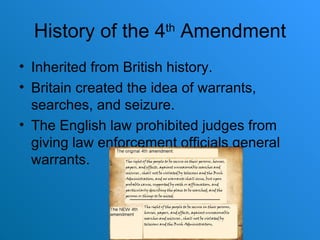
History of the 4 th  Amendment Inherited from British history. Britain created the idea of warrants, searches, and seizure. The English law prohibited judges from giving law enforcement officials general warrants.
Fourth Amendment Prohibits general warrants Requires applications for warrants to be supported by probable cause. Requires a judge or magistrate, not the official who official who will serve the warrant, to decide whether probable cause exist. Requires applications for warrants to particularly to describe the place, persons, and things to be siezed.
Interpreting and Applying the Fourth Amendment The fourth amendment raises three important questions: When is a warrant required? What is probable cause and when is it required? How should the fourth amendment be enforced?
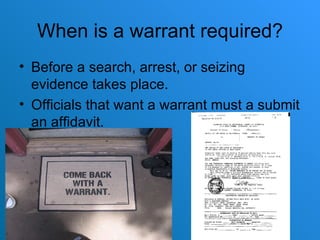
When is a warrant required? Before a search, arrest, or seizing evidence takes place. Officials that want a warrant must a submit an affidavit.
When is a probable cause and when is it required? Probable cause means there is enough evidence for a reasonable person to believe that it is likely that an illegal act is being or has been committed. Probable cause requires more than a hunch or a vague suspicion.
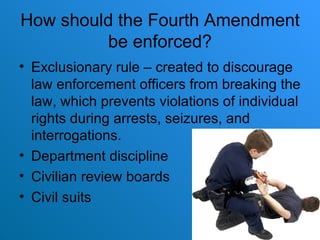
How should the Fourth Amendment be enforced? Exclusionary rule – created to discourage law enforcement officers from breaking the law, which prevents violations of individual rights during arrests, seizures, and interrogations. Department discipline Civilian review boards Civil suits
Purpose of the 5 th  amendment Self-Incrimination – Criminal defendant can not be forced to take the stand to testify a trial. Individuals can refuse to incriminate themselves. Limits the government to obtain incriminating statements.
Miranda Rule Right to remain silent They have the right to have attorney with them when they are being questioned. Anything they say may be used against them in court. If they cant afford an attorney, one will be appointed for them.

Lesson 31

  • 1.
    Lesson 31 Grant,Veronica, Eric
  • 2.
    Vocabulary Affidavit -Formally sworn statement Exclusionary Rule – The rule established by the US Supreme Court that evidence unconstitutionally gathered by law enforcement officers may not be against a defendant in a trial. Probable Cause – Reasonable grounds for presuming that a crime has been or is in the process of being committed. Warrant – A order by a judge authorizing a police officer to make an arrest or search or perform some other designated act.
  • 3.
    Vocab Con’t Reasonableness– quality of what a rational a fair minded person might say. Search – in the context of the American constitutional law intrusion into someone's privacy. Seizure – in the context of the US constitutional law interference with a persons property or freedom of movement. Self-incrimination – personal benefits contrasted with the public interest or the common good.
  • 4.
    Vocab Con’t Useimmunity – a guarantee government prosecutors gave to a witness to not use the witnesses' self incriminating compelled testimony as evidence against the witness in a subsequent criminal prosecution. A witness who receives use immunity may still be prosecuted, but based only on evidence not gathered from protected testimony.
  • 5.
    History of the4 th Amendment Inherited from British history. Britain created the idea of warrants, searches, and seizure. The English law prohibited judges from giving law enforcement officials general warrants.
  • 6.
    Fourth Amendment Prohibitsgeneral warrants Requires applications for warrants to be supported by probable cause. Requires a judge or magistrate, not the official who official who will serve the warrant, to decide whether probable cause exist. Requires applications for warrants to particularly to describe the place, persons, and things to be siezed.
  • 7.
    Interpreting and Applyingthe Fourth Amendment The fourth amendment raises three important questions: When is a warrant required? What is probable cause and when is it required? How should the fourth amendment be enforced?
  • 8.
    When is awarrant required? Before a search, arrest, or seizing evidence takes place. Officials that want a warrant must a submit an affidavit.
  • 9.
    When is aprobable cause and when is it required? Probable cause means there is enough evidence for a reasonable person to believe that it is likely that an illegal act is being or has been committed. Probable cause requires more than a hunch or a vague suspicion.
  • 10.
    How should theFourth Amendment be enforced? Exclusionary rule – created to discourage law enforcement officers from breaking the law, which prevents violations of individual rights during arrests, seizures, and interrogations. Department discipline Civilian review boards Civil suits
  • 11.
    Purpose of the5 th amendment Self-Incrimination – Criminal defendant can not be forced to take the stand to testify a trial. Individuals can refuse to incriminate themselves. Limits the government to obtain incriminating statements.
  • 12.
    Miranda Rule Rightto remain silent They have the right to have attorney with them when they are being questioned. Anything they say may be used against them in court. If they cant afford an attorney, one will be appointed for them.