Financial statements
DEFINITION TYPES OF FINANCIAL
STATEMENTS
Definition
 Financial Statement is that statement which gives an overview about
the Financial position, performance & overall health of a company. It
helps us to understand the liquidity & financial position of an
organization. A user with the help of Financial statement can have an
overview as to how a business is performing.
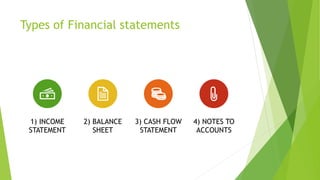
Types of Financial statements
1) INCOME
STATEMENT
2) BALANCE
SHEET
3) CASH FLOW
STATEMENT
4) NOTES TO
ACCOUNTS
1) Income Statement: It contains details
regarding revenue, expenses, profit & loss.
Revenue contains details of Cash or Credit sales generated through goods sold or
services rendered. Since we follow accrual concept therefore Income earned but
not yet received also form part of Revenue.
Expenses – It refers to such expenses incurred during the day today operation of
a business-like salary, Administration expenses, depreciation etc. Expenses or
expenditure incurred but not yet paid are included as per accrual concept.
Profit & Loss- When Revenue side is more than the expense side, it leads to
generate profit. Same way, when Expense is more than Revenue then it leads to
generate Loss.
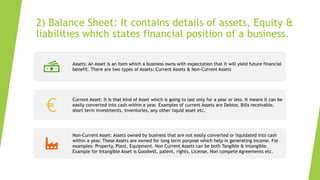
2) Balance Sheet: It contains details of assets, Equity &
liabilities which states financial position of a business.
Assets: An Asset is an Item which a business owns with expectation that it will yield future financial
benefit. There are two types of Assets: Current Assets & Non-Current Assets
Current Asset: It is that kind of Asset which is going to last only for a year or less. It means it can be
easily converted into cash within a year. Examples of current Assets are Debtor, Bills receivable,
short term investments, Inventories, any other liquid asset etc.
Non-Current Asset: Assets owned by business that are not easily converted or liquidated into cash
within a year. These Assets are owned for long term purpose which help in generating income. For
examples- Property, Plant, Equipment. Non Current Assets can be both Tangible & Intangible.
Example for Intangible Asset is Goodwill, patent, rights, License, Non compete Agreements etc.
Equity and Liability: Equity means shareholder’s fund which further
breaks down in share capital and reserve & surplus. liability is a term
used in accounting to describe financial obligation of a business. it can
be short term and long term.

Format of Equity & Liability is given below:
Equity & Liability
Shareholder’s Fund - It refers to the amount which belongs to shareholder.
 Share capital
Reserve & Surplus
Non Current Liability - long term liabilities which are due within a
duration of more than 12 months
Current Liability -short term liabilities which are due within an accounting
period (12 months)
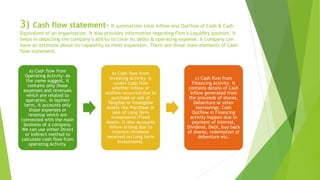
3) Cash flow statement- It summarizes total Inflow and Outflow of Cash & Cash
Equivalent of an organization. It also provides information regarding Firm’s Liquidity position. It
helps in depicting the company’s ability to clear its debts & operating expense. A Company can
have an estimate about its capability to meet expansion. There are three main elements of Cash
flow statement.
a) Cash flow from
Operating Activity- As
the name suggest, it
contains only those
expenses and revenues
which are related to
operation. In laymen
term, it accounts only
those expenses or
revenue which are
connected with the main
business of a company.
We can use either Direct
or Indirect method to
calculate cash flow from
operating Activity.
b) Cash flow from
Investing Activity- It
covers Cash flow
whether Inflow or
outflow occurred due to
purchase or sell of
Tangible or Intangible
Assets like Purchase or
sale of Long Term
Investments/Fixed
Assets. It also accounts
inflow arising due to
Interest/dividend
received on Long term
Investments.
c) Cash flow from
Financing Activity- It
contains details of Cash
Inflow generated from
the proceeds of shares,
Debenture or other
borrowings. Cash
Outflow in Financing
activity happen due to
payment of Interest,
Dividend, Debt, buy back
of shares, redemption of
debenture etc.
Notes to Accounts
 These are basically footnote to the Financial statements of the company.
Notes to Account gives detailed view about the information mentioned in the
Financial Statement. It gives a complete bifurcation or break down of
purchase, Sale, Expense, Revenue, Potential Profit and Loss, Asset & Liability
etc. It also mention details of accounting policy, accounting assumption
considered while preparation of Financial Statement. In order to have a
critical understanding of Financial statements, these Notes to Account play an
important role in defining company’s Financial position.

Financial Statements

  • 1.
  • 2.
    Definition  Financial Statementis that statement which gives an overview about the Financial position, performance & overall health of a company. It helps us to understand the liquidity & financial position of an organization. A user with the help of Financial statement can have an overview as to how a business is performing.
  • 3.
    Types of Financialstatements 1) INCOME STATEMENT 2) BALANCE SHEET 3) CASH FLOW STATEMENT 4) NOTES TO ACCOUNTS
  • 4.
    1) Income Statement:It contains details regarding revenue, expenses, profit & loss. Revenue contains details of Cash or Credit sales generated through goods sold or services rendered. Since we follow accrual concept therefore Income earned but not yet received also form part of Revenue. Expenses – It refers to such expenses incurred during the day today operation of a business-like salary, Administration expenses, depreciation etc. Expenses or expenditure incurred but not yet paid are included as per accrual concept. Profit & Loss- When Revenue side is more than the expense side, it leads to generate profit. Same way, when Expense is more than Revenue then it leads to generate Loss.
  • 5.
    2) Balance Sheet:It contains details of assets, Equity & liabilities which states financial position of a business. Assets: An Asset is an Item which a business owns with expectation that it will yield future financial benefit. There are two types of Assets: Current Assets & Non-Current Assets Current Asset: It is that kind of Asset which is going to last only for a year or less. It means it can be easily converted into cash within a year. Examples of current Assets are Debtor, Bills receivable, short term investments, Inventories, any other liquid asset etc. Non-Current Asset: Assets owned by business that are not easily converted or liquidated into cash within a year. These Assets are owned for long term purpose which help in generating income. For examples- Property, Plant, Equipment. Non Current Assets can be both Tangible & Intangible. Example for Intangible Asset is Goodwill, patent, rights, License, Non compete Agreements etc.
  • 6.
    Equity and Liability:Equity means shareholder’s fund which further breaks down in share capital and reserve & surplus. liability is a term used in accounting to describe financial obligation of a business. it can be short term and long term.  Format of Equity & Liability is given below: Equity & Liability Shareholder’s Fund - It refers to the amount which belongs to shareholder.  Share capital Reserve & Surplus Non Current Liability - long term liabilities which are due within a duration of more than 12 months Current Liability -short term liabilities which are due within an accounting period (12 months)
  • 7.
    3) Cash flowstatement- It summarizes total Inflow and Outflow of Cash & Cash Equivalent of an organization. It also provides information regarding Firm’s Liquidity position. It helps in depicting the company’s ability to clear its debts & operating expense. A Company can have an estimate about its capability to meet expansion. There are three main elements of Cash flow statement. a) Cash flow from Operating Activity- As the name suggest, it contains only those expenses and revenues which are related to operation. In laymen term, it accounts only those expenses or revenue which are connected with the main business of a company. We can use either Direct or Indirect method to calculate cash flow from operating Activity. b) Cash flow from Investing Activity- It covers Cash flow whether Inflow or outflow occurred due to purchase or sell of Tangible or Intangible Assets like Purchase or sale of Long Term Investments/Fixed Assets. It also accounts inflow arising due to Interest/dividend received on Long term Investments. c) Cash flow from Financing Activity- It contains details of Cash Inflow generated from the proceeds of shares, Debenture or other borrowings. Cash Outflow in Financing activity happen due to payment of Interest, Dividend, Debt, buy back of shares, redemption of debenture etc.
  • 8.
    Notes to Accounts These are basically footnote to the Financial statements of the company. Notes to Account gives detailed view about the information mentioned in the Financial Statement. It gives a complete bifurcation or break down of purchase, Sale, Expense, Revenue, Potential Profit and Loss, Asset & Liability etc. It also mention details of accounting policy, accounting assumption considered while preparation of Financial Statement. In order to have a critical understanding of Financial statements, these Notes to Account play an important role in defining company’s Financial position.