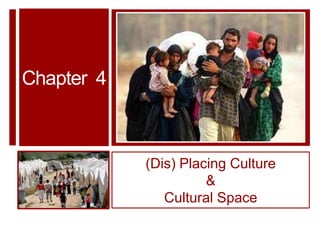
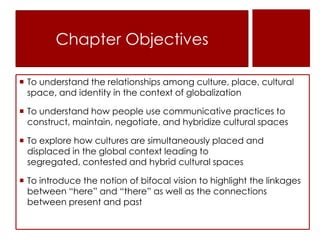
Chapter 4


            (Dis) Placing Culture
                      &
               Cultural Space
Chapter Objectives

 To understand the relationships among culture, place, cultural
  space, and identity in the context of globalization

 To understand how people use communicative practices to
  construct, maintain, negotiate, and hybridize cultural spaces

 To explore how cultures are simultaneously placed and
  displaced in the global context leading to
  segregated, contested and hybrid cultural spaces

 To introduce the notion of bifocal vision to highlight the linkages
  between “here” and “there” as well as the connections
  between present and past
INTRODUCTION
     Explore the cultural and intercultural
    communication dimensions of PLACE,
           SPACE and LOCATION.
               WE WILL EXAMINE:
  The dynamic process of placing and
   displacing cultural space in the context of
   globalization.

  How people use communicative practices to
   construct, maintain, negotiate, and hybridize
   cultural spaces

  How segregated, contested, and hybrid
   cultural spaces are both shaped by the
   legacy of colonialism and the context of
   globalization.
Placing Culture and Cultural
               Space
                                               CULTURE:
CULTURE, by definition,
is rooted in place with a           “Place tilled” in Middle English
 reciprocal relationship            Colere : “to inhabit, care for,
  between people and                 till, worship” in Latin
          place


         In the context of
    globalization, what is the       Culture is both PLACED and
relationship between culture and              DISPLACED
              place?
Cultural Space

                 CULTURAL SPACE
The communicative practices that construct          Cultural spaces are constructed
meanings in, through and about particular places
                                                       through the communicative
                                                    practices developed and lived by
   Cultural space shapes verbal and nonverbal           people in particular places
             communicative practices

                  EXAMPLES:                        Communicative practices include:
                  Classrooms                           The languages
                 Dance Clubs
                                                       Accent
                                                       Slang
                    Library                            Dress
                  Courtroom                            Artifacts
                Construction Site                      Architectural design
                Amusement Park                         the behaviors and patterns of
                    Home                                interaction
                  Restaurant                           the stories
                    Movies                             the discourses and histories
                Baseball Game


  How is the cultural space of your home, neighborhood, city, and state constructed
                          through communicative practices?
Place, Cultural
Space and Identity                     What’s the relationship between place
                                       and identity?

                                       Avowed identity:
LOCATIONS OF ENUNCIATION:
   Sites or positions from which to        The way we see, label and make
    speak.                                   meaning about ourselves and
   A platform from which to voice
    a perspective and be heard         Ascribed identity:
    and/or silenced.
                                            The way others view, name and
               Place
                                             describe us and our group
               Culture
               Identity                  How is place related to STANDPOINT
             Difference                             and POWER?
Displacing Culture and Cultural
            Space
(Dis) placed culture and
                                Time-space Compression:
     cultural space:

 A notion that captures the
complex, contradictory and
contested nature of cultural   A characteristic of globalization
 space and the relationship    that brings seemingly disparate
between culture and place        cultures into closer proximity,
  that has emerged in the       intersection and juxtaposition
  context of globalization.            with each other.
Displacing Culture and Cultural
              Space
   “IN-HERENESS AND OUT-                   GLOCALIZATION:
         THERENESS”:
                                    The dual and simultaneous
 A characteristic of                forces of globalization and
  globalization in which a           localization.
  particular “here” is linked to
  “there,” and how this             First introduced in 19802 to
  linkage of places reveals          describe Japanese business
  colonial histories and             practices
  postcolonial realities.
                                    The concept allows us to
 The particular “here” is           think about how globalizing
  linked to “there” and this         forces always operate in
  linkage of places reveals          relationship to localizing
  colonial histories and             forces.
  postcolonial realities.
Cultural Space, Power and
          Communication
                                 Power is signified, constructed and
Throughout history and today,    regulated   through    SIZE,  SHAPE,
   space has been used to        ACCESS,      CONTAINMENT        and
 establish, exert and maintain   SEGREGATION of space
      power and control
                                         Can You Think of an Example?


The use of space communicates…

                                          Can You Think of an Example?
EXAMPLES:

                               The word “ghetto” originally referred to
                                an area in Venice, Italy where Jews
                                were segregated and required to live
                                in the 1500s.

                               The reservation system imposed on
                                Native Americans.

                               The Jim Crow laws (1865-1960s) that
                                segregated Blacks.

 Segregated                    The isolation of Japanese Americans
                                during WWII.

Cultural Space                 Sundown towns or “whites only” towns.

                               Schools today are re-segregated to
                                the same level as in 1970s
  Cultural spaces that are
segregated based on socio-     In Hurricane Katrina, low-
                                income, working class neighborhoods
  economic, racial, ethnic,     were hit the hardest
   sexual, political and/or
    religious differences:     Gated communities

       Voluntary or
   involuntary/imposed
Contested Cultural
     Space
Cultural space where people
  with unequal control and
 access to resources engage
     in oppositional and
confrontational strategies of
      resistance and/or
         contestation.
                                             EXAMPLES:

 Chinese immigrants who came to the U.S. to work from the 1850s onward were forced to live in
  isolated ethnic enclaves known as Chinatowns in large cities such as San Francisco and New
  York

 In the early 2000s, in Hudson, New York, a small town of 7,000 just 100 miles north of New York
  City, residents joined together to protest the building of a massive, coal-fired cement factory

 Occupy Wall Street; Occupy Oakland; Occupy Boston, etc.
The intersection of intercultural
 communication practices that
construct meanings in, through
  and about particular places
 within a context of relations of
             power.
Examples:
   McDonald’s in Russia
   Wal-Mart, Starbucks and other American
    companies are mixed into local cultural
    spaces around the world

 Hybrid culture spaces are not simply
 the blending of cultures and cultural
              practices.

Rather, hybrid culture spaces involve
      a negotiation of power
Hybrid Cultural
           Space
       As Site Of
      Intercultural
HybridNegotiation
       cultural spaces as innovative and
creative spaces where people constantly
adapt to, negotiate with and improvise
between multiple cultural frameworks.


              EXAMPLES:

 Cultural space of “home”
  experienced by Asian Indian
  immigrants in the U.S.


 Immigrants create hybrid cultural
  space to creatively maintain their
  relationship to their culture and
  tradition.
Hybrid Cultural                   Hybrid cultural spaces where people
                                      challenge stable, territorial, and
 Space As Site                      static definitions of culture, cultural
 Of Resistance                         spaces and cultural identities.


                                     EXAMPLE:

 Asian Indian immigrants create hybrid cultural space as a form of resistance to
  the dominant American culture.

 Hybrid cultural space allows them to avoid total assimilation and a loss of their
  own culture.
Hybrid Cultural
 Spaces As Sites Of
  Transformation
  Hegemonic structures
   are negotiated and
  reconfigured through
 hybridization of culture,
   cultural space, and
         identity.

            EXAMPLE:
Chicana       feminist     Gloria
Anzaldua uses the notion of
“borderlands” to transform the
experience       of       cultural
marginalization into a space of
oppositional    and    liberatory
identity.
 Placing Culture and Cultural Space
 Place, Cultural Space, and Identity
 Displacing Culture and Cultural Space
 Segregated, Contested, and Hybrid cultural space

Ch 4 - Displacing Culture

  • 1.
    Chapter 4 (Dis) Placing Culture & Cultural Space
  • 2.
    Chapter Objectives  Tounderstand the relationships among culture, place, cultural space, and identity in the context of globalization  To understand how people use communicative practices to construct, maintain, negotiate, and hybridize cultural spaces  To explore how cultures are simultaneously placed and displaced in the global context leading to segregated, contested and hybrid cultural spaces  To introduce the notion of bifocal vision to highlight the linkages between “here” and “there” as well as the connections between present and past
  • 3.
    INTRODUCTION Explore the cultural and intercultural communication dimensions of PLACE, SPACE and LOCATION. WE WILL EXAMINE:  The dynamic process of placing and displacing cultural space in the context of globalization.  How people use communicative practices to construct, maintain, negotiate, and hybridize cultural spaces  How segregated, contested, and hybrid cultural spaces are both shaped by the legacy of colonialism and the context of globalization.
  • 4.
    Placing Culture andCultural Space CULTURE: CULTURE, by definition, is rooted in place with a  “Place tilled” in Middle English reciprocal relationship  Colere : “to inhabit, care for, between people and till, worship” in Latin place In the context of globalization, what is the Culture is both PLACED and relationship between culture and DISPLACED place?
  • 5.
    Cultural Space CULTURAL SPACE The communicative practices that construct Cultural spaces are constructed meanings in, through and about particular places through the communicative practices developed and lived by Cultural space shapes verbal and nonverbal people in particular places communicative practices EXAMPLES: Communicative practices include: Classrooms  The languages Dance Clubs  Accent  Slang Library  Dress Courtroom  Artifacts Construction Site  Architectural design Amusement Park  the behaviors and patterns of Home interaction Restaurant  the stories Movies  the discourses and histories Baseball Game How is the cultural space of your home, neighborhood, city, and state constructed through communicative practices?
  • 6.
    Place, Cultural Space andIdentity What’s the relationship between place and identity? Avowed identity: LOCATIONS OF ENUNCIATION:  Sites or positions from which to  The way we see, label and make speak. meaning about ourselves and  A platform from which to voice a perspective and be heard Ascribed identity: and/or silenced.  The way others view, name and Place describe us and our group Culture Identity How is place related to STANDPOINT Difference and POWER?
  • 7.
    Displacing Culture andCultural Space (Dis) placed culture and Time-space Compression: cultural space: A notion that captures the complex, contradictory and contested nature of cultural A characteristic of globalization space and the relationship that brings seemingly disparate between culture and place cultures into closer proximity, that has emerged in the intersection and juxtaposition context of globalization. with each other.
  • 8.
    Displacing Culture andCultural Space “IN-HERENESS AND OUT- GLOCALIZATION: THERENESS”:  The dual and simultaneous  A characteristic of forces of globalization and globalization in which a localization. particular “here” is linked to “there,” and how this  First introduced in 19802 to linkage of places reveals describe Japanese business colonial histories and practices postcolonial realities.  The concept allows us to  The particular “here” is think about how globalizing linked to “there” and this forces always operate in linkage of places reveals relationship to localizing colonial histories and forces. postcolonial realities.
  • 9.
    Cultural Space, Powerand Communication Power is signified, constructed and Throughout history and today, regulated through SIZE, SHAPE, space has been used to ACCESS, CONTAINMENT and establish, exert and maintain SEGREGATION of space power and control Can You Think of an Example? The use of space communicates… Can You Think of an Example?
  • 10.
    EXAMPLES:  The word “ghetto” originally referred to an area in Venice, Italy where Jews were segregated and required to live in the 1500s.  The reservation system imposed on Native Americans.  The Jim Crow laws (1865-1960s) that segregated Blacks. Segregated  The isolation of Japanese Americans during WWII. Cultural Space  Sundown towns or “whites only” towns.  Schools today are re-segregated to the same level as in 1970s Cultural spaces that are segregated based on socio-  In Hurricane Katrina, low- income, working class neighborhoods economic, racial, ethnic, were hit the hardest sexual, political and/or religious differences:  Gated communities Voluntary or involuntary/imposed
  • 11.
    Contested Cultural Space Cultural space where people with unequal control and access to resources engage in oppositional and confrontational strategies of resistance and/or contestation. EXAMPLES:  Chinese immigrants who came to the U.S. to work from the 1850s onward were forced to live in isolated ethnic enclaves known as Chinatowns in large cities such as San Francisco and New York  In the early 2000s, in Hudson, New York, a small town of 7,000 just 100 miles north of New York City, residents joined together to protest the building of a massive, coal-fired cement factory  Occupy Wall Street; Occupy Oakland; Occupy Boston, etc.
  • 12.
    The intersection ofintercultural communication practices that construct meanings in, through and about particular places within a context of relations of power. Examples:  McDonald’s in Russia  Wal-Mart, Starbucks and other American companies are mixed into local cultural spaces around the world Hybrid culture spaces are not simply the blending of cultures and cultural practices. Rather, hybrid culture spaces involve a negotiation of power
  • 13.
    Hybrid Cultural Space As Site Of Intercultural HybridNegotiation cultural spaces as innovative and creative spaces where people constantly adapt to, negotiate with and improvise between multiple cultural frameworks. EXAMPLES:  Cultural space of “home” experienced by Asian Indian immigrants in the U.S.  Immigrants create hybrid cultural space to creatively maintain their relationship to their culture and tradition.
  • 14.
    Hybrid Cultural Hybrid cultural spaces where people challenge stable, territorial, and Space As Site static definitions of culture, cultural Of Resistance spaces and cultural identities. EXAMPLE:  Asian Indian immigrants create hybrid cultural space as a form of resistance to the dominant American culture.  Hybrid cultural space allows them to avoid total assimilation and a loss of their own culture.
  • 15.
    Hybrid Cultural SpacesAs Sites Of Transformation Hegemonic structures are negotiated and reconfigured through hybridization of culture, cultural space, and identity. EXAMPLE: Chicana feminist Gloria Anzaldua uses the notion of “borderlands” to transform the experience of cultural marginalization into a space of oppositional and liberatory identity.
  • 16.
     Placing Cultureand Cultural Space  Place, Cultural Space, and Identity  Displacing Culture and Cultural Space  Segregated, Contested, and Hybrid cultural space