Crossing Borders: Migration and
    Intercultural Adaptation
            Chapter 5
Chapter Objectives


To understand intercultural border     To explore the unique aspects of
                                     migration and intercultural adaptation
crossing and adaptation within the   today as well as the similarities with
context of globalization               earlier waves of world migration


  To introduce and apply a           To gain understanding
  multi-level framework to
                                     and empathy for the
    analyze intercultural
adaptation that accounts for         challenges and rewards
micro, meso and macro-level          of      migration      and
   factors and influences            intercultural adaptation in
                                     the        context       of
                                     globalization.
Introduction

                            TONI MORRISON:
     “Come to terms with being, fearing and accepting
                       strangers”
   MIGRATION & IDENTITY
 1 out 35 people living
  outside country of origin
  (nearly 200 million people)
 912 million crossed borders
  for tourism, business, etc.
     Why are people on the
       move today?
     Who can cross
       borders? Who is
       restricted?
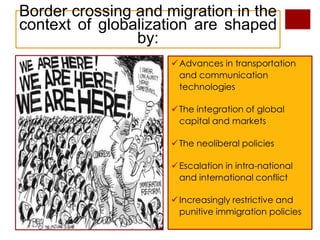
Border crossing and migration in the
context of globalization are shaped
                by:
                      Advances in transportation
                       and communication
                       technologies

                      The integration of global
                       capital and markets

                      The neoliberal policies

                      Escalation in intra-national
                       and international conflict

                      Increasingly restrictive and
                       punitive immigration policies
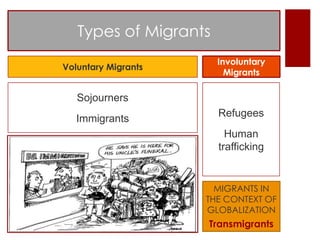
Types of Migrants
                       Involuntary
Voluntary Migrants
                         Migrants

   Sojourners
                       Refugees
   Immigrants
                         Human
                       trafficking


                       MIGRANTS IN
                     THE CONTEXT OF
                     GLOBALIZATION
                     Transmigrants
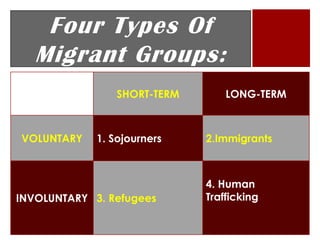
Four Types Of
   Migrant Groups:
                 SHORT-TERM       LONG-TERM


VOLUNTARY    1. Sojourners    2.Immigrants


                              4. Human
INVOLUNTARY 3. Refugees       Trafficking
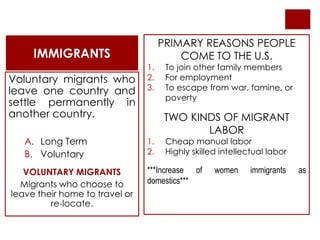
PRIMARY REASONS PEOPLE
     IMMIGRANTS                          COME TO THE U.S.
                                1.    To join other family members
Voluntary migrants who          2.    For employment
leave one country and           3.    To escape from war, famine, or
                                      poverty
settle permanently in
another country.                     TWO KINDS OF MIGRANT
                                            LABOR
   A. Long Term                 1.    Cheap manual labor
   B. Voluntary                 2.    Highly skilled intellectual labor

   VOLUNTARY MIGRANTS           ***Increase of     women     immigrants   as
  Migrants who choose to        domestics***
leave their home to travel or
         re-locate.
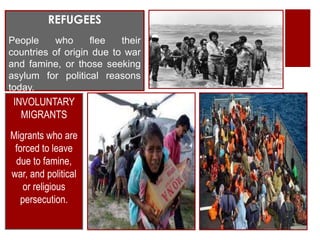
REFUGEES
People     who     flee   their
countries of origin due to war
and famine, or those seeking
asylum for political reasons
today.
 INVOLUNTARY
   MIGRANTS
Migrants who are
 forced to leave
 due to famine,
war, and political
    or religious
   persecution.
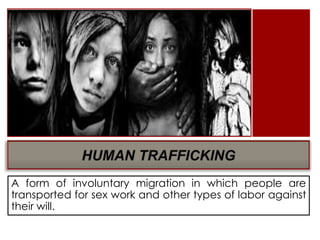
A form of involuntary migration in which people are
transported for sex work and other types of labor against
their will.
Historical Overview of World Migration

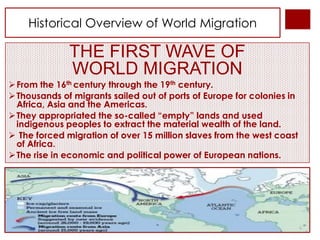
              THE FIRST WAVE OF
              WORLD MIGRATION
 From the 16th century through the 19th century.
 Thousands of migrants sailed out of ports of Europe for colonies in
  Africa, Asia and the Americas.
 They appropriated the so-called “empty” lands and used
  indigenous peoples to extract the material wealth of the land.
 The forced migration of over 15 million slaves from the west coast
  of Africa.
 The rise in economic and political power of European nations.
CHAIN MIGRATION
     THE SECOND WAVE
                                     Linkages that connect
 From the mid 1800s to the        migrants from points of origin
   early 1900s during the          to destinations, led to the
    industrial revolution.          segmentation of ethnic
                                        groups in the U.S.

                     NATIVIST MOVEMENTS

 Movements that called for the exclusion of foreign-born people.

                          XENOPHOBIA
The fear of outsiders. It dramatically curtailed immigration to
                   the U.S. until after WW II.
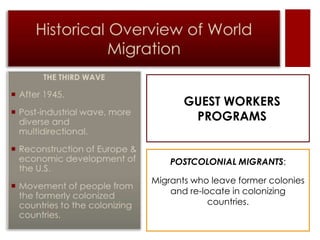
GUEST WORKERS
        PROGRAMS


    POSTCOLONIAL MIGRANTS:

Migrants who leave former colonies
    and re-locate in colonizing
             countries.
LATE 20TH CENTURY TO THE PRESENT
 Rapid, complex, multidirectional and diverse
 “Sending” and “receiving” countries not distinct
 South to North migration (3rd to 1st World)
 High and Low skilled labor
 Migrant networks
 Altering “host” countries
 Feminization of the workforce
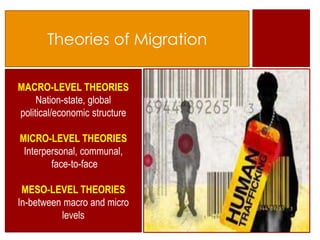
Theories of Migration

MACRO-LEVEL THEORIES
     Nation-state, global
political/economic structure

MICRO-LEVEL THEORIES
 Interpersonal, communal,
        face-to-face

 MESO-LEVEL THEORIES
In-between macro and micro
          levels
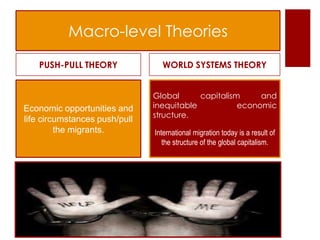
Macro-level Theories
   PUSH-PULL THEORY              WORLD SYSTEMS THEORY


                               Global      capitalism     and
Economic opportunities and     inequitable           economic
                               structure.
life circumstances push/pull
         the migrants.         International migration today is a result of
                                  the structure of the global capitalism.
Macro-level Theories
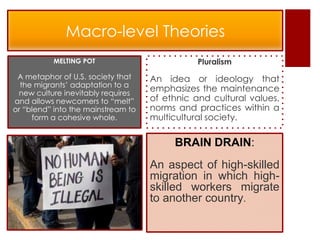
          MELTING POT                          Pluralism
 A metaphor of U.S. society that    An idea or ideology that
  the migrants’ adaptation to a
 new culture inevitably requires
                                    emphasizes the maintenance
and allows newcomers to “melt”      of ethnic and cultural values,
or “blend” into the mainstream to   norms and practices within a
     form a cohesive whole.         multicultural society.

                                         BRAIN DRAIN:
                                    An aspect of high-skilled
                                    migration in which high-
                                    skilled workers migrate
                                    to another country.
Micro-level Theories

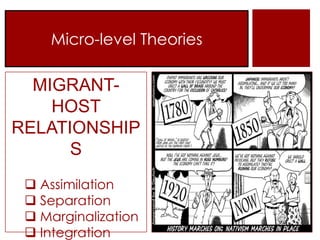
  MIGRANT-
    HOST
RELATIONSHIP
      S
  Assimilation
  Separation
  Marginalization
  Integration
Micro-level Theories
Integrative Theory of Cultural
                                   Intercultural Transformation
         Adaptation


  Individual and environment co-
    define adaptation process:
                                    Emergence of intercultural
 Attitudes and receptivity of       identity
  host environment
                                    As a result of stress-
 Ethnic community
                                     adaptation-growth process
 Psychological characteristics
  of the individual
MESO-LEVEL THEORIES

      MIGRANT NETWORKS                      SOCIAL CAPITAL
A set of interpersonal ties that      The sense of commitment and
connect      migrants,       former
                                      obligation people within a
migrants, and non-migrants in
origin and destination areas          group or network have to look
through ties of kinship, friendship   after the well-being and
and shared community origin.          interests of one another.

         XENOPHOBIA                       NATIVIST MOVEMENTS

Fear of outsiders, foreigners.        Movements that call for the
                                      exclusion of   foreign-born
                                      people.

Ch 5 - Crossing Borders

  • 1.
    Crossing Borders: Migrationand Intercultural Adaptation Chapter 5
  • 2.
    Chapter Objectives To understandintercultural border To explore the unique aspects of migration and intercultural adaptation crossing and adaptation within the today as well as the similarities with context of globalization earlier waves of world migration To introduce and apply a To gain understanding multi-level framework to and empathy for the analyze intercultural adaptation that accounts for challenges and rewards micro, meso and macro-level of migration and factors and influences intercultural adaptation in the context of globalization.
  • 3.
    Introduction TONI MORRISON: “Come to terms with being, fearing and accepting strangers” MIGRATION & IDENTITY  1 out 35 people living outside country of origin (nearly 200 million people)  912 million crossed borders for tourism, business, etc.  Why are people on the move today?  Who can cross borders? Who is restricted?
  • 4.
    Border crossing andmigration in the context of globalization are shaped by:  Advances in transportation and communication technologies  The integration of global capital and markets  The neoliberal policies  Escalation in intra-national and international conflict  Increasingly restrictive and punitive immigration policies
  • 5.
    Types of Migrants Involuntary Voluntary Migrants Migrants Sojourners Refugees Immigrants Human trafficking MIGRANTS IN THE CONTEXT OF GLOBALIZATION Transmigrants
  • 7.
    Four Types Of Migrant Groups: SHORT-TERM LONG-TERM VOLUNTARY 1. Sojourners 2.Immigrants 4. Human INVOLUNTARY 3. Refugees Trafficking
  • 8.
    PRIMARY REASONS PEOPLE IMMIGRANTS COME TO THE U.S. 1. To join other family members Voluntary migrants who 2. For employment leave one country and 3. To escape from war, famine, or poverty settle permanently in another country. TWO KINDS OF MIGRANT LABOR A. Long Term 1. Cheap manual labor B. Voluntary 2. Highly skilled intellectual labor VOLUNTARY MIGRANTS ***Increase of women immigrants as Migrants who choose to domestics*** leave their home to travel or re-locate.
  • 9.
    REFUGEES People who flee their countries of origin due to war and famine, or those seeking asylum for political reasons today. INVOLUNTARY MIGRANTS Migrants who are forced to leave due to famine, war, and political or religious persecution.
  • 10.
    A form ofinvoluntary migration in which people are transported for sex work and other types of labor against their will.
  • 11.
    Historical Overview ofWorld Migration THE FIRST WAVE OF WORLD MIGRATION  From the 16th century through the 19th century.  Thousands of migrants sailed out of ports of Europe for colonies in Africa, Asia and the Americas.  They appropriated the so-called “empty” lands and used indigenous peoples to extract the material wealth of the land.  The forced migration of over 15 million slaves from the west coast of Africa.  The rise in economic and political power of European nations.
  • 12.
    CHAIN MIGRATION THE SECOND WAVE Linkages that connect From the mid 1800s to the migrants from points of origin early 1900s during the to destinations, led to the industrial revolution. segmentation of ethnic groups in the U.S. NATIVIST MOVEMENTS Movements that called for the exclusion of foreign-born people. XENOPHOBIA The fear of outsiders. It dramatically curtailed immigration to the U.S. until after WW II.
  • 13.
    GUEST WORKERS PROGRAMS POSTCOLONIAL MIGRANTS: Migrants who leave former colonies and re-locate in colonizing countries.
  • 14.
    LATE 20TH CENTURYTO THE PRESENT  Rapid, complex, multidirectional and diverse  “Sending” and “receiving” countries not distinct  South to North migration (3rd to 1st World)  High and Low skilled labor  Migrant networks  Altering “host” countries  Feminization of the workforce
  • 15.
    Theories of Migration MACRO-LEVELTHEORIES Nation-state, global political/economic structure MICRO-LEVEL THEORIES Interpersonal, communal, face-to-face MESO-LEVEL THEORIES In-between macro and micro levels
  • 16.
    Macro-level Theories PUSH-PULL THEORY WORLD SYSTEMS THEORY Global capitalism and Economic opportunities and inequitable economic structure. life circumstances push/pull the migrants. International migration today is a result of the structure of the global capitalism.
  • 17.
    Macro-level Theories MELTING POT Pluralism A metaphor of U.S. society that An idea or ideology that the migrants’ adaptation to a new culture inevitably requires emphasizes the maintenance and allows newcomers to “melt” of ethnic and cultural values, or “blend” into the mainstream to norms and practices within a form a cohesive whole. multicultural society. BRAIN DRAIN: An aspect of high-skilled migration in which high- skilled workers migrate to another country.
  • 18.
    Micro-level Theories MIGRANT- HOST RELATIONSHIP S  Assimilation  Separation  Marginalization  Integration
  • 19.
    Micro-level Theories Integrative Theoryof Cultural Intercultural Transformation Adaptation Individual and environment co- define adaptation process:  Emergence of intercultural  Attitudes and receptivity of identity host environment  As a result of stress-  Ethnic community adaptation-growth process  Psychological characteristics of the individual
  • 20.
    MESO-LEVEL THEORIES MIGRANT NETWORKS SOCIAL CAPITAL A set of interpersonal ties that The sense of commitment and connect migrants, former obligation people within a migrants, and non-migrants in origin and destination areas group or network have to look through ties of kinship, friendship after the well-being and and shared community origin. interests of one another. XENOPHOBIA NATIVIST MOVEMENTS Fear of outsiders, foreigners. Movements that call for the exclusion of foreign-born people.