MEDIA ECOLOGY. Exploring the metaphor. Carlos A. Scolari - Universitat Pompeu Fabra [email_address] www.digitalismo. com  -  www.hipermediaciones. com  -  www.modernclicks. net
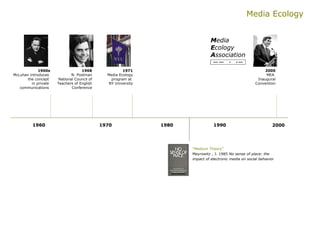
1960 1968 N. Postman National Council of Teachers of English Conference 1971 Media Ecology program at  NY University “ Medium Theory” Meyrowitz , J. 1985  No sense of place: the impact of electronic media on social behavior Media Ecology 2000 MEA  Inaugural Convention 1970 1990 2000 1960s McLuhan introduces  the concept  in private  communications  1980
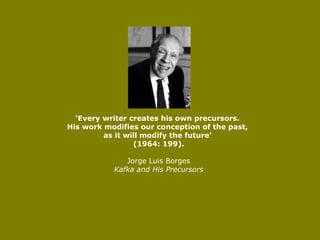
‘ Every writer creates his own precursors.  His work modifies our conception of the past,  as it will modify the future’  (1964: 199). Jorge Luis Borges Kafka and His Precursors
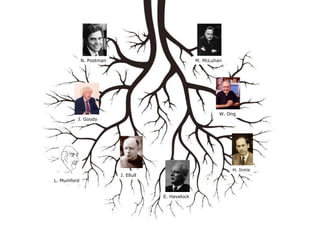
L. Mumford J. Ellull E. Havelock J. Goody H. Innis W. Ong M. McLuhan N. Postman
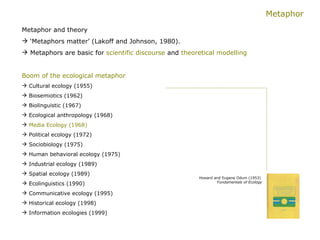
Metaphor Metaphor and theory ‘ Metaphors matter’ (Lakoff and Johnson, 1980). Metaphors are basic for  scientific discourse  and  theoretical modelling Boom of the ecological metaphor Cultural ecology (1955) Biosemiotics (1962) Biolinguistic (1967) Ecological anthropology (1968) Media Ecology (1968) Political ecology (1972) Sociobiology (1975)  Human behavioral ecology (1975) Industrial ecology (1989) Spatial ecology (1989) Ecolinguistics (1990) Communicative ecology (1995) Historical ecology (1998)   Information ecologies (1999) Howard and Eugene Odum (1953)  Fundamentals of Ecology
Interpretations of metaphor (I) Media as environments   ‘ ME is the study of media as environments’ (Postman, 1970). ‘ ME looks into the matter of how media of communication affect human perception, understanding, feeling, and value (Postman, 1970). ‘ Media are extensions’ (McLuhan, 1964). ‘ Technology alter sense ratios or patterns of perception steadily and without any resistance’ (McLuhan, 1964).  This is the environmental dimension of Media Ecology:  media create an ‘environment’ that surrounds the individuals  and models their perception and cognition.
Interpretations of metaphor (II) Intermedia relations   ‘ The steadying influence of the book as a product of sustain intellectual effort was destroyed by new developments in periodicals and newspapers’ (Innis, 1951). ‘ The potential of the telegraph to transform information into a commodity might never have been realized, except for the partnership between the telegraph and the press’ (Postman, 1985). ‘ No medium has its meaning or existence alone, but only in constant interplay with other media” (McLuhan, 1964).  This is the intermedia dimension of Media Ecology:  media are like ‘species’ that live in the same ecosystem  and establish relationships between them.
Exploring a scientific metaphor means analyzing the semantic universe of the analogy, translating the basic assumptions from one field to another to check the strength of the metaphor and identify new questions and challenges for media studies.  I will limit my reflection to a short list of concepts:  Evolution Interface Hybridization
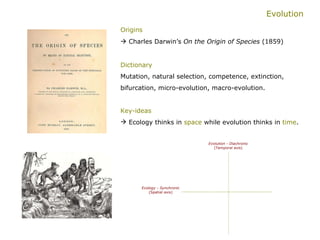
Evolution Origins   Charles Darwin’s  On the Origin of Species  (1859)   Dictionary   Mutation, natural selection, competence, extinction, bifurcation, micro-evolution, macro-evolution. Key-ideas   Ecology thinks in  space  while evolution thinks in  time . Evolution - Diachronic (Temporal axis) Ecology - Synchronic (Spatial axis)
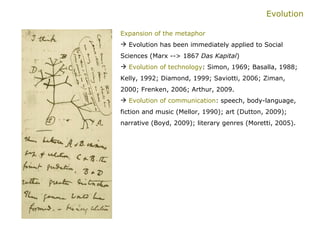
Evolution Expansion of the metaphor   Evolution has been immediately applied to Social Sciences (Marx --> 1867  Das Kapital ) Evolution of technology : Simon, 1969; Basalla, 1988; Kelly, 1992; Diamond, 1999; Saviotti, 2006; Ziman, 2000; Frenken, 2006; Arthur, 2009.  Evolution of communication : speech, body-language, fiction and music (Mellor, 1990); art (Dutton, 2009); narrative (Boyd, 2009); literary genres (Moretti, 2005).
‘ It is time to look at the arts in the light of Charles Darwin’s theory of evolution […] Recent years have seen immensely productive applications of Darwinian ideas in anthropology, economics, social psychology, linguistics, history, politics, legal theory, and criminology, as well as the philosophical study of rationally, theology and value theory […]’  Denis Dutton (2009) The Art Instinct: Beauty, Pleasure, and Human Evolution
‘ Evocriticism  (evolutionary-criticism)   lets us link literature with the whole of life, with other human activities and capacities, and their relation to those of other animals, as they compete, cooperate, and play, as they observe, understand, and empathize with other. It can reconnect literature with the whole range of human experience […]’ Boyd, B. (2009)   On the Origin of Stories. Evolution, cognition, and fiction
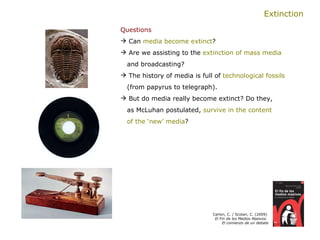
Extinction Questions   Can  media become extinct ?  Are we assisting to the  extinction of mass media     and broadcasting? The history of media is full of  technological fossils (from papyrus to telegraph).  But do media really become extinct? Do they,    as McLuhan postulated,  survive in the content    of the ‘new’ media ? Carlon, C. / Scolari, C. (2009)  El Fin de los Medios Masivos.  El comienzo de un debate
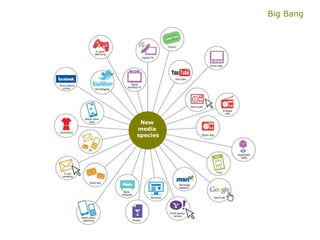
Big Bang New  media  species
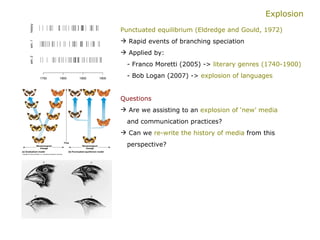
Explosion Punctuated equilibrium (Eldredge and Gould, 1972) Rapid events of branching speciation Applied by:   - Franco Moretti (2005) ->  literary genres (1740-1900)   - Bob Logan (2007) ->  explosion of languages Questions   Are we assisting to an  explosion of ‘new’ media     and communication practices?  Can we  re-write the history of media  from this  perspective?
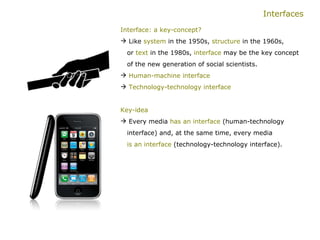
Interfaces Interface: a key-concept? Like  system  in the 1950s,  structure  in the 1960s,    or  text  in the 1980s,  interface  may be the key concept  of the new generation of social scientists. Human-machine interface Technology-technology interface Key-idea   Every media  has an interface  (human-technology    interface) and, at the same time, every media    is an interface  (technology-technology interface).
Interfaces Media interfaces The interface is the place where the evolution of    the media is negotiated ->  human-media coevolution   The interface is also the place where media interact    between them ->  intermedia coevolution   Key-ideas   The  interface is the ‘environment’  that media ecologists  have been analyzing for the last 50 years. The study of the interfaces could be considered    the  micro-level of Media Ecology analysis ,    the  minimal unit  of analysis (like the  sign  for Linguistics    or the  gene  for Genetics)
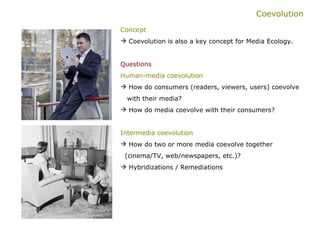
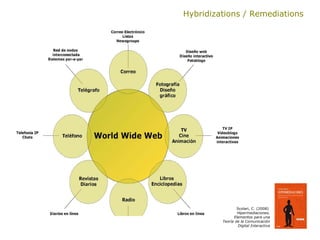
Coevolution Concept Coevolution is also a key concept for Media Ecology. Questions   Human-media coevolution How do consumers (readers, viewers, users) coevolve    with their media?  How do media coevolve with their consumers?  Intermedia coevolution How do two or more media coevolve together    (cinema/TV, web/newspapers, etc.)? Hybridizations / Remediations
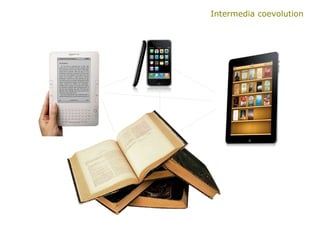
Intermedia coevolution
Hybridizations / Remediations Scolari, C. (2008)  Hipermediaciones. Elementos para una Teoría de la Comunicación Digital Interactiva
Conclusions In a few words… To expand the ecological metaphor… …  mans to increase the dictionary and explore new research lines: Media evolution Interface Human-media coevolution Intermedia coevolution / Hybridizations
Email:  [email_address] Facebook:  carlos.scolari Twitter:  cscolari Blog I:  www.digitalismo. com   Blog II:  www.hipermediaciones. com Website:  www.modernclicks. net   Thanks! Gracias!  Carlos A. Scolari Universitat Pompeu Fabra Barcelona

MEDIA ECOLOGY. Exploring the metaphor.

  • 1.
    MEDIA ECOLOGY. Exploringthe metaphor. Carlos A. Scolari - Universitat Pompeu Fabra [email_address] www.digitalismo. com - www.hipermediaciones. com - www.modernclicks. net
  • 2.
    1960 1968 N.Postman National Council of Teachers of English Conference 1971 Media Ecology program at NY University “ Medium Theory” Meyrowitz , J. 1985 No sense of place: the impact of electronic media on social behavior Media Ecology 2000 MEA Inaugural Convention 1970 1990 2000 1960s McLuhan introduces the concept in private communications 1980
  • 3.
    ‘ Every writercreates his own precursors. His work modifies our conception of the past, as it will modify the future’ (1964: 199). Jorge Luis Borges Kafka and His Precursors
  • 4.
    L. Mumford J.Ellull E. Havelock J. Goody H. Innis W. Ong M. McLuhan N. Postman
  • 5.
    Metaphor Metaphor andtheory ‘ Metaphors matter’ (Lakoff and Johnson, 1980). Metaphors are basic for scientific discourse and theoretical modelling Boom of the ecological metaphor Cultural ecology (1955) Biosemiotics (1962) Biolinguistic (1967) Ecological anthropology (1968) Media Ecology (1968) Political ecology (1972) Sociobiology (1975) Human behavioral ecology (1975) Industrial ecology (1989) Spatial ecology (1989) Ecolinguistics (1990) Communicative ecology (1995) Historical ecology (1998) Information ecologies (1999) Howard and Eugene Odum (1953) Fundamentals of Ecology
  • 6.
    Interpretations of metaphor(I) Media as environments ‘ ME is the study of media as environments’ (Postman, 1970). ‘ ME looks into the matter of how media of communication affect human perception, understanding, feeling, and value (Postman, 1970). ‘ Media are extensions’ (McLuhan, 1964). ‘ Technology alter sense ratios or patterns of perception steadily and without any resistance’ (McLuhan, 1964). This is the environmental dimension of Media Ecology: media create an ‘environment’ that surrounds the individuals and models their perception and cognition.
  • 7.
    Interpretations of metaphor(II) Intermedia relations ‘ The steadying influence of the book as a product of sustain intellectual effort was destroyed by new developments in periodicals and newspapers’ (Innis, 1951). ‘ The potential of the telegraph to transform information into a commodity might never have been realized, except for the partnership between the telegraph and the press’ (Postman, 1985). ‘ No medium has its meaning or existence alone, but only in constant interplay with other media” (McLuhan, 1964). This is the intermedia dimension of Media Ecology: media are like ‘species’ that live in the same ecosystem and establish relationships between them.
  • 8.
    Exploring a scientificmetaphor means analyzing the semantic universe of the analogy, translating the basic assumptions from one field to another to check the strength of the metaphor and identify new questions and challenges for media studies. I will limit my reflection to a short list of concepts: Evolution Interface Hybridization
  • 9.
    Evolution Origins Charles Darwin’s On the Origin of Species (1859) Dictionary Mutation, natural selection, competence, extinction, bifurcation, micro-evolution, macro-evolution. Key-ideas Ecology thinks in space while evolution thinks in time . Evolution - Diachronic (Temporal axis) Ecology - Synchronic (Spatial axis)
  • 10.
    Evolution Expansion ofthe metaphor Evolution has been immediately applied to Social Sciences (Marx --> 1867 Das Kapital ) Evolution of technology : Simon, 1969; Basalla, 1988; Kelly, 1992; Diamond, 1999; Saviotti, 2006; Ziman, 2000; Frenken, 2006; Arthur, 2009. Evolution of communication : speech, body-language, fiction and music (Mellor, 1990); art (Dutton, 2009); narrative (Boyd, 2009); literary genres (Moretti, 2005).
  • 11.
    ‘ It istime to look at the arts in the light of Charles Darwin’s theory of evolution […] Recent years have seen immensely productive applications of Darwinian ideas in anthropology, economics, social psychology, linguistics, history, politics, legal theory, and criminology, as well as the philosophical study of rationally, theology and value theory […]’ Denis Dutton (2009) The Art Instinct: Beauty, Pleasure, and Human Evolution
  • 12.
    ‘ Evocriticism (evolutionary-criticism) lets us link literature with the whole of life, with other human activities and capacities, and their relation to those of other animals, as they compete, cooperate, and play, as they observe, understand, and empathize with other. It can reconnect literature with the whole range of human experience […]’ Boyd, B. (2009) On the Origin of Stories. Evolution, cognition, and fiction
  • 13.
    Extinction Questions Can media become extinct ? Are we assisting to the extinction of mass media and broadcasting? The history of media is full of technological fossils (from papyrus to telegraph). But do media really become extinct? Do they, as McLuhan postulated, survive in the content of the ‘new’ media ? Carlon, C. / Scolari, C. (2009) El Fin de los Medios Masivos. El comienzo de un debate
  • 14.
    Big Bang New media species
  • 15.
    Explosion Punctuated equilibrium(Eldredge and Gould, 1972) Rapid events of branching speciation Applied by: - Franco Moretti (2005) -> literary genres (1740-1900) - Bob Logan (2007) -> explosion of languages Questions Are we assisting to an explosion of ‘new’ media and communication practices? Can we re-write the history of media from this perspective?
  • 16.
    Interfaces Interface: akey-concept? Like system in the 1950s, structure in the 1960s, or text in the 1980s, interface may be the key concept of the new generation of social scientists. Human-machine interface Technology-technology interface Key-idea Every media has an interface (human-technology interface) and, at the same time, every media is an interface (technology-technology interface).
  • 17.
    Interfaces Media interfacesThe interface is the place where the evolution of the media is negotiated -> human-media coevolution The interface is also the place where media interact between them -> intermedia coevolution Key-ideas The interface is the ‘environment’ that media ecologists have been analyzing for the last 50 years. The study of the interfaces could be considered the micro-level of Media Ecology analysis , the minimal unit of analysis (like the sign for Linguistics or the gene for Genetics)
  • 18.
    Coevolution Concept Coevolutionis also a key concept for Media Ecology. Questions Human-media coevolution How do consumers (readers, viewers, users) coevolve with their media? How do media coevolve with their consumers? Intermedia coevolution How do two or more media coevolve together (cinema/TV, web/newspapers, etc.)? Hybridizations / Remediations
  • 19.
  • 20.
    Hybridizations / RemediationsScolari, C. (2008) Hipermediaciones. Elementos para una Teoría de la Comunicación Digital Interactiva
  • 21.
    Conclusions In afew words… To expand the ecological metaphor… … mans to increase the dictionary and explore new research lines: Media evolution Interface Human-media coevolution Intermedia coevolution / Hybridizations
  • 22.
    Email: [email_address]Facebook: carlos.scolari Twitter: cscolari Blog I: www.digitalismo. com Blog II: www.hipermediaciones. com Website: www.modernclicks. net Thanks! Gracias! Carlos A. Scolari Universitat Pompeu Fabra Barcelona