30.1
Chapter 30
Cryptography
Copyright © The McGraw-Hill Companies, Inc. Permission required for reproduction or display.
30.2
30-1 INTRODUCTION
Let us introduce the issues involved in cryptography.
First, we need to define some terms; then we give some
taxonomies.
Definitions
Two Categories
Topics discussed in this section:
30.3
Figure 30.1 Cryptography components
30.4
Figure 30.2 Categories of cryptography
30.5
Figure 30.3 Symmetric-key cryptography
30.6
In symmetric-key cryptography, the
same key is used by the sender
(for encryption)
and the receiver (for decryption).
The key is shared.
Note
30.7
Figure 30.4 Asymmetric-key cryptography
30.8
Figure 30.6 Comparison between two categories of cryptography
30.9
30-2 SYMMETRIC-KEY CRYPTOGRAPHY
Symmetric-key cryptography started thousands of years
ago when people needed to exchange secrets (for
example, in a war). We still mainly use symmetric-key
cryptography in our network security.
Traditional Ciphers
Simple Modern Ciphers
Modern Round Ciphers
Mode of Operation
Topics discussed in this section:
30.10
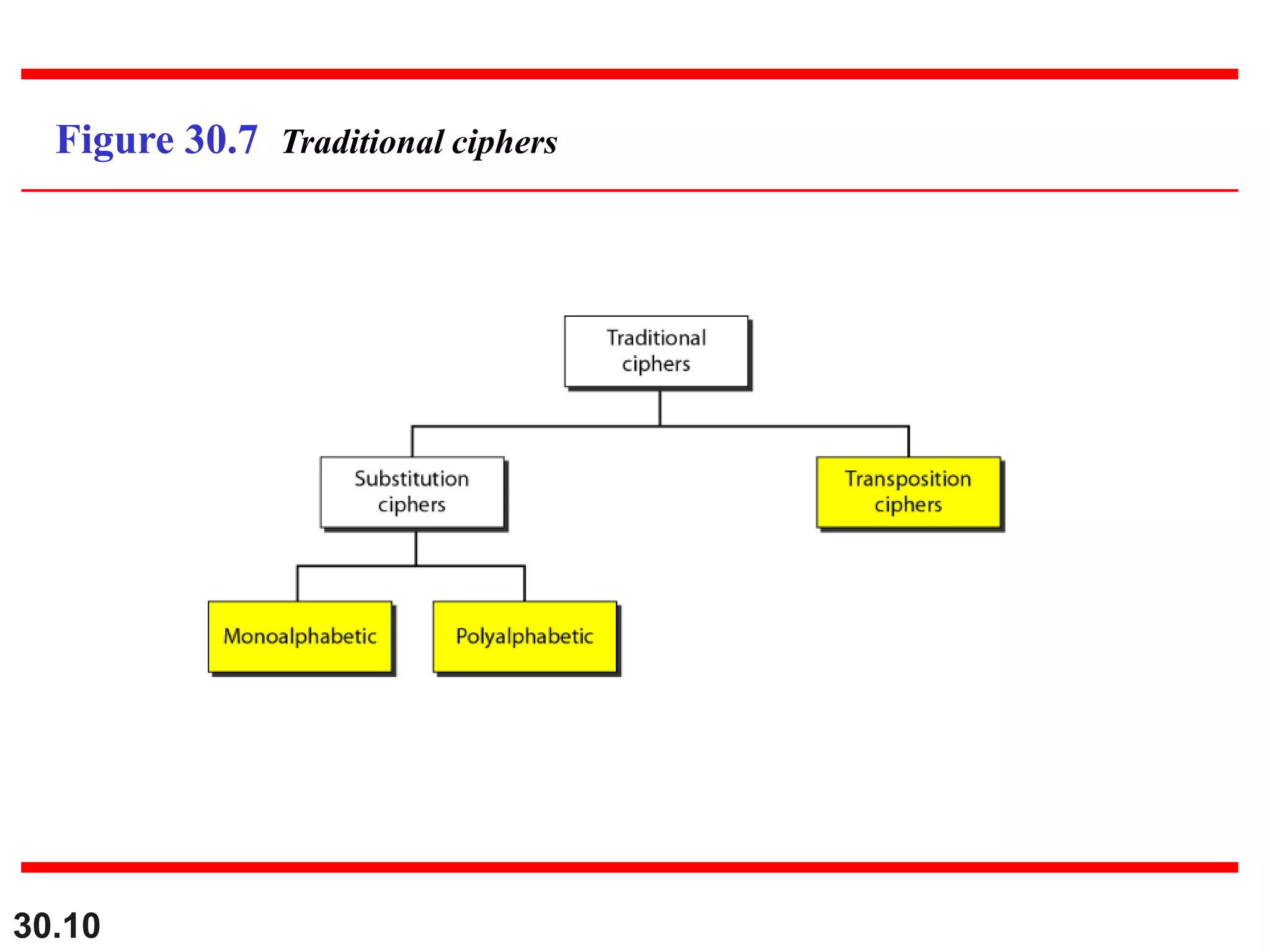
Figure 30.7 Traditional ciphers
30.11
A substitution cipher replaces one
symbol with another.
Monoalphabetic replaces the same symbol
with the same another symbol.
Polyalphabetic replaces the same symbol
with different symbols at each occurrence.
Note
30.12
The shift cipher is sometimes referred to
as the Caesar cipher. (monoalphabetic)
Note
30.13
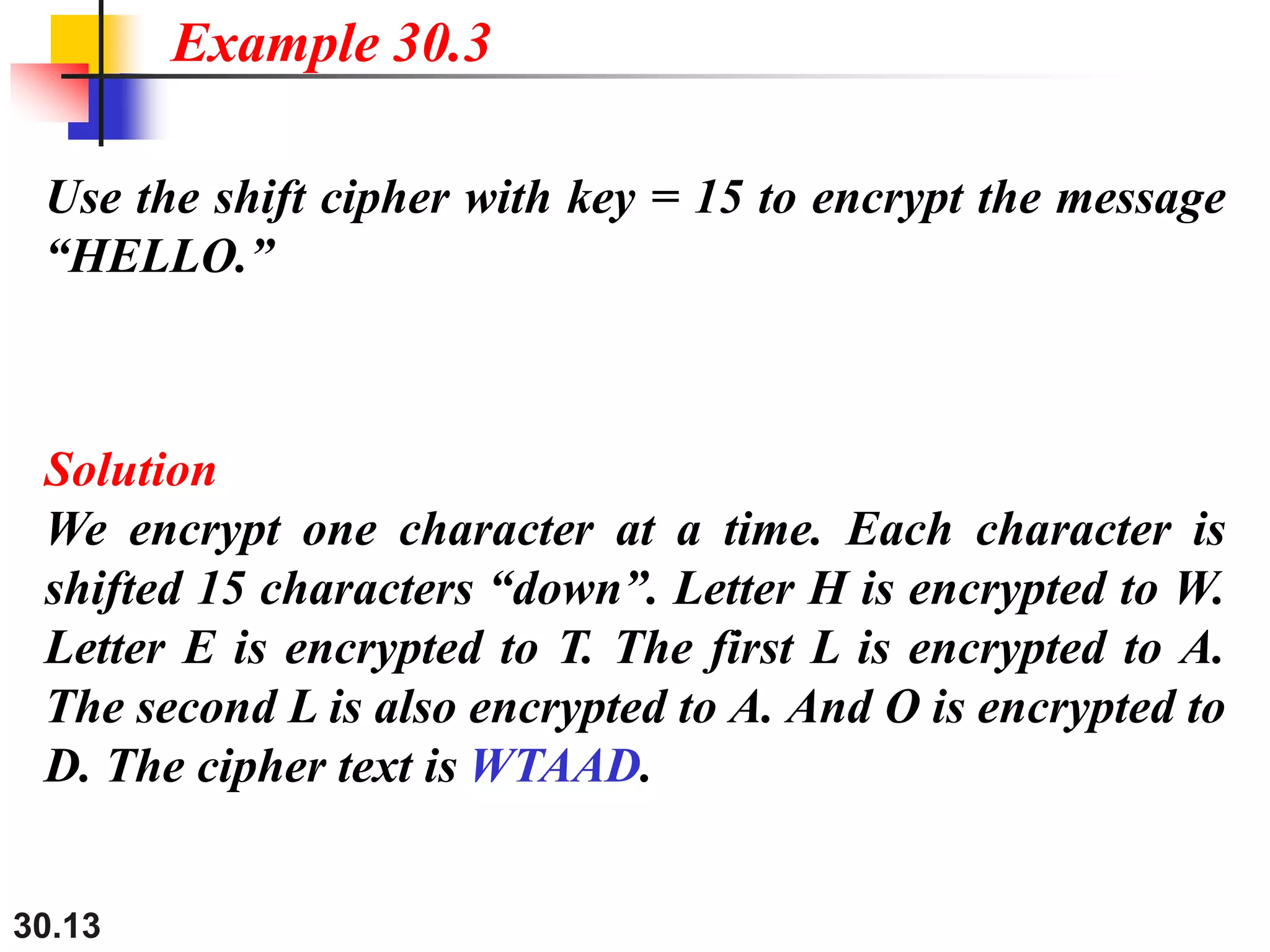
Use the shift cipher with key = 15 to encrypt the message
“HELLO.”
Solution
We encrypt one character at a time. Each character is
shifted 15 characters “down”. Letter H is encrypted to W.
Letter E is encrypted to T. The first L is encrypted to A.
The second L is also encrypted to A. And O is encrypted to
D. The cipher text is WTAAD.
Example 30.3
30.14
Use the shift cipher with key = 15 to decrypt the message
“WTAAD.”
Solution
We decrypt one character at a time. Each character is
shifted 15 characters “up”. Letter W is decrypted to H.
Letter T is decrypted to E. The first A is decrypted to L.
The second A is decrypted to L. And, finally, D is
decrypted to O. The plaintext is HELLO.
Example 30.4
30.15
A transposition cipher reorders
(permutes) symbols in a block of
symbols (shuffle poker cards)
Note
30.16
Figure 30.8 Transposition cipher
30.17
Encrypt the message “HELLO MY DEAR,” using the key
shown in Figure 30.8.
Solution
We first remove the spaces in the message. We then divide
the text into blocks of four characters. We add a bogus
character Z at the end of the third block. The result is
HELL OMYD EARZ. We create a three-block ciphertext
ELHLMDOYAZER.
Example 30.5
30.18
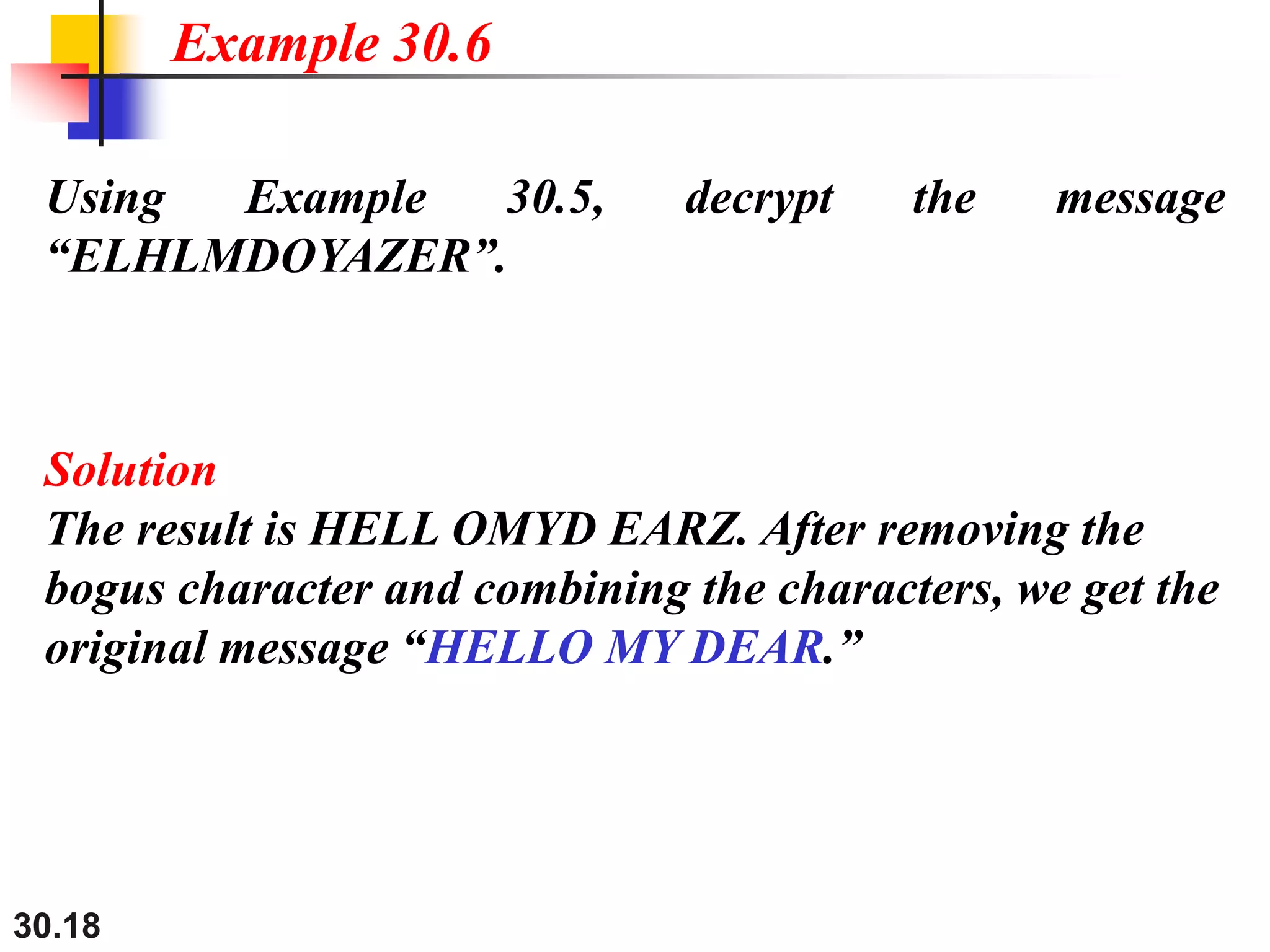
Using Example 30.5, decrypt the message
“ELHLMDOYAZER”.
Solution
The result is HELL OMYD EARZ. After removing the
bogus character and combining the characters, we get the
original message “HELLO MY DEAR.”
Example 30.6
30.19
Modern Cryptography
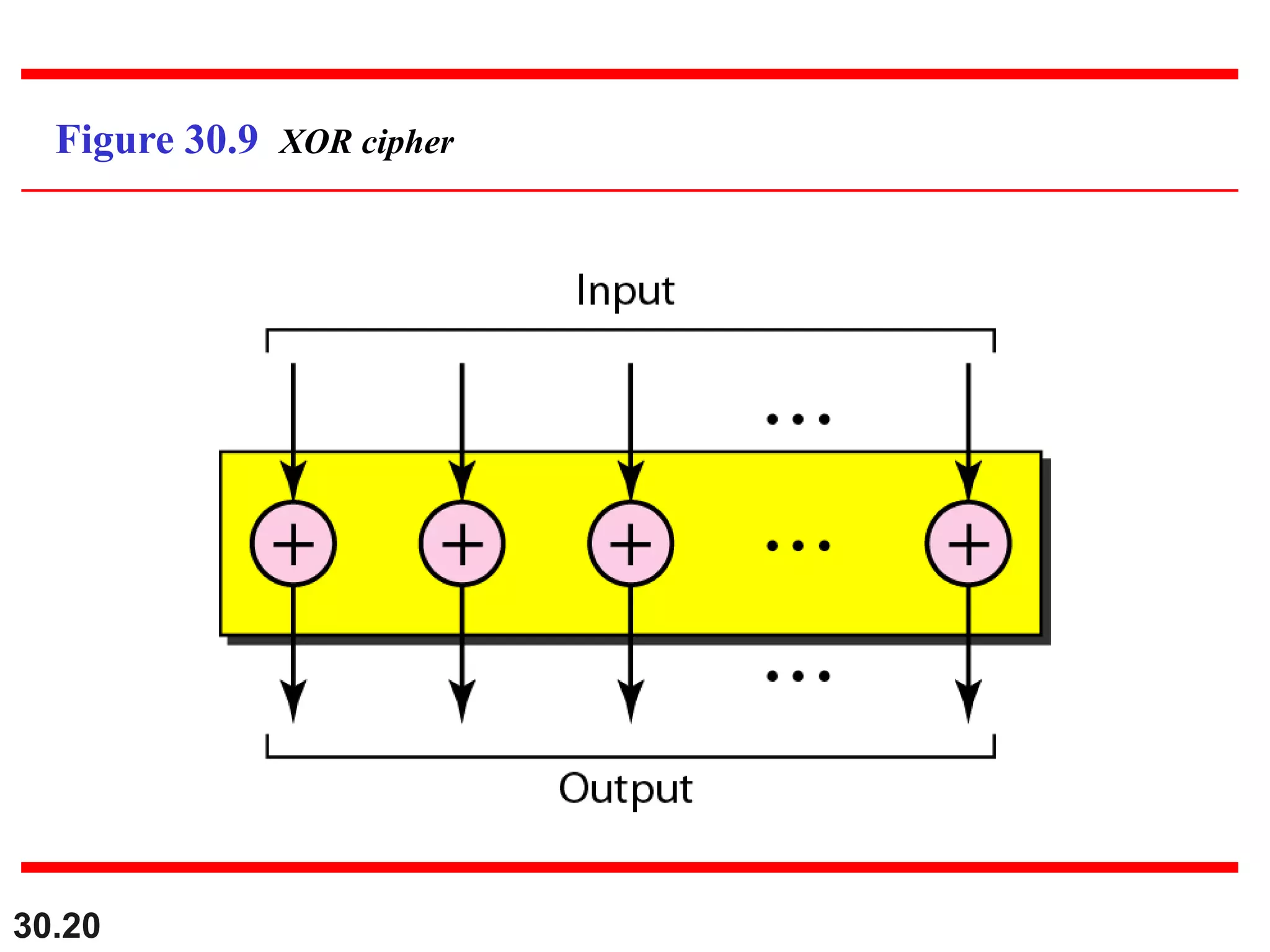
30.20
Figure 30.9 XOR cipher
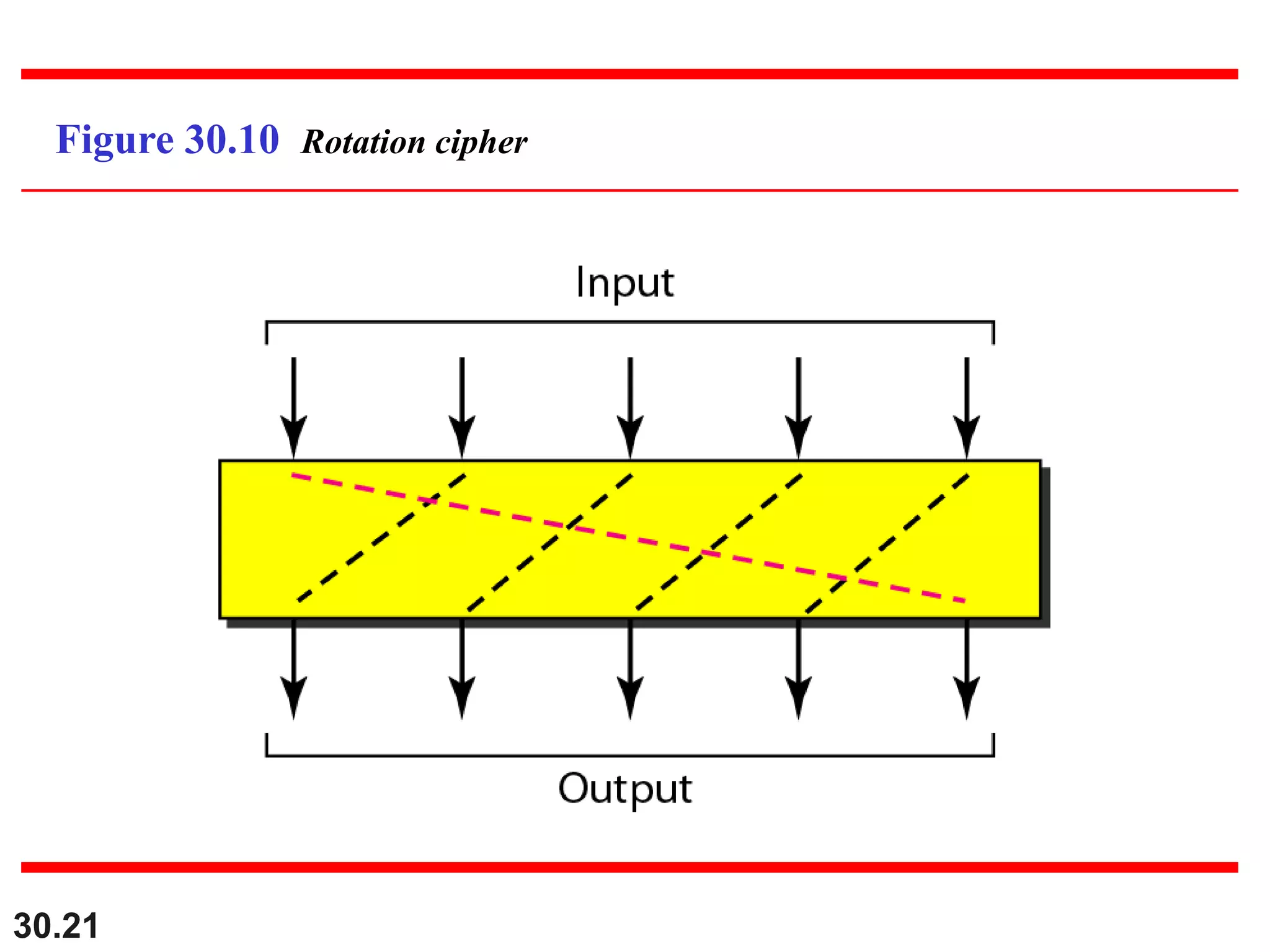
30.21
Figure 30.10 Rotation cipher
30.22
Figure 30.11 S-box (substitution box)
30.23
Figure 30.12 P-boxes (permutation box): straight, expansion, and compression
30.24
Figure 30.13 DES (Data Encryption Standard)
30.25
Figure 30.14 One round in DES ciphers
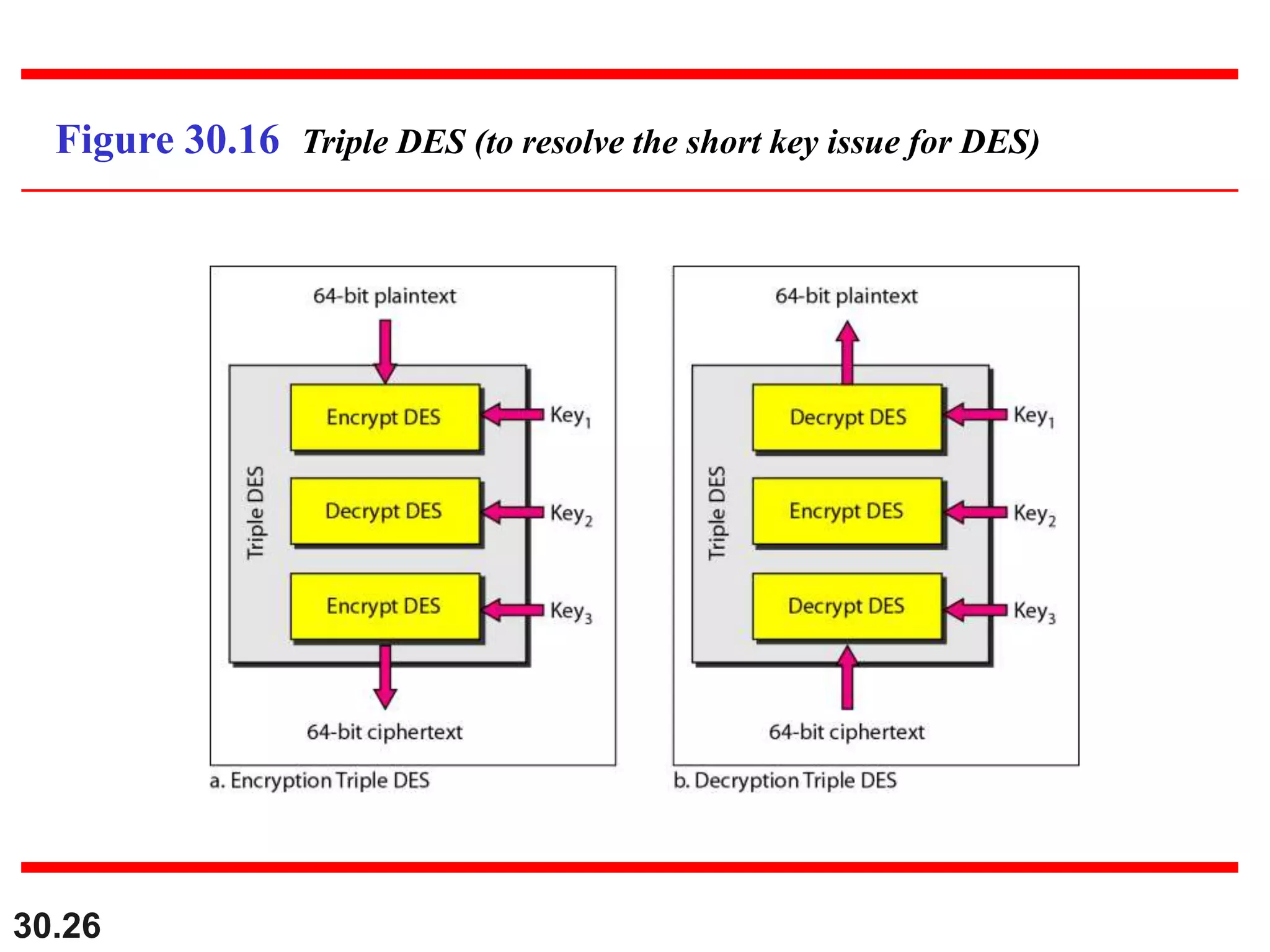
30.26
Figure 30.16 Triple DES (to resolve the short key issue for DES)
30.27
Table 30.1 AES (advanced encryption standard) configuration
AES is the replacement of DES
AES has three different configurations
with respect to the number of rounds
and key size.
Note
30.28
30-3 ASYMMETRIC-KEY CRYPTOGRAPHY
An asymmetric-key (or public-key) cipher uses two
keys: one private and one public. We discuss two
algorithms: RSA and Diffie-Hellman.
RSA
Diffie-Hellman
Topics discussed in this section:
30.29
Figure 30.24 RSA
RSA: Choosing keys
1. Choose two large prime numbers p, q.
(e.g., 1024 bits each)
2. Compute n = pq, F = (p-1)(q-1)
3. Choose e (with e<n) that has no common factors
with F. (e, F are “relatively prime”).
4. Choose d such that ed-1 is exactly divisible by F.
(in other words: ed mod F = 1 ).
5. Public key is (n,e). Private key is (n,d).
KB
+
KB
-
RSA: Encryption, decryption
0. Given (n,e) and (n,d) as computed above
1. To encrypt bit pattern, m, compute
c = m mod n
e
(i.e., remainder when m is divided by n)
e
2. To decrypt received bit pattern, c, compute
m = c mod n
d
(i.e., remainder when c is divided by n)
d
m = (m mod n)
e mod n
d
Magic
happens! c
RSA example:
Bob chooses p=5, q=7. Then n=35, F =24.
e=5 (so e, F relatively prime).
d=29 (so ed-1 exactly divisible by F).
letter m m
e c = m mod n
e
l 12 1524832 17
c m = c mod n
d
17 481968572106750915091411825223071697
12
cd letter
l
encrypt:
decrypt:
Computational very extensive
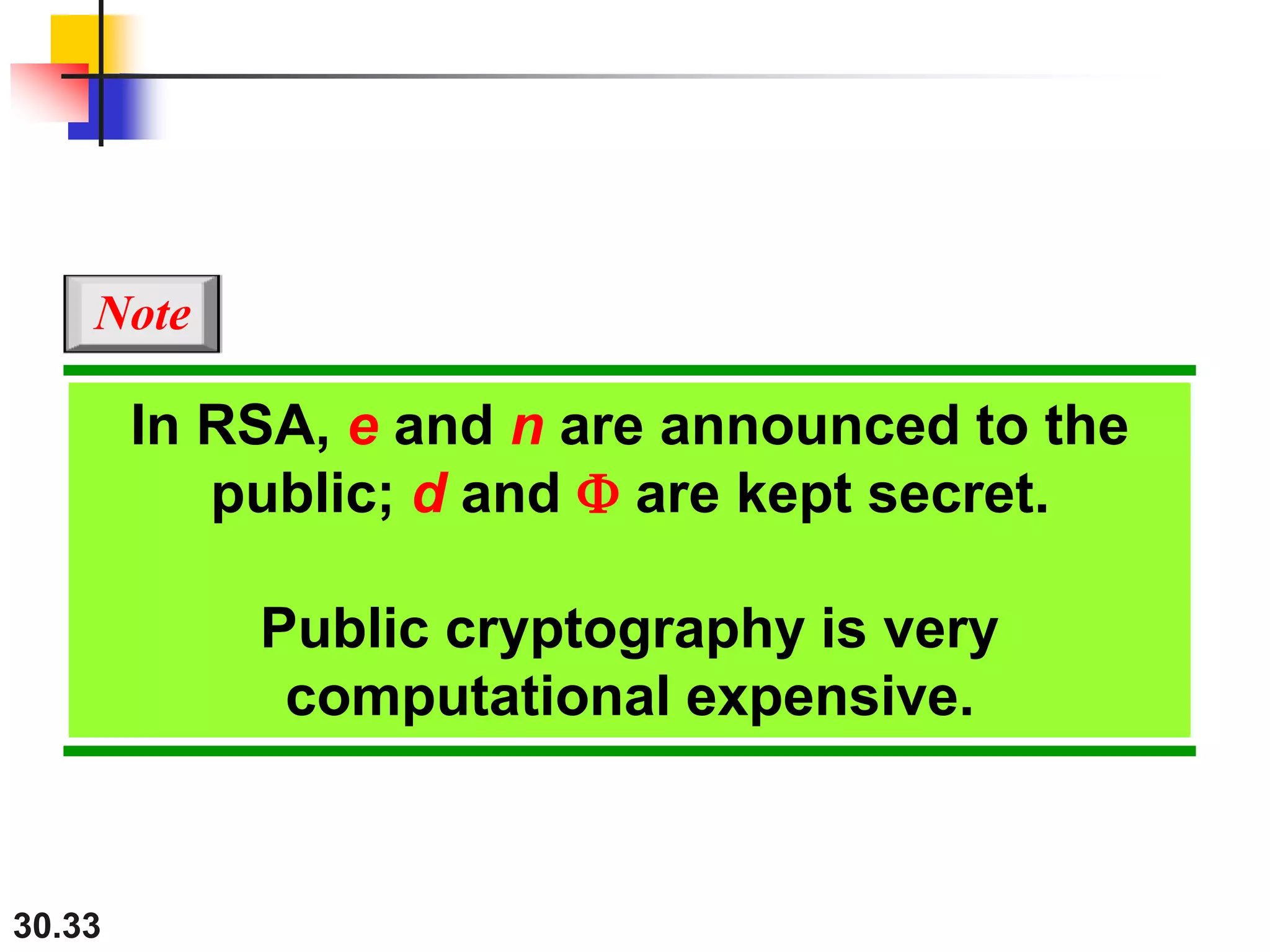
30.33
In RSA, e and n are announced to the
public; d and F are kept secret.
Public cryptography is very
computational expensive.
Note

ch30.ppt

  • 1.
    30.1 Chapter 30 Cryptography Copyright ©The McGraw-Hill Companies, Inc. Permission required for reproduction or display.
  • 2.
    30.2 30-1 INTRODUCTION Let usintroduce the issues involved in cryptography. First, we need to define some terms; then we give some taxonomies. Definitions Two Categories Topics discussed in this section:
  • 3.
  • 4.
  • 5.
  • 6.
    30.6 In symmetric-key cryptography,the same key is used by the sender (for encryption) and the receiver (for decryption). The key is shared. Note
  • 7.
  • 8.
    30.8 Figure 30.6 Comparisonbetween two categories of cryptography
  • 9.
    30.9 30-2 SYMMETRIC-KEY CRYPTOGRAPHY Symmetric-keycryptography started thousands of years ago when people needed to exchange secrets (for example, in a war). We still mainly use symmetric-key cryptography in our network security. Traditional Ciphers Simple Modern Ciphers Modern Round Ciphers Mode of Operation Topics discussed in this section:
  • 10.
  • 11.
    30.11 A substitution cipherreplaces one symbol with another. Monoalphabetic replaces the same symbol with the same another symbol. Polyalphabetic replaces the same symbol with different symbols at each occurrence. Note
  • 12.
    30.12 The shift cipheris sometimes referred to as the Caesar cipher. (monoalphabetic) Note
  • 13.
    30.13 Use the shiftcipher with key = 15 to encrypt the message “HELLO.” Solution We encrypt one character at a time. Each character is shifted 15 characters “down”. Letter H is encrypted to W. Letter E is encrypted to T. The first L is encrypted to A. The second L is also encrypted to A. And O is encrypted to D. The cipher text is WTAAD. Example 30.3
  • 14.
    30.14 Use the shiftcipher with key = 15 to decrypt the message “WTAAD.” Solution We decrypt one character at a time. Each character is shifted 15 characters “up”. Letter W is decrypted to H. Letter T is decrypted to E. The first A is decrypted to L. The second A is decrypted to L. And, finally, D is decrypted to O. The plaintext is HELLO. Example 30.4
  • 15.
    30.15 A transposition cipherreorders (permutes) symbols in a block of symbols (shuffle poker cards) Note
  • 16.
  • 17.
    30.17 Encrypt the message“HELLO MY DEAR,” using the key shown in Figure 30.8. Solution We first remove the spaces in the message. We then divide the text into blocks of four characters. We add a bogus character Z at the end of the third block. The result is HELL OMYD EARZ. We create a three-block ciphertext ELHLMDOYAZER. Example 30.5
  • 18.
    30.18 Using Example 30.5,decrypt the message “ELHLMDOYAZER”. Solution The result is HELL OMYD EARZ. After removing the bogus character and combining the characters, we get the original message “HELLO MY DEAR.” Example 30.6
  • 19.
  • 20.
  • 21.
  • 22.
    30.22 Figure 30.11 S-box(substitution box)
  • 23.
    30.23 Figure 30.12 P-boxes(permutation box): straight, expansion, and compression
  • 24.
    30.24 Figure 30.13 DES(Data Encryption Standard)
  • 25.
    30.25 Figure 30.14 Oneround in DES ciphers
  • 26.
    30.26 Figure 30.16 TripleDES (to resolve the short key issue for DES)
  • 27.
    30.27 Table 30.1 AES(advanced encryption standard) configuration AES is the replacement of DES AES has three different configurations with respect to the number of rounds and key size. Note
  • 28.
    30.28 30-3 ASYMMETRIC-KEY CRYPTOGRAPHY Anasymmetric-key (or public-key) cipher uses two keys: one private and one public. We discuss two algorithms: RSA and Diffie-Hellman. RSA Diffie-Hellman Topics discussed in this section:
  • 29.
  • 30.
    RSA: Choosing keys 1.Choose two large prime numbers p, q. (e.g., 1024 bits each) 2. Compute n = pq, F = (p-1)(q-1) 3. Choose e (with e<n) that has no common factors with F. (e, F are “relatively prime”). 4. Choose d such that ed-1 is exactly divisible by F. (in other words: ed mod F = 1 ). 5. Public key is (n,e). Private key is (n,d). KB + KB -
  • 31.
    RSA: Encryption, decryption 0.Given (n,e) and (n,d) as computed above 1. To encrypt bit pattern, m, compute c = m mod n e (i.e., remainder when m is divided by n) e 2. To decrypt received bit pattern, c, compute m = c mod n d (i.e., remainder when c is divided by n) d m = (m mod n) e mod n d Magic happens! c
  • 32.
    RSA example: Bob choosesp=5, q=7. Then n=35, F =24. e=5 (so e, F relatively prime). d=29 (so ed-1 exactly divisible by F). letter m m e c = m mod n e l 12 1524832 17 c m = c mod n d 17 481968572106750915091411825223071697 12 cd letter l encrypt: decrypt: Computational very extensive
  • 33.
    30.33 In RSA, eand n are announced to the public; d and F are kept secret. Public cryptography is very computational expensive. Note