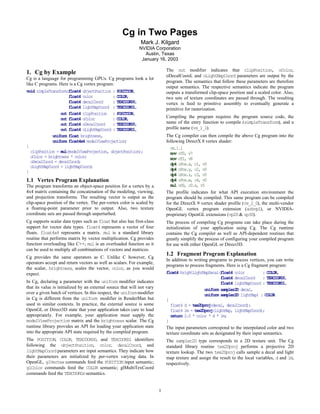
Cg in Two Pages
                                                              Mark J. Kilgard
                                                             NVIDIA Corporation
                                                                Austin, Texas
                                                              January 16, 2003

                                                                             The out modifier indicates that clipPosition, oColor,
1. Cg by Example                                                             oDecalCoord, and oLightMapCoord parameters are output by the
Cg is a language for programming GPUs. Cg programs look a lot
                                                                             program. The semantics that follow these parameters are therefore
like C programs. Here is a Cg vertex program:
                                                                             output semantics. The respective semantics indicate the program
void simpleTransform(float4 objectPosition : POSITION,                       outputs a transformed clip-space position and a scaled color. Also,
                     float4 color          : COLOR,                          two sets of texture coordinates are passed through. The resulting
                     float4 decalCoord     : TEXCOORD0,                      vertex is feed to primitive assembly to eventually generate a
                     float4 lightMapCoord : TEXCOORD1,                       primitive for rasterization.
                 out float4 clipPosition : POSITION,
                 out float4 oColor         : COLOR,                          Compiling the program requires the program source code, the
                 out float4 oDecalCoord    : TEXCOORD0,                      name of the entry function to compile (simpleTransform), and a
                 out float4 oLightMapCoord : TEXCOORD1,                      profile name (vs_1_1).
             uniform float brightness,                                       The Cg compiler can then compile the above Cg program into the
             uniform float4x4 modelViewProjection)                           following DirectX 8 vertex shader:
{                                                                              vs.1.1
  clipPosition = mul(modelViewProjection, objectPosition);                     mov oT0, v7
  oColor = brightness * color;                                                 mov oT1, v8
  oDecalCoord = decalCoord;
                                                                               dp4 oPos.x, c1, v0
  oLightMapCoord = lightMapCoord;
}                                                                              dp4 oPos.y, c2, v0
                                                                               dp4 oPos.z, c3, v0
1.1 Vertex Program Explanation                                                 dp4 oPos.w, c4, v0
The program transforms an object-space position for a vertex by a              mul oD0, c0.x, v5
4x4 matrix containing the concatenation of the modeling, viewing,            The profile indicates for what API execution environment the
and projection transforms. The resulting vector is output as the             program should be compiled. This same program can be compiled
clip-space position of the vertex. The per-vertex color is scaled by         for the DirectX 9 vertex shader profile (vs_2_0), the multi-vendor
a floating-point parameter prior to output. Also, two texture                OpenGL vertex program extension (arbvp1), or NVIDIA-
coordinate sets are passed through unperturbed.                              proprietary OpenGL extensions (vp20 & vp30).
Cg supports scalar data types such as float but also has first-class         The process of compiling Cg programs can take place during the
support for vector data types. float4 represents a vector of four            initialization of your application using Cg. The Cg runtime
floats. float4x4 represents a matrix. mul is a standard library              contains the Cg compiler as well as API-dependent routines that
routine that performs matrix by vector multiplication. Cg provides           greatly simplify the process of configuring your compiled program
function overloading like C++; mul is an overloaded function so it           for use with either OpenGL or Direct3D.
can be used to multiply all combinations of vectors and matrices.
                                                                             1.2 Fragment Program Explanation
Cg provides the same operators as C. Unlike C however, Cg
                                                                             In addition to writing programs to process vertices, you can write
operators accept and return vectors as well as scalars. For example,
                                                                             programs to process fragments. Here is a Cg fragment program:
the scalar, brightness, scales the vector, color, as you would
expect.                                                                      float4 brightLightMapDecal(float4 color              : COLOR,
                                                                                                           float4 decalCoord      : TEXCOORD0,
In Cg, declaring a parameter with the uniform modifier indicates                                           float4 lightMapCoord : TEXCOORD1,
that its value is initialized by an external source that will not vary                           uniform sampler2D decal,
over a given batch of vertices. In this respect, the uniform modifier                            uniform sampler2D lightMap) : COLOR
in Cg is different from the uniform modifier in RenderMan but                {
used in similar contexts. In practice, the external source is some             float4 d = tex2Dproj(decal, decalCoord);
OpenGL or Direct3D state that your application takes care to load              float4 lm = tex2Dproj(lightMap, lightMapCoord);
appropriately. For example, your application must supply the                   return 2.0 * color * d * lm;
modelViewProjection matrix and the brightness scalar. The Cg                 }
runtime library provides an API for loading your application state           The input parameters correspond to the interpolated color and two
into the appropriate API state required by the compiled program.             texture coordinate sets as designated by their input semantics.
The POSITION, COLOR, TEXCOORD0, and TEXCOORD1 identifiers                    The sampler2D type corresponds to a 2D texture unit. The Cg
following the objectPosition, color, decalCoord, and                         standard library routine tex2Dproj performs a projective 2D
lightMapCoord parameters are input semantics. They indicate how              texture lookup. The two tex2Dproj calls sample a decal and light
their parameters are initialized by per-vertex varying data. In              map texture and assign the result to the local variables, d and lm,
OpenGL, glVertex commands feed the POSITION input semantic;                  respectively.
glColor commands feed the COLOR semantic; glMultiTexCoord
commands feed the TEXCOORDn semantics.


                                                                         1
The program multiplies the two textures results, the interpolated            vec1.xw = vec3; // vec1 = (3.0, -2.0, 5.0, 3.0)
color, and the constant 2.0 together and returns this RGBA color.           Use either .xyzw or .rgba suffixes swizzling and write masking.
The program returns a float4 and the semantic for the return value
                                                                            The Cg standard library includes a large set of built-in functions
is COLOR, the final color of the fragment.
                                                                            for mathematics (abs, dot, log2, reflect, rsqrt, etc.) and texture
The Cg compiler generates the following code for                            access (texCUBE, tex3Dproj, etc.). The standard library makes
brightLightMapDecal when compiled with the arbfp1 multi-                    extensive use of function overloading (similar to C++) to support
vendor OpenGL fragment profile:                                             different vector lengths and data types. There is no need to use
  !!ARBfp1.0                                                                #include to obtain prototypes for standard library routines as in C;
  PARAM c0 = {2, 2, 2, 2}; TEMP R0; TEMP R1; TEMP R2;                       Cg standard library routines are automatically prototyped.
  TXP R0, fragment.texcoord[0], texture[0], 2D;                             In addition to the out modifier for call-by-result parameter
  TXP R1, fragment.texcoord[1], texture[1], 2D;                             passing, the inout modifier treats a parameter as both a call-by-
  MUL R2, c0.x, fragment.color.primary;
                                                                            value input parameter and a call-by-result output parameter.
  MUL R0, R2, R0;
  MUL result.color, R0, R1;                                                 The discard keyword is similar to return but aborts the
  END                                                                       processing without returning a transformed fragment.
This same program also compiles for the DirectX 8 and 9 profiles
(ps_1_3 & ps_2_x) and NVIDIA-proprietary OpenGL extensions
                                                                            2.3 Features Not Supported
                                                                            Cg has no support currently for pointers or bitwise operations
(fp20 & fp30).
                                                                            (however, the necessary C operators and keywords are reserved for
2. Other Cg Functionality                                                   this purpose). Cg does not (currently) support unions and function
                                                                            variables.
2.1 Features from C
                                                                            Cg lacks C++ features for “programming in the large” such as
Cg provides structures and arrays, including multi-dimensional
                                                                            classes, templates, operator overloading, exception handling, and
arrays. Cg provides all of C’s arithmetic operators (+, *, /, etc.).
                                                                            namespaces.
Cg provides a boolean type and boolean and relational operators
(||, &&, !, etc.). Cg provides increment/decrement (++/--) operators,       The Cg standard library lacks routines for functionality such as
the conditional expression operator (?:), assignment expressions            string processing, file input/output, and memory allocation, which
(+=, etc.), and even the C comma operator.                                  is beyond the specialized scope of Cg.
Cg provides user-defined functions (in addition to pre-defined              However, Cg reserves all C and C++ keywords so that features
standard library functions), but recursive functions are not allowed.       from these languages could be incorporated into future
Cg provides a subset of C’s control flow constructs (do, while,             implementations of Cg as warranted.
for, if, break, continue); other constructs such as goto and
switch are not supported in current the current Cg implementation           3. Profile Dependencies
but the necessary keywords are reserved.                                    When you compile a C or C++ program, you expect it to compile
                                                                            without regard to how big (within reason) the program is or what
Like C, Cg does not mandate the precision and range of its data             the program does. With Cg, a syntactically and semantically
types. In practice, the profile chosen for compilation determines           correct program may still not compile due to limitations of the
the concrete representation for each data type. float, half, and            profile for which you are compiling the program.
double are meant to represent continuous values, ideally in
                                                                            For example, it is currently an error to access a texture when
floating-point, but this can depend on the profile. half is intended
                                                                            compiling with a vertex profile. Future vertex profiles may well
for a 16-bit half-precision floating-point data type. (NVIDIA’s
                                                                            allow texture accesses, but existing vertex profiles do not. Other
CineFX architecture provides such a data type.) int is an integer
                                                                            errors are more inherent. For example, a fragment profile should
data type, usually used for looping and indexing. fixed is an
                                                                            not output a parameter with a TEXCOORD0 semantic. Other errors
additional data type intended to represent a fixed-point continuous
                                                                            may be due to exceeding a capacity limit of current GPUs such as
data type that may not be floating-point.
                                                                            the maximum number of instructions or the number of texture units
Cg provides #include, #define, #ifdef, etc. matching the C                  available.
preprocessor. Cg supports C and C++ comments.
                                                                            Understand that these profile dependent errors do not reflect
2.2 Additional Features Not in C                                            limitations of the Cg language, but rather limitations of the current
Cg provides built-in constructors (similar to C++ but not user-             implementation of Cg or the underlying hardware limitations of
defined) for vector data types:                                             your target GPU.
  float4 vec1 = float4(4.0, -2.0, 5.0, 3.0);                                4. Compatibility and Portability
Swizzling is a way of rearranging components of vector values and           NVIDIA's Cg implementation and Microsoft's High Level Shader
constructing shorter or longer vectors. Example:                            Language (HLSL) are very similar as they were co-developed.
  float2 vec2 = vec1.yx;          // vec2 = (-2.0, 4.0)                     HLSL is integrated with DirectX 9 and the Windows operating
  float scalar = vec1.w;          // scalar = 3.0                           system. Cg provides support for multiple APIs (OpenGL, Direct X
  float3 vec3 = scalar.xxx;       // vec3 = (3.0, 3.0, 3.0)                 8, and Direct X 9) and multiple operating systems (Windows,
More complicated swizzling syntax is available for matrices.                Linux, and Mac OS X). Because Cg interfaces to multi-vendor
Vector and matrix elements can also be accessed with standard               APIs, Cg runs on GPUs from multiple vendors.
array indexing syntax as well.
                                                                            5. More Information
Write masking restricts       vector   assignments    to   indicated        In March 2003, look for The Cg Tutorial: The Definitive Guide to
components. Example:                                                        Programmable Real-Time Graphics (ISBN 0321194969) published
                                                                            by Addison-Wesley.
                                                                        2

Cg in Two Pages

  • 1.
    Cg in TwoPages Mark J. Kilgard NVIDIA Corporation Austin, Texas January 16, 2003 The out modifier indicates that clipPosition, oColor, 1. Cg by Example oDecalCoord, and oLightMapCoord parameters are output by the Cg is a language for programming GPUs. Cg programs look a lot program. The semantics that follow these parameters are therefore like C programs. Here is a Cg vertex program: output semantics. The respective semantics indicate the program void simpleTransform(float4 objectPosition : POSITION, outputs a transformed clip-space position and a scaled color. Also, float4 color : COLOR, two sets of texture coordinates are passed through. The resulting float4 decalCoord : TEXCOORD0, vertex is feed to primitive assembly to eventually generate a float4 lightMapCoord : TEXCOORD1, primitive for rasterization. out float4 clipPosition : POSITION, out float4 oColor : COLOR, Compiling the program requires the program source code, the out float4 oDecalCoord : TEXCOORD0, name of the entry function to compile (simpleTransform), and a out float4 oLightMapCoord : TEXCOORD1, profile name (vs_1_1). uniform float brightness, The Cg compiler can then compile the above Cg program into the uniform float4x4 modelViewProjection) following DirectX 8 vertex shader: { vs.1.1 clipPosition = mul(modelViewProjection, objectPosition); mov oT0, v7 oColor = brightness * color; mov oT1, v8 oDecalCoord = decalCoord; dp4 oPos.x, c1, v0 oLightMapCoord = lightMapCoord; } dp4 oPos.y, c2, v0 dp4 oPos.z, c3, v0 1.1 Vertex Program Explanation dp4 oPos.w, c4, v0 The program transforms an object-space position for a vertex by a mul oD0, c0.x, v5 4x4 matrix containing the concatenation of the modeling, viewing, The profile indicates for what API execution environment the and projection transforms. The resulting vector is output as the program should be compiled. This same program can be compiled clip-space position of the vertex. The per-vertex color is scaled by for the DirectX 9 vertex shader profile (vs_2_0), the multi-vendor a floating-point parameter prior to output. Also, two texture OpenGL vertex program extension (arbvp1), or NVIDIA- coordinate sets are passed through unperturbed. proprietary OpenGL extensions (vp20 & vp30). Cg supports scalar data types such as float but also has first-class The process of compiling Cg programs can take place during the support for vector data types. float4 represents a vector of four initialization of your application using Cg. The Cg runtime floats. float4x4 represents a matrix. mul is a standard library contains the Cg compiler as well as API-dependent routines that routine that performs matrix by vector multiplication. Cg provides greatly simplify the process of configuring your compiled program function overloading like C++; mul is an overloaded function so it for use with either OpenGL or Direct3D. can be used to multiply all combinations of vectors and matrices. 1.2 Fragment Program Explanation Cg provides the same operators as C. Unlike C however, Cg In addition to writing programs to process vertices, you can write operators accept and return vectors as well as scalars. For example, programs to process fragments. Here is a Cg fragment program: the scalar, brightness, scales the vector, color, as you would expect. float4 brightLightMapDecal(float4 color : COLOR, float4 decalCoord : TEXCOORD0, In Cg, declaring a parameter with the uniform modifier indicates float4 lightMapCoord : TEXCOORD1, that its value is initialized by an external source that will not vary uniform sampler2D decal, over a given batch of vertices. In this respect, the uniform modifier uniform sampler2D lightMap) : COLOR in Cg is different from the uniform modifier in RenderMan but { used in similar contexts. In practice, the external source is some float4 d = tex2Dproj(decal, decalCoord); OpenGL or Direct3D state that your application takes care to load float4 lm = tex2Dproj(lightMap, lightMapCoord); appropriately. For example, your application must supply the return 2.0 * color * d * lm; modelViewProjection matrix and the brightness scalar. The Cg } runtime library provides an API for loading your application state The input parameters correspond to the interpolated color and two into the appropriate API state required by the compiled program. texture coordinate sets as designated by their input semantics. The POSITION, COLOR, TEXCOORD0, and TEXCOORD1 identifiers The sampler2D type corresponds to a 2D texture unit. The Cg following the objectPosition, color, decalCoord, and standard library routine tex2Dproj performs a projective 2D lightMapCoord parameters are input semantics. They indicate how texture lookup. The two tex2Dproj calls sample a decal and light their parameters are initialized by per-vertex varying data. In map texture and assign the result to the local variables, d and lm, OpenGL, glVertex commands feed the POSITION input semantic; respectively. glColor commands feed the COLOR semantic; glMultiTexCoord commands feed the TEXCOORDn semantics. 1
  • 2.
    The program multipliesthe two textures results, the interpolated vec1.xw = vec3; // vec1 = (3.0, -2.0, 5.0, 3.0) color, and the constant 2.0 together and returns this RGBA color. Use either .xyzw or .rgba suffixes swizzling and write masking. The program returns a float4 and the semantic for the return value The Cg standard library includes a large set of built-in functions is COLOR, the final color of the fragment. for mathematics (abs, dot, log2, reflect, rsqrt, etc.) and texture The Cg compiler generates the following code for access (texCUBE, tex3Dproj, etc.). The standard library makes brightLightMapDecal when compiled with the arbfp1 multi- extensive use of function overloading (similar to C++) to support vendor OpenGL fragment profile: different vector lengths and data types. There is no need to use !!ARBfp1.0 #include to obtain prototypes for standard library routines as in C; PARAM c0 = {2, 2, 2, 2}; TEMP R0; TEMP R1; TEMP R2; Cg standard library routines are automatically prototyped. TXP R0, fragment.texcoord[0], texture[0], 2D; In addition to the out modifier for call-by-result parameter TXP R1, fragment.texcoord[1], texture[1], 2D; passing, the inout modifier treats a parameter as both a call-by- MUL R2, c0.x, fragment.color.primary; value input parameter and a call-by-result output parameter. MUL R0, R2, R0; MUL result.color, R0, R1; The discard keyword is similar to return but aborts the END processing without returning a transformed fragment. This same program also compiles for the DirectX 8 and 9 profiles (ps_1_3 & ps_2_x) and NVIDIA-proprietary OpenGL extensions 2.3 Features Not Supported Cg has no support currently for pointers or bitwise operations (fp20 & fp30). (however, the necessary C operators and keywords are reserved for 2. Other Cg Functionality this purpose). Cg does not (currently) support unions and function variables. 2.1 Features from C Cg lacks C++ features for “programming in the large” such as Cg provides structures and arrays, including multi-dimensional classes, templates, operator overloading, exception handling, and arrays. Cg provides all of C’s arithmetic operators (+, *, /, etc.). namespaces. Cg provides a boolean type and boolean and relational operators (||, &&, !, etc.). Cg provides increment/decrement (++/--) operators, The Cg standard library lacks routines for functionality such as the conditional expression operator (?:), assignment expressions string processing, file input/output, and memory allocation, which (+=, etc.), and even the C comma operator. is beyond the specialized scope of Cg. Cg provides user-defined functions (in addition to pre-defined However, Cg reserves all C and C++ keywords so that features standard library functions), but recursive functions are not allowed. from these languages could be incorporated into future Cg provides a subset of C’s control flow constructs (do, while, implementations of Cg as warranted. for, if, break, continue); other constructs such as goto and switch are not supported in current the current Cg implementation 3. Profile Dependencies but the necessary keywords are reserved. When you compile a C or C++ program, you expect it to compile without regard to how big (within reason) the program is or what Like C, Cg does not mandate the precision and range of its data the program does. With Cg, a syntactically and semantically types. In practice, the profile chosen for compilation determines correct program may still not compile due to limitations of the the concrete representation for each data type. float, half, and profile for which you are compiling the program. double are meant to represent continuous values, ideally in For example, it is currently an error to access a texture when floating-point, but this can depend on the profile. half is intended compiling with a vertex profile. Future vertex profiles may well for a 16-bit half-precision floating-point data type. (NVIDIA’s allow texture accesses, but existing vertex profiles do not. Other CineFX architecture provides such a data type.) int is an integer errors are more inherent. For example, a fragment profile should data type, usually used for looping and indexing. fixed is an not output a parameter with a TEXCOORD0 semantic. Other errors additional data type intended to represent a fixed-point continuous may be due to exceeding a capacity limit of current GPUs such as data type that may not be floating-point. the maximum number of instructions or the number of texture units Cg provides #include, #define, #ifdef, etc. matching the C available. preprocessor. Cg supports C and C++ comments. Understand that these profile dependent errors do not reflect 2.2 Additional Features Not in C limitations of the Cg language, but rather limitations of the current Cg provides built-in constructors (similar to C++ but not user- implementation of Cg or the underlying hardware limitations of defined) for vector data types: your target GPU. float4 vec1 = float4(4.0, -2.0, 5.0, 3.0); 4. Compatibility and Portability Swizzling is a way of rearranging components of vector values and NVIDIA's Cg implementation and Microsoft's High Level Shader constructing shorter or longer vectors. Example: Language (HLSL) are very similar as they were co-developed. float2 vec2 = vec1.yx; // vec2 = (-2.0, 4.0) HLSL is integrated with DirectX 9 and the Windows operating float scalar = vec1.w; // scalar = 3.0 system. Cg provides support for multiple APIs (OpenGL, Direct X float3 vec3 = scalar.xxx; // vec3 = (3.0, 3.0, 3.0) 8, and Direct X 9) and multiple operating systems (Windows, More complicated swizzling syntax is available for matrices. Linux, and Mac OS X). Because Cg interfaces to multi-vendor Vector and matrix elements can also be accessed with standard APIs, Cg runs on GPUs from multiple vendors. array indexing syntax as well. 5. More Information Write masking restricts vector assignments to indicated In March 2003, look for The Cg Tutorial: The Definitive Guide to components. Example: Programmable Real-Time Graphics (ISBN 0321194969) published by Addison-Wesley. 2