Towards a Language Server Protocol
Infrastructure for Graphical Modeling
Roberto Rodriguez-Echeverria, Javier L. Cánovas, Manuel Wimmer and Jordi Cabot
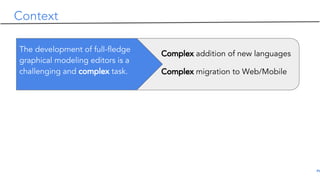
Context
Complex addition of new languages
Complex migration to Web/Mobile
The development of full-fledge
graphical modeling editors is a
challenging and complex task.
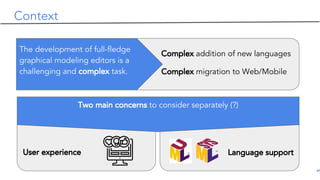
Context
User experience Language support
Complex addition of new languages
Complex migration to Web/Mobile
The development of full-fledge
graphical modeling editors is a
challenging and complex task.
Two main concerns to consider separately (?)
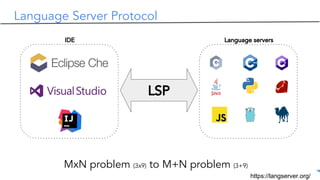
LSP
Language Server Protocol
IDE Language servers
MxN problem (3x9) to M+N problem (3+9)
https://langserver.org/
Problem
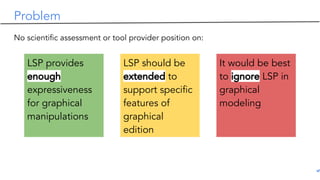
No scientific assessment or tool provider position on:
LSP provides
enough
expressiveness
for graphical
manipulations
LSP should be
extended to
support specific
features of
graphical
edition
It would be best
to ignore LSP in
graphical
modeling
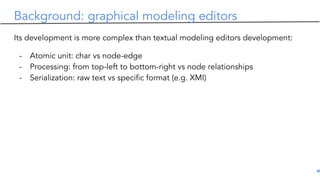
Background: graphical modeling editors
Its development is more complex than textual modeling editors development:
- Atomic unit: char vs node-edge
- Processing: from top-left to bottom-right vs node relationships
- Serialization: raw text vs specific format (e.g. XMI)
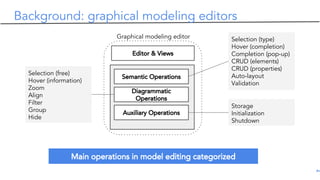
Background: graphical modeling editors
Editor & Views
Semantic Operations
Diagrammatic
Operations
Auxiliary Operations
Graphical modeling editor Selection (type)
Hover (completion)
Completion (pop-up)
CRUD (elements)
CRUD (properties)
Auto-layout
Validation
...
Selection (free)
Hover (information)
Zoom
Align
Filter
Group
Hide
Storage
Initialization
Shutdown
Main operations in model editing categorized
Background: Language Server Protocol 3.0
https://microsoft.github.io/language-server-protocol/overview
Background: Language Server Protocol 3.0
Main issue: designed for textual
programming languages
● Text ranges are a basic type
=> making easy for clients to
connect to different LS in a seamless
way, because the protocol is
completely language-agnostic
NotificationMessage {
method : "textDocument/didChange",
params : {
textDocument : {
version : 2
},
contentChanges : [
{ range : {
start : {
line : 21,
character : 6
},
end : {
line : 33,
character : 6
}
}
text : ""
}]}}
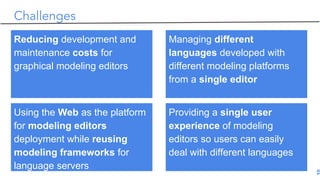
Challenges
Reducing development and
maintenance costs for
graphical modeling editors
Using the Web as the platform
for modeling editors
deployment while reusing
modeling frameworks for
language servers
Managing different
languages developed with
different modeling platforms
from a single editor
Providing a single user
experience of modeling
editors so users can easily
deal with different languages
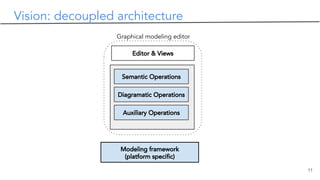
Vision: decoupled architecture
Editor & Views
Semantic Operations
Diagramatic Operations
Auxiliary Operations
Graphical modeling editor
11
Modeling framework
(platform specific)
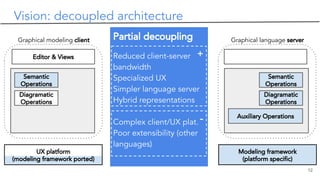
Vision: decoupled architecture
Editor & Views
Diagramatic
Operations
Graphical modeling client
Semantic
Operations
Diagramatic
Operations
Auxiliary Operations
Graphical language serverPartial decoupling
Reduced client-server
bandwidth
Specialized UX
Simpler language server
Hybrid representations
Complex client/UX plat.
Poor extensibility (other
languages)
-
+
Semantic
Operations
12
Modeling framework
(platform specific)
UX platform
(modeling framework ported)
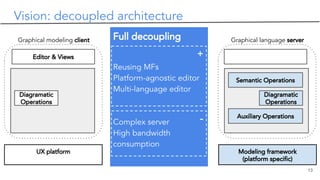
Vision: decoupled architecture
Editor & Views
Diagramatic
Operations
Graphical modeling client
Semantic Operations
Diagramatic
Operations
Auxiliary Operations
Graphical language serverFull decoupling
Reusing MFs
Platform-agnostic editor
Multi-language editor
Complex server
High bandwidth
consumption
-
+
13
Modeling framework
(platform specific)
UX platform
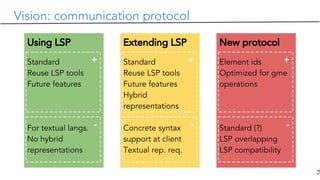
Vision: communication protocol
Using LSP
Standard
Reuse LSP tools
Future features
For textual langs.
No hybrid
representations
Extending LSP
Standard
Reuse LSP tools
Future features
Hybrid
representations
Concrete syntax
support at client
Textual rep. req.
New protocol
Element ids
Optimized for gme
operations
Standard (?)
LSP overlapping
LSP compatibility
-
+ +
-
+
-
Vision: communication protocol
Although the pros of defining a new protocol or
extending LSP may be substantial, we argue that
using LSP itself plus a textual representation is
expressive enough for graphical languages, and
most of its drawbacks may be properly addressed by
providing the needed LSP infrastructure.
LSP provides
enough
expressiveness
for graphical
manipulations
LSP infrastructure for graphical modeling
Intermediate Representation Format
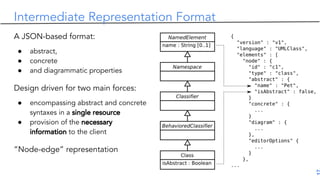
A JSON-based format:
● abstract,
● concrete
● and diagrammatic properties
Design driven for two main forces:
● encompassing abstract and concrete
syntaxes in a single resource
● provision of the necessary
information to the client
“Node-edge” representation
Intermediate Representation Format
Mapping GME operations into LSP
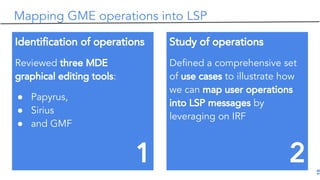
Identification of operations
Reviewed three MDE
graphical editing tools:
● Papyrus,
● Sirius
● and GMF
Study of operations
Defined a comprehensive set
of use cases to illustrate how
we can map user operations
into LSP messages by
leveraging on IRF
1 2
Mapping GME operations into LSP
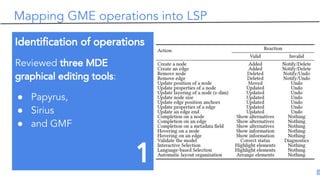
Identification of operations
Reviewed three MDE
graphical editing tools:
● Papyrus,
● Sirius
● and GMF
1
Mapping GME operations into LSP
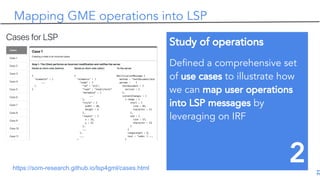
Study of operations
Defined a comprehensive set
of use cases to illustrate how
we can map user operations
into LSP messages by
leveraging on IRF
2https://som-research.github.io/lsp4gml/cases.html
Mapping GME operations into LSP
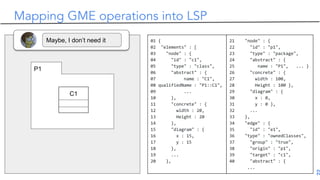
P1
C1
01 {
02 "elements" : [
03 "node" : {
04 "id" : "c1",
05 "type" : "class",
06 "abstract" : {
07 name : "C1",
08 qualifiedName : "P1::C1",
09 ...
10 },
11 "concrete" : {
12 width : 20,
13 Height : 20
14 },
15 "diagram" : {
16 x : 15,
17 y : 15
18 },
19 ...
20 },
21 "node" : {
22 "id" : "p1",
23 "type" : "package",
24 "abstract" : {
25 name : "P1", ... }
26 "concrete" : {
27 width : 100,
28 Height : 100 },
29 "diagram" : {
30 x : 0,
31 y : 0 },
32 ...
33 },
34 "edge" : {
35 "id" : "e1",
36 "type" : "ownedClasses",
37 "group" : "true",
38 "origin" : "p1",
39 "target" : "c1",
40 "abstract" : {
...
Maybe, I don’t need it
Mapping GME operations into LSP
01 {
02 "elements" : [
03 "node" : {
04 "id" : "c1",
05 "type" : "class",
06 "abstract" : {
07 name : "C1",
08 qualifiedName : "P1::C1",
09 ...
10 },
11 "concrete" : {
12 width : 20,
13 Height : 20
14 },
15 "diagram" : {
16 x : 15,
17 y : 15
18 },
19 ...
20 },
21 "node" : {
22 "id" : "p1",
23 "type" : "package",
24 "abstract" : {
25 name : "P1", ... }
26 "concrete" : {
27 width : 100,
28 Height : 100 },
29 "diagram" : {
30 x : 0,
31 y : 0 },
32 ...
33 },
34 "edge" : {
35 "id" : "e1",
36 "type" : "ownedClasses",
37 "group" : "true",
38 "origin" : "p1",
39 "target" : "c1",
40 "abstract" : {
...
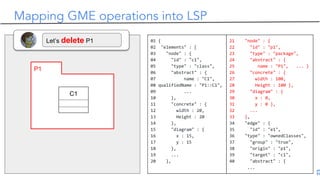
P1
C1
Let’s delete P1
Mapping GME operations into LSP
NotificationMessage {
method :
"textDocument/didChange",
params : {
textDocument : {
version : 2
},
contentChanges : [
{ range : {
start : {
line : 21,
character : 6
},
end : {
line : 33,
character : 6
}
}
text : ""
}]}}
RequestMessage {
jsonrpc : "2.0",
id : "0001",
method: "workspace/ApplyEdit",
params : {
edit : {
documentChanges : [
{
textDocument : { version: 2 },
edits : [
{ range : {
start : {
line : 03,
character : 00 },
end : {
line : 35,
character : 00 }
},
newtext: ""
}]]}}}
ResponseMessage{
jsonrpc : "2.0",
id : "0001",
result : { applied : true }
}
Client => Server Server => Client Client => Server
Mapping GME operations into LSP
01 {
02 "elements" : []
03 }
D’oh!
Proof of Concept
MDETools 2018
“An LSP infrastructure to build
EMF language servers for
Web-deployable model editors”
https://github.com/SOM-Research/lsp4gml
Conclusions and Future Work
We discussed different alternatives of clients, servers and the LSP usages for
decoupling graphical language editors.
We described an approach relying on standard LSP and a text-based model
representation shared between clients and servers.
Roadmap:
● Automatic generation of graphical language servers
○ To what extent is feasible?
● Performance assessment
○ bandwidth optimization and server-side enhancements.
Decoupling GME dev into a client-server architecture
using a convenient protocol is a key approach.
Let’s use an open common protocol to share
our graphical language servers
Final
Remark
Thank you
Towards a Language Server Protocol
Infrastructure for Graphical Modeling
Roberto Rodriguez-Echeverria, Javier L. Cánovas, Manuel Wimmer and Jordi Cabot

Towards a language server protocol infrastructure for graphical modeling

  • 1.
    Towards a LanguageServer Protocol Infrastructure for Graphical Modeling Roberto Rodriguez-Echeverria, Javier L. Cánovas, Manuel Wimmer and Jordi Cabot
  • 2.
    Context Complex addition ofnew languages Complex migration to Web/Mobile The development of full-fledge graphical modeling editors is a challenging and complex task.
  • 3.
    Context User experience Languagesupport Complex addition of new languages Complex migration to Web/Mobile The development of full-fledge graphical modeling editors is a challenging and complex task. Two main concerns to consider separately (?)
  • 4.
    LSP Language Server Protocol IDELanguage servers MxN problem (3x9) to M+N problem (3+9) https://langserver.org/
  • 5.
    Problem No scientific assessmentor tool provider position on: LSP provides enough expressiveness for graphical manipulations LSP should be extended to support specific features of graphical edition It would be best to ignore LSP in graphical modeling
  • 6.
    Background: graphical modelingeditors Its development is more complex than textual modeling editors development: - Atomic unit: char vs node-edge - Processing: from top-left to bottom-right vs node relationships - Serialization: raw text vs specific format (e.g. XMI)
  • 7.
    Background: graphical modelingeditors Editor & Views Semantic Operations Diagrammatic Operations Auxiliary Operations Graphical modeling editor Selection (type) Hover (completion) Completion (pop-up) CRUD (elements) CRUD (properties) Auto-layout Validation ... Selection (free) Hover (information) Zoom Align Filter Group Hide Storage Initialization Shutdown Main operations in model editing categorized
  • 8.
    Background: Language ServerProtocol 3.0 https://microsoft.github.io/language-server-protocol/overview
  • 9.
    Background: Language ServerProtocol 3.0 Main issue: designed for textual programming languages ● Text ranges are a basic type => making easy for clients to connect to different LS in a seamless way, because the protocol is completely language-agnostic NotificationMessage { method : "textDocument/didChange", params : { textDocument : { version : 2 }, contentChanges : [ { range : { start : { line : 21, character : 6 }, end : { line : 33, character : 6 } } text : "" }]}}
  • 10.
    Challenges Reducing development and maintenancecosts for graphical modeling editors Using the Web as the platform for modeling editors deployment while reusing modeling frameworks for language servers Managing different languages developed with different modeling platforms from a single editor Providing a single user experience of modeling editors so users can easily deal with different languages
  • 11.
    Vision: decoupled architecture Editor& Views Semantic Operations Diagramatic Operations Auxiliary Operations Graphical modeling editor 11 Modeling framework (platform specific)
  • 12.
    Vision: decoupled architecture Editor& Views Diagramatic Operations Graphical modeling client Semantic Operations Diagramatic Operations Auxiliary Operations Graphical language serverPartial decoupling Reduced client-server bandwidth Specialized UX Simpler language server Hybrid representations Complex client/UX plat. Poor extensibility (other languages) - + Semantic Operations 12 Modeling framework (platform specific) UX platform (modeling framework ported)
  • 13.
    Vision: decoupled architecture Editor& Views Diagramatic Operations Graphical modeling client Semantic Operations Diagramatic Operations Auxiliary Operations Graphical language serverFull decoupling Reusing MFs Platform-agnostic editor Multi-language editor Complex server High bandwidth consumption - + 13 Modeling framework (platform specific) UX platform
  • 14.
    Vision: communication protocol UsingLSP Standard Reuse LSP tools Future features For textual langs. No hybrid representations Extending LSP Standard Reuse LSP tools Future features Hybrid representations Concrete syntax support at client Textual rep. req. New protocol Element ids Optimized for gme operations Standard (?) LSP overlapping LSP compatibility - + + - + -
  • 15.
    Vision: communication protocol Althoughthe pros of defining a new protocol or extending LSP may be substantial, we argue that using LSP itself plus a textual representation is expressive enough for graphical languages, and most of its drawbacks may be properly addressed by providing the needed LSP infrastructure. LSP provides enough expressiveness for graphical manipulations
  • 16.
    LSP infrastructure forgraphical modeling
  • 17.
    Intermediate Representation Format AJSON-based format: ● abstract, ● concrete ● and diagrammatic properties Design driven for two main forces: ● encompassing abstract and concrete syntaxes in a single resource ● provision of the necessary information to the client “Node-edge” representation
  • 18.
  • 19.
    Mapping GME operationsinto LSP Identification of operations Reviewed three MDE graphical editing tools: ● Papyrus, ● Sirius ● and GMF Study of operations Defined a comprehensive set of use cases to illustrate how we can map user operations into LSP messages by leveraging on IRF 1 2
  • 20.
    Mapping GME operationsinto LSP Identification of operations Reviewed three MDE graphical editing tools: ● Papyrus, ● Sirius ● and GMF 1
  • 21.
    Mapping GME operationsinto LSP Study of operations Defined a comprehensive set of use cases to illustrate how we can map user operations into LSP messages by leveraging on IRF 2https://som-research.github.io/lsp4gml/cases.html
  • 22.
    Mapping GME operationsinto LSP P1 C1 01 { 02 "elements" : [ 03 "node" : { 04 "id" : "c1", 05 "type" : "class", 06 "abstract" : { 07 name : "C1", 08 qualifiedName : "P1::C1", 09 ... 10 }, 11 "concrete" : { 12 width : 20, 13 Height : 20 14 }, 15 "diagram" : { 16 x : 15, 17 y : 15 18 }, 19 ... 20 }, 21 "node" : { 22 "id" : "p1", 23 "type" : "package", 24 "abstract" : { 25 name : "P1", ... } 26 "concrete" : { 27 width : 100, 28 Height : 100 }, 29 "diagram" : { 30 x : 0, 31 y : 0 }, 32 ... 33 }, 34 "edge" : { 35 "id" : "e1", 36 "type" : "ownedClasses", 37 "group" : "true", 38 "origin" : "p1", 39 "target" : "c1", 40 "abstract" : { ... Maybe, I don’t need it
  • 23.
    Mapping GME operationsinto LSP 01 { 02 "elements" : [ 03 "node" : { 04 "id" : "c1", 05 "type" : "class", 06 "abstract" : { 07 name : "C1", 08 qualifiedName : "P1::C1", 09 ... 10 }, 11 "concrete" : { 12 width : 20, 13 Height : 20 14 }, 15 "diagram" : { 16 x : 15, 17 y : 15 18 }, 19 ... 20 }, 21 "node" : { 22 "id" : "p1", 23 "type" : "package", 24 "abstract" : { 25 name : "P1", ... } 26 "concrete" : { 27 width : 100, 28 Height : 100 }, 29 "diagram" : { 30 x : 0, 31 y : 0 }, 32 ... 33 }, 34 "edge" : { 35 "id" : "e1", 36 "type" : "ownedClasses", 37 "group" : "true", 38 "origin" : "p1", 39 "target" : "c1", 40 "abstract" : { ... P1 C1 Let’s delete P1
  • 24.
    Mapping GME operationsinto LSP NotificationMessage { method : "textDocument/didChange", params : { textDocument : { version : 2 }, contentChanges : [ { range : { start : { line : 21, character : 6 }, end : { line : 33, character : 6 } } text : "" }]}} RequestMessage { jsonrpc : "2.0", id : "0001", method: "workspace/ApplyEdit", params : { edit : { documentChanges : [ { textDocument : { version: 2 }, edits : [ { range : { start : { line : 03, character : 00 }, end : { line : 35, character : 00 } }, newtext: "" }]]}}} ResponseMessage{ jsonrpc : "2.0", id : "0001", result : { applied : true } } Client => Server Server => Client Client => Server
  • 25.
    Mapping GME operationsinto LSP 01 { 02 "elements" : [] 03 } D’oh!
  • 26.
    Proof of Concept MDETools2018 “An LSP infrastructure to build EMF language servers for Web-deployable model editors” https://github.com/SOM-Research/lsp4gml
  • 27.
    Conclusions and FutureWork We discussed different alternatives of clients, servers and the LSP usages for decoupling graphical language editors. We described an approach relying on standard LSP and a text-based model representation shared between clients and servers. Roadmap: ● Automatic generation of graphical language servers ○ To what extent is feasible? ● Performance assessment ○ bandwidth optimization and server-side enhancements.
  • 28.
    Decoupling GME devinto a client-server architecture using a convenient protocol is a key approach. Let’s use an open common protocol to share our graphical language servers Final Remark
  • 29.
  • 30.
    Towards a LanguageServer Protocol Infrastructure for Graphical Modeling Roberto Rodriguez-Echeverria, Javier L. Cánovas, Manuel Wimmer and Jordi Cabot