CARBON FIBER REINFORCEMENT
( And Its Role Against Loading)
OR
CARBOCRETE
Supervisor: Ma`am Engr. Rabia
Bano
Section C
Semester 8th
Group No 3
Naqeeb Ullah Khan Niazi 107
Muhammad Adnan 94
Syed M Tajdar Hussain 125
Haroon Khan Niazi 56
M.Tahir 103
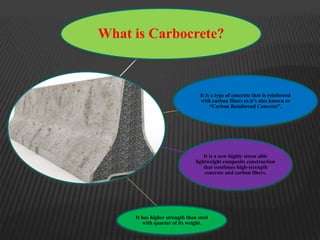
What is Carbocrete?
It is a type of concrete that is reinforced
with carbon fibers so it’s also known as
“Carbon Reinforced Concrete”.
It is a new highly stress able
lightweight composite construction
that combines high-strength
concrete and carbon fibers.
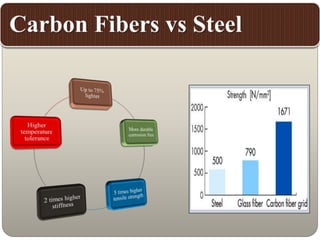
It has higher strength than steel
with quarter of its weight.
History of Carbon Fibers
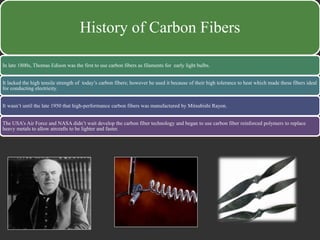
In late 1800s, Thomas Edison was the first to use carbon fibers as filaments for early light bulbs.
It lacked the high tensile strength of today’s carbon fibers; however he used it because of their high tolerance to heat which made these fibers ideal
for conducting electricity.
It wasn’t until the late 1950 that high-performance carbon fibers was manufactured by Mitsubishi Rayon.
The USA’s Air Force and NASA didn’t wait develop the carbon fiber technology and began to use carbon fiber reinforced polymers to replace
heavy metals to allow aircrafts to be lighter and faster.
LITERATURE REVIEW
Carbon fiber is not an absolutely new material; it is successfully applied in such fields as: aerospace industry,
car industry, production of sport equipment, production of working clothes and military , electronic industry,
etc. Rather new is the idea of using carbon fiber in building structures. At the present time methods of
strengthening of the structures with fibers are applying for different structures.
Kukreja (1980) conducted some experiments and reported that, based on the results of three methods such as
split tensile test, direct tensile test and flexural test, split tensile. Also increase in tensile strength and post
cracking strength, toughness were reported.
Mohammed Ezziane, Laurent Molez, and Damien Rangeard et at (2011) A study has been made of the
mechanical behavior of standard mortars, fiber mortar, subjected to thermal exposure. The fiber mortars
appear to offer a good compromise.
Ahsan Habib, Razia Begum and Mohammad Mydul Alam at (2013) they tried to show a comparative study
on the mechanical properties of different fibers containing mortar composites. They also put emphasize on
the fibers content and fibers length, because these are also important to contribute the mechanical strength of
mortars similarly as type of fibers.
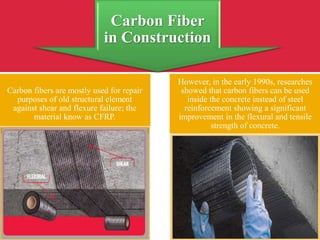
Carbon Fiber
in Construction
Carbon fibers are mostly used for repair
purposes of old structural element
against shear and flexure failure; the
material know as CFRP.
However, in the early 1990s, researches
showed that carbon fibers can be used
inside the concrete instead of steel
reinforcement showing a significant
improvement in the flexural and tensile
strength of concrete.
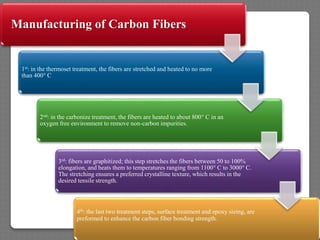
Manufacturing of Carbon Fibers
1st: in the thermoset treatment, the fibers are stretched and heated to no more
than 400° C
2nd: in the carbonize treatment, the fibers are heated to about 800° C in an
oxygen free environment to remove non-carbon impurities.
3rd: fibers are graphitized; this step stretches the fibers between 50 to 100%
elongation, and heats them to temperatures ranging from 1100° C to 3000° C.
The stretching ensures a preferred crystalline texture, which results in the
desired tensile strength.
4th: the last two treatment steps, surface treatment and epoxy sizing, are
preformed to enhance the carbon fiber bonding strength.
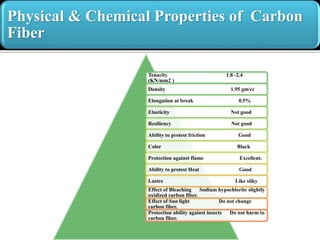
Physical & Chemical Properties of Carbon
Fiber
Tenacity 1.8 -2.4
(KN/mm2 )
Density 1.95 gm/cc
Elongation at break 0.5%
Elasticity Not good
Resiliency Not good
Ability to protest friction Good
Color Black
Protection against flame Excellent.
Ability to protest Heat Good
Lustre Like silky
Effect of Bleaching Sodium hypochlorite slightly
oxidized carbon fiber.
Effect of Sun light Do not change
carbon fiber.
Protection ability against insects Do not harm to
carbon fiber.
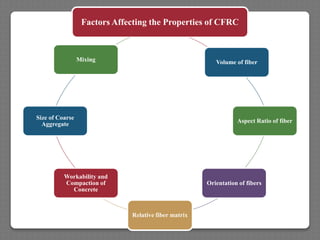
Factors Affecting the Properties of CFRC
Volume of fiber
Aspect Ratio of fiber
Orientation of fibers
Relative fiber matrix
Workability and
Compaction of
Concrete
Size of Coarse
Aggregate
Mixing
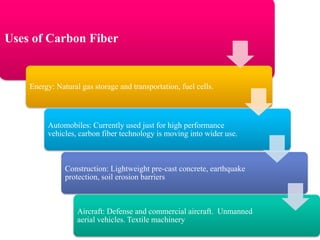
Uses of Carbon Fiber
Energy: Natural gas storage and transportation, fuel cells.
Automobiles: Currently used just for high performance
vehicles, carbon fiber technology is moving into wider use.
Construction: Lightweight pre-cast concrete, earthquake
protection, soil erosion barriers
Aircraft: Defense and commercial aircraft. Unmanned
aerial vehicles. Textile machinery
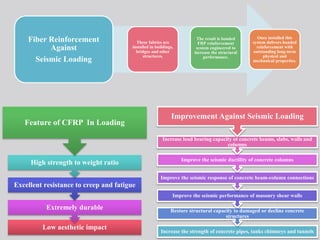
Fiber Reinforcement
Against
Seismic Loading
These fabrics are
installed in buildings,
bridges and other
structures.
The result is bonded
FRP reinforcement
system engineered to
increase the structural
performance.
Once installed this
system delivers bonded
reinforcement with
outstanding long-term
physical and
mechanical properties.
Low aesthetic impact
Extremely durable
Excellent resistance to creep and fatigue
High strength to weight ratio
Feature of CFRP In Loading
Increase the strength of concrete pipes, tanks chimneys and tunnels
Restore structural capacity to damaged or decline concrete
structures
Improve the seismic performance of masonry shear walls
Improve the seismic response of concrete beam-column connections
Improve the seismic ductility of concrete columns
Increase load bearing capacity of concrete beams, slabs, walls and
columns
Improvement Against Seismic Loading
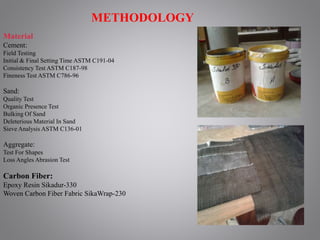
Material
Cement:
Field Testing
Initial & Final Setting Time ASTM C191-04
Consistency Test ASTM C187-98
Fineness Test ASTM C786-96
Sand:
Quality Test
Organic Presence Test
Bulking Of Sand
Deleterious Material In Sand
Sieve Analysis ASTM C136-01
Aggregate:
Test For Shapes
Loss Angles Abrasion Test
Carbon Fiber:
Epoxy Resin Sikadur-330
Woven Carbon Fiber Fabric SikaWrap-230
METHODOLOGY
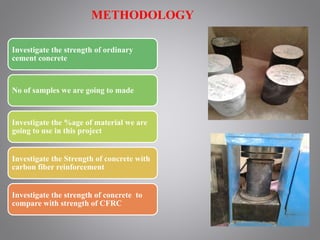
METHODOLOGY
Investigate the strength of ordinary
cement concrete
No of samples we are going to made
Investigate the %age of material we are
going to use in this project
Investigate the Strength of concrete with
carbon fiber reinforcement
Investigate the strength of concrete to
compare with strength of CFRC
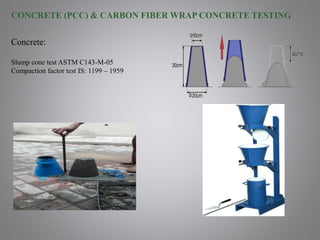
Concrete:
Slump cone test ASTM C143-M-05
Compaction factor test IS: 1199 – 1959
CONCRETE (PCC) & CARBON FIBER WRAP CONCRETE TESTING
Samples
(Pcc)
Ultimate load
(KN)
Strength
(psi)
Avg. Strength
(psi)
1 390 3100.88 3028.57
2 371 2950.26
Using Carbon Fiber
1 430 3419.43 3320.03
2 405 3220.63
Type of
Mould
Moulds For Curing Wt .Of Cement
(kg)
Fine
Aggregate(kg)
Wt. of
Course
Aggregate (kg)
Total
Weight(kg)
For Each Mould For Each Mould For Each Mould
#7days #14days #28days Wt. Of Sand
Cylinder 2 3 3 2 4 8 14
Samples
(Pcc)
Ultimate load
(KN)
Strength
(psi)
Avg. Strength
(psi)
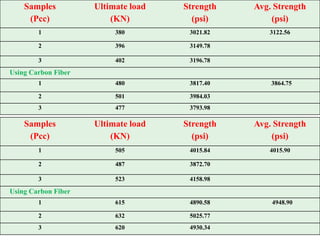
1 380 3021.82 3122.56
2 396 3149.78
3 402 3196.78
Using Carbon Fiber
1 480 3817.40 3864.75
2 501 3984.03
3 477 3793.98
Samples
(Pcc)
Ultimate load
(KN)
Strength
(psi)
Avg. Strength
(psi)
1 505 4015.84 4015.90
2 487 3872.70
3 523 4158.98
Using Carbon Fiber
1 615 4890.58 4948.90
2 632 5025.77
3 620 4930.34
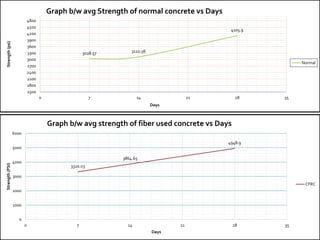
3028.57 3122.56
4105.9
1500
1800
2100
2400
2700
3000
3300
3600
3900
4200
4500
4800
0 7 14 21 28 35
Strength(psi)
Days
Graph b/w avg Strength of normal concrete vs Days
Normal
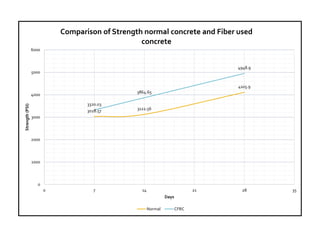
3320.03
3864.65
4948.9
0
1000
2000
3000
4000
5000
6000
0 7 14 21 28 35
Strength(PSI)
Days
Graph b/w avg strength of fiber used concrete vs Days
CFRC
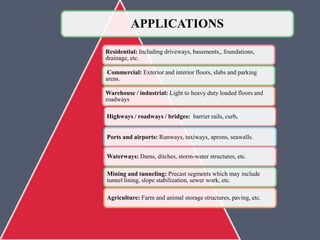
3028.57 3122.56
4105.9
3320.03
3864.65
4948.9
0
1000
2000
3000
4000
5000
6000
0 7 14 21 28 35
Strength(PSI)
Days
Comparison of Strength normal concrete and Fiber used
concrete
Normal CFRC
APPLICATIONS
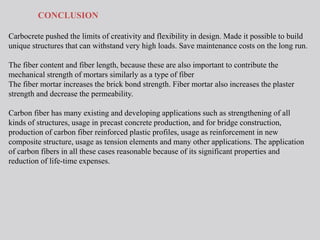
Residential: Including driveways, basements,, foundations,
drainage, etc.
Commercial: Exterior and interior floors, slabs and parking
areas.
Warehouse / industrial: Light to heavy duty loaded floors and
roadways
Highways / roadways / bridges: barrier rails, curb.
Ports and airports: Runways, taxiways, aprons, seawalls.
Waterways: Dams, ditches, storm-water structures, etc.
Mining and tunneling: Precast segments which may include
tunnel lining, slope stabilization, sewer work, etc.
Agriculture: Farm and animal storage structures, paving, etc.
Carbocrete pushed the limits of creativity and flexibility in design. Made it possible to build
unique structures that can withstand very high loads. Save maintenance costs on the long run.
The fiber content and fiber length, because these are also important to contribute the
mechanical strength of mortars similarly as a type of fiber
The fiber mortar increases the brick bond strength. Fiber mortar also increases the plaster
strength and decrease the permeability.
Carbon fiber has many existing and developing applications such as strengthening of all
kinds of structures, usage in precast concrete production, and for bridge construction,
production of carbon fiber reinforced plastic profiles, usage as reinforcement in new
composite structure, usage as tension elements and many other applications. The application
of carbon fibers in all these cases reasonable because of its significant properties and
reduction of life-time expenses.
CONCLUSION
Cfrc methodology, Testing and Comparison

Cfrc methodology, Testing and Comparison

  • 2.
    CARBON FIBER REINFORCEMENT (And Its Role Against Loading) OR CARBOCRETE Supervisor: Ma`am Engr. Rabia Bano
  • 3.
    Section C Semester 8th GroupNo 3 Naqeeb Ullah Khan Niazi 107 Muhammad Adnan 94 Syed M Tajdar Hussain 125 Haroon Khan Niazi 56 M.Tahir 103
  • 4.
    What is Carbocrete? Itis a type of concrete that is reinforced with carbon fibers so it’s also known as “Carbon Reinforced Concrete”. It is a new highly stress able lightweight composite construction that combines high-strength concrete and carbon fibers. It has higher strength than steel with quarter of its weight.
  • 5.
    History of CarbonFibers In late 1800s, Thomas Edison was the first to use carbon fibers as filaments for early light bulbs. It lacked the high tensile strength of today’s carbon fibers; however he used it because of their high tolerance to heat which made these fibers ideal for conducting electricity. It wasn’t until the late 1950 that high-performance carbon fibers was manufactured by Mitsubishi Rayon. The USA’s Air Force and NASA didn’t wait develop the carbon fiber technology and began to use carbon fiber reinforced polymers to replace heavy metals to allow aircrafts to be lighter and faster.
  • 6.
    LITERATURE REVIEW Carbon fiberis not an absolutely new material; it is successfully applied in such fields as: aerospace industry, car industry, production of sport equipment, production of working clothes and military , electronic industry, etc. Rather new is the idea of using carbon fiber in building structures. At the present time methods of strengthening of the structures with fibers are applying for different structures. Kukreja (1980) conducted some experiments and reported that, based on the results of three methods such as split tensile test, direct tensile test and flexural test, split tensile. Also increase in tensile strength and post cracking strength, toughness were reported. Mohammed Ezziane, Laurent Molez, and Damien Rangeard et at (2011) A study has been made of the mechanical behavior of standard mortars, fiber mortar, subjected to thermal exposure. The fiber mortars appear to offer a good compromise. Ahsan Habib, Razia Begum and Mohammad Mydul Alam at (2013) they tried to show a comparative study on the mechanical properties of different fibers containing mortar composites. They also put emphasize on the fibers content and fibers length, because these are also important to contribute the mechanical strength of mortars similarly as type of fibers.
  • 7.
    Carbon Fiber in Construction Carbonfibers are mostly used for repair purposes of old structural element against shear and flexure failure; the material know as CFRP. However, in the early 1990s, researches showed that carbon fibers can be used inside the concrete instead of steel reinforcement showing a significant improvement in the flexural and tensile strength of concrete.
  • 9.
    Manufacturing of CarbonFibers 1st: in the thermoset treatment, the fibers are stretched and heated to no more than 400° C 2nd: in the carbonize treatment, the fibers are heated to about 800° C in an oxygen free environment to remove non-carbon impurities. 3rd: fibers are graphitized; this step stretches the fibers between 50 to 100% elongation, and heats them to temperatures ranging from 1100° C to 3000° C. The stretching ensures a preferred crystalline texture, which results in the desired tensile strength. 4th: the last two treatment steps, surface treatment and epoxy sizing, are preformed to enhance the carbon fiber bonding strength.
  • 10.
    Physical & ChemicalProperties of Carbon Fiber Tenacity 1.8 -2.4 (KN/mm2 ) Density 1.95 gm/cc Elongation at break 0.5% Elasticity Not good Resiliency Not good Ability to protest friction Good Color Black Protection against flame Excellent. Ability to protest Heat Good Lustre Like silky Effect of Bleaching Sodium hypochlorite slightly oxidized carbon fiber. Effect of Sun light Do not change carbon fiber. Protection ability against insects Do not harm to carbon fiber.
  • 11.
    Factors Affecting theProperties of CFRC Volume of fiber Aspect Ratio of fiber Orientation of fibers Relative fiber matrix Workability and Compaction of Concrete Size of Coarse Aggregate Mixing
  • 12.
    Uses of CarbonFiber Energy: Natural gas storage and transportation, fuel cells. Automobiles: Currently used just for high performance vehicles, carbon fiber technology is moving into wider use. Construction: Lightweight pre-cast concrete, earthquake protection, soil erosion barriers Aircraft: Defense and commercial aircraft. Unmanned aerial vehicles. Textile machinery
  • 13.
    Fiber Reinforcement Against Seismic Loading Thesefabrics are installed in buildings, bridges and other structures. The result is bonded FRP reinforcement system engineered to increase the structural performance. Once installed this system delivers bonded reinforcement with outstanding long-term physical and mechanical properties. Low aesthetic impact Extremely durable Excellent resistance to creep and fatigue High strength to weight ratio Feature of CFRP In Loading Increase the strength of concrete pipes, tanks chimneys and tunnels Restore structural capacity to damaged or decline concrete structures Improve the seismic performance of masonry shear walls Improve the seismic response of concrete beam-column connections Improve the seismic ductility of concrete columns Increase load bearing capacity of concrete beams, slabs, walls and columns Improvement Against Seismic Loading
  • 14.
    Material Cement: Field Testing Initial &Final Setting Time ASTM C191-04 Consistency Test ASTM C187-98 Fineness Test ASTM C786-96 Sand: Quality Test Organic Presence Test Bulking Of Sand Deleterious Material In Sand Sieve Analysis ASTM C136-01 Aggregate: Test For Shapes Loss Angles Abrasion Test Carbon Fiber: Epoxy Resin Sikadur-330 Woven Carbon Fiber Fabric SikaWrap-230 METHODOLOGY
  • 15.
    METHODOLOGY Investigate the strengthof ordinary cement concrete No of samples we are going to made Investigate the %age of material we are going to use in this project Investigate the Strength of concrete with carbon fiber reinforcement Investigate the strength of concrete to compare with strength of CFRC
  • 16.
    Concrete: Slump cone testASTM C143-M-05 Compaction factor test IS: 1199 – 1959 CONCRETE (PCC) & CARBON FIBER WRAP CONCRETE TESTING
  • 17.
    Samples (Pcc) Ultimate load (KN) Strength (psi) Avg. Strength (psi) 1390 3100.88 3028.57 2 371 2950.26 Using Carbon Fiber 1 430 3419.43 3320.03 2 405 3220.63 Type of Mould Moulds For Curing Wt .Of Cement (kg) Fine Aggregate(kg) Wt. of Course Aggregate (kg) Total Weight(kg) For Each Mould For Each Mould For Each Mould #7days #14days #28days Wt. Of Sand Cylinder 2 3 3 2 4 8 14
  • 18.
    Samples (Pcc) Ultimate load (KN) Strength (psi) Avg. Strength (psi) 1380 3021.82 3122.56 2 396 3149.78 3 402 3196.78 Using Carbon Fiber 1 480 3817.40 3864.75 2 501 3984.03 3 477 3793.98 Samples (Pcc) Ultimate load (KN) Strength (psi) Avg. Strength (psi) 1 505 4015.84 4015.90 2 487 3872.70 3 523 4158.98 Using Carbon Fiber 1 615 4890.58 4948.90 2 632 5025.77 3 620 4930.34
  • 19.
    3028.57 3122.56 4105.9 1500 1800 2100 2400 2700 3000 3300 3600 3900 4200 4500 4800 0 714 21 28 35 Strength(psi) Days Graph b/w avg Strength of normal concrete vs Days Normal 3320.03 3864.65 4948.9 0 1000 2000 3000 4000 5000 6000 0 7 14 21 28 35 Strength(PSI) Days Graph b/w avg strength of fiber used concrete vs Days CFRC
  • 20.
    3028.57 3122.56 4105.9 3320.03 3864.65 4948.9 0 1000 2000 3000 4000 5000 6000 0 714 21 28 35 Strength(PSI) Days Comparison of Strength normal concrete and Fiber used concrete Normal CFRC
  • 21.
    APPLICATIONS Residential: Including driveways,basements,, foundations, drainage, etc. Commercial: Exterior and interior floors, slabs and parking areas. Warehouse / industrial: Light to heavy duty loaded floors and roadways Highways / roadways / bridges: barrier rails, curb. Ports and airports: Runways, taxiways, aprons, seawalls. Waterways: Dams, ditches, storm-water structures, etc. Mining and tunneling: Precast segments which may include tunnel lining, slope stabilization, sewer work, etc. Agriculture: Farm and animal storage structures, paving, etc.
  • 22.
    Carbocrete pushed thelimits of creativity and flexibility in design. Made it possible to build unique structures that can withstand very high loads. Save maintenance costs on the long run. The fiber content and fiber length, because these are also important to contribute the mechanical strength of mortars similarly as a type of fiber The fiber mortar increases the brick bond strength. Fiber mortar also increases the plaster strength and decrease the permeability. Carbon fiber has many existing and developing applications such as strengthening of all kinds of structures, usage in precast concrete production, and for bridge construction, production of carbon fiber reinforced plastic profiles, usage as reinforcement in new composite structure, usage as tension elements and many other applications. The application of carbon fibers in all these cases reasonable because of its significant properties and reduction of life-time expenses. CONCLUSION