PRESENTED TO: PRESENTED BY:
Mr. Rohit Soni Devanshu Rai
H.O.D, (Civil Department) 22E1SBCEM10P200
DEPARTMENT OF CIVIL ENGINEERING
SRI BALAJI COLLEGE OF ENGINEERING & TECHNOLOGY
JAIPUR
NOVEMBER - 2024
A
Presentation
On
“CARBON FIBER USE IN CONSTRUCTION”
Submitted
in partial fulfillment
for the award of Degree of
Bachelor of Technology in Department of Civil Engineering
LIST OF CONTENTS
• Introduction
• Properties
• Types of Carbon Fiber
• Manufacturing Process
• Comparison with Traditional Materials
• Methodology
• Benefits of Carbon Fiber
• Uses of Carbon Fiber
• Limitations of Carbon Fiber
• Environmental Impact & Sustainability
• Future of Carbon Fiber
• Conclusion
• References
INTRODUCTION
• Carbon fiber is a strong, lightweight material consisting of carbon atoms aligned in long,
thin crystals. Its unique structure offers high strength and stiffness while remaining
extremely lightweight, making it ideal for aerospace and high-performance industries.
• Carbon fiber has versatile applications. In construction, it is used to reinforce structures,
enhance durability, and reduce weight in large-scale projects.
KEY PROPERTIES OF CARBON FIBER
• Corrosion Resistance: Carbon fiber does not rust or degrade easily when exposed to moisture,
making it suitable for long-term construction projects in various climates.
• Thermal Expansion: It has minimal thermal expansion, meaning it does not expand or contract
significantly with temperature changes.
• Electrical Conductivity: Carbon fiber conducts electricity, a property that can be advantageous or
disadvantageous in construction depending on application needs.
• Strength-to-Weight Ratio: Carbon fiber is five times stronger than steel while being significantly
lighter.
• Electrical Conductivity: Carbon fiber conducts electricity, a property that can be advantageous or
disadvantageous in construction depending on application needs.
TYPES OF CARBON FIBER
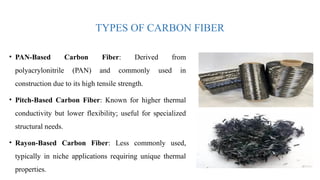
• PAN-Based Carbon Fiber: Derived from
polyacrylonitrile (PAN) and commonly used in
construction due to its high tensile strength.
• Pitch-Based Carbon Fiber: Known for higher thermal
conductivity but lower flexibility; useful for specialized
structural needs.
• Rayon-Based Carbon Fiber: Less commonly used,
typically in niche applications requiring unique thermal
properties.
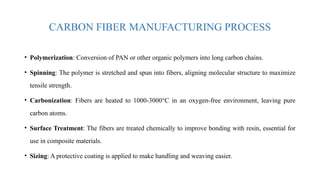
CARBON FIBER MANUFACTURING PROCESS
• Polymerization: Conversion of PAN or other organic polymers into long carbon chains.
• Spinning: The polymer is stretched and spun into fibers, aligning molecular structure to maximize
tensile strength.
• Carbonization: Fibers are heated to 1000-3000°C in an oxygen-free environment, leaving pure
carbon atoms.
• Surface Treatment: The fibers are treated chemically to improve bonding with resin, essential for
use in composite materials.
• Sizing: A protective coating is applied to make handling and weaving easier.
COMPARISON WITH TRADITIONAL MATERIALS
• Carbon Fiber vs. Steel: Carbon fiber offers superior strength with reduced weight, which
minimizes structural load and requires less foundational support.
• Carbon Fiber vs. Aluminum: Although both materials are lightweight, carbon fiber provides
greater tensile strength and stiffness, making it more suitable for critical structural
applications.
• Carbon Fiber vs. Wood: Unlike wood, carbon fiber is not subject to rotting, warping, or
other moisture-related issues.
ROLE OF CARBON FIBER IN MODERN
CONSTRUCTION
• Structural Enhancement: Carbon fiber strengthens
building frameworks, improves load-bearing capacity,
and extends the durability of materials.
• Lightweight Construction: Reduces the need for
heavy, load-bearing foundations, making construction
easier and cost-effective, especially for high-rise
buildings.
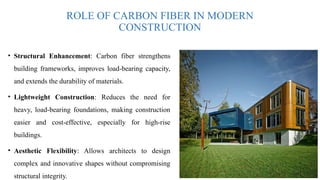
• Aesthetic Flexibility: Allows architects to design
complex and innovative shapes without compromising
structural integrity.
METHODOLOGY
The methodology for integrating carbon fiber in construction requires precise engineering,
material preparation, and application steps to maximize strength and durability.
• Steps Covered:
• Material Selection and Testing
• Preparation of Carbon Fiber Composite
• Application Techniques for Structural Components
• Inspection and Quality Assurance
MATERIAL SELECTION AND TESTING
• Fiber Type Selection: Determine whether PAN-based, pitch-based, or hybrid carbon
fibers meet project needs (e.g., PAN for high tensile strength).
• Resin Selection: Choose resins (e.g., epoxy, polyester) compatible with structural
requirements and carbon fiber type.
• Testing: Test the carbon fiber for tensile strength, flexibility, and environmental
resilience.
PREPARATION OF CARBON FIBER COMPOSITE
• Layering and Weaving: Arrange carbon fibers into layers or woven patterns to achieve the
desired load distribution properties.
• Resin Impregnation: Saturate fibers with resin to create a strong, flexible composite. This
step includes resin curing, where heat or pressure may be applied to set the resin.
• Cutting and Shaping: Customize the composite to fit structural components like beams,
columns, or slabs.
• Details: The composite preparation can vary based on the target application, such as
reinforcing beams versus wrapping columns.
APPLICATION TECHNIQUES FOR STRUCTURAL
COMPONENTS
• Application Techniques:
• Wrapping: Used for columns and beams to enhance load-bearing strength and prevent cracks.
• Sheeting: Applied as a sheet layer for walls, floors, and bridges to provide reinforcement.
• Pultrusion: Continuous molding for producing longer carbon fiber parts, such as cables or
rods, for structural reinforcement.
• Example: Wrapping carbon fiber around bridge pylons to protect against corrosion and
cracking.
BONDING AND CURING
• Surface Preparation: Clean and roughen surfaces for improved adhesion.
• Bonding Adhesive Application: Apply high-strength epoxy or resin adhesives for firm
attachment of the composite material.
• Curing: Use controlled heat or UV curing processes to solidify the adhesive, ensuring
maximum strength and durability.
• Details: Proper bonding and curing reduce the chances of delamination or weakening
over time, critical for load-bearing structures.
INSPECTION AND QUALITY ASSURANCE
• Ensure that the carbon fiber installation meets safety and quality standards.
• Inspection Steps:
1.Visual Inspection: Check for uniformity in bonding, absence of air pockets, and surface
imperfections.
2.Ultrasonic Testing: Use non-destructive ultrasonic tests to assess the integrity of the bond and
detect any internal flaws.
3.Load Testing: Perform load-bearing tests to verify that the structure meets design specifications
and safety requirements.
• Importance: Inspection guarantees that the carbon fiber application will endure environmental
stresses and maintain structural performance.
BENEFITS OF USING CARBON FIBER
• Durability: Carbon fiber structures resist corrosion, UV exposure, and other
environmental stresses, reducing maintenance needs.
• Lightweight Nature: Reduces transport costs, minimizes labor requirements, and lowers
the risk of structural load failure.
• High Tensile Strength: Suitable for structural reinforcements, especially in buildings
subjected to dynamic loads or seismic activity.
• Flexibility for Design: Allows for innovative architectural elements, such as curved or
cantilevered structures, without additional support.
CARBON FIBER IN CONCRETE REPAIR AND
STRENGTHENING
• Carbon Fiber Wraps: Used to repair cracks and reinforce structural integrity in aging
concrete buildings.
• Enhanced Load-Bearing Capacity: Increases the durability and stability of concrete,
essential for high-traffic or load-intensive structures.
• Case Example: Retrofitting of a commercial structure where carbon fiber wraps were
used to restore its load-bearing walls.
EARTHQUAKE RESISTANCE AND SEISMIC
RETROFITTING
• Energy Absorption: Carbon fiber can dissipate seismic forces, protecting structural
integrity during earthquakes.
• Retrofitting Applications: Often used to retrofit buildings in seismic zones to reduce
damage risks.
• Case Study: Example of earthquake-prone buildings in Japan retrofitted with carbon fiber
wraps, resulting in minimal damage during seismic events.
USE OF CARBON FIBER IN BRIDGE CONSTRUCTION
• Lightweight Durability: Reduces weight on support structures, extending bridge lifespan
and minimizing maintenance.
• Corrosion Resistance: Carbon fiber cables and deck panels resist degradation, making
them suitable for long-span bridges exposed to environmental elements.
• Case Study: The I-90 bridge in Seattle, where carbon fiber materials significantly
reduced maintenance costs.
CARBON FIBER IN HIGH-RISE BUILDING
CONSTRUCTION
• Weight Reduction: Reduces stress on lower-level columns and foundations, ideal for
skyscrapers and other tall structures.
• Stability: Provides the necessary support without the added weight, improving safety and
durability.
• Example: Tokyo’s Shimizu Building utilizes carbon fiber reinforcement to enhance
stability.
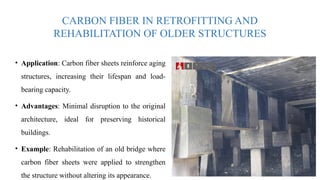
CARBON FIBER IN RETROFITTING AND
REHABILITATION OF OLDER STRUCTURES
• Application: Carbon fiber sheets reinforce aging
structures, increasing their lifespan and load-
bearing capacity.
• Advantages: Minimal disruption to the original
architecture, ideal for preserving historical
buildings.
• Example: Rehabilitation of an old bridge where
carbon fiber sheets were applied to strengthen
the structure without altering its appearance.
COMPOSITE USE IN BEAMS AND SLABS
• CFRP Beams and Slabs: Carbon fiber composites provide increased load-bearing
capacity and are especially effective in earthquake-prone areas.
• Advantages in Design Flexibility: Allows architects and engineers to experiment with
structural designs without compromising stability.
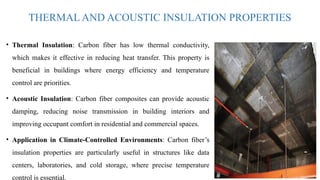
THERMAL AND ACOUSTIC INSULATION PROPERTIES
• Thermal Insulation: Carbon fiber has low thermal conductivity,
which makes it effective in reducing heat transfer. This property is
beneficial in buildings where energy efficiency and temperature
control are priorities.
• Acoustic Insulation: Carbon fiber composites can provide acoustic
damping, reducing noise transmission in building interiors and
improving occupant comfort in residential and commercial spaces.
• Application in Climate-Controlled Environments: Carbon fiber’s
insulation properties are particularly useful in structures like data
centers, laboratories, and cold storage, where precise temperature
control is essential.
CARBON FIBER IN SUSTAINABLE URBAN
DEVELOPMENT
• Reducing Carbon Footprint: Carbon fiber’s lightweight nature reduces the need for heavy
machinery during construction, leading to lower fuel consumption and fewer emissions.
• Sustainable Sourcing and Recycling Efforts: Emerging technologies focus on making carbon
fiber production more eco-friendly. Research into recycling carbon fiber composites is advancing,
which will make future construction projects more sustainable.
• Urban Space Optimization: With carbon fiber's strength and flexibility, urban structures can be
designed to use space efficiently. This helps in the creation of more vertical and modular
structures, maximizing land use in densely populated areas.
• Green Building Certification: Incorporating carbon fiber can help buildings meet green building
standards, such as LEED certification, due to its durability and energy-saving properties.
LIMITATIONS OF CARBON FIBER IN CONSTRUCTION
• High Cost: Carbon fiber is significantly more expensive than traditional materials like steel
and concrete, which can limit its use in budget-sensitive projects.
• Repair Challenges: Damaged carbon fiber structures are difficult and costly to repair, often
requiring specialized skills and materials.
• Installation Complexity: Working with carbon fiber requires specialized knowledge and
tools, and improper installation can reduce its effectiveness.
• Environmental Concerns: Manufacturing carbon fiber is energy-intensive, which raises
concerns about its carbon footprint.
ENVIRONMENTAL IMPACT AND SUSTAINABILITY
• Recycling Challenges: Carbon fiber is difficult to recycle because breaking down the
fibers can compromise its properties. Current recycling methods are costly and not widely
available.
• Energy-Intensive Production: Manufacturing carbon fiber consumes a significant
amount of energy, contributing to its environmental footprint.
• Ongoing Research: Scientists are working on more sustainable production methods, like
using renewable energy sources and creating bio-based carbon fibers.
FUTURE OF CARBON FIBER IN CONSTRUCTION
• Expanded Use in Sustainable Buildings: As production becomes more eco-friendly,
carbon fiber could become more common in green construction projects.
• Smart Materials Integration: Combining carbon fiber with sensors for real-time
monitoring could lead to "smart buildings" that detect structural weaknesses.
• Cost Reduction Through Scale: As technology advances, carbon fiber production costs
may decrease, making it more accessible for a variety of applications.
• Bio-based Carbon Fibers: Ongoing research is exploring carbon fibers derived from
sustainable sources, such as lignin from wood, to reduce reliance on fossil fuels.
CONCLUSION
• Reiterate the major advantages of carbon fiber in construction—high strength-to-weight ratio, durability,
and corrosion resistance.
• Recommendations
1. Focus on Cost-Effective Solutions: Encourage the development of hybrid materials to balance cost and
performance.
2. Invest in Recycling Technology: Support initiatives for better recycling methods to make carbon fiber
more sustainable.
3. Promote Training Programs: Training engineers and construction professionals in carbon fiber
handling will improve implementation and effectiveness.
4. Incorporate in High-Performance Projects: Recommend prioritizing carbon fiber use in projects
where weight reduction and durability are critical, such as high-rise buildings and bridges.
REFERENCES
1. American Concrete Institute (ACI). (2018). Guide for the Design and Construction of
Externally Bonded FRP Systems for Strengthening Concrete Structures (ACI 440.2R-17).
ACI.
2. Mehta, P. K., & Monteiro, P. J. M. (2013). Concrete: Microstructure, Properties, and
Materials (4th ed.). McGraw-Hill Education.
3. Hollaway, L. C., & Teng, J. G. (2008). Strengthening and Rehabilitation of Civil
Infrastructures Using Fibre-Reinforced Polymer (FRP) Composites. Woodhead
Publishing.
THANK YOU

DEVANSHU SEMINAR final year presentation.pptx

  • 1.
    PRESENTED TO: PRESENTEDBY: Mr. Rohit Soni Devanshu Rai H.O.D, (Civil Department) 22E1SBCEM10P200 DEPARTMENT OF CIVIL ENGINEERING SRI BALAJI COLLEGE OF ENGINEERING & TECHNOLOGY JAIPUR NOVEMBER - 2024 A Presentation On “CARBON FIBER USE IN CONSTRUCTION” Submitted in partial fulfillment for the award of Degree of Bachelor of Technology in Department of Civil Engineering
  • 2.
    LIST OF CONTENTS •Introduction • Properties • Types of Carbon Fiber • Manufacturing Process • Comparison with Traditional Materials • Methodology • Benefits of Carbon Fiber • Uses of Carbon Fiber • Limitations of Carbon Fiber • Environmental Impact & Sustainability • Future of Carbon Fiber • Conclusion • References
  • 3.
    INTRODUCTION • Carbon fiberis a strong, lightweight material consisting of carbon atoms aligned in long, thin crystals. Its unique structure offers high strength and stiffness while remaining extremely lightweight, making it ideal for aerospace and high-performance industries. • Carbon fiber has versatile applications. In construction, it is used to reinforce structures, enhance durability, and reduce weight in large-scale projects.
  • 4.
    KEY PROPERTIES OFCARBON FIBER • Corrosion Resistance: Carbon fiber does not rust or degrade easily when exposed to moisture, making it suitable for long-term construction projects in various climates. • Thermal Expansion: It has minimal thermal expansion, meaning it does not expand or contract significantly with temperature changes. • Electrical Conductivity: Carbon fiber conducts electricity, a property that can be advantageous or disadvantageous in construction depending on application needs. • Strength-to-Weight Ratio: Carbon fiber is five times stronger than steel while being significantly lighter. • Electrical Conductivity: Carbon fiber conducts electricity, a property that can be advantageous or disadvantageous in construction depending on application needs.
  • 5.
    TYPES OF CARBONFIBER • PAN-Based Carbon Fiber: Derived from polyacrylonitrile (PAN) and commonly used in construction due to its high tensile strength. • Pitch-Based Carbon Fiber: Known for higher thermal conductivity but lower flexibility; useful for specialized structural needs. • Rayon-Based Carbon Fiber: Less commonly used, typically in niche applications requiring unique thermal properties.
  • 6.
    CARBON FIBER MANUFACTURINGPROCESS • Polymerization: Conversion of PAN or other organic polymers into long carbon chains. • Spinning: The polymer is stretched and spun into fibers, aligning molecular structure to maximize tensile strength. • Carbonization: Fibers are heated to 1000-3000°C in an oxygen-free environment, leaving pure carbon atoms. • Surface Treatment: The fibers are treated chemically to improve bonding with resin, essential for use in composite materials. • Sizing: A protective coating is applied to make handling and weaving easier.
  • 7.
    COMPARISON WITH TRADITIONALMATERIALS • Carbon Fiber vs. Steel: Carbon fiber offers superior strength with reduced weight, which minimizes structural load and requires less foundational support. • Carbon Fiber vs. Aluminum: Although both materials are lightweight, carbon fiber provides greater tensile strength and stiffness, making it more suitable for critical structural applications. • Carbon Fiber vs. Wood: Unlike wood, carbon fiber is not subject to rotting, warping, or other moisture-related issues.
  • 8.
    ROLE OF CARBONFIBER IN MODERN CONSTRUCTION • Structural Enhancement: Carbon fiber strengthens building frameworks, improves load-bearing capacity, and extends the durability of materials. • Lightweight Construction: Reduces the need for heavy, load-bearing foundations, making construction easier and cost-effective, especially for high-rise buildings. • Aesthetic Flexibility: Allows architects to design complex and innovative shapes without compromising structural integrity.
  • 9.
    METHODOLOGY The methodology forintegrating carbon fiber in construction requires precise engineering, material preparation, and application steps to maximize strength and durability. • Steps Covered: • Material Selection and Testing • Preparation of Carbon Fiber Composite • Application Techniques for Structural Components • Inspection and Quality Assurance
  • 10.
    MATERIAL SELECTION ANDTESTING • Fiber Type Selection: Determine whether PAN-based, pitch-based, or hybrid carbon fibers meet project needs (e.g., PAN for high tensile strength). • Resin Selection: Choose resins (e.g., epoxy, polyester) compatible with structural requirements and carbon fiber type. • Testing: Test the carbon fiber for tensile strength, flexibility, and environmental resilience.
  • 11.
    PREPARATION OF CARBONFIBER COMPOSITE • Layering and Weaving: Arrange carbon fibers into layers or woven patterns to achieve the desired load distribution properties. • Resin Impregnation: Saturate fibers with resin to create a strong, flexible composite. This step includes resin curing, where heat or pressure may be applied to set the resin. • Cutting and Shaping: Customize the composite to fit structural components like beams, columns, or slabs. • Details: The composite preparation can vary based on the target application, such as reinforcing beams versus wrapping columns.
  • 12.
    APPLICATION TECHNIQUES FORSTRUCTURAL COMPONENTS • Application Techniques: • Wrapping: Used for columns and beams to enhance load-bearing strength and prevent cracks. • Sheeting: Applied as a sheet layer for walls, floors, and bridges to provide reinforcement. • Pultrusion: Continuous molding for producing longer carbon fiber parts, such as cables or rods, for structural reinforcement. • Example: Wrapping carbon fiber around bridge pylons to protect against corrosion and cracking.
  • 13.
    BONDING AND CURING •Surface Preparation: Clean and roughen surfaces for improved adhesion. • Bonding Adhesive Application: Apply high-strength epoxy or resin adhesives for firm attachment of the composite material. • Curing: Use controlled heat or UV curing processes to solidify the adhesive, ensuring maximum strength and durability. • Details: Proper bonding and curing reduce the chances of delamination or weakening over time, critical for load-bearing structures.
  • 14.
    INSPECTION AND QUALITYASSURANCE • Ensure that the carbon fiber installation meets safety and quality standards. • Inspection Steps: 1.Visual Inspection: Check for uniformity in bonding, absence of air pockets, and surface imperfections. 2.Ultrasonic Testing: Use non-destructive ultrasonic tests to assess the integrity of the bond and detect any internal flaws. 3.Load Testing: Perform load-bearing tests to verify that the structure meets design specifications and safety requirements. • Importance: Inspection guarantees that the carbon fiber application will endure environmental stresses and maintain structural performance.
  • 15.
    BENEFITS OF USINGCARBON FIBER • Durability: Carbon fiber structures resist corrosion, UV exposure, and other environmental stresses, reducing maintenance needs. • Lightweight Nature: Reduces transport costs, minimizes labor requirements, and lowers the risk of structural load failure. • High Tensile Strength: Suitable for structural reinforcements, especially in buildings subjected to dynamic loads or seismic activity. • Flexibility for Design: Allows for innovative architectural elements, such as curved or cantilevered structures, without additional support.
  • 16.
    CARBON FIBER INCONCRETE REPAIR AND STRENGTHENING • Carbon Fiber Wraps: Used to repair cracks and reinforce structural integrity in aging concrete buildings. • Enhanced Load-Bearing Capacity: Increases the durability and stability of concrete, essential for high-traffic or load-intensive structures. • Case Example: Retrofitting of a commercial structure where carbon fiber wraps were used to restore its load-bearing walls.
  • 17.
    EARTHQUAKE RESISTANCE ANDSEISMIC RETROFITTING • Energy Absorption: Carbon fiber can dissipate seismic forces, protecting structural integrity during earthquakes. • Retrofitting Applications: Often used to retrofit buildings in seismic zones to reduce damage risks. • Case Study: Example of earthquake-prone buildings in Japan retrofitted with carbon fiber wraps, resulting in minimal damage during seismic events.
  • 18.
    USE OF CARBONFIBER IN BRIDGE CONSTRUCTION • Lightweight Durability: Reduces weight on support structures, extending bridge lifespan and minimizing maintenance. • Corrosion Resistance: Carbon fiber cables and deck panels resist degradation, making them suitable for long-span bridges exposed to environmental elements. • Case Study: The I-90 bridge in Seattle, where carbon fiber materials significantly reduced maintenance costs.
  • 19.
    CARBON FIBER INHIGH-RISE BUILDING CONSTRUCTION • Weight Reduction: Reduces stress on lower-level columns and foundations, ideal for skyscrapers and other tall structures. • Stability: Provides the necessary support without the added weight, improving safety and durability. • Example: Tokyo’s Shimizu Building utilizes carbon fiber reinforcement to enhance stability.
  • 20.
    CARBON FIBER INRETROFITTING AND REHABILITATION OF OLDER STRUCTURES • Application: Carbon fiber sheets reinforce aging structures, increasing their lifespan and load- bearing capacity. • Advantages: Minimal disruption to the original architecture, ideal for preserving historical buildings. • Example: Rehabilitation of an old bridge where carbon fiber sheets were applied to strengthen the structure without altering its appearance.
  • 21.
    COMPOSITE USE INBEAMS AND SLABS • CFRP Beams and Slabs: Carbon fiber composites provide increased load-bearing capacity and are especially effective in earthquake-prone areas. • Advantages in Design Flexibility: Allows architects and engineers to experiment with structural designs without compromising stability.
  • 22.
    THERMAL AND ACOUSTICINSULATION PROPERTIES • Thermal Insulation: Carbon fiber has low thermal conductivity, which makes it effective in reducing heat transfer. This property is beneficial in buildings where energy efficiency and temperature control are priorities. • Acoustic Insulation: Carbon fiber composites can provide acoustic damping, reducing noise transmission in building interiors and improving occupant comfort in residential and commercial spaces. • Application in Climate-Controlled Environments: Carbon fiber’s insulation properties are particularly useful in structures like data centers, laboratories, and cold storage, where precise temperature control is essential.
  • 23.
    CARBON FIBER INSUSTAINABLE URBAN DEVELOPMENT • Reducing Carbon Footprint: Carbon fiber’s lightweight nature reduces the need for heavy machinery during construction, leading to lower fuel consumption and fewer emissions. • Sustainable Sourcing and Recycling Efforts: Emerging technologies focus on making carbon fiber production more eco-friendly. Research into recycling carbon fiber composites is advancing, which will make future construction projects more sustainable. • Urban Space Optimization: With carbon fiber's strength and flexibility, urban structures can be designed to use space efficiently. This helps in the creation of more vertical and modular structures, maximizing land use in densely populated areas. • Green Building Certification: Incorporating carbon fiber can help buildings meet green building standards, such as LEED certification, due to its durability and energy-saving properties.
  • 24.
    LIMITATIONS OF CARBONFIBER IN CONSTRUCTION • High Cost: Carbon fiber is significantly more expensive than traditional materials like steel and concrete, which can limit its use in budget-sensitive projects. • Repair Challenges: Damaged carbon fiber structures are difficult and costly to repair, often requiring specialized skills and materials. • Installation Complexity: Working with carbon fiber requires specialized knowledge and tools, and improper installation can reduce its effectiveness. • Environmental Concerns: Manufacturing carbon fiber is energy-intensive, which raises concerns about its carbon footprint.
  • 25.
    ENVIRONMENTAL IMPACT ANDSUSTAINABILITY • Recycling Challenges: Carbon fiber is difficult to recycle because breaking down the fibers can compromise its properties. Current recycling methods are costly and not widely available. • Energy-Intensive Production: Manufacturing carbon fiber consumes a significant amount of energy, contributing to its environmental footprint. • Ongoing Research: Scientists are working on more sustainable production methods, like using renewable energy sources and creating bio-based carbon fibers.
  • 26.
    FUTURE OF CARBONFIBER IN CONSTRUCTION • Expanded Use in Sustainable Buildings: As production becomes more eco-friendly, carbon fiber could become more common in green construction projects. • Smart Materials Integration: Combining carbon fiber with sensors for real-time monitoring could lead to "smart buildings" that detect structural weaknesses. • Cost Reduction Through Scale: As technology advances, carbon fiber production costs may decrease, making it more accessible for a variety of applications. • Bio-based Carbon Fibers: Ongoing research is exploring carbon fibers derived from sustainable sources, such as lignin from wood, to reduce reliance on fossil fuels.
  • 27.
    CONCLUSION • Reiterate themajor advantages of carbon fiber in construction—high strength-to-weight ratio, durability, and corrosion resistance. • Recommendations 1. Focus on Cost-Effective Solutions: Encourage the development of hybrid materials to balance cost and performance. 2. Invest in Recycling Technology: Support initiatives for better recycling methods to make carbon fiber more sustainable. 3. Promote Training Programs: Training engineers and construction professionals in carbon fiber handling will improve implementation and effectiveness. 4. Incorporate in High-Performance Projects: Recommend prioritizing carbon fiber use in projects where weight reduction and durability are critical, such as high-rise buildings and bridges.
  • 28.
    REFERENCES 1. American ConcreteInstitute (ACI). (2018). Guide for the Design and Construction of Externally Bonded FRP Systems for Strengthening Concrete Structures (ACI 440.2R-17). ACI. 2. Mehta, P. K., & Monteiro, P. J. M. (2013). Concrete: Microstructure, Properties, and Materials (4th ed.). McGraw-Hill Education. 3. Hollaway, L. C., & Teng, J. G. (2008). Strengthening and Rehabilitation of Civil Infrastructures Using Fibre-Reinforced Polymer (FRP) Composites. Woodhead Publishing.
  • 29.