Lifestyle Medicine
Interest Group at UCSF
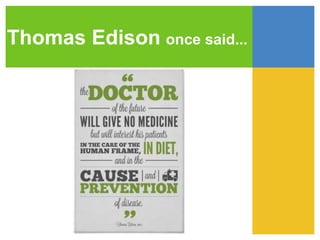
Thomas Edison once said...
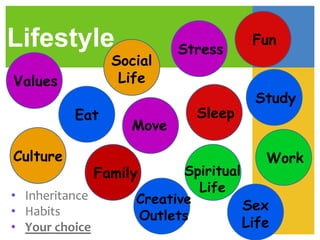
Lifestyle
• Inheritance
• Habits
• Your choice
Eat
Move
Sex
Life
Spiritual
Life
Social
Life
Fun
Sleep
Culture
Stress
Work
Family
Values
Study
Creative
Outlets
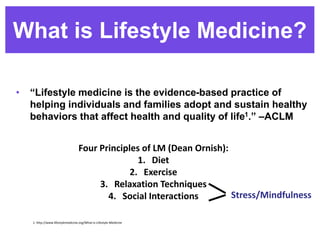
What is Lifestyle Medicine?
• “Lifestyle medicine is the evidence-based practice of
helping individuals and families adopt and sustain healthy
behaviors that affect health and quality of life1.” –ACLM
1. http://www.lifestylemedicine.org/What-is-Lifestyle-Medicine
Four Principles of LM (Dean Ornish):
1. Diet
2. Exercise
3. Relaxation Techniques
4. Social Interactions Stress/Mindfulness
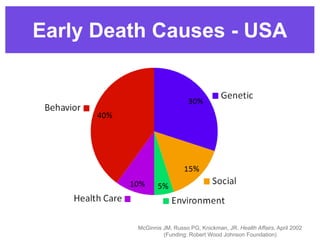
Early Death Causes - USA
McGinnis JM, Russo PG, Knickman, JR. Health Affairs, April 2002
(Funding: Robert Wood Johnson Foundation)
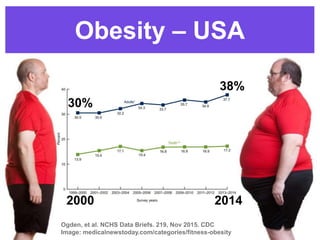
Obesity – USA
Ogden, et al. NCHS Data Briefs. 219, Nov 2015. CDC
Image: medicalnewstoday.com/categories/fitness-obesity
38%
30%
2000 2014
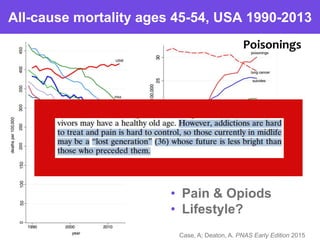
All-cause mortality ages 45-54, USA 1990-2013
• Pain & Opiods
• Lifestyle?
Case, A; Deaton, A. PNAS Early Edition 2015
Poisonings
Lifestyle Medicine Applied
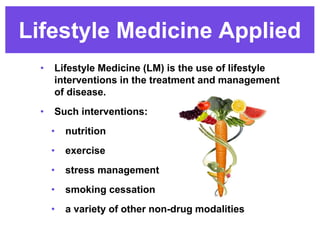
• Lifestyle Medicine (LM) is the use of lifestyle
interventions in the treatment and management
of disease.
• Such interventions:
• nutrition
• exercise
• stress management
• smoking cessation
• a variety of other non-drug modalities
Hippocrates once said...
Evidence
• European Prospective Investigation into Cancer and
Nutrition (EPIC) study, patients who adhered to healthy
dietary principles (low meat consumption and high
intake of fruits, vegetables, and whole-grain bread),
never smoked, were not overweight, and had at least 30
minutes a day of physical activity had a 78% lower
overall risk of developing a chronic disease1.
1. Ford, E. S., Bergmann, M. M., Kroger, J., Schienkiewitz, A., Weikert, C., & Boeing, H. (2009). Healthy living is the best revenge: findings from the European Prospective Investigation
Into Cancer and Nutrition-Potsdam study. Archives of internal medicine, 169(15), 1355.
• 93% reduced risk of
diabetes
• 81% lower risk of
heart attacks
• 50% reduction in risk
of stroke
• 36% overall reduction
in risk of cancer
Evidence
• Our genes are a predisposition, but our genes are not our fate.
LM changes your genes—turning on genes that keep you healthy,
and turning off genes that promote heart disease, prostate
cancer, breast cancer, and diabetes—over 500 genes in only
three months1.
• Diet and lifestyle changes may lengthen telomeres. Effects still
significant after 5 years2.
• Lifestyle factors accounted for 90% of the PAR (population
attributed risk) in men and 94% in women for coronary heart
disease (52 country study)3.
1. Ornish, D., Magbanua, M. J. M., Weidner, G., Weinberg, V., Kemp, C., Green, C., ... & Carroll, P. R. (2008). Changes in prostate gene expression in men undergoing an intensive nutrition and lifestyle
intervention. Proceedings of the National Academy of Sciences, 105(24), 8369-8374.
2. Ornish, D., Lin, J., Chan, J. M., Epel, E., Kemp, C., Weidner, G., ... & Blackburn, E. H. (2013). Effect of comprehensive lifestyle changes on telomerase activity and telomere length in men with biopsy-proven
low-risk prostate cancer: 5-year follow-up of a descriptive pilot study. The lancet oncology, 14(11), 1112-1120.
3. Yusuf, S., Hawken, S., Ôunpuu, S., Dans, T., Avezum, A., Lanas, F., ... & INTERHEART Study Investigators. (2004). Effect of potentially modifiable risk factors associated with myocardial infarction in 52
countries (the INTERHEART study): case-control study. The Lancet, 364(9438), 937-952.
Evidence
Adapted from:
Yusuf, S., Hawken, S., Ôunpuu, S., Dans, T., Avezum, A., Lanas, F., ... & INTERHEART Study Investigators. (2004). Effect of potentially modifiable risk factors associated with myocardial
infarction in 52 countries (the INTERHEART study): case-control study. The Lancet, 364(9438), 937-952.
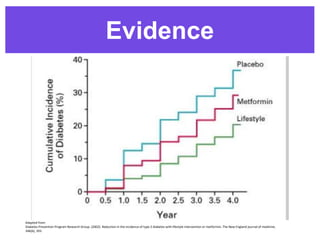
Evidence
Adapted from:
Diabetes Prevention Program Research Group. (2002). Reduction in the incidence of type 2 diabetes with lifestyle intervention or metformin. The New England journal of medicine,
346(6), 393.
Evidence
• Can help reduce greenhouse gases, promote more sustainable
environment. Livestock greenhouse gas emissions account for 18-51%
of total emissions1.
• Reduces healthcare costs
1. Herrero, M., Gerber, P., Vellinga, T., Garnett, T., Leip, A., Opio, C., ... & McAllister, T. A. (2011). Livestock and greenhouse gas emissions: The importance of getting the numbers right. Animal Feed Science and
Technology, 166, 779-782.
2. Hersey, J. C., Khavjou, O., Strange, L. B., Atkinson, R. L., Blair, S. N., Campbell, S., ... & Britt, M. (2012). The efficacy and cost-effectiveness of a community weight management intervention: a randomized
controlled trial of the health weight management demonstration. Preventive medicine, 54(1), 42-49.
Table adapted from:
Herman, W. H., Hoerger, T. J., Brandle, M., Hicks, K., Sorensen, S., Zhang, P., ... & Ratner, R. E. (2005). The cost-effectiveness of lifestyle modification or metformin in preventing type 2 diabetes in adults with
impaired glucose tolerance. Annals of Internal medicine, 142(5), 323-332.
Prevention & Treatment with
Lifestyle Medicine
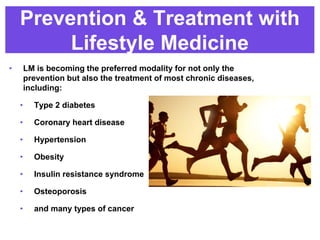
• LM is becoming the preferred modality for not only the
prevention but also the treatment of most chronic diseases,
including:
• Type 2 diabetes
• Coronary heart disease
• Hypertension
• Obesity
• Insulin resistance syndrome
• Osteoporosis
• and many types of cancer
Why Lifestyle Medicine?
• “ As a nation, more than 75% of our health care spending is
on people with chronic conditions1.” — CDC 2009
• “If the major risk factors from chronic disease were
eliminated, at least 80% of all heart disease, stroke, and type
2 diabetes would be prevented, and more than 40% of
cancer cases would be prevented2.” —WHO
1. CDC. (2009). The Power of Prevention. Retrieved November 10, 2015, from http://www.cdc.gov/chronicdisease/pdf/2009-Power-of-Prevention.pdf
2. World Health Organization. Preventing chronic diseases: a vital investment. Geneva: World Health Organization;
2005. Available from: http://www.who.int/chp/chronic_disease_report/full_report.pdf
Value Statement
From the ACLM:
Lifestyle practices and health
habits are among the nation’s
most important health
determinants.
Changing unhealthy behaviors is
foundational to medical care,
disease prevention, and health
promotion.
The physician’s trusted
relationship with the patient, with
the support of the family, an
interdisciplinary team and the
community is the key to improving
health behaviors and outcomes.
How Can We Get Started?
“It’s not all or nothing. In all of our studies, we
found that the more people changed their diet
and lifestyle, the more they improved and the
better they felt—at any age. So, if you indulge
yourself one day, just eat healthier the next. If
you don’t have time to exercise one day, do a
little more the next. If you don’t have time to
meditate for an hour, do it for a minute. What
matters most is your overall way of eating and
living.” –Dean Ornish
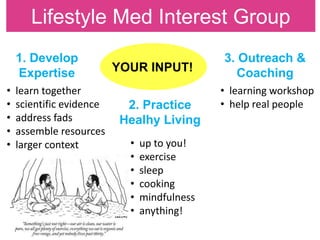
Lifestyle Med Interest Group
1. Develop
Expertise
2. Practice
Healhy Living
3. Outreach &
CoachingYOUR INPUT!
• learn together
• scientific evidence
• address fads
• assemble resources
• larger context • up to you!
• exercise
• sleep
• cooking
• mindfulness
• anything!
• learning workshop
• help real people
Meeting Logistics
• Monthly Meetings
 Interactive Discussions
 Speakers
 Health Education
 Goal-Setting
• Potential Topics:
 Nutrition
 Exercise
 Mindfulness
 Social Support
 Relaxation Techniques
 Inspiration
 Health Policy
 Population Health
 Chronic Disease (i.e. diabetes,
hypertension, etc.)
 Ideas???
Lifestyle Medicine
Interest Group at UCSF

Lmig meeting 1

  • 1.
  • 2.
  • 3.
    Lifestyle • Inheritance • Habits •Your choice Eat Move Sex Life Spiritual Life Social Life Fun Sleep Culture Stress Work Family Values Study Creative Outlets
  • 4.
    What is LifestyleMedicine? • “Lifestyle medicine is the evidence-based practice of helping individuals and families adopt and sustain healthy behaviors that affect health and quality of life1.” –ACLM 1. http://www.lifestylemedicine.org/What-is-Lifestyle-Medicine Four Principles of LM (Dean Ornish): 1. Diet 2. Exercise 3. Relaxation Techniques 4. Social Interactions Stress/Mindfulness
  • 5.
    Early Death Causes- USA McGinnis JM, Russo PG, Knickman, JR. Health Affairs, April 2002 (Funding: Robert Wood Johnson Foundation)
  • 6.
    Obesity – USA Ogden,et al. NCHS Data Briefs. 219, Nov 2015. CDC Image: medicalnewstoday.com/categories/fitness-obesity 38% 30% 2000 2014
  • 7.
    All-cause mortality ages45-54, USA 1990-2013 • Pain & Opiods • Lifestyle? Case, A; Deaton, A. PNAS Early Edition 2015 Poisonings
  • 8.
    Lifestyle Medicine Applied •Lifestyle Medicine (LM) is the use of lifestyle interventions in the treatment and management of disease. • Such interventions: • nutrition • exercise • stress management • smoking cessation • a variety of other non-drug modalities
  • 9.
  • 10.
    Evidence • European ProspectiveInvestigation into Cancer and Nutrition (EPIC) study, patients who adhered to healthy dietary principles (low meat consumption and high intake of fruits, vegetables, and whole-grain bread), never smoked, were not overweight, and had at least 30 minutes a day of physical activity had a 78% lower overall risk of developing a chronic disease1. 1. Ford, E. S., Bergmann, M. M., Kroger, J., Schienkiewitz, A., Weikert, C., & Boeing, H. (2009). Healthy living is the best revenge: findings from the European Prospective Investigation Into Cancer and Nutrition-Potsdam study. Archives of internal medicine, 169(15), 1355. • 93% reduced risk of diabetes • 81% lower risk of heart attacks • 50% reduction in risk of stroke • 36% overall reduction in risk of cancer
  • 11.
    Evidence • Our genesare a predisposition, but our genes are not our fate. LM changes your genes—turning on genes that keep you healthy, and turning off genes that promote heart disease, prostate cancer, breast cancer, and diabetes—over 500 genes in only three months1. • Diet and lifestyle changes may lengthen telomeres. Effects still significant after 5 years2. • Lifestyle factors accounted for 90% of the PAR (population attributed risk) in men and 94% in women for coronary heart disease (52 country study)3. 1. Ornish, D., Magbanua, M. J. M., Weidner, G., Weinberg, V., Kemp, C., Green, C., ... & Carroll, P. R. (2008). Changes in prostate gene expression in men undergoing an intensive nutrition and lifestyle intervention. Proceedings of the National Academy of Sciences, 105(24), 8369-8374. 2. Ornish, D., Lin, J., Chan, J. M., Epel, E., Kemp, C., Weidner, G., ... & Blackburn, E. H. (2013). Effect of comprehensive lifestyle changes on telomerase activity and telomere length in men with biopsy-proven low-risk prostate cancer: 5-year follow-up of a descriptive pilot study. The lancet oncology, 14(11), 1112-1120. 3. Yusuf, S., Hawken, S., Ôunpuu, S., Dans, T., Avezum, A., Lanas, F., ... & INTERHEART Study Investigators. (2004). Effect of potentially modifiable risk factors associated with myocardial infarction in 52 countries (the INTERHEART study): case-control study. The Lancet, 364(9438), 937-952.
  • 12.
    Evidence Adapted from: Yusuf, S.,Hawken, S., Ôunpuu, S., Dans, T., Avezum, A., Lanas, F., ... & INTERHEART Study Investigators. (2004). Effect of potentially modifiable risk factors associated with myocardial infarction in 52 countries (the INTERHEART study): case-control study. The Lancet, 364(9438), 937-952.
  • 13.
    Evidence Adapted from: Diabetes PreventionProgram Research Group. (2002). Reduction in the incidence of type 2 diabetes with lifestyle intervention or metformin. The New England journal of medicine, 346(6), 393.
  • 14.
    Evidence • Can helpreduce greenhouse gases, promote more sustainable environment. Livestock greenhouse gas emissions account for 18-51% of total emissions1. • Reduces healthcare costs 1. Herrero, M., Gerber, P., Vellinga, T., Garnett, T., Leip, A., Opio, C., ... & McAllister, T. A. (2011). Livestock and greenhouse gas emissions: The importance of getting the numbers right. Animal Feed Science and Technology, 166, 779-782. 2. Hersey, J. C., Khavjou, O., Strange, L. B., Atkinson, R. L., Blair, S. N., Campbell, S., ... & Britt, M. (2012). The efficacy and cost-effectiveness of a community weight management intervention: a randomized controlled trial of the health weight management demonstration. Preventive medicine, 54(1), 42-49. Table adapted from: Herman, W. H., Hoerger, T. J., Brandle, M., Hicks, K., Sorensen, S., Zhang, P., ... & Ratner, R. E. (2005). The cost-effectiveness of lifestyle modification or metformin in preventing type 2 diabetes in adults with impaired glucose tolerance. Annals of Internal medicine, 142(5), 323-332.
  • 15.
    Prevention & Treatmentwith Lifestyle Medicine • LM is becoming the preferred modality for not only the prevention but also the treatment of most chronic diseases, including: • Type 2 diabetes • Coronary heart disease • Hypertension • Obesity • Insulin resistance syndrome • Osteoporosis • and many types of cancer
  • 16.
    Why Lifestyle Medicine? •“ As a nation, more than 75% of our health care spending is on people with chronic conditions1.” — CDC 2009 • “If the major risk factors from chronic disease were eliminated, at least 80% of all heart disease, stroke, and type 2 diabetes would be prevented, and more than 40% of cancer cases would be prevented2.” —WHO 1. CDC. (2009). The Power of Prevention. Retrieved November 10, 2015, from http://www.cdc.gov/chronicdisease/pdf/2009-Power-of-Prevention.pdf 2. World Health Organization. Preventing chronic diseases: a vital investment. Geneva: World Health Organization; 2005. Available from: http://www.who.int/chp/chronic_disease_report/full_report.pdf
  • 17.
    Value Statement From theACLM: Lifestyle practices and health habits are among the nation’s most important health determinants. Changing unhealthy behaviors is foundational to medical care, disease prevention, and health promotion. The physician’s trusted relationship with the patient, with the support of the family, an interdisciplinary team and the community is the key to improving health behaviors and outcomes.
  • 18.
    How Can WeGet Started? “It’s not all or nothing. In all of our studies, we found that the more people changed their diet and lifestyle, the more they improved and the better they felt—at any age. So, if you indulge yourself one day, just eat healthier the next. If you don’t have time to exercise one day, do a little more the next. If you don’t have time to meditate for an hour, do it for a minute. What matters most is your overall way of eating and living.” –Dean Ornish
  • 19.
    Lifestyle Med InterestGroup 1. Develop Expertise 2. Practice Healhy Living 3. Outreach & CoachingYOUR INPUT! • learn together • scientific evidence • address fads • assemble resources • larger context • up to you! • exercise • sleep • cooking • mindfulness • anything! • learning workshop • help real people
  • 20.
    Meeting Logistics • MonthlyMeetings  Interactive Discussions  Speakers  Health Education  Goal-Setting • Potential Topics:  Nutrition  Exercise  Mindfulness  Social Support  Relaxation Techniques  Inspiration  Health Policy  Population Health  Chronic Disease (i.e. diabetes, hypertension, etc.)  Ideas???
  • 21.

Editor's Notes

  • #4 When we say lifestyle, for sure we’re often talking about what you eat, and how you move. Maybe even how you sleep. But as you know, your lifestyle is so much more. It can include your social life, work, family… Inheritance – Family, Culture, Peers Habits – Accumulated subconscious actions Choice – What you choose to do, what you enjoy doing. Lifestyle is complex. It’s the interplay of all these factors and more. There isn’t one “right” or “wrong” lifestyle, but there is a continuum along which these integrated actions contribute to our health, sense of well-being, and prevention of disease. A healthy lifestyle can enable us to spend more of our time doing the things we care about.
  • #6 Health Care
  • #8 Is this the kind of legacy we want?
  • #11 Included 93% reduced risk of diabetes, an 81% lower risk of heart attacks, a 50% reduction in risk of stroke, and a 36% overall reduction in risk of cancer, compared with participants without these healthy factors.
  • #14 Lifestyle Intervention can be more effective at preventing disease than diabetes medications. Subjects from the landmark DPP study in the lifestyle intervention group reduced their risk for type 2 diabetes by 58% (71% for those aged >60) when compared to subjects in the placebo group. Subjects who took metformin reduced their risk by 31%3.
  • #15 DPP Study-Compared with the placebo intervention, the cost per QALY was approximately $1100 for the lifestyle intervention and $31,300 for the metformin intervention. From a societal perspective, the interventions cost approximately $8,800 and $29,900 per QALY, respectively. From both perspectives, the lifestyle intervention dominated the metformin intervention.2 Weight Loss Intervention Program-Cost-effectiveness ratios were $900 to $1900/QALY. The cost recovery period to the government was 3 and 6 years3.
  • #20 We want this to be fun and interactive, and if it’s not, you need to tell us! Your lifestyle is up to you –