Chinese Food and Drug Administration 
(CFDA) Regulatory Approval Process: 
Medical Device Market Entry 
Seth J. Goldenberg PhD 
Senior Principal Scientist 
NAMSA
2 
Overview 
 Overview of Testing Process 
 China Medical Device Standards 
 Medical Devices Registration Changes
Overview of Testing Process 
 Manufacturers must write standards and file for 
validation testing at CFDA designated sites 
3
Overview of Testing Process 
 Manufacturers must write standards and file for 
validation testing at CFDA designated sites 
 Careful following of existing testing standards 
4
Overview of Testing Process 
 Manufacturers must write standards and file for 
validation testing at CFDA designated sites 
 Careful following of existing testing standards 
 The custom “product standards” will be generated 
referencing current Industry (YY) and National (GB) 
standards 
5
Overview of Testing Process 
 Manufacturers must write standards and file for 
validation testing at CFDA designated sites 
 Careful following of existing testing standards 
 The custom “product standards” will be generated 
referencing current Industry (YY) and National (GB) 
standards 
 Performance testing can be highly variable at 
CFDA between test labs and between foreign test 
results 
6
Overview of Testing Process 
 Manufacturers must write standards and file for 
validation testing at CFDA designated sites 
 Careful following of existing testing standards 
 The custom “product standards” will be generated 
referencing current Industry (YY) and National (GB) 
standards 
 Performance testing can be highly variable at 
CFDA between test labs and between foreign test 
results 
 Sending a representative to testing lab is key 
 Briefed on performance of device and functionality 
7
China Medical Device Standards 
8 
 Types of Standards 
 GB – National Mandatory Standards 
 Typically follow global standards . . . Almost 
 GB/T 16886 . . . ISO 10993
China Medical Device Standards 
9 
 Types of Standards 
 GB – National Mandatory Standards 
 Typically follow global standards . . . Almost 
 GB/T 16886 . . . ISO 10993 
 YY Standards – Industrial standards in Medical area 
 Mandatory
China Medical Device Standards 
10 
 Types of Standards 
 GB – National Mandatory Standards 
 Typically follow global standards . . . Almost 
 GB/T 16886 . . . ISO 10993 
 YY Standards – Industrial standards in Medical area 
 Mandatory 
 YY/T standards – Industrial standards in Medical 
area 
 Recommended 
 YY/T 0660-2008 vs. ASTM F2026-12 
 PEEK for Surgical Implant Applications
China Medical Device Standards 
11 
 Types of Standards 
 GB – National Mandatory Standards 
 Typically follow global standards . . . Almost 
 GB/T 16886 . . . ISO 10993 
 YY Standards – Industrial standards in Medical area 
 Mandatory 
 YY/T standards – Industrial standards in Medical area 
 Recommended 
 YY/T 0660-2008 vs. ASTM F2026-12 
 PEEK for Surgical Implant Applications 
 YZB Registration Product Standards 
 Baseline for testing for a given device 
 Compiled by the device manufacturer to China Medical Device 
Standards
Medical Devices Registration Changes 
Issued on March 31st, 2014, the CFDA regulation 
changes went into effect on June 1st, 2014. 
12
Medical Devices Registration Changes 
 Class I will no longer require registration, but will 
13 
change to filing
Medical Devices Registration Changes 
 Class I will no longer require registration, but will 
14 
change to filing 
 Risk analysis report of the product
Medical Devices Registration Changes 
 Class I will no longer require registration, but will 
change to filing 
 Risk analysis report of the product 
 Technical requirements of the product 
15
Medical Devices Registration Changes 
 Class I will no longer require registration, but will 
change to filing 
 Risk analysis report of the product 
 Technical requirements of the product 
 Testing report of the product 
16
Medical Devices Registration Changes 
 Class I will no longer require registration, but will 
change to filing 
 Risk analysis report of the product 
 Technical requirements of the product 
 Testing report of the product 
 Clinical evaluation material 
17
Medical Devices Registration Changes 
 Class I will no longer require registration, but will 
change to filing 
 Risk analysis report of the product 
 Technical requirements of the product 
 Testing report of the product 
 Clinical evaluation material 
 Sample of Instruction for Use and label 
18
Medical Devices Registration Changes 
 Class I will no longer require registration, but will 
change to filing 
 Risk analysis report of the product 
 Technical requirements of the product 
 Testing report of the product 
 Clinical evaluation material 
 Sample of Instruction for Use and label 
 Quality management system document related to 
research and development and manufacture 
19
Medical Devices Registration Changes 
 Class I will no longer require registration, but will 
change to filing 
 Risk analysis report of the product 
 Technical requirements of the product 
 Testing report of the product 
 Clinical evaluation material 
 Sample of Instruction for Use and label 
 Quality management system document related to 
research and development and manufacture 
 Other necessary documents to demonstrate safety 
20 
and effectiveness of the product
Medical Devices Registration Changes 
 Class I will no longer require registration, but will 
change to filing 
 Risk analysis report of the product 
 Technical requirements of the product 
 Testing report of the product 
 Clinical evaluation material 
 Sample of Instruction for Use and label 
 Quality management system document related to 
research and development and manufacture 
 Other necessary documents to demonstrate safety and 
21 
effectiveness of the product 
 The medical device registration applicant and filing 
applicant shall be responsible for the authenticity of the 
submitted documents
22 
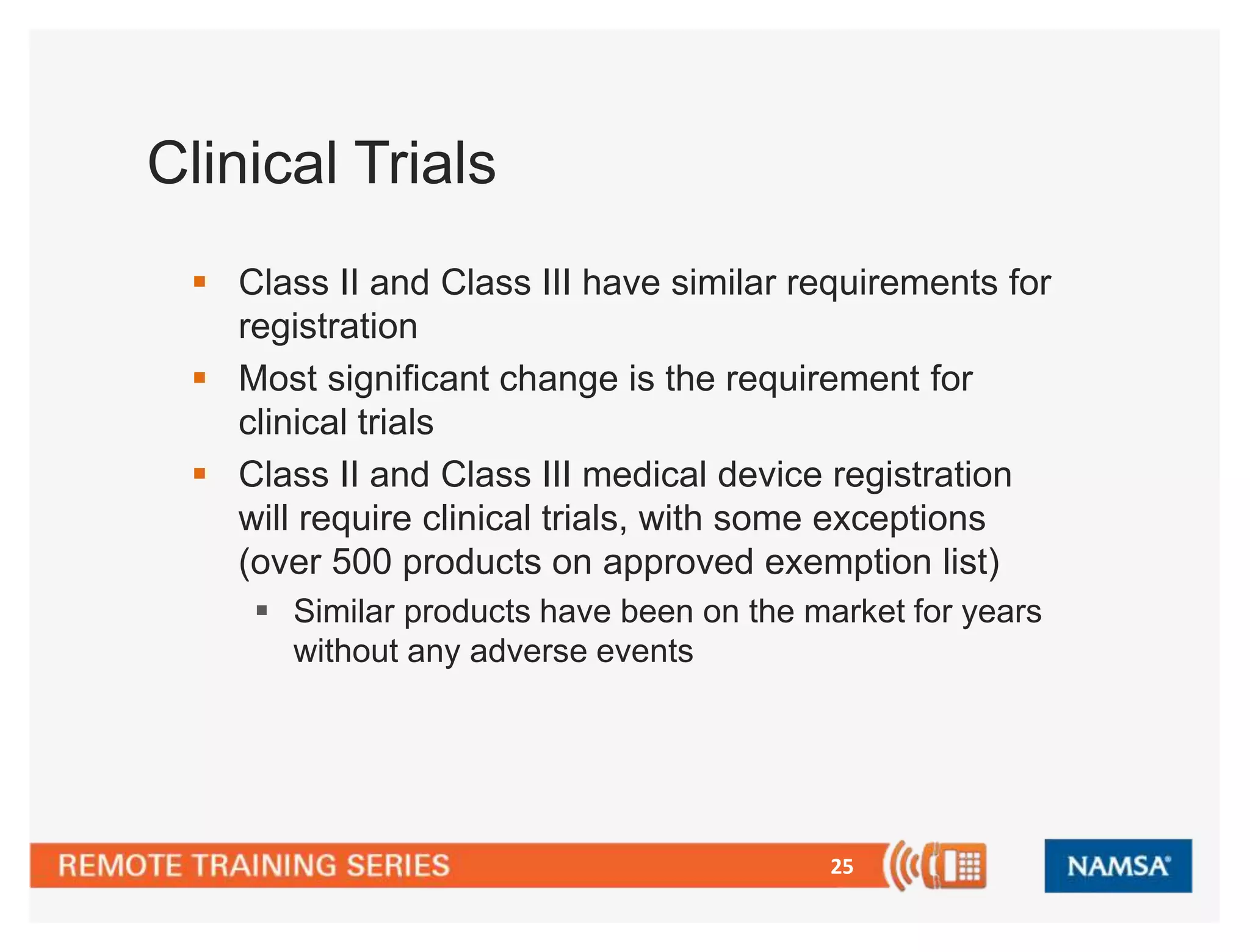
Clinical Trials 
 Class II and Class III have similar requirements for 
registration
23 
Clinical Trials 
 Class II and Class III have similar requirements for 
registration 
 Most significant change is the requirement for 
clinical trials
24 
Clinical Trials 
 Class II and Class III have similar requirements for 
registration 
 Most significant change is the requirement for 
clinical trials 
 Class II and Class III medical device registration 
will require clinical trials, with some exceptions 
(over 500 products on approved exemption list)
25 
Clinical Trials 
 Class II and Class III have similar requirements for 
registration 
 Most significant change is the requirement for 
clinical trials 
 Class II and Class III medical device registration 
will require clinical trials, with some exceptions 
(over 500 products on approved exemption list) 
 Similar products have been on the market for years 
without any adverse events
26 
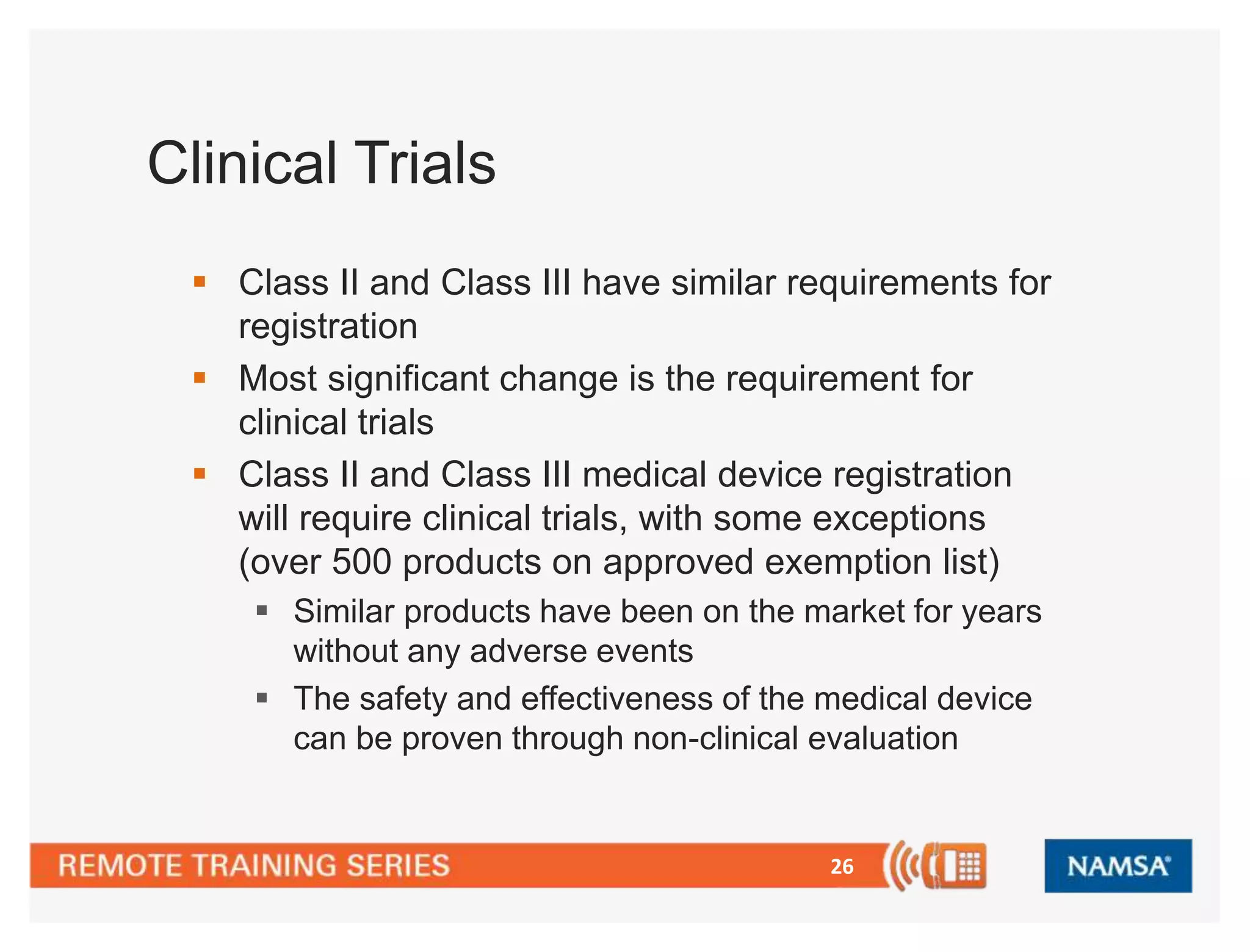
Clinical Trials 
 Class II and Class III have similar requirements for 
registration 
 Most significant change is the requirement for 
clinical trials 
 Class II and Class III medical device registration 
will require clinical trials, with some exceptions 
(over 500 products on approved exemption list) 
 Similar products have been on the market for years 
without any adverse events 
 The safety and effectiveness of the medical device 
can be proven through non-clinical evaluation
27 
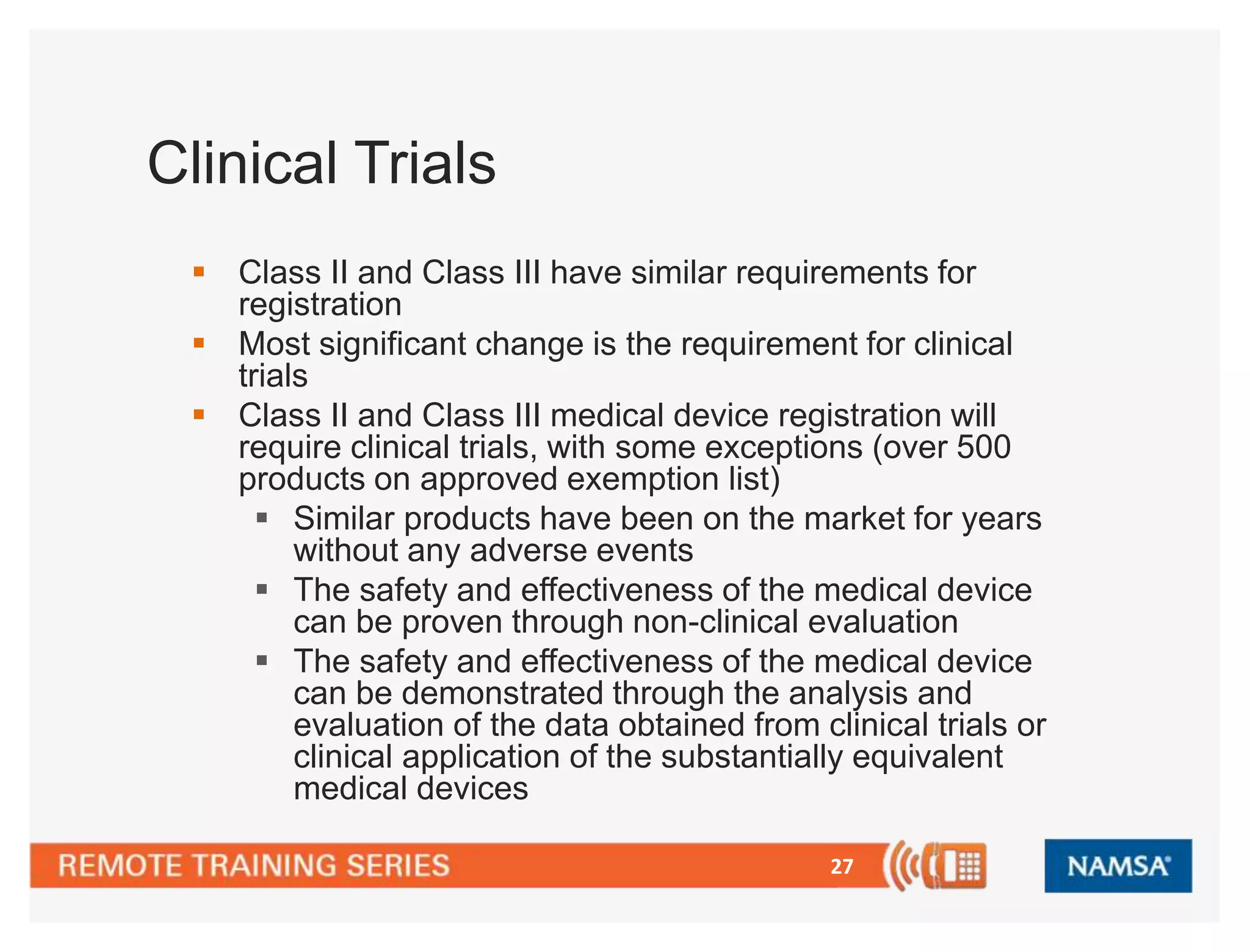
Clinical Trials 
 Class II and Class III have similar requirements for 
registration 
 Most significant change is the requirement for clinical 
trials 
 Class II and Class III medical device registration will 
require clinical trials, with some exceptions (over 500 
products on approved exemption list) 
 Similar products have been on the market for years 
without any adverse events 
 The safety and effectiveness of the medical device 
can be proven through non-clinical evaluation 
 The safety and effectiveness of the medical device 
can be demonstrated through the analysis and 
evaluation of the data obtained from clinical trials or 
clinical application of the substantially equivalent 
medical devices
28 
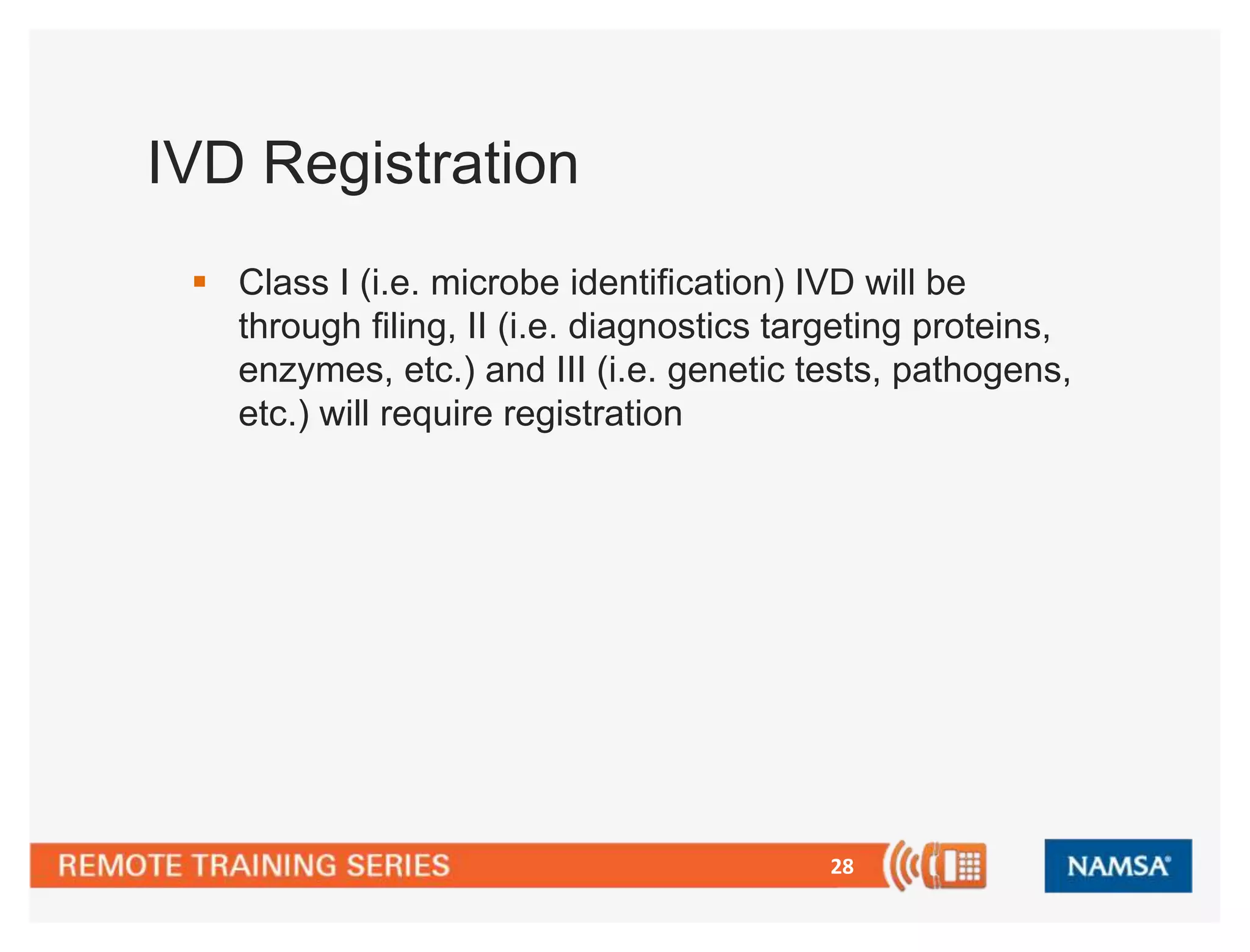
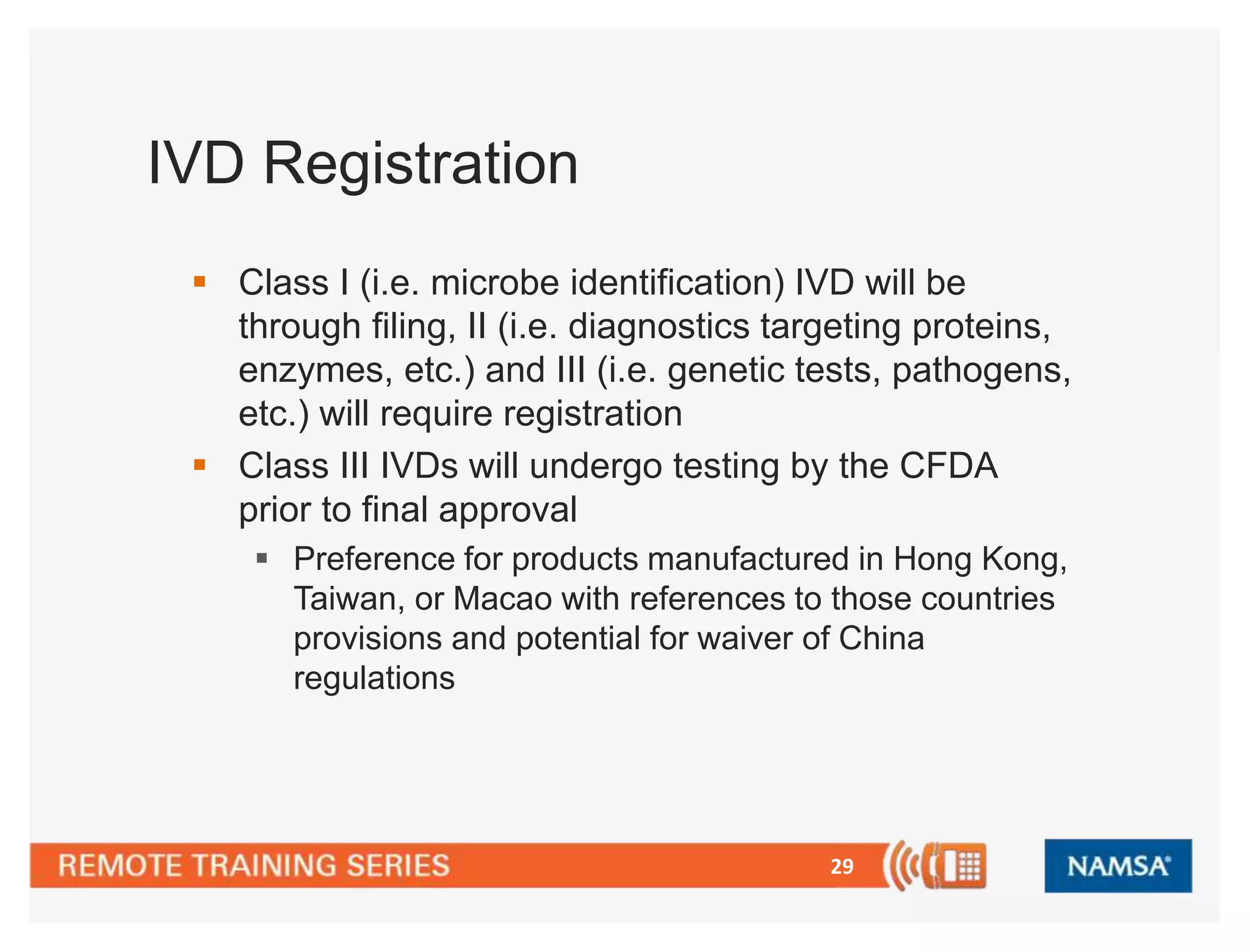
IVD Registration 
 Class I (i.e. microbe identification) IVD will be 
through filing, II (i.e. diagnostics targeting proteins, 
enzymes, etc.) and III (i.e. genetic tests, pathogens, 
etc.) will require registration
29 
IVD Registration 
 Class I (i.e. microbe identification) IVD will be 
through filing, II (i.e. diagnostics targeting proteins, 
enzymes, etc.) and III (i.e. genetic tests, pathogens, 
etc.) will require registration 
 Class III IVDs will undergo testing by the CFDA 
prior to final approval 
 Preference for products manufactured in Hong Kong, 
Taiwan, or Macao with references to those countries 
provisions and potential for waiver of China 
regulations
30 
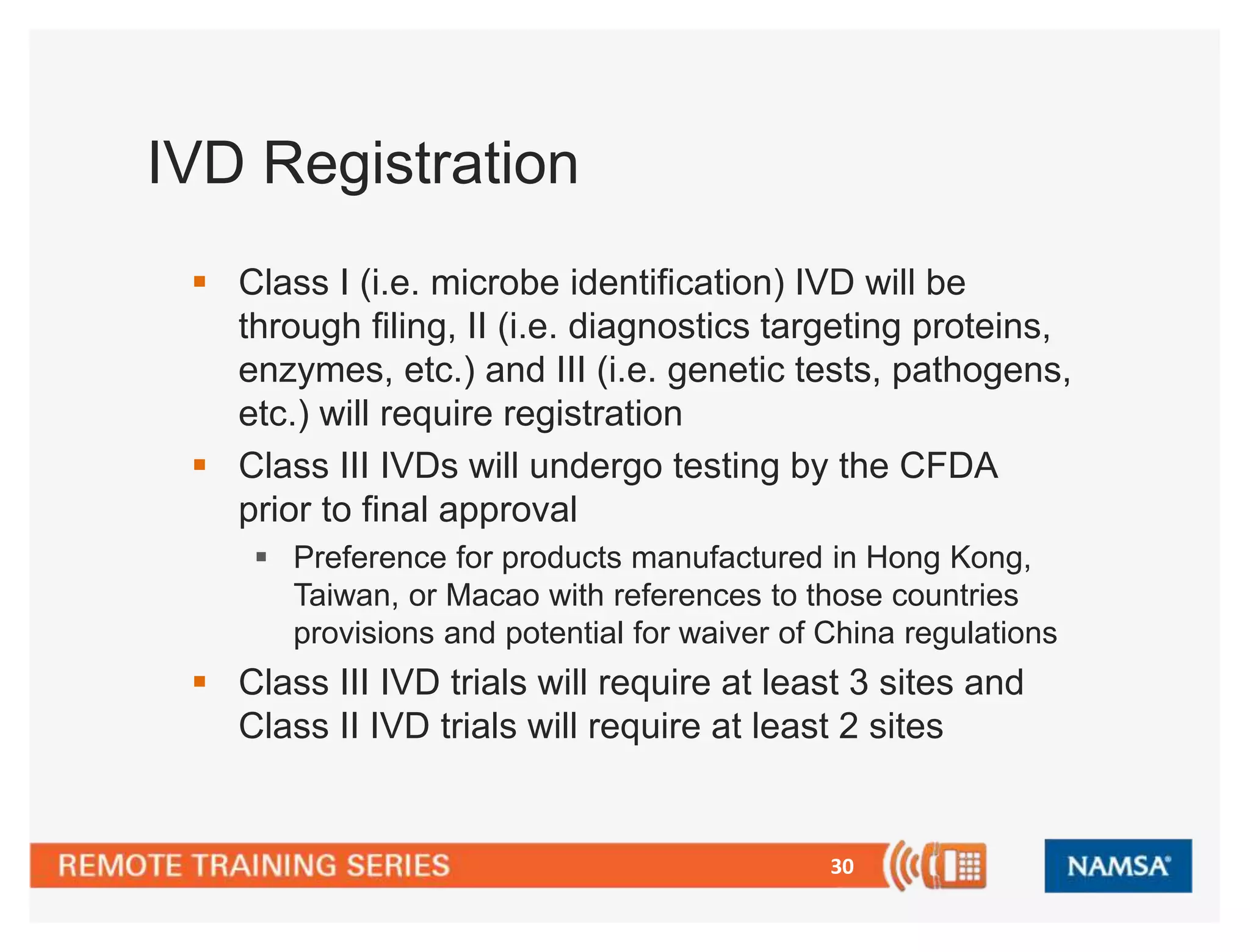
IVD Registration 
 Class I (i.e. microbe identification) IVD will be 
through filing, II (i.e. diagnostics targeting proteins, 
enzymes, etc.) and III (i.e. genetic tests, pathogens, 
etc.) will require registration 
 Class III IVDs will undergo testing by the CFDA 
prior to final approval 
 Preference for products manufactured in Hong Kong, 
Taiwan, or Macao with references to those countries 
provisions and potential for waiver of China regulations 
 Class III IVD trials will require at least 3 sites and 
Class II IVD trials will require at least 2 sites
31 
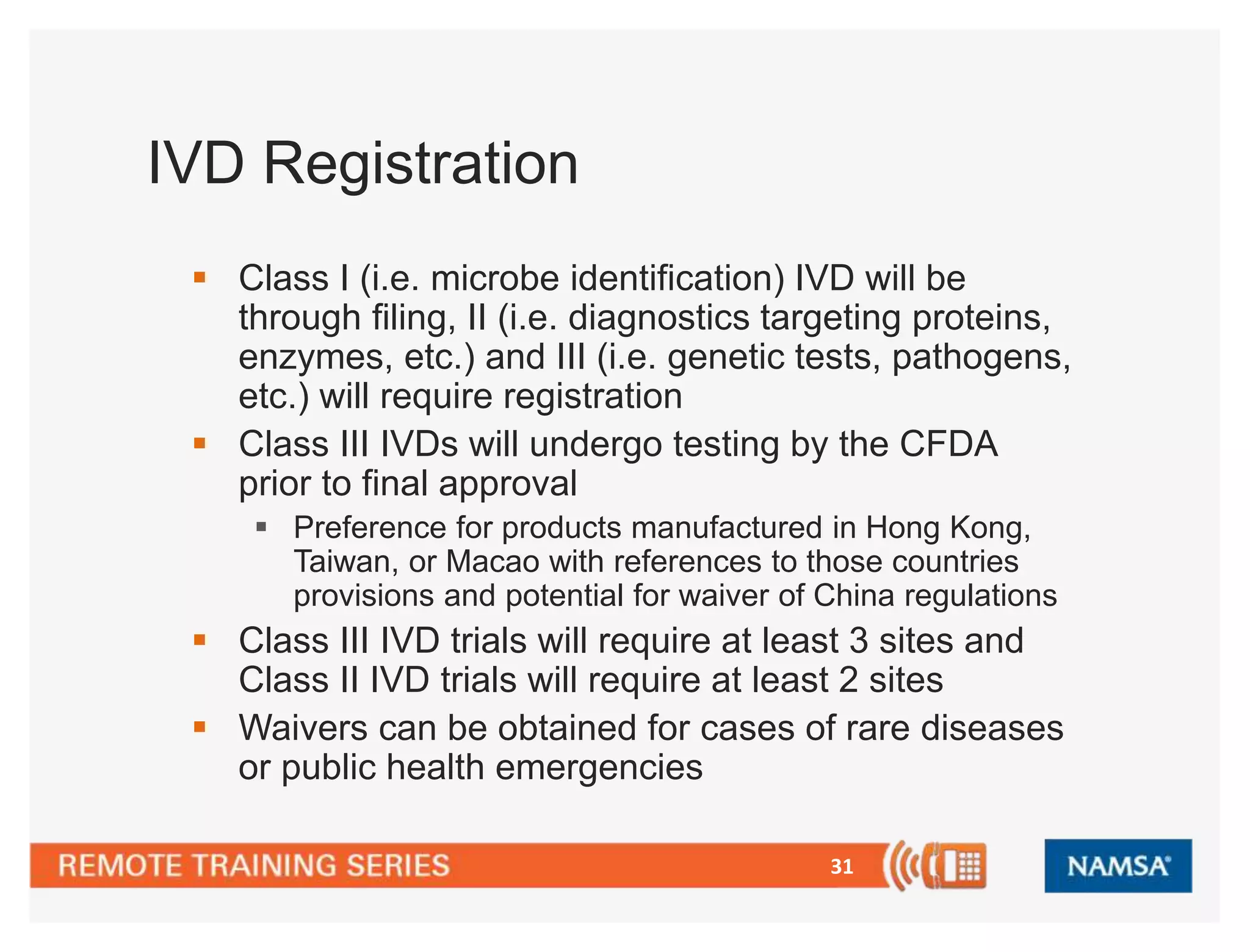
IVD Registration 
 Class I (i.e. microbe identification) IVD will be 
through filing, II (i.e. diagnostics targeting proteins, 
enzymes, etc.) and III (i.e. genetic tests, pathogens, 
etc.) will require registration 
 Class III IVDs will undergo testing by the CFDA 
prior to final approval 
 Preference for products manufactured in Hong Kong, 
Taiwan, or Macao with references to those countries 
provisions and potential for waiver of China regulations 
 Class III IVD trials will require at least 3 sites and 
Class II IVD trials will require at least 2 sites 
 Waivers can be obtained for cases of rare diseases 
or public health emergencies
32 
IVD Registration 
 Class I (i.e. microbe identification) IVD will be 
through filing, II (i.e. diagnostics targeting proteins, 
enzymes, etc.) and III (i.e. genetic tests, pathogens, 
etc.) will require registration 
 Class III IVDs will undergo testing by the CFDA 
prior to final approval 
 Preference for products manufactured in Hong Kong, 
Taiwan, or Macao with references to those countries 
provisions and potential for waiver of China regulations 
 Class III IVD trials will require at least 3 sites and 
Class II IVD trials will require at least 2 sites 
 Waivers can be obtained for cases of rare diseases 
or public health emergencies 
 Imported products must submit overseas clinical 
trial data to support clinical trial application
33 
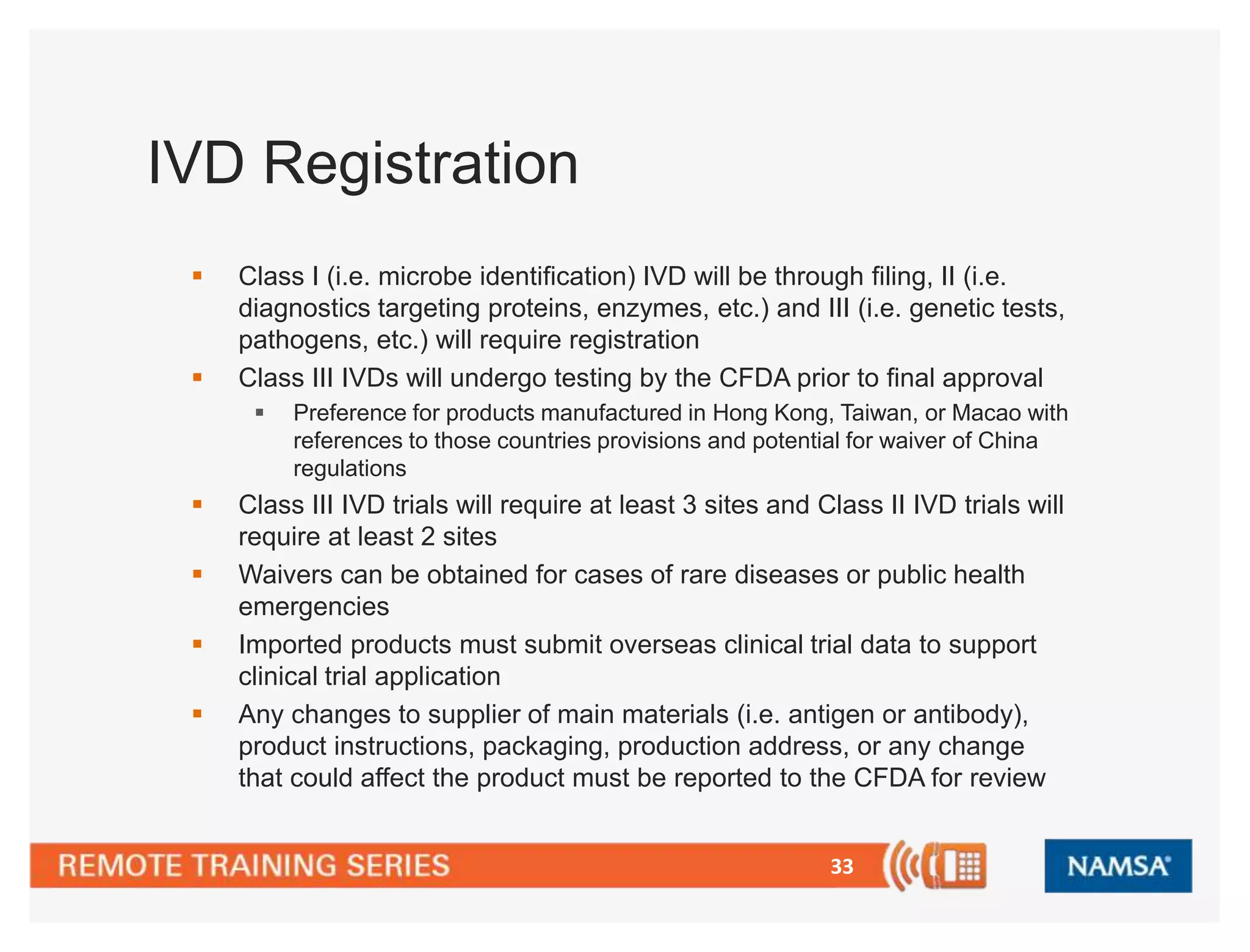
IVD Registration 
 Class I (i.e. microbe identification) IVD will be through filing, II (i.e. 
diagnostics targeting proteins, enzymes, etc.) and III (i.e. genetic tests, 
pathogens, etc.) will require registration 
 Class III IVDs will undergo testing by the CFDA prior to final approval 
 Preference for products manufactured in Hong Kong, Taiwan, or Macao with 
references to those countries provisions and potential for waiver of China 
regulations 
 Class III IVD trials will require at least 3 sites and Class II IVD trials will 
require at least 2 sites 
 Waivers can be obtained for cases of rare diseases or public health 
emergencies 
 Imported products must submit overseas clinical trial data to support 
clinical trial application 
 Any changes to supplier of main materials (i.e. antigen or antibody), 
product instructions, packaging, production address, or any change 
that could affect the product must be reported to the CFDA for review
 To view the complete Remote Training Series on Chinese 
Food and Drug Administration Regulatory Approval Process 
 Check out NAMSA’s Seminars 
 For information about the Regulatory services NAMSA can 
34 
offer you 
 Visit our Regulatory page 
 For additional information 
 Download our brochure on Regulatory and Quality 
Systems Consulting 
 Contact us at clientcare@namsa.com.

Chinese Food and Drug Administration (CFDA) Regulatory Approval Process: Medical Device Market Entry

  • 1.
    Chinese Food andDrug Administration (CFDA) Regulatory Approval Process: Medical Device Market Entry Seth J. Goldenberg PhD Senior Principal Scientist NAMSA
  • 2.
    2 Overview Overview of Testing Process  China Medical Device Standards  Medical Devices Registration Changes
  • 3.
    Overview of TestingProcess  Manufacturers must write standards and file for validation testing at CFDA designated sites 3
  • 4.
    Overview of TestingProcess  Manufacturers must write standards and file for validation testing at CFDA designated sites  Careful following of existing testing standards 4
  • 5.
    Overview of TestingProcess  Manufacturers must write standards and file for validation testing at CFDA designated sites  Careful following of existing testing standards  The custom “product standards” will be generated referencing current Industry (YY) and National (GB) standards 5
  • 6.
    Overview of TestingProcess  Manufacturers must write standards and file for validation testing at CFDA designated sites  Careful following of existing testing standards  The custom “product standards” will be generated referencing current Industry (YY) and National (GB) standards  Performance testing can be highly variable at CFDA between test labs and between foreign test results 6
  • 7.
    Overview of TestingProcess  Manufacturers must write standards and file for validation testing at CFDA designated sites  Careful following of existing testing standards  The custom “product standards” will be generated referencing current Industry (YY) and National (GB) standards  Performance testing can be highly variable at CFDA between test labs and between foreign test results  Sending a representative to testing lab is key  Briefed on performance of device and functionality 7
  • 8.
    China Medical DeviceStandards 8  Types of Standards  GB – National Mandatory Standards  Typically follow global standards . . . Almost  GB/T 16886 . . . ISO 10993
  • 9.
    China Medical DeviceStandards 9  Types of Standards  GB – National Mandatory Standards  Typically follow global standards . . . Almost  GB/T 16886 . . . ISO 10993  YY Standards – Industrial standards in Medical area  Mandatory
  • 10.
    China Medical DeviceStandards 10  Types of Standards  GB – National Mandatory Standards  Typically follow global standards . . . Almost  GB/T 16886 . . . ISO 10993  YY Standards – Industrial standards in Medical area  Mandatory  YY/T standards – Industrial standards in Medical area  Recommended  YY/T 0660-2008 vs. ASTM F2026-12  PEEK for Surgical Implant Applications
  • 11.
    China Medical DeviceStandards 11  Types of Standards  GB – National Mandatory Standards  Typically follow global standards . . . Almost  GB/T 16886 . . . ISO 10993  YY Standards – Industrial standards in Medical area  Mandatory  YY/T standards – Industrial standards in Medical area  Recommended  YY/T 0660-2008 vs. ASTM F2026-12  PEEK for Surgical Implant Applications  YZB Registration Product Standards  Baseline for testing for a given device  Compiled by the device manufacturer to China Medical Device Standards
  • 12.
    Medical Devices RegistrationChanges Issued on March 31st, 2014, the CFDA regulation changes went into effect on June 1st, 2014. 12
  • 13.
    Medical Devices RegistrationChanges  Class I will no longer require registration, but will 13 change to filing
  • 14.
    Medical Devices RegistrationChanges  Class I will no longer require registration, but will 14 change to filing  Risk analysis report of the product
  • 15.
    Medical Devices RegistrationChanges  Class I will no longer require registration, but will change to filing  Risk analysis report of the product  Technical requirements of the product 15
  • 16.
    Medical Devices RegistrationChanges  Class I will no longer require registration, but will change to filing  Risk analysis report of the product  Technical requirements of the product  Testing report of the product 16
  • 17.
    Medical Devices RegistrationChanges  Class I will no longer require registration, but will change to filing  Risk analysis report of the product  Technical requirements of the product  Testing report of the product  Clinical evaluation material 17
  • 18.
    Medical Devices RegistrationChanges  Class I will no longer require registration, but will change to filing  Risk analysis report of the product  Technical requirements of the product  Testing report of the product  Clinical evaluation material  Sample of Instruction for Use and label 18
  • 19.
    Medical Devices RegistrationChanges  Class I will no longer require registration, but will change to filing  Risk analysis report of the product  Technical requirements of the product  Testing report of the product  Clinical evaluation material  Sample of Instruction for Use and label  Quality management system document related to research and development and manufacture 19
  • 20.
    Medical Devices RegistrationChanges  Class I will no longer require registration, but will change to filing  Risk analysis report of the product  Technical requirements of the product  Testing report of the product  Clinical evaluation material  Sample of Instruction for Use and label  Quality management system document related to research and development and manufacture  Other necessary documents to demonstrate safety 20 and effectiveness of the product
  • 21.
    Medical Devices RegistrationChanges  Class I will no longer require registration, but will change to filing  Risk analysis report of the product  Technical requirements of the product  Testing report of the product  Clinical evaluation material  Sample of Instruction for Use and label  Quality management system document related to research and development and manufacture  Other necessary documents to demonstrate safety and 21 effectiveness of the product  The medical device registration applicant and filing applicant shall be responsible for the authenticity of the submitted documents
  • 22.
    22 Clinical Trials  Class II and Class III have similar requirements for registration
  • 23.
    23 Clinical Trials  Class II and Class III have similar requirements for registration  Most significant change is the requirement for clinical trials
  • 24.
    24 Clinical Trials  Class II and Class III have similar requirements for registration  Most significant change is the requirement for clinical trials  Class II and Class III medical device registration will require clinical trials, with some exceptions (over 500 products on approved exemption list)
  • 25.
    25 Clinical Trials  Class II and Class III have similar requirements for registration  Most significant change is the requirement for clinical trials  Class II and Class III medical device registration will require clinical trials, with some exceptions (over 500 products on approved exemption list)  Similar products have been on the market for years without any adverse events
  • 26.
    26 Clinical Trials  Class II and Class III have similar requirements for registration  Most significant change is the requirement for clinical trials  Class II and Class III medical device registration will require clinical trials, with some exceptions (over 500 products on approved exemption list)  Similar products have been on the market for years without any adverse events  The safety and effectiveness of the medical device can be proven through non-clinical evaluation
  • 27.
    27 Clinical Trials  Class II and Class III have similar requirements for registration  Most significant change is the requirement for clinical trials  Class II and Class III medical device registration will require clinical trials, with some exceptions (over 500 products on approved exemption list)  Similar products have been on the market for years without any adverse events  The safety and effectiveness of the medical device can be proven through non-clinical evaluation  The safety and effectiveness of the medical device can be demonstrated through the analysis and evaluation of the data obtained from clinical trials or clinical application of the substantially equivalent medical devices
  • 28.
    28 IVD Registration  Class I (i.e. microbe identification) IVD will be through filing, II (i.e. diagnostics targeting proteins, enzymes, etc.) and III (i.e. genetic tests, pathogens, etc.) will require registration
  • 29.
    29 IVD Registration  Class I (i.e. microbe identification) IVD will be through filing, II (i.e. diagnostics targeting proteins, enzymes, etc.) and III (i.e. genetic tests, pathogens, etc.) will require registration  Class III IVDs will undergo testing by the CFDA prior to final approval  Preference for products manufactured in Hong Kong, Taiwan, or Macao with references to those countries provisions and potential for waiver of China regulations
  • 30.
    30 IVD Registration  Class I (i.e. microbe identification) IVD will be through filing, II (i.e. diagnostics targeting proteins, enzymes, etc.) and III (i.e. genetic tests, pathogens, etc.) will require registration  Class III IVDs will undergo testing by the CFDA prior to final approval  Preference for products manufactured in Hong Kong, Taiwan, or Macao with references to those countries provisions and potential for waiver of China regulations  Class III IVD trials will require at least 3 sites and Class II IVD trials will require at least 2 sites
  • 31.
    31 IVD Registration  Class I (i.e. microbe identification) IVD will be through filing, II (i.e. diagnostics targeting proteins, enzymes, etc.) and III (i.e. genetic tests, pathogens, etc.) will require registration  Class III IVDs will undergo testing by the CFDA prior to final approval  Preference for products manufactured in Hong Kong, Taiwan, or Macao with references to those countries provisions and potential for waiver of China regulations  Class III IVD trials will require at least 3 sites and Class II IVD trials will require at least 2 sites  Waivers can be obtained for cases of rare diseases or public health emergencies
  • 32.
    32 IVD Registration  Class I (i.e. microbe identification) IVD will be through filing, II (i.e. diagnostics targeting proteins, enzymes, etc.) and III (i.e. genetic tests, pathogens, etc.) will require registration  Class III IVDs will undergo testing by the CFDA prior to final approval  Preference for products manufactured in Hong Kong, Taiwan, or Macao with references to those countries provisions and potential for waiver of China regulations  Class III IVD trials will require at least 3 sites and Class II IVD trials will require at least 2 sites  Waivers can be obtained for cases of rare diseases or public health emergencies  Imported products must submit overseas clinical trial data to support clinical trial application
  • 33.
    33 IVD Registration  Class I (i.e. microbe identification) IVD will be through filing, II (i.e. diagnostics targeting proteins, enzymes, etc.) and III (i.e. genetic tests, pathogens, etc.) will require registration  Class III IVDs will undergo testing by the CFDA prior to final approval  Preference for products manufactured in Hong Kong, Taiwan, or Macao with references to those countries provisions and potential for waiver of China regulations  Class III IVD trials will require at least 3 sites and Class II IVD trials will require at least 2 sites  Waivers can be obtained for cases of rare diseases or public health emergencies  Imported products must submit overseas clinical trial data to support clinical trial application  Any changes to supplier of main materials (i.e. antigen or antibody), product instructions, packaging, production address, or any change that could affect the product must be reported to the CFDA for review
  • 34.
     To viewthe complete Remote Training Series on Chinese Food and Drug Administration Regulatory Approval Process  Check out NAMSA’s Seminars  For information about the Regulatory services NAMSA can 34 offer you  Visit our Regulatory page  For additional information  Download our brochure on Regulatory and Quality Systems Consulting  Contact us at clientcare@namsa.com.