STALKING John S Price, Ph.D. Psychological Services San Antonio Police Department
“ I have an obsession with the unattainable. I have to eliminate what I cannot attain.”  Robert John Bardo
Definition of Stalking The legal definition of stalking varies from state to state but they generally contain three elements: (1) a pattern of  unwanted behavioral intrusion upon another person; (2) an implicit or explicit threat that is evidenced by a pattern of behavioral intrusion ; and (3) as a result of these intrusive behaviors the person who is threatened experiences reasonable fear (Meloy & Gothard, 1995)
Definition of Stalking Stalking is the willful , malicious and repeated following and harassing of another person that threatens his or her safety Stalking is an old behavior but a new crime. The first stalking law was passed in California in 1990 Currently all fifty states and the federal government have stalking laws
Scope of the Problem A study by the Center for Policy Research  found that the life time risk for stalking victimization is 8% for women and 2% for men (Tjaden & Thoennes, 1997) The majority of stalkers are men and the majority of victims are women
Scope of the Problem The length of the pursuit by stalkers is measured in months or years Although most victims of stalking  are women when men are stalked it is most likely to be by another male ( Tjaden & Thoemmes, 1997) Most victims of stalking suffer major life disruptions and psychological distress
Characteristics of Stalkers Both victims and perpetrators of stalking are older than most criminals and victims of other crimes. The criminal behavior often occurring in the fourth decade of life Immigration is a risk factor to become a stalker Mental disorders are evident in the majority of stalkers
Characteristics of Stalkers Research suggest that stalkers are more intelligent than other criminals Most stalkers are unemployed or underemployed at the time of the stalking Stalkers frequently have a history of prior criminal activity Substance abuse is frequently seen in this group
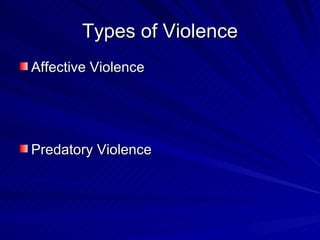
Types of Violence Affective Violence Predatory Violence
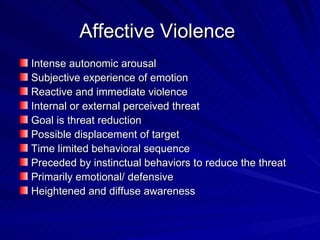
Affective Violence  Intense autonomic arousal Subjective experience of emotion Reactive and immediate violence Internal or external perceived threat Goal is threat reduction  Possible displacement of target Time limited behavioral sequence Preceded by instinctual behaviors to reduce the threat Primarily emotional/ defensive Heightened and diffuse awareness
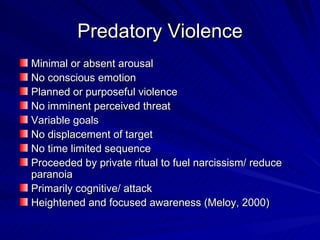
Predatory Violence Minimal or absent arousal No conscious emotion Planned or purposeful violence No imminent perceived threat Variable goals No displacement of target No time limited sequence Proceeded by private ritual to fuel narcissism/ reduce paranoia Primarily cognitive/ attack  Heightened and focused awareness (Meloy, 2000)
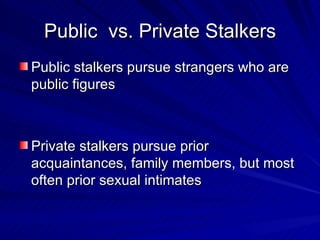
Public  vs. Private Stalkers Public stalkers pursue strangers who are public figures Private stalkers pursue prior acquaintances, family members, but most often prior sexual intimates
Public vs. Private Stalkers Threats appear to have a different meaning for public and private stalkers Threats among private stalkers appear to increase the risk of violence, but they are so common that threats have little predictive value Threats by public stalkers are very unlikely to be acted on, while those individuals who do not directly threaten pose a greater risk (Calhoun & Weston, 2003)
Public vs. Private Stalkers Violence follows a different pattern for public and private stalkers Private stalkers engage in an affective violence, wherein the subject will typically be pushed punched, slapped, choked, fondled or have their hair pulled.  However, these stalkers usually do not use weapons This mode of violence is preceded by autonomic arousal and is an immediate reaction to the perceived threat, usually rejection
Public vs. Private Stalkers Public stalkers, who are violent appear to engage in predatory violence (Fein & Vossekuil, 1999)
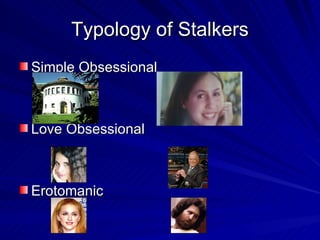
Typology of Stalkers  Simple Obsessional  Love Obsessional Erotomanic
Typology of Stalkers Simple Obsessional: These are cases in which the victim and the perpetrator have some prior knowledge of each other Individuals in this group are likely to have a Personality Disorder Intimate relationship: In many of these cases an individual breaks away from the relationship only to have his/her ex-partner initiate a campaign of harassment  The stalkers motive may be to coerce the victim back or simply revenge
Typology of Stalkers Simple Obsessional Nonimtimate Relationships: Employee who is disciplined or terminated who perceives that one particular supervisor is the direct cause of his/her troubles Employee who attempts to establish a personal relationship with a co-worker and is rejected People with prior professional relationship
Typology of Stalkers Love Obsessional: These cases a characterized by the absence of existing relationship between the perpetrator and the victim. Often the victim is only known to the subject through the media, movies or television These individuals are often Schizophrenic or Bipolar Love obsessional type is usually less dangerous than the simple obsessional
Typology of Stalkers Erotomanic: In these cases the subject develops a delusional belief that he/she is loved by the victim The majority of cases the suspects are women Erotomanics can be very aggressive in their pursuit to contact they are not likely to do physical harm to the victim
Typology of Stalkers False Victimization Syndrome: These cases involve an individual  who constructs a scenario to falsely support the position that he/she is being stalked.  Most subjects are female who are motivated by an attempt to salvage a perceived failing relationship (Meloy, 2000)
Survival Signals Forced Teaming: Creating the impression that there is a shared purpose (We are a team) This process lowers  defenses and encourages trust Charm and Niceness: We should view charm not as an adjective but as a verb. Rather than he is charming we should think why is he charming me Typecasting:  Labeling the victim in some slightly critical way hoping he/she will feel compelled to prove that the stalker is not accurate Discounting the Word No: Actions speak louder than words.  If you say no, but give in to the stalker.  He/she knows to discount your words and persist in his actions. Men who can not take no find women that  cannot say no
Survival Signals Too many Details: Liars often give to much information in an effort to convince others The Unsolicited Promise: An solicited problems is one of the most reliable signal of questionable motives Loan Sharking: What appears to be a gift and is actually an investment, a way of gaining control (De Becker, 1997)
Managing Stalkers No is a complete sentence Persistence is often reinforced Disengage set limits Avoid explaining why Say good bye once Engage and enrage Let him talk to your voice mail (De Becker, 1997)
Stalking Questions
References Calhoun, F., Weston, S., (2003). Contemporary threat management: A practical guide for identifying, assessing and managing individuals of violent intent. San Diego, CA: Specialized Training Services De Becker G. (1997). The gift of fear survival signals that protect us from violence. Boston, MA: Little, Brown and Company Fein, R., Vossekuil, B., & Holden, G. (1995). Threat assessment: An approach to prevent targeted violence. In National Institute of Justice: Research in Action. Washington DC: U.S. Department of Justice, Office of Justice Programs. Meloy, J.,R., editor. (1998). The psychology of stalking: clinical and forensic perspectives. San Diego, CA: Academic Press Meloy J. R., Violence Risks and threat assessment: A practical guide for mental health and criminal justice professionals (2000). San Diego, CA: Specialized Training Services
References Meloy J., R. (2006) The scientific pursuit of stalking. San Diego, CA: Specialized Training Services  Meloy J., R., & Gothard, S. (1995). Demographic and clinical comparison of obsessional followers and offenders with mental disorders. American Journal of Psychiatry, 152, 258-263. Tjaden, P., & Thoennes, N.(1997) Stalking in American: Findings from the National Violence against Women Survey, Denver, CO: Center for Policy Research.

Stalking

  • 1.
    STALKING John SPrice, Ph.D. Psychological Services San Antonio Police Department
  • 2.
    “ I havean obsession with the unattainable. I have to eliminate what I cannot attain.” Robert John Bardo
  • 3.
    Definition of StalkingThe legal definition of stalking varies from state to state but they generally contain three elements: (1) a pattern of unwanted behavioral intrusion upon another person; (2) an implicit or explicit threat that is evidenced by a pattern of behavioral intrusion ; and (3) as a result of these intrusive behaviors the person who is threatened experiences reasonable fear (Meloy & Gothard, 1995)
  • 4.
    Definition of StalkingStalking is the willful , malicious and repeated following and harassing of another person that threatens his or her safety Stalking is an old behavior but a new crime. The first stalking law was passed in California in 1990 Currently all fifty states and the federal government have stalking laws
  • 5.
    Scope of theProblem A study by the Center for Policy Research found that the life time risk for stalking victimization is 8% for women and 2% for men (Tjaden & Thoennes, 1997) The majority of stalkers are men and the majority of victims are women
  • 6.
    Scope of theProblem The length of the pursuit by stalkers is measured in months or years Although most victims of stalking are women when men are stalked it is most likely to be by another male ( Tjaden & Thoemmes, 1997) Most victims of stalking suffer major life disruptions and psychological distress
  • 7.
    Characteristics of StalkersBoth victims and perpetrators of stalking are older than most criminals and victims of other crimes. The criminal behavior often occurring in the fourth decade of life Immigration is a risk factor to become a stalker Mental disorders are evident in the majority of stalkers
  • 8.
    Characteristics of StalkersResearch suggest that stalkers are more intelligent than other criminals Most stalkers are unemployed or underemployed at the time of the stalking Stalkers frequently have a history of prior criminal activity Substance abuse is frequently seen in this group
  • 9.
    Types of ViolenceAffective Violence Predatory Violence
  • 10.
    Affective Violence Intense autonomic arousal Subjective experience of emotion Reactive and immediate violence Internal or external perceived threat Goal is threat reduction Possible displacement of target Time limited behavioral sequence Preceded by instinctual behaviors to reduce the threat Primarily emotional/ defensive Heightened and diffuse awareness
  • 11.
    Predatory Violence Minimalor absent arousal No conscious emotion Planned or purposeful violence No imminent perceived threat Variable goals No displacement of target No time limited sequence Proceeded by private ritual to fuel narcissism/ reduce paranoia Primarily cognitive/ attack Heightened and focused awareness (Meloy, 2000)
  • 12.
    Public vs.Private Stalkers Public stalkers pursue strangers who are public figures Private stalkers pursue prior acquaintances, family members, but most often prior sexual intimates
  • 13.
    Public vs. PrivateStalkers Threats appear to have a different meaning for public and private stalkers Threats among private stalkers appear to increase the risk of violence, but they are so common that threats have little predictive value Threats by public stalkers are very unlikely to be acted on, while those individuals who do not directly threaten pose a greater risk (Calhoun & Weston, 2003)
  • 14.
    Public vs. PrivateStalkers Violence follows a different pattern for public and private stalkers Private stalkers engage in an affective violence, wherein the subject will typically be pushed punched, slapped, choked, fondled or have their hair pulled. However, these stalkers usually do not use weapons This mode of violence is preceded by autonomic arousal and is an immediate reaction to the perceived threat, usually rejection
  • 15.
    Public vs. PrivateStalkers Public stalkers, who are violent appear to engage in predatory violence (Fein & Vossekuil, 1999)
  • 16.
    Typology of Stalkers Simple Obsessional Love Obsessional Erotomanic
  • 17.
    Typology of StalkersSimple Obsessional: These are cases in which the victim and the perpetrator have some prior knowledge of each other Individuals in this group are likely to have a Personality Disorder Intimate relationship: In many of these cases an individual breaks away from the relationship only to have his/her ex-partner initiate a campaign of harassment The stalkers motive may be to coerce the victim back or simply revenge
  • 18.
    Typology of StalkersSimple Obsessional Nonimtimate Relationships: Employee who is disciplined or terminated who perceives that one particular supervisor is the direct cause of his/her troubles Employee who attempts to establish a personal relationship with a co-worker and is rejected People with prior professional relationship
  • 19.
    Typology of StalkersLove Obsessional: These cases a characterized by the absence of existing relationship between the perpetrator and the victim. Often the victim is only known to the subject through the media, movies or television These individuals are often Schizophrenic or Bipolar Love obsessional type is usually less dangerous than the simple obsessional
  • 20.
    Typology of StalkersErotomanic: In these cases the subject develops a delusional belief that he/she is loved by the victim The majority of cases the suspects are women Erotomanics can be very aggressive in their pursuit to contact they are not likely to do physical harm to the victim
  • 21.
    Typology of StalkersFalse Victimization Syndrome: These cases involve an individual who constructs a scenario to falsely support the position that he/she is being stalked. Most subjects are female who are motivated by an attempt to salvage a perceived failing relationship (Meloy, 2000)
  • 22.
    Survival Signals ForcedTeaming: Creating the impression that there is a shared purpose (We are a team) This process lowers defenses and encourages trust Charm and Niceness: We should view charm not as an adjective but as a verb. Rather than he is charming we should think why is he charming me Typecasting: Labeling the victim in some slightly critical way hoping he/she will feel compelled to prove that the stalker is not accurate Discounting the Word No: Actions speak louder than words. If you say no, but give in to the stalker. He/she knows to discount your words and persist in his actions. Men who can not take no find women that cannot say no
  • 23.
    Survival Signals Toomany Details: Liars often give to much information in an effort to convince others The Unsolicited Promise: An solicited problems is one of the most reliable signal of questionable motives Loan Sharking: What appears to be a gift and is actually an investment, a way of gaining control (De Becker, 1997)
  • 24.
    Managing Stalkers Nois a complete sentence Persistence is often reinforced Disengage set limits Avoid explaining why Say good bye once Engage and enrage Let him talk to your voice mail (De Becker, 1997)
  • 25.
  • 26.
    References Calhoun, F.,Weston, S., (2003). Contemporary threat management: A practical guide for identifying, assessing and managing individuals of violent intent. San Diego, CA: Specialized Training Services De Becker G. (1997). The gift of fear survival signals that protect us from violence. Boston, MA: Little, Brown and Company Fein, R., Vossekuil, B., & Holden, G. (1995). Threat assessment: An approach to prevent targeted violence. In National Institute of Justice: Research in Action. Washington DC: U.S. Department of Justice, Office of Justice Programs. Meloy, J.,R., editor. (1998). The psychology of stalking: clinical and forensic perspectives. San Diego, CA: Academic Press Meloy J. R., Violence Risks and threat assessment: A practical guide for mental health and criminal justice professionals (2000). San Diego, CA: Specialized Training Services
  • 27.
    References Meloy J.,R. (2006) The scientific pursuit of stalking. San Diego, CA: Specialized Training Services Meloy J., R., & Gothard, S. (1995). Demographic and clinical comparison of obsessional followers and offenders with mental disorders. American Journal of Psychiatry, 152, 258-263. Tjaden, P., & Thoennes, N.(1997) Stalking in American: Findings from the National Violence against Women Survey, Denver, CO: Center for Policy Research.