Jean Nidetch Women’s Center
          PAAVE Presentation
                       2009
   Workshops and presentations
   Events on campus
   Advocacy for violence prevention and
    breast cancer awareness
   Academic involvement
   Two on staff, certified victim
    advocates
   Peers Advocating for Anti-Violence
    Education
   Formerly known as SAFE Team,
    began in 2002
   Completed 18-hour training on domestic
    violence and sexual assault
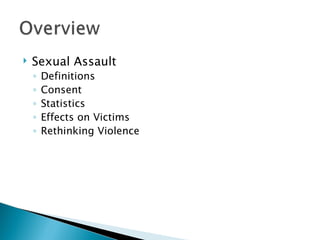
   Sexual Assault
    ◦   Definitions
    ◦   Consent
    ◦   Statistics
    ◦   Effects on Victims
    ◦   Rethinking Violence
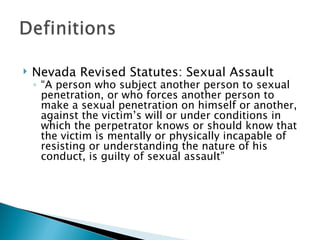
   Nevada Revised Statutes: Sexual Assault
    ◦ “A person who subject another person to sexual
      penetration, or who forces another person to
      make a sexual penetration on himself or another,
      against the victim’s will or under conditions in
      which the perpetrator knows or should know that
      the victim is mentally or physically incapable of
      resisting or understanding the nature of his
      conduct, is guilty of sexual assault”
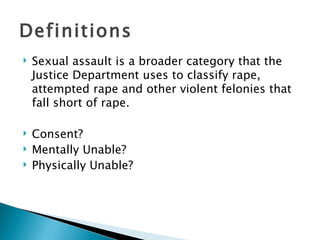
Definitions
   Sexual assault is a broader category that the
    Justice Department uses to classify rape,
    attempted rape and other violent felonies that
    fall short of rape.

   Consent?
   Mentally Unable?
   Physically Unable?
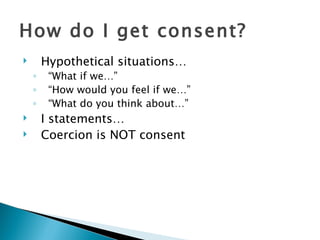
How do I get consent?
       Hypothetical situations…
    ◦    “What if we…”
    ◦    “How would you feel if we…”
    ◦    “What do you think about…”
       I statements…
       Coercion is NOT consent
What is consent?
    Both parties are fully conscious.
    Both parties have equal ability to act.
    Both parties are positive and sincere in their desires.
    Both parties have clearly communicated their intent.


Why don’t people get consent?
 Fear of Rejection
 May hear partner is a survivor

 May not know how
   25% of women and 7% of men will be victims
    of domestic violence or partner rape.
   Six months following an experience of
    domestic violence, 32% of battered women
    are victimized again
   Yearly, 3.3 million children are exposed to
    interfamily violence against their mothers or
    female caretakers
   Only about 42% of rapes/sexual assaults
    were reported to law enforcement in 2007
   1 out of 6 American have been the victim of
    an attempted or completed rape in their
    lifetime
   About 3% of men (2.78 million) have
    experienced an attempted or completed
    rape against them
   Rape is the most rapidly growing, most
    underreported, and most rarely convicted
    crime in the world
   The F.B.I. estimates that one in three
    women in this country will be sexually
    assaulted in her lifetime.
   According to the National College Health
    Risk Behavior Survey, one in five
    undergraduate women have been raped.
   In the majority of rape cases, 73%, the
    perpetrator is someone the victim knows- a
    partner, spouse, classmate, date, co-
    worker, neighbor, or family member.
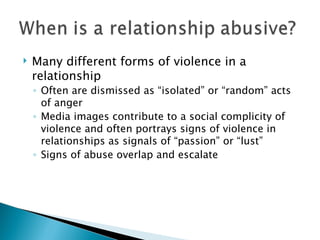
   Many different forms of violence in a
    relationship
    ◦ Often are dismissed as “isolated” or “random” acts
      of anger
    ◦ Media images contribute to a social complicity of
      violence and often portrays signs of violence in
      relationships as signals of “passion” or “lust”
    ◦ Signs of abuse overlap and escalate
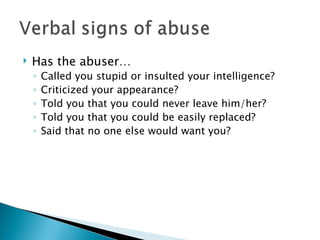
   Has the abuser…
    ◦   Called you stupid or insulted your intelligence?
    ◦   Criticized your appearance?
    ◦   Told you that you could never leave him/her?
    ◦   Told you that you could be easily replaced?
    ◦   Said that no one else would want you?
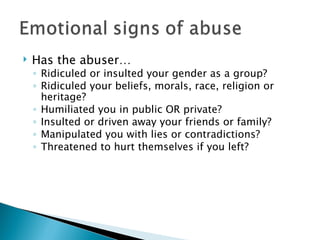
   Has the abuser…
    ◦ Ridiculed or insulted your gender as a group?
    ◦ Ridiculed your beliefs, morals, race, religion or
      heritage?
    ◦ Humiliated you in public OR private?
    ◦ Insulted or driven away your friends or family?
    ◦ Manipulated you with lies or contradictions?
    ◦ Threatened to hurt themselves if you left?
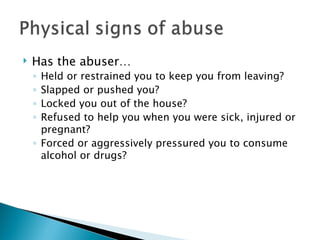
   Has the abuser…
    ◦ Held or restrained you to keep you from leaving?
    ◦ Slapped or pushed you?
    ◦ Locked you out of the house?
    ◦ Refused to help you when you were sick, injured or
      pregnant?
    ◦ Forced or aggressively pressured you to consume
      alcohol or drugs?
   Has the abuser…
    ◦ Forced you to strip when you didn’t want to?
    ◦ Been jealous or angry, assuming you have had sex
      with someone else?
    ◦ Criticized you sexually?
    ◦ Forced you into unwanted sex?
    ◦ Withheld sex and affection?
    ◦ Insisted on uncomfortable or unwanted touching?
   Has the abuser…
    ◦ Taken credit cards/checks/money away as a form
      of punishment?
    ◦ Forced you to hand over money or your
      paychecks?
    ◦ Refused to tell you about bills?
    ◦ Are they the only one “allowed” to work?
    ◦ Taken your name off crucial documents
      (insurance, leases) to prevent your access to
      them?
    ◦ Drained your bank account?
   Can be short or long term
    ◦   Cutting/ self-mutilation
    ◦   Eating disorders
    ◦   Depression
    ◦   Alcohol and substance abuse
    ◦   Re-entrance into a violent relationship
    ◦   Post traumatic stress disorder (PTSD)
    ◦   Academic Career
   Abuse in relationships is any pattern of
    behavior that is used to coerce, dominate or
    isolate the other partner to gain control
   Abuse knows no boundary concerning race,
    class, gender, sexual orientation etc.
   Remember, violence may take a different
    form in different communities but that does
    not make one form more important than
    another
    Similarities
    1. Abuse is always the responsibility of the
       abuser. It is their choice.
    2. Victims are often blamed for the abuse by their
       partner.
    3. It is difficult for victims to leave their
       relationship.
    4. Victims often feel responsible for their abuse.
    5. Abuse escalates over time.
    6. The abuser is often apologetic after abusing,
       giving false hope that the abuse will stop.
    Differences
    1. There are limited resources available for
       abused and abusive LGBTQ people.
    2. Homophobia in society denies the reality of
       some same sex relationships, including their
       very existence, let alone abuse.
    3. Shelters for women may not be sensitive to a
       victim of same sex assault.
    4. Gay/Bi/Trans men have even fewer options for
       help.
    5. Reporting may result in a feeling or experience
       of being excluded from the LGBTQ community.
   The Role of Alcohol

         Alcohol is the most common drug used to
    facilitate sexual assaults- particularly among college
    students. As opposed to other drugs (such as GHB
    and Rohypnol) that are often given to victims without
    their knowledge, alcohol is often consumed
    consensually.
         Perpetrators often take advantage of victims who
    are already intoxicated, or purposefully get a target
    drunk in order to facilitate a sexual assault. These
    perpetrators most often have had much less to drink
    than the victim and in some cases have not
    consumed alcohol at all.
Seriously! check your phone, talk, party it up!
Battered spouses leave their abusers an
average of 7 times before they leave for good
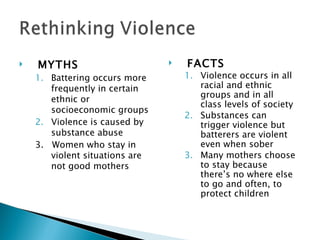
   MYTHS                          FACTS
    1. Battering occurs more        1. Violence occurs in all
       frequently in certain           racial and ethnic
                                       groups and in all
       ethnic or
                                       class levels of society
       socioeconomic groups
                                    2. Substances can
    2. Violence is caused by           trigger violence but
       substance abuse                 batterers are violent
    3. Women who stay in               even when sober
       violent situations are       3. Many mothers choose
       not good mothers                to stay because
                                       there’s no where else
                                       to go and often, to
                                       protect children
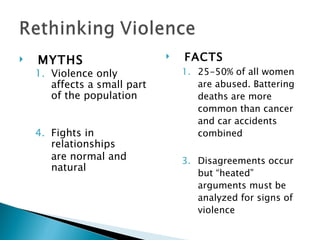
   MYTHS                        FACTS
    1. Violence only              1. 25-50% of all women
       affects a small part          are abused. Battering
       of the population             deaths are more
                                     common than cancer
                                     and car accidents
    4. Fights in                     combined
       relationships
       are normal and             3. Disagreements occur
       natural
                                     but “heated”
                                     arguments must be
                                     analyzed for signs of
                                     violence
   Myths                   Facts
                             6. Sexual assault is a crime of
6. Sexual assault is a
  crime of passion and       violence. Assailants seek to
  lust.                      dominate, humiliate and

                             punish their victims.

                             “Rape is primarily an act of

                             violence with sex as the

                             weapon” (Burgess &Holmstrom).
Myths               Facts
7. Persons who       7. Many convicted
 dress or act in a    sexual assailants are
                      unable to remember
 "sexy" way are       what their victims
 asking to be         looked like or were
 sexually             wearing. Nothing a
 assaulted.           person does or does
                      not do causes a
                      brutal crime like
                      sexual assault.
   Anyone can be a victim of sexual assault or
    domestic violence. If you or someone you
    know is involved with interpersonal violence
    know that there are resources to help you.
   Safe House (Domestic Violence Support)
    ◦ 702.451.4203
   Abuse Crisis Center / DV Hotline
    ◦ 702.646.4981
   Rape Crisis Center
    ◦ 366-1640
   More information available at:
    ◦ The Jean Nidetch Women’s Center, UNLV
        SSC A, 255 – 702.895.4475

Dv,sa,dfsa

  • 1.
    Jean Nidetch Women’sCenter PAAVE Presentation 2009
  • 2.
    Workshops and presentations  Events on campus  Advocacy for violence prevention and breast cancer awareness  Academic involvement  Two on staff, certified victim advocates
  • 3.
    Peers Advocating for Anti-Violence Education  Formerly known as SAFE Team, began in 2002  Completed 18-hour training on domestic violence and sexual assault
  • 4.
    Sexual Assault ◦ Definitions ◦ Consent ◦ Statistics ◦ Effects on Victims ◦ Rethinking Violence
  • 5.
    Nevada Revised Statutes: Sexual Assault ◦ “A person who subject another person to sexual penetration, or who forces another person to make a sexual penetration on himself or another, against the victim’s will or under conditions in which the perpetrator knows or should know that the victim is mentally or physically incapable of resisting or understanding the nature of his conduct, is guilty of sexual assault”
  • 6.
    Definitions  Sexual assault is a broader category that the Justice Department uses to classify rape, attempted rape and other violent felonies that fall short of rape.  Consent?  Mentally Unable?  Physically Unable?
  • 7.
    How do Iget consent?  Hypothetical situations… ◦ “What if we…” ◦ “How would you feel if we…” ◦ “What do you think about…”  I statements…  Coercion is NOT consent
  • 8.
    What is consent? Both parties are fully conscious. Both parties have equal ability to act. Both parties are positive and sincere in their desires. Both parties have clearly communicated their intent. Why don’t people get consent?  Fear of Rejection  May hear partner is a survivor  May not know how
  • 9.
    25% of women and 7% of men will be victims of domestic violence or partner rape.  Six months following an experience of domestic violence, 32% of battered women are victimized again  Yearly, 3.3 million children are exposed to interfamily violence against their mothers or female caretakers
  • 10.
    Only about 42% of rapes/sexual assaults were reported to law enforcement in 2007  1 out of 6 American have been the victim of an attempted or completed rape in their lifetime  About 3% of men (2.78 million) have experienced an attempted or completed rape against them  Rape is the most rapidly growing, most underreported, and most rarely convicted crime in the world
  • 11.
    The F.B.I. estimates that one in three women in this country will be sexually assaulted in her lifetime.  According to the National College Health Risk Behavior Survey, one in five undergraduate women have been raped.  In the majority of rape cases, 73%, the perpetrator is someone the victim knows- a partner, spouse, classmate, date, co- worker, neighbor, or family member.
  • 12.
    Many different forms of violence in a relationship ◦ Often are dismissed as “isolated” or “random” acts of anger ◦ Media images contribute to a social complicity of violence and often portrays signs of violence in relationships as signals of “passion” or “lust” ◦ Signs of abuse overlap and escalate
  • 13.
    Has the abuser… ◦ Called you stupid or insulted your intelligence? ◦ Criticized your appearance? ◦ Told you that you could never leave him/her? ◦ Told you that you could be easily replaced? ◦ Said that no one else would want you?
  • 14.
    Has the abuser… ◦ Ridiculed or insulted your gender as a group? ◦ Ridiculed your beliefs, morals, race, religion or heritage? ◦ Humiliated you in public OR private? ◦ Insulted or driven away your friends or family? ◦ Manipulated you with lies or contradictions? ◦ Threatened to hurt themselves if you left?
  • 15.
    Has the abuser… ◦ Held or restrained you to keep you from leaving? ◦ Slapped or pushed you? ◦ Locked you out of the house? ◦ Refused to help you when you were sick, injured or pregnant? ◦ Forced or aggressively pressured you to consume alcohol or drugs?
  • 16.
    Has the abuser… ◦ Forced you to strip when you didn’t want to? ◦ Been jealous or angry, assuming you have had sex with someone else? ◦ Criticized you sexually? ◦ Forced you into unwanted sex? ◦ Withheld sex and affection? ◦ Insisted on uncomfortable or unwanted touching?
  • 17.
    Has the abuser… ◦ Taken credit cards/checks/money away as a form of punishment? ◦ Forced you to hand over money or your paychecks? ◦ Refused to tell you about bills? ◦ Are they the only one “allowed” to work? ◦ Taken your name off crucial documents (insurance, leases) to prevent your access to them? ◦ Drained your bank account?
  • 19.
    Can be short or long term ◦ Cutting/ self-mutilation ◦ Eating disorders ◦ Depression ◦ Alcohol and substance abuse ◦ Re-entrance into a violent relationship ◦ Post traumatic stress disorder (PTSD) ◦ Academic Career
  • 20.
    Abuse in relationships is any pattern of behavior that is used to coerce, dominate or isolate the other partner to gain control  Abuse knows no boundary concerning race, class, gender, sexual orientation etc.  Remember, violence may take a different form in different communities but that does not make one form more important than another
  • 21.
    Similarities 1. Abuse is always the responsibility of the abuser. It is their choice. 2. Victims are often blamed for the abuse by their partner. 3. It is difficult for victims to leave their relationship. 4. Victims often feel responsible for their abuse. 5. Abuse escalates over time. 6. The abuser is often apologetic after abusing, giving false hope that the abuse will stop.
  • 22.
    Differences 1. There are limited resources available for abused and abusive LGBTQ people. 2. Homophobia in society denies the reality of some same sex relationships, including their very existence, let alone abuse. 3. Shelters for women may not be sensitive to a victim of same sex assault. 4. Gay/Bi/Trans men have even fewer options for help. 5. Reporting may result in a feeling or experience of being excluded from the LGBTQ community.
  • 23.
    The Role of Alcohol Alcohol is the most common drug used to facilitate sexual assaults- particularly among college students. As opposed to other drugs (such as GHB and Rohypnol) that are often given to victims without their knowledge, alcohol is often consumed consensually. Perpetrators often take advantage of victims who are already intoxicated, or purposefully get a target drunk in order to facilitate a sexual assault. These perpetrators most often have had much less to drink than the victim and in some cases have not consumed alcohol at all.
  • 24.
    Seriously! check yourphone, talk, party it up!
  • 25.
    Battered spouses leavetheir abusers an average of 7 times before they leave for good
  • 26.
    MYTHS  FACTS 1. Battering occurs more 1. Violence occurs in all frequently in certain racial and ethnic groups and in all ethnic or class levels of society socioeconomic groups 2. Substances can 2. Violence is caused by trigger violence but substance abuse batterers are violent 3. Women who stay in even when sober violent situations are 3. Many mothers choose not good mothers to stay because there’s no where else to go and often, to protect children
  • 27.
    MYTHS  FACTS 1. Violence only 1. 25-50% of all women affects a small part are abused. Battering of the population deaths are more common than cancer and car accidents 4. Fights in combined relationships are normal and 3. Disagreements occur natural but “heated” arguments must be analyzed for signs of violence
  • 28.
    Myths  Facts 6. Sexual assault is a crime of 6. Sexual assault is a crime of passion and violence. Assailants seek to lust. dominate, humiliate and punish their victims. “Rape is primarily an act of violence with sex as the weapon” (Burgess &Holmstrom).
  • 29.
    Myths Facts 7. Persons who 7. Many convicted dress or act in a sexual assailants are unable to remember "sexy" way are what their victims asking to be looked like or were sexually wearing. Nothing a assaulted. person does or does not do causes a brutal crime like sexual assault.
  • 30.
    Anyone can be a victim of sexual assault or domestic violence. If you or someone you know is involved with interpersonal violence know that there are resources to help you.
  • 31.
    Safe House (Domestic Violence Support) ◦ 702.451.4203  Abuse Crisis Center / DV Hotline ◦ 702.646.4981  Rape Crisis Center ◦ 366-1640  More information available at: ◦ The Jean Nidetch Women’s Center, UNLV SSC A, 255 – 702.895.4475