FEBRUARY 2015 AFTER THE BELL
MEMBERSHIP
Anjum T. Hussain, CFA,
CAIA
Director of Risk
Management
Office of Investments
Case Western Reserve
University
MEMBERSHIP SPOTLIGHT
Interview conducted by Elizabeth Falco, Membership Committee
Anjum joined the Office of Investments in 2006. Anjum focuses on investment process,
asset allocation, strategy, risk management and derivatives trading.
Anjum invented RADAR (Risk Adjusted Dynamic Asset Re-Modeling) a dynamic portfolio
construction model and platform. He directly manages about 15%-20% of the Endowment
assets invested in RADAR generated portfolios. Additionally, he has developed in-
house proprietary systems to facilitate strategic/dynamic asset allocation, manager
performance metrics, hedge fund analytics, risk management and measurement,
stress testing, spending policy modeling and endowment reporting. Additionally, he has
significant experience trading derivatives and is responsible for identifying, researching
and implementing hedging and tail risk management strategies as well as alpha overlay
strategies, using derivative and/or structured products.
He is also actively involved in manager reviews, performance and style tracking,
determining the manager fit within the context of the overall portfolio and in decisions to
hire/terminate managers.
He has prior experience as an Investment Analyst with Oberlin College, Financial
Consultant with Smith Barney, Portfolio Manager Associate/Equity Research Analyst with
Victory Capital Management (Key Bank), Managing Director Technology and Operations
with Victory Capital Management (Key Bank) and various other Technology related roles
with the Trust Divisions of Key Bank and its predecessors Society and Ameritrust. Anjum
holds a MBA in Finance from the Weatherhead School of Business at Case, a MA in
Economics from the University of Akron and a BA in Economics from the University of
Bombay, in India. In addition, he is a Chartered Financial Analyst (CFA) and a Chartered
Alternative Investment Analyst (CAIA) Charter Holder. He also holds the Series 65 (Uniform
Investment Advisor) license.
1. Talk about three major decisions you made that have positively impacted your
career
•Starting my career in the information technology world (learning the power of
information and decision systems and having a mentor who taught me how to
think and develop systems).
•Changing careers from information technology to investments (marrying my two
favorite interests).
•Being given the opportunity to join the Oberlin College Investment office and
later being given another opportunity to be part of the CWRU endowment
investment office, which in turn provided a fertile platform to leverage all my skill
sets.
CONTINUED ON PAGE 6
FEBRUARY 2015 AFTER THE BELL
MEMBERSHIP
MEMBERSHIP SPOTLIGHT CONTINUED
2. In your opinion, what are the biggest opportunities and challenges you see facing the capital markets in 2015?
The biggest opportunity lies in going beyond the boundaries of our comfort zones or knowledge, disaggregating and expanding
the investable universe so we can dynamically take advantage of opportunities (harvest risk-premia) around the globe and across
asset classes in a systematic way. This naturally involves developing and implementing a robust portfolio construction/calibration
platform/system. The biggest challenge facing institutions going forward is delivering on their objectives if they continue doing what
they have done in the past. The relationships between assets are going to be volatile due to a greater frequency of external political
shocks, government interventions and disconnection across global markets. This requires a more nimble framework than most
institutional investors or their investment decision processes can handle.
3. How would you describe the investment strategy of the endowment and how do you think about, and manage risk?
The building blocks of the investment strategy at the CWRU endowment are, “Purpose, Allocation, Construction and Execution
(PACE)”. Step one is to clearly articulate the “Purpose” or purpose of the asset class. This then determines the strategy within
each asset class as well as the expected returns, volatility, drawdown and factor exposures associated with the asset class.
“Allocation” or strategic allocation is then calibration of the weights to an asset class to generate the kind of return or drawdown
that the governing entity is comfortable with. This then is the policy portfolio.” Construction and Execution is the final piece where
the allocation to each marketable asset class is distributed between active and passive exposures with a further breakdown of
active exposures into secular and dynamic exposures. This in effect helps bridge the gap between the long term policy allocation
and short term performance. Our focus here at CWRU is control over outcomes in the short term . To enable this, we have built and
implemented a dynamic asset allocation model called RADAR (Risk Adjusted Dynamic Asset Re-Modeling) which is highly flexible
in its choice of inputs (global index swaps, futures, ETFS, Mutual Funds, hedge funds) covering all marketable asset classes
and which can be calibrated and validated (out of sample) over 35 years to any benchmark or risk/return/drawdown objective.
This allows us to be return (rather than risk) focused while the portfolio construction does the heavy lifting in managing risks
or drawdown. Lastly, we can generate and implement global portfolios targeting any objective in less than a day without ever
leaving our office .
4. If you could give one piece of advice to someone building a career in the investment industry what would it be?
The investment world is expanding, becoming increasingly complex and becoming increasingly interconnected each day. The human
mind is incapable of consistently making optimal decisions in the face of so much information. Individuals who have a passion for
the markets and who can harness the power of technology will do well in the future. Also, individuals who embrace complexity,
challenges (instruments like derivatives) rather than dismiss it, and individuals who have an open mind are willing to travel in
uncharted waters will be more likely to succeed. Lastly, the only way to really learn is to be in the market (trade), take risks and
challenge the status quo (especially if it is not working), while offering a better alternative.
It’s the executors of active management who appear to be the problem (not active management).
CONTINUED ON PAGE 7
FEBRUARY 2015 AFTER THE BELL
MEMBERSHIP
MEMBERSHIP SPOTLIGHT CONTINUED
5. There has been a lot of debate around the benefits of active vs. passive management, how do you think about it for the
endowment?
The question itself does not make any sense. Active management is a conglomeration of managers, strategies and exposures.
There exists a belief in the institutional world that individual manager selection determines outcome. This does not make logical
or mathematical sense. When one selects a manager you are in effect making two decisions, an asset allocation decision and a
manager skill decision. If you decide to be sector neutral (which is an impossible task to begin with) then the managers better have a
100% batting average (again highly improbable). It is my argument that you can have the best managers in the worst sector and
underperform and likewise you can have the worst managers in the best sector and still outperform (which leads to an interesting
implication, it is not manager selection but largely asset allocation and portfolio construction which determines outcome). So rather
than randomly collecting trophy managers, it is perhaps more efficient to identify the best managers covering a wide gamut of size/
style/sector/geographic exposures (we avoid region/country level exposures in this bucket due to the stickiness of this allocation)
and using a framework such as RADAR described earlier to select and size the investment to these managers. What is clearly missing
in most institutional portfolios is a clearly articulated and validated strategy in portfolio construction (so simple but yet so elusive).
It’s the executors of active management who appear to be the problem (not active management).
Based on all the work we have done, there is no conflict between active and passive management the way we approach it (using
RADAR). There are times when active management does well and there are times it does not. By adding an additional dynamic sleeve
and by having a passive allocation, you essentially diversify your sources of alpha, reduce tracking error and increase the probability
of generating consistent alpha. If you are creative and are using swaps to execute the passive allocation then you can generate
alpha even in the passive sleeve by investing the cash behind the collateral in an optimized portfolio of low duration and/or floating
rate bond funds to generate alpha as we have done here at the endowment.

CFA Newsletter February 2015 - Membership Spotlight

  • 1.
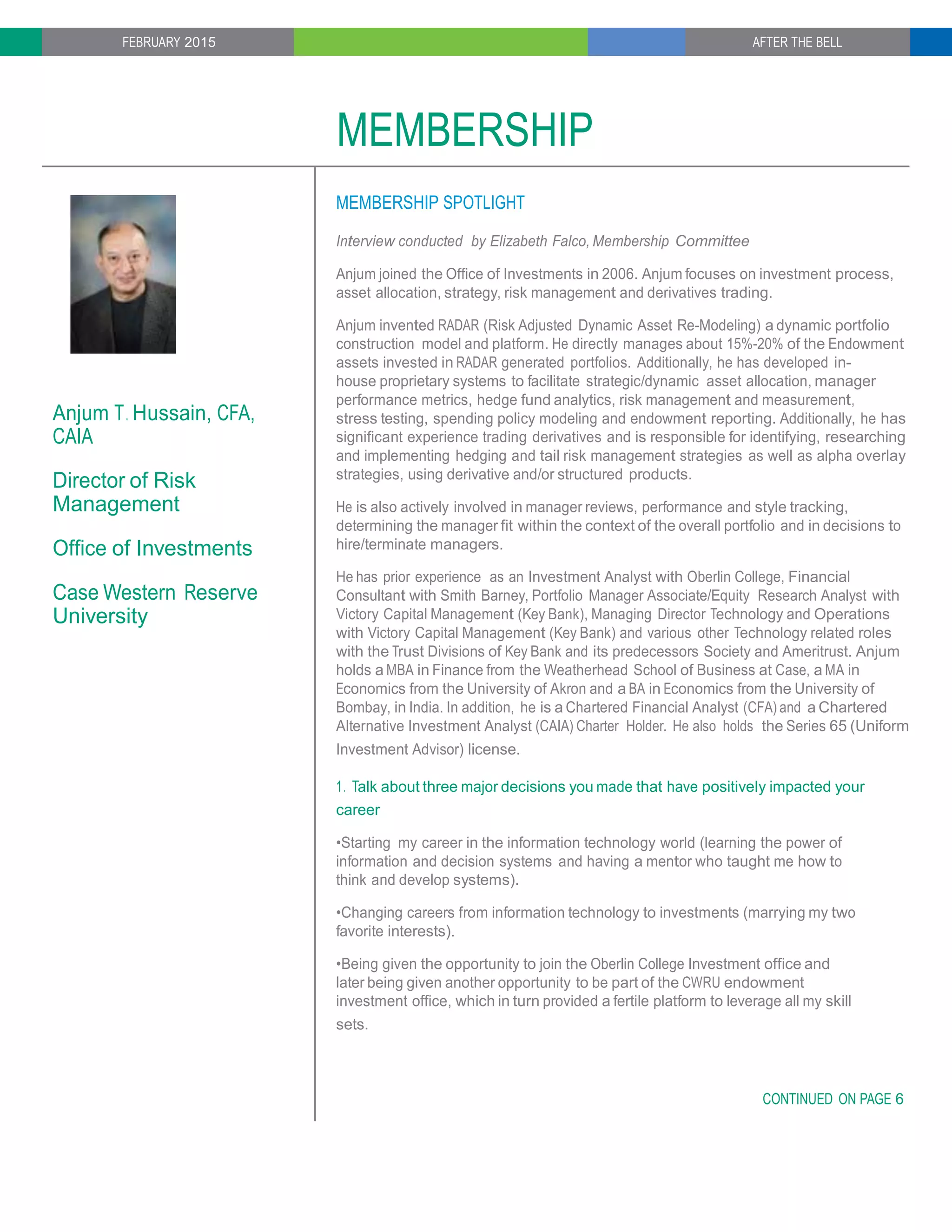
    FEBRUARY 2015 AFTERTHE BELL MEMBERSHIP Anjum T. Hussain, CFA, CAIA Director of Risk Management Office of Investments Case Western Reserve University MEMBERSHIP SPOTLIGHT Interview conducted by Elizabeth Falco, Membership Committee Anjum joined the Office of Investments in 2006. Anjum focuses on investment process, asset allocation, strategy, risk management and derivatives trading. Anjum invented RADAR (Risk Adjusted Dynamic Asset Re-Modeling) a dynamic portfolio construction model and platform. He directly manages about 15%-20% of the Endowment assets invested in RADAR generated portfolios. Additionally, he has developed in- house proprietary systems to facilitate strategic/dynamic asset allocation, manager performance metrics, hedge fund analytics, risk management and measurement, stress testing, spending policy modeling and endowment reporting. Additionally, he has significant experience trading derivatives and is responsible for identifying, researching and implementing hedging and tail risk management strategies as well as alpha overlay strategies, using derivative and/or structured products. He is also actively involved in manager reviews, performance and style tracking, determining the manager fit within the context of the overall portfolio and in decisions to hire/terminate managers. He has prior experience as an Investment Analyst with Oberlin College, Financial Consultant with Smith Barney, Portfolio Manager Associate/Equity Research Analyst with Victory Capital Management (Key Bank), Managing Director Technology and Operations with Victory Capital Management (Key Bank) and various other Technology related roles with the Trust Divisions of Key Bank and its predecessors Society and Ameritrust. Anjum holds a MBA in Finance from the Weatherhead School of Business at Case, a MA in Economics from the University of Akron and a BA in Economics from the University of Bombay, in India. In addition, he is a Chartered Financial Analyst (CFA) and a Chartered Alternative Investment Analyst (CAIA) Charter Holder. He also holds the Series 65 (Uniform Investment Advisor) license. 1. Talk about three major decisions you made that have positively impacted your career •Starting my career in the information technology world (learning the power of information and decision systems and having a mentor who taught me how to think and develop systems). •Changing careers from information technology to investments (marrying my two favorite interests). •Being given the opportunity to join the Oberlin College Investment office and later being given another opportunity to be part of the CWRU endowment investment office, which in turn provided a fertile platform to leverage all my skill sets. CONTINUED ON PAGE 6
  • 2.
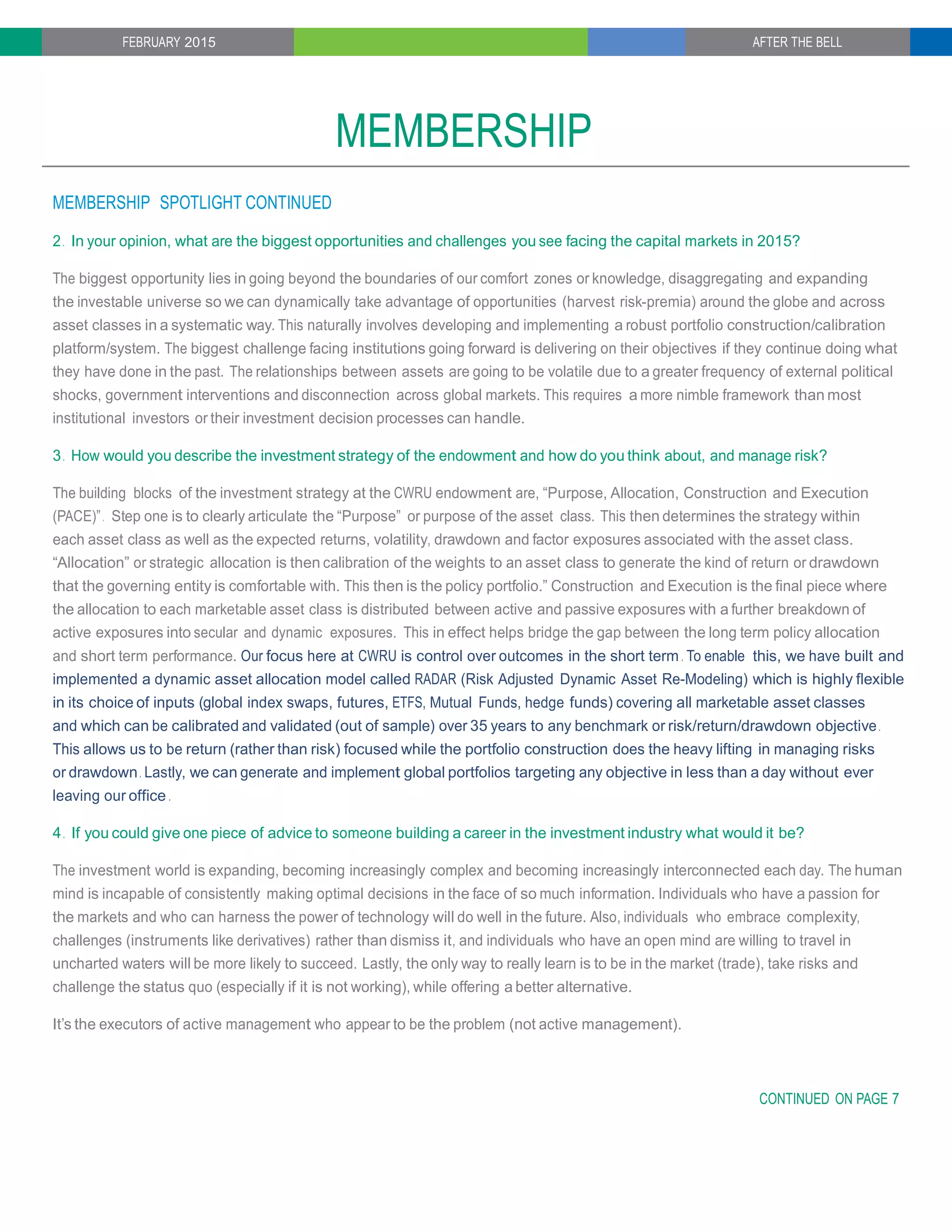
    FEBRUARY 2015 AFTERTHE BELL MEMBERSHIP MEMBERSHIP SPOTLIGHT CONTINUED 2. In your opinion, what are the biggest opportunities and challenges you see facing the capital markets in 2015? The biggest opportunity lies in going beyond the boundaries of our comfort zones or knowledge, disaggregating and expanding the investable universe so we can dynamically take advantage of opportunities (harvest risk-premia) around the globe and across asset classes in a systematic way. This naturally involves developing and implementing a robust portfolio construction/calibration platform/system. The biggest challenge facing institutions going forward is delivering on their objectives if they continue doing what they have done in the past. The relationships between assets are going to be volatile due to a greater frequency of external political shocks, government interventions and disconnection across global markets. This requires a more nimble framework than most institutional investors or their investment decision processes can handle. 3. How would you describe the investment strategy of the endowment and how do you think about, and manage risk? The building blocks of the investment strategy at the CWRU endowment are, “Purpose, Allocation, Construction and Execution (PACE)”. Step one is to clearly articulate the “Purpose” or purpose of the asset class. This then determines the strategy within each asset class as well as the expected returns, volatility, drawdown and factor exposures associated with the asset class. “Allocation” or strategic allocation is then calibration of the weights to an asset class to generate the kind of return or drawdown that the governing entity is comfortable with. This then is the policy portfolio.” Construction and Execution is the final piece where the allocation to each marketable asset class is distributed between active and passive exposures with a further breakdown of active exposures into secular and dynamic exposures. This in effect helps bridge the gap between the long term policy allocation and short term performance. Our focus here at CWRU is control over outcomes in the short term . To enable this, we have built and implemented a dynamic asset allocation model called RADAR (Risk Adjusted Dynamic Asset Re-Modeling) which is highly flexible in its choice of inputs (global index swaps, futures, ETFS, Mutual Funds, hedge funds) covering all marketable asset classes and which can be calibrated and validated (out of sample) over 35 years to any benchmark or risk/return/drawdown objective. This allows us to be return (rather than risk) focused while the portfolio construction does the heavy lifting in managing risks or drawdown. Lastly, we can generate and implement global portfolios targeting any objective in less than a day without ever leaving our office . 4. If you could give one piece of advice to someone building a career in the investment industry what would it be? The investment world is expanding, becoming increasingly complex and becoming increasingly interconnected each day. The human mind is incapable of consistently making optimal decisions in the face of so much information. Individuals who have a passion for the markets and who can harness the power of technology will do well in the future. Also, individuals who embrace complexity, challenges (instruments like derivatives) rather than dismiss it, and individuals who have an open mind are willing to travel in uncharted waters will be more likely to succeed. Lastly, the only way to really learn is to be in the market (trade), take risks and challenge the status quo (especially if it is not working), while offering a better alternative. It’s the executors of active management who appear to be the problem (not active management). CONTINUED ON PAGE 7
  • 3.
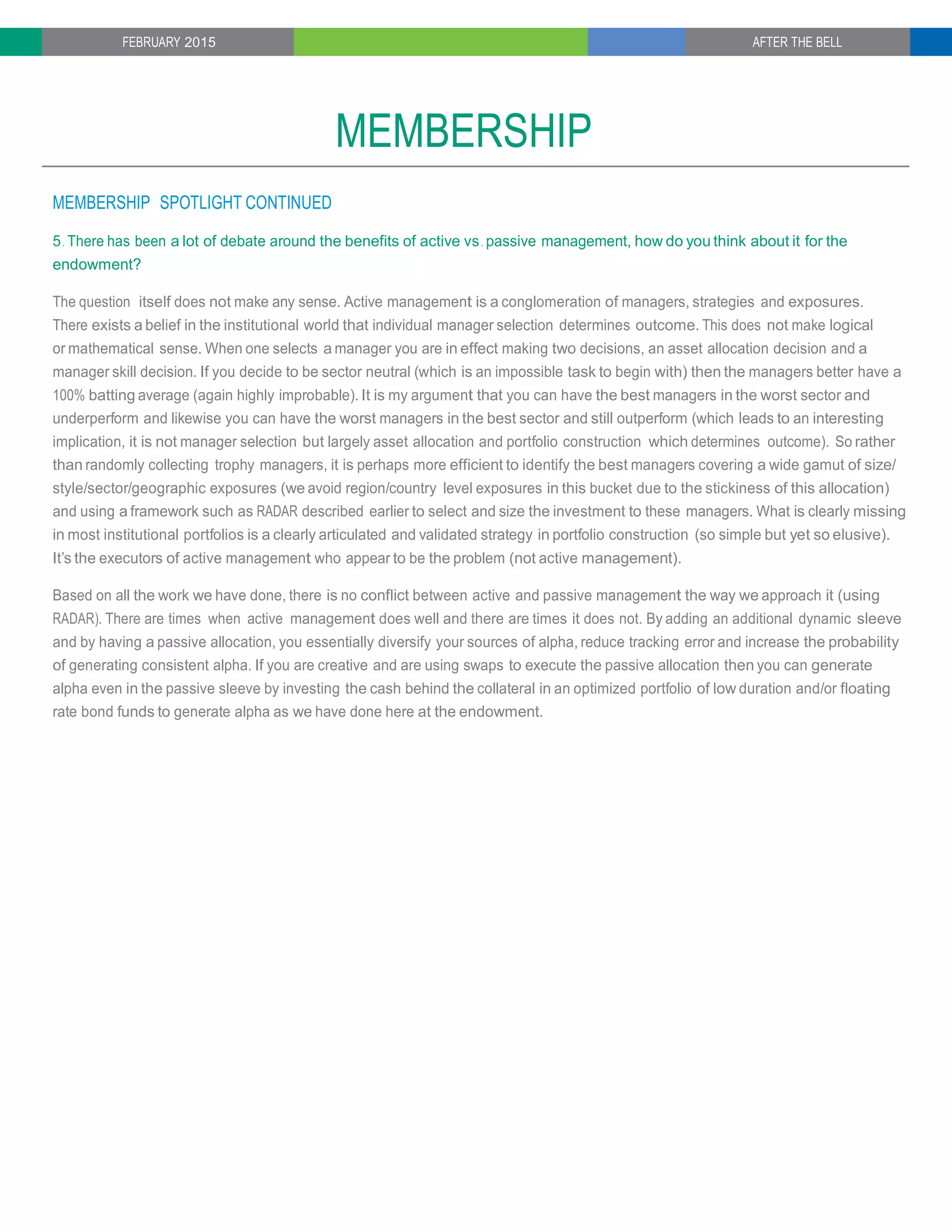
    FEBRUARY 2015 AFTERTHE BELL MEMBERSHIP MEMBERSHIP SPOTLIGHT CONTINUED 5. There has been a lot of debate around the benefits of active vs. passive management, how do you think about it for the endowment? The question itself does not make any sense. Active management is a conglomeration of managers, strategies and exposures. There exists a belief in the institutional world that individual manager selection determines outcome. This does not make logical or mathematical sense. When one selects a manager you are in effect making two decisions, an asset allocation decision and a manager skill decision. If you decide to be sector neutral (which is an impossible task to begin with) then the managers better have a 100% batting average (again highly improbable). It is my argument that you can have the best managers in the worst sector and underperform and likewise you can have the worst managers in the best sector and still outperform (which leads to an interesting implication, it is not manager selection but largely asset allocation and portfolio construction which determines outcome). So rather than randomly collecting trophy managers, it is perhaps more efficient to identify the best managers covering a wide gamut of size/ style/sector/geographic exposures (we avoid region/country level exposures in this bucket due to the stickiness of this allocation) and using a framework such as RADAR described earlier to select and size the investment to these managers. What is clearly missing in most institutional portfolios is a clearly articulated and validated strategy in portfolio construction (so simple but yet so elusive). It’s the executors of active management who appear to be the problem (not active management). Based on all the work we have done, there is no conflict between active and passive management the way we approach it (using RADAR). There are times when active management does well and there are times it does not. By adding an additional dynamic sleeve and by having a passive allocation, you essentially diversify your sources of alpha, reduce tracking error and increase the probability of generating consistent alpha. If you are creative and are using swaps to execute the passive allocation then you can generate alpha even in the passive sleeve by investing the cash behind the collateral in an optimized portfolio of low duration and/or floating rate bond funds to generate alpha as we have done here at the endowment.