1
Behavioral Finance
How Participants Make Decisions
Dr. Gregory W Kasten
Chief Executive Officer
Unified Trust Company
2
“Hello”
What we will cover: Behavioral finance research shows most 401(k)
participants are not active decision-makers. In fact, most participants are
dominated by five key behavioral traits: inertia, procrastination, choice
overload, endorsement and framing. Today I will explain these behaviors and
how appropriate strategies can be enacted to allow for participant success
despite these behaviors.
I am Gregory Kasten
Welcome!
3
1. The Purpose of ERISA
2. Five Key Financial Behaviors
3. How They Hurt Participants
4. Successful Strategies
5. Improving Outcomes
6. Adding Value As An Adviser
Presentation Agenda
The Purpose of ERISA
5
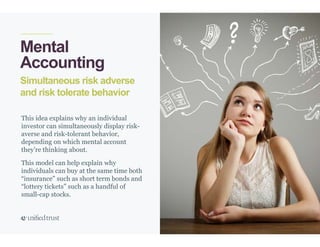
Studebaker
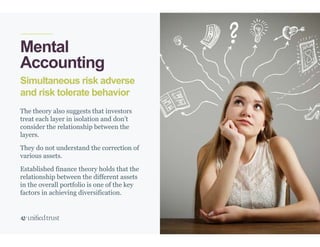
“A catastrophe”
• For 27 years, Ray worked on the
truck line at the Studebaker auto

plant in South Bend, earning $2.60
an hour and a pension that
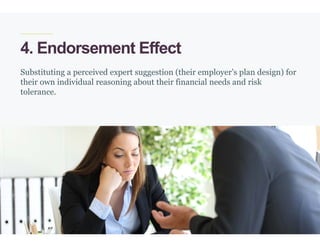
company officials promised he
could look forward to in his old age.
• “I loved my job,” said Ray, “I
thought I was set for life.”
“Pensions: the Broken Promise” NBC News aired
9/12/1972
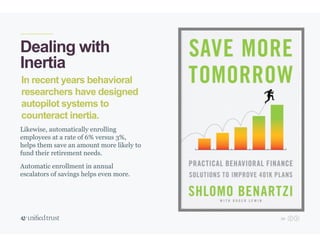
6
Studebaker
“A catastrophe”
• Then, in 1963, Ray showed up for
work and was told there was no
more job. No more Studebaker. And
no more pension.
• The funds that had been promised
to provide pensions for 4400 vested
Studebaker employees were gone.
“Pensions: the Broken Promise” NBC News aired
9/12/1972
7
“It is hereby declared to be
policy…to protect the interests of
participants in employee benefit
plans and their beneficiaries…”
8
Congress thought the trustee
would be discretionary!
ERISA’S VISION
“The House bill also provides that
all plans must be in writing, that
plan assets generally are to be
held in trust, and that trustees
generally are to have the
exclusive authority to manage
and control plan assets.”
Where Did
ERISA Go Wrong?
10
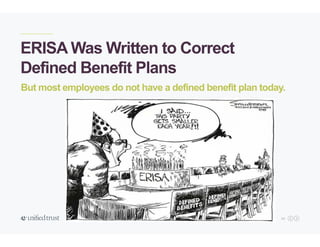
ERISA Was Written to Correct
Defined Benefit Plans
But most employees do not have a defined benefit plan today.
11
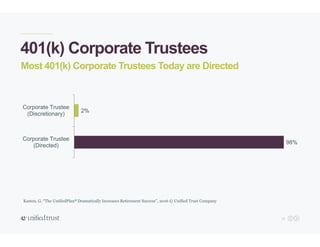
401(k) Corporate Trustees
Most 401(k) Corporate Trustees Today are Directed
98%
2%
Corporate Trustee
(Directed)
Corporate Trustee
(Discretionary)
Kasten, G. “The UnifiedPlan® Dramatically Increases Retirement Success”, 2016 © Unified Trust Company
Where Did All The
(Discretionary) Trustees Go?
13
“Immune from judicial
inquiry!”
Directed Trustee
“As we have explained, a directed
trustee is essentially ‘immune
from judicial inquiry’ because it
lacks discretion, taking
instructions from the plan
fiduciary that it is required to
follow.”
Renfro v. Unisys Corp. 671 F. 3d 314 – Court of Appeals, 3rd
Circuit 2011
14
Better for the Vendor
• Exempt from most fiduciary prohibited transactions
• Little fiduciary compliance cost
• Little risk (most risk remains with named plan fiduciary-plan sponsor)
• Requires employee to become an actuary and investment expert
But worse for the average employee
15
The Average
31% Full Funded
Percentage of participants on track to retire
Kasten, G. “The UnifiedPlan® Dramatically Increases Retirement Success”, 2016 © Unified Trust Company
16
Industry Solutions
• Automatic Enrollment
• Target Date Fund
• Email Campaigns
• Web Calculator
• Gap Report
• “Plan Health Reports”
Retirement industry offers simple but often ineffective solutions
Personalized Data
The industry has offered distinct
homepages and account-specific
dashboards, along with increased
dashboard or homepage retirement
readiness content and the integration
of more personalized communication
strategies.
Today most
workers are
on their
own…and
failing!
The Gap
Between where
participants are and
what they will need for
retirement
Overconfidence
Mental Accounting
21
It can be harmful.
Overconfidence
Research has found that people tend to
have unwarranted confidence in their
decision making. In essence, this means
having an inflated view of one’s own
abilities.
This trait appears universal, affecting
most aspects of our lives. Researchers
have asked people to rate their own
abilities, for example in driving, relative
to others and found that most people rate
themselves in the top third of the
population.
Few people rate their own abilities as
below average, although obviously 50% of
all drivers are below average.
Barber and Odean (1999), ‘The courage of misguided convictions’
Financial Analysts Journal, November/December, p.47
22
It can be harmful.
Overconfidence
Many studies–of company CEOs, doctors,
lawyers, and students–have also found
these individuals tend to overrate the
accuracy of their views of the future.
Most humans tend to view the world in
positive terms. They tend to ignore
mistakes.
While this behavior can be valuable – it
can help a person recover from life’s
disappointments more quickly – it can
also cause an ongoing source of bias in
money-related decisions.
23
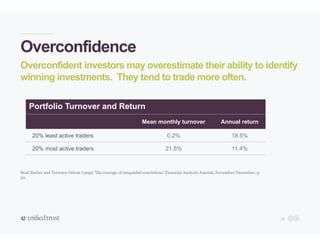
Overconfidence
Overconfident investors may overestimate their ability to identify
winning investments. They tend to trade more often.
Brad Barber and Terrence Odean (1999) ‘The courage of misguided convictions’ Financial Analysts Journal, November/December, p.
50.
Portfolio Turnover and Return
Mean monthly turnover Annual return
20% least active traders 0.2% 18.5%
20% most active traders 21.5% 11.4%
24
Mental Accounting
Participants think about money and risk through ‘mental accounts’ – separating their wealth
into various buckets or pools.
25
Mental Accounting
• Investors pay less attention to the relationship between the investments held in the different
mental accounts than traditional theory suggests. This natural tendency to create mental
buckets also causes them to focus on the individual buckets rather than thinking broadly, in
terms of their holistic wealth position.
• Mental accounting creates “investment layers.” The base layers represent assets designed to
provide “protection from poverty”, which results in conservative investments designed to
avoid loss. Higher layers represent “hopes for riches” and are invested in risky assets in the
hope of high returns.
• The base layer usually consists of cash, bank accounts and conservative bonds.
• The risky upper layer consists of stocks and buying lottery tickets.
26
Simultaneous risk adverse
and risk tolerate behavior
Mental
Accounting
This idea explains why an individual
investor can simultaneously display risk-
averse and risk-tolerant behavior,
depending on which mental account
they’re thinking about.
This model can help explain why
individuals can buy at the same time both
“insurance” such as short term bonds and
“lottery tickets” such as a handful of
small-cap stocks.
27
Simultaneous risk adverse
and risk tolerate behavior
Mental
Accounting
The theory also suggests that investors
treat each layer in isolation and don’t
consider the relationship between the
layers.
They do not understand the correction of
various assets.
Established finance theory holds that the
relationship between the different assets
in the overall portfolio is one of the key
factors in achieving diversification.
The Five Key
Financial Behaviors
29
1. Inertia
Going along the same path,
engaging in certain money habits,
and finding it is difficult to break
out of that situation.
30
2. Procrastination
The strong tendency to put off
until tomorrow what one should
be doing today.
31
3. Choice Overload
The prospect of making the decision is so overwhelming that the individual
refuses to make it.
32
4. Endorsement Effect
Substituting a perceived expert suggestion (their employer’s plan design) for
their own individual reasoning about their financial needs and risk
tolerance.
33
5. Framing
How a concept is presented to
individuals matters in their
decision. Framing can allow most
participants to accept the help
they seek.
The Key to Improving
Outcomes Is Allowing
Participants to Keep
Their Behavior
Successful Strategies
36
What are the fiduciary
aspects of the Robo Adviser?
“Robo Advice”?
• Where does data originate?
• How often is account tested for errors?
• Are FI360 CEFEX Best Practices in
place?
• Most robo advice systems have not
been tested in a bear market.
• This is a fiduciary act.
• “Digital Fiduciary”
37
Usually Less Than 10% of Participants
Select a Managed Account
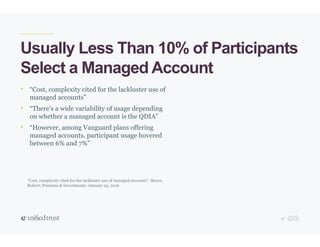
• “Cost, complexity cited for the lackluster use of
managed accounts”
• “There's a wide variability of usage depending
on whether a managed account is the QDIA”
• “However, among Vanguard plans offering
managed accounts, participant usage hovered
between 6% and 7%”
“Cost, complexity cited for the lackluster use of managed accounts”, Steyer,
Robert; Pensions & Investments; January 25, 2016
38
In recent years behavioral
researchers have designed
autopilot systems to
counteract inertia.
Dealing With
Inertia
For example, it has been observed that
many individuals fail to join their
company’s 401(k) plan, possibly as a
result of inertia.
Changing the enrollment process so that
employees are automatically enrolled,
while retaining a right to opt out, tends to
boost participation rates considerably.
39
In recent years behavioral
researchers have designed
autopilot systems to
counteract inertia.
Dealing with
Inertia
Likewise, automatically enrolling
employees at a rate of 6% versus 3%,
helps them save an amount more likely to
fund their retirement needs.
Automatic enrollment in annual
escalators of savings helps even more.
40
Default the employee into the
correct solution.
Dealing With
Inertia
Most employees do not have a retirement
goal. Most do not know how to solve the
actuarial solution for the goal.
Defaulting employees into a goal, and
solving for the goal, selecting the portfolio
prior to the enrollment meeting ensures a
very high acceptance rate of advice.
This is a fiduciary act.
Ongoing quarterly monitoring.
41
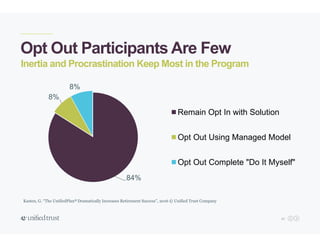
Opt Out Participants Are Few
Inertia and Procrastination Keep Most in the Program
84%
8%
8%
Remain Opt In with Solution
Opt Out Using Managed Model
Opt Out Complete "Do It Myself"
Kasten, G. “The UnifiedPlan® Dramatically Increases Retirement Success”, 2016 © Unified Trust Company
42
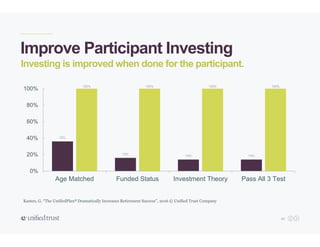
Improve Participant Investing
36%
16%
14% 14%
100% 100% 100% 100%
0%
20%
40%
60%
80%
100%
Age Matched Funded Status Investment Theory Pass All 3 Test
Investing is improved when done for the participant.
Kasten, G. “The UnifiedPlan® Dramatically Increases Retirement Success”, 2016 © Unified Trust Company
43
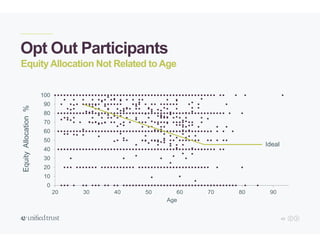
Opt Out Participants
Equity Allocation Not Related to Age
0
10
20
30
40
50
60
70
80
90
100
20 30 40 50 60 70 80 90
EquityAllocation%
Age
Ideal
44
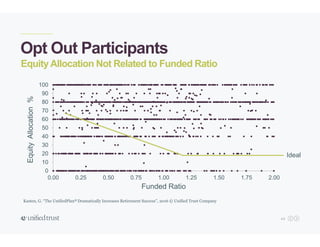
Opt Out Participants
Equity Allocation Not Related to Funded Ratio
0
10
20
30
40
50
60
70
80
90
100
0.00 0.25 0.50 0.75 1.00 1.25 1.50 1.75 2.00
EquityAllocation%
Funded Ratio
Ideal
Kasten, G. “The UnifiedPlan® Dramatically Increases Retirement Success”, 2016 © Unified Trust Company
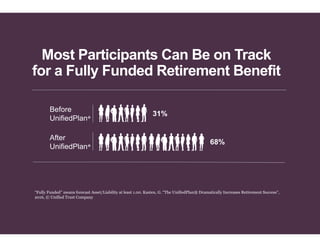
Most Participants Can Be on Track
for a Fully Funded Retirement Benefit
Before
UnifiedPlan®
31%
“Fully Funded” means forecast Asset/Liability at least 1.00. Kasten, G. “The UnifiedPlan® Dramatically Increases Retirement Success”,
2016, © Unified Trust Company
After
UnifiedPlan®
68%
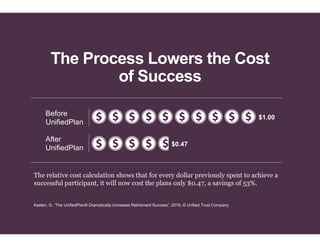
The Process Lowers the Cost
of Success
After
UnifiedPlan
Before
UnifiedPlan
The relative cost calculation shows that for every dollar previously spent to achieve a
successful participant, it will now cost the plans only $0.47, a savings of 53%.
Kasten, G. “The UnifiedPlan® Dramatically Increases Retirement Success”, 2016, © Unified Trust Company
$0.47
$1.00
Adding Value As An Adviser
Quantifying
Results
“When going through the specifics
of how the plan and the participants’
situations have improved over the
past 12 months, it is vital for
advisers to show plan sponsors how
they drove those changes.”
PlanAdvisor July/August 2015
49
It Is Really Just
Four Questions
Be able to answer them.
1. Is the participant in the right answer?
2. Are they in the correct portfolio?
3. Are their fees reasonable in light of
services provided?
4. Have their outcomes improved?
50
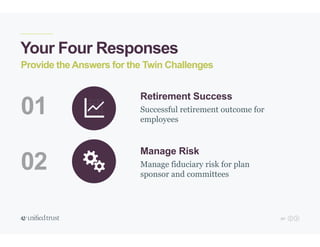
Your Four Responses
Retirement Success
Successful retirement outcome for
employees
Provide the Answers for the Twin Challenges
01
02
Manage Risk
Manage fiduciary risk for plan
sponsor and committees
Participants
don’t want to
know how to
build a watch.
They just want
to know the
time!
53
What’s In It For…
• The Participant: They have the answer! A retirement goal and a plan
that’s easy and doesn’t require them to change their behavior.
• The Plan Sponsor: They have a plan that has improved employee
satisfaction and retention while at the same time reduced their fiduciary
risk.
• The Plan Advisor: You now have a scalable and deliverable service model
that drives quantifiable results.
The participant, the plan sponsor and the plan advisor
Success!
Thanks for Joining Us!
Gregory W. Kasten, MD, MBA, CFP®, CPC, AIFA®
2353 Alexandria Drive, Suite 100, Lexington, KY
(859) 296-4407, Ext. 202
Greg.Kasten@unifiedtrust.com
Contact:
56
Disclosures
1. The UnifiedPlan reporting tool helps investors understand whether
they are on course to achieve a successful retirement. The
UnifiedPlan uses “asset liability” matching. The asset is the money
forecast to be accumulated and the liability is the amount of money
needed to pay for the retirement. For investors who are planning for
retirement, the tool estimates the amount of funds required to meet
their retirement spending goals and provides alternatives such as
delaying retirement or lowering retirement spending for those who
may not be able to save the required amount.
2. For investors who are already retired, the tool estimates the
confidence that their portfolio will be able to sustain their desired
spending throughout retirement. The tool uses a combination of
deterministic methods and Monte Carlo simulation that consider
factors that include saving and spending levels, long-term market
expectations associated with the risk profile selected, pre- and in-
retirement time horizons, and other sources of outside income.
3. The UnifiedPlan limitations relate to the large number of
assumptions used in the analysis. The accuracy of these assumptions
directly impacts the quality of the tool's assessment. Potential
problems may include, but are not limited to, the use of inaccurate
financial data by the investor, the selection of a risk tolerance by the
investor that does not represent how their portfolio is actually
invested, long term market expectations of risk, return, and inflation
that are not achieved in the modeled time frame, the inclusion future
income that is never received, and unforeseen life emergencies that
require decreased saving before retirement, force an earlier
retirement, or increase spending needs during retirement.
4. The UnifiedPlan is highly dependent upon assumptions of annual
income and annual savings. Any variances or changes in the figures
used should be reported immediately by the plan participant. Unified
Trust is not responsible for any discrepancies in the data, or output
from the UnifiedPlan tool.
5. All mutual fund and collective investment fund data was gathered
from publicly available sources of information such as Standard &
Poor’s, Morningstar, Zephyr or vendors’ own websites. We take
reasonable care in collecting the data, and believe the data are
accurate, but reserve the right to correct any errors. Individual
mutual fund or collective fund performance data throughout the
document are net of underlying fund expense ratios but gross of add-
on expenses such as Trustee fees, administration fees, or advisory
fees. The performance histories reported are simply dollar-weighted
historical returns for the proposed funds and do not reflect the
effects of rebalancing or fund replacements.
6. Any past performance information for the illustrated investment
selections is not indicative of future returns but is merely a snapshot
of historical performance. Past performance is not a guarantee of
future performance. The investments are not FDIC insured.
7. Differences will probably exist between prospective and your actual
results because events and circumstances frequently do not occur as
expected, and those differences may be material, especially when
making estimates over extended time periods. All figures are shown
in current (inflation adjusted) dollars. The estimated inflation rate
used in this analysis may vary over time.
57
Disclosures
8. The UnifiedPlan portfolio changes and time line changes for each

participant are governed by the Plan Document, the Investment
Policy Statement and the Benefit Policy Statement for their Plan.
9. The calculated 70% income replacement goal includes the estimated
Social Security benefit. The actual Social Security benefit may be
different from the estimated value.
10. Compensation in excess of the IRC 415 limit is excluded. All figures
reported in current (inflation-adjusted) real dollars.
11. The projections or other information generated by the tool regarding
the likelihood of various investment outcomes are hypothetical in
nature, do not reflect actual investment results, and are not
guarantees of future results. Projected growth of assets is based
Unified Trust Company's Projected Future Modeled Returns and the
asset allocation of your portfolio for this goal. The graphical
representations are an approximation taken from the direct path
between the pertinent events tied to your goal. Indices are
unmanaged, do not incur management fees or expenses, and cannot
be invested in directly.
12. Neither the Plan Sponsor nor Unified Trust can guarantee that any
participant will achieve a successful retirement. The UnifiedPlan
reporting tool helps investors understand whether they are on course
to achieve a successful retirement. The UnifiedPlan uses “asset
liability” matching. The asset is the money forecast to be accumulated
and the liability is the amount of money needed to pay for the
retirement. For investors who are planning for retirement, the tool
estimates the amount of funds required to meet their retirement
spending goals and provides alternatives such as delaying retirement
or lowering retirement spending for those who may not be able to
save the required amount.
13. Projections are made based upon expected asset transfers. Actual
transfer amounts may be different and may require a new retirement
solution.
14. Before investing it is important that you understand that securities
and insurance products involve risk and may lose value. They are not
FDIC insured or insured by any Federal government agency and are
not deposits of, guaranteed or insured by Unified Trust. Asset
allocation of your investments does not guarantee a profit or
eliminate the risk of loss of value of assets. Unified Trust cannot
guarantee that any participant will achieve a successful retirement.
Unified Trust does not provide tax, accounting or legal advice, and
information presented about tax considerations is not intended as tax
advice and should not be relied upon for the purpose of avoiding any
tax penalties. Clients should review any planned financial
transactions or arrangements that may have tax, accounting or legal
implications with their personal professional advisors.
©2018 Unified Trust Company, N.A. All Rights Reserved

Behavioral Finance How Participants Make Decisions

  • 1.
    1 Behavioral Finance How ParticipantsMake Decisions Dr. Gregory W Kasten Chief Executive Officer Unified Trust Company
  • 2.
    2 “Hello” What we willcover: Behavioral finance research shows most 401(k) participants are not active decision-makers. In fact, most participants are dominated by five key behavioral traits: inertia, procrastination, choice overload, endorsement and framing. Today I will explain these behaviors and how appropriate strategies can be enacted to allow for participant success despite these behaviors. I am Gregory Kasten Welcome!
  • 3.
    3 1. The Purposeof ERISA 2. Five Key Financial Behaviors 3. How They Hurt Participants 4. Successful Strategies 5. Improving Outcomes 6. Adding Value As An Adviser Presentation Agenda
  • 4.
  • 5.
    5 Studebaker “A catastrophe” • For27 years, Ray worked on the truck line at the Studebaker auto plant in South Bend, earning $2.60 an hour and a pension that company officials promised he could look forward to in his old age. • “I loved my job,” said Ray, “I thought I was set for life.” “Pensions: the Broken Promise” NBC News aired 9/12/1972

  • 6.
    6 Studebaker “A catastrophe” • Then,in 1963, Ray showed up for work and was told there was no more job. No more Studebaker. And no more pension. • The funds that had been promised to provide pensions for 4400 vested Studebaker employees were gone. “Pensions: the Broken Promise” NBC News aired 9/12/1972
  • 7.
    7 “It is herebydeclared to be policy…to protect the interests of participants in employee benefit plans and their beneficiaries…”
  • 8.
    8 Congress thought thetrustee would be discretionary! ERISA’S VISION “The House bill also provides that all plans must be in writing, that plan assets generally are to be held in trust, and that trustees generally are to have the exclusive authority to manage and control plan assets.”
  • 9.
  • 10.
    10 ERISA Was Writtento Correct Defined Benefit Plans But most employees do not have a defined benefit plan today.
  • 11.
    11 401(k) Corporate Trustees Most401(k) Corporate Trustees Today are Directed 98% 2% Corporate Trustee (Directed) Corporate Trustee (Discretionary) Kasten, G. “The UnifiedPlan® Dramatically Increases Retirement Success”, 2016 © Unified Trust Company
  • 12.
    Where Did AllThe (Discretionary) Trustees Go?
  • 13.
    13 “Immune from judicial inquiry!” DirectedTrustee “As we have explained, a directed trustee is essentially ‘immune from judicial inquiry’ because it lacks discretion, taking instructions from the plan fiduciary that it is required to follow.” Renfro v. Unisys Corp. 671 F. 3d 314 – Court of Appeals, 3rd Circuit 2011
  • 14.
    14 Better for theVendor • Exempt from most fiduciary prohibited transactions • Little fiduciary compliance cost • Little risk (most risk remains with named plan fiduciary-plan sponsor) • Requires employee to become an actuary and investment expert But worse for the average employee
  • 15.
    15 The Average 31% FullFunded Percentage of participants on track to retire Kasten, G. “The UnifiedPlan® Dramatically Increases Retirement Success”, 2016 © Unified Trust Company
  • 16.
    16 Industry Solutions • AutomaticEnrollment • Target Date Fund • Email Campaigns • Web Calculator • Gap Report • “Plan Health Reports” Retirement industry offers simple but often ineffective solutions
  • 17.
    Personalized Data The industryhas offered distinct homepages and account-specific dashboards, along with increased dashboard or homepage retirement readiness content and the integration of more personalized communication strategies.
  • 18.
    Today most workers are ontheir own…and failing!
  • 19.
    The Gap Between where participantsare and what they will need for retirement
  • 20.
  • 21.
    21 It can beharmful. Overconfidence Research has found that people tend to have unwarranted confidence in their decision making. In essence, this means having an inflated view of one’s own abilities. This trait appears universal, affecting most aspects of our lives. Researchers have asked people to rate their own abilities, for example in driving, relative to others and found that most people rate themselves in the top third of the population. Few people rate their own abilities as below average, although obviously 50% of all drivers are below average. Barber and Odean (1999), ‘The courage of misguided convictions’ Financial Analysts Journal, November/December, p.47
  • 22.
    22 It can beharmful. Overconfidence Many studies–of company CEOs, doctors, lawyers, and students–have also found these individuals tend to overrate the accuracy of their views of the future. Most humans tend to view the world in positive terms. They tend to ignore mistakes. While this behavior can be valuable – it can help a person recover from life’s disappointments more quickly – it can also cause an ongoing source of bias in money-related decisions.
  • 23.
    23 Overconfidence Overconfident investors mayoverestimate their ability to identify winning investments. They tend to trade more often. Brad Barber and Terrence Odean (1999) ‘The courage of misguided convictions’ Financial Analysts Journal, November/December, p. 50. Portfolio Turnover and Return Mean monthly turnover Annual return 20% least active traders 0.2% 18.5% 20% most active traders 21.5% 11.4%
  • 24.
    24 Mental Accounting Participants thinkabout money and risk through ‘mental accounts’ – separating their wealth into various buckets or pools.
  • 25.
    25 Mental Accounting • Investorspay less attention to the relationship between the investments held in the different mental accounts than traditional theory suggests. This natural tendency to create mental buckets also causes them to focus on the individual buckets rather than thinking broadly, in terms of their holistic wealth position. • Mental accounting creates “investment layers.” The base layers represent assets designed to provide “protection from poverty”, which results in conservative investments designed to avoid loss. Higher layers represent “hopes for riches” and are invested in risky assets in the hope of high returns. • The base layer usually consists of cash, bank accounts and conservative bonds. • The risky upper layer consists of stocks and buying lottery tickets.
  • 26.
    26 Simultaneous risk adverse andrisk tolerate behavior Mental Accounting This idea explains why an individual investor can simultaneously display risk- averse and risk-tolerant behavior, depending on which mental account they’re thinking about. This model can help explain why individuals can buy at the same time both “insurance” such as short term bonds and “lottery tickets” such as a handful of small-cap stocks.
  • 27.
    27 Simultaneous risk adverse andrisk tolerate behavior Mental Accounting The theory also suggests that investors treat each layer in isolation and don’t consider the relationship between the layers. They do not understand the correction of various assets. Established finance theory holds that the relationship between the different assets in the overall portfolio is one of the key factors in achieving diversification.
  • 28.
  • 29.
    29 1. Inertia Going alongthe same path, engaging in certain money habits, and finding it is difficult to break out of that situation.
  • 30.
    30 2. Procrastination The strongtendency to put off until tomorrow what one should be doing today.
  • 31.
    31 3. Choice Overload Theprospect of making the decision is so overwhelming that the individual refuses to make it.
  • 32.
    32 4. Endorsement Effect Substitutinga perceived expert suggestion (their employer’s plan design) for their own individual reasoning about their financial needs and risk tolerance.
  • 33.
    33 5. Framing How aconcept is presented to individuals matters in their decision. Framing can allow most participants to accept the help they seek.
  • 34.
    The Key toImproving Outcomes Is Allowing Participants to Keep Their Behavior
  • 35.
  • 36.
    36 What are thefiduciary aspects of the Robo Adviser? “Robo Advice”? • Where does data originate? • How often is account tested for errors? • Are FI360 CEFEX Best Practices in place? • Most robo advice systems have not been tested in a bear market. • This is a fiduciary act. • “Digital Fiduciary”
  • 37.
    37 Usually Less Than10% of Participants Select a Managed Account • “Cost, complexity cited for the lackluster use of managed accounts” • “There's a wide variability of usage depending on whether a managed account is the QDIA” • “However, among Vanguard plans offering managed accounts, participant usage hovered between 6% and 7%” “Cost, complexity cited for the lackluster use of managed accounts”, Steyer, Robert; Pensions & Investments; January 25, 2016
  • 38.
    38 In recent yearsbehavioral researchers have designed autopilot systems to counteract inertia. Dealing With Inertia For example, it has been observed that many individuals fail to join their company’s 401(k) plan, possibly as a result of inertia. Changing the enrollment process so that employees are automatically enrolled, while retaining a right to opt out, tends to boost participation rates considerably.
  • 39.
    39 In recent yearsbehavioral researchers have designed autopilot systems to counteract inertia. Dealing with Inertia Likewise, automatically enrolling employees at a rate of 6% versus 3%, helps them save an amount more likely to fund their retirement needs. Automatic enrollment in annual escalators of savings helps even more.
  • 40.
    40 Default the employeeinto the correct solution. Dealing With Inertia Most employees do not have a retirement goal. Most do not know how to solve the actuarial solution for the goal. Defaulting employees into a goal, and solving for the goal, selecting the portfolio prior to the enrollment meeting ensures a very high acceptance rate of advice. This is a fiduciary act. Ongoing quarterly monitoring.
  • 41.
    41 Opt Out ParticipantsAre Few Inertia and Procrastination Keep Most in the Program 84% 8% 8% Remain Opt In with Solution Opt Out Using Managed Model Opt Out Complete "Do It Myself" Kasten, G. “The UnifiedPlan® Dramatically Increases Retirement Success”, 2016 © Unified Trust Company
  • 42.
    42 Improve Participant Investing 36% 16% 14%14% 100% 100% 100% 100% 0% 20% 40% 60% 80% 100% Age Matched Funded Status Investment Theory Pass All 3 Test Investing is improved when done for the participant. Kasten, G. “The UnifiedPlan® Dramatically Increases Retirement Success”, 2016 © Unified Trust Company
  • 43.
    43 Opt Out Participants EquityAllocation Not Related to Age 0 10 20 30 40 50 60 70 80 90 100 20 30 40 50 60 70 80 90 EquityAllocation% Age Ideal
  • 44.
    44 Opt Out Participants EquityAllocation Not Related to Funded Ratio 0 10 20 30 40 50 60 70 80 90 100 0.00 0.25 0.50 0.75 1.00 1.25 1.50 1.75 2.00 EquityAllocation% Funded Ratio Ideal Kasten, G. “The UnifiedPlan® Dramatically Increases Retirement Success”, 2016 © Unified Trust Company
  • 45.
    Most Participants CanBe on Track for a Fully Funded Retirement Benefit Before UnifiedPlan® 31% “Fully Funded” means forecast Asset/Liability at least 1.00. Kasten, G. “The UnifiedPlan® Dramatically Increases Retirement Success”, 2016, © Unified Trust Company After UnifiedPlan® 68%
  • 46.
    The Process Lowersthe Cost of Success After UnifiedPlan Before UnifiedPlan The relative cost calculation shows that for every dollar previously spent to achieve a successful participant, it will now cost the plans only $0.47, a savings of 53%. Kasten, G. “The UnifiedPlan® Dramatically Increases Retirement Success”, 2016, © Unified Trust Company $0.47 $1.00
  • 47.
    Adding Value AsAn Adviser
  • 48.
    Quantifying Results “When going throughthe specifics of how the plan and the participants’ situations have improved over the past 12 months, it is vital for advisers to show plan sponsors how they drove those changes.” PlanAdvisor July/August 2015
  • 49.
    49 It Is ReallyJust Four Questions Be able to answer them. 1. Is the participant in the right answer? 2. Are they in the correct portfolio? 3. Are their fees reasonable in light of services provided? 4. Have their outcomes improved?
  • 50.
    50 Your Four Responses RetirementSuccess Successful retirement outcome for employees Provide the Answers for the Twin Challenges 01 02 Manage Risk Manage fiduciary risk for plan sponsor and committees
  • 51.
    Participants don’t want to knowhow to build a watch.
  • 52.
    They just want toknow the time!
  • 53.
    53 What’s In ItFor… • The Participant: They have the answer! A retirement goal and a plan that’s easy and doesn’t require them to change their behavior. • The Plan Sponsor: They have a plan that has improved employee satisfaction and retention while at the same time reduced their fiduciary risk. • The Plan Advisor: You now have a scalable and deliverable service model that drives quantifiable results. The participant, the plan sponsor and the plan advisor
  • 54.
  • 55.
    Thanks for JoiningUs! Gregory W. Kasten, MD, MBA, CFP®, CPC, AIFA® 2353 Alexandria Drive, Suite 100, Lexington, KY (859) 296-4407, Ext. 202 Greg.Kasten@unifiedtrust.com Contact:
  • 56.
    56 Disclosures 1. The UnifiedPlanreporting tool helps investors understand whether they are on course to achieve a successful retirement. The UnifiedPlan uses “asset liability” matching. The asset is the money forecast to be accumulated and the liability is the amount of money needed to pay for the retirement. For investors who are planning for retirement, the tool estimates the amount of funds required to meet their retirement spending goals and provides alternatives such as delaying retirement or lowering retirement spending for those who may not be able to save the required amount. 2. For investors who are already retired, the tool estimates the confidence that their portfolio will be able to sustain their desired spending throughout retirement. The tool uses a combination of deterministic methods and Monte Carlo simulation that consider factors that include saving and spending levels, long-term market expectations associated with the risk profile selected, pre- and in- retirement time horizons, and other sources of outside income. 3. The UnifiedPlan limitations relate to the large number of assumptions used in the analysis. The accuracy of these assumptions directly impacts the quality of the tool's assessment. Potential problems may include, but are not limited to, the use of inaccurate financial data by the investor, the selection of a risk tolerance by the investor that does not represent how their portfolio is actually invested, long term market expectations of risk, return, and inflation that are not achieved in the modeled time frame, the inclusion future income that is never received, and unforeseen life emergencies that require decreased saving before retirement, force an earlier retirement, or increase spending needs during retirement. 4. The UnifiedPlan is highly dependent upon assumptions of annual income and annual savings. Any variances or changes in the figures used should be reported immediately by the plan participant. Unified Trust is not responsible for any discrepancies in the data, or output from the UnifiedPlan tool. 5. All mutual fund and collective investment fund data was gathered from publicly available sources of information such as Standard & Poor’s, Morningstar, Zephyr or vendors’ own websites. We take reasonable care in collecting the data, and believe the data are accurate, but reserve the right to correct any errors. Individual mutual fund or collective fund performance data throughout the document are net of underlying fund expense ratios but gross of add- on expenses such as Trustee fees, administration fees, or advisory fees. The performance histories reported are simply dollar-weighted historical returns for the proposed funds and do not reflect the effects of rebalancing or fund replacements. 6. Any past performance information for the illustrated investment selections is not indicative of future returns but is merely a snapshot of historical performance. Past performance is not a guarantee of future performance. The investments are not FDIC insured. 7. Differences will probably exist between prospective and your actual results because events and circumstances frequently do not occur as expected, and those differences may be material, especially when making estimates over extended time periods. All figures are shown in current (inflation adjusted) dollars. The estimated inflation rate used in this analysis may vary over time.
  • 57.
    57 Disclosures 8. The UnifiedPlanportfolio changes and time line changes for each participant are governed by the Plan Document, the Investment Policy Statement and the Benefit Policy Statement for their Plan. 9. The calculated 70% income replacement goal includes the estimated Social Security benefit. The actual Social Security benefit may be different from the estimated value. 10. Compensation in excess of the IRC 415 limit is excluded. All figures reported in current (inflation-adjusted) real dollars. 11. The projections or other information generated by the tool regarding the likelihood of various investment outcomes are hypothetical in nature, do not reflect actual investment results, and are not guarantees of future results. Projected growth of assets is based Unified Trust Company's Projected Future Modeled Returns and the asset allocation of your portfolio for this goal. The graphical representations are an approximation taken from the direct path between the pertinent events tied to your goal. Indices are unmanaged, do not incur management fees or expenses, and cannot be invested in directly. 12. Neither the Plan Sponsor nor Unified Trust can guarantee that any participant will achieve a successful retirement. The UnifiedPlan reporting tool helps investors understand whether they are on course to achieve a successful retirement. The UnifiedPlan uses “asset liability” matching. The asset is the money forecast to be accumulated and the liability is the amount of money needed to pay for the retirement. For investors who are planning for retirement, the tool estimates the amount of funds required to meet their retirement spending goals and provides alternatives such as delaying retirement or lowering retirement spending for those who may not be able to save the required amount. 13. Projections are made based upon expected asset transfers. Actual transfer amounts may be different and may require a new retirement solution. 14. Before investing it is important that you understand that securities and insurance products involve risk and may lose value. They are not FDIC insured or insured by any Federal government agency and are not deposits of, guaranteed or insured by Unified Trust. Asset allocation of your investments does not guarantee a profit or eliminate the risk of loss of value of assets. Unified Trust cannot guarantee that any participant will achieve a successful retirement. Unified Trust does not provide tax, accounting or legal advice, and information presented about tax considerations is not intended as tax advice and should not be relied upon for the purpose of avoiding any tax penalties. Clients should review any planned financial transactions or arrangements that may have tax, accounting or legal implications with their personal professional advisors. ©2018 Unified Trust Company, N.A. All Rights Reserved