Focused on Q2
earnings • pg. 7
Simple is better
for client reviews
pg. 3
Investor confusion about
passive investing• pg. 4
July 10, 2014 | Volume 3 | Issue 2 First magazine focused on active investment management
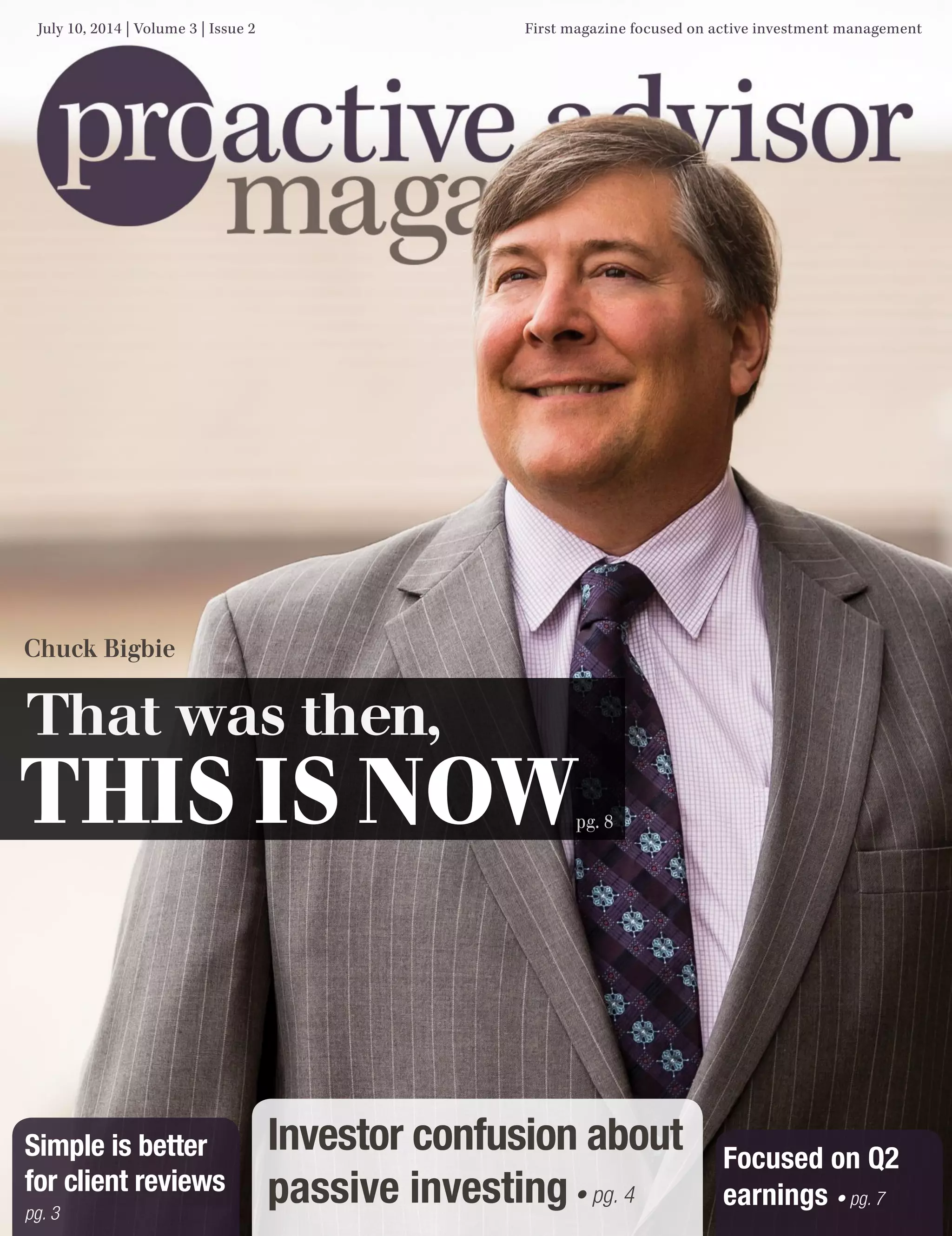
Chuck Bigbie
That was then,
THIS IS NOWpg. 8
of taxable versus non-taxable
income, insurance, and, of course,
all of the various components of
their investments. What is espe-
cially important is the consolidated
income statement, as clients can see
at a glance what they can expect to
receive every year in retirement.
I explain to clients that this in
no way replaces all of the formal
documentation and statements of
their ‘full’financial plan, but it really
provides a service to have things
condensed in this way. It has gen-
erated some very positive feedback
over the years.”
hen I first start-
ed as a financial
advisor in 1981,
financial plans could be 50 to 60
pages long—so long that they were
essentially useless since few clients
took the time to read them.You can
imagine how long a meeting might
be to review such a document.
As computer-generated docu-
mentation came of age, financial
plans only got more unwieldy in
terms of complexity and length.
Financial plans were beginning to
look like government budget books.
While having detailed back-up
information is important, for client
meetings and reviews the simpler
the better. In fact, I tell all of my
clients that I can put all of their es-
sential financial information on one
page. And that is exactly what I do
for client review meetings, creating
a ‘report card’ on the state of their
financial health.
Even for a client that might
have millions in assets, this can be
captured in an easily digested and
understandable format—especially
important for retirees. I include a
basic income statement,an overview
Simple is better for
client reviews
Kimble Johnson
Louisville, KY
LPL Financial
W“
Securities and Advisory services offered through LPL Financial, a registered investment advisor. Member FINRA & SIPC.
The opinions voiced in this material are for general information only and are not intended to provide specific advice or
recommendations for any individual. All performance referenced is historical and is no guarantee of future results. There is
no guarantee that a diversified portfolio will enhance overall returns or outperform a non-diversified portfolio. Diversification
does not protect against market risk. Investing involves risk, including loss of principal.
Read text only
VOTE
Easy
Difficult
Last week’s results
VIEWER RESPONSE
How many advisors
are actively seeking
younger clients to replace
older clients or those in
“decumulation” phase?
-Results in next issue
This week’s poll
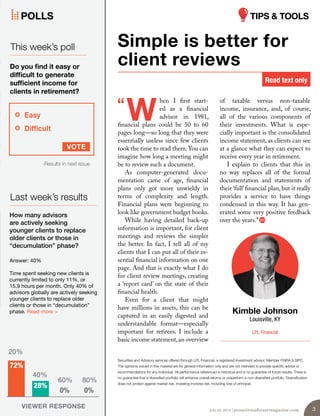
Do you find it easy or
difficult to generate
sufficient income for
clients in retirement?
Answer: 40%
Time spent seeking new clients is
currently limited to only 11%, or
15.9 hours per month. Only 40% of
advisors globally are actively seeking
younger clients to replace older
clients or those in “decumulation”
phase. Read more >
72%
0% 0%
28%
20%
40%
60% 80%
POLLS
July 10, 2014 | proactiveadvisormagazine.com 3
TIPS & TOOLS
investing
By Jerry Wagner
Investors
confused
about
passive
proactiveadvisormagazine.com | July 10, 20144
Read text only
he opposite of active investing is pas-
sive investing. It is index investing. It
is buy-and-hold investing.
While active investing is like the ant in
the fable that works tirelessly to improve,
passive investing is like the grasshopper that
just enjoys what the world can provide him.
To my mind, passive investing is like
being a passenger in a car and having no
say in where you are going but still being
exposed to the risk of an accident.
I’m not a fan.
So I was surprised when I ran across
a November, 2013 survey of investors in
which they were asked what they thought
of active and passive investing. The survey
was conducted by independent research
firm Research Collaborative, and was
sponsored by mutual fund company
MFS Investment Management. It surveyed
about  1,000 investors, each with more
than $100,000 in investable assets.
What the survey showed was that there
is an appalling lack of knowledge about
what passive investing is all about.
These investors were asked whether they
agreed with three statements about passive
investing. More than 60% of the investors
agreed with all three statements.
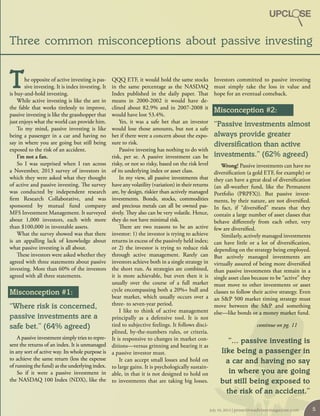
Misconception #1:
“Where risk is concerned,
passive investments are a
safe bet.” (64% agreed)
A passive investment simply tries to repre-
sent the returns of an index. It is unmanaged
in any sort of active way. Its whole purpose is
to achieve the same return (less the expense
of running the fund) as the underlying index.
So if it were a passive investment in
the NASDAQ 100 Index (NDX), like the
QQQ ETF, it would hold the same stocks
in the same percentage as the NASDAQ
Index published in the daily paper. That
means in 2000-2002 it would have de-
clined about 82.9% and in 2007-2008 it
would have lost 53.4%.
Yes, it was a safe bet that an investor
would lose those amounts, but not a safe
bet if there were a concern about the expo-
sure to risk.
Passive investing has nothing to do with
risk, per se. A passive investment can be
risky, or not so risky, based on the risk level
of its underlying index or asset class.
In my view, all passive investments that
have any volatility (variation) in their returns
are, by design, riskier than actively managed
investments. Bonds, stocks, commodities
and precious metals can all be owned pas-
sively. They also can be very volatile. Hence,
they do not have minimal risk.
There are two reasons to be an active
investor: 1) the investor is trying to achieve
returns in excess of the passively held index;
or 2) the investor is trying to reduce risk
through active management. Rarely can
investors achieve both in a single strategy in
the short run. As strategies are combined,
it is more achievable, but even then it is
usually over the course of a full market
cycle encompassing both a 20%+ bull and
bear market, which usually occurs over a
three- to seven-year period.
I like to think of active management
principally as a defensive tool. It is not
tied to subjective feelings. It follows disci-
plined, by-the-numbers rules, or criteria.
It is responsive to changes in market con-
ditions—versus grinning and bearing it as
a passive investor must.
It can accept small losses and hold on
to large gains. It is psychologically sustain-
able, in that it is not designed to hold on
to investments that are taking big losses.
Investors committed to passive investing
must simply take the loss in value and
hope for an eventual comeback.
Misconception #2:
“Passive investments almost
always provide greater
diversification than active
investments.” (62% agreed)
Wrong! Passive investments can have no
diversification (a gold ETF, for example) or
they can have a great deal of diversification
(an all-weather fund, like the Permanent
Portfolio (PRPFX)). But passive invest-
ments, by their nature, are not diversified.
In fact,  if “diversified” means that they
contain a large number of asset classes that
behave differently from each other, very
few are diversified.
Similarly, actively managed investments
can have little or a lot of diversification,
depending on the strategy being employed.
But actively managed investments are
virtually assured of being more diversified
than passive investments that remain in a
single asset class because to be “active” they
must move to other investments or asset
classes to follow their active strategy. Even
an S&P 500 market timing strategy must
move between the S&P and something
else—like bonds or a money market fund.
continue on pg. 11
Three common misconceptions about passive investing
T
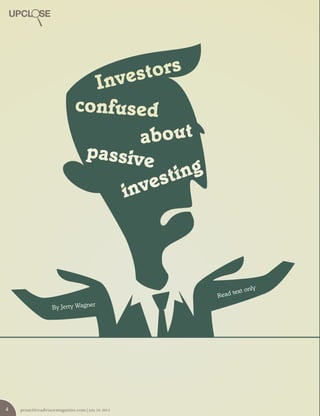
“... passive investing is
like being a passenger in
a car and having no say
in where you are going
but still being exposed to
the risk of an accident.”
July 10, 2014 | proactiveadvisormagazine.com 5
An investor should consider the investment objectives, risks, charges, and expenses of The Gold Bullion Strategy Fund before investing. This and other information
can be found in the Fund’s prospectus, which can be obtained by calling 1-855-650-7453. The prospectus should be read carefully prior to investing.
There is no guarantee that The Gold Bullion Strategy Fund will achieve its investment objectives.
Flexible Plan Investments, Ltd., serves as investment sub-advisor to The Gold Bullion Strategy Fund, distributed by Ceros Financial Services Inc. (member FINRA).
Ceros Financial Services, Inc. and Flexible Plan Investments, Ltd. are not affiliated entities.
Advisors Preferred, LLC is the Fund’s investment adviser. Advisors Preferred, LLC is a wholly-owned subsidiary of Ceros Financial Services, Inc.
The principal risks of investing in The Gold Bullion Strategy Fund are Risk of the Sub-advisor’s Investment Strategy. Risks of Aggressive Investment Techniques,
High Portfolio Turnover, Risk of Investing in Derivatives, Risks of Investing in ETFs, Risks of Investing in Other Investment Companies, Leverage Risk, Concentration
Risk Gold Risk, Wholly-owned Corporation Risk, Risk of Non-Diversification and Interest Rate Risk. “Gold Risk” includes volatility, price fluctuations over short periods,
risks associated with global monetary,economic,social and political conditions and developments,currency devaluation and revaluation and restrictions,and trading and
transactional restrictions.
For more information on the risks of The Gold Bullion Strategy Fund, including a description of each risk, please refer to the prospectus.
The Gold Bullion Strategy Fund (QGLDX) offers your
investors access to gold bullion in a mutual fund format.
Launched in 2013, the fund is designed to:
• Diversify a portfolio with a strategic allocation to gold
• Offer a purer play on gold
• Provide a more cost-effective way to own gold with
Form 1099 reporting
To learn more, please download Flexible Plan Investments’
white paper, The Role of Gold in Investment Portfolios at
www.goldbullionstrategyfund.com/white-paper
A fresh take on an
enduring alternative
www.goldbullionstrategyfund.com
Fund gross estimated annual operating expenses = 1.55%
5 4 9 3 3
24
40
79
14
38
92
145
266
30
62
177
216
311
28
0
50
100
150
200
250
300
350
26.0
24.0
22.0
20.0
18.0
16.0
14.0
12.0
10.0
7/30/1999
Forward 12-Month P/E Ratio 5-Year Average 10-Year Average 15-Year Average
7/30/2001 7/30/2003 7/30/2005 7/30/2007 7/30/2009 7/30/2011 7/30/2013
15.7
Second quarter earnings in focus
hile the markets were celebrating “DOW
17,000” and a better-than-expected
employment report going into the 4th
of
July holiday, second quarter earnings season will now
largely take center stage through the next 4-6 weeks.
Although Alcoa “unofficially” kicked off earnings
on July 8, some 20 S&P 500 companies reported
earnings prior to July 1, including major names such
as FedEx (FDX), Oracle (ORCL), and General Mills
(GIS). But the reports start coming fast and furious
beginning the w/o 7/14 and continue into August for
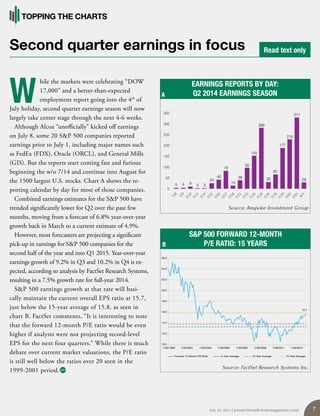
the 1500 largest U.S. stocks. Chart A shows the re-
porting calendar by day for most of those companies.
Combined earnings estimates for the S&P 500 have
trended significantly lower for Q2 over the past few
months, moving from a forecast of 6.8% year-over-year
growth back in March to a current estimate of 4.9%.
However, most forecasters are projecting a significant
pick-up in earnings for S&P 500 companies for the
second half of the year and into Q1 2015. Year-over-year
earnings growth of 9.2% in Q3 and 10.2% in Q4 is ex-
pected, according to analysis by FactSet Research Systems,
resulting in a 7.5% growth rate for full-year 2014.
S&P 500 earnings growth at that rate will basi-
cally maintain the current overall EPS ratio at 15.7,
just below the 15-year average of 15.8, as seen in
chart B. FactSet comments, “It is interesting to note
that the forward 12-month P/E ratio would be even
higher if analysts were not projecting record-level
EPS for the next four quarters.” While there is much
debate over current market valuations, the P/E ratio
is still well below the ratios over 20 seen in the
1999-2001 period.
W
Source: Bespoke Investment Group
Source: FactSet Research Systems Inc.
TOPPING THE CHARTS
Read text only
EARNINGS REPORTS BY DAY:
Q2 2014 EARNINGS SEASON
S&P 500 FORWARD 12-MONTH
P/E RATIO: 15 YEARS
A
B
July 10, 2014 | proactiveadvisormagazine.com 7
That was then,
By David Wismer
Chuck Bigbie
this is now
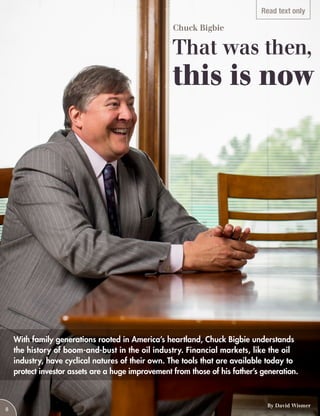
With family generations rooted in America’s heartland, Chuck Bigbie understands
the history of boom-and-bust in the oil industry. Financial markets, like the oil
industry, have cyclical natures of their own. The tools that are available today to
protect investor assets are a huge improvement from those of his father’s generation.
Read text only
8
Proactive Advisor Magazine: Tell me
about your background, Chuck.
Chuck Bigbie: I have always been very
inquisitive, scientifically-minded, and into
math. I was proficient with computers early in
the game and worked in computer program-
ming during high school. I ended up majoring
in chemical engineering at the University of
Tulsa and have also studied nuclear physics
and nuclear chemistry.
I spent a bit of time after college working as
an engineer but when the energy business hit
a rough patch here in Oklahoma back in the
1980s, I decided it was time to switch careers.
And financial services has always been in my
blood, starting with my grandfather, way back
when, and then with my father, who both
worked in the insurance business.
My grandfather was a huge influence, as
I saw firsthand the positive impact he had on
the lives of clients and their families. He had
originally moved to Tulsa back in the 1930s,
after researching the rapid growth of the energy
industry here and the fact there were probably
more millionaires per capita than anywhere else
in the U.S. at that time.
What did you learn from your family?
They both were retired by the time I got
into the business but there was certainly a
lesson in the boom-and-bust cycle of the oil
business and the same cyclical nature of the
stock market. They were dedicated to pro-
tecting the assets of their clients and so am I,
although the tools we have today are obviously
much more advanced.
When and how did you first become
involved with active investment
management?
First, let me give you the big picture. We
work on a holistic and highly individualized
basis with each and every client. We use a very
specific discovery process that looks at their
goals, values, risk profiles, and financial and
retirement objectives. We then quantify that
using our customized software and develop the
appropriate long-term financial strategies.
When I first started in the business
and some years after, everything was asset
allocation-driven and rebalanced. There were
no tactical strategies. There was no active man-
agement. It was pretty much “set it and forget
it” with the occasional rebalance. And then we
saw some market corrections in the 1990s. In
the early 2000s, there was absolute decimation
of many of those traditional portfolios.
There was no mechanism to say, “It’s time
to go cash,” or switch from stocks to bonds,
or move from Europe to Japan. There was
no intelligent system—there was no active
management. As a result, when there would be
huge downturns in the market, and in clients’
accounts, the recovery period was long and
protracted, if at all.
What was your answer to that?
When we switched to the independent ad-
visory channel, we utilized active management
firms that had strategies with the ability to move
to cash in dangerous markets, or to be strongly
allocated to equities when the trend was right, or
to change the asset class or mix of asset classes.We
found that there was more downside protection.
If clients didn’t lose as much, they didn’t have to
recover as much. It would be a much smoother,
more controlled ride, with an emphasis on risk
management and taming volatility.
Going beyond theory, how did that play
out in your practice?
When we began moving client funds to
active management in the late 1990s, it was
a gradual process. We had to explain the
concept to clients and it was very new to
many of them—and in fact pretty new to us
as well. One of my larger clients was part of
that first move to active management, and
his account represented almost one-third of
our actively managed portfolios. When the
9/11 tragedy and the dot-com bust both hit
the markets—and most of his money was in
cash or defensive mode—he became an even
bigger believer in active management and has
remained so ever since.
How do you evaluate the active
managers you now use?
There are three main criteria. First, I look
for firms that have strong customer support
for me and my staff and clear communications
for clients.
continue on pg. 10
July 10, 2014 | proactiveadvisormagazine.com 9
their risk tolerance, time horizon, and invest-
ment goals. We work closely with third-party
managers to then build a risk-appropriate
portfolio that meets the client’s needs. Like my
father and grandfather, I want to have a positive
impact on people’s lives and I believe we have
the tools to do just that.
Second, I select companies with a clear
statement of their investment philosophy and
the methods they use. I want this not only to be
transparent, and with a deep level of sophistica-
tion, but also to have a history and track record
that can fairly easily be explained to my clients.
Third, I don’t think it is very efficient to work
with a great number of third-party managers. I
have probably evaluated close to three dozen
and generally choose to work with a handful
who can deliver multiple active strategies, so
that different client needs can be met.
What are some issues you see with
clients today?
Most of my clients fall into a fairly affluent
segment,andmanyareapproachingorarealready
in retirement. It’s interesting to see the wide split
among people of relatively similar income levels
on how they have approached financial planning
over the years before engaging our services.
About half of them have really been prudent
stewards of their wealth. The other half might
be asset-rich but cash-poor, with very coun-
terproductive financial habits. We know our
wealth management process can work for just
about all of them and active management plays
a big role in that.
For each and every client, we create an
investment policy statement that memorializes
continued from pg. 9
Securities offered through Geneos Wealth Management, Inc. Member FINRA/SIPC. Advisory Services
offered through Geneos Wealth Management, Inc. a Registered Investment Advisor.
10 proactiveadvisormagazine.com | July 10, 2014
There can be no assurance that any investment product will achieve its investment objective(s). There are risks associated with investing, including the entire loss of principal invested. Investing involves market
risk. The investment return and principal value of any investment product will fluctuate with changes in market conditions. Guggenheim Investments represents the investment management businesses of Gug-
genheim Partners, LLC. Securities offered through Guggenheim Funds Distributors, LLC. Guggenheim Funds Distributors, LLC is affiliated with Guggenheim Partners, LLC. x0515 #12526
Uncover the True Cost of Trading Mutual Funds
and ETFs
The reflexive perception that ETFs cost less, simply based on their low expense
ratios, and are more cost-effective than mutual funds, is not entirely true. In
addition to an expense ratio, there are additional considerations that should
be considered when making an informed choice between ETFs and funds—
including spreads and commissions. This informative white paper from Rydex
Funds provides an in-depth look at the cost of ownership of no-transaction-fee
(NTF) mutual funds and ETFs—with a focus on active investing strategies.
Request your free copy.
Call 630.505.3749 or visit guggenheiminvestments.com/rydex
Chicago | New York City | Santa Monica
Rydex Funds
A Comparison of ETFs and
Mutual Funds—The True
Cost of Investing
In addition, maximum diversifica-
tion cannot be achieved with asset class
investing in a passive portfolio. Instead,
one needs to use all of the tools available.
Therefore, an actively managed portfolio
of actively  managed strategies with access
to multiple asset classes works to achieve
greater diversification on more levels than a
simple passive investment or a passive port-
folio allocated to these index funds.
Misconception #3:
“A passive investment
could significantly beat its
benchmark.” (62% agreed)
This one is just plain silly. Most passive
investments seek to replicate an index, so the
benchmark for the passive investment is that
same index. It’s pretty difficult for an index
to significantly outperform itself, right?
Furthermore, it is an oft-repeated small-
print warning about indexes that “indexes are
not tradable,” meaning investors can’t just buy
the index and replicate its performance. Every
index fund has costs associated with putting
it together, maintaining it and distributing
it. The trading costs alone can be a big factor
and virtually assure that most passive invest-
ments will underachieve their benchmarks.
Active investments can, and do, out-
perform their benchmarks, but it is often
on the basis of their risk-adjusted return.
Why? Because most  active management
is focused, first, on risk management; any
payoff in return is designed to occur not
in the short term but instead over a full
market cycle. Since most indexes don’t do
this, it is difficult to even find an appropri-
ate benchmark for active investments.
There is an advantage to passive invest-
ments, and the media and indexing adher-
ents never tire of reminding us of it: low
cost. 52% of the survey respondents iden-
tified this as a selection criterion.
Of course, the lower cost is understand-
able. If there is very little involved in the man-
agement of the investment, the payoff to the
manager should be lower. But investors have
to ask themselves if they are being penny wise
and pound foolish. Is the lower cost enough
of an advantage to offset the designed benefits
of active management—responsiveness  to
market environments; risk aversion; more
complete diversification; and the opportuni-
ty to outperform the benchmark?
As Hall of Fame broadcaster Ernie
Harwell said, “He stood there like the
house by the side of the road.”
That sums up my view of investors who
follow a passive investing philosophy.
continued from pg. 5
11July 10, 2014 | proactiveadvisormagazine.com
The opinions and forecasts expressed herein are those of the author and may not actually come to pass. Any opinions and viewpoints regarding the future of the markets should not be
construed as recommendations of any specific security nor specific investment advice. The analysis and information in this edition and on our website is for informational purposes only.
No part of the material presented in this edition or on our websites is intended as an investment recommendation or investment advice. Neither the information nor any opinion expressed
nor any portfolio constitutes a solicitation to purchase or sell securities or any investment program.
Editor
David Wismer
Marketing Coordinator
Elizabeth Whitley
Contributing Writers
Jerry Wagner
David Wismer
Graphic Designer
Roger Ackerman
Contributing Photographer
Shane Bevel
July 10, 2014
Volume 3 | Issue 2
Proactive Advisor Magazine is
dedicated to promoting and educating
on active investment management.
Distribution reaches a wide audience
of financial professionals who advise
clients on investments and portfolio
management. Each issue features
an experienced investment advisor
who offers insights on active money
management, client service, and
investment approaches. Additionally,
Proactive Advisor Magazine offers
an up-close look at a topic with
current relevance to the field of
active management.
Advertising
proactiveadvisormagazine.com/advertising
Reprints
proactiveadvisormagazine.com/reprints
Contact
proactiveadvisormagazine.com/contact
Proactive Advisor Magazine
Copyright 2014 © Dynamic Performance
Publishing, Inc. All rights reserved.
Reproduction of printed form, whole or in
part, without permission is prohibited.
39 ways to improve your practice
A collection of quick thought-starters from client prospecting to business
strategy to event planning.
Does risk tolerance merely track the market?
A new risk tolerance study implies advisors can add significant value by
shielding clients from the powerful influence of market sentiment that
can lead to “buy high/sell low.”
Yellen lays out her policy blueprint
A close reading of Janet Yellen’s recent remarks point to a delicate transition
from policy-induced growth to more organic economic growth, says
Mohamed A. El-Erian.
What an elite group of younger
advisors has to say
The best new talent will congregate in the strong cultures,
rewarding and growing the firms that embrace
evolutionary change and work/life balance.
Learning to embrace “post-Boomer” prospects
The challenges and opportunities of a less affluent, younger, higher
maintenance—but lower mileage—client pool.
Putting strategy into action to accelerate growth
4 steps to an annual business plan that provides clear
direction for execution.
12
L NKS WEEK
Stay connected
Read text only

Chuck Bigbie – Proactive Advisor Magazine – Volume 3, Issue 2

  • 1.
    Focused on Q2 earnings• pg. 7 Simple is better for client reviews pg. 3 Investor confusion about passive investing• pg. 4 July 10, 2014 | Volume 3 | Issue 2 First magazine focused on active investment management Chuck Bigbie That was then, THIS IS NOWpg. 8
  • 3.
    of taxable versusnon-taxable income, insurance, and, of course, all of the various components of their investments. What is espe- cially important is the consolidated income statement, as clients can see at a glance what they can expect to receive every year in retirement. I explain to clients that this in no way replaces all of the formal documentation and statements of their ‘full’financial plan, but it really provides a service to have things condensed in this way. It has gen- erated some very positive feedback over the years.” hen I first start- ed as a financial advisor in 1981, financial plans could be 50 to 60 pages long—so long that they were essentially useless since few clients took the time to read them.You can imagine how long a meeting might be to review such a document. As computer-generated docu- mentation came of age, financial plans only got more unwieldy in terms of complexity and length. Financial plans were beginning to look like government budget books. While having detailed back-up information is important, for client meetings and reviews the simpler the better. In fact, I tell all of my clients that I can put all of their es- sential financial information on one page. And that is exactly what I do for client review meetings, creating a ‘report card’ on the state of their financial health. Even for a client that might have millions in assets, this can be captured in an easily digested and understandable format—especially important for retirees. I include a basic income statement,an overview Simple is better for client reviews Kimble Johnson Louisville, KY LPL Financial W“ Securities and Advisory services offered through LPL Financial, a registered investment advisor. Member FINRA & SIPC. The opinions voiced in this material are for general information only and are not intended to provide specific advice or recommendations for any individual. All performance referenced is historical and is no guarantee of future results. There is no guarantee that a diversified portfolio will enhance overall returns or outperform a non-diversified portfolio. Diversification does not protect against market risk. Investing involves risk, including loss of principal. Read text only VOTE Easy Difficult Last week’s results VIEWER RESPONSE How many advisors are actively seeking younger clients to replace older clients or those in “decumulation” phase? -Results in next issue This week’s poll Do you find it easy or difficult to generate sufficient income for clients in retirement? Answer: 40% Time spent seeking new clients is currently limited to only 11%, or 15.9 hours per month. Only 40% of advisors globally are actively seeking younger clients to replace older clients or those in “decumulation” phase. Read more > 72% 0% 0% 28% 20% 40% 60% 80% POLLS July 10, 2014 | proactiveadvisormagazine.com 3 TIPS & TOOLS
  • 4.
  • 5.
    he opposite ofactive investing is pas- sive investing. It is index investing. It is buy-and-hold investing. While active investing is like the ant in the fable that works tirelessly to improve, passive investing is like the grasshopper that just enjoys what the world can provide him. To my mind, passive investing is like being a passenger in a car and having no say in where you are going but still being exposed to the risk of an accident. I’m not a fan. So I was surprised when I ran across a November, 2013 survey of investors in which they were asked what they thought of active and passive investing. The survey was conducted by independent research firm Research Collaborative, and was sponsored by mutual fund company MFS Investment Management. It surveyed about  1,000 investors, each with more than $100,000 in investable assets. What the survey showed was that there is an appalling lack of knowledge about what passive investing is all about. These investors were asked whether they agreed with three statements about passive investing. More than 60% of the investors agreed with all three statements. Misconception #1: “Where risk is concerned, passive investments are a safe bet.” (64% agreed) A passive investment simply tries to repre- sent the returns of an index. It is unmanaged in any sort of active way. Its whole purpose is to achieve the same return (less the expense of running the fund) as the underlying index. So if it were a passive investment in the NASDAQ 100 Index (NDX), like the QQQ ETF, it would hold the same stocks in the same percentage as the NASDAQ Index published in the daily paper. That means in 2000-2002 it would have de- clined about 82.9% and in 2007-2008 it would have lost 53.4%. Yes, it was a safe bet that an investor would lose those amounts, but not a safe bet if there were a concern about the expo- sure to risk. Passive investing has nothing to do with risk, per se. A passive investment can be risky, or not so risky, based on the risk level of its underlying index or asset class. In my view, all passive investments that have any volatility (variation) in their returns are, by design, riskier than actively managed investments. Bonds, stocks, commodities and precious metals can all be owned pas- sively. They also can be very volatile. Hence, they do not have minimal risk. There are two reasons to be an active investor: 1) the investor is trying to achieve returns in excess of the passively held index; or 2) the investor is trying to reduce risk through active management. Rarely can investors achieve both in a single strategy in the short run. As strategies are combined, it is more achievable, but even then it is usually over the course of a full market cycle encompassing both a 20%+ bull and bear market, which usually occurs over a three- to seven-year period. I like to think of active management principally as a defensive tool. It is not tied to subjective feelings. It follows disci- plined, by-the-numbers rules, or criteria. It is responsive to changes in market con- ditions—versus grinning and bearing it as a passive investor must. It can accept small losses and hold on to large gains. It is psychologically sustain- able, in that it is not designed to hold on to investments that are taking big losses. Investors committed to passive investing must simply take the loss in value and hope for an eventual comeback. Misconception #2: “Passive investments almost always provide greater diversification than active investments.” (62% agreed) Wrong! Passive investments can have no diversification (a gold ETF, for example) or they can have a great deal of diversification (an all-weather fund, like the Permanent Portfolio (PRPFX)). But passive invest- ments, by their nature, are not diversified. In fact,  if “diversified” means that they contain a large number of asset classes that behave differently from each other, very few are diversified. Similarly, actively managed investments can have little or a lot of diversification, depending on the strategy being employed. But actively managed investments are virtually assured of being more diversified than passive investments that remain in a single asset class because to be “active” they must move to other investments or asset classes to follow their active strategy. Even an S&P 500 market timing strategy must move between the S&P and something else—like bonds or a money market fund. continue on pg. 11 Three common misconceptions about passive investing T “... passive investing is like being a passenger in a car and having no say in where you are going but still being exposed to the risk of an accident.” July 10, 2014 | proactiveadvisormagazine.com 5
  • 6.
    An investor shouldconsider the investment objectives, risks, charges, and expenses of The Gold Bullion Strategy Fund before investing. This and other information can be found in the Fund’s prospectus, which can be obtained by calling 1-855-650-7453. The prospectus should be read carefully prior to investing. There is no guarantee that The Gold Bullion Strategy Fund will achieve its investment objectives. Flexible Plan Investments, Ltd., serves as investment sub-advisor to The Gold Bullion Strategy Fund, distributed by Ceros Financial Services Inc. (member FINRA). Ceros Financial Services, Inc. and Flexible Plan Investments, Ltd. are not affiliated entities. Advisors Preferred, LLC is the Fund’s investment adviser. Advisors Preferred, LLC is a wholly-owned subsidiary of Ceros Financial Services, Inc. The principal risks of investing in The Gold Bullion Strategy Fund are Risk of the Sub-advisor’s Investment Strategy. Risks of Aggressive Investment Techniques, High Portfolio Turnover, Risk of Investing in Derivatives, Risks of Investing in ETFs, Risks of Investing in Other Investment Companies, Leverage Risk, Concentration Risk Gold Risk, Wholly-owned Corporation Risk, Risk of Non-Diversification and Interest Rate Risk. “Gold Risk” includes volatility, price fluctuations over short periods, risks associated with global monetary,economic,social and political conditions and developments,currency devaluation and revaluation and restrictions,and trading and transactional restrictions. For more information on the risks of The Gold Bullion Strategy Fund, including a description of each risk, please refer to the prospectus. The Gold Bullion Strategy Fund (QGLDX) offers your investors access to gold bullion in a mutual fund format. Launched in 2013, the fund is designed to: • Diversify a portfolio with a strategic allocation to gold • Offer a purer play on gold • Provide a more cost-effective way to own gold with Form 1099 reporting To learn more, please download Flexible Plan Investments’ white paper, The Role of Gold in Investment Portfolios at www.goldbullionstrategyfund.com/white-paper A fresh take on an enduring alternative www.goldbullionstrategyfund.com Fund gross estimated annual operating expenses = 1.55%
  • 7.
    5 4 93 3 24 40 79 14 38 92 145 266 30 62 177 216 311 28 0 50 100 150 200 250 300 350 26.0 24.0 22.0 20.0 18.0 16.0 14.0 12.0 10.0 7/30/1999 Forward 12-Month P/E Ratio 5-Year Average 10-Year Average 15-Year Average 7/30/2001 7/30/2003 7/30/2005 7/30/2007 7/30/2009 7/30/2011 7/30/2013 15.7 Second quarter earnings in focus hile the markets were celebrating “DOW 17,000” and a better-than-expected employment report going into the 4th of July holiday, second quarter earnings season will now largely take center stage through the next 4-6 weeks. Although Alcoa “unofficially” kicked off earnings on July 8, some 20 S&P 500 companies reported earnings prior to July 1, including major names such as FedEx (FDX), Oracle (ORCL), and General Mills (GIS). But the reports start coming fast and furious beginning the w/o 7/14 and continue into August for the 1500 largest U.S. stocks. Chart A shows the re- porting calendar by day for most of those companies. Combined earnings estimates for the S&P 500 have trended significantly lower for Q2 over the past few months, moving from a forecast of 6.8% year-over-year growth back in March to a current estimate of 4.9%. However, most forecasters are projecting a significant pick-up in earnings for S&P 500 companies for the second half of the year and into Q1 2015. Year-over-year earnings growth of 9.2% in Q3 and 10.2% in Q4 is ex- pected, according to analysis by FactSet Research Systems, resulting in a 7.5% growth rate for full-year 2014. S&P 500 earnings growth at that rate will basi- cally maintain the current overall EPS ratio at 15.7, just below the 15-year average of 15.8, as seen in chart B. FactSet comments, “It is interesting to note that the forward 12-month P/E ratio would be even higher if analysts were not projecting record-level EPS for the next four quarters.” While there is much debate over current market valuations, the P/E ratio is still well below the ratios over 20 seen in the 1999-2001 period. W Source: Bespoke Investment Group Source: FactSet Research Systems Inc. TOPPING THE CHARTS Read text only EARNINGS REPORTS BY DAY: Q2 2014 EARNINGS SEASON S&P 500 FORWARD 12-MONTH P/E RATIO: 15 YEARS A B July 10, 2014 | proactiveadvisormagazine.com 7
  • 8.
    That was then, ByDavid Wismer Chuck Bigbie this is now With family generations rooted in America’s heartland, Chuck Bigbie understands the history of boom-and-bust in the oil industry. Financial markets, like the oil industry, have cyclical natures of their own. The tools that are available today to protect investor assets are a huge improvement from those of his father’s generation. Read text only 8
  • 9.
    Proactive Advisor Magazine:Tell me about your background, Chuck. Chuck Bigbie: I have always been very inquisitive, scientifically-minded, and into math. I was proficient with computers early in the game and worked in computer program- ming during high school. I ended up majoring in chemical engineering at the University of Tulsa and have also studied nuclear physics and nuclear chemistry. I spent a bit of time after college working as an engineer but when the energy business hit a rough patch here in Oklahoma back in the 1980s, I decided it was time to switch careers. And financial services has always been in my blood, starting with my grandfather, way back when, and then with my father, who both worked in the insurance business. My grandfather was a huge influence, as I saw firsthand the positive impact he had on the lives of clients and their families. He had originally moved to Tulsa back in the 1930s, after researching the rapid growth of the energy industry here and the fact there were probably more millionaires per capita than anywhere else in the U.S. at that time. What did you learn from your family? They both were retired by the time I got into the business but there was certainly a lesson in the boom-and-bust cycle of the oil business and the same cyclical nature of the stock market. They were dedicated to pro- tecting the assets of their clients and so am I, although the tools we have today are obviously much more advanced. When and how did you first become involved with active investment management? First, let me give you the big picture. We work on a holistic and highly individualized basis with each and every client. We use a very specific discovery process that looks at their goals, values, risk profiles, and financial and retirement objectives. We then quantify that using our customized software and develop the appropriate long-term financial strategies. When I first started in the business and some years after, everything was asset allocation-driven and rebalanced. There were no tactical strategies. There was no active man- agement. It was pretty much “set it and forget it” with the occasional rebalance. And then we saw some market corrections in the 1990s. In the early 2000s, there was absolute decimation of many of those traditional portfolios. There was no mechanism to say, “It’s time to go cash,” or switch from stocks to bonds, or move from Europe to Japan. There was no intelligent system—there was no active management. As a result, when there would be huge downturns in the market, and in clients’ accounts, the recovery period was long and protracted, if at all. What was your answer to that? When we switched to the independent ad- visory channel, we utilized active management firms that had strategies with the ability to move to cash in dangerous markets, or to be strongly allocated to equities when the trend was right, or to change the asset class or mix of asset classes.We found that there was more downside protection. If clients didn’t lose as much, they didn’t have to recover as much. It would be a much smoother, more controlled ride, with an emphasis on risk management and taming volatility. Going beyond theory, how did that play out in your practice? When we began moving client funds to active management in the late 1990s, it was a gradual process. We had to explain the concept to clients and it was very new to many of them—and in fact pretty new to us as well. One of my larger clients was part of that first move to active management, and his account represented almost one-third of our actively managed portfolios. When the 9/11 tragedy and the dot-com bust both hit the markets—and most of his money was in cash or defensive mode—he became an even bigger believer in active management and has remained so ever since. How do you evaluate the active managers you now use? There are three main criteria. First, I look for firms that have strong customer support for me and my staff and clear communications for clients. continue on pg. 10 July 10, 2014 | proactiveadvisormagazine.com 9
  • 10.
    their risk tolerance,time horizon, and invest- ment goals. We work closely with third-party managers to then build a risk-appropriate portfolio that meets the client’s needs. Like my father and grandfather, I want to have a positive impact on people’s lives and I believe we have the tools to do just that. Second, I select companies with a clear statement of their investment philosophy and the methods they use. I want this not only to be transparent, and with a deep level of sophistica- tion, but also to have a history and track record that can fairly easily be explained to my clients. Third, I don’t think it is very efficient to work with a great number of third-party managers. I have probably evaluated close to three dozen and generally choose to work with a handful who can deliver multiple active strategies, so that different client needs can be met. What are some issues you see with clients today? Most of my clients fall into a fairly affluent segment,andmanyareapproachingorarealready in retirement. It’s interesting to see the wide split among people of relatively similar income levels on how they have approached financial planning over the years before engaging our services. About half of them have really been prudent stewards of their wealth. The other half might be asset-rich but cash-poor, with very coun- terproductive financial habits. We know our wealth management process can work for just about all of them and active management plays a big role in that. For each and every client, we create an investment policy statement that memorializes continued from pg. 9 Securities offered through Geneos Wealth Management, Inc. Member FINRA/SIPC. Advisory Services offered through Geneos Wealth Management, Inc. a Registered Investment Advisor. 10 proactiveadvisormagazine.com | July 10, 2014
  • 11.
    There can beno assurance that any investment product will achieve its investment objective(s). There are risks associated with investing, including the entire loss of principal invested. Investing involves market risk. The investment return and principal value of any investment product will fluctuate with changes in market conditions. Guggenheim Investments represents the investment management businesses of Gug- genheim Partners, LLC. Securities offered through Guggenheim Funds Distributors, LLC. Guggenheim Funds Distributors, LLC is affiliated with Guggenheim Partners, LLC. x0515 #12526 Uncover the True Cost of Trading Mutual Funds and ETFs The reflexive perception that ETFs cost less, simply based on their low expense ratios, and are more cost-effective than mutual funds, is not entirely true. In addition to an expense ratio, there are additional considerations that should be considered when making an informed choice between ETFs and funds— including spreads and commissions. This informative white paper from Rydex Funds provides an in-depth look at the cost of ownership of no-transaction-fee (NTF) mutual funds and ETFs—with a focus on active investing strategies. Request your free copy. Call 630.505.3749 or visit guggenheiminvestments.com/rydex Chicago | New York City | Santa Monica Rydex Funds A Comparison of ETFs and Mutual Funds—The True Cost of Investing In addition, maximum diversifica- tion cannot be achieved with asset class investing in a passive portfolio. Instead, one needs to use all of the tools available. Therefore, an actively managed portfolio of actively  managed strategies with access to multiple asset classes works to achieve greater diversification on more levels than a simple passive investment or a passive port- folio allocated to these index funds. Misconception #3: “A passive investment could significantly beat its benchmark.” (62% agreed) This one is just plain silly. Most passive investments seek to replicate an index, so the benchmark for the passive investment is that same index. It’s pretty difficult for an index to significantly outperform itself, right? Furthermore, it is an oft-repeated small- print warning about indexes that “indexes are not tradable,” meaning investors can’t just buy the index and replicate its performance. Every index fund has costs associated with putting it together, maintaining it and distributing it. The trading costs alone can be a big factor and virtually assure that most passive invest- ments will underachieve their benchmarks. Active investments can, and do, out- perform their benchmarks, but it is often on the basis of their risk-adjusted return. Why? Because most  active management is focused, first, on risk management; any payoff in return is designed to occur not in the short term but instead over a full market cycle. Since most indexes don’t do this, it is difficult to even find an appropri- ate benchmark for active investments. There is an advantage to passive invest- ments, and the media and indexing adher- ents never tire of reminding us of it: low cost. 52% of the survey respondents iden- tified this as a selection criterion. Of course, the lower cost is understand- able. If there is very little involved in the man- agement of the investment, the payoff to the manager should be lower. But investors have to ask themselves if they are being penny wise and pound foolish. Is the lower cost enough of an advantage to offset the designed benefits of active management—responsiveness  to market environments; risk aversion; more complete diversification; and the opportuni- ty to outperform the benchmark? As Hall of Fame broadcaster Ernie Harwell said, “He stood there like the house by the side of the road.” That sums up my view of investors who follow a passive investing philosophy. continued from pg. 5 11July 10, 2014 | proactiveadvisormagazine.com
  • 12.
    The opinions andforecasts expressed herein are those of the author and may not actually come to pass. Any opinions and viewpoints regarding the future of the markets should not be construed as recommendations of any specific security nor specific investment advice. The analysis and information in this edition and on our website is for informational purposes only. No part of the material presented in this edition or on our websites is intended as an investment recommendation or investment advice. Neither the information nor any opinion expressed nor any portfolio constitutes a solicitation to purchase or sell securities or any investment program. Editor David Wismer Marketing Coordinator Elizabeth Whitley Contributing Writers Jerry Wagner David Wismer Graphic Designer Roger Ackerman Contributing Photographer Shane Bevel July 10, 2014 Volume 3 | Issue 2 Proactive Advisor Magazine is dedicated to promoting and educating on active investment management. Distribution reaches a wide audience of financial professionals who advise clients on investments and portfolio management. Each issue features an experienced investment advisor who offers insights on active money management, client service, and investment approaches. Additionally, Proactive Advisor Magazine offers an up-close look at a topic with current relevance to the field of active management. Advertising proactiveadvisormagazine.com/advertising Reprints proactiveadvisormagazine.com/reprints Contact proactiveadvisormagazine.com/contact Proactive Advisor Magazine Copyright 2014 © Dynamic Performance Publishing, Inc. All rights reserved. Reproduction of printed form, whole or in part, without permission is prohibited. 39 ways to improve your practice A collection of quick thought-starters from client prospecting to business strategy to event planning. Does risk tolerance merely track the market? A new risk tolerance study implies advisors can add significant value by shielding clients from the powerful influence of market sentiment that can lead to “buy high/sell low.” Yellen lays out her policy blueprint A close reading of Janet Yellen’s recent remarks point to a delicate transition from policy-induced growth to more organic economic growth, says Mohamed A. El-Erian. What an elite group of younger advisors has to say The best new talent will congregate in the strong cultures, rewarding and growing the firms that embrace evolutionary change and work/life balance. Learning to embrace “post-Boomer” prospects The challenges and opportunities of a less affluent, younger, higher maintenance—but lower mileage—client pool. Putting strategy into action to accelerate growth 4 steps to an annual business plan that provides clear direction for execution. 12 L NKS WEEK Stay connected Read text only