Article Publication: 	Targeting Journals, 		Retaining Copyright, 			and Making an Impact
Targeting Journals
Core JournalsJournal Publication Information guide provides subject specific listings by college http://libguides.unco.edu/jpubinfoWhat makes a journal core?Acknowledged by scholars in the fieldImpact factorHigh visibility Low acceptance rate/high invited article rate
Quality indicators for journalsScholarly or professional audiencePeer reviewedVisibilityIndexingCirculationOpen accessAcceptance ratesEditor/editorial board
Ulrichsweb - Articles & More By subject identify titlesActiveRefereed (peer reviewed)Academic/Scholarly CirculationIndexingReviewed (Core)Link to journal’s information pageImpact factorJournal ranking
Types of review processesEditorialPeerOpenSingle BlindDouble Blind
Cabell’s Directories - Articles & MoreEditor(s)Acceptance rate and % of invited articlesType of reviewNumber of reviewers and time to reviewSubmission and manuscript guidelinesLink to journal information sitePublication feeCall for submissions
EditorsBen VarnerAcademic Exchange QuarterlyEster Gimbernat GonzalezConfluenciaLinda L. Black and Heather M. Helm	Counselor Education and SupervisionSample reviewer forms http://www.unco.edu/ces/evaluation.htmFrederick “Rick” Silverman	Journal of Mathematics and Culture
Directory of Open Access Journals -http://www.doaj.org/ Scientific and scholarly journalsEditorial or peer reviewedTopics for each journalLanguagesLink to journal information site
What is an open access journal?No charge for readers or their institutions to accessUsers have the right to “read, download, copy, distribute, print, search, or link to the full texts of these articles” (Budapest Open Access Initiative)Research is showing that open access articles are cited significantly more than non-open access.
Retaining Copyright
Congratulations!Your article has been accepted for publication What happens next?You will be asked to sign a publication agreementBut don’t be in a rush to sign it There are some important considerations . . .
What are your rights as an author?You, as the author -- a person who has created an original expression of ideas -- automatically hold copyright once that expression is fixed in tangible form
And what is copyright?Copyright is the exclusive legal right granted for a specified period (author’s life + 70 years) to print, publish, perform, film, or record original material A Fair(y) Use Talehttp://www.youtube.com/watch?v=CJn_jC4FNDo
Let’s repeat those rights again:To publish and distribute a work in print or other mediaTo reproduce it (e.g., photocopying)To prepare derivative works (e.g., translations)To perform or publicly display the workTo authorize others to exercise any of the above rights
Rights retention & transferCarefully read the publication agreement with your future career in mind  Which rights should you retain and which rights should you transfer?  It doesn’t have to be all or nothing  It can be a compromiseIt can accommodate the needs of information users
Full transfer:  the traditional agreementStatus quo:  transfer all rights to publisherNo posting on your web siteNo distribution to your colleaguesNo use (outside of fair use) without publisher’s permissionIgnores the needs of the information user
A compromise agreementAuthor transfers copyright to the publisher; in exchange, publisher grants the author the following rights, for example: Copies for colleaguesCopies for teaching duties (e.g. course reserves)Inclusion on personal web site or in institutional repository
Full retention: the limited licenseThe author retains copyright ownership and licenses to the publisher a specific right (such as the right of first publication)
Open access:  creative commonsThe author retains copyright ownership and licenses to the publisher a specific right (such as the right of first publication)The information user is granted rights beyond those typically granted for fair useProper attribution is often the only caveat
Where to find publishers’policies re copyrightSherpa/Romeo web site:http://www.sherpa.ac.uk/romeo/Interactive database created by a partnership of research librariesSummarizes standard permissions in publishers’ copyright transfer agreementsFocuses upon self-archiving
The right to post on a web siteThere are several versions of your submitted work:The “pre-print” version of your work before it is refereed and publishedThere are two “post-print” versions of your work: Post-refereed (but not typeset)The publisher’s “official” typeset version
My non-legal adviceRead the contract when you are in a rested, analytical frame of mindBe assertive in asking for what you wantAsk for clarifications and changesGet clarifications and changes in writingKeep copies of everything (email correspondence, guidelines posted on web pages, contracts, etc.)Keep copies of all submitted versions of your work
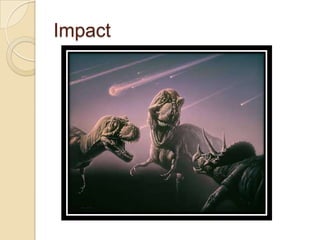
Impact
Impact factor
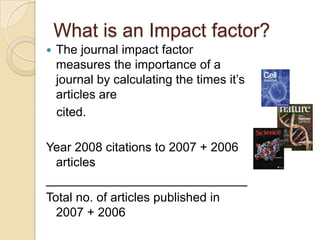
What is an Impact factor?The journal impact factor measures the importance of a journal by calculating the times it’s articles are    cited.Year 2008 citations to 2007 + 2006 articles_____________________________Total no. of articles published in 2007 + 2006
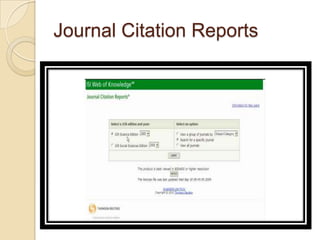
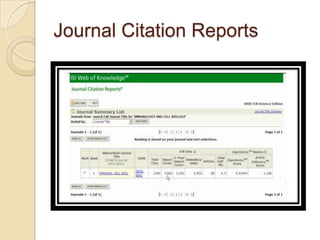
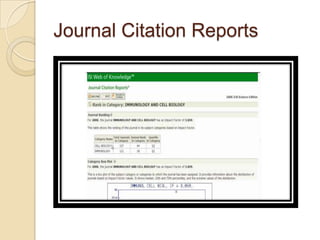
Journal Citation Reports (JCR) forms part of the subscription-based ISI suite of Products known as Web of Knowledge which also includes Web of Science.
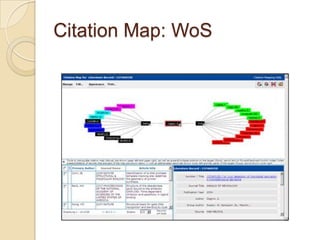
 JCR is the original journal ranking tool, first developed in the 1950s, and it is the current market leader for journal rankings.Citation Map: WoS
Journal Citation Reports
Impact factor: UseEvaluating individual scholarsEvaluating institutionsEvaluating journalsSubscription decision
Impact factor: limitationsOnly a limited subset of journals is indexed by ISIOnly uses the articles cited by the ~10,000 “ISI journals”  Some disciplines are especially poorly coveredDatabase is dominated by American publicationsJournals in database may vary from year to year
Impact factor: limitationsSelf citations are allowedReview articles are heavily cited and inflate the impact factorLong articles collect many citationsShort publication lag allows short term journal self citationsBiased toward English-language journals
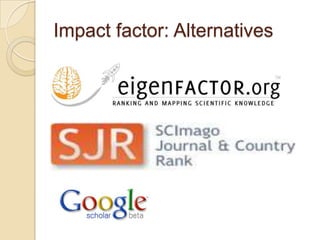
Impact factor: Alternatives
A free and searchable databaseEigenfactorTMscores and Article InfluenceTM scores rank journals much as Google ranks websites. Covers the natural and social scienceshttp://www.eigenfactor.org/
The SCImago Journal & Country Rank is a portal that includes the journals and country scientific informationA free source that uses data from Elsevier's Scopus database http://www.scimagojr.com/
Google Scholar: StrengthNumber of articles found
International/multilingual coverage
Better coverage of citations in books and other non-journal sourcesWeaknesses Inclusion of non-scholarly sources Lack of transparency regarding source selection, number of documents, coverage, indexing, etc.
Coverage is uneven across different fields of study

CETL/GSPD 2011

  • 1.
  • 2.
  • 3.
    Core JournalsJournal PublicationInformation guide provides subject specific listings by college http://libguides.unco.edu/jpubinfoWhat makes a journal core?Acknowledged by scholars in the fieldImpact factorHigh visibility Low acceptance rate/high invited article rate
  • 4.
    Quality indicators forjournalsScholarly or professional audiencePeer reviewedVisibilityIndexingCirculationOpen accessAcceptance ratesEditor/editorial board
  • 5.
    Ulrichsweb - Articles& More By subject identify titlesActiveRefereed (peer reviewed)Academic/Scholarly CirculationIndexingReviewed (Core)Link to journal’s information pageImpact factorJournal ranking
  • 6.
    Types of reviewprocessesEditorialPeerOpenSingle BlindDouble Blind
  • 7.
    Cabell’s Directories -Articles & MoreEditor(s)Acceptance rate and % of invited articlesType of reviewNumber of reviewers and time to reviewSubmission and manuscript guidelinesLink to journal information sitePublication feeCall for submissions
  • 8.
    EditorsBen VarnerAcademic ExchangeQuarterlyEster Gimbernat GonzalezConfluenciaLinda L. Black and Heather M. Helm Counselor Education and SupervisionSample reviewer forms http://www.unco.edu/ces/evaluation.htmFrederick “Rick” Silverman Journal of Mathematics and Culture
  • 9.
    Directory of OpenAccess Journals -http://www.doaj.org/ Scientific and scholarly journalsEditorial or peer reviewedTopics for each journalLanguagesLink to journal information site
  • 10.
    What is anopen access journal?No charge for readers or their institutions to accessUsers have the right to “read, download, copy, distribute, print, search, or link to the full texts of these articles” (Budapest Open Access Initiative)Research is showing that open access articles are cited significantly more than non-open access.
  • 11.
  • 12.
    Congratulations!Your article hasbeen accepted for publication What happens next?You will be asked to sign a publication agreementBut don’t be in a rush to sign it There are some important considerations . . .
  • 13.
    What are yourrights as an author?You, as the author -- a person who has created an original expression of ideas -- automatically hold copyright once that expression is fixed in tangible form
  • 14.
    And what iscopyright?Copyright is the exclusive legal right granted for a specified period (author’s life + 70 years) to print, publish, perform, film, or record original material A Fair(y) Use Talehttp://www.youtube.com/watch?v=CJn_jC4FNDo
  • 15.
    Let’s repeat thoserights again:To publish and distribute a work in print or other mediaTo reproduce it (e.g., photocopying)To prepare derivative works (e.g., translations)To perform or publicly display the workTo authorize others to exercise any of the above rights
  • 16.
    Rights retention &transferCarefully read the publication agreement with your future career in mind Which rights should you retain and which rights should you transfer? It doesn’t have to be all or nothing It can be a compromiseIt can accommodate the needs of information users
  • 17.
    Full transfer: the traditional agreementStatus quo: transfer all rights to publisherNo posting on your web siteNo distribution to your colleaguesNo use (outside of fair use) without publisher’s permissionIgnores the needs of the information user
  • 18.
    A compromise agreementAuthortransfers copyright to the publisher; in exchange, publisher grants the author the following rights, for example: Copies for colleaguesCopies for teaching duties (e.g. course reserves)Inclusion on personal web site or in institutional repository
  • 19.
    Full retention: thelimited licenseThe author retains copyright ownership and licenses to the publisher a specific right (such as the right of first publication)
  • 20.
    Open access: creative commonsThe author retains copyright ownership and licenses to the publisher a specific right (such as the right of first publication)The information user is granted rights beyond those typically granted for fair useProper attribution is often the only caveat
  • 21.
    Where to findpublishers’policies re copyrightSherpa/Romeo web site:http://www.sherpa.ac.uk/romeo/Interactive database created by a partnership of research librariesSummarizes standard permissions in publishers’ copyright transfer agreementsFocuses upon self-archiving
  • 22.
    The right topost on a web siteThere are several versions of your submitted work:The “pre-print” version of your work before it is refereed and publishedThere are two “post-print” versions of your work: Post-refereed (but not typeset)The publisher’s “official” typeset version
  • 23.
    My non-legal adviceReadthe contract when you are in a rested, analytical frame of mindBe assertive in asking for what you wantAsk for clarifications and changesGet clarifications and changes in writingKeep copies of everything (email correspondence, guidelines posted on web pages, contracts, etc.)Keep copies of all submitted versions of your work
  • 24.
  • 25.
  • 26.
    What is anImpact factor?The journal impact factor measures the importance of a journal by calculating the times it’s articles are cited.Year 2008 citations to 2007 + 2006 articles_____________________________Total no. of articles published in 2007 + 2006
  • 27.
    Journal Citation Reports(JCR) forms part of the subscription-based ISI suite of Products known as Web of Knowledge which also includes Web of Science.
  • 28.
    JCR isthe original journal ranking tool, first developed in the 1950s, and it is the current market leader for journal rankings.Citation Map: WoS
  • 29.
  • 30.
  • 31.
  • 32.
    Impact factor: UseEvaluatingindividual scholarsEvaluating institutionsEvaluating journalsSubscription decision
  • 33.
    Impact factor: limitationsOnlya limited subset of journals is indexed by ISIOnly uses the articles cited by the ~10,000 “ISI journals” Some disciplines are especially poorly coveredDatabase is dominated by American publicationsJournals in database may vary from year to year
  • 34.
    Impact factor: limitationsSelfcitations are allowedReview articles are heavily cited and inflate the impact factorLong articles collect many citationsShort publication lag allows short term journal self citationsBiased toward English-language journals
  • 35.
  • 36.
    A free andsearchable databaseEigenfactorTMscores and Article InfluenceTM scores rank journals much as Google ranks websites. Covers the natural and social scienceshttp://www.eigenfactor.org/
  • 37.
    The SCImago Journal& Country Rank is a portal that includes the journals and country scientific informationA free source that uses data from Elsevier's Scopus database http://www.scimagojr.com/
  • 38.
  • 39.
  • 40.
    Better coverage ofcitations in books and other non-journal sourcesWeaknesses Inclusion of non-scholarly sources Lack of transparency regarding source selection, number of documents, coverage, indexing, etc.
  • 41.
    Coverage is unevenacross different fields of study