NIH Public Access Policy
(and how librarians can help)

By Stephanie Ballard, M.L.S., M.Ed.
2009
Why involve the Library?


 Institutions receive $$$ from National
  Institutes of Health for research
 As grantees, institutions are liable for
  complying with NIH policies
 Shows proactive & responsible
  approach
Overview of presentation

  I. Benefits
 II. Logistics
III. Copyright
IV. Library
I. Benefits
Benefits of Policy to researcher

 Increased visibility for your work
 Your articles are archived in perpetuity
 Easy access to colleagues’ PMC
  articles
 Continued eligibility for NIH grants
 Integration with NLM databases:
  PubMed, Clinical Trials, Gen
  Bank, PubChem
Benefits of Policy to others
 Unprecedented access to biomedical
  literature via PubMed Central
 Allows researchers to more quickly
  build on cutting-edge discoveries
 Speeds process of translating
  scientific findings to clinical care
 Adds transparency & accountability to
  federal spending
PubMed Central
   NLM’s digital repository
    ◦ “free internet-accessible archive of full text
      articles from peer-reviewed scholarly
      biomedical journals”
 Permanent & searchable
 Links to publisher websites
 Includes many articles reporting on
  research not funded by NIH
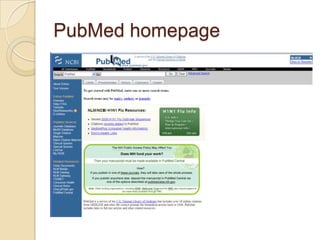
PubMed homepage
II. Logistics
Brief history
 Congress assigned NIH job of drafting
  Public Access Policy
 Voluntary Policy enacted in 2005, but
  compliance rates were low
 Became mandatory in 2008
 Applies to articles accepted for peer-
  reviewed publication after April 7, 2008
  or grants active as of October 2007
    ◦ Prior to mandatory date: OK but not required
   All types of NIH grants, not just research
Resistance to Policy
   H.R. 801 by Rep John Conyers
    ◦ “Fair Copyright in Research Works Act”
    ◦ Referred to House committee in March
 Attempt to reverse Policy
 H.R. supported by publishing lobby
 H.R. opposed by scientific community,
  patient advocates & librarians
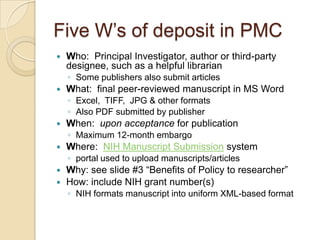
Five W’s of deposit in PMC
   Who: Principal Investigator, author or third-party
    designee, such as a helpful librarian
    ◦ Some publishers also submit articles
   What: final peer-reviewed manuscript in MS Word
    ◦ Excel, TIFF, JPG & other formats
    ◦ Also PDF submitted by publisher
   When: upon acceptance for publication
    ◦ Maximum 12-month embargo
   Where: NIH Manuscript Submission system
    ◦ portal used to upload manuscripts/articles
 Why: see slide #3 “Benefits of Policy to researcher”
 How: include NIH grant number(s)
    ◦ NIH formats manuscript into uniform XML-based format
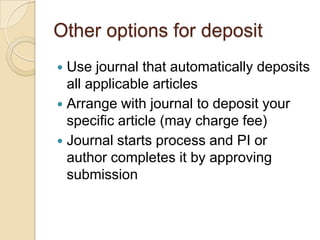
Other options for deposit
 Use journal that automatically deposits
  all applicable articles
 Arrange with journal to deposit your
  specific article (may charge fee)
 Journal starts process and PI or
  author completes it by approving
  submission
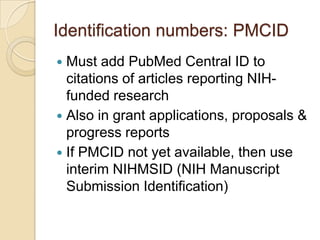
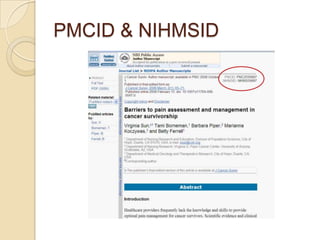
Identification numbers: PMCID
 Must add PubMed Central ID to
  citations of articles reporting NIH-
  funded research
 Also in grant applications, proposals &
  progress reports
 If PMCID not yet available, then use
  interim NIHMSID (NIH Manuscript
  Submission Identification)
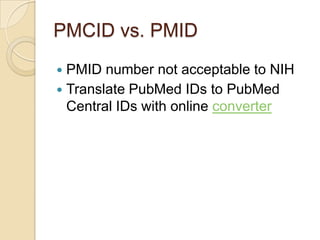
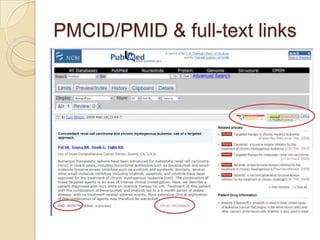
PMCID vs. PMID
 PMID number not acceptable to NIH
 Translate PubMed IDs to PubMed
  Central IDs with online converter
PMCID & NIHMSID
PMCID/PMID & full-text links
III. Copyright
Copyright alert for authors !
 Ask your friendly librarian for help
 Before selecting journal, check
  publisher’s policies for cooperating
  with NIH Policy
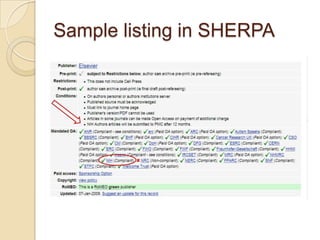
    ◦ SHERPA website for publishers’ policies
   Include submission notice & amend
    publisher agreement, if necessary
Sample listing in SHERPA
Article submission notice
 Authors should include notice to
  publisher that article, if accepted, is
  subject to Public Access Policy
 Extra protection when used with
  amendment to publisher agreement
Amend publisher agreement
 Add to agreement SPARC’s
  Addendum or
 NIH’s suggested language
    ◦ “Journal acknowledges that Author retains
      the right to provide a copy of the final
      peer-reviewed manuscript to the NIH
      upon acceptance for Journal
      publication, for public archiving in
      PubMed Central as soon as possible but
      no later than 12 months after publication
      by Journal.”
Copyright alert for grantees !
 Institutions must assume greater
  administrative role in compliance
 Risk management focus on how PI’s
  handle publishers agreements
 Once author signs rights
  away, grantee may be in non-
  compliance
 Requiring pre-approval of journals
  may spur resistance from authors
Grantee license
 Authors, rather than employer, often
  own copyright to their work
 Employer may acquire rights from
  authors to ensure its compliance
 Use a non-exclusive license with
  authors which automatically allows
  grantee to submit works to PMC
 Grantee may also seek right to post
  works in institution’s own repository
IV. Library
Library involvement--why?
 PubMed Central (PMC) is housed in
  National Library of Medicine (NLM)
 3 librarians on NIH Advisory
  Committee from start of planning
 Libraries are supportive of Policy
 Librarians have traits required for task
How Library can help
1.   Advise authors re: copyright issues
2.   Research publishers’ policies
3.   ID publishers that submit to PMC
4.    Assist in amending publishing
     agreements
5.   Locate citations & PMCIDs
How Library can help (cont’d)
6.   Coordinate various departments
7.   Stay current on new developments
8.   Presentations & written updates
9.   Dedicated staff can better handle
     complicated tasks of Policy
Library’s vision
 Relieve research staff of burden
 Provide support, resources &
  education
 Carrot-not-stick approach
 Show NIH Public Access Policy is an
  opportunity rather than annoyance
References
1.   Carroll, M. W. (2008). Complying with the National Institutes of Health public access policy
     Copyright considerations and options. Cambridge, MA: Science Commons.
     http://www.arl.org/sparc/bm~doc/NIH_Copyright_v1.pdf
2.   Homan, J. Michael; Watson, Linda A. STM publishing meets NIH digital archive: librarian
     service on the PubMed Central National Advisory Committee. Reference Services Review,
     2004, Vol. 32 Issue 1, p83-88, 6p; DOI: 10.1108/00907320410519504; (AN 14083164)
3.   National Institutes of Health (U.S.). (2008). Analysis of comments and implementation of
     the NIH Public Access Policy. Bethesda, Md.?: NIH.
     http://publicaccess.nih.gov/analysis_of_comments_nih_public_access_policy.pdf
4.   The Scholarly Publishing and Academic Resources Coalition.Addendum to publication
     agreement. http://www.arl.org/sparc/bm~doc/Access-Reuse_Addendum.pdf Accessed
     May 25, 2009.
5.   The Scholarly Publishing and Academic Resources Coalition. Author Rights: Using the
     SPARC Author Addendum to secure your rights as the author of a journal article.
     http://www.arl.org/sparc/author/addendum.shtml Accessed May 25, 2009.
6.   Shepard P. Schizophrenia Bulletin and the revised NIH public access policy. Schizophrenia
     Bulletin [serial online]. September 2008; 34(5):799-800. Available from: PsycINFO, Ipswich,
     MA. Accessed May 25, 2009.
7.   University of Wisconsin-Madison Libraries. NIH Public Access Policy: Frequently Asked
     Question. http://www.library.wisc.edu/scp/nih/faq.html Accessed May 25, 2009.
8.   Willinsky J. The publisher's pushback against NIH's public access and scholarly publishing
     sustainability. Plos Biology [serial online]. January 27, 2009;7(1):e30-e30. Available from:
     MEDLINE with Full Text, Ipswich, MA. Accessed May 25, 2009.

NIH Public Access Policy

  • 1.
    NIH Public AccessPolicy (and how librarians can help) By Stephanie Ballard, M.L.S., M.Ed. 2009
  • 2.
    Why involve theLibrary?  Institutions receive $$$ from National Institutes of Health for research  As grantees, institutions are liable for complying with NIH policies  Shows proactive & responsible approach
  • 3.
    Overview of presentation I. Benefits II. Logistics III. Copyright IV. Library
  • 4.
  • 5.
    Benefits of Policyto researcher  Increased visibility for your work  Your articles are archived in perpetuity  Easy access to colleagues’ PMC articles  Continued eligibility for NIH grants  Integration with NLM databases: PubMed, Clinical Trials, Gen Bank, PubChem
  • 6.
    Benefits of Policyto others  Unprecedented access to biomedical literature via PubMed Central  Allows researchers to more quickly build on cutting-edge discoveries  Speeds process of translating scientific findings to clinical care  Adds transparency & accountability to federal spending
  • 7.
    PubMed Central  NLM’s digital repository ◦ “free internet-accessible archive of full text articles from peer-reviewed scholarly biomedical journals”  Permanent & searchable  Links to publisher websites  Includes many articles reporting on research not funded by NIH
  • 8.
  • 9.
  • 10.
    Brief history  Congressassigned NIH job of drafting Public Access Policy  Voluntary Policy enacted in 2005, but compliance rates were low  Became mandatory in 2008  Applies to articles accepted for peer- reviewed publication after April 7, 2008 or grants active as of October 2007 ◦ Prior to mandatory date: OK but not required  All types of NIH grants, not just research
  • 11.
    Resistance to Policy  H.R. 801 by Rep John Conyers ◦ “Fair Copyright in Research Works Act” ◦ Referred to House committee in March  Attempt to reverse Policy  H.R. supported by publishing lobby  H.R. opposed by scientific community, patient advocates & librarians
  • 12.
    Five W’s ofdeposit in PMC  Who: Principal Investigator, author or third-party designee, such as a helpful librarian ◦ Some publishers also submit articles  What: final peer-reviewed manuscript in MS Word ◦ Excel, TIFF, JPG & other formats ◦ Also PDF submitted by publisher  When: upon acceptance for publication ◦ Maximum 12-month embargo  Where: NIH Manuscript Submission system ◦ portal used to upload manuscripts/articles  Why: see slide #3 “Benefits of Policy to researcher”  How: include NIH grant number(s) ◦ NIH formats manuscript into uniform XML-based format
  • 13.
    Other options fordeposit  Use journal that automatically deposits all applicable articles  Arrange with journal to deposit your specific article (may charge fee)  Journal starts process and PI or author completes it by approving submission
  • 14.
    Identification numbers: PMCID Must add PubMed Central ID to citations of articles reporting NIH- funded research  Also in grant applications, proposals & progress reports  If PMCID not yet available, then use interim NIHMSID (NIH Manuscript Submission Identification)
  • 15.
    PMCID vs. PMID PMID number not acceptable to NIH  Translate PubMed IDs to PubMed Central IDs with online converter
  • 16.
  • 17.
  • 18.
  • 19.
    Copyright alert forauthors !  Ask your friendly librarian for help  Before selecting journal, check publisher’s policies for cooperating with NIH Policy ◦ SHERPA website for publishers’ policies  Include submission notice & amend publisher agreement, if necessary
  • 20.
  • 21.
    Article submission notice Authors should include notice to publisher that article, if accepted, is subject to Public Access Policy  Extra protection when used with amendment to publisher agreement
  • 22.
    Amend publisher agreement Add to agreement SPARC’s Addendum or  NIH’s suggested language ◦ “Journal acknowledges that Author retains the right to provide a copy of the final peer-reviewed manuscript to the NIH upon acceptance for Journal publication, for public archiving in PubMed Central as soon as possible but no later than 12 months after publication by Journal.”
  • 23.
    Copyright alert forgrantees !  Institutions must assume greater administrative role in compliance  Risk management focus on how PI’s handle publishers agreements  Once author signs rights away, grantee may be in non- compliance  Requiring pre-approval of journals may spur resistance from authors
  • 24.
    Grantee license  Authors,rather than employer, often own copyright to their work  Employer may acquire rights from authors to ensure its compliance  Use a non-exclusive license with authors which automatically allows grantee to submit works to PMC  Grantee may also seek right to post works in institution’s own repository
  • 25.
  • 26.
    Library involvement--why?  PubMedCentral (PMC) is housed in National Library of Medicine (NLM)  3 librarians on NIH Advisory Committee from start of planning  Libraries are supportive of Policy  Librarians have traits required for task
  • 27.
    How Library canhelp 1. Advise authors re: copyright issues 2. Research publishers’ policies 3. ID publishers that submit to PMC 4. Assist in amending publishing agreements 5. Locate citations & PMCIDs
  • 28.
    How Library canhelp (cont’d) 6. Coordinate various departments 7. Stay current on new developments 8. Presentations & written updates 9. Dedicated staff can better handle complicated tasks of Policy
  • 29.
    Library’s vision  Relieveresearch staff of burden  Provide support, resources & education  Carrot-not-stick approach  Show NIH Public Access Policy is an opportunity rather than annoyance
  • 30.
    References 1. Carroll, M. W. (2008). Complying with the National Institutes of Health public access policy Copyright considerations and options. Cambridge, MA: Science Commons. http://www.arl.org/sparc/bm~doc/NIH_Copyright_v1.pdf 2. Homan, J. Michael; Watson, Linda A. STM publishing meets NIH digital archive: librarian service on the PubMed Central National Advisory Committee. Reference Services Review, 2004, Vol. 32 Issue 1, p83-88, 6p; DOI: 10.1108/00907320410519504; (AN 14083164) 3. National Institutes of Health (U.S.). (2008). Analysis of comments and implementation of the NIH Public Access Policy. Bethesda, Md.?: NIH. http://publicaccess.nih.gov/analysis_of_comments_nih_public_access_policy.pdf 4. The Scholarly Publishing and Academic Resources Coalition.Addendum to publication agreement. http://www.arl.org/sparc/bm~doc/Access-Reuse_Addendum.pdf Accessed May 25, 2009. 5. The Scholarly Publishing and Academic Resources Coalition. Author Rights: Using the SPARC Author Addendum to secure your rights as the author of a journal article. http://www.arl.org/sparc/author/addendum.shtml Accessed May 25, 2009. 6. Shepard P. Schizophrenia Bulletin and the revised NIH public access policy. Schizophrenia Bulletin [serial online]. September 2008; 34(5):799-800. Available from: PsycINFO, Ipswich, MA. Accessed May 25, 2009. 7. University of Wisconsin-Madison Libraries. NIH Public Access Policy: Frequently Asked Question. http://www.library.wisc.edu/scp/nih/faq.html Accessed May 25, 2009. 8. Willinsky J. The publisher's pushback against NIH's public access and scholarly publishing sustainability. Plos Biology [serial online]. January 27, 2009;7(1):e30-e30. Available from: MEDLINE with Full Text, Ipswich, MA. Accessed May 25, 2009.