Financing Energy Efficiency:
Credit Enhancements and
Leveraging Strategies
Matthew H. Brown
ConoverBrown LLC
Matthew@ConoverBrown.com
720 246 8847
ConoverBrown LLC
 Consulting firm with a specialty in financing for
clean energy & environmental strategy.
 Domestic and International government, non-
profit and private clients.
 Clean energy finance clients include U.S. Dept
of Energy, Iowa, Colorado, Michigan, utility,
lender, national and regional associations and
advocacy organizations.
 Working with these clients to set up or assist in
establishing new financing programs.
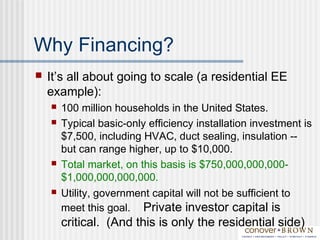
Why Financing?
 It’s all about going to scale (a residential EE
example):
 100 million households in the United States.
 Typical basic-only efficiency installation investment is
$7,500, including HVAC, duct sealing, insulation --
but can range higher, up to $10,000.
 Total market, on this basis is $750,000,000,000-
$1,000,000,000,000.
 Utility, government capital will not be sufficient to
meet this goal. Private investor capital is
critical. (And this is only the residential side)
Leveraging Potential
 In its simplest form, leveraging on basis of
a 5% loss reserve=20x
 $1,000,000 leverages up to $20,000,000
 Common leveraging could be based on a
5% to 10% credit enhancement.
 Some higher deals or markets may need
higher enhancements – up to 20%-25%.
Who are the lender partners?
 Credit unions: Understand small loans,
community-minded.
 Specialty Lenders: Know energy finance very
well
 Community Development Financial Institutions
(CDFI) lenders: low cost, but limited amounts of
capital
 Public lenders (state or municipal bonding
authorities such as housing finance agencies):
low cost capital availability
What will bring these lenders to
the table?
 A market for loans – deal flow. (Many
lenders hungry for good quality loans).
 Good quality borrowers with good credit.
 A secondary market for loans (a place to
sell the loans).
 Credit enhancements.
Credit Enhancements Come in
Several Forms
 Loss Reserves or Guarantees
 Subordinated Debt
 Loan Insurance
 Interest rate buydowns sometimes fall
into this category
 Not addressed in detail here.
 Typically structured as a payment to the
lender based on NPV of difference between
market and target interest rate.
Why Are Credit Enhancements
Attractive?
 Help to make lenders comfortable with a
new and unfamiliar product.
 Help to extend the range of potential
borrowers to those who might not
otherwise be able to borrow.
 Increases amount of capital available to
lend by attracting investor and lender
interest in a product.
Issues to Consider with Credit
Enhancements
 Make sure that there’s a real benefit to the
enhancement -- eg. a lower interest rate, more
loans.
 Consider ways to customize the enhancement (eg.
Reduce reserve size based on improving default
rates).
 Find maximum leverage – 20x leverage based on
5% loss reserve isn’t unreasonable.
 Pre-agreed underwriting standards are critical.
Eg. 680 credit score, 50% debt/income ratio.
Issues to Consider with Credit
Enhancements
 Don’t give away the farm: a full guarantee may not
leave enough “skin in the game” to encourage
appropriate underwriting and collections.
 Recommend structuring the enhancement on the basis
of total loans outstanding (a portfolio) rather than on a
per-loan basis.
 Eg. A loss reserve set at 5% of total outstanding
loan balance, with lenders able to recover up to 80%
of the balance of any individual loan in default.
 Reserve levels will vary depending on target market
risk. Could be as high as 20% for certain markets
served by CDFI lenders.
Reserve vs. Guarantees
 Loss Reserves are provided contingent
upon availability of funds (eg. 5% of
outstanding loans).
 Guarantees are available regardless of
fund availability.
Michigan Example of Loss
Reserve (proposed)
 5% loss reserve based on the total
portfolio of loans that lender holds.
 Lender would be able to recover up to
80% of defaulted amount (skin in the
game).
 Unsecured loan – although possibly tied
to a meter and disconnection threat.
 For this, lenders willing to offer 5-7%
unsecured loans. (about ½ market rate).
Senior/Sub Debt Structure -- WA State
Housing Authority (in process)
 ARRA funds used to provide a
subordinated debt at 0% in amount of $1
million. This sub-debt absorbs first loss
(ie. before any losses accrue to senior
debt).
 Reflows create a loss reserve.
 Private investor funds provide $9 million
of senior debt (much more secure and
lower rate).
Loan Loss Insurance
 Very limited availability of any loan loss
insurance now – used to be available in
the past.
 Insurance that is available is quite
expensive.
 Not a recommended option at this point.
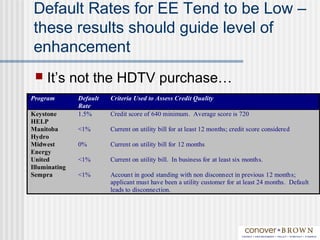
Default Rates for EE Tend to be Low –
these results should guide level of
enhancement
 It’s not the HDTV purchase…
Program Default
Rate
Criteria Used to Assess Credit Quality
Keystone
HELP
1.5% Credit score of 640 minimum. Average score is 720
Manitoba
Hydro
<1% Current on utility bill for at least 12 months; credit score considered
Midwest
Energy
0% Current on utility bill for 12 months
United
Illuminating
<1% Current on utility bill. In business for at least six months.
Sempra <1% Account in good standing with non disconnect in previous 12 months;
applicant must have been a utility customer for at least 24 months. Default
leads to disconnection.
To Summarize
Without financing we can’t make our climate, energy independence or other goals.
Financing requires working with financial institutions in new ways.
And educating finance institutions in part through use of credit enhancements.
Credit enhancements, structured properly, provide significant leverage opportunity.

Financing Energy Efficiency: Credit Enhancements and Leveraging Strategies

  • 1.
    Financing Energy Efficiency: CreditEnhancements and Leveraging Strategies Matthew H. Brown ConoverBrown LLC Matthew@ConoverBrown.com 720 246 8847
  • 2.
    ConoverBrown LLC  Consultingfirm with a specialty in financing for clean energy & environmental strategy.  Domestic and International government, non- profit and private clients.  Clean energy finance clients include U.S. Dept of Energy, Iowa, Colorado, Michigan, utility, lender, national and regional associations and advocacy organizations.  Working with these clients to set up or assist in establishing new financing programs.
  • 3.
    Why Financing?  It’sall about going to scale (a residential EE example):  100 million households in the United States.  Typical basic-only efficiency installation investment is $7,500, including HVAC, duct sealing, insulation -- but can range higher, up to $10,000.  Total market, on this basis is $750,000,000,000- $1,000,000,000,000.  Utility, government capital will not be sufficient to meet this goal. Private investor capital is critical. (And this is only the residential side)
  • 4.
    Leveraging Potential  Inits simplest form, leveraging on basis of a 5% loss reserve=20x  $1,000,000 leverages up to $20,000,000  Common leveraging could be based on a 5% to 10% credit enhancement.  Some higher deals or markets may need higher enhancements – up to 20%-25%.
  • 5.
    Who are thelender partners?  Credit unions: Understand small loans, community-minded.  Specialty Lenders: Know energy finance very well  Community Development Financial Institutions (CDFI) lenders: low cost, but limited amounts of capital  Public lenders (state or municipal bonding authorities such as housing finance agencies): low cost capital availability
  • 6.
    What will bringthese lenders to the table?  A market for loans – deal flow. (Many lenders hungry for good quality loans).  Good quality borrowers with good credit.  A secondary market for loans (a place to sell the loans).  Credit enhancements.
  • 7.
    Credit Enhancements Comein Several Forms  Loss Reserves or Guarantees  Subordinated Debt  Loan Insurance  Interest rate buydowns sometimes fall into this category  Not addressed in detail here.  Typically structured as a payment to the lender based on NPV of difference between market and target interest rate.
  • 8.
    Why Are CreditEnhancements Attractive?  Help to make lenders comfortable with a new and unfamiliar product.  Help to extend the range of potential borrowers to those who might not otherwise be able to borrow.  Increases amount of capital available to lend by attracting investor and lender interest in a product.
  • 9.
    Issues to Considerwith Credit Enhancements  Make sure that there’s a real benefit to the enhancement -- eg. a lower interest rate, more loans.  Consider ways to customize the enhancement (eg. Reduce reserve size based on improving default rates).  Find maximum leverage – 20x leverage based on 5% loss reserve isn’t unreasonable.  Pre-agreed underwriting standards are critical. Eg. 680 credit score, 50% debt/income ratio.
  • 10.
    Issues to Considerwith Credit Enhancements  Don’t give away the farm: a full guarantee may not leave enough “skin in the game” to encourage appropriate underwriting and collections.  Recommend structuring the enhancement on the basis of total loans outstanding (a portfolio) rather than on a per-loan basis.  Eg. A loss reserve set at 5% of total outstanding loan balance, with lenders able to recover up to 80% of the balance of any individual loan in default.  Reserve levels will vary depending on target market risk. Could be as high as 20% for certain markets served by CDFI lenders.
  • 11.
    Reserve vs. Guarantees Loss Reserves are provided contingent upon availability of funds (eg. 5% of outstanding loans).  Guarantees are available regardless of fund availability.
  • 12.
    Michigan Example ofLoss Reserve (proposed)  5% loss reserve based on the total portfolio of loans that lender holds.  Lender would be able to recover up to 80% of defaulted amount (skin in the game).  Unsecured loan – although possibly tied to a meter and disconnection threat.  For this, lenders willing to offer 5-7% unsecured loans. (about ½ market rate).
  • 13.
    Senior/Sub Debt Structure-- WA State Housing Authority (in process)  ARRA funds used to provide a subordinated debt at 0% in amount of $1 million. This sub-debt absorbs first loss (ie. before any losses accrue to senior debt).  Reflows create a loss reserve.  Private investor funds provide $9 million of senior debt (much more secure and lower rate).
  • 14.
    Loan Loss Insurance Very limited availability of any loan loss insurance now – used to be available in the past.  Insurance that is available is quite expensive.  Not a recommended option at this point.
  • 15.
    Default Rates forEE Tend to be Low – these results should guide level of enhancement  It’s not the HDTV purchase… Program Default Rate Criteria Used to Assess Credit Quality Keystone HELP 1.5% Credit score of 640 minimum. Average score is 720 Manitoba Hydro <1% Current on utility bill for at least 12 months; credit score considered Midwest Energy 0% Current on utility bill for 12 months United Illuminating <1% Current on utility bill. In business for at least six months. Sempra <1% Account in good standing with non disconnect in previous 12 months; applicant must have been a utility customer for at least 24 months. Default leads to disconnection.
  • 16.
    To Summarize Without financingwe can’t make our climate, energy independence or other goals. Financing requires working with financial institutions in new ways. And educating finance institutions in part through use of credit enhancements. Credit enhancements, structured properly, provide significant leverage opportunity.