Trust Deed Investing With Sterling Pacific Financial Security. Innovation. Growth. December 2008
Presentation Overview Brief Introduction to Trust Deed Investing Why Trust Deed Investing is a Logical Choice for Many Investors Choosing a Trust Deed Investment Company – Things to Consider Sterling Pacific Financial and Your Clients
Trust Deed Investments in Brief A trust deed – or deed of trust – is an investment instrument similar to a mortgage Deed of trust secures a loan made to finance purchase or development of a subject property Provides lender recourse in case of default These private loans also known as “hard money” loans because they are secured by hard assets (collateral)
Trust Deed Investment Process Investor (the lender) provides loan funding and receives monthly interest at a predictable, stable rate Process is brokered and managed through a licensed company known as a TDIC Licensed lender can avoid state usury laws and charge market-driven interest rates
Trust Deeds Versus  Mortgage Loans Trust deeds typically generate much higher yields than ordinary mortgage loans Investments can usually be made on a fractional basis – one investor needn’t fund the entire loan Whether a trust deed or mortgage loan/lien is used depends on state law Recourse for lender in default situations is usually more straightforward
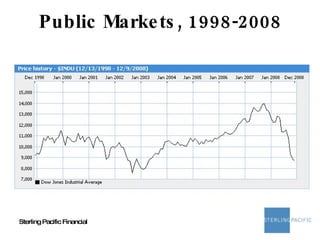
Real Estate and Portfolio Diversification Public stocks have battered most portfolios – short term yields are needed to rebuild Investors need diversification beyond stocks and bonds Real estate has become more attractive for security, long-term growth  – but is only really appropriate for some investors
Real Estate Investing Caveats Real estate offers real diversification, but requires more expertise to evaluate Costs of errors can be devastating A single RE investment can account for most of a portfolio’s value (limiting diversification) If leverage is used, risk increases substantially If the investment is in a retirement account, tax laws add complexity
Trust Deeds as a Lower Risk Proxy for Real Estate Trust deeds are tied to RE– benefits of collateralization with hard asset, but risk is shared with borrower A good TDIC will be expert at choosing properties – investor can learn through them Smaller minimum investments – easy to achieve true diversification across multiple projects Unlike direct real estate investing, returns are immediate and stable
Credit Crunch = Opportunity Banks’ tighter credit standards mean very few borrowers qualify TDICs can tap many attractive lending opportunities ineligible for bank loans
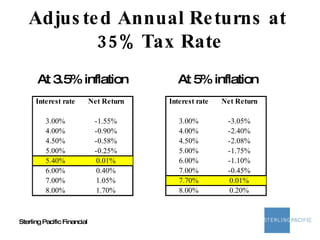
Adjusted Annual Returns at  35% Tax Rate At 3.5% inflation At 5% inflation
Public Markets, 1998-2008
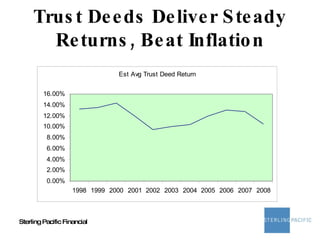
Trust Deeds Deliver Steady Returns, Beat Inflation
What Current Investors Like About Trust Deeds Relatively secure and predictable, but returns beat inflation significantly Monthly growth rebuilds wealth Simple, transparent Like RE investing without the hassles of ownership … …  and with the benefits of relative liquidity
What Current Investors Like About Trust Deeds They can diversify across multiple RE projects with relatively small investments – without leverage They can diversify into real estate without acquiring that expertise – or learning the hard way
Unfortunately, These Benefits Haven’t Been Universally Available Private money real estate loan opportunities have been “under the radar,” not accessible to all investors Sterling Pacific and its peers aim to expand access to  quality  trust deed investments
Risks of Trust Deed Investing Secured by collateral, trust deeds are relatively low risk – but not risk-free Borrower default Property value decline or disparity with market Real estate risks: tax and regulatory changes, neighborhood changes, interest rates, changing economic conditions Choosing the right firm can minimize these risks
Choosing the Right TDIC Still largely unregulated – reputation and track record matter most Retained investors, repeat borrowers Highest return not the only consideration Market expertise, staffing, infrastructure Local and general RE knowledge essential to identifying best investments Recourse only protective if TDIC can effectively prevent/manage workouts and foreclosures!
Choosing the Right TDIC Lending standards – LTV, etc Investor qualification Diversity of investment options Capitalization – for fast action on prime deals, more options on refinance Are the principals invested?
Sterling Pacific Financial – About Our Firm Ten+ years as a TDIC Dedicated investment committee with more than 40 years of real estate and lending experience We focus on mid-risk, quality investments We focus on markets we know well (primarily CA)
Sterling Pacific Financial – About Our Firm Well-capitalized – so we can move fast All principals invest – our goals are aligned with investors We have a robust infrastructure – not a mom and pop Experienced, well-managed loan servicing operation Regular communications program
Our Borrowers Have needs that banks can’t fill: short-term or bridge loans, fast turnaround, mixed use Shopping centers, medical office buildings, apartment buildings Borrowers’ projects are located within geographic areas highly familiar to Sterling Many of Sterling’s borrowers are repeat borrowers with a long track record of real estate success
How We Evaluate  Loan-to-Value LTV is a measure of the protective equity in a property – lower LTV, lower investor risk Sterling permits a  maximum  LTV of 75% Credit history is not unimportant, but well-analyzed LTV provides more security We also research title, determine the impact of any existing liens or other encumbrances
Typical Sterling Loan Terms 12-36 months term  Interest only, with a balloon repayment of principal at the end of the term At the end of the term, principal is returned to investor(s) (individual or fractional trust deed) or to the fund for reinvestment (mortgage pool)
Case Study:  Speedy Medical Office Build-Out Madera County medical group sought to build out 7,000sf building – with Office of Behavioral Health Services ready to lease But, OBHS needed their space within seven months – too fast for bank funding Sterling provided funding in 15 days, so project could proceed – and the community now has needed services
Case Study: Bridge Financing Architectural firm owner ready to buy the Santa Cruz building he had rented for more than 20 years Seller’s fast-close requirement almost left this highly qualified borrower’s firm homeless A bridge loan from Sterling Pacific saved the transaction
Case Study: Mixed Use Shopping Center A Fresno community’s big-box center was held up by lack of bank financing Bank lending requirements couldn’t stretch to fit this mixed-use project – even though the entire community supported it Sterling assembled a mix of financing programs for the project’s different components
Our Investors Have never lost principal Reinvest at over 90% rate Are individuals, foundations, corporations, retirement plans and other trusts
Leadership and Innovation We strive to lead the category in innovation and consistent results Our level of capitalization and track record mean we get first pick of most local deals We’ve invested in infrastructure throughout the lending lifecycle, including servicing and workouts (not just evaluating/funding)
Leadership and Innovation Sterling far exceeds industry standards for transparent communication with investors Our investment committee is an unusual advantage and provides broad lending and real estate knowledge We offer products for different needs, including fractional deeds, mutual-fund-like mortgage pools
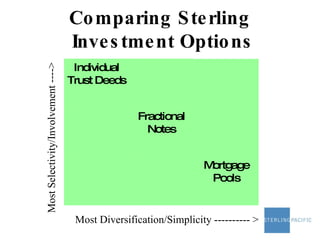
Comparing Sterling  Investment Options Most Diversification/Simplicity ---------- > Most Selectivity/Involvement ----> Mortgage Pools Fractional Notes Individual Trust Deeds
Option 1: Funding a  Single Trust Deed Investor chooses best fit for investment preferences (rate, term, position, etc) Capital must be committed for the full term of the loan (typically one-two years) Sterling manages the entire process, paying interest on a monthly basis and returning or reinvesting capital at loan end
Option 2: Investing in a Fractional Deed Investors choose among fractionalized opportunities (rate, position, percentage interest, project type, location, etc.) Capital committed for loan term Sterling manages the entire process for all fractional participants, paying interest monthly and returning or reinvesting capital at loan payoff
Option 3: Mortgage Pool Increased diversification through collective investment in a deed portfolio  Sterling manages the pools – continuously investing funds into quality loans Investors are paid a monthly yield – which can also be automatically reinvested Minimum $25,000 investment (one year lockup) Sterling’s simplest, lowest risk investment option
Sterling Pacific’s Mortgage Pools The Foundation Fund, LLC Open to CA residents only Loans for California properties only $500K net worth (net of home) or $250K net worth with $65K annual income Open for investing through tax-advantaged accounts Target yield 10-11% The First Floor Fund, LLC Open to all US citizens Properties in AZ, CA, NM, NV, OR, WA $1MM net worth (minus home) or income of $200K (individual)/$300K (couple) No tax-advantaged account investing at this time Target yield 11-13%
No Hidden Fees There are no hidden fees or loads for any of our products Sterling receives a portion of the interest paid by borrowers – which has already been deducted from the rate you’re quoted In other words, what you see is what you get: the rate quoted is expected yield
Extending Tax Advantages Trust deed investments combine stability with regular, substantial yields – an excellent combination for self-directed retirement or education portfolios Income accumulates tax-free until withdrawal – taking full advantage of tax-deferral on  income
Summary Trust deeds are an excellent way to diversify a portfolio Many of the benefits of RE investing, but fewer hassles Choosing the right firm is crucial Sterling Pacific Financial offers experience, integrity, and innovation – all backed by our track record
Sterling Pacific Financial Investment/Lending Contacts Joshua Fischer, Managing Director [email_address] Joseph DeNigris, Director of Bus Dev [email_address]
Notes

Trust Deed Investing

  • 1.
    Trust Deed InvestingWith Sterling Pacific Financial Security. Innovation. Growth. December 2008
  • 2.
    Presentation Overview BriefIntroduction to Trust Deed Investing Why Trust Deed Investing is a Logical Choice for Many Investors Choosing a Trust Deed Investment Company – Things to Consider Sterling Pacific Financial and Your Clients
  • 3.
    Trust Deed Investmentsin Brief A trust deed – or deed of trust – is an investment instrument similar to a mortgage Deed of trust secures a loan made to finance purchase or development of a subject property Provides lender recourse in case of default These private loans also known as “hard money” loans because they are secured by hard assets (collateral)
  • 4.
    Trust Deed InvestmentProcess Investor (the lender) provides loan funding and receives monthly interest at a predictable, stable rate Process is brokered and managed through a licensed company known as a TDIC Licensed lender can avoid state usury laws and charge market-driven interest rates
  • 5.
    Trust Deeds Versus Mortgage Loans Trust deeds typically generate much higher yields than ordinary mortgage loans Investments can usually be made on a fractional basis – one investor needn’t fund the entire loan Whether a trust deed or mortgage loan/lien is used depends on state law Recourse for lender in default situations is usually more straightforward
  • 6.
    Real Estate andPortfolio Diversification Public stocks have battered most portfolios – short term yields are needed to rebuild Investors need diversification beyond stocks and bonds Real estate has become more attractive for security, long-term growth – but is only really appropriate for some investors
  • 7.
    Real Estate InvestingCaveats Real estate offers real diversification, but requires more expertise to evaluate Costs of errors can be devastating A single RE investment can account for most of a portfolio’s value (limiting diversification) If leverage is used, risk increases substantially If the investment is in a retirement account, tax laws add complexity
  • 8.
    Trust Deeds asa Lower Risk Proxy for Real Estate Trust deeds are tied to RE– benefits of collateralization with hard asset, but risk is shared with borrower A good TDIC will be expert at choosing properties – investor can learn through them Smaller minimum investments – easy to achieve true diversification across multiple projects Unlike direct real estate investing, returns are immediate and stable
  • 9.
    Credit Crunch =Opportunity Banks’ tighter credit standards mean very few borrowers qualify TDICs can tap many attractive lending opportunities ineligible for bank loans
  • 10.
    Adjusted Annual Returnsat 35% Tax Rate At 3.5% inflation At 5% inflation
  • 11.
  • 12.
    Trust Deeds DeliverSteady Returns, Beat Inflation
  • 13.
    What Current InvestorsLike About Trust Deeds Relatively secure and predictable, but returns beat inflation significantly Monthly growth rebuilds wealth Simple, transparent Like RE investing without the hassles of ownership … … and with the benefits of relative liquidity
  • 14.
    What Current InvestorsLike About Trust Deeds They can diversify across multiple RE projects with relatively small investments – without leverage They can diversify into real estate without acquiring that expertise – or learning the hard way
  • 15.
    Unfortunately, These BenefitsHaven’t Been Universally Available Private money real estate loan opportunities have been “under the radar,” not accessible to all investors Sterling Pacific and its peers aim to expand access to quality trust deed investments
  • 16.
    Risks of TrustDeed Investing Secured by collateral, trust deeds are relatively low risk – but not risk-free Borrower default Property value decline or disparity with market Real estate risks: tax and regulatory changes, neighborhood changes, interest rates, changing economic conditions Choosing the right firm can minimize these risks
  • 17.
    Choosing the RightTDIC Still largely unregulated – reputation and track record matter most Retained investors, repeat borrowers Highest return not the only consideration Market expertise, staffing, infrastructure Local and general RE knowledge essential to identifying best investments Recourse only protective if TDIC can effectively prevent/manage workouts and foreclosures!
  • 18.
    Choosing the RightTDIC Lending standards – LTV, etc Investor qualification Diversity of investment options Capitalization – for fast action on prime deals, more options on refinance Are the principals invested?
  • 19.
    Sterling Pacific Financial– About Our Firm Ten+ years as a TDIC Dedicated investment committee with more than 40 years of real estate and lending experience We focus on mid-risk, quality investments We focus on markets we know well (primarily CA)
  • 20.
    Sterling Pacific Financial– About Our Firm Well-capitalized – so we can move fast All principals invest – our goals are aligned with investors We have a robust infrastructure – not a mom and pop Experienced, well-managed loan servicing operation Regular communications program
  • 21.
    Our Borrowers Haveneeds that banks can’t fill: short-term or bridge loans, fast turnaround, mixed use Shopping centers, medical office buildings, apartment buildings Borrowers’ projects are located within geographic areas highly familiar to Sterling Many of Sterling’s borrowers are repeat borrowers with a long track record of real estate success
  • 22.
    How We Evaluate Loan-to-Value LTV is a measure of the protective equity in a property – lower LTV, lower investor risk Sterling permits a maximum LTV of 75% Credit history is not unimportant, but well-analyzed LTV provides more security We also research title, determine the impact of any existing liens or other encumbrances
  • 23.
    Typical Sterling LoanTerms 12-36 months term Interest only, with a balloon repayment of principal at the end of the term At the end of the term, principal is returned to investor(s) (individual or fractional trust deed) or to the fund for reinvestment (mortgage pool)
  • 24.
    Case Study: Speedy Medical Office Build-Out Madera County medical group sought to build out 7,000sf building – with Office of Behavioral Health Services ready to lease But, OBHS needed their space within seven months – too fast for bank funding Sterling provided funding in 15 days, so project could proceed – and the community now has needed services
  • 25.
    Case Study: BridgeFinancing Architectural firm owner ready to buy the Santa Cruz building he had rented for more than 20 years Seller’s fast-close requirement almost left this highly qualified borrower’s firm homeless A bridge loan from Sterling Pacific saved the transaction
  • 26.
    Case Study: MixedUse Shopping Center A Fresno community’s big-box center was held up by lack of bank financing Bank lending requirements couldn’t stretch to fit this mixed-use project – even though the entire community supported it Sterling assembled a mix of financing programs for the project’s different components
  • 27.
    Our Investors Havenever lost principal Reinvest at over 90% rate Are individuals, foundations, corporations, retirement plans and other trusts
  • 28.
    Leadership and InnovationWe strive to lead the category in innovation and consistent results Our level of capitalization and track record mean we get first pick of most local deals We’ve invested in infrastructure throughout the lending lifecycle, including servicing and workouts (not just evaluating/funding)
  • 29.
    Leadership and InnovationSterling far exceeds industry standards for transparent communication with investors Our investment committee is an unusual advantage and provides broad lending and real estate knowledge We offer products for different needs, including fractional deeds, mutual-fund-like mortgage pools
  • 30.
    Comparing Sterling Investment Options Most Diversification/Simplicity ---------- > Most Selectivity/Involvement ----> Mortgage Pools Fractional Notes Individual Trust Deeds
  • 31.
    Option 1: Fundinga Single Trust Deed Investor chooses best fit for investment preferences (rate, term, position, etc) Capital must be committed for the full term of the loan (typically one-two years) Sterling manages the entire process, paying interest on a monthly basis and returning or reinvesting capital at loan end
  • 32.
    Option 2: Investingin a Fractional Deed Investors choose among fractionalized opportunities (rate, position, percentage interest, project type, location, etc.) Capital committed for loan term Sterling manages the entire process for all fractional participants, paying interest monthly and returning or reinvesting capital at loan payoff
  • 33.
    Option 3: MortgagePool Increased diversification through collective investment in a deed portfolio Sterling manages the pools – continuously investing funds into quality loans Investors are paid a monthly yield – which can also be automatically reinvested Minimum $25,000 investment (one year lockup) Sterling’s simplest, lowest risk investment option
  • 34.
    Sterling Pacific’s MortgagePools The Foundation Fund, LLC Open to CA residents only Loans for California properties only $500K net worth (net of home) or $250K net worth with $65K annual income Open for investing through tax-advantaged accounts Target yield 10-11% The First Floor Fund, LLC Open to all US citizens Properties in AZ, CA, NM, NV, OR, WA $1MM net worth (minus home) or income of $200K (individual)/$300K (couple) No tax-advantaged account investing at this time Target yield 11-13%
  • 35.
    No Hidden FeesThere are no hidden fees or loads for any of our products Sterling receives a portion of the interest paid by borrowers – which has already been deducted from the rate you’re quoted In other words, what you see is what you get: the rate quoted is expected yield
  • 36.
    Extending Tax AdvantagesTrust deed investments combine stability with regular, substantial yields – an excellent combination for self-directed retirement or education portfolios Income accumulates tax-free until withdrawal – taking full advantage of tax-deferral on income
  • 37.
    Summary Trust deedsare an excellent way to diversify a portfolio Many of the benefits of RE investing, but fewer hassles Choosing the right firm is crucial Sterling Pacific Financial offers experience, integrity, and innovation – all backed by our track record
  • 38.
    Sterling Pacific FinancialInvestment/Lending Contacts Joshua Fischer, Managing Director [email_address] Joseph DeNigris, Director of Bus Dev [email_address]
  • 39.