DR. BAHAA ALI KORNAH
PROF.. OF ORTHOPEDIC
AL-AZHAR UNIVERSITY
CAIRO – EGYPT
Cervical Spine
Deformities
Dr. Bahaa Ali Kornah - Al-Azhar Un. - Cairo- EGYPT
Dr. Bahaa Ali Kornah,
Prof. Of Orthopedic and Trauma
Al-Azhar University
Cairo. Egypt
Deformities,
• ugliness,
• Deformity: Alteration in or distortion of the
natural form of a part, organ, or the entire
body.
• It may be acquired or congenital.
• If present after injury, deformity usually
implies the presence of bone fracture, bone
dislocation, or both.
Dr. Bahaa Ali Kornah - Al-Azhar
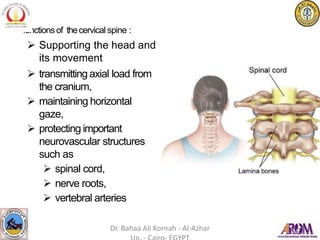
• functionsof thecervical spine :
 Supporting the head and
its movement
 transmitting axial load from
the cranium,
 maintaining horizontal
gaze,
 protecting important
neurovascular structures
such as
 spinal cord,
 nerve roots,
 vertebral arteries
Dr. Bahaa Ali Kornah - Al-Azhar
• Cervical spine deformitiescan have a significantnegative impacton
thequalityof life by causing :
 pain,
 myelopathy,
 radiculopathy,
 sensory motor deficits,
 inabilitytomaintain horizontal gaze
in severe cases.
Why important to recognize
cervical deformity!!!
Dr. Bahaa Ali Kornah - Al-Azhar Un. - Cairo- EGYPT
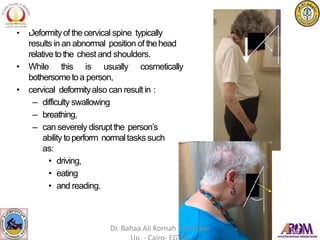
• Deformityof thecervical spine typically
results in an abnormal position of thehead
relative tothe chest and shoulders.
• While this is usually cosmetically
bothersometoa person,
• cervical deformityalso can resultin :
– difficulty swallowing
– breathing,
– can severely disruptthe person’s
ability toperform normaltasks such
as:
• driving,
• eating
• and reading.
Dr. Bahaa Ali Kornah - Al-Azhar
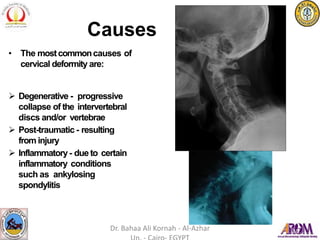
• The mostcommoncauses of
cervical deformity are:
 Degenerative - progressive
collapse of the intervertebral
discs and/or vertebrae
 Post-traumatic - resulting
from injury
 Inflammatory- due to certain
inflammatory conditions
such as ankylosing
spondylitis
Causes
Dr. Bahaa Ali Kornah - Al-Azhar
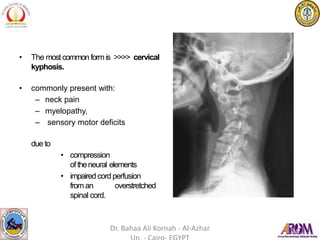
• The mostcommon form is >>>> cervical
kyphosis.
• commonly present with:
– neck pain
– myelopathy,
– sensory motor deficits
due to
• compression
oftheneural elements
• impaired cordperfusion
froman overstretched
spinal cord.
Dr. Bahaa Ali Kornah - Al-Azhar
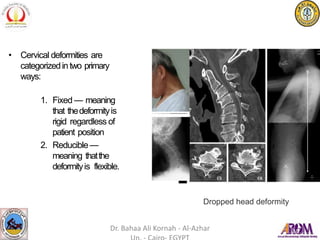
• Cervical deformities are
categorizedintwo primary
ways:
1. Fixed — meaning
that thedeformityis
rigid regardless of
patient position
2. Reducible —
meaning thatthe
deformityis flexible.
Dropped head deformity
Dr. Bahaa Ali Kornah - Al-Azhar
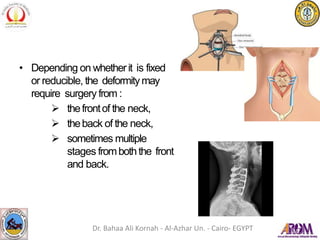
• Depending on whetherit is fixed
or reducible, the deformitymay
require surgery from :
 thefrontof the neck,
 theback of the neck,
 sometimes multiple
stages fromboththe front
and back.
Dr. Bahaa Ali Kornah - Al-Azhar Un. - Cairo- EGYPT
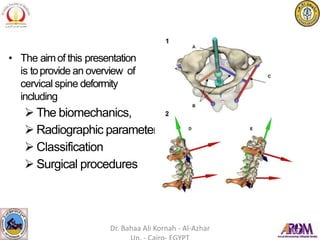
• The aimof this presentation
is toprovide an overview of
cervical spine deformity
including
 The biomechanics,
 Radiographic parameters,
 Classification
 Surgical procedures
Dr. Bahaa Ali Kornah - Al-Azhar
Biomechanics
of
the Cervical Spine
LeeA. Tan,etal, Cervical Spine Deformitypart1-2-3, Neurosurgery 2017
Dr. Bahaa Ali Kornah - Al-Azhar
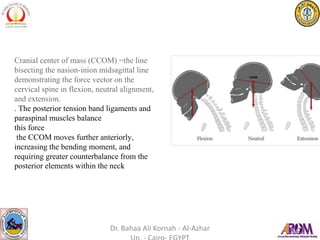
Cranial center of mass (CCOM) =the line
bisecting the nasion-inion midsagittal line
demonstrating the force vector on the
cervical spine in flexion, neutral alignment,
and extension.
. The posterior tension band ligaments and
paraspinal muscles balance
this force
the CCOM moves further anteriorly,
increasing the bending moment, and
requiring greater counterbalance from the
posterior elements within the neck
Dr. Bahaa Ali Kornah - Al-Azhar
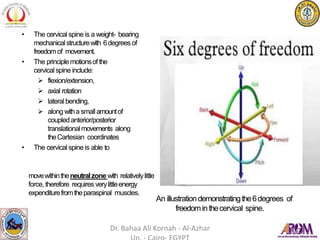
• The cervical spineis a weight- bearing
mechanicalstructurewith 6degrees of
freedomof movement.
• The principlemotionsof the
cervical spine include:
 flexion/extension,
 axial rotation
 lateral bending,
 alongwitha smallamountof
coupledanterior/posterior
translationalmovements along
theCartesian coordinates
• The cervical spineis able to
movewithintheneutralzone with relativelylittle
force, therefore requires verylittleenergy
expenditurefromtheparaspinal muscles.
An illustrationdemonstratingthe6degrees of
freedominthecervical spine.
Dr. Bahaa Ali Kornah - Al-Azhar
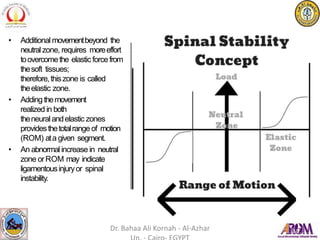
• Additional movementbeyond the
neutralzone, requires moreeffort
toovercomethe elastic forcefrom
thesoft tissues;
therefore,thiszone is called
theelastic zone.
• Adding themovement
realized in both
theneuralandelastic zones
providesthetotalrangeof motion
(ROM) ata given segment.
• An abnormalincrease in neutral
zone orROM may indicate
ligamentousinjuryor spinal
instability.
Dr. Bahaa Ali Kornah - Al-Azhar
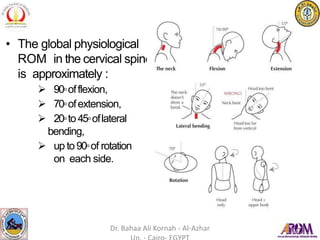
• The global physiological
ROM in the cervical spine
is approximately :
 90◦offlexion,
 70◦ofextension,
 20◦to45◦oflateral
bending,
 up to90◦of rotation
on each side.
Dr. Bahaa Ali Kornah - Al-Azhar
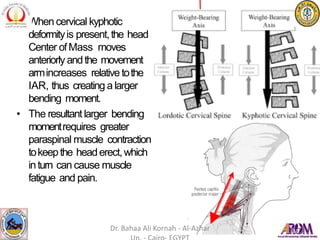
• When cervical kyphotic
deformityis present,the head
Center ofMass moves
anteriorly andthe movement
armincreases relative tothe
IAR, thus creating a larger
bending moment.
• The resultant larger bending
momentrequires greater
paraspinal muscle contraction
tokeepthe headerect,which
inturn can cause muscle
fatigue and pain.
Dr. Bahaa Ali Kornah - Al-Azhar
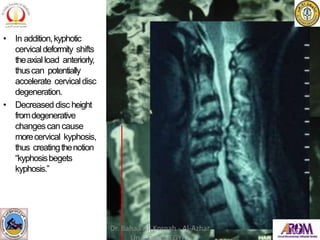
• In addition,kyphotic
cervicaldeformity shifts
theaxial load anteriorly,
thuscan potentially
accelerate cervicaldisc
degeneration.
• Decreased disc height
fromdegenerative
changescan cause
morecervical kyphosis,
thus creatingthenotion
“kyphosisbegets
kyphosis.”
Dr. Bahaa Ali Kornah - Al-Azhar
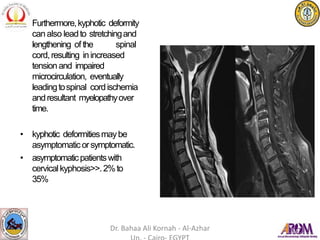
• Furthermore,kyphotic deformity
can also leadto stretchingand
lengthening of the spinal
cord,resulting inincreased
tensionand impaired
microcirculation, eventually
leadingtospinal cordischemia
andresultant myelopathyover
time.
• kyphotic deformitiesmaybe
asymptomaticorsymptomatic.
• asymptomaticpatientswith
cervicalkyphosis>>.2%to
35%
Dr. Bahaa Ali Kornah - Al-Azhar
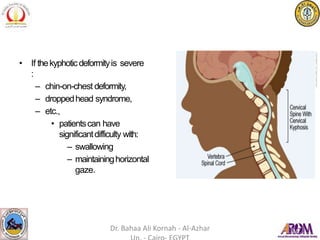
• If thekyphoticdeformityis severe
:
– chin-on-chest deformity,
– droppedhead syndrome,
– etc.,
• patientscan have
significantdifficulty with:
– swallowing
– maintaininghorizontal
gaze.
Dr. Bahaa Ali Kornah - Al-Azhar
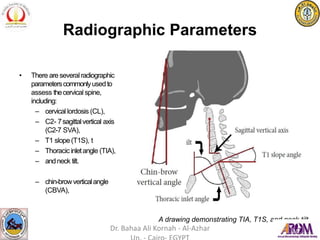
Radiographic Parameters
• There areseveralradiographic
parameterscommonlyusedto
assess thecervical spine,
including:
– cervical lordosis (CL),
– C2- 7sagittalvertical axis
(C2-7 SVA),
– T1 slope(T1S), t
– Thoracicinletangle (TIA),
– andneck tilt.
– chin-browverticalangle
(CBVA),
A drawing demonstrating TIA, T1S, and neck tilt.
Dr. Bahaa Ali Kornah - Al-Azhar
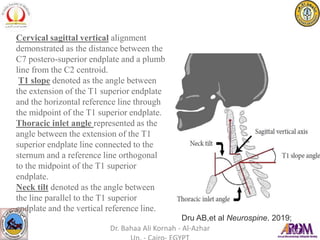
Cervical sagittal vertical alignment
demonstrated as the distance between the
C7 postero-superior endplate and a plumb
line from the C2 centroid.
T1 slope denoted as the angle between
the extension of the T1 superior endplate
and the horizontal reference line through
the midpoint of the T1 superior endplate.
Thoracic inlet angle represented as the
angle between the extension of the T1
superior endplate line connected to the
sternum and a reference line orthogonal
to the midpoint of the T1 superior
endplate.
Neck tilt denoted as the angle between
the line parallel to the T1 superior
endplate and the vertical reference line.
Dru AB,et al Neurospine. 2019;
Dr. Bahaa Ali Kornah - Al-Azhar
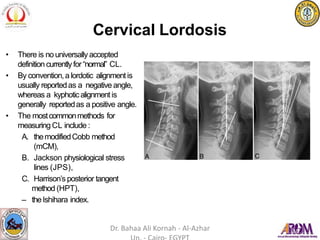
Cervical Lordosis
• There is nouniversally accepted
definition currentlyfor“normal” CL.
• By convention,a lordotic alignmentis
usually reportedas a negative angle,
whereas a kyphoticalignment is
generally reportedas a positive angle.
• The mostcommonmethods for
measuring CL include :
A. themodifiedCobb method
(mCM),
B. Jackson physiological stress
lines (JPS),
C. Harrison’s posterior tangent
method (HPT),
– theIshihara index.
Dr. Bahaa Ali Kornah - Al-Azhar
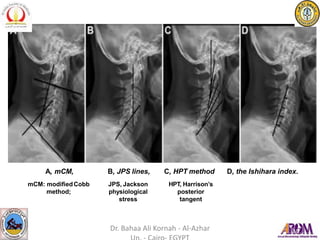
A, mCM,
mCM: modifiedCobb
method;
B, JPS lines,
JPS, Jackson
physiological
stress
C, HPT method
HPT, Harrison’s
posterior
tangent
D, the Ishihara index.
Dr. Bahaa Ali Kornah - Al-Azhar
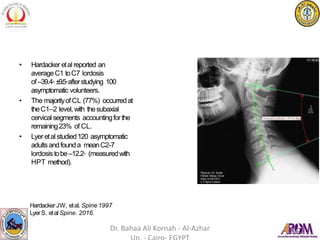
• Hardacker etal reported an
averageC1 toC7 lordosis
of–39.4◦±9.5◦afterstudying 100
asymptomatic volunteers.
• The majorityofCL (77%) occurredat
theC1–2 level,with thesubaxial
cervical segments accountingforthe
remaining23% of CL.
• Lyer etal studied120 asymptomatic
adultsandfounda meanC2-7
lordosistobe–12.2◦ (measuredwith
HPT method).
Hardacker JW, etal. Spine 1997
LyerS. etal Spine. 2016.
Dr. Bahaa Ali Kornah - Al-Azhar
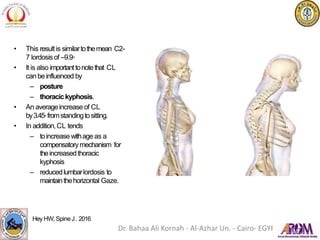
• This resultis similartothemean C2-
7 lordosisof –9.9◦
• It is also importanttonotethat CL
can beinfluenced by
– posture
– thoracickyphosis.
• An averageincrease of CL
by3.45◦fromstandingtositting.
• In addition,CL tends
– toincrease withageas a
compensatorymechanism for
theincreasedthoracic
kyphosis
– reducedlumbarlordosis to
maintainthehorizontal Gaze.
Hey HW,Spine J. 2016
Dr. Bahaa Ali Kornah - Al-Azhar Un. - Cairo- EGYPT
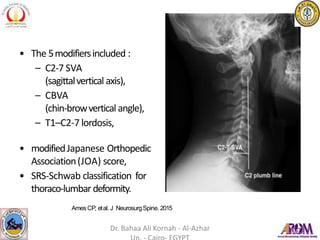
C2-7 SVA
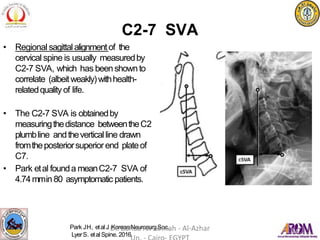
• Regional sagittalalignmentof the
cervical spine is usually measuredby
C2-7 SVA, which has beenshownto
correlate (albeitweakly)withhealth-
relatedqualityof life.
• The C2-7 SVA is obtainedby
measuringthedistance betweentheC2
plumbline andtheverticalline drawn
fromtheposteriorsuperiorend plateof
C7.
• Park etal founda meanC2-7 SVA of
4.74mmin 80 asymptomatic patients.
Park JH, etal J KoreanNeurosurgSoc.
LyerS. etal Spine. 2016.
Dr. Bahaa Ali Kornah - Al-Azhar
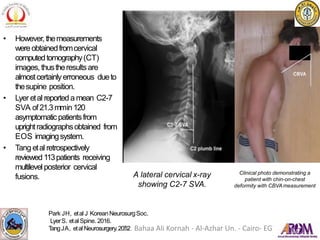
A lateral cervical x-ray
showing C2-7 SVA.
Clinical photo demonstrating a
patient with chin-on-chest
deformity with CBVAmeasurement
• However,themeasurements
wereobtainedfromcervical
computedtomography(CT)
images, thustheresultsare
almostcertainlyerroneous dueto
thesupine position.
• Lyer etal reporteda mean C2-7
SVA of21.3mmin120
asymptomaticpatientsfrom
uprightradiographsobtained from
EOS imagingsystem.
• Tang etal retrospectively
reviewed 113patients receiving
multilevel posterior cervical
fusions.
Park JH, etal J KoreanNeurosurgSoc.
LyerS. etal Spine. 2016.
T
angJA, etal Neurosurgery.2012
Dr. Bahaa Ali Kornah - Al-Azhar Un. - Cairo- EGYPT
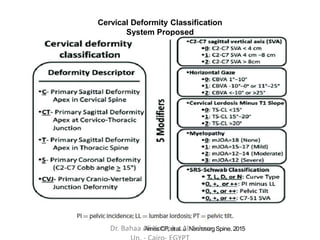
Cervical Deformity Classification
• therehas not beena universally accepted classification
systemfor cervicaldeformity.
• common classification system >>>
 Ames-ACD and
 Schwab-ASD schemes
• Common used terms
• flexible,
• rigid,
• kyphotic,
• scoliotic, etc.
Dr. Bahaa Ali Kornah - Al-Azhar
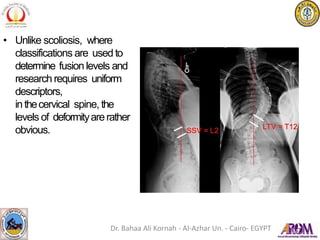
• Unlike scoliosis, where
classifications are used to
determine fusion levels and
research requires uniform
descriptors,
inthecervical spine, the
levels of deformityarerather
obvious.
Dr. Bahaa Ali Kornah - Al-Azhar Un. - Cairo- EGYPT
• In 2015,Amesetal proposedaclassification
systemforcervicalspine deformityincluding
– adeformitydescriptor
– plus5modifiers.
AmesCP, etal. J NeurosurgSpine. 2015
Dr. Bahaa Ali Kornah - Al-Azhar
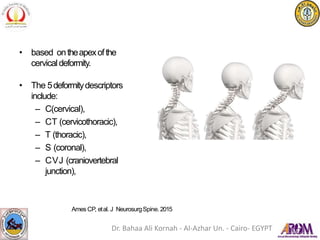
• based ontheapexofthe
cervicaldeformity.
• The 5deformitydescriptors
include:
– C(cervical),
– CT (cervicothoracic),
– T (thoracic),
– S (coronal),
– CVJ (craniovertebral
junction),
Ames CP, etal. J NeurosurgSpine. 2015
Dr. Bahaa Ali Kornah - Al-Azhar Un. - Cairo- EGYPT
• The 5modifiersincluded :
– C2-7 SVA
(sagittalvertical axis),
– CBVA
(chin-browvertical angle),
– T1–C2-7 lordosis,
• modifiedJapanese Orthopedic
Association(JOA) score,
• SRS-Schwab classification for
thoraco-lumbar deformity.
AmesCP, etal. J NeurosurgSpine. 2015
Dr. Bahaa Ali Kornah - Al-Azhar
Cervical Deformity Classification
System Proposed
AmesCP, etal. J NeurosurgSpine. 2015
Dr. Bahaa Ali Kornah - Al-Azhar
Surgical Procedures
Dr. Bahaa Ali Kornah - Al-Azhar
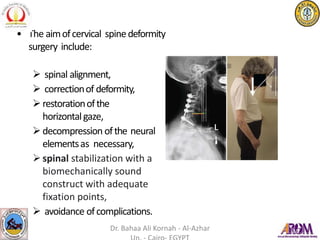
• The aimofcervical spinedeformity
surgery include:
 spinal alignment,
 correctionof deformity,
restorationofthe
horizontalgaze,
decompression ofthe neural
elementsas necessary,
spinal stabilization with a
biomechanically sound
construct with adequate
fixation points,
 avoidance ofcomplications.
Dr. Bahaa Ali Kornah - Al-Azhar
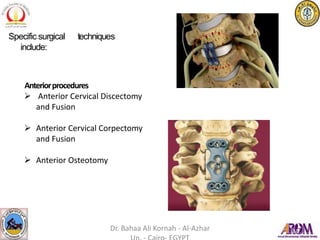
Specific surgical techniques
include:
Anteriorprocedures
 Anterior Cervical Discectomy
and Fusion
 Anterior Cervical Corpectomy
and Fusion
 Anterior Osteotomy
Dr. Bahaa Ali Kornah - Al-Azhar
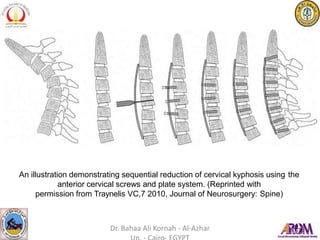
An illustration demonstrating sequential reduction of cervical kyphosis using the
anterior cervical screws and plate system. (Reprinted with
permission from Traynelis VC,7 2010, Journal of Neurosurgery: Spine)
Dr. Bahaa Ali Kornah - Al-Azhar
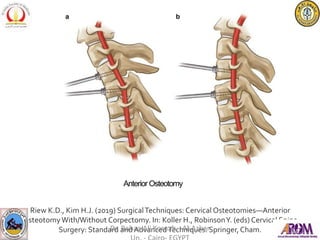
Anterior Osteotomy
Riew K.D., Kim H.J. (2019) SurgicalTechniques: Cervical Osteotomies—Anterior
OsteotomyWith/Without Corpectomy. In: Koller H., RobinsonY. (eds) Cervical Spine
Surgery: Standard and AdvancedTechniques. Springer,Cham.
Dr. Bahaa Ali Kornah - Al-Azhar
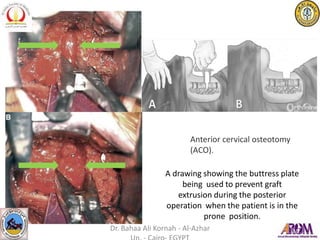
Anterior cervical osteotomy
(ACO).
A drawing showing the buttress plate
being used to prevent graft
extrusion during the posterior
operation when the patient is in the
prone position.
Dr. Bahaa Ali Kornah - Al-Azhar
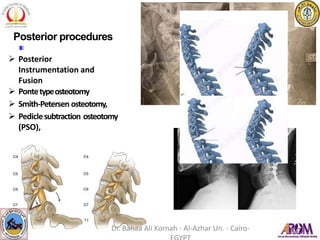
Posterior procedures
 Posterior
Instrumentation and
Fusion
 Pontetypeosteotomy
 Smith-Petersen osteotomy,
 Pediclesubtraction osteotomy
(PSO),
Ponte type osteotomy
Dr. Bahaa Ali Kornah - Al-Azhar Un. - Cairo-
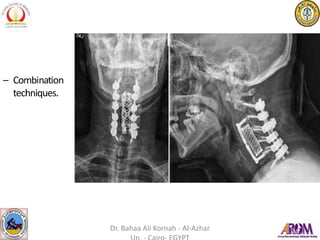
– Combination
techniques.
Dr. Bahaa Ali Kornah - Al-Azhar
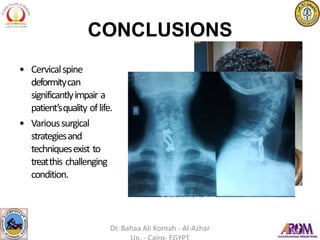
CONCLUSIONS
• Cervicalspine
deformitycan
significantlyimpair a
patient’squality oflife.
• Varioussurgical
strategiesand
techniquesexist to
treatthis challenging
condition.
Dr. Bahaa Ali Kornah - Al-Azhar
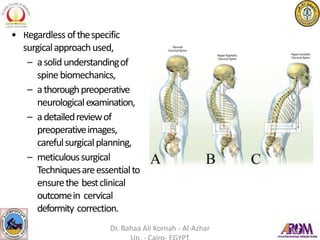
• Regardless ofthespecific
surgicalapproachused,
– asolidunderstandingof
spinebiomechanics,
– athoroughpreoperative
neurologicalexamination,
– adetailedreviewof
preoperativeimages,
carefulsurgicalplanning,
– meticuloussurgical
Techniquesareessentialto
ensurethe bestclinical
outcomein cervical
deformity correction.
Dr. Bahaa Ali Kornah - Al-Azhar
Bahaa Kornah - Al-Azhar UN. -
thank
you
for
your
attent
ion
Bahaa Kornah - Al-Azhar UN. - Cairo EGYPT
‫شكرا‬
Thanks
Bahaa Kornah
bkornah@gmail.com
‫قرنة‬ ‫على‬ ‫بهاء‬
T H A N K Y O U !
‫بهاءقرنة‬

Cervical spine deformity bahaa

  • 1.
    DR. BAHAA ALIKORNAH PROF.. OF ORTHOPEDIC AL-AZHAR UNIVERSITY CAIRO – EGYPT Cervical Spine Deformities Dr. Bahaa Ali Kornah - Al-Azhar Un. - Cairo- EGYPT
  • 2.
    Dr. Bahaa AliKornah - Al-Azhar Un. - Cairo- EGYPT Dr. Bahaa Ali Kornah, Prof. Of Orthopedic and Trauma Al-Azhar University Cairo. Egypt
  • 3.
    Deformities, • ugliness, • Deformity:Alteration in or distortion of the natural form of a part, organ, or the entire body. • It may be acquired or congenital. • If present after injury, deformity usually implies the presence of bone fracture, bone dislocation, or both. Dr. Bahaa Ali Kornah - Al-Azhar
  • 4.
    • functionsof thecervicalspine :  Supporting the head and its movement  transmitting axial load from the cranium,  maintaining horizontal gaze,  protecting important neurovascular structures such as  spinal cord,  nerve roots,  vertebral arteries Dr. Bahaa Ali Kornah - Al-Azhar
  • 5.
    • Cervical spinedeformitiescan have a significantnegative impacton thequalityof life by causing :  pain,  myelopathy,  radiculopathy,  sensory motor deficits,  inabilitytomaintain horizontal gaze in severe cases. Why important to recognize cervical deformity!!! Dr. Bahaa Ali Kornah - Al-Azhar Un. - Cairo- EGYPT
  • 6.
    • Deformityof thecervicalspine typically results in an abnormal position of thehead relative tothe chest and shoulders. • While this is usually cosmetically bothersometoa person, • cervical deformityalso can resultin : – difficulty swallowing – breathing, – can severely disruptthe person’s ability toperform normaltasks such as: • driving, • eating • and reading. Dr. Bahaa Ali Kornah - Al-Azhar
  • 7.
    • The mostcommoncausesof cervical deformity are:  Degenerative - progressive collapse of the intervertebral discs and/or vertebrae  Post-traumatic - resulting from injury  Inflammatory- due to certain inflammatory conditions such as ankylosing spondylitis Causes Dr. Bahaa Ali Kornah - Al-Azhar
  • 8.
    • The mostcommonform is >>>> cervical kyphosis. • commonly present with: – neck pain – myelopathy, – sensory motor deficits due to • compression oftheneural elements • impaired cordperfusion froman overstretched spinal cord. Dr. Bahaa Ali Kornah - Al-Azhar
  • 9.
    • Cervical deformitiesare categorizedintwo primary ways: 1. Fixed — meaning that thedeformityis rigid regardless of patient position 2. Reducible — meaning thatthe deformityis flexible. Dropped head deformity Dr. Bahaa Ali Kornah - Al-Azhar
  • 10.
    • Depending onwhetherit is fixed or reducible, the deformitymay require surgery from :  thefrontof the neck,  theback of the neck,  sometimes multiple stages fromboththe front and back. Dr. Bahaa Ali Kornah - Al-Azhar Un. - Cairo- EGYPT
  • 11.
    • The aimofthis presentation is toprovide an overview of cervical spine deformity including  The biomechanics,  Radiographic parameters,  Classification  Surgical procedures Dr. Bahaa Ali Kornah - Al-Azhar
  • 12.
    Biomechanics of the Cervical Spine LeeA.Tan,etal, Cervical Spine Deformitypart1-2-3, Neurosurgery 2017 Dr. Bahaa Ali Kornah - Al-Azhar
  • 13.
    Cranial center ofmass (CCOM) =the line bisecting the nasion-inion midsagittal line demonstrating the force vector on the cervical spine in flexion, neutral alignment, and extension. . The posterior tension band ligaments and paraspinal muscles balance this force the CCOM moves further anteriorly, increasing the bending moment, and requiring greater counterbalance from the posterior elements within the neck Dr. Bahaa Ali Kornah - Al-Azhar
  • 14.
    • The cervicalspineis a weight- bearing mechanicalstructurewith 6degrees of freedomof movement. • The principlemotionsof the cervical spine include:  flexion/extension,  axial rotation  lateral bending,  alongwitha smallamountof coupledanterior/posterior translationalmovements along theCartesian coordinates • The cervical spineis able to movewithintheneutralzone with relativelylittle force, therefore requires verylittleenergy expenditurefromtheparaspinal muscles. An illustrationdemonstratingthe6degrees of freedominthecervical spine. Dr. Bahaa Ali Kornah - Al-Azhar
  • 15.
    • Additional movementbeyondthe neutralzone, requires moreeffort toovercomethe elastic forcefrom thesoft tissues; therefore,thiszone is called theelastic zone. • Adding themovement realized in both theneuralandelastic zones providesthetotalrangeof motion (ROM) ata given segment. • An abnormalincrease in neutral zone orROM may indicate ligamentousinjuryor spinal instability. Dr. Bahaa Ali Kornah - Al-Azhar
  • 16.
    • The globalphysiological ROM in the cervical spine is approximately :  90◦offlexion,  70◦ofextension,  20◦to45◦oflateral bending,  up to90◦of rotation on each side. Dr. Bahaa Ali Kornah - Al-Azhar
  • 17.
    • When cervicalkyphotic deformityis present,the head Center ofMass moves anteriorly andthe movement armincreases relative tothe IAR, thus creating a larger bending moment. • The resultant larger bending momentrequires greater paraspinal muscle contraction tokeepthe headerect,which inturn can cause muscle fatigue and pain. Dr. Bahaa Ali Kornah - Al-Azhar
  • 18.
    • In addition,kyphotic cervicaldeformityshifts theaxial load anteriorly, thuscan potentially accelerate cervicaldisc degeneration. • Decreased disc height fromdegenerative changescan cause morecervical kyphosis, thus creatingthenotion “kyphosisbegets kyphosis.” Dr. Bahaa Ali Kornah - Al-Azhar
  • 19.
    • Furthermore,kyphotic deformity canalso leadto stretchingand lengthening of the spinal cord,resulting inincreased tensionand impaired microcirculation, eventually leadingtospinal cordischemia andresultant myelopathyover time. • kyphotic deformitiesmaybe asymptomaticorsymptomatic. • asymptomaticpatientswith cervicalkyphosis>>.2%to 35% Dr. Bahaa Ali Kornah - Al-Azhar
  • 20.
    • If thekyphoticdeformityissevere : – chin-on-chest deformity, – droppedhead syndrome, – etc., • patientscan have significantdifficulty with: – swallowing – maintaininghorizontal gaze. Dr. Bahaa Ali Kornah - Al-Azhar
  • 21.
    Radiographic Parameters • Thereareseveralradiographic parameterscommonlyusedto assess thecervical spine, including: – cervical lordosis (CL), – C2- 7sagittalvertical axis (C2-7 SVA), – T1 slope(T1S), t – Thoracicinletangle (TIA), – andneck tilt. – chin-browverticalangle (CBVA), A drawing demonstrating TIA, T1S, and neck tilt. Dr. Bahaa Ali Kornah - Al-Azhar
  • 22.
    Cervical sagittal verticalalignment demonstrated as the distance between the C7 postero-superior endplate and a plumb line from the C2 centroid. T1 slope denoted as the angle between the extension of the T1 superior endplate and the horizontal reference line through the midpoint of the T1 superior endplate. Thoracic inlet angle represented as the angle between the extension of the T1 superior endplate line connected to the sternum and a reference line orthogonal to the midpoint of the T1 superior endplate. Neck tilt denoted as the angle between the line parallel to the T1 superior endplate and the vertical reference line. Dru AB,et al Neurospine. 2019; Dr. Bahaa Ali Kornah - Al-Azhar
  • 23.
    Cervical Lordosis • Thereis nouniversally accepted definition currentlyfor“normal” CL. • By convention,a lordotic alignmentis usually reportedas a negative angle, whereas a kyphoticalignment is generally reportedas a positive angle. • The mostcommonmethods for measuring CL include : A. themodifiedCobb method (mCM), B. Jackson physiological stress lines (JPS), C. Harrison’s posterior tangent method (HPT), – theIshihara index. Dr. Bahaa Ali Kornah - Al-Azhar
  • 24.
    A, mCM, mCM: modifiedCobb method; B,JPS lines, JPS, Jackson physiological stress C, HPT method HPT, Harrison’s posterior tangent D, the Ishihara index. Dr. Bahaa Ali Kornah - Al-Azhar
  • 25.
    • Hardacker etalreported an averageC1 toC7 lordosis of–39.4◦±9.5◦afterstudying 100 asymptomatic volunteers. • The majorityofCL (77%) occurredat theC1–2 level,with thesubaxial cervical segments accountingforthe remaining23% of CL. • Lyer etal studied120 asymptomatic adultsandfounda meanC2-7 lordosistobe–12.2◦ (measuredwith HPT method). Hardacker JW, etal. Spine 1997 LyerS. etal Spine. 2016. Dr. Bahaa Ali Kornah - Al-Azhar
  • 26.
    • This resultissimilartothemean C2- 7 lordosisof –9.9◦ • It is also importanttonotethat CL can beinfluenced by – posture – thoracickyphosis. • An averageincrease of CL by3.45◦fromstandingtositting. • In addition,CL tends – toincrease withageas a compensatorymechanism for theincreasedthoracic kyphosis – reducedlumbarlordosis to maintainthehorizontal Gaze. Hey HW,Spine J. 2016 Dr. Bahaa Ali Kornah - Al-Azhar Un. - Cairo- EGYPT
  • 27.
    C2-7 SVA • Regionalsagittalalignmentof the cervical spine is usually measuredby C2-7 SVA, which has beenshownto correlate (albeitweakly)withhealth- relatedqualityof life. • The C2-7 SVA is obtainedby measuringthedistance betweentheC2 plumbline andtheverticalline drawn fromtheposteriorsuperiorend plateof C7. • Park etal founda meanC2-7 SVA of 4.74mmin 80 asymptomatic patients. Park JH, etal J KoreanNeurosurgSoc. LyerS. etal Spine. 2016. Dr. Bahaa Ali Kornah - Al-Azhar
  • 28.
    A lateral cervicalx-ray showing C2-7 SVA. Clinical photo demonstrating a patient with chin-on-chest deformity with CBVAmeasurement • However,themeasurements wereobtainedfromcervical computedtomography(CT) images, thustheresultsare almostcertainlyerroneous dueto thesupine position. • Lyer etal reporteda mean C2-7 SVA of21.3mmin120 asymptomaticpatientsfrom uprightradiographsobtained from EOS imagingsystem. • Tang etal retrospectively reviewed 113patients receiving multilevel posterior cervical fusions. Park JH, etal J KoreanNeurosurgSoc. LyerS. etal Spine. 2016. T angJA, etal Neurosurgery.2012 Dr. Bahaa Ali Kornah - Al-Azhar Un. - Cairo- EGYPT
  • 29.
    Cervical Deformity Classification •therehas not beena universally accepted classification systemfor cervicaldeformity. • common classification system >>>  Ames-ACD and  Schwab-ASD schemes • Common used terms • flexible, • rigid, • kyphotic, • scoliotic, etc. Dr. Bahaa Ali Kornah - Al-Azhar
  • 30.
    • Unlike scoliosis,where classifications are used to determine fusion levels and research requires uniform descriptors, inthecervical spine, the levels of deformityarerather obvious. Dr. Bahaa Ali Kornah - Al-Azhar Un. - Cairo- EGYPT
  • 31.
    • In 2015,Amesetalproposedaclassification systemforcervicalspine deformityincluding – adeformitydescriptor – plus5modifiers. AmesCP, etal. J NeurosurgSpine. 2015 Dr. Bahaa Ali Kornah - Al-Azhar
  • 32.
    • based ontheapexofthe cervicaldeformity. •The 5deformitydescriptors include: – C(cervical), – CT (cervicothoracic), – T (thoracic), – S (coronal), – CVJ (craniovertebral junction), Ames CP, etal. J NeurosurgSpine. 2015 Dr. Bahaa Ali Kornah - Al-Azhar Un. - Cairo- EGYPT
  • 33.
    • The 5modifiersincluded: – C2-7 SVA (sagittalvertical axis), – CBVA (chin-browvertical angle), – T1–C2-7 lordosis, • modifiedJapanese Orthopedic Association(JOA) score, • SRS-Schwab classification for thoraco-lumbar deformity. AmesCP, etal. J NeurosurgSpine. 2015 Dr. Bahaa Ali Kornah - Al-Azhar
  • 34.
    Cervical Deformity Classification SystemProposed AmesCP, etal. J NeurosurgSpine. 2015 Dr. Bahaa Ali Kornah - Al-Azhar
  • 35.
    Surgical Procedures Dr. BahaaAli Kornah - Al-Azhar
  • 36.
    • The aimofcervicalspinedeformity surgery include:  spinal alignment,  correctionof deformity, restorationofthe horizontalgaze, decompression ofthe neural elementsas necessary, spinal stabilization with a biomechanically sound construct with adequate fixation points,  avoidance ofcomplications. Dr. Bahaa Ali Kornah - Al-Azhar
  • 37.
    Specific surgical techniques include: Anteriorprocedures Anterior Cervical Discectomy and Fusion  Anterior Cervical Corpectomy and Fusion  Anterior Osteotomy Dr. Bahaa Ali Kornah - Al-Azhar
  • 38.
    An illustration demonstratingsequential reduction of cervical kyphosis using the anterior cervical screws and plate system. (Reprinted with permission from Traynelis VC,7 2010, Journal of Neurosurgery: Spine) Dr. Bahaa Ali Kornah - Al-Azhar
  • 39.
    Anterior Osteotomy Riew K.D.,Kim H.J. (2019) SurgicalTechniques: Cervical Osteotomies—Anterior OsteotomyWith/Without Corpectomy. In: Koller H., RobinsonY. (eds) Cervical Spine Surgery: Standard and AdvancedTechniques. Springer,Cham. Dr. Bahaa Ali Kornah - Al-Azhar
  • 40.
    Anterior cervical osteotomy (ACO). Adrawing showing the buttress plate being used to prevent graft extrusion during the posterior operation when the patient is in the prone position. Dr. Bahaa Ali Kornah - Al-Azhar
  • 41.
    Posterior procedures  Posterior Instrumentationand Fusion  Pontetypeosteotomy  Smith-Petersen osteotomy,  Pediclesubtraction osteotomy (PSO), Ponte type osteotomy Dr. Bahaa Ali Kornah - Al-Azhar Un. - Cairo-
  • 42.
  • 43.
    Dr. Bahaa AliKornah - Al-Azhar
  • 44.
    CONCLUSIONS • Cervicalspine deformitycan significantlyimpair a patient’squalityoflife. • Varioussurgical strategiesand techniquesexist to treatthis challenging condition. Dr. Bahaa Ali Kornah - Al-Azhar
  • 45.
    • Regardless ofthespecific surgicalapproachused, –asolidunderstandingof spinebiomechanics, – athoroughpreoperative neurologicalexamination, – adetailedreviewof preoperativeimages, carefulsurgicalplanning, – meticuloussurgical Techniquesareessentialto ensurethe bestclinical outcomein cervical deformity correction. Dr. Bahaa Ali Kornah - Al-Azhar
  • 46.
    Bahaa Kornah -Al-Azhar UN. -
  • 47.
    thank you for your attent ion Bahaa Kornah -Al-Azhar UN. - Cairo EGYPT ‫شكرا‬ Thanks Bahaa Kornah bkornah@gmail.com ‫قرنة‬ ‫على‬ ‫بهاء‬
  • 48.
    T H AN K Y O U ! ‫بهاءقرنة‬