Bahaa Ali Kornah-Al-Azhar Un. Cairo. EGYPT
Dr. Bahaa Ali Kornah
Prof.. Of Orthopedic
Al-Azhar University
Cairo - Egypt
‫وبركاته‬ ‫هللا‬ ‫ورحمة‬ ‫عليكم‬ ‫السالم‬
Bahaa Ali Kornah-Al-Azhar Un. Cairo. EGYPT
CLINCIAL HIP
EXAMINATION
Dr. Bahaa Ali Kornah
Prof.. Of Orthopedic
Al-Azhar University
Cairo - Egypt
Bahaa Ali Kornah-Al-Azhar Un. Cairo. EGYPT
Keytothespine
Task at hand...
l How to examine a patient
SYSTEMATIC APPROACH
Bahaa Ali Kornah-Al-Azhar Un. Cairo. EGYPT
Systematic Approach
l Steps
_ Components
1
2
3
4
5
Bahaa Ali Kornah-Al-Azhar Un. Cairo. EGYPT
Systematic Approach
l Miss a Step
Bahaa Ali Kornah-Al-Azhar Un. Cairo. EGYPT
 Avoid lack of a systematic approach in
your clinical practice.
 Develop your own routine that works best
for you but don’t stray too far from the
norm.
 Just as important do not jump around and
get the order of the hip examination out of
sync.

Bahaa Ali Kornah-Al-Azhar Un. Cairo. EGYPT
It’s not “What you do” but
“How you do it” that counts.
Don’t forget the 5 P’s.
Bahaa Ali Kornah-Al-Azhar Un. Cairo. EGYPT
Few important points
before examination proper
Introduce
yourself
consent
exposure
Female
attendant
Bahaa Ali Kornah-Al-Azhar Un. Cairo. EGYPT
Professional attitude
Polite
Gesture
Dress
Handling
Mobile in
vibration mode.
Bahaa Ali Kornah-Al-Azhar Un. Cairo. EGYPT
HISTORY
SYMPTOMS / CHIEF COMPLAINTS
 PAIN
 SWELLING
 DEFORMITIES
 LIMP
 STIFFNESS +loss of function
 Snapping
 Limb length discrepancy
Bahaa Ali Kornah-Al-Azhar Un. Cairo. EGYPT
HISTORY
CHIEF COMPLAINTS
DURATTION ONSET
PROGRESSION OF THE SYMPTOMS
PERTAINING TO VARIOUS AETIOLOGY
CONSTITUTIONAL SYMPTOMS
COMORBIDITIES
HABITS
TREATMENT TAKEN
OCCUPATION AND RECREATIONAL DEMANDS
EFFECT ON DAILY ACTIVITIES (ADL)
Bahaa Ali Kornah-Al-Azhar Un. Cairo. EGYPT
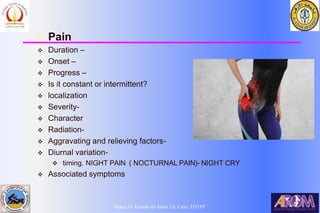
l Pain
 Duration –
 Onset –
 Progress –
 Is it constant or intermittent?
 localization
 Severity-
 Character
 Radiation-
 Aggravating and relieving factors-
 Diurnal variation-
 timing. NIGHT PAIN ( NOCTURNAL PAIN)- NIGHT CRY
 Associated symptoms
Bahaa Ali Kornah-Al-Azhar Un. Cairo. EGYPT
PAIN
Most important reported symptom.
Site
Anterior hip pain : arthritis, hip flexor strain, iliopsoas bursitis,
labral tear
Lateral hip pain : greater trochanteric bursitis, gluteus medius
tear, iliotibial band syndrome (athletes), meralgia paresthetica
(an entrapment syndrome of the lateral femoral cutaneous
nerve syndrome)
Posterior hip pain DDx: hip extensor and external rotator
pathology, degenerative disc disease, spinal stenosis
REFERED PAIN: to knee. hip pathology can be referred to the knee
Bahaa Ali Kornah-Al-Azhar Un. Cairo. EGYPT
SWELLING , STIFFNES
 Site
 Onset
 Duration
 Association with pain
 Progression over time
 PROGRESSION –
STATIONARY
INCREASING -
REGRESSING
Bahaa Ali Kornah-Al-Azhar Un. Cairo. EGYPT
LIMP
 Onset
 Duration
 Association with pain
 Progression
 Ambulatory status
 PROGRESSION OF LIMP (GRADES)
 LIMP WITHOUT AID
 LIMP WITH AID
 WHEEL CHAIR BOUND
 BED RIDDEN
Bahaa Ali Kornah-Al-Azhar Un. Cairo. EGYPT
l Deformity
How long the deformity is present?
How did it start?
How is it progressing?
Any associated symptoms?
Is there any history of trauma or infection?
l Limb length discrepancy
How long it is present?
Is it static or progressive?
Associated symptoms?
Any history of infection or trauma?
Bahaa Ali Kornah-Al-Azhar Un. Cairo. EGYPT
l History to assess function
 Walking ability
Normal or altered
Restricted or unrestricted
Aided or unaided
If aided; which aid is used
 Ability to squat
 Ability to sit cross legged
 Ability to drive car
 Ability to tie shoes
Bahaa Ali Kornah-Al-Azhar Un. Cairo. EGYPT
PAST HISTORY
Trauma
Tuberculosis
Surgery around hip
Skin /hematological
disorders
Neurological
disorders
Connective tissue
disorders
Steroid intake
Any other significant
medical /surgical illness
Bahaa Ali Kornah-Al-Azhar Un. Cairo. EGYPT
PERSONAL HISTORY
Occupation and work
tolerance
Diet
Smoking/alcohol
Sexual history
Menopausal history
Bahaa Ali Kornah-Al-Azhar Un. Cairo. EGYPT
FAMILY HISTORY
TBin close relative
Dysplasia
Metabolicstorage disorders
Inflammatory arthritis
Bahaa Ali Kornah-Al-Azhar Un. Cairo. EGYPT
SUMMARY OF HISTORY
ACUTE / CHRONIC
PROGRESSIVE / NON PROGRESSIVE /REGRESSIVE
MONOARTICULAR / POLYARTICULAR
POSSIBLE AETIOLOGY
(CONG./TRAUMATIC/INFECTIVE/INFLAMMATORY/NEO
PLASTIC/DEGENERATIVE/ METABOLIC ETC)
PATIENT’S DEMAND / EXPECTATION
Bahaa Ali Kornah-Al-Azhar Un. Cairo. EGYPT
Pattern of Examination
l Inspection.
l Palpation.
l Movements.
l Measurements.
l Special tests.
Bahaa Ali Kornah-Al-Azhar Un. Cairo. EGYPT
Basic Principles
( Prerequisites of Examination )
l Patient must be suitably undressed.
l Hard bed.
X
Bahaa Ali Kornah-Al-Azhar Un. Cairo. EGYPT
GENERAL EXAMINATION
Head to foot examination
l Eyes- Blue sclera, iritis ,uveitis, squint, microphthalmos, cornea,
pigmentation of sclera.
l Pinna- Low set, blackish discoloration.
l Cheeks- Malar rash.
l Mouth – Normal dental hygiene, arch of palate.
l Hair Line- Normal or low
l Neck – Webbing , thyroid swelling.
l Nipples- Normal level or not.
l Shape of chest wall- Pectus carinatum/ excavatum.
l Abdomen- Protuberant , undescended testis , hernias.
l Nails- Pitting.
l Palms and soles- Hyperkeratosis.
Bahaa Ali Kornah-Al-Azhar Un. Cairo. EGYPT
GENERAL EXAMINATION
Head to foot examination
l Thickening of lower end radius, malleoli and costochondral junctions.
l Ligamentous laxity
 Apposition of thumb to flexor aspect of forearm
 Passive extension of fingers so that they lie parallel to the forearm.
 Hyperextension of elbow at least 10 degrees
 Hyperextension of knee at least 10 degrees
 Excessive passive dorsiflexion of ankle (45 degree) with eversion of foot.
l Neurocutaneous markers-
l General postures and altitude
Bahaa Ali Kornah-Al-Azhar Un. Cairo. EGYPT
Inspection
l with the patient
_ standing,
_ walking,
_ sitting and
_ lying down.
l Look from the front, sides and back.
l Look for any asymmetry when compared to the
normal side.
Bahaa Ali Kornah-Al-Azhar Un. Cairo. EGYPT
Inspection
l Standing position.
Inspection
Gait
Alignment
Limb Length Discrepancy
l Lying down position.
 Limb Length Discrepancy
ATTITUDE
Bahaa Ali Kornah-Al-Azhar Un. Cairo. EGYPT
l General Inspection
 Observe the patient first in the standing
position
 Stand with the patient facing you.
 Be prepared to support the patient, as they may
not be able to stand unaided.
 considering the patient as a whole. Consider if
the patient looks well, is breathless at rest, is
jaundiced or has generalized features of
psoriasis or rheumatoid arthritis.
Bahaa Ali Kornah-Al-Azhar Un. Cairo. EGYPT
Inspection.
l Look for general clues
 Any walking frame,
 special shoes or orthosis present?
 Does the patient use a stick and is it in the
correct hand?
 Ask the patient is they have a walking stick
 Talk to the patient; explain what you are going
to do Work around the hip 360° get used to
using a small space
Bahaa Ali Kornah-Al-Azhar Un. Cairo. EGYPT
l General Inspection
l Observe the patient from
 the front,
 the side and
 then back.
Bahaa Ali Kornah-Al-Azhar Un. Cairo. EGYPT
Look for the following.
 Attitude
 Deformity
 Bony contours
 Soft tissue contours
 Swelling
 Wasting
 Limb length discrepancy
 Skin over the joint
Bahaa Ali Kornah-Al-Azhar Un. Cairo. EGYPT
Hip inspection from the Front
l Does the patient stand straight and upright?
l Is stance comfortable?
l Is stance symmetrical?
l Are the shoulders level?
l Check the level of the ASIS .Is the pelvis symmetrical? If not
level…. why not? What is causing the pelvic obliquity
l • Is there a leg length discrepancy
l • Is there a fixed deformity Ask for blocks if the
pelvis is not level to access functional leg
length discrepancy.
Bahaa Ali Kornah-Al-Azhar Un. Cairo. EGYPT
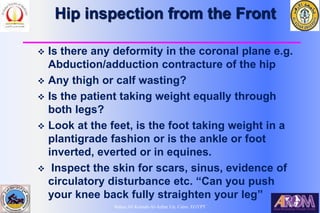
Hip inspection from the Front
 Is there any deformity in the coronal plane e.g.
Abduction/adduction contracture of the hip
 Any thigh or calf wasting?
 Is the patient taking weight equally through
both legs?
 Look at the feet, is the foot taking weight in a
plantigrade fashion or is the ankle or foot
inverted, everted or in equines.
 Inspect the skin for scars, sinus, evidence of
circulatory disturbance etc. “Can you push
your knee back fully straighten your leg”
Bahaa Ali Kornah-Al-Azhar Un. Cairo. EGYPT
Anteriorly from proximal to distal
 Level of ASIS
 Normal hollowing of iliac fossa
 Inguinal orifices
 Widened perineum
 Femoral artery pulsations
 Abnormal fullness in the Scarpa’s triangle
 Contour and level of the greater
trochanter
 Contour and bulk of the thigh muscles
looking for abnormal contour and wasting
 Scars, discolorations, swellings and
sinuses
Bahaa Ali Kornah-Al-Azhar Un. Cairo. EGYPT
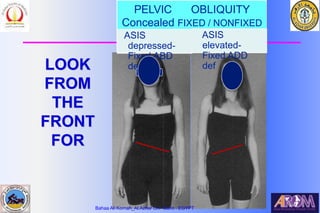
LOOK
FROM
THE
FRONT
FOR
PELVIC OBLIQUITY
Concealed FIXED / NONFIXED
ASIS
depressed-
Fixed ABD
def
ASIS
elevated-
Fixed ADD
def
Bahaa Ali Kornah_Al.Azhar Un. Cairo . EGYPT
Bahaa Ali Kornah-Al-Azhar Un. Cairo. EGYPT
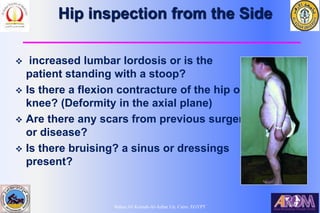
Hip inspection from the Side
 increased lumbar lordosis or is the
patient standing with a stoop?
 Is there a flexion contracture of the hip or
knee? (Deformity in the axial plane)
 Are there any scars from previous surgery
or disease?
 Is there bruising? a sinus or dressings
present?
Bahaa Ali Kornah-Al-Azhar Un. Cairo. EGYPT
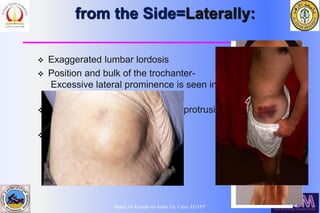
from the Side=Laterally:
 Exaggerated lumbar lordosis
 Position and bulk of the trochanter-
Excessive lateral prominence is seen in
subluxation/dislocation.
 Reduced prominence seen with protrusio
acetabuli.
 Scars sinuses or any abnormal
prominences
Bahaa Ali Kornah-Al-Azhar Un. Cairo. EGYPT
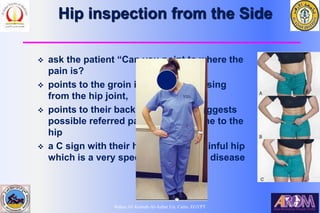
Hip inspection from the Side
 ask the patient “Can you point to where the
pain is?
 points to the groin it is probably arising
from the hip joint,
 points to their back or buttock it suggests
possible referred pain from the spine to the
hip
 a C sign with their hand over the painful hip
which is a very specific sign for hip disease
Bahaa Ali Kornah-Al-Azhar Un. Cairo. EGYPT
Hip inspection from the Back
 Does the patient have a straight or
scoliotic lumbar spine, and if so, is it
compensated or not.
 Check for any gluteal muscle
(buttock) wasting Look at the
popliteal creases,
 You are assessing forward flexion
checking the spine for symmetrical
movement, normal rhyme
Bahaa Ali Kornah-Al-Azhar Un. Cairo. EGYPT
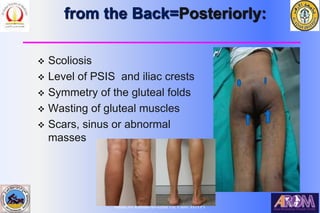
from the Back=Posteriorly:
 Scoliosis
 Level of PSIS and iliac crests
 Symmetry of the gluteal folds
 Wasting of gluteal muscles
 Scars, sinus or abnormal
masses
Bahaa Ali Kornah-Al-Azhar Un. Cairo. EGYPT
Inspection
In standing position
l Patient able to stand – Yes / No.
l If yes, patient able to walk – Yes / No.
l If yes, check Gait.
l Gait :
_ Trendelenburg.
_ Antalgic
_ Waddling
_ Short legged
_ High stepping
l Patient able to squat or not.
Bahaa Ali Kornah-Al-Azhar Un. Cairo. EGYPT
Inspection
In standing position
l Spine.
l Wasting e.g. Disuse atrophy, neurological
deficit.
l Swelling e.g. Cold abscess, dislocation,
lipoma.
_ Scarpa's triangle.
_ Greater trochanter.
_ Gluteal region
l Scars / Sinus
l Level of natal fold e.g. CDH.
Bahaa Ali Kornah-Al-Azhar Un. Cairo. EGYPT
Inspection
l Observe gait
l Check hip and pelvis area for skin abrasions,
abnormal swelling, etc.
l Check if the anterior superior iliac spines are
in the same horizontal plane or tilted pelvis
l Observe the two discernible dimples to check
PSIS for pelvic obliquity
Bahaa Ali Kornah-Al-Azhar Un. Cairo. EGYPT
GAIT
Simplest of all definitions
“mode of walking”
Normal gait is rhythmical
bipedal biphasic walking in
which the lumbar spine, hip
and legs move in unison
Limping is the most common
abnormality
Can be defined as any
abnormality of normal
rhythmic biphasic walking
Bahaa Ali Kornah-Al-Azhar Un. Cairo. EGYPT
GAI
T
LIMB
TRUN
K
Bahaa Ali Kornah-Al-Azhar Un. Cairo. EGYPT
Gait
l Abnormalities of gait
 Antalgic gait
 Trendelenburg gait
 Short leg gait
 Drop foot gait
 Gluteus maximus gait
l Circumduction gait step
l Stiff hip gait
l Quadriceps lurch
l Stiff knee gait
l Waddling or duct gait
Bahaa Ali Kornah-Al-Azhar Un. Cairo. EGYPT
TYPES OF GAIT
Antalgic gait
in painful hip
conditions
pt.. walks with
reduced stance
phase on the
affected side
Bahaa Ali Kornah-Al-Azhar Un. Cairo. EGYPT
Waddling gait
Body sways from side
to side on a wide base
seen in bil. DDH,
pregnancy
Bahaa Ali Kornah-Al-Azhar Un. Cairo. EGYPT
Trendelenberg gait
In double stance forces
distributed equally over two
hips
In single stance forces
increases 6 fold
Patient lurches on the
affected side and pelvis
drops on to sound side
Bahaa Ali Kornah-Al-Azhar Un. Cairo. EGYPT
Short limb gait-
When the affected limb
becomes short
Up and down movement
of half of the body
Pt lurches on the
affected side with a
pelvis drop on the same
side
Bahaa Ali Kornah-Al-Azhar Un. Cairo. EGYPT
Circumduction gait- In fixed
abduction deformity or in
hemiparesis the pt.. moves his
limbs while dragging his
body along with limb in a
semi circle
Bahaa Ali Kornah-Al-Azhar Un. Cairo. EGYPT
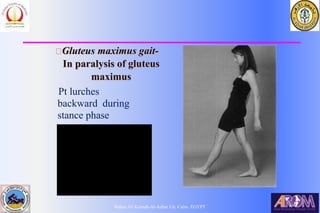
Gluteus maximus gait-
In paralysis of gluteus
maximus
Pt lurches
backward during
stance phase
Bahaa Ali Kornah-Al-Azhar Un. Cairo. EGYPT
Quadriceps gait
In quadriceps
weakness body
collapses-hence the
trunk goes for
anterior bending to
shift the vertical
vector anterior to the
knee to balance
Bahaa Ali Kornah-Al-Azhar Un. Cairo. EGYPT
Toe in gait
Pt walks with both feet
turned inwards-
seen in femoral
anteversion
Bahaa Ali Kornah-Al-Azhar Un. Cairo. EGYPT
Toe out gait
Pt walks with both
feet turned outwards-
seen in femoral
retroversion
Bahaa Ali Kornah-Al-Azhar Un. Cairo. EGYPT
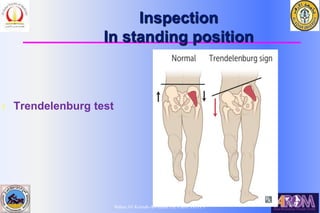
Inspection
In standing position
l Trendelenburg test
Bahaa Ali Kornah-Al-Azhar Un. Cairo. EGYPT
l Trendelenburg Testing
l In 1895 Friedrich Trendelenburg described
observations on the gait of congenitally
dislocated hip patients. Later he went on to
describe the pelvic inclination on single leg
weight bearing, which became known as the
Trendelenburg test. This test has been
modified repeatedly since the original
description.
Bahaa Ali Kornah-Al-Azhar Un. Cairo. EGYPT
l Method 1 Stand in
front of the patient
and ask them to
hold their hands out
in front and place
their hands in your
hands for balance.
Ask the patient to
stand on their
normal leg fir
Bahaa Ali Kornah-Al-Azhar Un. Cairo. EGYPT
True positive (weakness of
abductors)
l • A Trendelenburg test is positive for two main
reasons either a
l Neuromuscular condition • or
l Mechanical conditions
Bahaa Ali Kornah-Al-Azhar Un. Cairo. EGYPT
l Neurological causes
l can be generalized or localized.
Generalized motor weakness
1. spinal cord lesions or myelomeningocele.
localized neurological
a) Gluteal muscle paralysis or weakness (superior gluteal
nerve injury)
b) superior gluteal nerve dysfunction secondary to previous
hip surgery.
c) Polio, neuromuscular conditions,
Bahaa Ali Kornah-Al-Azhar Un. Cairo. EGYPT
The mechanical group includes
1. conditions that affect the abductor
muscle lever arm,
2. • • Osteoarthritis
3. short neck in coxa vara, hip fractures
etc.
4. DDH Fulcrum failure
5. • Post THR exposure with failure of
adequate repair
6. • Trochanteric osteotomy Lever (pivot)
failure
7. • #NOF; #ITF,,
Bahaa Ali Kornah-Al-Azhar Un. Cairo. EGYPT
l False positives
_ Gluteal inhibition due to pain secondary to • OA • AVN
_ Hip pain makes proper assessment of these cases difficult If
pain is not considered a true positive It has been suggested
that a 10% rate of false positives occur
l False negative
_ • Arthrodesis or ankylosed hip Able to maintain abduction with
no abductor function
l False-positive and false-negative responses
_ may occur, but their interpretation can be clarified if the test is
properly performed
_ Invalid if • Poor balance • Lack of co-ordination • Unable to
understand instructions
Bahaa Ali Kornah-Al-Azhar Un. Cairo. EGYPT
Inspection
In lying down position
Sequential -
Top to bottom
or
Bottom to top.
Bahaa Ali Kornah-Al-Azhar Un. Cairo. EGYPT
Inspection
In Lying down position
• Attitude.
• Lumbar lordosis.
• ASIS.
• Greater trochanter
• Position
• Prominence
Bahaa Ali Kornah-Al-Azhar Un. Cairo. EGYPT
Wide Perineum Lateralized Contour
Bahaa Ali Kornah-Al-Azhar Un. Cairo. EGYPT
Inspection
In Lying down position
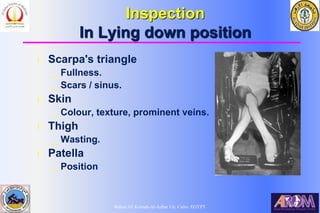
l Scarpa's triangle
_ Fullness.
_ Scars / sinus.
l Skin
_ Colour, texture, prominent veins.
l Thigh
_ Wasting.
l Patella
_ Position
Bahaa Ali Kornah-Al-Azhar Un. Cairo. EGYPT
Inspection
In Lying down position
l Calf
_ Wasting
l Malleoli
_ Level
_ Direction.
l Heel
_ Level
l SLR
Bahaa Ali Kornah-Al-Azhar Un. Cairo. EGYPT
l look for
l asymmetry,
l APPARENT DFORMITIES and
l rotational alignment of the legs
l Any obvious shortening position as
the affected leg
l Leg Shortening
Bahaa Ali Kornah-Al-Azhar Un. Cairo. EGYPT
Palpation
l Superficial palpation
_ Skin temp
_ Skin condition
_ Scars
_ Sinuses :
• Margins, Discharge, adherence to bone
_ tenderness,
_ bony thickening or
_ swelling,
_ soft tissue mass or defect.
_ Medial malleolus
• How to feel?
• Level & direction
_ Heel Level
Bahaa Ali Kornah-Al-Azhar Un. Cairo. EGYPT
N)
PALPATIO
N
ANTERI
OR
WARMT
H
JOINT
LINE
TENDERNE
SSSWELLI
NG
LATER
AL
TROCANT
ER
WARMTH
TROCHANTERIC
TENDERNESS
BI-TROCHANTERIC
RETRO-TROCH
TENDERNESS
POSITION
SURFACE
THICKNESS(GI
RTH)
CREPITUSPOSTERI
OR
HEAD OF
FEMUR
POST JOINT
TENDERNESS
MEDIA
L
SWELLIN
G
TENDERN
ESS
PELVIC
TENDERNE
SS
Bahaa Ali Kornah-Al-Azhar Un. Cairo. EGYPT
Palpation
Confirmation of inspection findings in same
sequence plus few additions :
Temperature, Tenderness & Telescope
l Lumbar lordosis
_ Thomas’s test for FFD.
Bahaa Ali Kornah-Al-Azhar Un. Cairo. EGYPT
Palpation
l ----Anterior Superior Iliac Spines (ASIS): check pelvic
obliquity
l ----Iliac crest ( gluteus and Sartorius muscles originate
just below it)
l ----Greater Trochanter (uneven in congenital hip
dislocation or poor-healed hip fx)
l ----PSIS (lie directly underneath the visible dimples just
above the buttocks, check for pelvic obliquity)
l ----Trochanteric Bursa (have pt. lie on the side with hip
flexion; If it is inflamed, the area feels boggy and tender to
palpation)
Bahaa Ali Kornah-Al-Azhar Un. Cairo. EGYPT
l Anteriorly:
l temperature
l Anterior joint line tenderness-
l Confirm level of ASIS.
l Feel the resistance over the Scarpa’s triangle.
l Femoral pulsations-
l (Vascular sign of Narath).
Bahaa Ali Kornah-Al-Azhar Un. Cairo. EGYPT
FEEL THE TENDERNESS
ANTERIOR JOINT
TENDERNESS
TROCHANTERIC
TENDERNESS
FEMORAL
MEDIAL JOINT
TENDERNESS
MID
INGUINAL
POINT
2 CM BELOW
AND
LATERAL
OEVR THE
TROCANTE
R
at
midinguinal
point
JUST
POSTERIOR TO
ADD. LONG.
Bahaa Ali Kornah-Al-Azhar Un. Cairo. EGYPT
RETRO-TROCHANTERIC
TENDERNESS
MILDLY INT-
ROTATE
POSTERIOR
TO
TROCANTER
Bahaa Ali Kornah-Al-Azhar Un. Cairo. EGYPT
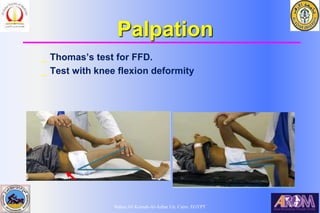
Palpation
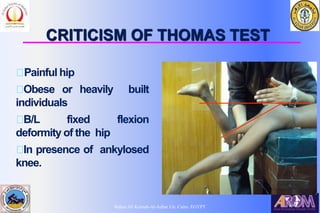
_ Thomas’s test for FFD.
_ Test with knee flexion deformity
Bahaa Ali Kornah-Al-Azhar Un. Cairo. EGYPT
Thomas’s test for FFD
Bahaa Ali Kornah-Al-Azhar Un. Cairo. EGYPT
CRITICISM OF THOMAS TEST
Painful hip
Obese or heavily built
individuals
B/L fixed flexion
deformity of the hip
In presence of ankylosed
knee.
Bahaa Ali Kornah-Al-Azhar Un. Cairo. EGYPT
Palpation
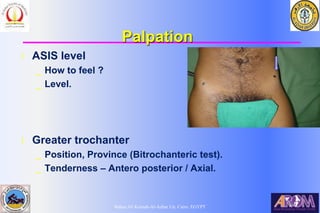
l ASIS level
_ How to feel ?
_ Level.
l Greater trochanter
_ Position, Province (Bitrochanteric test).
_ Tenderness – Antero posterior / Axial.
Bahaa Ali Kornah-Al-Azhar Un. Cairo. EGYPT
palpate
l Laterally:
_ Greater trochanter
_ Level in both supero-inferior as well as antero-posterior
directions.
_ Surface – Smooth or irregular or is it thickened.
_ Tenderness both local and on thrust
l Posteriorly:
_ Any mass- Globular bony mass that moves with the femur is suggestive of
dislocated femoral head in presence of an unstable hip.
_ Posterior joint line tenderness- Located at the junction of the lateral one
third and the medial two third of a line connecting the posterior superior
iliac spine (PSIS) and greater trochanter.
Bahaa Ali Kornah-Al-Azhar Un. Cairo. EGYPT
Movement
l Active
l Passive
l ROM depends on the age, gender and race.
Children and women have greater range of
movement. Elderly will have lesser range of
motion. Asian populations have greater range of
movement.
Bahaa Ali Kornah-Al-Azhar Un. Cairo. EGYPT
ACTIVE AND
PASSIVEPASSIV
E :
 RANGE
 ASSOCIATED PAIN
 MUSCLE SPASM
 CREPITUS
 INSTABILITY
MOVEMENTS
Bahaa Ali Kornah-Al-Azhar Un. Cairo. EGYPT
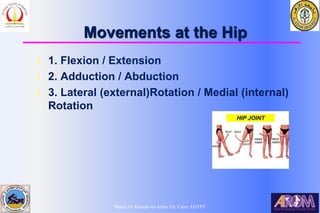
Movements at the Hip
l 1. Flexion / Extension
l 2. Adduction / Abduction
l 3. Lateral (external)Rotation / Medial (internal)
Rotation
Bahaa Ali Kornah-Al-Azhar Un. Cairo. EGYPT
l Normal ROM in Hip in adults
l Flexion 1200
l Extension 100
l Abduction 400
l Adduction 400
l Internal rotation in flexion 350
l Internal rotation in Extension 300
l External rotation in flexion 450
l External rotation in Extension 400
l Circumduction Incomplete
Bahaa Ali Kornah-Al-Azhar Un. Cairo. EGYPT
Movements
The important points to be noted
l 1. Is the range of movements normal?
using a goniometer.
2. If restricted; which movement is restricted?.
3. If restricted; what is the severity?
4. Is the movements painless, painful?
5. If painful; during which movement and during
which part of the arc of movement?
6. Is the limitation of movement due to mechanical
causes or due to pain and spasm?
7. Is the axis of movement normal?.
8. Was there any exaggeration of the normal
movements?
Bahaa Ali Kornah-Al-Azhar Un. Cairo. EGYPT
FLEXION
Bahaa Ali Kornah-Al-Azhar Un. Cairo. EGYPT
ABD + ADDUCTION
Bahaa Ali Kornah-Al-Azhar Un. Cairo. EGYPT
EXTENSION
Bahaa Ali Kornah-Al-Azhar Un. Cairo. EGYPT
Movements
Externalrotation
90 deg
flexion(45 deg)
full
extension(45deg)
Bahaa Ali Kornah-Al-Azhar Un. Cairo. EGYPT
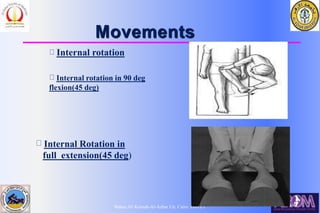
Movements
Internal rotation
Internal rotation in 90 deg
flexion(45 deg)
Internal Rotation in
full extension(45 deg)
Bahaa Ali Kornah-Al-Azhar Un. Cairo. EGYPT
Hip Rotation
prone position
Bahaa Ali Kornah-Al-Azhar Un. Cairo. EGYPT
Hip Rotation sitting position
Bahaa Ali Kornah-Al-Azhar Un. Cairo. EGYPT
Hip Flexors
l Iliopsoas (prime hip flexor)
l Pectineus
l Sartorius
l Rectus femoris
l Pectineus
l Tensor fasciae latae
l Adductor brevis
l Adductor longus
l Adductor magnus (anterior head)
l Rectus femoris
Bahaa Ali Kornah-Al-Azhar Un. Cairo. EGYPT
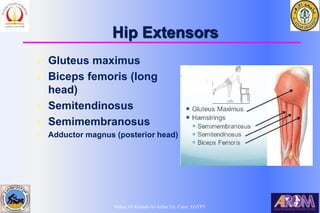
Hip Extensors
l Gluteus maximus
l Biceps femoris (long
head)
l Semitendinosus
l Semimembranosus
l Adductor magnus (posterior head)
Bahaa Ali Kornah-Al-Azhar Un. Cairo. EGYPT
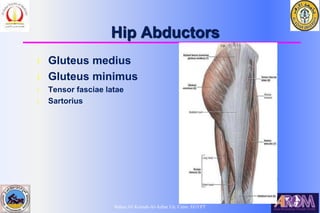
Hip Abductors
l Gluteus medius
l Gluteus minimus
l Tensor fasciae latae
l Sartorius
Bahaa Ali Kornah-Al-Azhar Un. Cairo. EGYPT
Hip Adductors
l Adductor brevis
l Adductor longus
l Adductor magnus
l Gracilis
l Pectineus
Bahaa Ali Kornah-Al-Azhar Un. Cairo. EGYPT
Internal Rotators of the Hip
l Gluteus medius
l Gluteus minimus
l Tensor fasciae latae
l assisted by the adductors
brevis and longus and the superior
portion of the adductor magnus
l
Bahaa Ali Kornah-Al-Azhar Un. Cairo. EGYPT
External Rotators of the Hip
 piriformis,
 superior and inferior
gemelli,
 obturator internus,
 obturator externus.
 quadratus femoris
Bahaa Ali Kornah-Al-Azhar Un. Cairo. EGYPT
Special tests
l Special tests are done as required depending on
the clinical diagnosis. They can be divided into the
following.
l 1. Tests to assess limb length discrepancy
2. Tests for stability
3. Tests for deformity assessment
4. Tests for impingement
5. Tests for muscle contracture
Tests to assess limb length
discrepancy
Bahaa Ali Kornah-Al-Azhar Un. Cairo. EGYPT
Leg Length Discrepancy (LLD)
l Leg Length Discrepancy (LLD)
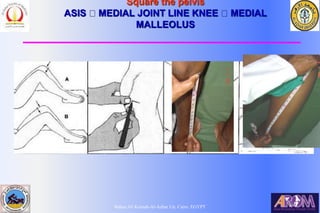
l True LLD: measure from ASIS to the medial malleoli.
Bahaa Ali Kornah-Al-Azhar Un. Cairo. EGYPT
Leg length discrepancy
l Apparent LLD: (determine no TLLD first)with
pt. supine, measure from umbilicus to the
medial malleoli. Apparent discrepancy may be
caused by pelvic obliquities or flexion or
adduction deformity of the hip.
Bahaa Ali Kornah-Al-Azhar Un. Cairo. EGYPT
l True and Apparent Leg Length
l How to Examine Leg Shortening?
_ Block Method
_ Supine Position
l Where is the Shortening?
_ Is it femoral or tibial?
l Where in Femur?
_ Bryant’s triangle
_ Nelatons line
_ Chiene’s line or parallelogram
Bahaa Ali Kornah-Al-Azhar Un. Cairo. EGYPT
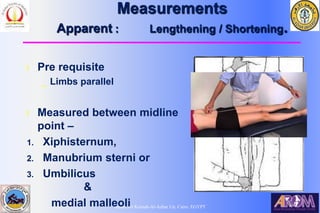
Measurements
Apparent : Lengthening / Shortening.
l Pre requisite
_ Limbs parallel
l Measured between midline
point –
1. Xiphisternum,
2. Manubrium sterni or
3. Umbilicus
&
medial malleoli
Bahaa Ali Kornah-Al-Azhar Un. Cairo. EGYPT
Measurements
Real :True Lengthening / Shortening
l Pre requisites
_ Squaring of pelvis.
• ASIS at same level.
_ Limbs in identical
position.
l Measurement from
ASIS to medial
malleolus.
Bahaa Ali Kornah-Al-Azhar Un. Cairo. EGYPT
MEASURE
APPARENTTRU
E
Bahaa Ali Kornah-Al-Azhar Un. Cairo. EGYPT
ADDUCTION  APPARENT
SHORTENING
ABDUCTION  APPARENT
Apparent shortening &
lengthening
Bahaa Ali Kornah-Al-Azhar Un. Cairo. EGYPT
Measurements
l Segmental measurements
l Find level of discrepancy
_ Leg,
_ Thigh or
_ Supra trochanteric.
Bahaa Ali Kornah-Al-Azhar Un. Cairo. EGYPT
 Galeazzi's test = Galeazzi's sign
 Allis test
 whether the shortening is in the femur or tibia Flex the hips to 45º
and the knees up to 90º. Place the malleoli together
 Normally both knees are at the same level
 knee projects farther forwards =femur is longer or more usually
the contra-lateral femur is shorter
 When one knee is higher than the other, either the tibia of that
side is longer or the contra-lateral tibia is shorter
Bahaa Ali Kornah-Al-Azhar Un. Cairo. EGYPT
FEMORAL SEGMENT
SHORTENING
Tibial shortening
Bahaa Ali Kornah-Al-Azhar Un. Cairo. EGYPT
Square the pelvis
ASIS MEDIAL JOINT LINE KNEE MEDIAL
MALLEOLUS
Bahaa Ali Kornah-Al-Azhar Un. Cairo. EGYPT
Measurements
(How to detect supratrochanteric shortening)
l Bryant's triangle.
l Nealon's line.
Bahaa Ali Kornah-Al-Azhar Un. Cairo. EGYPT
BRYANT’S TRIANGLE NELATON’S LINE
Bahaa Ali Kornah-Al-Azhar Un. Cairo. EGYPT
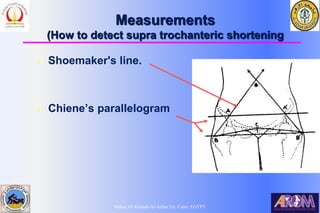
Measurements
(How to detect supra trochanteric shortening
l Shoemaker's line.
l Chiene’s parallelogram
Bahaa Ali Kornah-Al-Azhar Un. Cairo. EGYPT
MEASUREMENTS
Morris’ Bitrochanteric Test:
• it measures the distance
between the GT and pubic
symphysis on both sides
•Reduced in hip dislocations
Bahaa Ali Kornah-Al-Azhar Un. Cairo. EGYPT
KOTHARI’S LINE
Bahaa Ali Kornah-Al-Azhar Un. Cairo. EGYPT
MEASUREMENTS
Supra trochanteric
Coxa Vara Perthes
SCFE
Malunited basal # NOF
Congenital Coxa Vara
Arthritis
Dislocation
Infra trochanteric
Malunion
Fracture femur & tibia
Growth arrest from
polio
Trauma and infective
sequala
True shortening
Bahaa Ali Kornah-Al-Azhar Un. Cairo. EGYPT
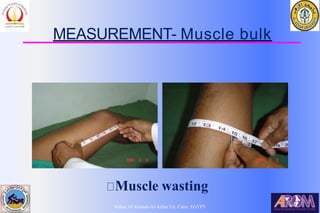
MEASUREMENT- Muscle bulk
Muscle wasting
Bahaa Ali Kornah-Al-Azhar Un. Cairo. EGYPT
Special tests
l Special tests are done as required depending on
the clinical diagnosis. They can be divided into the
following.
l 1. Tests to assess limb length discrepancy
2. Tests for stability
3. Tests for deformity assessment
4. Tests for impingement
5. Tests for muscle contracture
Tests for deformity
assessment
Bahaa Ali Kornah-Al-Azhar Un. Cairo. EGYPT
DEFORMITIES
Abnormal fixed position of the joint
Deformities along sagittal plain
( flexion, extension)
Deformity along mediolateral plain
( coronal plain)
{ abduction, adduction deformity}
Rotational deformity
{ external, internal rotation deformity}
Bahaa Ali Kornah-Al-Azhar Un. Cairo. EGYPT
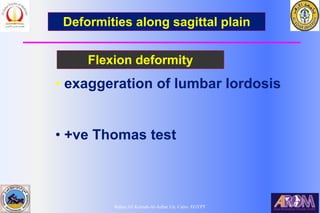
Deformities along sagittal plain
Flexion deformity
• exaggeration of lumbar lordosis
• +ve Thomas test
Bahaa Ali Kornah-Al-Azhar Un. Cairo. EGYPT
HIP EXAMINATION
THOMAS TEST Flexion deformity
NORMAL LIMB
DISEASED LIMB
Bahaa Ali Kornah-Al-Azhar Un. Cairo. EGYPT
Tests for deformity assessment
l Staheli prone extension test
l Patient position- Prone with hip
and knees dangling beyond the
end of the examination table
l Interpretation- The angle between
the thigh and the table is the fixed
flexion deformity.
Bahaa Ali Kornah-Al-Azhar Un. Cairo. EGYPT
Deformities along
coronal plain
Pelvic tilting
Abduction: lowering of the
ASIS of the diseased side
Adduction: elevation of
the ASIS of the diseased side
Lateral deviation of the spine ( scoliosis)
+
Bahaa Ali Kornah-Al-Azhar Un. Cairo. EGYPT
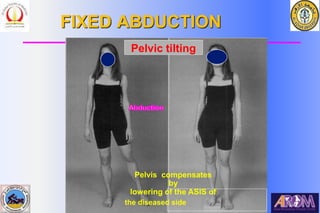
FIXED ABDUCTION
Pelvic tilting
Pelvis compensates
by
lowering of the ASIS of
the diseased side
Bahaa Ali Kornah-Al-Azhar Un. Cairo. EGYPT
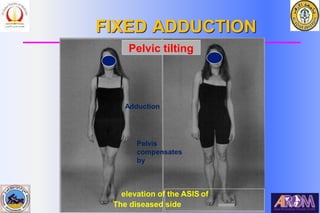
FIXED ADDUCTION
Pelvic tilting
Adduction
Pelvis
compensates
by
elevation of the ASIS of
The diseased side
Bahaa Ali Kornah-Al-Azhar Un. Cairo. EGYPT
ASIS –DEPRESSED –
FIXED ABDUCTION
SQUARE THE PELVIS BY
FURTHER ABDUCTION
CORONAL
DEFORMITY
ASIS-ELEVATED - FIXED
ADDUCTION
SQUARE THE PELVIS BY
FURTHER ADDUCTION
Bahaa Ali Kornah-Al-Azhar Un. Cairo. EGYPT
FIXED ABDUCTION & ADDUCTION
DEFORMITY
Pelvic tilt indicated by ASIS at
different level
Bahaa Ali Kornah-Al-Azhar Un. Cairo. EGYPT
FIXED ABDUCTION & ADDUCTION
DEFORMITY
DN
Bahaa Ali Kornah-Al-Azhar Un. Cairo. EGYPT
FIXED ABDUCTION & ADDUCTION
DEFORMITY
N
D
Bahaa Ali Kornah-Al-Azhar Un. Cairo. EGYPT
FIXED ABDUCTION – ADDUCTION
DEFORMITY
Bahaa Ali Kornah-Al-Azhar Un. Cairo. EGYPT
Alternate method for
determing
Fixed abduction & adduction
deformity
Kothari’s method
Bahaa Ali Kornah-Al-Azhar Un. Cairo. EGYPT
DEFORMITIES
Abnormal fixed position of the joint
Rotational deformity
{ external, internal rotation deformity}
Bahaa Ali Kornah-Al-Azhar Un. Cairo. EGYPT
Fixed external & internal
rotation deformity
Always remains revealed
Determined by noting the
direction of anterior surface
of patella or the toes when
the foot is held at right angle
to the leg
Bahaa Ali Kornah-Al-Azhar Un. Cairo. EGYPT
Tests for deformity assessment
l Craig’s test
l Patient position – Prone
FOR ANTEVERSION
1.POSITIONED PRONE
2.KNEE FLEXED 900
3.ONE HAND OVER
TROCANTER
4.OTHER HAND IS
ROTATING THE LEG TILL
THE TROCANTER FELT
PROMINENT
5.ANGLE SUBTENDED
BETWEEN THE IMAGINARY
VERTICAL TO THE LONG
AXIS OF THE LEG
Bahaa Ali Kornah-Al-Azhar Un. Cairo. EGYPT
Special tests
l Special tests are done as required depending on
the clinical diagnosis. They can be divided into the
following.
l 1. Tests to assess limb length discrepancy
2. Tests for stability
3. Tests for deformity assessment
4. Tests for impingement
5. Tests for muscle contracture
Tests for stability
Bahaa Ali Kornah-Al-Azhar Un. Cairo. EGYPT
Tests for stability
l Trendelenburg test
l Described by Freidreich Trendelenburg in 1894.
l Patient position – Standing.
l Don’t do if hip has fixed adduction or
abduction deformity.
Bahaa Ali Kornah-Al-Azhar Un. Cairo. EGYPT
Tests for stability
l Telescopy test
(Piston or
Dupuytren’s test)
l Patient position –
Supine
Bahaa Ali Kornah-Al-Azhar Un. Cairo. EGYPT
Palpation ( contd. )
l Telescopy
Bahaa Ali Kornah-Al-Azhar Un. Cairo. EGYPT
Neonatal Examination for CDH
Feel a clunk
not hear a click !
Special Tests – Ortolani test
Bahaa Ali Kornah-Al-Azhar Un. Cairo. EGYPT
Special Tests – Barlow test
Neonatal Examination for CDH
Feel a clunk
not hear a click !
Bahaa Ali Kornah-Al-Azhar Un. Cairo. EGYPT
Tests for stability
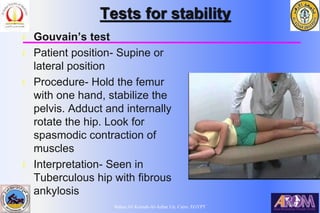
l Gouvain’s test
l Patient position- Supine or
lateral position
l Procedure- Hold the femur
with one hand, stabilize the
pelvis. Adduct and internally
rotate the hip. Look for
spasmodic contraction of
muscles
l Interpretation- Seen in
Tuberculous hip with fibrous
ankylosis
Bahaa Ali Kornah-Al-Azhar Un. Cairo. EGYPT
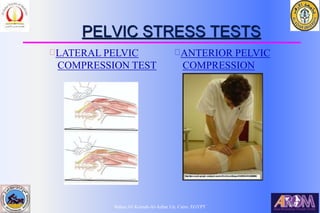
PELVIC STRESS TESTS
LATERAL PELVIC
COMPRESSION TEST
ANTERIOR PELVIC
COMPRESSION
TEST
Bahaa Ali Kornah-Al-Azhar Un. Cairo. EGYPT
PELVIC STRESS TESTS
PUBIC SYMPHYSIS STINCHFIELD
TEST STRESS TEST
Bahaa Ali Kornah-Al-Azhar Un. Cairo. EGYPT
FULCRUM TEST
It tests for the stress
fractures of the shaft
of femur
Bahaa Ali
Bahaa Ali Kornah-Al-Azhar Un. Cairo. EGYPT
Special tests
l Special tests are done as required depending on
the clinical diagnosis. They can be divided into the
following.
l 1. Tests to assess limb length discrepancy
2. Tests for stability
3. Tests for deformity assessment
4. Tests for impingement
5. Tests for muscle contracture
Tests for impingement
Bahaa Ali Kornah-Al-Azhar Un. Cairo. EGYPT
Tests to assess impingement
l The FABER (Patrick's) Test
l FABERE (Flexion-Abduction-External
rotation-Extension) test
l Patient position – Supine
l Procedure- Put the affected limb on the
opposite limb in the Flexion-Abduction-
External rotation (FABER) position or Figure 4
position. Apply hand over the medial aspect of
knee and force the hip into full abduction and
extension.
• TEND TO STRESS THE IPSILATERAL S-I
JOINT
• PAIN IS POSTERIOR IN S-I ARTHRITIS
• PAIN IS ANTERIOR IN HIP ARTHRITIS
Bahaa Ali Kornah-Al-Azhar Un. Cairo. EGYPT
Tests to assess impingement
l Scour test
l Patient position- Supine
l Procedure- Done by moving the hip in an arc
Bahaa Ali Kornah-Al-Azhar Un. Cairo. EGYPT
Tests to assess impingement
l Stinchfield test (Resisted
SLR test)
l Patient position- Supine
l Procedure- Ask the patient to
actively flex the hip to 30 degrees
while keeping the knee in
extension and to hold the position.
Apply resistance just proximal to
the knee.
l Interpretation- Pain felt in the
groin is suggestive of intra
articular pathology.
Bahaa Ali Kornah-Al-Azhar Un. Cairo. EGYPT
Tests to assess impingement
l Posterior impingement test
(Hyperextension-
Abduction-External
rotation (HEABER test))
l Patient position – Prone
l Procedure- Passively place the affected
hip in the Hyperextension-Abduction-
External rotation (HEABER) position.
l Interpretation- If there is catching type of
pain then test is positive.
Bahaa Ali Kornah-Al-Azhar Un. Cairo. EGYPT
Tests to assess impingement
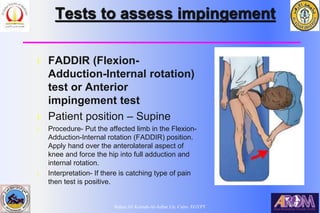
l FADDIR (Flexion-
Adduction-Internal rotation)
test or Anterior
impingement test
l Patient position – Supine
l Procedure- Put the affected limb in the Flexion-
Adduction-Internal rotation (FADDIR) position.
Apply hand over the anterolateral aspect of
knee and force the hip into full adduction and
internal rotation.
l Interpretation- If there is catching type of pain
then test is positive.
Bahaa Ali Kornah-Al-Azhar Un. Cairo. EGYPT
Tests to assess impingement
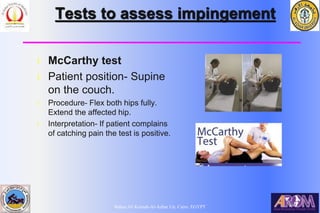
l McCarthy test
l Patient position- Supine
on the couch.
l Procedure- Flex both hips fully.
Extend the affected hip.
l Interpretation- If patient complains
of catching pain the test is positive.
Bahaa Ali Kornah-Al-Azhar Un. Cairo. EGYPT
Special tests
l Special tests are done as required depending on
the clinical diagnosis. They can be divided into the
following.
l 1. Tests to assess limb length discrepancy
2. Tests for stability
3. Tests for deformity assessment
4. Tests for impingement
5. Tests for muscle contracture
Tests for muscle contracture
Bahaa Ali Kornah-Al-Azhar Un. Cairo. EGYPT
Tests to assess muscle contracture
l Piriformis test (FAIR
(Flexion-Adduction-
Internal Rotation test)
l Patient position –
Lateral position with the
affected side up.
l Procedure- Flex the hip to 600 and flex the
knee. Stabilize the pelvis with one hand.
Hold the leg with other hand. Move the hip
into adduction and internal rotation with
gentle force.
l Interpretation- If there is pain in the
buttocks or sciatica then test is positive.
Bahaa Ali Kornah-Al-Azhar Un. Cairo. EGYPT
Tests to assess muscle contracture
l Obers test
l Patient position – Lateral
position with the affected
side up. Opposite hip
and knee flexed to 900.
l Procedure- Flex the hip and the knee to 900.
Stabilize the pelvis with one hand. Hold the leg with
other hand. Move the hip into full abduction and
external rotation. Extend the knee and hip and let
the limb drop down due to gravity.
l Interpretation- Normally the limb should drop down
and rest on the couch. If the limb is held high in
abduction, there is contracture of the iliotibial band.
Bahaa Ali Kornah-Al-Azhar Un. Cairo. EGYPT
Tests to assess muscle contracture
l Ely’s test
l Patient position – Prone
l Procedure- Flex the knee
fully. Observe for flexion of
hip.
l Interpretation- If the hip
flexes, there is rectus femoris
contracture.
Bahaa Ali Kornah-Al-Azhar Un. Cairo. EGYPT
TO DETECT THE CONTRACTURE OF GRACILIS MUSCLE
PRONE POSITION WITH THE KNEE EXTENDED
PASSIVE ABDUCTION TO THE MAXIMUM WITH THE
EXTENDED KNEE KNEES ARE THEN FLEXED TO RELAX
GRACILIS
ATTEMPT TO FURTHER ABDUCT THE HIP WITH KNEE IN
FLEXION FURTHER ABDUCTION IS POSSIBLE IN
PHELPS’ TEST
Bahaa Ali Kornah-Al-Azhar Un. Cairo. EGYPT
Thomas Test
l To assess hip flexion contractures
l Perform the test with the pt. supine, flex one
hip fully reducing the lumbar spine lordosis,
stabilizing the spine and pelvis, extend the
opposite hip. A flexion contracture is present if
the hip cannot fully extend. The degree of
flexion contracture can be done by estimating
the angle between the table and pt.’s leg.
Bahaa Ali Kornah-Al-Azhar Un. Cairo. EGYPT
Tests to assess muscle contracture
l Examination of Gait:
l Front : Look at trunk , pelvis and swinging of hand
(contralateral to the hand)
l Back : Look at shoulder and pelvis:
l Side : Excessive Lordosis, ankle plantar flexion
and knee flexion, hip and knee extension.
Bahaa Ali Kornah-Al-Azhar Un. Cairo. EGYPT
Remember
l Examination of the opposite hip, knee and
spine
l Examination of the sacroiliac joint
l Examination of the distal neurovascular deficit
l Per rectal examination
Bahaa Ali Kornah-Al-Azhar Un. Cairo. EGYPT
Examination
l Examination of hip is incomplete without
examination of spine & knee.
Bahaa Ali Kornah-Al-Azhar Un. Cairo. EGYPT
Key to Examination findings
ASIS at same level No adduction or
abduction deformity
Apparent
measurements =
Real measurements
ASIS raised Adduction
deformity
Apparent
shortening > Real
shortening
ASIS lower Abduction
deformity
Apparent
lengthening > Real
lengthening
Bahaa Ali Kornah-Al-Azhar Un. Cairo. EGYPT
Neurologic Exam
l Muscle testing: test muscle strength in
functional groups.
l Primary flexor: Iliopsoas (femoral N. L1,2,3)
l Primary extensors: Gluteus Maximus (inferior gluteus N. S1)
l Primary adductors: Adductor longus (obturator N. L2,3,4)
l Primary Abductor: Gluteus medius( superior gluteal N., L5)
l Sensation testing: for example, dermatomes (
T10-L3)
Bahaa Ali Kornah-Al-Azhar Un. Cairo. EGYPT
l DIAGNOSIS
l Anatomical : Synovitis/Arthritis/Coxa
vara/Unstable hip/ Ankylosis of hip
l Pathological :
Traumatic/Inflammatory/Neoplastic/Infective/
Degenerative
Bahaa Ali Kornah-Al-Azhar Un. Cairo. EGYPT
‫قرنة‬ ‫بهاء‬
Bahaa Kornah
bkornah@hotmail.com
l .

Hip examination

  • 1.
    Bahaa Ali Kornah-Al-AzharUn. Cairo. EGYPT Dr. Bahaa Ali Kornah Prof.. Of Orthopedic Al-Azhar University Cairo - Egypt ‫وبركاته‬ ‫هللا‬ ‫ورحمة‬ ‫عليكم‬ ‫السالم‬
  • 2.
    Bahaa Ali Kornah-Al-AzharUn. Cairo. EGYPT
  • 3.
    Bahaa Ali Kornah-Al-AzharUn. Cairo. EGYPT CLINCIAL HIP EXAMINATION Dr. Bahaa Ali Kornah Prof.. Of Orthopedic Al-Azhar University Cairo - Egypt
  • 4.
    Bahaa Ali Kornah-Al-AzharUn. Cairo. EGYPT Keytothespine Task at hand... l How to examine a patient SYSTEMATIC APPROACH
  • 5.
    Bahaa Ali Kornah-Al-AzharUn. Cairo. EGYPT Systematic Approach l Steps _ Components 1 2 3 4 5
  • 6.
    Bahaa Ali Kornah-Al-AzharUn. Cairo. EGYPT Systematic Approach l Miss a Step
  • 7.
    Bahaa Ali Kornah-Al-AzharUn. Cairo. EGYPT  Avoid lack of a systematic approach in your clinical practice.  Develop your own routine that works best for you but don’t stray too far from the norm.  Just as important do not jump around and get the order of the hip examination out of sync. 
  • 8.
    Bahaa Ali Kornah-Al-AzharUn. Cairo. EGYPT It’s not “What you do” but “How you do it” that counts. Don’t forget the 5 P’s.
  • 9.
    Bahaa Ali Kornah-Al-AzharUn. Cairo. EGYPT Few important points before examination proper Introduce yourself consent exposure Female attendant
  • 10.
    Bahaa Ali Kornah-Al-AzharUn. Cairo. EGYPT Professional attitude Polite Gesture Dress Handling Mobile in vibration mode.
  • 11.
    Bahaa Ali Kornah-Al-AzharUn. Cairo. EGYPT HISTORY SYMPTOMS / CHIEF COMPLAINTS  PAIN  SWELLING  DEFORMITIES  LIMP  STIFFNESS +loss of function  Snapping  Limb length discrepancy
  • 12.
    Bahaa Ali Kornah-Al-AzharUn. Cairo. EGYPT HISTORY CHIEF COMPLAINTS DURATTION ONSET PROGRESSION OF THE SYMPTOMS PERTAINING TO VARIOUS AETIOLOGY CONSTITUTIONAL SYMPTOMS COMORBIDITIES HABITS TREATMENT TAKEN OCCUPATION AND RECREATIONAL DEMANDS EFFECT ON DAILY ACTIVITIES (ADL)
  • 13.
    Bahaa Ali Kornah-Al-AzharUn. Cairo. EGYPT l Pain  Duration –  Onset –  Progress –  Is it constant or intermittent?  localization  Severity-  Character  Radiation-  Aggravating and relieving factors-  Diurnal variation-  timing. NIGHT PAIN ( NOCTURNAL PAIN)- NIGHT CRY  Associated symptoms
  • 14.
    Bahaa Ali Kornah-Al-AzharUn. Cairo. EGYPT PAIN Most important reported symptom. Site Anterior hip pain : arthritis, hip flexor strain, iliopsoas bursitis, labral tear Lateral hip pain : greater trochanteric bursitis, gluteus medius tear, iliotibial band syndrome (athletes), meralgia paresthetica (an entrapment syndrome of the lateral femoral cutaneous nerve syndrome) Posterior hip pain DDx: hip extensor and external rotator pathology, degenerative disc disease, spinal stenosis REFERED PAIN: to knee. hip pathology can be referred to the knee
  • 15.
    Bahaa Ali Kornah-Al-AzharUn. Cairo. EGYPT SWELLING , STIFFNES  Site  Onset  Duration  Association with pain  Progression over time  PROGRESSION – STATIONARY INCREASING - REGRESSING
  • 16.
    Bahaa Ali Kornah-Al-AzharUn. Cairo. EGYPT LIMP  Onset  Duration  Association with pain  Progression  Ambulatory status  PROGRESSION OF LIMP (GRADES)  LIMP WITHOUT AID  LIMP WITH AID  WHEEL CHAIR BOUND  BED RIDDEN
  • 17.
    Bahaa Ali Kornah-Al-AzharUn. Cairo. EGYPT l Deformity How long the deformity is present? How did it start? How is it progressing? Any associated symptoms? Is there any history of trauma or infection? l Limb length discrepancy How long it is present? Is it static or progressive? Associated symptoms? Any history of infection or trauma?
  • 18.
    Bahaa Ali Kornah-Al-AzharUn. Cairo. EGYPT l History to assess function  Walking ability Normal or altered Restricted or unrestricted Aided or unaided If aided; which aid is used  Ability to squat  Ability to sit cross legged  Ability to drive car  Ability to tie shoes
  • 19.
    Bahaa Ali Kornah-Al-AzharUn. Cairo. EGYPT PAST HISTORY Trauma Tuberculosis Surgery around hip Skin /hematological disorders Neurological disorders Connective tissue disorders Steroid intake Any other significant medical /surgical illness
  • 20.
    Bahaa Ali Kornah-Al-AzharUn. Cairo. EGYPT PERSONAL HISTORY Occupation and work tolerance Diet Smoking/alcohol Sexual history Menopausal history
  • 21.
    Bahaa Ali Kornah-Al-AzharUn. Cairo. EGYPT FAMILY HISTORY TBin close relative Dysplasia Metabolicstorage disorders Inflammatory arthritis
  • 22.
    Bahaa Ali Kornah-Al-AzharUn. Cairo. EGYPT SUMMARY OF HISTORY ACUTE / CHRONIC PROGRESSIVE / NON PROGRESSIVE /REGRESSIVE MONOARTICULAR / POLYARTICULAR POSSIBLE AETIOLOGY (CONG./TRAUMATIC/INFECTIVE/INFLAMMATORY/NEO PLASTIC/DEGENERATIVE/ METABOLIC ETC) PATIENT’S DEMAND / EXPECTATION
  • 23.
    Bahaa Ali Kornah-Al-AzharUn. Cairo. EGYPT Pattern of Examination l Inspection. l Palpation. l Movements. l Measurements. l Special tests.
  • 24.
    Bahaa Ali Kornah-Al-AzharUn. Cairo. EGYPT Basic Principles ( Prerequisites of Examination ) l Patient must be suitably undressed. l Hard bed. X
  • 25.
    Bahaa Ali Kornah-Al-AzharUn. Cairo. EGYPT GENERAL EXAMINATION Head to foot examination l Eyes- Blue sclera, iritis ,uveitis, squint, microphthalmos, cornea, pigmentation of sclera. l Pinna- Low set, blackish discoloration. l Cheeks- Malar rash. l Mouth – Normal dental hygiene, arch of palate. l Hair Line- Normal or low l Neck – Webbing , thyroid swelling. l Nipples- Normal level or not. l Shape of chest wall- Pectus carinatum/ excavatum. l Abdomen- Protuberant , undescended testis , hernias. l Nails- Pitting. l Palms and soles- Hyperkeratosis.
  • 26.
    Bahaa Ali Kornah-Al-AzharUn. Cairo. EGYPT GENERAL EXAMINATION Head to foot examination l Thickening of lower end radius, malleoli and costochondral junctions. l Ligamentous laxity  Apposition of thumb to flexor aspect of forearm  Passive extension of fingers so that they lie parallel to the forearm.  Hyperextension of elbow at least 10 degrees  Hyperextension of knee at least 10 degrees  Excessive passive dorsiflexion of ankle (45 degree) with eversion of foot. l Neurocutaneous markers- l General postures and altitude
  • 27.
    Bahaa Ali Kornah-Al-AzharUn. Cairo. EGYPT Inspection l with the patient _ standing, _ walking, _ sitting and _ lying down. l Look from the front, sides and back. l Look for any asymmetry when compared to the normal side.
  • 28.
    Bahaa Ali Kornah-Al-AzharUn. Cairo. EGYPT Inspection l Standing position. Inspection Gait Alignment Limb Length Discrepancy l Lying down position.  Limb Length Discrepancy ATTITUDE
  • 29.
    Bahaa Ali Kornah-Al-AzharUn. Cairo. EGYPT l General Inspection  Observe the patient first in the standing position  Stand with the patient facing you.  Be prepared to support the patient, as they may not be able to stand unaided.  considering the patient as a whole. Consider if the patient looks well, is breathless at rest, is jaundiced or has generalized features of psoriasis or rheumatoid arthritis.
  • 30.
    Bahaa Ali Kornah-Al-AzharUn. Cairo. EGYPT Inspection. l Look for general clues  Any walking frame,  special shoes or orthosis present?  Does the patient use a stick and is it in the correct hand?  Ask the patient is they have a walking stick  Talk to the patient; explain what you are going to do Work around the hip 360° get used to using a small space
  • 31.
    Bahaa Ali Kornah-Al-AzharUn. Cairo. EGYPT l General Inspection l Observe the patient from  the front,  the side and  then back.
  • 32.
    Bahaa Ali Kornah-Al-AzharUn. Cairo. EGYPT Look for the following.  Attitude  Deformity  Bony contours  Soft tissue contours  Swelling  Wasting  Limb length discrepancy  Skin over the joint
  • 33.
    Bahaa Ali Kornah-Al-AzharUn. Cairo. EGYPT Hip inspection from the Front l Does the patient stand straight and upright? l Is stance comfortable? l Is stance symmetrical? l Are the shoulders level? l Check the level of the ASIS .Is the pelvis symmetrical? If not level…. why not? What is causing the pelvic obliquity l • Is there a leg length discrepancy l • Is there a fixed deformity Ask for blocks if the pelvis is not level to access functional leg length discrepancy.
  • 34.
    Bahaa Ali Kornah-Al-AzharUn. Cairo. EGYPT Hip inspection from the Front  Is there any deformity in the coronal plane e.g. Abduction/adduction contracture of the hip  Any thigh or calf wasting?  Is the patient taking weight equally through both legs?  Look at the feet, is the foot taking weight in a plantigrade fashion or is the ankle or foot inverted, everted or in equines.  Inspect the skin for scars, sinus, evidence of circulatory disturbance etc. “Can you push your knee back fully straighten your leg”
  • 35.
    Bahaa Ali Kornah-Al-AzharUn. Cairo. EGYPT Anteriorly from proximal to distal  Level of ASIS  Normal hollowing of iliac fossa  Inguinal orifices  Widened perineum  Femoral artery pulsations  Abnormal fullness in the Scarpa’s triangle  Contour and level of the greater trochanter  Contour and bulk of the thigh muscles looking for abnormal contour and wasting  Scars, discolorations, swellings and sinuses
  • 36.
    Bahaa Ali Kornah-Al-AzharUn. Cairo. EGYPT LOOK FROM THE FRONT FOR PELVIC OBLIQUITY Concealed FIXED / NONFIXED ASIS depressed- Fixed ABD def ASIS elevated- Fixed ADD def Bahaa Ali Kornah_Al.Azhar Un. Cairo . EGYPT
  • 37.
    Bahaa Ali Kornah-Al-AzharUn. Cairo. EGYPT Hip inspection from the Side  increased lumbar lordosis or is the patient standing with a stoop?  Is there a flexion contracture of the hip or knee? (Deformity in the axial plane)  Are there any scars from previous surgery or disease?  Is there bruising? a sinus or dressings present?
  • 38.
    Bahaa Ali Kornah-Al-AzharUn. Cairo. EGYPT from the Side=Laterally:  Exaggerated lumbar lordosis  Position and bulk of the trochanter- Excessive lateral prominence is seen in subluxation/dislocation.  Reduced prominence seen with protrusio acetabuli.  Scars sinuses or any abnormal prominences
  • 39.
    Bahaa Ali Kornah-Al-AzharUn. Cairo. EGYPT Hip inspection from the Side  ask the patient “Can you point to where the pain is?  points to the groin it is probably arising from the hip joint,  points to their back or buttock it suggests possible referred pain from the spine to the hip  a C sign with their hand over the painful hip which is a very specific sign for hip disease
  • 40.
    Bahaa Ali Kornah-Al-AzharUn. Cairo. EGYPT Hip inspection from the Back  Does the patient have a straight or scoliotic lumbar spine, and if so, is it compensated or not.  Check for any gluteal muscle (buttock) wasting Look at the popliteal creases,  You are assessing forward flexion checking the spine for symmetrical movement, normal rhyme
  • 41.
    Bahaa Ali Kornah-Al-AzharUn. Cairo. EGYPT from the Back=Posteriorly:  Scoliosis  Level of PSIS and iliac crests  Symmetry of the gluteal folds  Wasting of gluteal muscles  Scars, sinus or abnormal masses
  • 42.
    Bahaa Ali Kornah-Al-AzharUn. Cairo. EGYPT Inspection In standing position l Patient able to stand – Yes / No. l If yes, patient able to walk – Yes / No. l If yes, check Gait. l Gait : _ Trendelenburg. _ Antalgic _ Waddling _ Short legged _ High stepping l Patient able to squat or not.
  • 43.
    Bahaa Ali Kornah-Al-AzharUn. Cairo. EGYPT Inspection In standing position l Spine. l Wasting e.g. Disuse atrophy, neurological deficit. l Swelling e.g. Cold abscess, dislocation, lipoma. _ Scarpa's triangle. _ Greater trochanter. _ Gluteal region l Scars / Sinus l Level of natal fold e.g. CDH.
  • 44.
    Bahaa Ali Kornah-Al-AzharUn. Cairo. EGYPT Inspection l Observe gait l Check hip and pelvis area for skin abrasions, abnormal swelling, etc. l Check if the anterior superior iliac spines are in the same horizontal plane or tilted pelvis l Observe the two discernible dimples to check PSIS for pelvic obliquity
  • 45.
    Bahaa Ali Kornah-Al-AzharUn. Cairo. EGYPT GAIT Simplest of all definitions “mode of walking” Normal gait is rhythmical bipedal biphasic walking in which the lumbar spine, hip and legs move in unison Limping is the most common abnormality Can be defined as any abnormality of normal rhythmic biphasic walking
  • 46.
    Bahaa Ali Kornah-Al-AzharUn. Cairo. EGYPT GAI T LIMB TRUN K
  • 47.
    Bahaa Ali Kornah-Al-AzharUn. Cairo. EGYPT Gait l Abnormalities of gait  Antalgic gait  Trendelenburg gait  Short leg gait  Drop foot gait  Gluteus maximus gait l Circumduction gait step l Stiff hip gait l Quadriceps lurch l Stiff knee gait l Waddling or duct gait
  • 48.
    Bahaa Ali Kornah-Al-AzharUn. Cairo. EGYPT
  • 49.
    Bahaa Ali Kornah-Al-AzharUn. Cairo. EGYPT
  • 50.
    Bahaa Ali Kornah-Al-AzharUn. Cairo. EGYPT
  • 51.
    Bahaa Ali Kornah-Al-AzharUn. Cairo. EGYPT TYPES OF GAIT Antalgic gait in painful hip conditions pt.. walks with reduced stance phase on the affected side
  • 52.
    Bahaa Ali Kornah-Al-AzharUn. Cairo. EGYPT Waddling gait Body sways from side to side on a wide base seen in bil. DDH, pregnancy
  • 53.
    Bahaa Ali Kornah-Al-AzharUn. Cairo. EGYPT Trendelenberg gait In double stance forces distributed equally over two hips In single stance forces increases 6 fold Patient lurches on the affected side and pelvis drops on to sound side
  • 54.
    Bahaa Ali Kornah-Al-AzharUn. Cairo. EGYPT Short limb gait- When the affected limb becomes short Up and down movement of half of the body Pt lurches on the affected side with a pelvis drop on the same side
  • 55.
    Bahaa Ali Kornah-Al-AzharUn. Cairo. EGYPT Circumduction gait- In fixed abduction deformity or in hemiparesis the pt.. moves his limbs while dragging his body along with limb in a semi circle
  • 56.
    Bahaa Ali Kornah-Al-AzharUn. Cairo. EGYPT Gluteus maximus gait- In paralysis of gluteus maximus Pt lurches backward during stance phase
  • 57.
    Bahaa Ali Kornah-Al-AzharUn. Cairo. EGYPT Quadriceps gait In quadriceps weakness body collapses-hence the trunk goes for anterior bending to shift the vertical vector anterior to the knee to balance
  • 58.
    Bahaa Ali Kornah-Al-AzharUn. Cairo. EGYPT Toe in gait Pt walks with both feet turned inwards- seen in femoral anteversion
  • 59.
    Bahaa Ali Kornah-Al-AzharUn. Cairo. EGYPT Toe out gait Pt walks with both feet turned outwards- seen in femoral retroversion
  • 60.
    Bahaa Ali Kornah-Al-AzharUn. Cairo. EGYPT Inspection In standing position l Trendelenburg test
  • 61.
    Bahaa Ali Kornah-Al-AzharUn. Cairo. EGYPT l Trendelenburg Testing l In 1895 Friedrich Trendelenburg described observations on the gait of congenitally dislocated hip patients. Later he went on to describe the pelvic inclination on single leg weight bearing, which became known as the Trendelenburg test. This test has been modified repeatedly since the original description.
  • 62.
    Bahaa Ali Kornah-Al-AzharUn. Cairo. EGYPT l Method 1 Stand in front of the patient and ask them to hold their hands out in front and place their hands in your hands for balance. Ask the patient to stand on their normal leg fir
  • 63.
    Bahaa Ali Kornah-Al-AzharUn. Cairo. EGYPT
  • 64.
    Bahaa Ali Kornah-Al-AzharUn. Cairo. EGYPT True positive (weakness of abductors) l • A Trendelenburg test is positive for two main reasons either a l Neuromuscular condition • or l Mechanical conditions
  • 65.
    Bahaa Ali Kornah-Al-AzharUn. Cairo. EGYPT l Neurological causes l can be generalized or localized. Generalized motor weakness 1. spinal cord lesions or myelomeningocele. localized neurological a) Gluteal muscle paralysis or weakness (superior gluteal nerve injury) b) superior gluteal nerve dysfunction secondary to previous hip surgery. c) Polio, neuromuscular conditions,
  • 66.
    Bahaa Ali Kornah-Al-AzharUn. Cairo. EGYPT The mechanical group includes 1. conditions that affect the abductor muscle lever arm, 2. • • Osteoarthritis 3. short neck in coxa vara, hip fractures etc. 4. DDH Fulcrum failure 5. • Post THR exposure with failure of adequate repair 6. • Trochanteric osteotomy Lever (pivot) failure 7. • #NOF; #ITF,,
  • 67.
    Bahaa Ali Kornah-Al-AzharUn. Cairo. EGYPT l False positives _ Gluteal inhibition due to pain secondary to • OA • AVN _ Hip pain makes proper assessment of these cases difficult If pain is not considered a true positive It has been suggested that a 10% rate of false positives occur l False negative _ • Arthrodesis or ankylosed hip Able to maintain abduction with no abductor function l False-positive and false-negative responses _ may occur, but their interpretation can be clarified if the test is properly performed _ Invalid if • Poor balance • Lack of co-ordination • Unable to understand instructions
  • 68.
    Bahaa Ali Kornah-Al-AzharUn. Cairo. EGYPT Inspection In lying down position Sequential - Top to bottom or Bottom to top.
  • 69.
    Bahaa Ali Kornah-Al-AzharUn. Cairo. EGYPT Inspection In Lying down position • Attitude. • Lumbar lordosis. • ASIS. • Greater trochanter • Position • Prominence
  • 70.
    Bahaa Ali Kornah-Al-AzharUn. Cairo. EGYPT Wide Perineum Lateralized Contour
  • 71.
    Bahaa Ali Kornah-Al-AzharUn. Cairo. EGYPT Inspection In Lying down position l Scarpa's triangle _ Fullness. _ Scars / sinus. l Skin _ Colour, texture, prominent veins. l Thigh _ Wasting. l Patella _ Position
  • 72.
    Bahaa Ali Kornah-Al-AzharUn. Cairo. EGYPT Inspection In Lying down position l Calf _ Wasting l Malleoli _ Level _ Direction. l Heel _ Level l SLR
  • 73.
    Bahaa Ali Kornah-Al-AzharUn. Cairo. EGYPT l look for l asymmetry, l APPARENT DFORMITIES and l rotational alignment of the legs l Any obvious shortening position as the affected leg l Leg Shortening
  • 74.
    Bahaa Ali Kornah-Al-AzharUn. Cairo. EGYPT Palpation l Superficial palpation _ Skin temp _ Skin condition _ Scars _ Sinuses : • Margins, Discharge, adherence to bone _ tenderness, _ bony thickening or _ swelling, _ soft tissue mass or defect. _ Medial malleolus • How to feel? • Level & direction _ Heel Level
  • 75.
    Bahaa Ali Kornah-Al-AzharUn. Cairo. EGYPT N) PALPATIO N ANTERI OR WARMT H JOINT LINE TENDERNE SSSWELLI NG LATER AL TROCANT ER WARMTH TROCHANTERIC TENDERNESS BI-TROCHANTERIC RETRO-TROCH TENDERNESS POSITION SURFACE THICKNESS(GI RTH) CREPITUSPOSTERI OR HEAD OF FEMUR POST JOINT TENDERNESS MEDIA L SWELLIN G TENDERN ESS PELVIC TENDERNE SS
  • 76.
    Bahaa Ali Kornah-Al-AzharUn. Cairo. EGYPT Palpation Confirmation of inspection findings in same sequence plus few additions : Temperature, Tenderness & Telescope l Lumbar lordosis _ Thomas’s test for FFD.
  • 77.
    Bahaa Ali Kornah-Al-AzharUn. Cairo. EGYPT Palpation l ----Anterior Superior Iliac Spines (ASIS): check pelvic obliquity l ----Iliac crest ( gluteus and Sartorius muscles originate just below it) l ----Greater Trochanter (uneven in congenital hip dislocation or poor-healed hip fx) l ----PSIS (lie directly underneath the visible dimples just above the buttocks, check for pelvic obliquity) l ----Trochanteric Bursa (have pt. lie on the side with hip flexion; If it is inflamed, the area feels boggy and tender to palpation)
  • 78.
    Bahaa Ali Kornah-Al-AzharUn. Cairo. EGYPT l Anteriorly: l temperature l Anterior joint line tenderness- l Confirm level of ASIS. l Feel the resistance over the Scarpa’s triangle. l Femoral pulsations- l (Vascular sign of Narath).
  • 79.
    Bahaa Ali Kornah-Al-AzharUn. Cairo. EGYPT FEEL THE TENDERNESS ANTERIOR JOINT TENDERNESS TROCHANTERIC TENDERNESS FEMORAL MEDIAL JOINT TENDERNESS MID INGUINAL POINT 2 CM BELOW AND LATERAL OEVR THE TROCANTE R at midinguinal point JUST POSTERIOR TO ADD. LONG.
  • 80.
    Bahaa Ali Kornah-Al-AzharUn. Cairo. EGYPT RETRO-TROCHANTERIC TENDERNESS MILDLY INT- ROTATE POSTERIOR TO TROCANTER
  • 81.
    Bahaa Ali Kornah-Al-AzharUn. Cairo. EGYPT Palpation _ Thomas’s test for FFD. _ Test with knee flexion deformity
  • 82.
    Bahaa Ali Kornah-Al-AzharUn. Cairo. EGYPT Thomas’s test for FFD
  • 83.
    Bahaa Ali Kornah-Al-AzharUn. Cairo. EGYPT CRITICISM OF THOMAS TEST Painful hip Obese or heavily built individuals B/L fixed flexion deformity of the hip In presence of ankylosed knee.
  • 84.
    Bahaa Ali Kornah-Al-AzharUn. Cairo. EGYPT Palpation l ASIS level _ How to feel ? _ Level. l Greater trochanter _ Position, Province (Bitrochanteric test). _ Tenderness – Antero posterior / Axial.
  • 85.
    Bahaa Ali Kornah-Al-AzharUn. Cairo. EGYPT palpate l Laterally: _ Greater trochanter _ Level in both supero-inferior as well as antero-posterior directions. _ Surface – Smooth or irregular or is it thickened. _ Tenderness both local and on thrust l Posteriorly: _ Any mass- Globular bony mass that moves with the femur is suggestive of dislocated femoral head in presence of an unstable hip. _ Posterior joint line tenderness- Located at the junction of the lateral one third and the medial two third of a line connecting the posterior superior iliac spine (PSIS) and greater trochanter.
  • 86.
    Bahaa Ali Kornah-Al-AzharUn. Cairo. EGYPT Movement l Active l Passive l ROM depends on the age, gender and race. Children and women have greater range of movement. Elderly will have lesser range of motion. Asian populations have greater range of movement.
  • 87.
    Bahaa Ali Kornah-Al-AzharUn. Cairo. EGYPT ACTIVE AND PASSIVEPASSIV E :  RANGE  ASSOCIATED PAIN  MUSCLE SPASM  CREPITUS  INSTABILITY MOVEMENTS
  • 88.
    Bahaa Ali Kornah-Al-AzharUn. Cairo. EGYPT Movements at the Hip l 1. Flexion / Extension l 2. Adduction / Abduction l 3. Lateral (external)Rotation / Medial (internal) Rotation
  • 89.
    Bahaa Ali Kornah-Al-AzharUn. Cairo. EGYPT l Normal ROM in Hip in adults l Flexion 1200 l Extension 100 l Abduction 400 l Adduction 400 l Internal rotation in flexion 350 l Internal rotation in Extension 300 l External rotation in flexion 450 l External rotation in Extension 400 l Circumduction Incomplete
  • 90.
    Bahaa Ali Kornah-Al-AzharUn. Cairo. EGYPT Movements The important points to be noted l 1. Is the range of movements normal? using a goniometer. 2. If restricted; which movement is restricted?. 3. If restricted; what is the severity? 4. Is the movements painless, painful? 5. If painful; during which movement and during which part of the arc of movement? 6. Is the limitation of movement due to mechanical causes or due to pain and spasm? 7. Is the axis of movement normal?. 8. Was there any exaggeration of the normal movements?
  • 91.
    Bahaa Ali Kornah-Al-AzharUn. Cairo. EGYPT FLEXION
  • 92.
    Bahaa Ali Kornah-Al-AzharUn. Cairo. EGYPT ABD + ADDUCTION
  • 93.
    Bahaa Ali Kornah-Al-AzharUn. Cairo. EGYPT EXTENSION
  • 94.
    Bahaa Ali Kornah-Al-AzharUn. Cairo. EGYPT Movements Externalrotation 90 deg flexion(45 deg) full extension(45deg)
  • 95.
    Bahaa Ali Kornah-Al-AzharUn. Cairo. EGYPT Movements Internal rotation Internal rotation in 90 deg flexion(45 deg) Internal Rotation in full extension(45 deg)
  • 96.
    Bahaa Ali Kornah-Al-AzharUn. Cairo. EGYPT Hip Rotation prone position
  • 97.
    Bahaa Ali Kornah-Al-AzharUn. Cairo. EGYPT Hip Rotation sitting position
  • 98.
    Bahaa Ali Kornah-Al-AzharUn. Cairo. EGYPT Hip Flexors l Iliopsoas (prime hip flexor) l Pectineus l Sartorius l Rectus femoris l Pectineus l Tensor fasciae latae l Adductor brevis l Adductor longus l Adductor magnus (anterior head) l Rectus femoris
  • 99.
    Bahaa Ali Kornah-Al-AzharUn. Cairo. EGYPT Hip Extensors l Gluteus maximus l Biceps femoris (long head) l Semitendinosus l Semimembranosus l Adductor magnus (posterior head)
  • 100.
    Bahaa Ali Kornah-Al-AzharUn. Cairo. EGYPT Hip Abductors l Gluteus medius l Gluteus minimus l Tensor fasciae latae l Sartorius
  • 101.
    Bahaa Ali Kornah-Al-AzharUn. Cairo. EGYPT Hip Adductors l Adductor brevis l Adductor longus l Adductor magnus l Gracilis l Pectineus
  • 102.
    Bahaa Ali Kornah-Al-AzharUn. Cairo. EGYPT Internal Rotators of the Hip l Gluteus medius l Gluteus minimus l Tensor fasciae latae l assisted by the adductors brevis and longus and the superior portion of the adductor magnus l
  • 103.
    Bahaa Ali Kornah-Al-AzharUn. Cairo. EGYPT External Rotators of the Hip  piriformis,  superior and inferior gemelli,  obturator internus,  obturator externus.  quadratus femoris
  • 104.
    Bahaa Ali Kornah-Al-AzharUn. Cairo. EGYPT Special tests l Special tests are done as required depending on the clinical diagnosis. They can be divided into the following. l 1. Tests to assess limb length discrepancy 2. Tests for stability 3. Tests for deformity assessment 4. Tests for impingement 5. Tests for muscle contracture Tests to assess limb length discrepancy
  • 105.
    Bahaa Ali Kornah-Al-AzharUn. Cairo. EGYPT Leg Length Discrepancy (LLD) l Leg Length Discrepancy (LLD) l True LLD: measure from ASIS to the medial malleoli.
  • 106.
    Bahaa Ali Kornah-Al-AzharUn. Cairo. EGYPT Leg length discrepancy l Apparent LLD: (determine no TLLD first)with pt. supine, measure from umbilicus to the medial malleoli. Apparent discrepancy may be caused by pelvic obliquities or flexion or adduction deformity of the hip.
  • 107.
    Bahaa Ali Kornah-Al-AzharUn. Cairo. EGYPT l True and Apparent Leg Length l How to Examine Leg Shortening? _ Block Method _ Supine Position l Where is the Shortening? _ Is it femoral or tibial? l Where in Femur? _ Bryant’s triangle _ Nelatons line _ Chiene’s line or parallelogram
  • 108.
    Bahaa Ali Kornah-Al-AzharUn. Cairo. EGYPT Measurements Apparent : Lengthening / Shortening. l Pre requisite _ Limbs parallel l Measured between midline point – 1. Xiphisternum, 2. Manubrium sterni or 3. Umbilicus & medial malleoli
  • 109.
    Bahaa Ali Kornah-Al-AzharUn. Cairo. EGYPT Measurements Real :True Lengthening / Shortening l Pre requisites _ Squaring of pelvis. • ASIS at same level. _ Limbs in identical position. l Measurement from ASIS to medial malleolus.
  • 110.
    Bahaa Ali Kornah-Al-AzharUn. Cairo. EGYPT MEASURE APPARENTTRU E
  • 111.
    Bahaa Ali Kornah-Al-AzharUn. Cairo. EGYPT ADDUCTION  APPARENT SHORTENING ABDUCTION  APPARENT Apparent shortening & lengthening
  • 112.
    Bahaa Ali Kornah-Al-AzharUn. Cairo. EGYPT Measurements l Segmental measurements l Find level of discrepancy _ Leg, _ Thigh or _ Supra trochanteric.
  • 113.
    Bahaa Ali Kornah-Al-AzharUn. Cairo. EGYPT  Galeazzi's test = Galeazzi's sign  Allis test  whether the shortening is in the femur or tibia Flex the hips to 45º and the knees up to 90º. Place the malleoli together  Normally both knees are at the same level  knee projects farther forwards =femur is longer or more usually the contra-lateral femur is shorter  When one knee is higher than the other, either the tibia of that side is longer or the contra-lateral tibia is shorter
  • 114.
    Bahaa Ali Kornah-Al-AzharUn. Cairo. EGYPT
  • 115.
    Bahaa Ali Kornah-Al-AzharUn. Cairo. EGYPT FEMORAL SEGMENT SHORTENING Tibial shortening
  • 116.
    Bahaa Ali Kornah-Al-AzharUn. Cairo. EGYPT Square the pelvis ASIS MEDIAL JOINT LINE KNEE MEDIAL MALLEOLUS
  • 117.
    Bahaa Ali Kornah-Al-AzharUn. Cairo. EGYPT Measurements (How to detect supratrochanteric shortening) l Bryant's triangle. l Nealon's line.
  • 118.
    Bahaa Ali Kornah-Al-AzharUn. Cairo. EGYPT BRYANT’S TRIANGLE NELATON’S LINE
  • 119.
    Bahaa Ali Kornah-Al-AzharUn. Cairo. EGYPT Measurements (How to detect supra trochanteric shortening l Shoemaker's line. l Chiene’s parallelogram
  • 120.
    Bahaa Ali Kornah-Al-AzharUn. Cairo. EGYPT MEASUREMENTS Morris’ Bitrochanteric Test: • it measures the distance between the GT and pubic symphysis on both sides •Reduced in hip dislocations
  • 121.
    Bahaa Ali Kornah-Al-AzharUn. Cairo. EGYPT KOTHARI’S LINE
  • 122.
    Bahaa Ali Kornah-Al-AzharUn. Cairo. EGYPT MEASUREMENTS Supra trochanteric Coxa Vara Perthes SCFE Malunited basal # NOF Congenital Coxa Vara Arthritis Dislocation Infra trochanteric Malunion Fracture femur & tibia Growth arrest from polio Trauma and infective sequala True shortening
  • 123.
    Bahaa Ali Kornah-Al-AzharUn. Cairo. EGYPT MEASUREMENT- Muscle bulk Muscle wasting
  • 124.
    Bahaa Ali Kornah-Al-AzharUn. Cairo. EGYPT Special tests l Special tests are done as required depending on the clinical diagnosis. They can be divided into the following. l 1. Tests to assess limb length discrepancy 2. Tests for stability 3. Tests for deformity assessment 4. Tests for impingement 5. Tests for muscle contracture Tests for deformity assessment
  • 125.
    Bahaa Ali Kornah-Al-AzharUn. Cairo. EGYPT DEFORMITIES Abnormal fixed position of the joint Deformities along sagittal plain ( flexion, extension) Deformity along mediolateral plain ( coronal plain) { abduction, adduction deformity} Rotational deformity { external, internal rotation deformity}
  • 126.
    Bahaa Ali Kornah-Al-AzharUn. Cairo. EGYPT Deformities along sagittal plain Flexion deformity • exaggeration of lumbar lordosis • +ve Thomas test
  • 127.
    Bahaa Ali Kornah-Al-AzharUn. Cairo. EGYPT HIP EXAMINATION THOMAS TEST Flexion deformity NORMAL LIMB DISEASED LIMB
  • 128.
    Bahaa Ali Kornah-Al-AzharUn. Cairo. EGYPT Tests for deformity assessment l Staheli prone extension test l Patient position- Prone with hip and knees dangling beyond the end of the examination table l Interpretation- The angle between the thigh and the table is the fixed flexion deformity.
  • 129.
    Bahaa Ali Kornah-Al-AzharUn. Cairo. EGYPT Deformities along coronal plain Pelvic tilting Abduction: lowering of the ASIS of the diseased side Adduction: elevation of the ASIS of the diseased side Lateral deviation of the spine ( scoliosis) +
  • 130.
    Bahaa Ali Kornah-Al-AzharUn. Cairo. EGYPT FIXED ABDUCTION Pelvic tilting Pelvis compensates by lowering of the ASIS of the diseased side
  • 131.
    Bahaa Ali Kornah-Al-AzharUn. Cairo. EGYPT FIXED ADDUCTION Pelvic tilting Adduction Pelvis compensates by elevation of the ASIS of The diseased side
  • 132.
    Bahaa Ali Kornah-Al-AzharUn. Cairo. EGYPT ASIS –DEPRESSED – FIXED ABDUCTION SQUARE THE PELVIS BY FURTHER ABDUCTION CORONAL DEFORMITY ASIS-ELEVATED - FIXED ADDUCTION SQUARE THE PELVIS BY FURTHER ADDUCTION
  • 133.
    Bahaa Ali Kornah-Al-AzharUn. Cairo. EGYPT FIXED ABDUCTION & ADDUCTION DEFORMITY Pelvic tilt indicated by ASIS at different level
  • 134.
    Bahaa Ali Kornah-Al-AzharUn. Cairo. EGYPT FIXED ABDUCTION & ADDUCTION DEFORMITY DN
  • 135.
    Bahaa Ali Kornah-Al-AzharUn. Cairo. EGYPT FIXED ABDUCTION & ADDUCTION DEFORMITY N D
  • 136.
    Bahaa Ali Kornah-Al-AzharUn. Cairo. EGYPT FIXED ABDUCTION – ADDUCTION DEFORMITY
  • 137.
    Bahaa Ali Kornah-Al-AzharUn. Cairo. EGYPT Alternate method for determing Fixed abduction & adduction deformity Kothari’s method
  • 138.
    Bahaa Ali Kornah-Al-AzharUn. Cairo. EGYPT DEFORMITIES Abnormal fixed position of the joint Rotational deformity { external, internal rotation deformity}
  • 139.
    Bahaa Ali Kornah-Al-AzharUn. Cairo. EGYPT Fixed external & internal rotation deformity Always remains revealed Determined by noting the direction of anterior surface of patella or the toes when the foot is held at right angle to the leg
  • 140.
    Bahaa Ali Kornah-Al-AzharUn. Cairo. EGYPT Tests for deformity assessment l Craig’s test l Patient position – Prone FOR ANTEVERSION 1.POSITIONED PRONE 2.KNEE FLEXED 900 3.ONE HAND OVER TROCANTER 4.OTHER HAND IS ROTATING THE LEG TILL THE TROCANTER FELT PROMINENT 5.ANGLE SUBTENDED BETWEEN THE IMAGINARY VERTICAL TO THE LONG AXIS OF THE LEG
  • 141.
    Bahaa Ali Kornah-Al-AzharUn. Cairo. EGYPT Special tests l Special tests are done as required depending on the clinical diagnosis. They can be divided into the following. l 1. Tests to assess limb length discrepancy 2. Tests for stability 3. Tests for deformity assessment 4. Tests for impingement 5. Tests for muscle contracture Tests for stability
  • 142.
    Bahaa Ali Kornah-Al-AzharUn. Cairo. EGYPT Tests for stability l Trendelenburg test l Described by Freidreich Trendelenburg in 1894. l Patient position – Standing. l Don’t do if hip has fixed adduction or abduction deformity.
  • 143.
    Bahaa Ali Kornah-Al-AzharUn. Cairo. EGYPT Tests for stability l Telescopy test (Piston or Dupuytren’s test) l Patient position – Supine
  • 144.
    Bahaa Ali Kornah-Al-AzharUn. Cairo. EGYPT Palpation ( contd. ) l Telescopy
  • 145.
    Bahaa Ali Kornah-Al-AzharUn. Cairo. EGYPT Neonatal Examination for CDH Feel a clunk not hear a click ! Special Tests – Ortolani test
  • 146.
    Bahaa Ali Kornah-Al-AzharUn. Cairo. EGYPT Special Tests – Barlow test Neonatal Examination for CDH Feel a clunk not hear a click !
  • 147.
    Bahaa Ali Kornah-Al-AzharUn. Cairo. EGYPT Tests for stability l Gouvain’s test l Patient position- Supine or lateral position l Procedure- Hold the femur with one hand, stabilize the pelvis. Adduct and internally rotate the hip. Look for spasmodic contraction of muscles l Interpretation- Seen in Tuberculous hip with fibrous ankylosis
  • 148.
    Bahaa Ali Kornah-Al-AzharUn. Cairo. EGYPT PELVIC STRESS TESTS LATERAL PELVIC COMPRESSION TEST ANTERIOR PELVIC COMPRESSION TEST
  • 149.
    Bahaa Ali Kornah-Al-AzharUn. Cairo. EGYPT PELVIC STRESS TESTS PUBIC SYMPHYSIS STINCHFIELD TEST STRESS TEST
  • 150.
    Bahaa Ali Kornah-Al-AzharUn. Cairo. EGYPT FULCRUM TEST It tests for the stress fractures of the shaft of femur Bahaa Ali
  • 151.
    Bahaa Ali Kornah-Al-AzharUn. Cairo. EGYPT Special tests l Special tests are done as required depending on the clinical diagnosis. They can be divided into the following. l 1. Tests to assess limb length discrepancy 2. Tests for stability 3. Tests for deformity assessment 4. Tests for impingement 5. Tests for muscle contracture Tests for impingement
  • 152.
    Bahaa Ali Kornah-Al-AzharUn. Cairo. EGYPT Tests to assess impingement l The FABER (Patrick's) Test l FABERE (Flexion-Abduction-External rotation-Extension) test l Patient position – Supine l Procedure- Put the affected limb on the opposite limb in the Flexion-Abduction- External rotation (FABER) position or Figure 4 position. Apply hand over the medial aspect of knee and force the hip into full abduction and extension. • TEND TO STRESS THE IPSILATERAL S-I JOINT • PAIN IS POSTERIOR IN S-I ARTHRITIS • PAIN IS ANTERIOR IN HIP ARTHRITIS
  • 153.
    Bahaa Ali Kornah-Al-AzharUn. Cairo. EGYPT Tests to assess impingement l Scour test l Patient position- Supine l Procedure- Done by moving the hip in an arc
  • 154.
    Bahaa Ali Kornah-Al-AzharUn. Cairo. EGYPT Tests to assess impingement l Stinchfield test (Resisted SLR test) l Patient position- Supine l Procedure- Ask the patient to actively flex the hip to 30 degrees while keeping the knee in extension and to hold the position. Apply resistance just proximal to the knee. l Interpretation- Pain felt in the groin is suggestive of intra articular pathology.
  • 155.
    Bahaa Ali Kornah-Al-AzharUn. Cairo. EGYPT Tests to assess impingement l Posterior impingement test (Hyperextension- Abduction-External rotation (HEABER test)) l Patient position – Prone l Procedure- Passively place the affected hip in the Hyperextension-Abduction- External rotation (HEABER) position. l Interpretation- If there is catching type of pain then test is positive.
  • 156.
    Bahaa Ali Kornah-Al-AzharUn. Cairo. EGYPT Tests to assess impingement l FADDIR (Flexion- Adduction-Internal rotation) test or Anterior impingement test l Patient position – Supine l Procedure- Put the affected limb in the Flexion- Adduction-Internal rotation (FADDIR) position. Apply hand over the anterolateral aspect of knee and force the hip into full adduction and internal rotation. l Interpretation- If there is catching type of pain then test is positive.
  • 157.
    Bahaa Ali Kornah-Al-AzharUn. Cairo. EGYPT Tests to assess impingement l McCarthy test l Patient position- Supine on the couch. l Procedure- Flex both hips fully. Extend the affected hip. l Interpretation- If patient complains of catching pain the test is positive.
  • 158.
    Bahaa Ali Kornah-Al-AzharUn. Cairo. EGYPT Special tests l Special tests are done as required depending on the clinical diagnosis. They can be divided into the following. l 1. Tests to assess limb length discrepancy 2. Tests for stability 3. Tests for deformity assessment 4. Tests for impingement 5. Tests for muscle contracture Tests for muscle contracture
  • 159.
    Bahaa Ali Kornah-Al-AzharUn. Cairo. EGYPT Tests to assess muscle contracture l Piriformis test (FAIR (Flexion-Adduction- Internal Rotation test) l Patient position – Lateral position with the affected side up. l Procedure- Flex the hip to 600 and flex the knee. Stabilize the pelvis with one hand. Hold the leg with other hand. Move the hip into adduction and internal rotation with gentle force. l Interpretation- If there is pain in the buttocks or sciatica then test is positive.
  • 160.
    Bahaa Ali Kornah-Al-AzharUn. Cairo. EGYPT Tests to assess muscle contracture l Obers test l Patient position – Lateral position with the affected side up. Opposite hip and knee flexed to 900. l Procedure- Flex the hip and the knee to 900. Stabilize the pelvis with one hand. Hold the leg with other hand. Move the hip into full abduction and external rotation. Extend the knee and hip and let the limb drop down due to gravity. l Interpretation- Normally the limb should drop down and rest on the couch. If the limb is held high in abduction, there is contracture of the iliotibial band.
  • 161.
    Bahaa Ali Kornah-Al-AzharUn. Cairo. EGYPT Tests to assess muscle contracture l Ely’s test l Patient position – Prone l Procedure- Flex the knee fully. Observe for flexion of hip. l Interpretation- If the hip flexes, there is rectus femoris contracture.
  • 162.
    Bahaa Ali Kornah-Al-AzharUn. Cairo. EGYPT TO DETECT THE CONTRACTURE OF GRACILIS MUSCLE PRONE POSITION WITH THE KNEE EXTENDED PASSIVE ABDUCTION TO THE MAXIMUM WITH THE EXTENDED KNEE KNEES ARE THEN FLEXED TO RELAX GRACILIS ATTEMPT TO FURTHER ABDUCT THE HIP WITH KNEE IN FLEXION FURTHER ABDUCTION IS POSSIBLE IN PHELPS’ TEST
  • 163.
    Bahaa Ali Kornah-Al-AzharUn. Cairo. EGYPT Thomas Test l To assess hip flexion contractures l Perform the test with the pt. supine, flex one hip fully reducing the lumbar spine lordosis, stabilizing the spine and pelvis, extend the opposite hip. A flexion contracture is present if the hip cannot fully extend. The degree of flexion contracture can be done by estimating the angle between the table and pt.’s leg.
  • 164.
    Bahaa Ali Kornah-Al-AzharUn. Cairo. EGYPT Tests to assess muscle contracture l Examination of Gait: l Front : Look at trunk , pelvis and swinging of hand (contralateral to the hand) l Back : Look at shoulder and pelvis: l Side : Excessive Lordosis, ankle plantar flexion and knee flexion, hip and knee extension.
  • 165.
    Bahaa Ali Kornah-Al-AzharUn. Cairo. EGYPT Remember l Examination of the opposite hip, knee and spine l Examination of the sacroiliac joint l Examination of the distal neurovascular deficit l Per rectal examination
  • 166.
    Bahaa Ali Kornah-Al-AzharUn. Cairo. EGYPT Examination l Examination of hip is incomplete without examination of spine & knee.
  • 167.
    Bahaa Ali Kornah-Al-AzharUn. Cairo. EGYPT Key to Examination findings ASIS at same level No adduction or abduction deformity Apparent measurements = Real measurements ASIS raised Adduction deformity Apparent shortening > Real shortening ASIS lower Abduction deformity Apparent lengthening > Real lengthening
  • 168.
    Bahaa Ali Kornah-Al-AzharUn. Cairo. EGYPT Neurologic Exam l Muscle testing: test muscle strength in functional groups. l Primary flexor: Iliopsoas (femoral N. L1,2,3) l Primary extensors: Gluteus Maximus (inferior gluteus N. S1) l Primary adductors: Adductor longus (obturator N. L2,3,4) l Primary Abductor: Gluteus medius( superior gluteal N., L5) l Sensation testing: for example, dermatomes ( T10-L3)
  • 169.
    Bahaa Ali Kornah-Al-AzharUn. Cairo. EGYPT l DIAGNOSIS l Anatomical : Synovitis/Arthritis/Coxa vara/Unstable hip/ Ankylosis of hip l Pathological : Traumatic/Inflammatory/Neoplastic/Infective/ Degenerative
  • 170.
    Bahaa Ali Kornah-Al-AzharUn. Cairo. EGYPT ‫قرنة‬ ‫بهاء‬ Bahaa Kornah bkornah@hotmail.com l .

Editor's Notes