Presented by :
Dr. Alia Elmoalef
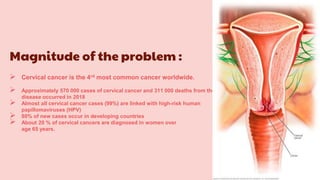
Magnitude of the problem :
 Cervical cancer is the 4rd most common cancer worldwide.
 Approximately 570 000 cases of cervical cancer and 311 000 deaths from the
disease occurred in 2018
 Almost all cervical cancer cases (99%) are linked with high-risk human
papillomaviruses (HPV)
 80% of new cases occur in developing countries
 About 20 % of cervical cancers are diagnosed in women over
age 65 years.
 Few women under the age of 20 diagnosed as
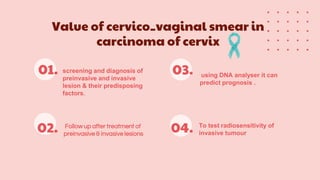
cervical cancer .
 Cervical cancer is easily accessible to early
diagnosis and treatment which can drastically reduce
the mortality
 More importantly to a large extend cervical cancer is
a preventable disease .
Pre-invasive lesion CIN
o Definition: Squamous epithelial lesion of cervix which are considered
to be cancer precursors, but lack features of invasive cancer.
o Cervical pre-cancers are diagnosed far more often than invasive
cervical cancer.
o Incidence: Strongly related to younger age of marriage,
socioeconomic factor , risk related behaviors.
o Age: Average age 35yrs.
Squamocolumnar junction:
 During embryogenesis upward migration of stratified squamous epithelium from the
urogenital and vaginal plate is thought to replace mullerian epithelium this process
end at cervical os.
 Squamous metaplasia is a normal process and occurs most actively immediately
adjacent to original scj, creating a zone of metaplastic epithelium termed the
transformation zone (tz) between the original scj and the columnar epithelium.
These metaplastic cells have phagocytic properties and if potential mutagen is present in
the vagina during this early squamous metaplasia transformation to premalignant change may
occur.
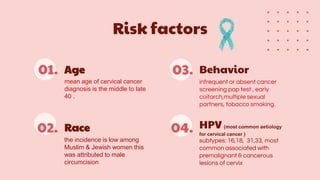
Age
01.
mean age of cervical cancer
diagnosis is the middle to late
40 .
Race
02.
the incidence is low among
Muslim & Jewish women this
was attributed to male
circumcision
Behavior
03.
infrequent or absent cancer
screening pap test , early
coitarch,multiple sexual
partners, tobacco smoking.
HPV (most common aetiology
for cervical cancer )
04.
subtypes: 16,18, 31,33, most
common associated with
premalignant & cancerous
lesions of cervix
Risk factors
Immunosuppression
05.
study suggest that HIV +ve women
have much higher rate of CIN
compared with HIV _ve women.
Parity
07.
Women who have had 3 or more full
term pregnancies have an increased
risk of cervical cancer
Combination oral
contraception
06.
Taking of COCP for long time
Family history
08.
Risk factors
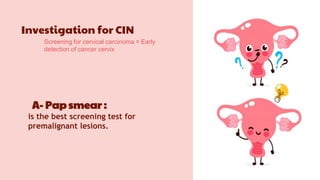
Screening for cervical carcinoma = Early
detection of cancer cervix
Investigation for CIN
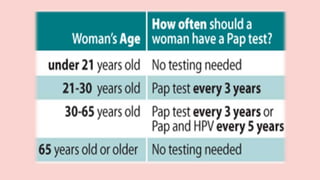
A- Pap smear :
is the best screening test for
premalignant lesions.
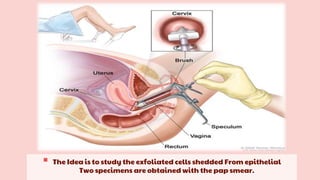
 The Idea is to study the exfoliated cells shedded From epithelial
Two specimens are obtained with the pap smear.
01. screening and diagnosis of
preinvasive and invasive
lesion & their predisposing
factors.
02. Follow up after treatment of
preinvasive & invasive lesions
03. using DNA analyser it can
predict prognosis .
04. To test radiosensitivity of
invasive tumour
Value of cervico_vaginal smear in
carcinoma of cervix
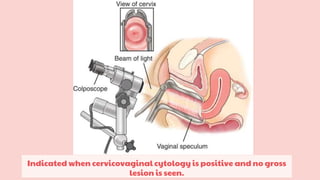
B- Colposcopy : an Outpatient procedure
 It’s simple, quick , and well tolerate
 It allow examination to lower genital tract with
microscope to further evaluate abnormal pap test
 Allow identification and management of
premalignant lesions
Investigation for CIN
Indicated when cervicovaginal cytology is positive and no gross
lesion is seen.
Investigation for CIN
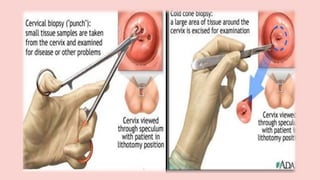
C - Biopsy :
Biopsy can differentiate CIN I,II,III microinvasive
and invasive cancer .
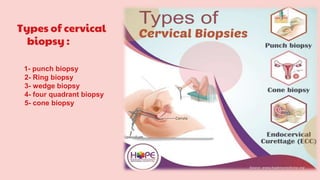
Types of cervical
biopsy :
1- punch biopsy
2- Ring biopsy
3- wedge biopsy
4- four quadrant biopsy
5- cone biopsy
Further cytological and colposcopy surveillance:
Post treatment , additional surveillance is required :
 patients with excision margins –ve must be followed with cytology testing
alone or with colposcopy each 6 month until 2 –ve evaluation are obtained
before returning to routine screening ,HPV testing done between 6-12 month
post treatment .
 If excision margins +ve for CIN II,III surveillance with repeat cytology 4 to 6
month later is preferred.
Invasive carcinoma of the cervix
 Malignant change in epithelial lining of cervix with
invasion of basement membrane.
 Incidence: it is most common form of cancer in women in developing
countries and the second most common form of cancer in women in the
world.
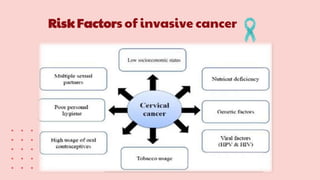
Risk Factors of invasive cancer
01.
02.
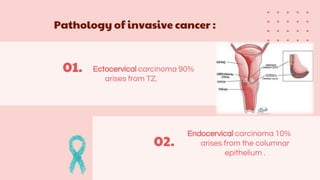
Ectocervical carcinoma 90%
arises from TZ.
Endocervical carcinoma 10%
arises from the columnar
epithelium .
Pathology of invasive cancer :
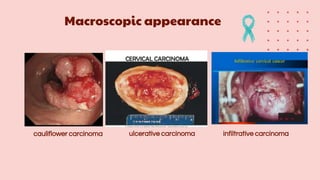
Macroscopic appearance
cauliflower carcinoma ulcerative carcinoma infiltrative carcinoma
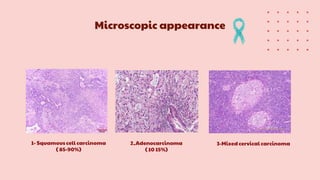
Microscopic appearance
1- Squamous cell carcinoma
( 85-90%)
2_Adenocarcinoma
( 10 15%)
3-Mixed cervical carcinoma
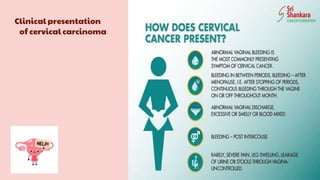
Clinical presentation
of cervical carcinoma
By Examination
 General examination : cachexia, pleural effusion, manifestation of uremia
 Abdominal examination : for abdominal metastasis or palbable kidney
(hydronephrosis)
 Pelvic examination : Digital examination
Bimanual examination
speculum examination
Rectal examination
Investigations
:
 To screen : same CIN
 To confirm the diagnosis: 
 biopsy & histologic examination
 Fractional curettage
 Metastatic workup: chest x ray ,intravenous pyelography, cystoscopy and
segmoidoscopy.
 Imaging studies: CT scan , MRI
 Other prognostic & follow up test:
- tumor markers : steroid receptor,CA125,CEA
- Anti viral antibodies.
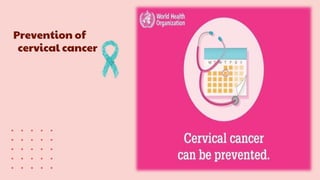
Prevention of
cervical cancer
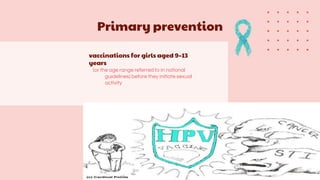
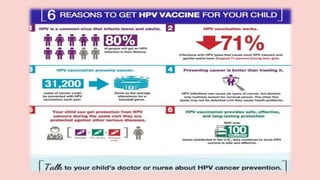
vaccinations for girls aged 9–13
years
(or the age range referred to in national
guidelines) before they initiate sexual
activity
Primary prevention
Vaccination
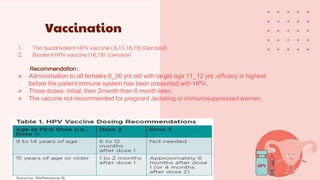
1. The quadrivalent HPV vaccine ( 6,11,16,18) (Gardasil)
2. Bivalent HPV vaccine (16,18) (cervarix)
Recommendation :
 Administration to all females 8_26 yrs old with target age 11_12 yrs ,efficacy is highest
before the patient immune system has been presented with HPV.
 Three doses: initial, then 2month then 6 month later.
 The vaccine not recommended for pregnant ,lactating or immunosuppressed women.
healthy sexuality education for
boys and girls
essential messages should include delay of
sexual initiation, and reduction of high-
risk sexual behaviors
Primary prevention
Avoidance of early marriage
and pregnancy
Follow healthy dietary pattern
Avoid smoking
Improve menstrual hygiene
Don’t forget your smear test
condom promotion or provision
for those who are sexually active
male circumcision where
relevant and appropriate.
Primary prevention
Secondary prevention
 screening for all women aged 30–49 years (or ages determined by national standards)
to identify precancerous lesions, which are usually asymptomatic
The public health goal is to decrease the incidence and prevalence of cervical
cancer and the associated mortality, by intercepting the progress from pre-
cancer to invasive cancer.
 Even for women who have received an HPV vaccination, it is important to continue
screening and treatment when they reach the target age.
 treatment of identified precancerous lesions before they progress to invasive cancer
Tertiary prevention
 Treatment of invasive cervical cancer is the goal
of public health to decrease the number of deaths
due to cervical cancer.
 Interventions include :- accurate and timely
cancer diagnosis, by exploring the extent of
invasion
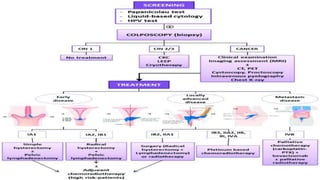
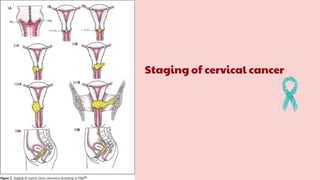
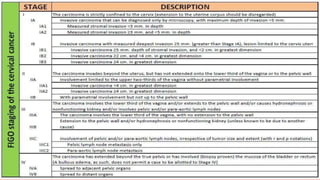
Staging of cervical cancer
21.March.2021
Cervical cancer Dr.Alia

Cervical cancer Dr.Alia

  • 2.
    Presented by : Dr.Alia Elmoalef
  • 4.
    Magnitude of theproblem :  Cervical cancer is the 4rd most common cancer worldwide.  Approximately 570 000 cases of cervical cancer and 311 000 deaths from the disease occurred in 2018  Almost all cervical cancer cases (99%) are linked with high-risk human papillomaviruses (HPV)  80% of new cases occur in developing countries  About 20 % of cervical cancers are diagnosed in women over age 65 years.
  • 5.
     Few womenunder the age of 20 diagnosed as cervical cancer .  Cervical cancer is easily accessible to early diagnosis and treatment which can drastically reduce the mortality  More importantly to a large extend cervical cancer is a preventable disease .
  • 6.
    Pre-invasive lesion CIN oDefinition: Squamous epithelial lesion of cervix which are considered to be cancer precursors, but lack features of invasive cancer. o Cervical pre-cancers are diagnosed far more often than invasive cervical cancer. o Incidence: Strongly related to younger age of marriage, socioeconomic factor , risk related behaviors. o Age: Average age 35yrs.
  • 7.
    Squamocolumnar junction:  Duringembryogenesis upward migration of stratified squamous epithelium from the urogenital and vaginal plate is thought to replace mullerian epithelium this process end at cervical os.  Squamous metaplasia is a normal process and occurs most actively immediately adjacent to original scj, creating a zone of metaplastic epithelium termed the transformation zone (tz) between the original scj and the columnar epithelium. These metaplastic cells have phagocytic properties and if potential mutagen is present in the vagina during this early squamous metaplasia transformation to premalignant change may occur.
  • 8.
    Age 01. mean age ofcervical cancer diagnosis is the middle to late 40 . Race 02. the incidence is low among Muslim & Jewish women this was attributed to male circumcision Behavior 03. infrequent or absent cancer screening pap test , early coitarch,multiple sexual partners, tobacco smoking. HPV (most common aetiology for cervical cancer ) 04. subtypes: 16,18, 31,33, most common associated with premalignant & cancerous lesions of cervix Risk factors
  • 9.
    Immunosuppression 05. study suggest thatHIV +ve women have much higher rate of CIN compared with HIV _ve women. Parity 07. Women who have had 3 or more full term pregnancies have an increased risk of cervical cancer Combination oral contraception 06. Taking of COCP for long time Family history 08. Risk factors
  • 10.
    Screening for cervicalcarcinoma = Early detection of cancer cervix Investigation for CIN A- Pap smear : is the best screening test for premalignant lesions.
  • 11.
     The Ideais to study the exfoliated cells shedded From epithelial Two specimens are obtained with the pap smear.
  • 12.
    01. screening anddiagnosis of preinvasive and invasive lesion & their predisposing factors. 02. Follow up after treatment of preinvasive & invasive lesions 03. using DNA analyser it can predict prognosis . 04. To test radiosensitivity of invasive tumour Value of cervico_vaginal smear in carcinoma of cervix
  • 14.
    B- Colposcopy :an Outpatient procedure  It’s simple, quick , and well tolerate  It allow examination to lower genital tract with microscope to further evaluate abnormal pap test  Allow identification and management of premalignant lesions Investigation for CIN
  • 15.
    Indicated when cervicovaginalcytology is positive and no gross lesion is seen.
  • 16.
    Investigation for CIN C- Biopsy : Biopsy can differentiate CIN I,II,III microinvasive and invasive cancer .
  • 17.
    Types of cervical biopsy: 1- punch biopsy 2- Ring biopsy 3- wedge biopsy 4- four quadrant biopsy 5- cone biopsy
  • 19.
    Further cytological andcolposcopy surveillance: Post treatment , additional surveillance is required :  patients with excision margins –ve must be followed with cytology testing alone or with colposcopy each 6 month until 2 –ve evaluation are obtained before returning to routine screening ,HPV testing done between 6-12 month post treatment .  If excision margins +ve for CIN II,III surveillance with repeat cytology 4 to 6 month later is preferred.
  • 20.
    Invasive carcinoma ofthe cervix  Malignant change in epithelial lining of cervix with invasion of basement membrane.  Incidence: it is most common form of cancer in women in developing countries and the second most common form of cancer in women in the world.
  • 21.
    Risk Factors ofinvasive cancer
  • 22.
    01. 02. Ectocervical carcinoma 90% arisesfrom TZ. Endocervical carcinoma 10% arises from the columnar epithelium . Pathology of invasive cancer :
  • 23.
    Macroscopic appearance cauliflower carcinomaulcerative carcinoma infiltrative carcinoma
  • 24.
    Microscopic appearance 1- Squamouscell carcinoma ( 85-90%) 2_Adenocarcinoma ( 10 15%) 3-Mixed cervical carcinoma
  • 25.
  • 26.
    By Examination  Generalexamination : cachexia, pleural effusion, manifestation of uremia  Abdominal examination : for abdominal metastasis or palbable kidney (hydronephrosis)  Pelvic examination : Digital examination Bimanual examination speculum examination Rectal examination
  • 27.
    Investigations :  To screen: same CIN  To confirm the diagnosis:  biopsy & histologic examination  Fractional curettage  Metastatic workup: chest x ray ,intravenous pyelography, cystoscopy and segmoidoscopy.  Imaging studies: CT scan , MRI  Other prognostic & follow up test: - tumor markers : steroid receptor,CA125,CEA - Anti viral antibodies.
  • 28.
  • 29.
    vaccinations for girlsaged 9–13 years (or the age range referred to in national guidelines) before they initiate sexual activity Primary prevention
  • 30.
    Vaccination 1. The quadrivalentHPV vaccine ( 6,11,16,18) (Gardasil) 2. Bivalent HPV vaccine (16,18) (cervarix) Recommendation :  Administration to all females 8_26 yrs old with target age 11_12 yrs ,efficacy is highest before the patient immune system has been presented with HPV.  Three doses: initial, then 2month then 6 month later.  The vaccine not recommended for pregnant ,lactating or immunosuppressed women.
  • 32.
    healthy sexuality educationfor boys and girls essential messages should include delay of sexual initiation, and reduction of high- risk sexual behaviors Primary prevention
  • 33.
    Avoidance of earlymarriage and pregnancy Follow healthy dietary pattern Avoid smoking Improve menstrual hygiene Don’t forget your smear test
  • 34.
    condom promotion orprovision for those who are sexually active male circumcision where relevant and appropriate. Primary prevention
  • 35.
    Secondary prevention  screeningfor all women aged 30–49 years (or ages determined by national standards) to identify precancerous lesions, which are usually asymptomatic The public health goal is to decrease the incidence and prevalence of cervical cancer and the associated mortality, by intercepting the progress from pre- cancer to invasive cancer.  Even for women who have received an HPV vaccination, it is important to continue screening and treatment when they reach the target age.  treatment of identified precancerous lesions before they progress to invasive cancer
  • 36.
    Tertiary prevention  Treatmentof invasive cervical cancer is the goal of public health to decrease the number of deaths due to cervical cancer.  Interventions include :- accurate and timely cancer diagnosis, by exploring the extent of invasion
  • 37.
  • 40.