Implementing Explanation-Based
Argumentation using Answer Set
Programming
Giovanni Sileno g.sileno@uva.nl
Alexander Boer, Tom van Engers
Leibniz Center for Law
University of Amsterdam
5 May 2014, ArgMAS presentation
Background
Argumentation
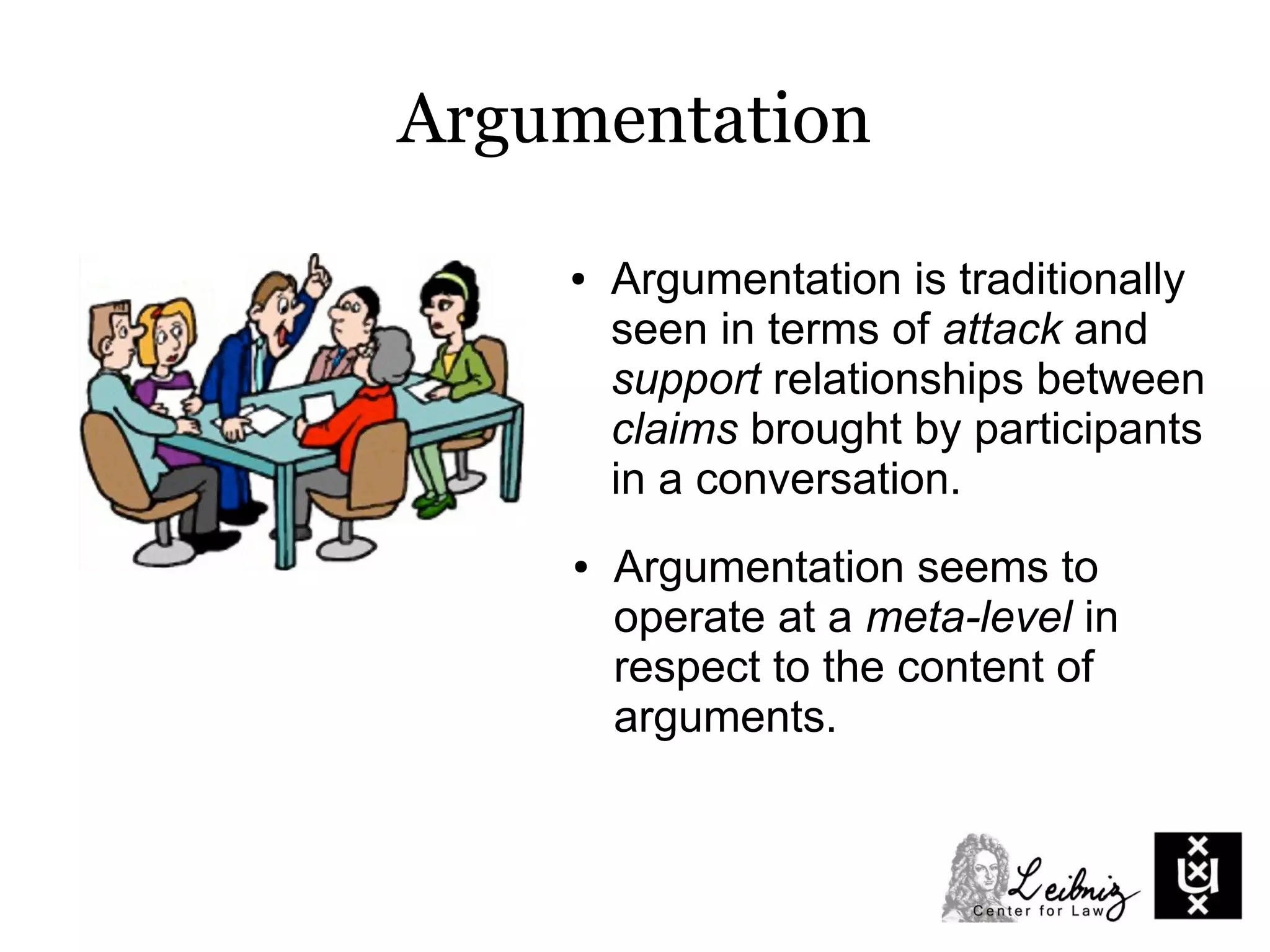
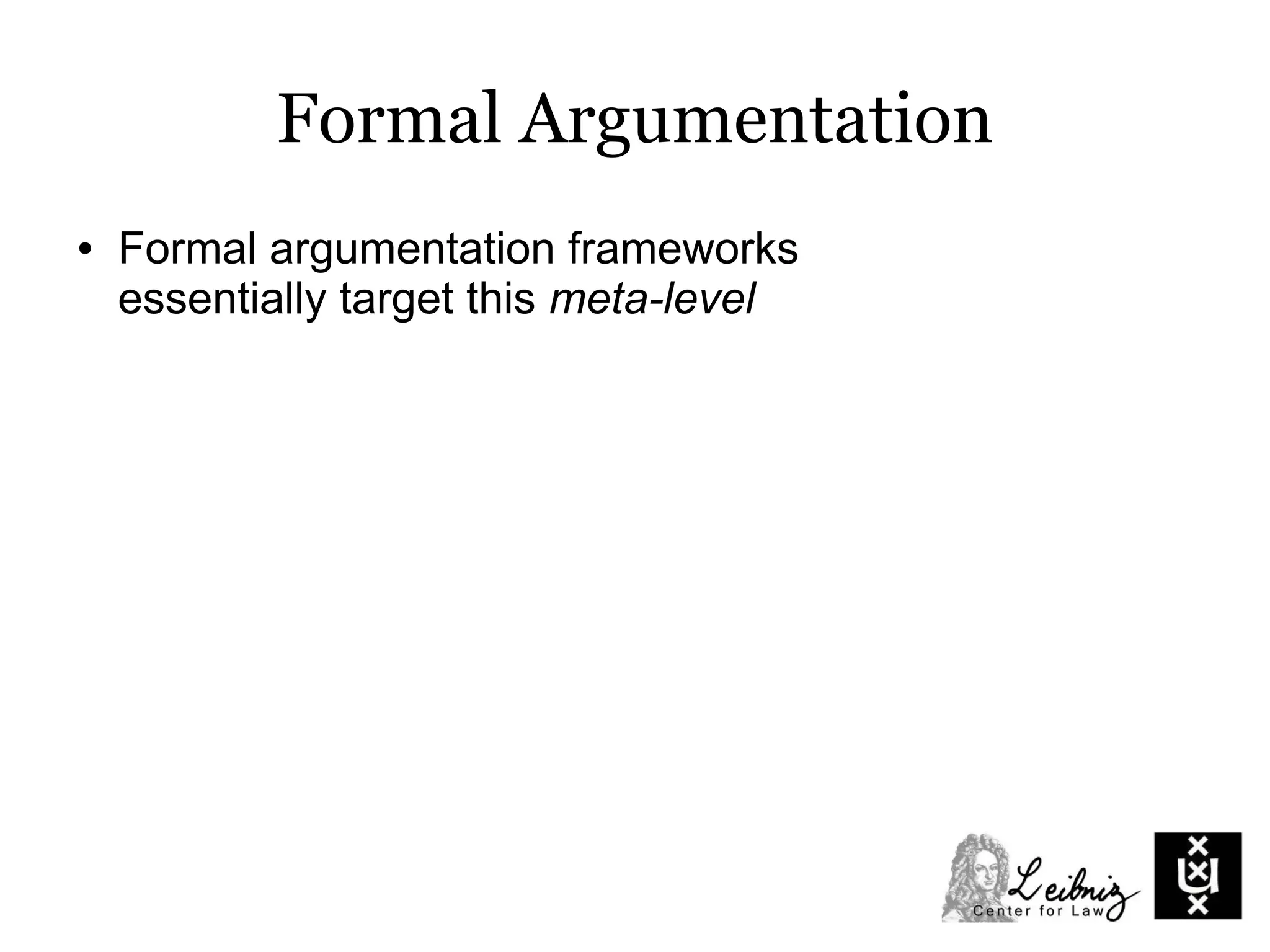
● Argumentation is traditionally
seen in terms of attack and
support relationships between
claims brought by participants
in a conversation.
Argumentation
● Argumentation is traditionally
seen in terms of attack and
support relationships between
claims brought by participants
in a conversation.
● Argumentation seems to
operate at a meta-level in
respect to the content of
arguments.
Formal Argumentation
● Formal argumentation frameworks
essentially target this meta-level
Formal Argumentation
● An Argumentation framework (AF) [Dung] consists of :
– a set of arguments
– attack relations between arguments
● Formal argumentation frameworks
essentially target this meta-level
Formal Argumentation
● To interpret/evaluate an AF we need a semantics.
● For instance, extension-based semantics classify
sub-sets of arguments collectively acceptable in
extensions:
→ the justification state of argument is defined in terms of
memberships to extensions (skeptically/credulously justified)
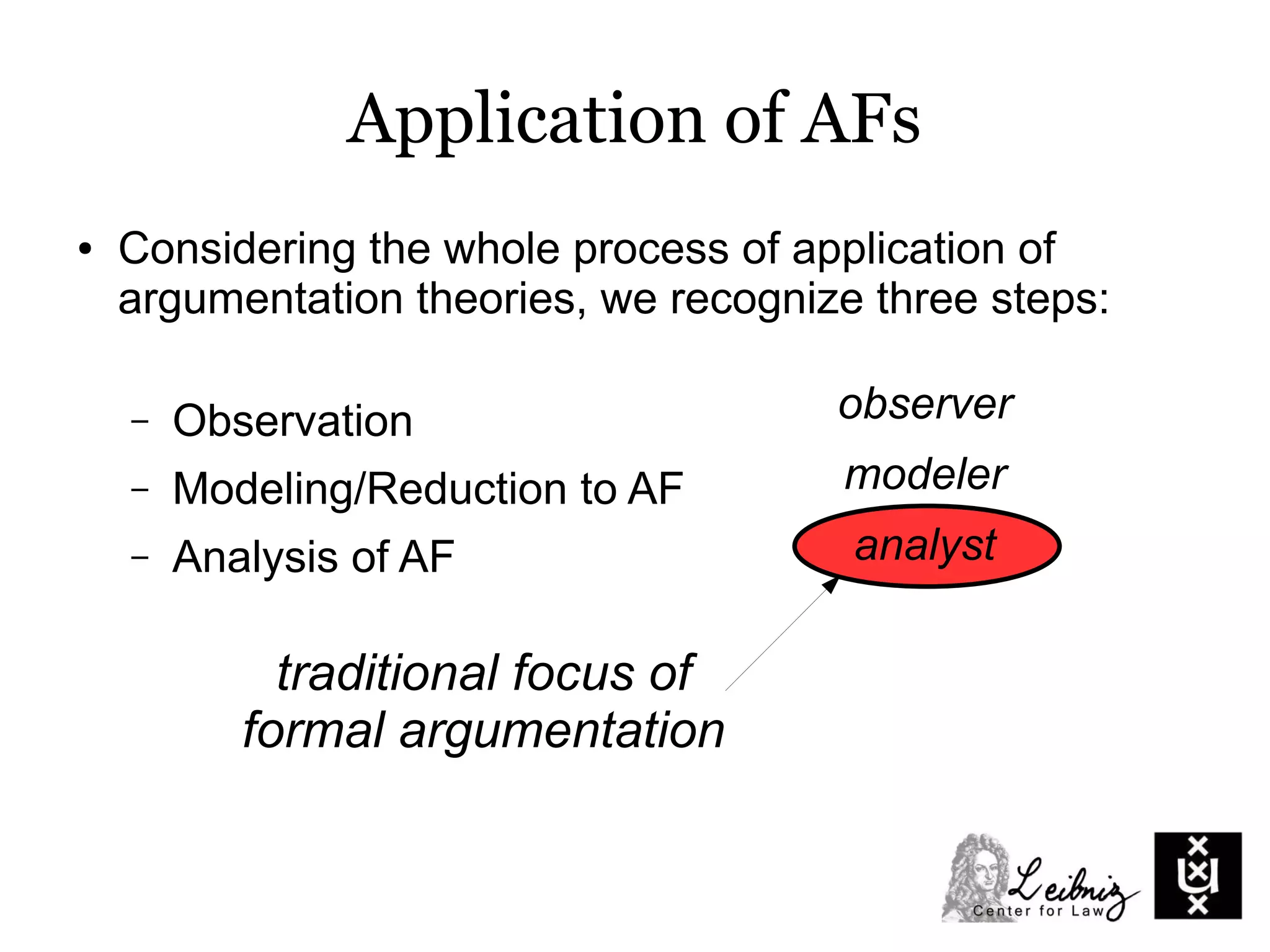
Application of AFs
● Considering the whole process of application of
argumentation theories, we recognize three steps:
– Observation
– Modeling/Reduction to AF
– Analysis of AF
traditional focus of
formal argumentation
observer
modeler
analyst
Inside/Outside of Argument Systems
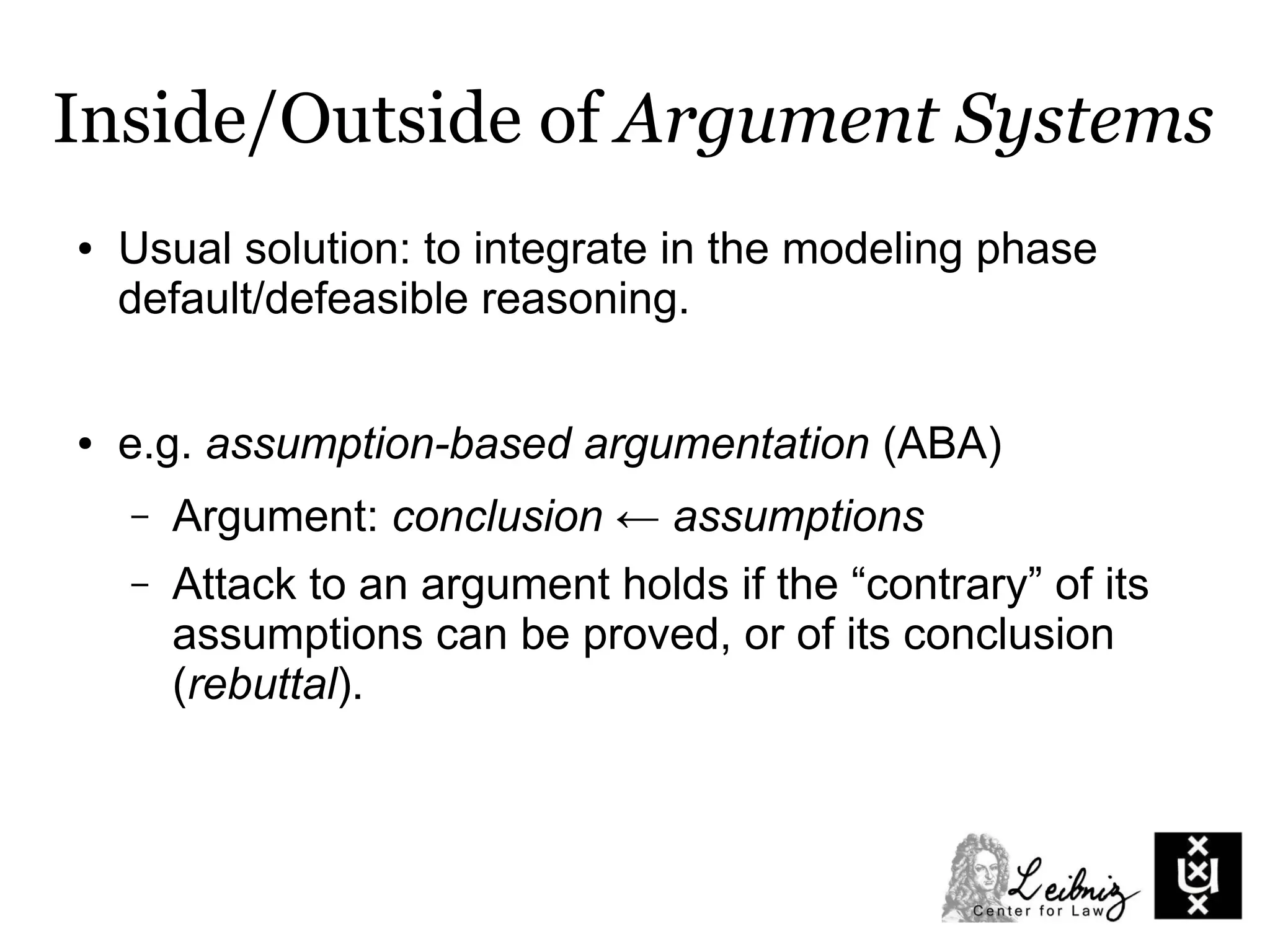
● In general, the extraction of attack relations may be
problematic.
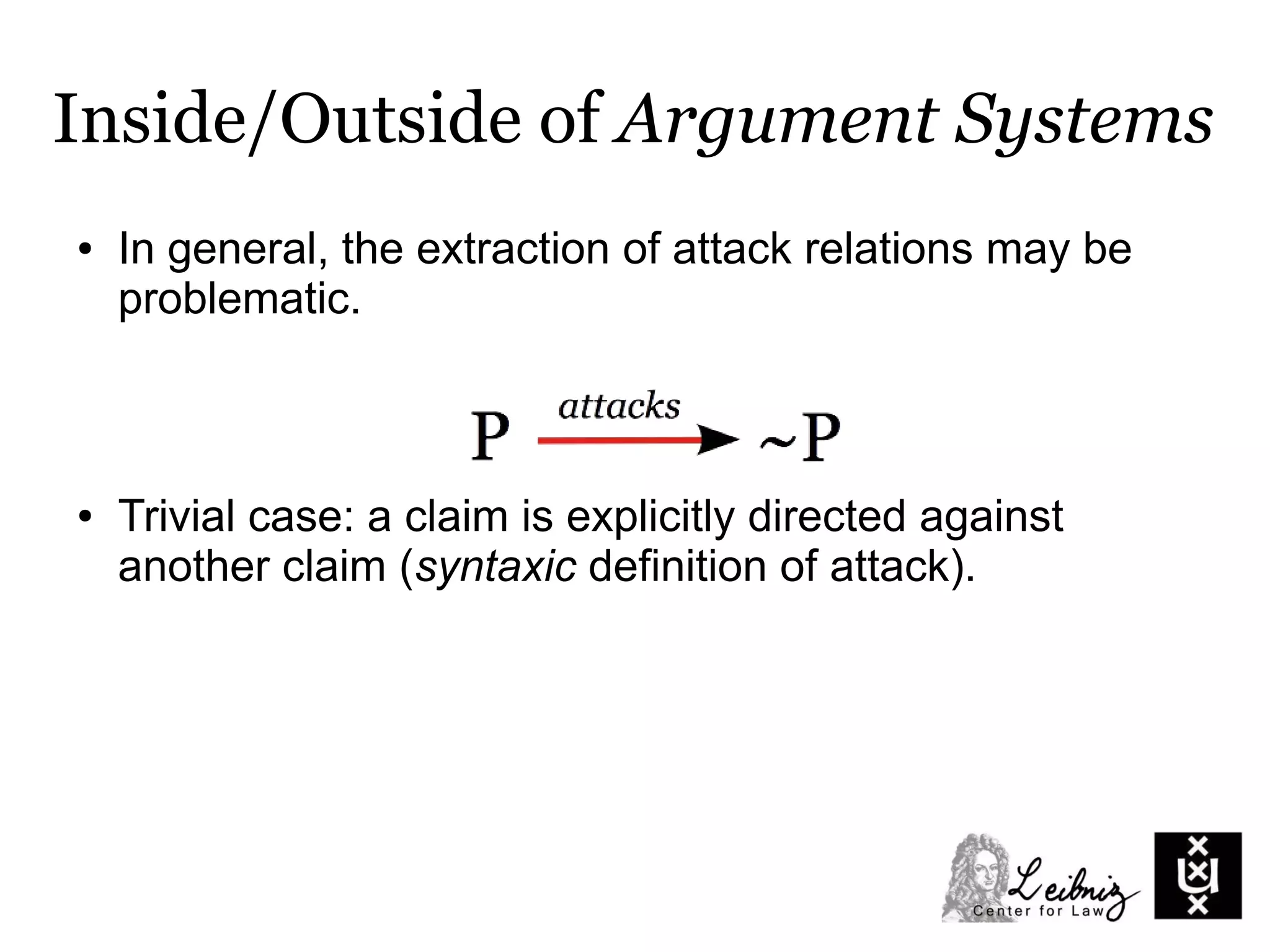
Inside/Outside of Argument Systems
● In general, the extraction of attack relations may be
problematic.
● Trivial case: a claim is explicitly directed against
another claim (syntaxic definition of attack).
Inside/Outside of Argument Systems
● In general, the extraction of attack relations may be
problematic.
● In a more general case, however, modelers have to
use some background knowledge and underlying
knowledge processing to identify the attacks.
Inside/Outside of Argument Systems
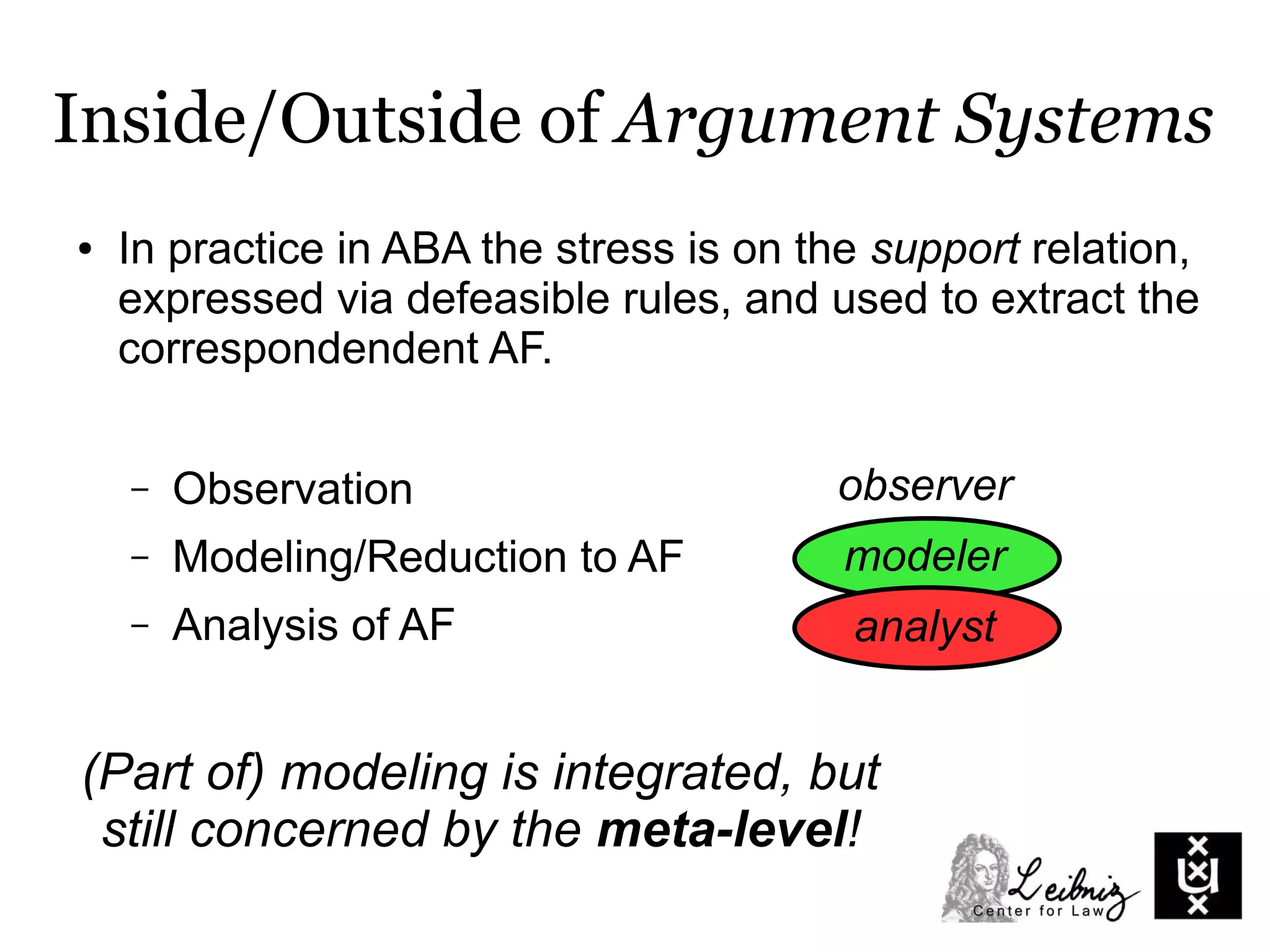
● Usual solution: to integrate in the modeling phase
default/defeasible reasoning.
● e.g. assumption-based argumentation (ABA)
– Argument: conclusion ← assumptions
– Attack to an argument holds if the “contrary” of its
assumptions can be proved, or of its conclusion
(rebuttal).
Inside/Outside of Argument Systems
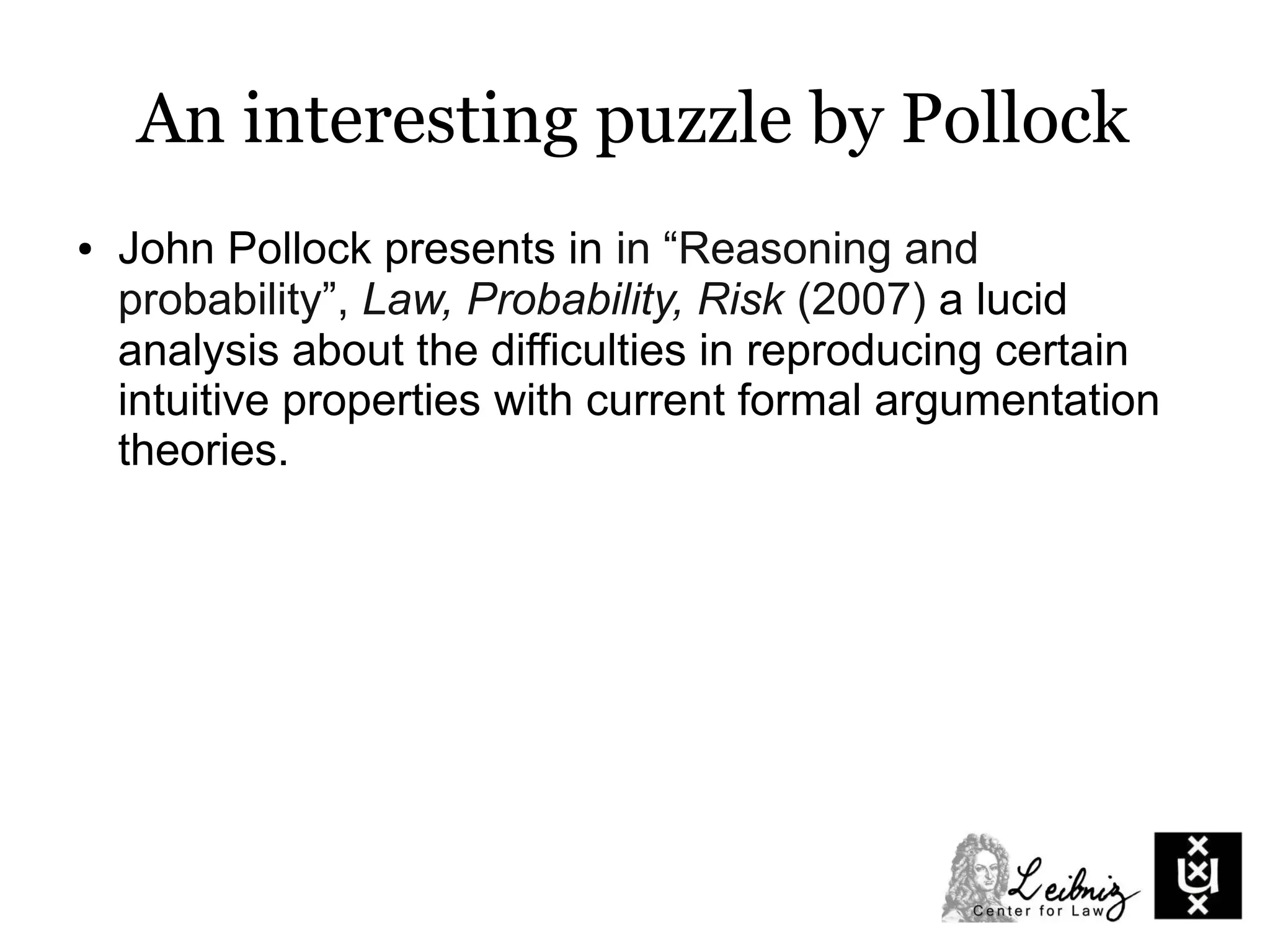
● In practice in ABA the stress is on the support relation,
expressed via defeasible rules, and used to extract the
correspondendent AF.
(Part of) modeling is integrated, but
still concerned by the meta-level!
– Observation
– Modeling/Reduction to AF
– Analysis of AF
observer
modeler
analyst
The Puzzle
An interesting puzzle by Pollock
● John Pollock presents in in “Reasoning and
probability”, Law, Probability, Risk (2007) a lucid
analysis about the difficulties in reproducing certain
intuitive properties with current formal argumentation
theories.
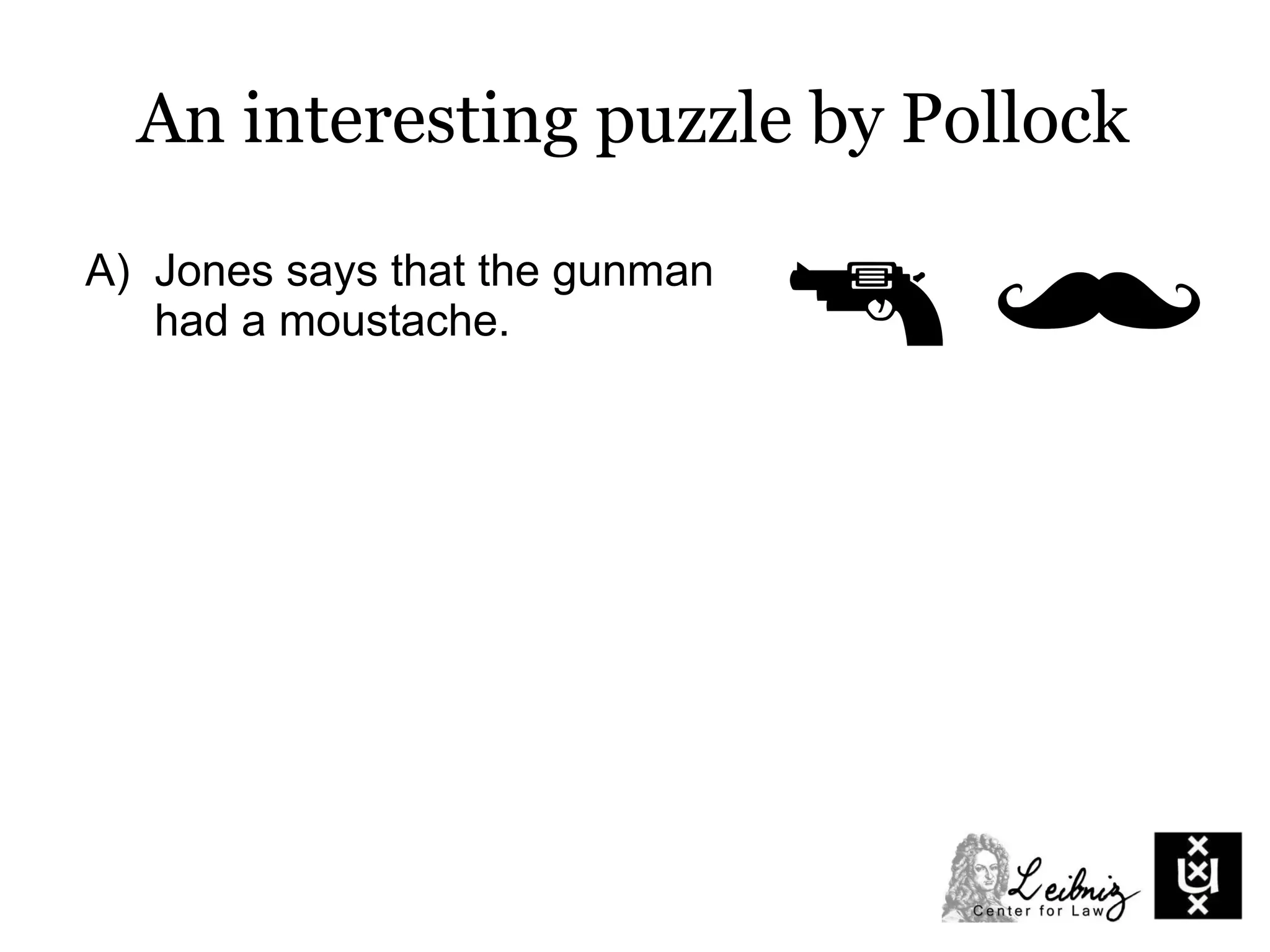
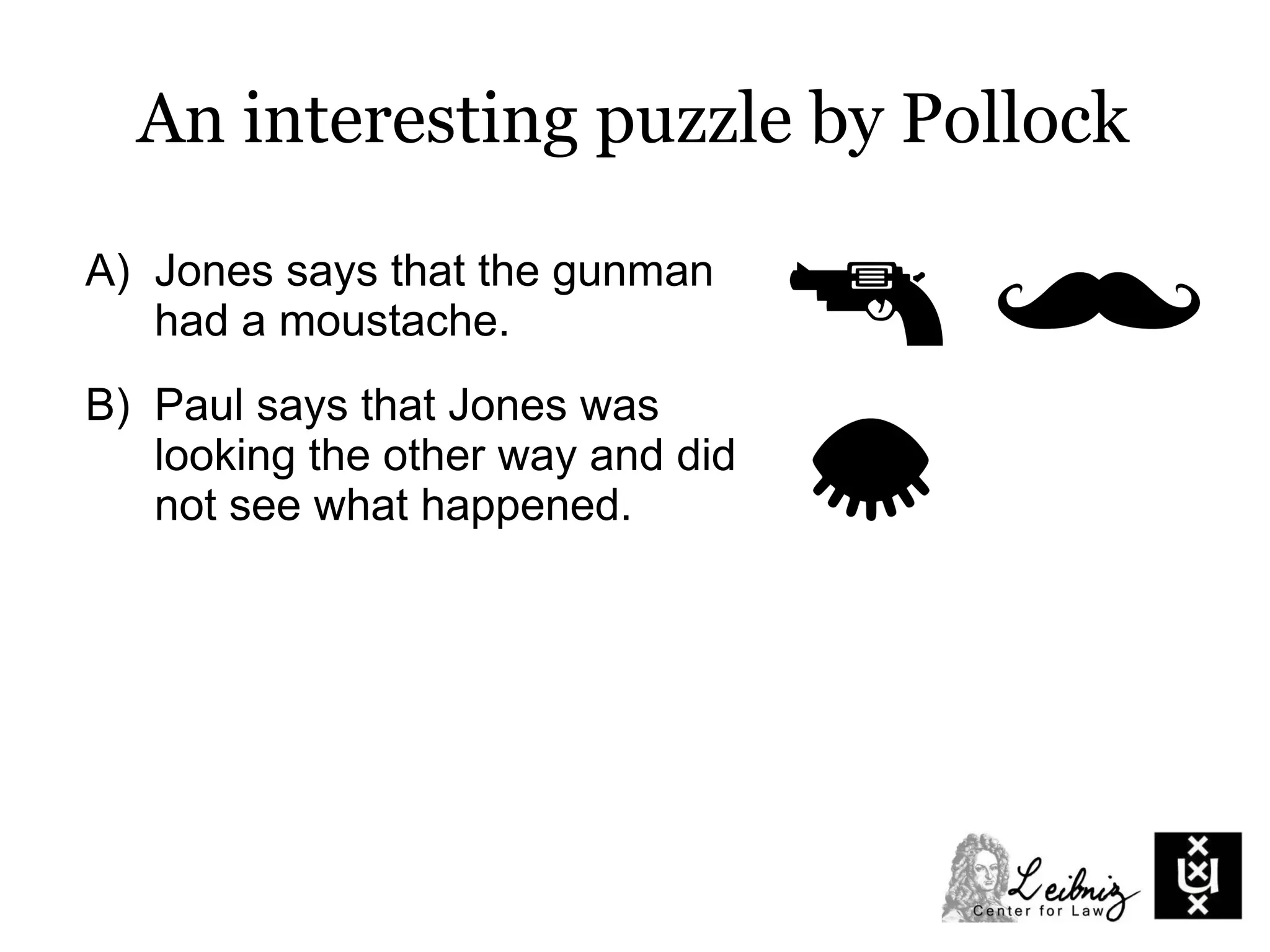
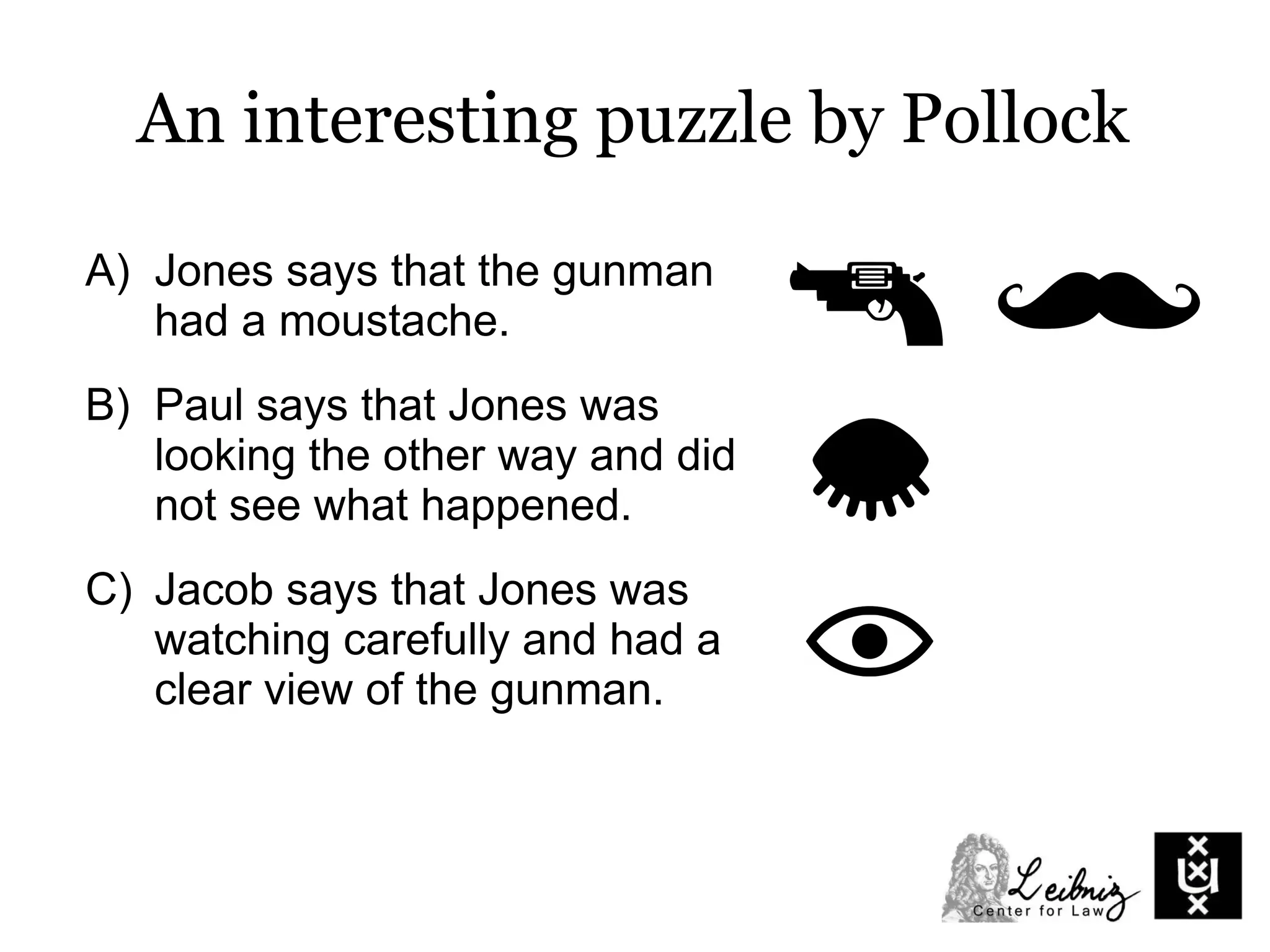
A) Jones says that the gunman
had a moustache.
B) Paul says that Jones was
looking the other way and did
not see what happened.
C) Jacob says that Jones was
watching carefully and had a
clear view of the gunman.
An interesting puzzle by Pollock
A) Jones says that the gunman
had a moustache.
B) Paul says that Jones was
looking the other way and did
not see what happened.
C) Jacob says that Jones was
watching carefully and had a
clear view of the gunman.
An interesting puzzle by Pollock
A) Jones says that the gunman
had a moustache.
B) Paul says that Jones was
looking the other way and did
not see what happened.
C) Jacob says that Jones was
watching carefully and had a
clear view of the gunman.
An interesting puzzle by Pollock
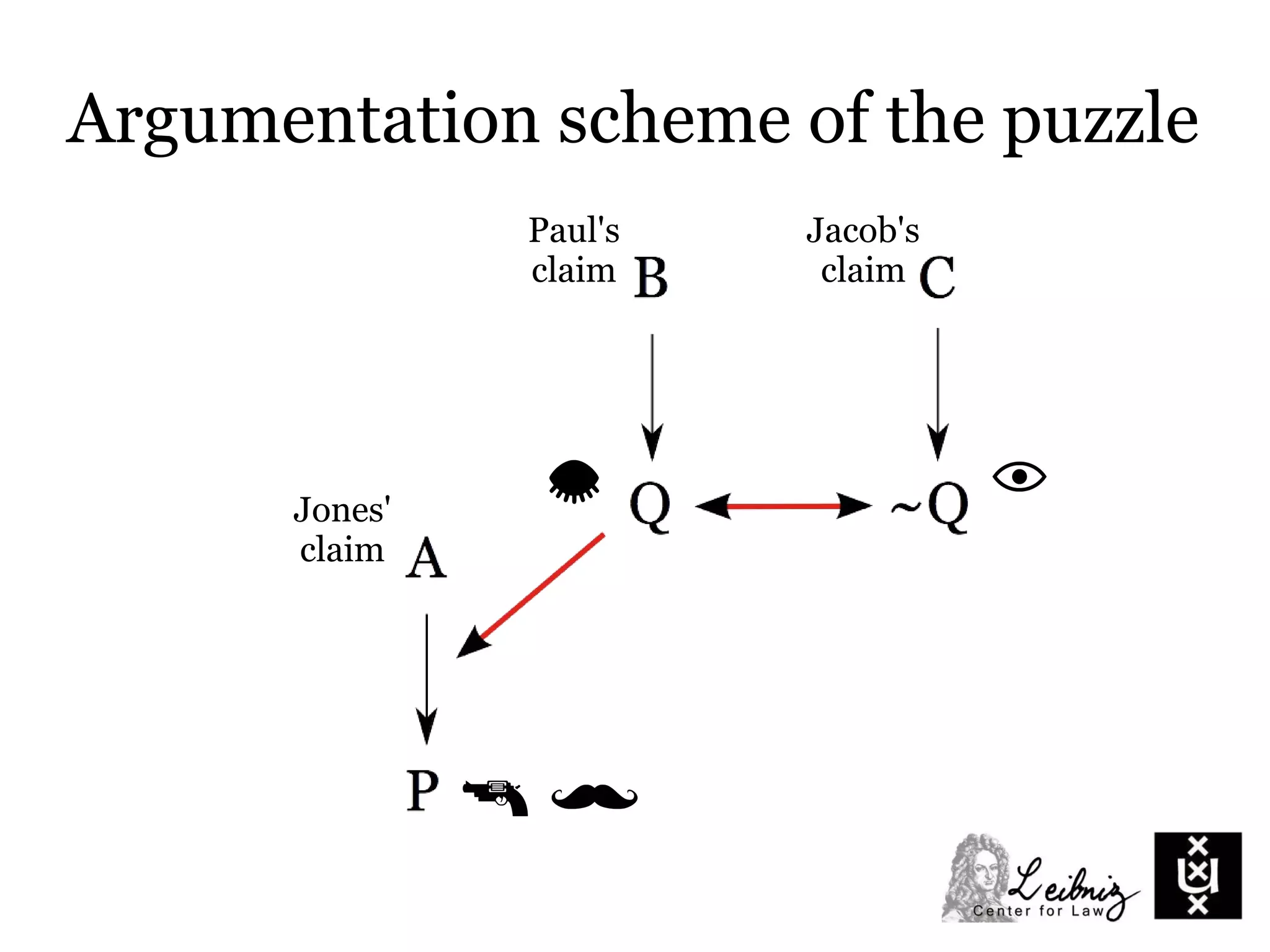
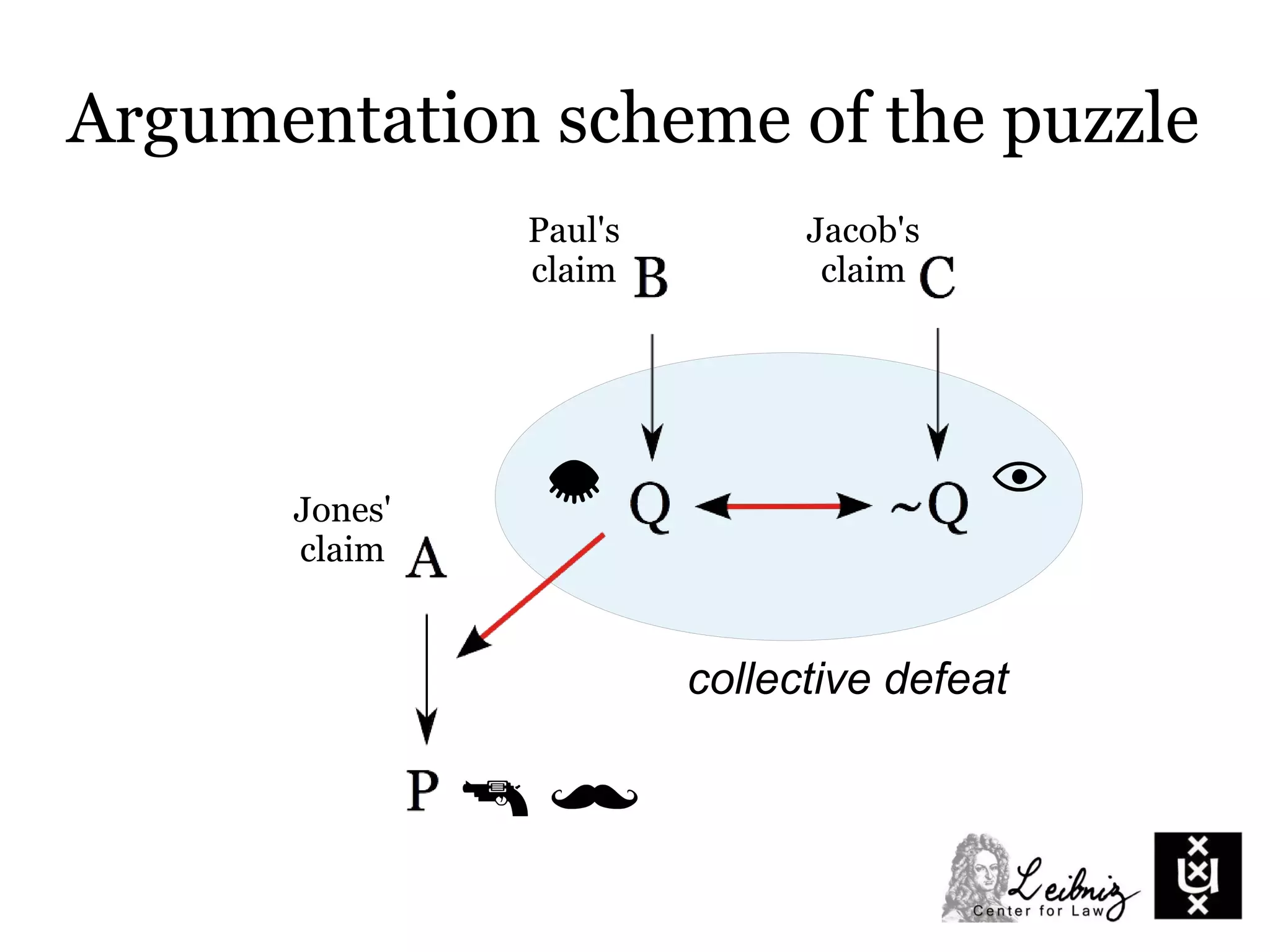
Jones'
claim
Paul's
claim
Jacob's
claim
Argumentation scheme of the puzzle
Jones'
claim
Paul's
claim
Jacob's
claim
collective defeat
collective defeat
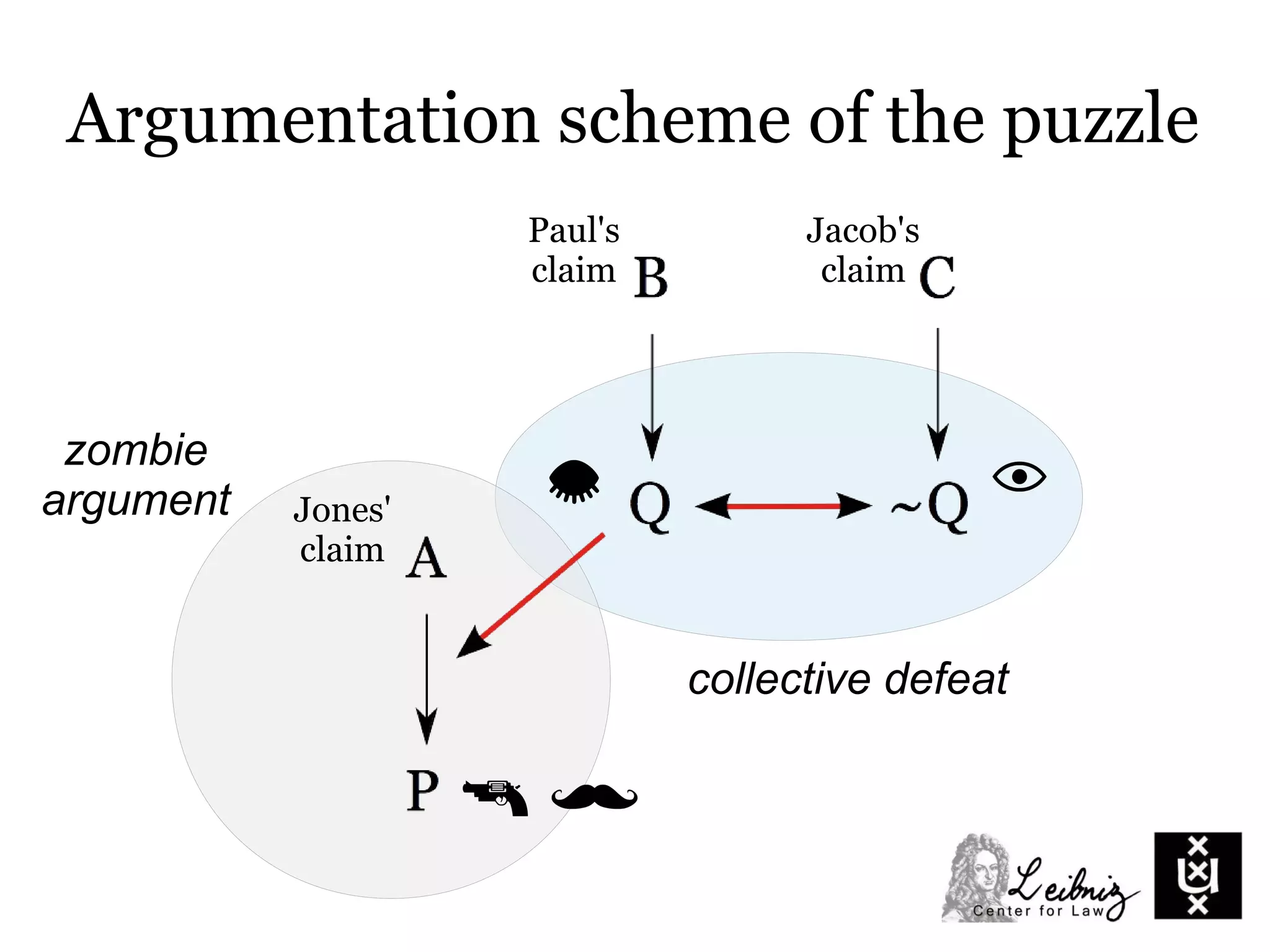
Argumentation scheme of the puzzle
Jones'
claim
Paul's
claim
Jacob's
claim
zombie
argument
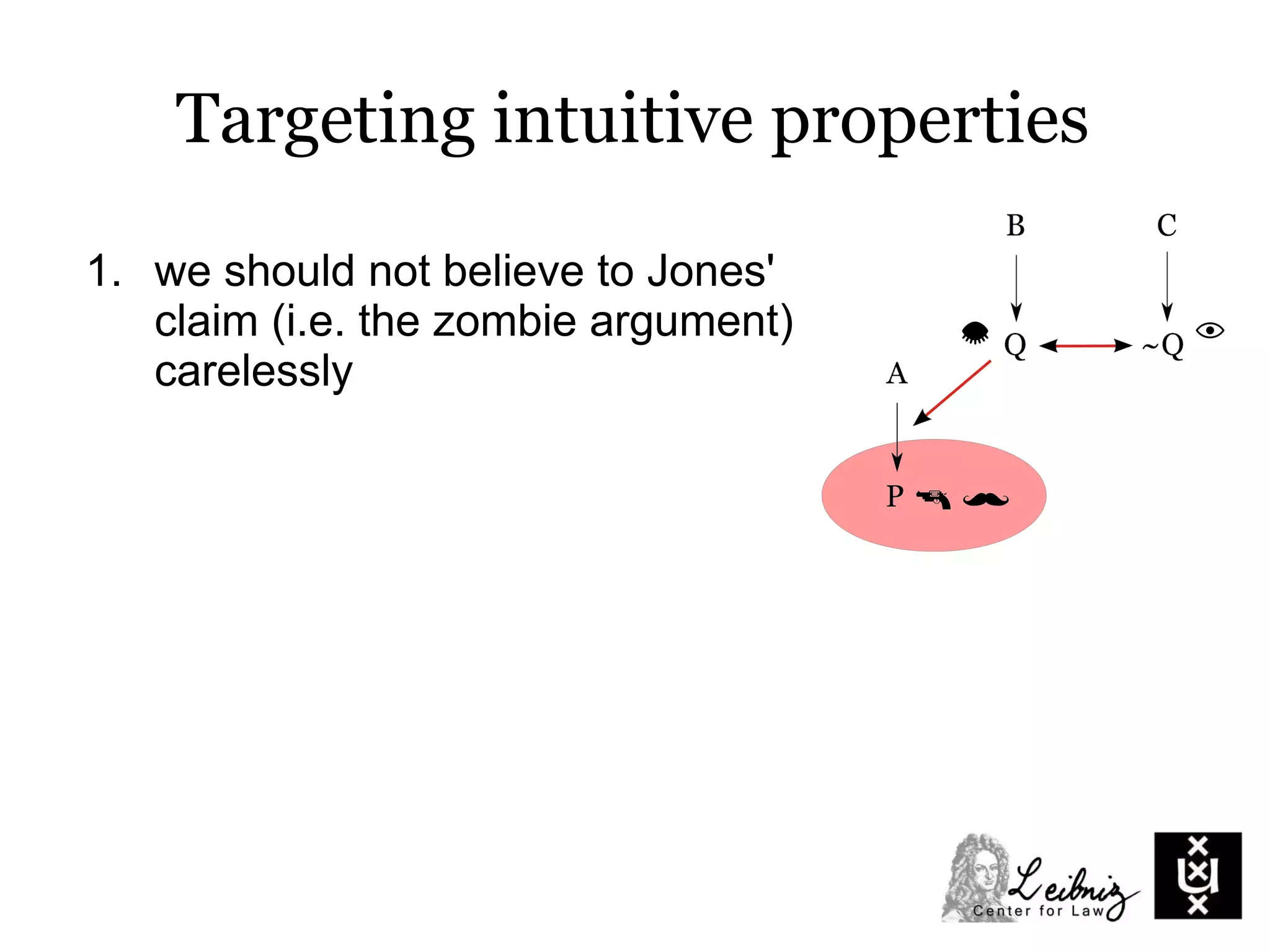
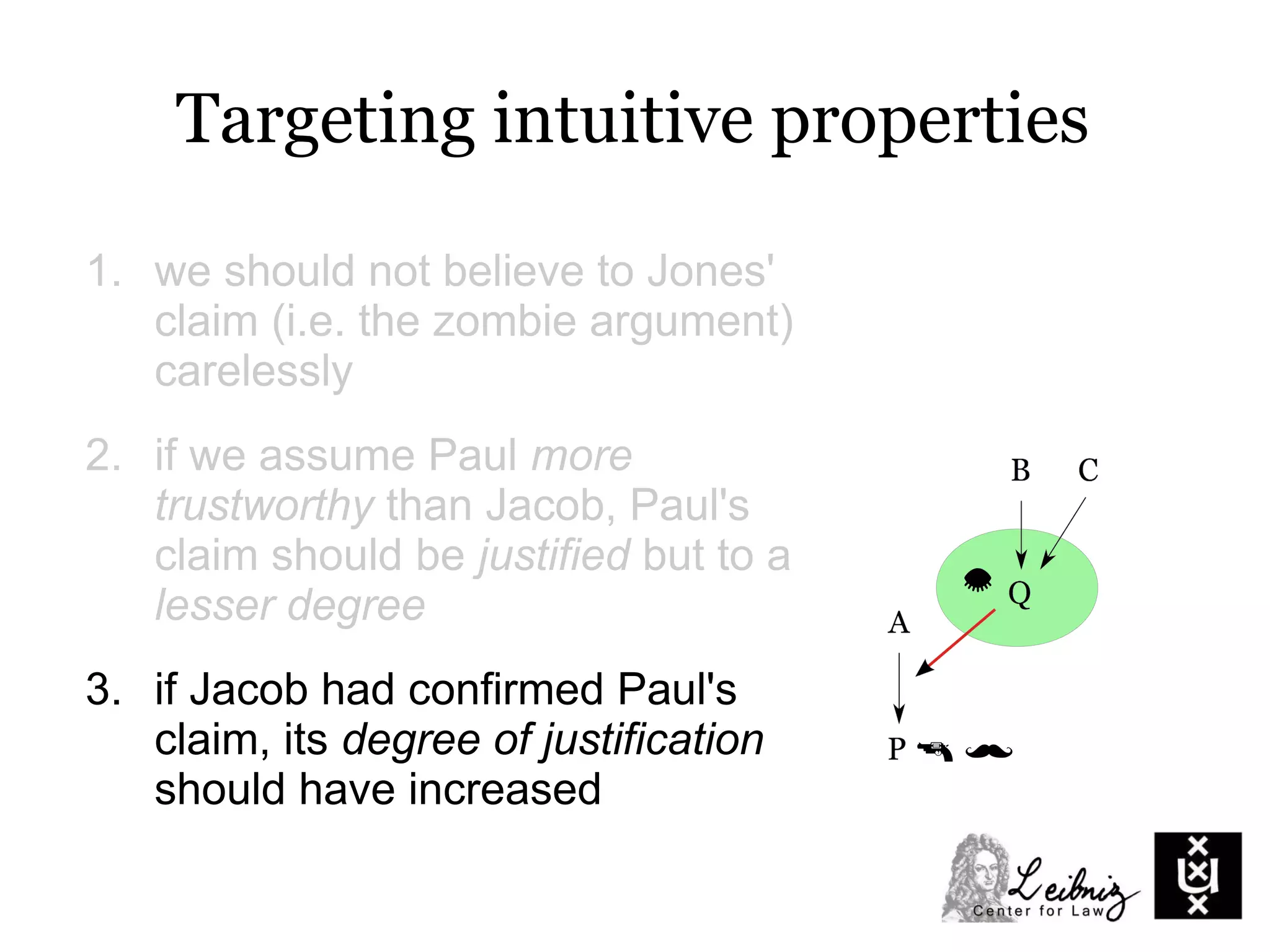
Targeting intuitive properties
1. we should not believe to Jones'
claim (i.e. the zombie argument)
carelessly
Targeting intuitive properties
1. we should not believe to Jones'
claim (i.e. the zombie argument)
carelessly
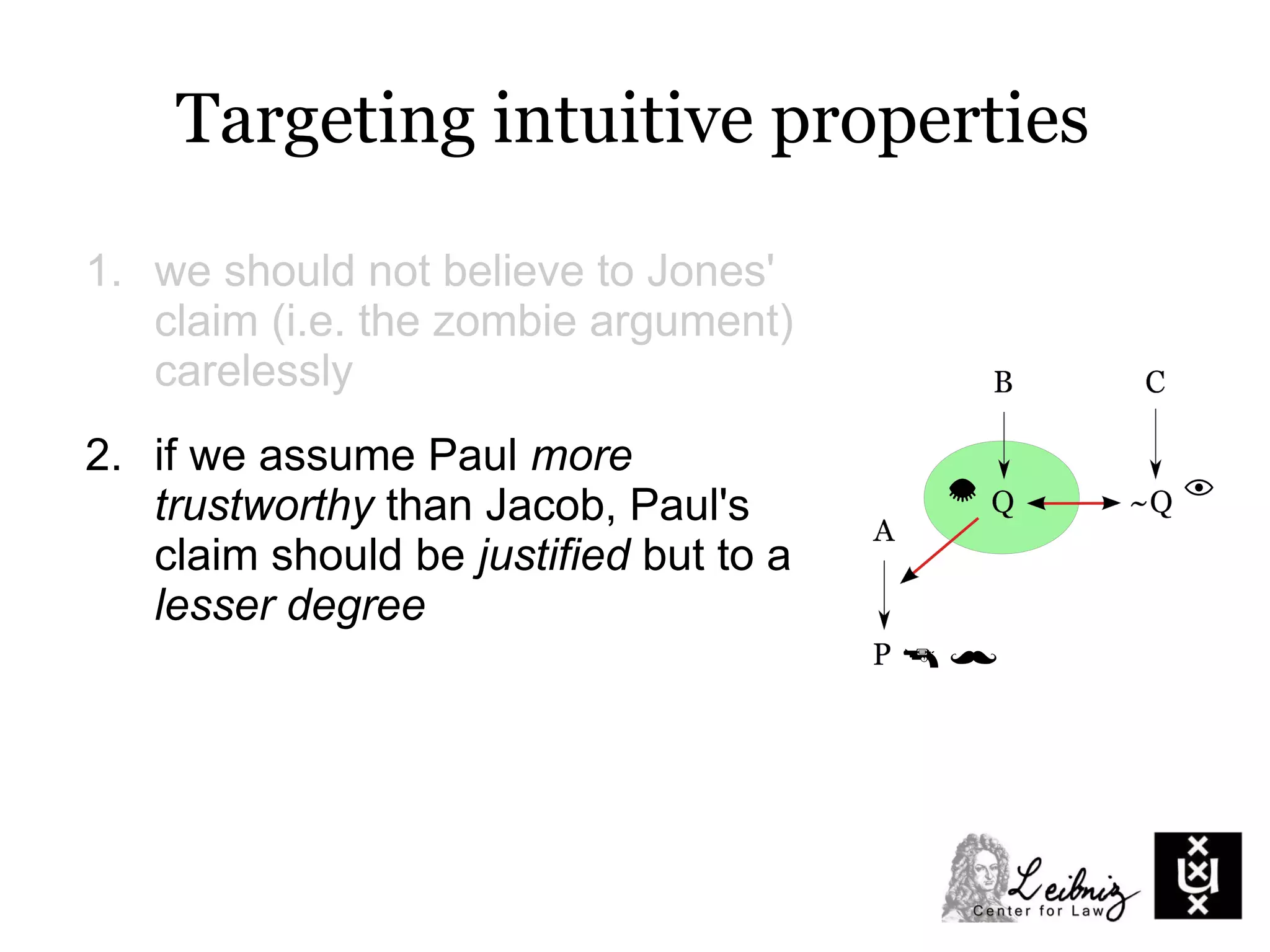
2. if we assume Paul more
trustworthy than Jacob, Paul's
claim should be justified but to a
lesser degree
Targeting intuitive properties
1. we should not believe to Jones'
claim (i.e. the zombie argument)
carelessly
2. if we assume Paul more
trustworthy than Jacob, Paul's
claim should be justified but to a
lesser degree
3. if Jacob had confirmed Paul's
claim, its degree of justification
should have increased
Pollock's puzzle
● Underlying problems:
– zombie arguments
– (relative) judgments of trustworthiness/reliability
– ...
– how to approach justification?
● Pollock proposed a highly elaborate preliminary
solution based on probable probabilities.
● We propose a different solution, based on
explanation-based argumentation.
Shift of perspective
Explanation-Based Argumentation
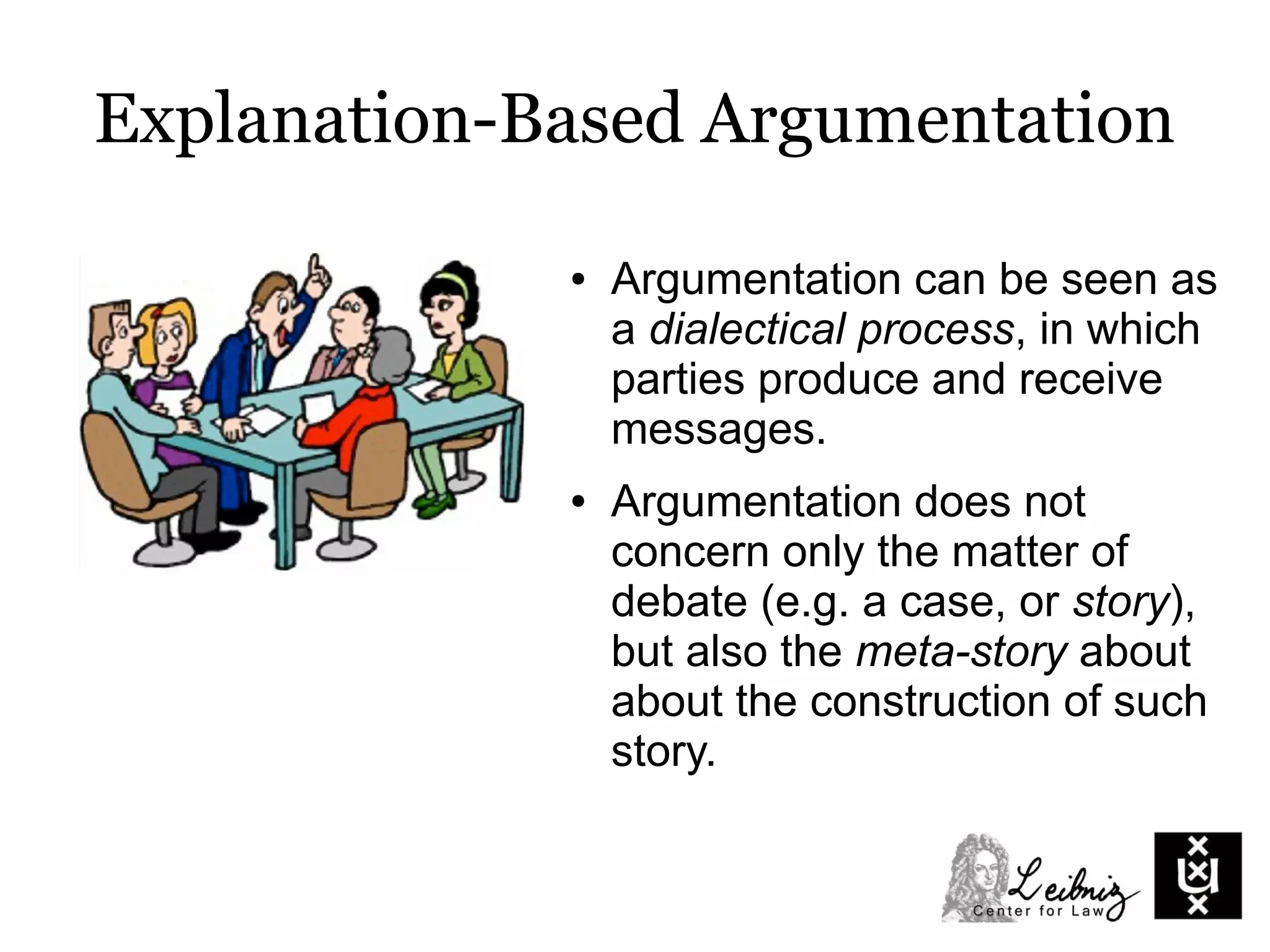
● Argumentation can be seen as
a dialectical process, in which
parties produce and receive
messages.
● Argumentation does not
concern only the matter of
debate (e.g. a case, or story),
but also the meta-story about
about the construction of such
story.
EBA: observations
● The sequence of collected
messages consists in the
observation.
● Sometimes the
observation is collected by
a third-party adjudicator,
entitled to interpret the
case from a neutral
position.The Trial of Bill Burn under
Martin's Act [1838]
EBA: explanations
● Given a disputed case, an explanation is a possible
scenario which is compatible
– with the content of the messages, and
– with the generation process of the messages.
In general, the nature of such scenarios is of a multi-
representational model, integrating physical, mental,
institutional and abstract domains.
EBA: explanations
● Given a disputed case, an explanation is a possible
scenario which is compatible
– with the content of the messages, and
– with the generation process of the messages.
● An explanation is valid if it reproduces the observation.
● Several explanations may be valid, i.e. fitting the same
observation. Their competition is matter of justification.
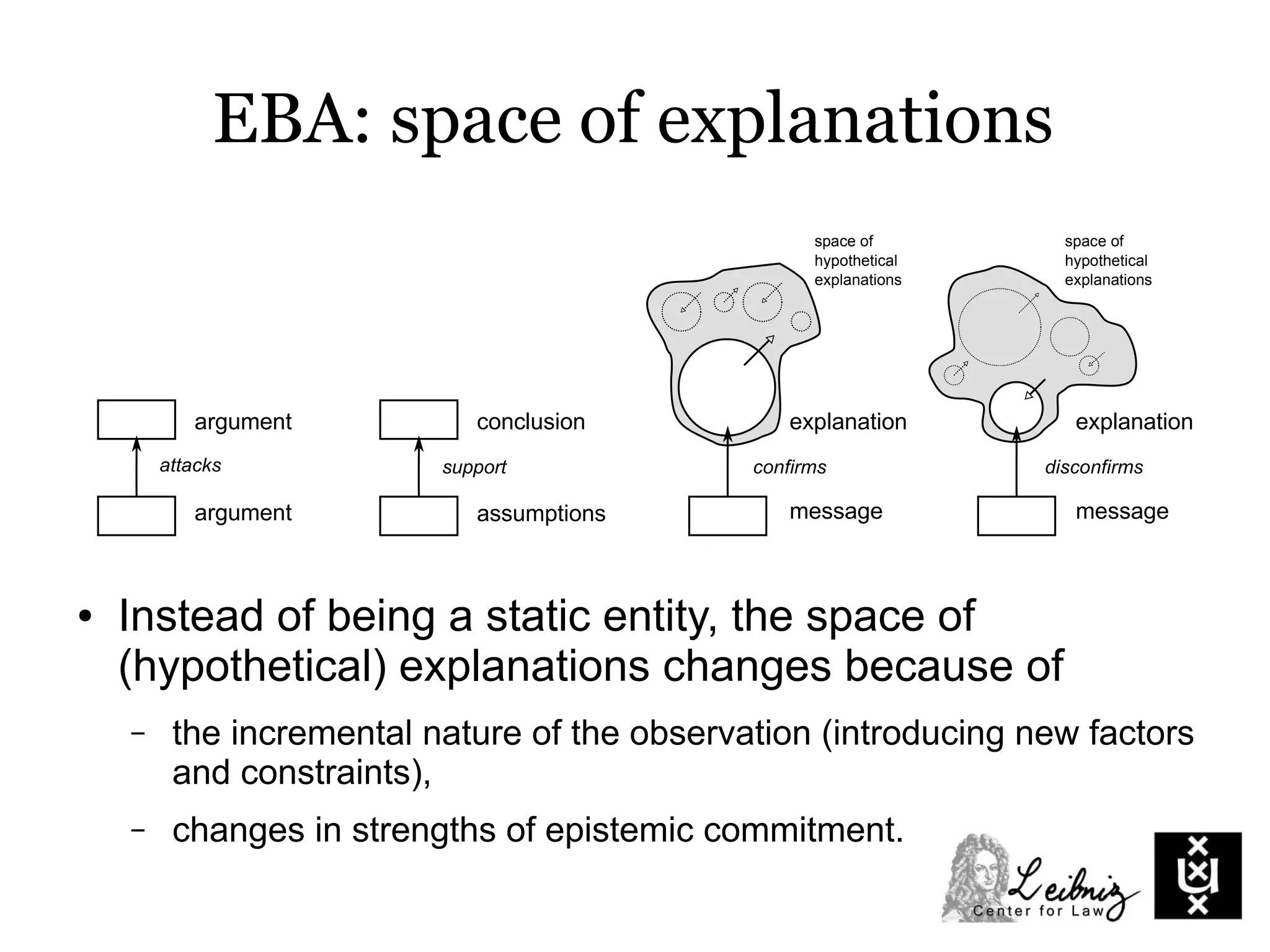
EBA: space of explanations
conclusion
support
assumptions
explanation
message
confirms
space of
hypothetical
explanations
explanation
message
disconfirms
space of
hypothetical
explanations
argument
argument
attacks
● Instead of being a static entity, the space of
(hypothetical) explanations changes because of
– the incremental nature of the observation (introducing new factors
and constraints),
– changes in strengths of epistemic commitment.
Explanation-based Argumentation
● Referring to these ingredients, we propose the
following operationalization, based on three steps.
Explanation-based Argumentation
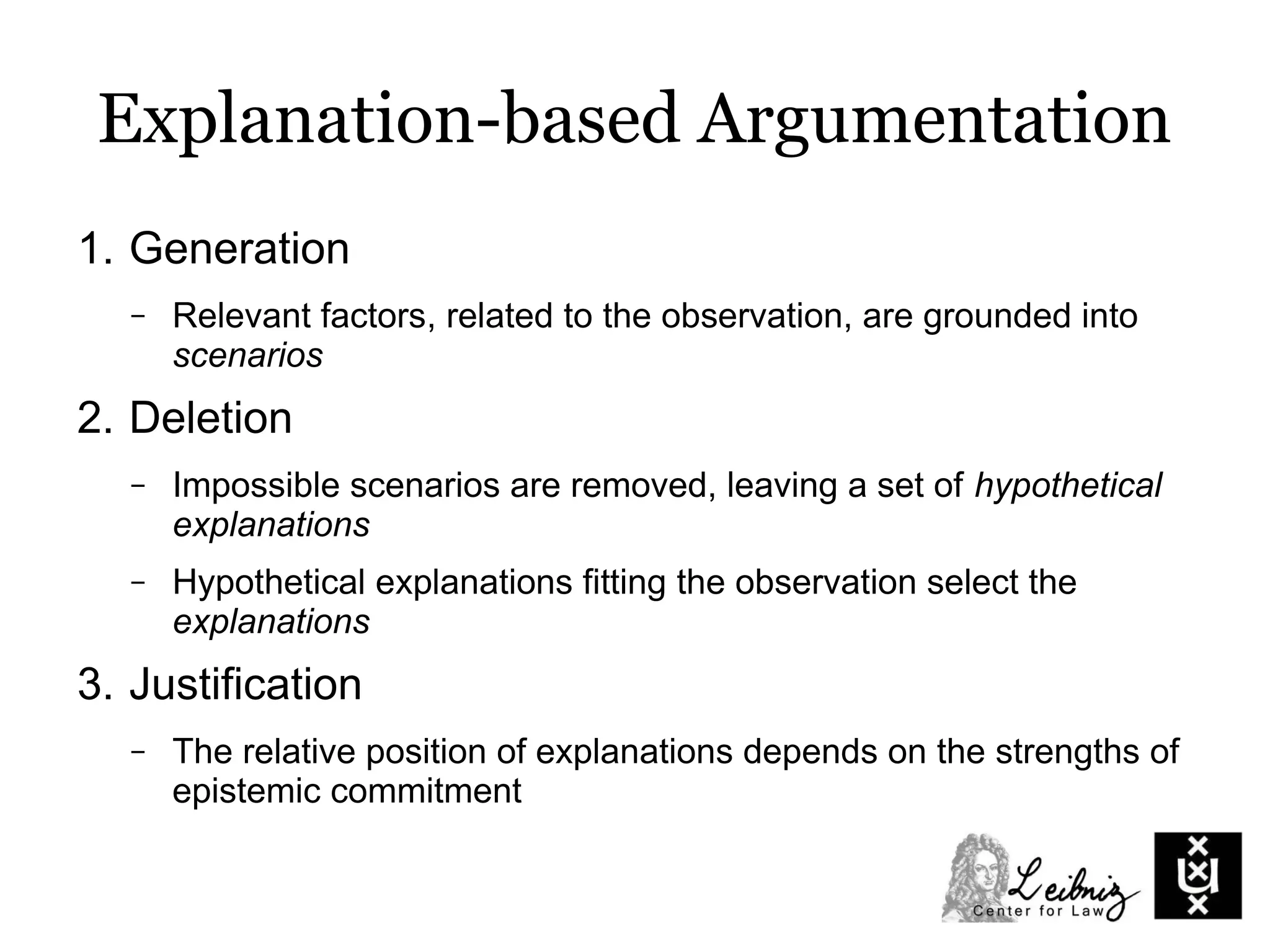
1. Generation
– Relevant factors, related to the observation, are grounded into
scenarios
Explanation-based Argumentation
1. Generation
– Relevant factors, related to the observation, are grounded into
scenarios
2. Deletion
– Impossible scenarios are removed, leaving a set of hypothetical
explanations
Explanation-based Argumentation
1. Generation
– Relevant factors, related to the observation, are grounded into
scenarios
2. Deletion
– Impossible scenarios are removed, leaving a set of hypothetical
explanations
Operational assumption: effective capacity of generating
adequate scenarios
Explanation-based Argumentation
1. Generation
– Relevant factors, related to the observation, are grounded into
scenarios
2. Deletion
– Impossible scenarios are removed, leaving a set of hypothetical
explanations
– Hypothetical explanations fitting the observation select the
explanations
Explanation-based Argumentation
1. Generation
– Relevant factors, related to the observation, are grounded into
scenarios
2. Deletion
– Impossible scenarios are removed, leaving a set of hypothetical
explanations
– Hypothetical explanations fitting the observation select the
explanations
Informational assumption: an observation either fits an
explanation or it doesn’t.
Explanation-based Argumentation
1. Generation
– Relevant factors, related to the observation, are grounded into
scenarios
2. Deletion
– Impossible scenarios are removed, leaving a set of hypothetical
explanations
– Hypothetical explanations fitting the observation select the
explanations
3. Justification
– The relative position of explanations depends on the strengths of
epistemic commitment
Explanation-based Argumentation
● Argumentation frameworks based on defeasible
reasoning insist on the inferential aspect of the
problem, rather than the selection of an adequate
search space.
● The selection of (hypothetical) explanations hides
already a certain commitment.
● Hypothetical explanations can be associated to a
certain likelihood (prior).
● After some relevant message, the likelihood, i.e. the
“strength” of explanations should change (posterior).
EBA: evaluation of explanations
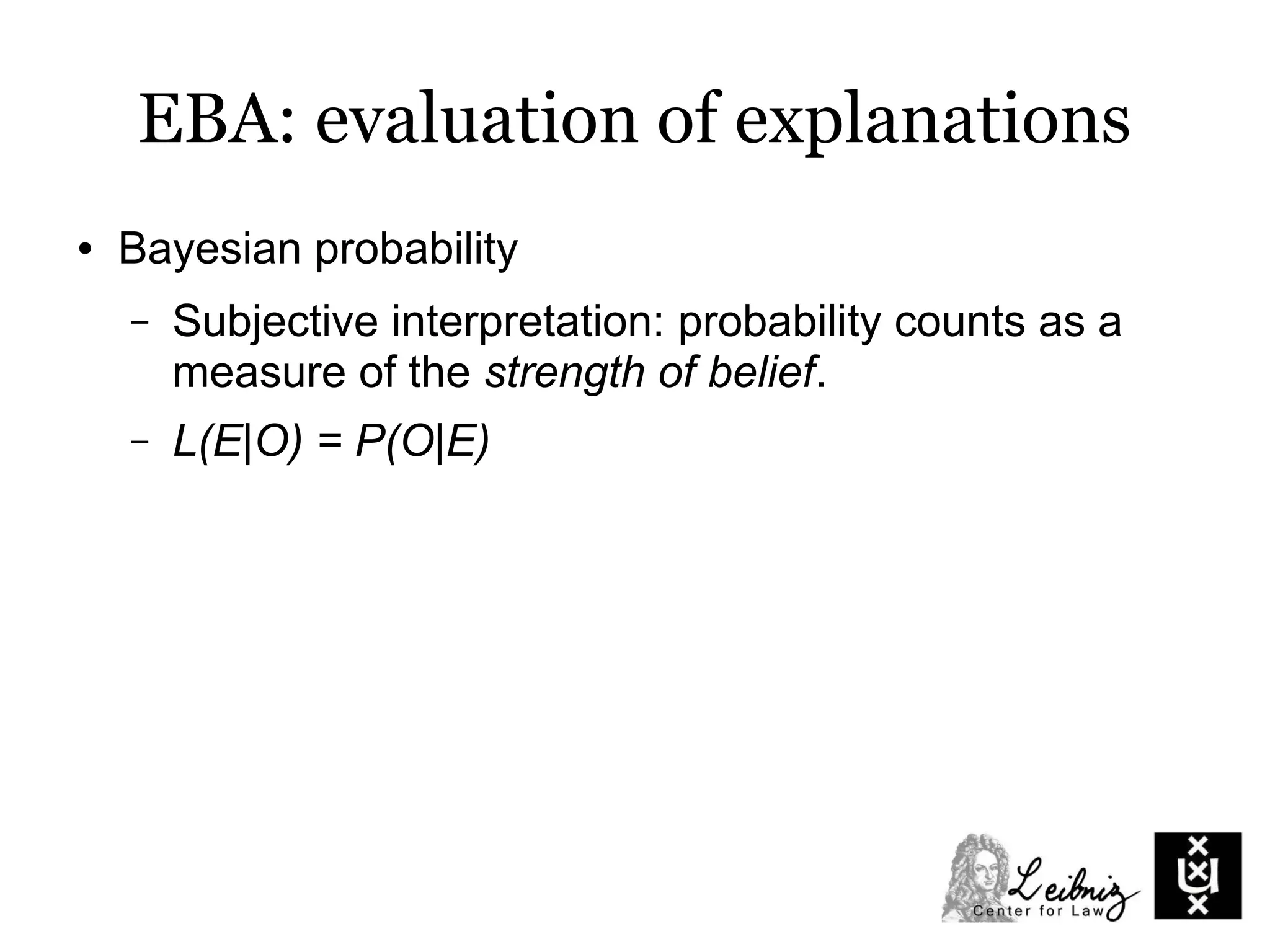
● Bayesian probability
– Subjective interpretation: probability counts as a
measure of the strength of belief.
– L(E|O) = P(O|E)
EBA: evaluation of explanations
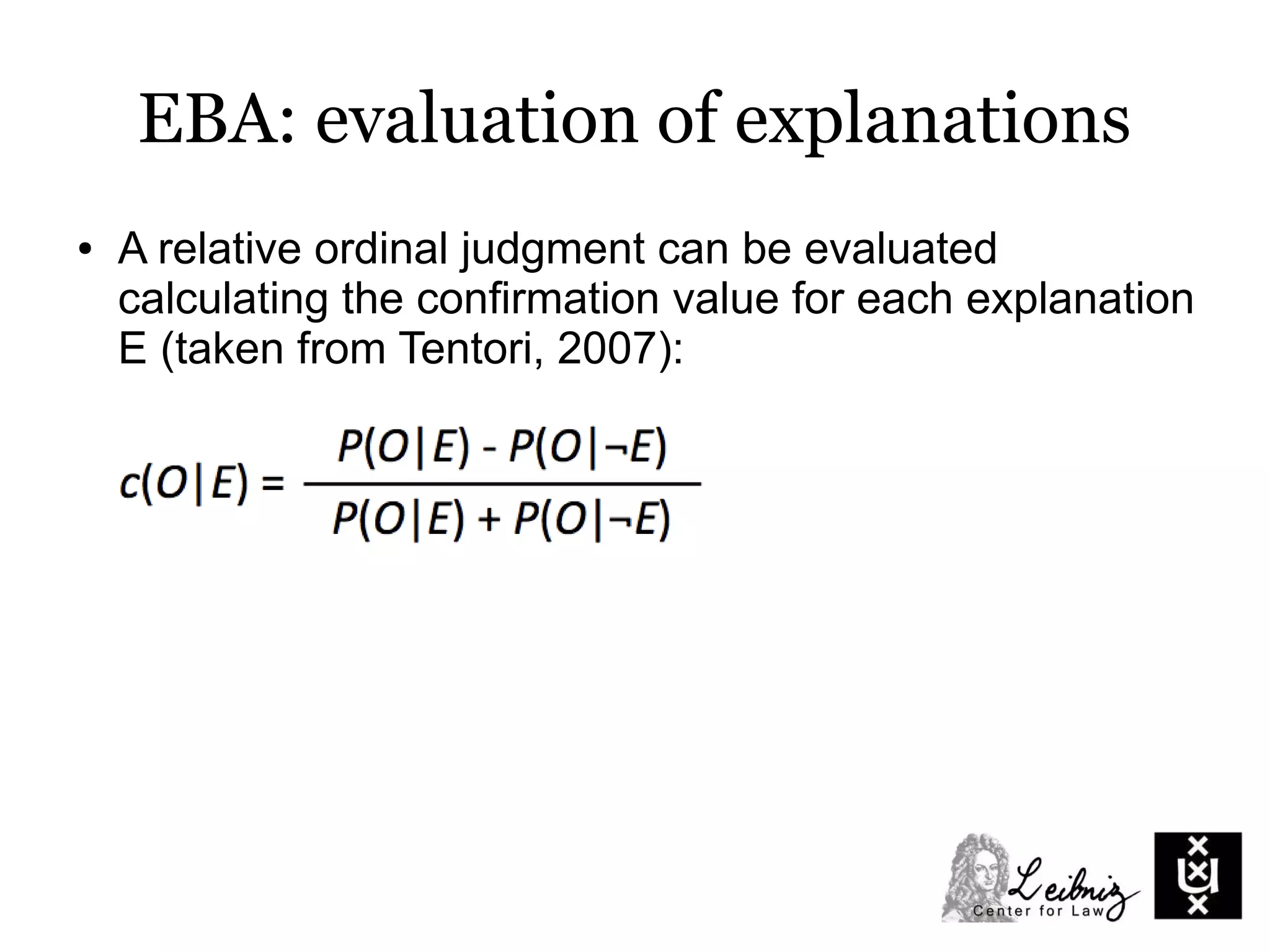
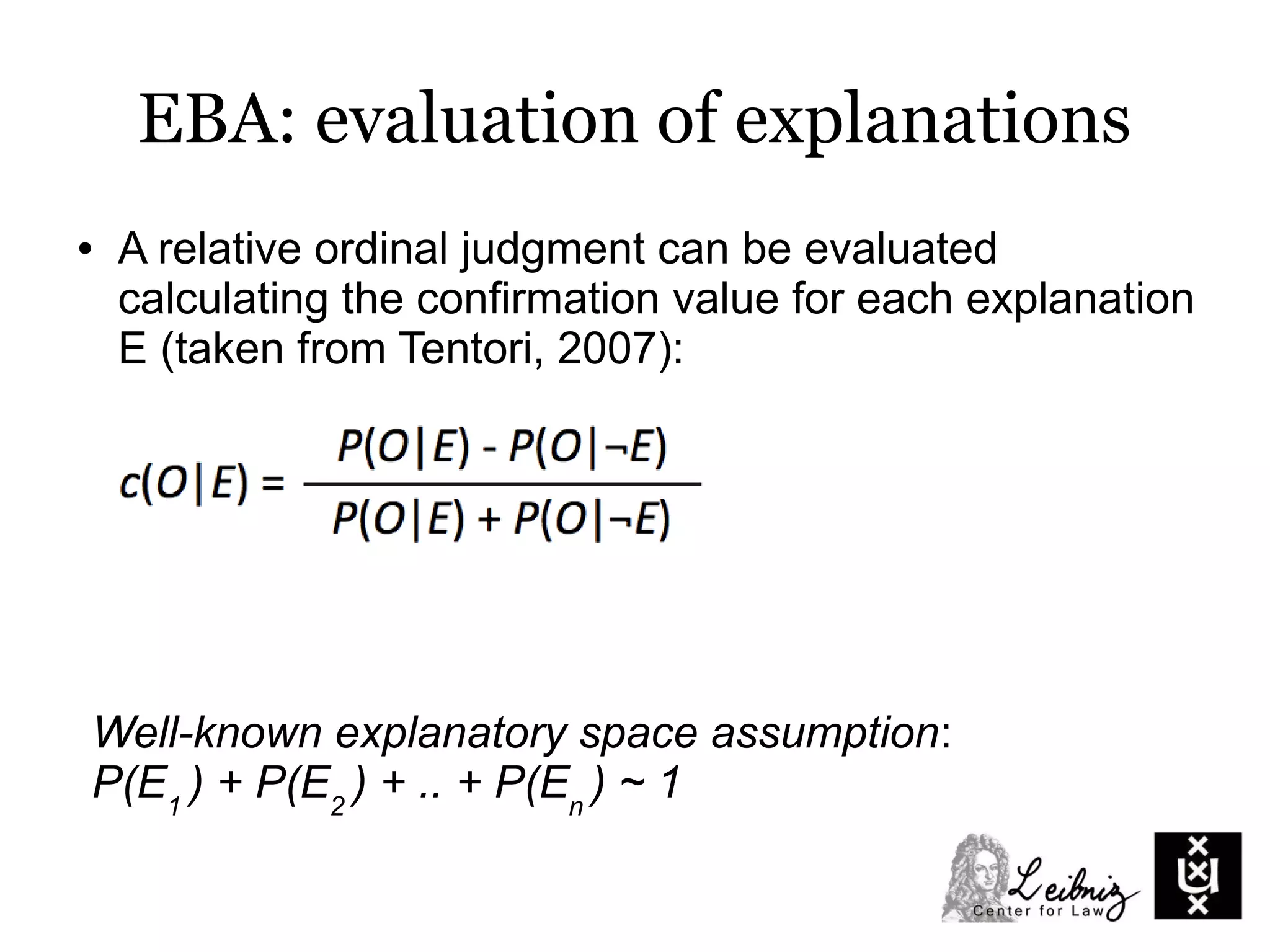
● A relative ordinal judgment can be evaluated
calculating the confirmation value for each explanation
E (taken from Tentori, 2007):
EBA: evaluation of explanations
● A relative ordinal judgment can be evaluated
calculating the confirmation value for each explanation
E (taken from Tentori, 2007):
Well-known explanatory space assumption:
P(E1
) + P(E2
) + .. + P(En
) ~ 1
Implementation
Implementation of EBA in ASP
● Answer set programming is a declarative programming
paradigm based on the stable-model semantic,
oriented towards difficult (NP-hard) search problems.
– In ASP, similarly to Prolog, the programmer models a problem in
terms of rules and facts, instead of specifying an algorithm. The
resulting code is given as input to a solver, which returns multiple
answer sets or stable models satisfying the problem.
● We take advantage of the search capabilities of ASP
solvers, in order to effectively perform the generation
and deletion steps at once.
Implementation of EBA in ASP
● An ASP program related to an explanation-based
argumentation consists of 3 parts:
1. allocation choices, grounding all permutations of
relevant factors,
2. world properties and ground facts, modeling shared
assumptions,
3. observation, modeling the collected messages.
Implementation of EBA in ASP
● An ASP program related to an explanation-based
argumentation consists of 3 parts:
1. allocation choices, grounding all permutations of
relevant factors,
2. world properties and ground facts, modeling shared
assumptions,
3. observation, modeling the collected messages.
● The ASP solver gives as output hypothetical
explanations (with 1+2) and explanations (1+2+3).
– Assigning a prior probability to hyp. explanations,
and analysing the fi nal explanations we
calculate the confi rmation values.
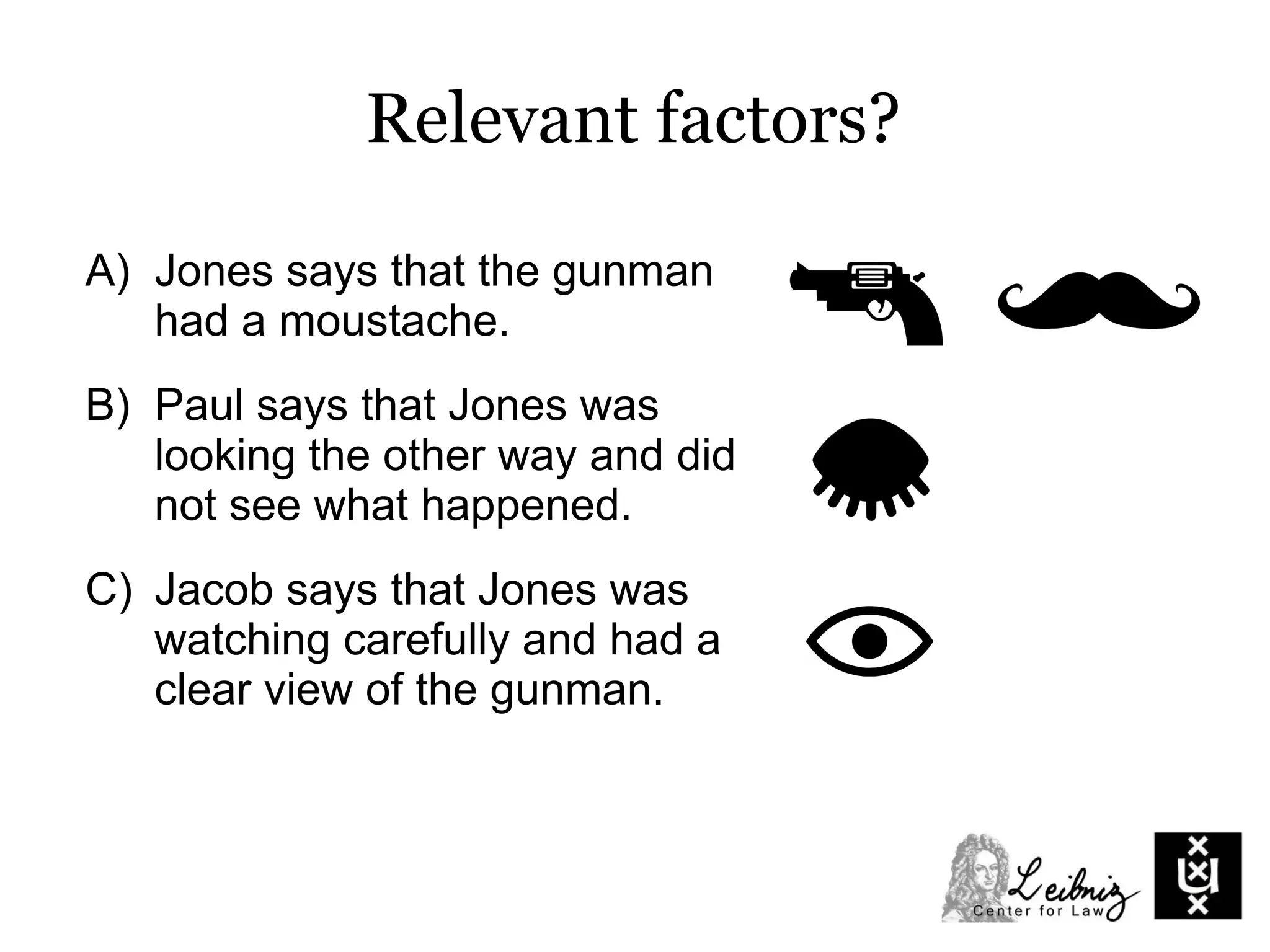
A) Jones says that the gunman
had a moustache.
B) Paul says that Jones was
looking the other way and did
not see what happened.
C) Jacob says that Jones was
watching carefully and had a
clear view of the gunman.
Relevant factors?
● what an agent says may hold or not
● an agent may be reliable or not
● when he is reliable, what he says is what it holds.
Relevant factors for assertion
● what an agent says may hold or not
● an agent may be reliable or not
● when he is reliable, what he says is what it holds.
● e.g. Paul says Jones was not seeing the gunman.
Writing “Paul is reliable” as paul and “Jones was
seeing” as eye, we have:
1{eye, -eye}1.
1{paul, -paul}1.
-eye :- paul.
Relevant factors for assertion
Implementation of the puzzle in ASP
● An ASP program related to an explanation-based
argumentation consists of 3 parts:
1. allocation choices, grounding all permutations of
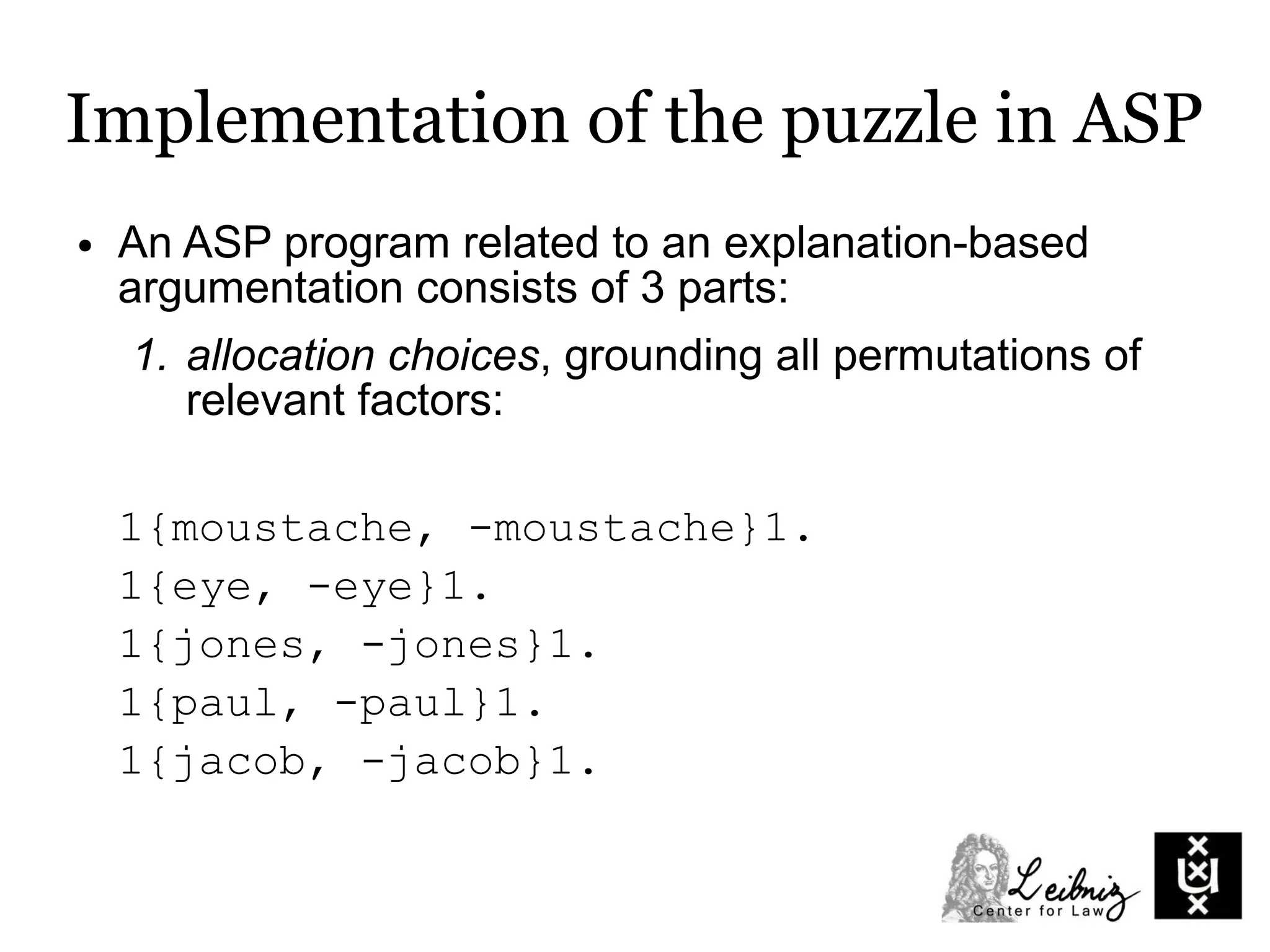
relevant factors:
1{moustache, -moustache}1.
1{eye, -eye}1.
1{jones, -jones}1.
1{paul, -paul}1.
1{jacob, -jacob}1.
Implementation of the puzzle in ASP
● An ASP program related to an explanation-based
argumentation consists of 3 parts:
1. allocation choices,
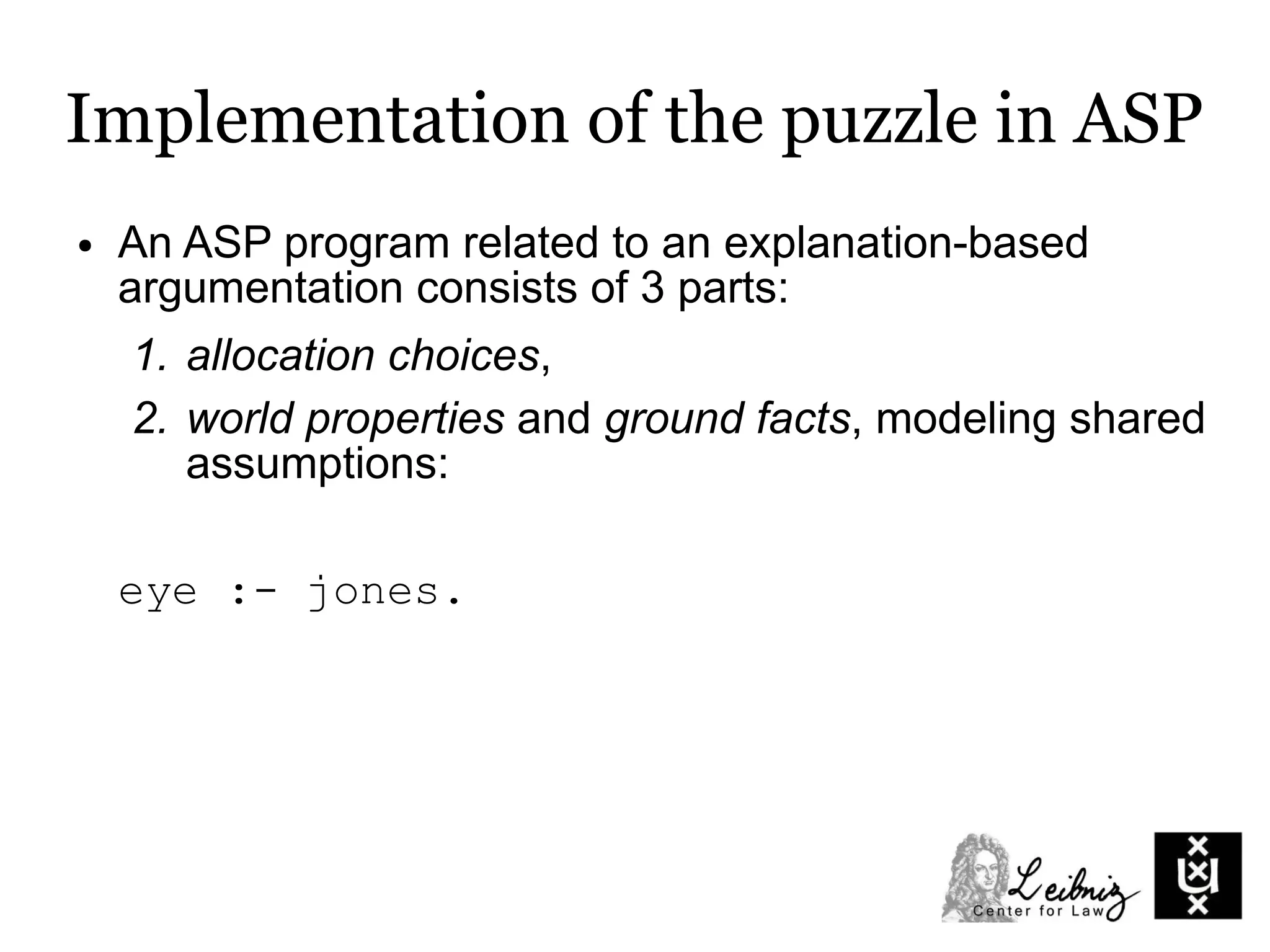
2. world properties and ground facts, modeling shared
assumptions:
eye :- jones.
Implementation of the puzzle in ASP
● An ASP program related to an explanation-based
argumentation consists of 3 parts:
1. allocation choices,
2. world properties and ground facts,
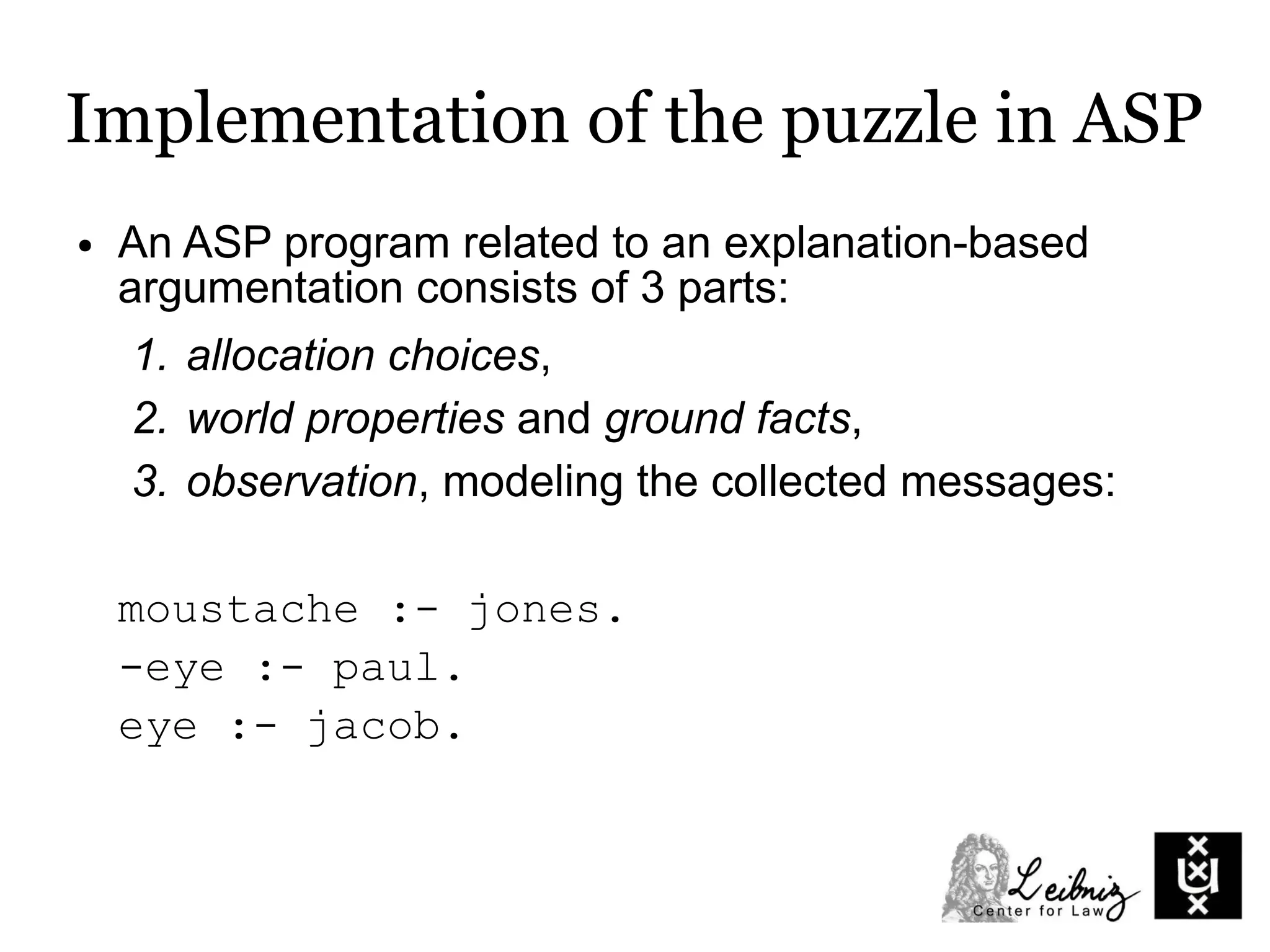
3. observation, modeling the collected messages:
moustache :- jones.
-eye :- paul.
eye :- jacob.
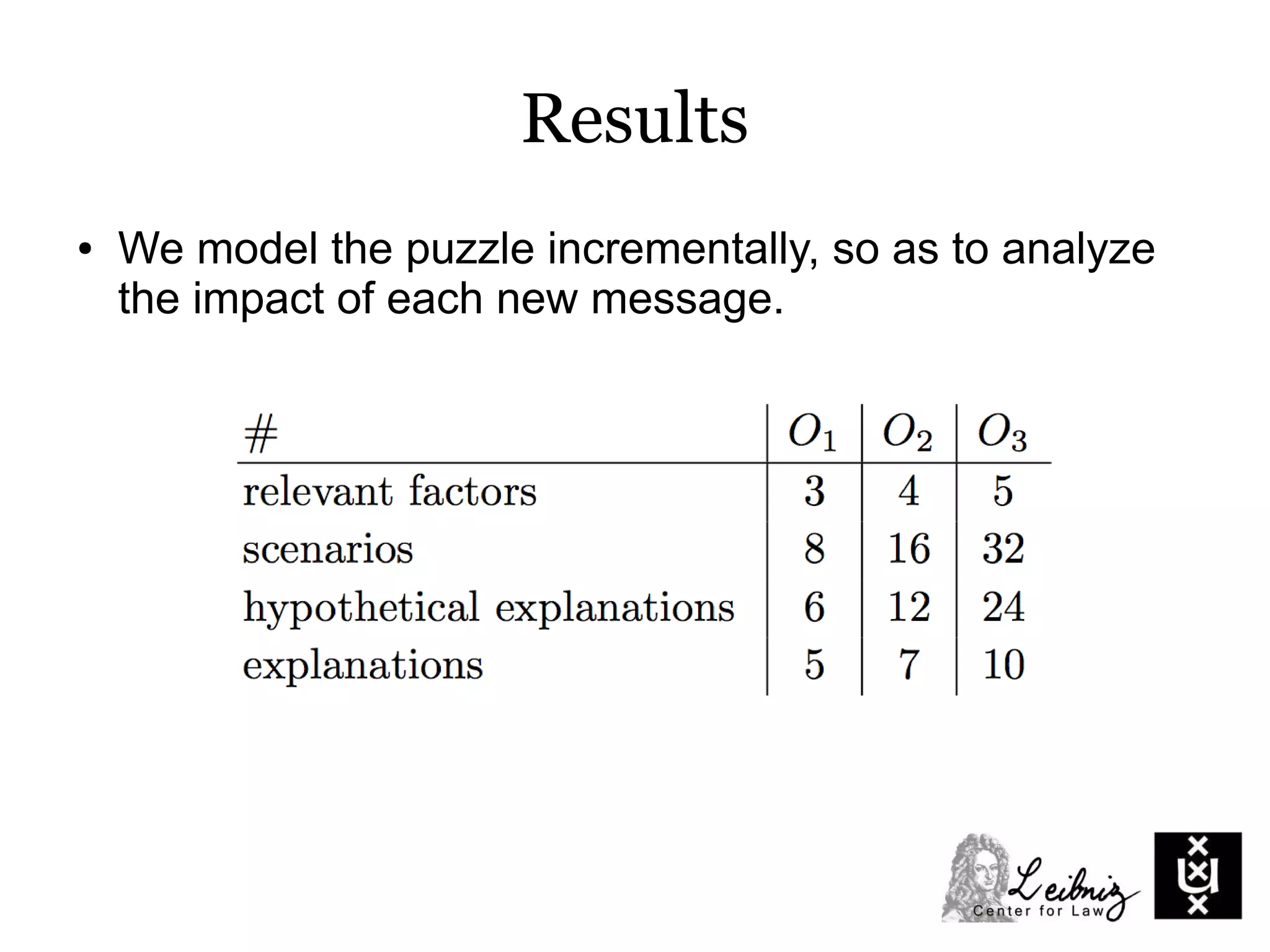
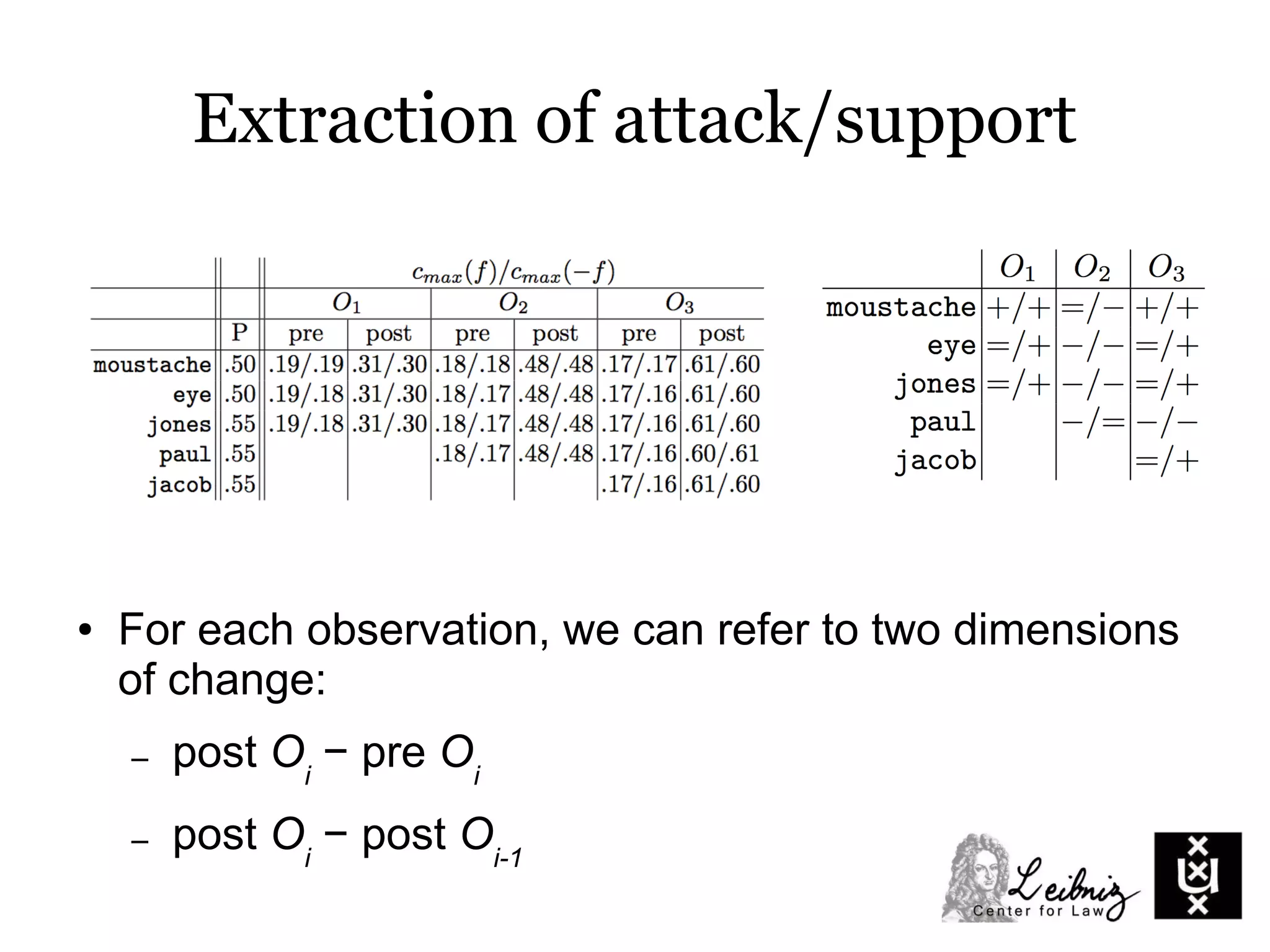
Results
● We model the puzzle incrementally, so as to analyze
the impact of each new message.
Prior probabilities
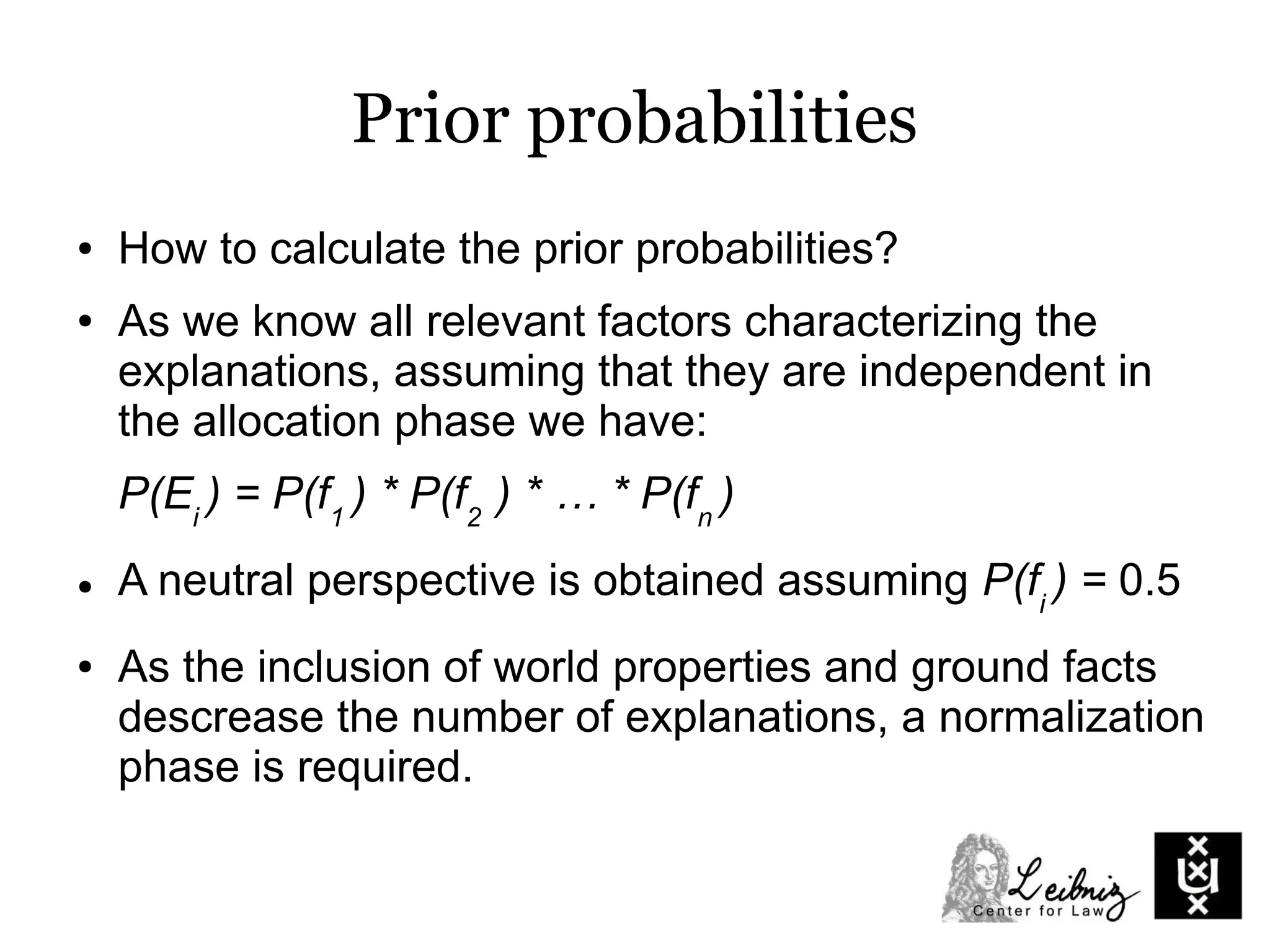
● How to calculate the prior probabilities?
● As we know all relevant factors characterizing the
explanations, assuming that they are independent in
the allocation phase we have:
P(Ei
) = P(f1
) * P(f2
) * … * P(fn
)
● A neutral perspective is obtained assuming P(fi
) = 0.5
● As the inclusion of world properties and ground facts
descrease the number of explanations, a normalization
phase is required.
Evaluation vs targeted properties
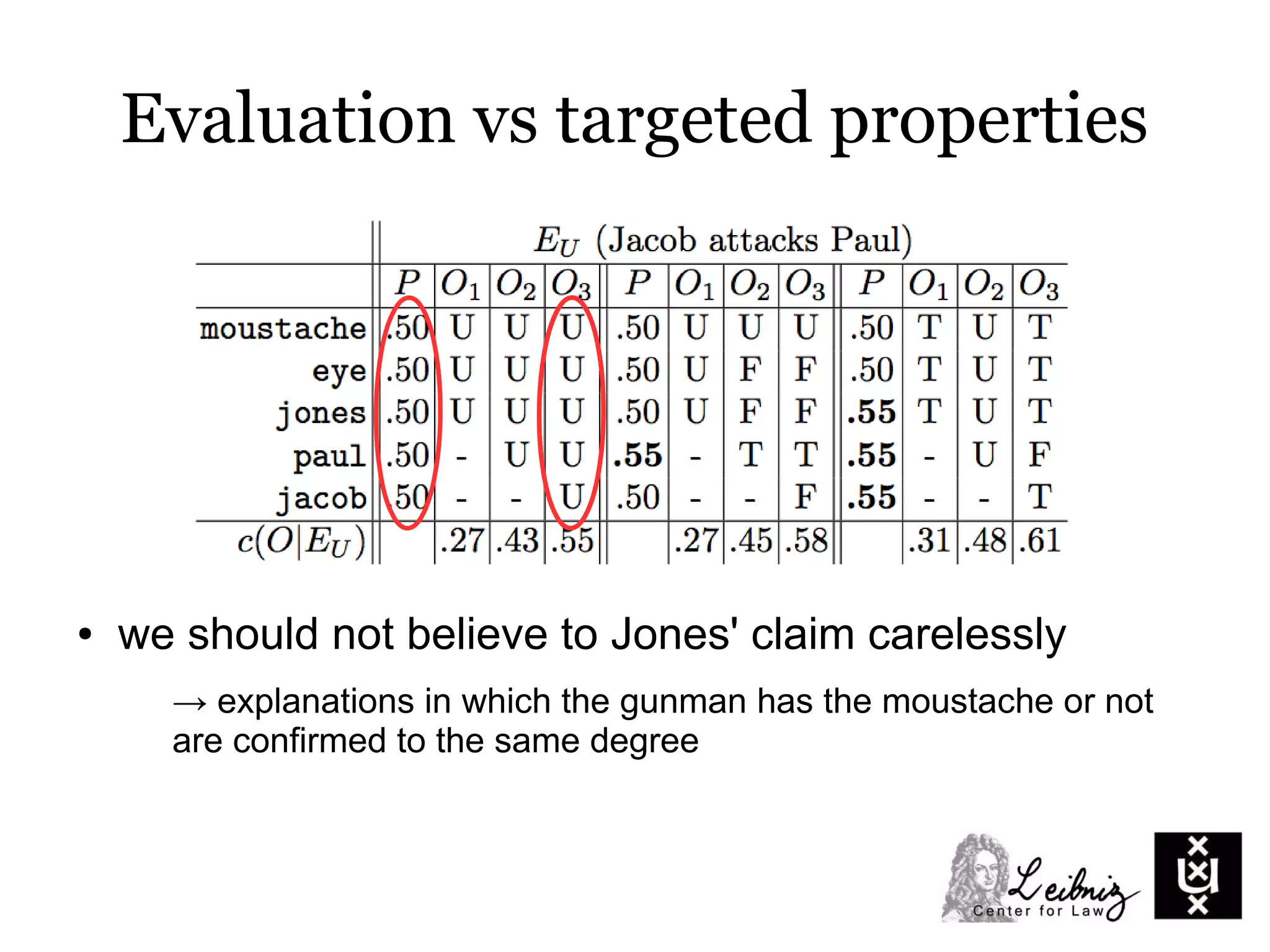
● we should not believe to Jones' claim carelessly
→ explanations in which the gunman has the moustache or not
are confirmed to the same degree
Evaluation vs targeted properties
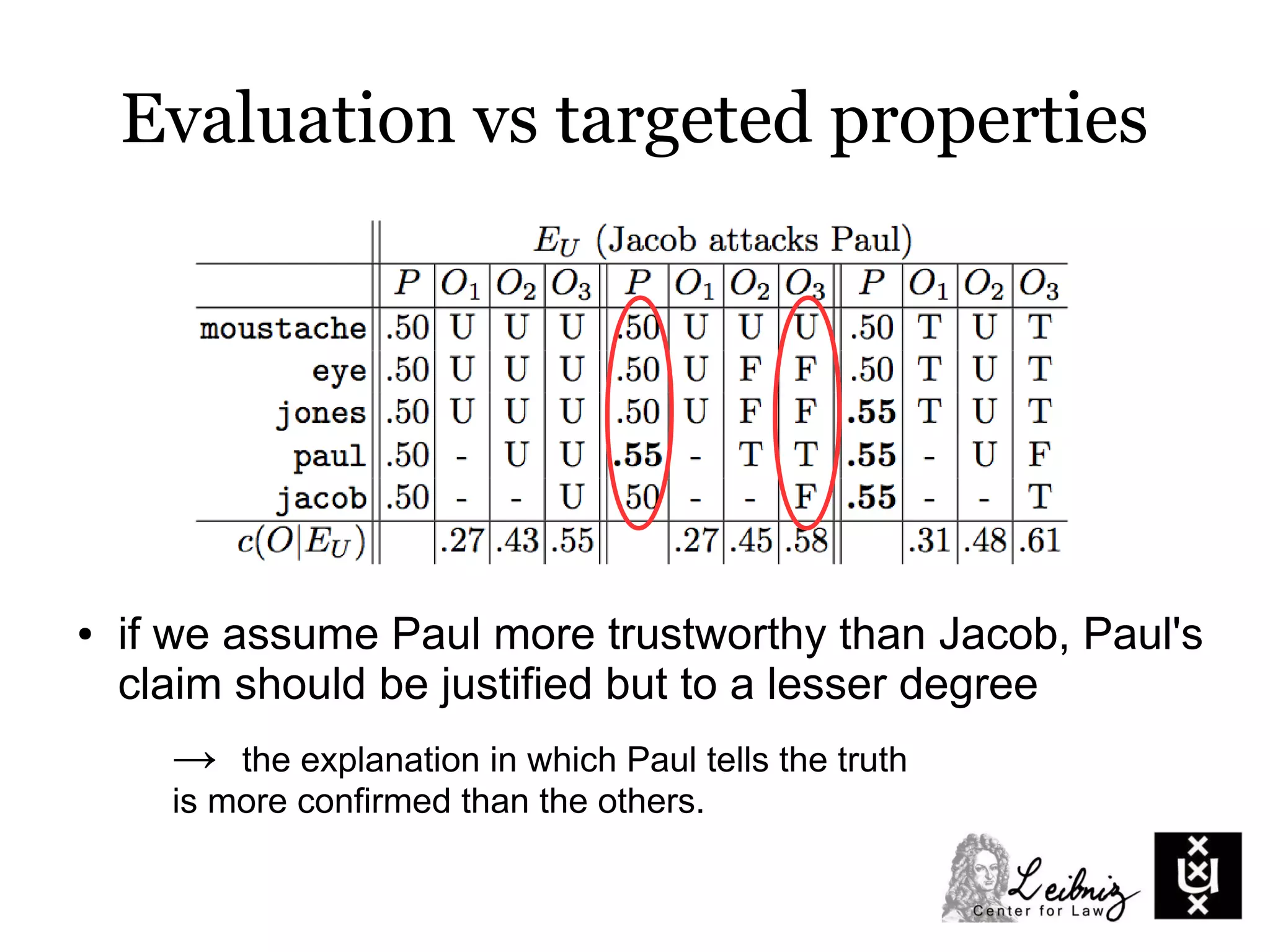
● if we assume Paul more trustworthy than Jacob, Paul's
claim should be justified but to a lesser degree
→ the explanation in which Paul tells the truth
is more confirmed than the others.
Evaluation vs targeted properties
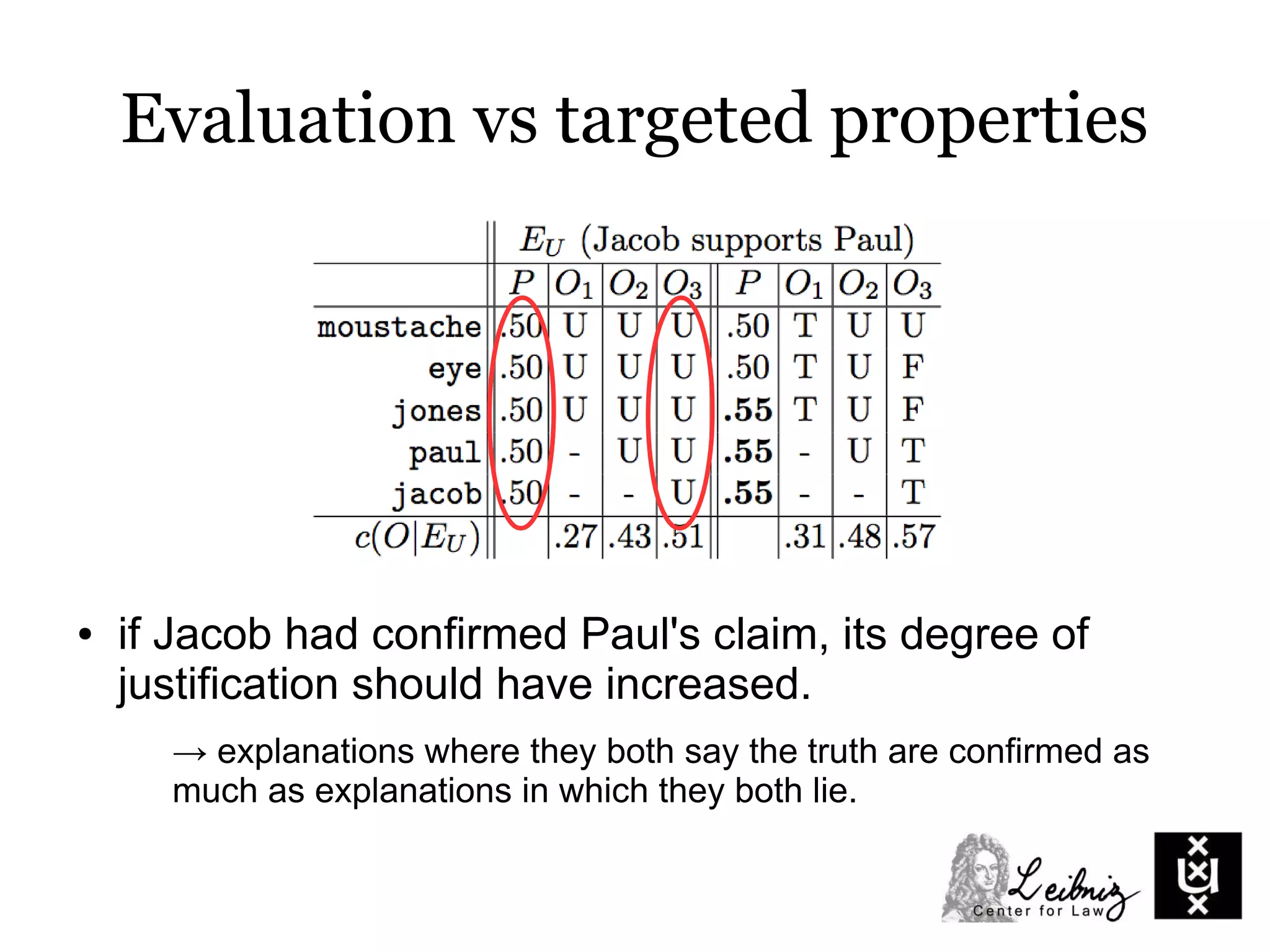
● if Jacob had confirmed Paul's claim, its degree of
justification should have increased.
→ explanations where they both say the truth are confirmed as
much as explanations in which they both lie.
Extraction of attack/support
● For each observation, we can refer to two dimensions
of change:
– post Oi
− pre Oi
– post Oi
− post Oi-1
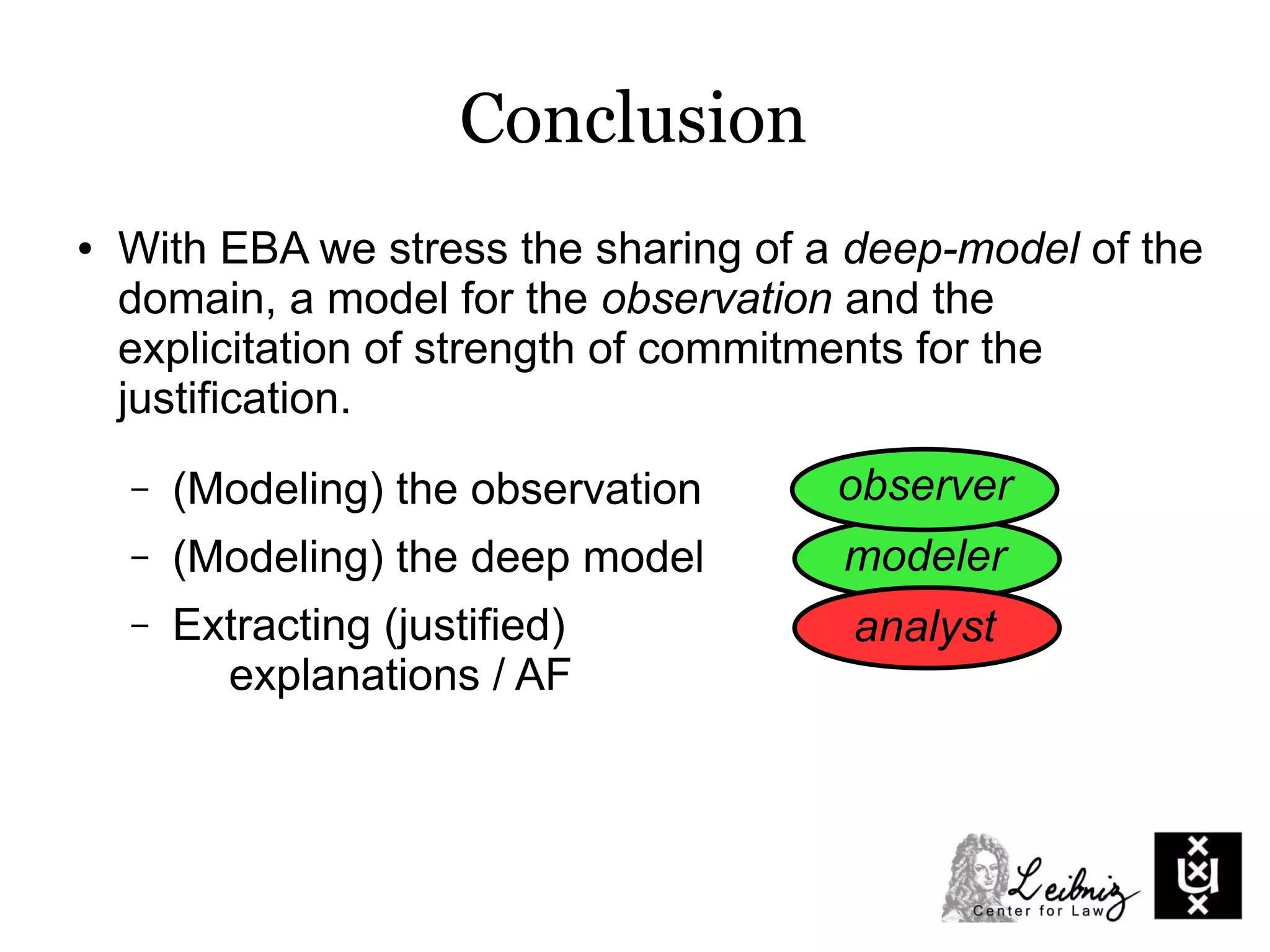
Conclusion
● With EBA we stress the sharing of a deep-model of the
domain, a model for the observation and the
explicitation of strength of commitments for the
justification.
– (Modeling) the observation
– (Modeling) the deep model
– Extracting (justified)
explanations / AF
observer
modeler
analyst
Conclusion
● We have validated a slightly "deeper model" of
reasoning, using Pollock's puzzle with EBA.
● Advantages:
– defines justification operationally
– handles neutral prior probability
● Disadvantages:
– increased overload for the deep-modeling
– explosion of explanations
Further research
● Investigate other definitions of confirmation values
● Propose an analytical definition for attack/support
relations
● Integrate agent-role models into ASP
● Integrate EBA in agent architectures for diagnoser
agents
● Integrate Bayesian networks for prior probabilities

Implementing Explanation-Based Argumentation using Answer Set Programming

  • 1.
    Implementing Explanation-Based Argumentation usingAnswer Set Programming Giovanni Sileno g.sileno@uva.nl Alexander Boer, Tom van Engers Leibniz Center for Law University of Amsterdam 5 May 2014, ArgMAS presentation
  • 2.
  • 3.
    Argumentation ● Argumentation istraditionally seen in terms of attack and support relationships between claims brought by participants in a conversation.
  • 4.
    Argumentation ● Argumentation istraditionally seen in terms of attack and support relationships between claims brought by participants in a conversation. ● Argumentation seems to operate at a meta-level in respect to the content of arguments.
  • 5.
    Formal Argumentation ● Formalargumentation frameworks essentially target this meta-level
  • 6.
    Formal Argumentation ● AnArgumentation framework (AF) [Dung] consists of : – a set of arguments – attack relations between arguments ● Formal argumentation frameworks essentially target this meta-level
  • 7.
    Formal Argumentation ● Tointerpret/evaluate an AF we need a semantics. ● For instance, extension-based semantics classify sub-sets of arguments collectively acceptable in extensions: → the justification state of argument is defined in terms of memberships to extensions (skeptically/credulously justified)
  • 8.
    Application of AFs ●Considering the whole process of application of argumentation theories, we recognize three steps: – Observation – Modeling/Reduction to AF – Analysis of AF traditional focus of formal argumentation observer modeler analyst
  • 9.
    Inside/Outside of ArgumentSystems ● In general, the extraction of attack relations may be problematic.
  • 10.
    Inside/Outside of ArgumentSystems ● In general, the extraction of attack relations may be problematic. ● Trivial case: a claim is explicitly directed against another claim (syntaxic definition of attack).
  • 11.
    Inside/Outside of ArgumentSystems ● In general, the extraction of attack relations may be problematic. ● In a more general case, however, modelers have to use some background knowledge and underlying knowledge processing to identify the attacks.
  • 12.
    Inside/Outside of ArgumentSystems ● Usual solution: to integrate in the modeling phase default/defeasible reasoning. ● e.g. assumption-based argumentation (ABA) – Argument: conclusion ← assumptions – Attack to an argument holds if the “contrary” of its assumptions can be proved, or of its conclusion (rebuttal).
  • 13.
    Inside/Outside of ArgumentSystems ● In practice in ABA the stress is on the support relation, expressed via defeasible rules, and used to extract the correspondendent AF. (Part of) modeling is integrated, but still concerned by the meta-level! – Observation – Modeling/Reduction to AF – Analysis of AF observer modeler analyst
  • 14.
  • 15.
    An interesting puzzleby Pollock ● John Pollock presents in in “Reasoning and probability”, Law, Probability, Risk (2007) a lucid analysis about the difficulties in reproducing certain intuitive properties with current formal argumentation theories.
  • 16.
    A) Jones saysthat the gunman had a moustache. B) Paul says that Jones was looking the other way and did not see what happened. C) Jacob says that Jones was watching carefully and had a clear view of the gunman. An interesting puzzle by Pollock
  • 17.
    A) Jones saysthat the gunman had a moustache. B) Paul says that Jones was looking the other way and did not see what happened. C) Jacob says that Jones was watching carefully and had a clear view of the gunman. An interesting puzzle by Pollock
  • 18.
    A) Jones saysthat the gunman had a moustache. B) Paul says that Jones was looking the other way and did not see what happened. C) Jacob says that Jones was watching carefully and had a clear view of the gunman. An interesting puzzle by Pollock
  • 19.
  • 20.
    Argumentation scheme ofthe puzzle Jones' claim Paul's claim Jacob's claim collective defeat
  • 21.
    collective defeat Argumentation schemeof the puzzle Jones' claim Paul's claim Jacob's claim zombie argument
  • 22.
    Targeting intuitive properties 1.we should not believe to Jones' claim (i.e. the zombie argument) carelessly
  • 23.
    Targeting intuitive properties 1.we should not believe to Jones' claim (i.e. the zombie argument) carelessly 2. if we assume Paul more trustworthy than Jacob, Paul's claim should be justified but to a lesser degree
  • 24.
    Targeting intuitive properties 1.we should not believe to Jones' claim (i.e. the zombie argument) carelessly 2. if we assume Paul more trustworthy than Jacob, Paul's claim should be justified but to a lesser degree 3. if Jacob had confirmed Paul's claim, its degree of justification should have increased
  • 25.
    Pollock's puzzle ● Underlyingproblems: – zombie arguments – (relative) judgments of trustworthiness/reliability – ... – how to approach justification? ● Pollock proposed a highly elaborate preliminary solution based on probable probabilities. ● We propose a different solution, based on explanation-based argumentation.
  • 26.
  • 27.
    Explanation-Based Argumentation ● Argumentationcan be seen as a dialectical process, in which parties produce and receive messages. ● Argumentation does not concern only the matter of debate (e.g. a case, or story), but also the meta-story about about the construction of such story.
  • 28.
    EBA: observations ● Thesequence of collected messages consists in the observation. ● Sometimes the observation is collected by a third-party adjudicator, entitled to interpret the case from a neutral position.The Trial of Bill Burn under Martin's Act [1838]
  • 29.
    EBA: explanations ● Givena disputed case, an explanation is a possible scenario which is compatible – with the content of the messages, and – with the generation process of the messages. In general, the nature of such scenarios is of a multi- representational model, integrating physical, mental, institutional and abstract domains.
  • 30.
    EBA: explanations ● Givena disputed case, an explanation is a possible scenario which is compatible – with the content of the messages, and – with the generation process of the messages. ● An explanation is valid if it reproduces the observation. ● Several explanations may be valid, i.e. fitting the same observation. Their competition is matter of justification.
  • 31.
    EBA: space ofexplanations conclusion support assumptions explanation message confirms space of hypothetical explanations explanation message disconfirms space of hypothetical explanations argument argument attacks ● Instead of being a static entity, the space of (hypothetical) explanations changes because of – the incremental nature of the observation (introducing new factors and constraints), – changes in strengths of epistemic commitment.
  • 32.
    Explanation-based Argumentation ● Referringto these ingredients, we propose the following operationalization, based on three steps.
  • 33.
    Explanation-based Argumentation 1. Generation –Relevant factors, related to the observation, are grounded into scenarios
  • 34.
    Explanation-based Argumentation 1. Generation –Relevant factors, related to the observation, are grounded into scenarios 2. Deletion – Impossible scenarios are removed, leaving a set of hypothetical explanations
  • 35.
    Explanation-based Argumentation 1. Generation –Relevant factors, related to the observation, are grounded into scenarios 2. Deletion – Impossible scenarios are removed, leaving a set of hypothetical explanations Operational assumption: effective capacity of generating adequate scenarios
  • 36.
    Explanation-based Argumentation 1. Generation –Relevant factors, related to the observation, are grounded into scenarios 2. Deletion – Impossible scenarios are removed, leaving a set of hypothetical explanations – Hypothetical explanations fitting the observation select the explanations
  • 37.
    Explanation-based Argumentation 1. Generation –Relevant factors, related to the observation, are grounded into scenarios 2. Deletion – Impossible scenarios are removed, leaving a set of hypothetical explanations – Hypothetical explanations fitting the observation select the explanations Informational assumption: an observation either fits an explanation or it doesn’t.
  • 38.
    Explanation-based Argumentation 1. Generation –Relevant factors, related to the observation, are grounded into scenarios 2. Deletion – Impossible scenarios are removed, leaving a set of hypothetical explanations – Hypothetical explanations fitting the observation select the explanations 3. Justification – The relative position of explanations depends on the strengths of epistemic commitment
  • 39.
    Explanation-based Argumentation ● Argumentationframeworks based on defeasible reasoning insist on the inferential aspect of the problem, rather than the selection of an adequate search space. ● The selection of (hypothetical) explanations hides already a certain commitment. ● Hypothetical explanations can be associated to a certain likelihood (prior). ● After some relevant message, the likelihood, i.e. the “strength” of explanations should change (posterior).
  • 40.
    EBA: evaluation ofexplanations ● Bayesian probability – Subjective interpretation: probability counts as a measure of the strength of belief. – L(E|O) = P(O|E)
  • 41.
    EBA: evaluation ofexplanations ● A relative ordinal judgment can be evaluated calculating the confirmation value for each explanation E (taken from Tentori, 2007):
  • 42.
    EBA: evaluation ofexplanations ● A relative ordinal judgment can be evaluated calculating the confirmation value for each explanation E (taken from Tentori, 2007): Well-known explanatory space assumption: P(E1 ) + P(E2 ) + .. + P(En ) ~ 1
  • 43.
  • 44.
    Implementation of EBAin ASP ● Answer set programming is a declarative programming paradigm based on the stable-model semantic, oriented towards difficult (NP-hard) search problems. – In ASP, similarly to Prolog, the programmer models a problem in terms of rules and facts, instead of specifying an algorithm. The resulting code is given as input to a solver, which returns multiple answer sets or stable models satisfying the problem. ● We take advantage of the search capabilities of ASP solvers, in order to effectively perform the generation and deletion steps at once.
  • 45.
    Implementation of EBAin ASP ● An ASP program related to an explanation-based argumentation consists of 3 parts: 1. allocation choices, grounding all permutations of relevant factors, 2. world properties and ground facts, modeling shared assumptions, 3. observation, modeling the collected messages.
  • 46.
    Implementation of EBAin ASP ● An ASP program related to an explanation-based argumentation consists of 3 parts: 1. allocation choices, grounding all permutations of relevant factors, 2. world properties and ground facts, modeling shared assumptions, 3. observation, modeling the collected messages. ● The ASP solver gives as output hypothetical explanations (with 1+2) and explanations (1+2+3). – Assigning a prior probability to hyp. explanations, and analysing the fi nal explanations we calculate the confi rmation values.
  • 47.
    A) Jones saysthat the gunman had a moustache. B) Paul says that Jones was looking the other way and did not see what happened. C) Jacob says that Jones was watching carefully and had a clear view of the gunman. Relevant factors?
  • 48.
    ● what anagent says may hold or not ● an agent may be reliable or not ● when he is reliable, what he says is what it holds. Relevant factors for assertion
  • 49.
    ● what anagent says may hold or not ● an agent may be reliable or not ● when he is reliable, what he says is what it holds. ● e.g. Paul says Jones was not seeing the gunman. Writing “Paul is reliable” as paul and “Jones was seeing” as eye, we have: 1{eye, -eye}1. 1{paul, -paul}1. -eye :- paul. Relevant factors for assertion
  • 50.
    Implementation of thepuzzle in ASP ● An ASP program related to an explanation-based argumentation consists of 3 parts: 1. allocation choices, grounding all permutations of relevant factors: 1{moustache, -moustache}1. 1{eye, -eye}1. 1{jones, -jones}1. 1{paul, -paul}1. 1{jacob, -jacob}1.
  • 51.
    Implementation of thepuzzle in ASP ● An ASP program related to an explanation-based argumentation consists of 3 parts: 1. allocation choices, 2. world properties and ground facts, modeling shared assumptions: eye :- jones.
  • 52.
    Implementation of thepuzzle in ASP ● An ASP program related to an explanation-based argumentation consists of 3 parts: 1. allocation choices, 2. world properties and ground facts, 3. observation, modeling the collected messages: moustache :- jones. -eye :- paul. eye :- jacob.
  • 53.
    Results ● We modelthe puzzle incrementally, so as to analyze the impact of each new message.
  • 54.
    Prior probabilities ● Howto calculate the prior probabilities? ● As we know all relevant factors characterizing the explanations, assuming that they are independent in the allocation phase we have: P(Ei ) = P(f1 ) * P(f2 ) * … * P(fn ) ● A neutral perspective is obtained assuming P(fi ) = 0.5 ● As the inclusion of world properties and ground facts descrease the number of explanations, a normalization phase is required.
  • 55.
    Evaluation vs targetedproperties ● we should not believe to Jones' claim carelessly → explanations in which the gunman has the moustache or not are confirmed to the same degree
  • 56.
    Evaluation vs targetedproperties ● if we assume Paul more trustworthy than Jacob, Paul's claim should be justified but to a lesser degree → the explanation in which Paul tells the truth is more confirmed than the others.
  • 57.
    Evaluation vs targetedproperties ● if Jacob had confirmed Paul's claim, its degree of justification should have increased. → explanations where they both say the truth are confirmed as much as explanations in which they both lie.
  • 58.
    Extraction of attack/support ●For each observation, we can refer to two dimensions of change: – post Oi − pre Oi – post Oi − post Oi-1
  • 59.
    Conclusion ● With EBAwe stress the sharing of a deep-model of the domain, a model for the observation and the explicitation of strength of commitments for the justification. – (Modeling) the observation – (Modeling) the deep model – Extracting (justified) explanations / AF observer modeler analyst
  • 60.
    Conclusion ● We havevalidated a slightly "deeper model" of reasoning, using Pollock's puzzle with EBA. ● Advantages: – defines justification operationally – handles neutral prior probability ● Disadvantages: – increased overload for the deep-modeling – explosion of explanations
  • 61.
    Further research ● Investigateother definitions of confirmation values ● Propose an analytical definition for attack/support relations ● Integrate agent-role models into ASP ● Integrate EBA in agent architectures for diagnoser agents ● Integrate Bayesian networks for prior probabilities