

CREDIT CREATION
Chitransh Waghmare
Banks : The Creators of Credit
 Through the process of credit Creation banks
provide finance to all the sectors of economy,
and thus Called “ Factories of Credit”.
 They advance much more than what they
receive as deposits.
Basics of Credit Creation
 The money that banks possess, comes from
bank deposits.
 Bank Deposits are of two Kinds :
 Primary deposits
 Secondary or derivative deposits
Process of Credit Creation
 The process can be better understood with two
assumptions :
 The entire banking system is one unit
 All transactions flow through this unit
Process of Credit Creation
 Any experienced banker knows two things by
experience :
 Not all the depositors approach the bank for
the withdrawal of money at the same time and
will never withdraw all money at once.
 There would be constant flow of deposits in
the bank and credit could be given.
But.. There is something that
controls Credit too !!!
 Central Banks imposes a requirement on the
commercial banks to keep a certain
percentage of total money supply with
themselves as reserves.
 This is Legal Reserve requirement (LRR)
 These act as a strong catalyst in controlling
the flow of credit when required.
What forms the LRR
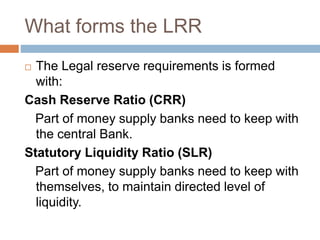
 The Legal reserve requirements is formed
with:
Cash Reserve Ratio (CRR)
Part of money supply banks need to keep with
the central Bank.
Statutory Liquidity Ratio (SLR)
Part of money supply banks need to keep with
themselves, to maintain directed level of
liquidity.
Lets take an example of credit
creation
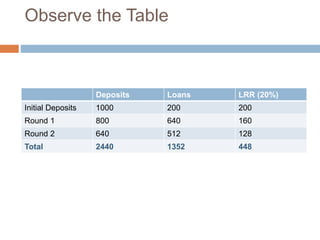
 Suppose, the initial deposits with the bank is
Rs. 1000
 And the LRR is 20 %
 Which implies that the bank is free to lend 80%
of the money which remains as balance.
Observe the Table
Deposits Loans LRR (20%)
Initial Deposits 1000 200 200
Round 1 800 640 160
Round 2 640 512 128
Total 2440 1352 448
What did we learnt ?
 Based on the example, Its Clear that :
 The banks are able to create more credit than
that of the initial deposit received.
 This Function of Banks is Called “ Money
Multiplier”.
 Shown as : 1/LRR
 Hence, credit flow remains unchanged and
unaffected.

Credit creation basics with Example

  • 1.
  • 2.
    Banks : TheCreators of Credit  Through the process of credit Creation banks provide finance to all the sectors of economy, and thus Called “ Factories of Credit”.  They advance much more than what they receive as deposits.
  • 3.
    Basics of CreditCreation  The money that banks possess, comes from bank deposits.  Bank Deposits are of two Kinds :  Primary deposits  Secondary or derivative deposits
  • 4.
    Process of CreditCreation  The process can be better understood with two assumptions :  The entire banking system is one unit  All transactions flow through this unit
  • 5.
    Process of CreditCreation  Any experienced banker knows two things by experience :  Not all the depositors approach the bank for the withdrawal of money at the same time and will never withdraw all money at once.  There would be constant flow of deposits in the bank and credit could be given.
  • 6.
    But.. There issomething that controls Credit too !!!  Central Banks imposes a requirement on the commercial banks to keep a certain percentage of total money supply with themselves as reserves.  This is Legal Reserve requirement (LRR)  These act as a strong catalyst in controlling the flow of credit when required.
  • 7.
    What forms theLRR  The Legal reserve requirements is formed with: Cash Reserve Ratio (CRR) Part of money supply banks need to keep with the central Bank. Statutory Liquidity Ratio (SLR) Part of money supply banks need to keep with themselves, to maintain directed level of liquidity.
  • 8.
    Lets take anexample of credit creation  Suppose, the initial deposits with the bank is Rs. 1000  And the LRR is 20 %  Which implies that the bank is free to lend 80% of the money which remains as balance.
  • 9.
    Observe the Table DepositsLoans LRR (20%) Initial Deposits 1000 200 200 Round 1 800 640 160 Round 2 640 512 128 Total 2440 1352 448
  • 10.
    What did welearnt ?  Based on the example, Its Clear that :  The banks are able to create more credit than that of the initial deposit received.  This Function of Banks is Called “ Money Multiplier”.  Shown as : 1/LRR  Hence, credit flow remains unchanged and unaffected.