


















DISCUSSION ON REC & ESCSandeepMelana
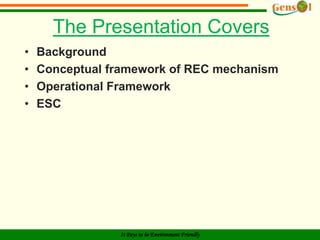
The Presentation CoversBackground Conceptual framework of REC mechanismOperational FrameworkESC
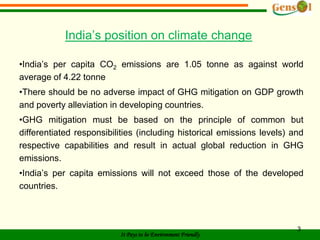
3India’s position on climate changeIndia’s per capita CO2 emissions are 1.05 tonne as against world average of 4.22 tonne
There should be no adverse impact of GHG mitigation on GDP growth and poverty alleviation in developing countries.
GHG mitigation must be based on the principle of common but differentiated responsibilities (including historical emissions levels) and respective capabilities and result in actual global reduction in GHG emissions.
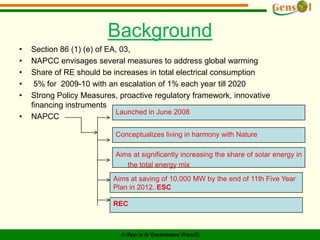
India’s per capita emissions will not exceed those of the developed countries. BackgroundSection 86 (1) (e) of EA, 03,NAPCC envisages several measures to address global warmingShare of RE should be increases in total electrical consumption 5% for  2009-10 with an escalation of 1% each year till 2020 Strong Policy Measures, proactive regulatory framework, innovative financing instrumentsNAPCCLaunched in June 2008Conceptualizes living in harmony with Nature Aims at significantly increasing the share of solar energy in the total energy mix Aims at saving of 10,000 MW by the end of 11th Five Year Plan in 2012. ESCREC
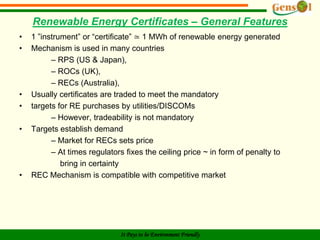
Renewable Energy Certificates – General Features1 ”instrument” or “certificate” ≃ 1 MWhof renewable energy generatedMechanism is used in many countries		– RPS (US & Japan),		– ROCs (UK),		– RECs (Australia),Usually certificates are traded to meet the mandatorytargets for RE purchases by utilities/DISCOMs		– However, tradeability is not mandatoryTargets establish demand		– Market for RECs sets price		– At times regulators fixes the ceiling price ~ in form of penalty to		    bring in certaintyREC Mechanism is compatible with competitive market
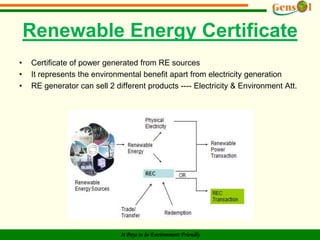
Renewable Energy CertificateCertificate of power generated from RE sourcesIt represents the environmental benefit apart from electricity generationRE generator can sell 2 different products ---- Electricity & Environment Att.
CERC7RPOs in different States7
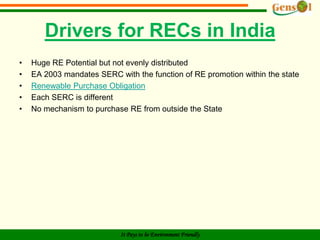
Drivers for RECs in IndiaHuge RE Potential but not evenly distributedEA 2003 mandates SERC with the function of RE promotion within the stateRenewable Purchase ObligationEach SERC is different No mechanism to purchase RE from outside the State
Objectives for REC Mechanism in IndiaEffective implementation of RPO regulation in all States in IndiaIncreased flexibility for participants to carry out RE transactionsOvercoming geographical constraints to harness available RE sourcesReduce transaction costs for RE transactionsCreate competition among different RE technologiesDevelopment of all encompassing incentive mechanismReduce risks for local distribution licensee.
Operational Framework for REC Mechanism
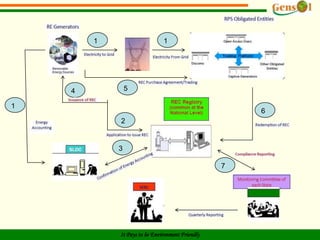
115416237
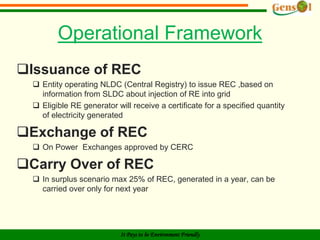
Operational FrameworkIssuance of REC
Entity operating NLDC (Central Registry) to issue REC ,based on information from SLDC about injection of RE into grid
Eligible RE generator will receive a certificate for a specified quantity of electricity generated
Exchange of REC
On Power  Exchanges approved by CERC
Carry Over of REC
In surplus scenario max 25% of REC, generated in a year, can be carried over only for next year Salient features of REC FrameworkRE generators with capacity untied in PPA will have an option to sell electricity and REC  separatelyREC will be issued to RE Generators only1 MWh 1 REC Purchase of REC would be considered as purchase of RE REC to overcome geographical constraints and provide flexibility to achieve RPO compliance
Eligibility criteriaEligible
RE technologies recognized by MNRE
Grid connected RE generators of at least 250 KW capacity.
Not eligible
RE project with existing PPA
If RE sale at preferential Tariff Energy Saving CertificateNAPCC                         NMEEETarget             Energy Saving of 10000 MW by 2012To achieve this target ESCs are proposed to energy intensive industriesSpecific Energy ConsumptionBaseline Year for SEC – 2008BEE – Nodal Egency
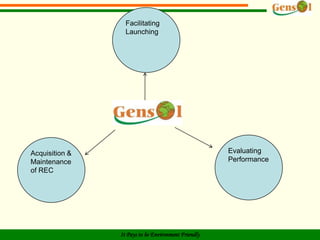
Facilitating LaunchingEvaluating PerformanceAcquisition & Maintenance of REC
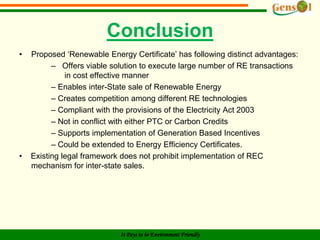
ConclusionProposed ‘Renewable Energy Certificate’ has following distinct advantages:		–   Offers viable solution to execute large number of RE transactions  	      in cost effective manner		– Enables inter-State sale of Renewable Energy		– Creates competition among different RE technologies		– Compliant with the provisions of the Electricity Act 2003		– Not in conflict with either PTC or Carbon Credits		– Supports implementation of Generation Based Incentives		– Could be extended to Energy Efficiency Certificates.•    Existing legal framework does not prohibit implementation of REC mechanism for inter-state sales.
Rec   Sandeep Melana

Rec Sandeep Melana

  • 1.
    DISCUSSION ON REC& ESCSandeepMelana
  • 2.
    The Presentation CoversBackgroundConceptual framework of REC mechanismOperational FrameworkESC
  • 3.
    3India’s position onclimate changeIndia’s per capita CO2 emissions are 1.05 tonne as against world average of 4.22 tonne
  • 4.
    There should beno adverse impact of GHG mitigation on GDP growth and poverty alleviation in developing countries.
  • 5.
    GHG mitigation mustbe based on the principle of common but differentiated responsibilities (including historical emissions levels) and respective capabilities and result in actual global reduction in GHG emissions.
  • 6.
    India’s per capitaemissions will not exceed those of the developed countries. BackgroundSection 86 (1) (e) of EA, 03,NAPCC envisages several measures to address global warmingShare of RE should be increases in total electrical consumption 5% for 2009-10 with an escalation of 1% each year till 2020 Strong Policy Measures, proactive regulatory framework, innovative financing instrumentsNAPCCLaunched in June 2008Conceptualizes living in harmony with Nature Aims at significantly increasing the share of solar energy in the total energy mix Aims at saving of 10,000 MW by the end of 11th Five Year Plan in 2012. ESCREC
  • 7.
    Renewable Energy Certificates– General Features1 ”instrument” or “certificate” ≃ 1 MWhof renewable energy generatedMechanism is used in many countries – RPS (US & Japan), – ROCs (UK), – RECs (Australia),Usually certificates are traded to meet the mandatorytargets for RE purchases by utilities/DISCOMs – However, tradeability is not mandatoryTargets establish demand – Market for RECs sets price – At times regulators fixes the ceiling price ~ in form of penalty to bring in certaintyREC Mechanism is compatible with competitive market
  • 8.
    Renewable Energy CertificateCertificateof power generated from RE sourcesIt represents the environmental benefit apart from electricity generationRE generator can sell 2 different products ---- Electricity & Environment Att.
  • 9.
  • 10.
    Drivers for RECsin IndiaHuge RE Potential but not evenly distributedEA 2003 mandates SERC with the function of RE promotion within the stateRenewable Purchase ObligationEach SERC is different No mechanism to purchase RE from outside the State
  • 11.
    Objectives for RECMechanism in IndiaEffective implementation of RPO regulation in all States in IndiaIncreased flexibility for participants to carry out RE transactionsOvercoming geographical constraints to harness available RE sourcesReduce transaction costs for RE transactionsCreate competition among different RE technologiesDevelopment of all encompassing incentive mechanismReduce risks for local distribution licensee.
  • 12.
  • 13.
  • 14.
  • 15.
    Entity operating NLDC(Central Registry) to issue REC ,based on information from SLDC about injection of RE into grid
  • 16.
    Eligible RE generatorwill receive a certificate for a specified quantity of electricity generated
  • 17.
  • 18.
    On Power Exchanges approved by CERC
  • 19.
  • 20.
    In surplus scenariomax 25% of REC, generated in a year, can be carried over only for next year Salient features of REC FrameworkRE generators with capacity untied in PPA will have an option to sell electricity and REC separatelyREC will be issued to RE Generators only1 MWh 1 REC Purchase of REC would be considered as purchase of RE REC to overcome geographical constraints and provide flexibility to achieve RPO compliance
  • 21.
  • 22.
  • 23.
    Grid connected REgenerators of at least 250 KW capacity.
  • 24.
  • 25.
    RE project withexisting PPA
  • 26.
    If RE saleat preferential Tariff Energy Saving CertificateNAPCC NMEEETarget Energy Saving of 10000 MW by 2012To achieve this target ESCs are proposed to energy intensive industriesSpecific Energy ConsumptionBaseline Year for SEC – 2008BEE – Nodal Egency
  • 27.
  • 28.
    ConclusionProposed ‘Renewable EnergyCertificate’ has following distinct advantages: – Offers viable solution to execute large number of RE transactions in cost effective manner – Enables inter-State sale of Renewable Energy – Creates competition among different RE technologies – Compliant with the provisions of the Electricity Act 2003 – Not in conflict with either PTC or Carbon Credits – Supports implementation of Generation Based Incentives – Could be extended to Energy Efficiency Certificates.• Existing legal framework does not prohibit implementation of REC mechanism for inter-state sales.