Understanding RECs
Presentation by
Agneya Carbon Ventures
http://www.agneya.in
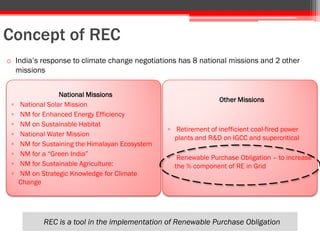
Concept of REC
o India’s response to climate change negotiations has 8 national missions and 2 other
missions
National Missions
▫ National Solar Mission
▫ NM for Enhanced Energy Efficiency
▫ NM on Sustainable Habitat
▫ National Water Mission
▫ NM for Sustaining the Himalayan Ecosystem
▫ NM for a “Green India”
▫ NM for Sustainable Agriculture:
▫ NM on Strategic Knowledge for Climate
Change
Other Missions
▫ Retirement of inefficient coal-fired power
plants and R&D on IGCC and supercritical
▫ Renewable Purchase Obligation – to increase
the % component of RE in Grid
REC is a tool in the implementation of Renewable Purchase Obligation
Concept of REC
o Renewable Energy Certificates is therefore an environmental commodity
o Captures the environmental benefits of renewable electricity generation
o Provides a market mechanism to incentivize Renewable Energy producers
o Market is created through requirement on the various companies to have % RE in portfolio
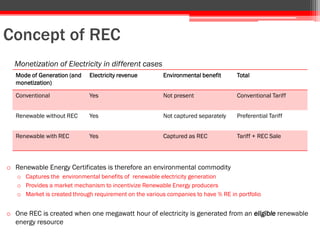
o One REC is created when one megawatt hour of electricity is generated from an eligible renewable
energy resource
Mode of Generation (and
monetization)
Electricity revenue Environmental benefit Total
Conventional Yes Not present Conventional Tariff
Renewable without REC Yes Not captured separately Preferential Tariff
Renewable with REC Yes Captured as REC Tariff + REC Sale
Monetization of Electricity in different cases
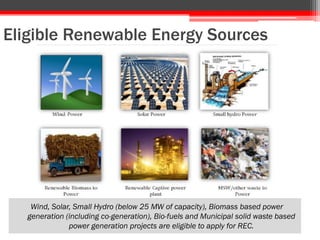
Eligible Renewable Energy Sources
Wind, Solar, Small Hydro (below 25 MW of capacity), Biomass based power
generation (including co-generation), Bio-fuels and Municipal solid waste based
power generation projects are eligible to apply for REC.
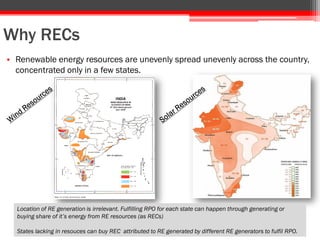
Why RECs
• Renewable energy resources are unevenly spread unevenly across the country,
concentrated only in a few states.
Location of RE generation is irrelevant. Fulfilling RPO for each state can happen through generating or
buying share of it’s energy from RE resources (as RECs)
States lacking in resouces can buy REC attributed to RE generated by different RE generators to fulfil RPO.
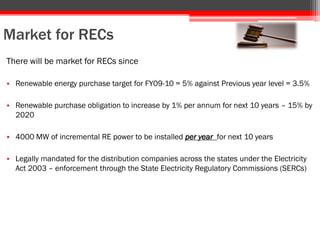
Market for RECs
There will be market for RECs since
• Renewable energy purchase target for FY09-10 = 5% against Previous year level = 3.5%
• Renewable purchase obligation to increase by 1% per annum for next 10 years – 15% by
2020
• 4000 MW of incremental RE power to be installed per year for next 10 years
• Legally mandated for the distribution companies across the states under the Electricity
Act 2003 – enforcement through the State Electricity Regulatory Commissions (SERCs)
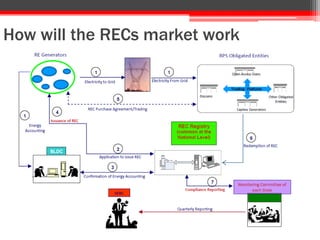
How will the RECs market work
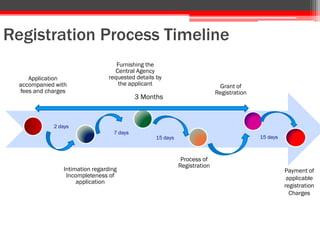
Registration Process Timeline
Application
accompanied with
fees and charges
Process of
Registration
Grant of
Registration
Furnishing the
Central Agency
requested details by
the applicant
Intimation regarding
Incompleteness of
application
Payment of
applicable
registration
Charges
2 days
7 days
15 days 15 days
3 Months
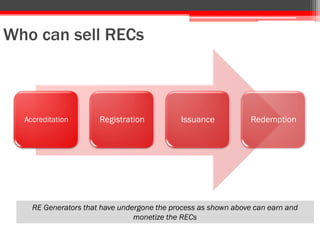
Who can sell RECs
Accreditation Registration Issuance Redemption
RE Generators that have undergone the process as shown above can earn and
monetize the RECs
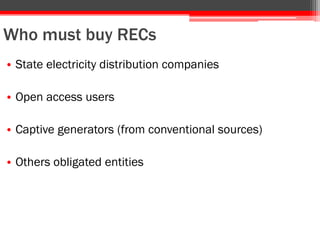
Who must buy RECs
• State electricity distribution companies
• Open access users
• Captive generators (from conventional sources)
• Others obligated entities
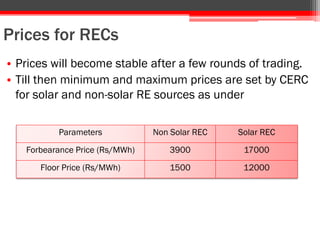
Prices for RECs
• Prices will become stable after a few rounds of trading.
• Till then minimum and maximum prices are set by CERC
for solar and non-solar RE sources as under
Parameters Non Solar REC Solar REC
Forbearance Price (Rs/MWh) 3900 17000
Floor Price (Rs/MWh) 1500 12000
Players in the REC market (1/2)
 MNRE : It is a facilitating agency for REC mechanism in India
 Forum of Regulators: It is a common platform for all electricity regulators in India. It
coordination and implementation body for REC mechanism in various states of India.
 CERC: It is responsible for regulatory framework for inter-sate transactions.
 SERC : It is responsible for regulating intra-state transactions.
 State agency: It is an agency designated by SERC within the regulated state. State
agency is responsible for accreditation of RE generators, certification of RE in
consultation with Sate Load Dispatch Centre (SLDC) for the purpose of issue of REC.
 State Load Dispatch Centre: It is engage with metering, energy accounting of the energy
being generated and consumed within a state. Hence, providing accurate data on RE
generation and consumption in a state.
 National Load Despatch Centre– It is designated as central agency. Main work includes;
Registration of eligible RE generators for issuing REC, Issuance of REC to RE generators,
Accounting of RECs, Tracking of REC in its lifetime, Extinction of REC after its sale, Provide
information to compliance auditor.
 Power Exchange – REC can only be traded in power exchange. Hence to provide trading
and to facilitate trading of REC.
 REC consumers (Obligated Entities/Voluntary buyers) – These are the entities who buy
REC as per RPO (or Voluntarily )as mandated by concerned SERC. Obligated entities are
generally distribution companies in states.
 RE Generators - They are the generating plant whose inputs to the energy generation
are from renewable sources.
 Compliance Auditors : It is a third party appointed by CERC for accessing the compliance
of REC regulations.
Players in the REC market (2/2)
Agneya Can
We are
• A focused renewables, carbon and sustainability management consulting firm.
• Established by alumni of IIM-A and IIM-B with background in engineering from
NIT-Trichy and experience across production, pharma, banking and sales
• Young, dynamic team which has in a short span of time has undertaken and
delivered projects across private and government sectors
• With clientele in process industry, sugar industry, real estate, infrastructure,
waste treatment, electronics and auto/auto ancillaries.
We Offer
• Offer a unbiased view of the investment opportunities across sectors,
technologies and opportunities
• Assistance in achieving financial closure
• Handholding right from initiating project with strong technical advisors right upto
commissioning stage
• Registration of projects under Clean Development Mechanism (CDM) and
Renewable Energy Certificates (RECs) – Trading of CERs/RECs
We look forward to hearing back from you.
Reach us at
Kedar - +91-9665407848 – kedar@agneya.in
Indrajeet - +91-9028788430 – indrajeet@agneya.in
http://www.agneya.in
http://blog.agneya.in

REC a market ready for take-off

  • 1.
    Understanding RECs Presentation by AgneyaCarbon Ventures http://www.agneya.in
  • 2.
    Concept of REC oIndia’s response to climate change negotiations has 8 national missions and 2 other missions National Missions ▫ National Solar Mission ▫ NM for Enhanced Energy Efficiency ▫ NM on Sustainable Habitat ▫ National Water Mission ▫ NM for Sustaining the Himalayan Ecosystem ▫ NM for a “Green India” ▫ NM for Sustainable Agriculture: ▫ NM on Strategic Knowledge for Climate Change Other Missions ▫ Retirement of inefficient coal-fired power plants and R&D on IGCC and supercritical ▫ Renewable Purchase Obligation – to increase the % component of RE in Grid REC is a tool in the implementation of Renewable Purchase Obligation
  • 3.
    Concept of REC oRenewable Energy Certificates is therefore an environmental commodity o Captures the environmental benefits of renewable electricity generation o Provides a market mechanism to incentivize Renewable Energy producers o Market is created through requirement on the various companies to have % RE in portfolio o One REC is created when one megawatt hour of electricity is generated from an eligible renewable energy resource Mode of Generation (and monetization) Electricity revenue Environmental benefit Total Conventional Yes Not present Conventional Tariff Renewable without REC Yes Not captured separately Preferential Tariff Renewable with REC Yes Captured as REC Tariff + REC Sale Monetization of Electricity in different cases
  • 4.
    Eligible Renewable EnergySources Wind, Solar, Small Hydro (below 25 MW of capacity), Biomass based power generation (including co-generation), Bio-fuels and Municipal solid waste based power generation projects are eligible to apply for REC.
  • 5.
    Why RECs • Renewableenergy resources are unevenly spread unevenly across the country, concentrated only in a few states. Location of RE generation is irrelevant. Fulfilling RPO for each state can happen through generating or buying share of it’s energy from RE resources (as RECs) States lacking in resouces can buy REC attributed to RE generated by different RE generators to fulfil RPO.
  • 6.
    Market for RECs Therewill be market for RECs since • Renewable energy purchase target for FY09-10 = 5% against Previous year level = 3.5% • Renewable purchase obligation to increase by 1% per annum for next 10 years – 15% by 2020 • 4000 MW of incremental RE power to be installed per year for next 10 years • Legally mandated for the distribution companies across the states under the Electricity Act 2003 – enforcement through the State Electricity Regulatory Commissions (SERCs)
  • 7.
    How will theRECs market work
  • 8.
    Registration Process Timeline Application accompaniedwith fees and charges Process of Registration Grant of Registration Furnishing the Central Agency requested details by the applicant Intimation regarding Incompleteness of application Payment of applicable registration Charges 2 days 7 days 15 days 15 days 3 Months
  • 9.
    Who can sellRECs Accreditation Registration Issuance Redemption RE Generators that have undergone the process as shown above can earn and monetize the RECs
  • 10.
    Who must buyRECs • State electricity distribution companies • Open access users • Captive generators (from conventional sources) • Others obligated entities
  • 11.
    Prices for RECs •Prices will become stable after a few rounds of trading. • Till then minimum and maximum prices are set by CERC for solar and non-solar RE sources as under Parameters Non Solar REC Solar REC Forbearance Price (Rs/MWh) 3900 17000 Floor Price (Rs/MWh) 1500 12000
  • 12.
    Players in theREC market (1/2)  MNRE : It is a facilitating agency for REC mechanism in India  Forum of Regulators: It is a common platform for all electricity regulators in India. It coordination and implementation body for REC mechanism in various states of India.  CERC: It is responsible for regulatory framework for inter-sate transactions.  SERC : It is responsible for regulating intra-state transactions.  State agency: It is an agency designated by SERC within the regulated state. State agency is responsible for accreditation of RE generators, certification of RE in consultation with Sate Load Dispatch Centre (SLDC) for the purpose of issue of REC.  State Load Dispatch Centre: It is engage with metering, energy accounting of the energy being generated and consumed within a state. Hence, providing accurate data on RE generation and consumption in a state.
  • 13.
     National LoadDespatch Centre– It is designated as central agency. Main work includes; Registration of eligible RE generators for issuing REC, Issuance of REC to RE generators, Accounting of RECs, Tracking of REC in its lifetime, Extinction of REC after its sale, Provide information to compliance auditor.  Power Exchange – REC can only be traded in power exchange. Hence to provide trading and to facilitate trading of REC.  REC consumers (Obligated Entities/Voluntary buyers) – These are the entities who buy REC as per RPO (or Voluntarily )as mandated by concerned SERC. Obligated entities are generally distribution companies in states.  RE Generators - They are the generating plant whose inputs to the energy generation are from renewable sources.  Compliance Auditors : It is a third party appointed by CERC for accessing the compliance of REC regulations. Players in the REC market (2/2)
  • 14.
    Agneya Can We are •A focused renewables, carbon and sustainability management consulting firm. • Established by alumni of IIM-A and IIM-B with background in engineering from NIT-Trichy and experience across production, pharma, banking and sales • Young, dynamic team which has in a short span of time has undertaken and delivered projects across private and government sectors • With clientele in process industry, sugar industry, real estate, infrastructure, waste treatment, electronics and auto/auto ancillaries. We Offer • Offer a unbiased view of the investment opportunities across sectors, technologies and opportunities • Assistance in achieving financial closure • Handholding right from initiating project with strong technical advisors right upto commissioning stage • Registration of projects under Clean Development Mechanism (CDM) and Renewable Energy Certificates (RECs) – Trading of CERs/RECs
  • 15.
    We look forwardto hearing back from you. Reach us at Kedar - +91-9665407848 – kedar@agneya.in Indrajeet - +91-9028788430 – indrajeet@agneya.in http://www.agneya.in http://blog.agneya.in