Centralized
Logging
Logging provides value.

How’s that now?
How does logging
provide value?
We can gather information on the system while it’s in
operation. We can use this information to provide more
value to the business.
More Value?
Information gathered from logs allows you to
proactively take actions that will keep systems
providing the most value to the business.
Talk in circles much?

Centralized logging provides visibility into the
operational efficiency of the system and process.
A story on operational sleep
efficiency
How is it done?
Logs for most/all systems are
shipped, parsed and stored in a
central location for monitoring and
decision making.
Um…sounds like a bunch of
work.
IIS Logs
SQL Logs
Router Logs
Etc.
Initial focus is on application logging for in-house applications.
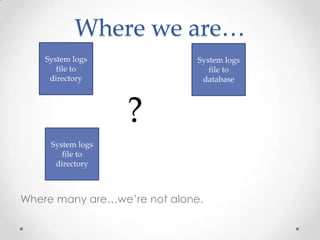
Where we are…
System logs
file to
directory

System logs
file to
database

?
System logs
file to
directory

Where many are…we’re not alone.
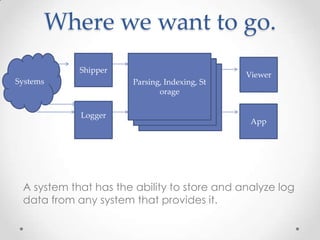
Where we want to go.
Shipper
Systems

Parsing, Indexing, St
orage
Logger

Viewer

App

A system that has the ability to store and analyze log
data from any system that provides it.
Logging Issues

to resolve
Access To Log
Getting access to production servers is not
always easy.
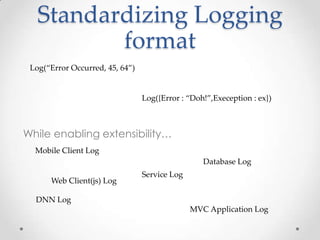
Standardizing Logging
format
Log(“Error Occurred, 45, 64”)

Log({Error : “Doh!”,Exeception : ex})

While enabling extensibility…
Mobile Client Log
Database Log
Web Client(js) Log

Service Log

DNN Log
MVC Application Log
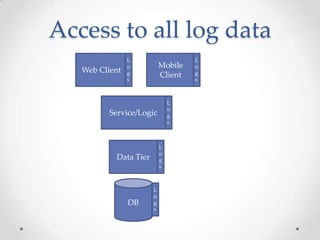
Access to all log data
Web Client

L
o
g
s

Mobile
Client

L
o
g
s

Service/Logic

L
o
g
s

Data Tier

DB

L
o
g
s

L
o
g
s
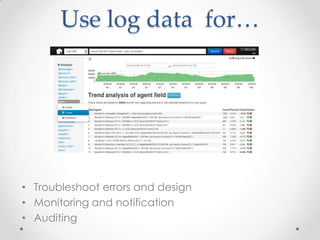
Use log data for…

• Troubleshoot errors and design
• Monitoring and notification
• Auditing
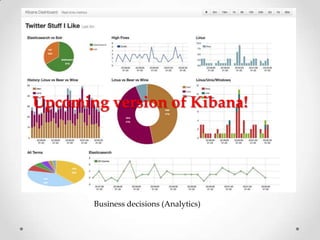
Upcoming version of Kibana!

Business decisions (Analytics)
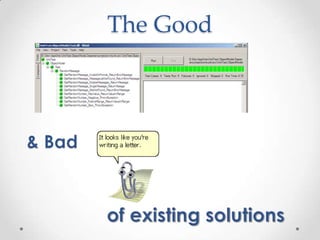
The Good
Windows Event Log
• Low Cost – Built in.
• Built in UI
• Can forward logs to a central server
Windows Event Log
• Event entries stored in memory.
• Have to configure logging per server.
• Service interface for other clients to
hook into not available.
Log to central SQL database
• Low Cost – SQL in
house, create an
database/table.
Log to central SQL database
• Relational (Schema based) format
challenging to use for
unstructured data.
• logging straight to database
could degrade application
performance.
Commercial Hosted Tools
• Handles multiple log formats
• Robust charting/searching Features
• Turned down previously
• $$$ - pricey for amount of space
allotted
And the winner is….

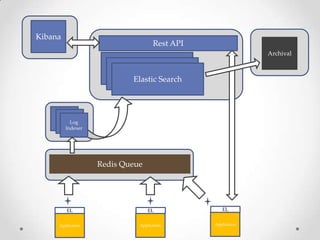
A Hybrid Approach.
Kibana

Rest API
Archival

Elastic Search

Log
Indexer

Redis Queue
L
o
g

L
o
g

EL

EL

EL

Application

Application

Application
Low(No) Cost
OSS FTW!
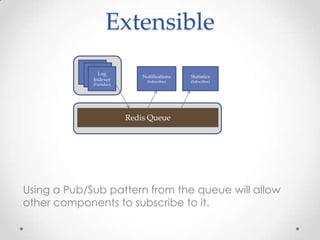
Extensible
Log
Indexer
(Publisher)

Notifications

Statistics

(Subscriber)

(Subscriber)

Redis Queue

Using a Pub/Sub pattern from the queue will allow
other components to subscribe to it.
Runs on Windows

Java/Ruby based tools run on windows with some
setup.
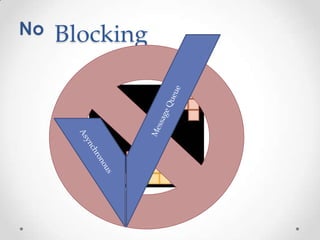
Blocking
Why ElasticSearch?
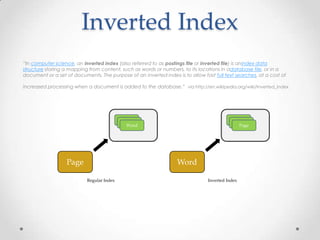
Inverted Index
“In computer science, an inverted index (also referred to as postings file or inverted file) is anindex data
structure storing a mapping from content, such as words or numbers, to its locations in adatabase file, or in a
document or a set of documents. The purpose of an inverted index is to allow fast full text searches, at a cost of
increased processing when a document is added to the database.” via http://en.wikipedia.org/wiki/Inverted_index

Word
Word
Word

Page

Page
Page
Page

Word
Regular Index

Inverted Index
Documented Oriented
• No need to define schema upfront
• Can store, index and quickly search unstructured data.

• Schema can be defined per type for customization of
the indexing process.
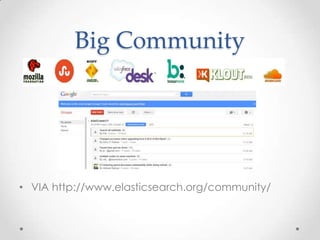
Big Community

• VIA http://www.elasticsearch.org/community/
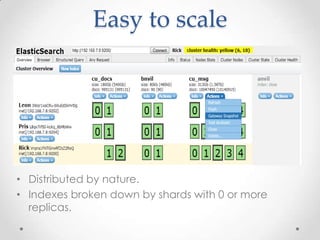
Easy to scale

• Distributed by nature.
• Indexes broken down by shards with 0 or more
replicas.
Easy Level 1 Rest API

• Well documented and straight forward api, which
makes it easy to build a client for it.
What’s Needed recap
•
•
•
•

Server for Elastic Search (Windows/Linux)
Redis Server
Windows service to index logs from queue.
Modify Enterprise Library Logger to send to queue.
In closing
Gathering the data is one part. Logging enough
information and knowing what questions your are
looking to answer is another part.
References

Centralized logging