CHAPTER
                 12

Gas Mixtures
Copyright © The McGraw-Hill Companies, Inc. Permission required for reproduction or display.


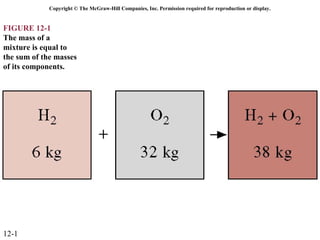
FIGURE 12-1
The mass of a
mixture is equal to
the sum of the masses
of its components.


12-1
Copyright © The McGraw-Hill Companies, Inc. Permission required for reproduction or display.

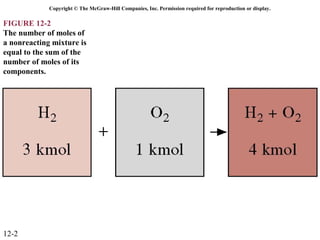
FIGURE 12-2
The number of moles of
a nonreacting mixture is
equal to the sum of the
number of moles of its
components.


12-2
Copyright © The McGraw-Hill Companies, Inc. Permission required for reproduction or display.


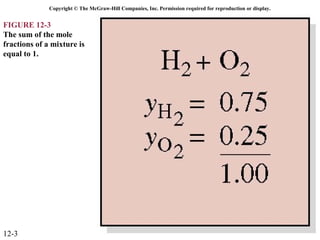
FIGURE 12-3
The sum of the mole
fractions of a mixture is
equal to 1.


12-3
Copyright © The McGraw-Hill Companies, Inc. Permission required for reproduction or display.


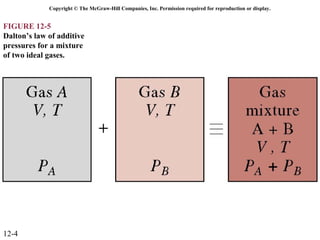
FIGURE 12-5
Dalton’s law of additive
pressures for a mixture
of two ideal gases.


12-4
Copyright © The McGraw-Hill Companies, Inc. Permission required for reproduction or display.


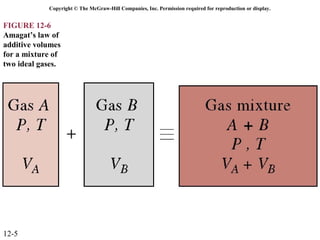
FIGURE 12-6
Amagat’s law of
additive volumes
for a mixture of
two ideal gases.


12-5
Copyright © The McGraw-Hill Companies, Inc. Permission required for reproduction or display.


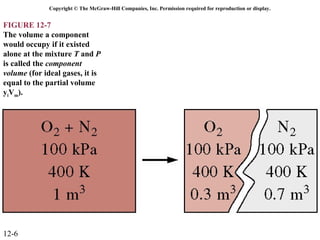
FIGURE 12-7
The volume a component
would occupy if it existed
alone at the mixture T and P
is called the component
volume (for ideal gases, it is
equal to the partial volume
yiVm).


12-6
Copyright © The McGraw-Hill Companies, Inc. Permission required for reproduction or display.


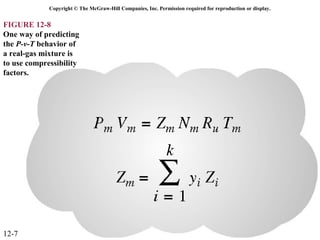
FIGURE 12-8
One way of predicting
the P-v-T behavior of
a real-gas mixture is
to use compressibility
factors.


12-7
Copyright © The McGraw-Hill Companies, Inc. Permission required for reproduction or display.

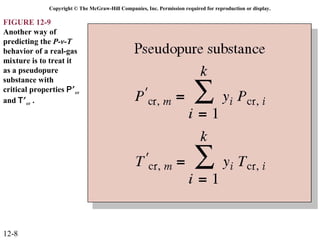
FIGURE 12-9
Another way of
predicting the P-v-T
behavior of a real-gas
mixture is to treat it
as a pseudopure
substance with
critical properties P′ cr
and T′ cr .


12-8
Copyright © The McGraw-Hill Companies, Inc. Permission required for reproduction or display.

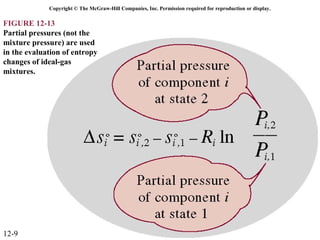
FIGURE 12-13
Partial pressures (not the
mixture pressure) are used
in the evaluation of entropy
changes of ideal-gas
mixtures.


12-9
Copyright © The McGraw-Hill Companies, Inc. Permission required for reproduction or display.

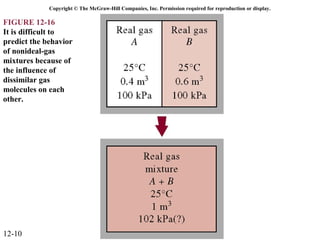
FIGURE 12-16
It is difficult to
predict the behavior
of nonideal-gas
mixtures because of
the influence of
dissimilar gas
molecules on each
other.


12-10
Copyright © The McGraw-Hill Companies, Inc. Permission required for reproduction or display.

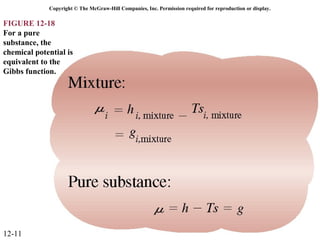
FIGURE 12-18
For a pure
substance, the
chemical potential is
equivalent to the
Gibbs function.


12-11
Copyright © The McGraw-Hill Companies, Inc. Permission required for reproduction or display.

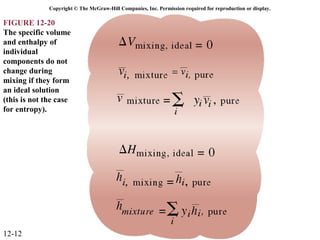
FIGURE 12-20
The specific volume
and enthalpy of
individual
components do not
change during
mixing if they form
an ideal solution
(this is not the case
for entropy).


12-12
Copyright © The McGraw-Hill Companies, Inc. Permission required for reproduction or display.

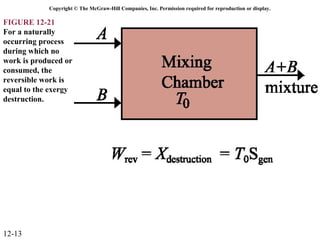
FIGURE 12-21
For a naturally
occurring process
during which no
work is produced or
consumed, the
reversible work is
equal to the exergy
destruction.


12-13
Copyright © The McGraw-Hill Companies, Inc. Permission required for reproduction or display.

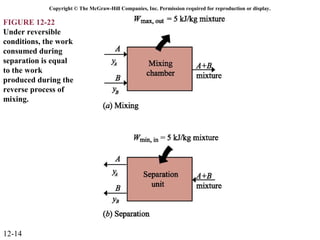
FIGURE 12-22
Under reversible
conditions, the work
consumed during
separation is equal
to the work
produced during the
reverse process of
mixing.


12-14
Copyright © The McGraw-Hill Companies, Inc. Permission required for reproduction or display.

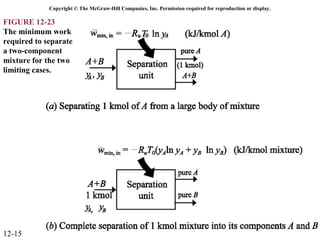
FIGURE 12-23
The minimum work
required to separate
a two-component
mixture for the two
limiting cases.


12-15
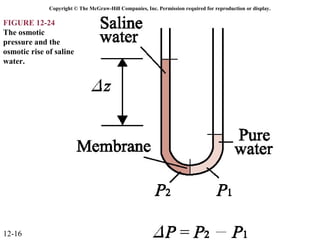
Copyright © The McGraw-Hill Companies, Inc. Permission required for reproduction or display.

FIGURE 12-24
The osmotic
pressure and the
osmotic rise of saline
water.


12-16
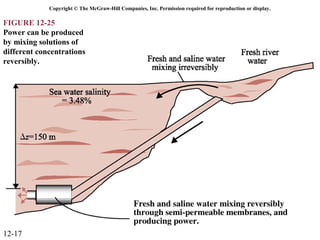
Copyright © The McGraw-Hill Companies, Inc. Permission required for reproduction or display.

FIGURE 12-25
Power can be produced
by mixing solutions of
different concentrations
reversibly.


12-17

Cengel ch12

  • 1.
    CHAPTER 12 Gas Mixtures
  • 2.
    Copyright © TheMcGraw-Hill Companies, Inc. Permission required for reproduction or display. FIGURE 12-1 The mass of a mixture is equal to the sum of the masses of its components. 12-1
  • 3.
    Copyright © TheMcGraw-Hill Companies, Inc. Permission required for reproduction or display. FIGURE 12-2 The number of moles of a nonreacting mixture is equal to the sum of the number of moles of its components. 12-2
  • 4.
    Copyright © TheMcGraw-Hill Companies, Inc. Permission required for reproduction or display. FIGURE 12-3 The sum of the mole fractions of a mixture is equal to 1. 12-3
  • 5.
    Copyright © TheMcGraw-Hill Companies, Inc. Permission required for reproduction or display. FIGURE 12-5 Dalton’s law of additive pressures for a mixture of two ideal gases. 12-4
  • 6.
    Copyright © TheMcGraw-Hill Companies, Inc. Permission required for reproduction or display. FIGURE 12-6 Amagat’s law of additive volumes for a mixture of two ideal gases. 12-5
  • 7.
    Copyright © TheMcGraw-Hill Companies, Inc. Permission required for reproduction or display. FIGURE 12-7 The volume a component would occupy if it existed alone at the mixture T and P is called the component volume (for ideal gases, it is equal to the partial volume yiVm). 12-6
  • 8.
    Copyright © TheMcGraw-Hill Companies, Inc. Permission required for reproduction or display. FIGURE 12-8 One way of predicting the P-v-T behavior of a real-gas mixture is to use compressibility factors. 12-7
  • 9.
    Copyright © TheMcGraw-Hill Companies, Inc. Permission required for reproduction or display. FIGURE 12-9 Another way of predicting the P-v-T behavior of a real-gas mixture is to treat it as a pseudopure substance with critical properties P′ cr and T′ cr . 12-8
  • 10.
    Copyright © TheMcGraw-Hill Companies, Inc. Permission required for reproduction or display. FIGURE 12-13 Partial pressures (not the mixture pressure) are used in the evaluation of entropy changes of ideal-gas mixtures. 12-9
  • 11.
    Copyright © TheMcGraw-Hill Companies, Inc. Permission required for reproduction or display. FIGURE 12-16 It is difficult to predict the behavior of nonideal-gas mixtures because of the influence of dissimilar gas molecules on each other. 12-10
  • 12.
    Copyright © TheMcGraw-Hill Companies, Inc. Permission required for reproduction or display. FIGURE 12-18 For a pure substance, the chemical potential is equivalent to the Gibbs function. 12-11
  • 13.
    Copyright © TheMcGraw-Hill Companies, Inc. Permission required for reproduction or display. FIGURE 12-20 The specific volume and enthalpy of individual components do not change during mixing if they form an ideal solution (this is not the case for entropy). 12-12
  • 14.
    Copyright © TheMcGraw-Hill Companies, Inc. Permission required for reproduction or display. FIGURE 12-21 For a naturally occurring process during which no work is produced or consumed, the reversible work is equal to the exergy destruction. 12-13
  • 15.
    Copyright © TheMcGraw-Hill Companies, Inc. Permission required for reproduction or display. FIGURE 12-22 Under reversible conditions, the work consumed during separation is equal to the work produced during the reverse process of mixing. 12-14
  • 16.
    Copyright © TheMcGraw-Hill Companies, Inc. Permission required for reproduction or display. FIGURE 12-23 The minimum work required to separate a two-component mixture for the two limiting cases. 12-15
  • 17.
    Copyright © TheMcGraw-Hill Companies, Inc. Permission required for reproduction or display. FIGURE 12-24 The osmotic pressure and the osmotic rise of saline water. 12-16
  • 18.
    Copyright © TheMcGraw-Hill Companies, Inc. Permission required for reproduction or display. FIGURE 12-25 Power can be produced by mixing solutions of different concentrations reversibly. 12-17